Int. J. Electrochem. Sci., 7 (2012) 272 - 281
International Journal of
ELECTROCHEMICAL
SCIENCE
www.electrochemsci.org
Cathodic Phase Transformations During Direct Electrolytic
Reduction of Nb
2O
5in a CaCl
2-NaCl-CaO Melt
Qiu-shi Song, Qian Xu *, Ran Tao , Xue Kang
School of Materials Science and Metallurgy, Northeastern University, Shenyang,110819, P R China. *
E-mail: [email protected]
Received: 25 September 2011 / Accepted: 27 November 2011 / Published: 1 January 2012
The phase transformations during direct electrochemical reduction of Nb2O5 were investigated through constant potential electrolysis in a CaCl2-NaCl-CaO melt at 1073 K. The microstructure and phase compositions of the cathode during the reduction were determined. The mechanism of the transformations was elucidated in the view of structure. The results show Chemical reactions between CaO and Nb2O5 occurred spontaneously in the melt, forming calcium niobates with different morphology. During the electrodeoxidation, the intercalation of calcium ions into the cathode formed calcium niobates with large particle size, and then disintegrated them to much smaller ones. The CaO concentration in the CaCl2-NaCl melt can affect the morphology of final niobium product.
Keywords: electrochemical reduction; niobium; calcium oxide; calcium niobate; phase transformation
1. INTRODUCTION
From previous studies, calcium niobates of Nb2O5·nCaO (n=1, 2, 3) were usually observed when the electro-deoxidation of Nb2O5 was carried out in CaCl2 or CaCl2-based melts [3-6, 20, 21]. Though the calcium niobates could be subsequently reduced to sub-oxides of niobium, the effect of CaO on the reduction process seemed to be unclear. Actually, the formation of calcium-enriched oxides have also been observed during the electro-deoxidation of some other metallic oxides, such as TiO2 [11, 12, 28, 29], Ta2O5 [7-9, 22] and Cr2O3 [30, 31]. All the results reveal that CaO plays an important role in the electrochemical reduction process.
The objective of this work has been to gain a great insight into the phase and microstructure transformations during the electrochemical reduction of Nb2O5 in a CaCl2-NaCl melt containing CaO. It is intended to investigate the reduction pathway of Nb2O5 in the melt and the behavior of CaO during the electro-deoxidation, in order to better understand the mechanism of Nb2O5 reduction, which may be critical for successful industrialization.
2. EXPERIMENTAL
All chemicals in this study were of analytical grade. Nb2O5 powder (99.99% in purity) was weighted 1.0g and compacted into cylindrical pellets under 12MPa, which were then sintered at 1273K for 12h. A eutectic mixture of CaCl2 and NaCl was melted in an alumina crucible, and then 1mol% of CaO was added into the molten salt, which served as the electrolyte. .The sintered oxide pellet was immersed in the melt as the cathode. High-density graphite rods of 12 mm diameter and 70 mm length served as the anodes. The experimental apparatus utilized in this work were similar to those described in the literature [5, 8, 9, 19, 22]. All the electrochemical experiments were carried out under an atmosphere of dried argon.
A constant voltage of 2.8V was applied between the cathode and anode at 1073K. In order to obtain incompletely and completely reduced specimens, the electrolysis was terminated after various reaction times ranging from 0.5 to 13.5h. The samples were removed from the melt and cooled down to room temperature, which were vigorously rinsed with tap water and dried for examination. To investigate chemical interaction between CaO and Nb2O5, the sintered pellets were immersed into the molten salt without a voltage applied. Phase composition of all the samples was determined through a D/Max-2500PC X-ray diffractometer with Cu-Kα radiation (XRD). Morphology and chemical composition of the samples were investigated by means of a SSX-550 scanning electron microscope (SEM) equipped with energy-dispersive X-ray analysis (EDX).
3. RESULTS AND DISCUSSION
[image:3.596.101.498.216.416.2]
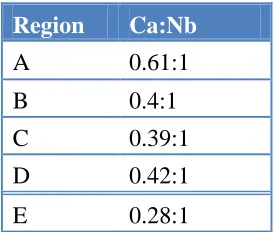
central part of the pellet. The outer surface of the sample (A in Fig. 1c) consists of wirelike particles with a high aspect ratio, which reach over 50μm in length and present obvious preferential orientation. Then a layer of rodlike particles (B in Fig. 1c) can be observed adjacent to wirelike ones, which are much coarser and have a length of less than 10μm. And the preferential orientation is less visible. Then, the lath-shaped particles (C and D in Figs. 1d-e) exist in the interior region of the pellet, which exceed more than 100μm. However, the particles in the central part of the sample (E in Fig. 1f) seem to be similar to those of the sintered pellet (in Fig. 1a), which are less than 10μm.
Figure 1. SEM images of (a) the Nb2O5 sintered pellet at 1273K for 12h; (b) the cross section of the sample immersed in the CaCl2-NaCl-1mol% CaO melt for 6h; (c)~(f) The enlarged images of different types of particles in the sample immersed in the melt for 6h.
Table 1. The molar ratios of Ca to Nb for the sample in Figs. 1c-f, respectively.
Region Ca:Nb
A 0.61:1
B 0.4:1
C 0.39:1
D 0.42:1
E 0.28:1
[image:3.596.230.367.525.641.2][image:4.596.143.454.130.348.2]
formed. And the morphology of particles in the pellet is also associated with their chemical compositions.
Figure 2. XRD pattern of the sample immersed in the CaCl2-NaCl-1mol% CaO melt for 6h.
[image:4.596.77.520.404.694.2]
The formation of calcium niobates is probably related with the concentration of CaO in the melt. More CaO were combined on the surface of the immersed pellet, where its concentration was relative higher because of the diffusion of CaO through the channels of open porosity in the sample. However, the percolation of CaO was less effective in the inner part of the oxide pellet, so calcium niobates containing less CaO were formed due to the relative lower concentration of CaO. In the center of the sample, the calcium to niobium ratio was the lowest one, where the particles were similar to those in the sintered pellet. As a result, calcium niobates with various compositions are formed across the pellet.
From the point of the view of structure, the transformation of the particles morphology during the chemical reactions is discussed. Nb2O5 has atomic structure formed from corner-sharing and edge-sharing NbO6 octahedra, as illustrated in Fig. 3a. When the sintered pellet was immersed into the molten salt, Nb2O5 would combine CaO in the melt. O2- ions went to the NbO6 octahedron arrays, and Ca2+ ions were located in interstitial sites among NbO6 octahedra. The amount of bridging oxygen linking the NbO6 octahedra decreased, and more non-bridging oxygen were formed at the same time. So the Nb-O network of Nb2O5 was changed to a stacking of Nb-O sheets consisting of corner-sharing and edge-sharing NbO6 octahedra, and layers of Ca2+ ions between the Nb-O sheets in the structure of Nb2O5·CaO in Fig. 3b. The process of bond-breaking, rebonding and new generation of bonds provides a chance for initial particles of Nb2O5 to grow to much bigger ones, as illustrated in Figs. 1d and e. As more Ca2+ and O2- ions were intercalated into the pellet, the connection between the edge-sharing NbO6 octahedra was broken up, and Ca2+ ions was located in the tunnel space of the Nb-O sheets at the same time, as shown in the structure of Nb2O5·2CaO in Fig. 3c. Fig. 3d reveals that Ca2+ ions in the tunnel space transformed to layered space by further breaking up of bridging oxygen when Nb2O5·4CaO was formed. In the process above, the Nb-O network with higher polymerization of NbO6 octahedra was decomposed to the network with lower polymerization of NbO6 octahedra, which would disintegrate the larger, lath-shaped particles into much smaller ones. CaO behaved here as a network modifier, and its disagglomeration effect towards the particles is more obvious with increasing amount of CaO incorporated into the pellets.
[image:6.596.53.546.129.573.2]
it also raised the quantity of oxygen voids in the crystal structure of the cathode. This process would enable further combination of CaO into the cathode.
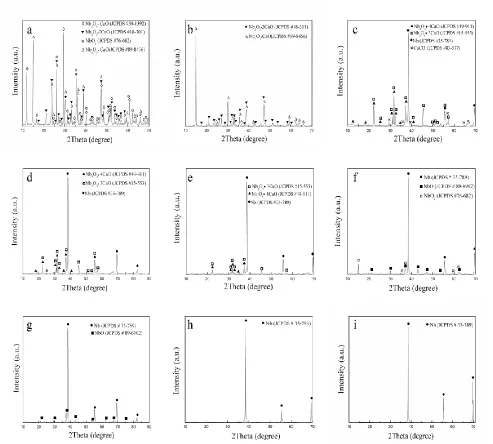
Figure 4. XRD patterns of the samples electro-deoxidized in the CaCl2-NaCl-1mol% CaO melt for (a) 0.5h, (b) 1h, (c) 2h, (d) 5h, (e) 7.5h, (f) 10h, (g) 12h, (h) 13.5h, respectively; (i) XRD pattern of the sample electro-deoxidized in the CaCl2-NaCl melt without an addition of CaO for 8h at 1073K.
[image:7.596.156.441.396.493.2]
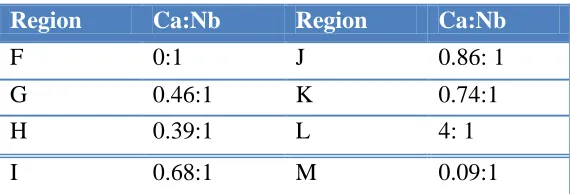
confirmed by the XRD analysis. Fig. 5b shows the morphology of the partially reduced sample for 1h. The EDX analysis for regions J and K is 0.86:1 and 0.74:1, respectively, where the major phases may be Nb2O5·2CaO and Nb2O3·2CaO. Fig. 5c presents the morphology of sample after 2h of reduction, and EDX analysis was carried out for the regions marked by L and M. The mole ratio of Ca to Nb for region is 4:1, where the major phase is Nb, Nb2O5·3CaO and Nb2O5·4CaO from the XRD analysis; and the ratio for region M is 0.09:1, where the major phase is Nb because of the small amount of Ca and its XRD pattern. From the SEM and EDX results of the partially reduced samples for 0.5, 1 and 2h, it reveals that the intercalation of CaO into the cathode has great influence on its morphology. The particles in the cathode changed to much bigger ones at the initial incorporation of CaO as shown by regions G and H in Fig. 5a, which is similar with that during the immersion of Nb2O5 into the melt without an application of a voltage. This may be a challenge for the electro-deoxidation because of the increased diffusion distance for oxygen ions from the cathode to the melt. However, the further incorporation of CaO into the cathode would decompose the particles to smaller ones, as illustrated by region J in Fig. 5b, which reflects the aggregation of the smaller flakes. When Nb2O5·3CaO and Nb2O5·4CaO are formed, the size of most particles in the sample is smaller than 5μm, as shown in Fig. 5c.
Table 2. The molar ratios of Ca to Nb for the samples in Figs. 4a-c, respectively.
Region Ca:Nb Region Ca:Nb
F 0:1 J 0.86: 1
G 0.46:1 K 0.74:1
H 0.39:1 L 4: 1
I 0.68:1 M 0.09:1
Figure 5. SEM images of the samples electro-deoxidized in the CaCl2-NaCl-1mol% CaO melt for (a) 0.5h, (b) 1h, (c) 2h, (d) 5h, (e) 7.5h, (f) 10h, and (g) 12h, (h) 13.5h, respectively; (i) SEM image of the sample electro-deoxidized in the CaCl2-NaCl melt without an addition of CaO for 8h at 1073K.
Fig. 4h shows XRD pattern of the sample reduced for 13h, in which metallic niobium is the only phase being present, indicating completely reduction of the cathode. And its morphology is presented in Fig. 5h. It presents uniform particle sizes and similar interconnected nodular shapes of the metal niobium product. Compared with the morphology of particles obtained in eutectic CaCl2-NaCl melt without the addition of CaO in Fig. 5i, they are smaller, and have smoother surface, though the XRD pattern shows that the two kinds of particles are both niobium, as illustrated in Fig. 4h-i. It informs that the morphology of the final product can probably be modified by controlling the concentration of CaO in the melt. This finding is in accordance with the results in the process of calciothermic reduction of Ta2O5 in the molten CaCl2 by Suzuki et al [32, 33].
value during about 1-3h reduction illustrated by the current shoulder, which means relatively faster reduction of the cathode. Thereafter the current gradually drops slowly to a relatively smaller value during about 3-8h of reduction, in which calcium niobates formation seems to cease and the removal of oxygen from the cathode becomes the dominant process. During the later stages of the reduction process, the oxygen content in the cathode is low for the formation of the major phase of niobium and the minor phase of niobium oxides, as shown in Fig. 4f-g, so the electronic current now contributes significantly to the overall current. This probably leads the relatively low overall current efficiency for preparation of niobium.
Figure 6. The current vs. time curve of electrochemical reduction of Nb2O5 for 13.5h in the CaCl2 -NaCl-1mol% CaO melt.
4. CONCLUSIONS
[image:9.596.139.458.235.465.2]
efficiency of the later stage from niobium suboxides to niobium. Furthermore, the bulk concentration of CaO in the melt can affect the particle size of the final Nb product.
ACKNOWLEDGMENTS
The authors acknowledge the National Natural Science Foundation of China (Grant No. 50574025 and 50874026), the Natural Science Foundation of Liaoning Province (Grant No.20062020), China, and the Doctoral Dissertation Foundation of Northeastern University, China for financial supports.
References
1. G.Z. Chen, D.J. Fray and T.W. Farthing, Nature, 407 (2000) 361.
2. D.J. Fray, T.W. Farthing and G.Z. Chen, International Patent PCT/GB99/01781. 3. X.Y. Yan and D.J. Fray, Metall. Mater. Trans. B, 33B (2002) 685.
4. G.H. Qiu, D.H. Wang, X.B. Jin and G.Z. Chen, Electrochim. Acta, 51 (2006) 5785. 5. Q. Xu, L.Q. Deng, Y. Wu and T. Ma, J. Alloys Compd., 396 (2005) 288.
6. T. Wu, W. Xiao, X.B. Jin, C. Liu, D.H. Wang and G.Z. Chen, Phys. Chem., 10 (2008) 1809. 7. T. Wu, X.B Jin, W. Xiao, X.H. Hu, D.H. Wang and G.Z. Chen, Chem. Mater., 19 (2007) 153. 8. X.F. Hu and Q. Xu, Acta Metall. Sinica, 42 (2006) 285.
9. X.F. Hu, Q. Xu and Y. Wu, Mater. ReV., 19 (2005) 97. 10.C. Schwandt and D.J. Fray, Electrochim. Acta, 51 (2005) 66.
11.D.T.L. Alexander, C. Schwandt and D.J. Fray, Acta Mater., 54 (2006) 2933. 12.C. Schwandt, D.T.L. Alexander and D.J. Fray, Electrochim. Acta, 54 (2009) 3819. 13.X.Y. Yan and D.J. Fray, Adv. Funct. Mater., 15 (2005) 1757.
14.X.Y. Yan, D.J. Fray, J. Appl. Electrochem. 39 (2009) 1349.
15.B. Jackson, M. Jackson, D. Dye and D. Inman, J. Electrochem. Soc., 155 (2008) E171. 16.S. Tan, T. Oers, M.K. Aydinol, T. Ozturk and I. Karakaya, J. Alloys Compd., 475 (2009) 368. 17.B.J. Zhao, L. Wang, L. Dai, G.H. Cui, H.H. Zhou and R.V. Kumar, J. Alloys Compd., 468 (2009)
379.
18.Y. Zhu, D.H. Wang, M. Ma, X.H. Hu, X.B. Jin and G.Z. Chen, Chem. Commun., 24 (2007) 2515. 19.X. Kang, Q. Xu, S.J. Ma, L.N. Zhao and Q.S. Song, Electrochemistry, 77 (2009) 663.
20.X.Y. Yan and D.J. Fray, J. Electrochem. Soc., 152 (2005) D12. 21.X.Y. Yan and D.J. Fray, J. Electrochem. Soc., 152 (2005) E308.
22.Q.S. Song, Q. Xu, X. Kang, J.H. Du and Z.P. Xi, J. Alloys Compd., 490 (2010) 24. 23.I. Park, T.H. Okabe and Y. Waseda, J. Alloys Compd., 280 (1998) 265.
24.S.M. Jeong, H.Y. Yoo, J.M. Hur and C.S. Seo, J. Alloys Compd., 440 (2007) 210. 25.S.L. Wang, Y. Xue and H. Sun, J. Electroanal. Chem., 595 (2005) 109.
26.P. Kar and J.W. Evans, Electrochim. Acta, 53 (2008) 5260. 27.P. Kar, J. Solid State Electrochem., 12 (2008) 161.
28.K. Jiang, X.H. Hu, M. Ma, D.H. Wang, G.H. Qiu, X.B. Jin and G.Z. Chen, Angew. Chem. Int. Ed., 45 (2006) 428.
29.G.Z. Chen and D.J. Fray, J. Electrochem. Soc., 149 (2002) E455.
30.G.Z. Chen, E. Gordo and D.J. Fray, Metall. Mater. Trans. B, 35B (2004) 223. 31.C. Schwandt and D. J. Fray, Z. Naturforsch. A, 62 (2007) 65.
32.M. Baba and R.O. Suzuki, J. Alloys Compd., 392 (2005) 225.
33.R.O. Suzuki, M. Baba, Y. Ono and K. Yamamoto, J. Alloys Compd., 389 (2005) 310.