Int. J. Electrochem. Sci., 10 (2015) 2988 - 2996
International Journal of
ELECTROCHEMICAL
SCIENCE
www.electrochemsci.org
Preparation of Titania Films with Cohered Nanosized Particles
Using Improved Liquid Phase Deposition Process
Masahiko Maeda
College of Engineering, Kanazawa Institute of Technology, 7-1 Ohgigaoka, Nonoichi, Ishikawa, 921-8501 Japan
E-mail: [email protected]
Received: 28 November 2014 / Accepted: 20 January 2015 / Published: 24 February 2015
An improved liquid phase deposition method is proposed for the preparation of titania films with cohered particles. This method involves introducing micro-bubbles into the normal LPD process. The micro-bubble plays a role in the film formation process by not only preventing nucleation in the lateral direction but also creating a hot spot by self-crushing. This results in a rugged surface film with cohered nanosized titania particles possessing anatase crystallinity, even in the as-grown film. The lowering of the transition temperature from the anatase phase to the rutile phase takes place in the films deposited by the improved LPD process. For the films prepared via the improved LPD process, a photocatalytic UV light response was observed even in the as-grown film. Furthermore, its activity increases drastically after a 500 ºC annealing step, leading to crystallinity improvement and surface area increase.
Keywords: improved LPD, titania, rugged surface, photocatalysis, micro-bubble
1. INTRODUCTION
A wide variety of deposition techniques have been developed for titania thin film preparation. They can be roughly classified as either physical or chemical processes. The physical processes include dry processes such as sputtering, vacuum evaporation, and chemical vapor deposition (CVD). The chemical processes include wet processes such as the sol-gel method, electrochemical deposition and liquid phase deposition (LPD). In general, film surfaces prepared using these techniques show comparative smoothness. For a titania photocatalyst to exhibit sufficient photocatalytic functions, an increase in surface area is practically essential; the surface area plays a potential role in enhancing the accessibility of the reactants to the active catalytic sites. Therefore, preparation techniques for titania films with rugged surfaces are important in terms of practical applications.
In this study, the LPD method is adopted. This method is a direct deposition technique using ligand-exchange hydrolysis of titanium fluoro complexes and an F consumption reaction with boric acid. Compared with other deposition techniques, such as the dry CVD process or the wet sol-gel method, the LPD method is a synthesis process that requires lower capital equipment, lower temperatures, and lower environmental load. This method was first used for SiO2 film deposition [8], but it is widely studied as a route for titania film deposition [9-13]. The usefulness of this technique in the formation of various metal oxide films has been recognized in the pioneering studies by Deki, et al. [14]. We propose an improved LPD method using micro-bubbles for the preparation of titania films with a rugged surface. This new preparation technique provides the titania films with cohered nanosized particles. These films exhibit a large surface area in addition to high anatase crystallinity.
2. EXPERIMENTAL
During the LPD process, the ligand-exchange equilibrium reaction (hydrolysis) is presumed to occur as follows [14];
[TiF6]2 + nH2O ↔ [TiF6n(OH)n]2 + nHF (1)
[TiF6n(OH)n]2 + (6n)H2O ↔ [Ti(OH)6]2 +(6n)HF (2)
[Ti(OH)6]2 + 2H → TiO2 + 4H2O (3)
H3BO3 + 4HF → BF4 + H3O + 2H2O (4)
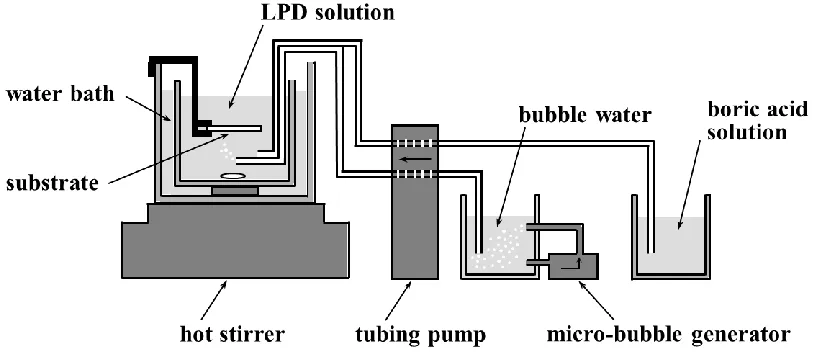
For the hydrolysis of [TiF6]2− ions in aqueous solutions, Eq. (1) has been proposed by Schmitt et al. [15]. This equilibrium is shifted towards the right-hand side with the addition of H3BO3, which acts as an F− scavenger. H3BO3 reacts readily with F− ions to generate the more stable BF4− ion by Eq. (4) [16]. The titania film formation proceeds according to Eq. (3), and the reaction is controlled by the amount of H3BO3. In this study, micro-bubble water is introduced into the raw solution along with H3BO3, for a purpose of preparing the films with rugged surface.
acid solution and micro-bubble water were introduced constantly into the reaction vessel and controlled by the tubing pump. The conditions of the LPD process are listed in Table 1.
[image:3.596.73.482.136.312.2]Figure 1. A schematic diagram of the improved LPD system
Table 1. LPD process conditions
0.1 mol/l (NH4)2TiF6 100 mL
Concentration of H3BO3 0.1 - 0.5 mol/L Flow rate of H3BO3 53 mL/h Micro-bubble water 42 mL/h Temperature 55 - 65 ºC Deposition time 3 - 5 hrs
3. RESULTS AND DISCUSSION
3.1 Surface morphology
The thicknesses and surface morphologies of the films were evaluated using SEM. The thicknesses of the films prepared by normal LPD process (without micro-bubbles) at the deposition time of 5 hours varied from 0.8 to 1.0 m, when the H3BO3 concentration and the raw solution temperature were changed in the range of Table 1. In the case of improved LPD process (with micro-bubbles), thicknesses cannot estimate exactly because the film surface is intensely rough, as described below. However, average thickness of the improved LPD films was about 1.0 m which was almost same as those of the normal LPD films.
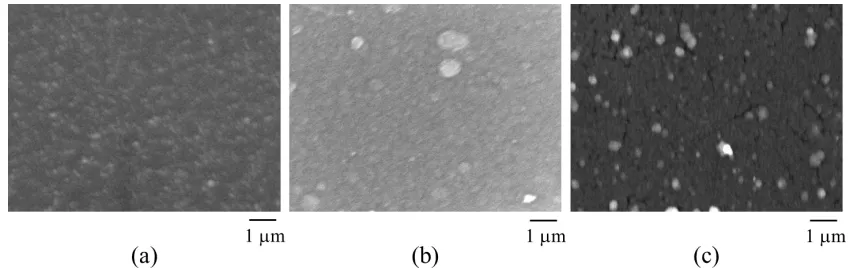
Figure 2. Surface morphology of the titania films prepared by a normal LPD process. The H3BO3 solution concentrations are (a) 0.1 mol/L, (b) 0.3 mol/ L, and (c) 0.5 mol/ L. The raw solution temperature and deposition time are 55 ºC and 5 hours, respectively.
Figure 3. Surface morphology of the titania films prepared by the normal LPD process. The raw solution temperatures are (a) 55 ºC, (b) 60 ºC, and (c) 65 ºC. The H3BO3 solution concentration and deposition time are 0.3 mol/ L and 5 hours, respectively.
[image:4.596.84.511.277.411.2] [image:4.596.86.504.486.620.2]
in the films; these cracks could have been generated by internal stress due to film contraction upon drying. Similar surface morphologies have been reported by several researchers [5, 14, 17, 18]. In the LPD process, titanium hydroxide complex ions are supersaturated with the F abstracted by BO33. Titania films are formed through nucleation of these titanium hydroxide complex ions. This nucleation process proceeds according to the following steps: (i) corpuscle nucleation due to the hydrolysis reaction following the ligand-exchange reaction and (ii) lateral and vertical growth of nuclei. Because the rate of step (ii) increases as the H3BO3 concentration and raw solution temperature increase, continuous film surfaces with some cracks were observed.
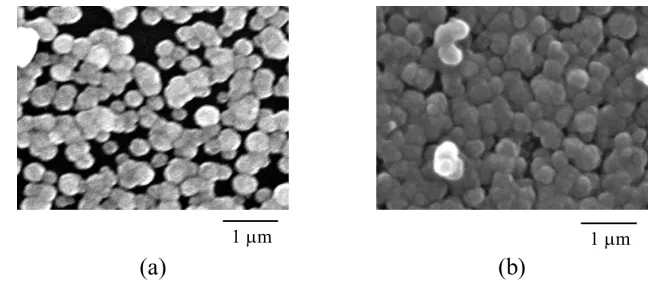
[image:5.596.129.454.400.544.2]Figures 4 (a) and (b) show the SEM photograph of the films prepared using the improved LPD process for 3 and 5 hours, respectively. The H3BO3 solution concentration and the raw solution temperatures are 0.3 mol/ L and 60 ºC, respectively. These surface morphology where many titania particles with a few hundred nm in diameter cohered differs greatly from those of the normal LPD films. In addition, the particles exist comparably sparsely for 3-hours deposition, while those are piled up for 5-hours deposition. Because the micro-bubble remains throughout the deposition process due to its long lifetime, the nucleation process in the lateral direction was considered to be obstructed by the coexisting micro-bubble on the substrate surface. As a result, many nanosized titania particles formed in initial stage of the LPD process. While the reaction progresses, these particles were piled up and rugged surface film was formed.
Figure 4. Surface morphology of the titania films prepared by the improved LPD process. Deposition times are (a) 3hours and (b) 5 hours. The H3BO3 solution concentration and the raw solution temperatures are 0.3 mol/ L and 60 ºC, respectively.
3.2 Crystallinity
[image:6.596.145.448.126.378.2]
film. These results indicate that the anatase and rutile are low- and high-temperature phases, respectively.
Figure 5. XRD patterns of the titania film prepared by a normal LPD process (Fig. 3 (b)) before and after annealing. A and R refer to the anatase and rutile planes, respectively.
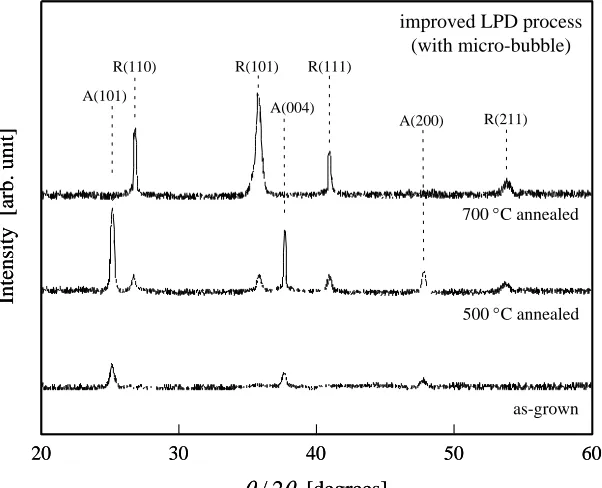
Figure 6. XRD patterns of the titania film prepared by an improved LPD process (Fig. 4) before and after annealing. A and R refer to the anatase and rutile planes, respectively.
/ 2 [degrees]
Int en sit y [a rb . uni t]
normal LPD process (without micro-bubble)
20 30 40 50 60
A(101) R(110) R(101) A(004) R(111) A(200) R(211) A(105) A(211) as-grown 700 C annealed
500 C annealed
Int en sit y [a rb . uni t]
/ 2 [degrees]
Int en sit y [a rb . uni t]
normal LPD process (without micro-bubble)
20 30 40 50 60
A(101) R(110) R(101) A(004) R(111) A(200) R(211) A(105) A(211) as-grown 700 C annealed
500 C annealed
Int en sit y [a rb . uni t]
improved LPD process (with micro-bubble)
20 30 40 50 60
A(101) R(110) R(101) A(004) R(111) A(200) R(211) as-grown 700 C annealed
500 C annealed
/ 2 [degrees]
Int en sit y [a rb . uni t]
improved LPD process (with micro-bubble)
20 30 40 50 60
A(101) R(110) R(101) A(004) R(111) A(200) R(211) as-grown 700 C annealed
500 C annealed
/ 2 [degrees]
[image:6.596.143.444.460.704.2]
As shown in Fig. 6, in the films deposited by the improved LPD process, anatase plane diffraction lines were observed even for the as-grown film, though the diffraction intensities were weak. The intensities of these anatase diffraction lines increase and rutile diffraction peaks appear in the 500 ºC-annealed film, but only rutile lines remain in the 700 ºC-annealed film.
In the grain growth process, the inside of the corpuscle reaches a high pressure and temperature; pressure remains constant due to nucleus growth in the surrounding area, and crystallization is promoted. Moreover, when a micro-bubble collapses on the film surface, temperature locally becomes several thousand ºC for several picoseconds, and the crystallization of the surrounding titania grains is considered to be promoted under the temporarily high temperature. After annealing at 500 - 700 ºC, the crystallinity of the films is improved further. This crystalline process caused lowering of transition temperature from the anatase phase to the rutile phase in the films deposited by the improved LPD process.
3.3 Photocatalytic activity
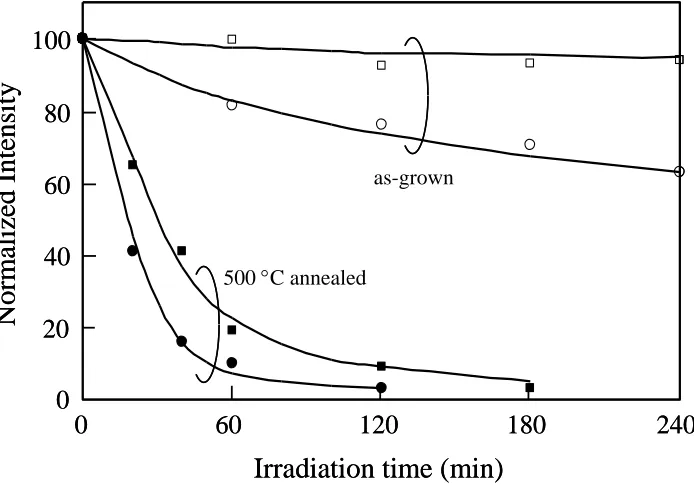
[image:7.596.111.458.408.651.2]When the titania is irradiated by UV light, it exhibits the peculiar photocatalytic function of causing photo-induced decomposition of organic compounds. Here, this effect was evaluated by measuring the degradation of methyleneblue.
Figure 7. Absorbance of methyleneblue at 654 nm as a function of UV light irradiation time. Squares represent the normal LPD films and circles represent the improved LPD films.
Figure 7 shows the absorbance of methyleneblue at 654 nm as a function of UV light irradiation time for both the as-grown and 500 ºC-annealed films described in Sec. 3.2. Methyleneblue
0 60 120 180 240
Irradiation time (min)
Nor
m
al
ized
Intensity
0 20 80
60
40 100
as-grown
500 C annealed
0 60 120 180 240
Irradiation time (min)
Nor
m
al
ized
Intensity
0 20 80
60
40 100
as-grown
was not degraded on the as-grown film prepared by the normal LPD method. For the film prepared using the improved LPD method, however, it can be observed that the degradation of methyleneblue took place in the as-grown film, though weakly. After the 500ºC annealing step, methyleneblue degradation drastically increases for films prepared using either the normal or improved LPD method. As shown in Figs. 5 and 6, these films exhibit predominately anatase crystallinity; strong photocatalytic activity was observed for both films. Photocatalytic activity of the improved LPD film is considered to be stronger than that of the normal LPD film due to differences in the surface area and the crystallinity intensity of the anatase phase.
4. CONCLUSION
The preparation and characterization of titania films with cohered nanosized particles has been studied. We proposed an improved liquid phase deposition method in which micro-bubbles were introduced to the film formation process. The micro-bubbles play a role in the film formation process by not only preventing the nucleation in the lateral direction but also creating a hot spot of several thousand ºC for several picoseconds. These effects lead to formation of titania films with cohered nanosized particles; these films possess large surface areas and anatase crystallinity, even in the as-grown film. These films additionally exhibit photocatalytic properties when they are irradiated by UV light. Photo-induced decomposition of organic compounds depends on both surface area and the crystallinity of anatase. The films prepared by the improved LPD method are considered to have great potential for application in environmental fields as photocatalytic materials.
ACKNOWLEDGEMENTS
The author would like to thank S. Kawaharabayashi and Y. Ishida for their technical assistance.
References
1. C. Kim, J. T. Kim, K. S. Kim, S. Jeong, H. Y. Kim and Y. S. Han, Electrochim. Acta, 54 (2009) 5715
2. A. Fujishima, X. T. Zhang and D. A. Tryk, Surf. Sci. Rep., 63 (2008) 515
3. C. X. Lei, H. Zhou, Z. D. Feng, Y. F. Zhu and R. G. Du, J. Alloy. Comp., 513 (2012) 552 4. D. Li, H. Tong and L. Zhang, Trans. Nonferrous Met. Soc. China, 23 (2013) 3306
5. H. Maki, Y. Okumura, H. Ikuta and M. Mizuhata, J. Phys. Chem., 118 (2014) 11964 6. H. Park, K. Y. Kim, and W. Choi, J. Phys. Chem., B106 (2002) 4775
7. G. X. Shen, Y. C. Chen and C. J. Lin, Thin Solid Films, 489 (2005) 130
8. H. Nagayama, H. Honda and H. Kawahara, J. Electrochem. Soc., 135 (1988) 2013.
9. K. Koumoto, S. Seo, T. Sugiyama, W.S. Seo and W.J. Dressick, Chem. Mater., 11 (1999) 2305 10.T. P. Niesen and M. R. De Guire, J. Electrochem. Soc., 6 (2001) 169
11.D. Gutierrez-Tauste, X. Domenech, M. A. Hernandez-Fenollosa and J. A. Ayllon, J. Mater. Chem., 16 (2006) 2249
14.S. Deki, Y. Aoi, O. Hiroi and A. Kajinami, Chem. Lett., 25 (1996) 433
15.R. H. Schmitt, E. L. Glove and R. D. Brown, J. Am. Chem. Soc., 82 (1960) 5292 16.C. A. Wamser, J. Am. Chem. Soc., 73 (1951) 409
17.A. Dutschke, C. Diegelmann and P. Löbmann, Chem. Mater., 15 (2003) 3501 18.M. Mallak, M. Bockmeyer and P. Löbmann, Thin Solid Films, 515 (2007) 8072