Int. J. Electrochem. Sci., 8 (2013) 10578 - 10585
International Journal of
ELECTROCHEMICAL
SCIENCE
www.electrochemsci.org
Short Communication
Study of Anion Membrane Electrolysis Technique for
Desalination of Mother Liquor in the process of Baking Soda
Zhou Junbo1,Yewei1, Gao Liping2,*, Zhao Zhongyi1 ,Li Haiting1 1
Engineering Research Center for Polymer Processing Equipment, Ministry of Education, Beijing University of Chemical Technology, Beijing, 100029, China.
2
College of Applied Arts and Sciences, Beijing Union University, Beijing 100191, China *
E-mail: [email protected]
Received: 18 May 2013 / Accepted: 21 June 2013 / Published: 1 August 2013
Now, use of trona as raw material to produce sodium bicarbonate is an important process whose advantages are simple process and low cost. When using centrifugal mother liquid to dissolve trona mining circularly, due to the continuous accumulation of sodium chloride, it directly influences the recovery and utilization ratio, and declines the quality of baking soda production so that the separation of salt from mother liquor is necessary. The method of anion-exchange membrane electrolysis was used in this paper to do electrolytic desalting research into centrifugal mother liquid, exploring a new salt separation technology which can be used in the process of salt separation technology from trona. Electrolytic efficiency and energy consumption index were discussed when adopting different solution as anolyte and finally obtained the optimal technological condition: utilizing 25%NaOH as anolyte, current efficiency is 80.3% and power consumption is 1.7 kilowatt hour when electrolyzing 1kgNaCl. After the electrolytic process, sodium chloride no longer gathers because of low-salt-concentration mother solution, which can be widely used to dissolve mining circularly, leading to cyclic utilization of waste alkali liquor and clean production.
Keywords: Anion membrance electrolysis, Desalination,Trona, Baking soda
1. INTRODUCTION
adopts natronite (Na2CO3·10H2O) in the lake as raw material, prepared alkali halide consist of 18% sodium carbonate, 0.5% sodium bicarbonate.
According to Na2C03--NaCl--NaHC02--H20 quaternary solubility system principle[3], Na2C03 · 10H20 firstly reached saturation and crystallized and precipitated from solution when the temperature of evaporating and concentrating kept on the range of 35.4-109 ℃[4], while NaCl still residue in the mother liquor. In order to keep solid phase point of the mixture solution staying in the Na2C03·10H20 crystallization area, mother liquid should be discharged properly in the process [5]. Then Na2C03·10H20 crystal was separated from the material liquid continuously on a certain solid-liquid ratio. Finally,bicarbonate of soda was gained after the carbonizing of Na2C03.
However, the above process had two drawbacks: one is that sodium chloride residues in the mother liquor in the crystallization process, and the other is that mother liquid should be discharged timely to keep solution point staying in Na2C03 · 10 H20 crystallization area, causing a lot of waste mother liquor and environmental pollution [6]. Recently, Qiu huibin used the phase diagram of the system to remove salt for the different solubility of salt and alkali at different temperatures [7]. But this method was limited by the solubility, leading to the low mother liquor‘s desalination rate and high production costs, and therefore it cannot recycling the waste liquid fundamentally. US4652054 patent commences to improve the purity of sodium bicarbonate from its production process which can reduce product cost, but this method has brought a lot of caustic sludge and its processing is very complicated problem [8].
For the purpose of rationally developing and utilizing the nature resources, a new method of desalination should be proposed which not only achieved the object of separating salt but also reduced the production costs. Ionic membrane electrolysis technology was the combination of electrodialysis [9] and electrolysis, containing both of their respective advantages [10]. It has been widely used in pollution management gradually, showing a huge potential because of its cleanness, quickness and high efficiency [11]. Anion membrane electrolysis methods were used in this research to remove sodium chloride from mother liquid, achieving dual-purpose pollution management and resources recovery [12]. Besides, there is no similar literature to illustrate the method of disposing mother liquor of trona with anion membrane electrolysis. This method is initiatives in China, and access to the patent ZL 201010619987.7 [13].
2. MATERIALS AND METHODS
2. 1 Reagents
Centrifugal mother liquor (contain 18% sodium carbonate, 0.5% sodium bicarbonate), Sodium chloride (analytical grade), sodium carbonate (analytical grade), sodium bicarbonate (analytical grade)
2.2 Experiment principle
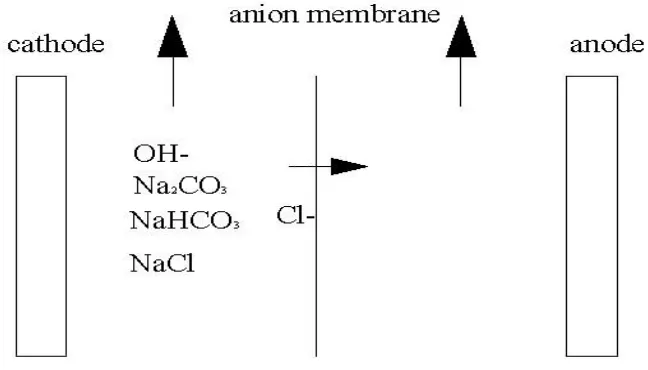
generating chlorine gas on the anode surface, and then NaCl can be removed. The anion membrane electrolysis principle was shown in Figure 1:
Figure 1. Schematic anion membrane electrolysis
Electrode reaction as follows
Cathode: 2H2O+2e-→2OH-+H2 (1) Anode : 2Cl--2e-→Cl2 (2) The parameter of the electrolytic current efficiency η is represented as:
The theoretical power consumption
100% The actual power consumption
ZFQ C It
(3)
In the above Formula, Z is equal to 1for monovalent ions ; F is the Faraday constant; Q is the amount of cathode chamber mother liquor (L); the △ C stands for the amount of NaCl changes in cathode chamber (mol / L); I is the current intensity(A) ; t is current time (s);. Electrolysis energy consumption W is defined as:
UIt W
m
(4)
W is power consumption (kWh / kg NaCl); U is voltage (V), I is current (A); t is time (H); △ m is the total change of NaCl cathode chamber (Kg).
2.3 The experimental process
[image:3.596.120.444.136.321.2]
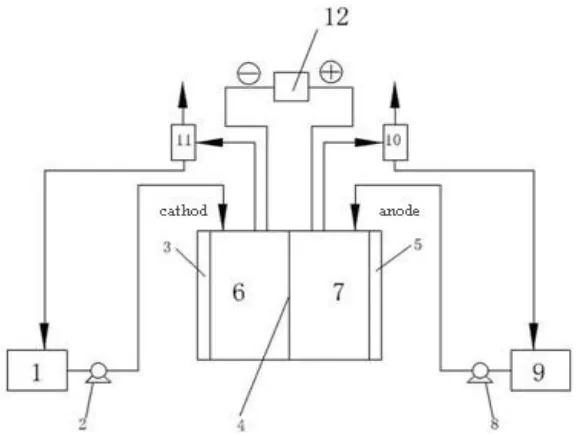
Figure 2. Electrolysis System flowchart; 1 - The cathode liquid circulation channel; 2 - A constant flow pump; 3 - cathode; 4 - anion exchange membrane; 5 - the anode; 6 - the cathode chamber; 7 - the anode chamber; 8 - the constant flow pump B; 9 - anode liquid circulation channel; 10 - anode gas liquid separator; 11 - cathode gas liquid separator; 12 - the dc stabilized power supply.
2.4 experiment process
Firstly,1400ml centrifugal mother solution was added into sodium exchange resin column for softening and removing Ca2 +, Mg 2 + to avoid forming Ca (OH) 2 and Mg (OH) 2 precipitation on the surface of the anion membrane in the process of electrolysis and affecting Cl- exchange of anion membrane. Then mother liquor passed through cathode chamber of the cell. At the same time, controlling the flow velocity of electrolyte by adjusting the power supply current and constant flow pump flow, and therefore mother liquor in cathode was constantly circulating accumulated. Thirdly, different concentrations of different anolyte with HCl solution, NaOH solution, NaCl solution respectively were added into the cathode chamber. Measuring sodium chloride concentration in cathode liquid after electrolytic by CIC - 100 ion chromatograph and calculating the response current density and energy consumption. Finally, we can choose the best anolyte and its concentration.
3. RESULTS AND DISCUSSION
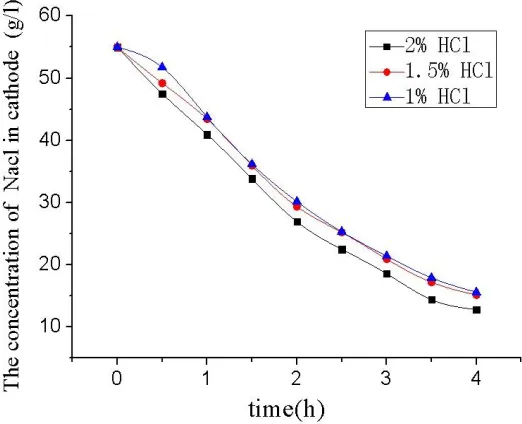
3.1 Effect of different concentrations of HCl in anode on the desalination of mother liquor in cathode.
[image:4.596.155.444.74.292.2]
45.1% by Eq. (3) and voltage stable was 7v at the process of electrolysis. The energy consumption was 7.1 kilowatt hour for removing 1kg NaCl by Eq. (4). According to the calculation results, current efficiency was low while energy consumption was high, the reason may be that anode use low concentration of HCl solution whose conductivity was low and leading to higher voltage , so that the energy consumption was higher.
Figure 3. Effect of different concentrations of HCl in anode on the desalination of mother liquor in cathode. (the supply current is 15A; constant flow pump flow velocity is 8L / h.)
3.2 Effect of different concentrations of NaCl in anode on the desalination of mother liquor in cathode.
[image:5.596.161.422.185.397.2] [image:5.596.161.416.506.705.2]
1400ml centrifugal mother solution was added into Cathode chamber Electrolytic cell, and the concentration of NaCl in mother liquor was 60 g/l. The concentration of 15%, 20%, 25% NaCl solution were added into anode chamber. Electrolysis of mother liquor was electrolyzed continually. Effect of different concentrations of NaCl in anode on the desalination of mother liquor in cathode was showed in fig.4. The figure 4 showed that the higher concentration of NaCl solution in anodic was, the higher desalting rate in catholyte was. When the anode NaCl concentration reached saturation, namely 25%,the desalting rate of catholyte solution was highest. The calculation current efficiency η was 80.8% by Eq. (3), and the electrolytic cell voltage was between 3.4 and 4.2 V. When electrolysis was going stable, cell voltage remained 4.0 V. The energy consumption was 2.3 kilowatt hour for removing 1kg NaCl Eq. (4). Above all, when anolyte used 25% NaCl solution as electrolyte, electrochemical desalination current efficiency was high and the energy consumption was low.
A similar linear sweep was obtained when using NaCl as anolyte for recover Au. Moreover, the higher the concentration of sodium chloride was, the higher recovery rate of gold was, and the highest recovery rate is up to 99%. More recently,zheng et al. [14] studies the regeneration of acidic copper chloride etchant with, 2mol/L NaCl as anolyte of an anion membrane,and a power consumption of 1.54 kw·h per kilogram of copper recovered. But it did not the best with the high the concentration of sodium chloride. Because it is almost the saturation limit for NaCl in water, fouling of the membrane takes place [15]. This reduces the current efficiency and increases the energy consumption. The above situation was that anolyte was neutral and alkaline were barely treat as anolyte. Chlorine can get through anion membrane easily in alkaline environment. We would discuss the situation that anolyte was sodium hydroxide.
3.3 Effect of different concentrations of NaOH in anode on the desalination of mother liquor in cathode
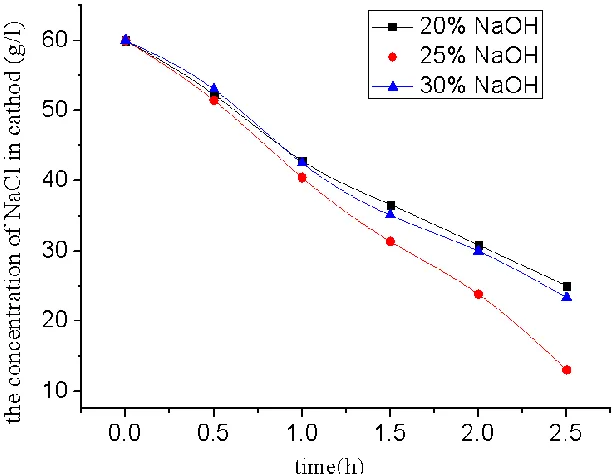
1400ml centrifugal mother solution was added into Cathode chamber electrolytic cell, and the concentration of NaCl in mother liquor was 60 g/l. The concentration of 20%, 25%, 30% NaOH solution were added into anode chamber. Effect of different concentrations of NaOH in anode on the desalination of mother liquor in cathode was showed in fig.5. But anode material was changed to oxygen evolution titanium mesh. So the anode and cathode electrode reactions as follow:
Cathode: 4H2O+4e-→4OH-+2H2 (5) Anode: 4H2O+4e-→4OH-+2H2 (6)
electrolyte, the calculation current efficiency η was 80.3% by Eq. (3), and the electrolytic cell voltage was between 2.7 to 3.5V. When electrolysis was going stable, cell voltage remained 3.0 V. The energy consumption was 1.7 kilowatt hour for removing 1kg NaCl by Eq. (4). So when anolyte used 25% NaOH solution as electrolyte, electrochemical desalination current efficiency was high and the energy consumption was low.
Figure 5. Effect of different concentrations of NaOH in anode on the desalination of mother liquor in cathode. (the supply current is 15A; constant flow pump flow velocity is 8L /h.)
4. CONCLUSION
The experiment is carried out based on ZL 201010619987.7, the results show that anion membrane electrolysis is stable and reliable to treat centrifugal mother liquor. The optimal technological condition: utilizing 25%NaOH as anolyte, current efficiency is 80.3% and power consumption is 1.7 kilowatt hour when removing 1KgNaCl. After the electrolytic process, sodium chloride no longer gathers because of low-salt-concentration mother solution. Centrifugal mother liquor after treatment can be widely used to dissolve trona circularly, resulting in cyclic utilization of waste alkali liquor and clean production.
References
1. A. E.Midaouia, F. Elhannounia, M. Takya, L.Chaya, M. A. M. Sahlia, L. Echihabib, M. Hafsib, J.Sep.Purif.Technol.,29(2002)235.
2. H.Liu, S.Z.Yi, Y.Wu, J.Q.Wu, ESIAT.C, 1(2009) 665.
3. C. Francesco, C. Daniela, D. S. Concetta , M. Demetrio, S. Silvio , V. Giuseppina , Eup. J. Pharm. Sci., 4(2012)661.
[image:7.596.140.446.177.414.2]
5. V.E.Santarosa, F.Pereti, V.Caldart, Desalination, 149 (2002)389. 6. K.Mani, D. Frederick, P.Chlanda, US4391680, 1983.
7. H.B.Qiu , H.B.Du, Soda Industry, 9 (2007)24.
8. C.Wiliam, P.Yardley, A.P.Herry, N.J.Mercerville, US4652054, 1987.
9. M.Jayalaksh, W.Y.Kim, K.D.Jung, J.Shim, Int. J. Electrochem. Sci., 3 (2008) 908. 10. J. Jorissena, S. M. Breiterb, C. Funkc, J. Membrane. Sci., 2 (2003) 247.
11. G..Saracco. NNALI DI CHIMICA , 93(2003) 817-826 . 12. Y.Liu, J.B.Zhou, Int. J. Electrochem. Sci., 8 (2013) 4864. 13. J.B.Zhou, Z.Y.Zhao , ZL 201010619987.7, 2012.
14. Z.Y.Yang , C.D. Huang, X.Q. Ji, Y.X. Wang,Int. J. Electrochem. Sci., 8 (2013) 6258 – 6268. 15. S.Savari, S. Sachdeva, A. Kumar,J. Membrane. Sci., 310 (2008) 246–261.