doi: 10.20964/110345
Int. J. Electrochem. Sci., 11 (2016) 3952 - 3962
International Journal of
ELECTROCHEMICAL
SCIENCE
www.electrochemsci.org
Short Communication
Investigation of the Consecutive Electron Transfer of
Metalloporphyrin Species on the Simulative Cell Membrane by
Thin Layer Cyclic Voltammetry
Wenting Gu1,2, Wenjian Li1,2, Ruiyuan Liu1 and Yin Qu1, Libin Zhou1*,Xicun Dong1,*
1
Institute of Modern Physics, Chinese Academy of Sciences, Lanzhou 730000, China 2
School of Life Sciences, Lanzhou University, Lanzhou 730000, China 3
Key Laboratory of Bioelectrochemistry&Environmental Analysis of Gansu Province, College of Chemistry & Chemical Engineering, Northwest Normal University, Lanzhou 730070, China *
E-mail: [email protected], [email protected]
Received: 7January 2016 / Accepted: 2 March 2016 / Published: 1April 2016
Metalloporphyrin, which is the essential sites of electron transfer in biological system, can be investigated the electrochemical process on cell membrane. The liquid/liquid interface is suitable to simulate process of heterogeneous electron transfer between two immiscible electrolyte solutions by thin layer cyclic voltammetry conveniently. As the excellent electron receptors, metalloporphyrins obtained electrons from the electron donor Fe(CN)64-, and the kinetics constants of multi-step interfacial bimolecular reaction were obtained simultaneously at the interface by thin-layer theory. Our
experimental results suggested that the rate of electron transfer in the liquid/liquid interface depends on the presence of different metallic ions located the porphyrin ring. In addition, it is noted that the dependence of driving force on rate constants follows the well-known Bulter–Volmer equation. This electrochemical approach to quantitatively measure and analysis the dynamic process on cell membrane is a potential marker for the evaluation of electron transfer process in cell.
Keywords: Thin-layer cyclic voltammetry, Metalloporphyrin, Multi-step electron transfer, liquid/liquid interface
1. INTRODUCTION
with various metallic ions in the porphyrin ring show some particular properties in the metabolism of living organisms due to their excellent electron-transfer properties, such as iron complex in the haemoproteins, magnesium complexes in the chlorophylls, and a cobalt complex in Vitamin B12. It is vital for us to clarify the essence of many important physiological processes by exploring the mechanism of electron transport (ET) at the liquid/liquid interface of biological system. As novel applications of electrochemical field[9, 12-22], the liquid/liquid interface in biomembranes has been suggested as a simplified model for understanding the mechanism of electron transfer[22,36,39]. It has been recognized that electrochemistry is an efficient method to explore the process of electron transfer at the interface between two immiscible electrolyte solutions(ITLES)[23-27]. Particularly, the thin layer cyclic voltammetry(TLCV) developed by Anson et al. is characterized by simplicity and a limited amount of reactant.
Scheme 1. (A) Schematic representations of two-step electron transfer process induced by porphyrin derivatives in cell membrane) and (B) Electrochemical reaction at the electrode.
papers have studied the electron transfer of metalloporphyrins in the transition metal elements across the ITIES by TLCV in this field.
In this paper, in order to investigate the effect of metabolic processes, which provides the important guideline for the biological activity and physiological function, the metalloporphyrins with different metallic elements in transition metal elements were implemented at the nitrobenzene/water (NB/W) interface based on the electrochemical method by TLCV. Due to the excellent complexing properties and strong redox activity, metalloporphyrins in transition metal elements can be used to simulate ET in biological cell[29,30,35]. Our obtained results have shown that the rate of interfacial ET processes strongly depend on the presence of different metallic ions in the porphyrin complexes. These studies could help us clarify the mechanism of electron transfer in metal transition series elements, also expose the molecular mechanism in biological cell.
2. EXPERIMENTAL
2.1. Chemicals and apparatus
NaCl, NaClO4, K4Fe(CN)6 (AR, Beijing Chemical Reagent Co.), nitrobenzene (NB) (Shanghai Chemical Reagent Co. Ltd.), were of highest available purity, they were used as received. Tetrabutylammonium perchlorate (TBAClO4) was synthesized in our lab according to the Ref. 41. 5,10,15,20-Tetraphenyl porphyrin iron (FeTPP). 5,10,15,20-tetraphenyl porphyrin cobalt (CoTPP) and 5,10,15,20-tetraphenylporphyrin nickel (NiTPP) were provided[28]. The present experiments were implemented in CHI-832 working station (CHI instrument, Co. Ltd., Austin, USA) by thin-layer cyclic voltammetry and cyclic voltammetry. A three-electrode configuration (EPG, auxiliary and reference) was applied throughout our experiments. The edge-plane pyrolytic graphite electrodes (EPG) with 0.3 cm2 of the edges of the graphite planes was prepared. Both Pt counter electrode and Ag/AgCl: KCl reference electrode were also used. The experiments were implemented at the room temperature (22±2°C).
2.2. Procedures
The EPG was pretreated as described [23]. The resulting surface was moderately hydrophobic as indicated by the failure of a drop of water to spread across its surface. When thin layers of NB solutions containing interest reactants (FeTPP, CoTPP and NiTPP) and supporting electrolytes (TBAClO4) were applied to the graphite electrode held in an upside-down position by transferring 1.5µL of the solutions to the electrode surface with a microsyringe, the organic liquid spread spontaneously across the surface of the graphite electrode. The electrode was then turned over and immediately immersed in the aqueous solution.
3. RESULTS AND DISCUSSION
compounds on the simulative cell membrane based on the TLCV. In Scheme 1A, the primary process of two-step electron transfer in cell membrane is shown. The porphyrin derivatives was reduced by reductive enzyme and gained one electron to form excited-state which move inside and outside the cell membrane, and transfer electrons to redox species, while some of the excited-state porphyrin derivatives again gained one electron to higher excited states porphyrin derivatives which was oxidized on cell membrane similarly. Up to here, a full consecutive electron transfer was completed and the system achieved the purpose of energy transfer. The intricate reactions could be simulated simply by electrochemical reaction at the electrode as shown in Scheme 1B. At first, the MTPP is oxidized to MTPP+ on the electrode. One part of MTPP+ could diffuse to the liquid/liquid interface and occur redox-active reactants and gain an electron from the Fe(CN)64-, and restore into MTPP. Then, MTPP diffuse to the electrode, and the first feedback current is captured by the electrode when the first step ET process was finished. Meanwhile, other MTPP+ will be continually oxidized to MTPP2+ due to the reduction of Fe(CN)64- at the interface. The electrochemical reactions are given as follows:
MTPP -e MTPP+ -e MTPP2+(EPG) (1) MTPP++ Fe(CN)64- MTPP + Fe(CN)63-(ITIES) (2) MTPP2++ Fe(CN)64- MTPP+ + Fe(CN)63-(ITIES) (3)
where M represents the group of Fe, Co and Ni in the porphyrin ring, respectively.
3.1. Electron transfer from metalloporphyrins with various metallic ions to Fe(CN)64-
across the NB/H2O interface
0.2 0.4 0.6 0.8 1.0 1.2 1.4 -4
-2 0 2 4 6
0.2 0.4 0.6 0.8 1.0 1.2 1.4 -4
-2 0 2 4 6
0.2 0.4 0.6 0.8 1.0 1.2 1.4 -4
-2 0 2 4 6
C
u
rr
en
t/
A
E,V vs Ag/AgCl
Figure 1. Steady-state cyclic voltammogram of three types of metalloporphyrins (from left to right: 1mM CoTPP, 1mM FeTPP, 1mM NiTPP, supporting electrolyte of 0.01 M TBAClO4). Scan rate of 5 mV s-1.
0.0 0.2 0.4 0.6 0.8 1.0 1.2
E,V vs Ag/AgCl
C
D A
[image:5.596.176.403.90.276.2]B
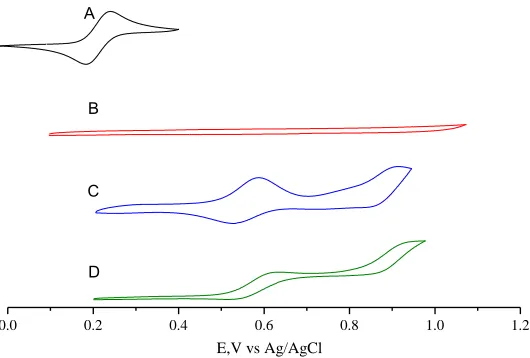
Figure 2. Thin-layer cyclic voltammogram of electron transfer between CoTPP and K4Fe(CN)6 for (A) 10 mM K4Fe(CN)6 at an uncoated EPG electrode with the supporting electrolyte of 0.1 M NaClO4 + 0.1 M NaCl, (B) Repeat of part A after the electrode surface was covered with NB of 1.5μL, (C) the electrode covered with NB of 1.5μL, 1 m MCoTPP, and supporting electrolyte (0.01 M TBAClO4). The aqueous solution contained only supporting electrolyte (0.1 M NaClO4 + 0.1 M NaCl). (D) Repeat of part C with 10 mM K4Fe(CN)6 present in the aqueous phase; 1.5μL of NB containing 1 mMCoTPP and supporting electrolyte (0.01 M TBAClO4). Scan rate of 5 mV s-1. The inset shows the cyclic voltammogram obtained at the EPG electrode with the solution of NB cotaining 1mM CoTPP and 0.01 M TBAClO4.
[image:5.596.176.441.354.533.2]
large formal potential difference plays an important role in the studies of electron transfer kinetics across an ITIES.
In Fig. 2A, we have presented a cyclic voltammogram recorded at a bare edge plane EPG electrode in a 10 mM aqueous solution of Fe(CN)64- with the supporting electrolyte of 0.1 M NaClO4+ 0.1 M NaCl. When a thin layer of NB was fixed on the electrode surface to separate it from the aqueous solution, no voltammetric current was obtained for the oxidized reactant. The phenomena can be explained that any form of Fe(CN)64- ions incapably reach the electrode surface (shown in Fig.2B). Both CoTPP and 0.01 M TBAClO4 supporting electrolyte were dissolved in the NB when the thin layer was observed on the electrode with only supporting electrolyte for the aqueous solution. The corresponding response is shown in Figure 2C. As one can see, the anodic currents are enhanced at the potential. Meanwhile, CoTPP and CoTPP+ will be formed due to the presence of CoTPP+ and CoTPP2+. It is inferred that cross-phase electron transfer will be observed from CoTPP to Fe(CN)64- in the aqueous phase. The two couples near 0.75 and 1.05 are the apparent half-wave potential of the CoTPP+/ CoTPP, and CoTPP2+/ CoTPP+ couple, respectively. In order to verify the stable phenomena, we have repetitive scanned between +1.1 and -0.1 V and found that the tendency of decrease can exist still in the peak currents. Thus, the difference between the formal potentials of the two reactants, ΔE, can be obtained. In the combination of Fe(CN)64- and the aqueous phase, repeating the operation shown in Fig. 2C, the anodic plateau can occur as shown in Fig.2D. It is concluded that the steady-state can be obtained by the biomolecular redox reaction. The obvious potential difference is interesting on the study of ET kinetics across an ITIES[25]. As well-known, every cycle of life will be related to the process of multistep ET. In order to clarify the processes of ET, scanning electrochemical microscopy (SECM) was used to investigate the process of electron transfer. However, it is noted that the results obtained by SECM are essentially indistinguishable from the consecutive ET when single step ET is analyzed by the mode of feedback[30].
3.2. Theoretical Analysis for Consecutive Interfacial Electron Transfer
10 15 20 25 30 35 40
8.0 8.2 8.4 8.6 8.8 9.0 9.2 i obs , m A
Fe(CN)64-,mM
a
10 15 20 25 30 35 40
4.2 4.3 4.4 4.5 4.6 4.7 i obs , m A
Fe(CN)64-,mM
[image:7.596.129.456.82.221.2]b
Figure 3A (a) Dependence of the steady-state currents (iobs) of the first step ET on the concentration of K4Fe(CN)6 in the aqueous phase (b) Dependence of the steady-state currents (iobs) of the second step ET on the concentration of K4Fe(CN)6 in the aqueous phase.
0.02 0.03 0.04 0.05 0.06 0.07 0.08 0.09 0.10 0.11 0.110 0.112 0.114 0.116 0.118 0.120 0.122 0.124 a 1 /iobs /m A -1
1/Fe(CN)64-,mM-1
0.02 0.03 0.04 0.05 0.06 0.07 0.08 0.09 0.10 0.11 0.215 0.220 0.225 0.230 0.235 0.240 b 1 /iobs /m A -1
1/Fe(CN)64-,mM-1
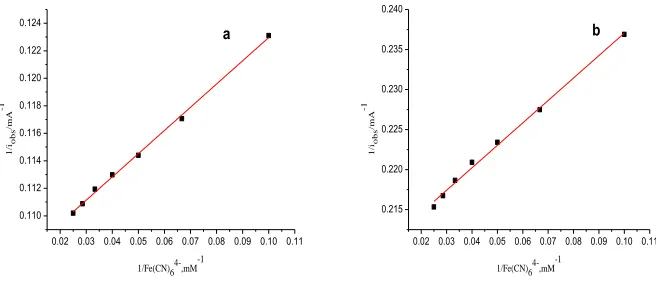
Figure 3B Dependence of reciprocal observed currents on [K4Fe(CN)6]-1 (a) for the first step ET and (b) for the second step ET.
According to these conditions, the rate constant of the first step ET can be obtained by the TLCV analysis theory [23-27]. An expression 8 can be derived from Eqs.5, 6 and 7.
ET D obs i i
i
1 1 1
(5)
d D nFAc iD NB NB1/
(6)
et NB HO
ET nFAk c c
i
2 (7)
1
1
1 12 / et O H NB NB NB
obs d nFAc D nFAc c k
i
(8)
Where c*NB and c*H2O are the initial bulk concentration of reactant contained in organic phase
[image:7.596.131.459.298.439.2]
observed plateau current. The dependence of (iobs)-1 on (cH2O)-1 should be linear with a slope (nFAc*NBket-1). Thus, we can calculate ket with intercept of (iD)−1.
However, it is noted that with the achievement of each step ET, the concentration of reactant in organic phase for the subsequent step ET will be gradually varied. Thus, for the multi-step cross-phase electron transfer reaction, our main attention is focused on the measure of the concentration of reactant in the organic phase for the following step ET. It is clearly cognized that the concentration of organic species in the following step is affected by the initial bulk concentration of reactant dissolved in the organic phase. According to Eq.6, the ratio of diffusion-controlled current (iD) of voltammetric response is determined under steady-state conditions. We assume that the concentration of c*NB1 for the first step is constant and equals to the initial value. iD1 and iDn can be obtained from the intercept of dependence of (iobs)-1 on (cH2O)-1. The concentration for the subsequent step is given as follows,
n
D D
i i
1
=
n
NB NB
c c
1
(n>1) (9)
1 1
NB D D
NB c
i i
c n
n
[image:8.596.80.513.430.557.2]Thus, for the multi-step ET, Eqs. (9) could be used to calculate the concentration of the organic species for the following step.
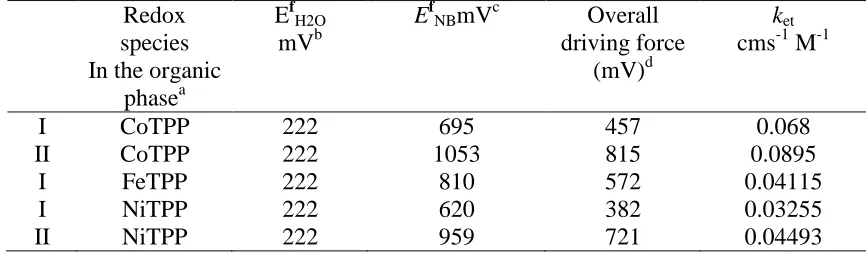
Table 1. Rate constants of bimolecular for single-step and two-step cross phase electron transfer
Redox species In the organic
phasea
EfH2O mVb
EfNBmVc Overall driving force
(mV)d
ket cms-1 M-1
I CoTPP 222 695 457 0.068
II CoTPP 222 1053 815 0.0895
I FeTPP 222 810 572 0.04115
I NiTPP 222 620 382 0.03255
II NiTPP 222 959 721 0.04493
a Redox species of the organic phase.
b Formal potential of the reactant redox couple in the H2O phase vs a saturated Ag/AgCl electrode
c Apparent formal potential of the reactant redox couple in the NB phase vs a saturated Ag / AgCl electrode in the H2O phase
d The overall driving force of the reaction: (EfH2O – EfNB).
3.3. Dependence of driving force on the rates of ET at the ITIES
interface. The overall driving force can be considerably changed by using the different redox couples either in the aqueous phase, or in the organic phase. It is desirable for TLCV measurement of rapid ET kinetics at ITIES to investigate the processes of the electron transfer. Besides, the traditional studies of charge transfer on liquid/liquid interface can also be used to display the dependence of different metallic ions on the molecules of metalloporphyrins in transition metal elements.
The driving force will increase when the organic phase reactant varies. However, the concentrations of the potential of ClO-4 in the two phases are constants. According to Marcus theory [33], the ket of the bimolecular rate constant ket is described by the following equations,
exp( / )
et
k const G RT (10) 0 2
/ 4)(1 /
G G
(11)
0
( )
O o
w
G F E
(12)
where ΔG≠ is the free energy of activation. ΔG0 is the standard free energy of reaction i.e., the driving force in Liquid/liquid interface. Due to the presence of different metallic ions, regulate the driving force for the ET reaction can be regulated in our experiment. Things will be interesting once the bimolecular rates ket shown in Table1 are obtained according to Eqs.10. Based on Marcus theory, the rate constant satisfies Bulter–Volmer kinetics, where the rate increases as the increase of driving force for the low driving force. At the high driving force, the rates will decrease. The phenomena are in good excellent with Marcus inverted region [31-33]. In the present paper, it is noted that the dependence of rate constant on the driving force can be controlled by the regulation of metallic ions of porphyrin complex in transition metal elements. As one can see from Table 1, the rate constants increase with the increase of the driving force, which indicates that the dependence of ket on the overall driving force for the consecutive ET is in good agreement with the conventional Butler-Volmer treatment[40,41].
4. CONCLUSIONS
In this paper, in order to explore the effect of metabolic processes in a biological system, the metalloporphyrins that containing different metallic elements in transition metal elements were used to survey the biological and physiological function of compounds at the nitrobenzene/water (NB/W) interface by the electrochemical method of TLCV. The obtained results have indicated that the rate of interfacial ET processes depend on the presence of different metallic ions in the porphyrin complexes, and follows Bulter–Volmer kinetics in certain range. These studies provide some significance and help us explain the molecular mechanism of biological system in nature.
ACKNOWLEDGEMENTS
References
1. M. Fujitsuka, M. Hara, S. Tojo, A. Okada, V. Troiani, N. Solladié, T. Majima, J. Phys.
Chem. B., 109 (2004) 33-35.
2. B. Munge, S. K. Das, R. Ilagan, Z. Pendon, J. Yang, H. A. Frank, J. F. Rusling, J. Am. Chem. Soc., 125 (2003) 12457-12463.
3. X. Peng, N. Aratan, A. Takag, T. Matsumoto, T. Kawai, I-W. Hwang, T. K. Ahn, D. Kim, A. Osuka, J. Am. Chem. Soc., 126 (2004) 4468-4469.
4. F. Longobardi, P. Cosma, F. Milano, A. Agostiano, J. Mauzeroll, A. Bard, J. Anal. Chem., 78 (2006) 5046-5051.
5. Goldberg, D. P., Acc. Chem. Res., 40 (2007) 626-34.
6. I. Hijazi, T. Roisnel, P. Even-Hernandez, E. Furet, J.-F. o. Halet, O. Cador, B. Boitrel, J.
Am. Chem. Soc., 132 (2010) 10652-3.
7. C. Hu, B. C. Noll, C. E. Schulz, W. R. Scheidt, Inorg. Chem., 47 (2008) 10984-91.
8. R. Ricoux, R. Dubuc, C. Dupont, J.-D. Marechal, A. Martin, M. Sellier, J.-P.Mahy, Bioconj.
Chem., 19 (2008) 899-910.
9. M. Biesaga, K. Pyrzyska, M. Trojanowicz, Talanta, 51 (2000) 209–224.
10. M. T. Barton, N. M. Rowley, P. R. Ashton, J. Chem. Soc., Dalton Trans., (2000) 3170– 3175.
11. Z. Ding, B. M. Quinn, A. J. Bard, J. Phys. Chem. B., 105 (2001) 6367–6374.
12. X. Lu, H. Zhang, L. Hu, C. Zhao, L. Zhang, X. Liu, Electrochem. Commun., 8 (2006) 1027-1034.
13. Y. Hirai, S. Sasaki, H. Tamiaki, S. Kashimura, Y. Saga, J. Phys. Chem. B., 115 (2011) 3240-3244.
14. H. Jensen, J. J. Kakkassery, H. Nagatani, D. J. Fermín, H. H. Girault, J. Am. Chem. Soc., 122 (2000) 10943-10948.
15. D. Tamae, P. Lim, G. E. Wuenschell, J. Termini, Biochemistry, 50 (2011) 2321–2329. 16. M. M. Islam, T. Ohsaka, J. Phys. Chem. C., 112 (2008) 1269-1275.
17. N. Eugster, D. J. Fermín, H. H. Girault, J. Phys. Chem. B., 106 (2002) 3428-3433. 18. S. Wu, B. Su, Chem. Eur. J., 18 (2012) 3169–3173.
19. H. Nagatani, D. J. Fermín, H. H. Girault, J. Phys. Chem. B., 105 (2001) 9463-9473. 20. S. Yoshimoto, A. Tada, K. Suto, R. Narita, K. Itaya, Langmuir, (2003) 19 672-677.
21. Y. Rio, G. Accorsi, N. Armaroli, D. Felder, E. Levillain, J. Nierengarten, Chem. Commun., 10 (2002) 2830–2831.
22. X. Lu, M. Nan, H. Zhang, X. Liu, H. Yuan, J. Yang, J. Phys. Chem. C., 111 (2007) 14998-15002.
23. C. Shi, F. C. Anson, Anal. Chem., 70 (1998) 3114-3118.
24. C. Shi, F. C. Anson, J. Phys. Chem. B., 102 (1998) 9850-9854.
25. M. Zhou, S. Gan, L. Zhong, X. Dong, Phys. Chem. Chem. Phys., 14 (2012) 3659–3668. 26. C. Shi, F. C. Anson, J. Phys. Chem. B., 105 (2001) 1047-1049.
27. C. Shi, F. C. Anson, J. Phys. Chem. B., 105 (2001) 8963-8969.
28. D. Zigah, J. Noel, C. Lagrost, P. Hapiot, J. Phys. Chem. C., 114 (2010) 3075–3081. 29. M. Shen, A. J. Bard, J. Am. Chem. Soc., 133 (2011) 15737–15742.
30. P. Sun, F. Li, Y. Chen, M. Zhang, Z. Zhang, Z. Gao, Y. Shao, J. Am. Chem. Soc., 125 (2003) 9600-9601.
31. R.A. Marcus, J. Phys. Chem., 90 (1990) 1050-1055 32. R.A. Marcus, J. Phys. Chem., 94 (1990) 4152-4155. 33. R.A. Marcus, J. Phys. Chem., 95 (1991) 2010-2013.
35. J. Xu, A. Frcic, J. A. C. Clyburne, R. A. Gossage, H. Z. Yu, J. Phys. Chem. B., 108 (2004) 5742-5746.
36. A. Wahab, M. Bhattacharya, S. Ghosh, A. G. Samuelson, P.K. Das, J. Phys. Chem. B., 112 (2008) 2842-2847.
37. R. E. Blankenship, Molecular Mechanisms of Photosynthesis. Blackwell Science (2002). 38. X. Q. Lu, L. N. Hu, X. Q. Wang, Electroanalysis, 17 (2005) 953-958.
39. X. H. Liu, L. N. Hu, L. M. Zhang, H. D. Liu, X. Q. Lu, Electrochim. Acta., 51 (2005) 467– 473.
40. S. E. Ward Jones, F. G. Chevallier, C. A. Paddon, R. G. Compton, Anal. Chem., 79 (2007) 4110-9.
41. D. Zhan, S. Mao, Q. Zhao, Z. Chen, H. Hu, P. Jing, M. Zhang, Z. Zhu, Y. Shao, Anal.
Chem., 76 (2004) 4128-4136.