1
Evaluating whole field irrigation performance using
statistical inference of inter-furrow infiltration
variation
M.H. GILLIES, R.J. SMITH AND S.R. RAINE
National Centre for Engineering in Agriculture and Cooperative Research Centre for Irrigation Futures, University of Southern Queensland, Toowoomba, Queensland, 4350, Australia
+61 7 46311715
Abstract
Inter-furrow infiltration variability is often ignored during the evaluation and optimisation of furrow irrigation. Existing techniques for estimating infiltration parameters are generally too intensive in measurement and computation for routine application at the field scale and have therefore primarily been used to study the behaviour of single furrows. This paper identifies the inter-furrow infiltration variation within typical furrow-irrigated fields and determines that this variation can be adequately described using a log-normal distribution. A procedure to predict whole field furrow infiltration characteristics using minimum field measurements is then presented. The technique uses a single advance measurement for single furrows and the log-normal probability distribution to predict the statistical distribution of infiltration functions across the field based on the measured infiltration curve for one or more fully evaluated furrows. This technique also considers the infiltration curve over appropriate
ranges of opportunity time. Simulations using the predicted infiltration parameters demonstrate more accurate estimates of the whole field efficiency and uniformity than those extrapolated from infiltration measurements on a limited number of furrows as sampled in a conventional evaluation.
Surface irrigation; Furrow irrigation; Infiltration; Simulation; IPARM; Kostiakov; Volume
2
Nomenclature
a, k empirical coefficients Vs volume on soil surface A0 upstream area of flow, m2 X distance, m
AT completion time of the advance
phase, min X
sample mean
CV coefficient of variance, % σs sample standard deviation CVVB variance of DI, % Z cumulative infiltration, m3 m-1 CVInfilt variance of Z, % Zp Z from estimated parameters, m3 m-1 DI average depth of infiltration, m3 m-1 ZVal standardised position relative to
mean
f0 steady infiltration term, m3 m-1 min-1 ZVaIInfilt ZVal of the infiltration curve n Manning roughness ZVaIVB ZVal of DI
N number of time values μ mean
NC number of known infiltration curves σ standard deviation
P limits of opportunity time, % σy surface storage shape factor Q0 inflow rate, m3 min-1 τ opportunity time, min
t time, min ωZVal correction factor for ZVal
VI volume infiltrated, m3 ωCV correction factor for CV
1. Introduction
3
The depth of water applied by furrow irrigation is governed by interactions between the inflow discharge, field topography and surface roughness but most importantly by the soil infiltration function. The infiltrated volume at any point within a furrow is a function of the opportunity time and is therefore sensitive to the infiltration rates at all locations upstream of that point. Hence, the spatial distribution of applied depths along furrows is primarily the result of systematic trends in the opportunity time. However, field experiments (Amali et al. 1997; Childs et al. 1993) have shown that differences in the soil infiltration characteristic
between furrows may have a greater effect on whole field irrigation performance than the differences in opportunity time along the furrows, particularly where the opportunity time is much longer than the advance time. Obviously soil properties may also vary along the length of each furrow, which has been shown to pose significant limitations on the ability to estimate the uniformity of applied depths (Oyonarte and Mateos 2002).
The infiltration characteristic is determined by a multitude of physical and chemical soil properties including crack volume, initial moisture content, bulk density, structural stability and surface sealing. Quantification of these properties, where possible, is difficult. Furthermore, many of these soil properties have been known to vary considerably in both the spatial and temporal dimensions. The variation in soil physical characteristics such as the clay percentage, bulk density and moisture content has been described using the normal distribution (Ersahin, 2003). However, the log-normal distribution provides a better fit to the hydraulic conductivity and infiltrated depths (Jaynes and Hunsaker 1989; Warrick and Nielsen 1980). The choice may also be influenced by scale as Sharma et al. (1983) found that the hydraulic conductivity and sorptivity were normally distributed at small scales (e.g. 1 m spacing) but at greater spacing (e.g. 10 and 100 m) tended to be log-normal distributed.
Some researchers (e.g. Jaynes and Hunsaker 1989) have described the variations in infiltration using spatial correlations and autocorrelations. Others have concluded that a large
4
Attempts have been made to alter and manage the variability of soil characteristics through practices such as controlled soil compaction and furrow smoothing (Allen and Musick 1997; Fornstrom et al. 1985; Hunsaker et al. 1999). Such practices may only be effective for limited soil types and are inappropriate in some situations due to the adverse effects of compaction on root growth and soil aeration. It is conceivable that significant variation will remain even with the best efforts to ameliorate soil variability. Hence, investigation should instead focus on strategies to measure and manage irrigation systems whilst accounting for the inevitable soil variability.
The commercial evaluation of surface irrigation performance generally involves a small sample of furrows. For example, the IrrimateTM (Raine et al. 2005) approach typically involves monitoring four to eight wetted furrows. To simplify measurement, these furrows are often located adjacent to each other and therefore cannot adequately describe the field scale spatial variation. In addition, while the inverse solution techniques (e.g. IPARM (Gillies et al. 2007) and INFILT (McClymont and Smith 1996)) used commercially to estimate the infiltration function are ideal for a small number of furrows, they are generally too data-intensive for identification of infiltration functions for all furrows across the field. Consequently, the recommendations for field management are commonly based on a simulation of a single furrow.
5
2. Theoretical Development
2.1 Infiltration function
The modified Kostiakov, also known as the Kostiakov-Lewis equation (Walker and Skogerboe 1987) is commonly used in surface irrigation to evaluate the cumulative infiltrated depth Z (m3 m-1) at a given opportunity (ponding) time τ (min):
0a
Z k f t
... Eq. 1
where a, k and f0 are empirical parameters, with f0 (m3 m-1 min-1) approximating the final
infiltration rate. The choice of infiltration function is arbitrary, and the prediction technique described herein uses but is not restricted to this equation.
2.2 Predicting the statistical distribution of infiltration
It is proposed that the statistical distribution of infiltration curves between furrows can be described using simple field measurements. Where the infiltration curves for a small number of furrows are measured, it should be possible to estimate the range of infiltration functions and the individual furrow infiltration parameters using surrogate spatial data. Khatri and Smith (2006) suggested the use of the mid-point advance as a surrogate measure of estimating inter-furrow infiltration variations where the purpose was to allow sufficient time for a real-time control response. However, a single advance time at the tail end of the furrow is a better choice of surrogate for whole field evaluations as it facilitates easy access for setup, observation and recovery of the measurement apparatus. The tail end advance time also provides infiltration information representing the full length of the furrow over a longer range of opportunity times.
The volume balance as applied to an irrigation furrow is simply stated as:
0 s I
Q tV V
... Eq. 2
where Q0 is the inflow rate (m3 min-1), t is the time (min) taken to reach the advance point
distance x (m) from the inlet, VS is the volume (m3) of water temporarily stored in the furrow,
6
Re-arrangement and substitution for the two volume terms results in an expression for the average depth of infiltration DI (m3 m-1):
0 y 0
I
Q t A x
D
x
... Eq. 3
where A0 (m2) is the upstream cross sectional flow area and σy is the surface shape factor.
Values of σy ranging from 0.7 to 0.8 are found in the literature (e.g. Scaloppi, et al.,
1995;Elliott & Walker, 1982; Valiantzas, et al., 2001; Renault & Wallender, 1997; (Mailhol & Gonzalez, 1993). Here the surface shape factor is assumed to be equal to 0.77 to be consistent with past work by the authors.
In the volume balance approach for estimation of the infiltration function, the infiltration volume (VI) is evaluated as the integral of infiltrated depth (Eq. 1) over the advance distance
with opportunity times determined by the advance trajectory. To simplify numerical techniques, this advance trajectory is commonly characterised using a power curve (e.g. Elliott and Walker 1982; Gillies and Smith 2005) and requires a minimum of two measured advance points to adequately describe the advance curve. The infiltrated volume becomes a function of subsurface storage terms derived from the parameters of the fitted advance curve.
Here a distinction is maintained between the Z calculated from the infiltration function (Eq.
1) and DI as calculated from the volume balance (Eq. 3) using measured advance data.
However, it is hypothesised that these two terms will be linearly related. Formulation of a direct empirical relationship between Z and DI will eliminate the need to fit the advance curve
and evaluate the subsurface storage terms.
Assuming that both DI and Z follow a log-normal distribution for a given opportunity time, it
is possible to characterise any individual furrow using the population variance term (CV) and the standardised position (ZVal) of each furrow relative to the mean (μ). If X is a random continuous variable then the standard normal variant, ZVal is given by:
X
ZVal
... Eq. 4
where σ is the standard deviation. When considering a subset of the population these terms
7
For the volume balance term, the variance (CVVB) is evaluated by dividing the standard
deviation of log DI by the mean of log DI:
ln ln I s D VB I CV D ... Eq. 5
where DI is calculated from Eq. 3 and ln
DI is the average across all furrows (or allirrigations) in the field. The standardised difference in infiltrated volume between any single furrow and the field average, ZValVB is evaluated by applying Eq. 4 to the values of log DI
from Eq. 3:
DI
s I I VB D D ZVal ln ln ln
... Eq. 6
Similarly for infiltration at a specific opportunity time:
ln ln ln point s Z Z Z ZVal ... Eq. 7
The volume balance (Eq. 3) evaluated at a given advance point yields a single value of DI and
hence Eq. 5 and 6 are valid. However the expression for infiltration, Z(τ) (Eq. 1), is a continuous function of opportunity time. Hence, it is necessary to consider the infiltration curve over a range of opportunity times rather than at a single point in time. The typical concave form of the advance trajectory forces the distribution of opportunity times to become negatively skewed, favouring the later part of the infiltration curve. Also, infiltration parameters estimated through inverse techniques are only valid over opportunity times less than or equal to that of the field measurements from which they are derived. Therefore the ZVal statistics are evaluated over a range of opportunity times related to the average final measured advance time (AT). The average variance (CVInfilt) over that range of opportunity
time is defined as:
ln 0 ln N s Z i Infilt Z CV N
8
and the position (ZValInfilt) of each infiltration curve relative to the mean as:
0 ln ln ln Ni s Z
Infilt Z Z ZVal N
... Eq. 9
Z(τ) is evaluated at N evenly spaced intervals of opportunity time (τ) between a pre-defined
upper and lower limit:
1 100 100 N P P AT i P AT Lower Upper Lower
... Eq. 10
where PLower and PUpper are percentage values of the average final advance time (e.g. 50% and
100%) .
2.3 Predicting individual furrow infiltration characteristics
The preceding section has shown that the ZValInfilt is linearly related to ZValVB:
.
Infilt ZVal VB
ZVal ZVal
... Eq. 11
where ωZVal is a correction factor which may differ between fields. A similar relationship is
proposed for the coefficient of variance, where CVInfilt is related to the equivalent volume
balance term using a coefficient ωCV.
VB CV on
Infiltrati CV
CV .
... Eq. 12
Rearrangement of Eq. 7 and substitution for σsln(Z(τ))results in an expression to predict the
average of Z(τ) for a given opportunity time τ based on a known infiltration curve Z(τ)j and
the ZVal of that furrow:
_ ln ln . 1 jInfilt Infilt j Z Z CV ZVal
9
For the case of two or more known infiltration curves, sum and take the average:
_ 1 ln . 1 ln C N jInfilt Infilt j j C Z CV ZVal Z N
... Eq. 14
where j is the curve number and NC is the total number of known curves.
The parameters for the infiltration function located a given relative distance ZValInfilt from the
mean are estimated by minimising the sum of squares between the ZVal from the predicted infiltration parameters (Eq. 9) and ZValInfilt based on the volume balance term (Eq. 11):
2 0 ln ln ln N Infilt i Infilt Zp Z Minimise ZVal CV Z
... Eq. 15
Zp represents the predicted infiltration depth calculated from Eq. 1 using the test values for a, k and f0. The algorithm considers the infiltration curve over N equal intervals of opportunity
time given by Eq. 10. The values of a, k and f0 are solved though a regression technique
following a group search approach similar to that used in IPARM (Gillies and Smith 2005). The infiltration parameters for the average infiltration curve are determined by applying Eq. 15 with ZValInfilt set to zero.
The procedure to estimate the infiltration characteristics for a group of furrows based on a single advance point in each furrow can be summarised as follows:
1. Collect detailed measurements (i.e. multiple advance points and/or runoff) from a
single furrow or small number of furrows and estimate the infiltration parameters for these furrows using IPARM or equivalent - these are the “known” furrows.
2. Measure inflow rates and single advance points for all other furrows (these are the “target” furrows)
3. Calculate DI (Eq. 3) for all known and target furrows (from steps 1 and 2) using the
single advance point; A0 is estimated using the Manning equation.
4. Calculate CVVB (Eq. 5) and ZValVB (Eq. 6) based on all known and target furrows.
5. Estimate CVInfilt (Eq. 12) for the group and ZValInfilt (Eq. 11) for each furrow.
6. From ZValInfilt for the known furrow(s), estimate and store the values of the average
10
7. Substitute the average curve into Eq. 15 and solve for the infiltration parameters of
the first target furrow using the ZValInfilt (Eq. 11) for that furrow.
8. Repeat step 7 for each of the target furrows.
This process was automated using computer code developed in C++.
3. Infiltration data
3.1 Field measurements
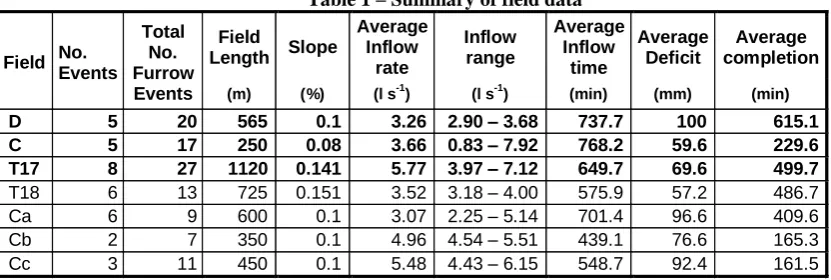
[image:10.595.75.491.509.649.2]Data used in this study were selected from the 200 individual furrow irrigation evaluations conducted by the NCEA (Smith et al. 2005) in the cotton-growing areas of southern Queensland, Australia. Table 1 summarises the data for each field, where the average completion time is the time taken for the water to reach the end of the furrow averaged across events and furrows. Similarly the soil moisture deficit prior to the irrigation varied between events, hence the average value is presented in the Table. All sites were operated under normal commercial conditions with inflow rates and cut-off times as normally used by the farmer. Measurements had been conducted using the tools and techniques of the IrrimateTM surface irrigation evaluation system developed by the NCEA, as described by Dalton et al. (2001). The data that were recorded included inflow hydrographs, furrow dimensions and advance times for up to six locations along the furrow length.
Table 1 – Summary of field data
Field No.
Events
Total No. Furrow Events
Field
Length Slope
Average Inflow
rate
Inflow range
Average Inflow
time
Average Deficit
Average completion
(m) (%) (l s-1) (l s-1) (min) (mm) (min)
D 5 20 565 0.1 3.26 2.90 – 3.68 737.7 100 615.1
C 5 17 250 0.08 3.66 0.83 – 7.92 768.2 59.6 229.6
T17 8 27 1120 0.141 5.77 3.97 – 7.12 649.7 69.6 499.7
T18 6 13 725 0.151 3.52 3.18 – 4.00 575.9 57.2 486.7
Ca 6 9 600 0.1 3.07 2.25 – 5.14 701.4 96.6 409.6
Cb 2 7 350 0.1 4.96 4.54 – 5.51 439.1 76.6 165.3
Cc 3 11 450 0.1 5.48 4.43 – 6.15 548.7 92.4 161.5
Fields in bold represent those used in the primary analysis
11
Inflow rates were also similar between furrows (coefficient of variance (CV) = 5.95 %). Runoff measurements from every furrow were collected close to the end of the field using trapezoidal flumes. However, the short storage phase prevented the onset of steady runoff rates and hence did not permit direct identification of the steady intake rate.
Field C was located on the western Darling Downs on a Black Vertosol soil. Unlike field D, inflow rates varied considerably between irrigation events ranging from 0.83 to 7.92 l s-1 and were constant during each irrigation event.
Field T17 was situated close to Goondiwindi in Southern Queensland and is characterised by a Grey Vertosol soil. In this case the measurements cover a total of eight irrigation events with a different number of furrows observed during each event. Similar to field C, the inflow rates varied from irrigation to irrigation (3.97 to 7.12 l s-1) and were constant within each event.
Each dataset represents the results from between 1 – 5 furrows over a number of irrigation events. For the purposes of this paper this dataset represents the combined population of temporal and spatial variability of furrow infiltration within each field.
3.2 Soil infiltration function
The infiltration parameters (of Eq. 1) were evaluated for every furrow using IPARM V2 (Gillies et al. 2007) which estimates the parameters of the modified Kostiakov equation by an inverse fit of the volume balance model. IPARM applies a least squares approach to identify the unique set of infiltration parameters that minimise the difference between model-simulated and measured advance times or advance times and runoff rates. In the absence of runoff or variable inflow data, IPARM essentially functions identically to INFILT (McClymont and Smith 1996) which has been shown to provide more reliable estimates of the parameters than other volume balance approaches (Khatri and Smith 2005).
12
calculation was computed from the inflow rate using the Manning equation and a roughness coefficient of n = 0.04. This Manning value was recommended by the US Soil Conservation Service for smooth bare soil (Clemmens 2003) and also suggested by ASAE (2003). It is worth noting that the furrow hydraulics are insensitive to small changes in the Manning n (McClymont at al. 1996)
The infiltration curves estimated for the three fields have been presented by Gillies (2008).
4. Validation
4.1 Fitting inter-furrow infiltration variability to the distribution
function
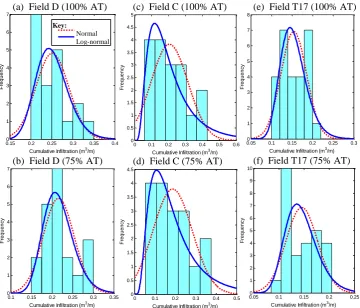
Distribution functions are typically applied to single continuous variables. To enable description of the infiltration curves, the fit to each distribution was evaluated at several discrete values of opportunity time. Accuracy may be compromised where the infiltration curve is extrapolated past the measured advance points used for calibration. Hence, four opportunity times (50%, 75%, 100% and 150%) were selected for each field as ratios of the average advance completion time (AT). Values of AT for fields D, C and T17 were 615, 230 and 500 min, respectively. Frequency histograms (Fig. 1) were created for each dataset at 50%, 75%, 100% and 150% AT and compared with the superimposed theoretical probability curve.
The frequency histograms do not follow the shape of either statistical model exactly, but it does appear that the log-normal curve provides the slightly better fit. The bi-modal pattern of some distributions (e.g. Fig. 1e) may be caused by the multi-event nature of the field data, as
13
fits at opportunity times of 50%, 75% (Fig. 1f) and 100% (Fig. 1e) AT. This is not surprising as this site has a cracking clay soil and there were only a small number of irrigation events for which data were available. Under these conditions, the data represent the distribution of crack volumes from a limited sample of possible crack volumes. It is hypothesised that, for all sites, the fit of the log-normal distribution will improve with increased numbers of infiltration curves.
(a) Field D (100% AT)
0.150 0.2 0.25 0.3 0.35 0.4 1 2 3 4 5 6 7
Cumulative Infiltration (m3/m)
F re q u e n cy Z data2 data3
(b) Field D (75% AT)
0.1 0.15 0.2 0.25 0.3 0.35 0 1 2 3 4 5 6 7
Cumulative Infiltration (m3/m)
F re q u e n cy
(c) Field C (100% AT)
0 0.1 0.2 0.3 0.4 0.5 0.6 0 0.5 1 1.5 2 2.5 3 3.5 4 4.5 5
Cumulative Infiltration (m3/m)
F re q u e n cy
(d) Field C (75% AT)
0 0.1 0.2 0.3 0.4 0.5 0 0.5 1 1.5 2 2.5 3 3.5 4 4.5
Cumulative Infiltration (m3/m)
F re q u e n cy
(e) Field T17 (100% AT)
0.050 0.1 0.15 0.2 0.25 0.3 1 2 3 4 5 6 7 8
Cumulative Infiltration (m3/m)
F re q u e n cy
(f) Field T17 (75% AT)
0.050 0.1 0.15 0.2 0.25 1 2 3 4 5 6 7 8 9 10
Cumulative Infiltration (m3/m)
[image:13.595.118.479.216.524.2]F re q u e n cy Key: Normal Log-normal
Fig. 1 – Frequency histograms for infiltrated depth at 100% and 75% of the final advance time (AT)
4.2 Validation of the proposed relationship between the infiltration
function and the volume balance
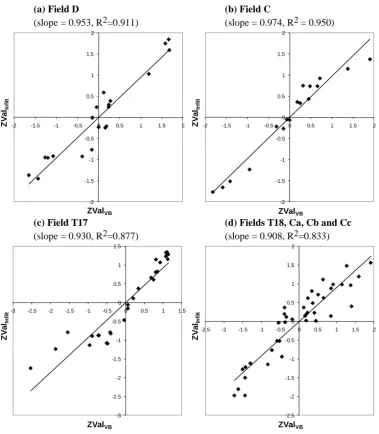
The strength of correlation in ZVal (Eq. 11) was evaluated using measurements from fields D, C and T17 (Fig. 2), with the ZVal terms calculated over the range of opportunity timesof 50
to 100% of the advance time. The plot Fig. 2d contains the combined results from fields T18, Ca, Cb and Cc. As anticipated, the values of ZValInfilt were found to be strongly linearly
correlated with the ZValVB computed from volume balance term. Slopes of the resulting
14
These results provide evidence for a direct 1:1 relationship between the two normalised distributions.
(a) Field D
(slope = 0.953, R2=0.911)
-2 -1.5 -1 -0.5 0 0.5 1 1.5 2
-2 -1.5 -1 -0.5 0 0.5 1 1.5 2
Z
V
a
lInfi
lt
ZValVB (c) Field T17
(slope = 0.930, R2=0.877)
-3 -2.5 -2 -1.5 -1 -0.5 0 0.5 1 1.5
-3 -2.5 -2 -1.5 -1 -0.5 0 0.5 1 1.5
Z
V
a
lInfi
lt
ZValVB
(b) Field C
(slope = 0.974, R2 = 0.950)
-2 -1.5 -1 -0.5 0 0.5 1 1.5 2
-2 -1.5 -1 -0.5 0 0.5 1 1.5 2
Z
V
a
lInfi
lt
ZValVB
(d) Fields T18, Ca, Cb and Cc
(slope = 0.908, R2=0.833)
-2.5 -2 -1.5 -1 -0.5 0 0.5 1 1.5 2
-2.5 -2 -1.5 -1 -0.5 0 0.5 1 1.5 2
Z
V
a
lInfi
lt
[image:14.595.108.488.131.566.2]ZValVB
Fig. 2 – Correlation between ZValInfilt and ZValVB.
The relative variance, given in this case by the CV, was also found to be correlated (Fig. 3) between the two quantities with a slope of 0.960 (R2=0.768) for the three primary fields (D, C and T17) and a slope of 0.981 (R2=0.710) across all seven fields. Ignoring all other possible sources of variability, the CV of the infiltration curves should be approximately equal to that of the volume balance (i.e. the ωCV term in Eq. 12 equals 1). In reality the non-linear form of
15
dependent on the final advance point. Separation of the infiltration variability from other potential sources of variation would require measures of soil infiltration rates independent of the water advance. The spread of the points in Fig. 3 also suggests that this relationship may change in different circumstances.
-0.35 -0.3 -0.25 -0.2 -0.15 -0.1 -0.05 0
-0.35 -0.3 -0.25 -0.2 -0.15 -0.1 -0.05 0
CV
In
fi
lt
CVVB
Primary fields All Fields
Trendline (primary fields) Trendline (all fields)
Fig. 3 – Correlation between the variances of the infiltration curve (CVInfilt) and volume balance term
Tests were also carried out to determine the most suitable range of opportunity times for evaluation of CVInfilt and ZValInfilt. These tests are described in Gillies (2008) and confirmed
16
5.
Case studies of the prediction technique
5.1 Predicted infiltration characteristics
Several case studies were chosen to demonstrate the infiltration characteristic prediction technique. Infiltration parameters were predicted using the final advance point and inflow rate for each furrow in:
- Case study A – Field D using Irr1 Fur3,
- Case study B – Field D using all four furrows from Irr2, - Case study C – Field C using Irr4Fur3 and Irr4Fur4, - Case study D – Field C using Irr1Fur1 and Irr2Fur1, - Case Study E – Field T17 using the two furrows from Irr1, - Case Study F – Field T17 using all four furrows from Irr7.
as the “known” furrow(s). The resulting infiltration curves have been provided by Gillies (2008).
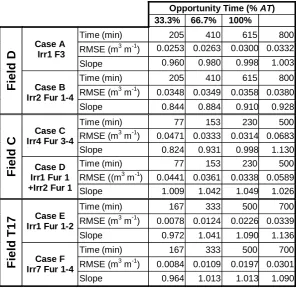
The accuracy of the proposed technique was evaluated using the correlation between the predicted and IPARM estimated infiltration curves. Infiltration parameters were predicted for all furrows including the “known” furrows to eliminate any possible bias towards these curves (which would otherwise be perfectly correlated). Linear correlations with a zero intercept were performed between the IPARM estimated and predicted infiltrated depths at four opportunity times, namely: one third and two thirds of average final advance time (AT), the average final advance time, and an additional later time (Table 2).
The prediction technique was found to provide satisfactory estimates when compared to the infiltration curves derived from the complete set of advance measurements (from IPARM) in every one of the six tests. Considering case study A, the predicted infiltration curves tended to slightly over-estimate the variance when compared to the IPARM generated parameters,
but the relative positions of each curve have been preserved. Similar behaviour was noted amongst the other fields and furrow selections. However, the predicted curves do not
consistently either underestimate or overestimate the variance.
17
to conform to a single general curve shape, defined by the curves for the “known” furrows. This may be an advantage in those cases where the inconsistent shape amongst the IPARM estimated curves is a result of errors or missing values in the field data. In other cases, where the shape difference results from real infield differences in soil infiltration properties, the predictive technique will not reproduce the true form of the curves for all furrows.
[image:17.595.119.416.218.507.2]
Table 2 – Comparison of predicted infiltration curves to measured (IPARM) values
Opportunity Time (% AT)
33.3% 66.7% 100%
F
ie
ld
D
Case A Irr1 F3
Time (min) 205 410 615 800
RMSE (m3 m-1) 0.0253 0.0263 0.0300 0.0332
Slope 0.960 0.980 0.998 1.003
Case B Irr2 Fur 1-4
Time (min) 205 410 615 800
RMSE (m3 m-1) 0.0348 0.0349 0.0358 0.0380
Slope 0.844 0.884 0.910 0.928
F
ie
ld
C
Case C Irr4 Fur 3-4
Time (min) 77 153 230 500
RMSE (m3 m-1) 0.0471 0.0333 0.0314 0.0683
Slope 0.824 0.931 0.998 1.130
Case D Irr1 Fur 1 +Irr2 Fur 1
Time (min) 77 153 230 500
RMSE ((m3 m-1) 0.0441 0.0361 0.0338 0.0589
Slope 1.009 1.042 1.049 1.026
F
ie
ld
T
1
7 Case E
Irr1 Fur 1-2
Time (min) 167 333 500 700
RMSE (m3 m-1) 0.0078 0.0124 0.0226 0.0339
Slope 0.972 1.041 1.090 1.136
Case F Irr7 Fur 1-4
Time (min) 167 333 500 700
RMSE (m3 m-1) 0.0084 0.0109 0.0197 0.0301
Slope 0.964 1.013 1.013 1.090
The root mean square errors (RMSE) for each case presented in Table 2 were calculated from the differences between the measured (IPARM) and predicted infiltrated depths for each furrow at the stated opportunity times. The RMSE statistic reflects the average estimation error for individual furrows. Regression slopes less than unity indicate that on average the predicted infiltration curves over-estimate the measured values. For Field D, the use of additional known furrows (case study B) did not improve the estimation considering either the slope or RMSE (Table 2). Hence, increasing the number of known furrows does not necessarily improve the accuracy of the predicted infiltration parameters, particularly when
18
practice where the user has no knowledge of the target furrows, the use of larger samples of known furrows should improve the reliability of the technique.
5.2 Simulation of whole field irrigation performance
Simulation models provide the ability to predict the advance and recession trajectories, runoff hydrograph and distribution of applied depths. Moreover they are used to assess the performance of an irrigation event through various efficiency and uniformity indices. These models (e.g. SIRMOD of Walker 2003) typically simulate individual furrows only and hence study of field scale variability is difficult. For this reason Gillies (2008) developed a multiple furrow simulation model, IrriProb, based on the full hydrodynamic (continuity and momentum) equations. IrriProb employs the full hydrodynamic model of McClymont (2007) to predict the water distribution in individual furrows and combines the results to predict the spatial distribution of applied depths across the field. The model also allows selection of the flow rate and time to cut-off to give the best or any preferred performance for the field.
When applied across multiple irrigations, IrriProb evaluates the seasonal performance in a similar manner.
In this paper the three performance measures of application efficiency (AE), requirement efficiency (RE) and distribution uniformity (DU) have their usual definitions (Walker and Skogerboe 1987).
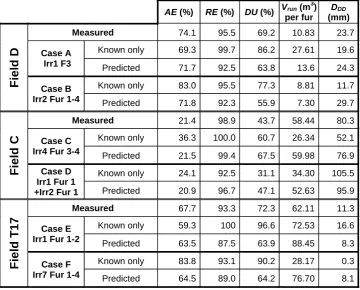
The whole field irrigation performance was modelled for each field using the IrriProb simulation model and using the complete set of infiltration parameters for all “measured” furrows in the field. The measured performance values in Table 3 represent the combined irrigation performance across the entire furrow set using the IPARM estimated infiltration parameters and measured inflow rates and times. In addition to the standard efficiency terms, Vrun represents the volume of runoff per furrow and DDD is the average depth of deep
drainage. “Known only” corresponds to simulation using the known furrows only from the case study and “Predicted” represents simulation of all furrows using the predicted infiltration
19
far better estimate than that from simulation of the known furrow(s) alone. For example, if Field D was evaluated using only measurements from Irr1Fur3 (case study A) the estimated performance values would be an AE of 69%, RE of 100%, DU of 86% and a volume of runoff (Vrun) of 27.6 m3 per furrow, a poor estimate compared to the measured (of 74%, 94%,
65% and 10.9 m3, respectively) results (Table 3). In comparison, the simulation results from the predictive technique provide a closer fit to the measured efficiency and uniformity terms (for example AE, RE and DU of 71.7%, 91.4% and 60.6% respectively). This same trend is repeated across all 6 case studies (Table 3) where simulations using infiltration parameters
[image:19.595.118.479.385.675.2]estimated using the predictive technique provide far better estimates of the performance values. Simulation based exclusively on the known furrow(s) may over-predict or under-predict the efficiency terms depending on random chance. However, reliance on the known furrows should lead to over-estimates of uniformity terms such as DU in the majority of cases.
Table 3 – Comparison of the estimated field performance between simulations using predicted infiltration curves and those based on measured (IPARM) curves
AE (%) RE (%) DU (%) Vrun (m
3 ) per fur
DDD
(mm)
Fie
ld D
Measured 74.1 95.5 69.2 10.83 23.7
Case A Irr1 F3
Known only 69.3 99.7 86.2 27.61 19.6
Predicted 71.7 92.5 63.8 13.6 24.3
Case B Irr2 Fur 1-4
Known only 83.0 95.5 77.3 8.81 11.7
Predicted 71.8 92.3 55.9 7.30 29.7
Fie
ld C
Measured 21.4 98.9 43.7 58.44 80.3
Case C Irr4 Fur 3-4
Known only 36.3 100.0 60.7 26.34 52.1
Predicted 21.5 99.4 67.5 59.98 76.9
Case D Irr1 Fur 1 +Irr2 Fur 1
Known only 24.1 92.5 31.1 34.30 105.5
Predicted 20.9 96.7 47.1 52.63 95.9
Fie
ld T1
7
Measured 67.7 93.3 72.3 62.11 11.3
Case E Irr1 Fur 1-2
Known only 59.3 100 96.6 72.53 16.6
Predicted 63.5 87.5 63.9 88.45 8.3
Case F Irr7 Fur 1-4
Known only 83.8 93.1 90.2 28.17 0.3
Predicted 64.5 89.0 64.2 76.70 8.1
20
characterise the field performance is determined by the furrows chosen for full instrumentation. In practice, with no additional knowledge of other furrows, one must trust that these few selected furrows are representative of the field. The predictive technique described provides the opportunity to reduce the uncertainty in the evaluation process, ultimately leading to improved water management decisions.
It should be noted that the data used to illustrate the approach outlined in this paper were sourced from a limited number of furrows across a small number of fields. Hence, further
studies are required to validate this technique using a more extensive dataset of furrows in a single irrigation event.
7. Conclusions
The data from three different fields were used to characterise the spatial and temporal variability in the infiltration curves for individual furrows. The magnitude of infiltration variability differed significantly between the sites tested. Statistical analysis of the curves demonstrated that both the normal and log-normal distributions were possible fits to the distribution of infiltration curves.
A technique was developed to predict the variation in infiltration functions across irrigated fields using the log-normal probability function, simple measurements of final advance time (or some other point) for the furrows of interest and accurate infiltration curves from one or more furrows in the same field. The resultant predicted infiltration functions provided matches for the measured values over opportunity times equal to the average final advance time. Simulations using the predicted infiltration functions were found to produce reasonable estimates of the field-wide performance parameters such as application efficiency and distribution uniformity. Furthermore, these values were far more representative of the measured field performance when compared to estimates based solely on evaluation of the furrows with accurate infiltration functions. The proposed technique for infiltration prediction at the field level still requires some further work to refine the numerical relationships. The
procedures developed here aim to reduce the data requirements to assess irrigation performance across large spatial scales. Hence, this research provides a step towards feasible
21
Acknowledgements
Acknowledgement must be given to the National Centre for Engineering in Agriculture for measurement and collation of the irrigation data contained within this paper. The authors would also like to acknowledge the Cooperative Research Centre for Irrigation Futures for financial support.
References
Allen, R. R., and Musick, J. T. (1997). "Furrow irrigation infiltration with multiple traffic and increased axle mass." Applied Engineering in Agriculture, 13(1), 49-53.
Amali, S., Rolston, D. E., Fulton, A. E., Hanson, B. R., Phene, C. J., and Oster, J. D. (1997). "Soil water variability under subsurface drip and furrow irrigation." Irrigation
Science, 17(4), 151-155.
ASAE. (2003). "Evaluation of Irrigated Furrows." ASAE EP419.1 FEB03, American Society of Agricultural Engineers.
Bautista E; Wallender W W (1985). "Spatial variability of infiltration in furrows."
Transactions of the ASAE, 28(6), 1846-1851.
Childs J L; Wallender W W; Hopmans J W (1993). "Spatial and seasonal variation of furrow infiltration." Journal of Irrigation and Drainage Engineering, 119(1), 74-90.
Clemmens A J (2003), “Field Verification of a Two-Dimensional Surface Irrigation Model.”
Journal of Irrigation and Drainage Engineering, 129(6), 402-411.
Dalton P; Raine S R; Broadfoot K (2001). "Best management practices for maximising whole farm irrigation efficiency in the Australian cotton industry." Final report to the Cotton Research and Development Corporation. National Centre for Engineering in
Agriculture Report. 179707/2, USQ, Toowoomba.
Elliott R L; Walker W R (1982). "Field evaluation of furrow infiltration and advance functions." Transactions of the ASAE, 25(2), 396-400.
Elliott R L; Walker W R; Skogerboe G V (1983). "Infiltration parameters from furrow irrigation advance data." Transactions of the ASAE, 26(6), 1726-1731.
Ersahin, S. (2003). “Comparing ordinary kriging and cokriging to estimate infiltration rate”. Soil Science Society of America Journal, 67(6), 1848-1855.
Fornstrom K J; Michel J A; Borrelli J; Jackson G D (1985). "Furrow firming for control of irrigation advance rates." Transactions of the ASAE, 28(2), 529-531.
Gillies M H (2008). "Managing the Effect of Infiltration Variability on Surface Irrigation," Unpublished PhD thesis, University of Southern Queensland, Toowoomba.
Gillies M H; Smith R J (2005). "Infiltration parameters from surface irrigation advance and run-off data." Irrigation Science, 24(1), 25-35.
22
Hunsaker D J; Clemmens A J; Fangmeier D D (1999). "Cultural and irrigation management effects on infiltration, soil roughness, and advance in furrowed level basins."
Transactions of the ASAE, 42(6), 1753-1764.
Jaynes D B; Hunsaker D J (1989). "Spatial and temporal variability of water content and infiltration on a flood irrigated field." Transactions of the ASAE, 32(4), 1229-1238. Khatri K L; Smith S R (2006). "Real-time prediction of soil infiltration characteristics for the
management of furrow irrigation." Irrigation Science, 1-11.
Khatri K L; Smith R J (2005). "Evaluation of methods for determining infiltration parameters from irrigation advance data." Irrigation and Drainage, 54(4), 467-482.
Mailhol, J C;, and Gonzalez, J.-M. (1993). “Furrow irrigation model for real-time applications on cracking soils.” Journal of Irrigation and Drainage Engineering, 119(5), 768-783.
McClymont D J (2007). "Development of a Decision Support System for Furrow and Border Irrigation," Unpublished PhD thesis, University of Southern Queensland,
Toowoomba.
McClymont D J; and Smith R J (1996). "Infiltration parameters from optimization on furrow irrigation advance data." Irrigation Science, 17(1), 15-22.
Myers J L; Well A (2003). Research design and statistical analysis, Lawrence Erlbaum Associates, Mahwah.
Oyonarte, N. A., and Mateos, L. (2002). "Accounting for soil variability in the evaluation of furrow irrigation." Transactions of the American Society of Agricultural Engineers, 45(6), 85-94.
Raine S R; McClymont D J; Smith R J (1998). "The effect of variable infiltration on design and management guidelines for surface irrigation." ASSSI National Soils Conference, Brisbane.
Raine S R; Purcell J; Schmidt E (2005). "Improving whole farm and infield irrigation
efficiencies using Irrimate tools." Irrigation 2005: Restoring the Balance, Townsville, Australia.
Renault, D; Wallender, W W (1997). Surface storage in furrow irrigation evaluation. Journal of Irrigation and Drainage Engineering, 123(6), 415-422.
Scaloppi, E J; Merkley, G P; and Willardson, L S (1995). “Intake parameters from advance and wetting phases of surface irrigation.” Journal of Irrigation and Drainage
Engineering, 121(1), 57-70.
Sharma M L; Barron R J W; De Boer E S (1983). "Spatial structure and variability of infiltration parameters." Advances in Infiltration, Proceedings of the National
Conference., Chicago, IL, USA,
Valiantzas, J D; Aggelides, S; and Sassalou, A (2001). “Furrow infiltration estimation from time to a single advance point.” Agricultural Water Management, 52(1), 17-32.
Walker, W R (2003). Surface irrigation simulation, evaluation and design, User Guide and
Technical Documentation (pp. 145). Logan, Utah: Utah State University.
23