CHILDREN’S SERVICES
CAMILLA KIDNER
This briefing provides an overview of children’s services looking at some key statistics, the legislative framework, main types of services provided and structures for integrated working.
There is a very large number of individual policy initiatives relating to children’s services. This briefing does not attempt to cover them all, but focuses on describing the key services and those policies emphasising integrated working.
SPICe
briefing
9 August 2007
07/40
Scottish Parliament Information Centre (SPICe) Briefings are compiled for the benefit of the Members of the Parliament and their personal staff. Authors are available to discuss the contents of these papers with MSPs and their staff who should contact Camilla Kidner on extension 85376 or email
[email protected]. Members of the public or external organisations may comment on this briefing by emailing us at
[email protected]. However, researchers are unable to enter into personal discussion in relation to SPICe Briefing Papers. If you have any general questions about the work of the Parliament you can email the Parliament’s Public Information Service at [email protected].
Every effort is made to ensure that the information contained in SPICe briefings is correct at the time of publication. Readers should be aware however that briefings are not necessarily updated or otherwise amended to reflect subsequent
hanges. c
providing research and information services to the Scottish Parliament
CONTENTS
KEY POINTS ...3
INTRODUCTION ...4
KEY STATISTICS ...7
CHILDREN’S SITUATIONS...7
CHILDREN’S USE OF SERVICES...8
CHILDREN’S SERVICES WORKFORCE...10
LEGISLATIVE FRAMEWORK ...11
KEY LEGISLATION FOR CHILDREN’S SERVICES...11
PLANNING FOR INDIVIDUAL CHILDREN...12
POLICY CONTEXT ...14
ORGANISATIONAL STRUCTURE...18
NHS SERVICES...18
Health Surveillance and Health Promotion ...19
Emergency and Hospital Care ...19
Specialist Services ...19
CHILDREN’S HEARINGS...20
POLICE...20
LOCAL AUTHORITY...20
Social work and social care services ...21
Local authority structures ...21
Integrating health and local authority functions in Glasgow...21
Joint Committee for Children and Young People in Highland...22
Children and Families Department in Edinburgh ...22
Children’s Services Department in Stirling...22
VOLUNTARY AND PRIVATE SECTOR PROVISION OF CHILDREN’S SERVICES...22
INTEGRATED SERVICES PLANNING ...23
STRUCTURES FOR INTEGRATED WORKING ...24
COMMUNITY HEALTH PARTNERSHIPS (CHPS) ...25
CHILDCARE PARTNERSHIPS...26
CHILD PROTECTION COMMITTEES (CPCS)...26
INTER-AGENCY YOUTH JUSTICE STRATEGY GROUP...26
INTEGRATED WORKING IN EDUCATION...27
INTEGRATED WORKING AND THE POLICE...27
INSPECTION AND ACCOUNTABILITY ...28
WORKFORCE ISSUES...29
DISCLOSURE CHECKS...29
HEALTH...29
SOCIAL WORK AND SOCIAL CARE...30
EDUCATION...31
providing research and information services to the Scottish Parliament
KEY POINTS
• Children’s services are very diverse, involving a large range of different agencies, professions, public, voluntary and private sector provision. However, investigations into child deaths have emphasised the need to focus on the individual child’s contacts with all these services and to consider them as a single service system.
• The main children’s services for most children are health visitor checks when they are very young and then pre-school, childcare and school education. However, a small proportion of children need extra support and this often involves complex multi-agency planning and service delivery. This is usually co-ordinated by social work but can involve a large and varied range of agencies. Some children will need sustained multi-agency support while for others it will only be needed for a short period in their childhoods.
• Integrated working is also increasing in ‘universal’ provision i.e. services that are open to everyone rather than being specialist support normally accessed through referral by another agency. For example, schools have developed their role in health promotion for all school pupils as well as being more involved in meeting the additional support needs of a relatively small proportion of pupils.
• Key themes in policy development have been:
o services that are available to everyone (such as school), increasingly work with those children who may need extra support. Early intervention and improved ability to provide support in these ‘mainstream’ settings is expected to prevent problems escalating and also ensure better targeted and fewer referrals to specialist services. This is seen in youth justice, health promotion and child protection policies.
o improving assessment, planning and sharing of information across the whole range of children’s services. This has arisen within separate policy areas, but is given a broader application through Getting it Right for Every Child (Getting it Right) which forms the (previous) Executive’s proposals for changes to children’s services.
o defining quality standards, self evaluation and the further development of inspection is covering an increasing range of services. Her Majesty’s Inspectorate of Education (HMIe) is leading the development of joint children’s services inspections which will begin in 2008.
providing research and information services to the Scottish Parliament
INTRODUCTION
Children’s services cover a wide range of inter-locking services mainly in education, health, social work and the police. Key agencies are therefore local authorities, NHS Boards, police boards and voluntary organisations. Over recent years, partly as a result of inquiry reports, there has been a general move towards improving sharing of information, integrated working and joint planning. Inspection and accountability have also developed with the creation of a new regulation and inspection regime for care services in 2002 and the development of joint inspections of services to protect children since 2005.
Policies referred to throughout are those of the previous Scottish Executive. However, rather than focusing on policy, this briefing aims to set out the ‘landscape’ of existing children’s services – their use, their workforce and accountability arrangements with a particular focus on integrated working. As this is an overview some important but complex areas have not been addressed – particularly funding, sharing information and the broader context of how children’s services sit within other service structures.
A key issue in children’s services is involving all agencies in protecting vulnerable children through improved communication, assessment of risk to children and their needs, planning and management, improved information exchange and clarity about how to respond to concerns about children. Flowing from this are complex issues of effective integrated working, workforce training, supply and targeting and the need to ensure that policies and systems aimed at all children can also identify and protect the minority who are at risk. This links policies in, for example, child protection, youth justice, education and health.
The Cabinet Delivery Group for Children and Young People agreed a clear set of priorities to improve the integration and quality of services for all children and young people in Scotland. The key elements are:
• Integrated Children’s Services Plans which cover school education, children’s social
work, child health and youth justice.
• Quality improvement framework for Integrated services for children and Young People.
This includes performance indicators to be reported annually through the integrated children’s services plans.
• Information sharing. A code of practice is to be produced on sharing information
between professionals on children at risk of significant harm.
• Joint inspection of children’s services
• Workforce development
• Consolidating funding streams for children’s services
An overarching vision for children was set out as part of this work. Children and young people should be ambitious for themselves and be confident individuals, effective communicators, successful learners and responsible citizens. To achieve this, they need to be:
Safe: Children and young people should be protected from abuse, neglect and harm by others at home, at school and in the community.
providing research and information services to the Scottish Parliament
Healthy: Children and young people should enjoy the highest attainable standards of physical and mental health, with access to suitable healthcare and support for safe and healthy lifestyle choices.
Achieving: Children and young people should have access to positive learning environments and opportunities to develop their skills, confidence and self esteem to the fullest potential.
Active: Children and young people should be active with opportunities and encouragement to participate in play and recreation, including sport.
Respected & Responsible: Children, young people and their carers should be involved in decisions that affect them, should have theirvoices heard and should be encouraged to play an active and responsible role in their communities.
Included: Children, young people and their carers should have access to high quality services, when required, and should be assisted to overcome the social, educational, physical, environmental and economic barriers that create inequality.
Getting it Right is an overarching programme which proposes improved planning and assessment for individual children, better integrated working and improvements to the Children’s Hearings System. Getting it Right is about all children and ensuring that they get the help they need when they need it. The policy includes legislation on children’s services and children’s hearings which was published for consultation earlier in 2007 (Scottish Executive, 2007a). This builds on previous and on-going work regarding for example, improving disclosure checks (following the Protection of Vulnerable Groups (Scotland) Act 2007 (asp 14)), the child protection reform programme following the audit and review of child protection ‘It’s Everyone’s Job to Make Sure I’m Alright (Child Protection Audit and Review Group, 2002) (itself sparked by the 2001 Hammond report into a child’s death) and a focus on integrated service planning following ‘For Scotland’s Children’ in 2001. However, the diverse range of children’s services and the people who work in them means that a very large number of policy programmes affect the development of these services.
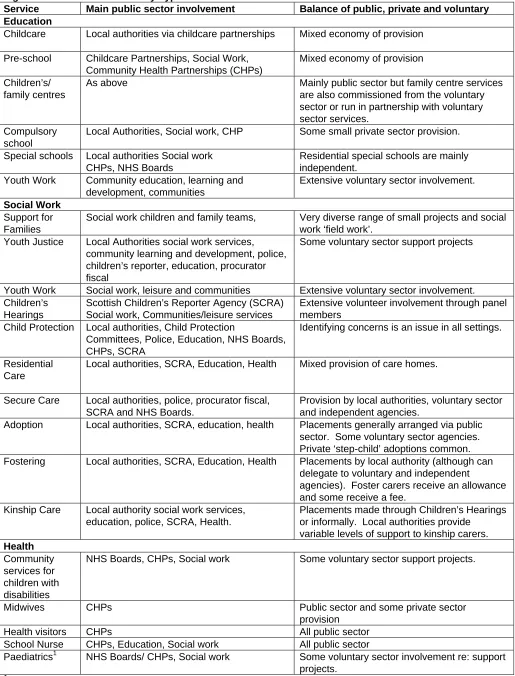
Children’s services are delivered by a range of different agencies (as outlined in figure 1), some of which also provide services to adults. As Figure 1 shows, children’s services are very diverse. They are provided by different professions, can be universal or targeted, and although mainly public sector are also provided by the voluntary and private sectors. Some voluntary and private sector provision is commissioned or purchased by local authorities.
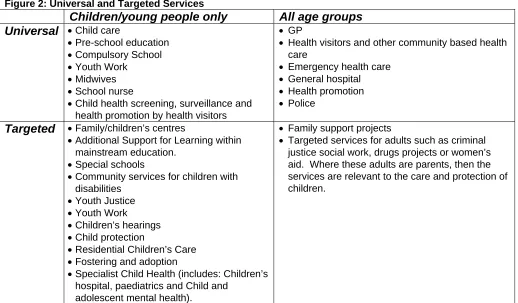
One way to consider services is to split them into four categories: 1. those provided for all and only children (e.g. school),
2. for the whole population including children (e.g. GPs),
3. services targeted at particular children (e.g. children’s hearings) and
4. those targeted at particular groups which include children (eg family support projects)
providing research and information services to the Scottish Parliament
Figure 1: Children’s Services by Type
Service Main public sector involvement Balance of public, private and voluntary Education
Childcare Local authorities via childcare partnerships Mixed economy of provision
Pre-school Childcare Partnerships, Social Work, Community Health Partnerships (CHPs)
Mixed economy of provision
Children’s/ family centres
As above Mainly public sector but family centre services are also commissioned from the voluntary sector or run in partnership with voluntary sector services.
Compulsory school
Local Authorities, Social work, CHP Some small private sector provision.
Special schools Local authorities Social work CHPs, NHS Boards
Residential special schools are mainly independent.
Youth Work Community education, learning and development, communities
Extensive voluntary sector involvement.
Social Work Support for Families
Social work children and family teams, Very diverse range of small projects and social work ‘field work’.
Youth Justice Local Authorities social work services, community learning and development, police, children’s reporter, education, procurator fiscal
Some voluntary sector support projects
Youth Work Social work, leisure and communities Extensive voluntary sector involvement. Children’s
Hearings
Scottish Children’s Reporter Agency (SCRA) Social work, Communities/leisure services
Extensive volunteer involvement through panel members
Child Protection Local authorities, Child Protection
Committees, Police, Education, NHS Boards, CHPs, SCRA
Identifying concerns is an issue in all settings.
Residential Care
Local authorities, SCRA, Education, Health
1
child health specialisms can be community or hospital based and include for example mental health, nursing, and surgery.
Mixed provision of care homes.
Secure Care Local authorities, police, procurator fiscal, SCRA and NHS Boards.
Provision by local authorities, voluntary sector and independent agencies.
Adoption Local authorities, SCRA, education, health Placements generally arranged via public sector. Some voluntary sector agencies. Private ‘step-child’ adoptions common. Fostering Local authorities, SCRA, Education, Health Placements by local authority (although can
delegate to voluntary and independent
agencies). Foster carers receive an allowance and some receive a fee.
Kinship Care Local authority social work services, education, police, SCRA, Health.
Placements made through Children’s Hearings or informally. Local authorities provide
variable levels of support to kinship carers. Health
Community services for children with disabilities
NHS Boards, CHPs, Social work Some voluntary sector support projects.
Midwives CHPs Public sector and some private sector
provision
Health visitors CHPs All public sector
School Nurse CHPs, Education, Social work All public sector
providing research and information services to the Scottish Parliament
Figure 2: Universal and Targeted Services
Children/young people only All age groups
Universal • Child care
• Pre-school education • Compulsory School • Youth Work
• Midwives • School nurse
• Child health screening, surveillance and health promotion by health visitors
• GP
• Health visitors and other community based health care
• Emergency health care • General hospital • Health promotion • Police
Targeted • Family/children’s centres
• Additional Support for Learning within mainstream education.
• Special schools
• Community services for children with disabilities
• Youth Justice • Youth Work • Children’s hearings • Child protection
• Residential Children’s Care • Fostering and adoption
• Specialist Child Health (includes: Children’s hospital, paediatrics and Child and
adolescent mental health).
• Family support projects
• Targeted services for adults such as criminal justice social work, drugs projects or women’s aid. Where these adults are parents, then the services are relevant to the care and protection of children.
KEY STATISTICS
In order to illustrate the differing levels of use of these services, the following section gives some statistics on children’s situations, their use of services and the workforce involved with them.
CHILDREN’S SITUATIONS
There are 921,833 children under 16 in Scotland, making up 18% of the population (GROS, 2007). This proportion declined by 10% between 1995 and 2005 (GROS, 2006). For most children, their involvement with children’s services will be health visitor checks and immunisations when a baby, the occasional visit to a GP or A&E, part time pre-school at 3-5 perhaps combined with some childcare and compulsory school from age 5 to 16 or 18. However, a small proportion of children require more specific services as illustrated in the following statistics. It is not possible to identify from published statistics, the extent to which these groups of children overlap. Therefore it is not possible to estimate the actual proportion of the population who require a targeted or specialised service at some point in their childhood. However, the following give some indication of the scale of need in different areas.
• A study in 2000 found that 9.5% of school age children in the UK (aged 5–15 years) have a disorder of mental health that affects their daily life (PHIS, 2003). If the proportion was the same in Scotland, then this would affect around 62,000 school children1.
• 5% of school pupils have additional support needs (36,148 pupils) (Scottish Executive, 2007b).
1
providing research and information services to the Scottish Parliament
• There are 11,219 carers in Scotland aged under 16 years. Nearly 2,000 of these young people provide more than 20 hours of care a week. (GROS, 2001)
• Current best estimates are that 1-2% of under 16’s live with a problem drug user. (10,300 to 19,500 children) but anestimated 4-6% have a problem drug using parent (40,000 – 60,000) (Advisory Council on the Misuse of Drugs, 2003)
• 14,579 children and young people under 20 years have additional health support needs. This breaks down as 0.9% of 0-4 year olds, 2.2% of 5-16year olds and 0.9% of 17-19 year olds (ISD, 2006a).
• 1.5% pupils are assessed or declared as having a disability (10,920 pupils) (Scottish Executive, 2007b).
• 0.31% of children have multiple and complex disabilities (ISD, 2006a)
• 1,429 children are ‘persistent young offenders’ (SCRA, 2007). This represents 0.3% of those aged 8 to 15 inclusive.
CHILDREN’S USE OF SERVICES
The patterns of children’s involvement with services unsurprisingly show education as the most used service. In other areas the large and increasing number of referrals to the Children’s Reporter has been consistently highlighted by the SCRA and the small number of persistent young offenders has been the subject of high profile policy interest.
• There are 702,737 school pupils and 105,814 children in early years education (Scottish Executive, 2007b, 2006b). (Children are counted once for each early year’s centre they are registered with so the latter figure may include some double counting).
• In 2005/06, 65.4 per 1,000 population (6.5%) under 15 were admitted to hospital as an emergency compared to 47.9 per 1,000 population elective admissions. The highest rate was emergency admission of children under 1 year which was 239 per 1,000 population (ISD 2006b).
• 53,883 children were referred to the Children’s Reporter in 2005/06. This represents 5.8% of the population under 16. Most (87%) referrals are made by the police on care and protection grounds. 14,282 children were subsequently referred on to a children’s hearing following a reporter’s investigation. This represents 1.5% of the under 16 population (SCRA, 2006).
• 12,966 children were looked after by local authorities at March 2006. This represents 1.2% of the population under 19 (Scottish Executive, 2006c).
providing research and information services to the Scottish Parliament
• In 2005/06 health visitors’ contact rate was 3.3 visits per head of population for children under five. For GP’s the rate was 3.3 for boys and 3.0 for girls. The contact rate drops off dramatically for children aged between 5 and 14 years. It is 1.7 for boys and 1.9 for girls (ISD 2006c, 2006d).
[image:9.595.119.476.268.460.2]Many of the children using targeted children’s social work services will be ‘looked after2’ by the local authority and access foster care, residential care or residential schools. However, nearly half (42%) of looked after children are at home with parents where their main involvement will be with the education services and local children and families social work team. Of the 13% in residential accommodation, most are either in local authority children’s homes or a residential school. 29% of looked after children are in foster care and these children tend to be slightly younger than those in residential care where most are aged between 12 and 15. (Scottish Executive, 2006c). In 2005/06 there was an average of 84 children in secure care (Scottish Executive, 2006i).
Figure 3: Looked after children by residence
0 1,000 2,000 3,000 4,000 5,000 6,000
parents foster care other community residential
(Scottish Executive, 2006c)
Figure 4 illustrates the different scale of use of some example children’s services taken from the above statistics.
Figure 4: Scale of use of example children’s services
0 100,000 200,000 300,000 400,000 500,000 600,000 700,000 800,000
school pupils
pre-school hospital admissions
children's hearing referrals
child protection
referrals
Ch
ild
re
n
Sources: Scottish Executive 2007b, 2006b, ISD 2006b, SCRA 2006, Scottish Executive 2006d.
2
[image:9.595.119.476.508.705.2]providing research and information services to the Scottish Parliament
CHILDREN’S SERVICES WORKFORCE
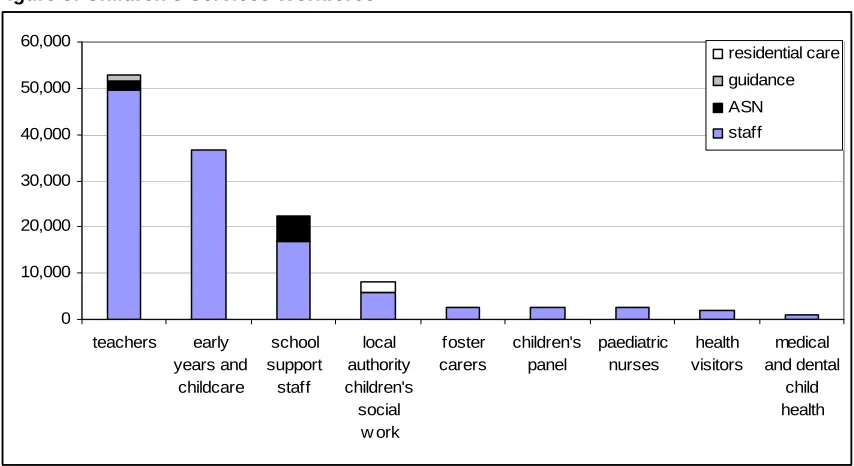
The main professional groups involved are in education, social work and health. In terms of numbers school education dominates, followed by pre-school and childcare. Although health is a universal service, relatively few health professionals specialise in children’s health. In social work services there is also a notable contribution from foster carers and in the Children’s Hearing system volunteers make a significant contribution through children’s panel membership.
Education and childcare
• 52,819 teachers (including 1,212 guidance teachers, 3,284 Additional support for learning) and 1,673 learning support, (Scottish Executive, 2007d)
• 36,691 in early years and childcare (Scottish Executive, 2006e)
• 20,231 school support staff (including 105 home-school link workers, 4,607 additional support needs/care assistants, 168 behaviour support) (Scottish Executive, 2007d)
Social Work/children’s hearings
• 8,124 children’s social work services local authority staff, representing 15% of the Scottish social work services workforce of which 2,200 are residential staff and 645 are day care staff providing services for children (Scottish Executive, 2006f)
• 2,600 foster carers (BBC News, 2006).
• 2,800 children’s panel members across Scotland (Scottish Executive, 2006g)
Health
• 3,367 Midwives(351 community, 3,016 hospital) (ISD, 2006e).
• 2,489 paediatric nurses (registered and non-registered) (ISD 2006e, Table E2). • 1,826 health visitors (ISD, 2006e)
• 421 school nurses (ISD, 2006e)
• 864 medical and dental staff with a child health speciality. (536 hospital based paediatrics, 105 child and adolescent psychiatry, 62 paediatric surgery, 135 community child health, 26 paediatric dentistry) (ISD 2006e, Table B12).
[image:10.595.81.508.528.761.2]Figure 5 below illustrates the domination of education in the children’s services workforce overall and the low numbers of child health specialists.
Figure 5: Children’s Services Workforce
0 10,000 20,000 30,000 40,000 50,000 60,000
teachers early years and
childcare
school support staff
local authority children's
social w ork
foster carers
children's panel
paediatric nurses
health visitors
medical and dental
child health residential care guidance ASN staff
providing research and information services to the Scottish Parliament
In addition to those who work mainly with children, we rely on many workers in general public services who might be the first to come into contact with a child, and may refer on to more specialist services such as the 4,367 GPs (ISD, 2006f) and the 16,164 Police officers (HMIC, 2005). Finally there are also those in services for vulnerable adults. If these adults are parents, then the staff of these projects may be the first to pick up on issues for the children.
[image:11.595.39.553.252.343.2]Figure 6 below gives an indication of the number of children accessing some services compared to the numbers of staff. While data is available for some services such as school education, pre-school and children’s hearings it is much harder to identify the comparable statistics in relation to social work, child protection and child health. The table below gives some of the more comparable figures.
Figure 6: Comparing staff and service use in example children’s services
Staff Children Teachers (Scottish Executive 2007d) 52,819 702,737 pupils (SE 2007b)
Pre-school staff (S.E 2006e) 12,544 105,814 pre-school pupils (SE 2006b)
ASL staff (SE 2007d) 3,284 36,148 pupils with ASN (SE 2007b)
Foster carers (BBC 2006) 2,600 3,731 children in foster care (SE 2006c)
Children’s panel members (SE 2006g) 2,500 14,282 referrals from the reporter to a hearing and 38,000 hearings3(SCRA, 2006)
LEGISLATIVE FRAMEWORK
The key legislation for children’s services is the Children (Scotland) Act 1995 (c.36) which, among other things, provides the framework for the children’s hearings system and the duties of local authorities towards children. Adoption legislation has recently been amended and other recent legislation has covered issues such as mental health services, social work and joint inspection, regulation and disclosure checks. Within these Acts are requirements for children in certain circumstances to have an assessment of needs or a plan. This is outlined in the second section.
KEY LEGISLATION FOR CHILDREN’S SERVICES
Figure 7: Key legislation for Children’s Services
Legislation Key effect for children’s services Children and Young Persons
(Scotland) Act 1937 (c.37)
various provisions regarding safety and health of children including smoking, alcohol consumption and employment.
Social Work (Scotland) Act 1968 (c.49)
concerns social work services generally with some provisions specifically in relation to children such as residential care and secure accommodation.
Adoption (Scotland) Act 1978 (c.28) provides the framework for adoption and adoption services in Scotland. It will be largely repealed when the Adoption and Children (Scotland) Act 2007 comes into effect
Education (Scotland) Act 1980 (c.44)
this is the main education Act and contains some provisions on child welfare such as the provision of free school meals, clothing and health checks.
Foster Children (Scotland) Act 1984 (c.56)
provides for the duties of local authorities towards children who are privately fostered and persons disqualified from being private foster parents. (n.b.: most foster care is covered by the Children (Scotland) Act 1995 and the Fostering of Children (Scotland) Regulations 1996.)
Children (Scotland) Act 1995 (c.36) in relation to the public sector this provides the framework for the
3
providing research and information services to the Scottish Parliament
children’s hearings system, for when a child can become ‘looked after and accommodated’ by the local authority, and subsequent duties towards them. Sets out duties of local authorities towards children ‘in need’. Requires local authorities to produce children’s services plans.
Standards in Scotland’s Schools etc. Act 2000 (asp 6)
establishes the right to education and the principle of mainstream education for pupils with special educational needs. Establishes a framework for raising standards based on ‘national priorities’ and ends corporal punishment. Provides for ending self- governing status of
schools, changes to School Boards, and reforms to the General Teaching Council for Scotland
Regulation of Care (Scotland) Act 2001 (asp 8)
creates a new regulatory and inspection framework for social care services including children’s services.
Commissioner for Children and Young People (Scotland) Act 2003 (asp 17)
establishes the office of Children’s Commissioner.
Protection of Children (Scotland) Act 2003 (asp 5)
provides for a list of individuals considered unsuitable to work with children and for those on the list (other than provisionally) to be banned from working with children. When it comes into force, Schedule 4 of the Protection of Vulnerable Groups (Scotland) Act 2007 will repeal this Act apart from s13 and s16.
Mental Health Care and Treatment (Scotland) Act 2003 (asp 13)
includes provision for the care and treatment of children. Interlinks with the Children (Scotland) Act 1995 and Social Work (Scotland) Act 1968. New duties on NHS boards to provide age-appropriate services for those under 18 who require psychiatric in-patient treatment.
Education (Additional Support for Learning) (Scotland) Act 2004 (asp 4)
introduces a new concept of ‘additional support needs’, which refers to any child or young person who, for whatever reason, requires additional support for learning. Establishes a new framework for supporting children and young people with additional support needs. Requires education authorities to give extra help in school to all children and young people with additional support needs
Anti-social Behaviour etc. (Scotland) Act 2004 (asp 8)
children aged 12 or older can be subject to an anti-social behaviour order. The Act also provides for parenting orders, movement restriction conditions, dispersal orders, and strengthens duties on local authorities to implement supervision requirements.
The Joint Inspections of Children's Services and Inspection of Social Work Services (Scotland) Act 2006 (asp 3)
allows for the inspection of social work services, establishes the Social Work Inspections Agency and provides for joint inspections of children’s services by HMIe, NHS-QIS (NHS Quality Improvement Scotland), HMIC (Her Majesty’s Inspectorate of Constabulary) and SWIA (Social Work Inspection Agency).
Adoption and Children (Scotland) Act 2007 (asp 4)
the key changes relating to public services are that it; introduces ‘permanence orders’ which could be used for long term fostering arrangements, extends the adoption support services framework and allows for the introduction of a national system of care allowances. Not yet in force.
Protection of Vulnerable Groups (Scotland) Act 2007 (asp 14)
amends the system for vetting and barring those working with children. (Also covers vulnerable adults). Not yet in force.
PLANNING FOR INDIVIDUAL CHILDREN
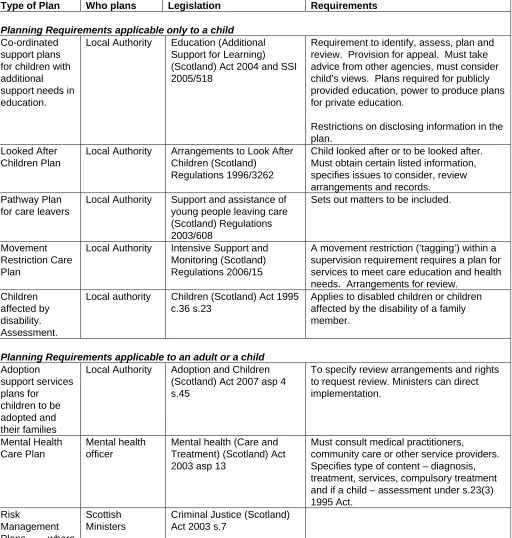
Currently there are nine statutory plans for individuals which can apply to a child. Five of them would apply only to a child and four can apply either to adults or children. They cover looked after children, adopted children, additional support needs in education, care services, youth justice and mental health.
providing research and information services to the Scottish Parliament
Right proposes a degree of harmonisation of children’s individual planning. The first stage of this is the intention that by December 2007 all children going to a Children’s Hearing have a plan (Scottish Executive, 2006a). The overarching aim of Getting it Right is that children and young people get the help they need when they need it. Draft legislation includes proposals that agencies are to co-operate with each other and when they do, in relation to an individual child they must adopt a joint plan and designate a person to take responsibility for ensuring the plan is implemented. The agencies involved are mainly local authorities, health boards and police forces although the draft legislation proposes that any specified body could be included (Scottish Executive, 2007a).
[image:13.595.42.554.227.765.2]The following lists the current statutory planning requirements for individual children.
Figure 8: Statutory requirements for individual plans for children
Type of Plan Who plans Legislation Requirements
Planning Requirements applicable only to a child Co-ordinated
support plans for children with additional support needs in education.
Local Authority Education (Additional Support for Learning) (Scotland) Act 2004 and SSI 2005/518
Requirement to identify, assess, plan and review. Provision for appeal. Must take advice from other agencies, must consider child’s views. Plans required for publicly provided education, power to produce plans for private education.
Restrictions on disclosing information in the plan.
Looked After Children Plan
Local Authority Arrangements to Look After Children (Scotland)
Regulations 1996/3262
Child looked after or to be looked after. Must obtain certain listed information, specifies issues to consider, review arrangements and records.
Pathway Plan for care leavers
Local Authority Support and assistance of young people leaving care (Scotland) Regulations 2003/608
Sets out matters to be included.
Movement Restriction Care Plan
Local Authority Intensive Support and Monitoring (Scotland) Regulations 2006/15
A movement restriction (‘tagging’) within a supervision requirement requires a plan for services to meet care education and health needs. Arrangements for review.
Children affected by disability. Assessment.
Local authority Children (Scotland) Act 1995 c.36 s.23
Applies to disabled children or children affected by the disability of a family member.
Planning Requirements applicable to an adult or a child Adoption
support services plans for
children to be adopted and their families
Local Authority Adoption and Children (Scotland) Act 2007 asp 4 s.45
To specify review arrangements and rights to request review. Ministers can direct implementation.
Mental Health Care Plan
Mental health officer
Mental health (Care and Treatment) (Scotland) Act 2003 asp 13
Must consult medical practitioners,
community care or other service providers. Specifies type of content – diagnosis, treatment, services, compulsory treatment and if a child – assessment under s.23(3) 1995 Act. Risk Management Plans where Scottish Ministers
providing research and information services to the Scottish Parliament
offenders pose a risk to the public.
Personal Plan Care provider Regulation of Care (Requirements as to care services) (Scotland) Regulations 2002/114
Sets out how the user’s health and welfare needs are to be met. Arrangements for review.
Assessment of carer.
Local authority Children (Scotland) Act 1995 c.36 s.24
Assessment of carer’s ability to provide for disabled child/ ability of carer of any age (including young carers) to provide care for a person aged over 18. This ought to lead to the planning and provision of services and ought to form part of a care plan.
There is an issue about whether all those who require a plan, have a plan. For example, in 2006, 52% of those leaving care had a pathway plan and 60% have a nominated pathway co-ordinator (Scottish Executive 2006c). A key objective of children’s services policy including Getting it Right is to ensure that all those who require a plan, have one.
POLICY CONTEXT
Factors which shape the policy context include:
• the involvement of a wide range of different services in delivering services for children and the challenges this presents to developing a single framework for them.
• the choice between organising services according to policy area i.e. health, social work, education or by life stage – as a children’s services approach does and the complications inherent in doing both.
• the mix of public and voluntary sector provision. This is particularly true in childcare and in voluntary sector projects supporting specialist health or social work.
• the balance between ‘universal’ and ‘targeted’ services which is often affected by the degree of emphasis on ‘early intervention.’ The increasing focus on early intervention places more emphasis on mainstream services supporting specialist service provision. Key documents such as ‘For Scotland’s Children’ (see below) placed the emphasis on dealing with an issue in ‘mainstream’ wherever possible.
• the role of ‘adult’ services in relation to children of their clients. This issue has arisen particularly in relation to services for problem drug users and the role of police in relation to domestic violence incidents where there are children present.
• logistical and IT capacity to create a seamless system for information sharing which adheres to both data protection/privacy considerations but still ensures that professionals can put together a full picture of the risks faced by a vulnerable child by drawing on different data sources. A common theme in child protection is the need for an agreed, consistent approach to the appropriate sharing of information across organisational, departmental and professional boundaries.
• responses to reports into child deaths. The Child Protection Audit and Review and subsequent reform programme responded to the Hammond report and changes to vetting and barring of staff working with children have been a response to the Bichard inquiry.
• the place of children’s services within the wider context of Community Planning, Best Value and proposals for public sector reform.
providing research and information services to the Scottish Parliament
For Scotland’s Children (Scottish Executive, 2001): The report proposed a single service system with joint workforce planning, joint service planning and a multi-disciplinary, preventative approach to assessment and intervention. This system did not require co-location or organisational restructuring but rather effective service delivery regardless of service and organisational boundaries. Six action points were that local agencies should:
• consider children's services as a single service system • establish a joint children's services plan for each area • ensure inclusive access for all children to universal services • co-ordinate needs assessment
• co-ordinate intervention
• target services to meet needs and reduce inequalities.
Much of what was recommended in ‘For Scotland’s Children’ has been reflected in subsequent policy.
Health for All Children 4 (Hall and Elliman, 2002) This report from the Royal College of Paediatrics and Child Health is the fourth in a series which started in 1989. It sets out proposals for child health surveillance, screening and health promotion. It focuses on preventive health care, health promotion and an effective community-based response to the needs of families, children and young people. The framework set out in Hall 4 is firmly rooted in the need for an integrated approach to the delivery of services and support for children and families. The Executive published guidance in 2005 on how it is to be implemented in Scotland (Scottish Executive, 2005a). It has a particular effect on health visitors and set out a ‘core programme’ of health checks which is supplemented where necessary by more targeted support. The planned result of this is for fewer routine checks and a greater focus on those assessed as having greater need.
It’s Everyone’s Job to Make Sure I’m Alright (Child Protection Audit and Review Group 2002). This audit and review of child protection services found a mixed picture with good outcomes reliant on the quality of social work. In 44 cases out of 188 reviewed, the child’s needs were not met. The review group made 17 recommendations including: improving information sharing (particularly to enable mainstream agencies to spot a pattern of injury by pulling together disparate records), improving record keeping both of notes of concern and of key information about a child by schools, health, police and social work, changes to the work of Child Protection Committees, developing practice standards, improving children’s services plans, reviewing the grounds of referral to children’s hearings, developing a computer based information system (which would include a single integrated assessment, planning and review report framework for children in need) and identifying minimum required qualifications for the workforce.
10-point Action Plan for tackling youth crime and disorder (2002) and Youth Justice Improvement Group report (2006). An advisory Group on Youth Crime report in 2000 was followed by an action plan in 2002 (Scottish Executive 2002a). These focused on increasing public confidence in Scotland's system of Youth Justice; easing the transition between the youth justice and adult criminal justice systems; giving victims an appropriate place in the youth justice process; recognising that all children and young people should be valued and encouraged to thrive; and effective early intervention.
providing research and information services to the Scottish Parliament
and developing the effectiveness of the system. The plan included youth courts, specialist children’s hearings, national standards and promoting parental responsibility.
National Standards for Scotland's Youth Justice services were published in December 2002 and had largely been implemented by April 2006. The Youth Justice Improvement Group reported in October 2006 and recommended a focus on early intervention (including support to parents), multi-agency working, integration of specialist and mainstream agencies, closer integration of Anti-Social Behaviour services with youth justice teams and tackling the barriers to change (such as poor mental health, addictions and poor education).
Child Protection Reform Programme (2003 – 06) This wide ranging reform programme included raising awareness, developing a framework for standards and improving training. Projects of the reform programme included:
• the publication of a Children's Charter, setting out what every child has the right to expect • the development of the Framework for Standards which applies to all agencies
• the development of joint agency inspection for all agencies involved in child protection This led to legislation and development of inspections for all children’s services • examination and clarification of the role and remit of Child Protection Committees
• the development of a 24 hour free phone line providing a single national gateway to local child protection service providers
• raising community awareness of child protection • inter-agency child protection training
• child death and significant case reviews guidance
Additional Support for Learning The Education (Additional Support for Learning) (Scotland) Act 2004 introduces a new framework for supporting children and young people in their school education. However, the Act also requires an education authority to provide additional support to certain disabled pre-school children in their area, normally those under 3 years old. Factors that may give rise to additional support needs may arise from the learning environment, family circumstances, disability or health need, or social and emotional factors. The Act promotes integrated working across agencies in assessment, intervention, planning provision and review. A small number of children and young people have additional support needs arising from complex or multiple factors which require a high degree of co-ordination of support from education authorities and other agencies and in such circumstances may have a statutory co-ordinated support plan prepared for them. Agencies referred to may include a local authority’s social work services, a health board or another local authority. However, this also includes Careers Scotland, further and higher educational providers, particularly when considering the transition to post-school life for certain children and young people with additional support needs.
Getting it Right for Every Child (2005 – current). A number of government reviews – For Scotland’s Children; It’s Everyone’s job to Make Sure I’m Alright and the Hearing’s Review consultation documents Getting it Right for Every Child, found that too many children were not getting the help they needed when they needed it. Implementation plans and a draft bill consultation were published in 2006. It is a broad ranging programme whose proposals include: • a draft bill which proposes new duties on agencies to co-operate with each other and
share information and make alterations to the Children’s Hearings system.
providing research and information services to the Scottish Parliament
efficient information sharing. Improvements in practice will also be encouraged through training and guidance.
• removing barriers. Where necessary, structural, financial, legislative and cultural change to remove the obstacles to effective joined up working and to timely, appropriate responses.
The implementation plan describes this as an “ambitious programme and a significant challenge for all those who work with children. It requires a fundamental shift in how children are helped and supported. This will take time” (Scottish Executive, 2006a).
Delivering a Healthy Future: An Action Framework for Children and Young People’s Health in Scotland. (Scottish Executive, 2007e) This ten year strategy pulls together existing policies on child health into a single document and describes a number of key actions on specific services for example emergency care, the development of two new children’s hospitals in Edinburgh and Glasgow and improving care in remote areas. As well as specific service improvements it includes action plans on improving quality, developing care pathways, establishing Managed Clinical Networks, workforce and performance management. It recognises that the issues are “extremely complicated and not susceptible to health solutions alone’ and so ‘given the crucial role of other sectors in the overall child health agenda and delivering improved outcomes for children more generally” implementation will require interagency working.
Changing Lives (Social Work Review Team, 2006) The report of the 21st century social work review is currently being implemented through a ‘change programme.’ This will affect all social work services – not just those working with children. The review highlighted the need for ‘client centred’ care, for early intervention and preventative work and the building of capacity in the workforce, community and individuals to meet changing demands and help improve outcomes.
Transforming Public Services (Scottish Executive, 2006h) The reform agenda across all public services will affect public services for children. Key principles echo those in many children’s policies – those of user focus, improved quality, joined up services and strengthened accountability. This builds on (among other things) developments in Best Value and Community Planning.
A broad spectrum of activity also exists to support children in substance-misusing households. Responding to the original Hidden Harm report in 2003 (Advisory Council on the Misuse of Drugs), and evolving through several strategic documents, the most recent of which, Hidden Harm – Next Steps (Scottish Executive, 2006j) was published in May 2006, this work extends across education, social work health and justice and represents a range of interventions aimed at tackling this complex problem.
Key issues running through all of these are:
• the need for better integrated services both at a strategic level and at the level of the individual child’s experience of services.
• a focus on mainstream services doing more before referring on to targeted services. • a focus on integrated assessment and planning, improving information systems and
better sharing of information.
providing research and information services to the Scottish Parliament
ORGANISATIONAL STRUCTURE
There are 8 police forces, 14 area health boards and 32 local authorities and the structures within each of these are complex. In a few areas boundaries between these services are shared but in many more they are not. There is also a wide range of voluntary and private sector organisations providing services. A variety of structures have developed to encourage integrated working between and within these. This has not only happened for children’s services – integrated children’s services need to complement structures for other kinds of integrated working such as community planning.
In 2001 the “For Scotland’s Children” report expressed concern that the help a child received often depended on the chance of where concerns were picked up:
“We should perhaps expect one of the two guides: health or education (the universal services) to identify such children and co-ordinate the further help they need. This does not always happen!
Instead, the child waits - sometimes escalating the problematic behaviour if that is their manifestation of "something wrong" - until there is some attention.
If it gets picked up at school there is a range of options: guidance, educational psychologist, social work, Reporter.
If in the community, another range, perhaps involving the police.
If in the family, yet another, perhaps including the GP and specialist medical services such as child and adolescent psychiatry.
The point is that the service the child ends up in is largely due to the accident of the point of entry to specialist services, rather than to any comprehensive appraisal of the optimum response to the assessed needs of the child.”
(Scottish Executive, 2001 ch.2)
Much work has been done since this report in 2001 but the landscape is still complicated. The following section gives an overview of the different kinds of services provided and this is followed by descriptions of the main arrangements to encourage integration between them.
NHS SERVICES
Most health care for children is delivered through community settings – such as GPs, health visitors and health promotion through schools. Very young children have a higher rate of emergency hospital admission than other children or of adults under 60 and while there are relatively few children in need of specialist health services, these low numbers make it difficult to deliver these specialist services as locally as possible.
providing research and information services to the Scottish Parliament
Community based services are mainly organised together under 37 Community Health Partnerships which generally reflect local authority boundaries. (Scottish Executive Health Department, on-line). See below p. 25.
Health Surveillance and Health Promotion
All children get routine health checks and immunisation in early childhood. Screening, surveillance and health promotion checks have recently been reviewed through HALL4 (Hall and Elliman, 2002) and Scottish Executive guidance in 2005 proposed stopping some of the routine checks and creating a more targeted approach. It also stressed the need for improved integrated working through settings such as family centres, nurseries and schools (Scottish Executive, 2005a). All schools will be required to be health promoting under the Schools (Health Promotion and Nutrition) (Scotland) Act 2007 asp 15.
Emergency and Hospital Care
In order of increasing specialism emergency care is provided through:
• Community hospital, minor injury facility, primary care medical centre, out-of-hours centre, NHS24
• General hospital with accident and emergency department without inpatient paediatric unit
• General hospital with inpatient paediatric unit • Specialist children’s hospital
(Scottish Executive, 2007e at 29)
The Scottish Executive published guidance in 2006 for delivering improvements in emergency care services for children and young people in Scotland (Scottish Executive, 2006k). This also provides a template with standards on what should be delivered in different settings.
Specialist Services
Specialist services include paediatrics and child and adolescent mental health services. Delivering a Healthy Future describes specialist services as ‘characterised by their complexity, low volume and dependence on small numbers of highly trained staff.’ As a result the current pattern of provision is fragmented and has evolved rather than been designed. In order to develop more coherence, the Executive set up a National Steering Group for Specialist Children’s Services in Scotland and asked it to produce a ‘National Delivery Plan’ by autumn 2007 (Scottish Executive, 2007e at 35).
Children and adolescent mental health services (CAMHS)
The wider children’s services workforce have key role in mental health. Complex and severe problems are dealt with by specialist CAMHS. Practitioners who contribute to specialist CAMHS include: psychiatric nurses, child and adolescent psychiatrists, clinical psychologists, forensic psychiatrists and psychologists, social workers, psychotherapists (including child, analytical, systemic/family, cognitive behavioural), creative therapists (including art, music and drama), play therapists, liaison teachers, speech and language therapists, occupational therapists and dieticians. Mental Health of Children and Young People: A framework for Promotion, Prevention and Care (2005) is to be implemented by 2015 (Scottish Executive, 2005b).
Complex needs
providing research and information services to the Scottish Parliament
locally and better management of transitions (Scottish Executive, 2007e at 41). As in other areas there is a need for:
• effective inter-agency working • sharing of information
• well organised discharge planning • structured resourcing of care packages
• co-ordination of care through an identified key worker/lead professional • planned multi-agency reviews
CHILDREN’S HEARINGS
The two key parts of the system are the Children’s Reporters and the panels. Children’s reporters are employed by the Scottish Children’s Reporter Administration (SCRA) which is a Non-Departmental Public Body (NDPB). There are four regional reporters and a lead reporter for each local authority. Reporters need to work closely with the local authority but are independent of it. Reporters take referrals from anyone concerned about a child. Most referrals are from the police although these are mainly on care and protection rather than offence grounds. They investigate referrals and decide whether to refer to a Children’s Hearing. Children’s Panels are Tribunal NDPBs4 and the Panel Chair is appointed by Scottish Ministers on advice from the Children’s Panel Advisory Committee.
The Executive’s review of the system now forms part of the Getting it Right programme. The operation of the Hearings system is also a key part of the Executive’s policy on reducing youth offending.
POLICE
The main involvement of the police in children’s services is through child protection, children’s hearings and youth justice. Police boards have family protection or child protection units which work with social work, health, education and the voluntary sector. This highlights their important role in identifying children at risk as well as their role in relation to offending behaviour. As noted above, the police make the majority of referrals to the Children’s Reporter – both on offending and non-offence grounds.
LOCAL AUTHORITY
Although there is some targeted provision for the under threes (particularly through social work, family centres and sure start), most local authority co-ordinated provision starts with pre-school education at 3 moving on to school education at age 5. Across the whole age group, children and families social work provide general and crisis support, which includes formal child protection work, youth justice work and work with the children’s hearings system. It is normally local authorities who implement the decisions from a children’s hearing and provide services for vulnerable children such as looked after children or children with disabilities. These services may be provided directly by the local authority or in conjunction with health or voluntary sector organisations.
Education services
Education services are mainly provided through the 1,584 pre-school centres, 2,184 primary schools, 381 secondary schools and 190 special schools.
4
providing research and information services to the Scottish Parliament Social work and social care services
Many children’s services are either core social work/social care function or involve this part of the workforce. Key areas of involvement are:
• child protection work
• youth justice work. This is often multi-agency work, and includes preventative work as well as managing youth offenders. It therefore links with youth work.
• ‘field social work’ supporting families and children • adoption and fostering agencies.
• social workers based in health care settings such as hospitals • support to ‘children in need’ including children with disabilities
• reports to the Children’s Hearings system and implementing supervision conditions
• support for looked after and accommodated children including residential and secure care.
• targeted support and integrated work with health visitors, children’s reporters and the police.
Local authority structures
Local authorities have differing approaches to the organisation of their education and social work functions. Some have kept these as separate departments, some have created ‘children’s services departments’. These departments need to work with other agencies such as the Community Health Partnership. The following examples illustrate these different approaches. Glasgow has recently merged education and social work at a senior management level. Together with the local NHS board it has also established a Community Health and Social Care Partnership to integrate more closely health care with local authority functions.
Integrating health and local authority functions in Glasgow
Glasgow has recently appointed a single Executive Director for education and social work services although currently there are still separate education and social work departments. Both departments participate in many inter service, inter agency and partnership arrangements, including most aspects of the Children’s Services Plan. The local authority has developed a new children’s services planning framework in the context of the ‘Community Health and Social Care Partnership’ This provides local jointly managed Health and Social Work services. There are six groups reporting to the Children and Young People’s Executive Group. These are:
• Vulnerable Children’s Planning Group (including early intervention, looked after children, mental health, youth justice and additional support for learning)
• Universal Children’s Planning Group (including health promotion, sport, citizenship and parenting support)
• Child Protection Committee
• New Learning Community Steering Group • Child Health Strategy Group
• Technical groups – including analytical support. (Glasgow City Council, 2007).
providing research and information services to the Scottish Parliament Joint Committee for Children and Young People in Highland
Highland is a ‘pathfinder’ project for the ‘Getting it right for every child’ programme and has developed a number of inter-agency planning structures. A Joint Committee for Children and Young People has been established to develop and implement the integrated children’s services plan – ‘For Highland’s Children’. The lead agencies are social work, education and NHS Highland. The Joint Committee includes all community planning partners; Highland Council; NHS Highland; Northern Constabulary; Voluntary Sector representatives and the Scottish Reporters Administration. At an operational level there are five Area Children Service Forums to enable better integrated working in local areas. The local Community Health Partnership shares the governance of these forums with the council’s area committees. These area forums include liaison groups which also link to Community Planning. The liaison groups emphasise links between services. For example a school liaison group includes school nurses, speech and language therapists, childcare partnership and pupil support teachers. (For Highland’s Children, online).
Edinburgh and Stirling are two examples of councils which have created children’s services departments.
Children and Families Department in Edinburgh
Along with the Health and Social Care Department, the Children and Families Department was created in April 2005 to provide integrated education and social work services to children and their families in Edinburgh. Children and Families was formed to bring together services previously provided by Education and some Social Work services. It is responsible for: adult education, child protection, childcare, children's residential care, community centres, fostering and adoption, under five services (nursery and children and family centres), primary, secondary and special schools, school services, services for children with disabilities, youth and justice work (City of Edinburgh Council, online).
Children’s Services Department in Stirling
Stirling has a ‘children’s services’ department with three main sections; ‘learning and development’ deals with education and ‘support’ deals with children’s social work, out of school care, early childhood services, extra support needs in education and co-ordinates the children’s health work of the council. The third section deals with planning, performance and resources (Stirling Council, online).
VOLUNTARY AND PRIVATE SECTOR PROVISION OF CHILDREN’S SERVICES
providing research and information services to the Scottish Parliament
Large children’s charities such as Aberlour Childcare trust, NCH Scotland, Children 1st, Quarriers and Barnardos provide children’s services commissioned by the local authorities alongside services funded solely by their own organisation. A local authority social worker will often call on voluntary sector support services for the children they are dealing with. Projects can include residential care, family support – including respite, advice and group work and youth work.
The voluntary and private sectors are notable in the provision of: • playgroups, holiday play schemes and out of school care • child minding
• pre-school education • foster care
• residential special schools • children’s panel members
• contact centres (providing supervised contact arrangements for separated or divorced families)
• children in need
• children with disabilities
• children with specific difficulties including social emotional and behavioural difficulties and offending
While large numbers of children attend independent schools, these only represent a small proportion of the school education sector. In contrast, while the actual numbers attending are relatively low, the voluntary sector takes a large proportion of those children who need more targeted/specialist services. These include for example children in foster care and special education.
• 30,519 pupils attend independent schools in Scotland which represents 4.2% of all school pupils (Scottish Executive, 2007f)
• 23,880 children attend around 6,000 childminders (Scottish Executive, 2006b)
• 3,731 children are with foster carers, 184 with prospective adopters and 84 children are in voluntary sector children’s homes. Together this represents 51% of children looked after away from home (Scottish Executive, 2006c). There are six voluntary sector adoption agencies (BAAF online).
• 36 special residential schools are on the Register of Independent Schools. These deal with children with significant social, emotional and behavioural difficulties or are residential schools for children and young people with complex needs including sensory impairment, physical disabilities and autism.
• 34% of registered childcare and pre-school education centres were in the voluntary sector and 22.3% were in the private sector (Scottish Executive, 2006b).
In addition to these main areas of activity, there are numerous small projects providing specialist support to children, young people and their families. To take just a single example NCH Scotland support over 6,475 of the most vulnerable children, young people and their families at 64 projects (NCH Online).
INTEGRATED SERVICES PLANNING
providing research and information services to the Scottish Parliament
guidance issued in 2004 asked agencies to draw together their existing plans for school education, children’s social work, child health and youth justice into an Integrated Children’s Services Plan (Scottish Executive, 2004a). The aim is to help agencies to rationalise existing planning activity and agree consistent improvement objectives and delivery strategies across universal and targeted services for children and young people. The Quality Improvement Framework for Integrated Services for Children and Young People, (Scottish Executive, 2006l) sets out a range of performance indicators derived from the Executive’s ‘vision’ for children and young people that they are safe, nurtured etc. The first Integrated Children’s Service Plans covered 2005-08 and many local authorities have integrated this into their Community Planning structures (established by the Local Government in Scotland Act 2003 asp1). While the Integrated Children’s Services Plan should provide the overview, other plans of relevance to children’s services include the following:
• Joint Health Improvement Plan Community Planning Partnerships (CPPs) produce these which set out objectives, strategies and actions for each partner organisation to improve health and reduce inequalities within the CPP. This includes children’s health.
• Local authority service plans (plans for separate departments such as education and social work)
• School development plans required by s.6 of the Standards in Scotland’s School etc Act 2000
• Local Authority annual statement of improvement objectives in education – required by s.5 of the Standards in Scotland’s Schools etc Act 2000.
• Child Protection Committee Plans • Race equality scheme
• Disability equality scheme • Gender equality scheme • Best Value Action Plans
Research looking at the statutory category of ‘children in need’ included consideration of integrated children’s services plans. They found that:
“plans were considerably more inter-agency than earlier versions. This was evident symbolically, in the use of multiple signatures and logos. It was evidenced in the action plans, which tended to cover a range of services and types of need. Education, health and social work continued to be the most named, but housing was also specified in half of the ICSP and leisure/ sport had a far higher profile than in the past.” (Tisdall and Plows, 2007)
STRUCTURES FOR INTEGRATED WORKING
From the above it is clear that the delivery of children’s services crosses many professional and organisational boundaries often to support very vulnerable children. Ensuring that children are not let down within these complex systems underpins developments towards integrated working and has led to organisational structures, service planning and plans for individual children which emphasise collaborative work.
The Hammond report included comment on integrated working in child protection and emphasised the need for more than just a structural approach to this:
providing research and information services to the Scottish Parliament
practices and ensure ready access to expert advice when required.’ (Hammond, 2001 at 40).
Reflecting that effective communication is a key issue in many investigations into child deaths, Dr Hammond emphasised that this is not just about the mechanical means of communication but about relationships.
‘we need to learn the lessons of these tragedies in maintaining our focus on the child and developing working relationships in which we can trust each other to contribute a clear objective assessment within our remit and competence undistorted by the likely reaction of other professionals or parents. Such trusting inter-professional relationships do not just happen because we put people in specific posts (or even in the same room) and by the laying down of rigid guidelines, but develop over time through joint training and working with meaningful and accessible networks of support.’ (Hammond, 2001 at 42). Some key structures for multi-agency working in children’s services are:
1. Community Health Partnerships (CHPs): key agencies are primary health care providers and local authority services.
2. Childcare Partnerships: key agencies are local authorities, private and voluntary sector childcare and nursery providers.
3. Child Protection Committees: key agencies are social work, education, GPs, police and children’s reporters.
4. Youth Justice Services Team: key agencies are social work, police and children’s reporters.
5. Children’s Services departments in some local authorities – bringing together local authority education and social work functions as they apply to children.
Overlying all of the above is the development of Integrated Children’s Services Planning which is normally done through Community Planning Partnerships.
COMMUNITY HEALTH PARTNERSHIPS (CHPS)
Guidance from the Scottish Executive states that: ‘it is anticipated that CHPs will be the main NHS vehicle for delivering integrated children’s services.’ (Scottish Executive, 2004b). CHPs are intended to deliver community based health services such as GPs and health visitors and ensure that these develop strong links with other professionals in health and social care – such as hospital based staff and specialist child health staff. There is intended to be a focus on devolved resources and responsibility as well as a focus on vulnerable families. The Advice Note states that:
“CHPs provide an opportunity for the development of integrated social care and health teams carrying out assessment, case management and support for children and families who require more than universal services.” (Scottish Executive 2004b)