Master of them all: performance specialization does
not result in trade-offs in tropical lizards
Brett A. Goodman,
1* Andrew K. Krockenberger
2and Lin Schwarzkopf
1 1School of Marine and Tropical Biology, James Cook University, Townsville, QLD 4811 and 2
School of Marine and Tropical Biology, James Cook University, Cairns, QLD 4878, Australia
ABSTRACT
Question: Does performance specialization lead to trade-offs among contrasting performance types?
Predictions: Evolutionary specialization for good performance at one task should result in relatively poor performance at contrasting tasks. We predicted that species with good sprinting ability would be relatively poor at the contrasting performance tasks of climbing, clinging, and jumping.
Organisms: Eighteen species of Lygosomine skinks from a diverse range of habitats in tropical Australia.
Methods: We measured four ecologically relevant modes of performance (sprinting, climbing, clinging, and jumping) and relevant morphological traits (e.g. body size, fore- and hind-limb length, body flatness).
Results: Contrary to predictions, phylogenetic analyses revealed a tight positive correlation between sprinting and climbing ability, climbing and clinging ability, and climbing and jumping. Sprinting, climbing, clinging, and jumping are presumably sufficiently similar tasks for scincid lizards for no trade-offs to be observed. There was no evidence that a flat body enhanced climbing in our study, but it may be related to energy efficiency in species from habitats that climb frequently on vertical surfaces.
Conclusions: The absence of trade-offs among performance traits, the converse to what has been observed for arboreal lizards (e.g. Anolis), suggests that such trade-offs are not general for lizards from all habitats or groups.
Keywords: ecomorphology, habitat specialization, performance, skinks, trade-offs.
INTRODUCTION
Natural selection acts on morphological traits, in theory shaping them to optimize habitat use (Futuyma, 1998; Schluter, 2000). Thus, based on the premise that form follows function, studying performance in the context of habitat variability provides a powerful test of adaptive traits (Arnold, 1983; Ricklefs and Miles, 1994; Lauder, 1996). It seems intuitive that some
* Author to whom all correspondence should be addressed. e-mail: [email protected] Consult the copyright statement on the inside front cover for non-commercial copying policies.
Evolutionary Ecology Research, 2007, 9: 527–546
adaptations promoting excellent performance in a single habitat might reduce performance in other habitats, so that the ‘jack-of-all-trades is master of none’ (Huey and Hertz, 1984a; Futuyma and Moreno, 1988). Limb length of arboreal lizards provides a clear example of an adaptation that causes a trade-off between performance ability in one habitat compared with others: Anolis with long limbs that occupy wide perches are quick and agile (Losos, 1990a, 1990b; Losos et al., 1994; Irschick and Losos, 1998; Irschick, 2000), but have reduced speed and agility on narrow perches (Losos and Sinervo, 1989; Macrini and Irschick, 1998). Similarly, chameleons trade-off sprint speed against clinging ability as leg length increases (Losos et al., 1993). However, in lacertid lizards, a group that uses wide, flat substrates such as rock, there appears to be no trade-off between sprinting and climbing ability for species with longer limbs (Vanhooydonck and Van Damme, 2001). Thus, whereas the link between limb length and performance has been well explored (Garland, 1985; Losos 1990a; Garland and Losos, 1994), the extent to which morphology may constrain performance, causing trade-offs in performance in different habitats, remains a relatively open question (Losos and Sinervo, 1989; Sinervo and Losos, 1991; Vanhooydonck and Van Damme, 2001). Many trade-offs appear to depend on the substrate used. Examining the evolution of morphology (body shape and limb length) and performance in a group that uses a variety of substrates might clarify whether trade-offs are substrate-dependent.
Skinks occupy a wide array of habitats and exhibit a diverse range of morphologies, with different body shapes and limb lengths (Cogger and Heatwole, 1984; Greer, 1989; Melville and Swain, 2000; Pianka and Vitt, 2003). Long limbs and dorsoventral flattening associated with rock-using have evolved independently several times in Australian skinks (Ingram and Rawlinson, 1981; Covacevich, 1984; Greer, 1989; B.A. Goodman, unpublished data). Biomechanical theory predicts that long hind-limbs are beneficial for locomotion of ground-dwelling species in open habitats, where they enable longer strides and faster locomotion (Cartmill, 1985; Pounds, 1988; Vanhooydonck and Van Damme, 2001). Climbing species should have equal-length fore- and hind-limbs in order to grip securely (Cartmill, 1985; Losos et al., 1993) and to stride similar distances with both limbs (Arnold, 1998; Vanhooydonck and Van Damme, 2001). Some climbing species have dorsoventrally flattened bodies, possibly to lower the centre of gravity and prevent toppling, and rigid bodies with reduced lateral bending perhaps to increase stability (Van Damme et al., 1997). Despite the putative benefits of a flattened morphology for climbing, there has been no test of the influence of flattening on performance (Herrel et al., 2002). Moreover, lacertid lizards show little evidence of body flattening or morphological differentiation among habitats (Vanhooydonck and Van Damme, 1999). Thus, an investigation of performance trade-offs using a group of morphologically divergent species should help to determine whether performance trade-offs due to limb length are generally present.
We measured four performance traits (sprinting, climbing, clinging, and jumping) in related scincid lizards that use a range of different habitats (trees, rocks, ground, and leaf litter), to examine how morphology and performance are related in lizards that use a variety of substrates, have different morphologies, and are not specialized solely for arboreal climbing. Specifically, we examined: (i) the relationship between key morphological traits and performance, and (ii) whether there was evidence for trade-offs among sprinting, climbing, clinging, and jumping of lizards with different morphological traits.
METHODS
(Greer, 1989; Cogger, 2000)] and exhibit a broad array of morphological variation in body shape and limb length (Greer, 1989; Cogger, 2000). To explore the effect of evolutionary changes in morphology on locomotion in skinks, species from five genera (Cryptoblepharus, Carlia, Eulamprus, Lampropholis, Techmarscincus) and a diverse range of microhabitat types were examined (Ingram and Covacevich, 1980, 1989; Ingram and Rawlinson, 1981; Cogger, 2000; Goodman, in press).
Lizard sampling and captive husbandry
All species used in this study occur in tropical north-east Australia, and were collected by hand with the aid of baited sticky traps or with pit-fall traps modified for rocky habitats (Goodman and Peterson, 2005). In the laboratory, all individuals were maintained separately in a plastic container of one of three sizes for small (snout-to-vent length [SVL]<45 mm, 350 mm long×130 mm wide×100 mm high), medium (SVL=45–75 mm, 350×230× 100 mm) or large individuals (SVL>75 mm, 550×360×305 mm). Each container consisted of a substrate of moist potting mix (to a depth of 8–10 mm), a bark refuge, and water bowl, and was placed on a rack with a heating element positioned at one end that produced a thermal gradient within each box (range 23–45⬚C) that spanned the preferred body temperature range of the genera examined (Greer, 1980, 1989; B.A. Goodman, unpublished data). Containers were heated from 08.00 to 18.00 h and the temperature dropped to 23±2⬚C when the heating was switched off. The photoperiod matched local tropical conditions and was produced by standard overhead fluorescent lighting that was on from 07.00 to 19.00 h. All captive lizards were fed a combination of live Tenebrio larvae and crickets dusted with mineral supplement (Repti-cal®) ad libitum.
Morphological measurements
All measurements were taken from live animals by first cooling each individual to 18±1⬚C for a minimum of an hour. To avoid potential confounding effects of pregnancy on performance, only male lizards were used in the experiments. The following morphological traits were measured directly using digital callipers (±0.01 mm): snout-to-vent length, body mass, inter-limb length, head width, head length, head height, tail length (if regenerated, both the original and regenerated tail portions), pectoral height, pectoral width, pelvis height, and pelvis width. In addition, each individual was radiographed to provide precise measurements of all skeletal elements. Radiograph measures were taken by first cooling each individual (as above) before securing it to a plexiglass plate (450×340×3 mm) using 3M Micropore Surgical tape (Hoefer et al., 2003). Metal staples (12.9 mm wide×6.2 mm high) fixed to the surface of each plate provided a size reference. Lizards were radiographed at two power intensities depending on the lizard’s size: small-to-medium species (SVL=30–75 mm) were radiographed at an exposure of 22 kV and 18 mA. Species with a snout-to-vent length>75 mm were radiographed at an exposure of 24 kV and 20 mA. All skeletal measurements were taken directly from radiographs using digital callipers (±0.01 mm) viewed on a light table at 20× magnification. Repeated measures of radiographed staples and actual staple dimensions were used to scale a correction factor for all the skeletal measurements. All direct and radiograph measurements were taken three times and the mean used in the analyses.
Performance measures
Before conducting the performance trials, each individual was transferred in its container to a constant-temperature heating chamber set to 32⬚C (30⬚C for Eulamprus), where individuals were allowed to acclimate for at least an hour before each performance trial. This temperature range is within the field active body temperature range of members of these genera (Greer, 1989; B.A. Goodman, unpublished data). Only one performance trait was recorded per day, with at least one day between consecutive performance trials. Sprint speed was determined using a 2-m horizontal racetrack with a series of infra-red sensors positioned at 100-mm intervals along the entire length of the track. To ensure lizards were detected during normal locomotion (see below), two infra-red sensors were positioned one on top the other 5 mm apart at each interval along the length of the racetrack. The surface of the racetrack was course particle size sandpaper that provided excellent traction. Speed was the time elapsed between successive breaks of a series of beams positioned at 100-mm intervals along the length of racetrack. A trial began when a single lizard was removed from the incubator and placed at the start of the racetrack and encouraged to sprint using an artist’s paintbrush. Each lizard was raced with at least an hour between successive trials and each trial was rated as either ‘good’ or ‘poor’. A trial was rated as ‘poor’ if an individual jumped along or out of the raceway, turned 180⬚ and ran in the opposite direction along the raceway, or simply stopped and refused to run the full length of the raceway. Trials were rated ‘good’ if individuals ran relatively constantly (i.e. only paused momentarily) while running along the entire length of the raceway.
Climbing ability was measured as for sprint speed except with the racetrack placed on a 70⬚ angle; only individuals that produced two or more ‘good’ climbing trials were used in analyses. Both sprinting and climbing used the maximum 0.5-m interval as the measure of speed.
Cling performance was measured using a 5-g (for small Carlia and Lampropholis), 60-g (large Carlia, Cryptoblepharus, Lampropholis, Techmarscincus) or 300-g (the two Eulamprus species) Pesola spring-balance connected to a 25-cm long fine-gauge nylon fishing line (5 kg) with a slipknot noose tied to one end (Losos, 1990a; Zani, 2000). Trials were conducted by placing each individual on a flat, horizontal board covered with medium-course grain sandpaper. Each lizard was attached to the spring-balance by placing the noose around the mid-body just anterior to the pelvis, such that the line connecting the spring-balance was parallel to the lizards’ body axis (Zani, 2000). Each trial consisted of placing a single lizard on the test surface and applying force at a constant horizontal speed (0.3 m · s−1) in a posterior direction until the lizard became dislodged (Losos, 1990a; Zani, 2000). Trials were conducted on each individual and graded as ‘good’ or ‘poor’ depending on whether an individual maintained a posture with outstretched limbs with the ventral surface in contact with the test surface; a minimum of two ‘good’ trials were obtained for each individual.
Statistical analyses
Mean values for each morphological measure for each species was log10-transformed before analyses to improve normality (Sokal and Rohlf, 1995). Each trait was regressed against log10 -transformed snout-to-vent length and the residuals calculated and used in subsequent analyses as size-corrected performance and morphological measures. Body height was calculated as the mean of mid-body, pectoral, and pelvis height. Biomechanical predictions posit that terrestrial lizards should have shorter fore-limbs than hind-limbs. We calculated the limb ratio using a regression of log hind-limb length regressed against log fore-limb length (Vanhooydonck and Van Damme, 2001; Zaaf and Van Damme, 2001). Furthermore, the tibia should be long relative to the femur in the hind-limb of ground dwelling species to assist rapid running on broad, level surfaces. However, in climbers, both limbs should have a low intra-limb ratio, which should increase the ability to grip perches (Vanhooydonck and Van Damme, 2001). We calculated tibia–femur length from the regression of tibia length against femur length (Vanhooydonck and Van Damme, 2001). Species with a large tibia–femur length have a long tibia relative to their femur.
Related species share, to varying extents, part of their evolutionary history and for this reason do not constitute independent data (Felsenstein, 1985; Harvey and Pagel, 1991). Consequently, conventional statistical tests are invalid if used directly for interspecifc comparisons. The use of phylogenetic comparative methods that account for phylogenetic relationships provides a solution to this impasse. Phylogenetic comparative methods that incorporate Felsenstein’s (1985) method of independent contrasts require information on the relation-ships between species, including correct information on the phylogenetic topology, branch lengths proportional to known variance in character evolution, character evolution that occurs by a process of Brownian motion, and little within-species variation within traits of interest (Felsenstein, 1985; Harvey and Pagel, 1991). However, although it is necessary to conduct analyses within a phylogenetic framework, whether hypotheses based on phylogenetic or conventional statistics should be considered more informative depends on whether the data show evidence of significant phylogenetic signal (Freckleton et al., 2002; Blomberg et al., 2003; Garland
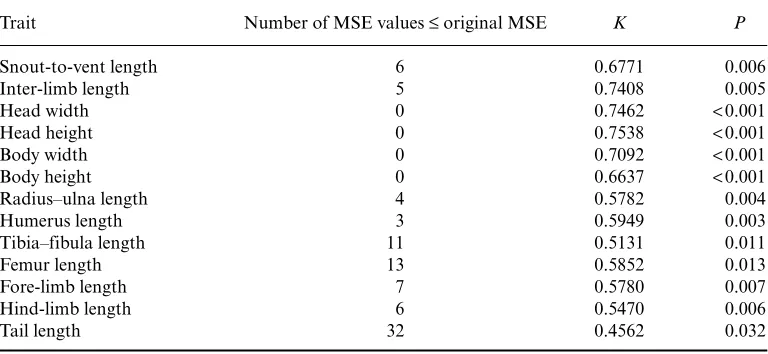
et al., 2005). The descriptive statistic K provides one index of the amount of phylogenetic signal within a trait, based on the Brownian motion model of evolution of a given phylogenetic tree with known topology and branch lengths (Blomberg et al., 2003). K-values equal to 1 indicate that a trait shows an expected amount of phylogenetic signal, whereas K-values less than 1 indicate a trait has less signal than expected and values of K greater than 1 suggest there is more phylogenetic signal than expected. To test for phylogenetic signal and calculate a K statistic and P-value for tests of significance for each trait, we used the program PHYSIG.M (Blomberg et al., 2003), as implemented in the program MatLab. We performed 1000 randomiza-tions on the current ‘best-estimate’ phylogeny and report K-values for all morphological traits examined in this study (Blomberg et al., 2003) (Table 1). However, while K-values are likely to be more than 80% reliable for phylogenies consisting of 20 or more species, they are considerably less so for phylogenies with fewer than 20 species. As this study consisted of 18 species, we also report P-values for significance testing of all traits as produced in PHYSIG.M to provide an additional diagnostic of whether traits display phylogenetic signal (Blomberg et al., 2003).
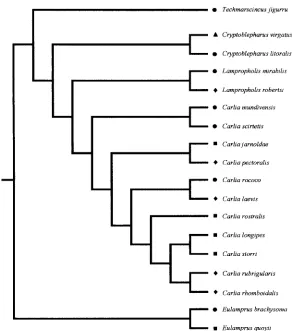
Lygosominae (Ingram and Covacevich, 1989). Supra-generic positions of genera were based on the phylogenetic relationships reported in Reeder (2003), with additional information taken from Hutchinson et al. (1990) and Greer (1989) for Lampropholis and T. jigurru (as Leiolopisma jigurru). While the position of E. quoyii was provided within Reeder (2003), the position of E. brachysoma was inferred from the close relationships and inclusion within the E. murrayi species group (Greer, 1989). The position of Cryptoblepharus was based on the inter-generic basis that the most primitive members of this genus are closely related to Emoia(Greer, 1974).
[image:6.612.109.493.137.314.2]A recent molecular phylogeny of the genus Carlia (the rainbow skinks) failed to resolve fully many of the relationships within this genus and proposed Lygisaurus should be synonymized with Carlia where they form a small clade nested within the overall Carlia phylogeny (Stuart-Fox et al., 2002). Additional sequence data from several new Carlia species failed to enhance the phylogenetic relationships (Couper et al., 2005), and the presence of unresolved polytomies within the genus Carlia likely reflects a rapid (explosive) speciation event that probably occurred from the mid-Miocene onwards (Stuart-Fox et al., 2002). The pos-ition of C. rubrigularis and C. rhomboidalis was based on mitochondrial DNA (mtDNA) evidence (Dolman and Moritz, 2006). Species in this study formerly within Lygisaurus (i.e. Carlia rococo and C. laevis) were placed in this sub-clade with several other arrangements also used in analyses. The position of C. scirtetis was based on evidence from morphological traits shared with the species C. coensis and C. mundivensis, with additional analyses performed with this species placed in other phylogenetic arrangements. As branch length information was not available for most species used in this study, branch lengths were set to unity. Several studies have shown that setting branch lengths to unity produces results that are robust and reliable (Diaz-Uriarte and Garland, 1996, 1998). As analyses involving all other phylogenetic arrangements, with and without polytomies treated as ‘hard’ (Purvis and Garland 1993; Garland and Diaz-Uriarte 1999), did not qualitatively change the analyses, we report only results for analyses using the ‘best-estimate’ phylogeny with potential polytomies treated as hard in this paper.
Table 1. K- and P-values of morphological traits of male lizards examined in this study
Trait Number of MSE values≤original MSE K P
Snout-to-vent length 6 0.6771 0.006
Inter-limb length 5 0.7408 0.005
Head width 0 0.7462 <0.001
Head height 0 0.7538 <0.001
Body width 0 0.7092 <0.001
Body height 0 0.6637 <0.001
Radius–ulna length 4 0.5782 0.004
Humerus length 3 0.5949 0.003
Tibia–fibula length 11 0.5131 0.011
Femur length 13 0.5852 0.013
Fore-limb length 7 0.5780 0.007
Hind-limb length 6 0.5470 0.006
Tail length 32 0.4562 0.032
Note: All values calculated with branch lengths set to unity. Number of mean square error values (MSE) less than
the original value is provided for reference. All values calculated using PHYSIG.M [see Blomberg et al.(2003)
Independent contrasts were calculated for all morphological and performance data sets using PDTREE. Because significant linear and non-linear trends indicate inadequate standardization of branch lengths, both statistical correlations and visual inspection of all diagnostic plots were performed. Contrasts of trait values were checked for adequacy of standardization by dividing the independent contrast of each trait by the standard deviation of the branch length (square root of the corrected branch lengths) for that trait (Garland et al., 1992). However, as there was no evidence of any trends within the data (r<0.4; all P-values>0.12), branch lengths were considered adequately standardized under the Brown-ian motion model of evolution. The independent contrasts of the morphological data were size-corrected by regressing (through the origin) the standardized independent contrast of the trait of interest against the standardized independent contrast of snout-to-vent length (Garland et al., 1992).
Fig. 1. Phylogenetic relationships of the 18 scincid lizard species examined in this study. The tree represents the current ‘best-estimate’ working hypothesis and is based on genetic (mitochondrial DNA, ND4), immunological, and morphological evidence (Greer, 1974, 1989; Covacevich, 1984; Stuart-Fox
et al., 2002; Reeder, 2003; Dolman and Moritz, 2006). Symbols indicate the four habitat types occupied by each species: 䉱, arboreal; 䊏, generalist; 䉬, leaf-litter dwelling; 䊉, rock-using.
Limb ratio was calculated using an ordinary least-squares regression of the contrasts of hind-limb length against the contrasts of fore-limb length (Vanhooydonck and Van Damme, 2001; Zaaf and Van Damme, 2001). Tibia–femur length was calculated from the regression of the contrasts of tibia length against the contrasts of femur length (Vanhooydonck and Van Damme, 2001).
To determine those morphological traits (body height, fore-limb length, hind-limb length, and tibia–femur ratio) – both phylogenetic and non-phylogenetic – that accounted for most of the variation in performance, we used backwards stepwise, multiple regression [phylogenetic data through the origin (see Garland et al., 1992)]. This technique provides a partial regression coefficient (β) between the response variable (performance trait) and significant morphological traits with each of the other variables statistically held constant. As correlated predictors may introduce problems of (multi)collinearity in multiple regression analyses, we tested that tolerance among correlated variables was above 0.1 (Quinn and Keough, 2002). Initial data inspection revealed fore-limb and hind-limb length were highly correlated, with low tolerance (both<0.09). Consequently, we used the measure of limb-length with the highest significant correlation with each performance measure. In the absence of a significant correlation, we used hind-limb length, due to its importance in most aspects of lizard locomotion (Garland, 1985; Garland and Losos, 1994; Bonine and Garland, 1999). The use of a single measure of limb-length in the analyses considerably increased tolerance (all>0.2). We report partial regression coefficients (β)±standard errors and model r2 values for both non-phylogenetic and phylogenetic analyses.
RESULTS
Non-phylogenetic analyses
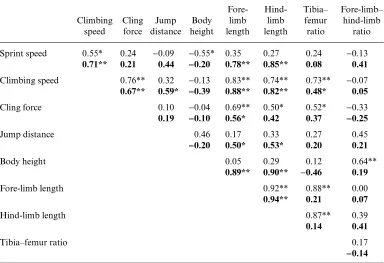
Considerable interspecific differences in size and morphology were observed (Table 2), with a similar degree of interspecific variation in performance among the species examined (Table 3). There was a significant positive correlation between sprinting and climbing speed (r=0.55, P=0.01) and between climbing speed and cling force (r=0.76, P<0.001; Fig. 2, Table 3). All other performance measures were not significantly correlated (Table 4).
A backwards, stepwise multiple-regression model with residual sprint speed as the dependent variable and residual body height, hind-limb length, and the ratio of tibia–femur length as independent variables resulted in a significant model (r2=0.54, F1,17=5.44,
P=0.011), with body height as the only contributing independent variable, indicating that lizards with flatter bodies sprint faster (partial regression coefficient β±standard error= −0.748±0.199). The same model using climbing speed as the dependent variable identified fore-limb length as the only contributing variable (r2=0.72, F1,17=11.98,
T
able 2.
Species
’ names (
n
, sample siz
es) and mean morpholo
gical tr
aits (all in millimetr
es
, e
x
cept bod
y mass in gr
ams) f
or each of the 18 scincid
lizar
ds e
xamined in this stud
y (mean ± standar d err or) Species n Snout-to-v ent length (mm) Bod y mass (g)
Inter-limb length (mm)
Bod
y height (mm)
F
o
re-limb
length (mm)
Hind-limb length (mm)
Tibia length
(mm)
F
em
ur length (mm)
Phylogenetic analyses
Overall, the results from the phylogenetically corrected data were broadly congruent with those of the uncorrected data. The four measures of performance were all positively correlated with each other (Table 4), with sprinting speed significantly positively correlated with climbing speed (r=0.71, P<0.001; Fig. 2). Climbing speed was significantly correlated with the ability to cling to a rock-like substrate (r=0.67, P<0.001; Fig. 2), and climbing ability was significantly positively correlated with jump distance (r=0.59, P<0.05; Fig. 2). There was a positive non-significant relationship between cling force and sprint speed.
[image:10.612.108.497.159.411.2]In a backwards, stepwise multiple regression (through the origin) with sprint speed as the dependent variable and the residual contrasts of body height, hind-limb length, and the ratio of tibia–femur length as independent variables, only hind-limb length contributed significantly (r2=0.75, F1,16=40.56, P<0.001), indicating that the evolution of longer hind-limbs has coincided with faster sprint speeds (partial regression coefficient β=0.856±0.135). A similar model, using jump distance as the dependent variable, was not significant (r2=0.20, F1,16=1.14, P>0.36). The same model with climbing speed as the dependent variable indicated that residual contrasts of fore-limb length contributed signifi-cantly to variation in climbing speed (r2=0.87, F1,16=62.51, P<0.001). This suggests that increased fore-limb length has evolved in concert with an increase in climbing speed Table 3. Species’ names (n, sample sizes) and mean performance traits [in m · s−1, except cling force (see footnote) and jump distance in millimetres] for each of the 18 scincid lizards examined in this study (mean±standard error)
Species Label n
Climbing speed (m · s−1)
Sprint speed (m · s−1)
Cling force (mN)*
Jump distance (mm)
Carlia jarnoldae Cj 12 0.73±0.05 0.52±0.05 157.72±12.41 268.50±27.70
Carlia laevis Cle 5 0.39±0.03 0.57±0.02 11.34±03.36 237.60±12.06
Carlia longipes Cln 14 1.24±0.05 1.20±0.10 373.47±20.43 351.25±17.51
Carlia mundivensis Cm 8 0.83±0.07 0.83±0.06 358.56±26.48 257.88±48.58
Carlia pectoralis Cp 10 0.80±0.06 0.86±0.05 135.33±08.75 316.60±21.28
Carlia rhomboidalis Crh 15 0.93±0.04 0.77±0.06 202.02±10.34 323.07±9.98
Carlia rococo Crc 9 0.63±0.03 0.90±0.05 77.47±20.82 194.11±19.66
Carlia rostralis Cro 8 1.07±0.08 0.99±0.11 343.23±34.77 408.88±31.64
Carlia rubrigularis Crb 13 0.89±0.04 1.02±0.08 185.57±19.93 304.85±17.07
Carlia scirtetis Csc 16 1.49±0.08 2.06±0.08 470.07±25.22 330.20±19.98
Carlia storri Cst 5 0.82±0.08 0.80±0.09 125.53±15.63 264.00±46.24
Cryptoblepharus litoralis Cyl 14 0.90±0.08 1.48±0.06 203.14±08.20 229.00±12.25
Cryptoblepharus virgatus Cyv 14 0.86±0.06 0.90±0.06 119.43±07.62 222.43±9.92
Eulamprus brachysoma Eb 12 1.28±0.03 1.67±0.07 809.05±42.17 342.67±13.24
Eulamprus quoyii Eq 5 1.37±0.09 2.33±0.25 1398.43±69.18 364.20±30.50
Lampropholis mirabilis Lm 13 0.92±0.06 1.27±0.07 196.51±07.40 274.54±24.11
Lampropholis robertsi Lro 12 0.63±0.05 0.58±0.04 140.56±13.19 242.67±16.83
Techmarscincus jigurru Tj 10 1.10±0.05 1.22±0.06 392.27±17.30 280.00±14.67
* Cling forces used in the analyses were raw gram pull-force values. The values presented have been converted to
(β=0.795±0.101). A similar model with cling force as the dependent variable retained residual contrasts of fore-limb length as the only variable contributing significantly to the model (r2=0.43, F1,16=6.11, P<0.05), indicating that an increase in fore-limb length evolved in concert with clinging ability (β=0.515±0.209).
DISCUSSION
[image:11.612.120.504.150.413.2]Specialization for a given task is thought to preclude simultaneous specialization for others, thus preventing specialized species from performing well at multiple tasks [e.g. ‘jack-of-all-trades is master of none’ (Huey and Hertz, 1984a; Stearns, 1992)]. However, in cases where selection for performance at one task enhances performance in other areas (e.g. sprinting, climbing, and clinging), there might be no trade-off in ability. We found no evidence of trade-offs in performance at sprinting, climbing, and clinging in this group of skinks; instead, good performance in one of these tasks was positively correlated with good performance in the others. Differences in limb length explained much of the variation in performance among species, with sprint speed correlated with hind-limb length, whereas climbing speed and clinging ability were correlated with fore-limb length. Hind- and fore-limb lengths were Table 4. Pearson correlation coefficients of performance and morphological traits for 18 scincid species of the sub-family Lygosominae
Climbing speed
Cling force
Jump distance
Body height
Fore-limb length
Hind-limb length
Tibia– femur ratio
Fore-limb– hind-limb
ratio
Sprint speed 0.55* 0.24 −0.09 −0.55* 0.35 0.27 0.24 −0.13 0.71** 0.21 0.44 −−0.20 0.78** 0.85** 0.08 0.41
Climbing speed 0.76** 0.32 −0.13 0.83** 0.74** 0.73** −0.07 0.67** 0.59* −−0.39 0.88** 0.82** 0.48* 0.05
Cling force 0.10 −0.04 0.69** 0.50* 0.52* −0.33
0.19 −−0.10 0.56* 0.42 0.37 −−0.25
Jump distance 0.46 0.17 0.33 0.27 0.45
−−0.20 0.50* 0.53* 0.20 0.21
Body height 0.05 0.29 0.12 0.64**
0.89** 0.90** −0.46 0.19
Fore-limb length 0.92** 0.88** 0.00
0.94** 0.21 0.07
Hind-limb length 0.87** 0.39
0.14 0.41
Tibia–femur ratio 0.17
−−0.14
Note: Non-phylogenetic correlations (n=18, above) are for residual (size-corrected against SVL) values.
Phylogenetic correlations (n=17, in bold below) are for (size-corrected against SVL contrasts) standardized
independent contrasts.
*−0.05>P>0.01; **0.01>P>0.001.
correlated as well. However, despite theoretical predictions, phylogenetic analyses revealed no evidence that the evolution of a flatter body per se has led to a direct performance benefit.
Absence of performance trade-offs
Biomechanical predictions suggest performance trade-offs should occur when morpho-logical traits that enhance performance at one task negatively affect another. Based on this reasoning, some studies have predicted a trade-off between sprinting and climbing, as morphological traits optimal for horizontal locomotion apparently oppose those required for optimal vertical locomotion (Cartmill, 1985; Zaaf et al., 1999; Zaaf and Van Damme, 2001). However, we found no support for this, as all performance measures (including both horizontal and vertical locomotion) were positively associated. Recent work suggests that trade-offs among performance abilities must be considered within the ecological context of the group examined (Vanhooydonck and Van Damme, 2001). No trade-offs were observed among sprinting, clambering, and climbing in lacertid lizards (Vanhooydonck and Van Damme, 2001). Thus, the relationships between sprinting, climbing, and clinging for scincids resemble those of lacertids. The strong positive correlation between sprinting and climbing in both these groups, and between clinging and climbing in scincids, implies that these traits require similar morphological features.
Positive correlations between sprinting and climbing are directly opposite to the findings for Anoles and chameleons, where trade-offs occur between sprinting speed and climbing speed. Characters enhancing sprinting and climbing apparently vary with substrate use. Anoles and chameleons use twigs and branches as perches (Schoener, 1968; Losos, 1990a; Irschick et al., 1997), whereas skinks and lacertids typically use broad (relative to the lizard’s body width), flat substrates such as rocks, bare earth, and leaf litter (Pianka, 1969; Vanhooydonck and Van Damme, 1999; B.A. Goodman, unpublished data). Surprisingly, the morphological features that enhance sprinting and climbing speed on broad surfaces do not enhance the same performance traits on narrow perches.
The apparent absence of trade-offs among performance traits in skinks and lacertids does not mean that they do not occur in other areas. For example, body shape has a strong influence on reproductive output in lizards (Vitt and Congdon, 1978; Vitt, 1981; Vitt and Price, 1982), and the flat body of many fast, rock-using skinks may reduce fecundity. Alternatively, a trade-off may occur in other performance measures, such as endurance (Vanhooydonck et al., 2001). However, the clear message from this study is that morphologically more derived species are simply better at a greater range of tasks that are sufficiently similar that no trade-offs among them occur.
Fig. 2. Relationships between four performance measures (sprinting, climbing, clinging ability, and jumping distance). Left panels show non-phylogenetic residuals of performance means per species. Right panels show residual phylogenetic independent contrasts of performance means per species.
Cj=Carlia jarnoldae, Cle=Carlia laevis, Cln=Carlia longipes, Cm=Carlia mundivensis, Cp=Carlia
pectoralis, Crh=Carlia rhomboidalis, Crc=Carlia rococo, Cro=Carlia rostralis, Crb=Carlia
rubrigularis, Csc=Carlia scirtetis, Cst=Carlia storri, Cyl=Cryptoblepharus litoralis, Cyv=
Crypto-blepharus virgatus, Eb=Eulamprus brachysoma, Eq=Eulamprus quoyii, Lm=Lampropholis mirabilis,
Lro=Lampropholis robertsi, Tj=Techmarscincus jigurru.
Limb length and performance
In this study, lizards with longer hind-limbs sprinted faster. This relationship has been noted for lizards and in other vertebrate groups (e.g. Losos, 1990a; Garland and Janis, 1993; Garland and Losos, 1994), and is caused by the increased stride length achieved with longer hind-limbs (Hildebrand, 1974; Cartmill, 1985; Losos, 1990a). Losos (1990b) observed an inverse relationship between fore-limb length and sprint speed in 14 species of Anolis. But for the group of scincids in our study, there was no indication that running was impeded by long fore-limbs; longer fore-limbs were either unrelated to running speed (uncorrected data) or were strongly positively correlated with running speed (phylogenetically corrected data). Climbing speed was also enhanced by long fore-limbs, and by long fore-limbs and hind-limbs. Increased fore-limb length, or fore-limbs and hind-limbs of equal length, are beneficial for climbing species, as it allows them to stride similar distances with each limb (Arnold, 1998; Vanhooydonck and Van Damme, 2001). Individuals climbing angled substrates should also benefit from increased tension provided by longer fore-limbs, which would prevent tumbling backwards (Cartmill, 1985; Alexander, 1992; Aerts et al., 2003). Relative to the width of their body, the species in this study generally occupy broad substrates, such as rocks (B.A. Goodman, unpublished data). Thus, longer hind- and fore-limbs appear to combine to allow increased stride length, equal stride length, and increased pulling forces to enhance locomotion when climbing.
[image:14.612.109.492.101.302.2]A direct consequence of increased running speed in lizards is the tendency for the body to lift, leading to bipedal locomotion (Aerts et al., 2003). While increased stride length increases speed, the increased propensity for the fore-body to lift in a way that leads to bipedalism presents an obvious problem of flipping backwards on inclined surfaces (Aerts et al., 2003). In Fig. 3. Relationship between body height and sprint speed. Left panel shows non-phylogenetic residuals of species means for sprint speed. Right panels show residual phylogenetic independent contrasts of species mean body height against species mean sprint speed. Cj=Carlia jarnoldae,
Cle=Carlia laevis, Cln=Carlia longipes, Cm=Carlia mundivensis, Cp=Carlia pectoralis, Crh=
Carlia rhomboidalis, Crc=Carlia rococo, Cro=Carlia rostralis, Crb=Carlia rubrigularis, Csc=Carlia
scirtetis, Cst=Carlia storri, Cyl=Cryptoblepharus litoralis, Cyv=Cryptoblepharus virgatus, Eb=
Eulamprus brachysoma, Eq=Eulamprus quoyii, Lm=Lampropholis mirabilis, Lro=Lampropholis
climbing lizards, morphological traits that lower the centre of mass and bring it forward should reduce the possibility of fore-body lifting. In addition to body flattening (Van Damme
et al., 1997), these traits include increased fore-limb length to widen the base of support, and a more sprawled form of locomotion (Aerts et al., 2003). Our study found support for increased fore-limb length to increase performance in climbing and clinging, and while non-phylogenetic analyses revealed that body flattening aided sprint performance, the phylogenetic analyses did not support this finding (see ‘Alternative hypotheses for the role of body flattening’ below).
Lizards with longer fore-limbs had greater clinging ability. The basis of this increased clinging ability is unclear, but may be related to an increased base of support (Aerts et al., 2003), or an increased number of sub-digital lamellae, which may increase frictional forces and improve contact on irregular surfaces (Cartmill, 1985; Losos, 1990a). Increased clinging ability in species with longer fore-limbs should also assist climbing by improving traction on an inclined slope. In a comparative examination of lizard clinging ability, Zani (2000) found that an evolutionary increase in claw height and a reduction in toe length were correlated with an increased ability to cling to course substrates, but provided no information on how limb-length was related to cling ability or toe length. In another study (Goodman, in press), I found that limb-length and digit-length were strongly correlated in this group of scincids, suggesting that increased limb-length and toe-length may act in concert to increase clinging ability in this group. For example, species with longer limbs may be able to produce greater tension, or may possess greater amounts of muscle mass or different muscle fibre types that are better suited for clinging. Increased amounts of muscle mass in long-limbed species is unlikely in this group, with most high-performance species having thin, gracile limbs; however, muscle fibre types have not been examined.
Jumping ability was correlated with both fore-limb and hind-limb length in this study. There should be a tight correlation between relative hind-limb length and jump perform-ance (Emerson, 1985; Losos et al., 1989; Losos, 1990a, 1990b; Harris and Steudel, 2002), as a greater hind-limb length provides a greater distance over which it can extend and accelerate the body (Cartmill, 1985; Alexander, 1992). The correlation between fore-limb length and jump distance is presumably due to the tight correlation between fore-limb and hind-limb lengths (Table 4). That is, species with long hind-limbs jump the greatest distances, but also have long fore-limbs; it is unlikely that long fore-limbs are directly related to increased jump distance (Emerson, 1985; Losos, 1990a).
The absence of performance trade-off may be the result of reduced selection on performance in some situations, such as species that occupy closed habitats, or which use crypsis as a predator avoidance strategy. For example, selection on performance ability may be maximal in high-performance species, and considerably lower for low-performance species. Under this scenario, interspecific comparisons of performance would still be positive with no evidence of a trade-off, even if high-performance taxa do experience performance trade-offs.
An important consideration for comparative studies is the presumption that all species will undergo evolutionary changes in morphology that lead to greater performance. Even in the absence of constraints, natural selection may only shape individuals to be ‘just good enough’ to perform those tasks relevant to the habitats they occupy. Thus, while species that inhabit more specialized habitats will display associated performance traits, the prediction that they will perform the best at these performance tasks might not always be upheld.
Alternative hypotheses for the role of body flattening
While the non-phylogenetic analyses suggest there is a benefit of body flattening on sprint speed in scincid lizards, this relationship disappeared in the phylogenetic analyses, which suggests this relationship is relatively weak. Counter to predictions, there was no evidence that dorsoventral flattening aided climbing, despite a relatively strong (phylogenetic) correlation between body flattening and climbing speed. In this case, a comparison involving a larger number of species might prove worthwhile. However, dorsoventral flattening may have a more indirect benefit on climbing not identified in this study. One aspect of vertical locomotion that would likely benefit from a flatter body is energy efficiency. Efficiency of locomotion at low temperatures might have been an important factor in the evolution and ecology of arboreal lizards, such as geckos (Autumn et al., 1999; Zaaf and Van Damme, 2001). For example, a ground-dwelling skink used almost 200% more energy to perform one unit of vertical work than a climbing gecko (Farley and Emshwiller, 1996). Within a taxonomic group, more dorsoventrally flattened species should expend less energy on postural adjustments and overcoming the forces of gravity due to their lowered centre of mass and reduced propensity to topple backwards on inclined surfaces [e.g. Plica plica(Vitt, 1991; Aerts et al., 2003)]. In this scenario, body flattening may be unrelated to climbing speed, but would allow species to perform such tasks more efficiently. The majority of species in this study, other than E. quoyii, are relatively light (< 6 g) and weigh considerably less than the threshold mass (40 g) at which climbing performance is notably reduced by a heavy body in agamids (Huey and Hertz, 1982, 1984b). However, it is unknown whether climbing species in this study had lowered energetic costs, relative to non-climbing congeners. Field observations of flattened, rock-using species (e.g. Carlia scirtetis) indicate that they are extremely swift-moving (Goodman, in press), relative to less flattened congeners. To test this idea, future research should include measurements of field metabolic rates, energetic costs of climbing, and food acquisition and assimilation efficiency.
A further, alternative hypothesis for the function of a flat body is that it may increase the ease with which individuals can take refuge in crevices, as do iguanids (Vitt, 1981; Vitt et al., 1997; Pianka and Vitt, 2003). While plausible, field observations of many of the flattest rock-using species in this study suggest that the evolution of flatness as an adaptation for crevice use is relatively minor for this group of skinks (personal observation). When approached, most species tend to use large gaps (relative to the height of the lizard) between rocks or rock overhangs as refuges (Goodman, in press). In addition, when observed inside rock crevices, these species do not wedge themselves into the narrowest part of the crevices and lack the sharply keeled scales that aid this behaviour in other taxa [e.g. Egernia cunninghami group (Cogger, 2000; Chapple, 2003)]. An additional alternative hypothesis is that a flattened body may assist a species to remain undetected against the substrate. A flat body, dorsal colouration that matches the background, and remaining motionless at the approach of a predator have co-evolved in numerous iguanian lizard clades (Schulte et al., 2004). Indeed, most of the flattened, rock-using species examined in this study exhibit dorsal colouration that matches the rocks they typically occupy (Ingram and Rawlinson, 1981; Ingram and Covacevich, 1989), suggesting this could be a strategy used by this group of lizards.
ACKNOWLEDGEMENTS
We thank the people of Gungardes and the traditional owners of Black Mountain for allowing access to this site. We thank D. Miles, J. Isaac, and two anonymous reviewers for reading and commenting on an earlier draft of the manuscript. We thank Beck Hansen and P.J. Harvey for inspiration. All animals were collected under QPWS Scientific Purposes Permit #F1/000253/99/SAA and maintained in captivity following guidelines specified in JCU Animal Ethics Permit #A516.
REFERENCES
Aerts, P., Van Damme, R., D’Aout, K. and Vanhooydonck, B. 2003. Bipedalism in lizards: whole-body modelling reveals a possible spandrel. Proc. R. Soc. Lond. B, 358: 1525–1533. Alexander, R.M. 1992. Exploring Biomechanics: Animals in Motion. New York: Scientific American
Library.
Arnold, E.N. 1998. Structural niche, limb morphology and locomotion in lacertid lizards (Squamata, Lacertidae): a preliminary survey. Bull. Br. Mus. Nat. Hist. (Zool.), 64: 63–89. Arnold, S.J. 1983. Morphology, performance and fitness. Am. Zool., 23: 347–361.
Autumn, K., Jindrich, D., DeNardo, D. and Mueller, R. 1999. Locomotor performance at low temperatures and the evolution of nocturnality in geckos. Evolution, 53: 580–599.
Blomberg, S.P., Garland, T., Jr. and Ives, A.R. 2003. Testing for phylogenetic signal in comparative data: behavioral traits are more labile. Evolution, 57: 717–745.
Bonine, K.E. and Garland, T., Jr. 1999. Sprint performance of phrynosomatid lizards, measured on a high-speed treadmill, correlates with hindlimb length. J. Zool. (Lond.), 248: 255–265.
Cartmill, M. 1985. Climbing. In Functional Vertebrate Morphology (M. Hildebrand, D.M. Bramble, K.F. Liem and D.B. Wake, eds.), pp. 73–88. Cambridge, MA: Belknap Press.
Chapple, D.G. 2003. Ecology, life history, and behavior in the Australian scincid genus Egernia, with comments on the evolution of complex sociality in lizards. Herpetol. Monogr., 17: 145–180. Cogger, H.G. 2000. Reptiles and Amphibians of Australia. Sydney, NSW: Reed Books.
Cogger, H.G. and Heatwole, H. 1984. The Australian reptiles: origins, biogeography, distribution patterns and island evolution. In Vertebrate Zoogeogrpaphy and Evolution in Australasia (M. Archer and G. Clayton, eds.), pp. 343–360. Marrickville, NSW: Hesperian Press.
Couper, P.J., Worthington Wilmer, J., Roberts, L., Amey, A.P. and Zug, G.R. 2005. Skinks currently assigned to Carlia aerata (Scincidae: Lygosominae) of north-eastern Queensland: a preliminary study of cryptic diversity and two new species. Aust. J. Zool., 53: 35–49.
Covacevich, J. 1984. A biogeographically significant new species of Leiolopisma (Scincidae) from north eastern Queensland. Mems. Qld. Mus., 21: 401–411.
Díaz-Uriarte, R. and Garland, T., Jr. 1996. Testing hypotheses of correlated evolution using phylogenetically independent contrasts: sensitivity to deviations from Brownian motion. Syst.
Biol., 45: 27–47.
Díaz-Uriarte, R. and Garland, T., Jr. 1998. Effects of branch length errors on the performance of phylogenetically independent contrasts. Syst. Biol., 47: 654–672.
Dolman, G. and Moritz, C. 2006. A multilocus perspective on refugial isolation and divergence in rainforest skinks (Carlia). Evolution, 60: 573–582.
Emerson, S.B. 1985. Jumping and leaping. In Functional Vertebrate Morphology (M. Hildebrand, D.M. Bramble, K.F. Liem and D.B. Wake, eds.), pp. 58–72. Cambridge, MA: Belknap Press. Farley, C.T. and Emshwiller, M. 1996. Efficiency of uphill locomotion in nocturnal and diurnal
lizards. J. Exp. Biol., 199: 587–592.
Felsenstein, J. 1985. Phylogenies and the comparative method. Am. Nat., 126: 1–25.
Freckleton, R.P., Harvey, P.H. and Pagel, M. 2002. Phylogenetic analysis and comparative data: a test and review of evidence. Am. Nat., 160: 712–726.
Futuyma, D.J. 1998. Evolutionary Biology, 3rd edn. Sunderland, MA: Sinauer Associates.
Futuyma, D.J. and Moreno, G. 1988. The evolution of ecological specialization. Annu. Rev. Ecol.
Syst., 19: 207–233.
Garland, T., Jr. 1985. Ontogenetic and individual variation in size, shape and speed in the Australian agamid lizard Amphibolurus nuchalis. J. Zool. (Lond.), 207: 425–439.
Garland, T., Jr. and Diaz-Uriarte, R. 1999. Polytomies and phylogentically independent contrasts: examination of the bounded degrees of freedom approach Syst. Biol., 48: 547–558.
Garland, T., Jr. and Janis, C.M. 1993. Does metatarsal/femur ratio predict maximal running speed in cursorial mammals? J. Zool. (Lond), 229: 133–151.
Garland, T., Jr. and Losos, J.B. 1994. Ecological morphology of locomotor performance in squamate reptiles. In Ecological Morphology: Integrative Organismal Biology (P.C. Wainwright and S.M. Reilly, eds.), pp. 240–302. Chicago, IL: University of Chicago Press.
Garland, T., Jr., Harvey, P.H. and Ives, A.R. 1992. Procedures for the analysis of comparative data using phylogenetic independent contrasts Syst. Biol., 41: 18–32.
Garland, T., Jr., Bennett, A.F. and Rezende, E.L. 2005. Phylogenetic approaches in comparative physiology. J. Exp. Biol., 208: 3015–3035.
Goodman, B.A. in press. Divergent morphologies, performance and escape behaviour in two tropical rock-using lizards. Biol. J. Linn. Soc.
Goodman, B.A. and Peterson, G.N.L. 2005. A technique for sampling lizards in rocky habitats.
Herpetol. Rev., 36: 41–43.
Greer, A.E. 1974. The generic relationships of the scincid lizard genus Leiolopisma and its relatives.
Aust. J. Zool. Suppl. Ser., 31: 1–67.
Greer, A.E. 1980. Critical thermal maximum temperatures in Australian lizards: their ecological and evolutionary significance. Aust. J. Zool., 28: 91–102
Greer, A.E. 1989. The Biology and Evolution of Australian Lizards. Chipping Norton, NSW: Surrey Beatty & Sons.
Harris, M.A. and Steudel, K. 2002. The relationship between maximum jumping performance and hindlimb morphology/physiology in domestic cats (Felis silvestris catus). J. Exp. Biol., 205: 3877–3889.
Harvey, P.H. and Pagel, M.D. 1991. The Comparative Method in Evolutionary Biology. Oxford: Oxford University Press.
Herrel, A., Myers, J.J. and Vanhooydonck, B. 2002. Relations between microhabitat use and limb shape in Phrynosomatid lizards. Biol. J. Linn. Soc., 77: 149–163.
Hildebrand, M. 1974. Analysis of Vertebrate Structure. New York: Wiley.
Hoefer, A.M., Goodman, B.A. and Downes, S.J. 2003. Two effective and inexpensive methods for restraining small lizards. Herpetol. Rev., 43: 223–224.
Huey, R.B. and Hertz, P.E. 1982. Effects of body size and slope on sprint speed of a lizard (Stellio (Agama) stellio). J. Exp. Biol., 97: 401–409.
Huey, R.B. and Hertz, P.E. 1984a. Is a jack-of-all-temperatures a master of none? Evolution, 38: 441–444.
Huey, R.B. and Hertz, P.E. 1984b Effects of body size and slope on acceleration of a lizard (Stellio
stellio). J. Exp. Biol., 110: 113–123.
Hutchinson, M.N., Donnellan, S.C., Baverstock, P.R., Krieg, M., Simms, S. and Burgin, S. 1990. Immunological relationships and generic revision of the Australian lizards assigned to the genus Leiolopisma (Scincidae: Lygosominae). Aust. J. Zool., 38: 535–554.
Ingram, G. and Covacevich, J. 1980. Two new Lygosomine skinks endemic to Cape York Peninsula. In Contemporary Cape York Peninsula (N. Stevens and A. Bailey, eds.), pp. 45–48. St. Lucia: The Royal Society of Queensland.
Ingram, G. and Covacevich, J. 1989. Revision of the genus Carlia (Reptilia, Scincidae) in Australia with comments on Carlia bicarinata of New Guinea. Mems. Qld. Mus., 27: 443–490.
Ingram, G. and Rawlinson, P.A. 1981. Five new species of skinks (Genus Lampropholis) from Queensland and New South Wales. Mems. Qld. Mus., 20: 311–317.
Irschick, D.J. and Losos, J.B. 1998. A comparative analysis of the ecological significance of maximal locomotor performance in Caribbean Anolis lizards. Evolution, 52: 219–226.
Irschick, D.J., Vitt, L.J., Zani, P.A. and Losos, J.B. 1997. A comparison of evolutionary radiations in mainland and Caribbean Anolis lizards. Ecology, 78: 2191–2203.
Lauder, G.V. 1996. The argument from design. In Adaptation (M.R. Rose and G.V. Lauder, eds.), pp. 187–220. London: Academic Press.
Losos, J.B. 1990a. Ecomorphology, performance capability and scaling in West Indian Anolis: an evolutionary analysis. Ecol. Monogr., 60: 369–388.
Losos, J.B. 1990b. The evolution of form and function: morphology and locomotor performance in West Indian Anolis lizards. Evolution, 44: 1189–1203.
Losos, J.B. and Sinervo, B. 1989. The effects of morphology and perch diameter on sprint performance of Anolis lizards. J. Exp. Biol., 245: 23–30.
Losos, J.B., Papenfuss, T.J. and Macey, J.R. 1989. Correlates of sprinting, jumping, and parachuting performance in the butterfly lizard, Leiolepis belliani. J. Zool. (Lond.), 217: 559–568.
Losos, J.B., Walton, B.M. and Bennett, A.F. 1993. Trade-offs between sprinting and clinging ability in Kenyan Chameleons. Funct. Ecol., 7: 281–286.
Losos, J.B., Irschick, D.J. and Schoener, T.W. 1994. Adaptation and constraint in the evolution of specialization of Bahamian Anolis lizards. Evolution, 48: 1786–1798.
Macrini, T.E. and Irschick, D.J. 1998. An intraspecific analysis of trade-offs in sprinting performance in a West Indian lizard species (Anolis lineatopus). Biol. J. Linn. Soc., 63: 579–591.
Melville, J. and Swain, R. 2000. Evolutionary relationships between morphology, performance, and habitat openness in the lizard genus Niveoscincus (Scincidae: Lygosominae). Biol. J. Linn. Soc., 70: 667–683.
Pianka, E.R. 1969. Sympatry of desert lizards (Ctenotus) in Western Australia. Ecology, 50: 1012–1030.
Pianka, E.R. and Vitt, L.J. 2003. Lizards: Windows to the Evolution of Diversity. Berkeley, CA: University of California Press.
Pounds, J.A. 1988. Ecomorphology, locomotion, and microhabitat structure: patterns in a tropical mainland Anolis community. Ecol. Monogr., 58: 299–320.
Purvis, A. and Garland, T., Jr. 1993. Polytomies in comparative analyses of continuous characters.
Syst. Biol., 42: 569–575.
Quinn, G.P. and Keough, M.J. 2002. Experimental Design and Data Analysis for Biologists. Cambridge: Cambridge University Press.
Reeder, T.W. 2003. A phylogeny of the Australian Sphenomorphus group (Scincidae: Squamata) and the phylogenetic placement of the crocodile skinks (Tribolonotus): Bayesian approaches to assessing congruence and obtaining confidence in maximum likelihood inferred relationships.
Molec. Phylogen. Evol., 27: 384–397.
Ricklefs, R.E. and Miles, D.B. 1994. Functional morphology as a tool in ecological research. In Ecological Morphology: Integrative Organismal Biology (P.C. Wainwright and S.M. Reilly, eds.), pp. 42–59. Chicago, IL: University of Chicago Press.
Schluter, D. 2000. The Ecology of Adaptive Radiation. New York: Oxford University Press.
Schulte, J.A., Losos, J.B., Cruz, F.B. and Nunez, H. 2004. The relationship between morphology, escape behaviour and microhabitat occupation in the lizard clade Liolaemus (Iguanidae: Tropidurinae : Liolaemini). J. Evol. Biol., 17, 408–420.
Schoener, T.W. 1968. The Anolis lizards of Bimini: resource partitioning in a complex fauna.
Ecology, 49: 704–726.
Sinervo, B. and Losos, J.B. 1991. Walking the tight rope: a comparison of arboreal sprint performance among populations of Sceloporus occidentalis. Ecology, 72: 1225–1237.
Sokal, R.A. and Rohlf, F.J. 1995. Biometry. New York: Freeman.
Stearns, S.C. 1992. The Evolution of Life Histories. Oxford: Oxford University Press.
Stuart-Fox, D.M., Hugall, A.F. and Moritz, C. 2002. A molecular phylogeny of rainbow skinks (Scincidae: Carlia): taxonomic and biogeographic implications. Aust. J. Zool., 50: 39–51. Van Damme, R., Aerts, P. and Vanhooydonck, B. 1997. No trade-off between sprinting and
climbing in two populations of the lizard Podarcis hispanica (Reptilia: Lacertidae). Biol. J. Linn.
Soc., 60: 493–503.
Vanhooydonck, B. and Van Damme, R. 1999. Evolutionary relationships between body shape and habitat use in lacertid lizards. Evol. Ecol. Res., 1: 785–805.
Vanhooydonck, B. and Van Damme, R. 2001. Evolutionary trade-offs in locomotor capacities in lacertid lizards: are splendid sprinters clumsy climbers? J. Evol. Biol., 14: 46–54.
Vanhooydonck, B., Van Damme, R. and Aerts, P. 2001. Speed and stamina trade-off in lacertid lizards. Evolution, 55: 1040–1048.
Vitt, L.J. 1981. Lizard reproduction: habitat specificity and constraints on relative clutch mass.
Am. Nat., 117: 506–514.
Vitt, L.J. 1991. Ecology and life history of the scansorial arboreal lizard Plica plica (Iguanidae) in Amazonian Brazil. Can. J. Zool., 69: 504–511.
Vitt, L.J. and Congdon, J.D. 1978. Body shape, reproductive effort and relative clutch mass in lizards: resolution of a paradox. Am. Nat., 112: 595–608.
Vitt, L.J. and Price, H.J. 1982. Ecological and evolutionary determinants of relative clutch mass in lizards. Herpetology, 38: 237–255.
Vitt, L.J., Caldwell, P.A., Zani, P. and Titus, T.A. 1997. The role of habitat shift in the evolution of lizard morphology: evidence from tropical Tropidurines. Proc. Natl. Acad. Sci. USA, 94: 3828–3832.
Zaaf, A. and Van Damme, R. 2001. Limb proportions in climbing and ground dwelling geckos (Lepidosauria, Gekkonidae): a phylogenetically informed analysis. Zoomorphology, 121: 45–53. Zaaf, A., Herrel, A., Aerts, P. and De Vree, F. 1999. Morphology and morphometrics of
the appendicular musculature in geckos with different locomotor habits (Lepidosauria).
Zoomorphology, 119: 9–22.
![Table 3. Species’ names ((see footnote) and jump distance in millimetres] for each of the 18 scincid lizards examined in thisstudy (meann, sample sizes) and mean performance traits [in m·s−1, except cling force ± standard error)](https://thumb-us.123doks.com/thumbv2/123dok_us/184740.53655/10.612.108.497.159.411/species-footnote-distance-millimetres-examined-thisstudy-performance-standard.webp)