Playing for Success:
An Evaluation of the
Second Year
R
E S E A RC H
Caroline Sharp, Leslie Kendall, Sunita Bhabra
Ian Schagen, Joanne Duff
Research Report No 291
Playing for Success:
An Evaluation of the Second Year
Caroline Sharp, Leslie Kendall, Sunita Bhabra Ian Schagen, Joanne Duff
National Foundation for Educational Research
Contents
Executive Summary i
1 Introduction to the report 1
1.1 About Playing for Success 1 1.2 Aims of the National Evaluation 2 1.3 Research design 2 1.4 About the Centres 4 1.5 About this report 6
2 Who attends Playing for Success? 7
2.1 Pupil selection 7 2.2 The pupils attending Playing for Success 9 2.3 Pupils’ attendance at Playing for Success 12 2.4 Pupils’ interest in football 14
2.5 Summary 16
3 Expectations and experiences of Playing for Success 19
3.1 What pupils thought of the Centre 19 3.2 Parents’ views of Playing for Success 24 3.3 Teachers’ views of Playing for Success 31 3.4 Improvements to the Study Support Centres suggested by 36
pupils, parents and schools
3.5 How did the football club environment contribute to pupils’ 40 experiences?
3.6 Summary 43
4 Changes in Pupils’ Attitudes 45
4.1 The design of the evaluation 45 4.2 The statistical analysis 45 4.3 Attitudes to reading 48 4.4 Reading enjoyment 48 4.5 Reading confidence 52 4.6 Writing enjoyment 54 4.7 Writing confidence 56 4.8 Punctuation 59 4.9 Attitudes to mathematics 61 4.10 Mathematics enjoyment 61 4.11 Mathematics confidence 64 4.12 Study skills 67 4.13 Independent study skills 67 4.14 Working with others 69
4.15 Self-esteem 71
4.16 Summary 74
5 Achievement in Numeracy and Reading Comprehension 79
5.1 Numeracy 79
5.2 Reading comprehension 85
6 Achievement in Computer Skills 93
6.1 The checklist of computer skills 93 6.2 Overall computer skills 93 6.3 Computer basics 98 6.4 Word processing skills 102 6.5 Using the Internet 104 6.6 Using email 108
6.7 Summary 111
7 Views from Schools and Pupils, One Term Later 113
7.1 About the follow up study 113 7.2 How pupils were selected to attend the Centre 114 7.3 Why pupils thought they had been selected for 115
Playing for Success
7.4 What were pupils’ expectations of the Centres? 116 7.5 What were the main benefits of Playing for Success? 116 7.6 What contributed to the Centres’ impact on pupils? 119 7.7 Did pupils continue to use their learning? 122 7.8 Liaison with and feedback to schools 124 7.9 Importance of the football club location 126 7.10 Suggestions for improvement 127 7.11 Alisha and Ben 129
8 Conclusions 131
8.1 What did Playing for Success set out to achieve? 131 8.2 Has Playing for Success reached its target groups? 132 8.3 Did pupils keep up their attendance at Playing for Success? 133 8.4 Did Playing for Success generate high levels of client 134
satisfaction?
8.5 What effect did Playing for Success have on pupils’ attitudes 135 and motivation?
8.6 What effect did Playing for Success have on pupils’ basic skills? 136 8.7 Did certain groups of pupils make greater progress at 139
Playing for Success?
8.8 How important is the football context? 140 8.9 What are the most important ingredients for success? 142 8.10 Implications for the future of Playing for Success 144
References 147
Appendix 1
Response Rates and Statistical Modelling 149
Appendix 2 163
The Pupil Attitude Questionnaire
Appendix 3 173
The Development of Numeracy and Reading Tests to Evaluate
Playing for Success
Appendix 4 181
Executive Summary
PLAYING FOR SUCCESS
AN EVALUATION OF THE SECOND YEAR
Playing for Success is a national initiative, established by the DfES in partnership with the FA Premier League, the Nationwide League and their clubs, and LEAs. It aims to contribute to raising educational standards, especially in urban areas, by establishing Study Support Centres in professional football clubs. Centres are managed by experienced teachers. They use the medium and environment of football to support work in literacy, numeracy and ICT and provide facilities for pupils to complete homework. With a focus on addressing the needs of underachieving young people, mainly in Years 6 to 9, the initiative places a strong emphasis on improving pupils’ attitudes and motivation to learn.
Key Findings
Playing for Success
has proved popular with pupils, parents
and schools
• Pupils had high hopes of Playing for Success, and the experience lived up to their expectations. They enjoyed attending the Centres and few could identify anything that could be improved.
• Despite sessions being held after school, most pupils attended over 80 per cent of the course, with almost half attending all available sessions.
• Parents had very positive views about their children’s participation in Playing for Success.
• Teachers felt that the Centre had had an impact on pupils’ attitudes and skills. Centres had no difficulty filling their places, and most schools would welcome another opportunity to take part.
The initiative has contributed to improved achievement
• Pupils made substantial and significant progress in numeracy. On average, primary pupils improved their numeracy scores by about 21 months and secondary pupils by about eight months.
• Gains in numeracy brought the performance of these under-achieving young people much closer to the level expected for their age-group, especially at KS2. In comparison, the numeracy performance of control-group pupils fell further behind national norms.
• Performance in reading comprehension improved during the pupils’ time at the Centres, although the progress of primary pupils did not quite reach statistical significance when compared with the control group. Secondary pupils’ reading comprehension scores improved significantly, by the equivalent of about six months.
• Pupils’ ICT skills improved significantly during their time at the Centres. They made progress in basic computer skills, word processing, email and Internet skills. • Teachers noticed particular improvements in pupils’ self-confidence and ICT
skills.
Playing for Success
has reached its target group of
underachieving pupils
• The initial numeracy and reading comprehension scores of participating pupils were well below average for their age. Just under a quarter of pupils had special educational needs.
• Just under a quarter of pupils were eligible for free school meals.
• Just over half (55 per cent) of the pupils attending the Centres were boys. Fifteen per cent of pupils were from non-White backgrounds, including Black, Asian and other ethnic groups.
• The initiative benefited all pupils, regardless of gender, deprivation, ethnicity, their fluency in English or special needs.
• Pupils who attended longer courses made greater progress in reading comprehension and computer skills.
What contributed to the Centres’ success?
The Centres have achieved a great deal in a relatively short period of time. Gains in numeracy are particularly impressive, given the relatively short periods of time for which pupils attend (most pupils attended for less than 30 hours).
The football setting proved attractive to all pupils, regardless of gender and ethnicity. It was a strong element in motivating pupils to become involved in Playing for Success.
Once at the Centres, pupils responded positively to many aspects of the initiative, especially using computers and the Internet. They enjoyed the work, felt they had made progress and were grateful for the help they received. They also benefited from the opportunity to meet people and make new friends.
Attending an educational setting other than school gave underachieving youngsters the opportunity to make a ‘fresh start’. Student mentors were available in many Centres to provide advice and support, and the high ratio of staff to pupils enabled pupils to get immediate help and to make progress in their learning.
The Centres provided some of the key elements in supporting self-regulated learning. Pupils volunteered to attend and were offered individual support. They were given tasks at their level and were able to see for themselves the progress they had made. Centre staff and mentors encouraged pupils to become more self-reliant and to try things out for themselves. There were opportunities for pupils to make choices and to develop independent study skills. All these elements contributed to pupils’ progress and sense of achievement.
Recommendations
The successful nature of Playing for Success has led the evaluation to offer the following main recommendations for the future of the initiative.
2. Maintain the focus on underachieving young people, including pupils with special needs.
3. Consider the balance between literacy and numeracy work within the Centres’ programmes. If improving reading and other literacy skills is a prime objective, consider giving more emphasis to these areas within courses and/or lengthening some of the shorter courses.
4. Continue to work in partnership with schools, focusing particularly on providing feedback on pupils’ progress at the Centres.
5. Given the impact on pupil’s achievement, teachers and schools should actively participate and seek to build on the success of the initiative once pupils have completed their course.
6. Consider parents’ need for information and feedback about their children’s progress at the Centres.
7. Encourage Centre Managers to continue to support the development of self-regulated learning by fostering pupils’ sense of autonomy, competence and relationships with others.
8. Continue to evaluate the initiative at both national and local levels.
About the evaluation
This evaluation was carried out for the DfES by a team of researchers based at the National Foundation for Educational Research. The team gathered information during 1999–2000 from 12 of the largest Study Support Centres. The researchers visited each Centre to interview Centre Managers and to observe sessions. Researchers also interviewed pupils and teachers from three Centres about a term after they had attended Playing for Success.
1. Introduction to the Report
1.1 About
Playing for Success
The Government established the Playing for Success initiative in 1997, in partnership with the Premier and Football Leagues and their clubs. The broad aim of the initiative was to contribute to raising educational standards, especially in urban areas, through the establishment of Study Support Centres in football clubs. As well as enhancing educational standards, it was anticipated that the Centres would have a major impact on pupils’ motivation to learn. The scheme allowed some flexibility for individual Centres to interpret these aims and relate them to local needs.
The initiative was targeted at underachieving pupils in Key Stages 2 and 3. The sessions were to be held after school and at weekends. The running and capital costs of the Centres were to be shared between national and local Government (via the Standards Fund), the clubs and business sponsorship. The initiative envisaged that the Centres would offer excellent facilities for Information and Communications Technology (ICT), with additional funding for this purpose raised from local business sponsors. Using the medium and environment of football, the Centres were expected to focus on skills in literacy and numeracy, as well as to provide opportunities for pupils to develop ICT and study skills and to complete their homework.
1.2 Aims of the National Evaluation
The national evaluation was carried out by a team of researchers at the National Foundation for Educational Research. The main aim of the evaluation was to provide an assessment of the effectiveness of Playing for Success and to identify and describe those features leading to success in terms of participation, gains in motivation, positive attitudes towards learning and enhanced learning outcomes.
The project also aimed to provide research instruments and procedures to contribute to the on-going evaluation of the initiative. The evaluation took place between September 1999 and October 2000, although most of the activity in Centres took place during the spring term, 2000 (the rest of the time was taken up with devising new evaluation instruments, liaising with Centre Managers and analysing the results).
1.3 Research design
Playing for Success is growing as more Centres become established. At the beginning of the 1999 autumn term, 22 Centres had been set up, some of which were in the early stages of development. The DfES wrote to all the Centre Managers to invite them to participate in the evaluation. Most of the Centre Managers agreed to participate, and the DfES selected the 12 which were taking the largest numbers of pupils. The majority of the participating Centres were located in the North of England, reflecting the distribution of the Centres as a whole.
The evaluation used both qualitative and quantitative methods. The qualitative part of the evaluation entailed members of the research team visiting all 12 Study Support Centres to interview Centre Managers about their aims, staffing, liaison with schools and the learning programme.
reading comprehension and numeracy. Pupils’ progress in computer skills was assessed by a self-report checklist.
In order to measure attitudinal change, the research team designed questionnaires to assess parent and pupil attitudes and to gather their views of the Centres. The researchers also designed a school feedback questionnaire. In addition, Centres were asked to supply background information on each pupil, namely:
•
age and gender;•
ethnic group and fluency in English;•
whether the pupil had special educational needs or was entitled to free school meals;•
their length of attendance at the Centre.The evaluation established a control group of pupils, drawn from schools that were sending pupils to five of the Centres in the spring term. The purpose of the control group was to enable comparisons to be made between the progress of pupils attending the Centres and that of similar pupils who had not taken part in Playing for Success. Pupils in the control group were selected to be as similar as possible to pupils attending Playing for Success, and the evaluation instruments were administered to both groups at about the same time (i.e. to coincide with the beginning and end of the course). Pupils who took part in the control group were offered places at the Centres in the summer term.
The evaluation aimed to establish whether the initiative continued to have an impact on pupils after they had completed the course. The team therefore arranged to visit nine schools linked with three of the Centres. These visits took place at the end of the summer term. Interviews were arranged with pupils, link teachers and heads.
1.4 About the Centres
secondary or special schools). Most had had some middle or senior management experience in schools, and a few had also worked as advisers in a local authority.
In addition to the Manager, four of the 12 Centres employed teachers, who were responsible for delivering some of the sessions. Six of the clubs had qualified IT technicians and six had at least part-time administrative support (in other cases, this work was taken on by the Centre Manager and/or mentors). Mostof the Centres used mentors, the majority of whom were students recruited from local colleges and universities. A few used adult mentors, and one Centre drew on volunteers from the sixth form of a local school. The main role of the mentors was to help and encourage pupils during each session. In some cases, the Centre Manager also intended that the mentors should present positive role models to pupils (for example, of people who had decided to continue with their education beyond school). Typically, the staff-pupil ratios were about one adult/mentor to five pupils.
All but one of the Centres were based in the football club. (The exception was based at the team’s practice ground, rather than at the main stadium.) Although nine of the Centres were in more or less permanent accommodation, three were occupying rooms regularly used for other purposes (such as conference rooms and hospitality suites). In these cases, Centre staff had to move equipment in and out for each session, or had to set up the Centre the beginning and end of each week.
numeracy and literacy summer schools, teacher training sessions, and courses for college students and adults (e.g. for computer training or adult literacy courses).
One of the particular features of Playing for Success is the access it affords to new technology. Most of the Centres were equipped with at least one computer per pupil. All but three Centres were able to provide pupils with access a computer for the whole session. The Centres offered a range of educational software (in some cases including integrated learning packages) and 11 of them had Internet access and email facilities. The software included word processing and graphics packages, tutorials, educational games and reference materials. Some of the Centres provided other software packages, including spreadsheets, questionnaire design, desk-top publishing, and software for making presentations to an audience. Many had a collection of printed reading material, including club programmes, and a stock of fiction, non-fiction and reference books.
The Centres’ learning programmes focused on helping pupils with basic skills in literacy, numeracy and ICT. The Centre staff encouraged pupils to bring their homework or coursework, and some offered resources for a range of subject areas, such as history, geography and art. The Centres used the environment and context of football in different ways. All of them organised a tour of the ground and offered club merchandise as incentives and prizes (including pens, signed photographs, items of clothing and match tickets). Most set tasks involving football, such as using fantasy football scenarios for numeracy work, or getting pupils to access information about players from the club’s website. Some had football-related software and many organised football-related competitions for pupils (e.g. designing a football strip or working on a football magazine). The pupils did not play football during their time at the Centres.
training and playing only, and all other work has to be negotiated separately with the players’ agents. However, several of the Centres were able to call upon one or two interested players to attend the presentation ceremonies, which took place at the end of the course.
1.5 About this report
This report is divided into eight main sections. Section 2 presents information about the characteristics and attendance of pupils at the 12 Centres. Section 3 looks at the expectations and experiences of Playing for Success, based on the views of pupils, parents and teachers.
2. Who attends Playing for Success
?
This section describes the pupils who attended Playing for Success Study Support Centres in terms of how they were selected, and their characteristics such as year group and gender. We also consider the pupils’ rates of attendance at the Centres and whether pupils were interested in football.
Most of the information summarised here was provided by Centre Managers with the help of the schools sending pupils to the Centres. Some of the information came directly from the schools and some from the pupils themselves.
2.1 Pupil selection
Pupils were nominated by their schools to attend Playing for Success. Centres provided guidelines to schools about this, but in most cases, schools had a considerable degree of discretion. When we asked Centre Managers about the guidelines they provided to schools, most referred to ‘pupils who benefit’ and ‘pupils who deserve a chance’. They also encouraged schools to select pupils who would be motivated to attend. One Centre Manager stressed that it was important that attending the Centre was not seen as a ‘reward’ for poor behaviour in school.
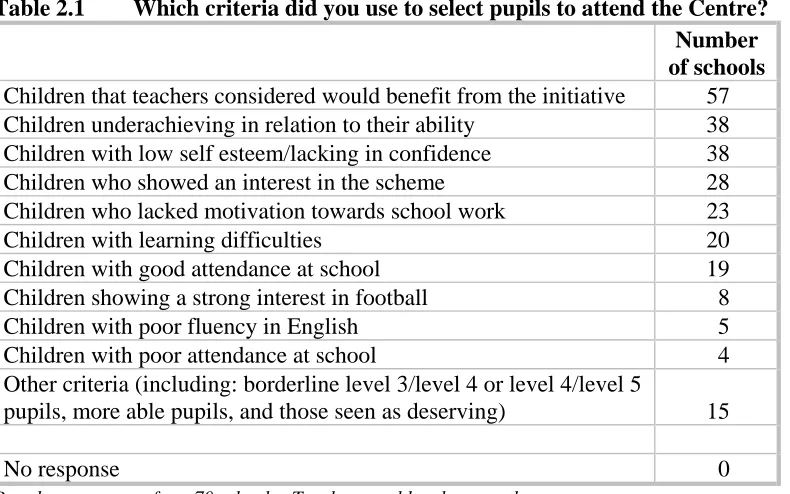
Link teachers were asked about the criteria used in selecting pupils to attend Playing for Success. A number of possible criteria were listed, and teachers were invited to add any others that they had used. The most frequent responses are given in Table 2.1.
Table 2.1 Which criteria did you use to select pupils to attend the Centre?
Number of schools
Children that teachers considered would benefit from the initiative 57 Children underachieving in relation to their ability 38 Children with low self esteem/lacking in confidence 38 Children who showed an interest in the scheme 28 Children who lacked motivation towards school work 23 Children with learning difficulties 20 Children with good attendance at school 19 Children showing a strong interest in football 8 Children with poor fluency in English 5 Children with poor attendance at school 4 Other criteria (including: borderline level 3/level 4 or level 4/level 5
pupils, more able pupils, and those seen as deserving) 15
No response 0
Based on responses from 70 schools. Teachers could make more than one response.
Teachers typically indicated that they used three or four selection criteria, suggesting that they were taking a range of factors into account. The table shows that teachers tended to select those pupils who they felt to be the most likely to benefit from the initiative, pupils seen as underachieving, and pupils with low self-esteem or lacking in confidence. This is very much in line with the scheme’s target groups. Selecting pupils with good attendance at school, those with learning difficulties, and children lacking motivation were each more likely be mentioned by secondary schools than by primary or middle deemed primary schools.
2.2 The pupils attending
Playing for Success
The Centre Managers, with the help of schools, provided a range of information about pupils attending the Centres during the evaluation period. The Centres provided information on a total of 1,247 pupils, almost equally divided between Key Stages 2 and 3. Table 2.2.1 shows the year groups of the pupils attending Playing for Success Centres during the spring term 2000.
Table 2.2.1 Pupils attending Playing for Success
Year group % Primary
5 6
KS2, year group not known
2 46 2
Secondary
7 8 9
KS3, year group not known
13 20 13 4
Based on responses for 1247 pupils. Percentages may not sum to 100 because of rounding.
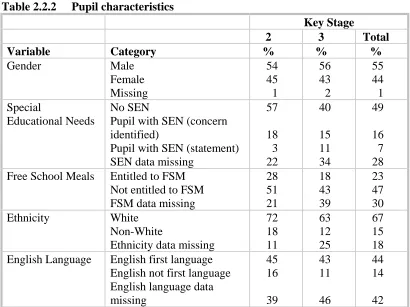
Table 2.2.2 shows some of the other characteristics of pupils attending Playing for Success.
Table 2.2.2 Pupil characteristics
Key Stage
2 3 Total
Variable Category % % %
Gender Male Female Missing 54 45 1 56 43 2 55 44 1 Special Educational Needs No SEN
Pupil with SEN (concern identified)
Pupil with SEN (statement) SEN data missing
57 18 3 22 40 15 11 34 49 16 7 28 Free School Meals Entitled to FSM
Not entitled to FSM FSM data missing
28 51 21 18 43 39 23 47 30 Ethnicity White Non-White
Ethnicity data missing
72 18 11 63 12 25 67 15 18 English Language English first language
English not first language English language data missing 45 16 39 43 11 46 44 14 42
Based on responses for 626 KS2 and 621 KS3 pupils. Percentages may not sum to 100 because of rounding.
This table shows that slightly more boys than girls were attending the 12 Playing for Success Centres during the spring term 2000. This may reflect the relative under-achievement of boys. However, the proportion of boys varied between Centres, and two Centres, had almost equal numbers of boys and girls.
Managers had difficulty in obtaining the more detailed background information from schools.
The high proportion of pupils for whom Centres were unable to establish whether or not special educational needs had been identified is disappointing, although some Centres managed to obtain complete information. However, it is clear that over 20 per cent of the pupils attending the Centres had special educational needs. Most Centres encouraged schools to select pupils with special educational needs, although one Centre Manager felt that it was not appropriate for pupils with statements to attend, because these pupils had other forms of support available within the LEA. Most of the pupils identified as having statements were from just two Centres, and in most Centres less than five per cent of pupils had statements.
We were interested to know whether or not pupils were entitled to free school meals. This is frequently used in research as an indicator of social deprivation. Unfortunately, details about entitlement to free school meals were unavailable for almost a third of the pupils. This makes it difficult to interpret the information in Table 2.3. In particular, we cannot tell if the apparent difference in entitlement between Key Stages 2 and 3 is really a result of different amounts of missing information. However, it is clear that at least 20 per cent of pupils attending the Centres were entitled to free school meals. Again, it appears that Centres varied widely. In two Centres, over half the pupils were entitled to free school meals, while in another two the proportion was about one in five. (Two Centres did not provide information about entitlement to free schools meals for any of their pupils.)
adopt a fairly crude category of ‘non-White’ in our analysis of the impact of ethnic differences.)
About 14 per cent of pupils were identified as having English as an additional language, although this information was missing for over 40 per cent of pupils. The pupils’ ethnic backgrounds and English fluency reflect the locations of the clubs. There were three Centres in which 15 to 20 per cent of pupils were from minority ethnic backgrounds. In one Centre, over half the pupils were from non-White backgrounds, and 70 per cent did not have English as their first language. This Centre serves an area with a high proportion of pupils from ethnic minorities, including asylum seekers from East European countries.
2.3 Pupils’ attendance at
Playing for Success
We were interested to know whether pupils kept up their attendance at the Playing for Success Centres. Centre Managers kept a register of each pupil’s attendance at each session, and also recorded the length of each session and the number of sessions per course.
Table 2.3.1 Length of course in hours
Key Stage
2 3
Number of Centres
Number of Centres
Less than 10 10 – 16 21 – 24 34 38 – 40
1 1 5 2 3 0 3 5 1 3
Based on data for 12 Centres.
[image:20.595.87.483.509.691.2]The table shows that 21 to 24 hours was the most popular course length for both primary and secondary pupils. Although Centres tended to offer the same length of course to all pupils, there were some differences within Centres between groups attending on different days of the week. In some cases this was scheduled, as in one Centre which ran two-hour sessions during the week and one-and-a-half hour sessions on Saturday mornings. In other cases it was due to circumstances beyond the control of the Centre Manager, such as staff illness or being unable to use the Centre because of a football match.
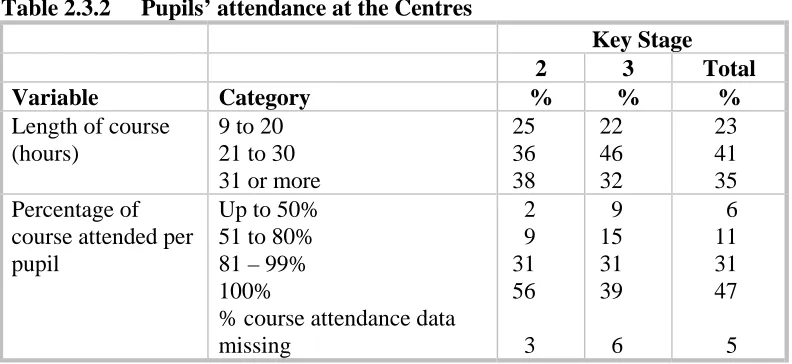
Table 2.3.2 shows the proportion of pupils attending courses of different lengths, and the percentage of the course pupils attended.
Table 2.3.2 Pupils’ attendance at the Centres
Key Stage
2 3 Total
Variable Category % % %
Length of course (hours)
9 to 20 21 to 30 31 or more
25 36 38 22 46 32 23 41 35 Percentage of
course attended per pupil
Up to 50% 51 to 80% 81 – 99% 100%
% course attendance data missing 2 9 31 56 3 9 15 31 39 6 6 11 31 47 5
The table shows that the majority of pupils attended courses running for over 20 hours. Almost half the pupils attended all the sessions in their particular course and the majority (78 per cent) attended for at least 80 per cent of the available time. The table also demonstrates that pupils in Key Stage 2 were more likely than those from Key Stage 3 to attend all, or almost all, of the available sessions. The high rate of attendance may be taken as an indication of pupils’ commitment to the programmes offered by the Centres, given that all the courses took place out of school time and some involved sessions on Saturday mornings.
The actual hours of attendance depends on both pupils’ willingness to attend and the length of the course on offer. Almost a fifth of pupils actually attended for 15 hours or less, and a further fifth for 16 to 20 hours. These are relatively short periods in which Centres have the opportunity to influence young people. Less than a quarter of pupils attended a Playing for Success Centre for more than 30 hours.
2.4 Pupils’ interest in football
Table 2.4: Pupils’ interest in football Support Centre team Support another team Not interested in football/ not sure No response % % % %
Key Stage KS2 KS3 53 48 37 34 3 2 8 17 Gender Boys Girls 46 56 41 29 2 3 12 13 Ethnicity White Non-White Ethnicity data missing 61 18 32 28 59 45 2 3 3 9 20 20
Total All pupils 51 35 2 12
Based on responses for 620 pupils attending Playing for Success. Percentages may not sum to 100 because of rounding. Results are based on pupils with pre-course questionnaires.
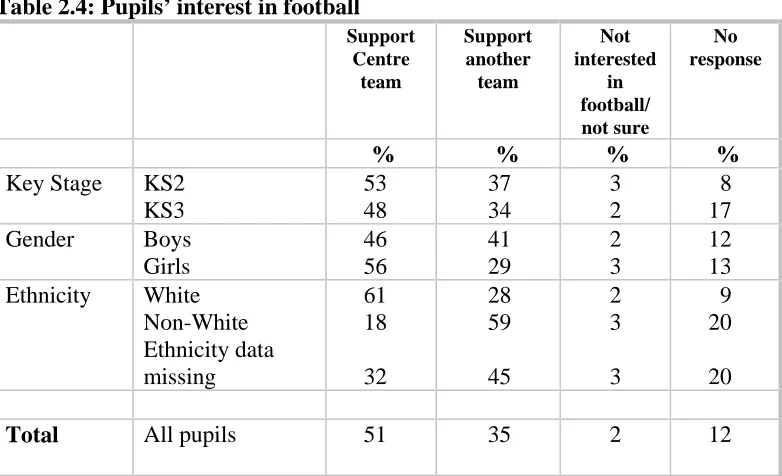
Table 2.4 shows a very high level of support for football among pupils who attended
Playing for Success. In total 86 per cent of the pupils who completed the questionnaire said they were interested in football, and half of them supported the team associated with the Centre which they were attending. The pattern of responses was similar for pupils in Key Stages 2 and 3, although it is slightly masked by the fact that a higher proportion of secondary pupils did not respond to the question.
It is a matter of speculation whether the high levels of football interest are typical of pupils as a whole, or whether they were inflated by the fact that pupils had been selected to take part in Playing for Success, and had just begun visiting the Centre. One of the ways of throwing light on this is to draw comparisons with the replies given by pupils in the control group. There were 114 control group pupils for whom we had pre-course attitude questionnaires. These pupils were drawn from schools sending pupils to the Centres, and were selected to be as similar as possible to pupils who were attending in the spring term. (In most cases these pupils went on to attend the Centres in the summer term.) An analysis of their answers to this question indicated a very similar level of interest in football among control group pupils. Only three per cent said they did not support football; 48 per cent supported the Centre team and 39 per cent supported another football team.
2.5 Summary
This section has looked at the ways in which pupils were selected to attend Playing for Success, and described the pupils attending in terms of a number of background characteristics. It also considered attendance rates, and looked at pupils’ interest in football and support for their Centre’s team.
Selection for Playing for Success
• Schools used a wide variety of criteria when selecting pupils to attend the Centre. Teachers commonly selected the pupils they considered would benefit from the initiative, pupils who were underachieving in relation to their ability, and pupils with low self-esteem or lacking in confidence.
Characteristics of pupils attending the Centres
• The pupils attending Playing for Success were equally divided between KS2 and KS3. Most primary pupils were from Year 6. Among secondary pupils, most were from Year 8, with the remainder equally divided between Years 7 and 9.
• There were slightly more boys than girls attending the Centres.
• Just under a quarter of the pupils had identified special educational needs, ranging from Stages 1 to 5 of the Code of Practice. Information on special needs was not available for a further quarter of the pupils.
• Just under a quarter of pupils were entitled to free school meals (information on entitlement to free school meals was missing for a further 30 per cent of pupils).
• About two-thirds of pupils came from ‘White European’ ethnic backgrounds. Fifteen per cent of pupils could be described as being from non-White backgrounds (mainly Black Caribbean, Indian and Pakistani). Information was not available on the ethnic background of a further 18 per cent of the pupils.
• Just under 15 per cent of pupils were identified as having English as an additional language, but this information was missing for over 40 per cent of pupils.
• The characteristics of pupils varied considerably between Centres.
Rates and length of attendance
• Attendance at the Centres was generally high. Almost half the pupils attended all the sessions and over three-quarters attended for at least 80 per cent of the available time. Rates of attendance were higher for KS2 pupils than for pupils in KS3.
Support for football
• The majority (86 per cent) of pupils attending the Centres said that they were interested in football. Half of pupils supported the club where the Centre was located.
• Interest in football was equally high among girls and boys. There were similar patterns of interest among pupils from White and non-White ethnic backgrounds. Boys and pupils from non-White backgrounds were more likely to support other teams.
3. Expectations and experiences of
Playing for Success
This section reports information from the questionnaires concerning expectations and experiences of Playing for Success from the point of view of parents, schools and the pupils themselves.
3.1 What pupils thought of the Centre
The pupil attitude questionnaire (‘What do you think?’) was completed by half of the pupils attending the 12 Centres at the beginning and end of their courses. The information below is based on the 536 pupils who attended the Centres and completed both pre- and post-course questionnaires.
Table 3.1.1 What do you think of the Centre?
Pre-course %
Post-course %
The Study Support Centre will be/was fun 86 91 The Study Support Centre will be/was boring <1 1 The Study Support Centre will be/was interesting 84 85 The Study Support Centre will be/was a good idea
for me
82 85
The Study Support Centre will help/helped me to
bebetter at maths
76 71
The Study Support Centre will help/helped me to
bebetter at writing
72 59
The Study Support Centre will help/helped me to
bebetter at reading
69 65
The Study Support Centre will help/helped me to use a computer
84 92
The Study Support Centre will help/helped me to
be a more confident person
77 79
Based on responses from 536 pupils who completed both pre- and post-course questionnaires.
The table shows that pupils had very high expectations of Playing for Success and that the Centres lived up to their expectations in offering an enjoyable and interesting experience (for example, at the end of the course, 91 per cent of pupils found the Centre to be ‘fun’ and 85 per cent considered it to be ‘interesting’ and ‘a good idea for me’). In addition, over three-quarters of pupils both expected the Centre to help them become more self-confident and felt that it had done so.
[image:27.595.89.475.107.413.2]composition as we had intended. If so, this may explain the lower scores on this item at the end of the course (because much of the written work was carried out using computers, pupils’ handwriting is unlikely to have improved as a result of their attendance at Playing for Success).
On the other hand, pupils’ already high expectations of the Centre in providing help with computer skills were exceeded by their positive ratings at the end, when 92 per cent said that the Centre had helped them to use a computer (p<0.05).
There were some differences between primary and secondary pupils in their patterns of responses. At the pre-course stage, primary pupils were significantly more likely than secondary pupils to anticipate that the Centre would be fun and to think that it would help them with maths, writing, reading and using a computer (p<0.05). There was also one difference between girls and boys at the pre-course stage: girls were more likely than boys to think that the Centre would help with their maths (p<0.05).
There were fewer differences at the post-course stage. Primary pupils were more likely than secondary pupils to think that the Centre had helped them get better at writing (p<0.05) and girls were more likely than boys to say that the Centre had helped with their maths (p<0.01).
Overall, this suggests that secondary pupils were more cautious than primary pupils in their initial assessment of whether the Centre would help them, but that primary and secondary pupils found the Centre equally helpful. The exception to this was in the area of writing, where primary pupils were more likely to feel that the Centre had helped. Girls and boys did not differ significantly in their expectations and experiences, except in relation to mathematics, where girls were more likely both to predict that the Centre would help them and to feel that it had helped.
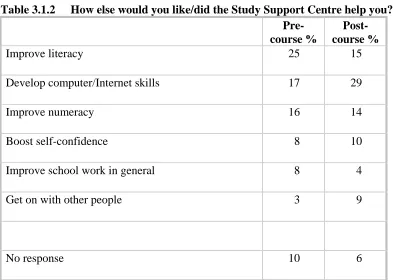
do or know?’). The coding of this open-ended question revealed that pupils took it as an opportunity to confirm their answers to the closed items, as can be seen in Table 3.1.2.
Table 3.1.2 How else would you like/did the Study Support Centre help you?
Pre-course %
Post-course %
Improve literacy 25 15
Develop computer/Internet skills 17 29
Improve numeracy 16 14
Boost self-confidence 8 10
Improve school work in general 8 4
Get on with other people 3 9
No response 10 6
Based on responses from 536 pupils who completed both pre- and post-course questionnaires. Percentages may sum to more than 100 because pupils could make more than one response.
The table shows that the expectation held by the highest proportion of pupils at the beginning of the course was that the Centre would help them with their literacy skills. Developing computer/Internet skills and improving numeracy were also areas in which some pupils said they would like help.
[image:29.595.87.480.165.445.2]3.1.1 What pupils liked most about the Study Support Centre
The final question in the pre-course questionnaire asked pupils what they were looking forward to most at the Study Support Centre. The parallel question in the post-course questionnaire asked pupils what they liked most at the Centre. Pupils’ answers to these open-ended questions are shown in Table 3.1.3.
Table 3.1.3 What are you looking forward to/did you like most at the Study Support Centre?
Pre-course %
Post-course %
Using computers/the Internet 41 45
Football related aspects 13 5
Meeting new people 9 7
Learning new things 7 3
The Centre staff 0 5
No response 9 6
Based on responses from 536 pupils who completed both pre- and post-course questionnaires. Percentages may sum to more than 100 because pupils could make more than one response.
Computers and the Internet were highlighted in pupils’ responses, both before and after their course. Almost half of pupils mentioned computers as the thing they had enjoyed most about going to the Centre. Typical comments included: ‘I liked going onto the computer and playing Amazing Maths, because it helped me with my maths’ and ‘I liked going on the computers because I didn’t know what to do on a computer but now I am
quite good on one.’
[image:30.595.85.475.247.496.2]pupils at the beginning of their course than was true at the end. This may be because pupils had fewer opportunities to meet players than they had hoped, and/or because other aspects of the Centre had come to the fore.
Other aspects mentioned by a small minority of pupils included: meeting new people (such as pupils from other schools); learning new things in general; and, at the post-course stage, the Centre staff. One girl identified the best things about the Centre as: ‘The staff and the wonderful and exciting things we did.’ Another summed up her experience in the following way: ‘It was fun, interesting and very cool.’
3.2 Parents’ views of
Playing for Success
A total of 898 parents responded to the parents’ questionnaire at the beginning of the course (a response rate of 53 per cent). Of these, 455 parents completed a questionnaire both before and after their child attended one of the 12 Centres. Centre Managers reported difficulties in encouraging parents to complete questionnaires, particularly after their children had completed their course (the response to the post-course questionnaire was disappointingly low at just under a third).
The following analyses are based on responses from parents who completed both questionnaires. This enables us to make direct comparisons between parents’ expectations of Playing for Success and the comments of the same group of parents after their child had completed the course.
3.2.1 Were parents pleased that their children were selected for
Playing for Success
?
The questionnaire at the beginning of the course asked parents how pleased they were that their child was selected to go to the Study Support Centre. Parents were invited to respond using a five-point scale (very pleased, pleased, not very pleased, not pleased at all, not sure). The responses to this question at the pre-course stage were very positive, with 86 per cent of parents saying that they were ‘very pleased’ and a further 13 per cent saying they were ‘pleased’. Similarly, the parents’ responses at the post-course stage showed a high degree of satisfaction with the initiative, with 88 per cent saying that they were ‘very pleased’ that their child had been selected, and a further 11 per cent saying that they were ‘pleased’.
3.2.2 What parents wanted the Centre to do for their child
We were interested to find out which of the Centres’ objectives were most important to parents. The pre-course questionnaire included the following question: ‘Study Support Centres try to help children in a number of ways. Please tick the ways that are most important to you.’ The question listed ten different items from which parents could choose five. The post-course questionnaire listed the same items, asking parents to indicate whether they felt the Centre had helped their child with each one (helped, not sure, did not help).
Table 3.2.2 What are the five most important ways in which the Centre can help your child/Did the Centre help?
Pre-course %
rating as important
Post course %
saying it helped
Become more self-confident 80 80
Get better at maths 78 62
Learn to use a computer to do school work 78 93
Get better at writing 68 49
Get better at reading 56 59
Have a better chance of getting a job when they leave school
51 49
Become more willing to do homework 37 55
Meet children from other schools 28 63
Like school more 12 43
Based on responses from 455 parents who completed both pre- and post-course questionnaires.
The table shows that help with self-confidence, mathematics and computers were high on the list of importance in terms of parents’ expectations of Playing for Success. These three items were each selected as important by over three-quarters of parents. Their children’s self-confidence was a key issue for parents. Help with writing, reading and employability were each selected as important by over half of the parents who responded. Items that came lower on the list of expectations were: willingness to complete homework, meeting children from other schools and positive attitudes to school.
parents felt that the Centre had helped their child with writing skills, despite this being a relatively high priority at the pre-course stage (as with pupils, it is possible that parents misinterpreted this statement to mean handwriting). On the other hand, there was a high level of satisfaction with the Centre’s impact in relation to two other items, namely their child’s willingness to do homework and meeting children from other schools. It is also worth noting that, although improving pupils’ attitudes to school was not among most parents’ top priorities at the pre-course stage, 43 per cent of parents felt Playing for Success had made a positive impact on their child’s attitudes to school.
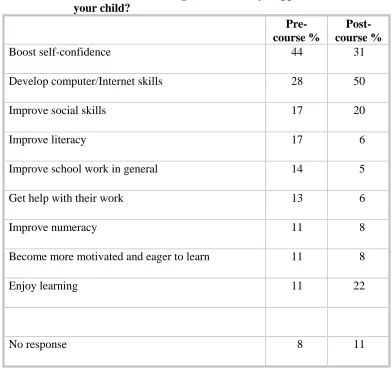
Table 3.2.3 What is the best thing that the Study Support Centre can do/did for your child?
Pre-course %
Post-course %
Boost self-confidence 44 31
Develop computer/Internet skills 28 50
Improve social skills 17 20
Improve literacy 17 6
Improve school work in general 14 5
Get help with their work 13 6
Improve numeracy 11 8
Become more motivated and eager to learn 11 8
Enjoy learning 11 22
No response 8 11
Based on responses from 455 parents who completed both pre- and post-course questionnaires. Percentages may sum to more than 100 because parents could make more than one response.
A high proportion of parents responded to these questions. The table shows that parents gave a variety of different answers to this question and commonly mentioned more than one ‘best thing’. These results are broadly consistent with parents’ answers to the closed questions, giving top priority to improving children’s self-confidence. Again, there were some differences in emphasis between the answers parents gave before and after the course.
In relation to personal and social attributes, the most common answer before the course was that parents wanted the Centre to help boost their child’s self-confidence. Many of the parents expressed their concern about their children’s lack of confidence, which they felt held their children back and inhibited them from trying at school. Several parents also made the point that a basic level of self-confidence and self-belief would be a key asset for their children in the future. For example, one parent answered the question as follows: ‘My daughter has a wonderful character but lacks in confidence. She is very unsure of herself and often thinks that what she has to offer in group talks is nonsense or
uninteresting. I think she has shown great courage wanting to attend the Centre and I
am hoping to see a difference with her. Thank you for the opportunity.’
Another said: ‘I think the best thing the Study Support Centre can do for my child is to help him become more self-confident as I believe this is an important part of getting on in
life. Being more confident can help people accomplish the things they want from their
lives.’
As well as self-confidence, parents also hoped the Centre would help their child to develop social skills, and to improve their motivation and enjoyment of learning. For example, one parent wrote: ‘I would like the Centre to teach him self-discipline and tolerance with others. For my son to learn to work with others in a team, to reduce his
competitive nature to a level where he can interact with others without stressing himself
about winning or losing.’ Another said: ‘If the Centre could help my son to enjoy learning, and therefore want to learn, it would benefit him so much.’
In terms of academic learning, parents hoped that the Centre would help their child with specific skills, particularly computer skills, but also literacy and, less commonly, numeracy. Several pointed out that the Centre was in a good position to offer their child some additional help with learning. Typical comments included: ‘The best thing the Centre could do is to help with learning computer skills and having extra help with
Parents’ comments after the course revealed that they felt the Centre had helped their child most with computer skills (half of the parents made this point). Other areas that parents identified as the ‘best thing’ about their child attending the Centre were improvements in self-confidence, enjoyment of learning and social skills. Parents often took the opportunity to thank the Centre staff for their work. Typical comments are reproduced below.
It helped make my daughter more confident and able to mix with [children from] other
schools.
The Centre has helped our daughter become a lot more computer literate than she was
and she is now totally at ease with computers. She enjoyed every minute of the Centre
and is disappointed that her visits have come to an end.
My son has no interest what so ever in football but has thoroughly enjoyed his time at the
Study Support Centre. He is now begging us to get the Internet at home because he
enjoyed so much all the work he has done on the computer.
The best thing was seeing the joy and excitement it brought to him every time the bus
picked him up. When he returned home he would be telling me and his mum what he had
learnt and that he could not wait until the Saturday session. This has been a great
experience for my son and we would like to thank the team for the excellent support
towards our child and the other children.
My son is a lot more happy and better in himself. He used to be a very quiet kid but now
3.3 Teachers’ views of
Playing for Success
This section reports the expectations and experiences of teachers. Questionnaires were sent to all the 119 schools which sent pupils to one of the 12 Centres during the Easter term. The questionnaires were addressed to a named ‘link teacher’ and were sent out just after summer half term (i.e. at least half a term after the pupils had completed their course at the Centres). We received responses from 70 schools (59 per cent). The majority of responses (44) were from primary schools, including a few from middle deemed primary schools. For just over half (36 schools) this was the first time they had taken part in
Playing for Success.
Because the number of responses from schools is below 100, the following tables report the number of respondents, rather than percentages.
3.3.1 How teachers expected pupils to benefit
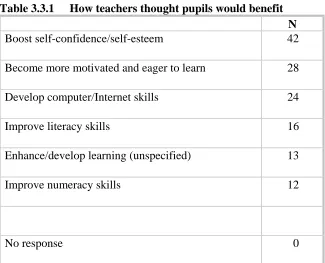
Table 3.3.1 How teachers thought pupils would benefit
N
Boost self-confidence/self-esteem 42
Become more motivated and eager to learn 28
Develop computer/Internet skills 24
Improve literacy skills 16
Enhance/develop learning (unspecified) 13
Improve numeracy skills 12
No response 0
Based on responses from 70 teachers who completed the school questionnaire. Numbers may sum to more than 70 because teachers could make more than one response.
Teachers had a number of expectations of Playing for Success, which fell into the two main areas of self-confidence/motivation to learn and academic skills. The majority of teachers (42 out of 70) said that they anticipated that the Centre would increase pupils’ self-confidence or self-esteem. A further 28 teachers said that they hoped the Centre would improve pupils’ motivation. One teacher listed the school’s expectations of the Centre as follows: ‘Confidence-building, raising self-esteem and further determination to succeed.’ Another wrote: ‘Motivation would be developed. A desire for learning for its own sake – the joy of discovering something new – not just for SATs.’
In terms of academic skills, just over a third of teachers said that they hoped the Centre would help children with their computer skills. As might be predicted, this answer was more likely to be given by teachers from primary and middle schools than by those from secondary schools. As one teacher from a middle school said: ‘Our children do not have access to computers at home to support their learning – this was our opportunity to
[image:39.595.88.413.105.368.2]A minority of teachers said that they expected the Centre to help pupils with literacy and/or numeracy. Other points made by a small minority of teachers included: improving attainment in National Curriculum Assessments; developing study skills; and providing additional study time.
3.3.2 Teachers’ views of the Centre’s impact on pupils
The school questionnaire contained a ‘closed’ question, asking teachers to rate the impact of the Centre on different aspects of pupils’ attitudes, behaviour and skills. The aspects listed in the question were related to the stated purposes of Playing for Success. Teachers were asked to indicate their level of agreement with each statement, using a three-point scale (agree, neutral, disagree). The results are shown in Table 3.3.2 (not all teachers answered every item).
Table 3.3.2 Teachers’ ratings of the impact of the Centre on pupils who attended during the Easter term
Agree N
Neutral N
Disagree N
The Centre had a positive impact on pupils’ motivation at school
56 14 0
Pupils’ self-esteem and confidence improved
65 5 0
Pupils’ school attendance improved 6 56 4
The Centre had a positive impact on homework completion
26 39 3
Literacy skills improved 44 23 1
Numeracy skills improved 42 25 1
ICT skills improved 64 3 1
Study skills improved 54 12 0
Based on responses from 70 teachers who completed the school questionnaire.
[image:40.595.87.477.384.671.2]on pupils’ self-esteem/confidence and on their ICT skills and over three-quarters felt that the Centre had impacted on pupils’ motivation at school and study skills. Over half of the teachers agreed that the Centre had helped pupils to improve their literacy and numeracy skills.
Two statements obtained the agreement of fewer than half of the responding teachers. Just over a third (26) of teachers agreed that the Centre had had a positive impact on pupils’ homework completion, and only six teachers agreed that pupils attending the Centre had shown improvements in school attendance. The response to the latter question may simply reflect the selection criteria for the Centre. Only four teachers reported that the school had selected pupils with a record of poor attendance at school, and 19 said that a record of good attendance was one of the criteria they had used in selecting pupils to attend. In most cases therefore, pupils probably had an acceptable or good record of attendance at school before attending the Centre. It is more difficult to interpret the pattern of responses to the question about homework completion. Perhaps pupils attending the Centre already had a good record of homework completion? In any case, we know that Centres varied in their practice towards homework: while some set aside time for this, many encouraged pupils to use the Centre’s facilities for homework if they so wished.
3.3.3 How teachers rated the Centres’ organisation
Table 3.3.3 Teachers’ ratings of aspects of the Centre’s organisation
Good N
Neither good nor
poor N
Poor N
Information about the Study Support
Centre 65 4 1
Liaison over practical arrangements
(e.g. dates, times) 67 3 0 Transport arrangements 61 6 3
Feedback on pupils’ progress at the Centre 51 13 5
Based on responses from 70 teachers who completed the school questionnaire.
The table shows that the majority of the 70 teachers considered the Centres to be well-organised, especially in relation to practical arrangements and information about the Centre. Feedback on pupil progress was rated less highly overall. Although the majority of teachers considered the Centre’s feedback on pupil progress to be ‘good’, 13 teachers gave this aspect a neutral rating and five rated it as ‘poor’. As might be expected, this was something of a ‘Centre’ factor, with some Centres getting better ratings than others on the quality of feedback provided to schools.
3.3.4 Would teachers send pupils to the Centre in future?
We wanted to know whether the schools would be keen to send another group of pupils to the Centre, so we asked teachers to respond to the following question: ‘If you have the opportunity, will you send pupils to a Playing for Success Study Support Centre in the future? Teachers were asked to respond by ticking one of three boxes (yes, not sure, no) and then to explain the reasons for their answer.
On the whole, teachers were very positive about their reasons for wanting to send more children to the Centres in future. About a third of teachers said that they were keen to do so because the initiative had proved a worthwhile experience for their pupils. Other reasons given by teachers included: that attending the Centre helped pupils to broaden their experience of learning; and that it increased pupils’ motivation to learn.
A selection of teachers’ comments is reproduced below.
[I would send pupils again]Because it worked! The children improved in so many areas.
It helped to switch them on to learning.
The Study Support Centre is an excellent support and provides a superb extra dimension
to our work. It was exceptionally beneficial to all pupils.
Self-esteem and the opportunity to develop ICT skills was superb. Watching ten- and
eleven-year-olds produce Powerpoint presentations was truly awesome and has raised
my expectations.
This is the second year our school has taken part. The pupils love it, they don’t seem to
realise they’re working. It’s a shame that we can only send 20 per year. More clamour
to go. It’s brilliant!
3.4 Improvements to the Study Support Centres
suggested by pupils, parents and schools
This section presents the suggestions offered by pupils, parents and schools about how the Centres could be improved.
current study we changed the wording to elicit more suggestions about improvements. Pupils were asked simply: ‘What would make the Study Support Centre better?’
The post-course parent questionnaire invited parents to tell us about anything they felt could be improved. Similarly, the school questionnaire invited further comments and suggestions for improvement from teachers.
[image:44.595.87.465.352.569.2]The responses to these open-ended questions are shown in the following two tables. Table 3.4.1 shows the improvements suggested by parents and pupils (expressed in terms of percentage of responses) and Table 3.4.2 shows the comments and improvements suggested by teachers (expressed in terms of the number of responses).
Table 3.4.1 Improvements suggested by pupils and parents
Pupils %
Parents %
Nothing – it’s good already 18 15
Longer courses 10 12
Improvements to Centre facilities 5 1
More information for parents - 5
No response 23 51
Based on responses from 536 pupils and 455 parents who completed both pre- and post-course questionnaires.
Respondents could make more than one comment.
The second main suggested ‘improvement’ was that pupils would have liked to attend for a longer period. Comments here included: ‘It would be better if it lasted a little bit longer. It has been great’, and ‘It would be better if you could come every week for ever’.
A small number of pupils made other comments, including suggesting improvements to Centre facilities. On closer examination, these appeared to come from certain Centres where the room allocated to Study Support were a little small and crowded. Additional suggestions made by a small minority of pupils (less than five per cent) included: more use of computers and more football-related content, such as the opportunity to meet players or play football.
Parents’ suggestions tended to echo those of the pupils, although a few parents (five per cent) said that they would have liked more information. One parent wrote: ‘[I would like] an information pack for parents covering all the activities and more information on
what we could do to help’ and another would have liked ‘Better communication with parents. I’m not sure whether my son had made any improvements with his study,
although his confidence has lasted and he did seem to enjoy attending.’
Nevertheless, most of the parents who replied took the opportunity to make positive comments about the Centre. One parent spoke for many when she said: ‘The Study Support Centre is an excellent initiative and the only way in which it could be improved
Table 3.4.2 Teachers’ further comments and suggested improvements
N
Centres should increase their pupil intake 11
Pupils gained a great deal from their involvement 11
The Centre is well organised 9
Communication between the Centre and the school is good
9
More liaison and feedback is needed 8
Facilities at the Centre are excellent 7
The school is satisfied with the Centre – it’s difficult to suggest improvements
7
No response 21
Based on responses from 70 teachers who completed the school questionnaire. Teachers could make more than one response.
The teachers’ responses reinforced the positive nature of the experience for the majority of schools. Teachers said that pupils gained a great deal from their experience and they wished that the opportunity could be available for more pupils to benefit. For example, one teacher said: ‘The enthusiasm of the Centre Manager is a strong feature of the programme. The programme is well run and fits into the existing knowledge/experience of pupils. We would just like more of it!’
proactive approach to involving teachers: ‘The opportunity to visit was open, but a more concrete invite would have been more likely to make me feel welcome.’
On the other hand, these criticisms came from a minority of teachers and several others made positive comments about the quality of their involvement with the Centre. As one teacher said: ‘I was very impressed with the organisation and communication. All kids who attended benefited in some way.’ Another said: ‘Could we send twice as many children? The Centre is excellent – the management, admin. and teaching staff are a
credit to [the LEA], [the club] and the schools they serve.’
One school reported that the Centre had made a contribution to staff and curriculum development. This had arisen through the participation of teachers in Playing for Success
sessions.
The Playing for Success scheme is absolutely superb and fulfilled all of our hopes and
expectations. In addition to the benefits for pupils, the school’s participation in this scheme proved to be a very valuable staff development strategy. It enabled teachers to
observe and participate in their after-school sessions, thereby providing access to expert
advice as well as opportunities to seek guidance about computer programs which would
be suitable for use in the school. The only possible improvement which I could suggest
would be to provide us with more sessions! PLEASE!
3.5 How did the football club environment
contribute to pupils’ experiences?
Table 3.5.1 How did the fact that the Centre was located in a football club contribute to the quality of pupils’ experiences?
N
Pupils felt privileged/special going to a football club 29
The location raised the profile and status of the initiative
14
Pupils who attended gained kudos with their peers 10
The possibility of seeing players was an incentive 10
The football environment was not important 7
No response 0
Based on responses from 70 teachers who completed the school questionnaire. Teachers could make more than one response.
Most teachers were able to identify one or more ways in which the football club environment had contributed to the quality of pupils’ experiences. Only seven of the teachers felt that the football environment had not contributed to pupils’ experiences (for example one teacher commented: ‘This fact seemed immaterial to thechildren.’) Others said that the football location acted as an incentive at first, but that different aspects of the scheme (particularly the learning programme and computer facilities) were more important in sustaining pupils’ willingness to attend. Teachers also made the point that part of the ‘special’ character came from the experience of visiting a high-profile venue that was different from school.
Some teachers felt that the football connection had an equal appeal to all pupils. As one teacher commented: ‘All pupils can relate to the football club, whether they like sport or not.’ Others made the point that the football club environment held a strong appeal for boys and for pupils who were football supporters, although this was not to the detriment of other groups. For example, one teacher wrote: ‘The connection with football is undoubtedly a strong motivator, especially for disaffected boys. Girls also enjoyed being
included on equal terms.’ Another said: ‘It was influential – a great deal of self-esteem was derived from the fact that the children could associate their learning with football –
particularly important to boys.’ A third commented that the football club held a particular appeal for ‘Boys and those of Asian heritage who do not traditionally attend football matches.’
The strength of the football club appeal clearly varied from Centre to Centre. Some teachers reported that ‘their’ club was successful and/or enjoyed a particularly high status within the local community. As one teacher explained: ‘[The team] is held in high regard by the majority of pupils and visiting their local club had a huge impact on their
desire to attend and learn... It helped to fulfil many pupils’ dreams being under the same
roof as their heroes!’ A teacher from a school in a different area said: ‘These are [area name] kids – what more need I say! They live football. It was very positive.’
The football club location raised the profile and status of the initiative among parents, schools and classmates. For example, one teacher said: ‘It made it exciting for pupils and gave credibility to the project for parents. Everyone knows where they’ve been.’ Others referred to the ‘street cred’ among fellow pupils of attending a Centre based in a football club, and the fact that it was seen as a ‘cool’ thing to do. Teachers commented that these were important ingredients in attracting pupils who were not strongly motivated towards learning and that it helped boys, in particular, feel able to participate in a learning initiative without fear of ridicule from their classmates.
part of the football club. This association inspired them academically and socially to
give of their best with their work, behaviour and attitudes.’
Several also pointed out that the possibility of meeting professional players and other club staff gave an added incentive for pupils to attend. Points made by a small minority of teachers included: that the pupils enjoyed the opportunity of seeing ‘behind the scenes’ at the club; that the clubs were able to provide an excellent standard of facilities; and that pupils benefited from football-related incentives and prizes (such as match tickets and team merchandise).
3.6 Summary
This section has revealed very positive views of Playing for Success among pupils, parents and schools.
Pupils’ views of
Playing for Success
• Most pupils were looking forward to attending the Centres. They anticipated that their experiences would be fun and int