1 Construction
2 Cultural and creative industries
5 Hospitality 6 Manufacturing 7 Public administration 3 Financial services 4Health and social care 0 Overview
W
orkf
or
ce
Development
Action
Plan
Financial
Services
Lift for action plan 8 Retail 9 Transport and logistics 10 Voluntary and community
Learning and Skills Council London East
Boardman House, 64 Broadway, Stratford, London E15 1NT Telephone: 0845 019 4151 e-mail: [email protected] www.lsc.gov.uk
This strategy was written by Trevor Carr and members of the LSC London East Workforce Development team. Trevor Carr McKerr Carr Ltd Telephone: 020 8349 2110 www.mckerrcarr.com Designed by Creative Leap Telephone: 020 7549 0700 www.creativeleap.com
Nordland Papier AG is committed to the tradition of sustainable forest management and minimisation of its impact on the local environment.
WFD/LSCLE/021/03
London East 2003-2005
3
W
orkf
or
ce
Development
Str
ateg
y
Financial
Services
Our
main
par
tner
s
and
stakeholder
s
• Accountancy Occupational Standards Group (and its successor organisation) • Association of Accounting Technicians (AAT) • Basic Skills Agency
• Be Ltd London East
• British Insurance Brokers Association (BIBA) • Business Link for London
• Chambers of Commerce • Chartered Institute of Bankers and the
Institute of Financial Services • Chartered Institute of Management
Accountants (CIMA)
• Chartered Institute of Public Finance and Accountancy (CIPFA)
• Chartered Insurance Institute (CII), • Connexions
• Department for Education and Skills (DfES) • Education Business Partnerships • Financial Services Authority (FSA) • The Skills Council for Financial Services
(in development) – formerly the Financial Services National Training Organisation (FSNTO) • Further education colleges • General Insurance Standards Council • Higher education institutions
• Information, advice and guidance partnerships (IAGs)
• Jobcentre Plus • learndirect • Local authorities • London Development Agency • London First
• Private-sector employers
• Qualifications and Curriculum Authority (QCA)
• Regeneration partnerships • Schools and sixth form colleges • Securities Institute
• The Institute of Chartered Accountants in England and Wales (ICAEW) • Trade unions
• Training providers (private and public) • UNIFI
• Work-based learning providers We, the Learning and Skills Council
London East, fund training and education for those over age 16 in Barking and Dagenham, Bexley, City of London, Greenwich, Hackney, Havering, Lewisham, Newham, Redbridge and Tower Hamlets.
Learning and Skills Council London East Boardman House, 64 Broadway, Stratford, London E15 1NT Telephone: 0845 019 4151 e-mail: [email protected] www.lsc.gov.uk
©LSC 2003. Published by the
Learning and Skills Council. You may copy extracts from this publication for non-commercial, educational or training purposes as long as you acknowledge the source and do not misrepresent the findings. Readers please note:
• in this publication where ‘we’ is used, it refers to the Learning and Skills Council London East, and • we have used footnotes in this
FINANCIAL
SER
VICES
PA
GE
1
C
ontents
Foreword
Introduction
Executive summary
Chapter 1
Chapter 2
Chapter 3
Chapter 4
Chapter 5
Bibliography/Appendix
Chapter 6
Pull-out section inside the back cover
2
3
4
6 The main features of the sector
6 Introduction
7 The size of the industry 8LSC London East area
12 Changing demand levels in the sector
12 Economic Drivers 12 • World events 12 • Globalisation
12 • Information and Communications Technology 13 • Regulation
14 • Consumer demand and social change 14 Skills gaps and skills shortages
16 Future employment demand – forecasts
18 Learning and training
18Introduction
20 Qualifications and examinations – time for change 20 Further education provision in London East 22 Work-based learning provision
22 Higher education
23 The main issues
24 Skills gaps 24 Skills shortages
24 Skills – the employers’ perspective 26 Barriers to workforce development
27 Strategic recommendations
28
The action plan
For
We are in the middle of an
exciting period of change.
London East’s 2 million
residents have seen many
changes in the last 10 years.
The new developments
announced for the Thames
Gateway show that there
will be further investment
and increased opportunities
during the next 10 years.
Mary Conneely
Executive Director
In every sector there is potential for growth. The proposal for major housing development in the Thames Gateway by the Deputy Prime Minister, in February 2003, is a boost for the construction industry. The Strategic Rail Authority and Transport for London have ambitious plans to develop the transport infrastructure. Health and social care, and financial services have their own challenges to meet as legislative changes place new demands on the workforce. The cultural and creative industries are thriving, and the retail sector can continue to grow with future town-centre redevelopments planned. Our task, with you, our partners, is to make sure that London East is ready to meet these challenges with a highly skilled workforce. The consultation paper,Success for All1,in June 2002 set out the role of
learning providers. It stated that “learning in an area must meet national and local skill needs… and be responsive to local employers and communities.” This view was reinforced in the formal publication of
Success for Allwhich set out the joint plans
of the DfES and the Learning and Skills Council, in November 2002, to reform the learning and skills sector and raise standards.
This series of workforce development strategies explains the issues affecting each industrial sector. Each strategy then suggests some realistic action to support the skills development of local people. The aims are to meet employers’ needs, and to give individuals positive learning and employment experiences.
By delivering the actions in these 10 sector strategies, we will be helping to:
• fulfil our corporate objectives which we outlined in the Local Strategic Plan 2002-2005
• meet the requirements of the Learning and Skills Council’s National Policy Frameworkfor workforce development
• support the objectives outlined in London’s
Framework for Regional Employment and Skills Action (FRESA)published by
the London Skills Commission, and • meet the aims of the Skills Strategy
White Paper (2003).
We hope that all partners and stakeholders in the various sectors will help deliver the plans presented in these very positive strategy documents. This will enable local people to improve their skills and make the most of the new opportunities being created in the Thames Gateway area.
FINANCIAL
SER
VICES
PA
GE
3
Intr
oduction
1DfES,Success for All – Reforming Further Education and Training,Discussion Document, June 2002;
DfES,Success for All – Reforming Further Education and Training – Our Vision for the Future, November 2002.
2This does not include higher education provision.
The Learning and Skills
Council is responsible
for funding and planning
education and training
for those over 16 years
old in England
2.
Workforce development is one of the most challenging and exciting parts of our work, and in November 2002, the national office published its Workforce Development Strategy – National Policy Framework to 2005.
The National Policy Frameworkwas
published at the same time as the
Government report,In Demand: Adult
Skills in the 21st century – part 2,
produced by the Strategy Unit. These two documents suggested action that would promote workforce development. They state that we should:
• “raise informed demand for employment-related skills among individuals and employers • support improvements to the
responsiveness and flexibility of the supply side, and
• contribute to the development of an underpinning framework of better skills and labour market intelligence, responsive vocational qualifications and improved links to the wider educational agenda.”
Each sector strategy has an action plan which shows how we, at LSC London East, will take practical steps to meet those three objectives. By carrying out the action proposed for each sector, with you, our partners, we will directly contribute to delivering the LSC’s goals, which are to: • “raise the participation and achievement
of young people
• increase the demand for learning and equalise opportunities through better access to learning
• engage employers in improving skills for employability and competitiveness • raise the quality of education and
training delivery
• improve effectiveness and efficiency.” This workforce development strategy for the financial services sector is one of ten sector-based strategies. Each one describes the current issues in the sector nationally and locally. They give details of the current levels of employment and skills in the sector, and suggest where improvements in skills are necessary to meet the needs of the local and national economy.
The action plan for each sector gives details of the funding opportunities that are being made available to help individuals and organisations fulfil their potential.
Workforce Development Strategies for London East
1 Construction
2 Cultural and creative industries 3 Financial services
4 Health and social care 5 Hospitality
6 Manufacturing 7 Public administration 8Retail
Ex
ecutive
The City of London and
the developments in and
around Canary Wharf in
the London borough of
Tower Hamlets form the
hub of London’s wholesale
financial services.
Meanwhile, across the whole of the London East area, and throughout the Thames Gateway subregion, retail financial services provide substantial employment
opportunities. Banks, building societies, insurance brokers and financial advisers have prominent positions in the high street.
The City is the heart of the world’s wholesale banking sector. It includes the work of the commodity exchanges and worldwide insurance underwriting. London’s share of the global foreign exchange market is 31.1% – which is almost twice the United States’ share of the market, and it has 56% of the global foreign equity market. The sector’s future is shaped by world events, the increasing use of technology, mergers and acquisitions, and increasing regulation.
In recent years there have been some redundancies as a result of the economic downturn across the world, but the overall workforce numbers have stabilised now. The latest employment forecasts show modest growth is expected up to 2010 for the insurance subsector, but there will be a slight decline in the numbers employed in financial services.
FINANCIAL
SER
VICES
PA
GE
5
The financial services industry has not been affected by skills shortages as much as some other industries. In the past it has bought its way out of difficulties. For example, it has paid premium rates for IT specialists when they have generally been in short supply. Nevertheless, it is possible to identify within the industry some skills gaps amongst existing staff, as well as particular skills shortages. The workforce will also need further training as new regulations relating to the sale of insurance and mortgages come into force.
The skills gaps of existing employees, including new recruits to the industry, were, in order of importance:
1. behavioural skills 2. business awareness 3. IT skills
4. leadership skills 5. risk management skills 6. technical skills
At the present time, it is hard to fill clerical and secretarial posts, some sales jobs and some professional posts. Looking to the future, shortages are forecast on a national basis in the following occupations: • actuaries
• independent financial advisers • ICT technical experts
• call centre staff
There has been a well-developed training culture in the sector, which has operated largely independently of public-sector education and training organisations. The training has often been driven by regulation, and the need to ensure that staff follow in-house procedures and company practices.
Chapter
1
The
main
featur
es
of
t
he
sector
London, New York and
Tokyo are the three
major financial markets
in the world, and set
the agenda for financial
trading globally.
Introduction
The City of London and the developments in and around Canary Wharf in the London Borough of Tower Hamlets form the hub of London’s financial services. They are in the eastern half of the London East area, and their well-being is of major importance to the health of the local economy.
A few statistics3show the importance
of the City to the UK and its capacity to generate wealth and jobs:
• London’s share of the global foreign exchange market is 31.1% – which was almost twice the United States’ share of the market
• It has 56% of the global foreign equity market
• Over half the UK’s £14 billion insurance premium income from abroad comes through London
• Ninety-five EU-owned banks have operations in London, with assets of £6344billion and employ 30,000 people5
London as a financial centre was estimated to employ some 325,000 people at the top of the recent business cycle, and recent falls have brought that figure down to 305,000 jobs in June 2002. The figure is expected to stabilise at about 295,000 for the lifetime of this current strategy document. In spite of the downturn in the economy in 2001 and 2002, it should be recognized that 57% of all EU investment banking and related business is still conducted in the City6.
The City, or the square mileas it is
sometimes known, is the heart of the world’s wholesale or corporate banking sector. It also includes the work of the commodity exchanges and worldwide insurance underwriting. Many of the firms are now either owned or managed from overseas as globalisation, merger and consolidation have taken hold of the industry. And although employment figures have held up in the industry as a whole, the internal re-structuring has had enormous implications for the workforce, and the skills required to sustain a continuing career. The new employment has come in the establishment of small businesses servicing niche markets, and specialist roles, using higher level skills in economics, statistics and IT, in large and small companies.
FINANCIAL
SER
VICES
PA
GE
7
3 Corporation of London. 4$1,000 billion.
5The City’s Importance to the European Union Economy, 3 February 2003, Corporation of London.
6The City’s Importance to the European Union Economy, 3 February 2003, Corporation of London.
7FSNTO,A Skills Foresight for the Financial Services Industry, 2002.
8FSNTO,A Skills Foresight for the Financial Services Industry, 2002.
9FSNTO,A Skills Foresight for the Financial Services Industry, 2002.
10These figures are from the Skills Foresight Reportand are based on SIC codes 65, 66, and 67.
The size of the industry
In this strategy, the financial services sector is defined as:
• banks, building societies, central banks and financial intermediation – this includes leasing, credit granting, investment trusts, unit trusts and venture capital
• life insurance, pension funding and other insurance
• administration of financial markets, security broking and fund management; Lloyd’s – agents and underwriters, and • accountancy, auditing and related
activity.
The strategy does not include an analysis of call centres.
The sector was responsible for 7% of the UK output in 20007. By contrast its
share of UK employment is only 4.2%8.
Employment growth is likely to be static over the decade in financial services, but there will be significant changes in the types of activities undertaken by the workforce, with greater emphasis on customer service skills, even for back office staff, and a continual requirement to improve IT skills. There will be some minor changes in the share of jobs between subsectors. The Financial Services National Training Organisation (FSNTO)9presentation of
sectoral employment over the period 1990 to 2000 to 2010 (actual and forecasts) showed little change in the numbers employed in financial services (not including professional services)10with the national
figure increasing marginally from about 1.07 million in 2000 to 1.08 million by 2010.
There are 50,000 firms in financial services nationally with 35,000 firms employing less than 10 staff each. Some 86% of the employees work full-time, and 54% of the total workforce is female.
LSC London East area11
The banks, building societies and other credit granting organisations had approximately 90,000 employees in 2001 and the largest employment share of the sector. Insurance and activities related to insurance and pension funds a further 45,000 employees. The other financial intermediationcategorisation (which
includes investment trusts and unit trusts, and dealing in securities and venture capital), security broking and fund management, and auxiliary activities to financial intermediation combined to provide 65,000 jobs. Professional services in accountancy and audit related work were approximately 21,500 (seetable 1). This
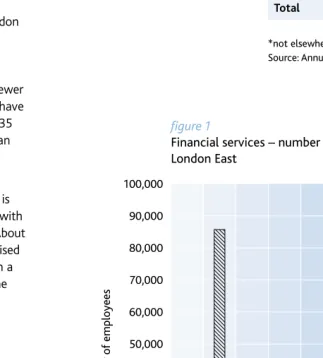
latter figure is probably an under-estimate, as other economic forecasts prepared for this Strategy show higher baseline figures for 2002 for Professional Services. The following figures (2, 3)show the
number of establishments in the London East area.Figure 2demonstrates the
dominance of small establishments employing fewer than 50 employees. 90 per cent of establishments have fewer than 50 employees, and 70 per cent have fewer than 11 employees. Of the 3,735 small businesses employing fewer than 11 people, exactly one quarter were accountancy firms.
The largest number of establishments is to be found in the banking subsector, with just under half of all establishments. About a quarter of all establishments specialised in insurance and pension funding, with a further 20 per cent of businesses in the category of professional accountancy.
0 10,000 20,000 30,000 40,000 50,000 60,000 70,000 80,000 90,000 100,000 Number o f emplo yees
Type of employer
C
e
ntr
al banking
Banks/building societies
(Other monetary intermediation)
Financial leasing Cr
edit gr
anting
Other financial intermediation Lif
e insur ance Non-lif e insur ance A d ministr ation o f financial markets Secur ity br oking and fund managment A
uxiliary services to
financial intermediation
A
u
xiliary services to insur
ance
and pension funding
[image:10.842.243.566.416.774.2]Pr o fessional – ac countancy figure 1
Financial services – number of employees by types of employer, London East
Source: Annual Business Inquiry 2001, ONS Crown copyright (2003) table 1
Financial services – numbers of employees by types of employer, London East, 200112
Central banking 1,551
Banks/building societies
(Other monetary intermediation) 85,985
Financial leasing 853
Other credit granting organisations 2,131
Other financial intermediation nec* 22,232
Life insurance 7,155
Non-life insurance 12,067
Administration of financial markets 1,100
Security broking and fund management 29,253
Activities auxiliary to financial
intermediation not elsewhere classified 14,476
Activities auxiliary to insurance and
pension funding 25,677
Professional services (accountancy) 21,417
Total 223,897
*not elsewhere classified
FINANCIAL SER VICES PA GE 9
11The employer/employee numbers used in this section are from the Annual Business Inquiry Survey. They are based on the London East area,
and cover a wider range of SIC codes than the FSNTO studies cited in this Strategy document, and are not strictly comparable. This document has used a broader industry base similar to the Skills Dialogue approach, and includes associated Professional Services – Accountancy.
12These figures are from the Annual Business Inquiry. They relate to employees in establishments categorised by sub-sectors, as shown, using
[image:11.842.46.471.57.421.2]the Standard Industrial Classification. They do not include staff carrying out similar functions in other sectors – eg accountants working for large retail organisations. These people are part of a wider labour pool.
figure 2
Financial services – number of establishments, size and subsector, London East, 2001
C e ntr al banking Banks /building s ocieties
(Other monetary intermediation)
Fi
nancial leasing Credit gr
anting
Other financial intermediation Lif
e insur ance Non-lif e insur ance A dministr ation o f financial markets Secur ity br oking and fund managment A
uxiliary services to
financial intermediation
A
uxiliary services to insur
ance
and pension funding
Pr
o
fessional
– ac
countancy
1-10 11-49 50-199 200+
0 100 200 300 400 500 600 700 800 900 1000 Number o f establishments
Type of establishment
Source: Annual Business Inquiry 2001, ONS Crown copyright (2003)
0 200 400 600 800 1,000 1,200 Number o f establishments
Type of establishment
C e ntr al banking Banks /building s ocieties
(Other monetary intermediation)
Financial leasing Cr
edit gr
anting
Other financial intermediation Lif
e insur ance Non-lif e insur ance A dministr ation o f financial markets Secur ity br oking and fund managment A
uxiliary services to
financial intermediation
A
uxiliary services to insur
ance
and pension funding
Pr of essional – ac countancy figure 3
Financial services – total number of establishments by subsector, London East, 2001
[image:11.842.47.348.460.753.2]The Figure 4(below) shows the
dominance of the City and the London Borough of Tower Hamlets in financial services employment in London East in 2001. The adjacent boroughs of Hackney and Newham also benefit from their proximity to the City.
The latest employment forecasts (figure 5)
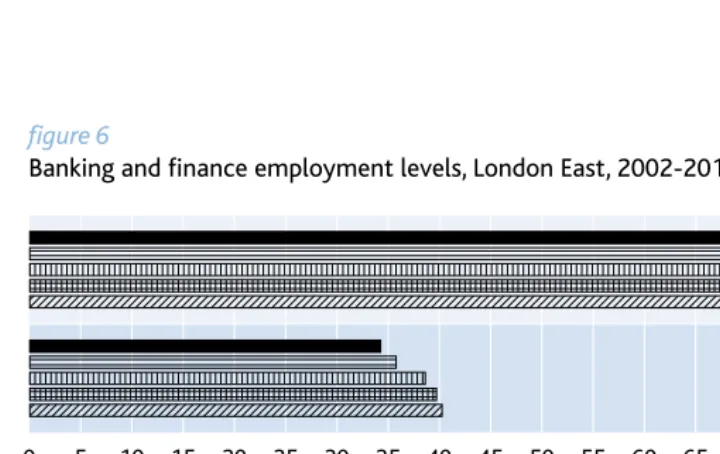
show modest growth over the decade for insurance, but a slight decline in the numbers expected to be employed in financial services. It is also expected that the number of males in full-time posts in the banking and finance subsectors will increase, and the number of women in full-time posts will decline (figure 6).
[image:12.842.32.296.280.418.2]This is a continuation of recent trends seen in the industry nationally, and contrary to the experience of other sectors. The insurance subsector shows the opposite trend with respect to male/female employment levels (figure 7).
figure 5
Financial Services – changes in employment levels, London East, 2002-2010 (thousands)
-2.8 -2.6 -2.4 -2.2 -2 -1.8 -1.6 -1.4 -1.2 -1 -0.8 -0.6 -0.4 -0.2 0 0.2 0.4 0.6
2004-2005
2006-2007
2009-2010
Insurance Banking & finance
Source: CE/IER LEFM 2002
2001-2002 721 Greenwich
14,544 Hackney
4,534 Havering
2,438 Lewisham
7,029 Newham
2,884 Redbridge
38,363 Tower Hamlets
1,432 Barking and Dagenham
3,086 Bexley
[image:12.842.30.382.552.672.2]148,866 City of London
figure 4
Financial services – employees by borough where employed, all subsectors
Source: Annual Business Inquiry 2001, ONS Crown copyright (2003)
2001-2002 2004-2005 2006-2007 2009-2010
Insurance 0.2 0.4 0.4 0.4
Banking and finance -2.6 -0.1 -1.4 -0.9
FINANCIAL
SER
VICES
PA
GE
[image:13.842.30.390.263.490.2]11
figure 6
Banking and finance employment levels, London East, 2002-2010 (thousands)
0 5 10 15 20 25 30 35 40 45 50 55 60 65 70 75 80
2010 2008 2006
Source: CE/IER LEFM 2002
2004 2002
Males (full time)
Females (full time)
figure 7
Employment levels male and female full time in the insurance sector, London East, 2002-2010 (thousands)
0 1 2 3 4 5 6 7 8 9 10 11 12
2010 2008 2006
Source: CE/IER LEFM 2002
2004 2002
Females (full time) Males (full time)
2002 2004 2006 2008 2010
Males (full time) 9.1 8.8 8.5 8.1 7.6
Females (full time) 8.7 9.3 9.9 10.6 11.1
Source: CE/IER LEFM 2002
2002 2004 2006 2008 2010
Males (full time) 70.9 73.2 73.2 73 73.1
Females (full time) 40.9 39.6 37.7 35.8 34.1
Economic Drivers • Introduction
The financial services
subsector experiences
continuous change and is
subject to macro-economic
activity and geo-political
forces in ways not
necessarily experienced by
other employment sectors.
This makes work in the sector both exciting and traumatic for its workforce. As a sector, according to the Skills Dialogue, it has also tended to insulate itself from the public sector in terms of education and training provision. Nevertheless, there is a role for the public sector to work with employers in maximising the opportunities for organisations to develop appropriate skills in their employees, augmenting the provision made in-house or through private training support.
• World events
Recent declines in world stock markets and other political uncertainties have prompted a decline in business activity in the financial services sector, and newspaper headlines have noted significant job cuts in the wholesale/ investment banking subsector. These job losses are carried out on an international basis and affect both residents of London East and the many commuters who travel into the City on a daily basis.
• Globalisation
The financial services sector has large multi-national companies that aggressively compete in world markets. This includes the labour market. The search is for highly skilled individuals who are responsive to rapid change. The competitive element which provides employment opportunities can also lead to job losses as companies seek either to be more efficient in their own operations, or gain business by merger or acquisition. Following such consolidation the larger companies subsequently streamline activities across national boundaries, concentrating specialisms in certain geographic areas and dispense with unnecessary manpower.
• Information and
communications technology
One of the key elements in the
globalisation strategy of larger companies has been the enormous development in IT. The changes in product delivery to the ordinary consumer, such as internet banking, are minor compared to the fundamental re-structuring that has taken place in the back office functions. From this, two skills issues have emerged. There is significant pressure on the IT industry to provide high calibre support in the design and operation of sophisticated systems. ICT has also changed the skill needs of customer-facing staff. They need training support to use computer programmes that provide information about financial products, and to give quotations and complete forms electronically.
Chapter
2
Chang
ing
demand
levels
in
the
FINANCIAL
SER
VICES
PA
GE
13
• Regulation
One of the most important drivers of industry change, and one where the workforce is in immediate need of development is the area of regulation. The Financial Services Authority (FSA) in December 2001 took on the role of central regulatory authority from a number of other organisations. This consolidation under a single regulator included the absorption of the Investment Management Regulatory Organisation (IMRO) within the FSA. This has helped strengthen its consumer protection role. One of the aims of the FSA is to streamline the current proliferation of examinations available to potential entrants and existing employees in the industry. The FSA has published initial reports in this area, but has now passed responsibility for the work to the Skills Council for Financial Services (in development). This may provide an opportunity for public sector-employer partnerships to be formed.
The General Insurance Standards Council, which is the current regulator of businesses offering general insurance, “has been advised by the Financial Secretary to the Treasury that the FSA will take over the regulation of general insurance on 14 January 2005.” A firm timetable for the regulation of mortgages and general insurance has been agreed, it is: • “implementation of regulation of
mortgages and long term care insurance on 31 October 2004;
• mediation of other general insurance to be implemented on 14 January 2005.” These changes will have an impact on the need for workforce development and appropriate programmes of training and accreditation need to be put in place.
30 St Mary Axe designed by Foster and Partners for Swiss Re.
Photograph by Grant Smith.
• Consumer demand and social change
Many of the studies written about the sector discuss the changing approach taken by the industry to present customer focused products, rather than assuming all consumers want the same. This trend demands greater flexibility by companies and their employees, perhaps putting greater emphasis on softer skills. One impact, with the change in product delivery to the telephone and internet, has been to see some jobs moved out of the Greater London area to call centres. There are two other trends that will require improved customer-handling skills. Firstly, there is the development of products that have been created to meet a customer’s specific needs, known as “customer designed” products. Secondly, the development of a holistic approach to customer service, which aims to build customer loyalty and retain customers. Several demographic and associated socio-economic factors however, are going to increase the range and scope of the products required. The United Kingdom has a growing and ageing population. The so-called pensions “time bomb” is ticking. With more older people, the State will be unable to raise the old age pension to a level that will satisfy many people’s needs, and there is already considerable pressure – in a period of falling stock markets – for a range of effective savings and investment products.
Skills gaps and skills shortages
The financial services industry has not been affected by skills shortages as much as some other industries. Historically, this has been because it has had the capacity to buy its way out of difficulties, for example, it has paid premium rates for IT specialists when they have generally been in short supply. At the present time, with a recent economic downturn, the problem has been “shedding labour”. Nevertheless, it is possible to identify within the industry some skills gaps amongst existing staff, as well as particular skills shortages. Information for the strategy was provided by the Skills Council for Financial Services (in development), and from a survey of employers in the London East area. Employers were contacted from all industry subsectors, but a number declined to comment because the information was regarded as commercially sensitive. The skills deficiencies in existing employees on a national basis, including new recruits to the industry were, in rank order of importance,
1. behavioural skills 2. business awareness 3. IT skills
FINANCIAL SER VICES PA GE 15
The issues of behavioural skills and business awareness are important in this industry. Organisational changes have encompassed flatter management structures, broader work roles and more multi-skilling. This means soft skills/social skills come to the fore. Employees are expected to work in teams internally, and communicate positively to external clients. The external communication function is now being taken on by many staff who may not previously have had
customer-facing roles.
Leadership skills were a critical gap in those occupying some managerial positions, and behavioural skills were capable of improvement across the occupational range.
The FSNTO in a paper prepared for the Learning and Skills Council identified specific occupations where shortages were evident. The hard-to-fill vacancies were:
• clerical and secretarial
(36.3% of hard-to-fill vacancies); • professionals (20%);
• sales and related occupations (18.5%); • associate professionals (15%). The three most important causes of hard-to-fill vacancies identified by employers were:
• “the low number of applicants with skills – this affects professionals and associate professionals as well as clerical and secretarial (varies between 76% and 82% of employers);
• a lack of work experience – this also affects all three occupations (varies between 39% and 50% of employers); • a lack of qualifications
– this mainly affects professionals (over 27% of employers).”
There is scope for public post-16 training provision to support applicants for clerical and secretarial posts in gaining the core competences that would enable them to take posts in the industry.
The response to enquiries from financial services organisations in London East was detailed and informative, and positively given. This locally collated evidence showed some common threads and some differences of opinion. Most companies remarked that they did not have specific skill shortages. This is possibly the result of recent downsizing exercises that have put more people into the market for work. Those shortages that were evident were in specialist roles in IT and Finance. There were, however, skills gaps. These had come about through the redundancy programmes that had removed middle managers. The more junior staff who were trying to fill the gaps lacked technical skills, as well as people management capabilities. This was a particular issue for insurance companies with more experienced underwriters being “eased out” of organisations, and replaced by qualified, but relatively inexperienced staff, resulting in “decisions on risk being compromised, slower and made without adequate historical perspective”. As well as the shortages identified above, underwriting and other technical areas of broking were seen as potential areas of skills shortages.
The solution offered to skills gaps by London East based organisations was to provide training, but this was generally through in-house or private external providers. Cost was clearly controlled, and the training was often geared to ensure regulatory compliance rather than for the enhancement of softer skills.
There were mixed views about retention. Some companies in the banking sector indicated that the quality of the job offer on one hand, and the uncertainties of the market on the other, prompted high retention. Other employers noted the highly competitive nature of the industry, and suggested that staff used the high quality training provided or sponsored by employers to raise their own skill levels, and then moved onward and upward! In the insurance sector, there was concern about the impact of future regulation. It was felt that failure to provide sufficient training to meet the future compliance requirements would lead to a loss of staff from the industry.
Future employment demand – forecasts
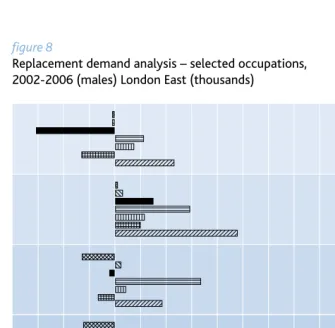
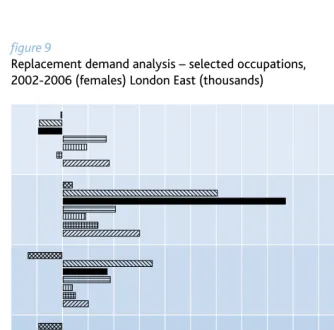
From the figures 8 and 9below it can
be seen that over a four-year period from 2002 to 2006, there will be a net requirement in London East for over 31,000 men and 80,000 women to enter the range of occupations from which the banking and finance industry draws its workforce. These subregional forecasts cover all sectors, but as financial services and associated industries employ a significant proportion of these occupational groups, there will be strong demand from the sector. As a result of retirements and employees moving on, the greatest need will be for corporate managers, those at associate professional level, and administrative and secretarial occupations.
Occupational mobility
-8 -6 -4 -2 0 2 4 6 8 10 12 14 16 18 20
Source: CE/IER LEFM 2002
Expansion demand
Retirements
Replacement demand
Net requirement
Customer service occupations Secretarial and related occupations Administrative and clerical occupations Business and public service
associate professionals
Business and public service professionals
[image:18.842.31.366.230.558.2]Managers and proprietors Corporate managers
figure 8
Replacement demand analysis – selected occupations, 2002-2006 (males) London East (thousands)
Expansion Retirements Occupational Replacement Net
demand mobility demand requirement
Corporate managers 4.6 9.7 3.813.4 18
Managers and proprietors -2.4 2 -1.2 0.8-1.6
Business and public service 1.5 2.2 0.9 3.1 4.6
professionals
Business and public service 2.2 5.9 6.6 12.5 14.7
associate professionals
Administrative and clerical -6.1 3.5 -0.5 3 -3.1
occupations
Secretarial and related occupations -0.1 0.3 0.5 0.9 0.8
Customer service occupations -0.1 0.1 -2.6 -2.5 -2.6
Total 30.8
FINANCIAL
SER
VICES
PA
GE
[image:19.842.32.366.230.559.2]17
figure 9
Replacement demand analysis – selected occupations, 2002-2006 (females) London East (thousands)
-5 -2.5 0 2.5 5 7.5 10 12.5 15 17.5 20 22.5 25 27.5 30
Source: CE/IER LEFM 2002
Customer service occupations Secretarial and related occupations Administrative and clerical occupations Business and public service
associate professionals
Business and public service professionals
Managers and proprietors Corporate managers
Expansion demand
Retirements
Occupational mobility
Replacement demand
Net requirement
Expansion Retirements Occupational Replacement Net
demand mobility demand requirement
Corporate managers 4.5 7.5 2.5 10 14.5
Managers and proprietors -0.5 3.4 1.2 4.6 4
Business and public service 2.3 2.2 0.9 3.1 5.4
professionals
Business and public service 4.1 5.1 4.6 9.7 13.8
associate professionals
Administrative and clerical -2.3 21.7 4.3 26 23.7
occupations
Secretarial and related occupations -2.2 15.1 8.7 23.8 21.6
Customer service occupations -0.1 0.9 -3.3 -2.4 -2.5
Total 80.5
Introduction
The financial services
industry has tended to
recruit well qualified staff
in terms of academic
examination performance,
and then provide industry
related training programmes
either in-house, or through
private external training
provision. Where there
have been gaps in supply,
such as in IT specialisms,
it has used a world-wide
market and paid highly
competitive salaries to
attract staff.
There has been a well developed training culture in the sector, which has operated largely independently of the public-sector education and training offer. The training has often been driven by regulation, and the need to ensure that staff are compliant with regulatory demands, in-house systems and company practices. Some companies have in-house
“universities”, and suggest that staff are eager to learn. The only barrier is time. Other local respondents also indicated that training opportunities, particularly in the large banks were not problematic. However, some employers noted there was a need for some element of basic skills support. This follows evidence from other studies that the number of A-level entrants is diminishing as more young people progress to higher education, and the threshold for entry to administrative and clerical occupations is being lowered. Several of the larger organisations felt the public sector had little to offer in terms of ongoing training activity. However, in London East some 3,700 establishments were found to have ten or fewer workers. And, although the proportion of small businesses in the sector is not as high as the figure nationally, it is expected that the employees in these smaller business units need support to meet the anticipated industry changes. There is a role for the public sector to assist in workforce development in this area.
Chapter
3
Learning
and
tr
FINANCIAL
SER
VICES
PA
GE
19
Qualifications and examinations – time for change
The FSNTO Skills Foresight Report 2002
noted the need for a streamlining of the qualifications framework as it affects the sector, and this is a task that employers, regulators and the public sector can participate in. The FSA has been taking this forward, and recently published a consultation document13. It said
“We are setting out to create a new examination structure for the financial services industry. …this paper addresses a key strand of investment advice and other strands will complete the structure.
The modular framework now proposed is more flexible and better matched to market needs and changes. It is designed to raise standards across the sector and to improve consumer protection by ensuring that those involved in giving advice have a sound understanding of key principles, such as investment risk.”
It continued by noting that“The Training and Competence regime for mortgages, general insurance and lower risk products is being consulted on separately.”
The Financial Services Authority (FSA) has supported improvements in standards of competence in the industry. In its Template for Training and Competence Toolkits,
the FSA stated:“We hope the Toolkits will inspire firms to go beyond the regulatory minimum and, in particular, will encourage them to integrate Training and Competence within their normal business management processes.”
The Skills Council for Financial Services (in development) summarised the current approach by companies to in-house training for professional qualifications (Levels 2 to 4). It said that:
“Though not universal, there is a trend away from supporting individuals to achieve professional qualifications. It is now unusual for employers to require employees to attain these awards (other than for regulatory purposes). Most companies continue to provide some financial support to students. Many award bonuses or pay increases. Fewer and fewer offer study leave.” “This reduction in active support for professional qualifications reflects the way they are perceived. Generally they are seen as important indicators that individuals have the technical knowledge required for their jobs. However, they are not generally seen as essential to the business, and not as a means of developing or assuring job competence.” “The challenge for the Awarding Bodies,” according to the Skills Council for Financial Services (in development), “…is to respond to the demand for improvement which employers have expressed: greater relevance, more flexibility and a faster response to updating content.”
In contrast, there has been much greater investment by employers in customer service awards / qualifications – at levels 1 to 4, especially in the Customer Service NVQs.
The local companies who provided supporting information to this strategy indicated that their recruitment strategies were based on appointing already well qualified applicants.
Further education provision in London East
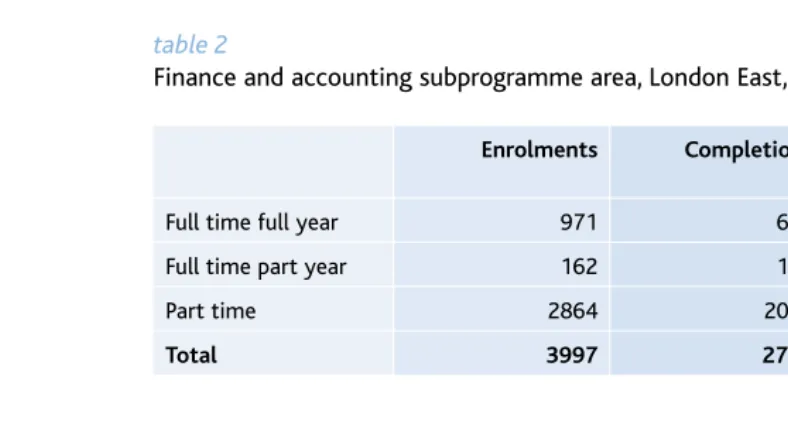
The table opposite shows the learners following a wide range of programmes in colleges across our area, mostly at levels 2, 3 and 4. Three-quarters of the enrolments were on a part-time basis. Achievement levels against completions were very similar across all modes of attendance. Student retention was a problem as 30% of those who enrolled failed to complete the courses.
The analysis by age shows that over 70% of the learners were 21 or over with 58% of all learners being aged between 25 and 59 years old. Again, there appears little difference in achievement rates between different age groups.
FINANCIAL
SER
VICES
PA
GE
[image:23.842.175.569.306.520.2]21
table 2
Finance and accounting subprogramme area, London East, ISR 2000-2001
Enrolments Completions Achievements Achievements /completions %
Full time full year 971 666 374 56
Full time part year 162 121 61 50
Part time 2864 2009 1137 57
Total 3997 2796 1572 56
Enrolments Completions Achievements Achievements /completions %
under 16 3 2
16-18 748 510 287 56
19-20 309 217 124 57
21-24 563 379 205 54
25-59 2328 1651 936 57
60 and over 35 29 14 48
Age not provided 11 8 6 75
Total 3997 2796 1572 56
Work-based learning provision
There are currently nine work-based learning providers contracted to LSC London East offering a range of programmes in accounting at NVQ levels 2, 3 and 4. Seven providers offer Foundation Modern Apprenticeships and six offer Advanced Modern Apprenticeships.
Higher education
[image:24.842.30.514.629.743.2]The financial services industry draws in graduates from universities in the UK and abroad. It also recruits from many disciplines and provides appropriate vocational training, so it is difficult to quantify the supply. The numbers of students in two of the most relevant subprogramme areas are shown in the table below. There were 33,120 from home and overseas studying on Financial Management and Accountancy programmes at undergraduate and postgraduate level in UK Higher Education Institutions. Approximately 26,300 of these were UK based students and 56% of these were men.
table 3
All higher education students – UK and overseas – by subject of study 2000/01 – Higher Education Statistics Agency
Total HE Full-time Full-time Part-time Part-time
students undergraduates postgraduates undergraduates postgraduates
Financial management 10,000 3,460 2,515 2,330 1,695
Accountancy 23,120 14,275 865 6,695 1,285
HE – UK
Student totals Female Male
Financial management 6,550 2,670 3,880
Accountancy 19,745 8,990 10,755
The launch of the Centre of Vocational Excellence in Accountancy and Finance at Havering College of Further and Higher Education.
FINANCIAL
SER
VICES
PA
GE
23
Chapter
4
The
main
issues
The creation of a
workforce development
strategy for the financial
services industry is
important, because almost
a quarter of all those
employed by companies
based in the London East
area are employed in
this sector, although a
significant proportion
are inward commuters.
As noted earlier, the linkage between publicly-funded education and training provision and a largely autonomous sector has been limited. With the pending raft of regulations, and a significant small business element growing in the sector, there is an opportunity for change.
The major factors which will continue to affect workforce development are:
• the impact of globalisation • the development of new product
delivery channels • tighter regulation
• more demanding consumers • a growing number of potential
consumers
• increased competition for business • merger and consolidation
• the competition for knowledge workers in the region
• the changing perception of the industry – caused by recent declines in the stock market, redundancy headlines, and financial scandals (particularly in the USA) that have made the industry seem less attractive to new entrants • rising skill demands in some occupations • diminishing skill demands in other
occupations.
The most immediate factors affecting the industry in London East are:
• the macro-economic picture where continued weakness may result in job losses, or modest recovery which will prompt further consolidation in the industry and possible job losses • the changes in delivery channels which
may take sector jobs out of the area, or out of the country
• the replacement demand for labour which the FSNTO suggests is 73% nationally over the period 2001-09, and which it says will impact quite sharply on SMEs, and
Skills gaps
Looking forward, the following future skills gaps identified by employers, in rank order, are:
• communication skills • customer-handling skills • team-working skills • problem-solving skills, and • management skills.
Other identified gaps included specific technical skills, sales skills and IT skills. Flexibility, adaptability and problem-solving were also highlighted. It is in the area of behavioural skills where significant support is needed, and where effective workforce development planning can be used, starting with greater emphasis on leadership and management, and project management programmes. In larger companies resources may be available to support this
developmental activity. In SMEs the need is just as important, but there may not be the resource to take action.
Finally, the competitive nature of the business requires short product lifecycles, and this drives the need for regular training updates for staff.
Skills shortages
Specific future occupational shortages were forecast on a national basis: • actuaries
• independent financial advisers • ICT technical experts, and • call centre staff.
Skills – the employers’ perspective
The following pressures are exerted on companies in the sector – they need to: • remain competitive(which requires
continuing efforts to increase the flexibility of the workforce and the transferability of skills)
• manage growth(which will require
continuous retraining to update and extend skills), and
• manage change– coping with changes
in roles, organisational systems and the use of technology.
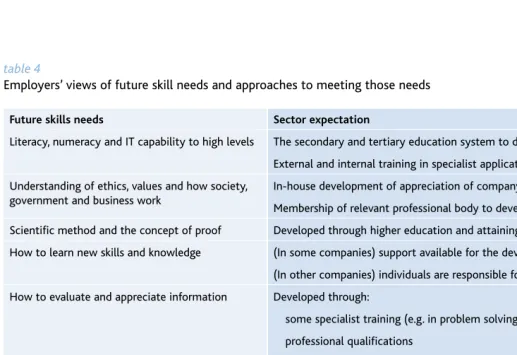
The FSNTO carried out an analysis of future skills needs from information supplied by employers. These specific skills identified by employers are regarded as essential to business success over the next ten years. Employers expressed views on how these skill needs should be met, and these views are presented in the second column of table 4.
It should be stressed that table 4does
FINANCIAL
SER
VICES
PA
GE
[image:27.842.40.558.260.615.2]25
table 4
Employers’ views of future skill needs and approaches to meeting those needs
Future skills needs Sector expectation
Literacy, numeracy and IT capability to high levels The secondary and tertiary education system to develop skills to the level of employability
External and internal training in specialist applications
Understanding of ethics, values and how society, In-house development of appreciation of company ethics and values
government and business work
Membership of relevant professional body to develop professional ethical practice
Scientific method and the concept of proof Developed through higher education and attaining professional qualifications
How to learn new skills and knowledge (In some companies) support available for the development of learning skills
(In other companies) individuals are responsible for developing their own learning skills
How to evaluate and appreciate information Developed through:
some specialist training (e.g. in problem solving)
professional qualifications
on-the-job development and coaching
How to take charge of your own learning Individuals to take personal responsibility
How to deal well with other people, (Mainly) a combination of in-house training and personal development
and to value them
How to communicate effectively with others (Mainly) in-house training and development
How to work well in teams (Mainly) in-house training and development
How to cope with change coming at you Some in-house training and development
How to make things change (Mainly) in-house training and development
How to manage risk and uncertainty (Professionally) through use of professional qualifications
(Personally) through in-house training and personal development
How to be assertive enough to get On-the-job coaching and mentoring
your concerns addressed
Barriers to workforce development
The industry provides many learning opportunities for those in larger companies, but the support is more limited in smaller companies. In all types of organisations in the sector the spending of the training/ staff development budgets tends to be driven by the need to ensure staff are aware of regulatory frameworks, and the conduct of their work is compliant with legislation and/or codes of practice. Thus regulation can become the focus of training development, rather than the broader needs of individual employees, or quality improvement in the operation of the organisation. In some smaller companies in wholesale banking, compliance training may become the only training activity, because of the costs involved. We are told that retail financial services may offer a broader range of learning opportunities for staff.
Small and medium-sized companies may not have developed a training culture, or a training system to handle staff’s learning and training needs. There is a potential under-supply of specialist training resources to support employees, particularly in knowledge and understanding of new regulatory requirements.
There is concern in some organisations that training enhancement may result in individuals leaving employment once trained or further qualified. Both employers and employees alike may find the plethora of qualifications available for the sector slightly confusing. Although this situation is being addressed, it still may inhibit progress on raising the qualification levels of the workforce. New employment relationships with increased numbers of self-employed and contract workers may mean skills improvement is left to individuals who may not be prepared to make the investment in their own training.
To overcome these barriers, the following should happen: • workforce development should
enable employers and individuals to use learning, training and qualifications to go beyond minimum regulatory requirements, in order to support business and personal development goals • companies of all sizes need to
integrate training and related support systems with the way they manage their businesses. This should be a benchmark for effective business management • companies and individuals need
to make the investment in time, and money, for development
• the Skills Council for Financial Services (in development) should work with awarding bodies to develop a coherent, relevant and up-to-date range of qualifications for the sector, and
• the availability of e-learning opportunities to the sector should be promoted, particularly through learndirect.
30 St Mary Axe designed by Foster and Partners for Swiss Re. Photograph by Grant Smith.
FINANCIAL
SER
VICES
PA
GE
27
Chapter
5
St
rateg
ic
recommendations
We will work with key partners to:
• develop stronger links between private-sector employers and publicly-funded agencies that provide education, training, information and guidance
• increase the availability of labour market information which is gathered on the sector to assist in planning publicly-funded learning provision where appropriate for the sector
• increase the opportunities for gaining information advice and guidance about careers at all levels in the sector • utilise information from the emerging
Sector Skills Council and ensure there are communication channels in place to inform FE colleges and schools • follow through the implications of the
FSA qualification reviews to support the rationalisation of assessment and accreditation opportunities in the sector • develop courses and modules that meet
the demands of the new regulatory frameworks
• enable more local people to work within the industry
• raise employer and employee awareness of learning opportunities, assessment and accreditation facilities, including e-learning available through public provision • encourage the take-up of Modern
Apprenticeships, NVQs and graduate apprenticeships
• find innovative ways to support small and microbusinesses to develop their workforce
• support the sector in gaining accreditation for its training activity by promoting the use of standards such as Investors in People (IiP). • support administrative and clerical
employees in the sector who lack basic skills, or IT skills, to access appropriate learning opportunities
• continue to encourage the Centre of Vocational Excellence (CoVE) in London East (at Havering College) in its work; and support the innovative Academy of Finance at Lewisham College, and • support initiatives that encourage
Appendix
Standard industrial
classification codes Financial services subsectors
65.11 Central banking
65.12/1 Banks
65.12/2 Building societies
65.21 Financial leasing
65.22/1 Credit granting by non-deposit taking finance houses and other
specialist consumer credit grantors
65.22/2 Factoring
65.22/3 Activities of mortgage finance companies
65.22/9 Other credit granting not elsewhere classified
65.23/1 Activities of investment trusts
65.23/2 Activities of unit trusts and property unit trusts
65.23/3 Security dealing on own account
65.23/4 Activities of bank holding companies
65.23/5 Activities of venture and development capital companies
65.23/9 Financial intermediaries not elsewhere classified
66.01 Life insurance
66.02 Pension funding
66.03 Non-life insurance
67.11 Administration of financial markets
67.12/1 Fund management activities
67.12/2 Security broking and related activities
67.13 Activities auxiliary to financial intermediation not elsewhere classified
67.2 Activities auxiliary to insurance and pension funding
74.1 Professional services (accountancy)
Source: Annual Business Inquiry 2001, ONS Crown copyright (2003)
Bibliography
Corporation of London,The City’s Importance to the European Union Economy, 3 February 2003
FSNTO,A Skills Foresight for the Financial Services Industry, 2002
FSA,Examination Framework for Retail Financial Services(Investment Advice
Strand 1), November 2002
DfES,An Assessment of Skill Needs in Financial Services and Accountancy
(Skills Dialogue), 2001
Biblio
gr
aph
y
/A
1 Construction
2 Cultural and creative industries
5 Hospitality 6 Manufacturing 7 Public administration 3 Financial services 4Health and social care 0 Overview
W
orkf
or
ce
Development
Action
Plan
Financial
Services
Lift for action plan 8 Retail 9 Transport and logistics 10 Voluntary and community
Learning and Skills Council London East
Boardman House, 64 Broadway, Stratford, London E15 1NT Telephone: 0845 019 4151 e-mail: [email protected] www.lsc.gov.uk
This strategy was written by Trevor Carr and members of the LSC London East Workforce Development team. Trevor Carr McKerr Carr Ltd Telephone: 020 8349 2110 www.mckerrcarr.com Designed by Creative Leap Telephone: 020 7549 0700 www.creativeleap.com
Nordland Papier AG is committed to the tradition of sustainable forest management and minimisation of its impact on the local environment.
WFD/LSCLE/021/03
London East 2003-2005
3
W
orkf
or
ce
Development
Str
ateg
y
Financial