Combining collaboration spaces: Identifying patterns of
tool use for decision-making in a networked learning
environment
Kate Thompson, Nick Kelly
Centre for Research on Computer Supported Learning and Cognition (CoCo Research Centre), The University of Sydney, [email protected], [email protected]
Abstract
This paper describes a study that examines the processes of two groups using a combined collaboration space (a synchronous chat and an asynchronous wiki). It uses data from the combined space to analyse the way that group processes change over time. We examine the tasks about which students made decisions during a month-long collaborative learning project, undertaken as part of a larger course. In order to examine the processes of collaboration, particularly in relation to the tools used and the decisions made, both chat and wiki data were coded for the task, sub-task and decision being made by the students. The data were rendered as visual forms which allowed us to describe the different ways in which the two groups used the tools in their collaboration for different types of decisions. We make an argument for the value in identifying Alexandrian properties in the structure of the collaboration, using deep interlock and ambiguity as an example. Identification of such properties, we think, will aid the future development of educational design patterns.
Deep interlock and ambiguity was identified in the structure of the groups’ collaboration. We discuss the structure in terms of the tools that the groups used – chat, wiki and email. For some tasks and subtasks, the use of the tools was simple, and decisions were made during a single chat. However, some decisions resulted in a complex use of both the wiki and the chat, and Group A in particular used both tools synchronously, tying the ideas they discussed in the chat back to the knowledge recorded in the wiki, as they chatted. We concluded that the flexibility that the two groups were given meant that they could determine the pattern of tool use and collaboration that best supported their collaboration. We found the visualisations to be extremely useful in identifying the collaboration of a group over time, and in visualising the multiple streams of data that were analysed. The identification of these patterns of learning and collaboration would support the patterns approach to educational design. We propose that this initial study be expanded to include other measures of process.
Keywords
Processes of learning; patterns; synchronous collaboration; asynchronous collaboration; online chat; wiki; decision-making.
Introduction
Advances in hardware and software have increased the ease with which multiple streams of data can be collected that each describe a different view of the same collaborative experience in networked learning environments. Methods to integrate this data and visualise it are needed to better understand the processes of learning. This study presents initial work within a larger program of research in which we aim to identify educationally significant recurrent patterns in networked learning and computer supported collaborative learning (CSCL) process data. This work focuses upon the identification of such patterns in combined online spaces that afford both synchronous and asynchronous collaboration.
patterns in the structure of collaboration. We identified one property that relates to the combined use of the wiki and chat tools.
Background
Our argument in this paper is based on the key concepts that: (i) time, and the order of events, are essential to researching the processes of learning (Jones, Dirckinck-Homfeld, & Lindstrom, 2006; Reimann, 2009); (ii) the qualities of form (Alexander, 2002) can be identified in the structure of networked learning environments. The long-term aim of this research is to further relate these to educational design patterns (Goodyear & Retalis, 2010). Further, the complex relationship between agents and technologies suggests that these processes should be examined in practice (Jones, et al., 2006). Building upon these ideas, the work presents a structured approach to the integration and visualisation of multiple streams of data from a combined collaboration space.
Processes of CSCL
The analysis of multiple processes is still relatively rare, with methods of analysis and the impact of the theoretical perspective still under debate. Research that has addressed the interaction of multiple processes has discussed decisions around segmentation, unit of analysis, time constraints, and methods of automation (Schrire, 2006; Weinberger & Fischer, 2006). The main work examining multiple perspectives has been labelled
multivocality; it has focused on the overlap of differing theoretical perspectives on one source of data (for an overview see (Dyke et al., 2011)). Other work that has explored the integration of data sources includes papers incorporating screen capture with audio files (Kennedy-Clark & Thompson, 2011a, 2011b) or in using screen capture to align students’ interaction with a model and their recording of observations in an online setting (Thompson, Kennedy-Clark, Markauskaite, & Southavilay, 2011). Within this field of research, the tool that is addressed is usually either synchronous (Ding, 2009) or asynchronous collaboration (for example, (Hull & Saxon, 2009; Weinberger & Fischer, 2006)), but few address both. Tinoca, Oliveira & Pereira (2010) use a grounded theory approach to analyse the way that final group products are influenced by the online
collaborative interaction within a group forum and chat environment and are able to make suggestions based upon the patterns that they find.
In attempting to integrate and visualise the data from collaborative interaction within a combined space, time is important in terms of the duration and rates of change at which events occur, as well as the order in which they occur (Reimann, 2009). Reimann (2009) goes on to suggest that when people meet repeatedly, the group has a history, and this history affects their learning; some of the methods suggested for analysing this are sequence mining, pattern identification, and process mining – these allow researchers to represent the data at a more abstract level and to make subsequent claims about the data. By taking time into account, we begin to be able to answer questions around how technologies and tools affect individuals and groups over time.
Tools for CSCL
Students in this study collaborated within a combined space. A distinction that is useful for analysing and comparing tools for CSCL is the notion of synchronicity, whether collaborators have instant (synchronous, e.g. (Ding, 2009)) or delayed (asynchronous e.g. (Hull & Saxon, 2009)) communication, with each recognized as having different characteristics. Students in this study had access to both types of communication (e.g. (Yeh, 2010)).
Wikis can be used for collaborative information compilation or knowledge construction (Dohn, 2010). They allow students to create pages that can be linked to other students’ pages, and to edit each other’s work. Most research on processes using asynchronous tools, however, has focused on discussion boards rather than wikis. An exception is Zenios and Holmes (2010) who investigated the ways in which new knowledge was created in communities of developing researchers through asynchronous text-based discussions and wikis, and
synchronous audio and video. They initially provided students with a discussion board, then students were required to develop collaborative wikis. They only began to use Skype once collaboration in the asynchronous environment stalled. Their findings suggest that the social affordances of a wiki are limited due to the
that the combination of the chat and the wiki were necessary for epistemic tasks to take place, and group cognition and new knowledge to be developed.
Alexandrian Qualities of Form
Alexander’s (2002) ideas about form provide us with a framework to discuss the structure of the groups’ collaboration. Alexander describes 15 principles of form, and we have focused on deep interlock and ambiguity. All the principles revolve around the existence of centres. Alexander (1999) defines centres as “field-like structures that appear in some region of space. They don’t have sharp boundaries, but they are the focal organizing entities that one perceives at the core of all pattern, all structure, and all wholeness” (p. 78). Alexander deliberately used the term centre instead of whole, because the relationship between entities in a design is considered extremely important (Alexander, 2002). For this paper, we see the tools provided for the learners to use, the chat and the wiki, as representative of the structure, and these can be seen as centres. In this context, deep interlock and ambiguity (pp. 195-199) describes situations where centres are “hooked” into their surroundings, in a way in which it makes it difficult to disentangle the centre from its surrounds. In buildings, it can be done literally, or with spatial ambiguity – a zone that belongs both to the centre and to its surroundings. We see the different ways in which the chat and wiki tools are used as representative of this quality. That students can use the wiki to tie ideas that are raised in the chat, to previous work of the group, and this can be referred back to by the group. The time-scale at which this occurs differs depending on the complexity of the decision being discussed.
Methods
Educational Design
[image:3.595.68.531.473.552.2]The study has been described previously in papers making use of the chat data (Reimann, Thompson, & Weinel, 2007a, 2007b), however we will describe it briefly here. Postgraduate university students participated in a 13-week course about learning, change and systems. Their participation in the course was synchronous, through weekly chat sessions with the lecturer, and asynchronous, through regular contributions to the wiki. As a requirement of the course, students were divided into groups containing 3-4 members, and given an assignment to complete during one month. They were encouraged to meet regularly in the chat environment, and to record any interactions, or notes related to the assignment in the wiki. The assignment was to redesign an existing system dynamics model such that it could be used for educational purposes.
Table 1: Tasks and subtasks discussed during the collaborative learning experience
Task Choosing a model Additions to the model Implementation Overall task
Subtask Criteria Group A: 2 Additions Group A: 7 Additions Group A: 3 Planning Group A: 3
Group B: 5 Group B: 4 Group B: 4 Group B: 2
Process Group A: 4 Resources Group A: 2 Resources Group A: 1 Dividing Roles Group A: 1
Group B: 2 Group B: 0 Group B: 1 Group B: 1
Process Group A: 1 Other Group A: 4
Group B: 1 Group B: 3
Specific tasks were not communicated to students as part of their assignment. In the two groups, students identified similar tasks themselves, and subtasks within these, seen in Table 1. There were relatively similar numbers of decisions made for each of the subtasks for each of the groups.
Data collection and preparation
In this paper we have included the wiki data and some additional chat data in our analysis in order to examine the way in which learners combined their use of the tools. Data will be reported on from wiki entries and chats coded to the level of the decision that was made. An utterance in the chat data was one line of the chat, as it appeared in real time. Coding of wiki data to the level of the decision resulted in 98% agreement for 2006 data and 100% agreement for 2007 data. An utterance in the wiki data was one iteration of a page that involved substantial changes – for example the addition or removal of text, not formatting changes. .
The data collection method and the sample have been described in other papers (Reimann, et al., 2009). Data were collected using a tool called Snooker (Ullman, Peters, & Reimann, 2005) from a group of graduate students who worked on a design task of adding instructional design features to an existing system dynamics model, without meeting face to face (Reimann, et al., 2007a). Students were expected to coordinate their own work for this task, which required frequent decision-making about the task and managing the group work. We focus on two groups. Group A was composed of three female students and one male student. Group B was composed of three female students. The data spans a one-month period.
Analysis - integrating and visualising the data
Multiple streams of data were brought together by organising and representing what has been collected in such a way that patterns could be observed. One way to describe this is taking the behaviours of the students and placing them into a structured representation.
Visualisations of the collaboration
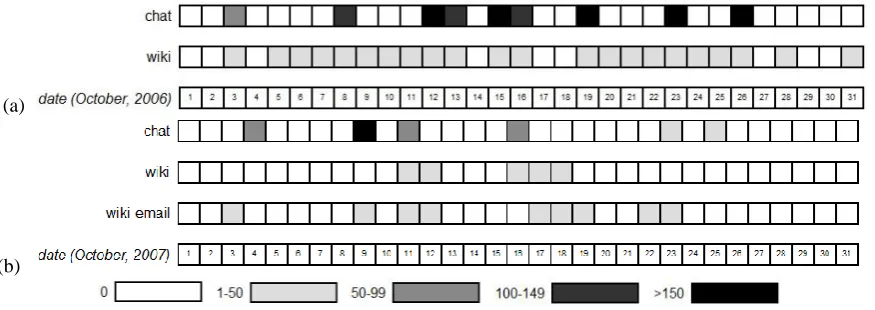
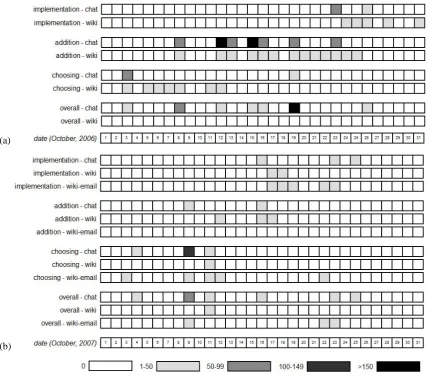
In order to reveal the patterns within the student behaviours, the collaboration was represented visually across time using the representations below. The first addresses just the tool use for the two groups. Wiki-email was separated for Group B because many of their wiki entries involved pasting copies of emails between group members into the wiki pages, which we considered to be different from the expected contributions to wiki pages. Figure 2 represents how this tool use was distributed amongst the four tasks (Table 1) for the two groups. We then selected two decisions that were made in the instructional additions to the model subtask – what to add, and the instructional approach. These were selected because of the differences in tool use observed between the two groups. The representation of tool use by the two groups can be seen in Figure 3.
(a)
[image:4.595.86.524.445.600.2](b)
Figure 1 Number of utterances per day for each tool for: (a) Group A; and (b) Group B
Figure 1a shows that Group A held their first chat on the 3rd of October, and the wiki was first added to on the same day. This group added to the wiki almost every day between then and the second chat on the 8th October. From the 12th of October, both the chat and wiki were used most days. The last day that students met in the chat environment was the 26th October, and they made their final changes to the wiki on the 31st, when the
assignment was due. Figure 1b shows that Group B held their first chat was held on the 4th October. After the 18th October the wiki was no longer updated unless to paste students’ email communication. The final chat occurred on the 25th October.
that students did to complete the assignment were choosing the model, deciding on additions to the model, implementing the changes, and overall issues such as planning or trouble shooting.
(a)
[image:5.595.85.514.104.482.2](b)
Figure 2 Number of utterances per day for each task for: (a) Group A; and (b) Group B
Figure 2a shows that the members of Group A spent a large number of utterances discussing the additions to the model (the point of the assignment), fewer on choosing the model and the implementation, and a relatively large amount, over a number of weeks, on the overall planning of the assignment. There were also many instances, over a number of days, that each of these tasks was discussed. In Group A, students discussed choosing the model during their first chat. They followed this with several days of work on the wiki, and revisited an element of this task on the 19th October. Most of this work appeared between the 3rd and 12th. Additions to the model were discussed between the 8th and the 25th of October. The chat and the wiki were both used. After the initial chat on the 8th October, the remaining work began on the same day as the final wiki change related to choosing the model. Discussions that involved implementation began in a chat on the 23rd of October, followed by two wiki changes, another chat and the remaining work carried out in the wiki, this was finalised on the 31st October. Finally, the overall tasks were discussed only in chats, and always occurred when other tasks were also being discussed. These occurred throughout the collaboration between the 3rd and the 26th October.
some overlap in time, with discussions about choosing the model. Implementing the changes was first discussed on the 16th of October, in parallel with the second discussion about the additions. Subsequent communication was via email, wiki, and chat. The work on the wiki occurred at the beginning, and then versions were sent via email rather than posted. The final discussion was in the chat on the 25th of October. Overall issues were discussed in chats, the wiki and via email. In all cases they were discussed at the same time as the other tasks were addressed.
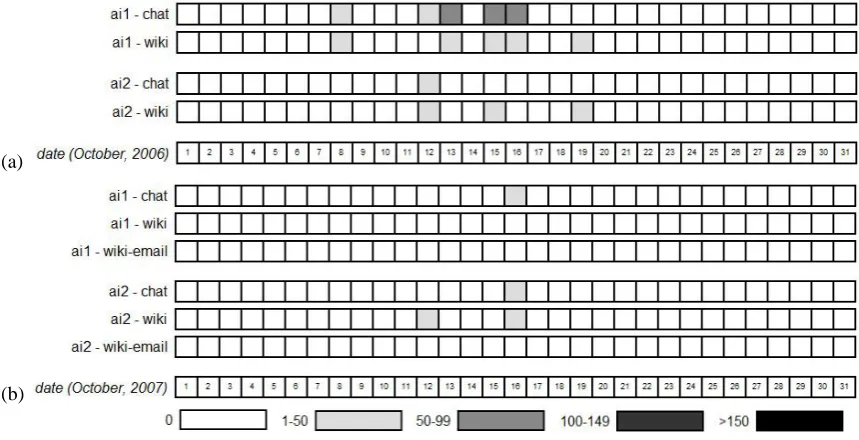
Figure 3 shows the final representation for two of the decisions made within the instructional additions to the model subtask. These two decisions demonstrate different ways of approaching the same type of decision. The first decision was adding to the model (ai1), and the second was the instructional approach to take (ai2).
(a)
(b)
Figure 3 Number of utterances per day for what to add to the model (ai1) and what instructional approach to use (ai2): (a) Group A; and (b) Group B
Figure 3a shows that in Group A, what to add to the model was a decision that the group discussed from the 8th to the 19th of October, using both the chat and the wiki. On those days when both tools were used on the same day, further examination of the data shows that they were used synchronously. As students participated in the chat, they updated the wiki with notes and ideas for what to add to the model. On the 12th/13th October (this was during a chat that began late on the night of the 12th and carried through to the early morning of the 13th), the students used the wiki to vote on proposed additions to the model by adding their names next to existing ideas on the wiki. The process took about 15 minutes. On the 16th of October, one member used the wiki to record ideas as students brainstormed in the chat. He alerted other members of the group when he had updated the wiki. The way in which Group A addressed the what instructional approach to use was similar. Members updated their ideas on the wiki as the chat progressed during the discussion on the 12th. This process continued with all members having a turn to update their ideas, and coordinating this via the chat environment. The final wiki change on the 19th was a note evaluating the work on the page by one of the group members.
Discussion
The representations used in this paper have allowed us to visualise the ways in which students in the two groups used the tools available to them in a month-long collaborative design exercise. Differences were observed in the two groups, mainly related to how integrated their use of the tools was. Also evident in the visualisations was that different decisions, and tasks, required different tool use – there was no pattern within either of the groups. Some decisions could be made in one chat encounter. Other decisions, however, resulted in far more complex online collaboration, with simultaneous use of wiki and chat and subsequent analysis of decisions made.
The observable differences in the ways in which these groups used the tools indicate that the affordances of these tools are not restricted to those discussed in reference to either wikis or chats separately. There are observable affordances of using the tools in combination. This flexibility gave students the opportunity to use these tools in the way they needed, in order to support their collaboration. Group A used both tools as an integral part of their group work; they used the chat often and the wiki as they were chatting, in addition to asynchronously. Group B used it as a place to store the work they did elsewhere. Although less dynamic, this was still an important requirement for extended collaborative work. The ability of researchers to observe the different ways that tools are used in combination can give us insights into design, and learning.
One of the aims of this paper was to identify an Alexandrian property of form (2002) in the structure of the way in which the tools were used. Alexander’s properties are useful to identify and understand beauty in form. They are then related to his design patterns. To produce a pattern for collaboration in an online environment, without recognising the properties of structure to which the design should be aspiring to will be difficult. We identified Deep interlock and ambiguity, which in a discussion about form explains instances of tying the centre into the surrounds. The use of the wiki and chat synchronously simultaneously ties the two centres (tools) together through the ideas generated. The ambiguity also relates to these ideas and decisions, they are at once separate in the wiki, and then in the chat. Deep interlock and ambiguity, we would argue, is relevant because of the affordances of the tools that students are using. The wiki was essentially the hub of both groups, and of the course overall, containing class notes, archives of chats, and instructions for assignments. Group A, in integrating the wiki into their synchronous collaboration, was continuously tying them back to the ‘classroom’ environment. The wiki became an essential part of their collaboration. Group B, however, by only recording items on the wiki after or before a chat session, and the nature of the information that they added to the wiki (copies of emails sent, their own writing, that was not incorporated together, but kept separated), did not engage in this connectedness with the networked learning environment in the same way.
Conclusions
The aim of this paper was to incorporate the arguments of Reimann (2009) and Jones et al., (2006), that time, and the way that groups will change over time are important in considering the processes of collaboration, with those of Alexander (2002), that there are certain properties which are observable in design. The reason for this was related to the work of Goodyear & Retalis (2010), in the creation of educational design patterns. We have described some of the ways in which two groups used a combination of tools to structure their own
collaboration space; discussed the ways in which their collaboration around particular types of tasks used these tools in different ways. We looked in depth at one subtask in particular at the complex way in which students simultaneously used the chat and wiki tools.
We relate this work to Alexandrian design principles by analysing existing data to determine that a property of form could be identified in the structure of the collaboration space, and that this facilitated different behaviours. This, we feel, will be a useful step in the future creation of educational design patterns. While the work in that area has been advancing, without a clear goal, such as identifiable properties in structure, this seems to be a challenging task. Identifying the property of deep interlock and ambiguity provides opportunities to create patterns at many levels.
References
Alexander, C. (1999). The origins of pattern theory: the future of the theory and the generation of a living world. IEEE Software, 16, 71-82.
Alexander, C. (2002). The Nature of Order. An essay on the art of building and the nature of the universe (Vol. 1: The Phenomenon of Life). Berkeley, California: The Center for Environmental Structure.
Ding, N. (2009). Visualizing the sequential process of knowledge elaboration in computer-supported collaborative problem solving. Computers & Education, 52, 509-519.
Dohn, N. B. (2010). Teaching with wikis and blogs: Potentials and pitfalls. . Paper presented at the 7th International Conference on Networked Learning 2010.
Dyke, G., Lund, K., Jeong, H., Medina, R., Suthers, D. D., van Aalst, J., et al. (2011). Technological affordances for productive multivocality in analysis. . Paper presented at the 9th International Computer Supported Collaborative Learning Conference.
Goodyear, P., & Retalis, S. (2010). Learning, Technology and Design. In P. Goodyear & S. Retalis (Eds.), Technology-enhanced learning: design patterns and pattern languages (pp. 1-28). Rotterdam: Sense Publishers.
Hull, D. M., & Saxon, T. F. (2009). Negotiation of meaning and co-construction of knowledge: An experimental analysis of asynchronous online instruction. Computers & Education, 52(3), 624-639.
Jones, C., Dirckinck-Homfeld, L., & Lindstrom, B. (2006). A relational, indirect, meso-level approach to CSCL design in the next decade. International Journal of Computer-Supported Collaborative Learning, 2(2-3), 35-56.
Kennedy-Clark, S., & Thompson, K. (2011a). Patterns of collaborative convergence in a scenario-based multi-user virtual environment. Paper presented at the 9th International Computer Supported Collaborative Learning Conference.
Kennedy-Clark, S., & Thompson, K. (2011b). What do students learn when collaboratively using a computer game in the study of historical disease epidemics, and why? Games & Culture.
Poole, M. S., & Roth, J. (1989a). Decision Development in Small Groups IV: A Typology of Group Decision Paths. Human Communication Research, 15(3), 323‐356.
Poole, M. S., & Roth, J. (1989b). Decision Development in Small Groups V: Test of a Contingency Model. Human Communication Research, 15(4), 549‐589.
Reimann, P. (2009). Time is precious: Variable- and event-centred approaches to process analysis in CSCL research. International Journal of Computer-Supported Collaborative Learning, 4, 239-257.
Reimann, P., Frerejean, J., & Thompson, K. (2009). Using process mining to identify models of group decision making in chat data. 98-107.
Reimann, P., Thompson, K., & Weinel, M. (2007a). Collaborative learning by modelling: Observations in an on-line setting. Paper presented at the ICT: Providing choices for learners and learning., ASCILITE, Singapore.
Reimann, P., Thompson, K., & Weinel, M. (2007b). Decision making patterns in virtual teams. Paper presented at the Supporting learning flow through integrative technologies, Amsterdam.
Schrire, S. (2006). Knowledge building in asynchronous discussion groups: Going beyond quantitative analysis. Thompson, K., Kennedy-Clark, S., Markauskaite, L., & Southavilay, V. (2011). Capturing and analysing the
processes and patterns of learning in collaborative learning environments. Paper presented at the 9th International Computer Supported Collaborative Learning Conference.
Tinoca, L., Oliveira, I., & Pereira, A. (2010). Online group work patterns: How to promote a successful collaboration. Paper presented at the the 7th International Conference on Networked Learning 2010. Ullman, A., Peters, D., & Reimann, P. (2005). Developing a research supportive web-based learning System.
Paper presented at the ODLAA Conference 2005, Adelaide.
Weinberger, A., & Fischer, F. (2006). A framework to analyze argumentative knowledge construction in computer-supported collaborative learning.
Yeh, Y.-C. (2010). Analyzing online behaviours, roles, and learning communities via online discussions. Educational Technology & Society, 13(1), 140-151.
Zenios, M., & Holmes, B. (2010). Knowledge creation in networked learning: combined tools and affordances. Paper presented at the 7th International Conference on Networked Learning 2010.