Research and Information Service
Research Paper
June 2011
Caroline Perry
Procurement in education
NIAR 305-11
This Research Paper considers current arrangements for procurement in education
in Northern Ireland and highlights a number of issues that have been identified in this
regard. It highlights concerns around the fragmentation of procurement in education,
the levels of procurement expertise in the sector and the levels of strategic
leadership for procurement.
Key Points
All public bodies in Northern Ireland must comply with EU Directives, UK
Procurement Regulations and NI Public Procurement Policy: there is no additional guidance specific to education;
Procurement is carried out by a range of bodies, including the Education and Library Boards (ELBs), Trustees and Boards of Governors;
The ELBs became Centres of Procurement Expertise (CoPEs) in 2002; CoPEs are responsible for the implementation of public policy in their area and must comply with high standards of good practice;
The CoPE status of ELBs had been due to be reassessed by March 2010, however in light of plans to make the Education and Skills Authority (ESA) a CoPE, a
decision was made to delay reaccreditation: however, ELBs retained CoPE status;
Plans had been underway to implement work streams in regard to a capital
procurement strategy: however, following a legal challenge the frameworks were set aside and plans subsumed into wider plans for the ESA;
Significant variations in spending across ELBs for similar items have been
highlighted, together with questions around the extent to which ELBs are taking a coordinated approach to achieving best value for money;
A number of reports and investigations into serious procurement issues in education have highlighted common themes where deficiencies are identified, including:
o A lack of robust procurement strategies or procedures;
o A lack of strategic leadership for procurement; and
o Inadequate levels of staff skills, experience and qualifications.
Evidence on good practice highlights the importance of taking a coordinated approach to procurement, and many reports advocate a single procurement body;
In light of these findings, areas for consideration could include:
o The status of the ELBs as a CoPE and the extent to which they work collaboratively and use collective buying power;
o Whether best value for money is being achieved in procurement (investigation and analysis of contracts and invoices may be useful);
o How procurement modernisation will be taken forward in a climate where uncertainty exists around the ESA; and
NIAR 305-11 Procurement in education
Executive Summary
Introduction
Public procurement law is regulated through the EU Directives and the Treaty on the Functioning of the European Union. These are implemented in Northern Ireland through UK Procurement Regulations that apply to all public bodies. Procurement in education must comply with this legislation and the Directives, as well as with
overarching NI Public Procurement Policy. This includes principles such as best value for money, procurement through a centre of procurement expertise and the award of contracts on the basis of the most economically advantageous tender. There is no additional guidance specific to education.
Overview of procurement in education
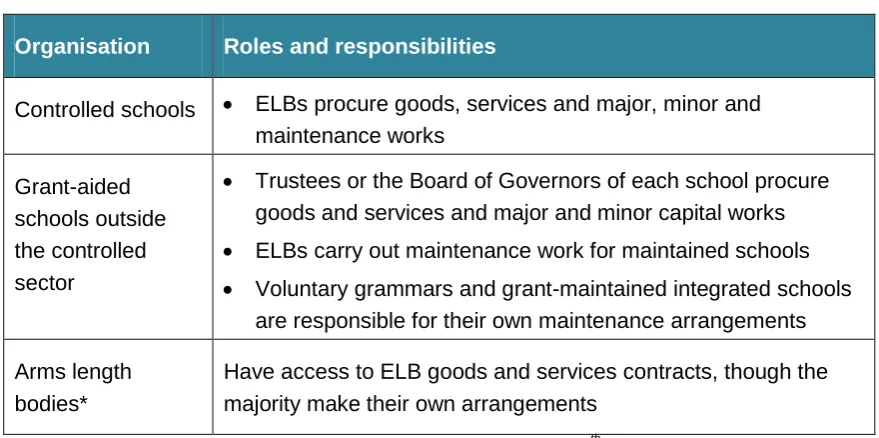
Procurement is currently carried out by a range of education bodies in Northern Ireland. The literature suggests that this approach is fragmented and makes a coordinated approach to procurement difficult. The following table provides an overview of the main roles and responsibilities for procurement in education.
Organisation Roles and responsibilities
Controlled schools Education and Library Boards (ELBs) procure goods, services and major, minor and maintenance works
Grant-aided schools outside the controlled sector
Trustees or the Board of Governors of each school procure goods and services and major and minor capital works
ELBs carry out maintenance work for maintained schools
Voluntary grammars and grant-maintained integrated schools are responsible for their own maintenance arrangements Arms length
bodies*
Have access to ELB goods and services contracts, though the majority make their own arrangements
*For example the Council for Catholic Maintained Schools, The Council for the Curriculum Examinations and Assessment and the Northern Ireland Council for Integrated Education.
Centres of Procurement Expertise
NIAR 305-11 Procurement in education
Northern Ireland Assembly, Research and Information Service 4
CoPE status is independently reviewed on a periodic basis. Evidence to the Public Accounts Committee indicated that the ELBs failed their independent assessment in 2005, although were reaccredited in 2006 as a result of a decision to work with them to support improvement. All CoPEs were due to be reassessed by April 2010: however a decision was taken not to review the status of the ELBs pending the establishment of the Education and Skills Authority (ESA). Nonetheless, the ELBs were allowed to retain their status as Centres of Procurement Expertise.
Schools estate
The Department of Education (the Department) established a Programme Delivery Support Unit to deliver procurement frameworks for the schools estate following recommendations from an independent review in 2005. However, a legal challenge was taken against the Department resulting in a judicial decision that the procedures adopted did not comply with regulations. The court ordered the framework to be set aside and plans for capital procurement strategy have been subsumed into wider plans for the ESA.
Procurement modernisation
It had been intended that the ESA would become a single CoPE for the education sector. However, following a number of independent investigations into serious
procurement issues, the former Minister for Education, Caitríona Ruane, established a unit within the Department in late February 2011 with the aim of designing and
implementing the new CoPE for education. The Department plans to establish the service early in 2012/13 (subject to Ministerial approval), with a view to achieving a unified CoPE for education subsequently.
Findings on procurement practices
The evidence has highlighted a number of issues pertaining to procurement in
education. Many of these relate to the largely fragmented approach in place and point to a lack of coordination in procurement.
Efficiency Review
A Joint Efficiency Review is underway by the Department and the Performance and Efficiency Delivery Unit (PEDU). Its initial report has raised questions about the extent to which ELBs are using their collective buying power to reap economies of scale, the level of small value transactions and the lack of a „major drive‟ towards bulk buying or consolidation of contracts. It also identified significant variations in costs across ELBs for similar goods and services.
Issues around procurement for the schools estate
different geographic locations. It also identified a number of problems relating to the supply chain, including:
Procuring works individually;
A lack of coordinated procurement expertise;
A complicated approvals process; and
The length of time taken to procure and complete schemes.
Investigations into procurement issues
There have been a number of recent investigations into serious procurement issues in education in Northern Ireland. The findings have varied depending on the organisation reviewed, with some good practice identified. However, common themes where deficiencies have been identified include:
Lack of robust procurement strategies or procedures;
Lack of strategic procurement leadership; and
Inadequate levels of staff skills, experience and qualifications.
Good practice in procurement
As previously highlighted, public bodies in Northern Ireland are required to comply with EU and UK directives and legislation, as well as NI policy. As such, much guidance already exists around achieving good practice that public bodies in education are bound to follow.
In addition, much of the literature reviewed for this paper highlights the importance of coordination in procurement, in particular advocating the implementation of a single procurement body. The crucial role of appropriately skilled procurement staff and strategic leadership are also highlighted.
Conclusion
This paper highlights a largely fragmented approach to procurement in education in Northern Ireland. It also notes concerns around the level of procurement expertise in the sector, the effectiveness and transparency of procurement practices, the extent to which best value for money is being achieved and an apparent lack of oversight for procurement within some ELBs.
In light of these concerns consideration could be given to the CoPE status of the ELBs, and to whether best value for money is being realised in procurement, particularly in regard to the extent of collaborative working between Boards. Investigation and
NIAR 305-11 Procurement in education
Northern Ireland Assembly, Research and Information Service 6
Contents
Key Points ... 1
Executive Summary ... 3
Contents 1 Public procurement structures in Northern Ireland ... 9
2 NI Public Procurement Policy ... 11
3 Procurement in education ... 12
4 Previous procurement investigations in the education sector ... 19
5 Good practice in procurement ... 22
1
Public procurement structures in Northern Ireland
Background
Public procurement is regulated through the European Union (EU) through the EU Directives and the provisions of the Treaty on the Functioning of the European Union (TFEU, previously known as the EC Treaty). The principles of the Treaty include:1
Equal treatment;
Non-discrimination;
Mutual recognition;
Proportionality; and
Transparency.
As a Member State, the UK retains overall responsibility for the negotiation and development of EU legislative proposals in relation to the Devolved Administrations. The Office of Government Commerce (OGC) is responsible for ensuring that public procurement policy throughout the UK complies with the obligations. Close links are maintained across the Devolved Administrations to ensure compliance with legislation and good practice and there is a „strong read across‟ in procurement policy matters as a result of this European dimension.2
Procurement is a transferred matter under the Northern Ireland Act 1998. However, as the UK Public Contracts and Utilities Contracts Regulations were made prior to the restoration of the devolved administration in Northern Ireland, the UK took the lead in drafting the Regulations. As such, public sector procurement in Northern Ireland falls within the scope of UK Procurement Regulations.3
Governance structure
The governance structure for public sector procurement in Northern Ireland is made up of a number of elements, described in the following paragraphs.
Procurement Board
The Procurement Board is chaired by the Minister for Finance and Personnel and its membership is comprised of the Permanent Secretaries of the 12 Northern Ireland Departments, the Treasury Officer of Accounts, the Director of CPD and two external experts. The Board was established in 2002 and meets twice annually. It has
1
Consolidated Version of the Treaty on the Functioning of the European Union (2008) Official Journal of the European Union 2
Central Procurement Directorate (2011) Northern Ireland Public Procurement Policy Handbook Belfast : Department of Finance and Personnel
3
NIAR 305-11 Procurement in education
Northern Ireland Assembly, Research and Information Service 10
responsibility for the development of Public Procurement Policy and overarching procurement strategy within Northern Ireland.4
Central Procurement Directorate (CPD)
Also established in 2002, the CPD acts as the lead professional procurement body for Northern Ireland. As well as providing a centralised procurement service to the NI public sector, one of its key functions is to support the Procurement Board in:5
The development and implementation of Public Procurement Policy;
Monitoring its implementation; and
Developing best practice guidance in association with the PPG.
Centres of Procurement Expertise (CoPEs)
Seven CoPEs exist in addition to CPD to provide a procurement service to public bodies and to contribute to the development of policies and best practice. They operate under the direction of the Procurement Board for Northern Ireland and are responsible for the implementation of procurement policy in their area.
CoPE status is granted by the Procurement Board following a third-party accreditation exercise assessing the extent to which CoPEs meet high standards of good practice. The Education and Library Boards have CoPE status in education for supplies, works and services procurement. CoPEs employ procurement professionals and are subject to independent accreditation to validate their procurement expertise on a periodic basis. The agreed criteria for assessment include:6
Responsibility for awarding contracts with an annual value of £80m averaged over a three year period;
Procurement expertise evidenced by the qualifications, training and development of staff;
Successful track record of achieving best value for money, regulatory compliance and application of best practice;
Accredited (or equivalent) Quality Assurance Systems in operation; and
Adequate mechanisms in place to provide assurance that the conditions of contract are adequately monitored and pursued.
4
Central Procurement Directorate (2011) Northern Ireland Public Procurement Policy Handbook Belfast : Department of Finance and Personnel
5
Central Procurement Directorate (2011) Northern Ireland Public Procurement Policy Handbook Belfast : Department of Finance and Personnel
6
Procurement Practitioners’ Group (PPG)
PPG provides a strategic, direction-setting role for CoPEs, as well as acting as the main channel for the development of policy guidance, best practice and information dissemination. The chair is the Director of CPD and comprises the Head of each of the CoPEs, together with the Divisional Directors from CPD.
2
NI Public Procurement Policy
Before 2002, policy on public procurement in Northern Ireland mainly involved compliance with the European Community and other international obligations, complying with UK law and Treasury guidance relating to public procurement, while otherwise allowing Departments considerable discretion as to how procurement was carried out.7 A Capita report in 1999 found significant variation in the quality of public procurement processes and a particular concern that it was not possible to show that procurement in NI was delivering “best value for money”. It therefore recommended a fundamental overhaul of these practices.8
Subsequently, the Department for Finance and Personnel (DFP) put forward
recommendations aiming to ensure that procurement in Northern Ireland became more efficient and that it achieved significant value for money improvements.9 The current overarching procurement policy in NI was approved by the Executive in 2002 and has since been monitored and developed by the Procurement Board. The principle
elements of the policy are as follows:10
Best value for money: the primary objective of procurement policy, defined as “the optimum combination of whole life cost and quality to meet the customer‟s requirements”;
Integration of sustainable development: a guiding principle requiring procurement policy to pay due regard to the Executive‟s other social and economic policies;
Procurement through a centre of procurement expertise: procurement activities must be carried out by means of Service Level Agreements with CPD or a relevant CoPE;
Award of contracts on the basis of most economically advantageous: contracts should be awarded on the basis of objective criteria ensuring
compliance with TFEU Principles and guaranteeing that tenders are assessed in conditions of effective competition;
7
Department of Finance and Personnel (2002) Review of Public Procurement 2002 8
Capita(1999) Strategic review of Procurement and purchasing arrangements within the NI Civil ServiceDFP 9
Department of Finance and Personnel (2002) Review of Public Procurement 2002 10
NIAR 305-11 Procurement in education
Northern Ireland Assembly, Research and Information Service 12
Procurement control limits: optimum limits for the procurement of general supplies, works and services have been set by the Procurement Board;
Achieving excellence in construction: Departments should have in place procedures to control construction projects; and
Programme and project management: projects and programmes must be managed in accordance with best practice.
The twelve guiding principles of public procurement are: accountability; competitive supply; consistency; effectiveness; efficiency; fair-dealing; integration; integrity; informed decision-making; legality; responsiveness; and transparency.11
3
Procurement in education
This section of the paper considers how procurement in education is carried out and discusses a number of issues that have been identified in this regard. It is structured as follows:
Overview;
DE and DFP Joint Efficiency Review;
Education and Library Boards and CoPE status;
Procurement for the schools estate;
Procurement of external consultancy services; and
Procurement modernisation.
Overview
Procurement in education must follow NI Public Procurement Policy as well as UK legislation and EU directives, as set out previously in this paper. There is no additional specific guidance for procurement in education.
Procurement within education in Northern Ireland is currently carried out by a range of bodies. The main roles and responsibilities are set out in Table 1.
11
Table 1: Roles and responsibilities for procurement in education
Organisation Roles and responsibilities
Controlled schools ELBs procure goods, services and major, minor and maintenance works
Grant-aided schools outside the controlled sector
Trustees or the Board of Governors of each school procure goods and services and major and minor capital works
ELBs carry out maintenance work for maintained schools
Voluntary grammars and grant-maintained integrated schools are responsible for their own maintenance arrangements Arms length
bodies*
Have access to ELB goods and services contracts, though the majority make their own arrangements
Source: Information request response from Department of Education, 17th June 2011
*For example the Council for Catholic Maintained Schools, The Council for the Curriculum Examinations and Assessment and the Northern Ireland Council for Integrated Education.
Recent research has suggested that the composition of the schools sector in Northern Ireland makes the existing capital procurement guidelines and arrangements complex and prone to inefficiencies. It states that unless fragmentation in procurement is addressed, the problems are likely to worsen as the level of investment increases.12 A 2011 Review of procurement in the ELBs indicated that the relatively small size of each organisation‟s spend limits the procurement-related quality, economies and efficiencies that can be achieved. This report called for the introduction of a unified and standardised approach to procurement.13
DE and DFP Joint Efficiency Review
A Joint Efficiency Review is underway between DE and the Performance and Efficiency Delivery Unit (PEDU), aiming to consider where efficiency savings could be made in education. The first stage report was published in March 2011, focusing on the efficiency of education administration and support services. The second stage report will seek to outline particular areas that could be taken forward to deliver the identified efficiencies.14
The review highlights a number of potential issues identified from a high level analysis of invoice trends at Education and Library Boards, including:
It is likely that there was „no major drive‟ towards further bulk buying or consolidation of contracts or payments between 2004 and 2008;
12 McAdam, R. et al. (2010) “Establishing ex ante public construction supply chain guidelines in the public procurement of schools‟ estate” in International Journal of Public Sector Management Vol. 24 No. 3, pp. 250-273
13
Review of Governance, Procurement Practice and Management of Contracts in the NI Education and Library Boards
(21/04/2011) 14
NIAR 305-11 Procurement in education
Northern Ireland Assembly, Research and Information Service 14
Invoices indicate a continued prevalence of small value transactions;
Variation in the average value per invoice may suggest that some Boards are not fully using their buying power to influence supplier prices.
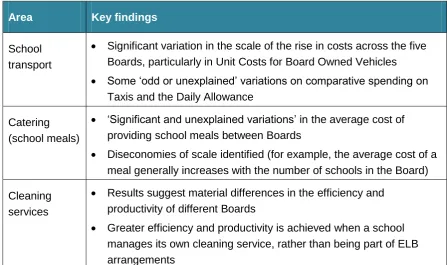
[image:16.595.91.539.234.499.2]It also highlights significant variation in the costs across Education and Library Boards for similar goods and services, raising further questions around whether current procurement practices are achieving best value for money. Examples of the areas identified by the Review are outlined in Table 2.
Table 2: Examples of key findings identified by the review
Area Key findings
School transport
Significant variation in the scale of the rise in costs across the five Boards, particularly in Unit Costs for Board Owned Vehicles
Some „odd or unexplained‟ variations on comparative spending on Taxis and the Daily Allowance
Catering (school meals)
„Significant and unexplained variations‟ in the average cost of providing school meals between Boards
Diseconomies of scale identified (for example, the average cost of a meal generally increases with the number of schools in the Board) Cleaning
services
Results suggest material differences in the efficiency and productivity of different Boards
Greater efficiency and productivity is achieved when a school manages its own cleaning service, rather than being part of ELB arrangements
However, the review states that there would be a need to examine in detail the
individual goods and services procured to consider variations in price, the potential for exercising further buying power and more coordinated purchasing, in order to fully understand the potential for savings from procurement.15
Education and Library Boards and CoPE status
The Education and Library Boards achieved CoPE status in May 2002: this status was awarded for goods and services and not for maintenance work.16 The procurement functions of the five Boards operate as separate CoPEs, negotiating their own contracts with one Board often taking the lead for a specific contract enabling other ELBs to call off the contract.17
15
DE and DFP (2011) DE and DFP Joint Efficiency Review Stage One Report 16
Public Accounts Committee (2010) Report on the Investigation of Suspected Contract Fraud 17
In 2005, the competency of CoPEs in Northern Ireland was reviewed for the first time. The Education and Library Boards failed the independent assessment of their CoPE status in 2005; however they were reaccredited in 2006 as a result of a decision to work with them to secure improvement. In light of this decision, the Public Accounts Committee called for independent and rigorous assessment of all CoPEs in the future:18
“The Committee recommends that CoPEs which demonstrate persistent poor practice should have their status removed, if the concept of a „Centre of Procurement Expertise‟ is to mean anything.”
The five ELBs operate a system of joint contracts whereby one of the Boards administers the joint contract on behalf of all five Boards.19 DFP reports highlight collaborative procurement previously undertaken by the ELBs sharing CoPE status. These include the provision of contracts for furniture, vehicles, equipment and services.20
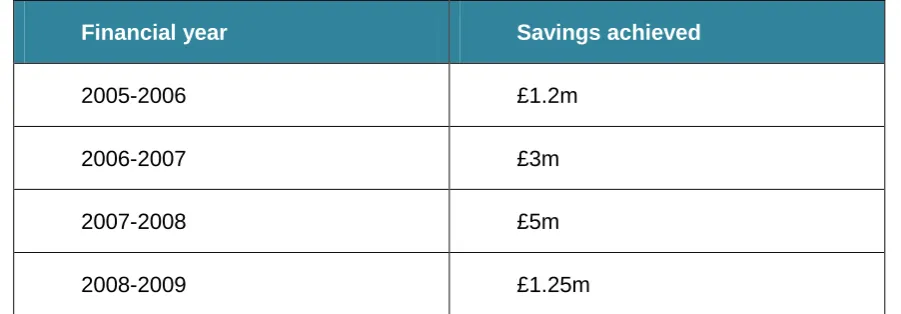
[image:17.595.87.538.404.561.2]DFP identified Value for Money gains made by the five ELBs sharing CoPE status from 2005-2009. (The CPD Procurement Value for Money and Efficiency Measurement was introduced in 2005). These are set out in Table 3.21
Table 3: Value for Money gains achieved by five ELBs sharing CoPE status
Financial year Savings achieved
2005-2006 £1.2m
2006-2007 £3m
2007-2008 £5m
2008-2009 £1.25m
Source: Central Procurement Directorate Annual Reports to the Procurement Board
In December 2008 the Procurement Board decided that the next review of the ELB CoPE status should not be carried out until twelve months after the establishment of the Education and Skills Authority (ESA). The CoPEs were due to next be reaccredited by 31st March 2010.22 However, it was agreed that the ELBs could retain their CoPE
18
Public Accounts Committee (2010) Report on the Investigation of Suspected Contract Fraud 19
Information request response from Department of Education, 17th June 2011 20
Department of Finance and Personnel (2009) Annual Report to the Procurement Board 2008-2009 Belfast:Central Procurement Directorate and Department of Finance and Personnel (2006) Annual Report to the Procurement Board 2005-2006 Belfast:Central Procurement Directorate
21
Department of Finance and Personnel (2005) Procurement Guidance Note 01/05 Procurement Value for Money and Efficiency Measurement Belfast:Central Procurement Directorate
22
NIAR 305-11 Procurement in education
Northern Ireland Assembly, Research and Information Service 16
status despite not having been reassessed.23 A recent review stated that ELBs are mainly operating independently from each other, although there are examples of good cooperation across the Boards. This review highlights the importance of Boards working collaboratively together to maximise efficiencies in procurement spend.24
Procurement for the schools estate
Background
In 2004 the Department of Education and the Strategic Investment Board Ltd (SIB) commissioned PricewaterhouseCoopers to prepare a procurement strategy for a rolling programme of investment in the schools estate. This was within a context of „broad agreement within the Department and across the education authorities‟ that planning arrangements for the schools estate needed to be improved.25
The report highlighted an apparent uneven and fragmented distribution of procurement services across the schools estate and recommended the establishment of a single infrastructure procurement service to ensure best value for money and to support quality assurance. It also proposed to establish strategic partnerships with the private sector to deliver capital investment.
Following consultation, the Department established a Programme Delivery Support Unit to deliver the work streams recommended by the report. Three frameworks were proposed for education: major works, professional services and minor work and maintenance. However, a legal challenge was brought against the Department
resulting in the frameworks being set aside, as discussed in the next paragraph. Plans for an Education Infrastructure Procurement Service were subsumed into wider plans for the establishment of the ESA.26
Legal challenge
A legal challenge was issued against the Department of Education in 2007 in regard to a framework agreement that was part of the Northern Ireland Schools Modernisation Programme. One of the unsuccessful firms questioned a decision by the Department regarding the basis on which they awarded contracts (using fee percentages, which the judge concluded was a „manifest error‟ in that it assumed that costs would always be the same in the construction industry).
In December 2007 the court concluded that there was a serious question around whether the procedures adopted by the Department complied with relevant domestic and EC law. The procedure adopted by the Department of Education was held by the court not to comply with the regulations and not to be "consistent with transparency,
23
Information request response from Department of Education, 17th June 2011 24
Review of Governance, Procurement Practice and Management of Contracts in the NI Education and Library Boards
(21/04/2011) 25
PricewaterhouseCoopers (2005) New Procurement and Delivery Arrangements for the Schools Estate Bangor: Department of Education
26
the equal treatment of tenderers or the development of effective competition in the public procurement sector in accordance with the community competition principles."27 Following a remedies hearing in 2008, the judge ruled that the framework agreement should be set aside and that damages were to be pursued by the firm.28
Underinvestment in the schools estate
Historic underinvestment in the schools estate and a resulting maintenance backlog of £292m were highlighted in a Northern Ireland Audit Office (NIAO) report in 2010.29 The report found that in the five years to the end of March 2010, £1.2bn of capital spend was made available to the Department, while total expenditure was £857m over this period. The Department stated that barriers to capital schemes included legal issues around site acquisitions, ongoing reviews of long-term pupil enrolments and statutory agency approvals.
Views on the current situation
A recent research paper30 stated that the existing approach to construction supply chain management in the schools estate is „beleaguered with a range of problems‟. It also notes that the five ELBs situated in different geographical areas make a
coordinated approach to procurement „difficult at best and impossible at worst‟. The paper analysed the procurement activity of one ELB, finding that it was necessary to undertake 116 separate procurement exercises for 77 works and maintenance schemes. Extrapolating these figures would mean that the five Boards undertake 580 procurement exercises annually. The authors suggest that this is indicative of the scope and fragmentation of capital procurement activity.
The paper also draws attention to the large number of disconnected projects within the sector and highlights the following among the most significant problems with the existing supply chain,emphasising a need for a professional procurement body:31
Procuring works individually: the procurement of each scheme individually does not comply with the latest government guidance on procurement or with best practice;
Lack of coordinated procurement expertise: limited expertise across the ELBs and limited personnel to perform the recommended governance roles in some sectors;
27
Construction Law update (2009) [online] Available at: http://addleshaw-goddard.net/view.asp?content_id=4521&parent_id=4518
28
Northern Ireland Audit Office (2009) Financial Auditing and Reporting: 2007-2008 General Report by the Comptroller and Auditor General for Northern Ireland Belfast: The Stationery Office
29
Northern Ireland Audit Office (2010) School Design and Delivery Belfast: The Stationery Office
30 McAdam, R. et al. (2010) “Establishing ex ante public construction supply chain guidelines in the public procurement of schools‟ estate” in International Journal of Public Sector Management Vol. 24 No. 3, pp. 250-273
NIAR 305-11 Procurement in education
Northern Ireland Assembly, Research and Information Service 18
Complicated approvals process: multiple approval processes requiring the Department‟s involvement at various stages; and
The length of time taken to procure and complete schemes: „inevitable
delays‟ caused by the number of procurement exercises at multiple ELBs.
Procurement of external consultancy services
A NIAO report published in June 2011 considered the use of external consultants across NI Departments. In regard to education, it identified a number of issues, including the following:32
Irregular expenditure of over £2m in respect of external consultancy was incurred across six Department of Education projects in 2009-2010;
Three contracts were awarded through Single Tender Actions (whereby one contractor is appointed without competitive process); and
A joint project between the Department of Education and the Strategic Investment Board incurred overrun costs of £1.9m between 2004 and 2007. The NIAO report found that across all Departments, more than 50% of contracts that were not procured through CoPEs were single tender actions, suggesting that there is less likelihood of single tender actions if CoPEs are used to procure external
consultancy services.33
Procurement modernisation
As discussed previously, it had been intended that the ESA would become a single CoPE for the education sector. However, following a number of independent reviews and investigations of serious procurement issues (considered in the subsequent section of this report), the previous Minister for Education, Caitríona Ruane,
established a unit within the Department charged with overseeing work arising from recent investigations and designing and implementing the new CoPE for education.34 The Department‟s aim is to establish the service early in the financial year 2012/13, subject to Ministerial approval, with a view to achieving single, unified CoPE status for the sector subsequently. The aims of the CoPE include to:35
Plan strategically across boundaries;
Maximise economies of scale and achieve greater value for money;
Reduce duplication of effort; and
Support the needs of the sector in the most effective way.
32
Northern Ireland Audit Office (2011) Use of External Consultants by Northern Ireland Departments: Follow-up Report Belfast: The Stationery Office
33
Northern Ireland Audit Office (2011) Use of External Consultants by Northern Ireland Departments: Follow-up Report Belfast: The Stationery Office
34
Statement: Procurement in the Education Sector from the Education Minister (1st February, 2011) 35
4
Previous procurement investigations in the education sector
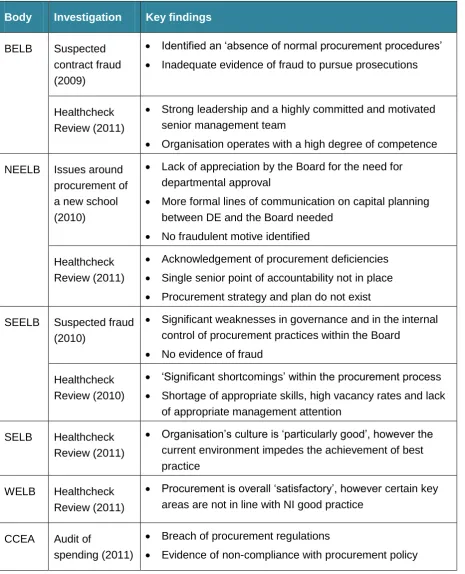
[image:21.595.72.538.175.750.2]A number of reports and investigations have highlighted procurement issues in the education sector in Northern Ireland. These are summarised in Table 4 and considered in more detail in the subsequent paragraphs.
Table 4: Examples of investigations into procurement issues in education
Body Investigation Key findings
BELB Suspected contract fraud (2009)
Identified an „absence of normal procurement procedures‟
Inadequate evidence of fraud to pursue prosecutions
Healthcheck Review (2011)
Strong leadership and a highly committed and motivated senior management team
Organisation operates with a high degree of competence NEELB Issues around
procurement of a new school (2010)
Lack of appreciation by the Board for the need for departmental approval
More formal lines of communication on capital planning between DE and the Board needed
No fraudulent motive identified Healthcheck
Review (2011)
Acknowledgement of procurement deficiencies
Single senior point of accountability not in place
Procurement strategy and plan do not exist SEELB Suspected fraud
(2010)
Significant weaknesses in governance and in the internal control of procurement practices within the Board
No evidence of fraud Healthcheck
Review (2010)
„Significant shortcomings‟ within the procurement process
Shortage of appropriate skills, high vacancy rates and lack of appropriate management attention
SELB Healthcheck Review (2011)
Organisation‟s culture is „particularly good‟, however the current environment impedes the achievement of best practice
WELB Healthcheck Review (2011)
Procurement is overall „satisfactory‟, however certain key areas are not in line with NI good practice
CCEA Audit of
spending (2011)
Breach of procurement regulations
NIAR 305-11 Procurement in education
Northern Ireland Assembly, Research and Information Service 20
Belfast Education and Library Board (BELB)
The Public Accounts Committee, investigating suspected contract fraud within the Property Services Unit of the BELB going back as far as 1997, highlighted an absence of normal procurement procedures, citing a long-standing culture of favouring certain contractors within the Board. It found a wide range of examples of „alarmingly poor value for money‟ in maintenance procurement, a history of weaknesses being highlighted to management by Internal Audit with no effective action taken and examples of substandard and incomplete building works carried out. It described this case as:36
“One of the most worrying cases the Committee has examined in terms of the failure of the public body to recognise the extent to which it was vulnerable to fraud and its slowness to respond as evidence of malpractice accumulated.”
A recent Healthcheck Review of the Board was positive in regard to its procurement practices, highlighting strong leadership and a highly committed and motivated senior management team. It also stated that the organisation operates with a high degree of competence, and due to its skills base and structure, takes a major role in the
procurement process for goods and services for itself and other ELBs.37
North Eastern Education and Library Board (NEELB)
Another external investigation was carried out into serious procurement issues in the NEELB. It related to the approval and procurement of a new school for Magherafelt High School, whereby the Board had entered into an arrangement with a contractor resulting in construction work being undertaken and payment made without the necessary approvals from the Department.38
The investigation found no evidence that the Department had suffered any financial loss as a consequence, or any suggestion of staff benefitting improperly. It stated that the failing was not appreciating the requirement for approval from the Department. The report drew attention to a shortage of appropriate skills and high vacancy rates at the Board and a need for more formal communication arrangements around capital planning and approvals between the Board and the Department.39
A recent Healthcheck Review stated that organisational inertia resulting from the degree of change (including uncertainty around the establishment of the ESA) had impacted upon procurement strategy and policy, adequate resourcing, staff
recruitment, skill shortages and morale. It found that senior staff were aware of procurement deficiencies and of the need to improve. Other key findings included:40
36
Public Accounts Committee (2010) Report on the Investigation of Suspected Contract Fraud 37
Review of Belfast Education and Library Board Procurement Practice and the Management of Contracts (09/05/11) 38
Browne, R.H. (2010) Independent Review of the Magherafelt High School Project 39
Browne, R.H. (2010) Independent Review of the Magherafelt High School Project 40
The Board is not in a position to provide direction or receive assurance across the full scope of its procurement responsibilities;
Procurement is not undertaken on the basis of rigorously applied policy, procedures and practices based informed by good practice;
A single senior point of accountability to oversee procurement has not been nominated;
A procurement strategy and plan do not exist;
No performance management framework in place to inform governance, hold individuals to account, monitor compliance and drive continuous improvement in procurement; and
Procurement skills and posts are not being refreshed by the recruitment of new staff.
South Eastern Education and Library Board (SEELB)
An independent investigation into procurement issues was undertaken in the SEELB when its Chief Executive alerted the Department to a suspected fraud regarding
heating installation in a post-primary school in October 2010. While no further evidence of fraud was found, the investigation found significant weaknesses in governance and in the internal control of procurement practices within the Board. It found that the Board had only partial oversight of procurement activities with no overarching strategy in place, and that there was an absence of appropriate skills and resources within the Board.41
A separate Healthcheck Review into wider SEELB procurement was commissioned by the former Minister for Education following the concerns raised by the investigations into the SEELB and the NEELB.42 It identified „Significant shortcomings‟ within the procurement process. In particular, the findings include that:43
The approach to the establishment of contracts is fragmented, lacks
consistency „and for the most part does not comply with best practice guidance‟;
No one person from the Senior Leadership Team has been nominated to oversee procurement;
A procurement strategy and plan signed off at Board level do not exist;
There is an over-reliance on staff acting up to more senior roles and few individuals have appropriate professional or technical qualifications; and
41
Statement: Procurement in the Education Sector from the Education Minister (1st February, 2011) 42
Statement: Procurement in the Education Sector from the Education Minister (1st February, 2011) 43
Review of procurement practice and the management of contracts in the South Eastern Education and Library Board
NIAR 305-11 Procurement in education
Northern Ireland Assembly, Research and Information Service 22
Factors such as a shortage of appropriate skills, high vacancy rates and the lack of appropriate management attention „may be creating the environment for possible irregularities, including fraud, to occur‟.
Southern Education and Library Board (SELB)
Mostly positive findings were reported in a 2011 Healthcheck Review of the Board.44 The report praised the organisation‟s culture and commitment to developing staff skills and experience. However, it suggests that „the current adverse environment is holding the organisation back from achieving best industry practice‟. For example, it notes that there are some limitations on the extent and sophistication of contract management processes, but suggests that substantial improvements could not be made without the introduction of a single CoPE.
Western Education and Library Board (WELB)
A Healthcheck Review of procurement practice and management of contracts at the WELB found that there is a strong commitment from leadership to procurement
practices. However, it found that whilst procurement was overall „satisfactory‟, there are certain key areas not in line with NI good practice. It also highlights difficulties in
recruiting appropriately skilled professionals.45
Council for the Curriculum, Examinations and Assessment (CCEA)
An internal report into spending by CCEA, not yet released, is reported to have
identified significant concerns around procurement within the organisation. The findings included „significantly higher‟ spending on a range of items than set out in policy
specifications, the use of unapproved venues for events, breaches of procurement regulations and a lack of compliance with procurement policy. The review of spending was ordered in November 2010.46
5
Good practice in procurement
As discussed previously in this report, much guidance, policy and legislation exists to support effective and efficient procurement in public services. Public sector bodies in Northern Ireland are bound to comply with a number of regulations, policies and directives. However, the evidence highlights some further potential areas for improvement that may be of relevance to education in NI.
Much of the literature and guidance highlights the importance of having a single, professional procurement body for a sector, with procurement professionals acting at a strategic level. For example, the Confederation of British Industry (CBI) has developed
44
Review of Southern Education and Library Board procurement practice and the management of contracts 45
Review of Western Education and Library Board procurement practice and the management of contracts (09/05/2011) 46
a number of measures in consultation with the public sector aiming to encourage a step change in how procurement is carried out, including the following:47
All central departments and significant strategic-level public bodies must have commercial directorates to ensure policy and delivery are joined up;
Central government departments should set up sector-specific procurement „academies‟ to ensure pooling of procurement and contract management expertise;
Criteria on which bids will be assessed must be established at strategic level by the procuring authority and clearly articulated; and
All projects should have a named project „sponsor‟ at the highest level to provide strategic vision and point of accountability.
Another paper states that implementing a professional procurement body for
education in NI will require considerable skills and expertise to effectively manage the initial procurement of suppliers for the many schools that exist. It also highlights the importance of managing the ongoing performance of the suppliers; sustaining productive contractual relationships; and ensuring value for money throughout.48 A Department for Education report on efficiency in schools49 highlighted the key importance of procurement as an area for making efficiency savings, citing a
Spending Review announcement that schools could save up to £1bn through smarter
procurement and back office spending. Both this paper and a report by the Audit Commission50 highlight substantial variation in the prices paid by schools for similar goods and services. The Audit Commission report states that:
Schools should subject suppliers to competition and seek to reap economies of scale; and
Councils should support schools to purchase more effectively, for example by aggregating buying power and understanding local markets.
This report also emphasises the importance of undertaking appropriate monitoring and evaluation of the goods and services that are procured, noting that this type of
evaluation is lacking in many schools.
6
Conclusion
This research paper has highlighted a fragmented approach to procurement in the education sector in Northern Ireland. The evidence demonstrates concerns around the
47
CBI (2006) Improving Delivery: Realising best practice in procurement and contract management
48 McAdam, R. et al. (2010) “Establishing ex ante public construction supply chain guidelines in the public procurement of schools‟ estate” in International Journal of Public Sector Management Vol. 24 No. 3, pp. 250-273
49
Department for Education (2011) Improving Efficiency in Schools London: Department for Education 50
NIAR 305-11 Procurement in education
Northern Ireland Assembly, Research and Information Service 24
potential impact of this as well as other issues such as the current levels of
procurement expertise within the sector, the extent to which bodies are achieving best value for money and the levels of strategic leadership for procurement. A number of recent investigations into procurement issues have also raised questions around the effectiveness and transparency of procurement for education.
In light of these concerns, consideration could be given to the extent to which the procurement of goods and services is open to competition, how effectively collective buying power is used to reap economies of scale and the extent to which “best value for money” is achieved. Further investigation and analysis of contracts and invoices may be beneficial in gaining a fuller understanding of this.
The Department of Education has established a procurement modernisation programme aiming to develop a single, unified CoPE for the education sector. Consideration could be given to how this will be taken forward in a climate of uncertainty regarding the formation of the ESA. Assessing the current level of