R E S E A R C H A R T I C L E
Open Access
Operationalizing the
‘
pragmatic
’
measures
construct using a stakeholder feedback and
a multi-method approach
Cameo F. Stanick
1, Heather M. Halko
2, Caitlin N. Dorsey
3, Bryan J. Weiner
4, Byron J. Powell
5,
Lawrence A. Palinkas
6and Cara C. Lewis
3*Abstract
Context:Implementation science measures are rarely used by stakeholders to inform and enhance clinical program change. Little is known about what makes implementation measures pragmatic (i.e., practical) for use in community settings; thus, the present study’s objective was to generate a clinical stakeholder-driven operationalization of a pragmatic measures construct.
Evidence acquisition:The pragmatic measures construct was defined using: 1) a systematic literature review to identify dimensions of the construct using PsycINFO and PubMed databases, and 2) interviews with an international stakeholder panel (N= 7) who were asked about their perspectives of pragmatic measures.
Evidence synthesis:Combined results from the systematic literature review and stakeholder interviews revealed a final list of 47 short statements (e.g., feasible, low cost, brief) describing pragmatic measures, which will allow for the development of a rigorous, stakeholder-driven conceptualization of the pragmatic measures construct. Conclusions:Results revealed significant overlap between terms related to the pragmatic construct in the existing literature and stakeholder interviews. However, a number of terms were unique to each methodology. This underscores the importance of understanding stakeholder perspectives of criteria measuring the pragmatic construct. These results will be used to inform future phases of the project where stakeholders will determine the relative importance and clarity of each dimension of the pragmatic construct, as well as their priorities for the pragmatic dimensions. Taken together, these results will be incorporated into a pragmatic rating system for existing implementation science measures to support implementation science and practice.
Keywords:Pragmatic, Measure, Implementation, Stakeholder
Background
Despite their potential for informing the practice of imple-mentation, measures largely remain a scientific phenomenon and are rarely employed by stakeholders (e.g., providers, policymakers, etc.) seeking to make clin-ical program changes. This may be the case for several reasons, with two of the most critical being: (1) stake-holders typically are not trained to use quantitative mea-sures (which may require special skills and/or knowledge to identify, select, administer, score, interpret and/or apply new knowledge from measures); (2) measures are typically
not designed for use outside of the research context (e.g., high participant burden, low relevance to clinical activ-ities, confusing/complicated scoring, high cost, etc.). Often researchers may be trying to capture or control for a num-ber of variables within one measure, or across several measures, leading to potentially lengthy, impractical, com-plex measures that are not feasible for use in everyday practice. Though measures used in research may be psy-chometrically strong, their practical or pragmatic utility may be low. Unfortunately, without more pragmatic mea-sures [1], stakeholders will remain limited in their ability to efficiently make decisions about implementation. For
* Correspondence:[email protected];[email protected]
3Kaiser Permanente Washington Health Research Institute, Seattle, WA, USA
Full list of author information is available at the end of the article
instance, measuring certain determinants of practice may inform a clinic director’s decision to invest in a particular evidence-based practice (EBP), or may help to identify that communication between care provider levels is subopti-mal but key to sustaining an EBP. If instruments that measure these constructs are only accessible within the re-search context, the gap between implementation science and practice will continue to grow.
Intervention researchers have highlighted the clinical utility of employing evidence-based, pragmatic measures (i.e., evidence-based assessments, EBA) of health status and mental health functioning in practice settings to guide treatment decisions and improve patient out-comes. For example, the Patient Health Questionnaire (PHQ) was developed with careful consideration of prag-matic qualities (e.g., length: 2- and 9-item versions are available; cost: free of charge) to provide clinicians with a psychometrically strong, accessible measure of depres-sion associated with recommended treatment actions based on national norms [2]. EBAs, such as the PHQ, are critical to aid in selecting evidence-based practices (EBPs) and to ensure that the EBPs are properly used and evaluated [3]. However, there has not been an expli-cit focus on making implementation science measures pragmatic. For instance, the Organizational Social Con-text (OSC) measurement system provides an assessment of organizations’culture, climate, and work attitudes in comparison to national norms [4]. The OSC has been shown to predict implementation, service system, and clinical outcomes [4–9], and has also informed the de-velopment of an organizational implementation strategy (the Availability, Responsiveness, and Continuity [ARC] intervention) that has been shown to improve organizational context and outcomes for youth. There is mounting evidence that organizational culture and cli-mate are critical to assess and address within both im-plementation research and practice. Unfortunately, despite possessing some pragmatic qualities (e.g., action-able, sensitive to change [1]), the OSC is proprietary and lengthy, which could limit its use in both research and practice.
“Pragmatic measures” is a relatively new construct, or way of conceptualizing measurement [1]. Glasgow and Riley [1] were the first to explicitly apply this conceptualization to measures in the domain of health status and mental health functioning, indicating that prag-matic measures are those that are (a) important to stake-holders, (b) low burden for respondents and staff, (c) actionable, and (d) sensitive to change. However, to our knowledge, this conceptualization was generated by the authors (who based their ideas on a convenience sample of relevant literature) in the absence of any stakeholder in-volvement. Although there is clear face validity to these dimensions of the pragmatic construct, particularly as it
applies to measurement, it is not clear whether stake-holders would agree that these dimensions have face valid-ity or that they are what make a measure pragmatic. It is also unclear whether stakeholders regard certain features as more important than others, or whether they identify other features as important that the authors overlooked. Without stakeholder involvement in the operationaliza-tion of the pragmatic measures construct, the impact of this work will be undermined.
We propose that evidence-based, pragmatic measures of implementation determinants (i.e., barriers and facili-tators), processes, and outcomes would be useful in re-search and practice. That is, we are suggesting that implementation science measures could aid stakeholders in any context in prospectively assessing actionable bar-riers and facilitators, monitoring implementation impact and feeding back implementation outcomes. Without the development and availability of pragmatic measures for these domains, the very individuals and contexts re-searchers and measure developers are attempting to work with/within will be inaccessible. To ensure that measures are “pragmatic,” we aim to learn how stake-holders conceptualize pragmatic measure qualities and to construct stakeholder-informed, reliable, and valid criteria for rating the pragmatic quality of measures. The objective of the present, multi-method study was to gen-erate a stakeholder-driven operationalization of the prag-matic construct through the completion of two aims: (1) complete a literature review to identify pragmatic mea-sures dimensions as found in the research, and (2) con-duct interviews with stakeholders to reveal unique pragmatic measures dimensions. This represents a sig-nificant step forward for the field. The resulting prag-matic rating criteria may motivate researchers to include these ratings in systematic reviews and for measure de-velopers (whether in research or practice settings) to consider these properties in new measure creation. Comparable rating criteria have over 1000 citations, des-pite their relatively recent development, suggesting the potential for significant impact [10, 11]. By combining results from the literature review and interviews with representative stakeholders we will develop a more rigorous and relevant understanding of the pragmatic measures construct on which to base future work. In addition, our ultimate goal is to combine relevant prag-matic domains and dimensions with similar set of psy-chometric domains and dimensions to culminate in a systematic criteria/rating framework that can be used to identify and/or develop measures that are strong in both pragmaticandpsychometric qualities.
Methods
inductive and deductive methods were utilized. First, a literature review was conducted to inductively identify synonyms, descriptors, or dimensions, of the ‘pragmatic’ construct. Following the literature review, a stakeholder interview was developed to deductively identify and re-fine the features of what it means for a measure to be ‘pragmatic.’ These pieces of information were synthe-sized and cross-walked to develop a comprehensive list of terms defining the pragmatic construct.
Method 1: Literature review
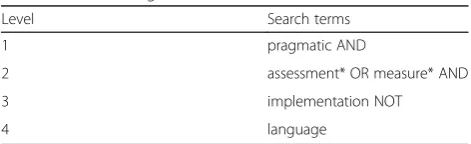
As a first step toward identifying a list of terms related to the pragmatic construct, a review of the literature was completed. On 11/16/2015, the first author (CC) searched PsycINFO and PubMed using the search strings detailed in Table1 to identify relevant literature. The specifier‘NOT language’was utilized. In the first at-tempt to search utilizing the term‘pragmatic,’ it became clear that ‘pragmatic language disorder’ substantiated a majority of results, particularly within PubMed. Thus, the specifier ‘NOT language’ was added to the search string to filter articles. The second author (HH) com-pleted a duplicate literature search on 01/20/2016. We reviewed titles and abstracts to exclude irrelevant articles and identify articles for full-text review. Full texts of arti-cles that made it past the title and abstract review were accessed and reviewed to identify possible dimensions of the pragmatic construct. The reference lists of included articles were also used to identify additional articles. All synonyms of ‘pragmatic’ (e.g.,‘simple’) and/or potential dimension terms/phrases (e.g., ‘ease to score’) were coded, including the field from which the terms were ex-tracted (e.g., mental health treatment outcomes, geriatric rehabilitation, pain management, etc.). Each included article was independently reviewed by the first and sec-ond authors (CS & HH) to ensure reliability of coding, and any discrepancies were discussed until consensus was reached.
All terms and phrases that were synonymous with, used to define, or apparent dimensions of the‘pragmatic’ construct for measurement were noted. Terms/phrases were edited by the investigative team for redundancies. Lengthy phrases (i.e., longer than 4 words) were edited for parsimony. Importantly, our review could be subject-ive to publication bias because it only included literature published in peer reviewed scientific journals; thus,
potential instruments living outside this space could have been overlooked. However, the purpose of this re-view method was to identify peer-rere-viewed articles that included specific assessment to the pragmatic measures construct.
Method 2: Stakeholder interviews
Stakeholder interviews were conducted in order to en-sure that the operationalization of the pragmatic con-struct was a participatory process. We also explored the stakeholders’context, experiences, and use of measure-ment in implemeasure-mentation [12, 13]. To ensure that stake-holders from multiple contexts were able to provide perspective on‘pragmatic’measurement, we purposively sampled [14] and recruited seven stakeholders from multiple organization types and service roles: outpatient community mental health center, school-based mental health, state mental health department, residential cen-ter, inpatient hospital, implementation consultant for non-profits, international implementation consultant. The investigative team identified five US-based panelists representing distinctly different agency types listed above, as well as two additional international stake-holders, all of whom had been directly involved in evidence-based practice implementation. This study was approved by the Internal Review Board at Indiana Uni-versity under expedited review. Informed consent was approved to be obtained verbally, and informed consent procedures were read aloud to interview participants prior to starting to record the interview (which was completed over telephone). Participants were informed that their participation was voluntary and that they may choose to not participate at any time.
[image:3.595.56.292.659.731.2]The interview questions directly targeting the prag-matic construct domain were drafted in consultation with a qualitative expert (fifth author, LP). They were further edited by the investigative team, and were sub-mitted and approved by the Institutional Review Board. The interview items targeting pragmatic measurement included exploration of what ‘pragmatic measurement’ meant to the stakeholder participants similar to syno-nyms found in the literature search (e.g., “What comes to mind when you hear the words, ‘practical or prag-matic measure’?”) and what attributes of measures they see as most and least relevant to the pragmatic construct (e.g., “If you have ever used any tools or measures for implementing new programs or clinical changes, what features or characteristics about those tools or measures made them pragmatic or practical?” “Have you ever used tools or measure that you did not consider practical or pragmatic? If so, what about those tools or measures made it impractical or not pragmatic?”). Interviews were conducted over a two-week period in 2016, and each took approximately one hour to complete. They were Table 1Search Strings
Level Search terms
1 pragmatic AND
2 assessment* OR measure* AND
3 implementation NOT
audio-recorded and transcribed using a human voice transcription service. Transcripts were checked for ac-curacy (CS & HH), and imported into NVivo 9 for data management and analysis.
Process for integrating findings
Interview transcriptions were coded by the first and sec-ond authors using a systematic content analysis to iden-tify core patterns or themes within the data. [15] Coding of transcripts was completed using a constant compara-tive approach, moving between the interview materials and results of the literature search to uncover similar-ities and differences between the various sources of in-formation [16, 17]. Specifically, themes were first inductively coded regarding ‘pragmatic’ synonyms and/ or dimensions, as well as antonyms/non-pragmatic di-mensions. Next, we adopted an iterative process to inte-grate the systematic literature review and interview findings for the pragmatic construct. Redundant terms between the systematic literature review and interview findings were eliminated, and the investigative team (CS, HH, CD, BP, BJW, & CCL) reviewed cases where terms/ phrases were similar but not exact to obtain consensus on whether to delete or reword terms. Next, the terms from the stakeholder interviews were reviewed for re-dundancy and if needed, stakeholder panelists were con-tacted again to seek clarity on their statements (two participants were re-contacted for clarifying in this way). Lastly, the inductively-developed themes from the litera-ture review were combined with deductively-derived themes from the stakeholder interviews to create a final list of terms/phrases [18, 19]. For the final list of terms, the investigative team further refined the wording of each theme to achieve clarity, precision, and distinctive-ness. We refined the terminology because it was pre-dicted that pragmatic dimensions would include different categories or levels similar to how reliability has variations in dimensions (e.g., test-retest, inter-rater, etc.). For instance, “low burden” may include the sub-dimensions: length, scoring, and cost.
Results
Literature review
The PsycINFO and PubMed database searches revealed 198 articles and book chapters containing the search string criteria in the title or abstract. Titles and abstracts were reviewed for all results. Of the 198 articles, only 10 (5%) contained a definition or described characteristics of ‘pragmatic’as an assessment construct and were thus included in our review. Importantly, three of the 10 arti-cles described characteristics of ‘pragmatic’clinical trials, but the focus of these works were on effectiveness vs. ef-ficacy trials and research design frameworks for imple-mentation, not measurement; thus, these articles were
excluded. An additional article describing characteristics of ‘pragmatic’as an assessment construct was identified during the duplicate literature review, increasing the total sample size to eight articles.
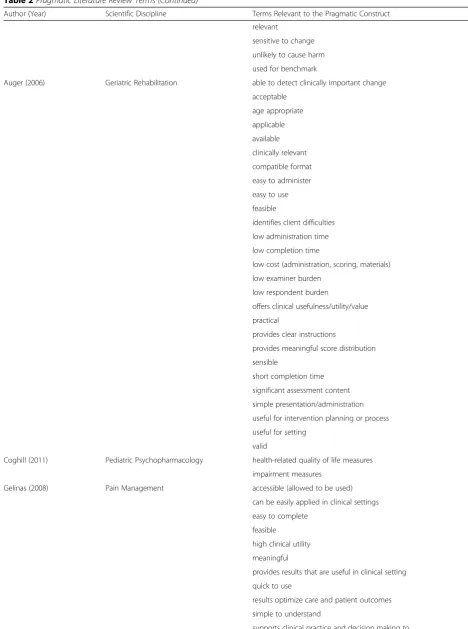
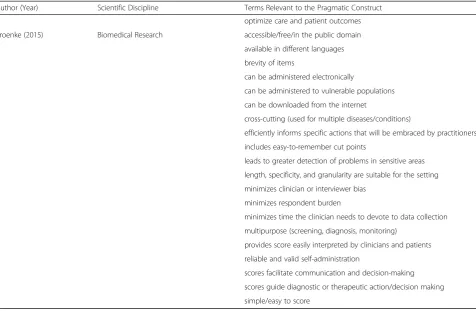
Multiple terms/phrases that were related to or syn-onymous with ‘pragmatic’ or practical measurement were extracted from the final eight articles. The articles contained terms/phrases that crossed five different areas: treatment outcome research (N= 3 articles); geriatric re-habilitation (N = 1 article); pediatric psychopharma-cology (N = 1 article); pain management (N= 1 article); implementation science (N= 1 article); biomedical re-search (N= 1 article). The full list of terms/phrases can be found in Table2.
There were several redundancies in terms across the eight articles, as well as terms/phrases with very similar wording. Therefore, terms/phrases were edited for re-dundancies and length (phrases were edited to be no more than 4 words in length), resulting in a final list of 37 terms/phrases related to or synonymous with ‘ prag-matic’or practical measurement. Example terms/phrases include measures that are ‘simple,’ ‘easy to administer,’ and‘brief.’
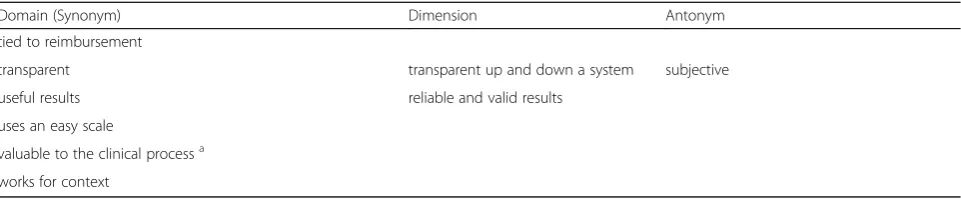
Interviews
The average age of the seven stakeholder panelists was 51.8 years (57% Female, 100% Caucasian). Three stake-holders held doctoral degrees, three held a master’s de-gree, and one held a bachelor’s degree. Stakeholders’ specific settings included a community mental health cen-ter (primarily residential), state Departments of Education and Mental Health, an outpatient community mental health center, and two different hospital-based programs (one with an area of emphasis in substance abuse).
Table 2Pragmatic Literature Review Terms
Author (Year) Scientific Discipline Terms Relevant to the Pragmatic Construct Pfieffer (1996) Treatment Outcomes confirm efficacy of intervention
efficient
lead to treatment planning low complexity
low cost
provide a clinical cut-off score Slade (1999) Treatment Outcomes able to be photocopied
acceptable
allows feedback data to be returned in a positive way available
benefits outweigh costs brief
compliments clinical judgment contains readable indices easily accessible easy to use feasible
flexible administration free
low administration time
meaningful for use in typical clinical settings non-duplicative
offers relative advantage provides meaningful feedback
provides understandable data to provider and patient reduces response bias related to social desirability relevant
simple
suitable for routine sustainable
valuable
Anderson (2003) Treatment Outcomes brief
demonstrates functional improvement easy to administer
easy to score focused
provides acute, clinically relevant information Glasgow (2013) Treatment Outcomes actionable
broadly applicable
feasible for use in real world settings important to stakeholders
Table 2Pragmatic Literature Review Terms (Continued)
Author (Year) Scientific Discipline Terms Relevant to the Pragmatic Construct relevant
sensitive to change unlikely to cause harm used for benchmark
Auger (2006) Geriatric Rehabilitation able to detect clinically important change acceptable
age appropriate applicable available clinically relevant compatible format easy to administer easy to use feasible
identifies client difficulties low administration time low completion time
low cost (administration, scoring, materials) low examiner burden
low respondent burden
offers clinical usefulness/utility/value practical
provides clear instructions
provides meaningful score distribution sensible
short completion time significant assessment content simple presentation/administration useful for intervention planning or process useful for setting
valid
Coghill (2011) Pediatric Psychopharmacology health-related quality of life measures impairment measures
Gelinas (2008) Pain Management accessible (allowed to be used) can be easily applied in clinical settings easy to complete
feasible
high clinical utility meaningful
provides results that are useful in clinical setting quick to use
results optimize care and patient outcomes simple to understand
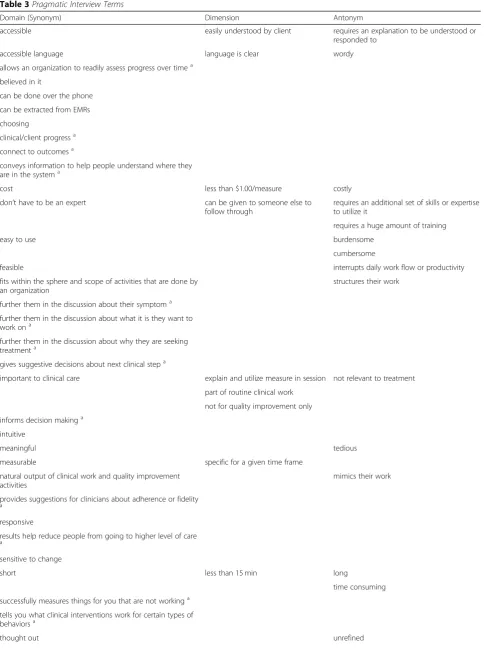
tasks (e.g.,“further them [clients] in the discussion about why they are seeking treatment”). A final list of 66 terms were derived from the stakeholder interviews.
Integrated results
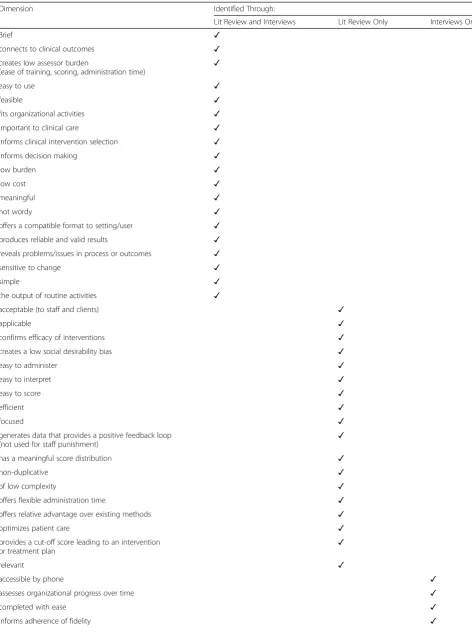
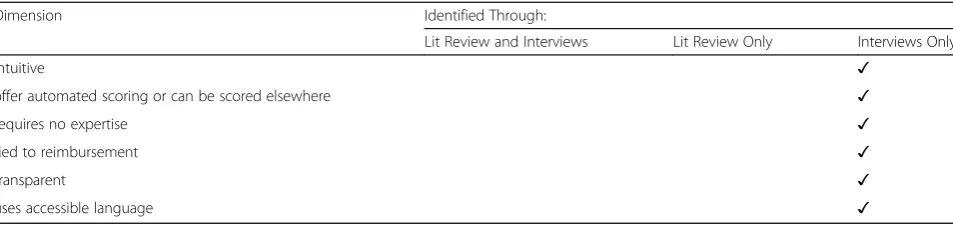
The terms/phrases from the literature review and stake-holder interviews were combined to construct a final list. Items that were thought to be confusing or duplicative were deleted (e.g.,“choosing” was deleted due to lack of clarity on this term), and phrases that were more lengthy were edited to be approximately four words or less (e.g., “Fits within the sphere and scope of activities that are done” was edited to “Fits organizational activities”). The final list consisted of 47 terms/phrases related to pragmatic measurement (see Table 4). Table 4 out-lines the consensus items – those terms/phrases that were found in both the literature review and the stakeholder interviews, as well as terms/phrases that were unique to either literature review or interviews. Notably, there were nearly as many items identified by researchers and found only in the literature review as there were consensus items. In addition, stake-holders reported an additional ten terms/phrases not found in the literature review.
Conclusions
[image:7.595.61.538.98.409.2]The current study focused on developing a comprehen-sive stakeholder-driven operationalization of the prag-matic construct for implementation measurement. Two different methods were used. The literature review phase of the current project revealed that research studies referencing the pragmatic qualities/aspects of measure-ment were relatively rare, with only eight studies from which to extract data. Importantly, work by Glasgow and colleagues [1, 20] and Kroenke and colleagues [2] were explicit in their attempts to describe pragmatic measure criteria and serve as the basis for the initial steps of our work. However, their methodology was simi-lar in that it involved primarily literature reviews, authors’ perspectives (i.e., expert review), and face validity of these features. To our knowledge, no studies have merged these methodologies with stakeholder interviews. Without the stakeholder perspective, researchers and measure devel-opers risk building non-implementable, unsustainable measurement models for their work, and stakeholders risk being unable to demonstrate effective outcomes or under-standing predictors of their own implementation efforts. Directly incorporating the perspectives of stakeholders who would be utilizing pragmatic measures seems to be a critical next step in the research.
Table 2Pragmatic Literature Review Terms (Continued)
Author (Year) Scientific Discipline Terms Relevant to the Pragmatic Construct optimize care and patient outcomes Kroenke (2015) Biomedical Research accessible/free/in the public domain
available in different languages brevity of items
can be administered electronically
can be administered to vulnerable populations can be downloaded from the internet
cross-cutting (used for multiple diseases/conditions)
efficiently informs specific actions that will be embraced by practitioners includes easy-to-remember cut points
leads to greater detection of problems in sensitive areas length, specificity, and granularity are suitable for the setting minimizes clinician or interviewer bias
minimizes respondent burden
minimizes time the clinician needs to devote to data collection multipurpose (screening, diagnosis, monitoring)
provides score easily interpreted by clinicians and patients reliable and valid self-administration
Table 3Pragmatic Interview Terms
Domain (Synonym) Dimension Antonym
accessible easily understood by client requires an explanation to be understood or responded to
accessible language language is clear wordy
allows an organization to readily assess progress over timea
believed in it
can be done over the phone can be extracted from EMRs choosing
clinical/client progressa
connect to outcomesa
conveys information to help people understand where they are in the systema
cost less than $1.00/measure costly
don’t have to be an expert can be given to someone else to follow through
requires an additional set of skills or expertise to utilize it
requires a huge amount of training
easy to use burdensome
cumbersome
feasible interrupts daily work flow or productivity
fits within the sphere and scope of activities that are done by an organization
structures their work
further them in the discussion about their symptoma further them in the discussion about what it is they want to work ona
further them in the discussion about why they are seeking treatmenta
gives suggestive decisions about next clinical stepa
important to clinical care explain and utilize measure in session not relevant to treatment part of routine clinical work
not for quality improvement only informs decision makinga
intuitive
meaningful tedious
measurable specific for a given time frame
natural output of clinical work and quality improvement activities
mimics their work
provides suggestions for clinicians about adherence or fidelity
a
responsive
results help reduce people from going to higher level of care
a
sensitive to change
short less than 15 min long
time consuming successfully measures things for you that are not workinga
tells you what clinical interventions work for certain types of behaviorsa
Results from the current study revealed that while there is significant overlap of terms related to the prag-matic construct in the existing literature and from stake-holders’ interviews, a number of terms were unique to each methodology. For instance, only the literature re-view revealed that the ability of a measure to be used for benchmarking would be relevant to its pragmatic fea-tures; whereas, only stakeholders suggested that a prag-matic measure would be one that could be integrated with an electronic medical/health record. This finding underscores the importance of surveying stakeholders for their perspectives given that many domains and di-mensions would have been missed otherwise. Indeed, understanding the characteristics of pragmatic measures from stakeholders’ perspectives serves as a first step in the process of also learning about which characteristics they value or believe are most important relative to mea-sures being pragmatic. Research on providers’ attitudes toward clinical assessment measures has shown that atti-tudes can vary significantly based on the practical char-acteristics of measures [21]. Thus, increasing the relevance, practicality, and applicability of measures will be imperative for their use in implementation initiatives.
Importantly, 14 terms/phrases were indicative of measure characteristics that describe an ‘actionable’ cri-terion (e.g., ‘informs decision-making’). That is, stake-holders suggested that pragmatic measures should enable some direct course of action such as the selection of a particular intervention. Indeed, stakeholders’use of measures likely hinges on whether measure results pro-vide clear information on specific decisions, interven-tions, or policies. Though scarce, research in the area of pragmatic measurement has included‘actionability’as an important criterion in defining the pragmatic construct [1]. Therefore, it may not be sufficient for stakeholders to learn about the level/magnitude/presence of a par-ticular determinant of practice (e.g., implementation readiness) but that measure results would provide guid-ance regarding whether or not to pursue one implemen-tation strategy over another given the level/magnitude/ presence of the identified determinant, for example. It is our concern that implementation science measurement is quite far from achieving this purpose. In addition,
understanding the dimensions of the criteria that were identified in the initial phases of this work will be an im-portant next step. For instance,‘low cost’ was identified as a domain in both the literature review and holder interviews but it is still unknown how stake-holders would further define as ‘low’ in cost (e.g., less than $1.00 per measure?). Our team will empirically evaluate all known measures of constructs included in the Consolidated Framework for Implementation Re-search [22] and the Implementation Outcomes Frame-work [23] to ascertain their pragmaticandpsychometric strength in a later phase of this National Institute of Mental Health funded work [24].
Limitations
The current study was not without limitations. As stated previously, the literature review was subject to bias given that only published literature was assessed; thus, terms related to the pragmatic construct that may fall outside of this source could substantially change the results of the systematic review. However, it was with intention that published articles were first assessed, coupled with stakeholder interviews to thoroughly capture both em-pirical and colloquial terminology. Also, settling on the use of term ‘pragmatic’to define the construct as it ap-plies to measurement was based on the small, but exit-ing, literature by Glasgow and colleagues regarding pragmatic measures. It is possible that one of the syno-nyms identified in the current study may be more broadly suited to define the construct. Given that the ex-tant literature settled on this terminology, however, we continued with it as it seemed the most appropriately suited label for the construct.
[image:9.595.58.539.98.199.2]In addition, though saturation appears to have been achieved, only seven stakeholder participants were re-cruited and it is possible that if more stakeholders, or indi-viduals in different professional roles, were recruited that additional pragmatic criteria may have been identified. In addition, our international stakeholder group did not in-clude individuals from low- and middle-income countries (LMIC), and therefore our representation may be lacking or may impact how the pragmatic construct is defined with respect to measurement in these contexts. Further
Table 3Pragmatic Interview Terms (Continued)
Domain (Synonym) Dimension Antonym
tied to reimbursement
transparent transparent up and down a system subjective
useful results reliable and valid results
uses an easy scale
valuable to the clinical processa works for context
a
Table 4List of Final Pragmatic Terms/Phrases
Dimension Identified Through:
Lit Review and Interviews Lit Review Only Interviews Only
Brief ✓
connects to clinical outcomes ✓
creates low assessor burden
(ease of training, scoring, administration time)
✓
easy to use ✓
feasible ✓
fits organizational activities ✓
important to clinical care ✓
informs clinical intervention selection ✓
informs decision making ✓
low burden ✓
low cost ✓
meaningful ✓
not wordy ✓
offers a compatible format to setting/user ✓ produces reliable and valid results ✓ reveals problems/issues in process or outcomes ✓
sensitive to change ✓
simple ✓
the output of routine activities ✓
acceptable (to staff and clients) ✓
applicable ✓
confirms efficacy of interventions ✓
creates a low social desirability bias ✓
easy to administer ✓
easy to interpret ✓
easy to score ✓
efficient ✓
focused ✓
generates data that provides a positive feedback loop
(not used for staff punishment) ✓
has a meaningful score distribution ✓
non-duplicative ✓
of low complexity ✓
offers flexible administration time ✓
offers relative advantage over existing methods ✓
optimizes patient care ✓
provides a cut-off score leading to an intervention or treatment plan
✓
relevant ✓
accessible by phone ✓
assesses organizational progress over time ✓
completed with ease ✓
investigations in this area should attempt to include LMIC representation and/or combine this work with other in-vestigators researching similar concepts in these areas. Further, as the current study was an investigation of the nomenclature associated with pragmatic measurement, which resulted in multiple terms, it remains unclear which pragmatic criteria stakeholders would regard according to relative importance. This limitation will be addressed in future phases of this work with concept mapping and Del-phi methodologies.
In summary, the current study involved the deve-lopment of a stakeholder-driven operationalization of the pragmatic construct for implementation measures. Though there was clearly consensus between the litera-ture review results and the stakeholder interview themes regarding what features define pragmatic measurement (e.g., ease of use, brief, results link to specific actions), there were also a number of terms identified that were unique. Thus, involving both expert opinion as well as stakeholder perspective is critical to achieving a compre-hensive understanding of the defining features of prag-matic measurement. The current study was a first step in elucidating the terms/phrases associated with the pragmatic construct. The next phase of our work in de-fining pragmatic measurement will be to utilize the com-bined results of the current study in a concept mapping process to determine the categorization of terms followed by a Delphi activity to obtain their relative im-portance to one another. By doing this, the investigative team can determine which domains of pragmatic meas-urement appear to be most relevant and stable across both the existing literature and stakeholder perspectives. Future work may also consider additional empirical ap-plications of this work, such as how certain domains may be relevant at different phases of implementation (e.g., pre-implementation vs. sustainability). The ultimate goal of our work is to put forth a reliable and valid criteria for assessing the pragmatic strength of implementation mea-sures. By combining a full spectrum of stakeholder-driven, operationalized pragmatic criteria for implementation meas-urement, the field will be better informed to develop mea-sures that are both psychometrically strong as well as
pragmatic. Insuring that implementation measures are high in standardized criteria for research purposes, as well as practical, actionable, and easily palatable among stake-holders will aid in bridging the implementation science and practice gap.
Abbreviations
ARC:Availability, Responsiveness, and Continuity; EBA: Evidence Based Assessments; EBP: Evidence Based Practice; OSC: Organizational Social Context; PHQ: Patient Health Questionnaire
Financial disclosures
No financial disclosures were reported by the authors of this paper.
Competing interests
All authors declare that they have no competing interests. This study was funded by the US National Institute of Mental Health (NIMH,
1R01MH106510). The funder did not have any role in study design, collection, analysis, and interpretation of data, writing the report, or the decision to submit the report for publication.
Availability of data and materials
The datasets used and/or analyzed during the current study available from the corresponding author on reasonable request.
Disclaimer
The views expressed are those of the authors and not necessarily those of the National Institute of Mental Health.
Authors’contributions
CS, CL, and BW conceived the study and developed the research design strategies of completing a literature search and stakeholder interviews. CS and HH developed the coding scheme, completed the literature search and interviews, and completed coding. CS and HH drafted initial versions of the manuscript. All authors provided substantive edits to iterative versions and approved the manuscript.
Ethics approval and consent to participate
This study was funded by the US National Institute of Mental Health (NIMH, 1R01MH106510). This study was approved by the Institutional Review Board of Indiana University (IRB00000222, Study # 1411709476).
Publisher’s Note
Springer Nature remains neutral with regard to jurisdictional claims in published maps and institutional affiliations.
Author details
1Hathaway-Sycamores Child and Family Services, Pasadena, CA, USA. 2
Department of Psychology, University of Montana, Missoula, MT, USA.
[image:11.595.60.537.98.211.2]3Kaiser Permanente Washington Health Research Institute, Seattle, WA, USA. 4Department of Global Health, University of Washington, Seattle, WA, USA. 5Department of Health Policy and Management, University of North Carolina
Table 4List of Final Pragmatic Terms/Phrases (Continued)
Dimension Identified Through:
Lit Review and Interviews Lit Review Only Interviews Only
intuitive ✓
offer automated scoring or can be scored elsewhere ✓
requires no expertise ✓
tied to reimbursement ✓
transparent ✓
at Chapel Hill, Chapel Hill, NC, USA.6Department of Children, Youth and
Families - University of Southern California, Los Angeles, CA, USA.
Received: 8 December 2017 Accepted: 13 November 2018
References
1. Glasgow RE, Riley WT. Pragmatic measures: what they are and why we need them. Am J Prev Med. 2013;45(2):237–43.https://doi.org/10.1016/j. amepre.2013.03.010.
2. Kroenke K, Spitzer RL. The PHQ-9: a new depression diagnostic and severity measure. Psychiatr Ann. 2002;32(9):509–15. https://doi.org/10.3928/0048-5713-20020901-06.
3. Achenbach TM. Advancing assessment of children and adolescents: commentary on evidence-based assessment of child and adolescent disorders. J Clin Child Adolesc Psychol. 2005;34(3):541–7.https://doi.org/10. 1207/s15374424jccp3403_9.
4. Glisson C, Landsverk J, Schoenwald S, et al. Assessing the organizational social context (OSC) of mental health services: implications for research and practice. Admin Pol Ment Health. 2008;35(1–2):98–113.https://doi.org/10. 1007/s10488-007-0148-5.
5. Glisson C. Assessing and changing organizational culture and climate for effective services. Res Soc Work Pract. 2007;17(6):736–47.https://doi.org/10. 1177/1049731507301659.
6. Glisson C, Schoenwald SK, Hemmelgarn A, et al. Randomized trial of MST and ARC in a two-level evidence-based treatment implementation strategy. J Consult Clin Psychol. 2010;78(4):537–50.https://doi.org/10.1037/a0019160. 7. Glisson C, Williams NJ, Hemmelgarn A, Proctor E, Green P. Increasing
clinicians' EBT exploration and preparation behavior in youth mental health services by changing organizational culture with ARC. Behav Res Ther. 2016; 76:40–6.https://doi.org/10.1016/j.brat.2015.11.008.
8. Williams NJ, Glisson C. Testing a theory of organizational culture, climate and youth outcomes in child welfare systems: a United States national study. Child Abuse Negl. 2014;38(4):757–67.https://doi.org/10.1016/j.chiabu. 2013.09.003.
9. Williams NJ, Glisson C. Reducing turnover is not enough: the need for proficient organizational cultures to support positive youth outcomes in child welfare. Child Youth Serv Rev. 2013;35(11).https://doi.org/10.1016/j. childyouth.2013.09.002.
10. Hunsley J, Mash EJ. Evidence-based assessment. Annu Rev Clin Psychol. 2007;3:29–51.https://doi.org/10.1146/annurev.clinpsy.3.022806.091419. 11. Mokkink LB, Terwee CB, Patrick DL, et al. The COSMIN checklist for assessing
the methodological quality of studies on measurement properties of health status measurement instruments: an international Delphi study. Qual Life Res. 2010;19(4):539–49.https://doi.org/10.1007/s11136-010-9606-8. 12. Chambers DA, Azrin ST. Research and services partnerships: partnership: a
fundamental component of dissemination and implementation research. Psychiatr Serv. 2013;64(6):509–11.https://doi.org/10.1176/appi.ps.201300032. 13. Minkler M, Salvatore AL. Participatory approaches for study design and
analysis in dissemination and implementation research. In: Brownson RC, Colditz GA, Proctor EK, editors. Dissemination and implementation research in health: translating science to practice. New York: Oxford University Press; 2012. p. 192–212.
14. Palinkas LA, Horwitz SM, Green CA, Wisdom JP, Duan N, Hoagwood K. Purposeful sampling for qualitative data collection and analysis in mixed method implementation research. Admin Pol Ment Health. 2015;42(5):533– 44.https://doi.org/10.1007/s10488-013-0528-y.
15. Patton MQ. Qualitative research and evaluation methods. 3rd ed. Thousand Oaks, CA: Sage Publications; 2002.
16. Benton D. Grounded theory. In: Cormack D, editor. The research process in nursing. 2nd ed. London: Blackwell; 1991.
17. Morgan DL. Qualitative content analysis: a guide to paths not taken. Qual Health Res. 1993;3(1):112–21.https://doi.org/10.1177/104973239300300107. 18. Stratford PW, Riddle DL. Assessing sensitivity to change: choosing the
appropriate change coefficient. Health Qual Life Outcomes. 2005;3:23. https://doi.org/10.1186/1477-7525-3-23.
19. Hendrickson AR, Massey PD, Cronan TP. On the test-retest reliability of perceived usefulness and perceived ease of use scales. MIS Q. 1993;17(2): 227.https://doi.org/10.2307/249803.
20. Glasgow RE, Nutting PA, King DK, et al. Randomized effectiveness trial of a computer-assisted intervention to improve diabetes care. Diabetes Care. 2005;28(1):33–9.
21. Jensen-Doss A, Hawley KM. Understanding barriers to evidence-based assessment: clinician attitudes toward standardized assessment tools. J Clin Child Adolesc Psychol. 2010;39(6):885–96.https://doi.org/10.1080/15374416. 2010.517169.
22. Damschroder LJ, Aron DC, Keith RE, Kirsh SR, Alexander JA, Lowery JC. Fostering implementation of health services research findings into practice: a consolidated framework for advancing implementation science. Implement Sci. 2009;4(50).https://doi.org/10.1186/1748-5908-4-50. 23. Proctor E, Landsverk J, Aarons G, Chambers D, Glisson C, Mittman B.
Implementation research in mental health services: an emerging science with conceptual, methodological, and training challenges. Admin Pol Ment Health. 2009;36(1):24–34.https://doi.org/10.1007/s10488-008-0197-4. 24. Lewis CC, Stanick CF, Martinez RG, et al. The Society for Implementation