TERMS OF ALIGNMENT EFFICIENCY, STRESS
DISTRIBUTION AND PAIN PERCEPTION – A
PROSPECTIVE CLINICAL TRIAL
A Dissertation submitted to
THE TAMILNADU DR.M.G.R. MEDICAL UNIVERSITY
CHENNAI - 600032
In partial fulfilment for the degree of
MASTER OF DENTAL SURGERY
BRANCH – V
DEPARTMENT OF ORTHODONTICS AND
DENTOFACIAL ORTHOPAEDICS
CERTIFICATE
This is to certify that the Dissertation entitled “CO MPARIS ON
O F THREE ALI GNING ARCHWI RES IN TERMS O F AL I GNME NT
EFFI CIE NCY, STRESS DIST RIB UTIO N AND PAIN PE RCE PTIO N
– A PROSPECTIVE CLINICAL TRIAL" i s a bonafide work done b y
Dr.A.ABOOB ACKE R ALI, Post Graduate st udent (2016 -2019) i n the
Departm ent of ORTHO DO NTI CS AND DE NTO FACIAL
ORTHO PE DI CS, Madha Dental Coll ege & Hospit al , kundrat hur,
Chennai-69 under t he di rect guidance a nd supervis ion i n parti al
ful film ent of regulation l aid down b y The Tamil Nadu Dr.M.G.R
Med ical Un iversity, Guind y, Chennai -32 for Mas ter of Den tal
Surgery, Orthodonti cs and Dentofaci al Orthopedi cs (Branch V) Degree
Examination.
Guid ed B y
Dr.M.C.SAI N AT H MDS , MBA,PGDCR.,
Professor and Head
Departm ent of Ort hodonti cs and Dentofacial Orthopedi cs
Madha Dent al Coll ege & Hospit al,
ENDORSEMENT BY HEAD OF THE DEPARTMENT
/HEAD OF THE INSTITUTION
This is t o certi f y that the Di ss ert ati on entitl ed “CO MPARIS ON
O F TH REE ALI GNING ARCHWIRES IN TERMS O F
ALI GNME NT E FFI CIENCY, STRESS DISTRIBUTI ON AND PAI N
PE RCE PTIO N – A PROS PE CTIVE CLINICAL T RI AL” is a
bonafi de work done b y Dr.A.ABOOB ACKE R AL I, Post Graduate
student (2016 -2019) in t he Departm ent of Orthodonti cs and Dent ofacial
Ort hopedics , under t he guidance of Dr.M.C.SAINATH MDS, MB A,
PGDCR., P rofessor and H ead , Department of Orthodontics and
Dentofaci al Ort hopedi cs, Madha Dental Coll ege and Hospital,
Kundrathur, Chennai – 600 069.
Dr.M.C.SAI NAT H M D S , M B A , P G D C R . ,
Professor and Head,
Departm ent of Orthodont ics and
Dentofaci al Orthopedics ,
Madha Dent al Coll ege & Hospit al,
Kundrathur, Chennai -600069.
Dr.M.C.SAI NAT H M D S , M B A , P G D C R . ,
Principal
Madha Dent al Coll ege & Hospit al,
DECLARATION OF THE CANDIDATE
I, Dr.A.ABOOBACKER ALI hereby declare that this dissertation
titled “COMPARISON OF THREE ALIGNING ARCHWIRES IN
TERMS OF ALIGNMENT EFFICIENCY, STRESS DISTRIBUTION
AND PAIN PERCEPTION – A PROSPECTIVE CLINICAL TRIAL” is a
bonafide and genuine research work carried out in the Department of
Orthodontics and Dentofacial Orthopedics, Madha Dental College and
Hospital, Chennai -600069, under the conceptualization and guidance of my
dissertation guide, Professor Dr.M.C.SAINATH MDS.,MBA,PGDCR. I have
utilized the facilities provided in the Madha Dental College & Hospital for the
study in partial fulfillment of the requirements for the degree of Master of
Dental Surgery in the speciality of Orthodontics and Dentofacial Orthopaedics
(Branch V) during the course period 2016-2019.
I declare that no part of the dissertation will be utilized for gaining
financial assistance for research or other promotions without obtaining prior
permission from Madha Dental College & Hospital.
I also declare that no part of this work will be published either in the
print or electronic media except with those who have been actively involved
in this dissertation work and I firmly affirm that the right to pr eserve or
publish this work rests solely with the prior permission of the Principal,
Madha Dental College & Hospital, but with the vested right that I shall be
cited as the author(s).
Signatu re of th e PG stud ent Signatu re of the HOD
This is to certify that this dissertation work titled "COMPARISON OF THREE ALIGNING ARCHWIRES IN TERMS OF ALIGNMENT EFFICIENCY, STRESS DISTRIBUTION AND PAIN PERCEPTION – A PROSPECTIVE CLINICAL TRIAL" of the candidate Dr.A.ABOOBACKER ALI with registration number
241619551 for the award of MASTER OF DENTAL SURGERY in the branch of Orthodontics and Dentofacial Orthopedics. I personall y verified the urkund.com website for the purpose of plagiarism check. I found that the uploaded thesis file contains from introduction to conclusion pages and result shows 4 percentage of plagiarism in the dissertation.
Dr.M.C.SAINATH MDS,MBA,PGDCR.,
Guide,
Professor and Head,
Department of Orthodontics and Dentofacial Orthopedics,
This agreement herein after the “Agreement” is entered into ... of January 2019 between the Madha Dental College and Hospital represented by its Principal having address at Madha Dental College and Hospital, Kundrathur, Chennai -69, (hereafter referred to as, „the college‟)
And Dr.M.C.SAINATH MDS,MBA,PGDCR., aged 60 years working as Principal ,Professor and HOD at the College, having residence address Block-U, Door.11, 4t h main road, Anna nagar, Chennai - 600 040, Tamil Nadu (Herein after referred to as the „Principal Author‟) And Dr.A.ABOOBACKER ALI aged 27 years currently studying as postgraduate student in Department of Orthodontics and Dentofacial Orthopedics in Madha Dental College and Hospital (Herein after referred to as the „PG/Research student and Co -Author‟).
Whereas the „PG/Research student as part of his curriculum undertakes to research " COMPARISON OF THREE ALIGNING ARCHWIRES IN TERMS OF ALIGNMENT EFFICIENCY, STRESS DISTRIBUTION AND PAIN PERCEPTION – A PROSPECTIVE CLINICAL TRIAL " for which purpose the PG/Principal author shall act as principal author and the college shall provide the req uisite infrastructure based on availability and also provide facility to the PG/Research student as to the extent possible as a Co -Author.
1. The parties agree that all the Research material and ownership therein shall become the vested right of the college, including in particular all the copyright in the literature including the study, research and all other related papers.
2. To the extent that the college has legal right to do go, shall grant to license or assign the copyright do vested with it for medical and/or commercial usage of inte rested persons/entities subject to a reasonable terms/conditions including royalty as deemed by the college.
3. All the parties shall share the royalty so received by the college equally.
4. The PG/Research student and PG/Principal Author shall under no circumstances deal with the copyright, Confidential information and know – how generated during the course of research/study in any manner whatsoever, while shall sole vest with the manner whatsoever and for any purpose without the express written consent of the college. 5. All expenses pertaining to the research shall be decided upon by the principal investigator/Co -Author or borne sole by the PG/research student (Co-Author).
6. The college shall provide all infrastructure and access facilities within and in other institutes to the extent possible. This includes patient interactions, introductory letters, recommendation letters and such other acts required in this regard.
by the student researcher under guidance from the principal author shall be subject to the prior approval, recommendations and commen ts of the Ethical Committee of the college constituted for this purpose. 8. It is agreed that as regards other aspects not covered under this agreement, but which pertain to the research undertaken by the student Researcher, under guidance from the Princip al author, the decision of the college shall be binding and final.
9. If any dispute arises as to the matters related or connected to this agreement herein, it shall be referred to arbitration in accordance with the provisions of the Arbitration and Concil iation Act, 1996.
In witness where of the parties here in above mentioned have on this the day month and year herein above mentioned set their hands to this agreement in the presence of the following two witnesses.
College represented by its
Principal PG Student
Witnesses Student Guide 1.
I thank God Almighty, whose immense grace has been sufficient in all aspects in every circumstance encountered. He guided and helped me throughout my life in every endeavor and for that I am grateful.
At the outset, I would like to thank our founder of Ma dha group of academic institutions Lion.Dr.S.PETER, our managing director,
Mr.AJAY KUMAR, and our vice chairperson Mrs.MERCY FLORENCE, Madha Dental College and Hospital for providing me with an opportunity to pursue post -graduation in the speciality of orthodontics and dentofacial orthopedics in their esteemed institution.
From the core of my heart I express my deep sense of gratitude and great honour to my respected guide, Professor Dr.M.C.SAINATH MDS,MBA,PGDCR., Principal and Head of the department, Department of Orthodontics and Dentofacial Orthopedics, Madha Dental College & Hospital, chennai 600 069, for his conceptualisation, patience guidance, support and encouragement throughout the study.
I am grateful to Dr.C.Karunanithi MDS., Professor, for his timely suggestions and support.
her timely suggestions and support.
I am grateful to Dr.Preethi MDS., Senior lecturer, for her timely suggestions, untiring support and encouragement.
I would like to thank Dr.Jhansi Ramani BDS., lecturer for her support.
I take this opportunity to thank Prof.Dr.Sanjay.K.Nayak, Ph.D., D.Sc., Director General, CIPET[Central Institute of Plastic Engineering and Technology], Department of Chemicals & Petrochemicals, Ministry of Chemicals & Fertilizers, Government of India, Chennai for allowing me to utilize the lab facilities to complete my thesis.
I take the opportunity to thank Dr.Nalini M.E, Ph.D., Scientist, for assisting me to carry out three point bending test.
I take the opportunity to thank Mr.Jeevi ITI(Dip)., Lab Technician in helping me to carry out three point bending test.
I thank the mathematical wizardry Mr.Boopathy M.Sc, MBA.,
Dr.M.R.Vishnu, Dr.A.Adarsh, Dr.Saranya and Dr.Subashree for supporting me in completing my thesis.
I sincerely express my gratitude from the core of my heart to all my patients who cooperated till the end of my study and written consents with full patience.
I would also extend my sincere thanks to my father
Mr.A.M.M.Anver Ali, mother Mrs.Seeni Ibrahimal, brother
Mr.Sultan Thahir Ali for giving me huge amount of moral support and courage during this venture.
I would like to thank my wife Dr.Hashmath Sakeena Banu for cooperating with me and bearing all the family responsibility throughout my entire course of study. Without her support it would have been really a very tough time for me. And special thanks to my daughter A.Asma aaliya being my source of happiness.
And I would like to thank my mother in law Mrs.Tahira begum
for understanding my situation and giving a constant support to successfully complete my course
teaching staffs of the department for their assistance and service rendered during my post graduation course.
AIM:
To clinically evaluate and compare the unraveling potential of the 0.014" Biostarter NiTi, 0.014" Heat activated Niti and 0.014" Superelastic Niti archwires during aligning and leveling stage of pre -adjusted edgewise appliance in crowded lower anterior teeth . To investigate and analyse the flexural stress distributed in these archwires and also to assess the pain perceived by the patients during the orthodontic treatment.
MATERIALS AND METHODS:
All the patients were bonded with 0.022x0.028" slot Ormco mini 2000 MBT prescription stainless steel metal brackets. Arch wires were placed in the lower arch in the same appointment. Arch wires were ligated using 3M elastomeric ligatures. Pre-treatment alginate impression and occlusal photographs were taken before the start of the treatment.
daily basis over the first 7 day period after bonding by means of a 10 -point visual analog scale (VAS) of 10 cm length. All of the patients received a recording sheet with seven visual analog scales and were asked to mark the point on the line which they believed to best represent the maximum pain they experienced.
After the completion of 12 weeks of alignment, the wires were removed from patient‟s mouth and three point bending test were carried out with INSTRON 8874 machine to assess the flexural stress distribution.
RESULTS:
The results reveal that there is no statistical significance seen in the unraveling efficiency among the three archwire types in aligning the mandibular anterior irregularity. (P = 0.64)
There is a significant difference in the mean pain score among the three groups every day(P=0.00) with mean pain scores of Biostarter NiTi group causing the least discomfort to the p atients followed by Heat activated NiTi and Superelastic NiTi.
unloading situations (P=0.070).
CONCLUSION:
S.No TITLE Page No
1. INTRODUCTION 1
2. AIM & OBJECTIVES 5
3. REVIEW OF LITERATURE 6
4. MATERIALS AND METHODS 30
5. RESULTS 41
6. DISCUSSION 48
7. SUMMARY 65
8. CONCLUSION 67
9. BIBILIOGRAPHY 69
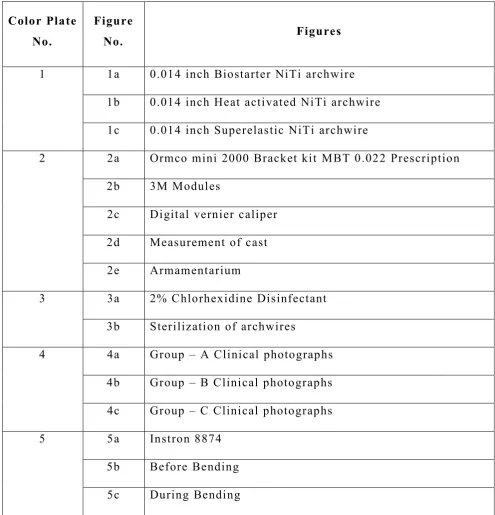
Color Plate No.
Figure
No. Figures
1 1a 0.014 inch Biostarter NiTi archwire 1b 0.014 inch Heat activated NiTi archwire 1c 0.014 inch Superelastic NiTi archwire
2 2a Ormco mini 2000 Bracket kit MBT 0.022 Prescription 2b 3M Modules
2c Digital vernier caliper 2d Measurement of cast 2e Armamentarium
3 3a 2% Chlorhexidine Disinfectant 3b Sterilization of archwires
4 4a Group – A Clinical photographs 4b Group – B Clinical photographs 4c Group – C Clinical photographs 5 5a Instron 8874
TABLE No. TITLE
I Demographic details and clinical characteristics of three groups
II One-way ANOVA to compare mean alignment values between groups at each interval.
III Tukey HSD Multiple Comparisons - Significance between the groups in unraveling efficiency at 8t h and 12t h week
IV General Linear Model (Repeated Measures ANOVA) to compare mean crowding alignment values in each group V Mean irregularity score between the intervals in each
group
VI Comparison of every interval alignment score with pre -op
VII Repeated measures ANOVA test using General Linear Models to compare the aligning performance of three archwires
VIII One way ANOVA to compare mean alignment values between groups at each interval in extraction and non -extraction cases
compare mean crowding alignment in each group in both extraction and non -extraction patients
XI Mean irregularity score between the intervals in each group
XII Comparison of every interval alignment score with pre -op
XIII Repeated measures ANOVA test using General Linear Models to compare the aligning performance of three archwires
XIV General Linear Model (Repeated Measures ANOVA) to compare mean pain scores between the time points and groups each day
XV Repeated measures ANOVA results to compare the significance in the mean pain score between groups. XVI Bonferroni Post Hoc Test results to compare the
significance in mean pain score between the groups XVII General Linear Model (Repeated Measures ANOVA) to
compare mean pain scores between time points in each groups
XVIII Comparison of Day 1 mean pain score with subsequent days mean pain scores in each group
XIX Comparison of significance within each groups
point
XXII Percentage of analgesic consumption on day 1
XXIII Chi-Square test to compare proportion of analgesic consumption between the groups on day 1.
XXIV Percentage of analgesic consumption on day 2
XXV Chi-Square test to compare proportion of analgesic consumption between the groups on day 2.
XXVI Percentage of analgesic consumption on day 1 & 2
XXVII Chi-Square test to compare the proportion of analge sic consumption between the groups on day 1 and day 2. XXVIII Kruskal-Wallis Test to compare stress values of the
archwires between groups XXIX Mean scores
GRAPH No. TITLE
1 Overall mean irregularity score of three archwires
2 Mean irregularity score of three archwires in extraction patients
3 Mean irregularity score of three archwires in non -extraction patients.
4 Mean pain score of the three groups from day 1 to day 7 5 Analgesic consumption on day 1 and day 2
6 Overall analgesic consumption
ANNEXURE No. TITLE
I ETHICAL COMMITTEE CLEARANCE
II INFORMATION SHEET
III INFORMED CONSCENT
IV CASE SHEET PROFORMA
V VISUAL ANALOGUE SCALE RECORDING SHEET
VI THREE POINT BENDING TEST CERTIFICATE
1
INTRODUCTION
Orthodontic treatment without discomfort is an enigma to orthodontic practitioners. Many treatment modalities have been advocated and followed to reduce the discomfort and to accelerate the orthodontic tooth movement. Various orthodontic mechanotherapy and biomaterials have been introduced to alleviate the discomfort and to hasten the orthodontic toot h movement. Aligning and leveling forms the first stage of comprehensive orthodontic treatment in Pre -adjusted edgewise appliance therapy.
2 appropriate archwire with above cited qualities, to accomplish the desired tooth movement.
In early 1930s, gold alloys were the only orthodontic wires available. Later, austenitic stainless steel wires came which subsequently gained popularity over gold.4 There after several contemporary alloys were developed, out of which nickel -titanium archwires gained huge popularity.
The use of NiTi archwires in Orthodontics was first described by Andreasen and Hilleman in 1975.5 It is marketed as Nitinol by Unitek Corporation and was first invented in the early 1960's by William F. Buehler, a research metallurgist at the Naval Ordinance Laboratory in Silver springs, Maryland.6 These nitinol wires had excellent elastic recovery p roperty but they lacked superelasticty and shape memory because of the process of cold working of the alloy during manufacturing. Later on in 1985, Burstone et al7
3 since superelastic NiTi archwires provide continuous light force to the teeth than other alloy archwires, it results in rapid tooth movement.
Light and continuous forces are needed to achieve physiologic tooth movement with minimal pathological effect to teeth and their surrounding structures.1 , 2 Therefore optimal force must be used to produce enhanced tooth movement with the least discomfort/pain to the patient. The forces delivered by the archwire depend mainly on the physical properties and dimensions of the wire material. An ideal aligning archwire should have a good formability, stiffness, spring-back, biocompatibility, low friction etc.4 , 1 1
4 Biostarter is a recent archwire introduced by the company Forestadent with the claim that the wire is extremely flexible and express the correct gentle forces on the patient’s dentition an d their uniquely smooth surface reduces the friction between archwire and bracket by up to 30%, thus decreasing the treatment time for unraveling the crowding.
Also the fear of pain is one of the important factor that may discourage patient from undergoing orthodontic treatment. Lew1 3
5
AIM & OBJECTIVES
The aim and objectives of this study is to,
I. Clinically evaluate and compare the unraveling potential of the following archwires,
(i) 0.014" Biostarter NiTi (ii) 0.014" Heat activated Niti (iii) 0.014" Superelastic Niti
during aligning and leveling stage of pre -adjusted edgewise appliance in crowded lower anterior teeth by measuring the amount of tooth movement that occurs at 4-, 8-, and 12-week intervals.
II. Investigate and analyse the flexural stress distributed in these archwires.
6
REVIEW OF LITERATURE
ALIGNMENT EFFICIENCY OF ARCHWIRES
Kevin O'Brien et al EJO 19905 conducted a clinical trial to compare the super elastic properties of 0.016 inch superelastic Titanol and 0.016 inch conventional Nitinol archwires in alleviating mandibular anterior crowding over a period of 35 days in a sample of 20 patients in each group using standard edgewise brackets. The super-elastic properties of Titanol and Nitinol were also investigated by the means of a bending test. It was found that the Titanol possessed superelastic properties, which exerted a light force when compared to nitinol archwires. When tooth movement was analysed the mean movement per contact point for Titanol was 1.7 mm and for Nitinol 1.42 mm, which was not statistically significant. The results of the data analysis in suggesting that there was no significant difference between the amount of tooth movement between the two study groups .
7 irregularity index until the score decreased below 2 mm, and the elastomeric ligatures were replaced at each appointment. Effective tooth movement occurred with each of the archwire types but there were no significant differences among wires, but the rate of alignment was significantly faster in the lower arch for subjects with the 22 slot appliance.
Nikolaos Pandis et al 2009 AJODO1 5 conducted a single centre, single operator, double blinded study to compare the efficiency of copper-nickel-titanium (CuNiTi) and nickel -titanium (NiTi) archwires in resolving crowding of the anterior mandibular dentition. The patients were allocated randomly into 2 groups of 30 patients, each receiving a 0.016 -inch CuNiTi and 0.016-inch NiTi wire. All the patients were bonded with In Ovation -R selfligating bracket with 0.022-inch slot and were followed monthly for a maximum of 6 months. Assessment of the alleviation of crowding involved only the mandibular anterior teeth. Measurements were made intra orally twice by the same clinician using a fine -tip digital caliber. The amount of crowding of the lower anterior dentition was assessed with irregularity index described by. No statistical difference was found between the two groups in alleviating the mandibular anterior crowding.
8 produced by three manufacturers namely (i) 3M Unitek, 0.014 inch Nitinol, 0.017 x 0.017 inch heat activated Ni –Ti (ii) GAC international, 0.014 inch Sentalloy, 0. 016 x 0.022 inch Bioforce and (iii) Ormco corporation, 0.014 inch Damon Copper Ni –Ti, 0.014 x 0.025 inch Damon Copper Ni –Ti in decrowding mandibular anteriors and also compared the discomfort caused these three archwire sequences All patients received 0.0 18 x 0.025 inch slot Victory SeriesTM brackets. All three groups ended in the same working archwire, a 0.016 x 0.022 inch stainless steel archwire of Orthoform II archform (3M Unitek) to produce a common endpoint. It was found that there was no statistically significant difference found between the archwire sequences in the time taken to reach the working wire or reduction in irregularity index and also no differences were found in the overall discomfort score between the archwire sequences.
9 (coaxial) stainless steel wire in the Begg appliance. However, in Pre-adjusted edgewise appliance there was no significant difference.
Abdelrahman et al AO 20153 clinically evaluated the alignment efficiency of 0.014” superelastic NiTi, 0.014” thermoelasti c NiTi, and 0.014” conventional NiTi in alleviating the mandibular anterior crowding. 74 patients requiring fixed orthodontic appliance therapy were randomly allocated into three different archwire groups. Patient’s treatment plan which had both the extr action and non-extraction of the pre-molars were included in this study. All patients received 0.022 x 0.028 inch Roth prescription brackets. Measurements were taken every 2 weeks upto16 weeks. The change in tooth alignment was measured using vernier cal liper in millimeters using Little’s irregularity index to evaluate. The study demonstrated no significant difference found among the three NiTi archwire in terms of alignment efficiency.
10 the study models, according to the irregularity index defined by Little . A digital calliper was held parallel to the occlusal plane for the measurements. Lower crowding was corrected in all of the cases in the group treated with the sequence that includes NiTi heat -activated arch wires, whereas about 30% of those treate d with NiTi arch wires were not completely corrected. There was a significant difference in time to complete treatment between the groups. In the group treated with the sequence that included heat -activated wires, alignment and levelling of mandibular anterior teeth were completed earlier than in the group treated only with conventional NiTi arch wires.
12 with conventional and copper Ni -Ti archwires and the results were statistically insignificant in comparis on.During the treatment period, the copper Ni-Ti and conventional Ni -Ti groups showed the same pattern of changes in the VAS scores between all observation periods, indicating that pain and discomfort are almost similar when conventional or copper Ni -Ti is used.
13 in inter-1st premolar width for the 0.014 inch NiTi archwire in the sixth week was more significant than that in 2n d and 4t h weeks. For the 0.016-in NiTi archwire, the increases in arch width in the 4t h and 6t h weeks were similar and significantly more evident than those in the second week. The inter -dental width obtained at the end of the 4th and 6t h weeks with the 0.014-in CuNiTi archwire was statistically significant than that obtained at the end of the 2n d week. For the 0.016-in CuNiTi archwire, the increase obtained at the end of the second, fourth, and sixth weeks was not statistically significant. As the study progressed, an increase in arch width was obtained for both types of archwires.
14 Questionnaire consisted of questions concerning the trigger of pain, description, location, duration, intensity, beginning, and medication. In addition, the patients were allowed to take only the 325 mg acetaminophen tablets if necessary (that doe s not interfere with orthodontic tooth movement), and if so, it should be mentioned in the appropriate section of the questionnaire The results of this study showed no significant difference between 0.014 A -NiTi and 0.016 HANT wires in amount of tooth alignment and the pain perception.
PAIN PERCEPTION
15 16 years). The results showed significant increase in discomfort level after the placement of either separator or archwire at 4 and 24 hours but not at 7 days. No significant difference was found in the level of discomfort of patients more than 16 years compared with those 16 years and under. However an interaction between the age and time factors was found to be significant that the patients 16 years and less experienced more discomfort at 4 hours, whereas patients more than 16 years experienced more discomfort at 24 hours and 7 days. Also it was found placement of separators tends to increase the level of discomfort on posterior teeth ,whereas wire placement tends to increase the discomfort in anterior region.
16 similar and were greater than the pain due to extraction. The pain score was highest in the morning after the placement of the archwire and lasted for 5-6 days .The pain experienced after the insertion of 2n d archwire was similar to the of the first . Diurnal variation was seen with the of increase in pain in the night although this did not greatly affect the sleep. The pain response was found to be highly and consistently subjective, not related to the dent al arch, crowding, sex.
17 daily life were all significantly greater in girls than in boys. Patients younger than thirteen years had pain significantly less frequently than the older patients. The pain intensity d id not differ among the age groups.
Lucete et al 1998 JOO2 5 compared and investigated the pain experienced by 128 patients after the placement of 0.014 Sentalloy Superelastic NiTi and 0.014 Nitinol Conventional Niti wire with edgewise fixed appliance using visual Analogue Scale for the first seven days with the recordings made every hour for 11 hours of the first day. Results showed the discomfort level increased continuously every hour after the placement of either Sentalloy or Nitinol as the first archwire with the peak in the first night, remaining high on the second day and decreasing thereafter to baseline level after seven days. During the first 10 hours the pain felt after the placement of a sentalloy was found to be less than that found with the Nitinol archwire, although a significant difference could be found at 4 hours only. A statistically significant difference between the upper and lower dental arches was observed during the first 11 hours, with the lower arch experiencing higher pain level with both Sentalloy and Nitinol.
Aslihan M. Ertan Erdinc and Banu Dincer2 6 EJO 2004
18 regions affected within mouth, the level of self-medication, the effect of pain on daily life and the gender difference. The study consisted of 109 patients receiving either 0.014 or 0.016 inch NiTi archwire by random selection. Pre -adjusted edgewise appliance with 0.018 inch Roth prescription brackets were used. In 0.014 inch group the archwire was inserted in both arches in 42 patients and in maxilla for 14 patients. In 0.016 inch group the wire was inserted in both arches in 41 patients and in maxilla for 12 patients. Following insertion of the archwires , a questionnaire comprising a total of 49 questions was given to the patients to describe the pain. The results shows that in both the groups initial pain was perceived at 2 hours, peaked at 24 hours and declined by day 3. No si gnificant differences were found in terms of gender, period of initial pain ,areas affected by pain within mouth and the effect of pain on daily living with the 0.014 inch and 0.016 inch NiTi archwires. But it was found that pain perceived at the anterior region was greater than the pain in posterior region. The most highly affected daily activity was observed at 6 hours with 57% in 0.014 inch groupand 50.5% in 0.016 inch group.55% patient consumed pain killers in 0.014 inch group and 32 % in 0.016 inch g roup.
19 with 0.022 inch Roth prescription brackets using Visual Analogue Scale with only mandibular arch bonded till the completion of the study. Totally 168 patients were assessed for the eligibility and 72 were excluded. 96 patients were finally selected and were divided equally into two groups. In this clinical trial, orthodontic pain began 1 h after initial arch wire placement, reached a peak on the morning of day 1 (24 h), and gradually decreased thereafter. However, even after 14 days, the mea n VAS score did not reach zero. At the completion of 14 days of study it was found that for overall pain, there was no statistically significant difference between the two wires. However, subjects with superelastic nickel – titanium archwires had a significantly higher pain at 12hours to 24 hours after the wire placement.
Marcio José da Silva Campos2 8 et al 2013 DPJO conducted a study with the aim to assess the intensity of toothache and buccal mucosal pain in adults and children during the two initial pha ses of the orthodontic treatment. The intensity of tooth ache and buccal mucosal pain reported by 20 patients , 10 children and 10 adults was recorded with the aid of a Visual Analog Scale (VAS). Mini Standard Edgewise American Orthodontic brackets we re used.
20 assessment was done for 14 days, which is divided in to two phases: Bonding phase from days 1 -7 and initial archwire phase from days 8-14. During the entire study period, patients did not use any analgesics or anti -inflammatory drugs. Upon completion of the study there was no significant difference in pain intensity for adults and children. After bracket bonding, 50% of the children and 70% of the adults reported pain. 70% patients in both groups reported pain after initial archwire insertion. After initial archwire insertion the peaks of toothache intensit y and prevalence occurred 24 h in children and 48 h in adults. In general, children reported pain less frequently than adults did, though with greater intensity.
21 multistranded stainless steel and CuNiTi archwires and Multistranded stainless steel and NiTi wires. From 4th day to 7 th day the pain levels were decreased progressively for all wires and there was no statistically significant d ifference was found between them .Overall pain associated with copper NiTi was less as compared to multistranded stainless steel and NiTi archwire.
22
23 T2 routine follow-up adjustment appointments. It was found that highest pain was experienced between 24 hours and 3 days after the appliance placement and in subsequent adjustments. The highest mean pain score arose at initial bonding followed by 2n d and 1st adjustments, with the difference between p ain levels at these appointment intervals being statistically significant. They also found that the use of analgesics following each appointment mirrored pain experience. The present study could not identify gender or age as a predictor of pain experience.
FLEXURAL STRESS DISTRIBUTION
24
Peter D. Wilkinson3 3 et al Ajodo 2002 investigated the load-deflection characteristics of 7 different 0.016 -in initial alignment archwires (Twistflex, NiTi, and 5 brands of heat -activated superelastic nickel -titanium [HASN]) with modified bending tests simulating a number of conditions encount ered clinically. Load-deflection tests were carried out on the wires with 5 different model designs, and data from selected points on the unloading phase of the generated graphs were statistically analyzed. Three -point bending with brass jig, Partial acrylic block model with 4 Mini-Diamond Brackets, Partial acrylic block model with 4 Twin -Lock self-ligating brackets, Full acrylic arch form with maxillary arch Mini -Diamond brackets, Full acrylic arch form with maxillary arch Twin -Lock brackets were the fi ve different models for the measurement. Wire deflection was carried out at 3 temperatures (22.0°C, 35.5°C, and 44.0°C) and to 4 deflection distances (1 mm, 2 mm, 3 mm, and 4 mm). Rankings were derived according to statistically significant differences in each test situation. The effects of model, wire, and temperature variation were all statistically significant. Twistflex and the 5 HASN wires produced a range of broadly comparable results, and NiTi gave the highest unloading values. Model rankings indicated that self-ligating Twin-Lock brackets produced lower friction than regular edgewise brackets.
26
Elda Gatto3 5 et al EJO 2011 investigated the mechanical properties of superelastic and thermal nickel – titanium (NiTi) archwires for correct selection of orthodontic wires. Seven different NiTi wires of two different sizes (0.014 and 0.016 inches), were tested. A three -point bending test was carri ed out to evaluate the load – deflection characteristics. The archwires were subjected to bending at a constant temperature of 37°C and deflections of 2 and 4 mm. Analysis of variance showed that thermal NiTi wires exerted significantly lower working forces than superelastic wires of the same size in all experimental tests . Wire size had a significant effect on the forces produced, with an increase in archwire dimension, the stress exerted was also increased for both thermal and superelastic wires.. It was also concluded that in low-friction mechanics, thermal NiTi wires are to be preferred to superelastic wires, during the alignment phase due to their lower working forces.
27 For each resulting load/ deflection curve, the plateau section was isolated, along with the mean value of the average plateau force, the plateau length, and the plateau slope for each type of wire obtained. Statistically significant differences were found between a lmost all wires for the three parameters considered. Statistically significant differences were also found that the heat -activated archwires generated longer plateaus and lighter average forces than the superelastic NiTi archwires. It was also found that there is an increase in average force seen with increasing diameter.
Daniel Jogaib Fernandes3 7 et al Materials Research 2015
conducted a study to compare the mechanical properties of commercially available NiTi orthodontic archwires lots. 0.014 inch Superelastic (SE) and heat -activated (HA) NiTi archwires from two lots of six manufacturers (3M, GAC, Tp, Orthosource, Orthometric and Morelli) were partitioned into eleven groups and tested under three-point bending tests. It was found that Heat activated archwires showed better mechanical performance than Superelastic archwires, with lower stress level on loading and unloading plateau ,thus lower forces is delivered to the tooth with Heat -activated NiTi wires.
28 three-point bending tests, since light continuous force is more efficient and physiological for tooth movement. 14 different superelastic nickel -titanium orthodontic preformed lower arch wires with a nominal size of 0.016 x 0.022 inch were selected. The three -point bending test was conducted using the Lloyd Universal testing machine: LF Plus CS4921 was conducted with a mid -span deflection rate of 5 mm/min under constant temperature range 36±1Co. Wires were deflected to 3.1 mm. All data were recorded during the unloading process at deflections 3, 2, 1 and 0.5 mm. It was found that there is a large variation of force exerted by different manufacturers with the unloading forces of Sentalloy being the lowest among the different brands of nickel -titanium alloy wires.
29 separate series of tests was performed using a specially made jig. All tests were made to a maximum deflection of 3 mm. At 1·5 mm deflection the forces exerted by wires in simulated fixed appliance ranged from 1·5 to 8·3 N. When the same wires were used in three point bending test, the forces exerted ranged from 0·3 to 3·0 N. The findings indicate that the forces generated by orthodontic mechanisms cannot be calcul ated from straightforward physical principles.
Aphinan Phukaoluan4 0 et al Key Engineering Materials 2017
30
MATERIALS AND METHODS
STUDY DESIGN
Double blinded Prospective Clinical Trail
STUDY AREA
Department of Orthodontics and Dentofacial Orthopaedics, Madha Dental College & Hospital, Kundrathur, Chennai, TamilNadu, India.
STUDY POPULATION
The study was carried out on the patients reporting to the Department of Orthodontics and Dentofacial Orthopaedics, Madha Dental College & Hospital.
INCLUSION CRITERIA
Age group 19 to 27 years.
Eruption of mandibular teeth upto second molar.
Patient’s treatment plan which includes both non -extraction and therapeutic extraction of pre -molars.
Little irregularity index score between 4 -9.
Class – I skeletal pattern
31
EXCLUSION CRITERIA
Congenitally missing or impacted lower anterior teeth.
Periodontally compromised patients.
Patients whose treatment plan included extraction of lower anterior teeth.
Patients with blocked out lower anterior teeth that did not allow for the placement of bracket at the initial bonding appointment.
Treatment plan which included the use of intermaxillary elastic, interproximal stripping and niti open coil spring to relieve the crowding.
Previous history of active Orthodontic treatment.
ETHICAL CLEARANCE:
This study was approved by Institutional Review Board and Human Ethical Committee of Madha Medical College & Hospital.
SAMPLE SIZE
32 correction of malalignment. To compensate for nonresponsive and incomplete data, 4 additional patients were included. During the course of the study four patients did not report the debond of brackets within 24 hours and were excluded from the study. Therefore the final sample size was 30 with 10 patients in each group. All patients were matched according to the age, sex, degree of initial crowding and treatment modality(extraction and non -extraction).
ARMAMENTARIUM USED
The following materials and equipments were used for measuring the mandibular anterior irregularity:
1. Ormco mini 2000 MBT prescription stainless steel metal brackets - 0.022x0.028" slot.
2. 0.014" Forestadent Biostarter NiTi archwire
3. 0.014" 3M(Unitek) Heat -activated NiTi arch wire. 4. 0.014" 3M(Unitek) Superelastic Niti arch wires. 5. 3M (Unitek) elastomeric modules
6. Digital Vernier caliper. 7. Alginate impression material 8. DSLR Camera (Canon 1200D). 9. Armamentarium
33
For measuring the pain perception:
A specially designed 10 point Visual Analogue Scale (VAS) recording sheet which consists of 7 VAS scale of each 10 cm in length. Details for recording the analgesic consumption for all seven days were also included.(Annexure- V)
For measuring the stress distributed in archwire: 1. Instron 8874 machine
2. 0.014" Biostarter NiTi, 0.014" Heat -activated NiTi and 0.014" Superelastic Niti archwire used for the alignment of dentition for a period of 12 weeks
METHODOLOGY:
Method of patient allocation:
All the participants were informed about the nature and purpose of the study and a consent form was duly signed before commencement of treatment. All doubts of the patients regarding the study were clarified. Patients were selected for the study according to the inclusion criteria mentioned.
34 In GROUP A - 0.014"Forestadent Biostarter NiTi
In GROUP B - 0.014" 3M(Unitek) Heat activated NiTi In GROUP C -0.014" 3M(Unitek) Super elastic NiTi
Prior to the placement of the appliance, the impression of the lower arch was made using alginate impression material, models were poured using orthokal and occlusal photographs were taken.
Little’s Irregularity Index:
35 Little classified mandibular crowding into the following groups: 0 - Perfect alignment
1-3 - Minimal irregularity 4-6 - Moderate irregularity 7-9 - Severe irregularity 10 - Very severe irregularity
For the present study patient's with irregularity index score of 4 to 9 (Moderate to Severe) were chosen.
METHOD OF INVESTIGATION:
36 At the routine follow-up appointment at 4 weeks, the wire was removed and alginate impression was made and occlusal photograph was taken. This alginate impression was then cast with stone. The archwires were ligated and activated with elastomeric modules. The whole procedure was repeated again a t 8t h and 12t h week.
All readings were measured by a single operator, who was not aware of the archwire specimen used for the arches being measured. These readings were taken at 0 -, 4-, 8-, and 12-week and were designated as T0, T1, T2, T3 respectively.
Identification number was assigned to each study model prior to measurement in order to mask the patient’s name, archwire group, and the time point during study model analysis. The study models were re-matched to the patient and archwire group after data collection was completed.
The change in the tooth alignment of the six anterior teeth is measured in millimeters from the resultant casts using Little’s irregularity index at each stage (T0, T1,T2,T3) using a digital vernier caliper.
Observer bias and Reproducibility :
37 patient’s allocated group. In order to assess the reliability of the examiner, all the study models were re -measured 4 weeks after the original measurements were taken. Intra-examiner reliability of measurements was assessed by determining the Reliability SD and 95% confidence intervals. (Table-XXX)
Assessment of Pain Perception:
Assessments of pain/discomfort were made in the morning on a daily basis over the first 7 -day period after bonding by means of a 10-point visual analog scale (VAS) of 10 cm length. The maximum pain experienced by each patient was recorded by them. All of the patients received a recording she et with seven visual analog scales and were given oral instructions on how to complete the VAS scale by marking the point on the line which they believed to best represent the maximum pain they experienced per day, with 0 indicating no pain and 10 indicat ing unbearable pain. Patients were reminded daily by a phone call or a text message to fill in the recording sheet and to bring it on their next visit. Patients were free to take analgesic as required. They were asked to report whether they had taken an analgesic during the recording period, and if so, when.
Assessment of Stress distribution:
38 clean cotton, then immersed in 2.0% chlorhexidine gluconate for 10 hours, which does not alter the load -deflection characteristics of NiTi archwires as proved in the previous study4 3 . The specimens with 0.014 inch diameter and 30 mm length were cut from the straighter section of the arch. Each specimen was tested using three point bending test.
39
STATISTICAL ANALYSIS:
The following statistical analysis was done to evaluate the results using the software "Statistical package for social sciences" (IBM SPSS Statistics for Windows, Version 23.0, Armonk, NY: IBM Corp. Released 2015)
The Normality tests Kolmogorov -Smirnov and Shapiro-Wilks tests results reveal that the variables follow Normal distribution except stress. Therefore, to analyse the data Parametric and non -parametric methods are applied.
1. To compare mean values between groups one -way ANOVA is applied followed by Tukey’s HSD post hoc tests for multiple pairwise comparisons.
2. To compare mean values between time points repeated measures ANOVA using General Linear Models is applied. 3. To compare proportions between groups Chi -Square test is
applied, if any expected cell frequency is less than five then Fisher’s exact test is used
40
FLOW CHART - SAMPLING METHOD
FINAL STUDY SAMPLE SIZE = 30
GROUP A Biostarter NiTi (n=10)
GROUP C
Superelastic NiTi (n=10)
Banding and Bonding done with Ormco Mini2000 MBT 0.022 inch stainless steel metal brackets and arch wire inserted and
ligated with 3M elastomeric ligatures. GROUP B
Heat activated NiTi (n=10)
Follow up done every 4 weeks upto 12 weeks.
FIGURES
Color plate 1 - Archwires
Group- A Group-B Group-C
1a – Biostarter NiTi 1b – Heat activated Niti 1c – Superelastic NiTi Archwire archwire archwire
Color plate 2 – Materials Used
2b-3M Modules
2c-Digital vernier caliper
2d-Measurement of cast
Color plate 3 -
3a - 2% Chlorhexidine Disinfectant
3b - Sterilization of archwires
Colour Plate 4 – Patient Photographs (4a): Group – A
Pre-Op:
8t h week:
Group – B (4b): Pre-Op (T0):
8t h week(T2):
12t h week(T3):
Group – C (4c): Pre-Op(T0):
8t h week(T2):
Color plate 5 – Three Point Bending Test
5a - Instron 8874
5b-Before Bending 5c-During Bending
41
RESULTS
A total of 42 patients were recruited. Eight patients were excluded from the trial because of not meeting the inclusion criteria. Four patients were excluded due to not reporting the debond of brackets within 24 hours. 30 patients were finally selected for the study.
They were divided into three groups.
i. Group-A comprises of patients receiving 0.014 inch BioStarter NiTi archwire.
ii. Group-B consisted of patients receiving 0.014 inch Heat activated NiTi archwire.
iii. Group-C consisted of patients receiving 0.014inch Superelastic NiTi archwire.
42
STATISTICAL ANALYSIS
The Normality tests Kolmogorov -Smirnov and Shapiro-Wilks tests results reveal that the variables follow Normal distribution except stress. Therefore, to analyse the data Parametric and non -parametric methods are applied. To compare mean values between groups one-way ANOVA is applied followed by Tukey’s HSD post hoc tests for multiple pairwise comparisons. To compare mean values between interval repeated measures ANOVA using General Linear Models is applied. To compare proportions between groups Chi-Square test is applied, if any expected cell frequency is less than five then Fisher’s exact test is used.For non -Normal variates (Stress values) to compare values between groups Kruskal Wallis test is used. To analyse the data SPSS (IBM SPSS Statistics for Windows, Version 23.0, Armonk, NY: IBM Corp. Released 2015) is used. Significance level is fixed as 5% (α = 0.05).
OVERALL UNRAVELING EFFICIENCY
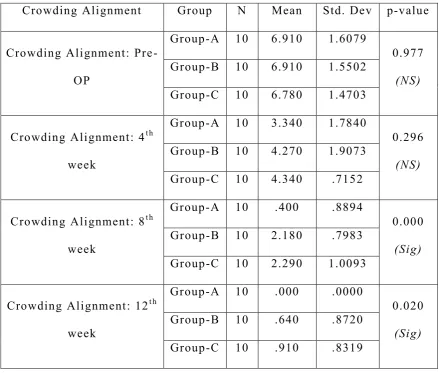
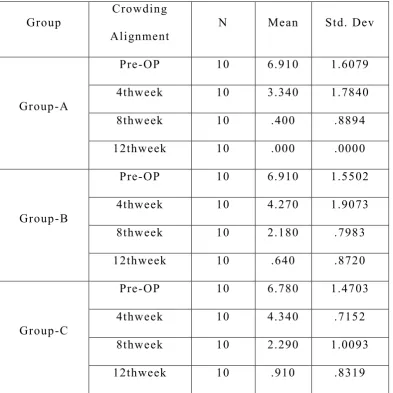
Within each group, the mean irregularity score has reduced significantly over time. (Graph 1)
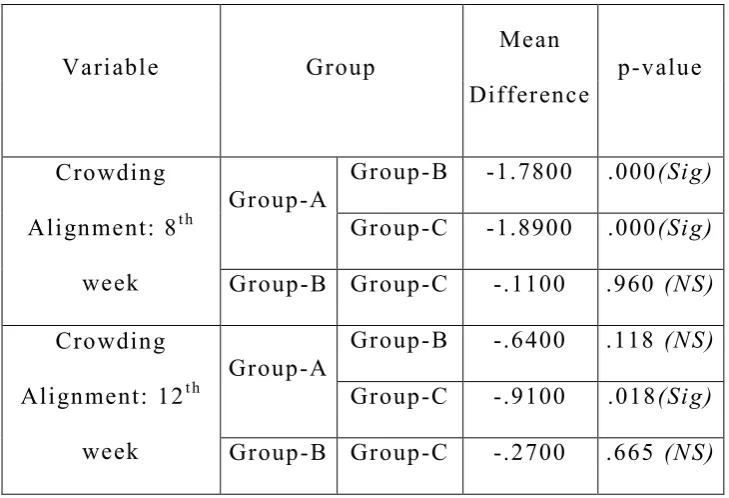
43 12t h week group-A significantly differs between group C ; but there is no significant difference observed between group -A and group-B & between group-B and group-C .
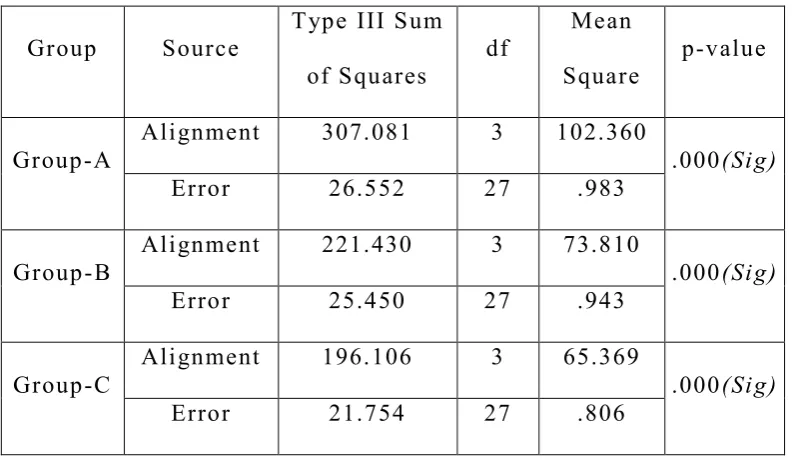
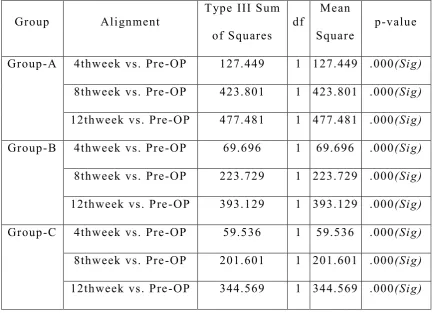
Table IV, V , VI represents the mean irregularity score between different interval of each group. The results reveal that there is statistical significance in the amount of decrowdin g between each interval within the three groups and shows that each wire has performed well in decrowding the irregularity within their groups .
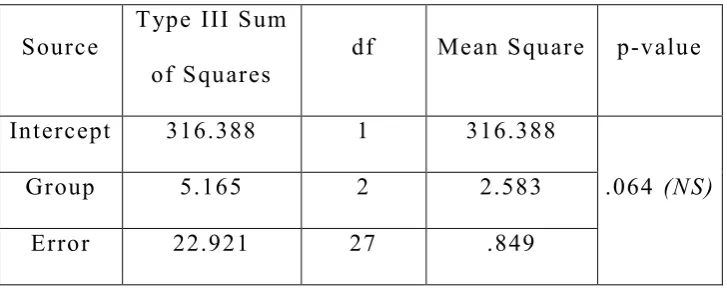
Table VII represents the repeated measures ANOVA test using General Linear Models ,which confirms that there is no statistical significance seen in the performance among the three archwire types in aligning the irregularity. (P = 0.64)
UNRAVELING EFFICIENCY IN EXTRACTION AND NON –EXTRACTION CASES
Within each group, the mean irregularity score has reduced significantly over time (Graph 2 & 3) in both extraction and non -extraction patients.
44 C; but there is no significant difference observed between group -B group-C (Tukey HSD Multiple Comparison).
Table X, XI, XII represents the mean irregularity between different interval of each group. The results reveal that there is statistical significance in the amount of decrowding between each interval among the three different archwires in both extraction and non -extraction patients and sho ws that each wire has performed well in decrowding the irregularity within their groups .
Table XIII represents a test using General Linear Models (Repeated measures ANOVA) confirmed that there is no statistical significance seen in the performance among the three archwire types in aligning the irregularity in both extraction(P=0.130) and non-extraction patients(P=0.484)
PAIN PERCEPTION
Table XIV represents the General Linear Model (Repeated Measures ANOVA) to compare mean pain scores between the interval and groups on each day. The table reveals that the mean pain score of Group-A is the least among the three groups on all the days. It also reveals that there no pain felt by the patient on the 7t h day in any of the groups.
45
Table XVI represents Bonferroni Post Hoc Test results, which shows that each group significantly differs in mean pain score from other groups.
Table XVII represents General Linear Model (Repeated Measures ANOVA) to compare mean pain scores between interval in each group separately. The table reveals that the mean pain score of all the three groups declines from day 1 to day 7.
Table XVIII and Table XIX represents the comparison of Day 1 mean pain score with subsequent day’s mean pain scores in each group. The tables reveal that the mean pain score in each group has significantly declined from day 1 to day 7. The mean pain score of each group reveals that, Group-A has the least pain when compared to the other two group.
Table XX represents the One-way ANOVA to compare mean pain scores between groups at each time point. The table reveals that there is a significant difference in the mean pain score am ong the three groups every day
46
Graph 4 represents the mean pain score of the three groups from day 1 to day 7
Table XXII and XXIII represents the Chi-Square test to compare proportion of analgesic consumption between the groups on day 1.The tables reveal that highest percentage of analgesic consumption is seen in group -C and also there is a statistical significance between group -A and group-C on day 1.
Table XXIV and XXV represents the Chi-Square test to compare proportion of analgesic consumption between the groups on day 2.The tables reveal that highest percentage of analgesic consumption is seen in group-C but there is no statistical significance between any groups on day 2.
Graph 5 represents the analgesic consumption on day 1 and day 2.
Table XXVI and XXVII represents the Chi-Square test to compare the overall proportion of analgesic consumption between the groups on day 1 and day 2.
Graph 6 represents the overall analgesic consumption in the three groups.
47 patients have consumed analgesics only on day 1 and 2. Patients have not consumed analgesic thereafter in any of the groups. On the whole, the drug consumption in Group -A is the least and it is statistically significant than Group -C. There is no significance between Group-B and Group-C
FLEXURAL STRESS DISTRIBUTION
Table XXVIII represents Kruskal-Wallis Test to compare flexural stress values of the archwires between groups. The table reveals that the Bio-starter NiTi arch wire belonging to Group -A exerted the least loading and unloading flexural stress among the three NiTi archwires but the mean stress value of Bio -starter NiTi archwire is not statistically significant between the three archwires in both loading(P=0.107) and unloading situation s(P=0.070).
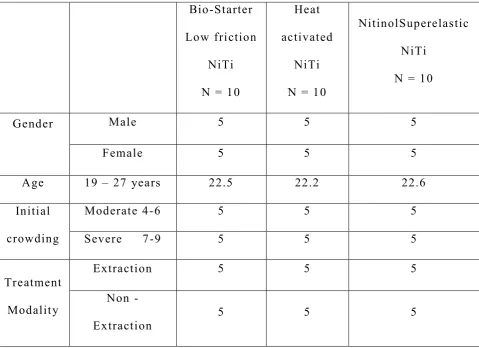
Table - I: shows the demographic details and clinical
characteristics of three groups
Bio-Starter Low friction
NiTi N = 10
Heat activated
NiTi N = 10
NitinolSuperelastic NiTi
N = 10
Gender Male 5 5 5
Female 5 5 5
Age 19 – 27 years 22.5 22.2 22.6 Initial
crowding
Moderate 4-6 5 5 5
Severe 7-9 5 5 5
Treatment Modality
Extraction 5 5 5
Non - Extraction
Table – II: shows the one-way ANOVA to compare mean
alignment values between groups at each interval
Crowding Alignment Group N Mean Std. Dev p-value
Crowding Alignment: Pre-OP
Group-A 10 6.910 1.6079
0.977 (NS) Group-B 10 6.910 1.5502
Group-C 10 6.780 1.4703
Crowding Alignment: 4t h week
Group-A 10 3.340 1.7840
0.296 (NS) Group-B 10 4.270 1.9073
Group-C 10 4.340 .7152
Crowding Alignment: 8t h week
Group-A 10 .400 .8894
0.000 (Sig) Group-B 10 2.180 .7983
Group-C 10 2.290 1.0093
Crowding Alignment: 12t h week
Group-A 10 .000 .0000
0.020 (Sig) Group-B 10 .640 .8720
Table – III: Tukey HSD Multiple Comparisons shows the
unravelling efficiency between the groups at 8t h and 12t h week
Variable Group
Mean Difference
p-value
Crowding Alignment: 8t h
week
Group-A
Group-B -1.7800 .000(Sig) Group-C -1.8900 .000(Sig) Group-B Group-C -.1100 .960 (NS) Crowding
Alignment: 12t h week
Group-A
Table - IV: General Linear Model (Repeated Measures ANOVA) to compare mean crowding alignment values in each group
Descriptive Statistics
Group
Crowding Alignment
N Mean Std. Dev
Group-A
Pre-OP 10 6.910 1.6079 4thweek 10 3.340 1.7840 8thweek 10 .400 .8894 12thweek 10 .000 .0000
Group-B
Pre-OP 10 6.910 1.5502 4thweek 10 4.270 1.9073 8thweek 10 2.180 .7983 12thweek 10 .640 .8720
Group-C
Table - V: Mean irregularity score between the intervals in each
group - Tests of Within-Subjects Effects
Group Source
Type III Sum of Squares
df
Mean Square
p-value
Group-A
Alignment 307.081 3 102.360
.000(Sig) Error 26.552 27 .983
Group-B
Alignment 221.430 3 73.810
.000(Sig) Error 25.450 27 .943
Group-C
Alignment 196.106 3 65.369
Table - VI: Comparison of each interval with pre -op
Tests of Within-Subjects Contrasts
Group Alignment Type III Sum of Squares
df Mean Square
p-value
Table - VII: Repeated measures ANOVA test using General
Linear Models confirms that there is no statistical significance
seen in the performance among the three archwire types in
aligning the irregularity.
Source Type III Sum of Squares
df Mean Square p-value
Intercept 316.388 1 316.388
.064 (NS) Group 5.165 2 2.583
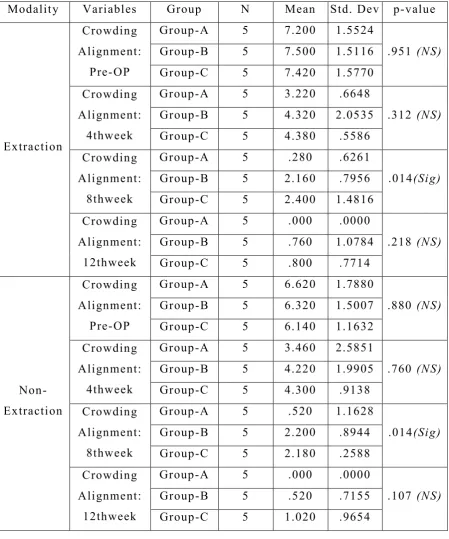
Table - VIII: shows the one-way ANOVA to compare mean
alignment values between groups at each interval in extraction
and non-extraction treatment modalities
Modality Variables Group N Mean Std. Dev p-value
Extraction
Crowding Alignment:
Pre-OP
Group-A 5 7.200 1.5524
.951 (NS) Group-B 5 7.500 1.5116
Group-C 5 7.420 1.5770 Crowding
Alignment: 4thweek
Group-A 5 3.220 .6648
.312 (NS) Group-B 5 4.320 2.0535
Group-C 5 4.380 .5586 Crowding
Alignment: 8thweek
Group-A 5 .280 .6261
.014(Sig) Group-B 5 2.160 .7956
Group-C 5 2.400 1.4816 Crowding
Alignment: 12thweek
Group-A 5 .000 .0000
.218 (NS) Group-B 5 .760 1.0784
Group-C 5 .800 .7714
Non-Extraction
Crowding Alignment:
Pre-OP
Group-A 5 6.620 1.7880
.880 (NS) Group-B 5 6.320 1.5007
Group-C 5 6.140 1.1632 Crowding
Alignment: 4thweek
Group-A 5 3.460 2.5851
.760 (NS) Group-B 5 4.220 1.9905
Group-C 5 4.300 .9138 Crowding
Alignment: 8thweek
Group-A 5 .520 1.1628
.014(Sig) Group-B 5 2.200 .8944
Group-C 5 2.180 .2588 Crowding
Alignment: 12thweek
Group-A 5 .000 .0000
.107 (NS) Group-B 5 .520 .7155
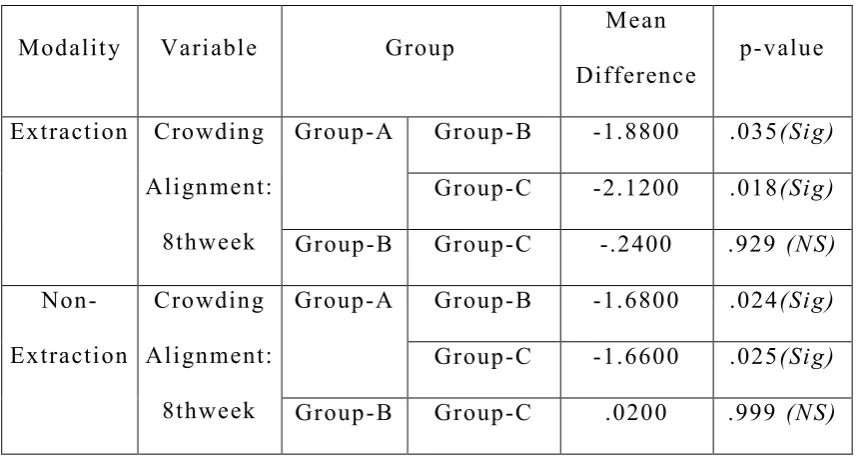
Table - IX: Comparison between the groups for significance in
unravelling at 8th week
Tukey HSD Multiple Comparisons -
Modality Variable Group
Mean Difference
p-value
Extraction Crowding Alignment:
8thweek
Group-A Group-B -1.8800 .035(Sig) Group-C -2.1200 .018(Sig) Group-B Group-C -.2400 .929 (NS)
Non-Extraction
Crowding Alignment:
8thweek
Table - X: General Linear Model (Repeated Measures ANOVA) to compare mean crowding alignment values in each group
Descriptive Statistics
Group Modality Crowding
Alignment N Mean Std. Dev
Group-A
Extraction
Pre-OP 5 7.200 1.5524 4thweek 5 3.220 .6648 8thweek 5 .280 .6261 12thweek 5 .000 .0000
Non-Extraction
Pre-OP 5 6.620 1.7880 4thweek 5 3.460 2.5851 8thweek 5 .520 1.1628 12thweek 5 .000 .0000
Group-B
Extraction
Pre-OP 5 7.500 1.5116 4thweek 5 4.320 2.0535 8thweek 5 2.160 .7956 12thweek 5 .760 1.0784
Non-Extraction
Pre-OP 5 6.320 1.5007 4thweek 5 4.220 1.9905 8thweek 5 2.200 .8944 12thweek 5 .520 .7155
Group-C
Extraction
Pre-OP 5 7.420 1.5770 4thweek 5 4.380 .5586 8thweek 5 2.400 1.4816 12thweek 5 .800 .7714
Non-Extraction