March 2017
Spring Budget 2017:
March 2017
© Crown copyright 2017
You may re-use this information (not including logos) free of charge in any format or medium, under the terms of the Open Government Licence v3. To view this licence, visit http://www.nationalarchives.gov.uk/doc/open-government-licence/version/2/ or write to the Information Policy Team, The National Archives, Kew, London TW9 4DU, or e-mail: [email protected].
Where we have identified any third party copyright information you will need to obtain permission from the copyright holders concerned.
Any queries regarding this publication should be sent to us at: [email protected].
1
Contents
Page
Chapter 1 Introduction 3
Chapter 2 Policy costings 5
Annex A Indexation in the public finance forecasts baseline 23
Annex B Office of Budget Responsibility: certification of policy costings
3
1
Introduction
1.1This document sets out the assumptions and methodologies underlying costings for tax and Annually Managed Expenditure (AME) policy decisions announced since Autumn Statement 2016, where those policies have a fiscally significant impact on the public finances. These costings are all submitted to the independent Office for Budget Responsibility (OBR) for their certification. This continues the practice established at June Budget 2010 and the principles outlined in ‘Tax policy making: a new approach’, published alongside June Budget 2010.This publication is part of the government’s wider commitment to increased transparency.
1.2Chapter 2 presents detailed information on the key data and assumptions underpinning the costing of policies in the Spring Budget 2017. Each note sets out a description of the measure, the base, the methodology for the costing (including relevant adjustments for behavioural responses) and highlights any areas of additional uncertainty, beyond those inherent in the OBR’s forecast. All costings are presented on a National Accounts basis.
1.3Annex A sets out the indexation assumptions included in the public finances forecast
baseline, including all pre-announcements. Annex B, by the OBR, sets out the approach the OBR has taken to scrutiny and certification of the costings, and highlights areas of particular
5
2
Policy costings
The following are included in this chapter:
Business Rates: discretionary support fund
Business Rates: targeted support for Small Business Rate Relief recipients
Business Rates: £1,000 discount for smaller pubs for 2017-18
Class 4 NICs: increase to 10% from April 2018 and 11% from April 2019
Dividend Allowance: reduce to £2,000 from April 2018
Making Tax Digital: one year deferral for businesses with turnover below VAT threshold
Stamp Duty Land Tax: delay reduction in payment window to 2018-19
Aggregates Levy: freeze for April 2017
Heavy Goods Vehicles: freeze VED and Road User Levy
Packaging Recycling Targets: set rates for 2018-2020
Tax avoidance: new penalty for enablers of tax avoidance
Qualifying Recognised Overseas Pension Schemes: targeted charge
Tax treatment of transfers to trading stock: prevent abuse
VAT on telecoms outside of EU: align with international practice and prevent avoidance
Tax Credit Debt: enhanced collection
Living Together Data Fraud: enhanced data collection
6
Business Rates: discretionary support fund
Measure description
The business rates revaluation takes effect from April 2017. This measure will fully compensate local authorities, with the funding to provide a further £300 million of discretionary relief to target individual hard cases in their local area following the revaluation. This measure is in addition to the transitional relief scheme which was announced in November 2016.
The cost base
The tax base was constructed using the Valuation Office Agency 2017 rating list.
Costing
The static costs were determined by setting the total amount of funding the government would provide to local authorities.
Two further adjustments have been made to the static costs:
business tax adjustments: business rates are deductible for Corporation Tax for companies and Income Tax for the self-employed
Barnett consequentials: business rates are devolved to Scotland, Wales and Northern Ireland
Exchequer impact (£m)
2017-18 2018-19 2019-20 2020-21 2021-22
Exchequer impact -180 -85 -35 -5 +0
Areas of uncertainty
7
Business Rates: targeted support for Small Business Rate Relief
recipients
Measure description
The business rates revaluation takes effect from April 2017. This measure will provide support to businesses who lose entitlement to some or all of their Small Business Rates Relief (SBRR). This measure is in addition to the transitional relief scheme which was announced in November 2016.
The cost base
The tax base was constructed using the Valuation Office Agency 2017 rating list and the National Non-Domestic Rates (NNDR) returns for those qualifying for SBRR.
The NNDR return reports information on businesses receiving small business rates relief. This information is derived from the National Non-Domestic Rates returns submitted by all 326 billing authorities in England.
Costing
The static costs were determined by first calculating bills before the Budget 2017 measure was applied. This was done by applying the 2017-18 tax rates and transitional relief caps to the new rateable values. Then the bills were estimated with the Budget 2017 measure applied.
Two further adjustments have been made to the static costs:
business tax adjustments: business rates are deductible for Corporation Tax for companies and Income Tax for the self-employed
Barnett consequentials: business rates are devolved to Scotland, Wales and Northern Ireland
Exchequer impact (£m)
2017-18 2018-19 2019-20 2020-21 2021-22
Exchequer impact -25 -20 -20 -25 -25
Areas of uncertainty
8
Business Rates: £1,000 discount for smaller pubs for 2017-18
Measure description
This measure will provide public houses in England with a rateable value below £100,000 with a discount of £1,000 off their business rates bill for one year in 2017-18.
The cost base
The tax base was constructed using the Valuation Office Agency 2017 rating list.
Costing
The static costs were determined by the number of pubic houses qualifying for the discount.
Two further adjustments have been made to the static costs:
business tax adjustments: business rates are deductible for Corporation Tax for companies and Income Tax for the self-employed
Barnett consequentials: business rates are devolved to Scotland, Wales and Northern Ireland
Exchequer impact (£m)
2017-18 2018-19 2019-20 2020-21 2021-22
Exchequer impact -25 neg +0 +0 +0
Areas of uncertainty
9
Class 4 NICs: increase to 10% from April 2018 and 11% from April
2019
Measure description
This measure increases the Class 4 National Insurance Contribution (NIC) rate charged between the Lower Profits Limit and the Upper Profits Limit from 9% to 10% from April 2018, and then from 10% to 11% from April 2019.
The tax base
The tax base consists of self-employed profits subject to Class 4 NICs. The tax base is estimated using data on taxable incomes taken from the Survey of Personal Incomes (SPI), comprising a sample of around 730,000 tax records, weighted to be representative of all taxpayers. The data used is for the tax year 2014-15.
The tax base, including taxpayer numbers and incomes, is projected forward over the forecast period in line with OBR Budget 2017 determinants.
Costing
The Exchequer impact is estimated using a micro-simulation model of the UK tax system. The pre and post measure tax regimes are applied to the tax base described above to estimate the impact of the measure in terms of the difference in Income Tax and NIC liabilities. The costing also includes an estimate of the impact of individuals changing their behaviour as a result of the Class 4 NICs increase, including the possibility of self-employed individuals moving to
incorporate their businesses.
Exchequer impact (£m)
2017-18 2018-19 2019-20 2020-21 2021-22
Exchequer impact +0 +325 +645 +595 +495
Areas of uncertainty
10
Dividend Allowance: reduce to £2,000 from April 2018
Measure description
This measure reduces the tax-free Dividend Allowance from £5,000 to £2,000 from April 2018.
The tax base
The tax base is all those with taxable dividend income over the personal allowance of £2,000. The tax base is estimated using data on taxable incomes taken from the Survey of Personal Incomes (SPI), comprising a sample of around 730,000 tax records, weighted to be
representative of all taxpayers. The data used is for the tax year 2014-15.
The tax base, including taxpayer numbers and incomes, is projected forward over the forecast period in line with OBR Budget 2017 determinants. A small adjustment is made to reduce this base to account for the expected impact of increases in the Individual Savings Account (ISA) limits.
Costing
The Exchequer impact is estimated using a micro-simulation model of the UK tax system. The pre and post measure tax regimes are applied to the tax base described above to estimate the impact of the measure in terms of the difference in income tax liabilities.
Behavioural effects including the increased incentive to use ISAs, behaviours to reduce taxable dividend income and the lower incentive for individuals to incorporate are accounted for in the costing.
Exchequer impact (£m)
2017-18 2018-19 2019-20 2020-21 2021-22
Exchequer impact neg +5 +870 +825 +930
Areas of uncertainty
11
Making Tax Digital: one year deferral for businesses with turnover
below VAT threshold
Measure description
This grouping includes two measures:
Making Tax Digital: Making Tax Digital for Business (MTDfB) will start from 2018-19. This measure provides Income Tax Self-Assessment (ITSA) businesses and landlords with turnovers below the VAT threshold an additional year to prepare before MTDfB becomes mandatory for them in 2019-20. Businesses and landlords with turnover below £10,000 remain exempted.
This measure takes effect from April 2018.
Cash basis increase: The cash basis was introduced in April 2013 and allows qualifying small businesses to calculate tax due for self-assessment under a cash basis. This measure increases the turnover entry threshold from the current level of £83,000 in 2015-16 to £150,000, with the corresponding exit threshold increased to £300,000.
The measure will take effect from 6 April 2017.
The tax base
Making Tax Digital: The tax base consists of Income Tax and National Insurance Contributions (NICs) lost as a result of error and failure to take reasonable care due to non-compliance by the population benefitting from the additional year to prepare.
Cash basis increase: The tax base is the tax paid by small businesses who would now be eligible for the cash basis but previously were not. This has been estimated using information from 2014-15 tax returns. As a result of the new threshold it is estimated that around 135,000 additional businesses will be eligible to take up the cash basis.
Costing
Making Tax Digital: The costing is calculated by deferring the benefits of improved compliance by the population affected. The benefits were estimated by applying a behavioural response to capture the impact of taxpayers improving their compliance as a result of the introduction of MTDfB through better, timelier record keeping and the prevention of some errors.
Cash basis: The costing is based on the value of tax expected to be reported under the cash basis as a result of this measure, including adjustments for take up over time and transition. It allows for the timing difference between the forecast tax paid by qualifying businesses under standard and cash basis accounting.
Exchequer impact (£m)
2017-18 2018-19 2019-20 2020-21 2021-22
Exchequer impact neg -20 -65 -150 -45
Areas of uncertainty
12
Stamp Duty Land Tax: delay reduction in payment window to 2018-19
Measure description
At Autumn Statement 2015, it was announced that the Stamp Duty Land Tax (SDLT) return filing and payment window would be reduced from 30 days to 14 days, starting in 2017-18. This measure defers the start of the reduced filing and payment window by one year, to 2018-19.
The tax base
The tax base consists of transactions that pay SDLT in the financial years affected by this measure. SDLT receipts are recorded on a cash receipts basis. The tax base is estimated using SDLT administrative data held by HMRC, and grown over the forecast period using OBR Budget 2017 determinants.
Costing
The costing is estimated by applying the delay to the changes to the tax payment regime to the tax base described above (where the reduction in the payment window now starts in 2018-19), and comparing this to the pre-measure tax payment regime, where the reduced payment window was due to start in 2017-18.
The costing accounts for a behavioural response whereby SDLT taxpayers adjust their behaviour around the new payment deadlines.
Exchequer impact (£m)
2017-18 2018-19 2019-20 2020-21 2021-22
Exchequer impact -105 +95 neg neg neg
Areas of uncertainty
13
Aggregates Levy: freeze for April 2017
Measure description
This measure freezes the aggregates levy at £2 per tonne for 2017-18.
The measure takes effect from 1 April 2017.
The tax base
The tax base is the tonnage of rock, sand and gravel commercially exploited in the UK. The tax base is estimated using the OBR Budget 2017 forecast for aggregates output. This forecast is dependent on the lagged duty rate, seasonal variation and a time trend.
Costing
The costing is estimated by applying the pre and post measure tax rates to the tax base described above. No behavioural impact is assumed because taxable aggregates are inelastic.
Exchequer impact (£m)
2017-18 2018-19 2019-20 2020-21 2021-22
Exchequer impact -15 -15 -15 -15 -15
Areas of uncertainty
14
Heavy Goods Vehicles: freeze VED and Road User Levy
Measure description
This measure freezes all Heavy Goods Vehicles (HGV) Road User Levy and Vehicle Excise Duty (VED) rates at 2016-17 levels.
This measure will be effective from 1 April 2017.
The tax base
The tax base is the stock of vehicles liable for HGV VED. The size of the tax base is projected to grow over the forecast period in line with trends over the last decade, derived from national statistical data.
Costing
The costing is estimated by applying the pre and post measure tax regimes to the tax base described above. There are no behavioural impacts expected as a result of this measure.
Exchequer impact (£m)
2017-18 2018-19 2019-20 2020-21 2021-22
Exchequer impact -10 -10 -10 -10 -10
Areas of uncertainty
15
Packaging Recycling Targets: set rates for 2018-2020
Measure description
Packaging (Export) Recovery Notes P(E)RNs are used to implement statutory packaging recycling targets under the EU Packaging Directive. Producers and handlers of packaging materials buy P(E)RNs to show evidence of recycling of packaging waste to achieve statutory targets. Targets and associated P(E)RNs are material-specific and denoted in tonnes. Packaging material is assumed to divert from landfill to recycling leading to a small impact on Landfill Tax receipts.
This measure sets new packaging targets for paper, aluminium, steel, wood, and overall recovery and recycling for 2018-2020:
2018 2019 2020
Paper 71.0% 73.0% 75.0%
Aluminium 58.0% 61.0% 64.0%
Steel 79.0% 82.0% 85.0%
Wood 38.0% 43.0% 48.0%
Recovery 80.0% 81.0% 82.0%
Recycling 73.6% 74.5% 75.4%
The tax base
The targets are expected to cause growth in recycling and hence a reduction in the amount of material sent to landfill. A change in the total amount of tonnage sent to landfill has an impact on Landfill Tax revenue.
Costing
The change in Landfill Tax revenue is calculated by multiplying the total additional recycling by the Landfill Tax rate, under the assumption that any additional recycling would have otherwise gone to landfill.
This costing assumes Landfill Tax rises in line with inflation over the period. The additional tonnes of recycling that are diverted by this policy are arrived at by applying the new recycling targets to the total packaging waste arising in each year.
Exchequer impact (£m)
2017-18 2018-19 2019-20 2020-21 2021-22
Exchequer impact neg neg -5 -5 -5
Areas of uncertainty
16
Tax avoidance: new penalty for enablers of tax avoidance
Measure description
This measure tackles the use of tax avoidance arrangements by:
clarifying the meaning of ‘reasonable care’ in relation to penalties for those whose tax returns are inaccurate as a result of HMRC defeating tax avoidance
arrangements
introducing a new penalty for those who enable taxpayers to use tax avoidance arrangements which HMRC defeats
This measure will have effect from Royal Assent to the Finance Act 2017.
The tax base
The tax base consists of those who use tax avoidance arrangements that HMRC defeats and the tax due on those arrangements, and those who design, market, and facilitate the use of such arrangements and their fees. The measure is targeted so that those who provide clients with advice on wholly commercial arrangements are not impacted.
The tax base is estimated from HMRC operational and administrative data and grown in line with OBR Budget 2017 determinants for UK wages and salaries.
Costing
The costing is estimated by determining the value of tax and penalties on the tax base described above. Adjustments are made for tax and penalty payment timing.
The costing accounts for a behavioural response, whereby the measure has a deterrent effect on existing and potential tax avoiders as well as enablers of avoidance.
Exchequer impact (£m)
2017-18 2018-19 2019-20 2020-21 2021-22
Exchequer impact +10 +50 +20 +20 +15
Areas of uncertainty
17
Qualifying Recognised Overseas Pension Schemes: targeted charge
Measure description
A new 25% tax charge will be imposed on all transfers of UK pensions to Qualifying Recognised Overseas Pension Schemes (QROPS). This will apply unless the transfer satisfies at least one of the exemptions, such as both the individual and QROPS being resident in the same country, or both residing in different countries in the European Economic Area.
This measure will be effective from 9 March 2017.
This policy also extends UK taxing rights, so that they apply to payments out of QROPS to cover the period of 5 full tax years following the date of transfer.
This measure will be effective from 6 April 2017.
The tax base
The tax base consists of pension transfers and payments that are affected by one of the changes mentioned above. This is estimated using HMRC data on UK pension transfers to foreign
schemes as well as payments made from foreign pension schemes.
Costing
The costing is estimated by multiplying the tax bases by the appropriate charge and average tax rates. Allowances are made for behavioural responses of both individuals and pension providers to the changes.
Exchequer impact (£m)
2017-18 2018-19 2019-20 2020-21 2021-22
Exchequer impact +65 +60 +60 +65 +65
Areas of uncertainty
18
Tax treatment of transfers to trading stock: prevent abuse
Measure description
This measure removes the option for a business to make an election to convert a capital loss into a trading loss when an asset it previously held as an investment is appropriated into trading stock.
This measure is effective from 8 March 2017.
The tax base
The tax base for this costing is the amount of capital losses converted using this election, estimated from filed Corporation Tax returns and computations, as well as HMRC operational data. This has been grown over the forecast period using OBR Budget 2017 determinants.
Costing
The costing is calculated by comparing the profits of companies pre and post measure and estimating their tax paid.
The costing also includes a behavioural effect to allow for the affected population finding ways to mitigate the impact of the changes.
Exchequer impact (£m)
2017-18 2018-19 2019-20 2020-21 2021-22
Exchequer impact +25 +15 +15 +15 +15
Areas of uncertainty
19
VAT on telecoms outside the EU: align with international practice
and prevent avoidance
Measure description
This measure removes the VAT use and enjoyment provision for mobile telecommunications provided to individuals. This means that UK VAT will be charged on all UK residents’ mobile phone use, including when outside the EU. It will align UK VAT rules with OECD principles and deter VAT avoidance.
This measure will be implemented from 1 August 2017.
The tax base
The tax base consists of the revenue generated by firms from the provision of
telecommunication services to UK consumers when outside of the EU, which would now be subject to VAT. This has been estimated using HMRC operational data and grown over the forecast period using telecommunications revenue growth taken from market research reports.
Costing
The costing is calculated by multiplying the tax base by the tax rate.
The costing takes account of a behavioural response from consumers who may be discouraged from using telecommunication services outside the EU following the introduction of the measure.
Exchequer impact (£m)
2017-18 2018-19 2019-20 2020-21 2021-22
Exchequer impact +45 +65 +65 +65 +65
Areas of uncertainty
20
Tax Credit Debt: enhanced collection
Measure description
This measure will enable HMRC to transfer suitable tax credits debts to the Department for Work and Pensions (DWP) in order to make use of Direct Earnings Attachments and other collection powers available to DWP to collect this debt.
This measure will be effective from 2018.
The tax base
The tax base for this measure is the tax credits debts associated with those debtors who satisfy the eligibility conditions for transfer to DWP. Namely;
they are not in receipt of a live tax credits award
they are not in a repayment arrangement
they have a minimum employment income of £5,200 after tax
This is estimated using HMRC administrative data.
Costing
The costing is calculated by applying the estimated recovery of this debt using DWP’s collection powers to the tax base of eligible tax credits debt.
There is an adjustment to account for those individuals who will not be required to pay their debts due to hardship.
Exchequer impact (£m)
2017-18 2018-19 2019-20 2020-21 2021-22
Exchequer impact +0 +60 +180 +145 +135
Areas of uncertainty
21
Living Together Data Fraud: enhanced data collection
Measure description
This measure will enable the Department for Work and Pensions (DWP) to make more effective use of data on their Income Support caseload to better identify fraud and error relating to individuals failing to appropriately declare a partner.
The cost base
The cost base for the policy is forecast expenditure on Income Support and forecast additional debt recoveries and debt write-offs on the Income Support caseload.
Costing
The costing is estimated by extrapolating the results of a proof of concept exercise run with an external data provider to the entire Income Support caseload. AME impacts are calculated by estimating how long newly uncovered overpayments would have continued for in the absence of the intervention.
Behavioural impacts were calculated by looking at evidence relating to claimants choosing to end a claim prior to a full fraud intervention being completed.
Exchequer impact (£m)
2017-18 2018-19 2019-20 2020-21 2021-22
Exchequer impact neg +5 neg neg neg
Areas of uncertainty
22
Child Tax Credit and Universal Credit: targeted exceptions to two
child limit
Measure description
This measure provides exceptions for the policy of limiting support from Child Tax Credit (CTC) and Universal Credit (UC) to a maximum of two children from 6 April 2017.
These exceptions were announced at Summer Budget 2015 and during the passage of the Welfare Reform and Work Act 2016. The exceptions were consulted on in late 2016 and the finalised detail was confirmed by government on 20 January 2017. This measure creates four exceptions to the maximum in respect of third and subsequent children and further qualifying young people:
multiple births, other than the first child in the birth
children being looked after by family or friends (non-parental caring arrangements)
children adopted from local authority care
non-consensual conception
The cost base
The cost base is estimated using HMRC’s tax credit forecast model and DWP’s micro-simulation models (to model interactions with the affected benefits) in combination with DWP’s integrated forecasting model for Universal Credit.
The cost base is consistent with OBR Budget 2017 forecast determinants.
Costing
The costing is estimated by calculating the difference between the pre and post measures regimes. There are no behavioural impacts included in the costing.
Exchequer impact (£m)
2017-18 2018-19 2019-20 2020-21 2021-22
Exchequer impact -5 -15 -35 -55 -70
Areas of uncertainty
23
A
Indexation in the public
finance forecasts baseline
The following table shows the indexation assumptions that have been included in the public finance forecast baseline, including all pre-announcements, for Spring Budget 2017 policy costings. Unless otherwise stated, changes are assumed to take place in April each year and tax raises are fixed.
Forecast area Element Default indexation
assumed in the baseline
Pre-announced policy changes from 2017-18 onwards
Income tax Personal allowance Multiply the personal
allowance from the previous tax year by CPI(%), and round up to the nearest £10. Add this figure to the previous year’s personal
allowance level
The personal allowance will increase to £11,500 in April 2017
Basic Rate Limit Multiply the personal allowance from the previous tax year by 100% + CPI(%), and round up to the nearest £100
The higher rate threshold, which is the sum of the personal allowance and the basic rate limit, will be set at £45,000 in April 2017
Personal savings allowance
Fixed at £1,000 for basic rate taxpayers and £500 for higher rate taxpayers
Starting rate limit for savings income
CPI, increase rounded up to the nearest £10
Fixed at £5,000 for 2017-18
Threshold for additional rate
Fixed at £150,000
Income limit for tapered withdrawal of personal allowances
Fixed at £100,000
Pensions Tax Relief –
annual allowance
24
Forecast area Element Default indexation
assumed in the baseline
Pre-announced policy changes from 2017-18 onwards
Pensions Tax Relief –
tapered annual allowance
Annual Allowance is tapered for individuals with income over £150,000 (including pension contributions)
Pensions Tax Relief –
Money Purchase Annual Allowance
Fixed at £10,000 Fixed at £4,000 from April 2017
Pensions Tax Relief –
Lifetime Allowance
Fixed at £1 million Lifetime allowance will be uprated with CPI from April 2018
Individual Savings Accounts – annual subscription limit
In line with CPI, rounded to nearest £120.
The ISA annual allowance will increase to £20,000 from April 2017
Individual income threshold for high income child benefit –
tax charge
Fixed at £50,000
Marriage tax allowance Fixed at 10% of the personal allowance
NICs Lower earnings limit CPI increase rounded
down to the nearest £1pw
Primary threshold / lower profits limit
CPI increase rounded to the nearest £1pw. Annual PT/LPL is weekly multiplied by 52
Secondary threshold CPI increase rounded to the nearest £1pw
Aligned with the primary threshold for 2017-18, thereafter will revert to the default indexation assumption
Upper earnings limit / upper profits limit
Aligned with income tax Higher Rate Threshold
25
Forecast area Element Default indexation
assumed in the baseline
Pre-announced policy changes from 2017-18 onwards
Small profits threshold CPI, increase rounded up to the nearest £10 and then added to the
previous year’s figure
Aligned with annual lower earnings limit from April 2018
Contribution rates Fixed percentage, apart from Class 2 and Class 3 weekly rates which rise by CPI, rounded to the nearest 5p
Employment allowance Fixed at £3,000
Capital gains tax Main annual exempt amount
CPI, rounded up to the nearest £100
Annual exempt amount for trustees
Half of the main annual exempt amount
Lifetime allowance for
entrepreneurs’ relief
Fixed at £10 million
Inheritance tax Nil rate band CPI rounded up to the
nearest £1,000
Freeze on the nil-rate band until 2020-21 (freeze at £325,000)
Working-age social security benefits and
payments: Jobseeker’s
Allowance, Income Support, Employment and Support Allowance, Housing Benefit
All main rates September’s CPI The personal allowances
of the working-age benefits; the ESA WRAG component and its UC equivalent; and Local Housing Allowances are frozen for four years from 2016-17
26
Forecast area Element Default indexation
assumed in the baseline
Pre-announced policy changes from 2017-18 onwards Disability Benefits: Disability Living Allowance; Attendance Allowance; Carer’s Allowance; Incapacity Benefit; and ESA support group element and its UC equivalent
All main rates September’s CPI
Statutory payments: Statutory Maternity Pay; Adoption Pay; Paternity Pay; Shared Parental Pay; and Sick Pay; Maternity Allowance; and
Guardian’s Allowance
All main rates September’s CPI
Basic State Pension All categories Highest of earnings,
September’s CPI or 2.5%
rounded to the nearest 5p
Additional State Pension All categories September’s CPI rounded to the nearest 1p
New State Pension All categories Highest of earnings,
September’s CPI or 2.5%
rounded to the nearest 5p
Pension Credit Guarantee Credit Earnings
Savings Credit Maximum savings credit
award frozen in real terms
Child Tax Credit Family element Fixed at £545 per year
Child element September’s CPI,
rounded up to the nearest £5
Four year uprating freeze from 2016-17
Disabled and enhanced disabled child elements
September’s CPI,
27
Forecast area Element Default indexation
assumed in the baseline
Pre-announced policy changes from 2017-18 onwards
Working Tax Credit Basic element, 30 hour element, second adult element, lone parent element
September’s CPI,
rounded up to the nearest £5
Four year uprating freeze from 2016-17
Disability elements September’s CPI,
rounded up to the nearest £5
Maximum eligible childcare costs (for 1 and 2+ children)
Fixed at 70% of actual childcare costs of up to £175 a week for one child or £300 a week for two or more children
Child benefit Eldest (or only) child and subsequent children amounts
September’s CPI,
rounded up to the nearest 5p
Four year uprating freeze from 2016-17
Stamp duties Stamp duty land tax
thresholds for residential property
Fixed at £125,000, £250,000, £925,000 and £1,500,000
Stamp duty land tax thresholds for non-residential freehold and leasehold premium transaction
Fixed at £150,000 and £250,000
Stamp duty land tax thresholds for non-residential leasehold rent transactions
Fixed at £150,000 and £5,000,000
Climate Change Levy Levy amount RPI
Aggregate Levy Levy amount RPI Frozen at £2 per tonne
from April 2017
Landfill tax Tax rates RPI, rounded to the
nearest 5p
Vehicle excise duty Duty rates RPI, rounded to the
28
Forecast area Element Default indexation
assumed in the baseline
Pre-announced policy changes from 2017-18 onwards
Air passenger duty Duty rates RPI, rounded to the
nearest £1
Rates for 2017-18 will increase by RPI on 1 April 2017
Tobacco duties Duty rates on all tobacco products
RPI Increase by 2 percentage
points above RPI every year until the end of the Parliament
Alcohol duties Beer, wine, spirits and cider duties
RPI
Fuel duties Duty rates RPI Freeze from April 2017
VAT VAT registration
threshold
RPI, rounded to the nearest £1,000
Gaming duty Gross gaming yield
bands
RPI, rounded to the nearest £500
B Budget 2017 policy decisions
Overview
B.1 Our Economic and fiscal outlook (EFO) forecasts incorporate the expected impact of the
policy decisions announced in each Budget and Autumn Statement. In the run-up to each statement, the Government provides us with draft estimates of the cost or gain from each policy measure it is considering. We discuss these with the relevant experts and then suggest amendments if necessary. This is an iterative process where individual measures can go through several stages of scrutiny. After this process is complete, the Government chooses which measures to implement and which costings to include in its scorecard. We choose
whether to certify the costings as ‘reasonable and central’, and whether to include them – or alternative costings of our own – in our forecast.
B.2 In this forecast, we have certified as reasonable and central all the costings of tax and
annually managed expenditure (AME) measures that appear in the Government’s main policy decisions scorecard.
B.3 The costings process worked reasonably efficiently, aided by the smaller-than-usual number of measures in this Budget and that fewer of them were submitted just before the deadline.
B.4 Table B.2 reproduces the Treasury’s scorecard, with further details in Chapter 4 and in the
Treasury’s Budget 2017 Policy costings document, which summarises very briefly the methodology used to produce each costing and the main areas of uncertainty within each.
Policy decisions not on the Treasury scorecard
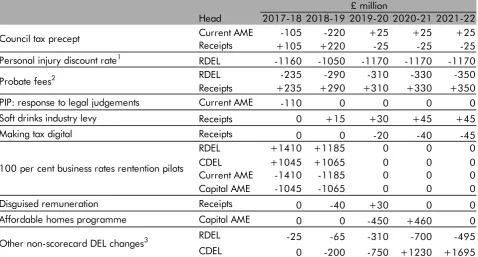
B.5 Our forecast includes the effect of a number of policy decisions that the Treasury has chosen not to present on its scorecard. These are presented in Table B.1. They include:
‘council tax precept’ – in November 2015, the Government announced that it would allow local authorities that deliver adult social care to raise council tax by an additional 2 per cent a year for three years from 2017-18 to 2019-20. In December 2016, it announced that local authorities would have further flexibility to decide how the maximum 6 percentage point increase over the three years is delivered. Relative to the initial precept policy, the additional flexibility increases council tax receipts by £0.1 billion in 2017-18 and by £0.2 billion in 2018-19;
increases the net present value of projected future flows, leading to higher awards. Box 4.2 sets out the different effects that this decision has on our forecast, which includes the Government adding around £1.2 billion a year to the RDEL reserve and a boost to insurance premium tax (IPT) receipts of around £100 million a year as the insurance sector passes higher costs through to higher premiums;
‘probate fees’ – the Government has confirmed its plans to change the fees payable for an application for a grant of probate. The new rates come into effect in May and range between £300 and £20,000, depending on the value of the estate. The
structure of the fees is such that the Treasury expects the ONS to classify them as a tax in the National Accounts. The Government expects the new fee structure to raise around £300 million a year. It will add to receipts and spending in equal measure, because the new tax is offset by the removal of negative spending from RDEL. We have also lowered our inheritance tax forecast by around £30 million a year to reflect the incentive for individuals with estates valued close to the bottom of the thresholds in the new probate fee structure to reduce the value of their estates (through genuine or contrived means) to remain within a lower fee band. This effect is expected to be relatively small, since the inheritance tax liability itself already provides a significant incentive to do this;
‘personal independent payments (PIP): response to legal judgements’ – at the end of November 2016 there were two legal judgements relating to PIP that would have pushed spending in 2021-22 up a further £0.9 billion (and up £3.7 billion across the whole forecast period) absent any Government policy response. (This is the ‘static’
cost, assuming no behavioural response from potential claimants.) It would have added around 3 per cent to average awards and 4 per cent to the overall PIP caseload in 2021-22. The Government has announced legislative changes that are expected to reduce the impact to £110 million in 2017-18, with no ongoing cost;
‘soft drinks industry levy’ – in its original announcement at Budget 2016 the
Government chose to exclude small producers and importers, as measured by volume, from the soft drinks industry levy. It has now decided that imports of major brands will not attract this relief, regardless of the volumes imported. Only imports of goods made by small producers based abroad will be eligible. This is expected to increase yield by £45 million a year by 2021-22;
‘making tax digital’ –the consultation on HMRC’s ‘making tax digital’ programme closed in November 2016 and as part of the Government’s response it has decided
that businesses currently using spreadsheets to record transactions will be able to continue to do so, but they must ensure that the spreadsheets meet the necessary
requirements of ‘making tax digital’. Part of the yield in the original November 2015
costing related to the assumed improvement in record-keeping and the correcting of errors that would, on the whole, benefit the Exchequer. Relative to that baseline, the use of spreadsheets is expected to increase such errors. This reduces the expected yield
forecast. The Government has also announced a delay to part of the programme, the effect of which was included on the scorecard;
‘100 per cent business rates retention pilots’– the Government has announced details of pilots ahead of allowing local authorities to retain all the business rates they collect, instead of the current 50 per cent. The full policy is intended to be fiscally neutral, by transferring some spending responsibilities to local authorities. The pilots are fiscally neutral by definition because they allow the pilot authorities to retain an amount of business rates equal to the reduction in central government grant funding. Table B.1 shows how this affects our business rates and expenditure forecasts. The Government is launching a further consultation on the full policy, so it is not included in our central forecast (see paragraph 4.19);
‘disguised remuneration’– at Budget 2016 the Government announced a measure to tackle existing, and prevent future, tax avoidance through the use of disguised
remuneration schemes. Following a consultation that closed in autumn 2016, the
Government decided to delay the introduction of a new close companies’ gateway by
one year, after concerns raised by respondents about the breadth of the proposal. This measure moves yield to later in the forecast. Relative to the previous costing it reduces it by £40 million in 2018-19 but then raises it by £30 million in 2019-20;
‘affordable homes programme’ – the Government has revised the profile of grants to housing associations via the affordable homes programme. This moves £200 million of grants from 2020-21 to 2019-20, which, after taking into account housing
associations leveraging this funding, raises PSNB in 2019-20 by £0.5 billion and lowers it in 2020-21 by a similar amount; and
‘other non-scorecard DEL changes’– as we describe in paragraphs 4.17 and 4.18,
[image:38.595.60.539.121.378.2]
Table B.1:
Costings for policy decisions not on the Treasury scorecard
3
Head 2017-18 2018-19 2019-20 2020-21 2021-22 Current AME -105 -220 +25 +25 +25 Receipts +105 +220 -25 -25 -25 Personal injury discount rate1 RDEL -1160 -1050 -1170 -1170 -1170 RDEL -235 -290 -310 -330 -350 Receipts +235 +290 +310 +330 +350 PIP: response to legal judgements Current AME -110 0 0 0 0 Soft drinks industry levy Receipts 0 +15 +30 +45 +45 Making tax digital Receipts 0 0 -20 -40 -45 RDEL +1410 +1185 0 0 0 CDEL +1045 +1065 0 0 0 Current AME -1410 -1185 0 0 0 Capital AME -1045 -1065 0 0 0 Disguised remuneration Receipts 0 -40 +30 0 0 Affordable homes programme Capital AME 0 0 -450 +460 0 RDEL -25 -65 -310 -700 -495 CDEL 0 -200 -750 +1230 +1695
Note: The presentation of these numbers is consistent with that in the scorecard shown in Table A.2, with negative signs implying an Exchequer loss and a positive an Exchequer gain.
1 This measure is also expected to increase insurance premium tax receipts by around £100 million a year. 2 This measure is also expected to increase inheritance tax receipts by around £30 million a year. 3 These changes are described in paragraph 4.17.
£ million
Probate fees2
100 per cent business rates rentention pilots Council tax precept
Other non-scorecard DEL changes3
Uncertainty
B.6 In order to be transparent about the potential risks to our forecasts, we assign each certified costing a subjective uncertainty rating, shown in Table B.2. These range from ‘low’ to ‘very high’. In order to determine the ratings, we have assessed the uncertainty arising from each of three sources: the data underpinning the costing; the complexity of the modelling
[image:39.595.65.539.143.696.2]
Table B.2:
Treasury scorecard of policy decisions and OBR assessment of the
uncertainty of costings
2017-18 2018-19 2019-20 2020-21 2021-22
1 16-19 Technical Education: implement Sainsbury reforms Spend 0 -60 -115 -250 -445 N/A 2 Education capital: extend free schools programme Spend -20 -30 -50 -280 -655 N/A
3 Education capital: school investment Spend 0 -130 -130 0 0 N/A
4 Labour market participation: funding for returnships Spend * -5 0 - - N/A
5 Business Rates: discretionary support fund Spend -180 -85 -35 -5 0 Low
6 Business Rates: targeted support for Small Business Rate
Relief recipients Spend -25 -20 -20 -25 -25 Medium
7 Business Rates: £1,000 discount for smaller pubs
for 2017-18 Spend -25 * 0 0 0 Medium
8 Regional and other spending Spend -15 -10 -5 0 0 N/A
9 Social Care: additional funding Spend -1,200 -800 -400 - - N/A
10 NHS: Accident and Emergency streaming Spend -120 0 0 0 0 N/A
11 NHS: Sustainability and Transformation Plans Spend -130 -130 -130 0 0 N/A
12 Tackling domestic violence and abuse Spend 0 -10 -10 0 0 N/A
13 Free school transport: expand eligibility to selective schools Spend 0 -5 -5 -5 -5 N/A 14 International Women's Day: voting rights centenary
commemoration Spend -5 0 0 - - N/A
15 Class 4 NICs: increase to 10% from April 2018 and 11%
from April 2019 Tax 0 +325 +645 +595 +495 Medium-high
16 Dividend Allow ance: reduce to £2,000 from April 2018 Tax 0 +5 +870 +825 +930 Medium 17 Making Tax Digital: one year deferral for businesses w ith
turnover below VAT threshold Tax * -20 -65 -150 -45 Medium
18 Stamp Duty Land Tax: delay reduction in payment w indow
to 2018-19 Tax -105 +95 * * * Medium-low
19 Aggregates Levy: freeze for April 2018 Tax -15 -15 -15 -15 -15 Low
20 Heavy Goods Vehicles: freeze VED and Road User Levy Tax -10 -10 -10 -10 -10 Low 21 Packaging Recycling Targets: set rates for 2018-2020 Tax * * -5 -5 -5 Medium
22 Tax avoidance: new penalty for enablers of tax avoidance Tax +10 +50 +20 +20 +15 High 23 Qualifying Recognised Overseas Pension Schemes:
targeted charge Tax +65 +60 +60 +65 +65 High
24 Tax treatment of transfers to trading stock: prevent abuse Tax +25 +15 +15 +15 +15 Medium 25 VAT on telecoms outside the EU: align w ith international
practice and prevent avoidance Tax +45 +65 +65 +65 +65 High
26 Tax Credit Debt: enhanced collection Spend 0 +60 +180 +145 +135 Medium
27 Living Together Data Fraud: enhanced data collection Spend * +5 * * * Medium-low 28 Child Tax Credit and Universal Credit: targeted exceptions
to tw o child limit Spend -5 -15 -35 -55 -70 Medium
TOTAL POLICY DECISIONS -1,710 -665 +825 +930 +445
*negligible
2At Spending Review 2015, the government set departmental spending plans for resource DEL (RDEL) for the years up to and
including 2019-20, and capital DEL (CDEL) for the years up to and including 2020-21. Where specific commitments have been made beyond those periods, these have been set out on the scorecard. Where a specific commitment has not been made, adjustments have been made to the overall spending assumption beyond the period.
Raising Productivity and Living Standards
1Costings reflect the OBR’s latest economic and fiscal determinants.
Tax Sustainability and Fairness
£ million
Uncertainty
An economy that works for everyone and public spending
Avoidance, Evasion, and Imbalances
Previously announced welfare policy decisions
B.7 Table B.3 shows the detailed criteria and applies them to a sample policy measure from this
Budget: ‘tax credits debt: enhanced collection’. This is expected to yield £0.5 billion in total from 2018-19 to 2021-22 by transferring tax credit debts for which HMRC has exhausted all possible collection procedures to the Department for Work and Pensions (DWP). Unlike HMRC, DWP has powers to recover debt directly from earnings without needing prior court approval. For this policy we have judged that the most important source of uncertainty will be data, followed by modelling, then behaviour.
B.8 The data are based on snapshots of eligible cases and the value of uncollected debt. While the data are generally of good quality, they are subject to occasional fluctuation that adds uncertainty around whether the snapshots are representative of the final cases that will be transferred. Overall we consider this to be a ‘medium’ source of uncertainty.
B.9 The modelling involved several steps to get to the final cases that would be transferred to DWP – for example excluding cases that did not meet the criteria, such as those with employment income below £5,200. We consider this to be a ‘medium’ source of
uncertainty.
B.10 We consider the behaviour to be the least important source of uncertainty as these debts relate to individuals that have already exhausted all of HMRC’s attempts to collect those debts, while collecting them via the individual’s employer reduces the scope not to comply. Any additional behavioural response from this measure is therefore considered negligible
and receives a ‘medium-low’ source of uncertainty.
[image:41.595.55.546.129.547.2]
Table B.3:
Example of assigning uncertainty rating criteria:
‘
tax credit debt:
enhanced collection
’
3
Rating Modelling Data Behaviour
Significant modelling challenges
Poor quality
Significant modelling challenges
Much of it poor quality
Some modelling challenges Basic data
May be from external sources Assumptions cannot be
readily checked
Some modelling challenges Incomplete data High quality external sources
Verifiable assumptions Straightforward modelling
Few sensitive assumptions required
Low
Straightforward modelling of new parameters for existing policy with few or no sensitive
assumptions
High quality data Well established, stable and predictable behaviour
Importance Medium High Low
Overall Medium
Medium-low High quality data Behaviour fairly predictable
Medium-high Significant policy for which
behaviour is hard to predict
Medium
Difficulty in generating an up-to-date baseline and sensitivity to particular underlying
assumptions
Difficulty in generating an up-to-date baseline
Considerable behavioural changes or dependent on factors outside the system
Very high No information on potential behaviour
High
Behaviour is volatile or very dependent on factors outside
the tax/benefit system Multiple stages and/or high
sensitivity on a range of unverifiable assumptions
Very little data
Little data Multiple stages and/or high
sensitivity on a range of unverifiable assumptions
B.12 Using the approach set out in Table B.3, we have judged three measures in the scorecard to
have ‘high’ uncertainty around the central costing. Together, these represent 11 per cent of the scorecard measures by number and 6 per cent by absolute value (in other words ignoring whether they are expected to raise or cost money for the Exchequer). In net terms, they are expected to raise the Exchequer £0.7 billion in total over the forecast period. The measures are:
‘qualifying recognised overseas pension schemes: targeted charge’– this measure
‘medium-high’ uncertainty as there was difficulty in forecasting the level and value of transfers to qualifying recognised overseas pension schemes as these have fluctuated greatly in previous years. The modelling therefore required several assumptions to be made, to which the estimated yield is sensitive;
‘tax avoidance: new penalty for enablers of tax avoidance’– this measure receives a
‘high’ uncertainty ranking. It contains two parts. The first defines what ‘reasonable care’ constitutes in relation to penalties for inaccuracies in tax returns as a result of using tax avoidance arrangements. The second introduces a penalty for those who are deemed to have enabled taxpayers to implement abusive tax avoidance arrangements which HMRC defeats. The main uncertainty was considered to be behaviour, which we
considered to be a ‘very high’ source of uncertainty. As with most avoidance measures, estimating the current amount of tax lost and predicting the behavioural response of individuals that are already changing their behaviour to avoid paying tax is hugely
uncertain. Modelling was also considered to be a ‘high’ uncertainty as it depends on a
projection of future avoidance; and
‘VAT on telecoms outside the EU: align with international practice and prevent avoidance’– this measure receives a ‘high’ uncertainty ranking. It aims to bring telecommunications used outside of the EU into the scope of VAT, with effect from 1 August 2017. The main uncertainty relates to the data, which we consider to be a
‘high’ source of uncertainty. The data consist of HMRC operational information from large telecommunications providers relating to revenue from ‘pay monthly’ roaming charges. This has been collected from various sources across different years. The data are incomplete, and needed to be scaled up to account for ‘pay-as-you-go’ revenue for the large providers and for all revenues from smaller providers. Modelling is also
considered to be a ‘medium-high’ source of uncertainty as it was difficult to generate an up-to-date baseline and, given the scaling approach, the costing is sensitive to the assumption made about the proportion of the yield that will be made up from ‘ pay-as-you-go revenues’.
B.13 We have judged 11 scorecard measures to have between ‘medium-low’ and ‘medium-high’
uncertainty around the central costing, with a further three having ‘low’ uncertainty. That
means that 39 per cent of the Budget scorecard measures have been placed in the medium range (49 per cent by absolute value) and 11 per cent have been rated as low (just 3 per cent by absolute value).
B.14 Chart B.1 plots these uncertainty ratings relative to the amount each policy measure is expected to raise or cost. One feature of the distribution of measures by uncertainty is that the spending measures are typically assigned lower uncertainty ratings, while the tax raising measures typically have higher uncertainty ratings than the tax cuts. This is particularly true for the measures that aim to raise money from companies and from high income and wealth individuals that are already actively planning their affairs to reduce their tax
Chart B.1:
OBR assessment of the uncertainty of scorecard costings
-500 -250 0 250 500 Tax measures -500 -250 0 250 500
Level of uncertainty
Low Medium-low Medium Medium-high High Very-high
Spending measures Ave rag e yi el d (p os iti ve ) or co st (n eg at ive ): 20 17 -1 8 to 20 21 -2 2 (£ mil lion )
Small measures
B.15 The BRC has agreed a set of conditions that, if met, allow OBR staff to put an individual policy measure through a streamlined scrutiny process. These conditions are:
the expected cost or yield does not exceed £40 million in any year;
there is a good degree of certainty over the tax base;
it is analytically straightforward;
there is a limited, well-defined behavioural response; and
B.16 A good example of a small measure announced in this Budget is the ‘heavy goods vehicles: freeze VED and road user levy’ measure. Vehicle excise duty rates are forecast to increase by RPI inflation, but the duty rate for heavy goods vehicles (HGVs) has remained frozen since 2001. This measure freezes vehicle excise duty rates for HGVs once again. It is expected to cost around £10 million a year. The costing uses good quality data based on a stock of relevant vehicles. The modelling is straightforward and has been applied
repeatedly. It involves multiplying the stock of HGVs by the difference between the current rate and the counterfactual rate if it were increased by RPI inflation. Behaviour is considered to have a negligible impact as the change in rate will make up a very small proportion of the running costs for the full stock of HGVs. Given the regularity with which the freeze is extended each year, it is not considered a contentious measure. The decision to freeze the aggregates levy rate at £2 rather than uprating it by RPI inflation meets the same criteria. It has now been held at that rate since 2009-10.
B.17 By definition, any costings that meet all these conditions will have a maximum uncertainty
rating of ‘medium’.
Update on previous measures
B.18 We cannot review and re-cost all previous measures at each fiscal event (the volume of them being simply too great), but we do look at any where we are informed that the original (or revised) costings are under- or over-performing, and at costings that we have previously identified as subject to particular uncertainty.
Corporation tax: change in National Accounts treatment
B.19 A number of past measures have been affected by aligning our forecast to the new ONS approach to recording corporation tax (CT) receipts in the public sector finances data on a time-shifted accruals rather than a cash basis.1 This approach time-adjusts cash receipts so
that they are recorded closer to the time when the economic activity that created the liabilities took place. This change was implemented in the February public finances release and the methodology was described in Box 4.2 of our November EFO. The main points are:
instalment payments by non-oil companies with profits less than £20 million are paid quarterly, starting seven months after the start of the accounting period. Time-shifting will mean that these are spread evenly over the three-month period four to six months previously. So a payment made in July 2017 relating to 2016-17 liabilities would be spread evenly over January 2017 to March 2017;
instalment payments by non-oil companies with profits greater than £20 million initially follow the pattern described above for smaller instalment paying companies. But for accounting periods beginning on or after 1 April 2019, the first quarterly payment will be brought forward four months and will be due two months after the end of the accounting period. The time-shifting methodology will reflect that change,
so that a payment made in June 2020 relating to 2019-20 liabilities would be spread evenly over April 2020 to June 2020; and
payments from smaller companies are due nine months and a day after the end of the accounting period. Time-shifting will mean that these are spread over the period from 10 to 21 months earlier. So a payment made in January 2018 relating to 2016-17 liabilities would be accrued back and spread evenly over the whole of the 2016-17 financial year.
B.20 One feature of the new National Accounts methodology is that the time-shifting of cash receipts can result in a policy change having an effect on recorded receipts prior to the year in which it comes into effect.
B.21 In the July 2015 Budget, the Government decided to bring the CT payment date for the largest non-oil companies forward by four months, with effect from April 2017. In Budget 2016, it delayed the start of the policy to April 2019. The change in the National Accounts methodology in effect removes the large impact that the measure had on our borrowing forecast when CT receipts were recorded on a cash basis. We adjusted for this consequence of the methodological change in our November forecast. In this forecast we have moved to the new methodology for all aspects of our CT forecast. Table B.4 shows how this has affected our current estimates of the effect of the largest CT measures:
‘July 2015 CT rate cut’ – the Government announced the CT rate was to be reduced from 20 to 19 per cent in 2017-18 and then to 18 per cent in 2020-21. Relative to the cash-basis, on a time-shifted accruals basis the cost of these cuts are concentrated in the years that they take effect rather than being spread over subsequent years in line with the lags in the payment pattern for large and small companies;
‘March 2016 CT rate cut’ – this announcement reduced the CT rate by a further 1 percentage point in 2020-21, so the costing reflects the change from 18 to 17 per cent. Again, the time-shifted accruals basis focuses the cost of the cut in the year that it takes effect;
‘restrict relief for interest’ – this Budget 2016 measure restricted the tax deductibility of corporate interest expense. The time-shifted accruals method records the yield from this measure sooner, with a relatively large effect on 2017-18;
‘dividends tax reform’– the July 2015 package of measures on the taxation of dividends has a large effect on CT as it was expected to reduce tax-motivated incorporations. This effect is assumed to come via small companies that would otherwise have been paying CT with a relatively long lag, so the new methodology brings forward the effect by around a year relative to the yield on a cash basis;
measured yield forward, with a relatively large effect in 2017-18 relative to the cash costing at the expense of future years; and
[image:46.595.60.539.269.537.2] ‘bringing forward payments’ – as set out above, this measure mainly affected the timing of cash payments, which will be factored into the ONS methodology so will in effect have no effect on recorded receipts on a time-shifted basis. The effect may not be precisely zero in outturn due to variations in the timing of cash payments through the relevant years and some behavioural change that may affect liabilities, but we have assumed zero for the purposes of our central forecast.
Table B.4:
Corporation tax: recosting of past measures using time-shifted accruals
3
2017-18 2018-19 2019-20 2020-21 2021-22 Cash -985 -2225 -2545 -3655 -4500
Time-shifted accruals -2280 -2035 -2770 -4410 -4430
Difference -1295 +190 -225 -755 +70 Cash 0 0 -205 -1400 -2575
Time-shifted accruals 0 0 -510 -2640 -2385
Difference 0 0 -305 -1240 +190 Cash +750 +1150 +1415 +1160 +1015
Time-shifted accruals +1105 +1140 +1080 +980 +1020
Difference +355 -10 -335 -180 +5 Cash -45 -405 -680 -895 -1040
Time-shifted accruals -465 -730 -925 -1085 -1275
Difference -420 -325 -245 -190 -235 Cash +370 +420 +420 +315 +215
Time-shifted accruals +495 +355 +305 +255 +215
Difference +125 -65 -115 -60 0 Cash2 0 0 +6105 +3815 neg
Time-shifted accruals3 0 0 -5 -5 -5
Difference 0 0 -6110 -3820 neg
1 This includes the combined effect of both the original July 2015 measure and the two-year delay announced in March 2015. 2 The cash effects were removed from our forecast in November, so are shown here for illustration only. The numbers here do not
align precisely with those in Table 4.11, which shows the amounts removed from our forecast in November.
3 The amounts in later years reflect a small behavioural response.
£ million
Note: This table shows the current estimate of the onshore corporation tax elements of these measures. It does not include the effects on other tax heads.
July 2015 rate cut
March 2016 rate cut
Restrict relief for interest
Dividends tax reform
Reform loss relief
Bringing forward payments1
Policy delays
B.22 In order to certify costings as central, we need to estimate when – as well as by how much – measures will affect the public finances. Many of the Government’s previously announced policy measures were subject to uncertainty over the timing of delivery, and a number have subsequently been delayed. These include:
a legal challenge to the Government’s decision to deliver the scheme through NS&I. At
Budget 2016 the Government informed us the policy would be rolled out more gradually, but from an unchanged February 2017 start date. The Government has now pushed the start date back once more – to April 2017, although that is still subject to Ministerial confirmation. We have assumed that the pace of take-up thereafter will be slower than was assumed in our November forecast;
‘right to buy: pilots’– at Autumn Statement 2015 the Government announced a pilot scheme of right-to-buy for five housing associations. At Budget 2016 it was estimated to have a fiscal cost of £75 million from 2017-18 to 2019-20. The pilot was capped at 600 completed sales by the Government, though the housing associations involved limited sales to 555, and was expected to run until May 2016. The pilot was delayed due to the process of applications taking longer than expected and there being a longer lag between issuing instructions to solicitors and completions being achieved.2
A larger pilot was announced at Autumn Statement 2016. We asked for the costing for this latest pilot to be adjusted in light of the possibility of similar delays;
‘stamp duty land tax: bringing forward payments’ – in November 2015 the
Government announced a reduction in the window during which SDLT liabilities can be paid without penalty from 30 to 14 days. This measure was due to come into effect in 2017-18, but following consultation has been delayed into the next financial year after concerns raised by respondents that the original timeframe was too challenging. The delay reduces SDLT receipts by around £100 million in 2017-18, and raises them by a similar amount in 2018-19. As we have previously noted, in fiscal terms this is purely a timing effect that will provide a one-off boost to receipts in 2018-19 without any change to the level of liabilities. The ONS has signalled that it may review the way SDLT receipts are recorded in the public finances. If it decides to record SDLT in
accruals rather than cash terms, as with CT, the yield from this measure would in effect be zero. Such a classification would affect the similar measure that changes the
payment window for CGT on residential property gains (see paragraph 4.23);
‘worldwide disclosure facility (WDF)’ – this was announced as part of the March 2015
measure ‘evasion: common reporting standard’. It gave UK taxpayers the opportunity
to disclose their tax affairs voluntarily before HMRC received details about offshore financial accounts as part of an international exchange of information involving over 100 countries. In 2016 we were informed that there was to be a one year extension to the effective closure date from September 2017 to September 2018. The Government then decided to delay the launch date from April 2016 to September 2016 and HMRC has now confirmed the delay will mean there is negligible yield in 2016-17 though expect to recoup this ahead of the effective closure date. We now expect the WDF to yield £330 million from 2017-18 to 2018-19, instead of the original £360 million from 2016-17 to 2017-18. At the time of the original costing we gave this measure a
‘very high’ uncertainty ranking and this remains the case. We will continue to monitor
2 See Cole, Pattison, Reeve and While (2017): The Pilot Programme for the Voluntary Right to Buy for Housing Associations: an
both the WDF and the common reporting standard, for which exchange of information begins in September 2017. The similar, but unrelated, ‘Liechtenstein disclosure facility’ and ‘UK-Swiss tax agreement’ are now coming to an end. We have revised down the
remaining yield from these facilities by a combined £110 million to reflect the latest lower-than-expected outturns. The overall performance of these measures will be evaluated ahead of our next EFO;
‘DWP operational measures: ESA and PIP presenting officers’– this Budget 2016 measure was intended to increase the number of DWP presenting officers attending first-tier tribunals to assist in the decision-making process for personal independence payment and employment and support allowance appeals. As we set out in our March 2016 EFO, DWP was given £22 million for recruitment and we were told the process would take six months. DWP has now informed us that there was a delay in recruiting the relevant officers – partly because it became apparent that it could disrupt DWP’s
broader activities. DWP expects the first tranche of officers recruited to be trained and in tribunals from the end of this month. The savings from the measure have been pushed back a year as a result of these delays;
‘disguised remuneration: tackling historic and new schemes’– this measure,
announced in March 2016, tackles the use of tax avoidance schemes, often through the use of employee benefit trusts, that affect income tax and national insurance contributions. As it targets both existing and future use of these schemes it leads to an odd profile where yield peaks in 2019-20 before falling away sharply. As we set out in paragraph B.5 the Government has decided to delay the close companies’ gateway element of the measure by one year. We have also made an adjustment to allow for the latest outturn data from HMRC’s use of accelerated payments notices, with which this measures interacts. Taken together, these two changes increase yield in the peak year by £70 million and reduce it across the other years by a combined £130 million;
‘making tax digital’– in November 2015 the Government announced an HMRC initiative