Rochester Institute of Technology
RIT Scholar Works
Theses
Thesis/Dissertation Collections
2004
Performance analysis of self-organized Ad-Hoc
sensor networks
Venkateswararao Oruganti
Follow this and additional works at:
http://scholarworks.rit.edu/theses
This Thesis is brought to you for free and open access by the Thesis/Dissertation Collections at RIT Scholar Works. It has been accepted for inclusion in Theses by an authorized administrator of RIT Scholar Works. For more information, please [email protected].
Recommended Citation
Performance
Analysis
ofSelf-organized
Ad
hoc Sensor Networks
By
Venkateswararao
Oruganti
Thesis
submittedin
partialfulfillment
ofthe requirementsfor
thedegree
ofMaster
ofScience in Information
Technology
Rochester
Institute
ofTechnology
B. Thomas Golisano College
of
Computing
andInformation
Sciences
Rochester Institute of Technology
B. Thomas Golisano College
of
Computing and Information Sciences
Master of Science in Information Technology
Thesis Approval Form
Student Name: Venkateswararao Oruganti
Thesis Title: Performance Analysis of self Organizing Ad-Hoc Sensor
Networks
Thesis Committee
Name
Signature
Date
Prof Fei Hu
Fei Hu
D2-//p/Dr
Chair
Prof Luther Troell
Luther Troell
~
j(,1o~
Committee Member
Prof Nirmala Sheno~
Nirmala Shenoy
62-!r
i
/05
Thesis Reproduction Permission Form
Rochester Institute of Technology
B. Thomas Golisano College
of
Computing and Information Sciences
Master of Science in Information Technology
Performance Analysis of self Organizing Ad-Hoc
Sensor Networks
I, Venkateswara Oruganti, hereby grant permission to the Wallace Library of the
Rochester Institute of Technology to reproduce my thesis in whole or in part.
Any reproduction must not be for commercial use or profit.
Performance
Analysis
ofSelf-organized
Ad
hoc Sensor Networks
Presented by: Venkat Oruganti
Advisor: Dr. Fei Hu
Committeemembers: Prof LutherTroell& Prof Nirmala
Shenoy
This project deals with a Distributed Sensor Network (DSN). The main focus ofthis
thesis is to deliveran OPNET simulation model for working DSN model. After
building
a model, various performance analysis techniques in terms ofdifferentparameters were
used toverifythe working model.
Query
Dominant Sets(QDS)
arethemain idea behindthis thesis. The QDS node is incharge ofthe nodes fora specific region andits job is to
assign the query tasks that it getsto the nodes in that region to
help
maximizethe life ofthe network. Ifno user queries are
being
sent, the QDS nodesthemselves go to sleep toconserve energy andjust listen for special
incoming
control signals. QDS management(including
the selection ofQDS and the interaction of QDS nodes and other commonnodes) is achallengingissue in DSNplatforms.
Our algorithm for QDS management attempts tolimit the dead spots in the network that
tend to disrupt the communication ofthe whole network. It has two phases and the first
phase is the election phase. The second stage is the previously elected QDS nodes
distributethe tasks to theother nodes. Thisalgorithmturns out tobe distributed which is
good for sensor networks. There is no use ofany global communication or
long-range,
high energydata communication, butjust local communications. Thisalso helps tosave
power and energy for
long
life ofthe sensors. This algorithm is also very scalable andfaulttolerant.
We have done significant simulations to verify our QDS concepts. There are some
metricsthatare usedtoevaluate our schemes such as the average energyvalues of all the
nodes in the network, minimum energy of all the nodes in the network, total energy
consumedin the awake, transmit, andreceive states,maximumtime spent
by
anynodeinelecting a new
QDS,
number ofelectedQDSs,
and so on. Our simulations have shownAcknowledgements
It is gratifying to be able toput many
long
days andtheoretical understanding to complete this thesis.Making
the project a reality takes many simple steps from thebeginning
to the end and it is my pleasure to thank and acknowledge everyone involved intheprocess.First of all, I would like to thank Prof. Fei
Hu,
thesis advisor for advising,motivating and reviewing the work from time to time. Hehas been a great motivator all the while from the time I met him in summer 2002 while
taking
Wireless Networks course in ComputerEngineering
department. He defined the research goals and set out the path for me to navigate through the complex world ofresearch. I thank him for hisadvice, recommendations andmotivationthroughout thisperiod.
I would like to thank Prof. Luther Troell for agreeing to be on the panel of committee members. I still remember how amazingly he explained the architecture of
Internet in one of my graduate classes. I also thank Prof Nirmala
Shenoy
for readilyagreeing to be a committee member and
being
supportive. I appreciate and thank their graciousunderstanding andhelpfulnature.It was challenging to get this project rolling and stay on track since it went through a lotoftwists and turns. I thankHarsha and Sreenivas for their valuable
help
introubleshooting
anddebugging
problems while in lab. Iwish themsuccess and good luck intheirfuture endeavors.Finally
I want to thank my friends and office colleagues who have been patient and supportive while I was grumpy at times due to stress developed inbalancing
school and work.Lastly
I would like to thank myfamily
forinspiring
and encouraging in9
IV
Contents
Acknowledgements
TableofContents
ListofFigures
Introduction i
1.1 Sensor Network 2
1.2 Sensor Networkconsiderations
4
1.3 Network Architecture Issues 5
1.4 Thesisorganization 7
Relatedresearch anddevelopmentwork 9
2.1 Sensor Nodes 9
2.2
Routing
andNode communication 122.3 DataAggregation 13
3
Query
Dominant Sets(QDS)
153.1 Selection issues 15
3.2 AlgorithmforselectingMaximal independent Set 16
3.3 CommunicationMethods. 21
3.3.1 Singlepathroutingwithrepair 22
3.3.2 Optimal Path Setup: 23
4 Test Scenariosand results 29
4. 1 Simulationtools 29
4.2 Node andProcess Models 33
4.3 Testcase Scenario 34
4.4 Results Analysis 35
5 Conclusion 42
List
of
Figures
Fig
1.1 Example of a sensor networkFig
2. 1 WINSwireless sensor nodeFig
2.2 uAmpsWireless sensorNode (sizecomparison with apenny)Fig
2.3 PicoRadio Project Sensor NodeFig
3.1 Maximal IndependentSetofNodesFig
3.2Query
DominantSet Node SelectionFig
3.3 Optimal Path BlockDiagram.Fig
3.4 Flowdiagram fordetermining
abrokenlinkFig
3.1Primary Hierarchy
ofOPNET ModelsFig
4.2 Processsteps ofdataextraction and result generationFig
4.3 TheNodemodel of a sensor nodeFig
4.4 SelectionofQDS ina regular sensor network.Fig
4.5 Parameters for simulationFig
4.6 MaximumTime spent onelectingQDS (forparametersfig 4.5)
Fig
4.7 Anotherset ofparametersFig
4.8 MaximumTimespent on electing QDS(forparametersfig
4.7)
Fig
4.9 Global PowerofthenetworkFig
4.10Taskcount,Asleep
timeandPoweranalysisIFig
4.1 1 Taskcount.Asleep
timeandPoweranalysisII1.
Introduction
A sensoris defined as a device thatreceives and responds to a signal or stimulus
and in turn may or may not send another signal as a responseto it. Ingeneral it is a
tiny
electromagnetic device that receives and transmits different radio waves. A sensor
network isan autonomous groupof
tiny
sensorsthataredistributedover an area such as afarm
land, battlefield,
ocean, parking lots etc. The recent advances in hardware andsoftware communications technologies have let manufacturers make a large number of
sensors with wide capabilities in a cost effective manner. Different features of a sensor
node are as follows
a)Small in size
-Inrecent
days,
sensor nodes are slightlybiggerthana quarterb)
Inexpensive-Nodes canbemanufactured fora couple of cents each.
c) Unattended
-Nodesareusuallyusedonlyonce and are unattended.
d)
Limitedresources-Nodes have less computingpower, lowmemoryandlow
energythatcan sustain for onlyafew daysorhours
depending
on powerutilization.
As a whole, the sensor nodes are unreliable, have
low-energy
and do not have manycapabilities. But we desire to forma robust, long-lived sensor network out of such short
lived,
unreliable sensor nodes. This may sound unusual but a good set of nodedistribution methods, robust data
forwarding
techniques and reliable communicationscenarios comprised together can make a more efficient sensor network. The only
problem here would be that this network would never be as reliable as a TCP/IP or
there can be a lessreliable butuseful network insuch areas as
battlefield,
forests or anysuch environmentswhere it isnexttoimpossibletoinstalladatanetwork.
1.1.
Sensor
Network
As previously mentioned a sensor network is an autonomous group of sensor
nodes or sensing devices deployed in a region. The sensor nodes have processing and
wireless capabilitiesthatenableittogatherinformationfromtheenvironmentand sendit
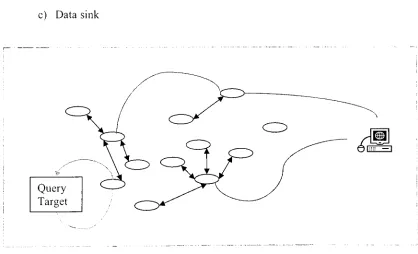
to a remote base station. In our thesis, a sensor network consists of the
following
constituents.
a) Sensornodes
b)
Query
Dominant Set(QDS)
node(also calledclusterheadorleadnode)c) Data sink
Fig
-1.1 Exampleofasensornetwork
The sensor nodes above shown are typical ones as described earlier. The QDS
(Query
[image:11.538.59.477.328.582.2]as described in thelater chapters. Thedata sinkis normallyadata center place which has
a ground network running from it. A data sink can be on the ground or in a over
flying
airplane. But the data sink is usually connected to outside world. The data is collected
from the QDS nodes, analyzed and converted to a form thatmakes sense to the outside
world. Therecan bethousands of sensor nodes andhundreds ofQDS nodesand a couple
ofdatasinks inalarge sensor network.
Atypicaldistributedsensor networktransfers data betweendifferentnodes. Butin
our case, the nodes transfer signals or data to the QDS nodes
thereby
saving a lot ofenergy
by
not sending powerful energy driven data signals to the sink themselves. TheQDS node collects information from the normal nodes andsends itto the sink. The QDS
nodes also can send their information to the other QDS node ifthe data sink is too far
from it.
The above diagram(Fig- 1.1
)
is a scenarioof a sensornetwork. There iscouple ofnodes, some QDSnodes andadatasink. Thepurpose oftheabovenetwork istoillustrate
aworking sensornetwork. Imaginetheabovesensor networkinaforest. The query target
is to find out ifthere is a fire in that particular area ofthe network. When the target is
fixed,
a data signal comes from the data sink to the QDS node which in turn sends asignal to that area node. The nearby node gets activated and the traces for any carbon
monoxide orcarbon dioxide inthe targetedarea. Ifittraces ornot, it sends a signal to the
an easy task. But there are a lot ofaspects involved in the signal transfer. Some of the
considerationsaboutsensornodes,QDSnodes, datasink are asfollows
1.2.
Sensor Network
considerationsThere are some major considerations for the components involved in a sensor
network.
First,
it is the sensor node. The size, power and capacity ofthe node are somefactorspertained toit. When
distributed,
they
shouldbevisible and need tobeinthe levelview oftheQDS node sothat the communicationbetweenthem isnotinterfered. Itis not
possible at all times tohave such ahospitable environment. Ifthe sensor networkis
being
deployed in a dense forest or a
battlefield,
then there is a high possibility of nodesbecoming
dead or useless due to various factors. When it comes to power, it isdirectly
proportionalto the size ofthenode. The smallerthe size ofthe node,the lowerthepower
of it
thereby
making it more vulnerable to become useless after some usage. When thenode's power is exhausted it is discarded. The only way to replenish the nodes is to
distribute some morenodesinthenode depletedarea.
Other consideration is the communication between the nodes. Sensor nodes
cannot be wired for several reasons.
So,
the sensor networks are constructed with awireless topology. The data sink though, is connected to the outside world mostly
by
aThe other consideration is the protocols used in the construction of a wireless
network. Conventional protocols cannot be used since
they
require a lot of energy. Newprotocols are required todeliveradequate coverage,availability and energyconservation. There should be a lot of redundancy built into the network in order to have reliable
coverage even when nodesbecome useless more often.
1.3
Network Architecture
Issues
Distributed Sensor Networks are in a way a new set of networks that work
independently
irrespective of their environment unlike traditional wire line ad-hoc networks or infrastructure-basedwireless networks. Someofthekey
characteristics area)
Mobility
-Ifthenodes arenotstatic itbringsconsiderable challenges interms of
topology
changes andnetworklogic. Thewireless sensor networks canbeequippedwithspecialhardwarethatmakes themmobilewhichinturncreates some challenges. This
thesis doesn'taddressthemobilityofnodechanges.We assume a static sensor network
b)
Routing
(singlehop
or Multihop)
redundant protocol that keeps the network alive for a longer time and helps insure a
reliabledatatransfer.
c) Medium
-traditional networks use wire medium to transfer signals. But in a
wireless sensor network, the medium is radio waves. Radio waves are susceptible to
interference and fading. Packet loss is another major problem in radio wave
communications. For example a simulation study
[1]
of a 50 node ad-hoc networkdistributedover a 1500 x300 m area shows that therewere 1 1,857 link failures
during
a900 second simulation period when each node moved at a speed of0 - 20
m/s. Though
we do not consider mobile nodes, the error rate is pretty high when compared to
traditionalwireline networks.
d)
Routing
-Traditional routing protocols are designed
taking
into consideration ofunlimited power supplywhich is not the same in a wireless sensor network. We have to
use protocols that do not form loops or send the same information to the same recipient
node again and again.
Also,
theoverhead to control networktraffic mustbe low so as toensure energy conservation in the nodes. The routing protocols should converge at a
faster speed when
topology
changes occurthereby
ensuring an accurate and low costroute.
There are some other issues like fault tolerance, environment and infrastructure
issues that also need to be addressed. In general, a wireless sensor network has all the
1.4
Thesis
organizationThe main focus of this thesis is to deliver an OPNET simulation model for working sensor
network model. After
building
a model, various performance analysis techniques in terms ofdifferentparameters were used toverifythe working model. Itdeals with a distributed sensor
network.
Query
Dominant Sets(QDS)
arethemainidea behind this thesis. The firstpartdealswithhow toselect aQDS node
by
a mathematical model. The second partdescribeshow a QS node assignsthe tasks to thenodes
by
getting aquery fromthe Sink. TheQDSnode is incharge ofthe nodes for a specific region andits job is toassignthe query tasks
that itgets to the nodesin thatregionto
help
maximizethe lifeofthenetwork. Thenodemustbe able to coverthe entire region, either
by
itselforthrough theuse of other nodes.If a node is not needed for any particular or elongated time, it can be put to sleep to
conserve
battery
power. Ifnouser queries arebeing
sent, the QDS nodes themselves goto sleeptoconserveenergyandjust listen for special
incoming
control signals.This thesis is organized in the
following
manner. The firstpart is an introductionto wireless sensor networks, its characteristics and issues. Different aspects of sensor
networks
including
various constraints, challenges and features are discussed withemphasistoenergyconservation andsimple routingalgorithms.
The second part gives an overview of ongoing research and development of
network architectures that were proposed and implemented in the last few years are
discussed.
The third part explains a mathematical approach to determine a maximal
independentsetfrom Luby's Monte Carlomethod. A QDS
(Query
DominantSet)
node isdetermined withthis process which acts as a clusterhead. An approach to communicate
with the sensor network is also explained. This approach tries to prolong the life ofthe
sensor network
by
utilizing redundancy innodestocreateload balanceandreliablesignaltransfer. The concept of single-path and multi-path routing techniques are discussed.
Althoughwe donot use or prove anything,we assume single path scenariointhe thesis.
The fourth part introduces metrics and simulation results. An introduction to
OPNET and the simulation parameters are discussed. The results are analyzed and
presented alongobservedtrends inthe simulations done. There are some metrics that are
used to evaluate our ideas such as the average energy values of all the nodes in the
network, minimum energy ofall the nodes in the network, total energy consumed in the
awake, transmit, and receive states, maximum time spent
by
any node in electing a newQDS,
number of electedQDSs,
and so on.The conclusion discusses possiblefuture workthatcanbe done starting fromthis
thesis. We also discuss the deficiencies in the proposed system andchallenges that need
2.
Related
research anddevelopment
workThework on normalsensors began
long
before last decadeand evolvedovertime.Sensors were used in automobiles and other industries in a very specific way. These
sensors were small and did a very few tasks.
They
were connected to one processorwhich receives signals from the sensors and then processed. These sensors had no
processing capability oranymemory and
they
were usedjust forspecifictasks. With theadvent oflow cost computers to the user end,
technology
evolved in bothhardware andsoftware. This ledto the creation of alotofdevices thatare smallin sizebut performeda
lotoftasks. Hardware advancements made all electronic devices small andthis ledto the
creation of anew set of sensors thatareinexpensive.
2.1.
Sensor
Nodes
The firstknown working sensor network wasdeveloped
by
UCLA. In the projectnamed WINS (Wireless Integrated Network
Sensors) [10]
at UCLA andRockwell,
asensornetwork was developedthat integratedsensing, processing and communication on
micro-sensor platforms [11]. These sensors were fabricated using low-power wireless
integrated micro-sensor
technology (LWIM)
and are capableofforming
self-assembling,multi-hop networks [4]. The transmission ofdata in these sensors was done through the
radio-frequencymodem built intothe sensor. These sensors were made using lowpower
wireless integrated microprocessor technology. Their main applications are in seismic,
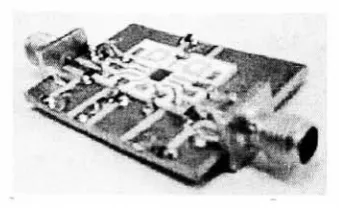
Fig
2.1 WINS wireless sensor nodeThe Smart Dust project
[14]
was completed in2001,
but it has led to otherprojects. One
interesting
thing
about the Smart Dust project is the small size of thesensors. These sensors were based on MEMS based
technology
[15].They
are under afewmillimetersinsize and store no morethan 1 Joule ofenergywithpowerconsumption
in the microwatt levels. These nodes are also capable of a range ofupto a few hundred
meters and a datatransferrate ofkilobits persecond. Auser can communicate withthese
nodes using a mobile base station with a transceiverunit. This research analysis proved
that communication in a range offew hundred meters is possible at several kilobits per
second.
The micro-Adaptive Multi-domain Power-aware Sensors
(uAmps)
project is aproject at the Massachusetts Institute of Technology. uAmps project also looks into
power conservation at the software level. This is an all inclusive project as it included
designing
the nodes, software, and protocols forcommunicationbetween thenodes. Thenodes were designed tobe power-aware.
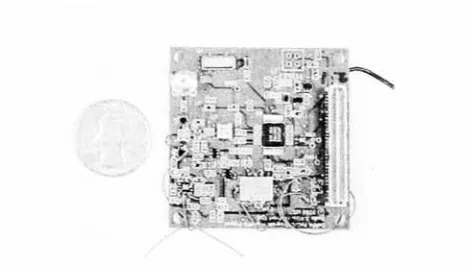
Fig
2.1 is a sensor node inthe uAmps project.The softwarewritten and theprotocols designed forthese nodes made it veryeffective to
prolong the life of the node. Another aspect of this project is the data processing
[image:19.538.199.369.52.163.2]algorithms that resulted in two common signal processing applications namely, finite
impulse
responsefiltering
andimage decoding.[16,
13]
i~m.
\L
ff"\Fig- 2.2 uAmps Wireless sensorNode (sizecomparisonwitha
penny)
The PicoRadio Project
[12]
is aproject oftheBerkeley
Wireless Research Centerthat involved
developing
the PicoRadiowireless sensor node. ThegoalofthePicoRadioproject was to
"Develop
meso-scale low cost (< 50 cents) transceivers for ubiquitouswireless data acquisition that minimizes power/energy
dissipation"
An
interesting
factabout thesewirelessnodes is that
they
arepoweredthroughsolar energy. [image:20.538.140.376.134.267.2] [image:20.538.149.350.456.603.2]These are some of the major technological places where research on wireless sensor
networks is
being
done. Rockwell ScienceCenter,
CrossbowInc,
ZigBee Alliance andmany other public and privatecompanies are alsopursuingand
developing
them.2.2
Routing
andNode
communicationEnergy
conservation is the main issue thatneeds tobe factored indeveloping
anyrouting protocol or communication techniques. The energy consumption level is
dependentontheprotocol stack used innode communication.
So,
theprotocol hasto slimand also robust enough to give a reliable communication and data transfer. Several
protocols have been proposed and variety of power saving techniques has been
introduced. Someoftheprotocols include
LEACH, SPIN,
DSDVetc.LEACH (Low
Energy
AdaptiveClustering Hierarchy)
is designed for sensornetworks where an end-user wants to remotely monitor the environment. In such a
situation, the data fromthe individual nodes mustbe sentto a central base station, often
located far from the sensor network, through which the end-user can access the data.
Conventional network protocols, such as direct transmission, minimum transmission
energy, multi-hop routing, and clustering all have drawbacks that don't allow them to
achieve all the desirable properties. LEACH includes distributed cluster
formation,
localprocessing to reduce global communication, and randomized rotation of the
cluster-heads.
Together,
these features allow LEACH to achieve the desired properties. Initialsimulations show that LEACH is an energy-efficient protocol that extends system
lifetime.
SPIN is a
family
of protocols used to efficiently disseminate information in awireless sensor network. Conventional data dissemination approaches like
flooding
andgossiping waste valuable communication and energy resources sending redundant
information throughout the network. In addition, these protocols are not resource-aware
or resource-adaptive. SPIN solves these shortcomings of conventional approaches using
data negotiation and resource-adaptive algorithms. Nodes running SPIN assign a
high-levelnameto their
data,
calledmeta-data,and perform meta-data negotiations before anydata is transmitted. This assures that there is no redundant data sent throughout the
network. In addition, SPINhas accessto the current energy level ofthenode and adapts
the protocolitis running basedon howmuch energy isremaining
Basic
Energy
Conservation Algorithm(BECA)
and AdaptiveFidelity Energy
Conservation Algorithm
(AFECA)
are two routing algorithms introducedby
Estrin[8]
that introduce sleep mode to the nodes when
they
are not needed.They
also use nodedensity
to let neighboring nodes to handle traffic in case of less power scenarios. ThePicoRadio research addresses network layer
by introducing
designs for the MAC layerusing dynamic channel assignment techniques.
Multi-hop
routing and multiple channelcommunications are thecharacteristics intheirproposal.
2.3
Data
AggregationOnce the routing techniques are
finalized,
the sensor network efficiency lays inone final and importantissue i.e. dataaggregation and interpretation. All signals are sent
to the
Query
Dominant Set nodes andthey
inturn forward itto the sink. There arc manyfactorstobe consideredin
doing
this.The raw data or theinformal signals that are sent
by
the nodes to the QDS nodesmaynotbeas efficient as the user wants ittobe. And eveniftheinformation is efficient,
the cost ofsending the complete data that it got to the sink might be too expensive and
drain all the energy resources ofthe QDS node.
So,
the QDS node must segregate theimportant inforation and then relay itto the sink. Another factor isthe possibility of one
QDS nodesolving the entirequery itself.
Many
queries may involve multiple QDS nodeswhich inturn assign multipletasks to thenodes.Data aggregationis an importantissue to
be considered while proposing a wireless sensor network. This topic is mentioned here
but is out ofreach for this thesis. We assume that the communication between the sink
andtheQDSnodes isthrough a solid reliablenetwork. Thisthesis dealswiththe network
and transportlayers but not thedata link or application layer if discussed inconventional
networks.
3.
Query
DominantSets
(QDS)
The sensor nodes are normally distributed randomly over an area with no set of
rules or design. When the sensor nodes are
distributed,
all of them are assumed to behaving
same energy level and capabilities. After thedistribution,
the first step in ourwireless network is
determining
thequerydominantset node.3.1
Selection issues
A QDS node is a node in the network that receives and transmits signals to the
sink, designates itself as the sensor head among a couple of neighboring sensors and
assigns tasks to the adjacent sensor nodes. A QDS node selection is based on different
factors
including
power level of the node, workload, number oftasks and adjacency tovarious other nodes. In general it is a node that manages a set of nodes in a particular
region.
The primary purpose ofthe QDS node is to increase the networklife as much as
possible
by
assigning and resolving queries in a power saving and reliable way. Thesensing coverage of aQDS node is similarto the others. So ithastouse the neighboring
nodes sensingcapabilities while
tasking
and answeringa query. This requires that it is inproximityofallthenodesin itsregion.
Energy
saving is the most important goal ofany node. This cannot be achievedunless nodes are switched off when
they
are notbeing
used. The QDS node is in chargeof sending a signal to sleep off to its regional nodes. The QDS node also can go to
hibernation mode if
they
are notbeing
used. This whole power scheme depends on thekind of sensing coverage needed from the sensor network. A network in a battlefield
requires the nodes to be active most of the time since there is a high availability
requirement for such kind of networks. Consider a wireless sensor network in a
deep
forest that has been deployed for counting endangered species like tigers. The network
doesn't need to be available all the time and most ofthe nodes can go to sleep mode
during
certain periods. The power scheme can be decided and programmed into thesensors before
they
arc deployed or canbe put to sleepby
the QDS node.Reliability
ofthe network is equally important and proper care need to be taken while
deciding
to getbalance betweenpower scheme and reliability.
The QDS selection can e explainedin two parts. The firstpart explains sequential
algorithm to find a Maximal Independent Set for simple graphs. This algorithm can be
modified and used in distributed networks. The simple algorithm selects all independent
nodes and ifmodified
by
adding some constraints in sensor networks will work to findthe QDS nodes in a distributed network. The second part describes how the Luby's
MonteCarloalgorithm
[6]
ofselecting Maximal Independent sets inadistributedpattern.3.2
Algorithm
for
selecting
Maximalindependent Set
The firststep istodescribe theselectionof a maximal independentsetin alinear
graph. The sensornetwork isrepresentedinasimplelineargraph. The basic algorithm
formaximal independentsetisdeterminedas follows.
Assume the network
by
a linear graph G =(V, E). Each vertex
V,
represents asensor node in the network and E is Edge set
{E(Vj
,V,
)}
that represents two adjacentnodes. The neighbor is determined
by
the ability ofthe radio ofnode i toreach the radioofthenodej. A maximal independentset isan independentset SofG ifall the vertices of
G are cither in S or adjacent to a vertex in S where G is a subsetofV such that no two
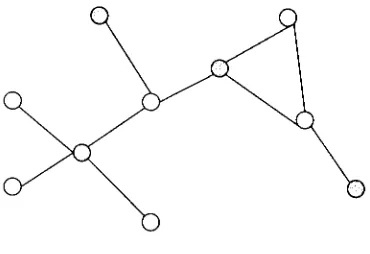
vertices ofS areadjacentin G [7]. Thiscanbe betterexplainedinadiagram.
Fig
3.1 Maximal Independent SetofNodesThe nodes that are red are selected as the Maximal independent set
by
the aboveconditions. The above sequential algorithm can be mathematically put like this. A set
Nc(I)
is defined to be a neighbor set ofI in G. Ateach iteration a vertex is chosen fromthe setV anddetermined if it belongs to the group NG(I). If itis not inthe groupthenit is
added to theIndependentset I.
For all v V
do
If v i
NG(I)
thenI = I U v
End if
End
do
Since the sensor network is distributed we need to determine the maximal
independent
set in a parallel way among all the nodes. The Luby's algorithm has to be
improved
to [image:26.538.130.315.187.314.2]work in a distributed environment. Jones andPlassman
[3]
developed a methodwhich isused as abasis forour sensornetwork.
The maximal independent set nodes aredetermined in a way that does not really
fulfill ourrequirement forselection of a
Query
Dominant Sets. Sowe need tomake someimprovements to get the needed set of nodes. Luby's Monte Carlo algorithm lets us
determine a minimum number of nodes fromthemaximalindependent set. Thiswas used
by
Jones and plassman[3]
to create a method for vertex coloringa graph in parallel. Inthis method, the initial independent setI ' is determinedwhich makeup
Nc (
I ') Thenextstep involvesremoving ofUnion of sets I 'and
Nq (
I')
fromV ' The remaining verticesinV 'is thesubset of maximal independentsetthatwe need. Thisis explainedas follows.
While G1 <>
0
do
Select
an Independent set I ' inG
'I = I U I1
H = I1 U
NG(
I ')
V ' = V '\
HG
' = G(V')
End
do
Using
this algorithm we deduce a similar algorithm to get an independentQuery
dominant set. This is done
by
selecting a set ofQuery
Dominant set nodes such that anode i is aQDS node ortheeffective radio coverage ofthatsensor node i intersects with
the radio coverageofthe QDS node. Ateach
iteration,
the set of nodesV withneighborshigherthan their
neighbors'
random numbersis chosen fromthe remaininggraphH. This
set V is addedto the maximal independent setandthen subtracted from H along withthe
nodesthatare neighbors ofH. S is setof nodes andV isthe set of nodes Sthat
belong
toH = G
V = S
While
r(i)
> r(j)
While S <>
0
do
P = P
\
VP = P
\
adjoining
(V)
I = I U V
H is the graph
induced
by
PEnd while End
While
This algorithm chooses an independent set of nodes that are designated as
Query
Dominant Sets. It may be a bit confusingwhile
discussing
distributedsensor nodes in theterminology
ofset theory.So,
the nodestheory
is explainedtaking
into consideration aset of nodes.
We consider a set of nodes
Sj
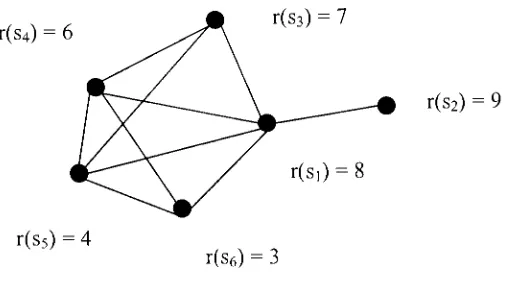
where i >0 and I < 7. That gives us a total of sixnodes. Letrbe arandom numberorvalue. Hereweassignarandom numberto the nodes.
The nodes do not need to have any global communication. The communication is just
between the neighboring nodes and thus will be very effective in terms of power. The
first step ofthealgorithmrequiresallneighboringnodes communicate their r(si)values to
each other. The whole selection process can be explained
by Fig
3.2 in a step wisemanner as follows.
a) The first step involves as said before communication between
neighboring nodes oftheir random values. The neighboring nodes are
defined as the nodes that can communicatewith each other i.e. nodes
that have theirradio
frequency
ofnode i intersects with thefrequency
of nodej. In theabove example that factoris alreadydetermined and is
denoted intheform oflinks betweennodes.
b)
The second step node s2 elects itselfas a part ofQDS or a QDS nodesince its random value is greater than Si. Then it communicates about
its decisionto thenode Si
c) In the third step s\ broadcasts a message
declaring
its intent not tobecome a leader node or QDS node since it already knew about s2
becoming
theQDSnode.d)
The fourth step node S3 elects itselfas a QDS node since the nodes s4and S5 have a lesser value. It broadcasts itself as a QDS node even
thoughits random valueis lessthan si because it has heardthe message
from S]
intending
nottobecomeaQDSnode.e) The fifth step involves nodes S4 and S5
declaring
their intent not tobecomeaQDS node.
They
drop
outbecauseofthesamereason asthey
alreadyheard fromnode S3aboutit
becoming
aQDS node.f)
In the last step node sr,declares itselfas aQDS node because it heardfrom all the other neighboring nodes about their intention not to
becometheQDS nodes.
r(s4) =
6
Fig
3.2Query
Dominant Set Node SelectionThustheprocess selects a
Query
Dominant Setthatincludesnodes2,
3 and6. Itis asmall examplethatinvolves a small number of nodes. Thisprocedureis followed ina
distributedway allalongthesensornetworktoselect a setofQDSnodes. Thedistributed
sensor nodesthus makeupalarge sensor networkwith a
Query
DominantSetofnodesthatmanagethem.
3.3
Communication Methods.
The data packet is transferred from a source through destination in various ways
depending
on how many copies of data packets are transferred simultaneously. Theprotocolscanbe dividedinto
Single Path
Routing
Multipath
Routing
We use only single path routing in our case. For single path routing we have the data
packet transferred as a single copy through out the nodes, while in multipath routing
[image:30.538.156.410.68.209.2]multiple copies of a data packet are sent simultaneously in different paths to the
destination.
Generally
single pathrouting ismore efficientintermsofenergy savedbut ifthere is failure in line it will cause the whole transmission ofdata packet tobe stopped.
On the other
hand,
multipath routing uses a lot ofenergy to transfer packets in parallellinesand hence theefficiencygoes down butthe transmission is completed. Comparative
to other sensors, wireless sensors are prone to more failures and therefore there is a
growing awareness inthe research
industry
touse multipath routingto ensure thedata istransmitted even though the efficiency is less. However the problem in using the
multipath routing is
determining
the sensor network topologies before transmission ofdata,
as the topologies changes rapidly due to malfunction of some nodes orenvironmental physical damage. Another disadvantage of multipath routing is the more
traffic is generated for one data packet
delivery,
which may cause network congestion,which leadstomore
delay
oftransmissionofdatapacket. Withthese differentadvantagesand disadvantages of single and multipath routing, we discuss few ofthenew initiatives
thatmightworkfor futureresearch.
3.3.1 Single path routingwith repair
This process involves sending thedata in a single path andrepairing as and when
a break is occurred. Path repair has been introduced in many wireless networks
depending
in the type of repair andthe path chosen for data transfer. The process is verysimple, the data packet is send in a single path and whenever a break is detected an
alternative path is created and the data is resent through it .One ofthe major problems
with this type ofdata transfer is ifthere is abreakage atthe farthestnode still the whole
data hastobe resentfromthe startfromthe source node.
In this paper, a local pivot-initiated path repairing approach will be discussed
where in the nodewhich is the successornode, immediate upstreamnode wherethepath
break is in the next node will have the responsibility to find some alternative paths and
send the data. Althoughthe selected alternative path might not be the optimal path but it
will ensurethedatapacket istransferredto the sink and alsothisprocessis moreefficient
than sending the wholedata from the source nodeinadifferent path. Suchenergy saving
shouldoutweigh theadditional energycaused
by
usinga non-optimal path. Thenext fewpagesdeal withthe transferofdata ina single path and canbeclassified asfollows.
OptimalPath
Setup
Data
Forwarding
Along
theOptimalPathDetecting
theBroken link3.3.2
Optimal
Path
Setup:
Inthis process, before data transmission,an optimal path fromeach sensor nodeis
determined,
which canbe attainedby
a low-costsetupprocessby initiating
fromthe sinknode. So
by
choosing any optimal path for a singlerouting process we can describe ournext process, which will be data
forwarding
along this optimal path. The DataForwarding
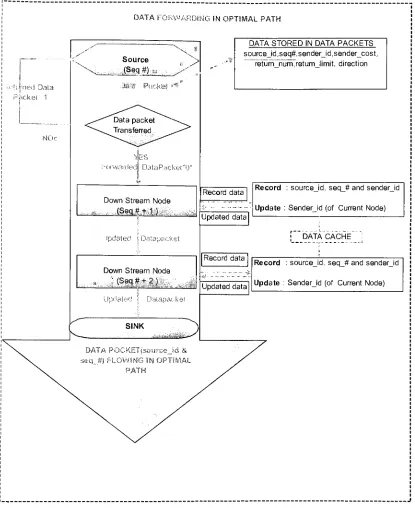
alongtheOptimal Pathis doneas follows.The data packet is transferred from source node to sink node in a downstream
process, the source
being
the first node and the data packetbeing
transferred down theline (downstream) along the optimal path. The source node is identified
by
a sequencenumber
(seq_#)
and as the datapacketis transferred downstreamthe sequence number isincremented
by
one forthe second node andthe datapacketis forwarded from thatnodeto the third node. The sequence number is incremented at every node for each new data
packet.
The data packet has the
following
information with it. sourcejd,
seq_#,sender
Jd,
sender_cost,returnjwm, retumjimit and direction. The data packet is
uniquely identified
by
the combination of a seq_# and source_id.IF the datapacket isforwardedto a downstream successfully itI s denoted
by
abinary
value "O'Mfit fails tosend the data packet it is denoted
by
abinary
value"1"
The data in the "0" is called as
"forwarding
data path"and the data stored in "1"
is called returning data path. Always
thedata in "1"
isreturned to theupstream node. Once thesuccessor node receives a data
packetfrom itsupstreamit hastorecordthe
following
valuesin its datacache, sourcejd,seq_# and senderJd. Once the data is recorded the data is updated
by
filling
its ownsender_id. Now theupdated datapacketis senttonext node in the downstream as shown
in
fig
3.3.3.3.3
Detecting
theBroken
Link:
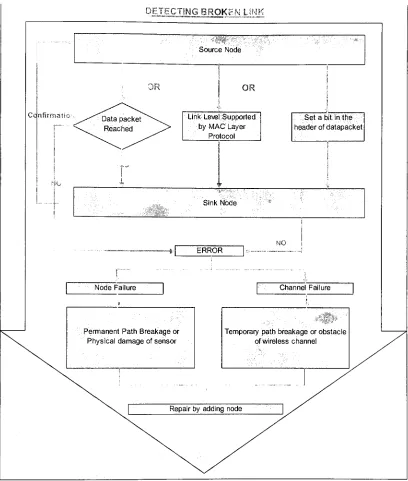
The data packet is transferred along the optimal path which would be decided
before the transfer ofdata packet is started. When a data packet is delivered along the
lowest cost path, the source node shouldknow any node failure. Toconfirmthat the data
packet has been sent successfully to the downstream node, it is the responsibility of
successornodeto get a confirmationfromthe receivingend. This maybe implemented in
one ofthe
following
twoways(fig
3.4).DATAFORWARDINGm OPTIMAL PATH
slurriedDala Packet"1"
.:
/
Source (Seg#);
Forwarded DataPackef'O"
Down Stream Node
(Seq#+ 1)
DATASTORED IN DATAPACKETS
sourceJd,seq#,senderJd,sender_cost,
return num,return limit,direction
Updated Oatauacket
Down Stream Node
, (Seq#+2).
Recorddata
Updated data
Record :sourcejd, seq_# and senderjd
Update: Senderjd (of CurrentNode)
DATACACHE
Record data
Updateddata
Record :sourcejd,seq_# and senderjd
Update : Senderjd(of CurrentNode)
Fig
3.3 Optimal Path Block Diagram. [image:34.538.64.479.54.562.2]1. Transmittermonitoring
(passive acknowledgement)
2. Link leveladjustmentusing MAC layerprotocol
Intransmitter monitoring a transmittermonitors the packetthatis sent downstream and a
passive acknowledgement is got from the receiving node as to whether the node was
transmitted successfullyor not. Ifthelink level is supported
by
MACprotocol layerthenthere isno need forpassiveacknowledgement.If boththesefailthesourcemaysend abit
inthe header ofthe data packetto requesttheinformation form each node as towhether
thedatapacket was received or not.
A failederrormaybe becauseofeither ofthesefailures.
Nodefailure
Channel Failure
Node failure refers to permanent path break due to energy exhaustion, malfunction or
physical damage of sensor nodes. Channel error refers to
temporary
path break due to acollision, interference or obstacle in the wireless channel [2]. Channel errors are
temporary
errors andthey
can be fixed based on the problem. A channel error can besolved in either
ARQ
or FEC mechanism in data link layer or while in some cases it issaid to be solved in Transport layer. So in ordertoprove that the node needbe replaced
or considered dead and use a redundant path
bypassing
it is the best way to attend theproblem as an assumption was made that there is no possible layer to repair control
problems. The second assumptionwould
be,
toavoidan extracommunication overhead;we don't delve on whether the problem was due to a node failure or channel failure. So
thetransmissionbreak is dealtwith sameway.
DETECTINGBROKEN LINK
SourceNode
OR OR
i>;;";
^^-^Datapacket^\. "*v. Reached fs*
Link LevelSupported byMACLayer
Protocol
Setabit inthe headerofdatapacket
<F '!
Sink Node
NO . 1
ERRO w\
NodeFailure Channel Failure
Permanent Path Breakageor
Physical damageof sensor
Temporarypathbreakageor obstacle of wireless channel
Fig
3.4 Flow diagram fordetermining
abroken link [image:36.538.65.473.61.542.2]Nochannel
failure
Response Received
Channel Failure
Wait forthespecifiedtime
out periodfor recovery
Noresponse
Repair
by
adding NodeFig
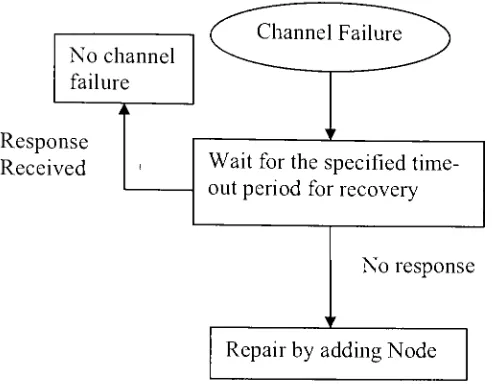
3.5 Flowdiagram for channelfailureInsome cases, the channel failuremightbejust
temporary
andthelinkmight recoverinacertain time. The other option is to have a certaintime-out period and wait until there is
no response and then confirm the channel failure. As shown in
fig
3.5 when there is aresponse received before the time-out expires, there is no need to replace the node o
followanyrepairtechnique.
[image:37.538.97.343.109.304.2]4.
Test Scenarios
and resultsThe above described algorithms were analyzed and testes with the available
resources. The QDS node selection can be tested in different ways.
By
simple scenarioassumption like the one explained in
fig
3.2 a leader node can be selected. It wastestedwith a more complex sensor network and different QDS nodes. If the scope and
complexity of a sensornetworkis
large,
there needtobe several testcases and scenariosto test theparameters properly. We begintoshowtheresults
by
describing
thesimulationenvironmentand simulationtoolsused.
4.1
Simulation
toolsThe simulation tools used inthis thesis are OPNET and MATLAB. The primary
reason for using OPNET is its modular design methodology. OPNET is a commercial
tool for simulating, and analyzing networks. It is a very intelligent tool with multiple
specifications and a huge volume of vendor tools. OPNET networking tools include all
kinds ofnetworking devices from all of the well known vendors. It has an extensive
support for wireless networks and radio communication technologies with extensive
information and onlinesupport.
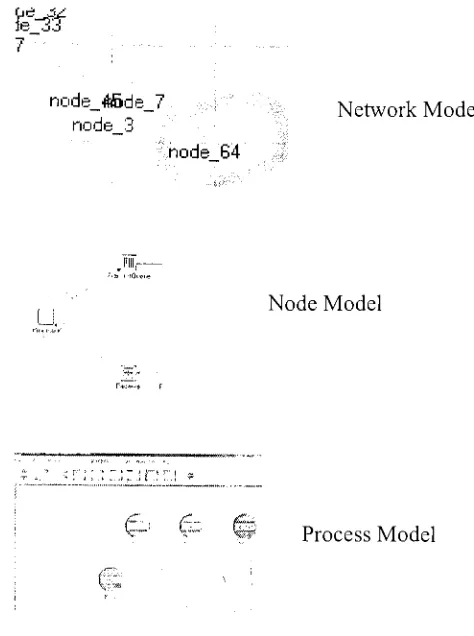
OPNET network simulation environment consists of hierarchal structure that
includesnetworkmode, nodemodelandprocess model as shownis
fig
4.1fe
^3
node *6de_7 Network Model
node_3
node G4 ~M
J*
hbvwilbw
Node Model
Process Model
Fig
3.1Primary Hierarchy
ofOPNET ModelsThe Projectmodel is themain staging area for creating a network simulation. From this
editor, you can build a network model using models from the standard
library,
choosestatistics about the network, run a simulation, and view the results [5]. The Nodemodel
editor lets you define the behavior of each network object. Behavior is defined using
different modules, each ofwhich models some internal aspect of node behavior such as
datacreation, datastorage, etc. Modules are connectedthroughpacketstreams or statistic
wires. Anetwork objectis
typically
madeupofmultiplemodulesthatdefine its behavior.The Process Model Editor lets us create process models, which control the underlying
functionality
of the node models created in the Node Editor. Process models are [image:39.538.196.433.62.380.2]represented
by
finite state machines(FSMs),
and are created with icons that representstates and lines that represent transitions between states. Operations performed in each
state or for a transition are
described
in embedded C or C++ code blocks [5]. There areother editors such as Link editor, patheditor, packet formateditor andthedemand editor
etc. These are various editors in OPNET to create link objects, define demand models,
construct differentpackets etc.
The node positions, timeslots and selection ofQDS nodes is done in MATLAB.
These are provided as inputs to the simulation kernel. The set of user queries, node
programs, event constraints and the simulation models
(network,
node, and processmodels) arc the other inputs provided to the simulation kernel. These inputs are then
combined with the model resources and execute the simulation.
Finally,
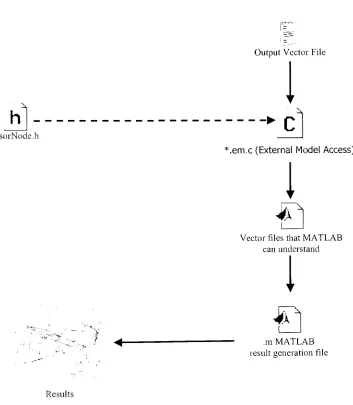
results areextractedusing theExternal Model Access
(EMA)
featureofOPNET and analyzed usingMATLAB. The
following
figure(fig 4.2)
showsthepathtoresultgeneration. Thegeneralprocess used to adapt the thesis models to the available software environment was as
follows:
a. import OPNETmodels/processes
b. import OPNET scenarios
c.
debug
& fixmodel compilation errorsd.
debug
& fix crashesinmodel process simulatione. rewritepaths and scriptsthatmanage simulation
f
debug
&fix compilationerrors of optimizedkernelexecutiong. simulateprojectwith optimizedkernel
h.
debug
& fix scriptsthatmanageEMA exportation of resultsi.
debug
& fixcustomEMAprogramj. export simulationresultsto textfilesviaEMAprogram
k.
debug
& fix MATLAB analysisprogramsanalyze results withMATLAB
SensorNodc.h
Output VectorFile
I
*.em.c (External ModelAccess)
I
VectorfilesthatMATLAB
can understand
1
,mMATLAB
result generationfile
Results
Fig
4.2 processsteps ofdata extraction and resultgeneration [image:41.538.98.451.203.608.2]4.2
Node
andProcess
Models
The node model ofthe sensor node is shown in
fig
4.3. The node consists of aprocessor, a
transmitter,
areceiverand atransmitqueue. Theprocessorcontainsthe finitestate machine that controls each and every operation of the node. The transmitter and
receiver are used for transmission ofsignals. The can transmit/receive at a rate of 2.4
Kbpsovera 80 ft
distance
andoperateinthe 900 MHZ frequency.Also,
thenodeshaveaseismic sensorand anacoustic sensor thatare used as sensingelements.
1
7*Jfix
p
..TYansmitQueueTransmitter TransrnitAntenna
node 83 rY
Inn .__i_v-i
Processor Listenforspecificdatapacket whilein sleepmode
Regulardatatransfer
P
\ Receiver ReceiveAntenna
Fig
4.3 The Nodemodel of a sensor nodeThe transmit queue is anotherimportant part ofthenode. It isused to control the
flowofthe traffic. Whenthereis alargetrafficbetweenthetransmitterandtheprocessor,
the transmit queuehandles it inanappropriate manner. Thenodeis based onthe work of
srivastava
[9]
andthe energyspecificationsused inthenodealsoarebasedonit. [image:42.538.91.444.274.474.2]The process model contains the logic ofthe finite state machinethat controls the
functioning
of the node. The objects embedded are programmed in C and C++programming
languages. OPNET provides extensive libraries to model communicationsandprocessingoperations.
4.3
Test
caseScenario
A test case scenario has to be developedto test theproposals. The firsttest
case wouldbethe election ofthe
Query
Dominant Set. The firsttest caseis arrangingthenodes in a disciplined manner. The arrangement was done in a hexagonal way. The
second test case involves nodes in a random way. The scenario also includes a set of
tasks which determine theworkability ofthe sensor nodes as well as the whole network.
The energy levels and performance ofthe nodes andthe total networklifetime
including
the QDS nodes are evaluated. The first test case scenario would be that of a regular
constant node density. Then we arrange the nodes in a random formation and look for
results. Before we go to see the results, we need to determine what metrics are going to
betested.
The first metric is the energy level of all nodes of the network. This is
obtained
by
the calculating the total energy ofthe network at a given time. The secondmetric would bethe time spent
by
any node in electing a QDS node. This is the averagetime of a node in thenetwork before it selects its QDS node. The other metrics include
time foraverage energy tofall below 50% ofthe initial energyandthenumber ofelected
QDSnodes. Thetestresults arebuiltandanalyzedinthe next step.
4.4
Results Analysis
The first process is to elect a
Query
Dominant Set. This set is elected in asystematic approach as described in part 3. We take the case of 100 nodes placed in a
regular hexagonal configuration. The results were analyzed in MATLAB and we found
that the
Query
Dominantset was determined inan expectedmanner. The selection oftheQDS is shown in
fig
4.4. The node selection depends on the number of nodes in theneighborhood ratherthan the distance between nodes. In the first simulation set
(fig
4.5)
we showthesimulation
id,
number of nodesandthedistance.3C
3G /
\
-~r
3C
\_
3. 5C
>-4C /"
3C
2C
7
1C
r i ...1 1 1 i
1G 2J 5C
X Axis
hi 50 ' 30
Fig
4.4 SelectionofQDS inaregular sensor network. [image:44.538.125.409.314.607.2]ID Number of nodes Area
1 100 100mx 100m
2 256 150mx 150m
3 400 200mx200m
4 900 300mx300m
Fig
4.5-Parameters forsimulation
The parameters set in
fig
4.5 are taken and graph for the maximum time spentby
anynode in selecting a QDS is displayed as is shown in
fig
4.6. The time taken is almostconstant all the time even whenthenumber of nodes increasedwiththe area. This proves
that asthe numberof nodes increasewiththe area, the time spent onelectinga QDS node
isconstant.
Fig. 4.6 Maximum Timespent onelecting QDS (forparameters
fig
4.5)
[image:45.538.106.426.49.210.2] [image:45.538.81.423.407.614.2]Another
set ofparameters istakenwiththesamesimulation caseandistested. Inthisparameters set we changethenumber of nodesbut
keep
theareathesame. Thisisdescribed
infig
4.7ID Numberof nodes Area
1 100 100mx 100m
2 256 100mx 100m
3 400 100mx 100m
4 900 100mx 100m
Fig
4.7 another set of parametersThearea remainedthesamebutthenumber of nodes increasedin each simulation. The
result is shown in
fig
4.8toe
Fig
4.8 Maximum Time spent onelecting QDS (forparametersfig 4.7)
[image:46.538.127.423.149.305.2] [image:46.538.90.449.387.620.2]The
aboveresult provesthat thenodedensity
effectsthemaximumtime spent on electingthe query dominant set. Ifwe compare
fig
4.6 andfig
4.8,
the maximum time is a lothigher
becausethenodedensity
hasincreased
by
ahighamountinthe same given area.The totalnetwork power isanother considerationthatneedsto beassessed. Asthe
network grows and performs the tasks the total power
ultimately goes down with time.
Thepower metric
depends
onthe number oftasks assigned atany given time. The otherfactors affecting the total power is the node density. Ifthe node
density
is high and thenodes arc placed in a systematic way, the power consumed
by
the nodes shouldbe lessthan forrandom placement of nodes ifgiven the same set oftasks. The
fig
4.9 shows thetotalenergyspentalong a couple ofhourswhileperforming randomtasks.
1.50
1 _5
1.00
0.50
0.25
0.00
globalbattery
iTl
"O
Fig
4.9 Global Powerofthenetwork(mixedresults) [image:47.538.82.440.333.645.2]Another
interesting
factor in theanalysisis readinga single node in a networki.e.arandomnodeselectedfrom thesensor network. The
following
analysisis todeterminehowmuch energycanbe savedorlost
by
increasing
anddecreasing
thenumberoftasksassigned and
by
making it sleep fora period oftime. The
following
aretheresults inthissimulation.
3,000
2,000
1,000
0
2
asleeptime
batteryvalue
ia;i count
11
I
Fig
4. 10 Taskcount,Asleep
timeand PoweranalysisIThe tasks are assigned in a haphazard way and the sleep time was set to be
increasing
over time. The power level shown
(fig 4.10)
is constantly decreasing. The results prove [image:48.538.118.426.236.562.2]that the nodes lose power randomly when tasks are continuously assigned to them. The
other resultwas as thenodeisputto sleepmode moreregularly, thepower levelremains
constant evenwhen thereis aburstoftasks assigned. Theenergyremainsthesame ifthe
tasks increasewithincrease in sleeptime
(fig.4.12)
3 000
2,000
1,000
n
2
ro lij
asleep time
batteryvalue
taskcount
0
vvmv]/)/vv
as
CO
"O
Fig
4. 1 1 Taskcount,Asleep
timeandPoweranalysis II [image:49.538.123.426.184.512.2]4,000
asleeptime
batteryvalue
Fig
4.12 Task count,Asleep
timeandPoweranalysisIIITheseare some ofthesimulation scenariosthat are addedafter
doing
athoroughresearchontheway sensor nodesbehave whentasked
by
theQuery
Dominantset nodes.Thus theresults are conceived andcompared with usualprocedures and are verifiedtocheckif
they
conformto the standard norms. [image:50.538.97.391.57.379.2]5.
Conclusion
A sensor network model has been developed and analyzed in a way that makes
sense to our aim and goals. The firstpart is an introduction towireless sensor networks,
its characteristics and issues. The primary goal of selecting a
Query
Dominant set hasbeen achieved. After that the performance of the sensor network has been analyzed.
Different aspects of sensor networks
including
various constraints, challenges andfeatures are discussed with emphasis to energy conservation and simple routing
algorithms. Although we did not
develop
a complete sensor model, some assumptionswere made to deal with all layers of networking. That is a primary drawback for this
thesis.
The second part gives an overview of ongoing research and development of
wireless sensors and wireless sensor networks indifferentpremium institutions.Different
network architectures that were proposed and implemented in the last few years are
discussed.
Many
solutions were developed around the world in various schools andcompanies. We researched some of them and took some assumptions based on these
models.
The third part is the important piece in our work. It explains a mathematical
approach to determine a maximal independent set from Luby's Monte Carlo method. A
QDS
(Query
DominantSet)
node is determined withthis process which acts as aclusterhead. An approach to communicate with the sensor network is also explained but not
used or tested. We assumed that the network uses the single path method in
communicating with the sink and to its neighboring nodes. We discussed some
nodes, load balance and reliable signal transfer. The concept of single-path and
multi-path routing techniques are discussed. Although we do not use or prove anything, we
assumesingle pathscenario inthe thesis.
The fourth part
introduces
metrics and simulation results. Here we tested thealgorithms and used a multi tool set to get to the above results. An introduction to
OPNET and the simulation parameters arc discussed. There are some metrics that are
used to evaluate our ideas such as the average energy values of all the nodes in the
network, minimum energy of all the nodes in the network, total energy consumed etc.
Some ofthe conclusionswere basedon the quantitative approach that was used to getto
them. Although the results were not the same each time the simulation were run, the
optimal solutions and results weredisplayedandtakenintoconsideration.
It is possible to do future work based on this thesis. One area where
improvements can be made is putting the election algorithm in the node process and
testing
froma real scenario. Another study on single pathandmulti path canbe done andimplemented into this model. That will give the proposed model completeness in a
network sense. The sensornode characteristicsand features
including
itsparameters weretaken from WINS node developed
by
UCLA. Another drawback to this model is dataquerying. The tasks assigned were from assumptions and not a real mode task. That can
be another improvement made to this system. A real case scenario like an animal
movement in a forest or a battlefield scenario can be taken into consideration and
implemented
by
using this model. That would be a great project that can lead to a realsensor model.
Also,
this model didnot take into consideration any kind ofirregularities
like signal to noise ratio, interference and fading. When these issues are considered the
results will certainly vary and lead to some other conclusions. The sensor coverage
including
the acoustic and sensing capabilities all are assumed and there can beimprovements
made to them. Also thebattery
can be made to have solar powergenerating capability that will increase the node and networklifetime. Data aggregation
is another important factor inasensor model.
Ultimately
the end-useris concerned aboutit more than any protocols or hardware. The node placement is another factor that can
change the results. Although we worked on random and regular placements of nodes,
ideal cases were considered. There can be several other ways of
distributing
the nodes.Also,
dead nodesordefectivenodes canbe anotherissue.Many
improvementsneedtobedone to provide an efficient solution to sensor network management.
Bibliography
[1]
WDaugherty,
"The growthofwirelessmobile,"
Business
2.0,
December12,
2000.[2]
Di TianandNicolasD.Georganas,
Low-Cost,
ReliableDataDelivery
inLarge Wireless Sensor
Networks,
SchoolofInformationTechnology
andEngineering,
University
ofOttawa,
2001[3]
M. T. JonesandP E.Plassmann,
"Aparallel graphcoloringheuristic,"
SIAM Journal
on Scientific
Computing,
vol.14,
no.3,
pp.654-669,
1993.[4]
K.Bult,
A.Burstein,
D.Chang,
M.Dong,
andW.Kaiser,
"Wireless integratedmicro sensors,"Proceedings ofConferenceonSensorsandSystems (SensorsExpo).
Anaheim,
CA, USA,
pp.33-38,
April 16-18 1996[5]
G.Pottie,
"Wireless sensornetworks,"
1998Information
Theory
Workshop,
Killarney,
Ireland,
pp.139^40,
22-26 June 1998.[6]
R. M.Karp
andA.Wigderson,
"Afastparallel algorithmforthemaximal independentsetproblem,"
Journal ofthe
ACM,
vol.32,
no.4,
pp.762-773,
1985[7]
O. G.G'omez,
Efficient Parallel AlgorithmsforCombinatorial Problems. PhD thesis,DepartmentofComputer
Science,
LundUniversity,
Sweden,
January
1996.