Published online in Wiley InterScience (www.interscience.wiley.com). DOI: 10.1002/smr
Comparing text-based and dependence-based approaches for
determining the origins of bugs
Steven Davies, Marc Roper & Murray Wood
Computer and Information Sciences
University of Strathclyde
Glasgow, UK
{
Steven.Davies,Marc.Roper,Murray.Wood
}
@cis.strath.ac.uk
SUMMARY
Identifying bug origins — the point where erroneous code was introduced — is crucial for many software engineering activities, from identifying process weaknesses and improvements to gathering data to support tool development for bug detection. Unfortunately this information is not usually recorded when fixes are made, and recovering it later is challenging. Recently the text approach and the dependence approach have been developed to tackle this problem. Respectively, they examine textual and dependence-related changes that occurred prior to a bug fix. However, only limited evaluation has been carried out, partially due to the lack of data-sets linking bugs to origins, and a lack of available implementations. To address this, origins of 174 bugs in three open-source projects were manually identified and compared to a simulation of the approaches. Both approaches were partially successful across a variety of different bugs — achieving precision of 29%–79% and recall of 40%–70%. Results suggested the precise definition of program dependence could affect performance, as could the decision on whether to identify a single or multiple origins. A number of potential improvements are explored in detail and serve to identify pragmatic strategies for combining the techniques along with relatively simple modifications. Even after adopting these improvements there remain many challenges: large commits, unrelated changes and long periods between origins and fixes all reduce effectiveness. Copyright©0000 John Wiley & Sons, Ltd.
Received . . .
KEY WORDS: software maintenance, bug origins, mining software repositories, program dependence graph, version control, bug tracking systems
1. INTRODUCTION
based on the changes made to fix it. Both start from the version of code containing the bug fix and progressively examine preceding versions until they find the one that introduced the code responsible for the bug. They differ primarily in how they examine the changes between versions and the number of files returned: the text approach [2] uses only the change in the text itself and returns all files deemed to be relevant, while the dependence approach [3] uses changes in the relationships between control and data in the code and returns only the first relevant file. Unfortunately, as yet no implementations of either approach are readily available, which presents a significant challenge to assessing their effectiveness or even their viability. Furthermore, the effort required to create an implementation in both cases is non-trivial, and the dependence approach in particular poses a number of implementation challenges, as discussed in Section 2.4.
As a necessary precursor prior to embarking on an expensive implementation exercise, this paper presents the results of an investigation into the accuracy of both approaches and provides insights into their respective strengths and weaknesses. Three open-source systems were chosen, the origins of a number of bugs associated with each system were identified, and the application of both the text approach and the dependence approach was then manually simulated. Comparing the results of this manual simulation with the true bug origins revealed a large variation in both the precision and recall of the approaches and also identified some key issues relating to factors such as unrelated changes, the number of versions between the bug introducing change and the fix, multiple files, and the potential variability introduced by dependence graph implementations. In addition to these challenges a range of possible improvements to both techniques are identified and a number of these explored in detail on a small subset of bugs. The results of this analysis show that, with some simple modifications, it is possible to increase the effectiveness of both approaches substantially at a relatively small cost and also combine the approaches in various ways that trade off effectiveness and efficiency. However, many of the key issues identified above still remain.
2. BACKGROUND AND RELATED WORK
2.1. Identifying Bug Origins
Two components of modern development are crucial to help identify the origin of a bug: software configuration management (SCM) and bug tracking systems (BTSs).
SCM allows multiple developers to work on a project by coordinating their changes. Developerscheck outa copy of the code from a central repository, make changes on their own machine, thencommit their changes back to the repository. When committing, developers usually include a comment describing the changes they have made. Each commit results in a new version of the code being stored in the SCM repository.
BTSs store information about problems with the code, called issues. Usually the information recorded for each issue includes: an ID; a description; how to reproduce the issue; and the current status, e.g. fixed, invalid, in progress, etc. Additionally, the BTS often records the type of issue. Many classifications exist but two of the most common are enhancements, which are requests for new functionality, and bugs, which are areas where the software does not do what it is supposed to.
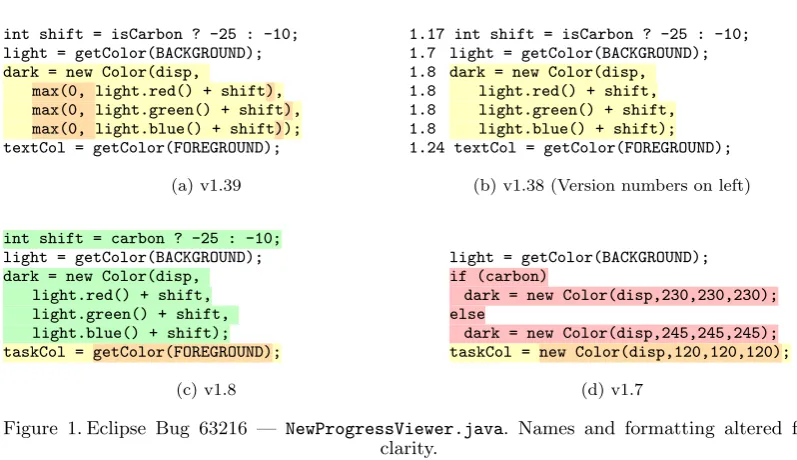
int shift = isCarbon ? -25 : -10; light = getColor(BACKGROUND); dark = new Color(disp,
max(0, light.red() + shift), max(0, light.green() + shift), max(0, light.blue() + shift)); textCol = getColor(FOREGROUND);
(a) v1.39
1.17 int shift = isCarbon ? -25 : -10; 1.7 light = getColor(BACKGROUND); 1.8 dark = new Color(disp, 1.8 light.red() + shift, 1.8 light.green() + shift, 1.8 light.blue() + shift); 1.24 textCol = getColor(FOREGROUND);
(b) v1.38 (Version numbers on left)
int shift = carbon ? -25 : -10; light = getColor(BACKGROUND); dark = new Color(disp,
light.red() + shift, light.green() + shift, light.blue() + shift); taskCol = getColor(FOREGROUND);
(c) v1.8
light = getColor(BACKGROUND); if (carbon)
dark = new Color(disp,230,230,230); else
dark = new Color(disp,245,245,245); taskCol = new Color(disp,120,120,120);
(d) v1.7
Figure 1. Eclipse Bug 63216 — NewProgressViewer.java. Names and formatting altered for clarity.
comments from the SCM repository and searching for bug IDs. Whilst other techniques for this task have been proposed [5], they have not been applied in this work.
Unfortunately for this work, the relationship between bugs and commits is not a simple one:
• Bug fixes may be relatively simple and may involve just a line or two in the system and the corresponding commit may involve just one file.
• Alternatively, bug fixes may involve a wider set of far more substantial changes. Consequently, a commit may be made up of one or more changes to one or more files.
• A commit may also involve changes that are unrelated to the bug in question: they may be associated with a different bug, or with no bug at all (taking the form of opportunistic refactorings or enhancements for example).
• A bug report may contain details about more than one bug.
• Developers may make more than one attempt to fix a bug, in which case there will be multiple commits associated with one bug report.
• A commit may fix a bug, but make no mention of the bug ID at all.
void applyResult(DResult result){ 1: Descriptor [] d =
result.getDescriptors();
3: for(int i=0; i<desc.length; i++){ 4: if(d[i] != null)
5: desc[i] = d[i]; }
}
(a) v1.6
void applyResult(DResult result){ 1: Descriptor [] d =
result.getDescriptors(); 2: if(d != null){
3: for(int i=0; i<desc.length; i++){ 4: if(d[i] != null)
5: desc[i] = d[i]; }
} }
[image:3.595.92.491.70.300.2](b) v1.7
these links are not entirely accurate [4].
2.2. Text Approach
Figure 1 shows four versions of the file NewProgressViewer.java. In version 1.39 the developers fixed a bug where, in certain scenarios, negative values were passed to the
Color constructor causing an IllegalArgumentException. To remove the error three of
the lines were updated to wrap parameters with calls to Math.max(0, ...)and so avoid the negative numbers. Using the text approach first proposed by ´Sliwerski et al. [2], to determine when this bug was introduced the cvs diff command is run on version 1.39. This command identifies all the lines that were added, removed or changed in that commit. The cvs annotate command is then run on the previous version, 1.38. This command displays the last version to change each line of code. For each line altered in the fix the version it was previously altered in is considered a possible origin of the bug. In this example each of the updated lines was last changed in version 1.8. Comparing version 1.8 to version 1.7 shows that this was indeed when the bug was introduced, as previously these values were set to specific numbers.
Various proposed improvements to the original approach are detailed in Section 2.5. Most pertinent to this study is that changes in formatting, whitespace and comments can be ignored, as they are unlikely to have been involved in causing or fixing a bug [7].
Unfortunately, the text approach is not suitable for all bugs. Figure 2 shows a bug involving a NullPointerException in the file DecorationBuilder.java. The bug was fixed by surrounding existing code with an if-statement that checks whether the variable is null. As these added lines did not exist in the previous version of code, cvs annotate cannot be used and the text approach cannot therefore identify any origin for this type of bug. A potentially more serious flaw is that there is no guarantee that a bug was actually introduced at the same location as it was fixed.
2.3. Dependence Approach
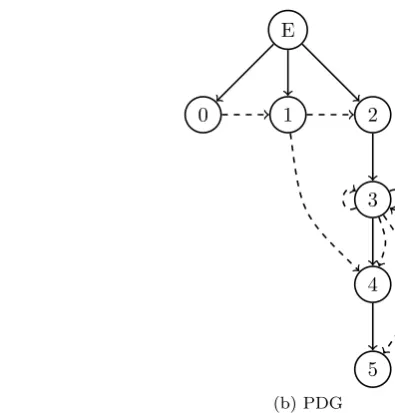
The dependence approach [3] attempts to address some of the text approach’s shortcomings by examining changes in the behaviour of the code rather than simply the text, using a program dependence graph (PDG). The idea of using a PDG within software engineering was first proposed by Ottenstein and Ottenstein [8]. In this simplest definition of a dependence graph, each statement is represented by a node and an additional unique entry node is added to identify the entry point of the program. Directed edges connect the nodes to identify the control dependences and the data dependences. A control dependence from node X to node Y (shown as X →Y) exists if the execution of Y is conditional on the
outcome of the execution of the predicate at X. A data dependence from nodeX to node Y (shown as X⇢Y) exists if Y references a variable which is defined in X. An example
of a simple method dependence graph for version 1.7 of the code in Figure 2 is shown in Figure 3. There are two points worth mentioning in relation to this illustration: firstly, an additional node (labelled 0) has been introduced to represent the result parameter; and secondly the method contains references to an instance variabledesc, but as this is external to the method there are no data dependences associated with it.
Control Dependence
Data Dependence
(a) Legend
E
0 1
3
4
5 2
[image:5.595.244.442.72.279.2](b) PDG Figure 3. PDG forDecorationBuilder.javav1.7 (See Figure 2)
approach therefore builds the PDG for each preceding version until it finds when the removed control dependence was added. In this case the dependence, and the bug, was introduced in version 1.5 when the method was created. If there are multiple dependences removed in the fix the dependence approach returns the most recent version in which one of these dependences was introduced.
Figure 4 also shows that a new line 2 has been introduced, with two new corresponding control dependences and a new data dependence from line 1 to line 2. As discussed, the approach prioritises removed dependences but if no dependences had been removed the approach would have built PDGs for preceding versions until it found the most recent one that altered either the source or target line of any of the new dependences.
Control Dependence
Data Dependence
Removed in v1.7
-Added in v1.7
+
(a) Legend
E
0 1
3
4
5
-(b) v1.6
E
0 1
3
4
5 2
+
+ +
[image:5.595.338.454.72.276.2] [image:5.595.114.485.485.690.2]for this is that each line contributed to the bug initially. Both of these could be considered valid interpretations of the origin of the bug, but it should be noted that these assumptions are not actually inherent to the approaches in questions. Either approach could be modified to return a single or multiple versions.
This work uses the decision of Sinha et al. [3], taking the last change involved to have been the one that introduced the bug. Note however that one bug report does not necessarily equate to one bug and so for a single bug report there can still be multiple versions in which a bug was introduced.
The dependence approach is not appropriate for all bugs. Using the approach described here the bug fix in Figure 1 would not result in any change to the method’s dependences. The approach could not therefore identify the origin of the bug.
2.4. Dependence Graphs
Since the introduction of the PDG there have been numerous additions and refinements made. One of the first notable modifications was made by Horwitz et al. [9] who extended the representation to handle programs with multiple procedures (the original PDG was only designed to handle monolithic programs). Termed the system dependence graph (SDG), and created with the goal of inter-procedural slicing in mind, its aim was to capture both the direct and the transitive dependences that can occur as a consequence of procedure calls. This was achieved by the inclusion of additional graph elements to identify thecallsites (the points in the program from which the procedure may be called) and the mapping between the formal and the actual input and output parameters, which results in the creation of four nodes for every parameter (actualin, f ormalin, actualout andf ormalout). These parameters
may be further linked via summary edges, which define dependences between parameters such as when an actualin node may influence the value of anactualout node. The result is
a collection of PDGs representing each procedure, linked via these additional control and data dependences from callsites to procedures.
The advent of popular object-oriented languages introduced further features that need to be captured by the SDG, most notably inheritance, dynamic binding and polymorphism, which create further possible transitive dependences. For instance, a reference in a program may be to an interface or to a class in an inheritance hierarchy which means that any message sent via this reference at run time may be received by one of many possible objects. This binding is not known at the time the graph is created, so to capture the transitive dependences the SDG needs to be extended to include every possible receiving type. Early representations of graphs for C++ were created by Larsen and Harrold [10] (and updated by Liang and Harrold [11]) and adapted by Kov´acs et al. [12] and Zhao [13] to capture Java-specific features. Walkinshaw et al. [14] describe these developments and the key components of the SDG for Java in more detail.
Although the SDG for even a modest sized Java program is a complex structure, it is still capturing just control and data information and its key components may be summarised as follows:
• The atomic construct is the statement which is either a simple expression or a callsite if method invocations are involved.
• Methods are linked to classes, which may also include data members. Any dependences between these data members and statements within methods (either in the containing class or elsewhere) are identified.
• Classes may exist within inheritance hierarchies and any data dependences between these need to be identified.
• Interfaces are modelled as separate graphs to identify the parameter and return type dependences between the interface and any potential implementation.
• Callsites identify all receiver types (although in practice this may not be feasible due to the possibly very large number of potential receivers).
• The treatment of type information is deserving of a special mention as it is often overlooked in the definitions of both the PDG and SDG. User-defined types (references to classes elsewhere in the system) will be captured via data dependences, but simple types and references to library classes will only appear as labels within the nodes which represent the variable declarations. The strategy taken by Apiwattanapong et al. [15] (upon whose work the graph differencing employed by Sinha et al. [3] is closely based) is to augment the name of scalar variables with type information (so a variable x of typeintis identified asx_int). User-defined types and library classes are referred to by their globally qualified name (such asjava.lang.String). This ensures that any changes to the type of identifiers will be reflected in a change to the node label.
For the purposes of this paper the focus of the analysis is on the method level which restricts the control and data dependences considered to just those within the method. This includes the formal parameters (but for input purposes only — any data dependences exported via a parameter are not modelled) but excludes any calls to other methods or references to variables outside the method, such as class member data. The original paper [3] was evaluated using a similar implementation, although it did describe the implementation of a full approach using SDGs.
Although tools to build the SDG of a Java system are not widely available, constructing them by combining the AST representation of a system available via the Eclipse JDT [16] along with a framework for performing dataflow analysis such as Wala [17] or Crystal [18] is now a realistic proposition (see for example the work of Luo et al. [19]). However, in this work it was decided to proceed with a manual analysis. Even though constructing a tool to perform the dependency analysis was a feasible option it would still probably have taken more time than to perform the analysis by hand. It must be stressed that the aim of this work is to gain insights into the approaches and, in particular, any problems associated with them, and without such insights it is not possible to build an accurate analyser. Should the approaches prove both valuable and free from fundamental problems then investment in the construction of an analyser would be worthwhile.
2.5. Additional Related Work
have yielded many insights into the huge variety of causes and fixes of bugs, they did not seek to find the originating version of code. Chou et al. [28] examined warnings found by twelve automated bug checkers across versions of Linux, but did not examine user-reported bugs. For all checkers they found the median difference between the introduction and the fix to be around 1.25 years. However, this often varied by the type of warning: those related to potential deadlocks could last significantly longer.
A number of practical tools have been built on top of the text approach. HATARI [29] is an Eclipse plugin which determines how risky it is to change an area of source code. For each bug in a project’s BTS it identifies the lines involved in the fix, using the techniques described earlier. Lines where a high proportion of changes lead to later fixes are identified as risky, and a visual indication of risk is presented to the developer. The developer can also view the history of each line, and examine which changes lead to which bug. FixCache [30] has a similar aim. A cache of elements, either files or methods, is maintained. Whenever a bug is fixed, the cause of the bug is identified and those elements are updated in the cache. The cache is then used to predict how likely changing an area is to cause another bug.
3. EVALUATION
As stated previously, limited evaluation has so far been performed on the approaches. The original text approach [2] did not validate whether the commits identified by the approaches actually caused the bugs in question. Subsequent work on other refinements has focused on evaluating the difference between the results returned by the original approach and those of the refined approach. In particular, there has been no evaluation of false negatives: commits which introduced bugs but which are not identified by the approaches. Identifying whether a commit caused a bug is time-consuming and subjective, as there is no one definition ofbug and there may well be multiple causes that could be said to introduce a bug. Additionally, implementations of the approaches are not readily available, and are challenging to complete. There is a notable paucity of reliable and well-known implementations of tools to support the creation and analysis of Java PDGs or SDGs. Therefore this section will evaluate a manual simulation of the approaches. This allows their expected effectiveness to be assessed prior to any implementation.
3.1. Subjects
The systems under examination are Eclipse [31], an IDE and development platform, and Rachota [32], a time tracking application. These were selected as they vary considerably in size, maturity and usage, although both are open-source, written in Java and use CVS [33]. Bug and commit data for Eclipse was obtained fromPromise[34], and contains a collection of fixes, each of which is a commit linked to a bug as described in Section 2.1. The set contains every fix which could be linked to a bug and which occurred from six months before the 3.0 release of Eclipse until six months afterwards. However, bugs may have been introduced in earlier releases and all previous versions were included in the evaluation. A series of scripts was used to select a random sample of 100 bugs, out of 4136 in total. These were linked to 301 separate commits (from a total of 10402). While this sample size may be considered small, the time required for evaluation prohibited the study of a larger sample.
fixing commits were identified for each of the 66 bugs in Rachota. A number of these commits only modified plain text files. While the text approach can be used on these files, the dependence approach cannot. Therefore, only the 130 commits involving Java files will be considered in this evaluation.
The sampling of bugs for analysis was driven primarily by the availability of the data and it probably best categorised as purposive sampling. It is emphatically non-probabilistic, and as such cannot be considered to be a representative sample of all bugs in all software systems (which means that it would not make sense to calculate confidence intervals etc.). This issue is considered in Section 6. Considering the bugs from the two systems in detail, all the bugs from Rachota were selected, and 100 out of the 4136 linked bugs from Eclipse were chosen.
Further evaluation was carried out on a sample of jEdit [36] bugs provided by Dit et al. [37]. jEdit is a text editor for programmers maintained by the free software community, which has been used as a case study in numerous research studies. jEdit was used by the authors to develop a common understanding of the application of the text and dependence approaches and to check that a third case study found the same kind of issues that arose with Eclipse and Rachota. It is used here to provide examples of qualitative insights into the application of the two techniques and also to provide a standardised process to document bugs and the outcome of the application of techniques in future studies. jEdit also uses Bugzilla, but unlike Eclipse or Rachota uses SVN as its SCM. The approaches are applicable to any SCM, but there is one slight difference. In CVS, each file is committed individually, and a version number is maintained for each file individually. In SVN, all modified files are committed together, and a revision number is used which identifies the state of the entire project, not just a single file.
All authors applied both approaches to eight selected jEdit bugs and then worked through each in detail to identify key decisions that needed to be made to ensure consistency of application, particularly with respect to the dependence approach. Some of the issues that arose are discussed in Sections 4 and 5, with some jEdit examples being used as detailed examples throughout the paper.
3.2. Research Procedure — A Worked Example
This section describes the research procedure used to simulate the text and dependence based approaches. To demonstrate both of these a detailed example of the analysis of jEdit bug 1965114 will be used.
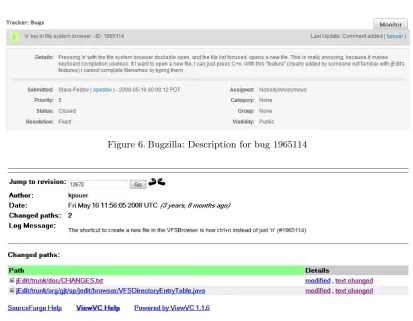
The bug was related to the SVN revision that fixed the bug through the use of the bug ID in the commit comment, as provided by the original sample [37]. Additional scripts were written to parse the provided dataset into an HTML page with links to jEdit’s Bugzilla [38] and ViewVC [39] servers to aid analysis. An example of the output from these scripts for bug 1965114 is shown in Figure 5.
Figure 5. Bug summary relating Bugzilla description to SVN revision
Figure 6. Bugzilla: Description for bug 1965114
Figure 7. ViewVC: SVN revision description for ‘fix’ to bug 1965114
The SVN revision description (Figure 7) identifies the jEdit commit that ‘fixed’ the bug (12672) and all the files that were modified during the fix. Often there will be multiple source code (.java) files modified for one fix. In this example the text file CHANGES.txt
(the jEdit release history) has been updated to include a textual description of the bug fix and the single fileVFSDirectoryEntryTable.javahas been modified.
There are now three stages of analysis to be performed using the SCM system: identifying the jEdit revision where the bug was introduced; simulating the text approach; and simulating the dependence approach.
3.2.1. Origin Identification
To identify the origin of the bug the BTS entry is read to see if there is any information that could aid understanding of the nature of the bug and its potential source. For bug 1965114 this helps since it indicates that the origin code is likely to be concerned with file shortcut options. This helps to focus the examination of the modified code.
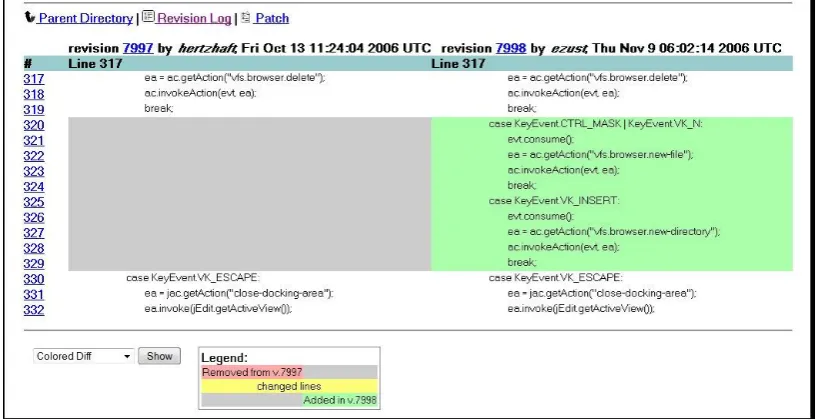
Next, the commit that fixed the bug, 12672, is examined. First, theCHANGES.txtfile was checked in case it contained helpful information; no further information was gained in this case. Second, the source file involved was examined using the annotated view provided by ViewVC. This provides a side-by-side SVN diff comparison against the preceding version of this file highlighting each line added, removed or changed. Figure 8 shows a snapshot of the annotated view for revision 12672 compared to its predecessor 12671. The lines highlighted in yellow (326–328) have changed between revisions and those in green (332) were added (any removed lines would be shown in red). Line 327 appears to be an added conditional to fix this bug.
Figure 8. ViewVC: Bug JEdit 1965114 side-by-side comparison of revisions 12671 and 12672 (the corresponding dependence graphs may be seen in Figure 13)
line 624. All of these changes must be considered as potential contributions to the bug fix. In this example these other changes appear to be concerned with opportunistic cleaning of the code — replacing a concreteLinkedListby the Listinterface and removing many unnecessary brackets. Such incidental changes can have unfortunate consequences for the two approaches.
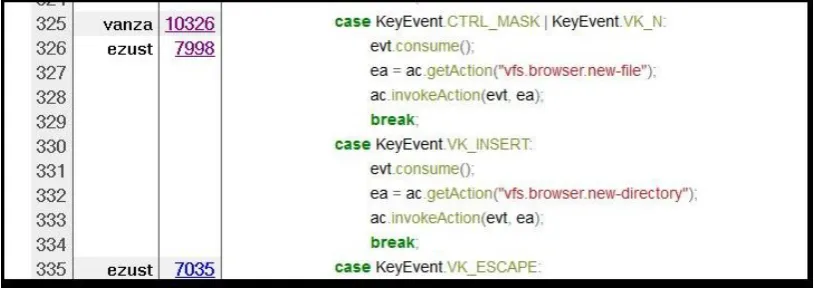
Having determined that the fix is likely to be the changes at lines 326–332 in revision 12672 and that the erroneous code is therefore on line 326 of revision 12671, the task now is to identify the origin of this bug — in what revision was the bug introduced? By examining the SVN annotated view of revision 12671 (shown in Figure 9) the last revisions to change the context around line 326 are highlighted.
Figure 9. ViewVC: Annotated revision view — the numbers in column 3 are hyperlinks to the last revisions that modified the lines in column 1
Opening the more recent revision 10326 associated with line 325 shows that there was only a change of layout in this revision, with no changes to the code. Opening revision 7998 reveals that all the code associated with this case branch was added in this revision, as shown in Figure 10. Revision 7998 is therefore deemed to be the origin of bug 1965114.
3.2.2. Text Approach
[image:11.595.93.502.354.498.2]Figure 10. ViewVC: Code containing bug 1965114 was added in revision 7998
the revision that fixes the bug are part of the bug fix. Furthermore, as mentioned earlier, the text approach cannot deal with fixes that involve adding lines of code and so the focus is only on removed and changed lines.
The text approach works by taking each line that has been changed or deleted in the revision that fixes the bug (subject to the exclusions just mentioned) and tracking back through the revision history to identify the revisions that previously altered these lines. The set of revisions identified is considered the potential origin of the bug in the text approach.
Revision 12672 included ten separate line changes and one line addition. The ten line changes are therefore all traced back through the revision history as potential origins of bug 1965114. This is similar to the process described above to identify the origin of the bug. The problem is that the text approach cannot distinguish amongst any of the ten changes, as was done above where an understanding of code semantics was used to focus on the changes made around line 326 as being the actual bug fix. Tracking back for each of the 10 changes leads to a set of possible bug origins, potentially one origin for each change. In this case the set of revisions identified is 4640, 4648, 5179, 5217, 7170, 7998, 9596, 10275 and 11009. This is a clear example of one of the limitations of the text approach. Notice that the set does include the origin, 7998, as a result of finding the revision that introduced the change at line 326.
3.2.3. Dependence Approach
The third stage is to simulate the dependence approach. The first step is to map methods between versions based on their name and signature. Although it did not occur in this case, this allows the dependence approach to handle methods which are relocated within the class (not true of the text approach).
only the most recent revision associated with a removed/added dependence and assumes that revision is the single bug origin.
The dependence approach therefore starts with the SVN diff between revision 12672 and its predecessor 12671. Of the ten changes and one addition, eight are concerned with the removal of unnecessary brackets and one is the addition of a closing brace matching the new conditional at line 326. This leaves only two changes that could affect the data or control dependences. Only dependences on other lines within the same method were considered; dependences on other methods and on any fields were ignored.
The first change is line 128 which was altered from
LinkedList<VFSFile> returnValue = new LinkedList<VFSFile>();
to
java.util.List<VFSFile> returnValue = new LinkedList<VFSFile>();
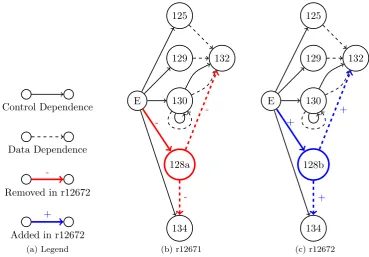
The dependences within this method are shown in Figure 11 (b) and the relevant sections of code in Figure 12. As shown, line 128 has a control dependence onto method entry and lines 132 and 134 have data dependences on line 128.
When comparing two methods, the first step of the dependence approach is to examine the graph for each version and determine which nodes in the first graph correspond to which nodes in the second graph, if any. This mapping is based on the similarity of the two lines and the lines surrounding them. Generally this was straightforward to do but where there were ambiguities these were recorded and re-examined at the end in order to ensure that similar cases were treated in the same manner. Specifically, if changes were made to an object’s type, or a method was added to or removed from a chain of method calls, then the two nodes were considered to not map to one another. Changes that were made to the condition of an if-statement were regarded as the nodes mapping to one another. These decisions are somewhat arbitrary, but are based on suggestions in the original description [3], and ensure consistency in the evaluation.
As such, as this is a change of type, the two nodes representing line 128 are not considered to match. Therefore both the control and data dependences have been removed (and new
Control Dependence
Data Dependence
Removed in r12672
-Added in r12672
+
(a) Legend
E
125
129
130
132
134 128a
-(b) r12671
E
125
129
130
132
134 128b
+
+
+
[image:13.595.113.483.435.692.2]Figure 12. ViewVC: Difference between revisions 12671 and 12672 in JEdit (corresponding PDGs shown in Figure 11
ones added), as shown by the highlighted edges in Figure 11. The dependence approach then searches the previous revisions to determine where any of those dependences were originally added. This process is performed in a similar manner to the text approach described above, using ViewVC to track back through the jEdit revisions. In this case, the generic parameter
VFSFile was introduced in revision 9596, which would be seen as the introduction of the
dependence, although prior to that the original data dependence was introduced in the baseline revision of jEdit, 4631. Had the two nodes representing line 128 instead been considered to match one another, then the two graphs would have been seen as identical: no dependences would have been seen as added or removed. This change would therefore not have led to any origin. The effects of these decisions are explored in more detail in Section 5.
The only other change is the code associated with the bug fix shown in Figure 8. Here the control dependences of the three assignments (startingevt.consume();) onto line 320 are removed and replaced with control dependences onto the new if-statement, as shown in Figure 13. In addition a new control dependence from the if-statement to the case -statement is introduced. As stated above, changes within conditionals are regarded as lines mapping to each other in the PDG, so the change on line 320 can be disregarded. Therefore, the focus here is on the removed control dependences and the revision(s) in which they originated. Since this is the code associated with the bug fix, tracking back to identify when these were introduced shows that they were all added in revision 7998.
As mentioned above, the dependence approach only identifies one revision: the most recent based on removed dependences (or added dependences if none are removed). Here
Control Dependence
Data Dependence
Removed in r12672
-Added in r12672
+
(a) Legend
E
0
285
326 329
330 331
-(b) r12671
E
0
285
326 329
330
331 327
+ +
+ +
+
(c) r12672
[image:14.595.114.517.473.680.2]the dependence approach will return revision 9596. Note though that if the two versions of line 128 had been considered to be the same node, by ignoring type changes, then the approach would have returned the actual origin, 7998. This example therefore highlights the major impact that subtle changes in the definition of PDG differences have on the dependence approach, particularly since it only returns a single revision. This is explored further in Section 5.
4. RESULTS AND ANALYSIS
Before looking at the results of the Eclipse and Rachota evaluation, it is useful to highlight the breadth of issues raised by just the small sample of jEdit bugs.
4.1. Qualitative Analysis — jEdit
A small, qualitative analysis was carried out using jEdit bugs, which is part of ongoing research. This was used by the authors to cross-check and develop an agreed understanding of the application of the text and dependence approaches and also to develop a standard process for summarising the bugs, their origin and the outcome of applying the techniques. The eight bugs discussed in Table I were specifically selected to highlight some of the subtleties that arose in the application of the approaches, particularly the dependence approach, across all three case studies. All authors independently applied both approaches to eight selected jEdit bugs. One of the jEdit bugs (1965114) was used as a detailed example in Section 3.2. Some of the issues that arose are discussed in more detail in Section 5.
Table I summarises the eight jEdit bugs. For each bug it: shows the jEdit bug identifier; gives a brief description of the bug; states the identified origin; lists the revision(s) identified by the text approach; lists the revision identified by the dependence approach; and highlights any interesting observations.
The jEdit study, though small, clearly demonstrates consistent findings with the main quantitative studies on Eclipse and Rachota which follow this section:
• There are examples where each approach clearly works as intended.
• Both approaches are impacted by intervening changes between the origin and the bug. • The dependence approach is sensitive to the definition of program (and system) dependence graph used — it is not clear, however, that one specific definition will consistently provide the best results.
• Most bug fixes had manyopportunisticmodifications as well as the bug fix, this means that the text approach often returns many revisions (including the correct one), while the dependence approach is more likely to be misled because it only returns the most recent revision.
• Bug fixes which involve changing surrounding context rather than the problematic lines can mislead the text approach; the dependence approach has more potential to identify the origin in these cases.
• The text approach cannot deal with changes that only add code.
4.2. Quantitative Results — Eclipse and Rachota
For each approach the predicted origins were compared to the manually identified origins. The predictions that the approach made correctly were recorded as true positives (TP). False positives (FP), versions that the approach predicted but which were not correct, and false negatives (FN), origins which were manually determined but the approach did not predict, were also recorded.∗
DA 9596
Notes Text approach identifies many revisions due to multiple opportunistic changes in bug fix file. Subtle questions raised for dependence approach: do type and generic type parameter changes cause PDG changes?
Bug 1584436 — Off-by-one error, local variableishould have been decremented
Origin Revision 5216 — Updated one use of ibut not the others
TA 5173
DA 5173
Notes Bug caused by change in context which misleads text approach. No change to data/control dependences in actual fix but changes elsewhere mislead dependence approach.
Bug 1834620 — Lexer problem - only seems to recognise one character after $
Origin 4826 — Original functionality added here
TA Nothing
DA 4826
Notes Text approach can’t deal with only added code. For dependence approach, data and control changes both lead to origin
Bug 1541372 — Caret positioning on text folding.
Origin Revision 3791 — Functionality introduced
TA 4 revisions including 3791
DA 4567
Notes Intervening changes between origin and fix cause difficulties for both approaches. Fix includes changes to multiple files — one file relevant, one not.
Bug 1600401 — Long lines cause editor to hang whenenter pressed on them
Origin 8103 Where the original condition added without length check
TA 8107
DA Nothing
Notes Intervening change causes difficulty for text approach. Questions raised about dependence approach: if adding conjunct toif-statement causes control change then it finds the wrong revision; if data change only then finds correct revision
Bug 1571629 — Issue with filtering files in Windows, looks like was a problem with Windows from original
Origin 6808 — Problem with Windows OS since beginning
TA 6808
DA 6808
Notes Good example of both approaches performing correctly — all changes lead to origin.
Bug 1548902 — Formatting empty paragraph throws exception, size isn’t checked
Origin revision 5196 — Move caret position introduced
TA Many revisions including 5196
DA 5324
Notes Opportunistic changes, e.g. changing StringBuffer to StringBuilder, mean that text approach gathers many revisions. Dependence approach depends on PDG subtleties — type change gets wrong revision, otherwise correct.
Bug 1542026 — Manipulating menus using keyboard — characters going into text file.
Origin 5114 — Original coded added
TA Nothing
DA 5114
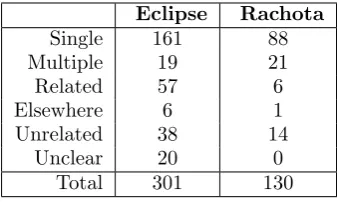
[image:16.595.93.511.87.725.2]Table II shows a summary of where the origin of the bug lies for each of the bug fix commits in Eclipse and Rachota. The majority of commits fixed a single instance of a bug where the origin and the fix lay within the same file, shown as Single. Some commits contained fixes for more than one instance of the same bug, shown as Multiple. These bugs may have all originated at the same time or may have been introduced in different commits, but in all cases the origin and the fix lay within the same file. A number of commits contained fixes for bugs for which the origin actually lay in a commit made to a separate file and these are classed asElsewhere. Finally some commits which claimed to be bug fixes were not actually fixes, but were instead consequences of the bug fix or unrelated changes, and these were classed as Related orUnrelated. Examples explaining the distinction between categories in greater detail will be given later in this section. For 20 commits the origin could not be determined, as the changes made by developers were complex and it was not possible for the authors to understand them or to identify if they were related to the bug in question. These commits were classed as Unclear. Note that these 20 files relate to just 3 bugs. All files for these bugs have been omitted from the remainder of the evaluation.
Only for bugs classed asSingle orMultiple could the two approaches potentially return the correct answer. Identifying the origin of Elsewherebugs would require an analysis over the whole system, not just on one individual file. Commits classed asRelated andUnrelated claim to be bug fixes but there is actually no bug in the file; for these bugs there is no origin and therefore any answer returned by either of the two approaches would be an error.
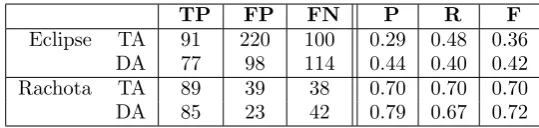
Table III shows the results obtained by the text approach (TA) and dependence approach (DA). In order to help compare the performance of each the commonly used measures of precision (P) and recall (R) are also shown, along with their harmonic mean F1-Score (F).
As can be seen, for Eclipse the text approach identifies more correct versions than the dependence approach. However, the text approach also generates a much larger number of false positives, as it can return multiple origins for each commit while the dependence approach only returns a single origin. As to be expected from the lower number of false positives, the precision of the dependence approach is higher, at 44% compared to 29%, although the recall is only 40% compared to 48% for the text approach.
A similar pattern is seen for Rachota but the proportion of false positives compared to true positives is vastly reduced compared to Eclipse. This may be because of the relative simplicity of changes in Rachota. The bugs, and their fixes, often seemed simpler than those in Eclipse and there were often fewer versions between the origin of the bug and the fix. Unsurprisingly, given the smaller number of false positives, the precision and recall for Rachota are higher than for Eclipse.
4.3. Analysis of Eclipse and Rachota
[image:17.595.212.381.601.702.2]The approaches successfully found origins for a variety of different types of bug. Of the 68 bugs in Eclipse for which at least one origin was successfully identified (out of a total of 100 bugs), around a third resulted in exceptions that either crashed the application, displayed
Table II. Count of Commits by Classification of Origin
Eclipse Rachota
Single 161 88
Multiple 19 21
Related 57 6
Elsewhere 6 1
Unrelated 38 14
Unclear 20 0
Rachota TA 89 39 38 0.70 0.70 0.70
DA 85 23 42 0.79 0.67 0.72
an error to the user or appeared in logs. However, bugs in other areas were also successfully identified:
UI Bug 63753 — “Checkbox being ignored”
Tests Bug 74229 — “Failing automated tests”
Code Reviews Bug 57670 — “Wrong subclass of InputStreamwas being used”
Performance Bug 64531 — “Find/Replace operation using 100% CPU”
There was a similar diversity of bugs identified in Rachota, although there was a greater proportion of user interface bugs and incorrect output rather than exceptions. Overall the approaches did not seem to be more or less effective for any particular type of bug, but there were a number of factors that impacted on their performance. This section will highlight some of these with a number of illustrative examples of bugs.
4.3.1. Graph matching, multiple bugs, age of origin and large fixes
Eclipse Bug 49561 — “Commit should only lock parent’s folder”
Some bugs demonstrated a wide range of issues.
Although the description only mentions commit operations, the actual bug involved a number of different operations locking the entire Eclipse workspace, preventing other operations from accessing it, when it was only actually necessary to lock individual folders. One of the changes made to fix the bug was version 1.156 of CompilationUnit.java, in which a number of lines were changed from
runOperation(operation, monitor) to operation.runOperation(monitor). This was
done as the method JavaElement.runOperation had been moved, and during the move changed, to JavaModelOperation.runOperation. Each of the calls was used as part of a different operation and therefore each represents a separate instance of the bug. Some of these bugs were introduced in version 1.1 of the file, while others were introduced in version 1.98.
[image:18.595.160.430.85.149.2]Table IV. Results by origin (Eclipse)
TA DA
TP FP FN TP FP FN
Single 79 75 82 73 41 88
Multiple 12 5 18 4 4 26
Related 0 88 0 0 29 0
Elsewhere 0 10 0 0 4 0
Unrelated 0 42 0 0 20 0
Multiple bugs Even if the dependence approach had returnedacorrect answer, it always only returns a single answer, so could not have hoped to identify both origins. This bug is an example of a number of bug reports in the Eclipse sample where one bug report actually represents multiple real bugs. Since these were often introduced at different times, the dependence approach fared much worse at identifying these, as shown by the row for Multiple bugs in Table IV.
Age of origin Quite a large number of versions passed between the bug being introduced and being fixed. While for this bug, and some others, the text approach was still successful, this was not generally true — the more versions passed between the introduction and the fix the less likely it was the origin could successfully be found, as will be shown in Section 5.4.
Large fixes CompilationUnit.java was only one of the files involved in this fix. In total, there were 13 files whose commit comments indicated they were related to this bug. However, the knock-on effects of moving therunOperation()method described above were responsible for most of these. In 3 of the files, there was no actual incidence of a bug, although the code changed was clearly involved in the fix. These commits were classed as Related. In an additional 7 files code that was not involved in the bug at all had to be altered and these commits were classed as Unrelated. For both these types of change, since there was never any bug in the file, any result returned by an approach would be wrong. The ideal outcome in fact would be for the approaches to return nothing. This did not happen however: these changes resulted in 19 false positives for the text approach and 7 for the dependence approach. This was often true of other bugs; as can be seen in Table IV these types of commits are responsible for a significant number of false positives.
4.3.2. Unrelated changes
Eclipse Bug 49891— “Problems launching a program, when using linked resources in CLASSPATH, which are not set”
This bug is an example of a fairly straightforward fix for which the origin is easily identified, but which can still result in issues for both approaches. In version 1.37 of
RuntimeClasspathEntry.javathe line
return res.getLocation().toOSString();
was altered to check first whether the value of res.getLocation()was null. This possibility had existed since version 1.1, the origin of the bug, but version 1.8 of the file had changed the line to its current version from the previous
return new String[] {res.getLocation().toOSString()};
circumstances.
4.3.3. Bugs caused by changes to other files
Eclipse Bug 54538 — “Bundle-SymbolicName value has changed”
Not all bugs were caused by a change made earlier in the same file. This bug was raised as the class BundleManifest.java was not correctly parsing the value of a String. It was fixed in version 1.6 of the file. However, the bug was originally caused by a change that was made elsewhere in the system to change the format of the String, not in the
BundleManifest.java itself. At that time, a number of classes which parsed this value
were updated, but this class was incorrectly omitted, and this bug then raised at a later date when the problem was discovered. As the origin lies in another class, this commit was therefore classed asElsewhere, and neither the text approach nor the dependence approach could correctly identify the origin.
4.3.4. Coincidental correctness
Eclipse Bug 65354— “[Perspectives] Perspective bar incorrectly updated when opening new perspective”
The fix for this bug was in version 1.11 of PerspectiveBarManager.java. Here, two lines were updated from
if (coolBar != null) LayoutUtil.resize(coolBar);
to
if (getControl() != null) LayoutUtil.resize(getControl());
However, as neither coolBar or getControl() are local variables, their dependences are not included in either graph and the intra-procedural dependence approach would therefore not be able to determine their origin (although it is possible an inter-procedural approach could have).
An additional change was also made before those lines to remove a call to
updateCoolBar(); (that method was also removed). However, the updateCoolBar()
method did not actually do anything: its entire contents had been commented out in an earlier version. The removed control dependence on the call however causes the dependence approach to return the correct origin for the bug. In effect, the approach is only correct due to the developer making an unnecessary change.
As this bug shows, developer behaviour has a major effect on the quality of the two approaches. They may be more effective for projects which have a strict policy on making one commit per logical change and less so for projects where developers tend to commit a large variety of changes all in one go. It also raises the question: even if a way could be found to ignore changes which are incidental or unrelated to the main fix, should they be, or are these still useful clues to help discover the origin? Here for instance, it was only due to the unrelated change that the dependence approach worked. After all, developers usually only change code if it is at least tangentially related to the code they need to fix; they are less likely to make changes to code which is totally disconnected from that involved in the bug.
approaches could often identify the correct version if not for the presence of other changes in the file.
4.3.5. Number of changes
Eclipse Bug 55640 — “[FastView] Screen cheese after Fastview resize”
Firstly, this bug highlights a major problem with trying to interpret developer changes through bug and commit data. The commit comment for this fix, version 1.56 of
ViewPane.java was “fix for bug 55640: views with custom titles were wasting space”. The
developer is fairly unequivocally claiming to have fixed a bug with the correct ID and the code is clearly in the same area as that described by the bug. However, the description of the commit and the description of the bug do not entirely match up and it is not clear whether they are definitely referring to the same thing. It is indeed possible that the developer used the wrong bug number when committing the fix or that the bug report was not a true description of what the problem actually was. Alternatively, this could simply be a problem of understanding caused by the analysis not being performed by a developer of the system. Regardless, it was fairly straightforward to identify the origin of the bug fixed by the developer as version 1.33 of the file. The fix itself involved the deletion (or commenting out) of 32 lines of code and modification of another 2, spread throughout the class. However, these lines of code were last changed in a variety of different versions: 1 in 1.22, 27 in 1.33, 1 in 1.34, 1 in 1.38, 1 in 1.48 and 3 in 1.53. This results in the text approach identifying the correct answer, but with an additional 5 false positives. The dependence approach identifies the most recent of these changes, 1.53, as the source and so gets the incorrect answer. The interesting point here is that the source of the bug was not the most recent change to the code (nor was it the oldest), but it was the version in which the majority of lines had last been changed.
4.3.6. Non-local dependences
Eclipse Bug 63753— “Team ->Tag as Version w/ ”Move tag if it already exists” option does not work”
Again this bug had a fairly straightforward fix, for which the text approach could correctly identify the origin. A single line
if (confirmDialog.getReturnCode() == IDialogConstants.OK_ID) {
was changed to
if (confirmDialog.getReturnCode() == IDialogConstants.YES_ID) {
Like previous bugs, if these two lines are interpreted asnotmapping to one another between dependence graphs then the dependence approach would also return the correct answer. If however, as was assumed here, these lines do map, then the dependenceswithinthe method have not changed at all. The only change that has been made is a dependence on a static variable. This highlights additional possibilities for altering the dependence approach. Even if a full inter-procedural analysis is not feasible, extending the dependence analysis to take into account constant or field declarations may still improve the recall of the approaches. It is not clear however how many bugs would be affected this way and there may be bugs where doing so would cause the wrong version to be returned.
4.3.7. Added dependences
Eclipse Bug 50549 — “[Dialogs] Pref Page Workbench/Keys/Advanced does not use dialog font”
A number of key points can be taken from the examples given here and earlier:
• For many bugs only one of the approaches gains the correct answer, or indeed any answer at all.
• The decisions taken by the dependence approach on graph matching, depth of analysis and priority of dependences has the potential to hugely affect its performance. • Large fixes, and the number of versions between a bug and a fix, can reduce the
effectiveness of the approaches.
• Unrelated changes have an impact on the results returned, but this can sometimes be to the approaches’ benefit.
• Taking the most recent version as that which introduced the bug may not be the most effective technique.
5. POTENTIAL IMPROVEMENTS
It is obvious from the sample, and from the examples highlighted above, that there are a number of areas in which the approaches could be improved. It is worth considering first why the approaches, or variations on them, should work at all. After all, it is not hard to construct theoretical examples of bugs for which neither approach would ever be successful, but these bugs do not appear to be frequent in the sample that was examined. Almost every bug fix involves either a textual change or a correction of an aberrant dependence. Using a theoretical extension of the dependence approach, with a richer variation of an SDG, even bugs which are fixed in other classes or by changes to inheritance hierarchies etc. could be seen as dependence changes. If the approaches were to consider every change, whether textual, added dependence or removed dependence and then to consider every previous version which affected these lines or dependences, it would seem very likely that the full set would include the bug origin. To do so would of course have huge costs, both in the large number of false positives and in the prohibitive time that would be required to run such a technique.
In a sense however, the various decisions taken by the two approaches can be seen as attempts to reduce both of these costs:
• Choosing to use just one of the approaches rather than both. • Ignoring changes to whitespace or formatting.
• Only returning the most recent version.
• Ignoring added dependences if dependences have been removed.
It is not clear however if these are the most appropriate ways to improve the approaches. This section will present a number of other possible improvements or changes that could be made.
5.1. False Negatives
Table V. Combining Approaches
TP FP FN P R F
Eclipse TA 91 220 100 0.29 0.48 0.36
TA,DA 116 231 75 0.33 0.61 0.43
DA 77 98 114 0.44 0.40 0.42
DA,TA 96 127 95 0.43 0.50 0.46
Rachota TA 89 39 38 0.70 0.70 0.70
TA,DA 109 43 18 0.72 0.86 0.78
DA 85 23 42 0.79 0.67 0.72
DA,TA 95 34 32 0.74 0.75 0.74
only involved lines being added. For the dependence approach the equivalent figure was 58 commits, where the fix usually contained no changed dependences.
The original authors proposed that in the cases where the dependence approach found no altered dependences it would fall back to using the text approach [3]. However, this could equally be applied in the other direction, with the text approach given first preference. In fact this may well be preferable due to the extra computational effort required for the dependence approach. The original paper reported the dependence approach to take around 7.2 times as long as the text approach on average, in the worst case taking over 12 hours to analyse 129 fixing commits where the text approach took around 1 hour.
A technique of using both strategies may well be viable. The most common result was for the two approaches to return the same outcome. However, in a significant number of cases one approach identified the correct version while the other did not, as already discussed. Obviously, however, it is also possible for one approach to return the incorrect answer where the other returned nothing.
Table V shows the effect of returning the result of the second approach if the first approach returns nothing. For both Eclipse and Rachota the change to the dependence approach is the same: a slight increase in both true and false positives, with a corresponding rise in recall but drop in precision. The change for the text approach is more pronounced however, increasing both precision and recall. The difference in F1-Score between the approaches has
now reduced and in fact for Rachota applying the text approach first gives the highest value. Given the potential time saving and the similarity in effectiveness, using the text approach first could benefit some applications.
There are perhaps more effective ways of combining the two approaches and of taking further evidence into account. As the earlier examples should have illustrated, there are often a number of decisions that need to be taken in each approach; there is not one correct way for every bug. Sometimes the most recent change is the one that introduced the bug, sometimes it is the first. Sometimes dependences are removed to fix the bugs, sometimes they are added. Sometimes type changes cause the bug, other times they are irrelevant. One potential way to approach handling this would be to aggregate this information and combine it in a probabilistic manner.
As a simplistic example, a fix in 1.7 involving 10 lines of code, 2 of which were changed in version 1.5 and 8 in 1.4, could imply that the bug was 80% likely to have been introduced in version 1.4. However, the fact that 1.5 was more recent could suggest that the bug is 66% likely to have originated in version 1.5. Multiplying these probabilities would say that the cause was version 1.4 with 65% probability. Obviously the examples given here are arbitrary, but the exact values could be determined empirically and additional evidence could also be taken into account.
could be made to it in order to increase the number of dependences it considers.
Starting from the basic intra-procedural approach used in the evaluation, a simple step would be to take into consideration dependences on fields, static values or constants. Slightly more complex would be to add in dependences on other methods within the same class, then more complex still to include other classes. Finally, other information could be added in until there is a full SDG as presented earlier: synchronization, exception handling, inheritance hierarchies etc. Each of these layers adds on more information and brings the system closer to that described at the beginning of this section, both in terms of being more likely to find the origin and of having more false positives and a longer runtime. However, it may be that there is a level between the basic one used here and the full SDG which proves to be the most balanced of solutions.
Another way to increase the number of potential results discovered by the dependence approach is to considerall the dependences, rather than stopping at the one which had the most recent change. This would in effect make it more similar to the text approach, with similar downsides.
Another possible investigation is into the graph matching techniques used. The original source does not fully explain the technique used [3], but is suggested as being similar to that used in JDiff [15]. In that technique, graphs are broken down into smaller subgraphs called hammocks and nodes are matched by their structural properties or textual equality — nodes which are textually similar but not exactly equal are not considered to match. However, there are many other graph or tree differencing techniques. In ChangeDistiller [40] for example, n-grams are used to determine whether the labels of leaf nodes are above a certain threshold of similarity. Whether a node in one version is matched to a node in a subsequent version or not has a major effect on how these techniques work, as two nodes which don’t match can result in a lot of removed dependences. Using a technique which gives a more accurate decision on whether a line has been updated or instead entirely removed and a new one added could give fewer false positives. Conversely however, using aless accurate technique may actually increase the number of dependences altered, which if multiple dependences are taken into account may give the approach more chance of finding the correct answer.
5.3. False Positives
[image:24.595.193.403.638.701.2]A significant proportion of the responses for the text approach were false positives. While most occurred when the approach could not identify the correct answer, a total of 41 false positives occurred where the approach identified the correct version along with one or more false positives, shown by the highlighted cells in Table VI. For example, there were 6 instances of commits which caused 1 true positive and 2 false positives, and 98 commits which caused 0 of each; nothing at all was returned for these commits. In addition, the bold
Table VI. Commits Classified by Number of True and False Positives for Text Approach (Eclipse)
FP 0 1 2 3 4 5 6
TP
0 98 44 25 12 7 3 1
1 59 11 6 4 0 1 0
cells show the large number of cases where more than one false positive occurred, for a total of 164 false positives.
One technique to reduce the number of these responses would be to return a single version, similar to the dependence approach. Doing so would reduce the maximum possible number of false positives per commit to one and would hopefully also result in discarding the false positive in favour of the true positive. Two ways to do so are to return the most recent version in which anything changed or to return the version in which the majority of the lines last changed.
Table VII shows the effect of such a change. As shown the false positives have decreased significantly. Unfortunately, the true positives have also decreased, as the approach no longer returns some of the correct versions it previously would have. This is especially true for bugs classed as Multiple, where it is no longer possible to correctly identify all of the origins. However, selecting the version in which most lines were last changed does significantly increase the precision at the cost of a smaller decrease in recall. Selecting the most recent version is similar but for a lesser benefit and larger downside.
5.4. Unrelated Changes
In total there were 34 fixes containing unrelated changes, of which 20 fixed multiple different bugs. An automated tool could potentially ignore these commits by checking the commit message for multiple bug IDs. Unfortunately, 13 of these commits were for a bug that was classed as Unclear and the remaining sample did not allow conclusions to be drawn about such a change.
One situation where this could be improved is where multiple commits are made to fix a bug, often because the first attempt was incorrect. One improvement would be to ignore changes made in versions that were linked to the bug other than the latest. This is in effect similar to the suggested improvement to remove all versions after the bug was raised as possible origins [7].
Possibly due to the increased chance of unrelated changes, the approaches tended to get less effective as the time between the bug being introduced and being fixed increased. Figure 14 shows the effects on F if fixes more than a given number of versions after the origin were to be ignored. Larger values have been omitted from the chart as the values remain largely stable, but the maximum difference between a bug being introduced and being found in Eclipse was 267 versions. Note that these figures only include bugs for which an origin actually existed so will not correspond with those given earlier in Table III.
Figure 14 also illustrates that bugs were often fixed shortly after being introduced. For Eclipse, 12.8% of bugs were fixed within 1 version after the bug was introduced with 50% of bugs being fixed within 12 versions.
[image:25.595.154.438.648.700.2]Another, more complex, way of removing false positives would be to ignore changes to code that had no semantic effects. A number of common patterns were identified by Jung et al. [22], from simple renames or deletions of lines with no effect, to deep semantic analysis. Some of these are already carried out, whilst others could perhaps be easily achieved by using abstract syntax trees rather than straight textual differencing, but detection of other patterns would be challenging. While Jung et al. only considered ignoring these changes in the fix itself, it would also be possible to apply such techniques to changes in intervening versions.
Table VII. Returning Single Version for Text Approach (Eclipse)
TP FP FN P R F
TA 91 220 100 0.29 0.48 0.36
Majority of Lines 75 103 116 0.42 0.39 0.41
3 7 13 1
4 4 21 1
5 5 22 1
6 1 24 1
5.5. Large Commits
Eclipse Bug 49561 showed a large number of false positives being returned when there were many files involved in the bug fix. This appeared to be common: often bug fixes which involved many files had a large number of unrelated changes, leading to an increase in false positives. One proposal is to ignore fixes that change a large number of files [7]. The number of bugs of each size in Eclipse is shown in Table VIII.
Figure 15 illustrates F if bugs with more than the given number of commits were to be ignored. Similar trends are present for P and R. As seen here, the vast majority of bugs were small and the scores are much better for smaller commits. For the few larger bugs the scores decrease. The same was not necessarily true of Rachota; there the largest bugs were smaller and the scores stayed largely constant.
Given the results for Eclipse, ignoring bugs with more than a certain number of commits may increase effectiveness without reducing applicability significantly. This might be appropriate for some use cases but further study would be needed to determine a threshold and it is likely this may vary by project.
5.6. Incorporating users
Whilst automated methods to reduce false positives are desirable, they are unlikely to be highly accurate and in some cases they may not be necessary. Depending on the desired use of the approaches, it may be that users could be available to manually remove false positives and to assist the approaches in other ways.
0 50 100 150
0.0
0.2
0.4
0.6
0.8
1.0
Maximum Number Of Versions Since Introduction
F−Score
● ●
● ●
● ●
● ● ● ● ●
●
TA DA
[image:26.595.174.420.84.171.2]Overall Proportion of Commits
[image:26.595.204.382.503.679.2]If the approaches are being used to assist a developer with finding the origin of a specific bug then a reasonable first step would be to present the developer with a list of all changes in the fix. From there, the developer could select any changes which are obviously not related to the bug. This could easily reduce the number of false positives quite significantly as a number of irrelevant changes could be ignored. This process could also be carried out throughout the search by presenting the user with a list of proposed origins. Again, the user could select some as being irrelevant and the approaches could then follow the trail back through older versions.
As well as potentially being more useful for a developer, such a technique could also lead to a better understanding of what type of changes are responsible for causing or fixing bugs. This information could then be incorporated into the approaches to improve them, learning from the developer’s feedback. As an example, there is a variable in Rachota which is displayed on screen to the user and indicates the version of the software. This variable is updated with every release and alone is responsible for 14 false positives in the Rachota sample. Being able to learn to eliminate these types of change would improve their accuracy.
5.7. Analysis of Potential Improvements
As a way of assessing the likely impact of several of these suggested improvements, a diverse set of bugs was selected in order to investigate in detail the consequences of a number of possible changes. Five bugs were randomly chosen from the set of Rachota bugs, two from Eclipse, and all eight of the JEdit bugs previously examined. Although this is a small set, and not one which could be argued as representative, the differences between the bugs and the insights obtained from the process give some very clear pointers about which approaches are likely to yield substantial benefits and which are not worth considering. Selection of the potential improvements was based on what could be feasibly investigated and objectively evaluated and consequently tended to include changes in the applications of the two strategies and exclude larger, more amorphous, amendments such as investigating user involvement (such modifications would need to be the subject of a larger, separate study). The modifications for the text approach were to:
• Return just the most recent revision
• Return just the largest revision (that with the most substantial number of modifications in terms of added/deleted/changed lines)
• Consider the impact of additions by looking at where the surrounding block was introduced (i.e. treat the enclosing block as if it was the subject of some change)
0 5 10 15 20 25
0.0
0.2
0.4
0.6
0.8
1.0
Maximum Commits Per Bug
F−Score
● ●
● ●
● ● ●
● ● ●
●
TA DA
[image:27.595.204.381.503.685.2]Overall Proportion of Commits