The Higher Education Academy Engineering Subject Centre Loughborough University
Leicestershire LE11 3TU
tel: 01509 227170
email: [email protected] web: www.engsc.ac.uk
an Engineering Subject Centre guide by
Andrew McLaren involved in engineering education. The complete series is also
available on our website.
About the centre:
The Engineering Subject Centre is one of the 24 subject centres that form the subject network of the Higher Education Academy. It provides subject based learning and teaching support for all engineering academics in the UK.
The Centre’s Mission is:
to work in partnership with the UK engineering community to provide the best possible higher education learning experience for all students and to contribute to the long term health of the engineering profession.
It achieves this through its strategic aims: sharing effective practice in teaching and learning amongst engineering
Engineering, University of Strathclyde, Glasgow, Scotland and Director of Undergraduate Studies. Alongside being an Associate of the Engineering Subject Centre, Andrew is also involved in the CDIO initiative, with a particular interest in the teaching of design.
Copyright © 2008 Higher Education Academy Engineering Subject Centre. All rights reserved.
ISBN 978-1-904804-802
There is an interactive version of the Guide, where you can comment on each paragraph individually, or on sections as a whole, this can be found at www.engsc.ac.uk/teaching-guides
How does it work?
To view a section, click the section name in the Table of Contents on the left. The paragraphs within the section are shown in one column, with a box on the right showing the comments which have been submitted by other readers. Next to each paragraph, there’s a small grey speech bubble. Click on this to bring up the comment form. Please abide by our moderation policy or your comment will not be published.
What happens next?
The feedback and discussion received will be reviewed by the Centre and author, and views and suggestions will be incorporated into new editions of the guide.
Approaches to the
teaching of design
Overview
Design is an extremely wide subject, covering the whole range of disciplines within engineering. It is at the heart of what engineers do, and draws together all the skills and knowledge that we seek to foster in our students into an activity that has perhaps the greatest effect on society.
There are many approaches to the teaching of design, and each of them has a place in engineering education. These approaches range from the traditional to the truly innovative, encompassing tasks based on individual study and scholarship, to those that require all the skills of group work, management, logistics and communication.
The requirement for teaching of design
There is a general recognition that design should be at the heart of the engineering curriculum, based largely on the recognition that design is one of the core activities that professional engineers undertake. The requirement for design at the core of the education of professional engineers was enshrined in the Engineering Council’s Standards and Routes to Registration (Engineering Council, 1997), which stated “The course must be taught in the context of design, which provides an integrating theme.”
The current UK-SPEC standards (Engineering Council, 2007), which superseded SARTOR in 2004, maintain design as a major theme. This is described as follows:
Design is the creation and development of an economically viable product, process or system to meet a defined need. It involves significant technical and intellectual challenges and can be used to integrate all engineering understanding, knowledge and skills to the solution of real problems.
The QAA Benchmark statements for Engineering (2006) include reference to design activities, stating that “The curriculum should include both design and research-led projects, which would be expected to develop in graduates both independence of thought and the ability to work effectively in a team.”
The Royal Academy of Engineering has published two booklets on the importance of design. Their booklet
Design principles: the engineer’s contribution to society
(Royal Academy of Engineering, 2002), provides these guiding principles:
Need All design begins with a clearly defined need
Vision All designs arise from a creative response to a need
[image:5.420.45.380.83.279.2]Delivery All designs result in a system, product or project that meets the need.
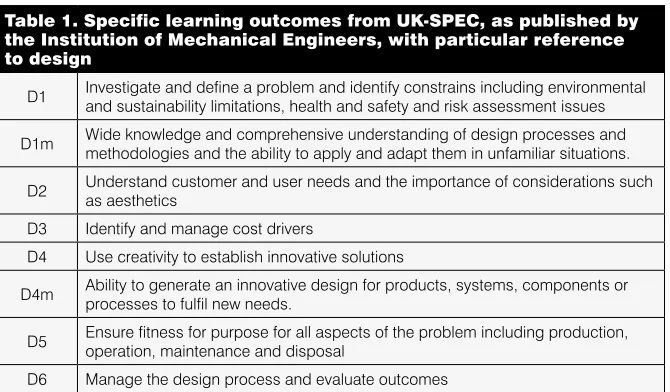
Table 1. Specific learning outcomes from UK-SPEC, as published by the Institution of Mechanical Engineers, with particular reference to design
D1 Investigate and define a problem and identify constrains including environmental and sustainability limitations, health and safety and risk assessment issues
D1m Wide knowledge and comprehensive understanding of design processes and methodologies and the ability to apply and adapt them in unfamiliar situations.
D2 Understand customer and user needs and the importance of considerations such as aesthetics
D3 Identify and manage cost drivers
D4 Use creativity to establish innovative solutions
D4m Ability to generate an innovative design for products, systems, components or processes to fulfil new needs.
D5 Ensure fitness for purpose for all aspects of the problem including production, operation, maintenance and disposal
A series of four case studies is presented as examples of these principles in action.
The second booklet, Educating Engineers in Design: Lessons Learnt from the Visiting Professors Scheme
(Royal Academy of Engineering, 2002), is prefaced by the following remarks:
And what do we need to teach? We don’t. We need to give the opportunity to gain experience and awareness in multi-disciplined team environments and let the confidence of youth loose on a prepared world. What can we give students in a university department? Experience of working in multidisciplinary teams working on realistic projects. The Visiting Professor’s role in this is to develop appreciation of the power of ideas and the value that transferring knowledge can have.
Professor Chris Pearce FREng, Visiting Professors 2002 Workshop. The Royal Academy of Engineering recently
commissioned a report entitled Educating Engineers for the 21st Century (2006a). This in-depth study, carried out by Henley Management College, involved interviews with experienced industrial practitioners, and a large-scale survey of engineering companies. The report predicted a worsening shortage of high calibre UK engineering graduates over the next 10 years.
Engineering courses must become better aligned with the changing needs of business and industry. In particular, more and better quality project work is needed, based around real-life problems, ideally delivered in collaboration with industry. Work is needed to improve the approach to teaching to ensure students remain motivated and engaged, and graduate keen to pursue engineering careers. There are already important developments in this area, such as the pedagogic approach taken in CDIO, and team-based hands-on engineering Developments of this sort will not only improve graduate performance in companies, but can also improve recruitment into engineering courses and student motivation.
Characterisation of design teaching
activities
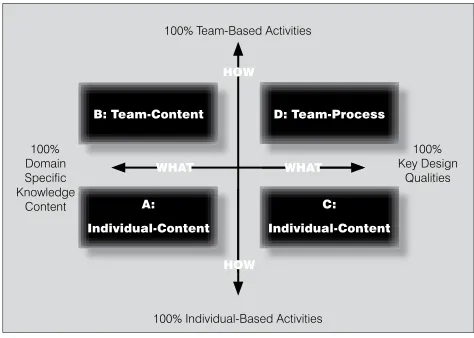
The authors characterised design activities according to a two dimensional matrix, reproduced in Figure 1. The horizontal dimension refers to WHAT is taught, with pure knowledge at the left hand end, and pure design at the right. The vertical dimension refers to the pedagogical approach, i.e. HOW the what is taught, with individual-based activities at the bottom, and team-individual-based activities at the top.
They propose that design activities can be characterised according to which quadrant of the diagram they lie in, as follows:
A. Individual-content centric (e.g. most traditional lecture-based courses fall in this category);
B. Team-content centric (e.g. mainly traditional lab-based courses);
HOW
HOW
WHAT WHAT
B: Team-Content D: Team-Process
A: Individual-Content
C: Individual-Content 100% Team-Based Activities
100% Individual-Based Activities 100%
Domain Specific Knowledge
Content
100% Key Design
[image:8.420.141.378.84.253.2]Qualities
C. Individual-process centric (few undergraduate engineering courses fall here, but many studio art courses are here);
D. Team-process centric (e.g. most senior-level
capstone design courses).
The authors address each of the quadrants in turn. For quadrant A, they review various innovative approaches that have been used to shift the position of traditional courses towards a more central position. Calculus, statics, strength of materials, graphics and CAD have all been addressed, usually by bringing elements of teamwork and problem solving into the class. For quadrant B, they review courses that have well-defined, domain-specific objectives, but that use team and group work the majority of the time. This type of class is commonly termed inquiry-based learning. Quadrant C is diametrically opposite quadrant B, and emphasises individual learning which utilises a process centric approach. This type of course is rare, the main example cited being a “Visual Thinking” course at Stanford, addressing core problem solving strategies. Quadrant D emphasised team based activities focused on process. This type of course is relatively common, and tends to fall into two main groups. The first is where students study the artefacts and designs of others. This may be broadly labelled as “case-based learning”, and several examples are reviewed, including a class utilising mechanical dissection. A more
this type of class are given, full details of which can be found in the papers.
Innovation in the teaching of design
Traditional approaches
Within engineering courses, traditional approaches to design teaching have centred on discipline-specific modules. For instance, in Mechanical Engineering, the subject of machine design is often taught using textbooks that seek to treat the process in a comprehensive manner. Examples of such texts are Shigley and Norton:
Shigley, Joseph (2003) Mechanical Engineering
Design 7th edition. McGraw-Hill Higher Education.
ISBN-13: 9780071232708
Norton, Robert L. (2006) Machine Design: An
Integrated Approach 3rd edition. Pearson Education.
ISBN-13: 9780132020121.
This approach emphasises the need for detailed specification of machine components within the design process, and the books reflect this by including detailed methodologies for sizing of components.
A more product design approach, involving the
generation of a general product concept, and the steps that are involved in producing and choosing between competing design solutions is typified by the approach of Stuart Pugh:
Pugh, Stuart (1990) Total Design: Integrated Methods for Successful Product Engineering
This approach strongly addresses the learning outcomes described under D1, D1m and D2 of UK-SPEC (see Table 1.), i.e. identifying the problem and understanding the customer and user needs and the importance of considerations such as aesthetics. There is a general consensus that while detailed design considerations are vital in engineering practice, students need concrete experience in which to root these
concepts.
Design as the core of engineering programmes
Design is widely recognised as the core activity in engineering education, which integrates the subject specific technical content with the needs of customers and business. As mentioned above, this concept was a strong theme in the SARTOR curriculum requirements for Engineering Council accreditation. Many approaches to design teaching recognise this.
Most prominent among curriculum models that follow this pattern is the CDIO initiative.
The CDIO Initiative
The CDIO website introduces the initiative as follows:
The CDIO Initiative is
The CDIO™ Initiative was developed with input from academics, industry, engineers and students. It is universally adaptable for all engineering schools. CDIO™
Initiative collaborators throughout the world have
adopted CDIO™ as the framework of their curricular planning and outcome–based assessment.
www.cdio.org
The initiative grew out of collaboration between MIT and three engineering departments in Sweden, and has now expanded to a network of approximately 30 partners worldwide.
The approach emphasises the need to teach engineering fundamentals (which will be discipline-specific) integrated with:
Personal and professional skills
Engineering Reasoning and Problem Solving Experimenting and Knowledge Discovery System Thinking
Personal Skills and Attributes Professional Skills and Attitudes
Interpersonal skills
Teamwork and Leadership Communications
Product and system building
External and Societal Context Enterprise and Business Context Conceiving
Implementing Operating
The CDIO Initiative (CDIO, 2004) has a set of 12 standards, described below:
The CDIO standards describe CDIO programs and enable schools to certify themselves if they are meeting the CDIO goals. These principles, or rules, distinguish the specific qualities of CDIO programs and their graduates. As a result, the CDIO Standards define the distinguishing features of a CDIO program, serve as guidelines for educational program reform, create benchmarks and goals that can be applied worldwide, provide a framework for continuous improvement, form the basis of a program’s self-certification, and provide academics and employers with attributes that distinguish graduates of CDIO programs.
While it is recognised that these standards represent an ideal program, schools and departments are encouraged to adopt the standards in a progressive manner, and in this way the CDIO initiative is less prescriptive than might appear at first sight.
Some approaches to the teaching
of design
Mechanical dissection
Stanford
Probably the best known example of the mechanical dissection approach to teaching design is the course ME99 at Stanford. ME99 Mechanical Dissection: Course Outline, Stanford University. Available online at:
Students participate in four “dissections” of different artefacts: usually an HP printer, a fishing reel, a bicycle and one other artefact of the student’s own choosing. Students prepare individual presentations concerning the function of their artefact and how it works. They learn the “vocabulary of mechanical systems” through the study of their dissected artefacts and mini lectures on topics such as gears, fasteners, bearings and other mechanisms.
The class fosters an awareness of the design process, stimulates the students to communicate clearly and concisely, and develops their resourcefulness and problem solving skills. In addition, certain aspects of the engineering curriculum are reinforced through application to a concrete object. Topics addressed include free body diagrams, dynamics and strength of materials (Sheppard, 1992).
Strathclyde
The Department of Mechanical Engineering at the University of Strathclyde utilises mechanical dissection to teach design in the first year. In this case, a scrap motor car is dissected by groups of four students. (For much of the first year, students work in the same groups of four, in lab-based activities, problem-based and active learning classes.)
temperatures) materials and manufacturing methods are discussed. Parts are selected for metallographic examination with a member of staff the following week. The students are set the task of producing a technical poster covering the function, physics, materials and manufacturing of their component. They base this on the discussions with staff, but must do further research, carry out calculations and analysis themselves.
The poster is reviewed by two members of staff to correct mistakes and give formative feedback. The students then prepare short presentations that describe what they have learned to the rest of the class.
Further information on this class is contained in an evaluation case study for the Engineering Subject Centre Teaching Awards 2005 (Barker and McLaren, 2005).
Design-Build experiences
Many design modules require students to design and build some sort of engineering artefact, often in teams. This is a key element of the CDIO initiative, described above. Of particular interest in this context is CDIO Standard 5 (CDIO, 2004), namely:
Standard 5 — Design-Build experiences:
A curriculum that includes two or more design-build experiences, including one at a basic level and one at an advanced level.
Description: The term design-build experience denotes
of conceptual design from the Conceive stage. Students develop product and system building skills, as well as the ability to apply engineering science, in design-build experiences integrated into the curriculum. Design-build experiences are considered basic or advanced in terms of their scope, complexity, and sequence in the program. For example, simpler products and systems are included earlier in the program, while more complex design-build experiences appear in later courses designed to help students integrate knowledge and skills acquired in preceding courses and learning activities. Opportunities to conceive, design, implement, and operate products and systems may also be included in required co-curricular activities, for example, undergraduate research projects and internships.
Rationale: Design-build experiences are structured and
sequenced to promote early success in engineering practice. Iteration of design-build experiences and increasing levels of design complexity reinforce students’ understanding of the product and system development process. Design-build experiences also provide a solid foundation upon which to build deeper conceptual understanding of disciplinary skills. The emphasis on building products and implementing processes in real-world contexts gives students opportunities to make connections between the
technical content they are learning and their professional and career interests.
Evidence: Two or more required design-build
The early stage design-build experiences are often in the form of a set kit, with limited parts and options, from which the students have to construct a machine or object that meets certain design objectives. Within the CDIO scheme, this tends to address the I
mplement-Operate aspects, and the Conceive-Design parts are pre-defined within the module.
Senior design-build experiences, occurring later in the course, tend to address at least the Design-I
mplement-Operate aspects, and possibly also the Conceive part. There are a wide variety of outcomes from this type of module.
A recent review by Johan Malmqvist from Chalmers University of Technology (Malmqvist et al., 2004) details various design-build-test courses, and the lessons learned from their implementation.
Design competitions
Competition modules
The 2.007 course @MIT began in the 1960’s and has been taught by Robert Mann, Woodie Flowers, Harry West and now Alexander Slocum. During the course of 2.007 you will learn design theory and methodologies and then demonstrate them in the construction of your robot. Good luck, but of course a good engineer never relies upon luck.
2.007 Design and Manufacturing 1, MIT. Available online at: pergatory.mit.edu/2.007/ The competition generally takes the form of some sort of obstacle course, which robots have to negotiate and perform tasks which interact with the structure of the race course. However, this description in no way does justice to the competition, and the reader is strongly urged to view the videos on the MIT website for a true appreciation of what the students achieve.
A further example of this type of competition, also at MIT, is the Autonomous Robot Design Competition. This utilises a kit approach where student teams build Lego robots to complete a task. 6.270 Autonomous Robot Design Competition, MIT. Available online at:
web.mit.edu/6.270/www/
Pre-University competitions
Closing remarks
It is hoped that this booklet will provide a useful resource for teachers of engineering design, and stimulate further reading and research into different teaching methods and approaches. Design classes are very effective vehicles for integrating the different parts of the curriculum and providing real life experiences for engineering students. They can be challenging to teach, exposing staff to a whole variety of questions outside their own research experience, but can be extremely rewarding in the quality of interaction with students. The Engineering Subject Centre has run a number of events supporting design teaching and group working. The following list is not exhaustive:
Design Teaching in Engineering: Exploring Differing Approaches
Engineering Subject Centre Workshop 23rd March 2007, University of Strathclyde www.engsc.ac.uk/nef/events/designteaching.asp
Teaching Sustainable Design
Engineering Subject Centre Workshop - 26th January 2005, Loughborough University www.engsc.ac.uk/nef/events/sustainability.asp
Project and Group Work in Engineering
References
All online references in the text and below were accessed on 25 June 2008.
Barker, P. and McLaren, A. (2005) Teaching First Year Design by Mechanical Dissection. Engineering Subject Centre. Available online at: www.engsc. ac.uk/downloads/mechdissesction.pdf
CDIO (2004) Standards. Available online at: www.cdio.org/tools/cdio_standards.html The Engineering Council UK (1997) SARTOR 1997.
Available online at:
www.engc.org.uk/Documents/Sartorprt1.pdf The Engineering Council UK (reprinted 2005) UK
Standard for professional Engineering Competence (UK-SPEC). Available online at www.engc.org.uk/ documents/CEng_IEng_Standard.pdf
The Engineering Council UK (reprinted 2007) The Accreditation of Higher Education Programmes. Available online at:
www.engc.org.uk/documents/Accreditation_HE_ Programmes_RP.pdf
Institution of Mechanical Engineers (2007) Appendix B: Specific Learning Outcomes. Issue 2, June 2007. Available online at www.imeche.org/ under University Submission Forms Stage 1 and Stage 2.
Malmqvist, J. et al. (2004) ‘Lessons learned from design-build-test-based project courses’ International Design Conference - Design 2004, Dubrovnik, May 18 - 21, 2004. Available online at:
www.cdio.org/papers/lessonslrnd_db.pdf
The Royal Academy of Engineering (2002) Design principles: the engineer’s contribution to society. Available online at:
www.raeng.org.uk/education/vps/pdf/design_ principles.pdf
The Royal Academy of Engineering (2002) Educating engineers in design: lessons learnt from the visiting professors scheme. Available online at:
www.raeng.org.uk/education/vps/pdf/design_ engineering.pdf
The Royal Academy of Engineering (2006a) Educating Engineers for the 21st Century: the industry view. Available online at: www.raeng.org.uk/news/releases/ henley/pdf/henley_report.pdf
The Royal Academy of Engineering (2006b) Educating Engineers for the 21st Century: the industry view. A commentary. Available online at: www.raeng.org.uk/ news/releases/henley/pdf/commentary.pdf
Sheppard, S. (1992) ‘Mechanical dissection: an experience in how things work’ Proceedings of the Engineering Education: Curriculum Innovation & Integration, Santa Barbara, CA, Jan. 6-10, 1992. www-adl.stanford.edu/images/dissphil.pdf Sheppard, S. and Jenison, R. (1997a) ‘Freshmen
engineering design experiences: an organizational framework’, International Journal of Engineering Education, 13 (3), 190-197.
Engineering, University of Strathclyde, Glasgow, Scotland and Director of Undergraduate Studies. Alongside being an Associate of the Engineering Subject Centre, Andrew is also involved in the CDIO initiative, with a particular interest in the teaching of design.
Copyright © 2008 Higher Education Academy Engineering Subject Centre. All rights reserved.
ISBN 978-1-904804-802
There is an interactive version of the Guide, where you can comment on each paragraph individually, or on sections as a whole, this can be found at www.engsc.ac.uk/teaching-guides
How does it work?
To view a section, click the section name in the Table of Contents on the left. The paragraphs within the section are shown in one column, with a box on the right showing the comments which have been submitted by other readers. Next to each paragraph, there’s a small grey speech bubble. Click on this to bring up the comment form. Please abide by our moderation policy or your comment will not be published.
What happens next?
The feedback and discussion received will be reviewed by the Centre and author, and views and suggestions will be incorporated into new editions of the guide.
The Higher Education Academy Engineering Subject Centre Loughborough University
Leicestershire LE11 3TU
tel: 01509 227170
email: [email protected] web: www.engsc.ac.uk
an Engineering Subject Centre guide by
Andrew McLaren involved in engineering education. The complete series is also
available on our website.
About the centre:
The Engineering Subject Centre is one of the 24 subject centres that form the subject network of the Higher Education Academy. It provides subject based learning and teaching support for all engineering academics in the UK.
The Centre’s Mission is:
to work in partnership with the UK engineering community to provide the best possible higher education learning experience for all students and to contribute to the long term health of the engineering profession.
It achieves this through its strategic aims: sharing effective practice in teaching and learning amongst engineering