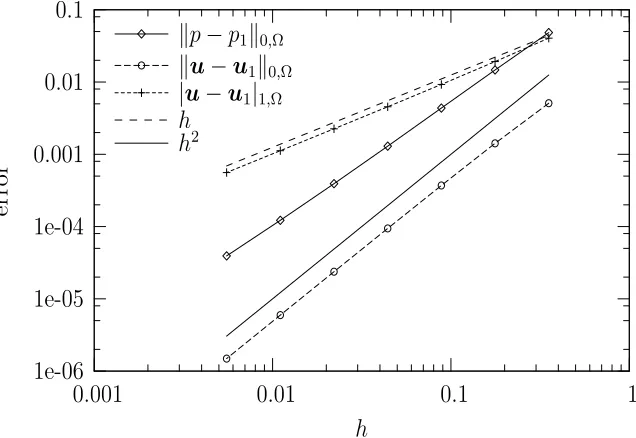
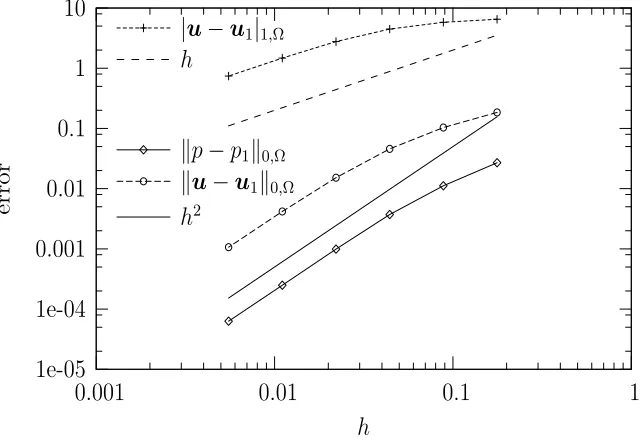
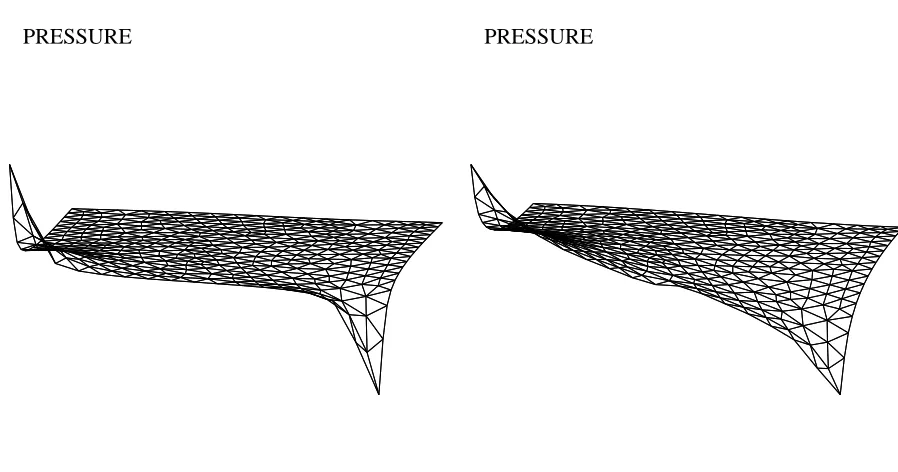
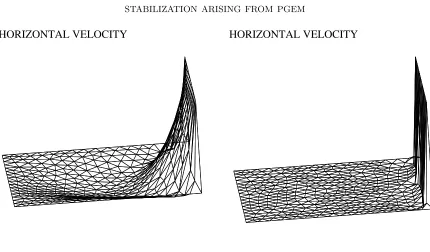
DEVELOPMENTS
RODOLFO ARAYA1
, GABRIEL R. BARRENECHEA2
, LEOPOLDO P. FRANCA3 , AND FR´ED´ERIC VALENTIN4
Abstract. The aim of this paper is twofold. First, we review the recent Petrov-Galerkin enriched method (PGEM) to stabilize numerical solutions of BVP’s in primal and mixed forms. Then, we extend such enrichment technique to a mixed singularly perturbed problem, namely, the generalized Stokes problem, and focus on a stabilized finite element method arising in a natural way after performing static condensation. The resulting stabilized method is shown to lead to optimal convergences, and afterward, it is numerically validated.
1.
Introduction
The Stokes problem emanates from modeling creeping flows and incompressible elasticity.
The problem fits into the abstract mixed method formulation [10, 12]. Mixed methods have
various applications, among them modeling deformation of beams, arches, plates and shells.
The approximation of these problems using standard finite element polynomials faces the
challenge of satisfying stability conditions known as inf-sup conditions [10]. These stability
conditions restrict which pairs of approximation (primal and dual variables) are allowed.
Convenient pairs, such as equal-order interpolations, are in general prohibited.
Stabilized methods address the limitations of mixed methods [29, 28]. Introduced for
advective-diffusive problems [16, 20], stabilized methods are built to enhance stability
with-out affecting consistency. This is accomplished by adding terms based on residuals of the
equations involving the trial functions while the test functions have different forms varying
from least-squares to adjoint operators. For the Stokes problem these methods have been
Date: October 6, 2007.
Key words and phrases. Stokes operator, reactive flow, multiscale function, Petrov-Galerkin method, stabilization.
1
This author is partially supported by FONDECYT Project No. 1070698. 2
This author is partially supported by CONICYT-Chile through FONDECYT Project No. 1061032 and FONDAP Program on Applied Mathematics.
3
This author is partially supported by NSF Grant No. 0610039. 4
This author is supported by CNPq grant No. 304051/2006-3 and FAPERJ..
proved convergent for almost all pairs of interpolation [29, 26]. The drawback of stabilized
methods is the choice of stability constants associated with the additional terms. In many
applications the value of these constants affects the numerical results.
To shed some light on how to produce the stability constant for the Stokes problem, in
[31] a relationship between the enrichment of a piecewise linear velocity field with a bubble
function (MINI element [4]) and the stabilized method from [29] was first pointed out. The
MINI element produces this stabilized method with a stability constant which is a function of
the bubble shape and value. This gives us a recipe for getting the stability constant, namely,
we pick a form of the bubble function and this gives us a specific value of the stability
constant. This relationship has been extended to the generalized Stokes problem in [8] (see
also [6] where this relationship was first highlighted) and to the advective-diffusive problem
in [11, 5].
The relationship discovery left an open problem, namely how to choose optimal bubbles
to produce the most accurate stabilized approximation. This question has been addressed
introducing the residual-free-bubbles concept [15, 25, 14, 13]. The idea is to construct the
bubbles by approximating a local problem dictated by the equations of the global problem.
The bubbles solve a PDE problem governed by the residual of the piecewise polynomial
component of the solution. The local problem is subject to a zero boundary condition
(except for some problems defined in
L
2), and this yields good solutions in some applications.
However, the zero boundary condition limits the capability of the approximation in some
cases. For example in the reactive dominated diffusive model (with, or without convection),
the residual-free bubbles method oscillates near a boundary layer. Several solutions have been
proposed in order to avoid this type of oscillations, including the use of adaptive meshes or
specially refined meshes, such as Shishkin meshes (see [30, 34], and references therein, and
[33] for a survey), but the detailed review of these techniques lies beyond the scope of this
work. Instead, in this work we focus on so-called Petrov-Galerkin Enriched Method (PGEM)
[22, 21], which is discussed in the next section.
The remainder of the paper is as follows: a review of PGEM is given in Section 2, in Section
3 PGEM is extended to the generalized Stokes problem, including a stabilized formulation
derived from it, for which we perform an a priori error analysis, and in Section 4 we present
some numerical results confirming the theoretical results.
1.1.
Notations.
Let Ω be an open bounded domain in
R
2with polygonal boundary. As
we denote by
k· k
s,D(
|· |
s,D) the norm (seminorm) in
H
s(
D
) (or
H
s(
D
)
2, if necessary). By
{T
h}
h>0we denote a family of regular triangulations of Ω, built up using triangles
K
with
boundary
∂K
=
F
1∪
F
2∪
F
3,
h
K:=
diam
(
K
) and
h
:= max
{
h
K:
K
∈ T
h}
.
We denote by
EΩ
the set of internal edges of
T
hand for
K
∈ T
hwe denote by
E
(
K
) the
set of its sides. The characteristic length of
F
∈ EΩ
is
h
F=
|
F
|
,
n
is the normal outward
vector on
∂K
,
∂
sand
∂
nare the tangential and normal derivative operators, respectively,
and
I
is the
R
2×2identity matrix. Also, for
K
∈ T
hand
F
∈ E
Ωwe define the following
neighborhoods:
ωK
:=
∪{
K
′∈ T
h:
K
∩
K
′6
=
∅}
,
ωF
:=
∪{
K
′∈ T
h:
F
∈ E
(
K
′)
}
.
For
F
∈ EΩ
we denote by
J
v
K
Fthe jump of a function
v
across
F
. Further, we introduce the
standard linear finite element space
Vh
=
{
v
∈
C
0(Ω) :
v
|
K∈
P1
(
K
)
,
∀
K
∈ T
h}
.
(1)
Finally,
H
1(
T
h
) and
H
01(
T
h) stand for the spaces of functions whose restriction to
K
∈ T
hbelongs to
H
1(
K
) and
H
01(
K
), respectively, and we present a space
Eh
⊂
H
1(
T
h) (which,
although not supposed finite dimensional, will turn out to be of finite dimension), called
multiscale space, which will be used to enrich the trial space and will be problem dependent.
Although we do not need a priori this space to satisfy
V
h∩
E
h=
{
0
}
, this is a propery that
the enrichment space ought to satisy.
2.
A review of Petrov-Galerkin Enriched Methods
Petrov-Galerkin enriched methods (PGEM) are designed to give superior accuracy along
with enhanced stability. The method is based on the variational formulation of a specific
model and is obtained by approximating the trial function by piecewise polynomials enriched
with multiscale functions; the test function is approximated by piecewise polynomials
en-riched with bubble functions. This difference between the approximations of the test and
trial functions is part of the Petrov-Galerkin framework.
into the equation tested by the piecewise polynomial component. The method that arises is
a stabilized method with several improvements. Among these, we can quote;
•
the enrichment produces an additional stability without compromising consistency
in a different manner than standard stabilized methods;
•
the accuracy is improved by letting the multiscale enrichment be different than zero
on the element boundaries;
•
the additional stabilizing terms may have a different form than the apparent canonical
modifications using least-squares or adjoint operators.
The latter is the key on accuracy comparisons with stabilized methods.
We start our review by looking at the first PGEM in reactive-diffusive problems [22, 21].
Let us start by recalling the model: find
u
such that
σu
− △
u
=
f
in Ω
,
(2)
u
= 0 on
∂
Ω
,
where
σ
∈
R
+denotes the reactive constant and
f
is a given datum. The usual variational
formulation for this problem is given by: Find
u
∈
H
01(Ω) such that:
A u, v
= (
f, v
)
Ω∀
v
∈
H
01(Ω)
,
(3)
where
A u, v
:=
σ
(
u, v
)
Ω+ (
∇
u,
∇
v
)
Ω.
(4)
We take the trial enrichment to be in
Eh
and the test enrichment to be in
H
01(
K
). These
are enrichments to piecewise linear
u
1and
v
1, respectively. The starting point towards the
PGEM is then: find
u
1+
u
e∈
V
h+
E
hsuch that
A u
1+
u
e, v
1+
v
b= (
f, v
1+
v
b)
Ω∀
v
1+
v
b∈
V
h⊕
H
01(
T
h)
.
(5)
Considering
v
1= 0 we have an equation in each element as follows:
L
u
e=
−
σu
1+ ∆
u
1+
f
=
−
σu
1+
f,
(6)
where we used the linearity of
u
1in
K
.
model, and with the aim of correcting the residual of the strong equation on the boundary
of
K
, in [22, 21] the following boundary condition is chosen for
ue
:
¯
σu
e−
∂
ssu
e=
¯
σ
σ
(
f
−
σu
1) along each
F
⊆
∂K
and
u
e= 0 at the nodes,
(7)
where ¯
σ
represents
σ
multiplied by a suitable constant. This perturbation of
σ
has been
introduced to make it possible to compute the solution to this problem analytically.
Combining (6) and (7) we can solve for
ue
|
Kto get
u
e=
M
K(
f
−
σu
1)
,
(8)
in every
K
∈ T
h, where
M
Kis the solution operator associated to (6)-(7). This is then
replaced in (5) to obtain the following PGEM method:
Find
u
1∈
Vh
such that:
A
(
u
1−
σ
M
K(
u
1)
, v
1) = (
f, v
1)
Ω−
A
(
M
K(
f
)
, v
1)
∀
v
1∈
Vh
,
which is a stabilized alike method, which has been proved to be well-posed in [21]. Note
that (8) is a formal result that needs to be computed in detail. We do this by using basis
functions for
u
1in the right-hand-sides of equations (6) and (7), and supposing that
f
∈
Vh
,
which is an approximation that does not undermine the precision of the method (see [1] for
the analysis in the case of a Stokes problem). For further details the interested reader is
referred to [22, 21] and to [3] for an
a posteriori
error estimator. Finally, we note that the
characterization (8) leads us to precisely define the space
E
has follows
Eh
=
{
ve
∈
H
01(
T
h) :
ve
|
K=
M
K(
v
1)
, v
1∈
Vh,
∀
K
∈ T
h}
,
(9)
and hence
Eh
is of finite dimension and moreover, it clearly satisfies
Eh
∩
Vh
=
{
0
}
.
Remark.
We remark that the problem (5) may not be well-posed in its original version, but,
once the boundary condition (7) is chosen, then the problem becomes well-posed.
Next, still keeping polynomial spaces enhanced with the solution of the local problem
(8), a parabolic version of PGEM is proposed in [24] to deal with the unsteady
reaction-diffusion problem. Stability is achieved for the reaction dominated case although persisting
spurious oscillations show up as soon as small time step procedure is used. Consequently, it
appears that overcoming such drawback demands replacing steady local enrichment (8) by
its time-dependent version. In [32] this issue is addressed.
dependent. Therefore, it emerges from [23, 17] that compromising stability and flexibility
leads to a non-conforming approach where the RFB method is adopted for internal elements
while the PGEM is set for elements touching external boundaries of Ω.
Turning back to mixed problems, a class of new stabilized finite element methods have
been derived to tackle the Stokes model. Roughly, this is accomplished following through
analogous steps as for the reaction-diffusion case, but now, just the velocity space is enhanced.
Continuous piecewise linear space for the velocity and continuous piecewise linear or constant
spaces for pressure have been made compatible in the sense of inf-sup condition by adding
the multiscale function
u
eto the linear contribution
u
1. The former solves the following
elliptic problem
−
ν
∆
u
e=
f
− ∇
p
k,
where
ν
∈
R
+represents viscosity,
p
kthe polynomial pressure variable with order
k
= 0
,
1
and
f
is given datum. Concerning boundary conditions, however, we disregard the previous
strategy and propose a quite different approach based on
a posteriori
error estimates. As a
matter of fact, it can be shown that numerical errors are strongly related to the jumps of
pressure and normal derivative of velocity on internal edges, and thus, we propose to correct
them imposing the following boundary condition on
u
e:
u
e=
0
if
F
⊂
∂
Ω, else
u
esolves
−
ν ∂
ssue=
1
h
FJ
ν∂
nu1±
p
kI
·
n
K
Fon
F ,
(10)
u
e=
0
at the nodes
.
It can be proved that all the derived methods achieve optimal convergence [1] and lead,
naturally, to
a posteriori
error estimators [2].
A second example of a mixed problem is the Darcy model. In its mixed form it presents an
additional variable besides the pressure, the so-called Darcy velocity, which is proportional
to the gradient of pressure. Unlike the Stokes case, now we ought to enrich both velocity
and pressure spaces in order to make the continuous piecewise linear and constant spaces
compatible, and even more important, to end up with locally mass conservative methods [7].
Going through the enriching methodology, it turns out that the piecewise linear velocity and
the constant pressure (
u
1, p
0) have to be element-wise augmented with the function (
u
e, p
e)
which solves the Darcy problem:
where
CK
is a suitable constant. Concerning the boundary condition for (11) two different
alternatives have been undertaken in [7] (leading to fix
CK
). First, following the idea used
for the Stokes case we set the boundary condition for
u
eas:
u
e·
n
=
α
Fh
Fσ
J
p
0K
Fon each
F
⊆
∂K
∩
Ω
,
(12)
where
α
Fis a positive constant close to one and independent of
h
which can vary on each
F
. We point out that such choice keeps final methods conforming while stability is achieved
without losing the local mass conservation feature. Alternatively, we can consider
u
esatis-fying
u
e·
n
=
α
Fh
Fσ
J
p
0K
F−
u
1·n
+
1
hF
Z
F
u
1·n
on each
F
⊆
∂K
∩
Ω
.
(13)
This second choice mixes the strategy of [22] and [1] and preserves all desirable properties of
(12). Furthermore, analytical solutions arise easily avoiding additional computational costs
due to two level calculations.
Applying the technique described above, in the next section we derive a new stabilized
finite element method for the generalized Stokes problem taking care of the inf-sup condition
and the boundary layer issue simultaneously.
3.
An application to the generalized Stokes problem
Let
f
∈
L
2(Ω)
2and let us consider the following generalized Stokes problem: Find (
u
, p
)
such that
L
u
+
∇
p
=
f
,
∇·
u
= 0 in Ω
,
(14)
u
=
0
on
∂
Ω
,
where
L
u
:=
σ
u
−
ν
∆
u
, and we recall that
σ, ν
∈
R
+denote the reaction term and the fluid
viscosity, respectively. The usual variational formulation for problem (14) is given by:
Find
(
u
, p
)
∈
V
×
Q
:=
H
10
(Ω)
2×
L
20(Ω)
such that:
B
(
u
, p
)
,
(
v
, q
)
=
F
v
, q
∀
(
v
, q
)
∈
V
×
Q ,
(15)
where
B
(
u
, p
)
,
(
v
, q
)
:=
σ
(
u
,
v
)
Ω+
ν
(
∇
u
,
∇
v
)
Ω−
(
p,
∇·
v
)
Ω+ (
q,
∇·
u
)
Ω,
(16)
Hereafter, we will define the bilinear form
a
(
., .
) over
V
×
V
by
a
(
u
,
v
) :=
σ
(
u
,
v
)
Ω+
ν
(
∇
u
,
∇
v
)
Ω.
(18)
In order to propose the Petrov-Galerkin method for (14), let
V
h:= [
V
h∩
H
01(Ω)]
2,
Q
h:=
V
h∩
L
20(Ω), where
V
his defined in (1). Then, we propose the following scheme for (14):
Find
u
1+
u
e∈
V
h+ [
Eh
]
2and
p
1∈
Qh
such that
B
(
u
1+
u
e, p
1)
,
(
v
1+
v
b, q
1)
=
F
v
1+
v
b, q
1,
for all
v
1+
v
b∈
V
h⊕
[
H
01(
T
h)]
2and all
q
1∈
Qh
. This Petrov-Galerkin scheme may be
written as the following system:
B
(
u
1+
u
e, p
1)
,
(
v
1, q
1)
=
F
v
1, q
1∀
(
v
1, q
1)
∈
V
h×
Q
h,
(19)
a
(
u
1+
u
e,
v
b)
K−
(
p
1,
∇·
v
b)
K= (
f
,
v
b)
K∀
v
b∈
H
01(
K
)
2,
∀
K
∈ T
h,
(20)
where the subindex
K
stands for integration over
K
. Equation (20) above may be written
in strong form in the following way
L
u
e=
f
−
(
σ
u
1+
∇
p
1)
in
K.
(21)
From now on, and just for the derivation of the method, we will suppose that
f
∈
[
Vh
]
2.
Now, this differential problem above must be completed with boundary conditions. In order
to correct also the residual of the strong equation on the boundary of
K
, we impose the
following boundary condition on
u
e:
u
e=
g
eon
F
i,
i
= 1
,
2
,
3
,
(22)
where
g
ewill appear as solution of a suitable ODE, with right-hand side depending on
f
,
u
1and
p
1, on each edge
Fi
(this ODE will be specified, for the basis functions, in
§
3.1 below).
Since this problem is well posed, we can write (19) as follows: Find (
u
1, p
1)
∈
V
h×
Qh
such
that
X
K∈Th
a
(
u
1+
u
Ke,
v
1)
K−
(
p
1,
∇·
v
1)
K+ (
q
1,
∇·
(
u
1+
u
Ke))
K= (
f
,
v
1)
Ω,
(23)
for all (
v
1, q
1)
∈
V
h×
Qh
, where
u
Ke:=
u
eK
. Next, in order to give a more practical (and
useful in the sequel) formulation, we define, as in (8), an operator
M
K:
P1
(
K
)
2→
H
1(
K
)
2such that
Thus, with the characterization (24), the problem (19) leads to the following Petrov-Galerkin
Enriched Method (PGEM): Find (
u
1, p
1)
∈
V
h×
Qh
such that
B
m((
u
1, p
1)
,
(
v
1, q
1)) :=
X
K∈Th
[
a
(
u
1− M
K(
σ
u
1+
∇
p
1)
,
v
1)
K−
(
p
1,
∇ ·
v
1)
K+ (
q
1,
∇ ·
(
u
1− M
K(
σ
u
1+
∇
p
1)))
K]
= (
f
,
v
1)
Ω−
X
K∈Th
[
a
(
M
Kf
,
v
1)
K−
(
q
1,
∇·
(
M
Kf
))
K]
,
(25)
for all (
v
1, q
1)
∈
V
h×
Q
h.
3.1.
The basis functions.
We describe now the way of implementing (25) in terms of the
basis functions. Let
ψ
1, ψ
2, ψ
3denote the barycentric coordinates of the element
K
. We
enumerate the sides
F
i, i
= 1
,
2
,
3 such that
ψ
i|
Fi= 0 and define as
b
i
K
the solution of
L
b
iK=
ψ
iin
K ,
(26)
for
j
= 1
,
2
,
3 :
σ
ijb
iK−
ν∂
ssb
i K
=
σ
ijσ
ψ
ion
F
j,
b
iK
= 0 at the nodes
,
where, suggested by [22], we have made the choice
σ
ij=
σ
4
|
K
|
2
|
F
j|
2|
F
i|
2.
(27)
The local problem can be solved analytically, obtaining
b
iK(
x, y
) =
1
σ
ψ
i(
x, y
)
−
sinh(
α
iψ
i)
sinh(
αi
)
where
α
i=
s
4
σ
|
K
|
2ν
|
Fi
|
2,
(28)
and hence, we see that, for a linear function
g
= (
g
1, g
2) = (
P
3i=1g
1iψ
i,
P
3j=1g
j
2
ψ
j), we have
that the operator
M
Kdefined in (24) is given by
M
K(
g
) =
3
X
i=1
g
1ib
iK,
3
X
j=1
g
j2b
jK!
.
(29)
Hence, an exact expression for the basis functions to be used in the implementation of (25)
is available, thus leading to a method which is not of a two level type. Finally, we note that
we can exactly formulate the enriched space
E
has the sub-space of
H
1(
T
h) whose functions
are locally linear combinations of the functions
b
iRemark.
Let
b
K=
P
3i=1
b
iK, i.e.,
b
K(
x, y
) =
1
σ
1
−
3
X
i=1
sinh(
α
iψ
i)
sinh(
αi
)
!
.
(30)
In Figure 1 we depict the function
b
Kin a patch of equilateral elements for different values
of
α
K:=
α
1=
α
2=
α
3. In there we can appreciate how this function varies with respect to
αK
. This will have a direct impact on the error analysis performed in Section 3.3. We can
also compute the mean value of
bK
on
K
, which will be very useful in the definition of our
stabilization parameter (see (36) below). Indeed, from the expression for
bK
we obtain
(
b
K,
1)
K|
K
|
=
1
σ
"
1
−
2
3
X
i=1
1
α
2i−
1
αi
sinh(
αi
)
#
.
(31)
We further remark that, in the case where the mesh
T
his composed by equilateral triangles,
then
σ
ij=
σ
for
i, j
= 1
,
2
,
3, and then
b
Ksatisfies the following boundary value problem in
K
:
L
bK
= 1 in
K ,
bK
=
g
on
∂K ,
(32)
where, for
i
= 1
,
2
,
3,
σ
g
−
ν∂
ssg
=
σ
σ
on
Fi,
g
= 0 at the nodes
.
(33)
Finally, using these functions, we may now give a precise definition of the function
g
eap-pearing in (22). Indeed, we have
g
e=
3
X
i=1
(
f
i1−
σu
1i)
b
iK−
b
K∂p
1∂x
1,
3
X
j=1
(
f
j2−
σu
2j)
b
jK−
b
K∂p
1∂x
2!
,
(34)
where
f
ik, u
ki, k
= 1
,
2
, i
= 1
,
2
,
3, stand for the nodal values of
f
and
u
1, respectively.
Remark.
We end this section by returning to the method (25). Since both the unknowns
(
u
1, p
1) and the test functions (
v
1, q
1) belong to the same space, (25) could be seen as a
Galerkin method. We remark nevertheless that it can be seen alternatively as a
Petrov-Galerkin method. Indeed, the solution of (25) may be also given by
u
1+
u
e=
u
1+
M
K(
f
−
σ
u
1− ∇
p
1)
∈
V
h⊕
[
E
h]
2, and hence the discrete solution belongs to a space different from
1 0 -1 0.5 0.02 -0.5 0.04 0 0 y x 0.06 -0.5 0.5 0.08 -1 1 0.1 0.12 -1 -0.5 0 1 0 0.5 y 0.2 0 0.5 x 0.4 -0.5 1 -1 0.6 0.8 1 -1 -0.5 0 1 0.5 0.2 0 y 0 0.4 0.5 x -0.5 0.6 1 -1 0.8 1
Figure 1.
Shape of
σbK
on a patch of elements with
αi
= 1,
αi
= 10 and
αi
= 25.
3.2.
A link to a stabilized formulation.
We begin by presenting the stabilized finite
element method: Find (
u
1, p
1)
∈
V
h×
Qh
such that
B
τ((
u
1, p
1)
,
(
v
1, q
1)) =
F
τ(
v
1, q
1)
∀
(
v
1, q
1)
∈
V
h×
Qh
,
(35)
where
B
τ((
u
1, p
1)
,
(
v
1, q
1)) :=
B
((
u
1, p
1)
,
(
v
1, q
1))
−
X
K∈Th
τ
K(
σ
u
1+
∇
p
1, σ
v
1− ∇
q
1)
K,
F
τ(
v
1, q
1) :=
F
(
v
1, q
1)
−
X
K∈Th
τ
K(
f
, σ
v
1− ∇
q
1)
K,
and the stabilization parameter is given by
τ
K:=
1
σ
"
1
−
2
3
X
i=1
1
α
2i−
1
αi
sinh(
αi
)
#
.
(36)
higher order polynomials. Even if this work is focused in first order approximations, an
ex-tension to arbitrary order seems feasible. In that case, the resulting formulation would have
a structure similar to the unusual stabilized finite element methods from [8], thus having a
symmetric formulation, contrary to the method from [6] in which the formulation is
non-symmetric for higher degrees of interpolation. Concerning the stabilization parameter, the
main difference relies on the fact that in the present approach the stabilization parameter is
exactly known as being the mean value of the enrichment function on the element, contrary
to a ”virtual” (not known) bubble in [8] and an ad-hoc expression arising from the stability
analysis in [6].
3.2.1.
Derivation.
For completeness of the presentation, we resume the derivation carried
out in [9]. We will suppose that the mesh
T
his made by equilateral triangles. The first step
is to replace in our formulation
u
eby
˜
u
e:=
M
K(
f
−
σ
u
1− ∇
p
1) =
bK
(
f
−
σ
u
1− ∇
p
1)
,
(37)
where, for a function
v
,
v
denotes its projection onto the
P0
(
K
) space, i.e.,
v
:=
(
v,
1)
K|
K
|
.
We further remark that
bK
satisfies
k
b
Kk0
,K≤
C h
3Kand
k
b
Kk0
,∂K≤
C h
5K/2,
(38)
where
C >
0 is a positive constant depending possibly on
σ
and
ν
, but independent of
h
.
Next, in order to design a stabilized finite element method we integrate by parts and arrive
at the following rewriting of (19) (or (25)):
B
((
u
1, p
1)
,
(
v
1, q
1)) +
X
K∈Th
h
(˜
u
e, σ
v
1− ∇
q
1)
K+ (˜
u
e, ν∂
nv1+
q
1I
·
n
)
∂Ki
=
F
(
v
1, q
1)
.
Next, we neglect the boundary terms (see [9] for a discussion about this matter). Also, using
(38) and the approximation properties of the projection (cf. [19]), we obtain
X
K∈Th
(˜
u
e, σ(
v
1−
v
1))
K≤
C h
3Kk
f
−
σ
u
1− ∇
p
1k
0,K|
v
1|
1,K,
and hence, using (37) and the orthogonality of the projection, the following approximation
is justified
X
K∈Th
(˜
u
e, σ
v
1− ∇
q
1)
K≈
X
K∈Th
(
b
K,
1)
KCollecting all the previous results, we can present the following stabilized finite element
method for (14): Find (
u
1, p
1)
∈
V
h×
Qh
such that
B
((
u
1, p
1)
,
(
v
1, q
1))
−
X
K∈Th
(
b
K,
1)
K|
K
|
(
σ
u
1+
∇
p
1, σ
v
1− ∇
q
1)
K=
F
(
v
1, q
1)
−
X
K∈Th
(
b
K,
1)
K|
K
|
(
f
, σ
v
1− ∇
q
1)
K,
(39)
for all (
v
1, q
1)
∈
V
h×
Q
h. We finally remark that, replacing the added terms in
K
by
(
σ
u
1+
∇
p
1, σ
v
1− ∇
q
1)
K(which introduces a new source of error, but, again, this error is
of a smaller size), and noting that
(bK,1)K|K|
is equal to
τK
, then method (39) is nothing but
method (35).
3.3.
Convergence analysis and error estimates.
This section is devoted to the a priori
error analysis of the method (35). We will start by giving a technical result concerning the
properties of the stabilization parameter
τK
and then we will give a stability result for (35).
Lemma 1.
Let
K
∈ T
h, let
α
K= max
{
α
i:
i
= 1
,
2
,
3
}
and
F
∈ E
(
K
) and
ω
F=
K
∪
K
′.
Then, the following estimates hold for
τ
K:
C
1min
{
1
, α
2K} ≤
στK
≤
C
2min
{
1
, α
2K}
,
(40)
C
11 +
α
2K≤
1
−
στ
K≤
C
21 +
α
2K,
(41)
|
J
1
−
στK
K
F| ≤
C
min
{
1
, α
2K}
,
(42)
where the (positive) constans
C, C
1and
C
2do not depend on
h, σ
or
ν
.
Proof.
The results can be proved using a Taylor series expansion for the function sinh(
·
), the
definition of
τK
and the regularity of the mesh.
Next, let us define the following mesh-dependent norm:
k
(
v
, q
)
k
2h
:=
X
K∈Th
σ
(1
−
στ
K)
k
v
k
20,K+
ν
|
v
|
21,K+
τ
Kk∇
q
k
20,KLemma 2.
For all (
v
, q
)
∈
[
H
1(Ω)]
2×
H
1(Ω), the bilinear form
B
τ
satisfies
B
τ((
v
, q
)
,
(
v
, q
)) =
k
(
v
, q
)
k
2h
,
B
τ((
v
, q
)
,
(
w
, r
))
≤ k
(
v
, q
)
k
hk
(
w
, r
)
k
h+
X
K∈Th
(1
−
στ
K) (
∇
q,
w
)
K+
X
K∈Th
(1
−
στ
K) (
∇ ·
v
, r
)
K−
X
F∈EΩ
J
στ
KK
F(
v
, r
)
F,
and the discrete problem (35) has a unique solution.
Proof.
The first equality follows easily from the definition of
B
τ. The second one is
straight-foward from the definition of
B
τ, integration by parts and the Cauchy-Schwarz inequality.
The method (35) is not strongly consistent. Hence, we bound the consistency error in the
following result.
Lemma 3.
Let us suppose that (
u
, p
)
∈
[
H
2(Ω)
∩
H
01(Ω)]
2×
[
H
1(Ω)
∩
L
20
(Ω)]. Then, there
exists
C >
0 such that
B
τ((
u
−
u
1, p
−
p
1)
,
(
v
1, q
1))
≤
X
K∈Th
τKν
(∆
u
, σ
v
1)
K+
C h
√
ν
|
u
|
2,Ωk
(
v
1, q
1)
k
h.
Proof.
A simple computation shows that
B
τ((
u
−
u
1, p
−
p
1)
,
(
v
1, q
1)) =
X
K∈Th
τK
(
ν
∆
u
, σ
v
1− ∇
q
1)
K,
and the result follows from (40), the Cauchy-Schwarz inequality and the definition of
k
.
k
h.
Remark.
As it was done in [1] for the Stokes problem, we could have given a consistent
presentation of our method, just keeping the ∆
u
and ∆
v
terms that vanish in the integration
by parts appearing in the static condensation procedure from last section. In that case, the
proof of Lemma 4 below would change since Lemma 2 should be written differently (since
the modified bilinear form
B
τwould not be elliptic in the whole continuous space), but the
results would be essentially the same.
Lemma 4.
Let us suppose that (
u
, p
)
∈
[
H
2(Ω)
∩
H
01(Ω)]
2×
[
H
1(Ω)
∩
L
20
(Ω)] is the solution
(
u
−
u
1, p
−
p
1). Then, there exists
C >
0, independent of
h, σ
and
ν
, such that
k
(
eu
, ep
)
k
2h≤
C
inf
(v1,q1)∈Vh×Qh
n
k
(
u
−
v
1, p
−
q
1)
k
2h+
X
K∈Th
νh
−K2k
u
−
v
1k
02,K+
ν h
2|
u
|
22,Ω+
X
K∈Th
min
{
1
, α
2K
}
σ
(
h
−2
K
k
p
−
q
1k
20,K+
|
p
−
q
1|21,K)
o
.
Proof.
Let (
v
1, q
1)
∈
V
h×
Q
h. Then, from Lemmas 2 and 3 there follows
k
(
eu
, e
p)
k
2h=
B
τ((
eu
, e
p)
,
(
eu
, e
p))
=
B
τ((
eu
, e
p)
,
(
u
−
v
1, p
−
q
1)) +
B
τ((
eu
, e
p)
,
(
v
1−
u
1, q
1−
p
1))
≤ k
(
eu
, e
p)
k
hk
(
u
−
v
1, p
−
q
1)
k
h+
X
K∈Th
(1
−
στ
K) (
∇
e
p,
(
u
−
v
1))
K|
{z
}
I
+
X
K∈Th
(1
−
στ
K) (
∇ ·
eu
,
(
p
−
q
1))
K−
X
F∈EΩ
J
στ
KK
F(
eu
·
n
, p
−
q
1)
F|
{z
}
II
X
K∈Th
τ
K(
ν
∆
u
, σ
(
v
1−
u
1))
K|
{z
}
III
+
C h
√
ν
|
u
|2
,Ωk
(
v
1−
u
1, q
1−
p
1)
k
h.
(44)
Now, we proceed term by term. First, using the Cauchy-Schwarz inequality we arrive at
I
=
X
K∈Th
(1
−
στK
)(
∇
ep,
u
−
v
1)
K≤
X
K∈Th
(1
−
στK
)
k∇
ep
k
0,Kk
u
−
v
1k
0,K≤
C
(
X
K∈Th
τ
K−11 +
α
2K
k
u
−
v
1k20,K)
1 2k
(
eu
, e
p)
k
h≤
C
(
X
K∈Th
σ
min
{
1
, α
−K2}
max
{
1
, α
K−2}k
u
−
v
1k
20,K)
1 2k
(
eu
, ep
)
k
h=
C
(
X
K∈Th
σα
−K2k
u
−
v
1k20,K)
1 2where we have also used the fact that 1
−
στK
≤
1, (40), (41) and the definition of the norm
k · k
h. Also, applying (41) we obtain
II
=
X
K∈Th
(1
−
στK
)(
p
−
q
1,
∇ ·
eu
)
K−
X
F∈EΩ
J
στK
K
F(
eu
·
n
, p
−
q
1)
F≤
X
K∈Th
C
1 +
α
2Kk
p
−
q
1k0,K|
eu
|1
,K+
X
F∈EΩ
|
J
στ
KK
F| k
eu
k0
,Fk
p
−
q
1k0,F≤
C
(
X
K∈Th
ν
−11 +
α
2K
k
p
−
q
1k20,K)
1 2k
(
eu
, e
p)
k
h+
X
F∈EΩ
|
J
στ
KK
F| k
eu
k0
,Fk
p
−
q
1k0,F.
Next, using the local trace result (cf. [35]): there exists
C >
0, independent of
h
, such that,
for all
K
∈ T
h, F∈ E
Kand all
v
∈
H
1(
ωF
)
k
v
k0
,F≤
C
h
−12F
k
v
k0
,ωF+
h
1 2 F
|
v
|1
,ωF,
(46)
the regularity of the mesh, (41), (42) and the definition of
α
K, we obtain
X
F∈EΩ
|
J
στ
KK
F| k
eu
k0
,Fk
p
−
q
1k0,F≤
C
X
F∈EΩ|
J
στK
K
F| {
h
−12F
k
eu
k
0,ωF+
h
1 2
F
|
eu
|
1,ωF}{
h
−12
F
k
p
−
q
1k
0,ωF+
h
1 2
F
|
p
−
q
1|
1,ωF}
=
C
X
F∈EΩ|
J
1
−
στK
K
F| {k
eu
k
0,ωF+
hF
|
eu
|
1,ωF}{
h
−1F
k
p
−
q
1k
0,ωF+
|
p
−
q
1|
1,ωF}
≤
C
(
X
K∈Th
(1
−
στ
K)
k
eu
k
20,K+
h
2K1 +
α
2K
|
eu
|
21,K)
1 2×
(
X
K∈Th
min
{
1
, α
2K}
(
h
−K2k
p
−
q
1k
20,K+
|
p
−
q
1|
21,K)
)
1 2≤
(
X
K∈Th
min
{
1
, α
2K}
σ
(
h
−2
K
k
p
−
q
1k20,K+
|
p
−
q
1|21,K)
)
1 2Finally, in an analogous way arrive at the following
III
=
X
K∈Th
ντ
K(∆
u
, σ
(
v
1−
u
1))
K=
X
K∈Th
ντ
K(∆
u
, σ
eu
)
K+
X
K∈Th
ντ
K(∆
u
, σ
(
u
−
v
1))
K≤
C
(
X
K∈Th
ν
2τ
K2σ
1
−
στ
K|
u
|
22,K)
1 2k
(
eu
, e
p)
k
h+
C
X
K∈Th
νστ
K|
u
|2
,Kk
u
−
v
1k0,K≤
C
(
X
K∈Th
ν
2min
{
1
, α
2
K
}
σ
(1 +
α
2
K
)
|
u
|
22,K)
1 2k
(
eu
, ep
)
k
h+
C
X
K∈Th
ν
|
u
|
2,Kk
u
−
v
1k
0,K≤
C
(
X
K∈Th
ν
2σ
min
{
1
, α
2
K
}
max
{
1
, α
2K} |
u
|
22,K)
1 2k
(
eu
, e
p)
k
h+
C
X
K∈Th
ν
|
u
|2
,Kk
u
−
v
1k0,K=
C
(
X
K∈Th
ν
2α
2K
σ
|
u
|
2 2,K
)
1 2k
(
eu
, ep
)
k
h+
C
X
K∈Th
ν
|
u
|
2,Kk
u
−
v
1k
0,K.
(48)
Summing up, from (44)-(48), and the definition of
α
K, we obtain
k
(
eu
, e
p)
k
2h≤ k
(
eu
, e
p)
k
hk
(
u
−
v
1, p
−
q
1)
k
h+
C
(
X
K∈Th
σ α
−K2k
u
−
v
1k20,K)
1 2k
(
eu
, e
p)
k
h+
C
(
X
K∈Th
ν
−11 +
α
2Kk
p
−
q
1k2 0,K
)
1 2k
(
eu
, e
p)
k
h+
C
(
X
K∈Th
min
{
1
, α
2K}
σ
(
h
−2
K
k
p
−
q
1k
20,K+
|
p
−
q
1|21,K)
)
1 2k
(
eu
, e
p)
k
h+
C
(
X
K∈Th
ν
2α
2K
σ
|
u
|
2 2,K
)
1 2k
(
eu
, ep
)
k
h+
C
X
K∈Th
ν
|
u
|
2,Kk
u
−
v
1k
0,K+
Ch
√
ν
|
u
|
2,Ωk
(
eu
, ep
)
k
h+
Ch
√
ν
|
u
|
2,Ωk
(
u
−
v
1, p
−
q
1)
k
h≤
C
n
k
(
u
−
v
1, p
−
q
1)
k
2h+
X
K∈Th
σ α
−K2k
u
−
v
1k20,K+
ν
|
u
|2
,Kk
u
−
v
1k0,K+
ν h
2|
u
|
22,Ω+
X
K∈Th
ν
−11 +
α
2K
k
p
−
q
1k
20,K+
X
K∈Th
min
{
1
, α
2K}
σ
(
h
−2
K
k
p
−
q
1k
2
0,K
+
|
p
−
q
1|
21,K)
o
+
1
2
k
(
eu
, ep
)
k
2
and the result follows using that
ν
−11 +
α
2K
≤
C
min
{
1
, α
2
K
}
h
−K2σ
,
and rearranging terms.
For the proof of the next result we introduce the Cl´ement interpolation operator (cf.
[18, 19])
C
h:
H
1(Ω)
→
Vh
(if
v
∈
H
01(Ω), then we may define
C
h(
v
) with values in
Vh
∩
H
01(Ω)),
satisfying
k
v
− C
h(
v
)
k0
,K≤
C
k
v
k0
,ωK,
(49)
|
v
− C
h(
v
)
|
m,K≤
C h
K1−m|
v
|1
,ωK,
(50)
for
m
= 0
,
1, with the obvious extension to vector-valued functions.
Lemma 5.
Let us suppose that (
u
, p
)
∈
[
H
2(Ω)
∩
H
01(Ω)]
2×
[
H
1(Ω)
∩
L
20
(Ω)] is the solution
of (14). Then, there exists
C >
0 such that
k
(
u
− C
h(
u
)
, p
−
ph
˜
)
k
2h+
X
K∈Th
νh
−K2k
u
− C
h(
u
)
k
20,K+
X
K∈Th
min
{
1
, α
2K}
σ
(
h
−2
K
k
p
−
p
˜
hk
20,K+
|
p
−
p
˜
h|
21,K)
≤
C h
2ν
|
u
|
22,Ω+
min
{
1
, α
2K}
σ
|
p
|
2 1,Ω
,
where ˜
p
h=
C
h(
p
)
−
(Ch(p),1)Ω
|Ω|
∈
Q
h.
Proof.
The result follows from the definition of the norm
k
.
k
h. Indeed, using (49)-(50),
(40)-(41) and the regularity of the mesh we obtain
k
(
u
− C
h(
u
)
, p
−
p
˜
h)
k
2h=
X
K∈Th
σ
(1
−
στ
K)
k
u
− C
h(
u
)
k
20,K+
ν
|
u
− C
h(
u
)
|
21,K+
τ
K|
p
−
p
˜
h|
21,K≤
C
X
K∈Thh
σh
4K
1 +
α
2K
+
νh
2K|
u
|
22,ωK+
min
{
1
, α
2
K
}
σ
|
p
|
2 1,ωK
i
≤
C
ν h
2|
u
|
22,Ω+
min
{
1
, α
2
K
}
σ
|
p
|
2 1,Ω
.
The other terms are bounded in a similar way.
Finally, using the previous result and the asymptotic behavior of
τ
K(cf. Lemma 1) we
Theorem 6.
Let us suppose that
(
u
, p
)
∈
[
H
2(Ω)
∩
H
01(Ω)]
2×
[
H
1(Ω)
∩
L
20
(Ω)]
is the solution
of
(14)
and that
(
u
1, p
1)
∈
V
h×
Qh
is the solution of
(35)
. Then, there exists
C >
0
independent of
h, σ
and
ν
, such that
k
(
eu
, ep
)
k
h≤
C
(
√
νh
|
u
|
2,Ω+
min
{
1
, αK
}
√
σ
|
p
|
1,Ω)
.
Proof.
The result follows applying Lemmas 4 and 5 with
v
1=
C
h(
u
) and
q
1= ˜
p
h.
Remark.
The estimate from Theorem 6 may written as:
h X
K∈Th
σ
(1
−
στ
K)
ν
k
eu
k
2 0,K
+
τ
Kν
|
ep
|
2 1,K
i
1 2+
|
eu
|
1,Ω≤
C
(
h
|
u
|
2,Ω+
min
{
1
, α
K}
√
σν
|
p
|
1,Ω)
,
which, using (41) leads to
h X
K∈Th
σ
σh
2K
+
ν
k
eu
k
20,Ki
1 2+
|
eu
|
1,Ω≤
C
(
h
|
u
|
2,Ω+
min
{
1
, α
K}
√
σν
|
p
|
1,Ω)
,
(51)
which may be seen as a robust estimate for the velocity. Now, if
ν
≤
σh
2K