City, University of London Institutional Repository
Citation: Doyle, Victoria Carey Felicitas (1998). TQM : fad or fixture? Implementing total
quality management in health care setting through the development and use of customer-supplier models. (Unpublished Doctoral thesis, City University, London)This is the accepted version of the paper.
This version of the publication may differ from the final published
version.
Permanent repository link: http://openaccess.city.ac.uk/17422/
Link to published version:
Copyright and reuse: City Research Online aims to make research
outputs of City, University of London available to a wider audience.
Copyright and Moral Rights remain with the author(s) and/or copyright
holders. URLs from City Research Online may be freely distributed and
linked to.
TQM: FAD OR FIXTURE?
Implementing Total Quality Management in a Health Care
Setting Through the Development and Use of
Customer-Supplier Models.
Thesis submitted in accordance with the requirements of City University, London for the degree of Doctor of Philosophy by
Victoria Carey Felicitas Doyle
DEDICATION
This work is dedicated to those I treasure most:
my parents
my grandparents
and the rest of my dear family
ACKNOWLEDGEMENTS
Although it has taken a long-time to complete this thesis - and some may say too long - there are many people I need to thank for believing that one day they would see the final product!
Firstly I must thank Mum, Dad and the rest of the family for their continuous support, especially in the 2 month writing up period when I descended on the family house. Special thanks to Mum for helping me maintain a healthy body, mind and soul during this period by creating such a nice work environment, for the delicious meals she prepared, for going to keep-fit classes with me and for her positive words of encouragement throughout.
To Chris Ellis (the best secretary in the World) for persistently reminding me to get on with the PhD and for her excellent support in the final production and formatting of the thesis.
To Dave Haran - my boss - for giving me study leave and having the confidence in me that I would use this time wisely!
My sincere gratitude also goes to my supervisor, Ewart Carson for making time to see me throughout my PhD years and for his valuable comments and contributions.
To the rest of my research mates from City University - Abdul, Paul, Howard, Jes, STan and many others -for being there and making it fun ... .
To all the staff at St Thomas' Hospital who participated in the design and implementation of this research study, especially Peter Sonksen and the rest of the day centre staff.
Special thanks to Rory 0' Callaghan for proof reading the PhD at super-sonic speed!
To all my friends (Liverpool, London, Southampton and far away climes).
And finally thank you to Jimmy Cliff, who inspired me with his famous reggae song to keep going ... .
"you can get it if
you really want, you can get it if you really want, you can get it if you really
want, but you must try, try and try, to succeed at all ... "
Uimmy Cliff, London:lsland Records,1972).
ABSTRACT
This research study reviews the global advances made in health care quality assurance, tracing its origins from the manufacturing and service industries through to the context of the health care industry. The Total Quality Management (TQM) model, originally adopted by the industrial sector is investigated as a possible paradigm for the health sector. Customer-supplier modelling, a novel methodology founded on the TQM philosophy is developed and applied to a hospital setting to test whether it can provide the framework for inter-disciplinary quality improvement. In essence this thesis examines whether it is possible to implement a quality assurance system in a large London teaching hospital based on the TQM philosophy, and whether the development of customer-supplier models can provide the framework for coherent, interdisciplinary, continuous quality improvement.
Application of the models is found to be particularly relevant and beneficial to the clinical directorate - the front end of health care delivery -and examples are given at both macro and micro level. In particular, practical application issues are highlighted which include the importance of leadership from the clinical director, support from medical doctors and the role of the quality facilitator. But tantamount to all these requirements is team working, without which Total Quality Management can never be achieved. The benefits of customer-supplier modelling are shown to promote inter-disciplinarity, genuine dialogue, co-operation and an holistic approach to health service provision.
This research has shown that an inter-disciplinary, systems approach to quality improvement, based on the use of customer-supplier modelling and the quality assurance cycle, provides a frame-work for the identification, analysis and solution of quality problems which involves both internal and external customers and suppliers. The results from this research have contributed towards the goal of inter-professionalism and genuine dialogue with the customer. This thesis concludes by recommending that there is a real requirement to look towards developing more participative ways of involving clients in the definition, evaluation, monitoring, supervision, production and reformation of health care quality and health care delivery systems.
CONTENTS
Dedication
Acknowledgements Abstract
Contents
List of Appendices List of Tables List of Figures Glossary
Chapter 1: Introduction 1.0 Background
1.1 Hypothesis
1.2 Objectives of Research 1.3 Thesis Structure
Chapter 2: The Evolution of Quality Assurance - A Review 2.0 Introduction
2.1 Industrial Quality Movement 2.1.1 Quality control (1900 - 1920)
2.1.2 Statistical process control (SPC, 19205) 2.1.3 Published standards (19305 and onwards)
2.1.4 Industrial quality assurance in Japan (1940s - 19905) 2.1.5 Quality circles (19605)
2.1.6 Zero defects approach (19605) 2.1. 7 Industrial QA in UK (19605 & 19705)
2.1.8 Total quality management (19805 and 19905) 2.2 Service Quality
2.3 PublidPrivate Sector Comparison
2.3.1 Demand-supply - resource problem 2.3.2 Client attitudes
2.3.3 Customer range 2.3.4 Intangibles
2.3.5 Professional component
2.3.6 Lessons from the commercial sector
2.4 Quality in the Health Sector
2.4.1
Quality assurance in health care pre 1980 2.4.2 Health care quality assurance post 19802.5 Definitions of Quality in Health Care
2.6
Models of Quality29
2.6.1 Different perspectives on quality
30
2.6.2 Different dimensions of quality
30
2.6.3 Different dimensions of the health system
31
2.6.4 Composite model for evaluating quality of health care32
2.6.5 Quality of health care for an individual patient encounter33
2
.
7
Quality Assurance Approaches36
2.8
Quality and Health Sector Reform38
2.B.1 Reasons for the introduction of QA in the NHS
39
2.B.2 Public accountability and consumerism39
2.B.3 Value for money
40
2.B.4 Concern for excellence and health gain
41
2.B.5 Inter-professional development
42
2.9
Summary43
Chapter 3: Research Design and Methods
45
3.0
Introduction45
3
.
1
Objectives of Research46
3.2
Study Design46
3.2.1 Research paradigm
47
3.2.2 Research options
47
3.2.3 Justification for approach
50
3.2
.
3.1
Action Research50
3.2
.
3.2
Case-Studies51
3.3
Key Stages of the Study51
3.3.1 Study Population
52
3.3.2 Variables
53
3.3.3 Tools and data collection and analysis
53
3.3.3.1
Situation analysis of St Thomas' Hospital53
3.3.3.2
Customer-supplier modelling53
3.3.3.3 Application of models using case-studies
54
3.3.4 Limitations and constraints
54
3.4
Summary55
Chapter 4 Customer- Supplier Modelling
564.0
Introduction56
4.1
Factors involved in Establishing QA Systems56
4.1.1 Technical factors
57
4.1.2 Political factors
58
4.1.3 Cultural factors
59
4.2 TQM Model in Health Care 4.2.1 The system
4.2.2 Tools and techniques 4.2.3 People and team work 4.2.4 Management
4.3 Customer Sensitivity
4.3.1 The role of the consumer 4.4 Customer-Supplier Relationships 4.5 Values and Group Culture 4.6 Customer-Supplier Modelling
4.6.1 Stages in the modelling process 4.6.2 External adaptation modelling 4.6.3 Internal integration modelling 4.6.4 Macro level modelling
4.6.5 Micro level modelling 4.6.6 Interactions types
4.6.7 Potential benefits of customer-supplier modelling 4.7 Implementation Strategies
4.7.1 Clinical directorate approach
4.7.2 Stages of a QA implementation strategy 4.8 Summary
Chapter 5: St Thomas' Hospital
5.0 Introduction
5.1 Organisational Structure and Background to St Thomas' Hospital 5.2 Significance of NHS Reforms to the Management and
Organisation of Hospitals 5.2.1 Reforms and QA
5.2.2 The Emergent health market and the importance of customer-supplier relationships
5.3 Organisational Readiness to Take on QA at St Thomas' Hospital 5.3.1 St Thomas' Hospital policy on quality
5.4 Summary
Chapter 6: The Clinical Directorate Approach - A Pilot Study in Using Customer-Supplier Modelling as a Framework for Quality Improvement
6.0 Introduction
6.1 Rationale for Selection of Pilot Sites 105 6.1.1 Limitations of pilot sites and the research study 107
6.2 Introducing QA into a Clinical Directorate 107
6.3 STAGE 1: Assessment of Current Situation 107
6.3.1 Directorate services and skill mix 108
6.3.2 Physical layout 109
6.3.3 Flow-charting a typical patient visit 110
6.3.4 Organisational and management structure of directorate 110
6.3.5 Directorate information system 112
6.3.6 Status of QA 113
6.3.7 Understanding group culture 114
6.4 STAGE 2: Sensitisation Towards Quality 116
6.5 STAGE 3: Developing Customer-Supplier Models 117
6.5.1 External adaptation modelling 119
6.5.2 Internal integration modelling 123
6.6 STAGE 4: Quality Action - Using Customer-Supplier Macro 129 Modelling for Problem Identification and Analysis
6.7 "Let Us Know" Patient Comment Scheme 135
6.8 Investigating Access to Diabetes Care for Afro-Caribbean 138 Patients; A Micro Level C-S Model Case Study
6.8.1 Selection of patients 141
6.8.2 Questionnaire design and distribution 141
6.8.3 Focus groups and open meeting 142
6.8.4 Knowledge questionnaires 142
6.8.5 Results 142
6.8.5.1 Patient access questionnaire 142
6.8.5.2 Focus groups / open meeting 143
6.8.5.3 Knowledge questionnaires 143
6.8.6 Summary of findings 144
6.8.7 Worth of micro-level modelling 144
6.9 Beatrice Ward 144
6.10 Role of the Quality Facilitator 146
6.11 Summary 146
Chapter 7: Discussion
1487.0 Introduction 148
7.1 Methodological Issues 148 7.1.1 Justification for customer-supplier modelling 148
7.1.2 Utility of customer-supplier modelling 151
7.1.3 Benefits of customer-supplier modelling 151
7.1.4 Limitations of modelling methodology 152
7.1 .4.1 Staff commitment and time 153
7.1.4.2 Feedback from different customers and suppliers 154
7.1.4.3 Systematic use of models 154
7.1.4.4 Eloquence and accuracy of the models 154
7.1.4.5 Integrating the voice of patient / local population 156
7.1.5 Terminology 156
7.2 Systems Complexity and TQM 158
7.3 Implementation Issues 159
7.3.1 Role of the quality facilitator 159
7.3.2 Expert facilitator model 160
7.3.3 Team work 163
7.3.4 Enabling factors for successful application of TQM 164
7.4 Health System Reform Issues 166
7.5 Further Developments 167
7.5.1 Construction of models 167
7.5.2 Quality specifications 168
7.5.3 Setting 168
7.5.4 Application of models to activities other than domain of 169
QA
7.6 Summary 169
Chapter 8: Conclusions 172
8.0 I ntrod uction 172
8.1 Extent to Which Objectives Were Met 172
8.2 Contribution to Knowledge 174
8.2.1 Systems thinking 174
8.2.2 Health care delivery 174
8.3 Future Directions 175
References 177
Appendices 187
LIST OF APPENDICES
Appendix I External Adaptation Modelling
Appendix II Rating System for External Adaption Modelling Appendix III Internal Integration Modelling
Appendix IV Internal Integration Models for the Diabetic and
Endocrine Day Centre
Appendix V "Let Us Know" Patient Comment Scheme Appendix VI Improving Access to Diabetes Care for the
Afro-Caribbean Community
Appendix VII Questionnaire Assessing Problems with Access to Diabetes Services
Appendix VIII Knowledge Questionnaire for Insulin Dependent Diabetics
Appendix IX Knowledge Questionnaire for Non-Insulin Dependent Diabetics
Appendix X Knowledge Questionnaire for the General Population Appendix XI Beatrice Ward Pilot Study
LIST OF TABLES
Chapter 2: The Evolution of Quality Assurance - A Review
2.1 2.2 2.3 2.4 2.5 2.6
Differences Between Product Based Companies and Service Organ isations
Service Qual ity Gaps
Determinants of Service Quality Levels of Quality
Composite Model
Classification of Approaches to Health Service Quality
Chapter 3: Research Design and Methods
3.1
3.2Key Issues and Constraining Factors Key Stages of Research
Chapter 4: Customer-Supplier Modelling
4.1
4.2
4.3
4.4
4.5
4.6
Constructs of TQM System Professional vs TQM Model
Translation of Parasuraman Model to a Health Care Setting Definition of Terms
Stages of External Adaptation Modelling Stages of Internal Integration Modelling
Chapter 5: St Thomas' Hospital
5.1
5.2The 1989 Reforms
The Role of Purchasers and Providers Post 1989 Reform
Chapter 6: The Clinical Directorate Approach - A Pilot Study in
Using Customer-Supplier Modelling as a Framework for Quality
Improvement
6.1
Staff Skill Mix6.2
Customer-Supplier Modelling Process6.3
External Adaptation Modelling6.4
Internal Integration Modelling6.5
Interaction TypesChapter
7:Discussion
7.1 7.2 7.3
Quality Improvement Tools
LIST OF FIGURES
Chapter 2: The Evolution of Quality Assurance - A Review
2.1 2.2
2.3 2.4 2.5
Parasuraman Service Quality Model
Service Level Expectations and Perceptions of Service Performance
Flow Chart of Cost Recovery
Model of Health Care for an Individual Patient Encounter Quality Costs
Chapter 4: Customer-Supplier Modelling
4.1 4.2 4.3 4.4 4.5 4.6 4.7
4.8
4.9
StakeholdersTQM Health Care model Simple Process Diagram A Unit of a Supply Chain
The Changing Role of Process Owner Simple Customer-Supplier Relationships Customer-Supplier Chain
Micro level Model of a Procedure
Stages of the QA Implementation Strategy
Chapter 5: St Thomas' Hospital
5.1 5.2 5.3 5.4
Organisational Structure of St Thomas' Hospital Competing Priorities
Customer-Suppl ier Map Emergent Key Players
Chapter 6: The Clinical Directorate Approach - A Pilot Study in Using Customer-Supplier Modelling as a Framework for Quality Improvement
6.1 Patient Flow Chart of a Diabetes Out-Patient Encounter 6.2 External Adaptation Model for Clinical Support Services 6.3 External Adaptation Model for Non-Clinical Support Services 6.4 External Adaptation Model for External Services
6.5 Internal Integration Model; DoctorH DEDC 6.6 Results from Clinical Audit Brainstorming Session 6.7 The QA Cycle
6.8 Overall Patient Satisfaction 6.9 Patient Suggestions
6.10 Positive Comments
Chapter 7: Discussion
7.1 7.2
Expert Facilitator Model Facilitator Role
xiii
161
GLOSSARY
AlC
BNCA BSI CHC CoS CWQC DECS DEDC DHA DNA DoH EMT FHSAGP
GPFH
HBAl IDDM MlSO MoH NHS NHSME NIDDM QA QC RMI SElCA SPC TQM UPA Afro-CaribbeanBrixton Neighbourhood Community Association
British Standards Institute
Community Health Council
Customer-Supplier
Company-Wide Quality Control
Diabetic Eye Complication Screening
Diabetes and Endocrine Day Centre
District Health Authority
Did Not Attend
Department of Health
Executive Management Team
Family Health Service Authority
General Practitioner
General Practitioner Fund Holder
Haemoglobin A 1
Insulin Dependent Diabetes Mellitus
Medical Laboratory Scientific Officer
Ministry of Health
National Health Service
National Health Service Management Executive
Non-Insulin Dependent Diabetes Mellitus
Quality Assurance
Quality Control
Resource Management Initiative
South East London Commissioning Authority
Statistical Process Control
Total Quality Management
Under Privileged Area
Chapter One
Introduction
"Unsuccessful Quality Assurance programmes
produce either systems without spirit or
passion without
a
system"
IlItroductwn
1.0
Background
In Britain the 1990 government National Health Service (NHS) reforms (DoH, 1989a) explicitly put 'quality' on the agenda for the first time and the pressure on NHS staff to implement more formalised audit and quality improvement programmes became a mandatory part of service provision.
Although concern about providing quality health care is as old as medicine itself, for a long time it has been confined to the development of clinical guidelines, protocols and standards of care by professional groups for specific problems. Comprehensive guidelines covering several levels of care and several provider groups are rare (Vuori, 1992), although much good quality care is dependent on collaboration and communication between these provider groups.
The rationale of quality improvement in health care is to create an environment whereby it is possible to anticipate, understand and be responsive to patient needs. For this to happen regular, critical and systematic analysis and evaluation of health services is required. This must include the contributions to care given by all professional groups and take into account both the clinical and non-clinical aspects of health care delivery (Moss, 1992a).
A widely accepted general definition of quality is 'meeting client needs'. In health care meeting client needs may not only mean the patient, but can also include potential users of health services, the population in general, other health care professionals and supporting staff. By expanding the word client to include all those involved with health care provision, whether giving or receiving services, we find that we cannot talk about quality of care alone but instead shift the emphasis to quality of health service provision. This encompasses all people, processes and systems involved with delivering health care.
What is required is to give health care providers an appropriate framework for assuring quality health services which anticipate, understand and respond to patient and population needs, whilst also allowing for organisational and staff development on a continuous basis. This framework must recognise that quality is as much a people issue
Introdm tion
as it is a technical issue, and that it is concerned with understanding how people,
processes and systems interrelate.
Total Quality Management (TQM), an holistic management philosophy initially adopted
by industry offers a possible paradigm for health services. Although there are
fundamental differences between the public and private sector, and manufacturing and
service based industries these do not prevent health services from using established
quality systems, tools and techniques, although careful adaptation and selectivity is
required (0vretveit, 1992).
1.1
Hypothesis
Flaws in quality tend to be a property of systems, not of people and as Berwick points
out (Berwick, 1992a), effective improvement depends far more on better systems of
product or service delivery than on better incentives for personnel. This research study
sets out to test whether industrially developed models for quality improvement can be
applied to the health sector, especially in light of the NHS reforms (DoH, 1989a) and
subsequent changes in organisational, managerial and clinical structures. The
hypothesis for this research is that the TQM philosophy can be successfully adopted in a
hospital clinical directorate through developing and establishing appropriate quality
assurance systems that take into account the changes of the reforming NHS.
1.2
Objectives of Research
The overall aim of this research is to demonstrate that TQM is applicable to a health
care setting in the context of the National Health Service.
The specific objectives of this study are to:
1. Critically review Quality Assurance (QA) approaches in order to identify
which have potential for application in the health sector
2. Examine whether TQM is applicable and appropriate in relation to a health
care del ivery system
3. Develop a customer-supplier modelling methodology for understanding how
people, processes and systems interrelate
4. Construct customer-supplier models of a clinical directorate
5. Establish a directorate quality assurance system, using customer-supplier models to provide the basic framework for interdisciplinary quality improvement
In essence this thesis is examining whether it is possible to implement a directorate QA system based on the TQM philosophy, through the development of customer-supplier models and whether such models can provide the framework for coherent, interdisciplinary, continuous quality improvement.
1.3
Thesis Structure
The structure of the thesis is as follows:
Chapter
2 follows the evolution of quality assurance theories and techniques from the industrial sector through to the context of health care delivery. It discusses what quality means in terms of health service delivery and critically reviews the different international models and approaches currently being adopted. An analysis of the impetus for the introduction of QA and reasons for why different models have been implemented is given. This chapter argues for the importance of having formal QA systems in place in terms of public accountability, concern for excellence, value for money and inter-professional development.Chapter
3 deals with the research approach and methods used in this study. It reviews the various research options available and argues that the most appropriate research strategy is an action research approach using case studies in select pilot-sites. Whilst the limitations of such an approach are recognised, it is concluded that due to the participative nature of this research the study does not lend itself to more traditional experimental approaches.Introduction
it can be used at micro and macro level as a tool to aid interdisciplinary QA. Finally the
relative merits of different implementation strategies are assessed and a framework for QA implementation is proposed.
Chapter
5 focuses on St Thomas' Hospital, the site for testing out this research. It describes its organisational structure and readiness to take quality assurance approaches on board in light of the NHS reforms and their particular relevance to London hospitals. It develops a customer-supplier model at hospital level and analyses the importance of the hospital's different external customers and suppliers. Finally the hospital's policy on quality is reviewed in relation to the proposed QA implementation strategy described in Chapter 3.Chapter
6 describes the pilot site selected for testing the hypothesis and focuses on the construction and application of customer-supplier models for quality improvement. Firstly the rationale and criteria for selection of pilot sites are discussed. The customer-supplier modelling process is described in relation to the Diabetes and Endocrine Directorate and internal integration and external adaptation models are presented. Case studies are given of how the customer-supplier modelling process was used to identify internal quality problems and also to highlight a particularly weak link with the local Afro-Caribbean community. The importance of interdisciplinary team working, strongleadership and the role of the expert facilitator are discussed in relation to the construction and use of these models. Difficulties with the modelling process are briefly
described.
In
Chapter
7 the development and application of customer-supplier modelling isdiscussed from both systems and health care perspectives. Major issues arising from this research study are examined, including considerations of choice of methodology, systems complexity, practical implementation issues and issues arising from health sector reforms. Finally the utility of customer-supplier modelling is analysed and
suggestions for further development of this work are proposed.
Chapter
8 of this thesis concludes the dissertation by reviewing the extent to which the original objectives of this research study were met and a critique is given of how this research has contributed to knowledge both in terms of systems thinking and from ahealth care perspective. Finally the chapter identifies directions in which health care quality assurance might profitably develop in future years based on the experience of
Chapter Two
The Evolution of Quality Assurance
-A Review
"Quality is about customer delight rather than
customer satisfaction.
It
is about total staff
involvement rather than hierarchical top
down system imposition.
It
is about
incremental quality improvement rather than
giant leaps.
It
is about living, loving, passion,
fighting, cherishing, nurturing, struggling,
crying, laughing"
nu."
fWJ/ut;ollof Quality
Assuf"antPA
RN;Pl-12.0
Introduction
In this chapter the evolution of quality assurance tools and techniques is followed from
their development in the industrial sector through to the context of health care delivery.
The meaning of quality is discussed in terms of health service delivery and the different international models and approaches currently being adopted are critically reviewed. The impetus for the introduction of quality assurance (QA) and reasons why different
models have been implemented are analysed. This chapter argues for the importance of
having formal QA systems in place in terms of public accountability, health gain, inter-professional development and value for money. It attempts to identify the gaps which
still exist in health care quality assurance and suggests how some of these may be
overcome through the development of a coherent, interdisciplinary approach building on the tenets of Total Quality Management (TQM) and Parasuraman's (1985) model of
service quality.
2.1
Industrial Quality Movement
Just as concern for quality in health care is as old as medicine itself the same is true for
industry. This chapter begins with the industrial sector because especially in the UK
there is substantial reference to industry as the source of quality assurance techniques.
Certainly in the last 100 years there has been a continuous growth of quality assurance
techniques and considerable literature has been produced by and for the manufacturing
industries.
Increased profitability and competitiveness rank highly among the objectives of quality
assurance programmes, indicating that it is commercial imperatives that are driving their
importance. Senior managers throughout the Western World have increasingly been
sensitised to the importance of quality assurance, especially since the rise of Japanese
industry following the Second World War. Garvin (1988, p23.) comments that:
"
With their companies' reputation, market shares and profitability
at risk, the topic
could no longer be ignored.
Nor could it be relegated to lower levels of the
organisation, where functional loyalties might interfere with the broader strategic
vision. What emerged from the environment was a new approach to quality, one
The E\'o/lllion of Quality
Assurance -
A Revie~"The Japanese success has been attributed to their obsessive drive for quality, not just in the sense of product quality, but of total quality; the efficiency and effectiveness of all
processes carried out in the organisation.
2.1.1 Quality control (1900 - 1920)
Before the industrial revolution most goods were produced in low volumes for local markets. Individual craftsmen acted as their own 'quality controllers'. The craftsman would be personally known to his customer and would tailor his product to his
customer's requirements. It was not until about 1900 that the separation of production
and quality conformance began, firstly with the foremen taking more responsibility and
then a separate inspector taking over. A new function called 'quality control' was
introduced and this was carried out through inspection of the final product at the end of
the entire process of manufacture. Poor quality goods were either rejected or were
returned to an earlier process for rework. It was expected that these additional costs of quality control would be offset by the increased sales which would result if quality
could be guaranteed. Little attention was paid to the causes of poor quality in the
manufacturing process.
2.1.2 Statistical process control (SPC, 19205)
By the 1920s due to the rising costs of quality control and in an effort to raise product
quality, several people independently started to look afresh at production processes, to
analyse and understand them and then correct them. This saw the development of
statistical process control. Shewart, one of its major exponents, recognised that
variability in production was inevitable and that the task of the quality control engineer was not the pursuit of invariability but the pursuit of acceptable levels of variation
within agreed limits of tolerance (Shewart, 1931). Variation could come from many
sources including raw materials, machine performance and human operator performance. Thus statistical process control was seen as a way by which quality
control could be taken back from the inspection stage to the processes where work is done. SPC does not inevitably lead to quality but should be viewed as a tool with which high process quality can be achieved. In health care contexts the major
or production of physical materials (Ellis and Whittington, 1993), eg clinical chemistry,
pathology and radiology.
2.1.3 Published standards (1930s and onwards)
By the end of the Second World War product standardisation and quality control had
become internationally established and accepted. Organisations such as the British
Standards Institute and the American National Standards Institute were increasingly
taking the lead in setting national and international standards for the production of the
best achievable limits of quality on the feature in question. Most published standards
only focus on one particular feature and individually make only a small and localised
contribution to the quality of the final product as a whole. Criticisms cited about quality
standards are that they are too rigid and do not emphasise system errors and the
continuous nature of quality improvement; either the standard is met or it is not.
Standards can also take considerable effort to be produced and in sectors where there is
considerable innovation or rapid development, the delay in forming standards can
render the subsequent standard of little practical value (Webb, 1991). However the use
of standards is rising.
2.1.4 Industrial quality assurance in Japan (1940s - 1990s)
The next significant development in industrial quality assurance took place in Japan,
almost immediately following the Second World War. Several quality control specialists
were imported to help re-establish Japanese industry. Among them were Deming, Juran
and Feigenbaum. Deming introduced the Japanese to statistical control techniques and encouraged them to adopt a systematic approach to problem solving, which became
known as the Deming cycle of planning, doing, checking and taking action for
improvement (Deming, 1986). This cycle is a recognisable version of quality assurance
as opposed to the narrower quality control cycle. He also pushed top managers into
becoming closely involved in all aspects of quality, introduced consumer survey
techniques, and stressed the need to monitor the balance between the costs of
organising the assurance of quality and the benefits of increased sales and reduced
waste of labour and materials.
I hp /:volulwll oJ Quality As.,urancp -A Rpl,J(1w
Juran was particularly interested in the management of quality and fostered the notion
that both commitment and actual involvement from top management were prerequisites
of success Uuran 1988a, b).
Feigenbaum argued for the involvement of the entire work force in quality - not just the
isolated or grafted-on quality department (Feigenbaum, 1987). Quality was thus to be
designed in, through a system of total quality management, committed to the idea of a
quality process leading to quality products. Participation, non-directive leadership and
bottom-up responsibility were also emphasised since as Feigenbaum put it,
"quality is
everyone's job"
(Feigenbaum, 1956). These new innovations and methodologies tookroot in Japanese managerial culture which spread and were consolidated throughout the
1960s and 1970s.
2.1.5 Quality circles (1960s)
Despite this, the Japanese Ministry of International Trade and Industry were able to
comment on lack of contact between management and shop floor workers, lack of
training for foremen and supervisors and lack of managerial receptiveness to ideas
generated from the shop floor. In response to these problems Ishikawa began in 1960
to publish his ideas for quality circles (lshikawa, 1985). The quality circle emerged as a
structure whereby shop-floor workers - those closest to production processes - could
study and discuss quality control problems and techniques. The first quality circle was
established in 1963 and growth thereafter was phenomenal. Their main objective
changed from simple study and discussion to the practical identification and solution of
local quality problems. Circles would normally meet weekly in a combination of lunch
breaks, paid time and unpaid time. Normally they had 5 - 10 members and were based
on natural work groups. It should be recognised that quality circles are least likely to
produce good results amongst methods chosen on a 'stand-alone' basis, but as part of an
overall quality system they can be highly effective (Hill, 1991).
Along with these developments there came closer attention to the co-ordination of
quality systems within companies and the use of quality co-ordinators or facilitators to
ensure smooth and effective communication networks between the various parts of the
1 Qu I A UlJt(
and their approach is now known as company-wide quality control (CWQC) (Kogure and Akao, 1983). Garvin (1988) notes that the 4 principal elements are:
• The involvement of functions other than manufacturing in quality activities
• The participation of employees at all levels • The goal of continuous improvement
• Careful attention to customers' definitions of quality
2.1.6 Zero defects approach (19605)
In the USA, Crosby (1979) developed the zero defects approach aimed initially at providing the necessarily very high levels of component quality and reliability demanded by the military for the Pershing Missile. He stressed the importance of
management commitment and involvement and pointed out that quality improvement
was a continuous process which should suffuse the entire organisation. The idea of
zero defects spread to other corporations and apparently had some initial success.
Gradually, however it was noticed that quality was largely unaffected and such drives
became more akin to employee motivational techniques (Webb, 1991).
2.1.7 Industrial
QA
in UK (19605&
1970s)In the UK, throughout the 1960s and 1970s quality assurance was substantially limited
to industrial quality control. The British Standards Institute (BSI) had been involved during and after the Second World War in the production of government approved
utility goods and subsequently extended this notion into the British Standard 'kitemark'
scheme. The major emphasis of kitemark certification for consumer products was on safety of the product. The development of systems for the management of quality assurance began to seem important to UK industry and the BSI in 1979 published a standard for quality systems (DTI, 1987) known as BS 5750 (ISO 9000). Companies
who are awarded BS 5750 status are allowed to publicise themselves as 'quality' organisations, although it is important to note that BS 5750 only assures consistency of
delivery (BSI, 1987a,b,c,d,e).
2.1.8 Total quality management (19805 and 1990s)
In the UK and USA, Japanese models of quality management were increasingly
appealed to and the 1980s saw the establishment of quality circles and other
The
f~'olutionof Quality Assurance - A
Re\-;el~influenced quality management initiatives in a wide range of organisations. A particular
approach to quality assurance which has been much hailed and criticised is the QA
approach referred to as Total Quality Management (TQM). Its implementation needs to
be tailored to the organisation's size, structure and culture. Once introduced the quality
system itself must be monitored, modified and subjected to its own quality assurance.
Oakland (1989) defines TQM as:
"an approach to improving the effectiveness and flexibility of businesses
as a whole.
lfis essentially
away of organising and involving the whole organisation; every
department, every activity, every single person at every level."
He identifies ten central features of successful TQM as follows:
1. Development of understanding through education and awareness
programmes
2. Commitment and policy development
3. Organisation for quality
4. Measurement of quality costs
5. Planning of quality
6. Design for quality
7. Statistical process control
8. Quality systems documentation and control
9. Training, education and communications
10. Teamwork, involvement and problem solving
TQM is a comprehensive approach to the management of quality throughout the whole
organisation. It goes beyond traditional quality assurance to strategic planning, goal
setting and mobilisation of the entire work force in a constant search for quality
improvement. It is described as a way of managing to improve the effectiveness,
flexibility and competitiveness of a business as a whole (MacDonald and Piggot, 1990).
It draws on quality techniques which were developed in their narrower contexts such as
SPC or quality circles as well as other statistical and analytical tools. Systems
accreditation through BS 5750 is Similarly useful but not essential to TQM firms. But
perhaps the most unquantifiable aspect of the QA philosophy which will largely
determine the success of TQM implementation is the establishment of a quality culture,
The E,
o/utioll
of QualityAs.sural1ce - A
Reviewwhereby employees have internalised the value characteristics of the quality ethos. Management and staff have to be convinced of the benefits of changing their working relationships. It is a major hurdle to gain this conviction, without which lasting cultural change is not possible.
It has been estimated that 80% of TQM initiatives fail (Price F, 1992) but those companies who do succeed have achieved highly desirable end results. This high failure is attributed to lack of senior management commitment, with many companies taking on TQM as a last 'quick fix' approach rather than as part of their long term management strategy (Economist, 1995), (Mathews and Katel, 1992).
Results from Develin's (Develin & Partners, 1989) survey of 300 UK companies highlighted key factors leading to successful TQM implementation as being:
• Careful planning and execution of the process • Middle management involvement from the outset
• Deliberate targeting of quick, tangible successes
• Constant employee communication, involvement and recognition
Four factors commonly reported as early problems in TQM schemes included: • Finding the time
• Middle management resistance
• Project timing
• Lack of adequate communication facilities
Difficulties with identifying tangible benefits were also reported as a serious problem.
2.2
Service Quality
Efforts in defining and measuring quality have come largely from the product-based industries. Clark (1989) and Gummeson (1989) suggest that service industries have lagged behind manufacturing industries in developing quality initiatives partly because of the strong product orientation of early quality inspection and control techniques. Gummeson suggests that recent attention to quality in the service sector is a function of:
• Widespread consumer articulation of dissatisfaction
Ihp hO/UtlOl1
ot
Qualify A'Isural1C<' - A RpviNt• Widespread recognition of the importance of service elements in all industries
• Increasing restriction, cost control and development of internal competition in public services
The concept of a quality culture has had particular impact in the development of quality systems for the service industries such as tourism, catering and banking. Services are
essentially things that people do to, with and for other people and their products. Three well documented characteristics of service must be acknowledged for a full understanding of service quality (Parasuraman et aI, 1985):
1. Intangibility - services cannot be counted, measured, inventoried, tested and verified in advance of sale to assure quality
2. Heterogeneity - performance varies from producer to producer, from customer to customer and from day to day
3. Inseparability - production and consumption of many services are
inseparable
Similar difficulties are evident in health care quality assurance and it may be therefore that service industry QA is a particularly rich source of relevant ideas and techniques (Ellis and Whittington, 1993). Inseparability is particularly of relevance in the health
sector where the government is actively promoting public involvement in the planning and provision of health services (DoH, 1997). Also Donabedian (1994) accurately identifies the varying roles of the consumer in health care, one of which is co-producer,
which will significantly affect the final service delivered to the patient.
Certainly Sasser (1978) highlights that there are irreconcilable differences between product based companies and service organisations. Table 2.1 highlights some of the key differences between product-based and service industries which must be taken into account if QA tools and methodologies from manufacturing-based industries are to be applied to the service sector.
Table 2.1: Differences Between Product Based Companies And Service Organisations
Product-Based Industry
A manufactured good is a tangible, physical object - it can be created,
transferred and has an existence over time
Product can be defined in terms of cost, quality and performance characteristics which are embodied and observable in the physical product
The manufacturing process is isolated from the customer
The elements of the manufacturing process are designed for the effective production of the physical good
Service Industry
A service is intangible and perishable - it is created and used simultaneously. It cannot be retained although the effect of the service can be retained
The intangibles are an integral part of the service provided and outcomes are therefore difficult to measure
In purchasing a service, the customer interacts with the work force, equipment and physical environment that create the service
The service delivery system must be designed with the presence of the customer in mind
Therefore in the service industries in comparison with the product-based industries far
more attention has been paid to defining and understanding customer needs and
expectations. Much emphasis is put on availability of information so that the customer
can be kept informed and be given regular feedback on system characteristics.
Recognising the need for quality initiatives in the service sector, BSI have produced a
version of BS 5750 for the service sector (BSI, 1991). It sets out that the quality system
should respond to the human aspects of service provision by:
• Managing the social processes involved in the service
• Regarding human interactions as a crucial part of service quality
• Recognising the importance of customers' perceptions of the organisation's
image, culture and performance
• Motivating personnel and developing their skill to meet customer
expectations
It also comments that service customers can be internal to an organisation as well as
external, however this is hardly a new concept when analysing TQM philosophies that
propound this for both product-based and service-based industries. The structure of the
TI
fQ
lir 4 urm(which service needs are established through a process of interaction with the customer
involving market research, preparation of a service brief and service design.
Parasuraman et al (1985), recognising the lack of literature and research into service
quality, propose a model of service quality in an attempt to provide something more
appropriate for the phenomenally growing service industries. They concur that service
quality involves a comparison of expectations with performance.
Gronroos (1982) postulates that two types of service quality exist:
1. Technical quality: which involves what the customer is actually receiving
from the service
2. Functional quality: which involves the manner in which the service is
delivered
This in fact relates very closely to Donabedian's definition of quality in health care
(Donabedian, 1989a), where he defines quality as the goodness of:
1. Technical care: judged by its effectiveness
2. The interpersonal relationship: judged by relationship between patient and
practitioner
3. The amenities of care: judged by creature comforts and convenience
In Parasuraman's model he picks up the discrepancies in consumer and marketer
(supplier) perceptions of quality. He states that:
"A set of key discrepancies or gaps exist regarding executive perceptions of service
quality and the tasks associated with service delivered to consumers. These gaps can
be major hurdles in attempting to deliver a service which consumers would perceive
as being of high quality"
(Parasuraman et aI,1995).
Figure 2.1 summarises the key insights gained about the concept of service quality and
factors affecti ng it.
[image:32.519.23.506.29.574.2]The h
o/utlOn
of QualityA
·.,urame -
A Review
Figure 2.1: Parasuraman Service Quality Model
(Source: Parasuraman et aI, 1985)
It is important to note that this model could easily be applied to the health sector by simply interchanging consumer for patient and manager for health care practitioner. In Chapter 3, the use of this model for a health care setting will be analysed in further
detail and its relationship to the supply chain described in SS 7850: part 1: 1992.
Parasuraman et
al
(1988) also propose a tool (SERVQUAL) for measuring consumerperception of service quality. Table 2.2 describes the significance of each of the gaps
Table 2.2: Service Quality Gaps (Adapted: Parasuraman et
ai,
1985)It is important to relate this model to consumer satisfaction. Service quality as perceived
by the consumer depends on the size and direction of gap 5, which in turn depends on
the nature of the gaps associated with the design, marketing and delivery of services.
Thus Parasuraman et at propose that:
gap 5 = f(gap1,gap2,gap3,gap4)
He also goes on to propose that consumers typically rely on experience properties
when evaluating service quality and lists the ten key determinants of perceived service
quality as illustrated in Table 2.3. But we still have to be cautious. Mason (1993) asserts that we cannot completely know the experience of another person; we can only
Th lution )f Quafit} A'i'iur.:w<
.4
R('H .~Table 2.3: Determinants of Service Quality (Adapted: Parasuraman et aI, 1985)
1Iu" f\ o/utum of Qualtty
As
uran«(;' -
A
R("wewTable 2.4: levels of Quality (Adapted: Parasuraman etal, 1991)
Discrepancies between
Expected Service (ES)
&
Perceived Service (PS)
ES>PS
ES= PS
ES<PS
level of Quality
Totally Unacceptable < - > Ideal Quality
perceived quality is less than satisfactory and will tend toward totally unacceptable quality
perceived quality is satisfactory
perceived quality is more than satisfactory and will tend towards ideal quality
In the TQM philosophy, Deming decrees that the overall aim is not merely to satisfy the
customer (ES = PS), but to delight the customer by exceeding expectations (ES
<
PS).Parasuraman et al (1991) develop their research further to explain how some companies
have more than just a competitive advantage in customer service, they have unwavering
customer loyalty. They argue that the key to providing superior service is through
understanding and responding to customer expectations, which have two levels: desired
and adequate. The desired service level is the service the customer hopes to receive. It
is a blend of what the customer believes 'can be' and 'should be'. The adequate service
level is that which the customer finds acceptable. It is in part based on the customer's
assessment of what the service 'will be', that is, the customer's 'predicted service'. The
tolerance zone separates the desired service level from the adequate service level. This
tolerance zone will vary from customer to customer and potentially from one situation
to the next for the same customer. Figure 2.2 illustrates service level expectations.
Figure 2.2: Service Level Expectations and Perceptions of Service Performance (Source: Parasuraman et
aI,
'991)Competitive Disadvantage
(perceptions fall
below adequate level)
Low
Competitive Advantage
(perceptions fall in tolerance zone)
I
tolerancei
Customer Franchise
(perceptions exceed
desired level)
adequate desired
Expectations
[image:36.518.16.509.13.804.2]J
/1(>
EvolutIOn ofQuality
A~,ur"Jn((l- A
RevJ(:lt"'As Figure 2.2 shows, depending on the relative levels of customer perceptions and
expectations, a firm can operate at a competitive disadvantage, a competitive advantage,
or at a 'customer franchise' in terms of service. To develop true customer loyalty, firms
must exceed not only the adequate service level but also the desired service level.
Parasuraman et al (1991), state that service quality can be used as a powerful
competitive weapon which requires continuous striving for service superiority,
consistently performing above the adequate service level and capitalising on
opportunities for exceeding the desired service level.
2.3
Public/Private Sector Comparisons
It is also important to consider that many of the QA models and techniques that have
been developed have been against the background of the private sector where the
primary incentive for QA has been concern about competition and profit. Recognition
must also be given to the different and conflicting objectives that public services have in
comparison with private enterprise. The public sector has a more complex function; to
serve the interests of the community as a whole, and to meet the needs of individuals
within the community. Meeting needs is not the same as satisfying tastes or wants
(Pfeffer and Coote, 1991, P 13). Thus it is crucial to be aware of these fundamental
differences when planning QA initiatives in public sector organisations. 0vretveit
(1992) compares the commercial sector with the health sector and lists the differences
as:
2.3.1 Demand-supply - resource problem
Pre NHS
1990
reforms, any improvement in quality which raised demand faster thansupply led to stricter rationing criteria and/or longer waiting lists because no extra
resources were available. Staff employment was not threatened by poor quality and
'losing' customers was not a problem but a relief. The introduction of the 'internal
market' has attempted to reduce this difference but it is important to remember that
health authorities may well wish to retain certain local services which could not
otherwise compete. In commercial sectors, by contrast an increase in demand leads to
higher profits and provides extra resources, making growth possible which is essential
in these sectors. Thus in the private sector there is a straightforward link between
satisfied customers, increased demand and commercial success. In the public sector
The holatlOll of QUdJit}' As Ul"df1(f' - A RN/PW
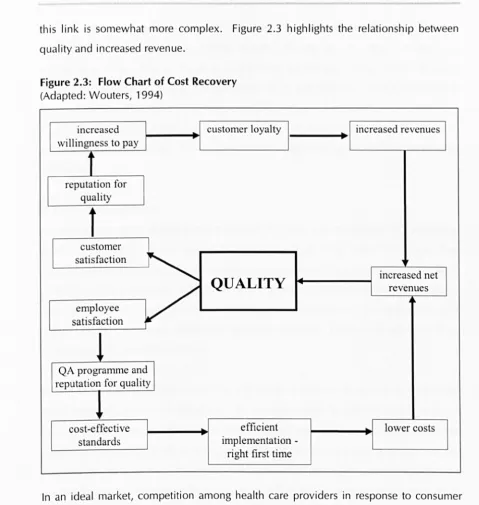
this link is somewhat more complex. Figure 2.3 highlights the relationship between
[image:38.523.24.503.40.545.2]quality and increased revenue.
Figure 2.3: Flow Chart of Cost Recovery (Adapted: Wouters, 1994)
increased customer loyalty
I
.
willingness to pay
t
reputation forquality
1
customer satisfaction
~
QUALITY
V
employeesatisfaction
!
QA programme and reputation for quality
~~
cost-effective efficient
standards implementation
-right first time
~'
I
increased revenuesincreased net revenues
lower costs
In an ideal market, competition among health care providers in response to consumer
demand will work to improve the quality of care, largely by eliminating outliers. A
competitive environment should support good information flow and should value
personal choices and preferences. An ideal market should also permit relatively easy
movement of providers into and out of the market. All of these characteristics of a
market are assumed to lead to better levels of quality than do purely regulatory
mechanisms. None has yet been shown to do so.
Reerink (1991) states that in health services conflict, mistrust and competition are
definitely counterproductive and that the keys to the proper development of modern
[he E\'o/utiof1 of Quality Asmram,,"(' - A Review
---QA are tolerance, common consent and trust. What is called for is 'collaborative
competition', since providing quality health services is not about rivalry and
withholding information to maintain competitive advantage. These 'dirty' business
tactics would certainly lead to a deterioration in health services. Public services are
serving both individual and community needs therefore it is necessary for providers to
co-operate with one another and share experiences in spite of competing for contracts
with purchasing authorities. In fact New Labour propounds (DoH, 1997) a partnership
approach.
2.3.2
Client attitudes
There is also a stark difference in the attitude of clients and availability of alternatives.
Albert Hirschmann (1970) describes that individuals who want to signal their
dissatisfaction with a product or service have two main options: 'exit' and 'voice'.
'Voice' is about expressing judgements and preferences and participating in
decision-making processes in a way which has an effect on what happens. In contrast the 'exit'
option allows individuals dissatisfied with the products, policies or services of an
organisation to vote with their feet.
Private sector clients are choosy, critical and vocal. It is easier for private services to get
direct feedback, where the client pays for a service directly and can judge value for
money. There is also a motive to seek out customer views because they can usually go
elsewhere. In public health services, clients do not pay directly for the service and feel
that they do not have the same rights to demand a quality service or to complain. This
may be due to the fact that many cl ients are too ill or scared to voice thei r views, or, as
Hirschmann has described, the 'voice' can be weakened or corroded when 'exit' is not
an alternative.
Genuine dialogue between consumers and providers is vital and without such dialogue
quality will remain elusive. This concept is developed further in Chapter 4.
I hp Evolutiun of Quality A'imrdnCe . A Rpvi(:'w
2.3.3 Customer range
Another important difference is that most health care providers have to satisfy a range of
clients, often with conflicting requirements. Taking the example of a hospital, it must try
and satisfy the purchasing authorities, the patient, informal carers, the referrer and the
community at large. Which client should the service aim to satisfy and how should the
service resolve conflicts? The answers are more difficult to find than in a service where
one individual walks in, cash in hand, asking for a service. Donabedian (1994) goes
further to discuss the differing roles of the consumer in the promotion of quality health
care. He defines their roles as:
1. Definers of quality
2.
Evaluators of quality3.
I nformants about qual ity4. Co-producers of care
5
.
Targets of quality assurance6. Controllers of practitioner behaviour
7. Reformers of health care
(In Chapter 4 these roles are described in more detail)
Thus, not only is it important to define customer range, it is also vital to understand the
different roles and responsibilities of the consumer and their relation to the provider in
designing, producing and delivering the service.
2.3.4 Intangibles
The patient's judgement of many health services, and often even the efficacy of services,
depends on subtle behaviours of staff. How staff treat the patient in the general sense
has a considerable effect on patient satisfaction since interpersonal relations are one of
the main things which patients can judge.
2.3.5 Professional component
Patients may not be able to judge significant aspects of the service, since often they are
not in a fit state to do so, they are afraid or they may not be technically competent to
make such a judgement. Thus the willing co-operation of professionals is necessary in
order to judge to what extent professionally assessed needs of the patients are met, and
how well the service carries out professional assessments. Donabedian (1994) warns
about the problem of perverse preferences and cultural dissonance. Sometimes patients have preferences that the practitioner believes are contrary to the patient's own best interests or to the practitioner's personal convictions. Also the model of an active, egalitarian partnership between patient and practitioner is often contrary to established norms where a patient delegates decision-making responsibility to the practitioner, who is expected to act in the patient's best interest.
2.3.6 Lessons from the commercial sector
"It's very difficult to say that we have anything to learn from the industrial model in
terms of consumer centredness because our own health care tradition is centred on
the patienti we are trained and motivated to serve patients, that is the raison d'etre of
health care"
(Baker, 1993).Although Baker quite blatantly states that the health sector has
I
ittle to learn from industry in terms of client focus, research into consumer centredness has been developed far more in the commercial sector for reasons of competition and economic gain. Even in the industrial context quality can be difficult to define. Despite this, working definitions have emerged and the basic characteristics of the industrial templatereflect five main emphases as follows (Ellis and Whittington, 1993):
• Achievement of predetermined standards or targets
• Involvement of customer requirements in the determination of such
standards
• Consideration of available financial and other resources in the determination
of such standards
• Recognition that there is always room for improvement and that standards and targets are subject to review
• Recognition of the value of positive organisation-wide quality management
Quality assurance can be applied to any process within any organisation and although there are fundamental differences between manufacturing and service industries and public and private sector organisations, these should not prevent health services from using established quality methods although careful adaptation and selectivity is required
(0vretveit, 1992).