Centre for excellence
for looked after children in ScotlandImplementation Note: 1
Corporate Parenting:
Enabling implementation of Part 9
(all sections)
Dr Lisa Ann Kennedy
November 2015
www
This is the first in a special series of ‘implementation notes’ developed
by CELCIS, with support from corporate parents, to assist in the
implementation and enactment of a specific duty (or a set of duties)
included in Part 9 (Corporate Parenting) of the Children and Young
People (Scotland) Act 2014 (the Act).
The aims of each paper are to:
• Assist corporate parents in deciding how they will meet their corporate parenting duties.
• Identify solutions to the practical challenges faced by corporate parents associated with implementing duties ‘in so far as consistent with the proper exercise of their other functions’.
• Support corporate parents in their efforts to make a positive and meaningful contribution towards improving the lives of looked after children and care leavers.
Implementing Part 9
Implementation is the process of putting a plan (or legislation or innovation) into effect. It’s the ‘doing’ part, and as such, it’s the part which largely determines whether a law is successful in delivering the change or outcome it was designed to. The text of a law rarely changes much on the ground; it’s how relevant organisations and individuals put that law into effect which determines its impact.
Effective implementation of legislation requires leadership, planning, commitment, good communication and hard work. This paper aims to:
• Guide you through a six-step process to ensure that, as a corporate parent, you have all these elements in place, and that you are in a position to implement these duties to both the spirit and letter of the law.
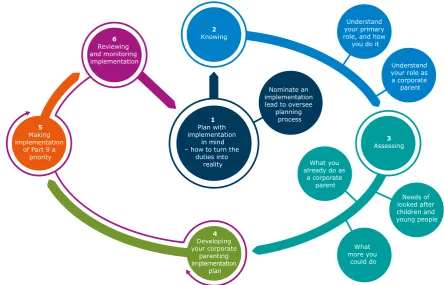
None of the steps are optional, but CELCIS is available to assist at any stage if you require further help. The six steps are illustrated in Figure 3.
Summary of Part 9
Collectively, the duties established by Part 9 are designed to ensure that the attention and resources of various publicly funded organisations are explicitly focused on the task of
safeguarding and promoting the wellbeing of looked after children and care leavers. In particular, Section 58 of the Act states that every corporate parent must:
• Be alert to matters which, or which might, adversely affect the wellbeing of an eligible young person
• Assess the needs of eligible children and young people for any services or support provided
• Promote the interests of eligible children and young people
• Seek to provide eligible children and young people with opportunities to promote their wellbeing
• Take appropriate action to help eligible young people access those opportunities
• Keep their approach to corporate parenting under constant review, seeking out improvement wherever possible1
[image:3.595.174.385.381.637.2]Under Sections 60 – 65 corporate parents must also publish detailed corporate parenting plans and reports, collaborate with each other, follow directions and guidance, and provide relevant information to Scottish Ministers.
Figure 1: Illustration of corporate parenting ‘responsibilities’
OPPORTUNITIES ALERT
ACCES S
AS SES
S
PROMOTE IMPROVE
!
Insights from Implementation Science
Over recent years an accumulation of research and evaluation studies have resulted in a
significant (and growing) body of knowledge of what works in terms of securing positive outcomes for children, adults and communities. However, existing services rarely adapt in response to these advances in knowledge (or do so very slowly). Similarly, policies and procedures mandated in legislation are often implemented partially, or in only a limited way. This difference between what knowledge or a law tell us to do, and our real-life structures and practice, is known as the implementation gap.
Research into the implementation gap is a relatively young discipline, with a focus on identifying the core components of effective implementation. A series of major studies have led to the identification of a set of ‘specific actions […] that can be employed to foster high quality
implementation.’2 These actions reflect best practice in guiding and supporting the implementation
of policies, programmes, interventions and services. They range from the obvious - stakeholder consultation, gaining buy-in, leadership, resource management - to the practical - establishing implementation teams, preparation of implementation plans, monitoring and evaluation. A strong emphasis is placed on the people who will be affected by the change - ensuring staff capacity, providing explicit organisational support to individuals, maintaining a supportive organisational culture, maintaining good communication, and learning from experience.3
A key aspect of the research into implementation is that it happens in stages. At CELCIS we identify four overlapping stages, moving from exploratory and planning activities, through the implementation (the doing) of new actions, and concluding with their full integration into routine, day to day practice across an organisation (illustrated in Figure 2). It’s worth noting that the stages are not linear, but cyclical; implementation should always be accompanied by evaluation and critical reflection, which may, in turn, lead to new innovations and changes that must be implemented. The literature indicates that achieving full implementation (from planning to business as usual practice) takes between two and four years.
Stages one and two of implementation are all about exploring what actions will be taken, and planning how they will be taken. This is a key time for consulting with stakeholders and getting buy-in. Following proper planning and preparation, the identified actions are taken (stage 3). During this stage, ongoing communication, testing (such as Plan-Do-Study-Act cycles), evaluation, and staff coaching are key to ensuring that all goes according to plan, and that plans can be modified as required. By stage 4 the new actions are fully embedded in the system and evaluated.
Research suggests that:
• Each stage is essential to the implementation process and cannot be skipped
• Those implementing the innovation may need to revisit earlier stages to address challenges, and ensure continued support and capacity
• Implementers must be mindful of adopting realistic timeframes (typically up to four years to move through all four stages of implementation).
1 For full details on the corporate parenting duties, please see Part 9 of the Children and Young People (Scotland) Act 2014 2 Meyers, D. C., Durlak, J. A., & Wandersman, A. (2012). The quality implementation framework: A synthesis of critical steps in
the implementation process. American journal of community psychology, 50(3-4), 462-480.
Figure 2: Stages of Implementation
Note: this figure draws on the work of the Centre for Effective Services (2012).
Building on Figure 2, we have developed a six-step process (see Figure 3) to support corporate parents implement their corporate parenting duties.
Figure 3: Six steps to implementation of Part 9 PLANN ING & R ES O UR CIN G EXPL
ORING & PREPARI
NG BU SI N ES S AS USU AL IM P LEM EN
TING & OPERATIONA
LIS ING 1 Plan with implementation in mind – how to turn the
duties into reality 2 Knowing 3 Assessing 4 Developing your corporate parenting implementation plan 5 Making implementation
of Part 9 a priority 6 Reviewing and monitoring implementation Nominate an implementation lead to oversee
planning process
Understand your primary role, and how you do it
Understand your role as a corporate parent Needs of looked after children and young people What more you could do What you
already do as a corporate
[image:5.595.70.515.457.742.2]Step 1: Plan with implementation in mind
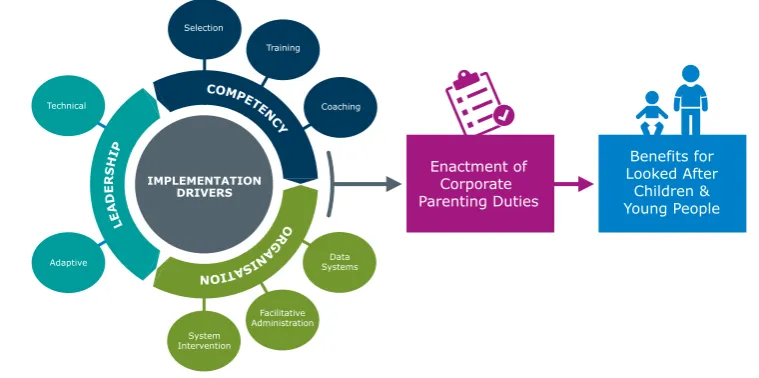
When drawing up a Corporate Parenting Plan, you should always be thinking about ‘how’ each element will be implemented (turned into reality). This requires an understanding of the systems, people and processes which are currently in place, and a detailed picture (based on an assessment of the evidence) of what needs to be in place to make things happen. These are the engines of change, or ‘implementation drivers’ (illustrated in figure 4).
The National Implementation Research Network4 identifies three categories of implementation
drivers.
Competency drivers
Competency drivers relate to your knowledge, skills, and abilities. Some questions you may wish to ask are:
• What knowledge, skills and abilities do we need to carry out the actions expected of us as corporate parents?
• Do we need to change our way of working to be an effective corporate parent?
• What additional learning do we need? For example, through training and coaching.
• What processes and systems do we have in place to respond to the new demands corporate parenting introduces? For example, the corporate parenting duties may influence staff selection and induction processes.
Organisation drivers
Organisation drivers relate to an organisation having sources of information available to enable staff to make good decisions. It involves creating and sustaining a positive, constructive and informed organisation.
• Successful implementation may involve ‘systems interventions’, which require changing policies or funding decisions that could hinder efforts to meet corporate parenting responsibilities. It also means being aware at all levels of opportunities and threats to sustainability.
• ‘Facilitative administration’ involves your efforts to eliminate barriers related to paperwork and uses of time.
• Your structure itself may be a barrier to implementation, so thought needs to be given how to create an administrative environment which facilitates (rather than obstructs) the changes you seek.
• ‘Data systems’ should be in place to support decision making, to assure continued
implementation of corporate parenting duties, and to facilitate assessment of performance.
A first step for many corporate parents will be to identify how many looked after children, young people and care leavers engage with their services, the demographic profile of this group and any trends suggested by this data.
Leadership drivers
[image:7.595.82.462.261.450.2]Leadership drivers focus on providing the right leadership for the challenges that will arise during implementation. Addressing these challenges often necessitates decision making, but it is also about providing guidance and support. You need leadership which can help your organisation navigate the ‘adaptive’ challenges needed to shift culture and attitudes. This will be particularly important at the beginning stages of implementation, such as making looked after children, young people and care leavers a priority. You also need to explore technical issues, for example what measures are put in place to meet corporate parenting duties.
Figure 4: Corporate parenting implementation drivers
1.1 Nominate an implementation lead
We recommend an individual (or a pair of individuals) is nominated as an implementation lead within each organisation identified as a corporate parent. These individuals should:
• Have a remit to ensure the corporate parenting duties are complied with over the implementation period (which we would suggest is April 2015 – April 2018).
• Lead on the development of the plan
• Be available (and equipped) to respond to the challenges of implementation
• Be able to see the impact of the changes introduced.
• Depending on how much change is required within an organisation, it may be useful to identify an implementation team to support the implementation lead. This team:
• Should have the expertise to promote effective, efficient, and sustainable implementation, organisation change, and system transformation work.
• Could involve individuals from outside the organisation as experience, expertise and critical friends are valuable tools in getting implementation right.
Step 2: Knowing
2.1 Understand your primary role, and how you do it
Once you have your implementation lead/ team established you can begin to draft up a corporate parenting plan (Section 59). The first thing you need is a clear understanding of how your new duties as a corporate parent will fit in with your existing functions, systems and processes.
To achieve this understanding you need to map out exactly what your organisation currently does (purpose, aims, objectives, functions, etc) and how (structure, teams, systems, processes, departments). This may involve revisiting your core organisational documents (such as budgets, corporate plans, business plans, organograms, service strategies, etc). The outcome should be a diagram which shows the insides of your organisation, and details how all the components work together to deliver your organisation’s aims. Try not to leave anything (or anyone) out; every part of an organisation has a role to play in making corporate parenting a reality.
2.2 Understand your role as a corporate parent
Once you have the diagram of your organisation, you will need to interrogate all parts through a corporate parenting lens. The aim is to identify what (potential) roles your organisation could play, within the exercise of its other functions, in safeguarding and promoting the wellbeing of eligible young people. Perhaps the simplest approach is to work your way through all parts of the diagram, repeatedly asking the question:
• Does this (service, process, department, etc) contribute to securing or improving the wellbeing of children and young people (in general)?
If the answer is no, then ask the questions: could it? And how?
Remember to ask this question about all parts of your organisation, not just those which have an obvious link to children, young people or families. For example, what role(s) does the Chief Executive, or the grounds keeping team, play? This process is a great opportunity to start
Step 3: Assessing
3.1 Assess the needs of looked after children and young people
In general, an organisation’s approach to corporate parenting should be shaped by two things: (1) its functions, purpose, structure, etc; and (2) the wellbeing needs of looked after children and young people. Step 2 (Knowing) should establish the parameters in respect to the first of these and now you must try and develop an understanding about the second. This is not only essential for effective implementation of Part 9. It is also a specific legal duty in its own right; Section 58(b) requires every corporate parent to ‘assess the needs of [looked after children and care leavers] for any services or support’ you may provide.
Different corporate parents will fulfil their duty to assess needs in different ways. Where appropriate, this may involve engaging with looked after children and care leavers directly. In all cases it is likely to mean exploring existing research and consulting with other relevant organisations. But whatever the method and scope of a corporate parent’s assessment, the objective is always the same: to provide the organisation with a detailed understanding of the wellbeing needs of looked after children and care leavers, including their aspirations and the challenges they face in their daily lives.
For further information on assessment, please refer to the Statutory Guidance and our second
implementation note To be alert and assess which explores the duty to assess needs (Section 58 (1)(b)).
3.2 Assess what you already do as a corporate parent
Equipped with information about your organisation (Step 2) and the needs of looked after children (Step 3.1), you are now in a position to assess what you are already doing which relates to
corporate parenting. Some questions you may wish to ask are:
• How do we stay informed about issues which could have a negative impact on looked after children and care leavers, particularly in relation to our service or organisation?
• How relevant and accessible are our services to looked after children and care leavers?
• What actions do we perform to advantage or benefit looked after children and care leavers?
• What opportunities do we make available to looked after children and care leavers?
• How do we support looked after children and care leavers to participate?
• How do we evaluate our performance and identify areas for improvement?
• What does our performance evaluation tell us? For example, how effective are our services? To what extent are our services helping to improve outcomes for looked after children and young people?
The aim of this process (essentially a baseline assessment) should be to further your
understanding of what you currently do for looked after children and care leavers, and how well you are doing it. This is the opportunity to review what work you’ve done before and evaluate its effectiveness. Where possible you should use evidence to support any assertions made.
3.3 Assess what more you could do as a corporate parent
Following on from, or in parallel to, step 3.2, you need to identify the areas for improvement and assess the opportunities to do new things. The information you gathered at step 2.2 (Know your role) will be key here, as it should contain ideas about how you can develop your role as a corporate parent. Making reference to your organisational diagram again, the following questions may be useful:
• How do we ensure that this service, process or department is being accessed by looked after children and care leavers?
• How do we improve the impact of this service, process or department on looked after children and care leavers?
• How can we work with other corporate parents to ensure the needs of looked after children and care leavers (as identified through our assessment) are met?
Step 4: Developing your corporate parenting
implementation plan
Your first corporate parenting plan is essentially an implementation plan. It should illustrate
• What each duty means for your organisation
• How you will meet each duty
• Who is responsible for ensuring it happens
Remember that responsibility for delivery could be shared among relevant parties, but accountability for delivery should be clearly defined, ideally with the name of an individual.
Appendix 1 should help you structure and begin thinking about your plan.
By following the previous steps you should have all the information you need to start populating your plan. Actions should be clearly defined, responsibility assigned, and deadlines set. The drivers also need to be made explicit, specifying what will be needed for that action to be completed, such as additional resources, or the involvement of senior executive.
Assessing your likely resource requirements will be important when planning the timescales over which you will be implementing Part 9 of the Act. The duty to collaborate with other corporate parents may involve identifying opportunities to share funding, and so discussion with other corporate parents will be helpful at this stage.
Step 5: Making implementation of Part 9 a priority
Everyone working in your organisation should see the implementation of Part 9 of the Act as a priority. This requires good awareness throughout the organisation of how your activities can positively impact on the lives of looked after children and young people. Good work in this area should be recognised, valued and rewarded.
Step 6: Reviewing and monitoring
Implementation of the plan (developed in steps 1 – 4) should be reviewed and monitored, with results fed back to interested parties, including looked after children and young people themselves. Indeed, review is expected under Sections 61 and 62 of Part 9 of the Act. You should be asking yourself questions like: did that work as we intended? And if so/ if not, why? And where could we improve?
Although listed as the final step in our list of suggested steps, these activities overlap heavily with those involved in Step 3. Reviewing and monitoring cannot be put off until later. Reviewing and monitoring is part of an ongoing process, and all learning must feed back into how the implementation of parenting duties and responsibilities is carried out, and the development of future corporate parenting plans.
Authors note
Please note this paper does not replace or supersede the Scottish Government’s Statutory Guidance on Part 9 (Corporate Parenting), published in July 2015, to which all corporate parents must have regard. As implementation of Part 9 will look different for each corporate parent, in view of their distinct functions and context, guidance or papers cannot provide a simple how-to guide. As such, this series of implementation notes have no statutory basis but instead provide additional, optional advice and ideas, as well as generic ‘good practice’ in respect of the fulfilment of specific corporate parenting duties. The Scottish Government and its agencies may also refer to these papers when reviewing corporate parent’s performance.
Section of the Act
Current R
elev
ant
Activities
Ev
aluation of
Current Activities
Actions to Progress W
ork in this Area
Time line
Expected outcomes
58 1(a)
T
o be alert
58 1(b)
T
o assess
the needs 58 1(c)
T
o promote
the interests 58 1(d)
T
o seek to
pro
vide opportunities
58 1(e)
T
o tak
e
action to help these children access opportunities and mak
e use of services
58 1(f)
T
o tak
e
action to impro
ve as
a corpor
ate parent
Appendix 1: Corpor
ate parenting duties
Section of the Act
Current R
elev
ant
Activities
Ev
aluation of
Current Activities
Actions to Progress W
ork in this Area
Time line
Expected outcomes
59
To prepare,
publish and k
eep plan
under review 60
To collabor
ate
61
To report on
fulfilment of corpor
ate
parenting duties 62
To pro
vide
Scottish Ministers with information on fulfilment of corpor
ate
parenting duties 63
To ha
ve regard to
an
y guidance about
corpor
ate parenting
issued b
y the Scottish
Ministers 64
To comply with
relev
ant direction
issued b
y the Scottish
About CELCIS
Our goal is simple. We want to make a difference. We are totally committed to making positive and lasting improvements in the experiences, life chances and outcomes for Scotland’s looked after children and young people. Taking a multi-agency, collaborative
approach towards making lasting change thinking and ways of working, with everyone whose work touches the lives of looked after children.