1
Speech, language and
communication difficulties
Nina Vaswani, Research Fellow,
Centre for Youth & Criminal Justice (CYCJ)
2
Introduction
The Scottish Government has identified a policy priority in relation to speech, language and communication needs and how they relate to youth justice. Competence in speech,
language and communication develops from birth onwards, with the early years
a crucial time for acquiring key skills (Snow and Powell, 2012). Speech, language and communication needs (SLCN) can be defined as “…problems with speech, language and hearing that significantly impact upon an individual’s academic achievement or day-to-day social interactions.” (Hughes et al., 2012: p9). Disorders and deficits can occur in children and young people for many reasons, including genetics, birth trauma, or childhood
injury (Hughes et al., 2012). Crucially, a key factor is the influence of the primary
caregiver(s) as an “unstable, unpredictable or critical communication environment curtails development of skills…” (CYCJ, 2014: p8.).
SLCN is a broad term that encompasses a range of difficulties, both receptive and
expressive. These include: verbal, written or non-verbal expression; understanding spoken or written word, body language and facial expressions; listening and remembering;
expressing feelings and emotions in an appropriate and adaptive way; or being able to relate to others in socially acceptable ways (RCSLT, 2009). It is clear that SLCN have the
potential to have a profound impact on the development and socialisation of children and young people, and with the evidence indicating that young people involved in offending are disproportionately affected by these issues (Gregory and Bryan, 2011) the need for clarity around SLCN and how they shape interactions with the justice system becomes apparent.
In order to collate existing knowledge and current practice in relation to this topic, the Centre for Youth & Criminal Justice (CYCJ) undertook a short desk-based piece of work between June and July 2014 to help inform Scottish Government policy.
Methodology
A literature search was undertaken by the Scottish Government Library services across a number of databases including: IDOX, Criminal Justice Abstracts, SocINDEX, ASSIA, Academic Search Premier and a general internet search. Further systematic searching was not undertaken by CYCJ, although a small number of additional articles were identified. All accessible articles were assessed for relevance, and a total of 27 papers were read and 25 were included in this review, but this is not an exhaustive review of the literature.
3
Brief Literature Review
1. Prevalence
Across studies there tended to be a broad consensus that the prevalence of SLCN in the youth justice population was approximately between 50% and 60% (Gregory and Bryan, 2012; Heritage et al., 2011; Hughes et al, 2012; Saunders, 2014; Snow and Powell, 2011; Talbot, 2010) compared to 10% or less in the general child population (Hartshorne, 2006a; Heritage et al., 2011; Hughes et al., 2012; RCSLT, 2012). However,
this estimate does vary between specific groups of young people, or with the nature of SLCN. For example it has been noted that there is less information available about the level of SLCN amongst female offenders (CYCJ, 2014) and that at least some level of difficulty with communication has been observed in 75%-90% of young people in custody (Gregory and Bryan, 2011; Khan, 2010; RCSLT, 2012; Snow and Sanger, 2011).
Detailed prevalence rates were not available for different manifestations of SLCN, however, social skills were commonly found to be affected (Hughes et al., 2012). For example, in a study of 72 young people aged 14 to 17 who were persistently involved in offending, Gregory and Bryan (2011) found that two-thirds (68%) required some form of intervention, with the most common difficulties relating to social skills and receptive language. Similarly, few studies explore the severity of SLCN when they are present, although one study indicated that, while 74% of young people attending a Youth Offending Team had problems with communication skills, a smaller (yet still substantial) proportion (42%)
displayed significant difficulties (RCSLT, 2012). Of note is that many of the young people’s SLCN remained undiagnosed until the study in question (RCSLT, 2012; Snow and Sanger, 2011), meaning that needs were remaining unaddressed until mid-to-late adolescence.
2. Implications for youth justice
Young people with SLCN can be marginalised from a young age, especially if these needs go undiagnosed and untreated (Snow and Powell, 2012). Young people with SLCN also often end up struggling with literacy and interpersonal skills, as a strong language base is needed to underpin the development of these skills (Hartshorne, 2006a; Snow and Powell, 2012). However, ‘learning to read’ is essential for being able to go on to ‘read to learn’ which is a key mechanism of curriculum delivery in the later primary and secondary school years (Hartshorne, 2006a; Snow and Powell, 2012). Young people may become frustrated with their learning experiences and experience low self-esteem and distress in the classroom, which often increases throughout the school years (RCSLT, 2013). Young people may begin to act out in the classroom, or truant, which leaves them (males especially) at risk of being diagnosed with behavioural problems rather than the underlying SLCN (Snow and Powell, 2012).
Furthermore, young people with SLCN are more likely to have had an adverse childhood, for example through neglect or poor parenting, and are therefore more likely to have reduced resilience to stressful events (CYCJ, 2014). This is compounded by the fact that language skills are important for reflection and the expression of emotions, all of which are crucial activities to help develop individual resilience (CYCJ, 2014). Left untreated, around one-third of young people with SLCN are estimated to go on to develop mental health
problems (Heritage et al., 2011).
Therefore SLCN can first be implicated in youth justice by interacting with protective factors, such as self-esteem, engagement with education, academic achievement; meaningful
4
at increased risk of involvement in offending (CYCJ, 2014; Gregory and Bryan,
2011; Hartshorne, 2006a; Hughes et al, 2012; RCSLT, 2012; Snow and Sanger, 2011). It is therefore not surprising that studies have found that early developmental language problems in young males can predict antisocial behaviour in adolescence or early adulthood (Brownlie et al., 2004; Snow and Sanger, 2011).
Once a young person is involved in the youth justice system, then SLCN can cause
further problems. When a young person with SLCN comes across those in authority, such as under questioning at a police station, or attendance at court, their SLCN can cause them to present in ways that increase their risk of criminalisation (Hughes et al., 2012). For example, young people may respond with monosyllabic answers (Snow and Powell, 2011), or be unable to make eye contact, or present a coherent narrative about the events in question (Snow and Powell, 2012). In addition they may not understand the court process enough to be able to successfully participate (RCSLT, 2012; Talbot, 2010). It is therefore of no surprise that an online survey of 208 Youth Offending Team staff in England and Wales revealed that their perception was that young people with SLCN were more likely to receive a custodial sentence than those without such needs (Talbot, 2010), or that 70% of young offenders in Polmont YOI were identified in 2003 as having significant communication problems (Polmont, 2003, cited in: RCSLT, 2010).
This may, in part, be attributable to greater non-compliance among young people with SCLN. Data from the Youth Justice Board (Hart, 2011) shows that around one-in-five children in custody were guilty of a breach offence, and that almost one-in-ten were there solely as a result of breach of a statutory order, most often a community sentence (Hart, 2011). Thus it is important to ensure that children and young people fully understand the detail and the implications of their orders. However, SLCN mean that young
people often struggle to understand what is being said to them, and therefore have difficulty following instructions (CYCJ, 2014; Khan, 2010) or keeping to timetabled appointments (CYCJ, 2014).
SLCN interferes with the ability to form positive, prosocial relationships or to engage in meaningful activity such as employment, which reduces the likelihood of the young person themselves creating the right environment for desistance (Hughes et al., 2012; Snow and Powell, 2011). Furthermore, most youth justice interventions are ‘verbally mediated’ (Snow and Powell, 2012) and include cognitive-behavioural approaches, anger management interventions, substance misuse programmes, or therapeutic work involving face-to-face contact and dialogue. SLCN mean that young people may find it difficult to engage meaningfully or to obtain any benefit from these interventions (Gregory and Bryan, 2011; Khan, 2010; RCSLT, 2012; Rucklidge et al., 2013).
Restorative Justice (RJ) has been highlighted as a particular intervention that young people with SLCN might struggle with. The intervention often involves face-to-face conferencing that demands a certain level of competence in communication skills, as
it requires both expressive and receptive language skills, in what can be an emotional and stressful situation for both parties (Snow and Sanger, 2011). Thus a young person who responds in monosyllables, who does not display the expected non-verbal behaviours or read the appropriate social cues “…may simply serve to create an impression of
5
It is clear then that SLCN can increase the likelihood of a young person becoming involved in offending, while at the same time decrease the likelihood of being able to create the opportunities and relationships necessary for desistance or to meaningfully engage with interventions designed to reduce offending. This has an impact not only on the individual, their family and their community, but also more widely, as it has been estimated that a 16 year old male with untreated SLCN would cost the public purse more than £153,000 in terms of interventions and periods in secure care, compared to costs of around £42,000 to
diagnose speech, language and communication needs and to intervene between the ages of five and 15 (Hartshorne, 2006b)
3. Assessment
Considering the far-reaching impact of SLCN, the importance of identifying SLCN at the earliest possible stage is clear. However, identification of SLCN is very low (RCSLT, 2012), and it is therefore unsurprising that few of the papers included in this review
mentioned assessment tools. Those that did tended not to report the use of the tools in any detail. Self-report of SLCN is often found to be inaccurate due to many young people being unaware of their difficulties (CYCJ, 2014). A few studies reported that in youth justice populations there was little routine screening for SLCN, mostly due to a lack of specific or validated screening tools (HMI Probation, 2013; Talbot, 2010). In these situations most practitioners relied on generic assessments such as ASSET to help identify
needs. However, it has also been noted that many of these generic assessment tools require a certain level of verbal understanding and expression from young people (Talbot, 2010).
Where specific tools were used, these were not always suitable for the youth justice
population. For example, in a study of 80 young people aged 14 to18 attending two London YOTs found that young people scored at the extreme ends on the self-report scale (tending to underestimate SLCN at pre-test and over-estimate it at post-test). The use of the
Broadmoor Observation of Communication, a standard tool used with adults and children who have suffered illness (i.e. stroke), was not found to be useful with this population as there were ceiling effects with most young people scoring close to the maximum (Burrows and Yiga, 2012). The tool has been used successfully in other Youth Offending
Teams (Gregory and Bryan, 2011).
Other screens mentioned were the Communications Trust’s ‘Communication Needs Hidden Disability Questionnaire’ (Heritage et al., 2011; Talbot, 2010), although this was reported to be labour intensive (Heritage et al., 2011); Quickscan and SCORE (Talbot, 2010) which were used in a small number of YOTs, as well as unspecified and locally developed tools. The Do-IT Profiler has also been developed to assess Learning Disabilities and Difficulties (LDD) more generally, but covers social, communication, literacy, numeracy, attention and co-ordination skills, and has been used in prisons and YOIs (Do-IT Solutions Ltd, 2014). The Box is a screening tool accompanied by a training package and has been specifically designed for youth justice. A pilot of the 14-item screening tool over five sites found that it identified a similar proportion of SLCN in comparison to other studies
(63%), and was found to be useful by most respondents (93%), but the screen has not been formally tested for reliability and validity (RCSLT, 2013).
6
Clearly, while a small number of screening tools exist, there is little information available about the use of these, or when and with whom they work best. Further information is required in this area, although it is promising to note that even without specific
tools, awareness raising can increase the likelihood that SLCN will be detected.
4. Intervention
Given the early onset of SLCN, public health and preventative approaches prior to attending school are seen as crucial for ensuring that children have the basic foundation from which to build their learning (Hartshorne, 2006a; Hughes et al., 2012). In this respect, supporting parents, particularly in at risk families, to model communication and literacy at home is seen as important (Hartshorne, 2006a).
In relation to specific interventions, it has been difficult to identify detailed information about approaches that are supported by good quality evaluation, as there is a dearth of intervention studies on this topic. Clearly interventions exist, as a survey of Speech and Language Therapists and a review of the literature (Law et al., 2010) identified 57
interventions that were in use in England and Wales, although only three had a strong level of evidence (at least one systematic review) and a further 32 had a ‘moderate’ level of
evidence. However, the majority of these were specialist speech and language interventions aimed at pre-school or primary age children. The report by Law et al. (2010) did not detail all of the available interventions but did provide a case study of an approach in use in North West England. ‘Talk of the Town’ aims to provide a joined-up and three-tiered approach to intervention (universal, targeted and specialist) for children under the age of 18. This project, while sounding promising, has not yet been formally evaluated and so will not be covered in more detail here.
Burrows and Yiga (2012) considered the effectiveness of a six-to-eight session of intensive therapy intervention delivered by an SLT, alongside awareness-raising for staff. Participants were a group of 47 randomly selected young people attending one London YOT. Outcomes were compared to 33 young people in a different London YOT, who did not receive the intervention, and there was found to be no significant difference in outcomes between the intervention and the comparison group. The authors suggest that this might be because the intervention that was delivered was standardised, and they hypothesised that young people might respond better to individually tailored interventions. As participants were not
randomised to experimental or control groups, there may have also been underlying differences between the two YOTs.
A number of interventions work by trying to build capacity in existing service provision. For example, in the study by Gregory and Bryan (2011) an SLT was hired to provide support for three-and-a-half days per week to the Intensive Supervision and Surveillance Programme (ISSP) in a YOT in England. This was a staged model of intervention,
including: screening; the provision of advice and resources; awareness-raising and training among YOT staff to deliver interventions and, on occasion, joint-working. The
evaluation found that 75% of young people made improvements in all areas of
communication targeted, but is limited by the small sample (n=20), the lack of a control group, and the fact that the study did not explore youth justice related outcomes.
7
main elements: firstly young people are trained to increase their awareness of SLCN and are given the skills to co-deliver training to organisations; the second element then relates to raising awareness, confidence and skills in non-specialist staff (co-delivered by young people); and the third stage involves mentoring sessions for the young people to help them actively develop and build on skills. The training is being evaluated, although the research has not yet concluded. Anecdotal feedback, however, is positive.
Similarly, The Box is a screening tool, e-learning and face-to-face training package for youth and criminal justice practitioners, developed by the Royal College of Speech and Language Therapists (RCSLT, 2013). The Box has been piloted across five sites in the UK, including one in Scotland. The research so far is limited to a process evaluation (RCSLT, 2013), although feedback from practitioners is promising, with the majority stating that their confidence, knowledge and awareness of strategies to promote better communication increased as a result of the training.
Other studies indicated modifications to existing interventions that might help a young person engage, such as reducing ‘verbal load’ and increasing the ‘dosage’
of interventions (Snow and Powell, 2012), or by using an intermediary in court to increase lawyers’ understanding of appropriate questioning (Davies et al., 2011).
It is clear that, although some promising-sounding interventions exist, very few are supported by even a moderate level of evidence. In addition, service provision is patchy; and tends to be geared towards the primary school ages and younger (Law et al., 2010). For adolescents and young adults, service provision tends to be most concentrated ‘upstream’ (i.e. in prisons) rather than at an earlier stage when support might have prevented the situation deteriorating (Clark et al., 2012).
Current Practice in Scotland
This section presents the findings from an online survey of youth justice managers,
practitioners and related staff across Scotland in June 2014. As outlined in the methodology section this should not be seen as a representative sample of youth justice, as only 17 responses were received.
Respondents tended to be youth or criminal justice managers (n=9, 53%), but also included some frontline staff, an SLT, a psychologist and education manager. Responses were most common from Dumfries and Galloway (n=3, 18%), but were also received from: Angus, Dundee, East Lothian, Falkirk, Fife, Glasgow, Orkney, Renfrewshire and Borders. Two respondents worked in organisations or roles that had a Scotland-wide remit and one respondent did not specify their location.
1. Assessment
8
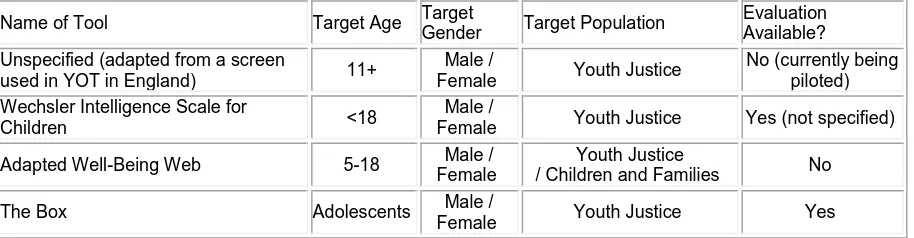
Table 1: Assessment tools available to youth justice and related staff (n=4)Name of Tool Target Age Target
Gender Target Population
Evaluation Available? Unspecified (adapted from a screen
used in YOT in England) 11+
Male /
Female Youth Justice
No (currently being piloted) Wechsler Intelligence Scale for
Children <18
Male /
Female Youth Justice Yes (not specified)
Adapted Well-Being Web 5-18 Male / Female
Youth Justice
/ Children and Families No
The Box Adolescents Male /
Female Youth Justice Yes
However, these tools were mainly not yet evaluated, or were not validated for specific use with SLCN populations. “We rarely use the WISC given that it is a static assessment with some validity issues for our population, however it can be useful to highlight potential areas
of need, including those with verbal comprehension.” Only The Box has been evaluated,
and has been perceived by practitioners to be useful for the youth justice population, although the screening tool has not been formally tested for reliability and validity.
Of the 11 respondents who did not have access to assessment or screening tools, or who were not aware of what existed in their area, almost three-quarters (n=8, 73%) were
interested in using a tool to assess SLCN in their area: “Would be useful to have such a tool
available to Youth Justice workers to ensure that these issues are highlighted as part of
YJ assessments.” Two respondents were not sure if this would be useful, and one
respondent did not answer the question.
2. Intervention
Only seven respondents (41%) reported that there were services or interventions available in their areas to support young people with SLCN, and of these only four specified the
[image:8.595.72.529.157.276.2]intervention available (see Table 2).
Table 2: Interventions available to youth justice and related staff (n=4) Name of Intervention /
Service Target Age
Target
Gender Target Population
Evaluation Available? SLCN Specialist service via
Health -
Male /
Female Youth Justice -
Speech and Language
Therapy <18
Male /
Female Youth Justice Don’t Know Speech and Language
Therapy <18
Male / Female
Youth Justice / Children and
Families No
The Box Adolescents Male /
Female Youth Justice Yes
It was clear that interventions were reliant on service provision by specialist and external services, with only one area having specific interventions available to non-specialist
practitioners (The Box). One other area noted that, although they did not have interventions designed specifically for SLCN, existing youth justice interventions were tailored to meet the needs of young people with SLCN: “Interventions are tailored to specific needs and may
incorporate advice and support on effective strategies or direct interventions to build skills.”
9
interested in using interventions to support young people with SLCN. Even those with access to services felt that a broader range would be beneficial: “Interventions are dealt with by specialists to whom we make referrals. We would benefit from interventions available to
ourselves."
Respondents were also given space to provide additional comments about SLCN in their area. They tended to talk about a high level of need in this area, but expressed frustration at the challenges that existed in accessing services for young people. Most were keen to meet the needs of young people with SLCN better and were interested in accessing training, resources and services:
“Experience and assessments would highlight a very high rate of language difficulties within
our population (secure and residential care) however, accessing services has proved difficult. Our work focuses on educating and training staff to communicate effectively and to
in turn scaffold and encourage communication skills with YP"
“Difficult to access speech and languages services for adolescents within a timescale
commensurate with SW intervention plan. No seamless service through CAMHS/school nurses etc. Young person and parent may have to attend numerous different health appointments with an array of individuals, again this is not an easy pathway to services for
young people"
“We would be very interested to further explore assessment tools and interventions”
Conclusions
SLCN are undoubtedly an important issue for youth justice, being widespread and having a profound impact on young people at all stages of the youth justice system. From reducing engagement with protective factors such as education; to having a detrimental impact on personal presentation and understanding during justice processes; to reducing the ability of young people to benefit from, or comply with, youth justice interventions, it is clear that unidentified and unaddressed SLCN contribute to an increased risk of criminalisation in young people. Unsurprisingly then, youth justice practitioners report a need for
10
References
Brownlie, E.B., Beitchman, J.H., Escobar, M., Young, A., Atkinson, L., Johnson, C., Wilson, B. and Douglas, L. (2004). Early language impairment and young adult delinquent and aggressive behaviour. Journal of Abnormal Child Psychology, 32(4),453-467.
Burrows, S. and Yiga, I. (2012). Youth offending and speech and language therapy (a
controlled study). London: Ealing Council.
Clark, A., Barrow, E. and Hartley, K. (2012). Unmet need in Scotland’s criminal justice
system. RCSLT Bulletin.
CYCJ. (2014). Speech, Language and Communication Needs in Youth
Justice: www.cycj.org.uk
Davies, E., Hanna, K., Henderson, E. and Hand, L. (2011). Questioning child
witnesses:
www.lawfoundation.org.nz/wp-content/uploads/2011/10/Questioning-child-witnesses_exploring-intermediary-models1.pdf
Do-IT Solutions Ltd. (2014). Do-IT Profiler: www.doitprofiler.com/
Gregory, J. and Bryan, K. (2011) Speech and language therapy intervention with a group of persistent and prolific young offenders in a non-custodial setting with previously
undiagnosed speech, language and communication difficulties. International Journal of
Language and Communication Disorders, 46(2): 202-215.
Hart, D. (2011). Into the breach: the enforcement of statutory orders in the youth justice
system. London: Prison Reform Trust.
Hartshorne, M. (2006a). Speech, language and communication needs and literacy
difficulties. I CAN Talk Series, Issue 1. London: I CAN: www.ican.org.uk
Hartshorne, M. (2006b). The cost to the nation of children’s poor communication. I CAN Talk Series, Issue 2. London: I CAN: www.ican.org.uk
Heritage, M., Virag, G. and McCuaig, L. (2011). Better outcomes for young offenders.
Exploring the impact of speech and language therapy in youth offending teams. NHS
Derbyshire Report.
HMI Probation. (2013). Examining multi-agency responses to children and young people
who sexually offend. Joint Inspection Report.
Hughes, M., Williams, H., Chitsabesan, P., Davies, R. and Mounce, L. (2012). Nobody made
the connection: The prevalence of neurodisability in young people who offend. London: The
Office of the Children’s Commissioner: www.childrenscommissioner.gov.uk/
Khan, L. (2010). Reaching out, reaching in: promoting mental health and emotional
well-being in secure settings. Centre for Mental Health.
Raising Your Game. (n.d.). Talk about Talk. Part of the Raising Your Game Project. Scottish
briefing document. Unpublished document.
11
RCSLT. (2010). Speaking out: young offenders with communication
difficulties: www.rcslt.org
RCSLT. (2012). Speech, language and communication needs in the Criminal Justice System and best practice responses to these. Dossier of Evidence. Unpublished document.
RCSLT. (2013). An evaluation of the pilot for The Box, the RCSLT’s criminal justice training
package and screening
tools: www.rcslt.org/speech_and_language_therapy/docs/rtk_final_report_box_pilot
Rucklidge, J.J., McLean, A.P. and Bateup, P. (2013). Criminal offending and learning
disabilities in New Zealand youth: Does reading comprehension predict recidivism? Crime &
Delinquency, 59(8), 1263-1286.
Saunders, A. (2014). Young Adults (18-24) in transition, mental health and criminal justice. Bradley Commission Briefing. London: Centre for Mental
Health: www.centreformentalhealth.org.uk
Snow, P. and Powell, M. (2011). Oral language competence in incarcerated young offenders: Links with offending severity. International Journal of Speech-Language
Pathology, 13(6): 480-489.
Snow, P. and Sanger, D.D. (2011). Restorative Justice conferencing and the youth offender:
exploring the role of oral language competence. International Journal of Language and
Communication Disorders, 46(3): 324-333.
Snow, P. and Powell, M. (2012). Youth (in)justice: Oral language competence in early life
and risk for engagement in antisocial behaviour in adolescence. Trends & issues in crime
and criminal justice: No. 435. Canberra: Australian Institute of Criminology.
Talbot, J. (2010). Seen and heard: Supporting vulnerable children in the youth justice