City, University of London Institutional Repository
Citation: Kapetanios, G., Labhard, V. and Price, S. (2007). Forecasting using Bayesian
and information theoretic model averaging: an application to UK inflation (07/15). London, UK: Department of Economics, City University London.This is the unspecified version of the paper.
This version of the publication may differ from the final published
version.
Permanent repository link: http://openaccess.city.ac.uk/1476/
Link to published version: 07/15
Copyright and reuse: City Research Online aims to make research
outputs of City, University of London available to a wider audience.
Copyright and Moral Rights remain with the author(s) and/or copyright
holders. URLs from City Research Online may be freely distributed and
linked to.
City Research Online: http://openaccess.city.ac.uk/ [email protected]
Department of Economics
School of Social Sciences
Forecasting using Bayesian and information theoretic model
averaging: an application to UK inflation
George Kapetanios
1Queen Mary University of London
Vincent Labhard
2Bank of England
Simon Price
3Bank of England and City University
Department of Economics
Discussion Paper Series
No. 07/15
1 Email: [email protected].
2 Email: [email protected]
3 Department of Economics, City University, Northampton Square, London, EC1V
Forecasting using Bayesian and
information theoretic model averaging:
an application to UK in ation
George Kapetanios
yQueen Mary University of London
Vincent Labhard
zBank of England
Simon Price
xBank of England and City University
June 2006
Abstract
Model averaging often improves forecast accuracy over individual forecasts. It may also be seen as a means of forecasting in data-rich environments. Bayesian model av-eraging methods have been widely advocated, but a neglected frequentist approach is to use information theoretic based weights. We consider the use of information-theoretic model averaging in forecasting UK in ation, with a large data set, and
nd that it can be a powerful alternative to Bayesian averaging schemes.
Keywords: forecasting, in ation, Bayesian model averaging, Akaike criteria, forecast
combining
JEL: C110, C150, C530
This paper represents the views and analysis of the authors and should not be thought to represent those of the Bank of England or Monetary Policy Committee members. We are grateful for comments from two anonymous referees, the Editor and an Associate Editor of the JBES.
1
Introduction
A key metric of a satisfactory forecast is precision, often de ned in a root mean square
error sense, and techniques that can deliver this are highly desirable. Model averaging is
one such that often improves forecast accuracy over individual forecasts.
Another aspect of forecasting is appropriate methodology in data-rich environments, and
in recent years there has been increasing interest in forecasting methods that utilise large
datasets. There is an awareness that there is a huge quantity of information available in
the economic arena which might be valuable for forecasting, but standard econometric
techniques are not well suited to extract this in a useful form. This is not an issue of
mere academic interest. Lars Svensson described what central bankers do in practice in
Svensson (2004). `Large amounts of data about the state of the economy and the rest of
the world ... are collected, processed, and analyzed before each major decision.' In an
e ort to assist in this task, econometricians began assembling large macroeconomic data
sets and devising ways of forecasting with them: James Stock and Mark Watson (e.g.,
Stock and Watson (1999)) were in the vanguard of this campaign.
One popular methodolgy is forecast combination, where information in many forecasting
models, typically simple and incomplete, are combined in some manner. Stepping back,
forecast combination originated not in the large data set programme, but from
observa-tions by forecast practitioners that for whatever reasons, combining forecasts (initially
by simple averaging) produced a forecast superior to any element in the combined set.
This may seem odd, as if it were possible to identify the correctly speci ed model (and
the data generating process (DGP) is unchanging), then it might seem natural so to do,
although this is less obvious than it may seem. The true DGP may include very many
variables that make it infeasible to estimate, and there is a general bene t from parsimony
in forecasting. But the weight of evidence dating back to Bates and Granger (1969) and
Newbold and Granger (1974) reveals that combinations of forecasts often outperform
in-dividual forecasts. Recent surveys of forecast combination from a frequentist perspective
are to be found in Newbold and Harvey (2002) and Clements and Hendry (1998); see also
Clements and Hendry (2002). Models may be incomplete, in di erent ways; they employ
di erent information sets. Forecasts might be biased, and biases can o set each other.
be taken into account. Thus, combining misspeci ed models may, and often will, improve
the forecast.
An alternative way of looking at this problem is from a Bayesian perspective. Here it
is assumed that there is a distribution of models, thus delineating the concept of model
uncertainty quite precisely. The basic problem, that a chosen model is not necessarily the
correct one, can then be addressed in a variety of ways, one of which is Bayesian model
averaging. From this point of view, a chosen model is simply the one with the best
pos-terior odds; but pospos-terior odds can be formed for all models under consideration, thereby
suggesting a straightforward way of constructing model weights for forecast combinations.
This has been used in many recent applications; for example, forecasting US in ation in
Wright (2003a).
There is an analagous frequentist information theoretic approach. In this context,
infor-mation theory suggest ways of constructing model con dence sets. We use this term in
a broader sense than in the related literature of Hansen, Lunde, and Nason (2005) and
Kapetanios, Labhard, and Schleicher (2006). Given we have a set of models, we can
de-ne relative model likelihood. Model weights within this framework have been suggested
by Akaike (initially, Akaike (1978)). Such weights are easy to construct using standard
information criteria. Our purpose, then, is to consider this way of model averaging as an
alternative to Bayesian model averaging.
In this paper we develop the information-theoretic alternative to Bayesian model averaging
and assess the performance of these techniques by means of a Monte Carlo study. We
then compare their performance in forecasting UK in ation. For this, we use a UK
data set which emulates the data set in Stock and Watson (2002) (see Appendix.) Our
ndings support those of Wright (2003a), who concludes that Bayesian model averaging
can provide superior forecasts for US in ation, but we nd that the frequentist approach
2
Forecasting using Model Averaging
2.1
Bayesian Model Averaging
The idea behind forecasting using model averaging re ects the need to account for model
uncertainty in carrying out statistical analysis. From a Bayesian perspective, model
un-certainty is straightforward to handle using posterior model probabilities. See for example
Min and Zellner (1993), Koop and Potter (2003), Draper (1995a) and Wright (2003a,b).
Brie y, under Bayesian model averaging a researcher starts with a set of models which have
been singled out as useful representations of the data. We denote this set asM=fMigNi=1
where Mi is the i-th of the N models considered. The focus of interest is some quantity
of interest for the analysis, denoted by . This could be a parameter, or a forecast, such
as in ation hquarters ahead. The output of a Bayesian analysis is a probability
distribu-tion for given the set of models and the observed data at time t. Denote the relevant
information set at timet byDt, and the probability distribution aspr( jD;M). This is
given by
pr( jDt;M) = N
X
i=1
pr( jMi; Dt)pr(MijDt) (1)
where pr( jMi; Dt) denotes the conditional probability distribution of given a model
Mi and the data Dt and pr(MijDt) denotes the conditional probability of the model
Mi being the true model given the data. Implementation requires two quantities to be
obtained at each point in time. First,pr( jMi; Dt) which is easily obtained from standard
model speci c analysis. Second, the weights, pr(MijDt). The weights are formed as part
of a stochastic process where pr(MijDt) is obtained from pr(MijDt 1), the conditional
probability of the model Mi being true, given the previous period's data. This requires
prior distributions forpr(MijD0) = pr(Mi) and pr( ijMi; Dt 1) to be speci ed.
Thus we need to obtain a number of expressions for (1) to be operational. First, using
Bayes' theorem
pr(MijDt) =
pr(DtjMi; Dt 1)pr(MijDt 1)
pr(DtjDt 1)
= PNpr(DtjMi; Dt 1)pr(MijDt 1)
i=1pr(DtjMi; Dt 1)pr(MijDt 1)
(2)
where pr(DtjMi; Dt 1) denotes the conditional probability distribution of the data given
the modelMi and the previous period's data and
pr(DtjMi; Dt 1) = Z
is the likelihood of model Mi, where i are the parameters of model Mi. Given this, the
quantity of interest is
E( jDt) = N
X
i=1
^
ipr(MijDt) (4)
In theory (see e.g. Madigan and Raftery (1994)) when is a forecast, this sort of
averaging provides better average predictive ability than single model forecasts.
2.2
Information Theoretic Model Averaging
In the context of non-Bayesian methods of forecasting the idea of model averaging (i.e.,
forecast combination) has a long tradition starting with Bates and Granger (1969). The
aim is to use forecasts obtained during some forecast evaluation period to determine
optimal weights from which a forecast can be constructed along the lines of (4). These
weights are usually constructed using some regression method and the available forecasts.
But a problem arises if N is large. For example, N=93 as in Wright (2003a) requires an
infeasibly large forecast evaluation period.
Although the literature on model averaging inference is dominated by work with Bayesian
foundations, there has also been some research based on frequentist considerations. Hjort
and Claeskens (2003) provide a brief overview in the context of analysing model
aver-aging estimators from a likelihood perspective. Most frequentist work focuses on the
construction of distributions and con dence intervals for estimators of parameters that
take into account, in some way, model uncertainty. Examples include Hurvich and Tsai
(1990), Draper (1995b), Kabaila (1995), P•otscher (1991), Leeband and P•otscher (2000)
and Kapetanios (2001). The work of Burnham and Anderson (1998), on which we build,
forms a substantial part of the frequentist model averaging work available in the
litera-ture. But the present paper is one of the rst to focus on forecasting as opposed to the
construction of con dence intervals in the context of frequentist model averaging.
Our alternative to Bayesian model averagaing is based on the analogue of pr(MijDt) for
frequentist statistics. Such a weight scheme has been implied in a series of papers by
Akaike and others (see, e.g., Akaike (1978, 1981, 1983, 1979) and Bozdogan (1987)) and
expounded further by Burnham and Anderson (1998). Akaike's suggestion derives from
the Akaike information criterion (AIC). AIC is an asymptotically unbiased measure of
parameters in the model, which may be viewed as a penalty for over-parameterization.
Akaike's original frequentist interpretation relates to the classic mean-variance trade-o ,
although Akaike (1979) o ers a Bayesian interpretation. In nite samples, when we add
parameters there is a bene t (lower bias), but also a cost (increased variance). More
technically, from an information theoretic point of view,AIC is an unbiased estimator of
the Kullback and Leibler (1951) (KL) distance of a given model where the KL distance
is given by
I(f; g) =
Z
f(x) log f(x)
g(xj ) dx:
Heref(x) is the unknown true model generating the data,g(xj:) is the entertained model
and is the probability limit of the parameter vector estimate for g(xj:). I(f; g) is not
known. It can be replaced by
^
I(f; g) =
Z
f(x) log f(x) g(xj^)
!
dx:
where ^ is the estimator of the parameter vector . However, ^I(f; g) cannot be used either
asf(x) is not known. Using an observed sample x1; : : : ; xT, ^I(f; g) can be approximated
by
~
I(f; g)1 T
T
X
t=1
logf(xt)
1 T
T
X
t=1
logg(xij^)
The rst term of ~I(f; g) is still unknown, but it remains constant when comparing di erent
models g and so is an operational model selection criterion. However, although ~I(f; g)
and ^I(f; g) have the same probability limit, the mean of the asymptotic distribution of
T( ~I(f; g)- ^I(f; g)) is not zero. Akaike's main contribution is to derive an expression for this
bias under certain regularity conditions. In particular, Akaike showed that the asymptotic
expectation of T( ~I(f; g)- ^I(f; g)) is p where p is the dimension of . More details on the
derivation of this asymptotic expectation may be found in, e.g., Gourieroux and Monfort
(1995, pp. 308-309).
So the di erence of the AIC for two di erent models can be given a precise meaning.
It is an estimate of the di erence between the KL distance for the two models. Further,
exp( 1=2 i) is the relative likelihood of modeliwhere i =AICi minjAICj andAICi
denotes the AIC of the ith model in M. Thus exp( 1=2 i) can be thought of as the
odds for the ith model to be the best KL distance model in M. So this quantity can be
viewed as the weight of evidence for model ito be the KL best model given that there is
do not require the assumption that the true model belongs toM. We are only considering
the ranking of models in terms of KL distance. It is natural to normalise exp( 1=2 i)
so that
wi =
exp( 1=2 i)
PN
i=1exp( 1=2 i)
(5)
where Piwi = 1. We refer to these as AIC weights. As the Akaike criterion is only
one of several criteria which can form the basis of such weights, we also consider weights
based on the Schwartz information criterion (SIC), which has a similar rationale. We
consider both versions of the information-theoretic model averaging (ITMA)approach in
the exercises we report below: one based on AIC weights (AITMA), and another based
on SIC weights (SITMA).
We note wi are not the relative frequencies with which given models would be picked up
according to AIC as the best model given M. Since the likelihood provides a superior
measure of data based weight of evidence about parameter values compared to such
rela-tive frequencies (see, e.g., Royall (1997)), it is reasonable to suggest that this superiority
extends to evidence about a best model given M. In Bayesian language, the wi might
be thought of as model probabilities under noninformative priors. However, this
anal-ogy should not be taken literally as these model weights are rmly based on frequentist
ideas and do not make explicit reference to prior probability distributions about either
parameters or models.
3
Monte Carlo evidence
We now undertake a small Monte Carlo study to explore the properties of various model
averaging techniques in the context of forecasting. As we discussed above, model averaging
aims to address the problem of model uncertainty in small samples. There are two broad
cases that may be considered. The rst is when the model that generates the data belongs
to the class under consideration. In this case it addresses the issue that the chosen model is
not necessarily the true model, and by assigning probabilities to various models provides
a forecast that is, to some extent, robust to model uncertainty. The second, perhaps
more relevant case, is where the true model does not belong to the class of models being
considered. Here there is no possibility that the chosen model will capture all the features
since forecasts from di erent models can inform the overall forecast in di erent ways. We
examine this latter case.
In the experimental design, we adapt the setup proposed in Fernandez, Ley, and Steel
(2001) and subsequently used repeatedly, for example in Eklund and Karlsson (2005). It
therefore o ers a standard problem to examine. LetX= (x1; : : : ; xN) be a T N matrix
of regressors, where xi = (xi;1; : : : ; xi;T)0. The series in the rst 2N=3 columns are given
by
xi;t = ixi;t 1+ i;t; i= 1; : : : ; N; t= 1; : : : ; T (6)
where t is i.i.d. N(0;1). The last N=3 series are constructed as
(x2N=3+1; : : : ; xN) = (x1; : : : ; xN=3)(0:3; : : : ;0:3 + (N=3 1)0:2)0(1; : : : ;1) +E (7)
where E is a T N=3 matrix of standard normal variates. This setup allows for some
cross sectional correlation in the predictor variables. The true model is given by
yt= 2x1;t x5;t+ 1:5x7;t+x11;t+ 0:5x13;t+ 2:5"t (8)
where "t is i.i.d. N(0;1). The numbering of the variables is prompted partly by the size
of the data set and features of the models investigated in the source references, but this
is not a critical feature of the design. The important point is that none of the models
considered are the true DGP.
The design in Eklund and Karlsson (2005) sets N = 15 and i = 0. We generalise it
in two directions. First, we set N = 60, the nearest round number to our own dataset.
Second, we let i U(0:5;1). The i introduce persistence, which we allow to be random.
The benchmark is the forecast produced by a simpleAR(1) model foryt. For the remaining
forecasts, we use the model
yt+h =a0xt+byt+"t (9)
for theh-step ahead forecast, wherext is aK-dimensional regressor set, and K takes the
value of 1 or 2. As K is no greater than 2, the true model can never be selected.
The combinations we evaluate are based on the complete set of models of form (9). The
rst three combinations are produced by Bayesian Model Averaging (BMA), which in
some sense are benchmarks given their wide adoption, di ering by a shrinkage parameter
we set the model prior probabilitiesP(Mi) to the uninformative priors 1=N. The prior for
the regression coe cients is chosen to be given byN(0; 2(X0X) 1), conditional on 2,
whereX is theT pregressor matrix for a given model andpis the numbers of regressors.
We assume strict exogeneity of the X. The improper prior for 2 is proportional to 1= 2.
The speci cation for the prior of the regression coe cients implies a degree of shrinkage
towards zero (which implies no predictability). The degree of shrinkage is controlled by .
The rationale is that some degree of shrinkage steers away from models that may t well
in sample (by chance, or because of over tting) but have little forecasting power. There
is empirical evidence that such shrinkage is bene cial for out-of-sample forecasting, but
no a priori guidance for what values should be selected. Following Wright (2003a) we
consider conventional choices of = 20;2;0:5. Given the above, routine integration gives
model weights which are proportional to
(1 + ) p=2S (T+1) (10)
where
S2 =Y0Y Y0X(X0X) 1X0Y
1 + (11)
and Y is the T 1 regressand vector.
We next consider the ITMA weights introduced above, namely AITM and SITMa. Finally,
we examine equal-weight model averaging (AV) where the weights are given by 1=N. This
last scheme, employed for example in Stock and Watson (2004) (see also Stock and Watson
(2003)), is commonly used and often thought to work well in practice.
We setT = 50;100. The forecast evaluation period for each sample is the last 30
observa-tions. We examine the forecast horizons h= 1; : : : ;8. For all model averaging techniques
we consider two di erent classes of models over which the weighting scheme is applied.
The rst is all models with one predictor variables (K = 1), and the second all models
with two predictor variables (K = 2), neither of which contains the true model. We do
not allow for higher K for two reasons. First, most forecasting models used in practice,
and found to have good performance, are parsimonious. Second, weights are assigned
to all members of the model class. With our setup and K = 2 we have 1770 models to
consider. For (say) K = 3 the number of models rises to 34220 and therefore becomes
computationally intensive. Methods to search the model space e ciently do exist that
bypass this problem. One is that discussed by Fernandez, Ley, and Steel (2001) and
uses genetic and simulated annealing algorithms to search for good models in terms of
information criteria. But we do not explore these methods in this paper.
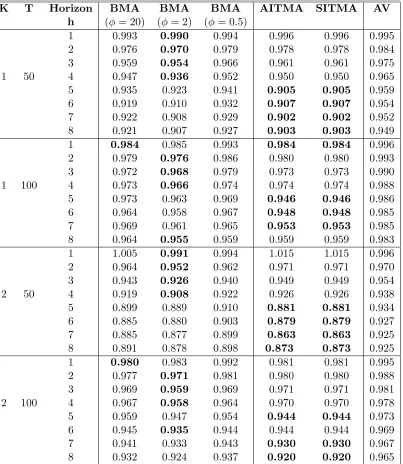
Results for forecast performance in terms of RMSE relative to the benchmark are given
in Table 1. The best forecast method in a particular row (that is, for given K, T and
h) are indicated in bold. These are evaluated to three decimal places, so in some cases
more than one model is `best', although at higher levels of numerical precision there is
always a single best performer. Variations in performance are reasonably large. It is
immediately evident that for this design the simple AR(1) benchmark does not perform
well, being dominated for most combinations of K, T and h by the combined forecasts.
Using simple averaging does better than the AR but is never best. In the Bayesian cases,
the low shrinkage parameter tends to do worst. A high shrinkage parameter improves
performance, but performance is best for the intermediate value. It is best in 16 out of
32 cases, especially for short horizons. The average value of the RRMSE is 0.942.
Our main interest is in the the information-criteria based methods. The two methods
(AITMA and SITMA) are based on penalty factors that are numerically similar in this
experiment, and the results are correspondingly close. As can be seen, they do well,
especially at longer horizons, where they tend to dominate BMA. Both AITMA and
SITMA and have the best forecast in 15 out of 32 cases, only one less than for the
intermediate BMA; similarly, the average RRMSE is a mere 0.003 greater at 0.945. The
equivalent performance is a robust result across samples and choice of K. Essentially,
it is hard to choose between the intermediate BMA and the information theoretic based
methods. In the remainder of the paper we see whether these conclusions carry over to
the real data.
4
Evidence from in ation forecasts
Our primary focus in this paper is practical, and in particular on the practice of in ation
forecasting using the model averaging schemes examined in the Monte Carlo study. The
models we consider are a standard speci cation, as discussed in Stock and Watson (2004).
We modify our Monte Carlo design by using a k1 lags autoregressive process augmented
with a k2 distributed lag on a single predictor variable. The number of lags in the pair
(k;1) where k is chosen optimally for each model, each sample and each forecast horizon
using the Akaike information criterion: we refer to these models as ARX(k).
Conse-quently, the lag structure for each predictor-variable model may vary with the horizon.
Thus, model ifor forecasting horizon h is given by
t+h = +
k1
X
j=1
j t j+1+ k2
X
j=1
xit j+1+ t (12)
where t is UK year-on-year CPI in ation, xit is the i-th predictor variable at timet and
t is the error term, with variance 2. As for the Monte Carlo experiment, the errors will
exhibit a M A(h 1) process. We consider 58 predictor variables, where the data span
1980Q2-2004Q1. We further include the AR forecast, making a total of 59 forecasts to
combine. Alongside the information theoretic combinations (based alternatively on AIC
and SIC as in the Monte Carlo exercise) we consider Bayesian and equal-weight model
averaging. The information theoretic weights are given by (5). The Bayesian weights are
given by the scheme discussed in the Monte Carlo section using (10) and (11).
We use data from the period 1980Q2 to 1990Q1. We evaluate the forecasts over two
post-sample periods: 1990Q2-1997Q1 (pre-MPC) and 1997Q2-2004Q1 (MPC). These are
natural dates to choose, as from May 1997 monetary policy was set by the Bank of
England's Monetary Policy Committee under an in ation targeting regime. Here we
focus on an evaluation in terms of a RMSE criterion; in the working paper version of this
paper Kapetanios, Labhard, and Price (2005) we also evaluate the combinations in terms
of forecast densities. We consider horizons up to three years (that is, h= 1; : : : ;12).
The forecasts are generated using a recursive forecasting scheme. For example, for the
rst evaluation period models are estimated up to 1990Q1 and 12 forecasts constructed
(that is, for each period between 1990Q2 and 1993Q1). Then the models are re-estimated
over the period 1980Q2 to 1990Q2 and forecasts constructed for the next 12 periods
as before. This is repeated for all the possible forecasts within the evaluation period.
From each re-estimation, the estimated log-likelihood is used to construct the relevant
information criterion which is in turn used to construct the information theoretic weights,
and similarly for the Bayesian weights. We report performance in terms of relative RMSE,
compared to the benchmark AR model, as well as two other indicators: the percentage
of models of the form (12) which perform worse than a given model averaging scheme
in terms of relative RMSE; and the proportion of periods in which the model averaging
three indicators are ranked similarly so we discuss only those from the rst. In the relative
RMSE tables we report a Diebold-Mariano (DM) test (Diebold and Mariano (1995)) of
whether the forecast is signi cantly di erent from the benchmark AR model at the 10%
level, indicated with an asterisc.
It is well known that the asymptotic distribution of the DM test statistic under the null
hypothesis of equal predictive ability for the two forecasts is not normal when the models
used to produce the forecasts are nested. A number of solutions have been proposed
for this problem: see Corradi and Swanson (2006) for a survey. We use the parametric
bootstrap to obtain the necessary critical values. An earlier example of the use of the
bootstrap for the Diebold Mariano test statistic is Killian (1999). Our bootstrap design
is straightforward. Under the null hypothesis the model generating the data is anAR(p)
model. We use the parametric bootstrap to construct bootstrap samples for in ation
from the recursively estimated AR(p) model. These bootstrap series are then combined
with the predictor variables, which are kept xed in the boostrap sample. Forecasts
are recursively produced for all the models and model averaging methods considered in
the forecasting exercise, in exactly the same way as the original forecasts. Then DM
statistics are produced and stored for every bootstrap replication. These statistics form
the empirical distribution from which the bootstrap critical values are obtained. 199
bootstrap replications are used.
We rst consider the MPC forecast evaluation period (Tables 2-4). The Akaike
informa-tion theory based AITMA beats the AR benchmark at all horizons. This is also true for
the simple average AV, but AITMA provides the best forecast in 8 out of 12 cases while
the AV provides none. In the table, `best' is de ned to three decimal places, so more
than one model can be `best'. In several cases the AIC and SIC are numerically identical
to three decimal places, but AITMA is absolutely best in all eight cases. The di erence
from the AR benchmark is signi cant in six of the eight cases. This is a strong result,
as forecast predictive tests have notoriously low power: Ashley (1998) concludes that `a
model which cannot provide at least a 30% MSE improvement over that of a competing
model is not likely to appear signi cantly better than its competitor over post sample
periods of reasonable size.' Moreover, AITMA beats the benchmark by a large margin
in many cases - with a RMSE advantage of over 5% in all cases, of 20% or more in eight
cases, and more than 30% in three cases. It does particularly well at long horizons,
this sample and this data set. The Bayesian BMA scheme works best for intermediate
in terms of the individual best forecast, but high (giving the data a high weight) is the
best Bayesian scheme overall, although clearly inferior to AITMA; and even the low
scheme is close to dominating the simple averaging scheme AV (which amounts to setting
= 0).
In the working paper version of this paper we report the top-ten ranked models for the
Bayesian and information theoretic schemes over the same period. The higher is , the
more weight is put on the variables with the highest in-sample explanatory power.
Com-paring the high and information theoretic schemes, the variables selected and weights
are very similar. However, the latter two give a little more weight to the best performer,
and the subsequent weights decline at a slower rate relative to the Bayesian scheme. The
AITMA and SITMA rankings are not identical but are extremely similar. Although there
is clearly a concentrated peak on the most important variable, in each combination all
the models enter with a non-zero weight; in that sense, the information in the entire data
set is being combined, although by the tenth variable the weight in both the SITMA and
the BMA with the highest are down to 0.5%.
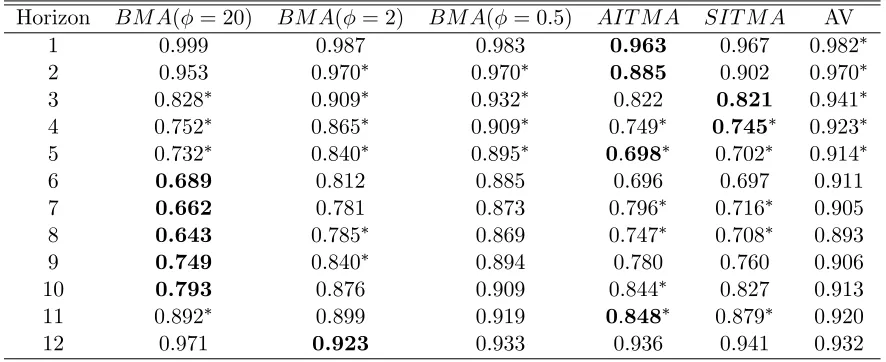
The conclusions remain broadly the same in the pre-MPC forecast evaluation period
(Tables 5-7), although the AITMA is no longer so clearly dominant. The best-performing
Bayesian ( = 20) combination provides best forecasts at ve horizons, compared to a
score of the four best for AITMA. Six of the AITMA forecasts are signi cantly better
than the benchmark: four of the Bayesian. In this period, while the AITMA continues
to place more weight on fewer variables, the weights are much less concentrated than in
the previous case. The variables selected by the high BMA and AITMA are now less
similar, but there is a high degree of commonality (as there is between the two samples).
Conceptually and practically, the two forecast combination methods are similar; as
men-tioned above, the model weights are not identical but there is a high degree of
com-monality. In both cases information is being gleaned from the data in-sample and used
to inform the forecast method. In the low-shrinkage case, the frequentist analogy is to
the likelihood-weighted scheme. As usual, the information theoretic measures steer away
from the raw likelihood with a parameter penalty, which can be seen as similar to the way
information criteria avoid over tting in standard model selection. It is well known that
information criteria can be given a Bayesian interpretation: see the discussion in Kadane
approx-imation to the Bayes factor to perform systematically better or worse than any other; all
we can conclude is that in these samples and data the AITMA performs comparably to the
Bayesian method. And unlike the Bayesian averaging, there is no requirement to select a
particular value for a key parameter ( ). Although we have not explored it in this paper,
in related work (Kapetanios, Labhard, and Price (2006)) we have extended the approach
to use information theoretic weights constructed with the predictive likelihood, which is
also a good performer. Finally, we note that although we nd these information-theoretic
techniques work well, and consider them a useful alternative to other techniques, we
nat-urally do not suggest that they would or should be used as the main or only forecasting
tool by any central bank.
5
Conclusions
Model averaging provides a well-established means of improving forecast performance
which works well in practice and has sound theoretical foundations. It may also be helpful
for another reason. In particular, in recent years there has been a rapid growth of interest
in forecasting methods that utilise large datasets, driven partly by the recognition that
policymaking institutions process large quantities of information, which might be helpful
in the construction of forecasts. Standard econometric methods are not well suited to this
task, but model averaging can help here as well.
In this paper we consider two averaging schemes. The rst is Bayesian model averaging.
This has been used in a variety of forecasting applications with encouraging results. The
second is an information theoretic scheme which we derive in this paper using the concept
of relative model likelihood developed by Akaike. Although the information theoretic
approach has received less attention than Bayesian model averaging, the evidence we
produce from a Monte Carlo study and an application forecasting UK in ation indicate
that it has at least some potential to produce more precise forecasts and therefore might
be a useful complement to other forecasting techniques. There are some advantages
in practice. In the frequentist approach the weights are straightforward to compute,
and there is less need to make arbitrary assumptions, for example about the shrinkage
parameter or the prior distribution.
on model performance, it would be odd if the alternative scheme were not also useful.
But our work shows that it may outperform Bayesian weights in some cases. Moreover,
it has a clear frequentist interpretation and is easy to implement with little judgement
required about ancillary assumptions. While it is highly unlikely that a single technique
would be more useful that all others in all settings, our work indicates that information
theoretic model averaging may provide a useful addition to the forecasting toolbox.
References
Akaike, H. (1978): \A Bayesian Analysis of the Minimum AIC Procedure," Annals of
the Institute of Statistical Mathematics, 30, 9{14.
(1979): \A Bayesian Extension of the Minimum AIC Procedure of Autoregressive
Model Fitting,"Biometrika, 66, 237{242.
(1981): \Modern Development of Statistical Methods," in Trends and progress
in system identi cation, ed. by P. Eykho , pp. 169{84. Pergamon Press Paris.
(1983): \Information Measures and Model Selection," International Statistical
Institute, 44, 277{291.
Ashley, R.(1998): \A New Technique for Postsample Model Selection and Validation,"
Journal of Economic Dynamics and Control, 22, 647{65.
Bates, J. M., and C. W. J. Granger (1969): \The Combination of Forecasts,"
Operations Research Quarterly, 20, 451{68.
Bozdogan, H.(1987): \Model Selection and Akaike's Information Criterion (AIC): the
General Theory and its Analytical Extensions," Psychometrika, 52(3), 345{70.
Burnham, K. P., and D. R. Anderson(1998): Model Selection and Inference. Berlin:
Springer Verlag.
Clements, M. P., and D. F. Hendry (1998): Forecasting Economic Time Series.
Cambridge: CUP.
Corradi, V., and N. R. Swanson(2006): \Predictive Density Evaluation," in
Hand-book of Economic Forecasting, ed. by C. W. J. G. G. Elliot, and A. Timmerman, pp.
197{284. (Amsterdam: Elsevier).
Diebold, F. X., and R. S. Mariano(1995): \Comparing Predictive Accuracy,"
Jour-nal of Business and Economic Statistics, 13, 253{63.
Draper, D. (1995a): \Assessment and propagation of model uncertainty," Journal of
the Royal Statistical Society Series B, 57, 45{97.
Draper, D. (1995b): \Assessment and propagation of model uncertainty," Journal of
the Royal Statistical Society, Series B, 57, 45{97.
Eklund, J., and S. Karlsson (2005): \Forecast Combination and Model Averaging
Using Predictive Measures,"CEPR Working Paper No. 5268.
Fernandez, C., E. Ley, and M. F. Steel (2001): \Benchmark Priors for Bayesian
Model Averaging,"Journal of Econometrics, 100, 381{427.
Gourieroux, C., and A. Monfort (1995): Statistics and Econometric Models:
Vol-ume 2. Cambridge: Cambridge University Press.
Hansen, P. R., A. Lunde, and J. M. Nason (2005): \Model Con dence Sets for
Forecasting Models," Working Paper 2005-7, Federal Reserve Bank of Atlanta.
Hjort, N. L., and G. Claeskens (2003): \Frequentist model average estimators,"
Journal of the American Statistical Association, 98, 879{99.
Hurvich, C. M., and C.-L. Tsai(1990): \The impact of model selection on inference
in linear regression," The American Statistician, 44, 214{17.
Kabaila, P. (1995): Econometric Theory11, 537.
Kadane, J. B., and N. Lazar (2004): \Methods and Criteria for Model Selection,"
Journal of the American Staistical Association, 99, 279{90.
Kapetanios, G. (2001): \Incorporating lag order selection uncertainty in parameter
inference for AR models," Economics Letters, 72, 137{44.
Kapetanios, G.(2005): \Variable Selection Using Non-Standard Optimisation of
Kapetanios, G., V. Labhard, and S. Price (2005): \Forecasting using Bayesian
and information theoretic model averaging: an application to UK in ation," Bank of
England Working Paper No. 268.
(2006): \Forecasting Using Predictive Likelihood Model Averaging,"Economics
Letters, 91, 373{79.
Kapetanios, G., V. Labhard, and C. Schleicher (2006): \Conditional Model
Con dence Sets with an Application to Forecasting Models," Manuscript, Bank of
England.
Killian, L.(1999): \Exchange Rates and Monetary Fundamentals: What Do We Learn
from Long-Horizon Regressions?,"Journal of Applied Econometrics, 14, 491.
Koop, G., and S. Potter(2003): \Forecasting in Large Macroeconomic Panels Using
Bayesian Model Averaging," Federal Reserve Bank of New York Report 163.
Kullback, S., and R. A. Leibler (1951): \On Information and Su ciency," Annals
of Mathematical Statistics, 22, 79{86.
Leeband, H., and B. M. P•otscher(2000): \The Finite-Sample Distribution of
Post-Model-Selection Estimators, and Uniform Versus Non-Uniform Approximations,"
Tech-nical Report TR 2000-03, Institut f•ur Statistik und Decision Support Systems,
Univer-sit•at Wien.
Madigan, D., and A. E. Raftery(1994): \Model Selection and Accounting for Model
Uncertainty in Graphical Models using Occam's Window," Journal of the American
Statistical Association, 89, 1,535{46.
Min, C., and A. Zellner(1993): \Bayesian and Non-Bayesian Methods for Combining
Models and Forecasts with Applications to Forecasting International Growth Rates,"
Journal of Econometrics, 56, 89{118.
Newbold, P., and C. W. J. Granger (1974): \Experience with Forecasting
Univari-ate Time Series and the Combination of Forecasts," Journal of the Royal Statistical
Society, Series A, 137, 131{65.
Newbold, P., and D. I. Harvey (2002): \Forecast Combination and Encompassing,"
in A Companion to Economic Forecasting, ed. by M. Clements, and D. F. Hendry,
P•otscher, B. M. (1991): \E ects of Model Selection on Inference,"Econometric
The-ory, 7, 163{85.
Royall, R. M. (1997): Statistical Evidence: a Likelihood Paradigm. New York:
Chap-man and Hall.
Stock, J. H., and M. W. Watson(1999): \Forecasting In ation," Journal of
Mone-tary Economics, 44, 293{335.
Stock, J. H., and M. W. Watson(2002): \Macroeconomic Forecasting Using Di
u-sion Indices," Journal of Business and Economic Statistics, 20, 147{62.
(2003): \Forecasting Output and In ation: the Role of Asset Prices," Journal
of Economic Literature, 41, 788{829.
(2004): \Combination Forecasts of Output Growth in a Seven Country Dataset,"
Journal of Forecasting, 23, 405{30.
Svensson, L. E. O. (2004): \Monetary Policy with Judgment: forecast Targeting,"
unpublished.
Wright, J. H. (2003a): \Bayesian Model Averaging and Exchange Rate Forecasts,"
Board of Governors of the Federal Reserve System, International Finance Discussion
Papers No 779.
(2003b): \Forecasting US In ation by Bayesian Model Averaging," Board of
Governors of the Federal Reserve System, International Finance Discussion Papers No
Table 1: Monte Carlo Study: RMSE of various Model Averaging schemes
K T Horizon BMA BMA BMA AITMA SITMA AV
h ( = 20) ( = 2) ( = 0:5)
1 0.993 0.990 0.994 0.996 0.996 0.995
2 0.976 0.970 0.979 0.978 0.978 0.984
3 0.959 0.954 0.966 0.961 0.961 0.975
1 50 4 0.947 0.936 0.952 0.950 0.950 0.965
5 0.935 0.923 0.941 0.905 0.905 0.959
6 0.919 0.910 0.932 0.907 0.907 0.954
7 0.922 0.908 0.929 0.902 0.902 0.952
8 0.921 0.907 0.927 0.903 0.903 0.949
1 0.984 0.985 0.993 0.984 0.984 0.996
2 0.979 0.976 0.986 0.980 0.980 0.993
3 0.972 0.968 0.979 0.973 0.973 0.990
1 100 4 0.973 0.966 0.974 0.974 0.974 0.988
5 0.973 0.963 0.969 0.946 0.946 0.986
6 0.964 0.958 0.967 0.948 0.948 0.985
7 0.969 0.961 0.965 0.953 0.953 0.985
8 0.964 0.955 0.959 0.959 0.959 0.983
1 1.005 0.991 0.994 1.015 1.015 0.996
2 0.964 0.952 0.962 0.971 0.971 0.970
3 0.943 0.926 0.940 0.949 0.949 0.954
2 50 4 0.919 0.908 0.922 0.926 0.926 0.938
5 0.899 0.889 0.910 0.881 0.881 0.934
6 0.885 0.880 0.903 0.879 0.879 0.927
7 0.885 0.877 0.899 0.863 0.863 0.925
8 0.891 0.878 0.898 0.873 0.873 0.925
1 0.980 0.983 0.992 0.981 0.981 0.995
2 0.977 0.971 0.981 0.980 0.980 0.988
3 0.969 0.959 0.969 0.971 0.971 0.981
2 100 4 0.967 0.958 0.964 0.970 0.970 0.978
5 0.959 0.947 0.954 0.944 0.944 0.973
6 0.945 0.935 0.944 0.944 0.944 0.969
7 0.941 0.933 0.943 0.930 0.930 0.967
8 0.932 0.924 0.937 0.920 0.920 0.965
BM A indicates Bayesian Model Averaging where indicates shrinkage factor
AIT M A,SIT M A indicate Akaike, Schwartz Information Criteria weights
AV indicates simple average
Table 2: Relative RMSE of Out-of-Sample CPI Forecasts using ARX(k) Models (Period: 1997Q2-2004Q1)
Horizon BM A( = 20) BM A( = 2) BM A( = 0:5) AIT M A SIT M A AV
1 1:130 1:028 1.002 0.948 1.072 0.993
2 0.904 0:955 0:962 0:774 0:833 0:964
3 0:747 0:920 0:959 0:706 0:706 0:967
4 0.875 0:906 0:957 0.849 0.893 0:967
5 0.908 0:808 0:903 0.924 0.932 0:934
6 0.877 0.819 0.906 0.858 0.868 0.940
7 0.805 0:805 0:890 0.797 0.794 0:934
8 0.729 0:788 0:881 0:718 0.718 0.929
9 0:713 0:801 0.898 0:706 0:706 0.939
10 0:704 0:817 0:915 0:694 0:694 0:949
11 0:700 0:828 0:916 0:689 0:689 0.946
12 0:702 0:836 0:917 0:684 0:683 0:946
* 10% rejection of Diebold-Mariano test that the forecast di ers from the benchmark
boldindicates best forecast in row (to third decimal place)
BM A indicates Bayesian Model Averaging where indicates shrinkage factor
AIT M A,SIT M A indicate Akaike, Schwartz Information Criteria weights
AV indicates simple average
Table 3: Proportion of individual models with higher relative RMSE for Out-of-Sample CPI Forecasts using ARX(k) Models (Period: 1997Q2-2004Q1)
Horizon BM A( = 20) BM A( = 2) BM A( = 0:5) AIT M A SIT M A AV
1 0.121 0.414 0.672 0.897 0.224 0.759
2 0.914 0.810 0.776 0.948 0.931 0.776
3 0.931 0.897 0.845 0.948 0.948 0.845
4 0.914 0.879 0.776 0.931 0.879 0.776
5 0.793 0.914 0.793 0.793 0.793 0.776
6 0.862 0.931 0.845 0.862 0.862 0.793
7 0.914 0.914 0.828 0.914 0.914 0.759
8 0.931 0.897 0.828 0.931 0.931 0.759
9 0.983 0.914 0.810 0.983 0.983 0.776
10 0.983 0.897 0.810 0.983 0.983 0.793
11 0.983 0.897 0.776 0.983 0.983 0.759
12 0.983 0.897 0.776 0.983 0.983 0.776
BM A indicates Bayesian Model Averaging where indicates shrinkage factor
AIT M A,SIT M A indicate Akaike, Schwartz Information Criteria weights
[image:22.612.71.510.504.683.2]Table 4: Proportion of Periods in which model has smaller absolute forecast error than AR model for Out-of-Sample CPI Forecasts using ARX(k) Models (Period: 1997Q2-2004Q1)
Horizon BM A( = 20) BM A( = 2) BM A( = 0:5) AIT M A SIT M A AV
1 0.375 0.406 0.438 0.500 0.313 0.500
2 0.625 0.719 0.750 0.656 0.656 0.719
3 0.688 0.750 0.750 0.688 0.688 0.750
4 0.625 0.656 0.594 0.750 0.688 0.594
5 0.719 0.750 0.813 0.719 0.719 0.813
6 0.719 0.688 0.750 0.719 0.719 0.688
7 0.719 0.750 0.719 0.719 0.719 0.781
8 0.781 0.813 0.781 0.781 0.781 0.781
9 0.844 0.813 0.844 0.844 0.844 0.813
10 0.875 0.875 0.906 0.875 0.875 0.844
11 0.906 0.906 0.938 0.906 0.906 0.875
12 0.938 0.938 0.938 0.938 0.938 0.906
BM A indicates Bayesian Model Averaging where indicates shrinkage factor
AIT M A,SIT M A indicate Akaike, Schwartz Information Criteria weights
AV indicates simple average
Table 5: Relative RMSE of Out-of-Sample CPI Forecasts using ARX(k) Models (Period: 1990Q2-1997Q1)
Horizon BM A( = 20) BM A( = 2) BM A( = 0:5) AIT M A SIT M A AV
1 0.999 0.987 0.983 0.963 0.967 0:982
2 0.953 0:970 0:970 0.885 0.902 0:970
3 0:828 0:909 0:932 0.822 0.821 0:941
4 0:752 0:865 0:909 0:749 0:745 0:923
5 0:732 0:840 0:895 0:698 0:702 0:914
6 0.689 0.812 0.885 0.696 0.697 0.911 7 0.662 0.781 0.873 0:796 0:716 0.905 8 0.643 0:785 0.869 0:747 0:708 0.893 9 0.749 0:840 0.894 0.780 0.760 0.906 10 0.793 0.876 0.909 0:844 0.827 0.913
11 0:892 0.899 0.919 0:848 0:879 0.920
12 0.971 0.923 0.933 0.936 0.941 0.932
* 10% rejection of Diebold-Mariano test that the forecast di ers from the benchmark
boldindicates best forecast in row (to third decimal place)
BM A indicates Bayesian Model Averaging where indicates shrinkage factor
AIT M A,SIT M A indicate Akaike, Schwartz Information Criteria weights
[image:23.612.70.513.462.643.2]Table 6: Proportion of individual models with higher relative RMSE for Out-of-Sample CPI Forecasts using ARX(k) Models (Period: 1990Q2-1997Q1)
Horizon BM A( = 20) BM A( = 2) BM A( = 0:5) AIT M A SIT M A AV
1 0.707 0.793 0.793 0.879 0.879 0.793
2 0.862 0.828 0.828 0.983 0.931 0.828
3 0.931 0.862 0.828 0.948 0.948 0.810
4 0.983 0.862 0.828 0.983 0.983 0.828
5 0.983 0.862 0.828 0.983 0.983 0.810
6 1.000 0.931 0.828 0.983 0.983 0.759
7 1.000 0.914 0.828 0.897 0.966 0.793
8 1.000 0.914 0.845 0.914 0.966 0.810
9 0.966 0.914 0.845 0.948 0.948 0.845
10 0.966 0.914 0.862 0.931 0.948 0.862
11 0.931 0.914 0.862 0.966 0.931 0.845
12 0.759 0.897 0.879 0.879 0.862 0.879
BM A indicates Bayesian Model Averaging where indicates shrinkage factor
AIT M A,SIT M A indicate Akaike, Schwartz Information Criteria weights
AV indicates simple average
Table 7: Proportion of Periods in which model has smaller absolute forecast error than AR model for Out-of-Sample CPI Forecasts using ARX(k) Models (Period: 1990Q2-1997Q1)
Horizon BM A( = 20) BM A( = 2) BM A( = 0:5) AIT M A SIT M A AV
1 0.656 0.719 0.688 0.688 0.563 0.688
2 0.750 0.688 0.688 0.656 0.719 0.688
3 0.781 0.750 0.781 0.781 0.781 0.781
4 0.750 0.875 0.844 0.688 0.719 0.906
5 0.719 0.719 0.813 0.688 0.656 0.844
6 0.656 0.813 0.813 0.594 0.625 0.813
7 0.781 0.844 0.906 0.656 0.688 0.906
8 0.781 0.813 0.844 0.688 0.688 0.844
9 0.688 0.688 0.719 0.625 0.625 0.750
10 0.750 0.781 0.781 0.719 0.656 0.781
11 0.719 0.781 0.813 0.781 0.781 0.781
12 0.719 0.750 0.719 0.625 0.625 0.719
BM A indicates Bayesian Model Averaging where indicates shrinkage factor
AIT M A,SIT M A indicate Akaike, Schwartz Information Criteria weights
[image:24.612.76.521.494.672.2]Data Appendix
In this appendix, we provide a list of the series used in Section 4 to forecast U.K. in ation.
These series come from a data set which has been constructed to match the set used by
Stock and Watson (2002). In total, this data set has 131 series, comprising 20 output
series, 25 labour market series, 9 retail and trade series, 6 consumption series, 6 series on
housing starts, 12 series on inventories and sales, 8 series on orders, 7 stock price series,
5 exchange rate series, 7 interest rate series and 6 monetary aggregates, 19 price indices
and an economic sentiment index. We retained the 58 series with at least 90 observations.
The series are grouped under 10 categories. For each series we give a brief description:
more details, summary statistics and the transformations applied to ensure stationarity
are available on request.
Series 1 to 8: Real output and income.
S1: Gross Domestic Product.
S2: Manufacturing
S3: Durable Manufacturing
S4: Semi-durable Manufacturing
S5: Non-durable Manufacturing
S6: Mining & quarrying
S7: Electricity, gas and water supply
S8: Real households disposable income
Series 9 to 21: Employment and hours.
S9: UK Workforce jobs
S10: Employed, Nonagricultural
S12: Employees total nonagricultural
S13: Employees private nonagricultural
S14: Employee jobs: Production
S15: Employee jobs: Construction
S16: Employee jobs: Manufacturing
S17: Employee jobs: Wholesale & retail trade
S18: Employee jobs: Banking, nance & insurance
S19: Employee jobs: Total services
S20: Employee jobs Public admin. & defence
S21: Average weekly manufacturing hours
Series 22 to 23: Trade.
S22: BOT Goods
S23: BOT: Manufactures
Series 24 to 29: Consumption.
S24: Household nal consumption expenditure
S25: Durable goods
S26: Semi-durable goods
S27: Non-durable goods
S28: Services
S29: Purchase of vehicles
S30: Change in Inventories: Manufacturing
S31: Change in Inventories Textiles & Leather
S32: Manuf & Trade Invent: Nondurable Goods
S33: Change in Inventories: Wholesale
S34: Change in Inventories: Retail
S35: Inventory/Output Mfg & Trade
Series 36 to 38: Stock prices.
S36: FTSE All Share Price Index
S37: FTSE100
S38: FTSE All Share Dividend Yield
Series 39 to 43: Exchange rates.
S39: Sterling e ective rate
S40: Euro/$
S41: Swiss Franc/$
S42: Yen/$
S43: US$/$
Series 44 to 47: Interest rates.
S44: Spread 6 months to 1 month
S45: Spread 1 year to 1 month
S47: Spread 10 years to 1 month
Series 48 to 50: Monetary and quantity credit aggregates.
S48: M4
S49: M0
S50: Reserves & other accounts outstanding
Series 51 to 57: Price indices.
S51: Output of manufactured products
S52: CPI
S53: Houselold nal consumption
S54: Durable goods
S55: Semi-durable goods
S56: Non-durable goods
S57: Services
Series 58: Surveys.