City, University of London Institutional Repository
Citation
:
Peat, Richard (2007). Representing children in opera. (Unpublished Doctoral thesis, City University)This is the draft version of the paper.
This version of the publication may differ from the final published
version.
Permanent repository link:
http://openaccess.city.ac.uk/17966/Link to published version
:
Copyright and reuse:
City Research Online aims to make research
outputs of City, University of London available to a wider audience.
Copyright and Moral Rights remain with the author(s) and/or copyright
holders. URLs from City Research Online may be freely distributed and
linked to.
City Research Online: http://openaccess.city.ac.uk/ [email protected]
Representing Children in Opera
RICHARD
PEAT
Submitted in partial fulfilment of the requirements of
PhD in Instrumental and Vocal Composition
CITY UNIVERSITY
School of Arts - Music Department
IMAGING SERVICES NORTH
Boston Spa, WetherbyWest Yorkshire, LS23 7BQ www.bl,uk
THESIS CONTAINS
VIDEO
CD
DVD
ABSTRACT
Abstract
Table of Contents Illustrations
Acknowledgements Declaration
Introduction
TABLE OF CONTENTS
ii
iii-iv v vi 1 Chapter 1: Composing for Children's Voices in the Opera House 10
Chapter 2: Evocations of Childhood 36
Chapter 3: Innocence and Experience 61
Chapter 4: Case Study - Richard Peat. I'm the King of the Castle 83 Conclusion
Appendices:
Composition Portfolio CD Track Listings
I'm the King of the Castle Libretto by Timothy Knapman Bibliography
11
103
CHAPTER 1 Ex. 1.1: Ex. 1.2: Ex. 1.3: Ex. 1.4: Ex. 1.5: Ex. 1.6: Ex. 1.7: Ex. 1.8: Ex. 1.9: Ex. 1.10: Ex. 1.11: Ex. 1.12: Ex. 1.13: Ex. 1.14: Ex. 1.15: Ex. 1.16: Ex. 1.17: Ex. 1.18: Ex. 1.19: Ex. 1.20: Ex. 1.21: Ex. 1.22: Ex. 1.23: CHAPTER 2 Ex.2.1: Ex. 2.2: Ex. 2.3: Ex. 2.4: Ex. 2.5: Ex. 2.6: Ex. 2.7: Ex. 2.8: Ex. 2.9: Ex. 2.10: Ex. 2.11: Ex.2.12: Ex. 2.13: Ex. 2.14: Ex.2.15: Ex. 2.16: Falla. Debussy. Davies. Birtwistle. Vir. Menotti. Schoenberg. Britten. Britten. Menotti. Portman. Strauss. Strauss. Britten, Portman. Britten. Birtwistle. Debussy. Debussy. Britten. Tippet. Davies. BirtwistIe. ILLUSTRA TIONS
El retablo de Maese Pedro, figure 11
Pelleas et Melisande, Act IV, Scene III, 4 bars after fig. 27 Taverner, Act I, Scene i, bb. 463-473
Yan Tan Tethera
Snatched by the Gods, fig. 20
Amahl and the Night Visitors, fig. 60 Von Heute auf Morgen, bb. 555-560
The Turn of the Screw, Act I, Scene ii. 6 bars after fig. 5 The Turn of the Screw, Act II, Scene ii, 1 bar after fig. 45 Amah! and the Night Visitors, Fig. 4
The Little Prince, Act II, Scene iii, bb. 72-84 Die Frau ohne Schatten, 4 bars after fig. 119 Die Frau ohne Schatten, 1 bar after figure 118
A Midsummer Night's Dream Act III, 1 bar after fig. 99 The Little Prince Act II, Scene ii, bb. 150-163
Albert Herring, Act I, scene ii, 11 bars before fig. 64 Yan Tan Tethera
Pelleas et Melisande,
Act IV, Scene iii, 4 bars before fig. 46
Pelleas et Melisande, Act IV, Scene iii, 6 bars after fig. 48 The Turn of the Screw, Act I, Scene iv, fig. 51
King Priam, Act I, Scene ii, fig. 93 Taverner, Act I Scene I, bb. 463-473 Yan Tan Tethera
Humperdink. Hansel und Gretel, Act II, scene i, fig. 68 Britten. The Turn of the Screw, Act I, Scene iii, fig. 17 Ravel. L 'enfant et les sortileges, 2 bars after fig. 7 Berg. Wozzeck, Act II, Scene I, bb. 44-59
Ravel. L 'enfant et les sortileges, fig. 83
Britten. The Turn of the Screw, Act I, Scene vi, fig. 51 Britten. The Turn of the Screw Act II, Scene vi, fig. 87 Ravel. L 'enfant et les sortileges, bb. 1-4
Ravel. L 'enfant et les sortileges, fig. 21 Menotti. Amahl and the night visitors, fig. 13
Knussen. Where the Wild Things Are, Scene i, fig. 10
Humperdinck. Hansel und Gretel, Act 2, Scene i, 8 bars after fig. 71 Knussen. Where the Wild Things Are, Scene ii, fig. 26
Knussen. Where the Wild Things Are, Scene i, 1 bar after fig. 3 Saxton. Caritas, Act I, scene i, bb. 186-193
Mozart. Die Zauberjlote, Act II, no. 21, bb. 10-14
CHAPTER 3:
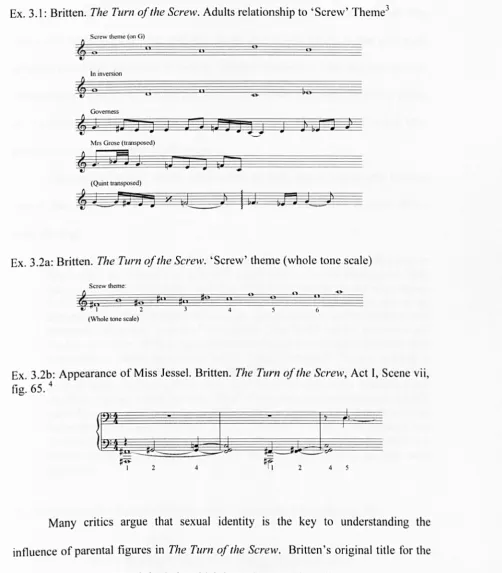
Ex. 3.1: Britten. Ex.3.2a: Britten. Ex.3.2b:
Ex. 3.3: Britten. Ex. 3.4: Britten. Ex. 3.5: Ravel. Ex 3.6: Knussen. Ex. 3.7:
Ex. 3.8: Britten. Ex. 3.9: Britten. Ex. 3.10: Portman. Ex.3.11: Britten. Ex. 3.12: Britten. Ex.3.13:
Ex.3.14: Ravel. Ex. 3.15: Ravel. CHAPTER 4:
Ex.4.1: Purcell. Ex. 4.2: Peat. Ex. 4.3: Peat. Ex. 4.4: Peat. Ex. 4.5: Peat. Ex. 4.6: Peat Ex. 4.7: Peat. Ex. 4.8: Peat. Fig. 4.1: Peat. Fig. 4.2: Klee.
ILLUSTRATIONS
The Turn of the Screw.
Adults' relationship to 'Screw' Theme
The Turn of the Screw. 'Screw' theme (whole tone scale) Appearance of Miss Jessel. Britten.
The Turn of the Screw, Act I, Scene vii, fig. 65.
The Turn of the Screw, Act I, Scene viii, 1 bar after fig. 79 The Turn of the Screw,
Act II, scene viii, 1 bar after fig. 134 L 'enfant et les sortiteges, fig. 17
Where the Wild Things Are, Scene viii, fig. 108
Presence of Quint Motifin Britten. The Turn of the Screw The Turn of the Screw
Act 1, Scene viii, 8 bars before fig. 72
The Turn of the Screw Act I, Scene viii, fig. 73 The Little Prince, Act II, Scene i, bb.l 08-11 0 Albert Herring, Act I, Scene ii, 33 bars after fig. 76 Albert Herring, Act II, Scene ii, 3 bars after fig. 88 Tadzio's mode in Britten. Death in Venice
L 'enfant et les sortileges, 3 bars after fig. 98 L 'enfant et les sortileges, 3 bars after fig. 67
Dido and Aeneas, 'When I am laid in earth', no. 37, bb.l-6 I'm the King of the Castle, note row
I'm the King of the Castle -Joseph's scale I'm the King of the Castle -Helena's scale I'm the King of the Castle -Charles' scale I'm the King of the Castle -Anthony's scale. I'm the King of the Castle,
Act I, Day 3, bb. 21-48 - Vibraphone ostinato I'm the King of the Castle, Act I, Day 1, bb.141-154 I'm the King of the Castle - Pitch Centres
Pedagogical Sketchbook
A line accompanied by a complimentary form
ACKNOWLEDGEMENTS
I would like to thank my supervisor, Professor Rhian Samuel, for all her unwavering support over the period of my enrolment at City University. I would also like to thank Denis Smalley, for the City University Symphony Orchestra commission which resulted in Sredni Vashtar, and all the musicians that have been involved in performances of my compositions over the last four years.
DECLARATION
I grant powers of discretion to the University Librarian to allow this thesis, 'Representing Children in Opera', to be copied in whole or in part without further reference to the author.
INTRODUCTION
One literary achievement of the nineteenth century was the discovery of the child. Prior to the rise of Romanticism, childhood had been seen as some pre-human stage that had to be exorcised before reaching maturity; now it was increasingly understood as a deep enduring basis of the adult personality. I Child roles have been a fairly rare feature in opera; indeed, the role of Jemmy in Rossini's Guillaume Tell (1829) might justifiably be considered the first significant children's role.2 Jerome Reel has observed how the emancipation of children in society has been paralleled on the operatic stage; as we shall see below, many 20th_ century composers, such as Ravel and Britten, have written involved roles for children who take an integral part of the drama.3
Children's roles usually fall into one of three categories. The first comprises those intended to be performed by adult singers, frequently a female adult playing the role of a young boy. These include the eponymous heroes of Humperdinck's Hansel und Gretel, and the boy in Ravel's L 'enfant et les sortileges. The second comprises
those roles intended for child actors who have non-singing, sometimes silent roles, like the page in Strauss' Der Rosenkavalier and the apprentice in Britten's Peter Grimes.
In
Death in Venice by the same composer, the boy Tadzio is represented by a dancer. The final category comprises those singing roles intended specifically for children, frequently trebles, to perform. These include Amahl in Menotti's AmahlI Steven R. Cerf, 'Too Grimm for words: Taming Hansel and Gretel for opera', Opera News, 6117, p. 14.
2 There is evidence to suggest that children were used in baroque opera. For example, Purcell wrote several roles for the young Jemmy Bowin. However, rarely were children used, at that time, to portray notions of childhood or to represent child characters on stage. [Olive Baldwin and Thelma Wilson: 'Bowen, James', Grove Music Online ed. L. Macy (Accessed 28th September, 2006), https://www.grovemusic.com].ltis also a popular misconception that Mozart intended the three genii in Die Zauberjlote to be sung by children. The urtext edition reveals that Anna Schikaneder, the librettist's niece, took one of those roles, and she was 24 at the time. While the genii act as a symbol of purity in Mozart's opera, they do not convey notions of childhood. [Wolfgang Amadeus Mozart, Die Zauberjlote ed. Gemot Gruber and Alfred Orel (Kassel: Barenreiter-Verlag, 1970)].
and the Night Visitors, and Miles in Britten's The Turn of the Screw.
What distinguishes operas like Ravel's L 'enfant et les sortileges, Menotti's Amahl and the Night Visitors, Britten's The Turn of the Screw, Knussen's Where the Wild Things Are and Portman's The Little Prince from other operas featuring children is that, in their own ways, they explore the child psyche. The words and music of the operas portray the way children think and behave, and the enormous power of external influences on their development. Henry James' novella The Turn of the Screw (1898), upon which Myfanwy Piper's libretto for Britten's opera is based, asks
questions about the innocence and experience of the children, Miles and Flora, whereas Sidonie-Gabrielle Collette's libretto for Ravel's L 'enfant et les sortileges charts the boy's positive journey from innocence to experience. Menotti wrote his own libretto for Amahl and the Night Visitors, a work which, unlike The Turn of the Screw, explores the goodness inherent in children. In that work, Menotti sought to rekindle memories of his own childhood Christmases in Italy.4 In the case of The Little Prince and Where the Wild Things Are, the libretti are based on the classic
children's books by Antoine de Saint-Exupery and Maurice Sendak. These operas place children at the heart of their narratives, portraying them as fascinating
characters in their own right.
Composers face a potentially difficult choice when writing operas that involve significant roles for children. They can either elect to write for children's voices and, in doing so, endeavour to overcome the challenges of the child voice type and the difficulties associated with minors involved in stage productions. In opting to create roles which can only be realised by child singers, composers also risk rendering their operas impractical as there is a much smaller selection of suitable children to cast in
operatic roles than there are adults. John Bridcut, in his book Britten's Children, indicates that finding an appropriate boy to sing Miles caused the composer and production team much trouble during preparations for the first performance.5 The way in which composers have risen to the challenge of writing for children's voices is the subject of the first chapter of this study.
If composers opt to write children's roles for adult singers, then they risk losing some of that role's credibility. Seeing a mature woman on stage, with a mature voice, and then accepting that image as a young boy or girl, involves suspending
one's disbelief to a considerable degree. Of course, the stylised nature of opera means that it has always been about suspension of disbelief, but it certainly takes a particularly talented adult singer to convey the child-like qualities of the boy in L 'enfant et les sortileges. Thus, composers include common symbols of childhood, such as nursery rhymes, in their operas, in order to render their adult singers convincing children. Evoking childhood in this way is the subject of Chapter 2.
Chapter 3 considers the way in which innocence and experience shape the course of operas with important roles for children. In the concluding chapter, my own opera, I'm the King of the Castle (2006), is used as a case study to illuminate how I
have responded to the issues raised by involving children in opera.
A brief survey of Children in Opera
After Rossini's Guillaume Tell, the next significant child role can be found in Mussorgsky's Boris Godunov, written in 1869.6 Boris' son, Fyodor, is represented in a touching domestic scene in Act II, which takes place in the Tsar's apartment in the Kremlin. Reel has commented on the way that children's rituals shape the dramatic landscape of this scene:
In the second act, the child, originally sung by a mezzo-soprano, plays a clapping game before his father directs his attention to Russian geography, an interesting juxtaposition of childhood games, which Froebel labelled 'mother play' with adult centred education.7
Later in the nineteenth century, Humperdinck was the first to place children in leading roles when he adapted the Brothers Grimm fairy tale, Hansel und Gretel for the operatic stage (1893). Humperdinck's sister, Adelheid Wette, wrote a libretto based on Ludwig Bechstein's innocuous version of the fairy tale, from which the composer created a large-scale score heavily indebted to Wagner and German folk traditions. The orchestration, and the scale of the lead roles, has meant that Hansel and Gretel are almost always played by adult, female singers. There are also small parts for children in Humperdinck's Konikskinder (1897).
In the early twentieth century there are numerous examples of bit parts for
children, many of which are intended to be played authentically. Puccini made Dolore, Cio-Cio-San' s son, a silent role in Madama Butterfly (1904) and created the part of Gherardino, a seven year old boy, in Gianni Schicchi (1918). In his adaptation of Maeterlinck's play Pelleas et Melisande, Debussy cast Yniold, Golaud's son by his first marriage (a small but significant role), as a treble in his 1907 opera bearing the
6 This summary of children's roles is indebted to A Short History o/Opera by Donald Jay Grout with Hermine Wiegel Williams (New York: Columbia University Press, 1988).
same title. This is the first 'involving' operatic role written for a child's voice, and the boy who sang the part in the first performance found it particularly challenging.8 In the same year Rimsky Korsakov included a small role for a young boy in The Legend of the Invisible City of Kitezh and the Maiden Feroniya. Also in 1907, Delius included significant parts for the young Vreli and Sali in the first scene of A Village Romeo and Juliet, a work in which the composer set his own libretto.
Strauss made the minor roles of the page in Der Rosenkavalier (1911) and Little Franz, in Intermezzo (1924) silent parts. He also used an ensemble of five children's voices in Die Frau ohne Schatten (1917), in which he set a text by Hugo von Hofmannsthaal. Children are included in Zemlinsky's Der Zwerg (1922) as playmates of the Infanta. In 1923 Falla cast one of the leading roles, the narrator, in his puppet opera El Retablo de Maese Pedro as a treble, a work for which he also wrote his own libretto. A year later Janacek used children's voices for the important parts of the young animals in The Cunning Little Vixen (1924), having based his own libretto on the stories of R. TesnohlTdek. In Wozzeck (1925), Berg used a treble to create the small but significant role of Marie's Child in his adaptation of BUchner's play. The inclusion of children at play in the final scene of Wozzeck alludes to a similar scene at the end of Zemlinsky's Der Zwerg. For Reel, Marie's child represents 'The fulfilment of the child's role as solo voice and personality .. .', and he cites the aforementioned scene as evidence that 'The world of the child in opera was not all sugarplums.'9 Later, Berg included a part for schoolboy in Lulu (c. 1937). 1925 was also the year Ravel completed L 'enfant et les sortileges, his magical tale of a child's journey into adolescence. This was the first opera, since Hansel und Gretel, to represent a child in the leading role. Schoenberg uses a speaking role for the child
8 David A. Grayson, The Opera: genesis and sources in Pelleas et Melisande, ed. Roger Nichols and
Richard Langham Smith (Cambridge: Cambridge University Press, 1989), p. 52.
in his comic opera Von Heute auf Morgen (1928) in which he set a text by his second wife Max Blonda.
While the incidence of children in some of the more important operas of the late nineteenth and early twentieth century is not uncommon, only in Hansel und
Gretel and L 'enfant et les sortileges are there lead roles for child protagonists in
stories which are actually about the children. There is a marked increase in the number of more significant roles for children from this time on, coupled with a renewed interest in the use of boy trebles.
Benjamin Britten created a string of notable parts for children between the mid-1940s and early 1970s. These often reflected his preoccupation with childhood and fixation on the unique qualities of the treble voice. As Bridcut has observed,
One of the hallmarks of Britten's sound world is the boy treble voice. He used it as naturally and as idiomatically as he did the oboe, the harp, or the viola ... Britten took the trebles out of their rarefied habitat of the chancel, which they normally only shared with altos, tenors, and basses and the church organ, and put them in almost every musical context he knew - on the stage and the symphony concert platform, in recital rooms, school halls and the cinema.10 While the apprentice in Peter Grimes (1945) remains silent until the scream that signals his death, and there are cameo roles for children in Albert Herring (1947),
Billy Budd (1951) and A Midsummer Night's Dream (1960), perhaps Britten's most
notorious childhood roles are those of Miles and Flora in his adaptation of Henry James' ghost story, The Turn of the Screw, composed in 1954. The Spirit of the Boy,
in Curlew River (1964), is created by a treble, and while the dancer who represents
the alluring Tadzio, in his adaptation of Thomas Mann's novella Death in Venice
(1973), is silent, the part is a potent one.
The small role of Willie Maurrant is cast as a treble in Weill's Street Scene
(1946). The eponymous lead role in Menotti's morality tale, Amahl and the Night
Visitors (1952), is a treble. The first opera to be commissioned for television (by N.B.C. studios, New York), this work is the most successful opera ever with a child in the leading role. Amahl and the Night Visitors still receives multiple performances all over the world, year in year out. The small role of Paris, as a young boy, is cast as a treble in Act I, Scene ii of Tippett's King Priam (1962), and a treble also plays the role of the Shepherd boy in Ginastera's Bomarzo (1967). A challenging part for treble, playing a choirboy, can be found in the courtroom scenes of Davies' Taverner (1972). With a libretto by the composer, Taverner was first performed at Covent
Garden the year it was completed.
There have been several notable children's parts in recent operas at the end of the twentieth century and beginning of the twenty-first. Oliver Knussen's Where the Wild Things Are (1980) was first performed in Brussels, under the title, 'Max et les Maixmonstres', and it revives the genre of fantasy opera of which Hansel und Gretel and L 'enfant et les sortileges are a part. Jane Manning created the role of Max, the naughty boy who, sent to bed without any supper, journeys to the land of the Wild Things. Knussen makes reference to Boris Godunov and Debussy's La Boite
a
joujoux, as Harewood explains:These references are symbolic: Mussorgsky is the supreme composer of music about children (The Nursery and Act 2 of Boris), and Debussy's music for Chouchou is the perfect example of how a composer can make children's music not by 'writing down' to them but by illuminating his harmonic language in particularly gentle and subtle ways. I I
Other children's roles in the 1980s include Anna's son, Seroshia, played by a treble in
Ian Hamilton's Anna Karenina. This was written in 1981 and performed by English National Opera the same year. The small parts for the children Davie, Rab, Jack and Dick, in Birtwistle's 'Mechanical Pastoral', Yan Tan Tethera, are likewise scored for
a treble voice. Commissioned by BBC television in 1986, the libretto for Yan Tan Tethera is by poet Tony Harrison. The BBC also commissioned Judith Weir's A Night at the Chinese Opera (1987), in which she creates a small and silent role for the young Chao Lin.
In 1991 Robert Saxton created the frightening village children in his chamber opera Caritas, commissioned by Opera North. Based on the play of the same name by Arnold Wesker, the opera charts the psychological descent of the pious Anchoress, Christine Carpenter. Param Vir made the prominent Rakhal a treble in his opera
Snatched by the Gods (1992), first performed by the Netherlands Opera. Vir's work shares much in common with the music and programme of Britten's Curlew River, as Bernard Hughes has observed:
In both operas there is a pilgrimage by water, a last-minute addition to the party, a chorus of pilgrims who comment on, but also contribute to, the narrative, and a martyred child invested with a supernatural significance by the
'1' 12 pi gnms.
With a libretto by William Radice, based on Rabindranath Tagore's poem Devater
Gras, the opera tells the story of how Rakhal is sacrificed to appease a fatalistic storm. A young girl has a cameo role in the final scene of James Macmillan's Ines de Castro (1996), commissioned by Scottish Opera.
More recently, film composer Rachel Portman and her librettist, Nicholas Wright, have adapted Antoine de Saint-Exupery's philosophical children's book Le Petit Prince as an opera. The Little Prince (2003) was commissioned by Houston Grand Opera, and performed there by a plethora of popular opera singers including Thomas Randle, Willard White and Lesley Garret. It represents a continuation of the genre of 'operetta-style' morality tales like Amahl and the Night Visitors. In 2005,
Gerald Barry alluded to Berg's Lulu by including a school-girl in his opera The Bitter Tears of Petra von Kant commissioned by English National Opera.
When casting children's voices in important roles, composers have almost invariably used boy trebles. While this may reflect the requirements of the libretto, correspondingly important girl's parts are typically played by trained female singers. Since the range of a young girl's voice does not change as dramatically as that of a young boy, when maturity is reached and his voice breaks, this may not appear so anachronistic. This use of trebles reflects the fact that child singers are frequently cast from choir schools which have traditionally only taken boys. However, in the case of some composers, notably Britten, there is much evidence to suggest that the inclusion of trebles reflects a personal preference.
While it might appear incongruous to consider the works of Davies, Birtwistle and Knussen, alongside the 'lighter' pieces of Menotti and Portman, the examples in the following chapters have been selected in order to highlight the issues which surround composing music for children's voices, evocations of childhood, and the role of innocence and experience. As this study is primarily concerned with children cast in a theatre dominated by adults, the genre of 'Children's Opera', defined as opera consisting of a cast of children, falls beyond the scope of this study.13 Suffice
to say that, in 'Children's Operas', where children are often cast as adults, the distinction between the ways in which children and adults are characterised becomes blurred, and the subtle nuances which define child-adult relationships become less
compelling.
Chapter 1: Composing for Children's Voices in the Opera House
Despite the obvious logistical and technical drawbacks, twentieth-century composers have often included roles for children's voices in their operas. Some of these roles have even been quite substantial. This chapter offers a technical exploration of those operatic roles composed specifically for children's voices, examining in particular the melodic construction of vocal lines, dialogue, ensembles and instrumental
. I accompamment.
In The Turn of the Screw, Britten specifies that Miles be sung by a boy treble, but does not insist that Flora, a girl of similar age, be sung 'authentically'. Britten intended Flora's part to be sung by a mature woman. As Patricia Howard has observed, 'Flora's lullaby requires a flexibility of voice far more taxing than anything Miles has to sing'? Kennedy has suggested that Britten favours the colour of a young boy's voice, in this instance, for its 'vulnerable yet guileful' quality.3 However, analysis suggests much more lies behind the decision. Throughout The Turn of the Screw, the role of Miles is much more strongly characterised in musical terms than that of Flora. For example, Miles' 'Malo' aria, which recurs at various crucial points in the drama, evolves to become a leitmotif. Flora, on the other hand, has no comparable associative theme. This is in part a reflection of the role Miles plays in James' novella. However, Britten's decision to cast Miles as a treble cannot be
I Examples of these can be found in Debussy's Pelleas et Melisande (1902), Strauss's Die Frau Ohne Schatten (1917), FaJla's EI Retablo de Maese Pedro (1923), Janacek's The Cunning Little Vixen (1924). Schoenberg'S Von He~te auf Morgen (1928), Menotti's Amahl and the Night Visitors (1952), Davies' Taverner (1972), Hamilton's Anna Karenina (1981), Tippett's King Priam (1962), Birtwistle's Yan Tan Tethera (1986), Saxt?n'~ Car~tas (1991), Vir's Snatched by the Gods (1992) and Portman's The Little Prince (2003). Benjamin Bntten, often acknowledged as a leader in the field of composing for children's voices, included roles for them in Albert Herring (1947), Billy Budd (1951), The Turn of the Screw (1954), A Midsummer Night's Dream (1960), and Curlew River (1964).
2 Patricia Howard, 'The Tur~ oft~e Screw' in the theatre in The Turn of the Screwed. Patricia Howard (Cambridge: Cambridge Umverslty Press, p. 127).
explained simply in terms of satisfying the requirements of James' story, otherwise Flora might also have been cast as a child singer. Rather it suggests a desire to highlight the particular qualities of an unbroken male voice.
The idiosyncrasies of children's voices and the practical requirements of having children on stage naturally effect the way in which the libretto is constructed. In adapting Antoine de Saint-Exupery's The Little Prince, Rachel Portman and Nick Wright (the librettist) shifted much of the narration on to the principal adult. As the
composer explains,
From the very beginning we were all ... thinking about ... whether ... The Little Prince should be sung by a soprano, a young girl soprano, which was something I really didn't want. .. because I always thought children would enjoy it much more if there was a boy in it, and if there were children in it. But then there were real fears that with the amount of weight on his shoulders, he wouldn't be able to carry a whole piece. And so that became my biggest task, actually. And the task of the librettist, Nick Wright, to involve The Pilot more, and keep The Prince's part as simple as possible . . . it happened very naturally, because the book offered it up, in a way, because of the way it's written; we just made much more of it.4
Similar approaches can be seen in The Turn of the Screw and Amahl and the Night
Visitors. For example, Amahl's mother recounts much of her son's past in a solo aria
in the opening scene of Menotti's opera, and Mrs Grose performs the same function
for Miles in Act I, Scene v of The Turn of the Screw. Neither Amahl nor Miles ever has to carry the dramatic weight of a scene entirely on his own.
4 h 1 portman interviewed by Marc Gcclhocd in March 2005.
The characteristics of children's voices
Although children's voices have a unique quality, their use in the opera house can prove problematic. As John Rosselli writes:
Opera does not readily lend itself to being sung by pre-adolescent children: their voices may sound sweet in church but are rarely strong enough to hold their own in a theatre among those of adults. 5
Casting children in operatic roles certainly offers challenges to composers, particularly in their approach to balance, vocal range and pitch material. Felicity Laurence, in her article 'Children's Singing', has made the following observations
about the range of children's voices:
Many investigations of children's vocal range give a general picture of about c l-c2 at five to six years, increasing to a-g2 by nine to ten years, and further to a-c3 by eleven to twelve years. However, most studies omit any mention of head or chest register, when in fact each is available to tiny children, as confirmed by observation of very young children's spontaneous, improvised singing which shows that they can manifest a very high voice. Each register yields its own vocal range, and while the lower-chest voice tends to be very limited in small children, many of whom find it difficult to reach tones below c 1, the head-voice extends in most children rather higher than indicated in conventional studies and than commonly believed.6
In contrast to Rosselli, and directing his practical advice more towards composers, Alfred Blatter, in Instrumentation and Orchestration, writes,
The unique voice of the child soprano has a great deal of appeal to composers. It is sometimes described as being clear and colourless. It is a very light and transparent voice, requiring careful scoring to avoid covering it up. There is little difference in quality between the high register and the low-register notes ... special care should be exercised to avoid fatiguing the voice, which, due to the limited air capacity and immature qualities, is quite delicate. Notes above the upper break should never be written for these voices unless the children who will sing them have had vocal training.7
The issue of vibrato is also central to any discussion of children's voices. The choral tradition of the Anglican Church in Britain, which frequently draws on
s J. Rosse\li: 'Child Performers', ~he New Grove Dictionary of Music Online ed. L. Macy (Accessed
20/03/02), <http://www .. grove~u~lc.~o~~
6 Felicity Laurence. 'ChIldr~n s ~IngIng In The Cambridge Companion to Singing, ed. John Potter (Cambridge: Cambridge UnIV~rslty Press, 2000), p.221.
repertoire from renaissance polyphony and other early music, has favoured a so-called 'pure' sound without vibrato. Given the formal musical training offered by cathedral schools, many child singers involved in operatic productions in Britain are trained in this tradition. Conversely, some European choirs, such as the world-renowned Vienna Boys Choir, have favoured a more 'mature' sound, embracing vibrato. A composer's awareness of vibrato will not only effect projection, but will, to some extent, influence characterisation, vibrato being seen as a sign of maturity.
Legal Restrictions
The physical properties of children's voices are not the only limitations which face British opera composers. Under Section 37 of the The Children and Young Persons Act, 1963, there are strict guidelines which govern the use of children in stage performances. 'The number of days and hours that a child can work is dependant on how old the child is, the type of performance, and which part of the UK they live in.,g Such restrictions, which prescribe how long a child may be on stage in one evening's production, have led to the unintentionally comic situation of a different boy being used at the end of Der Rosenkavalier from the one used at the beginning. There are also regulations governing the provision of children's education whilst they are involved in productions, and chaperones are required at all times.
The discussion of the way in which composers have approached writing for children's voices is divided into four sections: children's monologues, children in dialogue, children in ensembles, and instrumental accompaniments.
1. Children's monologues (Melodic construction - interval, scale, rhythm)
It appears that composers approach the idiosyncrasies of children's voices in the opera house in similar ways. Most favour vocal lines made up of diatonic melodies, which move largely by step and employ a restrained rhythmic language. However, such apparently simple material, in the hands of composers such as Debussy, Falla, and Britten, has been incorporated into more sophisticated textures. In such instances, it seems that rather than stifling the creative process, writing for children's voices seems
to have fired it.
Plainsong has frequently proved a valuable model for melodic lines in children's vocal music. It moves largely by step, and often comprises a conservative range. However, despite its apparent simplicity, it has generally been used for the expression of weighty religious texts. In Falla's El Retablo de Maese Pedro, the boy is confined almost entirely to the role of narrator and so is never involved in dialogue. Writing in the performance notes of the piece, the composer is very specific about the
manner of delivery:
The part of the Boy demands a voice which is nasal and rather forced - the voice of a boy shouting in the street, rough in expression and exempt from all lyrical feeling. It should be sung by a boy soprano ... 9
Falla's requirement is clear in the boy's first entry (Ex. 1.1). It has been noted that this style of recitation was not only inspired by plainsong, but also by the street cries of Andalusia, incorporating their traditional cadences and inflections.1o The text is set entirely syllabically and the melody contains a very limited group of pitches: only adding the occasional A and E to the C monotone. Relatively straightforward rhythms
9 Manuel de Falla, £1 Retablo de Maese Pedro (Full Score - London: Chester, 1924), p. vi. (In his
performance directions for the role of Harry, in Albert Herring, Britten asks for a similar style of delivery, stating, 'The part of Harry should be sung by a boy with an unbroken voice, who can act well and sing in a natural urchin manner.')[Benjamin Britten, Albert Herring (Vocal Score - London: Boosey and Hawkes, 1948), p. v)]
Ex. 1.1: Falla. El retablo de Maese Pedro, figure II
AII~gro (J = 132)
sf (gridol/do)
Treble
'i
0
if~
~ ~ ~ ~
I
~
a·
p'
;)9I
~ ~
u=
U
~
(shouting) Es • ta ver·da· de rahis to· ria quea -quia vue-sas mer-ce-des se re-prer--3--, sf
i
D
r
D
V~ I~ ~ ~ ~ ~ ~ ~
i1
I~
~
r
sen -ta es sa - ea - da de las Cro -ni -cas fran - ce - sas_
are employed: strings of semiquavers predominate with longer notes at the end of
phrases. Falla offers a vocal-line easily within the capabilities of a trained treble,
without compromising his dramatic ideal. Janacek's The Cunning lillie Vixen was premiered in 1924, just over a year after Falla's opera, and the children's first phrases reveal an almost identical style of recitation.
Britten makes more overt use of plainsong than Falla in his writing for the spirit of the boy in Curlew River, quoting the hymn Custodes Hominum towards the end of the opera. In Curlew River, the hymn forms part of a heterophonic texture which is a specific feature of that opera, and its use is fortuitous: the intervals of the
treble's melodic lines are heard in five other parts which offer substantial cues and
harmonic support. Like much of Britten's idiomatic writing for children, a melodic line, easily within the capabilities of a trained child singer, forms part of a more
sophisticated texture.
In keeping with the other vocal lines in PrHleas et Melisande, Debussy, in his
writing for Yniold, also keeps close to the rhythms and nuances of speech. This
'recitative-like' style is similar to that employed by Falla. In the following passage, the melody moves mostly by step, there is use of monotone, and the range of the phrase is only a perfect fourth. Much of the vocal line is doubled in the orchestra,
Ex. 1.2: Debussy. Pelleas et Melisande, Act IV, Scene
m,
4 bars after fig. 27Moden'
~ tre
d
ro-r
II
eel - Ie me -chun - te pier n:,
n
:}-
~~
r
r
These approaches contrast markedly with Peter Maxwell Davies' melodic writing for the choir boy in the court scenes of his opera, Taverner. In the following example he assigns the treble simple rhythms, but a complicated sequence of pitches rich in intervals of major and minor sevenths, minor ninths and diminished fifths (Ex. 1.3). The orchestral accompaniment offers little supportive harmony, and no instrumental doubling. Thus, it might provide a challenge for a child singer who does not possess perfect pitch.
Ex. 1.3: Davies. Taverner, Act I, Scene i, bb. 463-473
tempo del'inizio dell'aria J = 100
f [4+3] ~
BOY - e:
And_ when I sup pli ca -ted Saint Frideswide. told
~ ff ~
BOY
In Yan Tan Tethera, Birtwistle creates complex rhythms for the children playing the roles of Jack and Dick. Though the vocal line moves largely by step, the shifting time signature, tuplets and syncopations create challenges for a child singer (Ex. 1.4).
Ex. 1.4: Birtwistle. Yan Tan Tethera
»
= c. 112unis. f r - :I- ,
-:i.
1==1 F=1 ~. ~IS
'"
~ r.q,J~{~
ijR
~
l;/if
yln
~NI1Jl~Ah
I
r~p--m"
y
l
U
y
in
lip
7~
I
13 13 mi -nus len now we nrc I 2 3 yan lalL le-Ihe rn_ which
-:i.
r 3 -, r 3, ~.~ --, ~ .1..., r---:.~ ~ r - :I ---, .---z:-:~ -, 7~ §~u ~p I~'
P
r
W
I~vt/
I~rPttQr
Cfd
il
D
E1t
D
I#~ 7 0/makes us free ofslIch e-vil men_ andmakes us lo-ge-Iher n forcc_ 10 noul Ihee.
Param Vir's approach, in Snatched by the Gods, a work which shares much in
common with the music and programme of Britten's Curlew River, lies somewhere
between that of Davies and Britten. Vir adopts several different styles of vocal writing. In the following example he favours a lyrical style: syllabic text setting,
relatively simple rhythms, stepwise movement (with the occasional major third,
perfect fifth, and diminished fifth leaps) and gentle chromaticism (Ex. 1.5). Vir also employs monotone-like melodies, reflective of speech rhythms, in a style of recitation
similar to that favoured by Falla and Debussy.
Ex. 1.5: Vir. Snatched by the Gods, fig. 20
Rakhal
~
_
~
~~~
~~
~~~
~
~~~~
~
~
g
~*~~
L~-'I have heard sto-ries of
--=
So ~la -ny things to watch and
9 3
res -Ii-val crowds 01 sa -cred plo -ces:
buy Jug-glers.ha\V~L-s--.J ers.
In The Turn of the Screw, Britten also adopts a variety of different approaches
to the setting of Miles' melodic lines. In Act I, scene vi (The Lesson) he favours the
aforementioned monotone approach. Miles also sings two well-known nursery
rhymes and the 'Malo' aria, discussed later in this chapter, reveals an engaging
lyricism (Ex. 1.20). II
Menotti is very pragmatic, and less adventurous than Davies or Birtwistle, in
the writing of Amahl's part. In this passage, characteristic of the whole opera, the
song-like, tonal melody moves entirely by step, except for one upwards leap of a fifth
which is heard in the orchestra first, and comprises four-square rhythms. The line is
always doubled in the orchestral accompaniment (Ex. 1.6).
Ex. 1.6: Menotti. Amahl and the Night Visitors, fig. 60
Allegretto
(sadM
Amuh)
was a shep . herd.
v pp
Reduction
1
1{~
~
4
-~ I:!J;fl Amahl
---~
-fl But my moth-er sold them,
t) Y Y· • ...::
--J J ), :
sold them.
J ~
had a flock or sheep.
r. . ~nu
~J
*
-Now there I1fC n~ sheep lefl.
I~l
.- Y
H
YJ
I L...J
Rachel Portman's overall style of composition is reminiscent of Menotti. In
The Little Prince, she adopts a predominantly safe, lyrical approach to composing the
vocal lines for treble, in a similar style to that found in Amahl and the Night Visitors.
II 'Lavender's Blue' in Act I, scene iii (The Letter), and Tom, Tom, the Piper's son in Act I, Scene v
The Prince's words are set to simple, diatonic melodies which move almost entirely
by step and are frequently doubled by a single flute.
2. Children in dialogue
What many of the examples below demonstrate is that frequently when children are
engaged in dialogue with adults, the adults' style of singing is simplified to match that
of the child, but it does not and cannot happen the other way round. The use of
sprechgesang and actual speech has frequently been favoured by composers when
presenting children's dialogue in their operas. In his book Opera Workshop,
Raymond Warren has observed that 'the moments of change from speech to music
and vice versa need especially careful handling, for they have to carry a dramatic
weight as signifying changes of level or intensity' .12 Rhythmically-notated speech is
the only style of delivery that Schoenberg employs for the part of the boy in Von
Heute auf Morgen, thus separating the timbre of his voice from the adults around him
(Ex. 1.7).
Ex. 1.7: Schoenberg. Von Heute auf Morgen, bb. 555-560
) = ca 80
im Nacthemd, tritt ein; blickt erstaunt auf die Eltem
KIND
~
'
Ma -rna, was machs! du da? (Recit. - - - - -)
~~~~~~~~~~~~~3(
~
ba
~
rsj
C
h~
)
~~~~~
FRAU ~
Dap man nie-mals Ru-he ha·ben
KI
ND
~~
~~
M
~a~
_II
~,"~
i
s
t
~oo§sa~
uf
~
d
e~
lI
~
p
a~
.p
~a?~
,
~~~
:1 (schn~~~~~
ell) /I~
ErS
~
l
e
~
in
~B~
U
S~
-
Si~!
FRAU
kann! LaP mich in Ru·he und geh'schla- fen!
Schoenberg's use of notated speech in Von Heute auf Morgen reveals speaking to be an exotic vocal timbre, much as it is in A Survivor from Warsaw, rather than an awkward compromise. When setting dialogue, or when the character of Rakhal addresses anyone, Vir adopts a dramatic, sprechgesang style. This approach is more 'song-like', than that found in Schoenberg's opera, because Vir notates approximate pitches. When this style is implemented at the climax of the opera, where Rakhal is thrown overboard, it imbues the vocal delivery with a much needed urgency.
As in the traditions of singspie/ and musicals, Kurt Weill employs spoken dialogue throughout much of his number opera, Street Scene (1946). Rather than slavishly notating the speech rhythms in the score, like Schoenberg and Vir, Weill writes the text of the dialogue above the music to indicate 'roughly' at what point the words should be spoken. This technique is used, by both parties, in the opening of Act 1, no. 3, for a conversation between the young child called Willie and Mrs Jones. The conversation between the children which ends Berg's Wozzeck (1925) is also notated in this fashion. Berg gives the following directions in the preface to the score, 'in those places where the pitch and rhythm are not given, ordinary speech is to be employed, that is entirely realistic natural conversation over the accompanying music'. \3 This method is particularly effective, in such contexts, as it allows for flexible delivery of dialogue by children, who need not memorise complex speech
rhythms.
Britten's approach to dialogue deserves close scrutiny. In the following example, from Act I, Scene ii (Ex. 1.8), Miles' questions are set to a dance-like melody in 6/8. The rhythms are simple and repetitive, and the pitches largely centre on B, D, and E. In order to make the vocal line even more approachable, much of
Ex. 1.8: Britten. The Turn of the Screw, Act I, Scene ii, 6 bars after fig. 5
.-120
---~==
Mrli... Grose! Will she be nice?_
f
Mrs... Grose! Mrs... Grose! Will she be nico?_
Flora
~~
.~
~
U
~!I
f:
~
r
~
:
'~~
Gro
~s
c
~!
~
f
I
W
~
i
ll
§
'I~
'
C
~
bc
E~
c
~=~.
,?~
~
~---~~~
~~
---~
§:~
M
i
l
es~~
!
~
~~~~
~
.
Mrs ... Grose! Will she be cross?
Miles' melody is presented in canon with Flora, so that what Miles has to sing has
already been heard. In Act I, Scene iv, Miles responds to the Governess' questions
with arioso passages. Simple rhythms are combined with a limited range of tonal
pitches, in a style reminiscent of the monotone techniques already outlined. The
pitches are prominent in the accompaniment, which further facilitates the vocal part.
Britten employs a more overtly recitative-like approach to setting dialogue in
Act II, Scene ii (The Bells) where Miles' free, speech-like lines are punctuated by chords in the orchestra (Ex. 1.9). Menotti's approach to dialogue has much in
common with that of Britten: both employ a limited range of pitches, a free approach
to rhythm and syllabic text setting. In this example, from the opening of Amahl and the Night Visitors, mother and child sing in an arioso style, with simple rhythms, and a limited pitch range (Ex. 1.10).14 Menotti also employs a 'dry recitative' style, based
on speech rhythms, for the more impassioned dialogue between mother and son. [n
those instances, such as in their discussion about whether Amahl is telling the truth
about the star outside, the vocal line is built around the repetition of a limited group of
pitches.
Ex. 1.9: Britten. The Turn of the Screw, Act II, Scene ii, 6 bars after fig. 5
Then we: can talk. Dnd you CDn lei I me
Reduction 13110 r':\
I
I v p. >----.;:=---~l-
~~~~~~~
...-0 .• ~
Miles 10)
when I'm go-ing bnck to school?_
Il ~ ,
10) •
.-
.
•.
~':'Harp
~r r~
~--:
Bnssoon
Ex. 1.10: Menotti. Amahl and the Night Visitors, fig. 4
Andantino, con moto
Amalu
~
~~
~
BU
~
t,M
~O~
tll~
_
e
~
r
~
I
e
~
t
~
m
e
~
s
t~
ay
~
a
~
ti
~
t-tl
~e
~
I
O~ng
~
-
e~r!~~MB
~
ut
~
m
~
y
~c1
o
~
a
k
~-
i
.
~
w
~
a
n
~
n
~.
l
e
~
1
tn
~
e
~
.
t
~
aY~A
~~
tit
-
~
t1e~
Mother~
The wind is cold.
AmalU
~
long _ er!Mother
~
But the sk-y is light, let me stay a lit -tIe long -er! But the
The night is dark. The time is late.
In contrast to the simple rhythmic language of the arias in Portman's The Little
Prince, the dialogue in that opera is much more reflective of speech rhythms. The
style of dialogue in Portman's opera varies from the monotone approach to a vocal
questions he puts to the snake are set to a melodic line which embraces a larger range
of intervals, in imitation of the Snake's melodic line.
Ex. 1.11: Portman. The Little Prince, Act II, Scene iii, bb. 72-84
J = 54
"
:
[
t:
J
:
I
'
i
rb
r
r
:
r
13
J
-(knows.) You'lI al ways be re -spons - i - blo_ For your r--:j---,
Prince
~~
~~~~~
=
I
~a~
m
~
r
e
~
_s
~
po
~
n
S~
_i
_
~
b
l
~
e
f
o
r
§
~
m
y
~
ro
s~e
'
i;§~~~~§J
Fox
rose. (Fare-well, my)
3. Children in ensembles
Many of the techniques for successful solo writing are also employed for the
composition of children's ensembles. Some of the most sophisticated writing for an
ensemble of children's voices can be found in Richard Strauss' Die F~au ohne
Schatten. In the foJlowing passage, five children sing homophonic chords (Ex. 1.12).
The potentiaJly-awkward harmonic shift from a G-minor ninth chord to a C
sharp-minor triad is pre-empted by the orchestra. The voice-leading is carefuJly organised
so that the children, apart from the lowest voice, simply oscillate between two pitches
a semitone apart. A more complex, contrapuntal passage precedes that example (Ex.
1.13). Some safeguards are implemented: the melodic lines all move by step, and
some lines are doubled at the unison or harmonised in parallel fourths. There is
however no question that this section provides a much greater challenge, particularly
Ex. 1.12: Strauss. Die Frau ohne Schatlen, 4 bars after fig. I 19
runf
KindcrSlimmcll
Reduction
"
0)"
0) 1\ 0)"
0) fI .0)"
(
~
J=88(\'erht1l1chcnd)
11Ij
",put-ter!
,"~ut.tCri
,.~UI-lerl
1II~ut-tCri
1> ... ;*
Mul-Ier!
·if
=-poco calando
P
--0 wchl
11
0 wehl 11
0 weh! p
~
0 wch!
P
~: ~:c?
~
~ ·if
pp
---Z:-dcin har • ICS Hcr"l_
pp ~
dcin har • ItS fler7.I_
pp ~
dcin har -les Hcrzl_
pp
==-dcin hm -Ics Hcrl.!_
pp
==-~·InI· ..,; ~"'---..f
dcin har -les Hcrt'_
..---,.,
pp .if I
. 0) l>.-~¥ ¥ l>. 'l¥-
..
I"~ ~ ..Ex. 1.13: Strauss. Die Frau ohne Schatten, 1 bar after figure I 18
J-88
(pp)
I)
Mut-Icr, laB uns cin. Mul-Icr. laB nits
Kind
e"'im~:~
~
(
pp) ~~
----..,,
~~~~
~~~~~~~~~~
0)
,,(pp)
Wch!_ _ _ _ _ _ _ _ _ _ Mul-ler, lall uns
(PPJ
Mut • lcr. lap uns tin
Mut -Icr. 13~ uns cin
OT _ Icr ruf dcn lic 1\
'0)
cin. MUI
1\
OT
Sehr Icbhaft
ben Va - Icr, daB cr uns die Tiir auf • tu
-tcr.__ MUI ler, \\'cl1l _ _ _ _ _ _ _
cin. 0-dcrrufdcn lie - ben V';;---:----" - ler!
fI
"'iT o-dcrrufdcn lie ~ benV. - lcr. <lap cr lin! die Tur ;Juf - tu!
In Billy Budd, Britten calls on four trebles to perform as midshipmen. They only sing twice throughout the entire opera, and are somewhat superfluous to the drama. IS Britten's approach to their first appearance in the opening scene is completely antithetical to that of Strauss: the text is set syllabically to a simple unison melody, and the pitches are introduced by trumpets in C playing the initial pitch in octaves. (This contrasts with the sophisticated harmony and counterpoint found in the Strauss examples.) Britten also makes much use of a small ensemble of trebles singing in unison in A Midsummer Night's Dream. In Act II, the fairies gradually join each other to sing in unison. Patricia Howard has described the children's music in A
Midsummer Night's Dream, as 'more sophisticated than any earlier children's music
in Britten's operas, though it has as always an absolute clarity and directness in the structure of the tunes that is completely apt for the voices' .16 Such sophistication can be seen in the following example where treble soloists and treble chorus sing in counterpoint with adult singers. Two solo trebles (Cobweb and Peaseblossom) sing in canon, at the major third, followed by the adult Tytania singing in canon a minor third higher. Underpinning this three-part canon is a counter-melody, comprised of scotch snaps, sung by the treble chorus doubled by counter-tenor (Oberon) (Ex. 1.14). This elegant, contrapuntal writing for ensemble is built from the simplest of materials. Each voice sings a repeated phrase, which moves mainly by step; interest comes from
the gradual layering of contrapuntal lines. As in the earlier example from Curlew River, this demonstrates Britten's ability to compose simple, idiomatic vocal lines for child singers which can be employed in the service of more sophisticated textures.
IS One cannot help but speculate that Britten seized on any small opportunity to include his favoured vocal timbre.
Ex. 1.14: Britten, A Midsummer Night's Dream Act III, I bar after fig. 99
(J = 48)
:::=-'
:::;
~;
:~
[
==:s:n
:
;;;:::
Now un -til thebreak of day, Throu 'h this house eRch FRi-ry stray.
pp:=>
us shall bles sed be:_
==-best bride bed will we, And the
sim.
To the best bride -bed wi II we,_ Which by liS shall bles-sed be:
E -vcr shall be
c.
E -ver shall be for - tu - nate:_
==--P.
is • sue there ere Me So shall
And the is-sue there ere - ate._ E-ver shallbe for-tu -nate:
for III - nate: E-ver true. _ _
:::=- ~
c
·
H
m~~~~~~~
E -ver true in 10 - ving be. _
P.
--all the cou - pies three. _ _ _ _ _ _
So shall all the cou-plcs three, E-ver trlle in lo-ving be._
In these operas, children are frequently called upon to sing in canon. This
recalls the tradition of 'rounds' found in children's songbooks. In a similar technique
to that employed by Britten, in Act I, scene ii of The Turn of the Screw (Ex. 1.8),
Weill has off-stage children's voices singing in canon, in no. 3 of Street Scene and
Robert Saxton has the village children sing in canon throughout Caritas (Ex. 2. \5).
Imitation is also a feature of the following passage from The Little Prince in which
Portman makes extensive use of imitation combined with the occasional dyad or triad
children's phrase is reminiscent of a similar passage from Britten's Albert Herring in which Britten also combines the boy treble timbre with that of young girls (Ex. 1.16). A more subtle rendering of the technique can be seen in Birtwistle's Yan Tan Tethera
Ex. 1.15: Portman. The Little Prince Act II, Scene ii, bb. 150-) 63
Lillln~ J. -60
" . 1ft/ .. f
Princc
loJ
II ..
Good mor-l1ln~ Who nre you'!
Rose I
oJ
II ..
Good mor· nins.
';'f. "if.
Rose 2
OJ
Good mor-ning. We're ro-scs.
II • mf .. /
Rose 3
~iT ....
Good mor-fling. We're
" .. / Prince
OJ
II .. "'f A i l l ., . - - -. - _ r1
Rose I
OJ
We're ro-ses. ~ oh _ _ _ _ _ o;;(_
"
.
"'f'::::---" ~Rose 2
,"'
Ah _ _-
Ahl_II • "'f
Rose 3
,oJ '1*
ro-ses
Ex. 1.16: Britten. Albert Herring, Act I, scene ii, ) 1 bars before fig. 64
Some lIlurc'l _ __ _ _
Some lIlore? _ __ _ _ _ _ _
Some morc? _ _ _ _ _ _ _ _
Ex. 1.17: Birtwistle. Yan Tan Tethera
lhcy make 'he sign of
4. Instrumental Accompaniment
Ex. l.l8: Debussy. Pelleas et Melisande, Act IV, Scene iii, 4 bars before fig. 46
Mod .... \
Oui, Qui, c'eSI vrni.
fl J~
Violin I
I~
"
Violin II
... ~
I
r
~rpp
Ex. 1.19: Debussy. Pelleas et Melisande, Act IV, Scene iii, 6 bars after fig. 48
I - ci, i - ci, il man pe· tit bras ...
Miles' 'Malo' ana from Act I, Scene iv (The Lesson) of The Turn of the
Screw, displays the characteristics of effective writing for treble In all parameters.
The melody is made up entirely of stepwise movement and major or minor thirds, and
is accompanied by a harp playing homophonic triads and a solo viola, with
interjections from cor anglais (Ex. 1.20). Like Britten, Param Vir, whose supporting
orchestration for Rakhal is often pared down to chamber music forces, makes frequent
use of the delicate timbre of the harp as an accompanying instrument for the treble.
When Rakhal sings of the beauty of the sea, Vir uses a repeated ostinato in which the
highest and lowest pitches are also the reciting-note of Rakhal's line. Portman also
favours the harp, combined with a quiet triangle in the Rose's narcissistic aria in Act
Ex. 1.20: Britten. The Turn a/the Screw, Act I, Scene iv, fig. 51
Slowly moving ( = 60)
II ~
...
'Cor Anglnis
0)
pp -===
==--1\ r.I
0)
p(heav;ly) I~. : p~--==
I-r.I :
(10 him.velj. hesitating) --==
=--"
pp --- ~ .--=-- ~ r.IMiles III
~ 10, ~- 10, ~.-Io I would ru· ther hc _ _
~~ #
...
~.a:---...
.
r.IViol.
pp(warm)
--==
=
(.fIIswim'd. "ot lUarked)
Ex. 1.21: Tippet. King Priam, Act I, Scene ii, fig. 93
J -c. 80
Paris -D
-r - -9 ---, ..-:1--,
I
I
10)
They havcto-ken my bulL
.
I lector : 0 ,
We wanl il for the sames
J.~
--
~ ~.
•
o"'" - - - l
-
-Oboe
0) p
==-
PII - I
-01-
qt
'1
t
'
Ybl..b..l
pp legg.
JJ
j~jm
M
-JJ.
:~:
-
~ U -=;.::-~-=r-t' - --;;i:::::/ I::::l::::::::!' ' -4 soli Vic.
-1\ r-3--,
Paris
I 0)
----Ilc\vnsmy bestfriend. _
fr,.~ Hector
You arc friends with n bull!
II ,...L.,
.9
...., ~
Oboe - -
.
.~~0)
==- pR*-'" -== poco
---
~II I
0)
q
t
R1
t!biWd
4 soli Vlo.
- -II
nJj)...!
J
#~~~
.~ ::;0=-:
Paris
==9
I hove no piny, ntnles_ I live n -tOile with my shep-herd fn -ther.
~
,
Oboe
In Act I, Scene iv, Portman employs a 'dry recitative' technique, similar to that used by Britten in Act II, Scene ii, of The Turn of the Screw. The Prince's melody can be heard clearly as chords punctuate the Prince's unaccompanied lines. Tippett makes calculated use of 'dry recitative' in King Priam. For much of the dialogue between the young Paris and Hector, Paris' lines are sung unaccompanied, whilst the adult Hector's are delicately orchestrated (Ex. 1.21). Having the treble unaccompanied, not only allows him to be clearly audible, but also separates his dialogue, musically, from his adult counterpart. Tippett makes very clear, in his performance notes, that diction is 'paramount' to the narrative sections of the opera.17
In the first few appearances of the boy in El Retablo de Maese Pedro, Falla circumvents the crucial issue of balance by having the treble singing unaccompanied. However, one critic has observed how
the boy becomes steadily more involved in the drama, a fact that Falla underlines by gradually incorporating his part ... into the instrumental texture. By the end of the fourth scene ... the process is complete.ls
In that fourth scene, Falla's delicate orchestration (two solo horns, a solo trumpet playing at the bottom of its range, timpani, sustained chords in upper strings, and pizzicato lower strings) allows the treble's line to be heard clearly and unhindered.
When Portman employs fuller orchestrations, she is as fastidious as Falla in
her balancing of voice with ensemble. In Act I, Scene iv, quiet strings are combined with broken chords in the harp and a solo flute accompany the Prince's aria about his Rose. A similar sensitivity to orchestration is shown by Peter Maxwell Davies in his opera, Taverner. The full symphony orchestra is pared down to chamber music forces: solo bassoon, solo trombone, solo harp (largely in monody with the occasional two or three part chord), and lower strings playing pizzicato (Ex. 1.22). An equally careful
17Michael Tippet King Priam Act 1, Scene ii. (Vocal Score - London: Schott, 1963), p. vi.
solution to the challenges posed by balance is offered by Birtwistle. A colourful combination of subtle instrumental timbres (muted strings, violin harmonics, vibraphone, harp and two bassoons) surround the insistent chanting of Jack and Dick in Yan Tan Tethera (Ex. 1.23). Davies' and Birtwistle's melodies for children may provide rhythmic and pitching challenges for young singers, but these composers have tackled the issue of balance with pragmatic orchestration that has resulted in some
ingenious orchestration.