Dynamics of a two-dimensional vapor bubble confined between superheated
or subcooled parallel plates
Kausik S. Das
Department of Mechanical and Industrial Engineering, University of Toronto, 5 King’s College Road, Toronto, Ontario, Canada M5S 3G8
Stephen K. Wilson
*
Department of Mathematics and Statistics, University of Strathclyde, Livingstone Tower, 26 Richmond Street, Glasgow G1 1XH, United Kingdom
共Received 3 June 2009; revised manuscript received 27 January 2010; published 22 April 2010兲 The dynamics of a long, two-dimensional vapor bubble confined in the gap between two superheated or subcooled parallel plates is analyzed theoretically. The unsteady expansion and/or contraction of the bubble is driven by mass transfer between the liquid and the vapor. The analysis uses the approach developed by Wilson
et al.关J. Fluid Mech. 391, 1共1999兲兴for a situation with “large” gaps and “small” superheating or subcooling to consider a situation with small gaps and large superheating or subcooling in which the mass transfer from or to the semicircular nose of the bubble is comparable to that from or to the thin liquid films on the plates. In order to permit a共semi-兲analytical treatment the analysis is restricted to low Prandtl number liquids. When both plates are superheated the bubble always expands. In this case there are two possible constant-velocity continuous-film solutions for the expansion of the bubble, namely, an unstable fast mode and a stable slow mode. The evolution of the bubble is calculated numerically for a range of values of the parameters. In particular, these calculations show that eventually the bubble expands either with the constant velocity of the slow mode or exponentially. When both plates are subcooled the bubble always collapses to zero length in a finite time. When one plate is subcooled and the other plate is superheated the situation is rather more complicated. If the magnitude of the subcooling is less than that of the superheating then if the magnitude of the subcooling is greater than a critical value then a variety of complicated behaviors共including the possibility of an unexpected “waiting time” behavior in which the bubble remains almost stationary for a finite period of time兲can occur before the bubble eventually collapses to a finite length in an infinite time, whereas if it is less than this critical value then the bubble always expands and eventually does so exponentially. If the magnitude of the subcooling is greater than that of the superheating then the bubble always collapses to zero length in a finite time.
DOI:10.1103/PhysRevE.81.046314 PACS number共s兲: 47.55.dd, 47.55.dp
I. INTRODUCTION
As a consequence of its applications in a wide range of areas including aerospace science, microelectromechanical systems共MEMS兲, compact heat exchangers, process intensi-fication and chemical microreactors, there is currently con-siderable research activity on microscale nucleate boiling. In both MEMS and microactuators, geometrically constrained vapor bubbles are used to move mechanical parts and to pump liquid in microchannels by localized heating. In a bubble jet printer, the ejection of ink is controlled by the expansion and contraction of vapor bubbles. Flow boiling in narrow channels is also used to generate vapor bubbles in various refrigeration and power systems, and in cooling sys-tems such as chemical reactors in which intensive heat gen-eration takes place. Heat generating porous materials in which vapor bubbles enter heated capillaries are also of in-terest because of their relevance to the radioactive debris caused by a serious nuclear accident.
Wilson, Davis and Bankoff 关1兴 共hereafter referred to as “WDB” for brevity兲 studied the dynamics of a long,
two-dimensional vapor bubble confined in the gap between two equally superheated or subcooled parallel plates. Unlike Bretherton’s 关2兴 classical isothermal problem, in which the steady translation of the bubble is driven by an externally imposed pressure gradient, they studied the unsteady expan-sion and/or contraction of a vapor bubble whose motion is driven by mass transfer between the liquid and the vapor. As in Bretherton’s problem, the velocity of the bubble deter-mines the initial thickness of the thin films of liquid laid down on both plates as the bubble expands, but unlike in Bretherton’s problem the evaporation from and/or condensa-tion onto those films共which may break up into disconnected patches of liquid as they evaporate兲determines the velocity of expansion and/or contraction of the bubble, and so there is a nonlinear coupling with a delay character between the pro-files of the thin films and the overall dynamics of the bubble. WDB investigated a particular parameter regime in which mass transfer between the liquid and the vapor was domi-nated by that from or to the thin liquid films on the plates. In the present work we shall use the approach developed by WDB to consider an alternative parameter regime in which the mass transfer from or to the semicircular nose of the bubble is comparable to that from or to the thin films. *Corresponding author. FAX:⫹44共0兲141 552 8657.
Ajaev and Homsy关3,4兴studied a steady vapor bubble in a rectangular channel with a prescribed temperature distribu-tion on its walls in which there is a balance between evapo-ration from the hotter parts of the bubble interface and con-densation onto the colder parts, while Ajaev et al. 关5兴 considered a steady two-dimensional vapor bubble between two parallel plates held at different temperatures, and then investigated its dynamic response to temporally varying plate temperatures. A review of the mathematical models for both the steady shapes and dynamics of confined vapor bubbles has recently been given by Ajaev and Homsy 关6兴.
In practice, there is often a net flow along the channel and so numerical simulations of the unsteady growth of a vapor bubble in a rectangular channel with prescribed temperatures on its walls in this so-called “flow boiling” regime were ob-tained by Mukherjee and Kandlikar 关7兴, while experimental measurements of flow boiling in a partially heated channel were recently reported by Wang and Cheng关8兴.
Helpful overviews of the rapidly growing literature on boiling and two-phase flow in microchannels have been given by Kandlikar关9兴, Thome关10兴, and in the introduction to the work by Kenninget al. 关11兴.
II. PROBLEM FORMULATION
Following WDB we consider a long, two-dimensional va-por bubble of inviscid and incompressible vava-por with density 共V兲
surrounded by its condensate and confined between two parallel plates a distance 2d apart. The condensate is as-sumed to be a Newtonian liquid with constant viscosity , kinematic viscosity , density, surface tension , thermal diffusivity, and thermal conductivityk. The effect of grav-ity is neglected. The two plates共hereafter referred to as the “upper” and “lower” plates for simplicity兲 are held at 共in general different兲 uniform temperatures Tu and Tl, respec-tively, which may be either above or below the saturation temperature Ts.
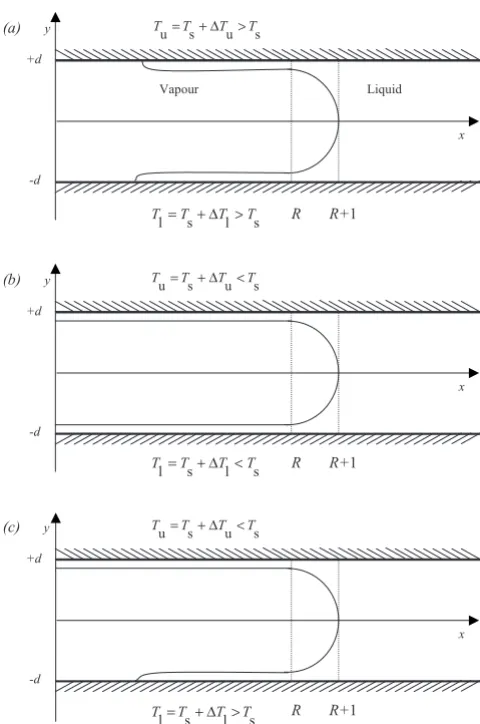
We choose Cartesian coordinates共x,y兲so that the parallel plates are aty=⫾d, and consider only bubbles that are sym-metric about the y axis. For simplicity of presentation in much of what follows we shall confine our attention to the lower quarter of the bubble lying in x⬎0 and y⬍0; the corresponding results in the upper quarter of the bubble lying inx⬎0 and y⬎0 can be readily deduced. For convenience, we writeTu=Ts+⌬TuandTl=Ts+⌬Tland consider the three specific situations sketched in Fig.1, namely,共a兲both plates superheated, ⌬Tu,⌬Tl⬎0, 共b兲 both plates subcooled,
⌬Tu,⌬Tl⬍0, and共c兲the upper plate subcooled and the lower plate superheated, ⌬Tu⬍0 and ⌬Tl⬎0.
We nondimensionalize length with d, velocity with /d, time with d2/, pressure with /d, and temperature differ-ence from the saturation temperature with兩⌬Tl兩. The energy balance at the interface gives the mass flux scale as k兩⌬Tl兩/Ld, whereL is the latent heat of vaporization. Here-after, all quantities will be dimensionless unless stated other-wise. In what follows we shall retain ⌬Tlfor clarity of pre-sentation, although the choice of nondimensionalization means that it can be set equal to either plus or minus unity without loss of generality.
The velocity 共u,v兲, where u=u共x,y,t兲 and v=v共x,y,t兲, pressurep=p共x,y,t兲and temperatureT=T共x,y,t兲of the liq-uid satisfy the usual continuity, Navier-Stokes and energy equations,
ux+vy= 0, 共1兲
C共ut+uux+vuy兲= −px+C共uxx+uyy兲, 共2兲
C共vt+uvx+vvy兲= −py+C共vxx+vyy兲, 共3兲
P共Tt+uTx+vTy兲=Txx+Tyy, 共4兲
where C=2/d is the capillary number, P=/ is the Prandtl number, andtdenotes time. Similar equations hold in the vapor. However, since the ratios of density, viscosity and thermal conductivity of the vapor to those of the liquid are typically small, we shall neglect all dynamic processes in the vapor. In the spirit of the classical Boussinesq approxima-tion, the vapor density is retained only where it multiplies the large vapor velocity. This so-called “one-sided” model devel-oped by Burelbach et al. 关12兴 allows us to obtain simple boundary conditions for the liquid without solving for the flow and heat transfer in the vapor.
(a) y
+d
x
-d
s l s
l T T T
T = +∆ >
s u s
u T T T
T = +∆ >
R+1
R
(b) y
+d
x
-d
s l s
l T T T
T = +∆ < R+1 s
u s
u T T T
T = +∆ <
R
(c) y
+d
x
-d
R+1 s
u s
u T T T
T = +∆ <
s l s
l T T T
T = +∆ > R
[image:2.609.315.555.63.425.2]Vapour Liquid
At the lower liquid-vapor interface y= −1 +h共x,t兲 the lo-cal mass-balance condition gives
−EJ=共ht+uhx−v兲共1 +hx
2兲−1/2, 共5兲 whereJ=J共x,t兲denotes the mass flux at the interface due to evaporation or condensation and E=k兩⌬Tl兩/L is the non-dimensional evaporation number. The local energy-balance condition at the interface yields
J=共Txhx−Ty兲共1 +hx2兲−1/2, 共6兲
while the normal-stress condition is
−p+ 2C关vy+hx2ux−hx共uy+vx兲兴共1 +hx2兲−1
=hxx共1 +hx2兲−3/2, 共7兲
and the tangential-stress condition can be written as 共1 −hx2兲共uy+vx兲− 2hx共ux−vy兲= 0. 共8兲
The boundary conditions at the plates y=⫾1 are no slip,u =v= 0, and prescribed temperature,T=⌬Tuat the upper plate y= 1 andT=⌬Tlat the lower plate y= −1.
One further共constitutive兲equation is required in order to close the system, and this is taken to be a linearized version of the nonequilibrium condition relating the interfacial mass flux to the interfacial temperature
KJ=T, 共9兲
where
K= kTs 3/2
␣L2共V兲d
冉
2Rg Mw
冊
1/2
共10兲
is a nondimensional kinetic parameter which measures the degree of nonequilibrium at the interface, with Rg= 8.31 J mol−1K−1denoting the gas constant,Mwthe mo-lecular weight of the vapor, and␣the accommodation coef-ficient 共see, for example, Burelbach et al. 关12兴, the more detailed discussion by Panzarella关13兴, and the extensive re-view of literature concerning the evaporation and condensa-tion coefficients of water by Marek and Straub关14兴兲.
Finally, global conservation of mass of liquid and vapor means that the rate of change of the mass of the bubble is equal to the total mass flux into the bubble and so
2U=DE
冕
Jds, 共11兲whereU=U共t兲is the velocity of the bubble,D=/共V兲is the ratio of the liquid density to vapor density, and the integral is over the entire liquid-vapor interface inx⬎0, parameterized by its arclengths.
III. ASYMPTOTIC SOLUTION IN THE LIMITC\0
In the present work we shall follow Bretherton关2兴, WDB, and many other previous authors by considering the limit of strong surface tension共i.e., the limit of small capillary num-ber C→0兲in which the bubble almost entirely fills the gap between the plates and an expanding bubble leaves behind
thin liquid films on the plates as it grows. In this limit the solution is composed of three different kinds of region. Spe-cifically, the asymptotic solution in x⬎0 consists of a “capillary-statics” region occupying the gap between the plates when R共t兲⬍x⬍R共t兲+ 1 in which capillary effects dominate and the leading-order solution for the liquid-vapor interface is a semicircular cap of radius unity that fits exactly between the plates, two small and thin “transition” regions of length O共C1/3兲Ⰶ1 and thickness O共C2/3兲Ⰶ1 near x=R共t兲 and y=⫾d 共i.e., where the semicircular cap touches the plates兲 in which viscous effects become significant and 共in the case of an expanding bubble兲 thin films of thickness O共C2/3兲Ⰶ1 are laid down on the plates, and two “thin-film” regions occupying 0⬍x⬍R共t兲 in which there are thin films of thicknessO共C2/3兲Ⰶ1 on the plates. The共unknown兲length of the thin-film regions R共t兲 is calculated from the 共un-known兲 velocity of the bubble U共t兲 which depends on the total mass flux according to Eq.共11兲.
In their analysis WDB investigated a parameter regime in whichD=O共C−2/3兲Ⰷ1,E=O共C4/3兲Ⰶ1, andK=O共C2/3兲Ⰶ1. In this situation the leading order total mass flux is deter-mined solely by the mass flux from or to the thin-film re-gions, and the higher order contributions to the mass flux from the capillary-statics and transition regions can be ne-glected at leading order. In the present work we investigate an alternative parameter regime in whichD=O共C−2/3兲Ⰷ1 as before but E=O共C2/3兲Ⰶ1 and K=O共1兲. In this situation the mass fluxes from the capillary-statics region and the thin-film regions both contribute to the leading order total mass flux, and only the higher order contribution from the transi-tion regions can be neglected at leading order. For clarity, we writeD=Dˆ C−2/3andE=Eˆ C2/3, whereDˆ andEˆ are bothO共1兲 in the limit C→0.
A. Capillary-statics region
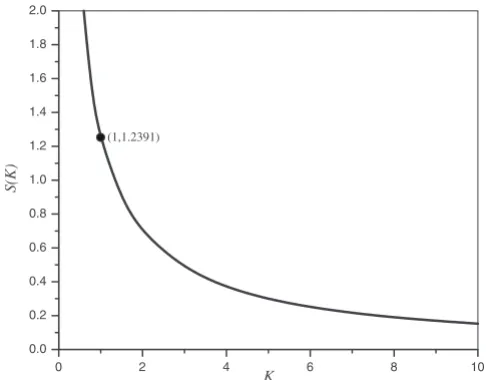
The calculation of the mass flux from the capillary-statics region involves determining the temperature distribution in the liquid in x⬎R by solving the energy Eq.共4兲 subject to the boundary conditions 共5兲 and 共6兲 at the 共known兲 liquid-vapor interface and prescribed temperature on the plates. In general, this is a difficult numerical problem involving solv-ing for both u andT in a reference frame moving with un-known velocity U共t兲 given by Eq. 共11兲. We can, however, make progress in the special case of small Prandtl number P=o共1兲 共i.e., when thermal diffusion is much stronger than viscous diffusion兲in which case the problem forTdecouples from that for u and depends on only⌬Tu,⌬Tl and K 共and not, for example, onDorE兲. In this case the contribution to the integral in Eq. 共11兲 from the capillary-statics region is given by 共⌬Tu+⌬Tl兲S共K兲, where straightforward numerical calculations 共undertaken using a standard finite element method implemented using the software package COMSOL
analyti-cal treatment it does, of course, mean that the present analy-sis is formally restricted to low Prandtl number liquids such as the liquid and alkali metals and their alloys with values of Pin the range 0.005 to 0.03 which are, for example, used as coolants in nuclear reactors共see, for example, Saravanan and Kandaswamy 关16兴兲. We would, however, anticipate that some of the qualitative features described here will also oc-cur for liquids共such as, for example, water兲with larger val-ues of P.
B. Transition regions
A straightforward modification of the analysis presented by WDB reveals that the leading-order solution for the liquid-vapor interface is simply the classical isothermal so-lution and so can be obtained in the usual way 共see, for example, Bretherton 关2兴兲. In particular, the solution in the thin-film regions yields an expression for the initial thickness of the film as it is laid down on the plates when the bubble expands共i.e., whenU⬎0兲, namely,h=cU2/3C2/3, wherecis a numerically determined constant. When the bubble retreats 共i.e., when U⬍0兲the liquid on the plates is “swept up” by the transition regions and so the details of the solution in the transition regions are unimportant.
C. Thin-film regions
Calculating the mass flux from the thfilm regions in-volves determining the temporal and spatial evolution of the profile of and the temperature distribution within the thin films on the plates. Unless they are swept up by a retreating bubble, on a superheated plate these films will thin before eventually drying out locally共possibly breaking up into dis-connected patches of liquid as they do so兲due to evaporation to the vapor, whereas on a subcooled plate they will always remain continuous as they thicken due to condensation from the vapor. In order to analyze this behavior, and hence deter-mine the total mass flux, for the thin film on the lower plate 共a similar analysis applies for the film on the upper plate兲we
introduce appropriately rescaled variables 共denoted by an overbar兲given by
v
¯=C−2/3v, ¯y=C−2/3共y+ 1兲, ¯h=C−2/3h. 共12兲 In the limit C→0 we obtain the leading-order lubrication equations
ux+¯v¯y= 0, 共13兲
u¯yy¯= 0, 共14兲
0 =p¯y, 共15兲
T¯yy¯= 0, 共16兲
subject to the leading-order boundary conditions
−Eˆ J=¯ht+uh¯x−¯v, 共17兲
0 =T¯y, 共18兲
p= 0, 共19兲
u¯y= 0, 共20兲
KJ=T 共21兲
at the lower bubble interface¯y=¯h共x,t兲, and u=¯v= 0 and T =⌬Tl on the lower plate¯y= 0. The leading-order solution is simplyu=v¯= 0 together withT=⌬TlandJ=⌬Tl/K, meaning that the liquid is quiescent and at the same uniform tempera-ture as the plate and that the flux is constant, and so Eq.共17兲 becomes
h
¯t+ Eˆ⌬Tl
K = 0. 共22兲
Hence, the profile of the film in the thin-film region is given by
h ¯共x,t兲=¯h
0共x兲− Eˆ⌬Tl
K 关t−t0共x兲兴, 共23兲 where ifx⬍Lthenh¯0=¯h0共x兲denotes the initial profile of the thin film att=t0= 0, while ifx⬎Lthen¯h0=h¯0共x兲=cU2/3 de-notes the thickness of the film laid down at positionxat time t=t0共x兲=R−1共x兲, whereL=R共0兲 共which may be zero or posi-tive兲 is the initial length of the thin films on the plates at t= 0. Equation 共23兲 shows that if the plate is superheated 共i.e., if ⌬Tl⬎0兲 then liquid evaporates from the thin film which dries out locally at position x at time t=t0 +Kh¯0共x兲/Eˆ⌬Tl, while if the plate is subcooled 共i.e., if ⌬Tl
⬍0兲 then vapor condenses onto the thin film and local dry out never occurs.
For ease of presentation, we rescale¯handEˆ withcandDˆ withc−1in order to remove the constantcfrom the leading-order problem, and remove all of the overbars and hats on the variables. Furthermore, for simplicity in what follows we
0 2 4 6 8 10
0.0 0.2 0.4 0.6 0.8 1.0 1.2 1.4 1.6 1.8 2.0
(1,1.2391)
S(K)
[image:4.609.51.294.67.257.2]K
setE=K= 1 and共unless stated otherwise兲D= 1 in all of the numerical results reported in the present work.
IV. BOTH PLATES SUPERHEATED (⌬Tu⬎0 AND⌬Tl= 1)
If both plates are superheated 共i.e., if ⌬Tu⬎0 and
⌬Tl= 1兲then the evaporation from the capillary-statics region and any films present in the thin-film regions on both plates always causes the bubble to expand, and the dynamics of the expansion are governed by Eq.共11兲, which takes the form
U=dR dt =
DE
2K关共⌬Tu+⌬Tl兲KS+⌬TuLu+⌬TlLl兴⬎0, 共24兲 whereLu=Lu共t兲andLl=Ll共t兲 共0ⱕLu,LlⱕR兲denote the total lengths of film on the upper and lower plates in x⬎0, re-spectively. Note that the three terms on the right hand side of Eq. 共24兲represent the contributions to the expansion due to the evaporation from the capillary-statics region, the evapo-ration from any film present in the thin-film region on the upper plate and the evaporation from any film present in the thin-film region on the lower plate, respectively.
A. Delay-equation formulation for continuous films
The liquid films laid down on the plates as the bubble expands will, in general, break up into disconnected patches of liquid as they dry. However, it is still very informative to investigate the behavior in the special case in which the films remain continuous as they dry共i.e., the special case in which there are no disconnected patches of liquid兲analytically be-fore analyzing the more general situation numerically. For continuous films we denote the position of the front of the film 共where h=h0=U2/3兲 by x=R关
u+Tu共u兲兴=R关l+Tl共l兲兴, the position of the back of the film on the upper plate共where h= 0兲byx=R共u兲, and the position of the back of the film on the lower plate 共where again h= 0兲 by x=R共l兲, where
Tu=Tu共u兲andTl=Tl共l兲, given by
Tu共u兲= Kh0 E⌬Tu
= KU共u兲 2/3
E⌬Tu
共25兲
and
Tl共l兲= Kh0 E⌬Tl
=KU共l兲 2/3
E⌬Tl
共26兲
are the lengths of time it takes for the liquid deposited on the upper and lower plates at times t=u andt=l, respectively, to dry out. Adopting this new notation, Eq.共24兲can be writ-ten as
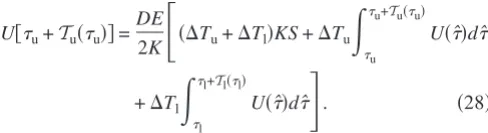
U关u+Tu共u兲兴= DE
2K兵共⌬Tu+⌬Tl兲KS+⌬TuLu关u+Tu共u兲兴 +⌬TlLl关l+Tl共l兲兴其, 共27兲 or, equivalently, as
U关u+Tu共u兲兴= DE
2K
冋
共⌬Tu+⌬Tl兲KS+⌬Tu冕
u
u+Tu共u兲
U共ˆ兲dˆ
+⌬Tl
冕
l
l+Tl共l兲
U共ˆ兲dˆ
册
. 共28兲Equation共28兲is an integrodelay equation forUwith noncon-stant delaysTuandTlwhich depend on the solution forUat timest=uandt=l, respectively, according to Eqs.共25兲and 共26兲.
B. Constant-velocity continuous-film solutions and their stability
Equation 共28兲 permits an exact continuous-film solution with constant velocity U0共⬎0兲 and the corresponding con-stant delays Tu0andTl0 given by
Tu0= KU02/3 E⌬Tu
and Tl0=KU0 2/3
E⌬Tl
. 共29兲
Substituting U=U0,Tu=Tu0andTl=Tl0into Eq.共28兲shows that U0satisfies
U0= DE
2K关共⌬Tu+⌬Tl兲KS+共⌬TuTu0+⌬TlTl0兲U0兴
= DE
2 共⌬Tu+⌬Tl兲S+DU0
5/3. 共30兲
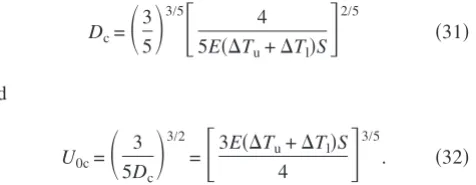
Figure3 showsU0plotted as a function ofDfor a range of values of ⌬Tu, and shows that for 0⬍D⬍Dcthere are two branches of positive solutions, namely, a “fast” mode satis-fying U0⬎U0c and a “slow” mode satisfying 0⬍U0⬍U0c, but that there are no positive solutions forD⬎Dc, where the critical valuesDcandU0care given by
0.0 0.1 0.2 0.3 0.4 0.5 0.6 0
2 4 6 8 10
∆Tu=0.2
∆Tu=1 ∆Tu=5
(Dc,U0c)
Slow (stable) mode
Fast (unstable) mode
U0
[image:5.609.317.555.65.265.2]D
[image:5.609.314.558.323.389.2]Dc=
冉
3 5冊
3/5
冋
45E共⌬Tu+⌬Tl兲S
册
2/5共31兲
and
U0c=
冉
3 5Dc冊
3/2
=
冋
3E共⌬Tu+⌬Tl兲S4
册
3/5
. 共32兲
In particular, the slow mode satisfies U0⬃DE共⌬Tu +⌬Tl兲S/2→0+and the fast mode satisfiesU0⬃D−3/2→⬁in the limit D→0+, while both modes satisfy U
0−U0c=O共Dc −D兲1/2 in the limit D→Dc−. For both modes the profiles of the films on both plates are linear inx. On the lower plate the profile has slope E⌬Tl/KU0 and increases from the value h= 0 at the back
x=R共t−Tl0兲=U0t− KU05/3
E⌬Tl
共33兲
to the value h=U02/3 at the frontx=R共t兲=U0taccording to
h=U02/3+E⌬Tl KU0
共x−U0t兲. 共34兲
The corresponding results for the profile of the film on the upper plate are obtained by replacing Tl0 with Tu0 and⌬Tl with⌬Tu.
The stability of both modes can be determined by writing U=U0+U1,Tu=Tu0+Tu1andTl=Tl0+Tl1 and linearizing for smallU1,Tu1andTl1. From Eqs.共25兲and共26兲the first-order delaysTu1=Tu1共u兲 andTl1=Tl1共l兲are given by
Tu1共u兲=
2KU1共u兲 3E⌬TuU0
1/3 共35兲
and
Tl1共l兲=
2KU1共l兲 3E⌬TlU01/3
, 共36兲
and from Eq.共28兲the equation forU1is found to be
U1共u+Tu0兲= DE
2K
冋
共⌬TuTu1+⌬TlTl1兲U0+⌬Tu
冕
u
u+Tu0
U1共ˆ兲dˆ+⌬Tl
冕
l
l+Tl0
U1共ˆ兲dˆ
册
. 共37兲Equation 共37兲 is an integrodelay equation for U1 with 共known兲 constant delays Tu0 and Tl0, which has an exact solution in the form
U1共t兲⬀exp
冉
EK t
冊
, 共38兲where the temporal growth rate=共U0,D,⌬Tu,⌬Tl兲 satis-fies the algebraic equation
2 D
冋
1 −DU02/3 3
再
exp冉
−U02/3
⌬Tu
冊
+ exp
冉
−U0 2/3⌬Tl
冊
冎
册
=⌬Tu
冋
1 − exp冉
− U02/3⌬Tu
冊
册
+⌬Tl
冋
1 − exp冉
− U02/3⌬Tl
冊
册
. 共39兲Figure 4 shows  plotted as a function ofDfor a range of values of ⌬Tu, and shows that ⬎0 for the fast mode and ⬍0 for the slow mode. In particular, for the fast mode ⬃ˆ D→0+in the limitD→0+, whereˆ=ˆ共⌬T
u,⌬Tl兲 sat-isfies the algebraic equation
0.0 0.1 0.2 0.3 0.4 0.5
-4 -3 -2 -1 0 1
∆Tu=1 ∆Tu=5
(Dc,0)
Slow (stable) mode Fast (unstable) mode
β
D
0.0 0.1 0.2 0.3 0.4 0.5 0.6
-4 -3 -2 -1 0 1
∆Tu=0.2 ∆Tu=1
(Dc,0) Fast (unstable) mode
Slow (stable) mode
β
D (b)
[image:6.609.315.556.66.467.2](a)
FIG. 4. The temporal growth rate of the constant-velocity continuous-film solutionsplotted as a function ofDfor共a兲⌬Tu
[image:6.609.61.299.67.159.2]2ˆ
冋
1 −13
再
exp冉
− ˆ⌬Tu
冊
+ exp
冉
−  ˆ⌬Tl
冊
冎
册
=⌬Tu
冋
1 − exp冉
−  ˆ⌬Tu
冊
册
+⌬Tl
冋
1 − exp冉
−  ˆ⌬Tl
冊
册
, 共40兲 and for the slow mode⬃ max共⌬Tu,⌬Tl兲 U02/3 log
冉
DU02/3
3
冊
=O共D−2/3logD兲→−⬁ 共41兲 in the limit D→0+ 关17兴, while for both modes =O共Dc−D兲1/2→0 in the limitD→Dc−. Thus the fast mode withU0⬎U0cis always unstable, while the slow mode with 0⬍U0⬍U0cis always stable. These results are qualitatively different from the corresponding results obtained by WDB who found a single unstable mode with velocity U0=D−3/2 共corresponding to the limitD→0+of the present fast mode兲 for all values ofD关18兴.
C. No initial films
If there are no films on the plates initially 关i.e., if L=R共0兲= 0兴then the initial expansion of the bubble is driven solely by the evaporation from the capillary-statics region. Until the film laid down on the hotter plate starts to dry out atx= 0 att=KU02/3/Emax共⌬Tu,⌬Tl兲, whereU0=U共0兲is the initial velocity of the bubble att= 0, we haveLu=Ll=R, and so from Eq.共24兲
R=KS
冋
exp冉
DE共⌬Tu+⌬Tl兲2K t
冊
− 1册
. 共42兲 In particular, the initial expansion of the bubble is given by U=U0+U1t+O共t2兲, whereU0共⬎0兲andU1共⬎0兲are givenU0=
DE共⌬Tu+⌬Tl兲S
2 共43兲
and
U1=
冉
DE共⌬Tu+⌬Tl兲
2
冊
2S
K. 共44兲
Solving Eq. 共24兲 numerically for a range of values of D reveals that the eventual behavior of the bubble is qualita-tively different for 0⬍D⬍DcandD⬎Dc, where the critical value Dcis given by Eq.共31兲. Specifically, we find that for 0⬍D⬍Dcthe bubble eventually expands with the constant velocity of the stable slow mode calculated in Sec. IV B above but that forD⬎Dcno constant-velocity solutions ex-ists and the bubble eventually expands exponentially accord-ing to
R=O
冉
exp冋
DE共⌬Tu+⌬Tl兲2K t
册
冊
→⬁ 共45兲as t→⬁. These results are illustrated in Fig.5 which shows two examples of the numerically calculated evolution of the
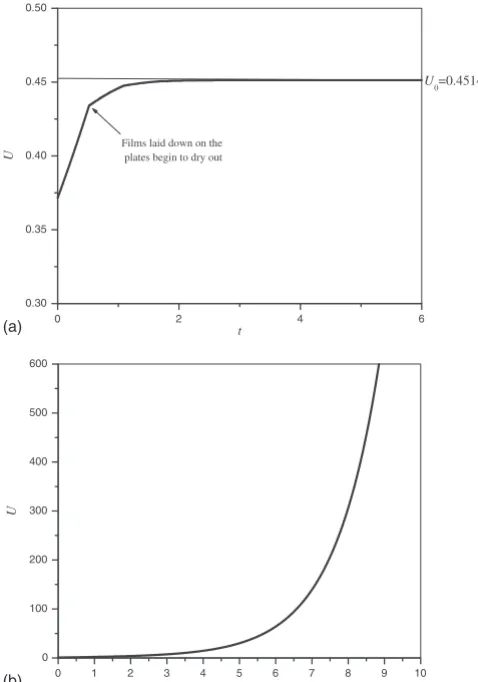
bubble in the case when both plates are superheated equally, i.e., when⌬Tu=⌬Tl= 1. Specifically, Fig.5共a兲illustrates that in the case D= 0.3 共⬍Dc⯝0.4682兲 the bubble velocity ap-proaches the limiting value ofU0⯝0.4514共⬍U0c⯝1.4560兲 in the limit t→⬁, while Fig.5共b兲illustrates that in the case D= 0.8共⬎Dc兲 the bubble eventually expands exponentially according to Eq.共45兲. Note that the “corners” inU discern-ible in Fig. 5共a兲 are not the result of numerical or plotting inaccuracies, but are caused by the local dry out of the films on the plates, which results in a discontinuous change in the local mass flux and hence a discontinuous change in the slope ofU as a function oft. For example, the corner high-lighted in Fig. 5共a兲 corresponds to the instant t⯝0.5170 at which the films of thickness U02/3⯝0.5170 laid down at x= 0 on both plates at t= 0 dry out creating dry patches at x= 0 on both plates. Since the thickness of the films laid down on the plates, and hence their subsequent contribution to the total mass flux, depends on the current value of U, “echoes” of this event occur in the subsequent evolution of the bubble.
D. Uniform initial films
If there are uniform films of lengthLand thicknessHon both plates initially关i.e., ifR共0兲=Landh0=Hfor 0ⱕxⱕL兴
0 2 4 6
0.30 0.35 0.40 0.45 0.50
Films laid down on the plates begin to dry out
U 0=0.4514
U
t
0 1 2 3 4 5 6 7 8 9 10
0 100 200 300 400 500 600
U
t
[image:7.609.315.554.67.408.2](b) (a)
FIG. 5. The velocity of the bubble Uplotted as a function of time t in the cases 共a兲 D= 0.3 共⬍Dc⯝0.4682兲 and 共b兲 D= 0.8
then the initial expansion of the bubble is driven by the evaporation from both the capillary-statics region and the initial films. For simplicity in what follows we setH= 1 in all of the numerical results reported in the present work. When the initial films on the upper and lower plates dry out at
t=tcu= KH E⌬Tu
and t=tcl= KH E⌬Tl
, 共46兲
this causes discontinuous drops in U of magnitude DEL⌬Tu/2KandDEL⌬Tl/2Kat those instants, respectively, and this may occur either before or after the film laid down on the hotter plate starts to dry out at x=L at t=KU02/3/Emax共⌬Tu,⌬Tl兲. Until the first dry out occurs we again haveLu=Ll=Rand hence
R=共KS+L兲exp
冉
DE共⌬Tu+⌬Tl兲2K t
冊
−KS. 共47兲 In particular, the initial expansion is given by U=U0+U1t +O共t2兲, whereU0共⬎0兲andU1共⬎0兲are givenU0=
DE共⌬Tu+⌬Tl兲
2K 共KS+L兲 共48兲
and
U1=
冉
DE共⌬Tu+⌬Tl兲
2K
冊
2
共KS+L兲. 共49兲
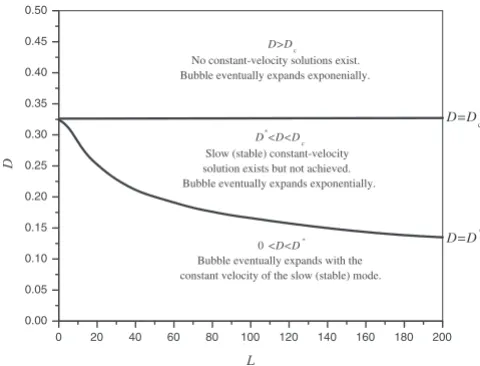
Note that in the special case L= 0 Eqs.共47兲–共49兲reduce to the corresponding expressions in the case of no initial films given by Eqs.共42兲–共44兲in Sec.IV Dabove. Solving Eq.共24兲 numerically for a range of values ofDreveals that the even-tual behavior of the bubble is again qualitatively different for different values ofD, but that the presence of the initial films makes the situation a little more complicated than when they are absent. Specifically, we find that while a stable constant-velocity solution is again possible for all values ofDin the range 0⬍D⬍Dc, it is eventually attained only when D is
less than a critical value denoted by Dⴱ共⬍Dc兲. Thus for 0
⬍D⬍Dⴱ the bubble eventually expands with the constant velocity of the stable slow mode calculated in Sec. IV B above, while for D⬎Dⴱ we find that the bubble eventually
0 20 40 60 80 100 120 140 160 180 200
0.00 0.05 0.10 0.15 0.20 0.25 0.30 0.35 0.40 0.45 0.50
D=D*
0<D<D*
Bubble eventually expands with the constant velocity of the slow (stable) mode.
D*
<D<D c
Slow (stable) constant-velocity solution exists but not achieved. Bubble eventually expands exponentially.
D>Dc
No constant-velocity solutions exist. Bubble eventually expands exponenially.
D=D
c
D
[image:8.609.316.556.63.613.2]L
FIG. 6. A plot of the共L,D兲parameter plane showing how the numerically calculated curveD=Dⴱdivides the region in which the bubble eventually expands with the constant velocity of the slow mode from the region in which it eventually expands exponentially.
0 1 2 3 4 5 6 7 8 9 10
0 1 2 3 4 5 6 7 8 9
Initial film on the lower superheated plate dries out att=tcl= 1 Initial film on the upper superheated
plate dries out att=tcu= 0.25
U0=1.0422
U
t
0 1 2 3 4 5 6 7 8 9 10
0 5 10 15 20 25 30 35 40
U0=1.0422
U
t
U 0.00 0.25 0.50 0.75 1.00 1.25 1.50
0 10 20 30 40 50
0.0 0.5 1.0 1.5 2.0 2.5 3.0 3.5
0 200 400 600 800 1000
U
t
t
(b) (a)
(c)
FIG. 7. The velocity of the bubble Uplotted as a function of time t in the cases 共a兲 D= 0.25 共⬍Dⴱ⯝0.2890兲, 共b兲 D= 0.3 共Dⴱ
[image:8.609.52.292.67.250.2]expands exponentially according to Eq.共45兲. In general, the value ofDⴱhas to be calculated numerically. Figure6shows Dⴱ plotted as a function of L, and, in particular, shows that Dⴱ→Dc− as L→0+. Figure 6 also shows how the curve D =Dⴱ divides the 共L,D兲 parameter plane into the region in which the bubble eventually expands with the constant ve-locity of the slow mode from the region in which it eventu-ally expands exponentieventu-ally. These results are illustrated in Fig. 7 which shows three examples of the numerically cal-culated evolution of the bubble in the case L= 10 when
⌬Tu= 4 and⌬Tl= 1. Specifically, Fig.7 shows the evolution in the cases 共a兲 D= 0.25 共⬍Dⴱ⯝0.2890兲, 共b兲 D= 0.3 共Dⴱ⬍D⬍Dc⯝0.3245兲 and 共c兲 D= 0.6共⬎Dc兲. In particular, Fig. 7共b兲 shows the evolution in a case in which a stable constant-velocity solution exists but is not achieved. In addi-tion to the corners inUarising from the local dry out of the films like those seen previously in Fig. 5共a兲, Fig. 7 also clearly shows the discontinuous drops inUarising from the dry out of the initial films on the upper and lower plates at tcu= 0.25 andtcl= 1, respectively.
Figure8shows the profile of the film on the lower plate in the caseD= 0.25 at various times. In particular, Fig.8shows the disappearance of the uniform initial film of length L= 10 at timet=tcl= 1 and the presence of one disconnected patch of liquid att= 3 and two disconnected patches of liquid att= 3.5 created as the nonuniform film which is laid down on the plate as the bubble expands dries out locally.
V. BOTH PLATES SUBCOOLED (⌬Tu⬍0 AND⌬Tl= −1)
If both plates are subcooled 共i.e., if ⌬Tu⬍0 and
⌬Tl= −1兲then the condensation onto the capillary-statics re-gion and the thin-film rere-gions on both plates always causes the bubble to contract, and the dynamics of the contraction are governed by Eq.共11兲, which takes the simple form
U=dR dt =
DE共⌬Tu+⌬Tl兲
2K 共KS+R兲⬍0. 共50兲 Note that the two terms on the right hand side of Eq. 共50兲 represent the contributions to the contraction due to the
con-densation onto the capillary-statics region and the condensa-tion onto the thin-film regions on the upper and lower plates, respectively.
If there are no initial films 关i.e., if L=R共0兲= 0兴 then R immediately becomes negative 共which is, of course, physi-cally impossible兲, i.e., the model fails immediately. However, if there are uniform initial films of lengthL共i.e., ifR共0兲=L兲 then the bubble collapses exponentially according to Eq. 共47兲. In particular, the initial contraction of the bubble is given by U=U0+U1t+O共t2兲, where U0共⬍0兲andU1共⬎0兲are given by Eqs. 共48兲 and 共49兲. Eventually, the model fails when the bubble reaches zero length at the finite time t=tⴱ given by
tⴱ= − 2K DE共⌬Tu+⌬Tl兲
log
冉
1 + LKS
冊
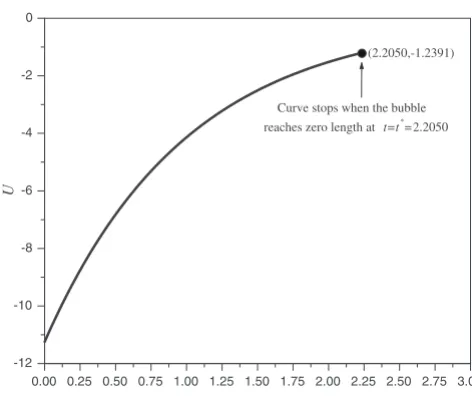
. 共51兲Figure 9 shows the evolution of the bubble in the case L= 10 when both plates are subcooled equally, i.e., when
⌬Tu=⌬Tl= −1, in which case the model fails when the bubble reaches zero length att=tⴱ= 2.2050.
VI. UPPER PLATE SUBCOOLED AND LOWER PLATE SUPERHEATED (⌬Tu⬍0 AND⌬Tl= 1)
[image:9.609.316.552.63.262.2]If the upper plate is subcooled and the lower plate is su-perheated 共i.e., if⌬Tu⬍0 and ⌬Tl= 1兲then the net effect of the evaporation from and condensation onto the capillary-statics region, the condensation onto the thin-film region on the upper plate and the evaporation from any film present in the thin-film region on the lower plate may cause the bubble to expand or contract, and the dynamics are governed by Eq. 共11兲, which takes the form
FIG. 8. The profile of the film on the lower plate in the case
D= 0.25 with initial films of length L= 10 when both plates are superheated unequally with⌬Tu= 4 and⌬Tl= 1 att= 0, 0.5, 1, 3 and 3.5.
0.00 0.25 0.50 0.75 1.00 1.25 1.50 1.75 2.00 2.25 2.50 2.75 3.00 -12
-10 -8 -6 -4 -2 0
(2.2050,-1.2391)
Curve stops when the bubble reaches zero length at t=t*=
2.2050
U
t
[image:9.609.53.295.68.252.2]U=dR dt =
DE
2K关共⌬Tu+⌬Tl兲KS+⌬TuR+⌬TlLl兴, 共52兲 whereLl=Ll共t兲 共0ⱕLlⱕR兲 is again the total length of film on the lower plate inx⬎0. Note that the three terms on the right hand side of Eq.共52兲represent the contributions to the expansion or contraction due to the evaporation from and condensation onto the capillary-statics region, the condensa-tion onto the thin-film region on the subcooled upper plate and the evaporation from any film present in the thin-film region on the superheated lower plate, respectively.
A. Magnitude of subcooling and superheating equal (−⌬Tu=⌬Tl= 1)
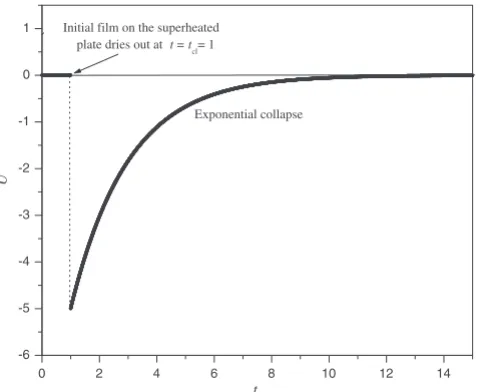
If the magnitude of the subcooling is equal to that of the superheating 共i.e., the special case −⌬Tu=⌬Tl= 1兲 then the behavior of the bubble depends on whether or not any initial films are present. If there are no initial films then the evapo-ration from the lower half of the semicircular cap is exactly balanced by the condensation onto the upper half of the cap, and hence U⬅0, i.e., the bubble remains stationary for all time. However, if there are uniform initial films of lengthL then the bubble remains stationary until the initial film on the superheated plate dries out at t=tcl given by Eq. 共46兲, and thereafter for t⬎tcl the bubble collapses exponentially to zero length in an infinite time according to
R=Lexp
冉
−DE共−⌬Tu兲2K 共t−tcl兲
冊
. 共53兲 Figure 10 shows the evolution of the bubble in the case L= 10. In particular, Fig. 10 shows both the discontinuous drop inUof magnitudeDEL⌬Tl/2K= 5 att=tcl= 1 when the initial film on the superheated plate dries out, and the subse-quent exponential decay of U.B. Magnitude of subcooling less than that of superheating (−⌬Tu⬍⌬Tl= 1)
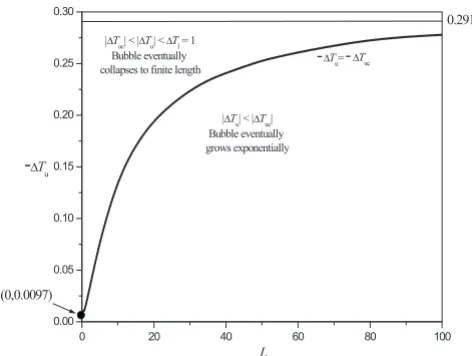
If the magnitude of the subcooling is less than that of the superheating 共i.e., if −⌬Tu⬍⌬Tl= 1兲then the bubble always expands initially, but its ultimate fate depends on whether or not the magnitude of the subcooling −⌬Tu共⬎0兲is greater or less than a critical value, denoted by −⌬Tuc共⬎0兲. Specifi-cally, if 兩⌬Tuc兩⬍兩⌬Tu兩⬍⌬Tl= 1 then once all of the film on the superheated plate has eventually disappeared 共i.e., when Ll= 0兲the bubble collapses exponentially to the finite length R=R⬁⬎0 given by
R⬁=KS共⌬Tu+⌬Tl兲
共−⌬Tu兲 共54兲
according to
R−R⬁=O
冉
exp冋
−DE共−⌬Tu兲2K t
册
冊
共55兲ast→⬁. On the other hand if兩⌬Tu兩⬍兩⌬Tuc兩 then the bubble always expands and eventually does so exponentially accord-ing to Eq.共45兲ast→⬁. Note that until the film laid down on the superheated plate starts to dry out at x= 0 at t =KU02/3/E⌬Tl, the evolution of the bubble is again described by Eqs.共42兲–共44兲when there are no initial films, and by Eqs. 共47兲–共49兲when there are uniform initial films.
If there are no initial films the value of −⌬Tuc is found numerically to be 0.0097. Figure 11 shows the numerically calculated evolution of the bubble in the case ⌬Tu= −0.5, which satisfies兩⌬Tuc兩⬍兩⌬Tu兩⬍⌬Tl= 1.
If there are uniform initial films the value of −⌬Tuc de-pends on the values of L and H. Figure12 shows how the numerically calculated curve −⌬Tu= −⌬Tuc divides the 共L, −⌬Tu兲 parameter plane into the region in which the bubble eventually expands exponentially from the region in which it eventually collapses to the finite length R⬁. In par-ticular, Fig. 12 shows that −⌬Tuc increases monotonically
0 2 4 6 8 10 12 14
-6 -5 -4 -3 -2 -1 0 1
Exponential collapse Initial film on the superheated
plate dries out at t=tcl= 1
U
[image:10.609.318.557.66.262.2]t
FIG. 10. The velocity of the bubbleUplotted as a function of time t for initial films of length L= 10 when the upper plate is subcooled and the lower plate is superheated with equal magnitude, i.e., when −⌬Tu=⌬Tl= 1.
0 2 4 6 8 10 12 14 16 18 20
0.0 0.1 0.2 0.3 0.4
Exponential collapse Film laid down on the superheated
plate begins to dry out
U
[image:10.609.55.296.67.263.2]t
[image:10.609.323.555.457.536.2]from 0.0097 when L= 0 towards 0.2911 in the limit L→⬁. Figure13shows the numerically calculated evolution of the bubble in the caseL= 50 when⌬Tu= −0.26 and⌬Tu= −0.31, both of which satisfy 兩⌬Tuc兩⬍兩⌬Tu兩⬍⌬Tl= 1, where −⌬Tuc ⯝0.2527. In particular, Fig.13shows that the dynamics can be considerably more complicated than those in the case of no initial film. Specifically, Fig. 13共b兲 shows that an unex-pected “waiting time” behavior in which the bubble remains almost stationary for a finite period of time can occur.
C. Magnitude of subcooling greater than that of superheating (−⌬Tu⬎⌬Tl= 1)
If the magnitude of the subcooling is greater than that of the superheating共i.e., if −⌬Tu⬎⌬Tl= 1兲then the bubble al-ways contracts.
If there are no initial films then the model fails immedi-ately as in Sec.Vabove. However, if there are uniform initial films of length L thenLl=R until all the film on the super-heated plate dries out at t=tclgiven by Eq. 共46兲, and so for 0ⱕt⬍tclthe bubble contracts exponentially according to Eq. 共47兲, reaching the lengthR=Rc=R共tcl兲att=tcl. Thereafter for t⬎tclthe bubble collapses exponentially according to
R=R⬁+共Rc−R⬁兲exp
冋
−DE共−⌬Tu兲
2K 共t−tcl兲
册
, 共56兲 whereR⬁⬍0共which is now negative兲is again given by Eq. 共54兲, until eventually the model fails when the bubble reaches zero length at the finite time t=tⴱgiven bytⴱ=tcl+ 2K
DE共−⌬Tu兲log
冉
1 + Rc共−R⬁兲
冊
. 共57兲VII. PHYSICAL VALUES
In order to illustrate typical physical situations in which the analysis of WDB and the present analysis apply, it is
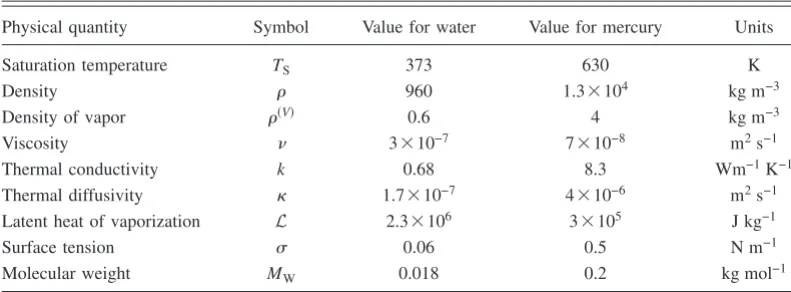
informative to consider the typical physical parameter values for water and mercury listed in TableIand the corresponding values of the nondimensional parameters P,C,D,E, andK listed in TableII. Both analyses are based on the assumption that the capillary number is small, CⰆ1, and hence that dⰇO共10−9兲 m for water and dⰇO共10−10兲 m for mercury, and that the density ratio is large, D=O共C−2/3兲Ⰷ1. The analysis of WDB applies whenP=O共1兲,K=O共C2/3兲Ⰶ1 and E=O共C4/3兲Ⰶ1 and so corresponds to physical situations with “large” gaps and “small” superheating or subcooling whereas the present analysis applies when P=o共1兲, K=O共1兲 andE=O共C2/3兲Ⰶ1 and so corresponds to physical situations with “small” gaps and “large” superheating or sub-cooling. Thus共assuming for definiteness that the accommo-dation coefficient ␣= 1 关19兴兲 while the analysis of WDB is applicable to water when d=O共10−4兲 m and 兩⌬T
l兩 =O共10−4兲 K, the present analysis is applicable to mercury when d=O共10−6兲 m and 兩⌬Tl兩=O共10−2兲 K. In particular, settingK= 1 andE=C2/3 for mercury corresponds to choos-ing d= 6⫻10−6 m and兩⌬T
l兩= 0.03 K, and the present
theo-0 20 40 60 80 100
0.00 0.05 0.10 0.15 0.20 0.25 0.30
--∆Tu= ∆Tuc
|∆Tuc| < |∆Tu| <∆Tl= 1
Bubble eventually collapses to finite length
|∆Tu| < |∆Tuc| Bubble eventually grows exponentially
(0,0.0097)
0.2911
∆Tu
[image:11.609.317.556.63.469.2]L
FIG. 12. A plot of the共L, −⌬Tu兲parameter plane showing how the numerically calculated curve −⌬Tu= −⌬Tucdivides the region in which the bubble eventually expands exponentially from the region in which it eventually collapses to the finite lengthR⬁.
0 5 10 15 20 25 30
-20 -10 0 10 20 30
Film laid down on the superheated plate aftert=tclbegins to dry out
Exponential collapse
No film left on the superheated plate Initial film on the superheated
plate dries out att=tcl= 1
U
t
0 5 10 15 20 25 30
-10 0 10 20 30
Film laid down on the superheated plate begins to dry out Initial film on the superheated
plate dries out att=tcl= 1
No film left on the superheated plate
Exponential collapse ''Waiting time" behaviour
U
t (b)
(a)
[image:11.609.53.289.66.244.2]retical prediction for the 共dimensional兲 initial expansion or contraction velocity of a bubble between equally subcooled or superheated plates isU0/d, whereU0is given by Eq.共43兲 and共48兲, which corresponds to a rather modest initial veloc-ity of approximately 0.04 m s−1for a bubble with no initial films to a much faster initial velocity of approximately 5 m s−1 for a bubble with initial films of 共dimensional兲 length L= 10−3 m.
VIII. CONCLUSIONS
In this paper the dynamics of a long, two-dimensional vapor bubble confined in the gap between two superheated or subcooled parallel plates was analyzed theoretically. The analysis used the approach developed by WDB to consider a situation with small gaps and large superheating or subcool-ing in which the mass transfer from or to the semicircular nose of the bubble is comparable to that from or to the thin liquid films on the plates. In order to permit a 共semi-兲analytical treatment the analysis was restricted to low Prandtl number liquids.
When both plates are superheated the bubble always ex-pands. In this case there are two possible constant-velocity continuous-film solutions for the expansion of the bubble
when 0⬍D⬍Dc, namely, an unstable fast mode with veloc-ity U0satisfying U0⬎U0c and a stable slow mode with ve-locityU0satisfying 0⬍U0⬍U0c, but none forD⬎Dc, where the critical values Dc and U0c are given by Eqs. 共31兲 and 共32兲, respectively. The evolution of the bubble was calcu-lated numerically for a range of values of the parameters. In particular, these calculations showed that when 0⬍D⬍Dⴱ共ⱕDc兲 the bubble eventually expands with the constant velocity of the slow mode whereas whenD⬎Dⴱit eventually expands exponentially according to Eq.共45兲. Nu-merically calculated values of Dⴱ are shown in Fig.6. This behavior is qualitatively different from that in the situation investigated by WBD in which there is only a single unstable constant-velocity continuous-film solution共corresponding to the limit D→0+ of the present fast mode兲 and all bubbles always either expand indefinitely or stop in a finite time.
When both plates are subcooled the bubble always col-lapses to zero length at the finite timet=tⴱgiven by Eq.共51兲. This behavior is also qualitatively different from that in the situation investigated by WBD in which all bubbles always collapse to zero length asymptotically in infinite time.
[image:12.609.106.502.83.229.2]When one plate is subcooled and the other plate is super-heated the situation is rather more complicated. If the mag-nitude of the subcooling −⌬Tuis less than that of the super-heating ⌬Tl then if 兩⌬Tuc兩⬍兩⌬Tu兩⬍⌬Tl then a variety of
TABLE I. Typical physical parameter values for water and mercury.
Physical quantity Symbol Value for water Value for mercury Units
Saturation temperature TS 373 630 K
Density 960 1.3⫻104 kg m−3
Density of vapor 共V兲 0.6 4 kg m−3
Viscosity 3⫻10−7 7⫻10−8 m2s−1
Thermal conductivity k 0.68 8.3 Wm−1K−1
Thermal diffusivity 1.7⫻10−7 4⫻10−6 m2s−1
Latent heat of vaporization L 2.3⫻106 3⫻105 J kg−1
Surface tension 0.06 0.5 N m−1
Molecular weight MW 0.018 0.2 kg mol−1
TABLE II. Values of the nondimensional parametersP, C,D, E, and Kfor water and mercury corre-sponding to the typical physical parameter values listed in TableI.
Nondimensional parameter Symbol Definition Value for water Value for mercury
Prandtl number P
1.8 0.02
Capillary number C
2 d
1.4⫻10−9
d
1.3⫻10−10
d
Density ratio D
共V兲 1.6⫻103 3.25⫻103
Evaporation number E
k兩⌬Tl兩
L 10−3兩⌬T
l兩 0.03兩⌬Tl兩
Kinetic parameter K
kTS3/2
␣L2共V兲d
冉
2Rg MW
冊
1/2 8⫻10−8
␣d
[image:12.609.106.503.563.746.2]complicated behaviors共including the possibility of an unex-pected “waiting time” behavior in which the bubble remains almost stationary for a finite period of time兲can occur before the bubble eventually collapses to the finite length R=R⬁ given by Eq. 共54兲 in an infinite time, whereas if 兩⌬Tu兩
⬍兩⌬Tuc兩then the bubble always expands and eventually does so exponentially according to Eq. 共45兲. Numerically calcu-lated values of −⌬Tucare shown in Fig.12. If the magnitude of the subcooling is greater than that of the superheating then the bubble always collapses to zero length at the finite time
t=tⴱ given by Eq. 共57兲. This behavior is also qualitatively different from that in the situation investigated by WBD in which all bubbles always eventually collapse to zero length asymptotically in infinite time.
ACKNOWLEDGMENTS
The present work was supported by the United Kingdom Engineering and Physical Sciences Research Council 共EPSRC兲Research under Grant No. GR/R74468.
关1兴S. K. Wilson, S. H. Davis, and S. G. Bankoff,J. Fluid Mech. 391, 1共1999兲.
关2兴F. P. Bretherton,J. Fluid Mech. 10, 166共1961兲.
关3兴V. S. Ajaev and G. M. Homsy,J. Colloid Interface Sci. 240, 259共2001兲.
关4兴V. S. Ajaev and G. M. Homsy,J. Colloid Interface Sci. 244, 180共2001兲.
关5兴V. S. Ajaev, G. M. Homsy, and S. J. S. Morris, J. Colloid Interface Sci. 254, 346共2002兲.
关6兴V. S. Ajaev and G. M. Homsy,Annu. Rev. Fluid Mech. 38, 277共2006兲.
关7兴A. Mukherjee and S. G. Kandlikar,Microfluid. Nanofluid. 1, 137共2005兲.
关8兴G. Wang and P. Cheng, Int. J. Heat Mass Transfer 52, 79
共2009兲.
关9兴S. G. Kandlikar,ASME J. Heat Transfer 126, 8共2004兲.
关10兴J. R. Thome,Int. J. Heat Fluid Flow 25, 128共2004兲.
关11兴D. B. R. Kenning, D. S. Wen, K. S. Das, and S. K. Wilson,Int. J. Heat Mass Transfer 49, 4653共2006兲.
关12兴J. P. Burelbach, S. G. Bankoff, and S. H. Davis,J. Fluid Mech. 195, 463共1988兲.
关13兴C. H. Panzarella, Ph.D. Thesis, Northwestern University, 1998
共unpublished兲.
关14兴R. Marek and J. Straub, Int. J. Heat Mass Transfer 44, 39
共2001兲.
关15兴www.comsol.com
关16兴S. Saravanan and P. Kandaswamy, ASME J. Heat Transfer 122, 602共2000兲.
关17兴In the special case of equal superheating 共i.e., when ⌬Tu=⌬Tl= 1兲 the argument of the logarithm in Eq. 共41兲 is multiplied by a factor of 2.
关18兴Note that a comparison of the present stability analysis with the corresponding analysis reported by WDB reveals that the latter is in error whenD⫽1. Specifically, the first term on the right hand side of their Eq.共57兲 关corresponding to the present Eq.共37兲兴should be multiplied byU0and so, in particular, the
D2/3term in their Eq.共59兲should be replaced by unity. Setting ⌬Tu=⌬TlandU0=D−3/2 in the present Eq.共39兲recovers the corrected version of their Eq. 共59兲 when the different defini-tions ofare taken into account. SinceDnow appears only in the corrected version of their Eq.共59兲in the combination/D
the solution for  in this case is simply = 0.7799D for all values ofD. Fortunately, the qualitative conclusions of WDB’s stability analysis are not affected by this minor error.
关19兴The extensive review of literature concerning the evaporation and condensation coefficients of water by Marek and Straub