City, University of London Institutional Repository
Citation
:
Simpson, A. (2006). Shared care and interprofessional practice. In: Rassool, G. H. and Hussein, R. G. (Eds.), Dual Diagnosis Nursing. (pp. 130-139). Wiley-Blackwell. ISBN 978-1-4051-1902-3This is the accepted version of the paper.
This version of the publication may differ from the final published
version.
Permanent repository link:
http://openaccess.city.ac.uk/7248/Link to published version
:
Copyright and reuse:
City Research Online aims to make research
outputs of City, University of London available to a wider audience.
Copyright and Moral Rights remain with the author(s) and/or copyright
holders. URLs from City Research Online may be freely distributed and
linked to.
City Research Online: http://openaccess.city.ac.uk/ [email protected]
Chapter 9: Shared Care and Interprofessional Practice
Introduction
The majority of mental health professionals that have experience of working with people with a dual diagnosis will have witnessed endless games of professional 'ping-pong'. Services for mentally ill people bat the referral across to drug or alcohol agencies, only to see the dazed and confused client knocked swiftly back across the invisible service line by a drug worker keen to keep substance misuse services free of people with mental illness. Often, after numerous discussions behind closed doors as to the suitability of this particular 'referral', the unseen and often much maligned individual has long since disappeared, having 'fallen through the net' of professional provision, thus unwittingly confirming their supposed unreliability and lack of motivation. Months or years later, the same rejected individual reappears at the doors of less discriminating voluntary services or, all too frequently, is delivered through the swing doors of the local casualty department.
Fortunately, as dual diagnosis has become increasingly commonplace and recognised it has been acknowledged that a range of different agencies and workers need to work together in order to provide skilled and effective care for people with a combination of substance misuse problems and mental illness. Government policy in England now requires high quality, patient focused, integrated care for people with dual diagnoses to be delivered within 'mainstream' services. Drug and alcohol services will continue to treat people with substance misuse problems but are also required to advise and work closely with their colleagues in primary care and mental health services, often providing collaborative approaches to treatment, care and support (Department of Health, 2003).
difficulties are even more likely to exist where managers and workers operate within organisations that adhere to different, even contradictory philosophical beliefs and clinical approaches. This is often the case between psychiatric and substance misuse services or where staff in statutory services work alongside staff from the voluntary sector.
Organisations may exhibit different attitudes and adopt contrary stances towards treatment regimes, harm minimisation, communication,
management of aggression, risk and safety and issues of confidentiality.
This chapter will outline some of the benefits of shared care,
inter-professional collaboration and teamwork. It will also explore some of the tensions and difficulties frequently reported and suggest some of the measures that can and should be taken to minimise conflict and maximise co-operation, co-ordination and the provision of effective, integrated
teamwork. For the purposes of this chapter, the term teamwork will be used interchangeably with interprofessional or collaborative practice. It is defined to include any situation where professional or non-professional workers from different disciplines or agencies are required to work closely with the service user and each other in order to ensure that health and social care needs are met. The issues discussed will be applicable whether staff work in primary care, in hospitals, in community services, or across any or all of these. First, I will outline the policy framework that underpins
interprofessional practice for people with a dual diagnosis.
Case management, the Care Programme Approach and dual diagnosis
of the Care Programme Approach (CPA), a loosely defined form of case management (Simpson, Miller & Bowers, 2003a).
The essential motivation underpinning the CPA is commendable. It aimed to provide a seamless service for mentally ill people, addressing both health and social care needs through an integrated and co-ordinated approach. When implemented well, it enables multi-disciplinary staff to provide an agreed plan of care whilst minimising inter-professional conflict and maximising opportunities for joint working. But the CPA was not well
implemented or resourced and was unaccompanied by appropriate training. It was associated with political and media attacks on community care, copious paperwork and bureaucratic procedures and was seen as part of an emerging 'blame culture'. This led to patchy service provision, little enthusiasm amongst staff and minimal impact on service users and carers (Simpson, Miller & Bowers, 2003b).
In response to the uneven implementation of the CPA and concerns that there was too much focus on the administrative aspects, the policy was reformed (Department of Health, 1999). People with a dual diagnosis were explicitly identified to be included under the CPA for the first time, whether they were located in mental health or substance misuse services. This entitled them to an assessment of their health and social care needs and the allocation of a named care co-ordinator who develops a plan of care in consultation with the service user, their family or informal carers and various care providers. This written care plan, which should consider and reflect the service user's culture, ethnicity, gender and sexuality, is given to the user. Copies are given to the GP, family carers and all health and social care staff involved. This might include workers in voluntary agencies, staff in hostels or supported accommodation, as well as workers in mental health and substance misuse services.
circumstances change. Risk assessment and management is an essential and on-going part of the CPA process and should include consideration of risk of neglect, exploitation and harm from others, self-harm, suicide and anything that threatens the safety of others. Alongside an increased propensity to suicide (Appleby, Shaw, Amos, & McDonnel, 1999) and aggression (Taylor & Gunn, 1999; Walsh & Fahy, 2002), substance misuse also raises potential child protection concerns which may require specialist assessment and support (Department of Health, 2003).
People with more complex needs such as dual diagnosis receive the 'enhanced' version of the CPA (see Table 9.1). Enhanced care plans should include instructions on what to do in a crisis and details of how to contact someone during non-office hours. They should also incorporate contingency plans so that continuous care and support is provided even when key personnel are not available, whether through sickness, holidays or any unforeseen situations (Department of Health, 1999).
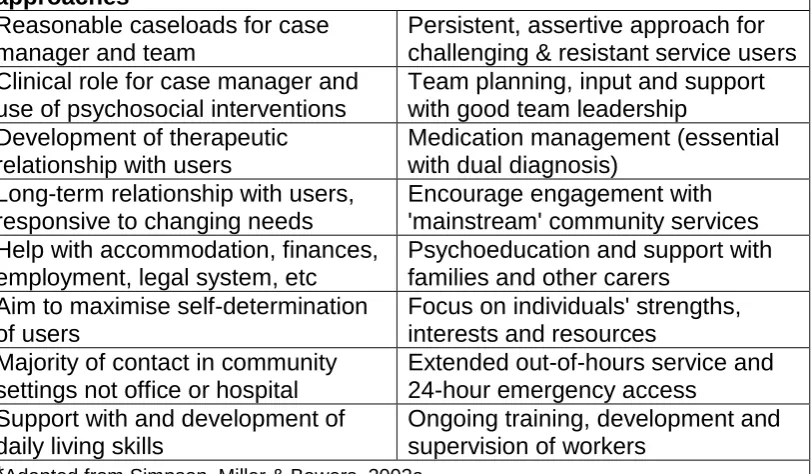
Although there is variable evidence concerning the effectiveness of the CPA, the evidence for case management approaches generally is more positive, if not without controversy and disagreement (Simpson, Miller & Bowers, 2003a). The key factors identified in the provision of effective case management are identified in Table 9.2. Without doubt, an assertive
approach to engagement and intervention, involving a high level of
such as excessive workload and lack of clinical supervision are addressed (Grant & Mills, 2000; Simpson, Bowers & Miller, 2003a&b).
More importantly, the successful discharge of individual responsibilities under case management can only be achieved when clinicians are working as part of a good team (Department of Health, 1999; Shepherd, 1995). And effective teamwork is absolutely imperative when the nature of work with users requires a high level of communication and co-operation or inter-dependence between workers in order to "get the job done" (Onyett, 2002: p84). This lies at the heart of successful work with people with a dual diagnosis of mental illness and substance misuse.
Benefits of shared care and effective teamwork
Summarising research in private and public sector organisations, West (1999) argued that teams are seen as the most effective way of delivering services with positive effects on performance, quality, efficiency, profits, staff turnover and redundancy. In mental health services, multi-disciplinary teams (CMHTs) are generally perceived to be the most appropriate delivery system for effective community care (Department of Health, 2002).
Advantages include multidisciplinary assessment of needs, access to a wide range of skills and disciplines, continuity of care, shared responsibility for clients and decisions, professional support and improved management of workload (Hall, 2000). CMHT care for people with severe mental illness helps services maintain contact with users, reduces the risk of suicide, cuts the time spent in hospital and is popular with patients (Tyrer et al., 2002).
Features that appeared to be key to effective interdisciplinary teamwork were identified by Proctor-Childs, Freeman & Miller (1998) and include:
A commitment to a shared philosophy of teamwork that has been
consciously worked through;
A focus on user-led work that encourages reflection on practice;
A high level of role understanding facilitated by joint working practices, which enhance role visibility;
Joint care planning and goal setting that allows exploration of professional values and beliefs; and
The sharing of knowledge, skills and information, which develops 'team knowledge'.
Effective interdisciplinary working requires each profession to understand
what other staff are doing and why. It incorporates an appreciation of how other disciplines understand knowledge and the methods by which it is gained and used. Conflict resolution, including an appreciation of the
difference between responsibility and accountability, is also central. A study of seven health and social care teams in various settings found clear
benefits for service users where teams worked in this more integrated, collaborative fashion (Miller et al., 2001). Benefits include:
Continuity of care, where professionals 'carry over' interventions initiated by colleagues;
Consistency of approach and reduction of ambiguity with a high level of shared, agreed knowledge provided to users;
Appropriate referrals to team colleagues based on an understanding of each other's roles;
An holistic approach derived from joint planning and working, and
High levels of constructive problem solving.
However, they found that 'fragmented' working in which individual
professionals often worked well but not as part of a team focus was much more commonplace. Where this occurred, many aspects of patient
management such as problem solving, decision-making and responsibility for actions were related to single professional groups. Partly as a result, communication between team members was relatively brief and tended to involve giving of information rather than sharing of professional
unable or unwilling to develop an in-depth understanding of each other's roles. Professionals reinforced the 'mono-professional' nature of clinical practice by actively protecting role boundaries. Team leadership was often problematic and tended to create an unsafe environment in which
communication and learning was stifled and multiprofessional collaboration unsupported. As a result, skills and knowledge remained within individual professional groups and the benefits of teamworking were rarely discussed, realised or demonstrated (Miller et al., 2001).
Effective teamworking is strongly related to the quality teamwork. A major three-year study of over 400 health care teams in England and Scotland including 113 CMHTs, found that effective teams were those that had clearer team objectives, enabled higher levels of participation; had a greater emphasis on quality and higher support for innovation (Borrill et al
2000). The better the level of communication in meetings and the more integration between different staff the better and more innovative were the approaches to patient care. More reflective CMHTs were found to be more innovative. Reflective teams are those that "reflect upon their objectives, strategies, processes and their organisational and wider environments; plan to adapt to their tasks, and make changes accordingly" (West, 1999: p13).
Team leadership was again found to be important. Where there was lack of clear leadership team members reported low levels of effectiveness and this was associated with poor quality team working, less participation and lack of clarity about objectives. In all types of health care teams studied, Borrill et al., (2000) also found that better team functioning was associated with better mental health amongst staff. In contrast, staff in teams with poor leadership and low levels of communication had poorer mental health.
Safe environments and meetings in which effective sharing of information and professional knowledge takes place;
Structures and support that enable high levels of constructive participation, joint planning of care and decision-making;
Multi-professional support for strong, consensual leadership that considers, includes, values and unites the different professions; and
Clear aims and objectives for the team with an underpinning philosophy of high quality user-focused care, team reflexivity and responsiveness.
These will be absolutely crucial for the success of shared care projects and the provision of effective, innovative care. However, there is plentiful
evidence that numerous barriers and difficulties are likely to threaten integrated working unless these are recognised, considered and addressed. I shall consider these now.
Problems with inter-agency and inter-professional practice
Attempts to establish multidisciplinary teamworking in health and social care have faced numerous difficulties, with the potential benefits often not realised (Leathard, 1994; West & Poulton, 1997). Barriers, often predicated on issues of hierarchy, class and gender, include communication
difficulties, power imbalances, interpersonal and interprofessional conflict, differing leadership styles, inequalities in status and pay and various organisational factors (Firth-Cozens, 1998; Leathard, 1994). The tendency for professional workers to protect their individual positions rather than work co-operatively is always likely to be a key obstacle to the successful
working of multi-disciplinary teams (Beeforth et al., 1990).
between doctors and nurses over the years (Allen, 1997; Stein, 1978; Wicks, 1998). Relations between nurses and social workers can also be difficult (Edwards & Garrety, 1998) with each bringing their own historical allegiances, suppositions and strong ideological differences (Brown, 1989; Bywaters, 1989; Dalley, 1989). It has even been suggested that community mental health teams were at least partly created to contain and resolve the tensions between professional groups without explicitly addressing the fundamental differences in culture and practice between the different
agencies and professions (Onyett et al., 1997; Peck, 1995). The addition of substance misuse workers with another set of approaches, ideas and philosophies can only add to the interprofessional fun and games.
Different professional groups tend to hold different views about the role and importance of teams, with psychiatrists and psychologists in particular often experiencing high levels of conflict over issues of leadership, responsibility and philosophical approaches (Mistral & Velleman, 1997). A range of views are essential to a multidisciplinary approach but where destructive
differences are not addressed those in inferior hierarchical positions tend to feel alienated with the potential loss of their knowledge and input to the team (Cott, 1998). The Confidential Inquiry into Homicides and Suicides found that inter-professional disagreements were often detrimental to the care of the user with the potential for tragic consequences (Royal College of Psychiatrists, 1996).
to reduce their participation, withdraw from meetings and assume defensive or even obstructive positions within the team. There is enormous potential for such inter-disciplinary tensions in teams drawn from different agencies and professions to meet the needs of people with dual diagnoses.
Staff working within multi-disciplinary teams are often reluctant to comply with operational directives aimed at facilitating interagency working. They adhere to their own professional cultures and there is an absence of a strong philosophy of care shared by all groups. Factors originating in training and maintained by professional socialisation can undermine attempts to establish and sustain inter-professional collaboration (Norman & Peck, 1999). Staff, particularly psychiatrists and psychologists, often express concerns over the loss of autonomy and revert to their own professional groups for 'protection'. Norman and Peck (1999) suggested that community psychiatric nurses (CPNs) were less concerned over loss of autonomy as they had always worked within hierarchies. However, this is contradicted by other research in which CPNs greatly resented the loss of clinical autonomy that came with CMHT working. CPNs closely managed by a combination of psychiatrists, team managers and senior managers expressed concerns about the dilution of their role and the impact on professional boundaries (Kashi & Littlewood, 2000). CPNs felt that they were being "redirected towards traditional activities [and] controlled by psychiatrists" and experienced "increasing professional rivalry and suspicions within the practice arena" (ibid: p13). In my own study, CPNs often reported concern that their traditional psychotherapeutic role was being subsumed by the need to address social care needs previously associated with the social worker role (Simpson, 2004); a finding reported elsewhere (Miller & Freeman, 2003).
defensive manoeuvres and inflexible demarcation as roles are defended stoutly:
Roles and responsibilities of mental health staff are integral to the professional persona and are likely to be defended rigorously […] these roles and responsibilities are reinforced by professional ideologies, models of working, professional training, status and reward. (Norman & Peck, 1999: p228)
In a study of role boundaries in three CMHTs in middle England, Brown, Crawford and Darongkamas (2000), reported that different team members saw role boundaries differently. They either saw role boundaries as
something to work towards removing in order to develop interdisciplinary teamwork, or expressed concern that the erosion of boundaries would result in role confusion and the development of 'generic' mental health workers. In such a model, all team members would be doing the same or 'meddling' in each others' areas of expertise, when they saw it as a strength and an advantage that the CMHTs could offer service users a variety of skills and approaches from different professional backgrounds. So, there was a dichotomy between those who thought it important that different professions maintained their separateness, whilst others within the same teams believed that it was beneficial for professional roles to 'blur' or develop to incorporate skills and knowledge from team colleagues. A third point of view wanted team members to concentrate on what they were each good at and to recognise and communicate the limits of their own
knowledge and expertise.
Structure and procedures
Brown et al (2000) also drew attention to the importance of structure within teams. Decisions had been made to introduce a level of 'democracy' in the running of the teams, so for example, a 'rolling chair' for team meetings was introduced with a different person chairing or taking minutes each week. However, this additional lack of clear structure left most people unhappy, feeling ill equipped and unprepared for such tasks. As a result the meetings and the team itself were experienced as insufficiently stable or secure, reinforcing a "sense of inadequacy rather than creating empowerment" (ibid: p431). Several staff members were required to work across different teams, which also undermined the coherence of the teams studied. The authors suggested that contrary to the aims of the management, attempts to remove boundaries were having the effect of reinforcing them.
In my study involving seven CMHTs, there were also difficulties when teams lacked clear objectives or there were a lack of structure or agreed procedures (Simpson, 2004). This included arrangements for accepting referrals, allocating work within teams and running the team meetings and led to repetition of work and time wasting as the same issues were
continually rehashed. It also created resentment and suspicion when workers perceived that others were 'not pulling their weight' or were not subject to the same organisational demands and strictures.
structure makes it difficult for even the "most willing and co-operative of people to collaborate with others" (Ovretveit, 1993: p3). He explained how there are usually organisational or structural explanations for difficulties within teams that are frequently blamed on 'personality clashes':
For example, issues like a team leader not being able to get the information needed from a team member, or a team never
confronting or making difficult decisions, are often explained in terms of the personalities involved. Or a legitimate concern about the quality of another team member's work is reduced to a 'conflict of personalities', when there were not agreed arrangements for monitoring and support, or arrangements for properly addressing and raising such issues without 'personalising' them. (Ovretveit, 1993: p3)
As well as conflict within teams, there is also enormous potential for conflict between the team and the parent organisation, even more so when teams are answerable to a variety of statutory and voluntary organisations. Conflicting boundaries within therapeutic organisations tend to be
problematic, especially where governmental or managerial policies are at odds with the therapeutic priorities held by the clinicians and service users. In certain circumstances teams can become united in their conflict with organisations but in such situations it is rare that the needs of either the team or the service users will prevail (Pietroni, 1995). Tension between clinical teams and organisations was identified in focus groups made up of 'experts' in mental health that included practitioners, educators, academics, service users and carers. Staff saw the risk-aversive organisational culture of NHS health trusts as obstacles to delivering effective care (Warner et al., 2001).
The potential for disagreements about issues of risk is likely to be magnified when working with people with dual diagnosis. The potential for risky
agree a pragmatic, shared approach. One issue that often complicates such discussions is that of patient confidentiality, which is discussed next.
Confidentiality
Issues around confidentiality and disclosure are often difficult for mental health staff. The number of people and agencies involved in the care of people using mental health services can be surprising. Alongside
immediate staff that may include GPs, psychiatrists, various nurses and health care assistants, occupational therapists, psychologists, social
workers and advocates there can be a range of other people and agencies involved, each acquiring and passing on sensitive client information. Other staff that might frequently be involved could include benefits and financial advisors, social security staff, housing officers and housing support workers. Szmukler and Holloway (2001) have outlined just how difficult if not impossible it is to maintain client confidentiality in mental health services given the vast range of services involved. The addition of substance misuse services simply magnifies the problem. Alongside the addition of drug and alcohol workers, needle exchange staff and
counsellors, it is not unusual for people with substance misuse problems to have contact with the police, probation officers, solicitors and court officials.
Staff working in various agencies might have quite different expectations regarding what constitutes confidential information. There might be difficult situations where information considered personal and confidential by one person is considered absolutely crucial information that needs to be passed on and documented by others before key decisions can be made. For example, discussions over the allocation of accommodation would involve consideration of previous criminal and other risky behaviour in order to consider the safety of other residents in shared accommodation or
Issues of confidentiality can be particularly complex and challenging for staff working with people who abuse illicit substances. The position concerning knowledge of possible illegal behaviour by clients and the responsibilities of service providers and their staff to act on that knowledge has become more sensitive and grievous following the case of the
'Cambridge Two' in the late 1990s (Simpson, 2000). The director and manager of a day centre for homeless people in Cambridge, England, were jailed for five and four years respectively when the courts found that they had not taken sufficient steps to prevent the selling of illicit drugs on or in the vicinity of their premises. The severe sentences passed on two experienced and respected workers, Ruth Wyner and John Brock, have serious implications for staff in a range of health and social care settings. People who have a drug addiction often sell small amounts to their friends as a way of financing their drug use. The judge's ruling in this case says that if staff are aware of the trading of drugs and do not take action to prevent it they are guilty of "knowingly permitting" the supply of the drug and could face prosecution and a hefty jail sentence.
In such a complex environment and when dealing with such potentially devastating situations, it is imperative that staff working jointly with people with a dual diagnosis ensure that they have a clear and agreed
understanding of where their responsibilities lie. There should be a clear policy and guidelines on the sharing and disclosure of client information with particular attention paid to potential risk factors and criminal activity.
Conclusion
addressed, hold the potential to derail any attempt at establishing shared care and teamwork. Consider the following essential points:
Encourage open discussion of roles and responsibilities between mental health staff and substance misuse workers and establish an agreed, written operating policy that should include a review date.
Encourage role shadowing and sharing in order to develop knowledge and understanding of each other's roles, skills and underpinning philosophies.
Establish regular team teaching sessions or 'master classes', in which one or more members lead an exploration of their professional
contribution to the care of service users.
Establish a mechanism for discussing and resolving disputes and
differences of opinion. If you have a procedure you will be less likely to use it. If you do not have one, disagreements often become intractable arguments.
Identify and discuss areas of potential conflict and seek compromise and agreement, e.g. referral criteria, admission and discharge criteria; abstinence vs harm-minimisation, risk assessment and management, confidentiality.
References
Allen, D. (1997). The nursing-medical boundary: a negotiated order? Sociology of Health and Illness, 19(4), 498-520.
Appleby, L., Shaw, J., Amos, T., & McDonnel, R. (1999). Safer Services: National Confidential Inquiry into Suicide and Homicide by People with Mental Illness. London: Department of Health.
Baguley, I., & Baguley, C. (1999). Psychosocial interventions in the treatment of psychosis. Mental Health Care, 2(9), 314-317.
Beeforth, M., Conlan, E., Field, V., Hoser, B., & Sayce, L. (1990). Whose service is it anyway? Users' views on co-ordinating community care. London: RDP.
Borrill, C., West, M., Shapiro, D., & Rees, A. (2000). Team working and effectiveness in health care. British Journal of Health Care Management, 6(8), 354-371.
Bowers, L. (1992). Ethnomethodology 11: a study of the Community Psychiatric Nurse in the patient's home. International Journal of Nursing Studies, 29(1), 69-79. Bray, J. (1999). An ethnographic study of psychiatric nursing. Journal of
Psychiatric and Mental Health Nursing, 6, 297-305.
Brown, B., Crawford, P., & Darongkamas, J. (2000). Blurred roles and permeable boundaries: the experience of multidisciplinary working in community mental health. Health and Social Care in the Community, 8(6), 425-435.
Brown, R. (1989). Social Work in Mental Health Teams: The Local Authority Field Social Worker. In R. Taylor, & J. Ford (Editors), Social Work and Health Care: Research Highlights in Social Work 19 (pp. 47-57). London: Jessice Kingsley. Bywaters, P. (1989). Social Work and Nursing: Sisters or Rivals? In R. Taylor, & J. Ford (Editors), Social Work and Health Care: Research Highlights in Social Work 19 (pp. 33-46). London: Jessica Kingsley.
Carpenter, J. (1995). Doctors and nurses: stereotypes and stereotype change in interprofessional education. Journal of Interprofessional Care, 9(2), 151-161. Cott, C. (1998). Structure and meaning in multidisciplinary teamwork. Sociology of Health and Illness, 20(6), 848-873.
Dalley, G. (1989). Professional Ideology or Organisational Tribalism? In R. Taylor, & J. Ford (Editors), Social Work and Health Care: Research Highlights in Social Work 19 (pp. 102-117). London: Jessica Kingsley.
Department of Health. (1999). Effective Care Co-ordination in Mental Health Services: Modernising the Care Programme Approach. A Policy Booklet. London: HMSO.
Department of Health. (2002). Mental Health Policy Implementation Guide: Community Mental Health Teams. London: Department of Health.
Abused (Summary). London: Department of Health.
Edwards, K., & Garrety, C. (1998). Learning to work with social workers. Nursing Times Learning Curve, 2(7), 4-5.
Firth-Cozens, J. (1998). Celebrating teamwork. Quality in Health Care, 7(Suppl), S3-S7.
Grant, A., & Mills, J. (2000). The Great Going Nowhere Show: Structural power and mental health nurses. Mental Health Practice, 4(3), 14-16.
Hall, P. (2000). Effective community mental health services for people with serious mental illness: a critical review. Mental Health Care, 3(9), 299-303.
Intagliata, J. (1982). Improving the quality of community care for the chronically mentally disabled: The role of case management. Schizophrenia Bulletin, 8(4), 655-674.
Kashi, R., & Littlewood, J. (2000). Politics and practice. Mental Health Nursing, 20(4), 10-16.
Kennedy, P., & Griffiths, H. (2000). Discussion Paper: An analysis of the concerns of Consultant General Psychiatrists about their jobs, and of the changing practices that may point towards solutions. Durham: Northern Centre for Mental Health. Leathard, A. E. (1994). Going Inter-Professional: Working Together for Health and Welfare. London: Routledge.
Mackay, L., Soothill, K., & Webb, C. (1995). Troubled times: The context for interprofessional collaboration? In K. Soothill, L. Mackay, & C. Webb (Editors ), Interprofessional Relations in Health Care (pp. 5-10). London: Edward Arnold. Menzies, I. E. P. (1960). A case-study in the functioning of social systems as a defence against anxiety. Human Relations, 13, 95-121.
Miller, C., & Freeman, M. (2003). Clinical Teamwork: the impact of policy on collaborative practice. In A. Leathard (Editor), Interprofessional Collaboration: From Policy to Practice in Health and Social Care (pp. 121-132). London: Routledge.
Miller, C., Freeman, M., & Ross, N. (2001). Interprofessional Practice in Health and Social Care: Challenging the shared learning agenda. London: Arnold. Mistral, W., & Velleman, R. (1997). CMHTs: the professionals' choice? Journal of Mental Health, 6(2), 125-140.
Norman, I. J., & Peck, E. (1999). Working together in adult community mental health services: An inter-professional dialogue. Journal of Mental Health, 8(3), 217-230.
Onyett, S. (2002). Teamworking in mental health. London: Palgrave.
care management. Buckingham: Open University Press.
Ovretveit, J., Mathias, P., & Thompson, T. E. (1997). Interprofessional Working for Health and Social Care. Basingstoke: Macmillan.
Peck, E. (1995). On the team. Health Service Journal, (6 April), 28-29.
Pietroni, M. (1995). The Nature and Aims of Professional Education for Social Workers: A postmodern perspective. In M. Yelloly, & M. Henkel (Editors), Learning and Teaching Social Work: Towards Reflective Practice (pp. 34-50). London: Jessica Kingsley Publishers.
Proctor-Childs, T., Freeman, M., & Miller, C. (1998). Visions of teamwork: the realities of an interdisciplinary approach. British Journal of Therapy and Rehabilitation, 5(12), 616-635.
Royal College of Psychiatrists. (1996). Report of the Confidential Inquiry into Homicides and Suicides by Mentally Ill People. London: Royal College of Psychiatrists.
Shepherd, G. (1995). Multi-disciplinary team-working: The essential background to the Care Programme Approach. In NHS Training Division Building on Strengths: Developing the Care Programme Approach . Bristol: NHS Executive.
Simpson, A. (2000). What price confidentiality? Nursing Times, 96(9), 35. Simpson, A. (2004) Co-ordinating care for people with severe mental illness (Unpublished PhD thesis). Brighton: University of Brighton.
Simpson, A., Miller, C. & Bowers, L. (2003a) The History of the Care Programme Approach in England: Where did it go wrong? Journal of Mental Health, 12(5), 489-504.
Simpson, A., Miller, C. & Bowers, L. (2003b) Models of case management and the Care Programme Approach: How to make the CPA effective and credible. Journal of Psychiatric and Mental Health Nursing, 10, 772-483.
Stein, L. (1978). The doctor-nurse game. In R. Dingwall, & J. McIntosh (editors), Readings in the sociology of nursing (pp. 107-117). London: Churchill Livingstone. Szmukler, G., & Holloway, F. (2001). Confidentiality in Community Psychiatry. In C. Cordess (Editor), Confidentiality and Mental Health (pp. 53-70). London: Jessica Kingsley Publishers.
Taylor, P. J., & Gunn, J. (1999). Homicides by people with mental illness: myth and reality. British Journal of Psychiatry, 174, 9-14.
Tyrer, P., Coid, J., Simmonds, S., Joseph, P., & Marriott, S. (2002). Community mental health teams (CMHTs) for people with severe mental illnesses and disordered personality (Cochrane Review). In The Cochrane Library (Issue 1). Oxford: Update Software.
Walsh, E., Buchanan, A., & Fahy, T. (2002). Violence and schizophrenia: examining the evidence. British Journal of Psychiatry, 180, 490-495.
Warner, L., Hoadley, A., & Ford, R. (2001). Obstacle course. Health Service Journal, 111(5775), 28-29.
West, M. (1999). Communication and teamworking in healthcare. NTresearch, 4(1), 8-17.
West, M. A., & Poulton, B. C. (1997). A failure of function: teamwork in primary health care. Vol. 11(2), 205-216.
Table 9.1: Characteristics of those people more like to be on the 'enhanced' level of the Care Programme Approach (CPA)
Table 9.1: Characteristics of those people more like to be on the 'enhanced' level of the Care Programme Approach CPA
Multiple care needs, including housing, employment, finances, etc; requiring inter-agency co-ordination;
Contact with a number of agencies (including the Criminal Justice System);
More frequent and intensive interventions, perhaps with medication management;
Mental health problems co-existing with other problems such as substance misuse;
More likely to be at risk of harming themselves or others;
[image:22.595.116.522.383.620.2] More likely to disengage with services.
Table 9.2: Factors identified in effective case management approaches*
Table 9.2: Factors identified in effective case management approaches*
Reasonable caseloads for case manager and team
Persistent, assertive approach for challenging & resistant service users Clinical role for case manager and
use of psychosocial interventions
Team planning, input and support with good team leadership
Development of therapeutic relationship with users
Medication management (essential with dual diagnosis)
Long-term relationship with users, responsive to changing needs
Encourage engagement with 'mainstream' community services Help with accommodation, finances,
employment, legal system, etc
Psychoeducation and support with families and other carers
Aim to maximise self-determination of users
Focus on individuals' strengths, interests and resources
Majority of contact in community settings not office or hospital
Extended out-of-hours service and 24-hour emergency access Support with and development of
daily living skills
Ongoing training, development and supervision of workers