City, University of London Institutional Repository
Citation
:
Lu, W., Robertson, S. and MacFarlane, A. (2006). CISR at INEX 2006. Paper
presented at the 5th International Workshop of the Initiative for the Evaluation of XML
Retrieval, 17-12-2006 - 20-12-2006, Dagstuhl Castle, Germany.
This is the accepted version of the paper.
This version of the publication may differ from the final published
version.
Permanent repository link:
http://openaccess.city.ac.uk/4460/
Link to published version
:
http://dx.doi.org/10.1007/978-3-540-73888-6_6
Copyright and reuse:
City Research Online aims to make research
outputs of City, University of London available to a wider audience.
Copyright and Moral Rights remain with the author(s) and/or copyright
holders. URLs from City Research Online may be freely distributed and
linked to.
CISR at INEX 2006
Wei Lu1, Stephen Robertson2.3, Andrew Macfarlane3
1 Center for Studies of Information Resources, School of Information Management
Wuhan University, China and City University [email protected]
2 Microsoft Research, Cambridge, U.K
3 Centre for Interactive Systems Research, Department of Information Science
City University London [email protected]
Abstract. In this paper, we describe the Centre for Interactive Systems Re-search’s participation in the INEX 2006 adhoc track. Rather than using a field-weighted BM25 model in INEX 2005, we revert back to using the traditional BM25 weighting function. Our main research aims in this year are to investi-gate the effects of document filtering by result record cut-off, element filtering by length cut-off and the effect of using phrases. The initial results show the lat-ter two methods did not do well, while the first one did well on FOCUSED TASK and RELEVANT IN CONTEXT TASK. Finally, we propose a novel method for BEST IN CONTEXT TASK, and present our initial results.
1. Introduction
This is the second year that the CISR has participated in INEX. In INEX 2005, we used a field-weighted BM25 model and submitted runs for two adhoc CO tasks [1]. Our results suggest that the method is promising. Subsequent to this, we investigated XML retrievable units and element inheritance in [2] and the average element length in [3]. This year, rather than further exploiting the field-weighted method, our work focused on investigating the effects of document filtering, element filtering and using phrases.
[7] and Mass et al [8] investigated document weight’s contribution to element retriev-al by using an interpolation method of merging the document weight into element weight. The results show this method is beneficial and has yielded good results at INEX 2004 and INEX 2005.
In this paper, we use a different approach to element retrieval. That is, we divided element retrieval into two phases: we conducted document level retrieval and set a cut-off for the retrieved results and then used the filtered results to further execute element level XML retrieval. Our aim is to investigate whether using top weighted documents could produce good results. Because of time limitations and issues with the newly adopted test collection, we did not compare the two methods directly in our experiments this year.
In order to avoid the too-small element problem, we restrict our set of retrievable units to article, body, section and paragraph, and set a cut-off for element length to abandon those elements which are shorter than the cut-off value. We also use phrases instead of single words to see if it could improve retrieval effectiveness.
In section 2, we describe the BM25 model used in our experiment. Section 3 pre-sents our results in INEX 2006. In Section 4, we evaluate and compare our results. We conclude the paper with closing remarks and future research directions to extend our work..
2. BM25 model
In this work we use the original BM25 model. This is in contrast to our previous work in the area at INEX 2005 [1]. We reverted back to the BM25 model so that we could use it in the first phase of the method we deployed in our INEX 2006 experi-ments. For adhoc retrieval, and ignoring any repetition of terms in the query, BM25 can be simplified to:
where C denotes the document collection, tf j is the term frequencyof the jth term in
document d, df jis the document frequency of term j, dl is the document length, avdl is
the average document length across the collection, N is the total number of documents in the collection and k1 and b are tuning parameters.
Formula (1) uses a logarithmic function to compute term’s collection weight. For frequently occurring terms, this function will produce negative weight values. To avoid this, we used an alternative weight function (command “w fn=3” in Okapi bss system) instead of the logarithmic function.
3. Description of the Experiments
Within the adhoc XML retrieval task there are four sub-tasks: BEST IN CONTEXT TASK, THOROUGH TASK, FOCUSED TASK and RELEVANT IN CONTEXT TASK . For each sub-task, we submitted 3 or 4 runs only for CO queries but not for CAS queries. Our purpose is twofold: to meet the experimental criteria of INEX 2006 and to test our stage approach taken this year. The details of these experiments are as follows:
3.1 BEST IN CONTEXT TASK
BEST IN CONTEXT TASK is a new adhoc task which aims at locating the best entry point of XML retrieval. We used two methods for this task and submitted four runs. In the first method, we take the element with the highest weight score (best-match element) in each document as the best entry point. This method was used in the two submitted runs BEST-BM25-cutoff400 and BEST-BM25-filter1500.
In the second method, we propose a novel way of selecting the best entry point. The distribution of element weight scores in the document is considered. Our basic idea is that, given an element, if more than one of its sub-elements has a good score, then this element should be chosen as the candidate best entry point rather than using its sub-element as the candidate best entry point. A problem for this particular method is how to determine a good score. In implementation, we set half the score of the best-match element in each document as the cut-off for determining a good score and use a bottom up method for selecting the best entry point. For each document, we find the best-match element in the document. Then we consider all other elements which do not overlap with this one. If any of these elements scores higher than half the score of the best-match element, then it should be included in the scope implied by the entry point. That is, we move the entry point up to the start of a higher-level element, such that the higher-level element includes all the high-scoring elements.
Fig.1 XML element tree with element weight score
In INEX 2006, the two submitted runs BM25-400-1500-level-p and BEST-BM25-Level-filter1500 used this method. For the initial evaluation of the effect of element length cut-off, we tuned element length cut-off between 0 to 550 (character length) on the INEX 2005’s data collection by using metrics Manx(10), Manx(25), Manx(50). The effect of the cut-off on “gen” Manx measure is shown in Fig.2. From this figure, we can see that using element length cut-off is beneficial especially to Manx(10) and Manx(25). We found an increase of 8% for the best tuned Manx(10) value over the non-tuned value.
0.250 0.255 0.260 0.265 0.270 0.275 0.280 0.285 0.290 0.295
0 50 100 150 200 250 300 350 400 450 500 550
C ha ra cte r L e ng th
Result
[image:5.595.137.461.264.540.2]Manx(10)
Manx(25)
Manx(50)
Fig. 2 Tuning results of element length cut-off on INEX 2005’s data collection
3.2 THOROUGH TASK
We submitted 3 runs for THOROUGH TASK. They are THOR-BM25-nobody, THOR-BM25-nobody-cutoff400 and THOR-BM25-400-1500-phrase:
• THOR-BM25-nobody-cutoff400 is much the same as THOR-BM25-nobody except the element length cut-off, which filters out elements shorter than a fixed length, is set to 400;
• THOR-BM25-400-1500-phrase uses the same element length cut-off, and it also set document result cut-off (1500) and uses phrases instead of single words.
3.3 FOCUSED TASK
The 3 submitted runs for FOCUSED TASK are as follows:
• FOCU-BM25-cutoff400 uses 400 characters length as element length cut-off;
• FOCU-BM25-cutoff400-filter1500 uses the same element length cut-off and also uses document result cut-off (1500);
• cutoff400-filter1500-phrase is similar to FOCU-BM25-cutoff400-filter1500 (above) except it uses phrases instead of single terms
3.4 RELEVANT IN CONTEXT TASK
For this task, we submitted runs All-BM25-cutoff400, All-BM25-cutoff400-filter1500 and All-BM25-cutoff400-All-BM25-cutoff400-filter1500-phrase. These runs use the same condi-tions as the ones for FOCUSED TASK. The difference is that the results in the runs are grouped by articles and without overlap elements.
4. Evaluation
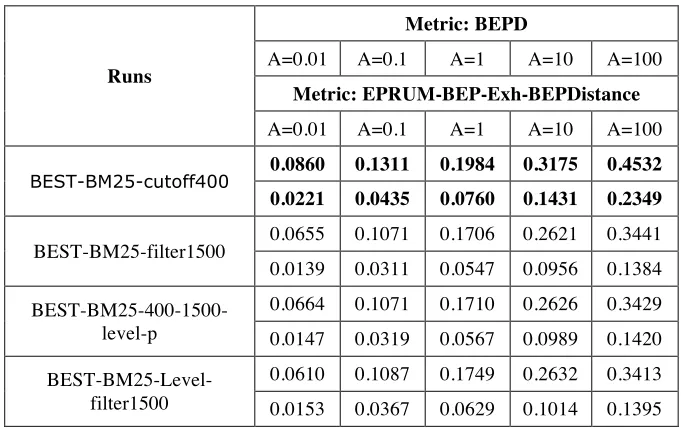
The evaluation results of our runs are shown in Tables 1 to 4. In Table 1, the run using the basic BM25 model was the best. In Tables 2 and 3, the runs using element length cut-off do best, which also rank them at the top of all INEX 2006 s correspond-ing submitted runs. In contrast, the runs uscorrespond-ing document filtercorrespond-ing and phrases did not do well. Table 4 shows the results of our runs for locating document’s best entry point. Although the run BEST-BM25-cutoff400 does best among the 4 runs, it can be seen that the two runs BEST-BM25-400-1500-level-p and BEST-BM25-Level-filter1500 using the derived novel method do better than the run BEST-BM25-filter1500. These three runs use the same document result set for locating the best entry point. Further investigation into why this happens is merited.
Table 1: Results for THOROUGH Task
Runs Metric: ep/gr
un-filtered filtered
THOR-BM25-nobody-cutoff400 0.0215 0.0407 THOR-BM25-400-1500-phrase 0.0118 0.0217
Table 2: Results for FOCUSED Task (Using un-filtered assessments)
Runs Metric: nxCG (Overlap=on)
5 10 25 50
FOCU-BM25-cutoff400 0.3961 0.3428 0.2638 0.2001
FOCU-BM25-cutoff400-filter1500 0.3054 0.2557 0.1873 0.1335
FOCU-BM25-cutoff400-filter1500-phrase 0.2849 0.2452 0.1836 0.1332
Table 3: Results for RELEVANT IN CONTEXT Task
Runs MAgP Metric: gP
5 10 25 50
All-BM25-cutoff400 0.1161 0.2936 0.2456 0.1622 0.1109
All-BM25-cutoff400-filter1500 0.0583 0.2227 0.1725 0.1147 0.0741
All-BM25-cutoff400-filter1500-phrase 0.0602 0.2298 0.1734 0.1155 0.0746
5 Conclusion
Table 4: Results for BEST IN CONTEXT Task (Using un-filtered assessments)
Runs
Metric: BEPD
A=0.01 A=0.1 A=1 A=10 A=100
Metric: EPRUM-BEP-Exh-BEPDistance
A=0.01 A=0.1 A=1 A=10 A=100
BEST-BM25-cutoff400 0.0860 0.1311 0.1984 0.3175 0.4532
0.0221 0.0435 0.0760 0.1431 0.2349
BEST-BM25-filter1500 0.0655 0.1071 0.1706 0.2621 0.3441 0.0139 0.0311 0.0547 0.0956 0.1384 BEST-BM25-400-1500-
level-p
0.0664 0.1071 0.1710 0.2626 0.3429 0.0147 0.0319 0.0567 0.0989 0.1420
BEST-BM25-Level-filter1500
0.0610 0.1087 0.1749 0.2632 0.3413 0.0153 0.0367 0.0629 0.1014 0.1395
Acknowledgements
This work is supported in part by National Social Science Foundation of China 06CTQ006.
References
[1] W. Lu, S. Robertson, A. Macfarlane. Field-Weighted XML Retrieval Based on BM25. Proceedings of INEX 2005. LNCS. 2006 126-137
[2] S. Robertson, W. Lu, A. Macfarlane. XML-structured documents: retrievable units and inheritance. FQAS 2006. Springer LNCS. 2006 121-132
[3] W. Lu, S. Robertson, A. Macfarlane. Investigating Average Element Length for XML Retrieval by Using BM25. (submitted to review)
[4] M. Abolhassani, N. Fuhr, S. Malik. HyREX at INEX 2003. Proceedings of the Second Workshop of the Initiative for The Evaluation of XML Retrieval (INEX), 15-17 December 2003, Schloss Dagstuhl, Germany.
[5] S. Geva. GPX - Gardens Point XML Information Retrieval at INEX 2004. INEX 2004, Lecture Notes in Computer Science, Springer-Verlag GmbH Volume 3493 / 2005.
[6] P. Ogilvie, J. Callan. Hierarchical Language Models for XML Component Retrieval. INEX 2004, Lecture Notes in Computer Science, Springer-Verlag GmbH Volume 3493 / 2005. [7] B. Sigurbjornsson, J. Kamps, M. Rijke, An element based approach to XML Retrieval,
Proceedings of the Second Workshop of the Initiative for The Evaluation of XML Retrieval (INEX), 15-17 December 2003, Schloss Dagstuhl, Germany.