City, University of London Institutional Repository
Citation: Ellis, M.R.C. & Kell, B. (2014). Development, delivery and evaluation of a team
building project. Leadership in Health Services, 27(1), doi: 10.1108/LHS-06-2012-0022This is the submitted version of the paper.
This version of the publication may differ from the final published
version.
Permanent repository link: http://openaccess.city.ac.uk/14253/
Link to published version: http://dx.doi.org/10.1108/LHS-06-2012-0022
Copyright and reuse: City Research Online aims to make research
outputs of City, University of London available to a wider audience.
Copyright and Moral Rights remain with the author(s) and/or copyright
holders. URLs from City Research Online may be freely distributed and
linked to.
For Peer Review
A Team Building Project Enhancing Quality Care Indicators.
Journal: Leadership in Health Services
Manuscript ID: Draft
Manuscript Type: Original Article
Keywords: Leadership, Management, Quality, Communications, Health services sector, Paediatrics
For Peer Review
A Team Building Project Enhancing Quality Care Indicators.
Abstract
Purpose: The purpose of this paper is to illustrate the development and delivery of a project aimed to facilitate team building and leadership and management skills in a London Paediatric Unit. The project content was tailored to meet the developmental needs of the staff working within the units, incorporating both soft and hard leadership teaching approaches.
Design/Methodology/Approach: This paper describes how the project was designed, developed, implemented and evaluated. Beginning with the needs identified by the Unit managers and the identified needs of the staff members, the self awareness person centred approach was used instilling individual responsibility for growth and development.
Findings: All staff participated and found themselves to have
significantly developed both as individuals and team. They also identified the support required from management in order to fulfill their potential and to work effectively as a team. The teams have since completion of the project been more cohesive and are working more effectively.
Practical Implications: The Team Building project demonstrated how externally developed team building projects can be an effective approach to team building and leadership skill set acquisition, which can then be utilized in the practice arena.
Originality/value: Utilisation of a person centred approach to team building enables the individual to develop both as an individual and as a team – allowing them to contribute at a higher level.
Keywords: Leadership, Management, Quality, Communications, Health Service Sector, Paediatrics.
Article classification: Case study
For Peer Review
Overview of paper
A project was undertaken for a London NHS Trust to support staff on a
paediatric ward with team building and leadership skills. The Trust
requested a project to develop a team of staff on a particular unit, in
order to enhance team building and cohesion. The broad scope of the
project was - team building to enhance quality indicators.
A number of new staff had recently joined the team and the ward
manager had identified some personality differences within the team.
The practice environment had been previously divided into two areas and
the teams had been rostered separately. However just before the
project commenced the rota was changed so the entire team could work
across the whole ward rather than in two separate teams. This was to
enable staff to work in all the unit areas, such as acute care, high
dependency unit, day care or oncology and to work as one whole team.
Planning phase
During the planning phase the facilitators explored how awareness of
management and leadership skills could be incorporated and how they
could be embedded to improve actual practice delivery in the clinical
setting. The aim was to identify ways in which the skills of the individuals
For Peer Review
within the team could result in much greater team coherence. It would
also facilitate opportunities for team members to consider specific areas,
commensurate with their responsibilities that they wanted to personally
develop within the setting and for their own personal development. It
was envisaged that the project would increase the quality of care
delivered and hence have a positive impact upon practice. The funding
allowed for a four-day project to be delivered by two facilitators for two
separate groups to ensure the unit was sufficiently staffed.
The project was developed and facilitated by the authors. Michelle Ellis
has expertise in Practice Development and has managed teams both in
practice and in the higher education setting. Billie Kell has expertise in
the development and delivery of leadership programmes. Jointly, a four
day training package was produced following discussions on the most
appropriate content and modes of delivery. A key aim was for
participants to recognise the links between:
1. Leadership styles
2. Team working
3. Quality
4. Practice Development 3
For Peer Review
The discussion of the content planned and rationale for inclusion led to
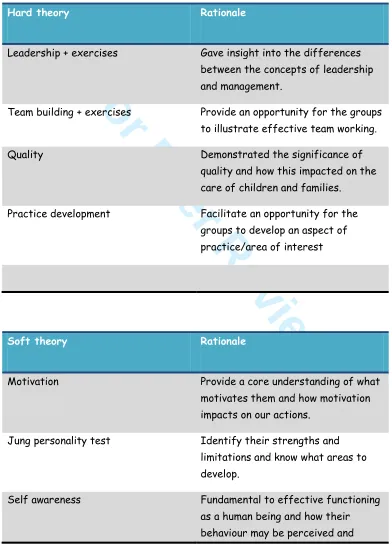
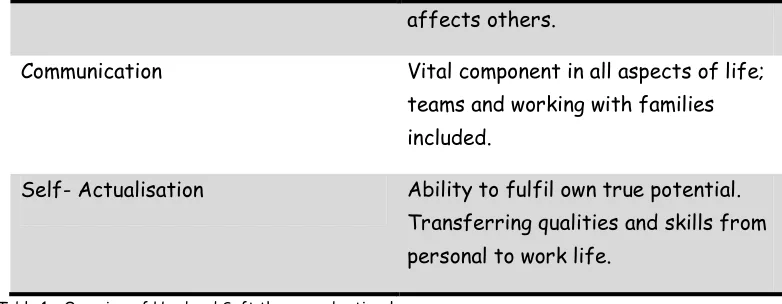
the recognition that the content planned fell into two themes: hard and
soft leadership theory (table 1).
Please place table 1 here
The Trust was clear on their expectations, and the facilitators had no
constraints placed on them in terms of content or methods of delivery.
It was vital however, to instigate the team to bond, and appreciate both
their individual and team responsibilities, which contributed to the
effective running of the unit and enhanced the quality of care given to
patients.
Discussion of the content and acknowledgment of the morale of the staff
on the unit required a delicate approach to the training package. For this
reason the decision was made to make the focus of the training, personal
self development of the individual. By learning about themselves and
becoming more self aware the training could be personalized to the staff
members.
For Peer Review
Content
Introduction
The first session commenced with an icebreaker which allowed the group
to introduce themselves to each other. This was particularly useful for
the new members of the team to get to know each other in a “non
threatening way” (Phillips, 1994). In line with the goals of the project the
ice breaker ‘Marooned’ was used. The question was posed ‘If you were
marooned on a deserted island which 3 people would you want with you?
They can be dead, alive or imaginary’. This enabled the group to start
exploring what they valued in someone in a given situation. It related to
Maslow’s (1999) hierarchy of needs. Group members identified people who
would help them meet the basic needs and Maslow was a theory that as
health professionals they already understood.
The groups were then given an individual resource to complete using
Pandora’s Box to ascertain their views of why they were attending the
project. Each of their comments were addressed, as in the main they
were negative; particularly as attendance was mandatory. Overall there
was strong recognition that team morale was low and consequently the
team was not working as effectively as they could have been. A major
concern raised by some attendees was that management had not included
For Peer Review
themselves in the project, and they were also part of the team. The
opportunity was taken to elaborate to the group the facilitators
understanding of the purpose of the project, and why they felt they were
attending the training. Focus was placed on individual personal
development, and how learning about themselves would aid their
development both personally and professionally. It was highlighted to the
group that our aim was to get them to learn about themselves and to
initially explore methods and skills that would enhance their ability to
develop. The approach taken personalized the learning experience and
content: for them to explore what makes them happy? What motivates
them? What type of communicators are they?
Self awareness is a fundamental aspect of every successful individual
(Burnard 1992) although definitions of success obviously vary. Reflecting
on oneself is challenging and there is a requirement to acknowledge that
we may not always like what we see (Schon 1995). Hence self-awareness
requires individuals to be brave and honest in order to develop. To
facilitate this process a reflective journal was utilised. Each day’s
training would encompass an additional insert to the reflective journal.
The purpose of the journal was explained as the tool for them to explore
issues as they arose. The journal was theirs to use for their personal
For Peer Review
development. They could add any resources they found useful and record
what they learnt and their reflections on the theory and how they applied
and related it to themselves. Although this was mandatory training it
would not include a formal assessment. To illustrate how they had
developed and to contribute to the team learning however they would be
expected to produce a resource pack focusing upon the specialist topic
they were responsible for on their unit, or an area of interest. This
resource pack would then be presented to their peers on the final day of
the project, and be made available for future use on the unit by the team.
Motivation.
The scene was set to focus on the personal development of the group
members and this commenced by exploring the concept of motivation with
the group. It was important to understand the significance of their
definitions of motivation. A word cloud on motivation was shown to
illustrate a diverse array of words that may be associated with
motivation. Once the concept had been understood individually, types of
motivation were explored. The first motivation for a human being is the
motivation for survival – the need to stay alive; which forces us to satisfy
our basic needs such as food, water and air. Visual examples were given
using the trailer of the film 127 hours (You Tube 2010) to illustrate the
For Peer Review
human need for survival. 127 Hours is the true story of mountain climber
Aron Ralston's remarkable adventure to save himself after a fallen
boulder crashes on his arm and traps him in an isolated canyon in Utah.
Over the next five days Ralston examines his life and survives the
elements to finally discover he has the courage and the wherewithal to
extricate himself by any means necessary, scale a 65 foot wall and hike
over eight miles before he can be rescued (Fox Searchlight 2010).
Participants were then given a scenario of feeling unwell and being at
home, and yet if their house was broken into the need for survival would
take over. Next external motivation was discussed with the group. A
definition was given of this being the type of motivation we get from
outside resources such as, parents, friends, managers and teachers,
inspiring individuals and websites. The group were asked about who their
external motivators were, which they shared with the group. The
limitations with external motivators are that they do not last forever,
and are not always present, which was acknowledged by the group. Hence
the most powerful form of motivation is internal motivation; the kind that
makes sportsmen excel for example. The group had to explore other
examples of internally motivated individuals. This linked to the desire
the group expressed about wanting to do their job to the best of their
For Peer Review
ability. According to Stephen Covey “Motivation is a fire from within. If
someone else tries to light that fire under you, chances are it will burn
very briefly”. (Thinkexist.com) A video clip was then shown of Stephen
Covey presenting The 7 habits of highly effective people (Mind Perk
2011). It was important for the group to explore exactly what motivates
them personally. This was instigated by using the quote “Dream as if
you’ll live forever…. Live as if you’ll die today”. This stimulated some
debate and led to exploring those people who motivate them and why.
These were shared with the groups and ranged from parents, friends and
co-workers.
Some members of the group believed they were not functioning
effectively as a group and this somewhat resulted in a lack of confidence
in their own competencies. To develop and build their confidence
Maslow’s hierarchy of needs (1999) was utilised. This is a core component
of nursing education programmes and hence a model most of the group
were aware of. Relating motivation to Maslow’s hierarchy enabled them
to appreciate what they already knew and make links to their previous
knowledge and current discussion upon motivation. To aid the group to
understand their own motivation at a deeper level McClellan’s motivation
needs theory (McClelland 1967) was used to help each of the participants
For Peer Review
to identify which type of motivation best described them: achievement,
authority/power, or affiliation. The purpose of the exercise was to raise
self awareness as this is a key contributor to the successful individual
and to reiterate to the group that the learning was personal development
for them.
Communication.
To do anything effectively in life there is a fundamental requirement to
be able to communicate (Sully and Dallas 2010). Communication was hence
next explored with the group; particularly miscommunication either via
being lost in translation or where jargon is used. Reasons for
communicating were explored with the group and they were asked why we
communicate – such as forming relationships, and how we make sense of
the world and our experiences. This led to a discussion on the role of
good communication in improving patient outcomes and satisfaction. The
groups were asked who they communicate with on the unit other than
their patients (table 2).
Please place table 2 here
For Peer Review
The significance of effective communication was discussed with the group
by posing questions:
• What happens when you speak to someone whilst having to
concentrate on doing something else?
• Have you ever spoken to someone and felt you weren’t being
listened to?
• How did this make you feel?
The debate stimulated led to the group members beginning to explore the
concept of communication from the standpoint that they knew and were
aware of. However, in order to enable them to develop and learn even
more about themselves an assessment quiz was utilised that would help
them to identify their dominant communication style (Sully and Dallas,
2010). Upon completion they were asked to discuss in pairs if the results
were what they had expected or whether they had learnt something
about themselves and furthermore, what did they think they now needed
to develop? To help them to focus on this task, theories of effective
communication were explored with the group. The importance of body
language and the fundamental role of non verbal communication were
highlighted by placing the participants into pairs and one of them telling
the other what they had done over the previous weekend, whilst the
For Peer Review
other had to deliberately avoid eye contact or display an annoying habit.
The pairs then discussed how the exercises made them feel, the process
of which clearly illustrated the importance of body language and non
verbal communication. Barriers to communication, such as: environment,
jargon, status of communicators, fear, pain or high emotion, language and
cultural differences and preconceptions were explored. A healthy
discussion occurred as the groups recognised each of the barriers and
then identified ways of overcoming these. The group then explored the
significance of active and therapeutic listening where not just the
content but also the underlying message is comprehended and enhanced
by using reflective statements with patients. The specifics of
communication in health care were revisited from how a professional
perspective might hinder effective communication; this led to questioning
why they considered effective communication was important within a
team.
At the end of the session the importance of understanding oneself was
reiterated. The concept of the Jung Personality test (Human Metrics
1998) was introduced as a mechanism to explore their own personalities.
This type of personality typing was used because it is renowned for it use
in helping individuals to grow and self develop (BSM consulting 2012),
For Peer Review
which was a key concept of this project. Jung’s theory of individuals is
based on psychological type based and the way we taking in information
and how we make decisions. The groups were hence directed to an online
Jung personality test where they could privately explore their own
persona. These were then explored within the group setting. It was
interesting that some participants found the results as no real surprise
yet believed they now understood more about themselves.
Leadership, Management and Team Working
Leadership and management overlap and are often confused. This session
commenced by asking the group what they thought were the differences
between managers and leaders. Then definitions of managers and
leaders were given. For example ‘Managers are people who do things
right…. Leaders are people who do the right thing’ (Bennis and Nanus
1986).
According to Kotter (1990) ‘management is about planning, controlling and
putting appropriate structures and systems in place, where as leadership
has more to do with anticipating change, coping with change and adopting
a new visionary stance’ (Harvard Business Review 1990, 68, 103-111). It
was important for the group members to comprehend this to better
For Peer Review
understand the different key players within the team environment. To
emphasise the differences the group were shown pictures of different
recognizable leader type personalities for them to explore who may be
perceived as a leader and how a consensus may not be achieved, because
of different leadership styles and of what constitutes an actual leader to
different individuals.
The groups were then asked to state how others would perceive them as
leaders. The significance of this was to commence with how they
perceived themselves. This was then explored by the group to see how
they were viewed as leaders by the wider group (Businessballs.com 2005).
This culminated in a practical activity where they were required to lead
their partner to achieve a particular task blindfolded. The session
incorporated how leadership styles have changed over time. To embed
this interactive and institutional leadership models were explored and
how the former is recognised as being more beneficial to enhancing team
spirit (Burham 2002). Group members discussed the approach they
thought was being utilised in their work environment. Different personal
leadership approaches were highlighted; co-ercive, pace-setting,
visionary, affiliative, democratic and coaching (Change minds 2012) and
group members considered which approach they used, when and why, and
For Peer Review
the significance of using the appropriate approach to the situation in
question.
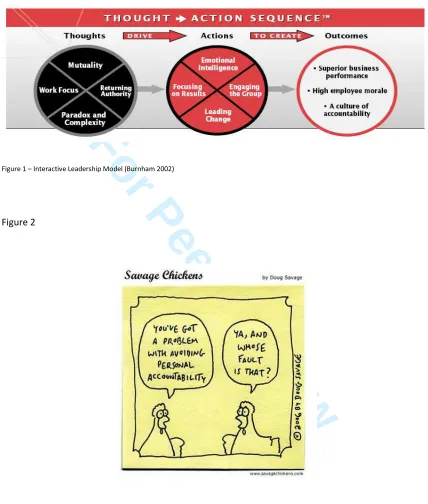
This led on to how leadership is used to lead change. To illustrate this
Burnham’s (2002) Interactive leadership model was explained and
explored (figure 1), to visualise the components and the process followed.
The key components of the actions stage: emotional intelligence; engaging
the group; leading change; and focusing on results were explored in
greater detail.
Please place figure 1 here.
Making links with authenticity embedded the role of emotional
intelligence and hence authentic and successful leadership were revisited
using a range of articles (Upenieks 2002, Upenieks 2003, Shirey 2006,
Triola 2007, Jumaa 2008, Shirey 2009). To ensure comprehension within
the groups authentic/successful leadership definitions and
characteristics that form them were discussed by the students.
Quality 3
For Peer Review
In order to improve quality there is a distinct need to understand exactly
what quality is. A group exercise, using Post It notes enabled the group
to explore what they understood quality to mean to them. Definitions of
quality were discussed: such as an essential or distinguished
characteristic, good moral, mental or aesthetic characteristic, virtue or a
degree of goodness. However, quality can also be seen in terms of
customer wants, or in this case patient satisfaction (Deming 1991). The
three dimensions explored were client quality – what clients and carers
want; professional quality – service need as defined by the profession and
referrers and management quality – the most efficient and productive
use of resources within set time limits set by those in authority and
purchasers. Models of quality within health care such as Donabedian’s
(2003) that describe and explain quality in terms of structure, process
and outcome and Maxwell’s six dimensions (2003) were incorporated.
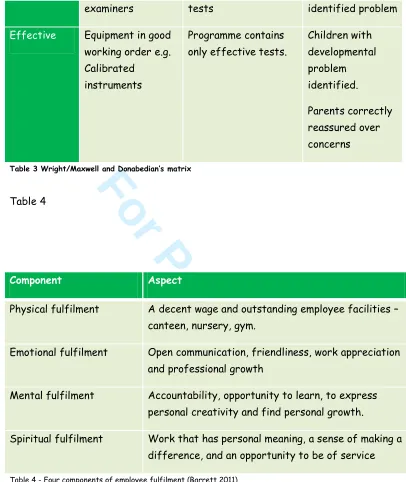
Using a combined Wright’s matrix of the two models illustrated a therapy
quality assurance strategy (Table 3). The limitations of this approach
shared were that neither, Donabedian’s or Maxwell’s models focus
specifically on patient needs or that of the whole organization.
Please place table 3 here
For Peer Review
Quality and its application to children’s nursing practice were included.
Guidance notes on the 5 why’s technique (Jasper, 2006) provided a
definition, benefits, how to use the 5 Why’s and examples of how to apply
them was given to the group (IMS International 2010). They were also
given details of the Critical Incident Technique (CIT) which included an
overview and a process map for CIT interventions (Serrat 2010).
Alongside this a template for the Plan, Do Study and Act (PDSA)
Improvement cycle (NHS Institute for Improvement and Innovation
2008) was elaborated upon. The groups were asked to complete the
PDSA in relation to an incident they had experienced. The process of
applying the theory and the solutions they arrived at were shared with
the wider group to enable lessons to be embedded, as storytelling is a
powerful resource to learning (Heath & Health 2008).
Quality was related to them by using Ralph Waldo Emerson’s quote ‘Make
the most of yourself, for that is all there is of you” (ThinkExist.com
1999). To apply this, the group had to explore quality in relation to a role
in their life. The role was written onto the centre of a circle, on the
periphery they had to write statements about how they undertake this
role. Each statement then was allocated a weighting from 1-10 as to how
much quality they gave to each statement. The reason for using a
For Peer Review
personal role was because it would enable them to explore a concept they
were very familiar with. Once completed, a number of questions were
posed:
What have you learnt?
Are you doing enough?
Could you do more?
What more could you do?
The group members were very comfortable exploring a personal role in
depth and stated they had learnt a lot from the exercise. This was then
expanded to enable them to explore their roles at work. The transition
was made by using another quote: “Pray as though everything depended
on God, work as though everything depended on you” Saint Augustine
(Think Exist.Com 1999). The same exercise was then undertaken, but
this time their role/position was written in to the centre of the circle.
On the periphery the different aspects of the role were stated.
Subsequently each statement was allocated a number between 1-10 as to
how much quality they gave to each aspect. The same reflective
questions were then applied. Strangely enough the group participants all
acknowledged that much less quality was being given to their work roles
For Peer Review
than their personal roles. In order to illustrate how developments in
quality could be made in their roles at work, a copy of their job
description was given to them From this each participant added those
aspects outlined within their job description that had been omitted from
their statements. They were then asked to explore what they had learnt
from the exercise about their role today. The result was interesting as
some were suddenly defensive about their actions, which had not
occurred when they had openly discussed their personal relationships.
Questions were then posed as to why there had been such a different
reaction.
Accountability enabled them to transition their ideas and explore how
they demonstrate accountability both as individuals and as team
members. Cartoons and comic strips were used to illustrate the futile
efforts individuals will go to not accept accountability and responsibility
(Figure 2) (Savage 2006).
Please place Figure 2 here.
For Peer Review
To explore this concept the question was posed: How do we demonstrate
we are taking responsibility? Using a personal example from life to
illustrate, each group member had to make a statement, e.g. I take
responsibility for my health by what I choose to eat and how much or
little I exercise. The group commenced discussing examples of how they
took responsibility in their own lives. An example was then given by the
facilitator of how responsibility had to be taken if a whole cohort of
students failed an assignment. This may be due to the fact that the
facilitator had not explained the task clearly. This resulted in a
discussion of how simple or challenging taking responsibility actually is,
and the skills needed to undertake it.
Duty of care was included because as health professionals they needed to
comprehend that their duty of care required them to take responsibility.
A duty of care was defined using the UNISON duty of care handbook
(2011) as an obligation implicit in their role as a health worker towards
their patients/service users, colleagues, employer, self and public
interest. However, the focus was not just on obligations but also on what
makes employees function most effectively, because employee fulfillment
has four key components (Barrett 2011) (Table 4).
For Peer Review
Please place table 4 hereThe work on the unit and how this did or did not fulfill these components
was discussed and group members were encouraged to continue their
personal reflections within their reflective journal. The concept was
discussed that they needed to understand themselves and what they
needed before they could ask for it. By exploring their own roles they
were able to highlight what they did well and what areas they could
develop and improve with help and guidance. From this the group
members identified what support they perceived would be beneficial from
management. These were noted, maintaining confidence and fed back to
the management by the facilitators.
Presentations
An array of topics were presented by the group members ranging from
materials for health promotion for children and parents to teaching
sessions/ resources for colleagues and students and there was a range of
quality to them. Unfortunately a number of group members were unable
to attend the final session due to work commitments and sickness. The
quality of some of the presentations were limited, however the group did
explore their contribution to this and what they would do differently in
future.
For Peer Review
Evaluation
Evaluation of the project was undertaken in a number of ways:
• Pre and post questionnaires per session – to identify knowledge and
learning gained.
• Overall evaluation of the project which enabled the group members
to explore the benefits and disadvantages of project participation.
• Trust evaluation that incorporated a synopsis of the group
feedback.
• Personal evaluation of what they had learnt and the actions
required of them to get the most out of participating in the
project.
Personal evaluation
The students were given a template (figure 3):
Please place figure 3 here.
For Peer Review
In order to evaluate what they had personally gained from undertaking
the project they were given the template show in figure 2. They were
asked to complete in green ink what they had learnt and in red ink what
actions they identified to continue to develop themselves. Table 5
illustrates the lessons they recognised they had learnt and what actions
they felt they now needed to make to get the most out of what they had
learnt.
Please place table 5 here
Overall Evaluation valuation v
The overall evaluation for the project enabled the groups to explore what
they had gained from completing the team building project. The questions
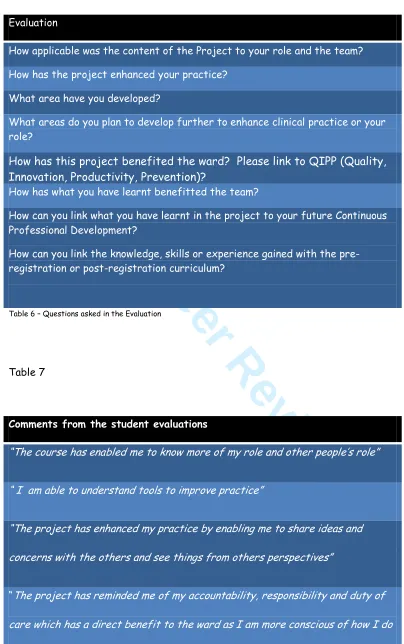
they were asked to evaluate the project are outlined in table 6 below.
Please place table 6 here
The groups evaluations were consistently positive throughout the project.
Table 7 outlines some the feedback given in the overall evaluation of the
project in response to the question stated above:
For Peer Review
Please place table 7 hereConclusion
Overall the project evaluated very well. It combined interactive
methods, group work and team building exercises with self reflection.
Emphasis was placed on how the group members could develop themselves
and maximize the impact on the team and on quality indicators for patient
care.
Since the project has been completed the teams have been more
cohesive, and the staff have been working effectively as a team. There
has been an improvement in communication amongst the staff. Staff
appear more aware of colleagues’ roles. The senior staff have been
working more regularly in direct patient care and shift patterns which
has enhanced relationships between the managers and the team.
Some staff have developed further in their areas of interest and this
has led to promotion for some such as Clinical Nurse Specialist posts.
Some staff have identified areas they will need to develop further and
have progressed on to do modules for their degree and also mentorship
For Peer Review
courses. This personal development will further support the development
of their colleagues, students and the quality of their practice in caring
for children and families.
For Peer Review
References:
Asian Development Bank (2010) “The Critical Incident Technique – Olivier Serrat”, available at:
http://www.adb.org/site/knowledge-management/knowledge-solutions (accessed 11 July 2011).
BSM Consulting (2012) “The Personality Page”, available at:
http://www.personalitypage.com/html/home.shtml (accessed 18 February 2012).
Barratt, R. (2011) “Building a vision guided, values driven organisation”, available at:
http://www.power-projects.com/BuildingValuesDrivenOrganization.pdf (accessed 1August 2011).
Bennis, W and Nanus, B. (1986), Leaders: strategies for taking charge, Harper and Row, New York.
Burnard, P. (1992) Know yourself! Self awareness activities for nurses, Scutari Press, London.
Burnham, D. H. (2002) “Inside the mind of a world class leader”, available
at: http://www.burnhamrosen.com/articles/Inside_the_Mind.pdf.
(accessed 24 June 2011)
Business Balls (2005) “Johari Window”, available at:
http://www.businessballs.com/johariwindowmodel.htm (accessed 8th August 2011).
Changing Minds (2012) “Six emotional leadership styles”, available at:http://changingminds.org/disciplines/leadership/styles/six_emotional _styles.htm) (accessed 13 July 2011).
Covey, S. (2004) “The seven habits of highly effective people”, available at: http://www.youtube.com/watch?v=1D3dGrSutK0 (accessed 13 July 2011).
Deming, E.W, and Walton, M. (1991) Management at work, Mercury, London.
For Peer Review
Donabedian, A. (2003) An Introduction to Quality Assurance in Health Care, Oxford University Press, New York.
Fox Searchlight Pictures (2010) “Plot summary for 127 hours”, available at:
http://www.imdb.com/title/tt1542344/plotsummary (accessed 8August 2011.
Heath, C. & Heath, D. (2007) Made to Stick, Random House. London.
Human Metrics (1998) “Jung typology test”, available at:
http://www.humanmetrics.com/cgi-win/jtypes2.asp (accessed 1 August 2011).
IMS International (2010)” 5 whys technique”, available at:
http://www.imsworld.org/blog/5-whys-technique/ (accessed 10 July 2011).
Jasper, M. (2006) Professional Development, Reflection and Decision-making, Blackwell publishing, Oxford.
Jumma, M, O. (2008) “The F.E.E.L good factors in Nursing Leadership at board level through work-based learning”, Journal of Nursing
Management, Vol 16, pp 992-999.
Kotter, J, P. (1990) A Force for Change: How Leadership differs from Management, The Free Press, New York.
Maslow, A.H. (1999)Toward a Psychology of Being, 3rd ed, John Wiley, New York.
Maxwell, J, C. (2003) Relationships 101 what Every leaders needs to know. Thomas Nelson, Nashville Tennessee.
McClelland, D. (1967)The Achieving Society, The Free Press. New York.
Mind Perk (2011) “7 effects of highly effective people DVD Stephen Covey”, available at: http://www.youtube.com/watch?v=37cZVY5ShU4 (accessed 8August 2011).
For Peer Review
NHS Institute for Improvement and Innovation (2008) “Plan, Do, Study, Act (PDSA)”, available at:
http://www.institute.nhs.uk/quality_and_service_improvement_tools/qual ity_and_service_improvement_tools/plan_do_study_act.html (accessed 10 July 2011).
Phillips, L, D, M. (1994) “Teaching Intravenous Therapy using innovative strategies”, Journal of Intravenous Nursing, Vol 17 No. 1, pp. 40-50.
Savage, D. (2006) “Blame – Savage Chickens”, available at:
http://www.savagechickens.com/tag/accountability (accessed 8 August 2011).
Schon, D. (1995) How professionals think in action. Basic Books. USA.
Shirey, M. R. (2006) “Building Authentic Leadership and Enhancing Entrepreneurial Performance”. Clinical Nurse Specialist. Vol 20 No. 6, pp. 280-282.
Shirey, M. R. (2009) “Building Authentic Leadership Organisational, Culture and Health Work Environments”. Critical Care Nursing Quarterly. Vol 32 No 3, pp. 189-198.
Sully, P. and Dallas, J. (2010) Essential Communication Skills for Nursing
and Midwifery, 2nd ed. Mosby/Elsevier, Edinburgh.
Think Exist.Com (1999) “ Ralph Waldo Emerson quotes”, available at:
http://thinkexist.com/quotes/ralph_waldo_emerson/ (accessed 1 August 2011).
Think Exist.Com (1999) “Stephen R Covey quotes”, available at:
http://thinkexist.com/quotation/motivation-is-a-fire-from-within-if-someone-else/362837.html (accessed 10July 2011).
Think Exist.com (1999) “St Augustine quotes”, available at: Think Exist.Com (1999)
http://thinkexist.com/quotation/pray_as_though_everything_depended_ on_god-work_as/149654.html (accessed 8 August 2011).
For Peer Review
Triola, N. (2007) “Authentic Leadership begins with EmotionalIntelligence”. American Association of Critical Care Advanced Critical Care. Vol 18 No. 3, pp. 244-247.
UNISON (2011) UNISON duty of care handbook. UNISON. London
Upenieks, V. V. (2002) “What constitutes successful Nurse Leadership”? Journal of Nursing Administration. Vol 32 No. 12, pp. 622-32.
Upenieks, V. V. (2003)”Nurse Leaders’ perceptions of what compromises successful leadership in today’s acute inpatient environment”. Nursing Administration Quarterly. Vol 27 No. 2, pp. 140-152.
You Tube (2010) “127 Hours Full Length Trailer HD”, available at: (http://www.youtube.com/watch?v=OlhLOWTnVoQ) (accessed 8August 2011).
For Peer Review
[image:32.612.98.490.169.719.2]Tables for Team Building Project to enhance quality care indicators
Table 1
Hard theory Rationale
Leadership + exercises Gave insight into the differences
between the concepts of leadership and management.
Team building + exercises Provide an opportunity for the groups
to illustrate effective team working.
Quality Demonstrated the significance of
quality and how this impacted on the care of children and families.
Practice development Facilitate an opportunity for the
groups to develop an aspect of practice/area of interest
Soft theory Rationale
Motivation Provide a core understanding of what
motivates them and how motivation impacts on our actions.
Jung personality test Identify their strengths and
limitations and know what areas to develop.
Self awareness Fundamental to effective functioning
as a human being and how their behaviour may be perceived and
For Peer Review
affects others.
Communication Vital component in all aspects of life;
teams and working with families included.
Self- Actualisation Ability to fulfil own true potential.
[image:33.612.95.486.68.220.2]Transferring qualities and skills from personal to work life.
Table 1 – Overview of Hard and Soft theory and rationale
Table 2
Who else do you communicate with other than the patient/child?
Children
Families
Colleagues
Other health professionals
Play specialists
Ward clerk
Porters
Table 2 – Persons other than patients communicated with.
For Peer Review
Table 3
Wright’s Matrix
Donabedian’s approach
Structure Process outcome
Maxwell’s Dimensions
Access Child friendly location (pushchair access)
Easy booking, sufficient appointments
Parent and child attend
Equity Facilities for families with special needs (physical/hearing problems)
HP resources in range language
Different appointment lengths available
Attendance – families feel they have been listened to
Appropriate, relevant to need
Facilities for hearing testing (soundproofed?)
Programme reflects client group e.g. Anaemia screening inner city area
Hearing problems detected
Acceptability Clinics at
appropriate time e.g. Not at same time as methadone clinic
Programme acceptable to parents – doesn’t not include
unacceptable tests (HIV?)
Attendance
Efficient Skill mix of Programme does not include inefficient
Cost per annum
For Peer Review
examiners tests identified problem
Effective Equipment in good working order e.g. Calibrated
instruments
Programme contains only effective tests.
Children with developmental problem identified.
[image:35.612.84.490.68.550.2]Parents correctly reassured over concerns
Table 3 Wright/Maxwell and Donabedian’s matrix
Table 4
Component Aspect
Physical fulfilment A decent wage and outstanding employee facilities –
canteen, nursery, gym.
Emotional fulfilment Open communication, friendliness, work appreciation
and professional growth
Mental fulfilment Accountability, opportunity to learn, to express
personal creativity and find personal growth.
Spiritual fulfilment Work that has personal meaning, a sense of making a
difference, and an opportunity to be of service
Table 4 - Four components of employee fulfilment (Barrett 2011)
Table 5
What I have learnt Actions to develop
To aim high I didn’t feel I accomplish my set
goals of giving 100% always
Ambition to see my end result first My presentation needed more
[image:35.612.86.489.625.712.2]For Peer Review
effort and enthusiasmWhat you put in is what you will get Stop thinking of excuses and just do your best
Be punctual – work on yourself first Making sure everyone attends all sessions
Think you are being looked up to by parents, child/family
Shorter, longer and regular sessions
Be a good leader, manager, listen before you contribute better team member
I just wish it (the project) could have been longer and hope everyone gets the chance to do this.
Run the extra mile
Self motivation
Motivation from other people
Types of leadership successful leadership
Reflection about what I have done
Learning about myself
Determination
To start doing things
To focus on me, what I want
To find what motivates me and stick to it
To help me further in life and solve problems
Taught me how I am as a person
To think more clearly
To focus on things that actually matter
To see things differently
Use experiences to do better and not repeat the bad
To because a better and stronger person
For Peer Review
To motivate myself to be better at myjob and course
Work more now
This course has made me re-evaluate my life and job
I have applied the principles to everything I do both at home and at work
My communication skills have improved greatly
I am thinking more now
My anger with certain things has disappeared
Nothing matters anymore as long as I give my all in a positive way
I’m more positive now
I now feel like I belong to a team rather than a group of people
I have given more respect and vice versa
My approach to things has improved/changed
I think the teacher was great in my practice sessions
Very engaging
Great work
Table 5 – What group had learnt and actions they needed to take to develop
Table 6
For Peer Review
EvaluationHow applicable was the content of the Project to your role and the team?
How has the project enhanced your practice?
What area have you developed?
What areas do you plan to develop further to enhance clinical practice or your role?
How has this project benefited the ward? Please link to QIPP (Quality, Innovation, Productivity, Prevention)?
How has what you have learnt benefitted the team?
How can you link what you have learnt in the project to your future Continuous Professional Development?
How can you link the knowledge, skills or experience gained with the pre-registration or post-pre-registration curriculum?
Table 6 – Questions asked in the Evaluation
Table 7
Comments from the student evaluations
“The course has enabled me to know more of my role and other people’s role”
“ I am able to understand tools to improve practice”
“The project has enhanced my practice by enabling me to share ideas and
concerns with the others and see things from others perspectives”
“The project has reminded me of my accountability, responsibility and duty of
care which has a direct benefit to the ward as I am more conscious of how I do
[image:38.612.85.489.53.697.2]For Peer Review
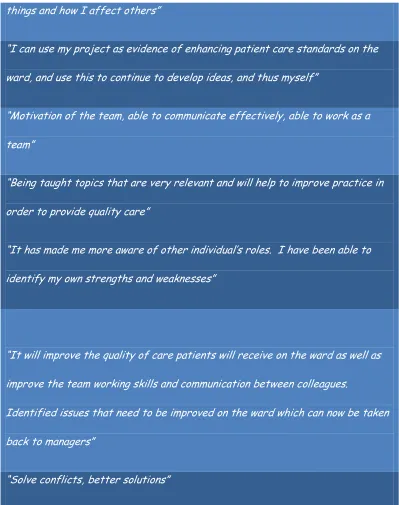
things and how I affect others”“I can use my project as evidence of enhancing patient care standards on the
ward, and use this to continue to develop ideas, and thus myself”
“Motivation of the team, able to communicate effectively, able to work as a
team”
“Being taught topics that are very relevant and will help to improve practice in
order to provide quality care”
“It has made me more aware of other individual’s roles. I have been able to
identify my own strengths and weaknesses”
“It will improve the quality of care patients will receive on the ward as well as
improve the team working skills and communication between colleagues.
Identified issues that need to be improved on the ward which can now be taken
back to managers”
[image:39.612.88.487.65.570.2]“Solve conflicts, better solutions”
Table 7 Comments made by the participants in the Evaluation
For Peer Review
Figure 1 [image:40.612.92.520.111.615.2]Figure 1 – Interactive Leadership Model (Burnham 2002)
Figure 2
For Peer Review
Figure 3Figure 3 – Personal evaluation template