Accelerated Multi-Organization Conflict Resolution
Fran Ackermann1, Colin Eden2, and Igor Pyrko2
1 Curtin University, Australia 2University of Strathclyde, UK
Abstract
In this paper, we discuss two situations where two organizations with different aims recognised the dysfunctionality of their relationship. In each of these cases, which were long running (6-8 months), the organizations had worked hard to resolve this dysfunctionality, and conflict, by organizing off-site meetings designed to resolve the conflict. These one-day meetings failed. Subsequently Group Support System workshops were used for one day workshops and in each case the conflict was essentially resolved within 55 minutes. The research reported in this paper seeks to answer the question: what happened in these cases that led to a resolution of the conflict in such a short time period, given other attempts had failed? Specifically the paper explores the impact of the GSS used to facilitate two organizations seeking to resolve a conflictual situation.
1 Introduction
Research has been conducted to explore the role Group Support Systems (GSS) play in single organizations to enable group decision and negotiation for brain-storming, problem solving and strategy making, and in multi-organizations (Ackermann et al. 2005; Franco and Rosenhead 2001).
However, research into the role of a GSS in conflict negotiations is limited. Miranda and Bostrom’s (1993) quantitative study concluded that using a GSS can lead to lower amounts of issue-based and interpersonal conflict, but the overall impact on the productivity of negotiation was not entirely clear. Anson and Jelassi (1990) write about an application of a GSS in conflict mediation, but does not involve a GSS using causal mapping, as was the case in this study. Their reportage concentrates on reducing ambiguity in problem definition by the participants, whereas, in the research reported here ambiguity has been shown to play an important role in reaching agreement. Cronin et al. (2014) explore the use of a Problem Structuring Method, called Issues Mapping, as a good way of helping conflicted parties in better understanding each other’s positions, however it does not reflect the role of a computer supported GSS, and neither does it discuss the facilitated workshop from a micro perspective, which is a primary purpose of the research reported in this paper.
In this paper, we discuss two situations where two organizations with different objectives recognised the dysfunctionality, and conflictual nature, of their relationship. In each of these cases, which were long running (6-8 months), the organizations had worked hard to resolve the conflict by organizing off-site meetings designed to resolve the conflict. The one-day meetings failed. One of the authors, who had successfully worked with each of the organizations before, was invited to facilitate an off-site workshop using a GSS in each case. Although each of the workshops had been planned to take place over one full day, in both workshops the conflict was resolved within 55 minutes and the rest of the day was spent designing strategies to decrease the probability of a further occurrence of the conflict, as well as working on other issues.
Specifically the paper explores the impact of a GSS used to facilitate two organizations to resolving a conflictual situation. Consequently it focuses on the first 55 minutes.
Getting groups to work effectively together has been seen as a challenge and necessity, and considerable work has been undertaken towards facilitating such activity. For example, recent research has sought to better understand how leadership teams negotiate a consensus under crisis (Combe and Carrington 2015), how groups produce knowledge in facilitated workshops (Tavella and Franco 2014), what role the causal maps play in effective working (Paroutis et al. 2015) and finally the contribution of GSSs when facilitating multi-organizational working (Ackermann et al. 2005). Not surprisingly, when the conflict straddles organizations with significantly different aims, as in the cases reported in this paper, resolution poses a far greater challenge.
Consequently to better understand how best to support this form of organizational working, this paper draws on detailed analysis of the first 55 minutes of each of the workshops. The analysis is undertaken with the purpose of understanding what unfolded, and thus answer the question of what was the impact of the GSS, in facilitating the two organizations to resolve a conflictual situation. From this analysis we hope to understand better what it takes to engage in a negotiation that is capable of producing a desirable outcome for both parties in under an hour – an outcome that was a significant surprise to both organizations. This way we seek to address Combe and Carrington’s (2015, p. 14) request that “future research should analyze the interaction within leadership teams to help understand more how cognitive consensus is formed”; and also Tavella and Franco’s (2014, p. 2) view that “we know very little about what actually happens in a facilitated modelling environment” which they consider as ‘a black-box’.
We conclude by providing final remarks about the relevance of these findings to academic knowledge and to the practice of facilitating negotiations.
2 The GSS
GSSs have been in existence since the 1980s although their capacity and utility was initially limited by technological and data management challenges (Lewis 2010). When reflecting on the well-established systems it is interesting to note that they are derived from a range of different theoretical backgrounds. For example, Group Systems (Valacich et al. 1991) was developed from an Information Technology paradigm, Dialogue Mapping (Conklin 2006) was based on a particular approach to addressing wicked problems (Horst and Melvin 1973) and Group Explorer has its foundations in the socio-political (Mangham 1979; Perrow 1986) social and cognitive psychology (Kelly 1963) and negotiation domains (Fisher and Ury 1981). Consequently the nature of their contribution to supporting a group varies and thus selection for use is best done on the basis of ensuring commensurability between aims of the intervention and GSS design.
What is meant by GSS in this paper, is a category of software tools accompanied by facilitation techniques that are aimed at supporting collaboration (Agres et al. 2005) and group productivity (Jessup and Valacich 1993) through such means as anonymising the contributions (Jessup and Tansik 1991), managing messy information in real-time, problem structuring (DeSanctis and Gallupe 1985), and strategy development (Ackermann and Eden 2010).
2.1 Negotiation: ‘Getting to Yes’
Group Explorer1, the GSS used in this research, has been used extensively in supporting organizations of various sizes, including those from the private and public sectors, national and international (Shaw 2003; Tavella and Franco 2014). An important conceptual influence for Group Explorer derives from Fisher and Ury’s (1981) work on ‘Getting to Yes’, consisting of principles of what makes a productive
1 Group Explorer is collaboration software designed and developed at Strathclyde Business School. Further
negotiation and based on the Harvard Negotiation Project2. The mission of the project is “improve the theory and practice of conflict resolution and negotiation by working on real world conflict intervention,
theory building, education and training, and writing and disseminating new ideas”. Fisher and Ury (two
of the lead researchers) emphasise the importance of separating a person from a problem so that the participants evaluate the ideas by their merit and not by their author, and so that they have an opportunity for face-saving. The participants should also be able socially to generate multiple options rather than fight over the first plausible options, and they should have a chance to actively contribute to the process in order to have a feeling of ownership and involvement. These aspects of a negotiation may in turn improve the perceived procedural justice of the workshop - the degree to which voices are not silenced and everyone can contribute in a fair manner (Chan and Mauborgne 1998; Tyler and Blader 2003).
2.2 Personal Construct Theory and Causal Mapping
Another key influence for the design of Group Explorer is Kelly’s (1955) Theory of Personal Constructs whereby people make sense of the world around them through contrast and similarity with respect to the things that they know, by explaining why certain things have happened, and/or by building their own hierarchies of meanings. Each individual has its own construct system (mental map) which, when considered against those of other people, typically results in extension or adaptation to the individual’s construct system, enabling that person to change their mind often imperceptibly.
Cognitive mapping is one means of operationalizing personal construct theory. In a group situation, the principle is extended to the use of causal mapping. The technique of causal mapping is well established (Hodgkinson et al. 2004; Huff 1990) although not always based upon personal construct theory. It has been used in management research as a specific qualitative data capture and analysis method (Hodgkinson and Clarkson 2005; Jenkins and Johnson 1997; Swan 1997; Walsh 1995). Nevertheless, independently of the use, causal mapping typically adheres to a set of formalisms which differentiates it from producing merely ‘word-and-arrow’ diagrams (Bryson et al. 2004).
2.3 The GSS: Group Explorer
Based on the causal mapping technique and a socio-political view of organizations, Group Explorer was developed to support facilitated workshops. In use, Group Explorer involves each participant being provided with a laptop or tablet enabling them to communicate their views to the group via a publically viewable casual map (for illustrations see Ackermann and Eden 2010). Participants create a ‘transitional’ or ‘boundary’ object (Black and Andersen 2012; Carlile 2002; de Geus 1988; Winnicott 1953) of the situation under consideration. Workshops start with the capture of the statements expressing personal views, these views will be roughly clustered according to content and reviewed with the group, and participants subsequently add causal links (that is, unidirectional arrows which signify the causality following from one statement to another statement) building up a causal map. The addition of the causal links will change the clusters from thematic to reasoned causal networks.
In addition, a chauffeur module not only provides the facilitator with control over the meeting (whether to provide participants with the facility to contribute ideas, relationships, preferences etc.) but also provides a range of additional features which are useful in the facilitation process. For example: monitoring the rate of contributions from each participant, the extent to which participants show attention to particular developing themes and clusters of views, etc. The module also provides a real time log that captures over time all contributions/activities from participants, the facilitator driven master machine which projects the emerging map/boundary object, and the chauffeur machine. The log allows a micro level analysis to be undertaken of the second by second behaviour of the participants as they are supported in navigating through the conflictual situation. It is this log alongside the causal maps that constitute the data used in this research.
3 Analyzing the workshop data
3.1 Scene setting: making sense of the negotiation of conflict
Based on the overarching aim of the paper to explore the impact of a GSS used to facilitate two organizations to resolving a conflictual situation and recognising the GSS used is based on a socio political theoretical basis, it is worth considering the social nature of developing consensus when undertaking negotiations in situations of conflict. Conflict situations can be challenging endeavours due to the complexity and ambiguity that is inherent when interacting within the context of incompatible views, stress and time pressures (Combe and Carrington 2015). These endeavours require effort on the part of the participants to review their mental models (understanding) of the situation and develop new ways of responding to it. Some aspects of these mental models – individual’s social construction of reality (Berger and Luckmann 1966) - comprise making sense of the world through attributing causality to events. As noted earlier, each participant’s understanding of a crisis can differ significantly (Combe and Carrington 2015) and thus exploring the perceptual lenses through which events/situations are being viewed can be the first step towards successful negotiation. As it is to enable an in-depth understanding of the contributions, their meaning and the process of constructing a shared representation (boundary object), in this research we take a micro-level focus on the cause-and-effect relationships in the form of a causal map.
The focus on causal relationships with regards to individuals’ meanings reflects a sensemaking perspective (Weick 1995) in which people contribute to developing situations that they participate in and which they concurrently seek to understand (Maitlis and Christianson 2013; Porac et al. 1989). In a conflictual and complex negotiation the process of sensemaking is believed to play an essential role in dealing with ambiguity, as simply providing more information does not substitute for collectively elaborating and surfacing problems:
The need to explore more deeply the available options in negotiation, and for mutually getting to the root of the problem whilst not just gathering as much information as possible, is also observed by Druckman (2009, p. 437) who argues that, in conflictual situations in which long-term solutions are sought, there will be a need for “a forum or format that is more conducive to exploring the sources of the conflict”. Similarly, Zartman (1977, p. 437) argues that a suitable approach for studying negotiations that are of high significance to the participants is what he calls aformula-and-detail approach. Here, the formula represents negotiating an outcome that is satisfactory for both sides, while the detail stands for an exploration of suitable specifications for that formula (and the other way round); and as he notes, “cognitive maps might help locate this combination” (Zartman 1977, p. 636). These claims are compatible with Fisher and Ury in the sense that negotiation is portrayed as a dynamic social process of developing new options which reshapes peoples’ understanding of the problem in question, rather than simply trying to agree on a mutually plausible solution. Thus, we treat our analysis as an opportunity, as noted above, to explore the impact of a GSS used to facilitate two organizations to resolving a conflictual situation and as part of that aim to consider how the specific causal mapping based GSS supported the participants in making sense of their conflict. We believe that this exploration could usefully guide the future design of workshops employing GSS in supporting organizations in conflict.
3.2 Organizational context
the same for both workshops, the conflicts involved different parts of the organizations. Thus all but one of the participants in the first workshop did not have any involvement in the second workshop. This meant that there was a limited linkage between the separate negotiations’ group dynamics (Crump 2010) providing two cases. As part of the workshop design equal representation in terms of number of participants was sought from each organization (2 x 4 participants attended ‘workshop 1’ and 1 x 3 and 1 x 4 participants attended ‘workshop 2’) where each managers represented different discipline and role perspectives.
3.3 Analyzing the data: Coding the statements and links
The form of the data was: i) the causal maps developed by the participants during the workshop, and ii) the data log of the contributions of participants showing all of their input to the GSS over time. The analysis followed a series of stages which we now describe.
The causal maps enabled a visual inspection of the data to familiarize the researchers with their structure (one of the researchers was already familiar having facilitated the workshops). Subsequently, the process of coding the links and statements (Miles and Huberman 1994), both in the Decision Explorer models3 and in the spreadsheets containing the data logs, was undertaken. In order to gain a rich view of what happened in the workshops, a number of approaches to coding were adopted. This required making multiple copies of the causal maps from the workshops and subsequently imposing different combinations of coding. No a priori codes were used and so the categories emerged gradually and were grounded in this specific data (Glaser and Strauss 1967). The emergent codes were tested continually across the coders to ensure their fitness for purpose with tests for inter-coder reliability being undertaken. The codes were also informed through immersion in the workshops and thus familiarity with the context, as reported by the facilitator/researcher. The small number of differences in coding all derived from the facilitator’s specialist knowledge of the situation that was derived from initial briefings from participants as well as being present during the workshops. Explanation from the facilitator to the other researchers satisfied the coders of robust inter-coder reliability. The final coding scheme for the
3 Decision Explorer provides the researcher with the ability to explore the maps produced in the Group Explorer
contributed statements identified: accusations, admissions, explanations, and conciliatory statements. In addition, the log shows which person (and so which organization) generated the activity and so additional codes were used to show visually which organization and person had generated the statement.
During the coding of statements the researchers identified a number of statements where a statement could be coded as either accusatory or conciliatory depending upon who was presumed to have made the statement. This presented the possibility of ambiguity for the participants. In these instances the coding recognized the intended code (drawing from log data) as well as the code as might be perceived by a participant. To ensure robustness and triangulation in the analysis the authors switched between each workshop’s causal maps (accessed in Decision Explorer software) and the data logs (which amongst other data contained details of authorship thus providing further context on which to determine the coding). This enabled the codes initially developed through exploration of the first causal map to be compared with the results from coding the second map – ensuring comprehensiveness and validity within the maps. And once a degree of robustness emerged, the data logs (containing the second by second capture of all interactions with the causal model) were used to test the codes. For example, in the data log it was easier to follow the authorship of contributions and hence it allowed a better understanding of the possible meaning of statements and links on the causal map. In addition, and as a natural part of triangulating data, the coding was informed by the conversations and correspondence with the participants prior to and after the workshops, as well as by the facilitator’s observations during the workshops.
A coding protocol for each causal link was straightforward and followed from the coding of the statements, for example ‘accusatory to accusatory’ (a link coming from one accusatory statement to another accusatory statement), or ‘admission to conciliatory’.
3.4 Patterns in the Causal Maps
The notion of importance derived from a combination of the structural properties of the map (as analyzed by the software) and a consensus of their judgment. In the post-workshop analysis, the causal mapping software (Decision Explorer) was again used to explore the structural properties of the overall map, without the addition of the group judgments made by the participants. The mapping software contains a number of analytical functions which were used to explore the structure of the map and reveal emergent patterns. The patterns were subsequently scrutinized through the use of the data log as this enabled the researchers to determine the possible significance of the order in which statements were submitted and attention returned to the map – in an iterative process.
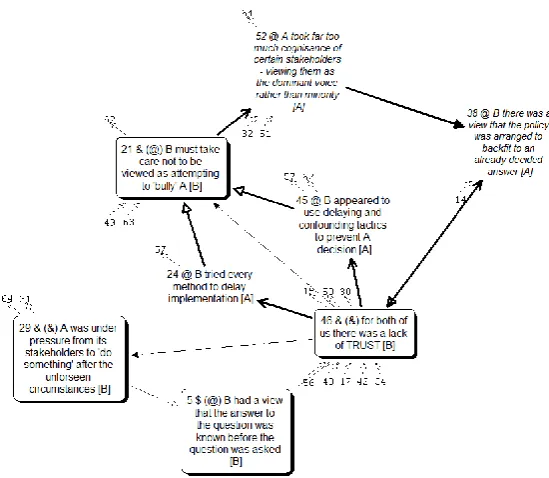
One important form of analysis (pattern exploration) undertaken was the identification of feedback loops. The loop analysis directs a researcher to the statements that form vicious cycles that might be at the core of the conflict. For example, in workshop 2 there was a loop with ten interacting loops (see Figure 1).
Fig. 1 An example of coding and ten interacting loops from one of the workshops
Legend: @=accusatory statement; &=conciliatory statement; $=admission; (€=explanatory); Open
[image:11.595.165.440.396.635.2]Other forms of analysis conducted included a central analysis which ranks the statements by their pervasive impact on the map while domain analysis ranks the statements by the number of in-out links (Bryson et al. 2004). These two analyses help re-identify themes which could be further analyzed, for example, in conjunction with the time logs and the colour coding of statements, allowing for a more nuanced exploration including when they appeared and who entered them. Central and domain intensive statements were of interest because they were topics of common interest and thus were used as potential starting points for negotiation.
3.5 Exploring the Data Logs of Participants’ Contributions
As noted above, alongside analyses of the map’s structure, scrutiny of the data log was undertaken seeking to track the generation of the statements and links, along with the authorship of statements and links to plot these over time. Thus, while the Decision Explorer model provided a rich visual picture of the relationships between the different elements of the maps, the data logs allowed the research team to gain a second by second understanding of the development of the maps. In other words the analysis provided us with a detailed view of both the process and the content of the Group Explorer-facilitated negotiation workshop (Ackermann and Eden 2005), which in turn led us to a more fine-grained perspective of why and how the participants were able to reach an agreement in under an hour.
The analysis of the data logs resulted in the creation of a profile for each participant based on an interpretation of their general approach towards the negotiation. The profile showed that while some participants displayed a consistently confrontational behaviour throughout the workshop, some participants clearly changed their mind based on the others’ contributions and became more eager to negotiate an agreement. As a result, it was possible to arrive at a very detailed perspective in terms of what happened in the workshops second by second, and at different levels: individual, group, and organizational.
links often appeared to seek new paths for agreement. A ‘conciliation to accusation’ link might have a conciliatory nature because such links were used to explain that certain confrontational actions were not caused deliberately by a given party ‘in bad faith’, but that party was led to it by some prior challenging situation. As an illustration Henry (team B) defended team A from his prior accusation that team A were rejecting historical basis for operational planning by linking to this statement a conciliatory statement previously added by Oliver (also team B) which explained that team A was forced to act due to unforeseen circumstances. In other words, the reason why team A engaged in the actions for which they were then criticized was because they had been led to those actions by a challenging situation, and on the causal map this could be seen as a conciliation (the appreciation of the situation) leading to an accusation (the criticized actions).
Moreover, these time based analyses of the log data made it possible to view the contributions in a ‘movie’ like manner (Ackermann and Eden 2011) with the facility to stop, examine, rewind etc. To facilitate this exploration a video in PowerPoint was created which tracked the evolution of the causal maps. For example it was possible to determine the life of central or high-domain statements, including identifying when it was generated, whether it was linked to by all, or just a few, of the participants or the parties and which team dominated the generation of the context surrounding it.
4 The Nature of the Negotiation
Review of the analysis of the data gave rise to two forms of insights which provide an overarching understanding of the cases. The first form centres on developing a sense of the process or behaviour manifested by the group. In essence it takes a descriptive format. The second form of insight builds on this behaviour and provides the basis for explanation of the rapid resolution of the conflict. In this section, each of these insights are explored in detail
4.1 Describing the ‘55 minute’ Dance
contributions. Thus the dance comprised a set of ‘moves’ which flowed from one to another, with the time spent undertaking each ‘move’ being dependent on the conflict situation and parties involved. Understanding both the requirement and detail of these ‘moves’ appears to be beneficial for understanding the 55 minute slot of the workshop and can be seen as a form of script (Ackermann et al. 2011). These moves are described below.
4.1.1 The Cathartic ‘move: Getting it out on the Table’
The first move centred on participants seemingly finding the initial stages of the workshop cathartic. Participants appeared to gain a sense of relief from having been given the opportunity to express their views without interruption – the logs revealed a clear initial flurry of contributions as they got their views ‘off their chest’. This phase surfaced a range of contributions from accusatory (40% in first session, and 63% in second session) to conciliatory (30%, 27%), from admissions (10%, 9%) to explanations (20%, 0%). The sense of emotional release was apparent during the workshops as participants focused only on expressing their views, without paying attention to the views of others (showing on the public screen). This initial flurry was followed by a significant slowing down of contributions as participants began the next move of paying some attention to the views of others by paying some attention to what had appeared on the public screen. This move was dominated by a relatively high proportion of accusatory statements emerging as it appeared that participants began to feel a need to defend or justify contributions. It is significant to note that participants later commented that the accusations captured in this early move were not raised in the previous offsite meetings. Through the use of the GSS, this move accounted for no more than 4-6 mins of the workshop, but was clearly defined in terms of nature of contribution and speed of making contributions.
4.1.2 The Reflection and Elaboration ‘move’
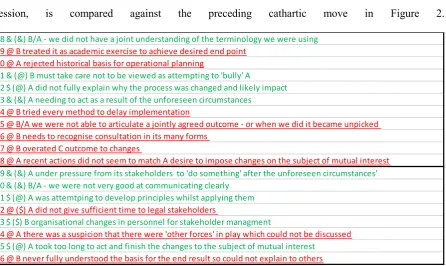
screen. The move allowed for a review and reflection period, one where participants could absorb what had been captured and without a need to immediately respond look at the concerns from both sides. Once again this move took about 2-3 mins. This move, appearing on the data log from the second session, is compared against the preceding cathartic move in Figure 2.
Fig. 2 Data log - the Cathartic move followed by the Reflection and Elaboration move
The numbers before statements stand for the order in which they were added on the map. The two moves are separated by a thick border in the middle of the table. Both moves took around 1 minute of the session. The underlined statements starting with @ symbol are accusations, whilst $ are admissions and & are conciliations. The symbols in brackets signify alternative interpretations deriving from the uncertainty with respect to which party originally added the statement.
4.1.3 Building a Shared Group Definition of the Situation
This move was about participants understanding their own views in the context of others as they linked their views with those of others. Analysis of the data logs revealed that participants began the linking process by focusing on those statements that were relatively broad in scope (e.g. trust) before moving on to linking more detailed or precisely defined statements. This move allowed the meaning of the broad statements to be believed to be co-created where every participant was seen to be able to contribute to the meaning of statements. In this causal mapping situation meaning was derived from seeing the explanations and consequences (in-arrows and out-arrows in the developing causal map). Thus, for example, trust became defined through linking contributions from several participants and from both
18 & (&) B/A - we did not have a joint understanding of the terminology we were using
19 @ B treated it as academic exercise to achieve desired end point 20 @ A rejected historical basis for operational planning
21 & (@) B must take care not to be viewed as attempting to 'bully' A
22 $ (@) A did not fully explain why the process was changed and likely impact 23 & (&) A needing to act as a result of the unforeseen circumstances
24 @ B tried every method to delay implementation
25 @ B/A we were not able to articulate a jointly agreed outcome - or when we did it became unpicked 26 @ B needs to recognise consultation in its many forms
27 @ B overated C outcome to changes
28 @ A recent actions did not seem to match A desire to impose changes on the subject of mutual interest
29 & (&) A under pressure from its stakeholders to 'do something' after the unforeseen circumstances’ 30 & (&) B/A - we were not very good at communicating clearly
31 $ (@) A was attemtping to develop principles whilst applying them
32 @ ($) A did not give sufficient time to legal stakeholders
33 $ ($) B organisational changes in personnel for stakeholder managment
34 @ A there was a suspicion that there were 'other forces' in play which could not be discussed
35 $ (@) A took too long to act and finish the changes to the subject of mutual interest
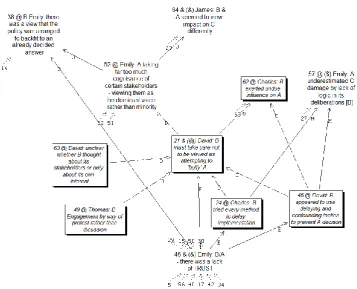
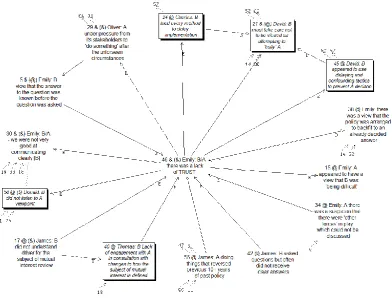
[image:15.595.78.525.141.407.2]teams, even though links were actually made by participants who had not contributed the statements, and many links were made by one participant. Again, the opportunity to link statements generated an initial flurry as participants appeared to see ways of linking statements that showed explanations for accusations, admissions explaining accusations (where in some instances the admission had been raised by the team unlikely to make the admission). For example in Figures 3 and 4 the participants collectively negotiated the meaning of two statements which thereby became central to the causal map: that there was no trust between the parties, and that team B should take care not to be viewed as attempting to bully team A. The contributions (links and surrounding statements) came from the two parties, and in both examples they were authored by six different people.
Fig. 3 An example of a group defined understanding
[image:16.595.115.473.328.617.2]Fig. 4 An example of a group defined understanding (2)
4.2 Explaining the settlement
The previous section reflects the moves of a designed ‘dance’ which, as a result of the Group Explorer GSS, are discrete. In traditional meetings these activities, if they existed at all, would be muddled together as participants fought to gain ‘air-time’ and gain prominence for their own views. This section considers the overall choreography shown in the logs. We consider, in this section, the significance for the role of anonymity, active sensemaking, and the telling of multiple stories. The first of these, anonymity, is directly supported by the data from the logs whereas the other two are informed by a synthesis of the above conclusions from the analyses of the logs.
4.2.1 The impact of anonymity
an opportunity for face-saving. As Fisher and Ury (1981) suggest, the requirement for such separation is an important aspect of successful negotiation and anonymity in these workshops provided this outcome.
In the context of our data analysis there are, however, a number of other impacts of anonymity. For example, one of the benefits of providing participants with anonymity in terms of their contributions was that they were able to ‘say’ things that they were unable to say in the previous offsite meetings. We suppose that the human need to protect oneself from the emotional and political impact of making blunt, but nevertheless honest, statements to others who one is required to continue a working relationship with discourages raising important contributions that need to be made in a conflict situation. It is likely that because participants did not need to respond immediately to potentially hurtful statements (demanding a physiological response), they were able to respond in a more measured and thoughtful way. Participants noted, in off-line conversations later in the workshops, that this anonymity was pivotal – without getting these potentially contentious contributions onto ‘the table’ progress would not have been possible and without the anonymity these contributions would not have been made.
The second impact, related to the first, is that it was not possible for members of either team to determine which team generated a statement and thus the disposition of the statement was not clear (whether the statement was an accusation or admission). For instance, in workshop 1 Jessica from team A entered a possible accusatory statement that ‘B behave with more openness and transparency’. This statement could have been interpreted as an admission by team B. The anonymity of contributions thus helped make it less clear where blame originated and thus provided a platform (the model) upon which to build a more positive stance.
one member of team A this was not known by any of the other participants. Participants could assume that the links had been contributed by all the other participants and so the definition of the situation co-created by the group rather than one individual. When combined with ambiguous language in the statements and ambiguity about who made the statement it is possible that new (shared) interpretations and meanings can be developed by the group (Weick 1995). For example Thomas (team A) defended team B from his team’s own accusation about ‘lack of engagement’ linking it with the statement that both parties had had different understanding of purpose to begin with. In this way Thomas’s link provided an explanation to the accusation and prepared the ground for settlement. In such sense ambiguity can be an indicator of empathy, or it can translate into empathy – an important point which will be developed in the discussion.
It is important to note that these impacts of anonymity are, of course, dependent on having at least two participants from each organization.
4.2.2 Active ’Sensemaking’
Participants had a sense of enactment as they engaged with the map in real-time. They exposed each other to what each thought, and they learnt more about what they think by engaging with the map on the public screen. In some respects this is a practical example of Weick’s “how can I know what I think until I hear what I say”.4 It also seems to resonate with Maitlis and Christianson’s (2013, p. 67) view regarding “a process, prompted by violated expectations, that involves attending to and bracketing cues in the environment, creating intersubjective meaning through cycles of interpretation and action, and thereby enacting a more ordered environment from which further cues can be drawn.”
Whilst we did not specifically code the data log for occurrences of sensemaking we used the sensemaking idea from the literature to sharpen our discussion how the causal maps were being co-produced during the session. For example, participants linking other participants’ contributions as a situation of sensemaking illustrating Weick’s notion of a cue plus a frame plus a connection may lead to a plausible new story (Weick et al. 2005) As an illustration, halfway through the linking stage Emily
attended to an accusation added by Charles from team A saying that ‘team B tried every method to delay implementation’ (for Emily it could be perceived as cue of nonobvious nature), and she linked to it (a meaningful connection) her own statement ‘between teams A and B there was a lack of trust’ (this could serve as a frame justifying the cue). Hence it can be said that Emily negotiated a new meaning through an act of sensemaking in the social context, and many similar acts could be observed in the sessions. This sense of engagement seemed, importantly, to be at both an individual and organizational level. For example as we stated above, participants developed a group definition and understanding of the situation. Social pressures were reduced to allow cautious generation of concerns, frustrations, and assumptions to be captured.
The nascent shared understanding was reinforced by the ability to link the statements on the map, thus helping the participants to actively engage with the contributions of others. As such they appeared to unravel the complexity of their collective thinking. The participants drew on otherwise camouflaged contributions such as accusations voiced during the cathartic move, as they added to the map at their own pace, and without competing against others as to who ‘takes the control’. The group map served as a point of reference that was not an external, independent object, but was rather an artefact collectively developed by the participants (Belmondo and Sargis-Roussel 2015) – the map became the ‘boundary object’ that was owned and understood by the participants, an ‘object’ that captured the socio-political as well as the rational elements of the situation.
4.2.3 Telling Multiple Stories at Different Levels in the same time
an alignment of views. In other words, a settlement is underpinned by the interplay of both blame and the readiness for reconciliation. In this sense the collective story - the whole picture - is different than the sum of its parts. An example of this is the evolving nature of a key statement regarding lack of trust. Initial statements, made during the cathartic move, were given new meanings as the participants negotiated their understanding of these statements by linking each other’s statements and so taking ownership of each other’s ideas. As such the statement ‘a lack of trust’ (the most central statement in workshop 2 and shown in Figure 4), gained a meaning specific to the negotiation of the conflict – it was not just a lack of trust in a dictionary sense but a lack of trust as understood by the participants in that very moment, in that situation, and within that context.
5 The Contribution of the GSS to Multi-organization Negotiation
This research has developed a description of what happened in, and what explains, two workshops where a mutually agreed settlement of a conflict between two organizations was achieved in under one hour. The descriptions set possible ‘standards’ for workshop design. But they also beg the question as to whether a GSS is crucial to that design. In this section we address this question.
While the dance can, of course, also take place in a traditional meeting, the GSS, encompassing causal mapping, provides the cathartic dance moves derived from a) the ability to express blunt views which could not have been expressed in the previous forums, and b) connecting one participant’s view with the views of others. The dance moves are facilitated through the GSS provision of allowing participants’ freedom in expressing their views at their own pace. Anonymity provides the ambiguity and equivocality that is crucial to arriving a mutually agreed settlement.
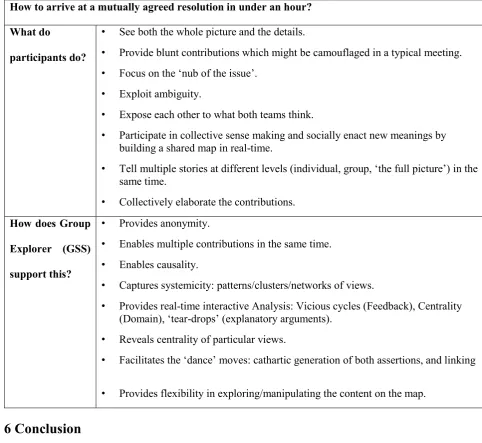
In these ways a workshop encompassing a GSS using causal mapping enables the group to arrive at mutually agreed resolution in under an hour. Table 1 summarizes the contribution of the GSS by answering the question: why couldn’t these conflict situations be resolved using the ‘traditional’ meetings/workshops employed by the teams?
Table 1 Shows the key components of effective negotiation
How to arrive at a mutually agreed resolution in under an hour?
What do
participants do?
• See both the whole picture and the details.
• Provide blunt contributions which might be camouflaged in a typical meeting. • Focus on the ‘nub of the issue’.
• Exploit ambiguity.
• Expose each other to what both teams think.
• Participate in collective sense making and socially enact new meanings by building a shared map in real-time.
• Tell multiple stories at different levels (individual, group, ‘the full picture’) in the same time.
• Collectively elaborate the contributions.
How does Group
Explorer (GSS)
support this?
• Provides anonymity.
• Enables multiple contributions in the same time. • Enables causality.
• Captures systemicity: patterns/clusters/networks of views.
• Provides real-time interactive Analysis: Vicious cycles (Feedback), Centrality (Domain), ‘tear-drops’ (explanatory arguments).
• Reveals centrality of particular views.
• Facilitates the ‘dance’ moves: cathartic generation of both assertions, and linking
• Provides flexibility in exploring/manipulating the content on the map.
6 Conclusion
furthering academic knowledge and providing assistance to practice in the areas of negotiation, GSSs, and facilitation scripts. While previously it had already been known in the literature that an application of a GSS could translate to good outcomes in supporting strategy making in groups (Ackermann and Eden 2010), this research provides a more fine-grained understanding of how a GSS can be useful within this context of conflict.
The paper has noted where the technical aspects of a GSS, such as simultaneity, anonymity and the possibility to generate a causal map, were linked to specific activities, ‘moves’, carried out by the participants that were supported by those aspects. In this fine grained understanding of negotiation a mutually desirable outcome is socially enacted through personal acts of building a shared causal map, with the map serving as a visual projection (transitional object or boundary object) of the participants’ thinking. As a result the individual, organizational, and the collective contributions tell stories of the past, the present, and the future of the undertaken negotiation: accusing and blaming the other team, defending oneself and the others, admitting to failure, explaining why certain things happened, and looking for spaces where a shared direction might be considered. From this perspective a search for mutually desirable outcomes is not only about securing a fairly neutral ground upon which to build a settlement, but about developing systemic and meaningful relationships between different types of views.
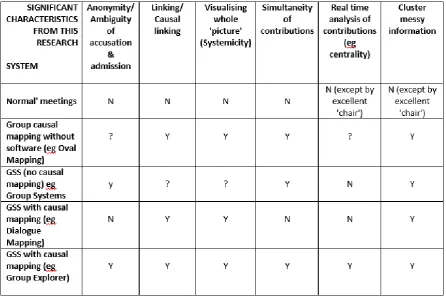
In this research the data derived from the use of a specific GSS – Group Explorer. To help begin to understand which components of GSS provide support for the different moves and negotiation we have contrasted the use of that GSS with ‘traditional’ or ‘normal’ meetings. This is done on the basis of an extensive knowledge of the area, from working in manual and computer supported arenas and from details conversations with those involved in the development and use of the other GSSs.
a traditional meeting; causal mapping using ‘ovals’ or ‘post-its’ on the wall; a well-established GSS such as ‘Group Systems’ (now called ‘ThinkTank’) that makes no use of causal mapping; and finally the system used for the workshops reported in this research (‘Group Explorer’) alongside another that incorporates mapping (‘Dialogue Mapping’). This table provides a starting point for exploration and not intended to be definitive but rather a tentative point of view. Further exploration of the contributions of different features – contrasts and similarities - might assist in developing a deeper understanding of how GSSs can be designed to support conflict situations, and in particular, to do so rapidly.
Table 2 Comparison of forms of support for groups in conflict
This research is limited to two workshops which involved two organizations and so the research must be viewed as exploratory. However, it is important to note that real cases of multi-organizational conflict that are accessible to researchers are not easy to find. The research therefore provides a valuable starting point from which to understand the micro processes of negotiation, and develop GSSs.
refine the extant knowledge. Building on the table and the ‘moves’ described here, research into facilitation scripts, GSS design, stakeholder dispositions can be extended. The work may also stimulate new avenues in the emerging areas of co-opetition, and help in mediation.
References
Ackermann F, Andersen DF, Eden C, Richardson GP (2011) ScriptsMap: A tool for designing
multi-method policy-making workshops Omega 39:427-434
doi:http://dx.doi.org/10.1016/j.omega.2010.09.008
Ackermann F, Eden C (2005) Using Causal Mapping with Group Support Systems to Elicit an Understanding of Failure in Complex Projects: Some Implications for Organizational Research Group Decis Negot 14:355-376 doi:10.1007/s10726-005-8917-6
Ackermann F, Eden C (2010) The Role of Group Decision Support Systems: Negotiating Safe Energy In: Kilgour M, Eden C (eds) Handbook of Group Decision and Negotiation. Springer, The Netherlands, pp 285-299
Ackermann F, Eden C (2011) Negotiation in Strategy Making Teams: Group Support Systems and the Process of Cognitive Change Group Decis Negot 20:293-314 doi:10.1007/s10726-008-9133-y Ackermann F, Franco LA, Gallupe B, Parent M (2005) GSS for Multi-Organizational Collaboration: Reflections on Process and Content Group Decis Negot 14:307-331 doi:10.1007/s10726-005-0317-4
Agres A, de Vreede G-J, Briggs R (2005) A Tale of Two Cities: Case Studies of Group Support Systems Transition Group Decis Negot 14:267-284 doi:10.1007/s10726-005-0315-6
Anson RG, Jelassi MT (1990) Group Decision and Negotiation Support SystemsA development framework for computer-supported conflict resolution European Journal of Operational Research 46:181-199 doi:http://dx.doi.org/10.1016/0377-2217(90)90131-T
Attenborough D (2002) Life on the Air. BBC Books, London, UK
Belmondo C, Sargis-Roussel C (2015) Negotiating Language, Meaning and Intention: Strategy Infrastructure as the Outcome of Using a Strategy Tool through Transforming Strategy Objects British Journal of Management 26:S90-S104 doi:10.1111/1467-8551.12070
Berger PL, Luckmann T (1966) The social construction of reality. Penguin books, London, UK Black LJ, Andersen DF (2012) Using Visual Representations as Boundary Objects to Resolve Conflict
in Collaborative Model-Building Approaches Systems Research and Behavioral Science 29:194-208 doi:10.1002/sres.2106
Bryson JM, Ackermann F, Eden C, Finn CB (2004) Visible Thinking - Unlocking Causal Mapping for Practical Results. John Wiley & Sons, Chichester, UK
Bryson JM, Crosby BC, Stone MM (2006) The Design and Implementation of Cross-Sector Collaborations: Propositions from the Literature Public Administration Review 66:44-55 doi:10.1111/j.1540-6210.2006.00665.x
Carlile PR (2002) A Pragmatic View of Knowledge and Boundaries: Boundary Objects in New Product Development Organization Science 13:442-455 doi:10.2307/3085976
Chan Kim W, Mauborgne R (1998) Procedural justice, strategic decision making, and the knowledge economy Strategic Management Journal 19:323-338 doi:10.1002/(SICI)1097-0266(199804)19:4<323::AID-SMJ976>3.0.CO;2-F
Combe IA, Carrington DJ (2015) Leaders' sensemaking under crises: Emerging cognitive consensus over time within management teams The Leadership Quarterly doi:http://dx.doi.org/10.1016/j.leaqua.2015.02.002
Conklin J (2006) Dialogue Mapping: Building Shared Understanding of Wicked Problems. Wiley, Chichester
Crump L (2010) Strategically Managing Negotiation Linkage Dynamics Negotiation and Conflict Management Research 3:3-27 doi:10.1111/j.1750-4716.2009.00046.x
de Geus A (1988) Planning as learning. Harvard Business Review:70-74
DeSanctis G, Gallupe B (1985) Group Decision Support Systems: A New Frontier Database Winter 3– 9 doi:10.1145/1040688.1040689
Druckman D (2009) Intuition or Counterintuition? The Science behind the Art of Negotiation Negotiation Journal 25:431-448 doi:10.1111/j.1571-9979.2009.00237.x
Fisher R, Ury W (1981) Getting to yes: Negotiating agreements without giving in. Penguin, New York, NY, USA
Franco LA, Rosenhead J The role of Wide-band GDSS in increasing value for multi-organisational groups: the case of the UK construction industry. In: Ackermann F, Vreede GJ (eds) Group Decision and Negotiation Conference, Delft, The Netherlands, 2001. pp 273-278
Glaser BG, Strauss AL (1967) The Discovery of Grounded Theory: Strategies for Qualitative Research. Aldine Publishing, Chicago, USA
Hodgkinson GP, Clarkson GP (2005) What Have We Learned from Almost 30 Years of Research on Causal Mapping? Methodological Lessons and Choices for the Information Systems and Information Technology Communities In: Narayanan VK, Armstrong DJ (eds) Causal Mapping for Research in Information Technology. Idea Group London, UK, pp 46-79
Hodgkinson GP, Maule AJ, Bown NJ (2004) Causal Cognitive Mapping in the Organizational Strategy Field: A Comparison of Alternative Elicitation Procedures Organizational Research Methods 7:3-26 doi:10.1177/1094428103259556
Horst WJR, Melvin MW (1973) Dilemmas in a General Theory of Planning Policy Sciences 4:155-169 doi:10.1007/BF01405730
Huff AS (1990) Mapping Strategic Thought. Wiley, New York, NY, USA
Jenkins M, Johnson G (1997) Linking Managerial Cognition and Organizational Performance: A Preliminary Investigation Using Causal Maps British Journal of Management 8:77-90 doi:10.1111/1467-8551.8.s1.7
Jessup L, Valacich J (1993) Group support systems: new perspectives. Macmillan, New York, NY, USA
Jessup LM, Tansik DA (1991) Decision Making in an Automated Environment: The Effects of Anonymity and Proximity with a Group Decision Support System* Decision Sciences 22:266-279 doi:10.1111/j.1540-5915.1991.tb00346.x
Kelly G (1955) The Psychology of Personal Constructs. Norton, New York, NY, USA
Kelly G (1963) A Theory of Personality: The Psychology of Personal Constructs W. W. Norton & Company, New York, NY, USA
Lewis LF (2010) Group Support Systems: overview and guided tour. In: Kilgour DMaE, C. (ed) Handbook of Group Decision and Negotiation. Springer, Dordrecht, pp 249-268
Maitlis S, Christianson M (2013) Sensemaking in Organizations The Academy of Management Annals:57-125 doi:10.1080/19416520.2014.873177
Mangham I (1979) Politics of Organizational Change. Greenwood Press, Westport, USA
Miles MB, Huberman MA (1994) Qualitative Data Analysis: An Expanded Sourcebook Sage, Thousand Oaks, USA
Miranda SM, Bostrom RP (1993) The impact of group support systems on group conflict and conflict management J Manage Inf Syst 10:63-95 doi:10.1080/07421222.1993.11518011
Paroutis S, Franco LA, Papadopoulos T (2015) Visual Interactions with Strategy Tools: Producing Strategic Knowledge in Workshops British Journal of Management 26:S48-S66 doi:10.1111/1467-8551.12081
Perrow C (1986) Complex Organization. 3rd Edition edn. Random House, New York, NY, USA Porac JF, Thomas H, Baden-Fuller C (1989) Competitive groups as cognitive communities: the case ot
Scottish knitwear manufacturers Journal of Management Studies 26:397-416 doi:10.1111/j.1467-6486.1989.tb00736.x
Shaw D (2003) Evaluating electronic workshops through analysing the /`brainstormed/' ideas J Oper Res Soc 54:692-705 doi:10.1057/palgrave.jors.2601568
Tavella E, Franco LA (2014) Dynamics of Group Knowledge Production in Facilitated Modelling Workshops: An Exploratory Study Group Decis Negot:1-25 doi:10.1007/s10726-014-9398-2 Tyler TR, Blader SL (2003) The Group Engagement Model: Procedural Justice, Social Identity, and
Cooperative Behavior Personality and Social Psychology Review 7:349-361 doi:10.1207/s15327957pspr0704_07
Valacich JS, Dennis AR, Nunamaker Jr JF (1991) Electronic meeting support: the GroupSystems concept International Journal of Man-Machine Studies 34:261-282 doi:http://dx.doi.org/10.1016/0020-7373(91)90044-8
Vangen S, Huxham C (2003) Nurturing Collaborative Relations: Building Trust in Interorganizational Collaboration The Journal of Applied Behavioral Science 39:5-31 doi:10.1177/0021886303039001001
Walsh JP (1995) Managerial and Organizational Cognition: Notes from a Trip Down Memory Lane Organization Science 6:280-321 doi:10.2307/2635252
Weick KE (1995) Sensemaking in Organizations. Sage Publications, Thousand Oaks, CA, USA Weick KE, Sutcliffe KM, Obstfeld D (2005) Organizing and the process of sensemaking Organization
Science 16: 409-421 doi:http://dx.doi.org/10.1287/orsc.1050.0133
Winnicott DW (1953) Transitional objects and transitional phenomena; a study of the first not-me possession. The International Journal of Psych-Analysis 34:89-97