Using X-ray spectroscopy of relativistic laser
plasma interaction to reveal parametric decay
instabilities: a modeling tool for astrophysics
E.
O
KS,
1,12E.
D
ALIMIER,
2A.Y
A.
F
AENOV,
3,4,13P.
A
NGELO,
2S.A.
P
IKUZ,
4,5E.
T
UBMAN,
6N.M.H.
B
UTLER,
7R.J.
D
ANCE,
7T.A.
P
IKUZ,
4,8I.Y
U.
S
KOBELEV,
4,5M.A.
A
LKHIMOVA,
4,5N.
B
OOTH,
9J.
G
REEN,
9C.
G
REGORY,
9A.
A
NDREEV,
10,11A.
Z
HIDKOV,
8R.
K
ODAMA,
3,8P.
M
CK
ENNA,
7 ANDN.
W
OOLSEY61Physics Department, 206 Allison Lab, Auburn University, AL 36849, USA
2LULI - UPMC Univ Paris 06 : Sorbonne Universités ; CNRS, Ecole Polytechnique, CEA : Université
Paris-Saclay - F-75252 Paris cedex 05, France
3Institute for Academic Initiatives, Osaka University, Suita, Osaka, 565-0871, Japan
4Joint Institute for High Temperatures, Russian Academy of Sciences, Moscow 125412, Russia 5National Research Nuclear University MEPhI, Moscow 115409, Russia.
6York Plasma Institute, Department of Physics, University of York, York YO10 5DD, UK 7Department of Physics, SUPA, University of Strathclyde, Glasgow G4 0NG, UK
8PPC and Graduate School of Engineering, Osaka University, 2-1, Yamadaoka, Suita, Osaka 565-0871,
Japan
9Central Laser Facility, STFC Rutherford Appleton Laboratory, Didcot OX11 0QX, UK 10Max Born Institute, Berlin 12489, Max-Born str. 2a, Berlin, Germany
11ELI-ALPS, Szeged H-6720, Hungary 12[email protected]
Abstract: By analyzing profiles of experimental x-ray spectral lines of Si XIV and Al XIII, we found that both Langmuir and ion acoustic waves developed in plasmas produced via irradiation of thin Si foils by relativistic laser pulses (intensities ~1021 W/cm2). We prove that these waves are due to the parametric decay instability (PDI). This is the first time that the PDI-induced ion acoustic turbulence was discovered by the x-ray spectroscopy in laser-produced plasmas. These conclusions are also supported by PIC simulations. Our results can be used for laboratory modeling of physical processes in astrophysical objects and a better understanding of intense laser-plasma interactions.
©2015 Optical Society of America
OCIS codes:(020.2649) Strong field laser physics; (320.2250) Femtosecond phenomena; (300.6560) Spectroscopy, x-ray; (350.5400) Plasmas; (020.3690) Line shapes and shifts;(350.1270) Astronomy and astrophysics
References and links
1. V. N. Tsytovich, Theory of Turbulent Plasmas (Springer, 1977). 2. B. B. Kadomtsev, Plasma Turbulence (Academic, 1965).
3. W. Ebeling, Transport Properties of Dense Plasmas (Birkhäuser, 1984).
4. G. Manfredi and R. O. Dendy, “Transport properties of energetic particles in a turbulent electrostatic field,” Phys. Plasmas 4, 628-635 (1997).
5. A. I. Zhuzhunashvili and E. Oks, “Technique of optical polarization measurements of the plasma Langmuir turbulence spectrum,” Sov. Phys. JETP 46, 1122-1132 (1977).
6. E. Oks and V.A. Rantsev-Kartinov, “Spectroscopic observation and analysis of plasma turbulence in a Z-pinch,” Sov. Phys. JETP 52, 50-58 (1980).
7. L. Jian, X. Shali, Y. Qingguo, L. Lifeng, and W. Yufen, “Spatially-resolved spectra from a new uniform dispersion crystal spectrometer for characterization of Z-pinch plasmas,” J. Quant. Spectr. Rad. Transfer 116, 41-48 (2013).
9. E. Oks, Plasma Spectroscopy: The Influence of Microwave and Laser Fields, Springer Series on Atoms and Plasmas, vol. 9 (Springer, 1995).
10. A. S. Antonov, O. A. Zinov’ev, V. D. Rusanov, and A.V. Titov, “Broadening of hydrogen spectral lines during turbulent heating of a plasma,” Sov. Phys. JETP 31, 838-839 (1970).
11. S. P. Zagorodnikov, G. E. Smolkin, E. A. Striganova, and G. V. Sholin, “Method of measurement of nonequilibrium electric fields in a turbulent plasma from Stark broadening of the spectral lines of hydrogen,” Sov. Phys. Doklady 15, 1122-1125 (1971).
12. E. K. Zavojskij, J. G. Kalinin, V. A. Skorjupin, V. V. Shapkin, and G. V. Sholin, “Measurement of electric fields in a turbulent plasma by the Stark broadening of the spectral lines of hydrogen,” Sov. Phys. Doklady 15, 823-826 (1971).
13. M. A. Levine and C. C. Gallagher, “Stark broadening for turbulence studies in a confined plasma,” Phys. Letters A32, 14 -15 (1970).
14. N. Ben-Yosef and A.G.Rubin, “Optical investigations of electrostatic turbulence in plasma,” Phys. Lett. A33, 222 -223 (1970).
15. A. B. Berezin, A. V. Dubovoj, and B. V. Ljublin, “Anisotropic electric fields due to ion-acoustic turbulence in a rf discharge,” Sov. Phys. Tech. Phys. 16, 1844-1846 (1972).
16. M. V. Babykin, A. I. Zhuzhunashvili, E. Oks, V. V. Shapkin, and G.V. Sholin, “Polarization spectroscopic analysis of noise produced in a turbulent plasma upon annihilation of oppositely moving magnetic fields,” Sov. Phys. JETP 38, 86-92 (1974).
17. Ja. F. Volkov, V. G. Djatlov, and A.I. Mitina, “Optical investigation of a turbulent plasma,” Sov. Phys. Tech. Phys. 19, 905-908 (1975).
18. A. B. Berezin, B. V. Ljublin, and D. G. Jakovlev, “Study of plasma turbulence in a fast linear theta-pinch by means of Stark broadening of deuterium spectral lines,” Sov. Phys. Tech. Phys. 28, 407-411 (1983). 19. A. N. Koval and E. Oks, “Some results of searching for low-frequency plasma turbulence in large
chromospheric flares,” Bull. Crimean Astrophys. Observ. 67, 78-89 (1983).
20. A. G. Frank, V. P. Gavrilenko, N. P. Kyrie, and E. Oks, “Spectroscopic study of anomalous electric fields in peripheral regions of a current sheet plasma,” J. Phys. B: At. Mol. Opt. Phys. 39, 5119-5129 (2006). 21. A. Pukhov, “Strong field interaction of laser radiation, “Rep. Prog. Phys. 66, 47-101 (2003). 22. P. McKenna, D. Neely, R. Bingham, and D. Jaroszynski, Laser-Plasma Interactions and Applications
(Springer, 2013).
23. O. Renner, E. Dalimier, E. Oks, F. Krasniqi, E. Dufour, R. Schott, and E. Foerster, “Experimental evidence of Langmuir-wave caused features in spectral lines of laser-produced plasmas,” J. Quant. Spectr. Rad. Transfer 99, 439-450 (2006).
24. V. Springel, S. D. M. White, A. Jenkins, C. S. Frenk, N. Yoshida, L. Gao, J. Navarro, R. Thacker, D. Croton, J. Helly, J. A. Peacock, S. Cole, P. Thomas, H. Couchman, A. Evrard, J. Colberg, and F. Pearce, “Simulations of the formation, evolution and clustering of galaxies and quasars,” Nature 435, 629-636 (2005).
25. T. Di Matteo, V. Springler, and L. Hernquist, “Energy input from quasars regulates the growth and activity of black holes and their host galaxies,” Nature 433, 604-606 (2005).
26. B. M. Peterson, An Introduction to Active Galactic Nuclei (Cambridge University Press, 1997). 27. D.A. Lorimer, and M. Kramer, Handbook of Pulsar Astronomy (Cambridge University Press, 2004). 28. R.T. Gangadhara, and V. Krishan, “Absorption of Electromagnetic Waves in Astrophysical Plasmas,” in Basic
Plasma Processes on the Sun, E.R. Priest, and V. Krishan, eds. (Springer, 1990).
29. A. G. Frank, “Dynamics of current sheets underlying flare-type events in magnetized plasmas, ” Physics – Uspekhi 53, 941-947 (2010).
30. S. V. Bulanov, V. A. Dogie, and A. G. Frank, “Solar flares and magnetic reconnection experiments,” Physica Scripta 29, 66-67 (1984).
31. B. Dromey, S. Kar, C. Bellei, D. C. Carroll, R. J. Clarke, J. S. Green, S. Kneip, K. Markey, S. R. Nagel, P. T. Simpson, L. Willingale, P. McKenna, D. Neely, Z. Najmudin, K. Krushelnick, P. A. Norreys, and M. Zepf, “ Bright multi-keV harmonic generation from relativistically oscillating plasma surfaces,” Phys. Rev. Lett. 99, 085001 (2007).
32. C.N. Danson, P.A. Brummitt, R.J. Clarke, J.L. Collier, B. Fell, A.J. Frackiewicz, S. Hancock, S. Hawkes, C. Hernandez-Gomez, P. Holligan, M.H.R. Hutchinson, A. Kidd, W.J. Lester, I.O. Musgrave, D. Neely, D.R. Neville, P.A. Norreys, D.A. Pepler, C.J. Reason, W. Shaikh, T.B. Winstone, R.W.W. Wyatt and B.E. Wyborn, “Vulcan Petawatt—an ultra-high-intensity interaction facility,” Nuclear Fusion 44, 5239-5246 (2004). 33. I. Musgrave, W. Shaikh, M. Galimberti, A. Boyle, C. Hernandez-Gomez, K. Lancaster, and R. Heathcote,
“Picosecond optical parametric chirped pulse amplifier as a preamplifier to generate high-energy seed pulses for contrast enhancement,” Appl. Opt. 49, 6558 - 6562 (2010).
34. A.Ya. Faenov, S. A. Pikuz, A. I. Erko, B. A. Bryunetkin, V. M. Dyakin, G. V. Ivanenkov, A. R. Mingaleev, T. A. Pikuz, V. M. Romanova, and T. A. Shelkovenko, “High-performance X-ray spectroscopic devices for plasma microsources investigations,” Physica Scripta 50, 333 – 338 (1994).
Uschmann, A. G. Zhidkov, and N. C. Woolsey, “Exotic dense-matter states pumped by a relativistic laser plasma in the radiation-dominated regime,” Phys. Rev. Lett. 110, 125001 (2013).
36. S.A. Pikuz, A.Ya. Faenov, J. Colgan, R.J. Dance, J. Abdallah, E. Wagenaars, N. Booth, O. Culfa, R.G. Evans, R.J. Gray, T. Kaempfer, K.L. Lancaster, P. McKenna, A.L. Rossall, I.Yu. Skobelev, K.S. Schulze, I. Uschmann, A.G. Zhidkov, and N.C. Woolsey, “Measurement and simulations of hollow atom X-ray spectra of solid-density relativistic plasma created by high-contrast PW optical laser pulses,” High Energy Density Phys. 9, 560-567 (2013).
37. J. Colgan, A. Ya. Faenov, S. A. Pikuz, E. Tubman, N. M. H. Butler, J. Abdallah jr., R. J. Dance, T. A. Pikuz, I. Yu. Skobelev, M. A. Alkhimova, N. Booth, J. Green, C. Gregory, A. Andreev, R. Lӧtz, I. Uschmann, A. Zhidkov, R. Kodama, P. McKenna, and N. Woolsey,.”Evidence of high-n hollow-ion emission from Si ions pumped by ultraintense x-rays from relativistic laser plasma,” Europhys. Lett. 114, 35001 (2016)55 38. V. P. Gavrilenko and E. A.Oks, “New effect in the Stark spectroscopy of atomic hydrogen: dynamic
resonance,” Sov. Phys. JETP 53, 1122-1127 (1981).
39. P. Maine, D. Strickland, P. Bado, M. Pessot, and G. Mourou, “Generation of ultrahigh peak power pulses by chirped pulse amplification,” IEEE J. Quantum Electron. QE-24, 398-403 (1988).
40. A. I. Akhiezer and R. V. Polovin, “Theory of wave motion of an electron plasma,” Sov. Phys. JETP 3, 696-705 (1956).
41. W. Lünow, “On the relativistic non-linear interaction of cold plasma with electro-magnetic waves,” Plasma Phys. 10, 879-897 (1968).
42. S. Guerin, P. Mora, J. C. Adam, A. Heron, and G. Laval, “Propagation of ultraintense laser pulses through overdense plasma layers,” Phys. Plasmas 3, 2693-2701(1996).
43. R.J. Gray, D. C. Carroll, X. H. Yuan, C. M. Brenner, M. Burza, M. Coury, K. L. Lancaster, X. X. Lin, Y. T. Li, D. Neely, M. N. Quinn, O. Tresca, C.-G. Wahlström. and P. McKenna, “ Laser pulse propagation and enhanced energy coupling to fast electrons in dense plasma gradients,” New J. Physics 16, 113075 (2014). 44. J. Fuchs, J.C. Adam, F. Amiranoff, S.D. Baton, P. Gallant, L. Gremillet, A. Heron, J.C. Kieffer, G. Laval, G.
Malka, J.L. Miquel, P. Mora, N. Pepin, and C. Rousseaux, “Transmission through highly overdense plasma slabs with a subpicosecond relativistic laser pulse,” Phys. Rev. Lett. 80, 2326-2329 (1998).
45. H. K. Chung, M. H. Chen, W. L. Morgan, Yu. Ralchenko, and R. W. Lee, “Generalized population kinetics and spectral model for rapid spectroscopic analysis for all elements,” High Energy Density Phys. 1, 3 -12 (2005).
46. A. Pukhov and J. Meyer-ter-Vehn, “Laser hole boring into overdense plasma and relativistic electron currents for fast ignition of ICF targets,” Phys. Rev. Lett. 79, 2686-2689 (1997)
47. G. A. Mourou, T. Tajima, and S. V. Bulanov, “Optics in the relativistic regime,” Rev. Modern Phys. 78, 309-371 (2006).
48. P. Sauvan, E. Dalimier, E, Oks, O. Renner, S. Weber, and C. Riconda, “Spectroscopic diagnostics of plasma interaction with an external oscillatory field,” J. Phys. B: At. Mol. Opt. Phys. 42, 195501 (2009).
49. P.Gibbon, Short Pulse Laser Interaction with Matter (Imperial College Press, 2003)
50. V. S. Lisitsa, “Stark broadening of hydrogen lines in plasmas,” Sov. Phys. Uspekhi 122, 449-495 (1977). 51. E. Oks and G. V. Sholin, “On Stark profiles of hydrogen lines in a plasma with low-frequency turbulence,”
Sov. Phys. Tech. Phys. 21, 144-151 (1976).
52. E. Oks and E. Dalimier, “Toward diagnostic of ionic sound in laser-produced plasmas,” Intern. Review of Atom. Mol. Phys. 2, 43-51 (2011).
53. C. A. Iglesias, H. E. Dewitt, J. L. Lebowitz, D. MacGowan, and W. B. Hubbard, “Low-frequency electric microfield distributions in plasmas,” Phys. Rev. A 31, 1698–1702 (1985).
54. D. I. Blochinzew, “Zur Theorie des Starkeffektes in Zeitveränderlichen Feld,” Phys. Z. Sow. Union 4, 501-515 (1933).
55. R. Lichters, J. Meyer-ter-Vehn, and A. Pukhov, “Short pulse laser harmonics from oscillating plasma surfaces driven at relativistic intensity,” Phys. Plasmas 3, 3425-3437 (1996).
56. W. L. Kruer, The Physics of Laser Plasma Interactions (Westview Press, 2003).
1. Introduction
laser-plasma interaction as a result of the parametric decay instability (PDI). Below we put this in prospective.
PDI is a nonlinear process in which an electromagnetic wave decays into a Langmuir wave and anion acoustic wave. The resulting waves constitute two types of the electrostatic plasma turbulence. Electrostatic turbulence frequently occurs in various kinds of laboratory and astrophysical plasmas [1,2]. It is represented by oscillatory electric fields corresponding to collective degrees of freedom in plasmas – in distinction to the electron and ion microfields that correspond to individual degrees of freedom of charged particles.
High-frequency plasma turbulence, namely Langmuir waves, develops at the electron plasma frequency ωpe = (4πe2Ne/me)1/2 = 5.64x10⁴Ne1/2, where Ne is the electron density. In the case of Low-frequency Electrostatic plasma Turbulence (LET), in the absence of a magnetic field, only ion-acoustic waves are generated (a.k.a. ionic sound waves). They have a broad spectrum at frequencies below or of the order of the ion plasma frequency ωpi =
(4πe2N
iZ2/mi)1/2 = 1.32 x10³Z(Nimp/mi)1/2, where Ni is the ion density, Z is the charge state; mp and mi are the proton and ion masses, respectively. CGS units are used in the above formulas. The LET strongly affects transport phenomena in various plasmas [3,4]. Plasmas subject to LET frequently exhibit properties such as anomalous resistivity, which changes the behavior of such plasmas significantly. Langmuir waves were discovered experimentally upon analysis of the shapes of neutral hydrogen spectral lines in many reliable experiments at various plasma sources and electron densities Ne ~ 1014 – 1018 cm-3, namely in a theta-pinch [5], Z-pinches [6,7], and a gas-liner pinch [8] – via the phenomenon (presented below) of the Langmuir-wave-caused dips (L-dips) in spectral line profiles. The majority of experimental studies, together with theoretical studies of L-dips are summarized in [9].
A variety of LET (including ion-acoustic waves) were diagnosed by an 'anomalous' broadening of neutral hydrogen spectral lines in experiments involving plasmas with low electron densities (Ne ~ 1014 - 1016 cm-3). Different types of discharges were used over these experiments [10-18]. The LET was also diagnosed in solar flares by a detailed analysis of the shapes of the observed spectral lines of neutral hydrogen [19], as well as in experiment [20] for laboratory modeling of mechanisms of solar flares.
The electrostatic waves/turbulence, such as, e.g., Langmuir waves and ion acoustic waves, can also develop in dense plasmas. In particular, in the area of laser-plasma interactions, they have been studied theoretically by many authors, including in the relativistic laser interactions with solid targets (see, e.g., [21, 22] and references therein).
In laser-produced, high-density plasmas, Langmuir waves were discovered experimentally [23] via the phenomenon of L-dips in spectral line profiles of Al XIII. By contrast, ion acoustic waves (or any other kind of a LET) in laser-produced, high-density plasmas were not discovered experimentally up to now.
Below after presenting this discovery, we show that the ratio of the energy density of the turbulent electric fields E2/(8π) to the thermal energy density of the plasma N
interval between pulses that range roughly from milliseconds to seconds for an individual pulsar – see, e.g., [27].
These very different astrophysical objects have one thing in common: in their atmosphere, the conditions are satisfied for the Parametric Decay Instability (PDI), causing the anomalous absorption of the incident electromagnetic radiation – see, e.g., [28].
The possibility to use the x-ray spectroscopy in laboratory laser-plasma interaction experiments as a tool to model the PDI in these astrophysical objects is based on the same principle (the similarity of dimensionless parameters) that was used in various modeling experiments at plasmas not produced by lasers. For example, this principle of modeling was used for decades for the successful modeling of mechanisms of solar flares by laboratory experiments – see, e.g., review [29] and references therein. While the dimensional parameters in the two objects differed by many orders of magnitude, the relevant dimensionless parameters were of the same order of magnitude – see, e.g., [30].
2. Results
2.1 X-ray spectra measurements
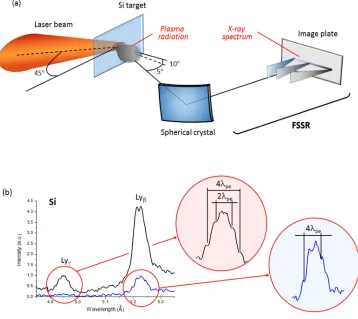
The experiments were performed at Vulcan Petawatt (PW) facility at the Rutherford Appleton Laboratory [31,32], which provides a beam using optical parametric, chirped pulse amplification (OPCPA) technology with a central wavelength of 1054 nm and a pulse full-width-half-maximum (FWHM) duration, which could be varied from 500 up to 1500 fs. The OPCPA approach enables an amplified spontaneous emission (ASE) to peak-intensity contrast ratio exceeding 1:109 several nanoseconds before the peak of the laser pulse [33]. The laser pulse was focused with an f/3 off-axis parabola. At the best focus approximately 30% of the energy (up to 290 J on the target in our experiments) was contained within an 7 μm (FWHM) diameter spot providing a maximum intensity of 1.4×10²¹ W/cm2. The horizontally polarized laser beam was incident on target at 45° from the target surface normal, as shown schematically in Fig. 1(a).
High-resolution spectroscopy measurements were performed using a Focusing Spectrometer with Spatial Resolution (FSSR) [34-36]. The instrument was equipped with a spherically bent mica crystal with a lattice spacing 2d ~ 19.94 Å and a radius of curvature of
R = 100 mm. The crystal was aligned to operate at m = 3 order of reflection to record K-shell emission Rydberg H-like spectral lines of multicharged Si XIV ions in 4.85 – 5.35 Å wavelength range. The FSSR spectral resolving power was approximately 3000. The spectrometer viewed the laser-irradiated rear surface of the target at an angle of 5° to the target surface normal (Fig. 1(a)). Target-to-crystal distance of 367 mm led to a demagnification factor of ~ 4.7 for the diffracting system.
density. It should be emphasized that any spectra of plasma, produced by amplified spontaneous emission (ASE) at the electron density lower than the non-relativistic critical density (< 1021 W/cm2 )have not been observed by both front and rear side spectrometers – see for details the experimental results from paper [37] obtained in the same experimental conditions. It is worth emphasizing that the experimental spectra of Si XIV, exhibited in the present paper, were observed from the rear side of target, what suggests that no influence of the ASE plasma emission should be important.
Figure 1(b) shows the experimental spectra of Si XIV Lyβ and Lyγ lines in shots 72 (2µm
[image:6.612.128.486.244.563.2]Si foil) and 89 (1µm Si foil) , which were obtained in a single laser shot with duration of 0.6 ps and laser intensities at the surface of the target theoretically estimated as 1.01x10²¹ W/cm2 and 0.24x10²¹ W/cm2, respectively. The positions of the dips/depressions in the profiles are marked in insets by vertical lines separated either by 2λpe or 4λpe, where = / (2 ) (λ0 is the unperturbed wavelength of the corresponding line).
Fig. 1. Schematic of experimental setup and typical X-ray spectra in the range of 0.485 – 0.535 nm. Experimental setup (a) and profiles (b) of Si XIV spectral lines, obtained in a single laser shot with initial laser intensity at the surface of the target estimated as 1.01x10²¹ W/cm2 (black trace) and 0.24x10²¹ W/cm2 (blue trace). In the insets,
positions of the dips/depressions in the profiles are marked by vertical lines separated either by 2λpe or 4λpe, where λpe = [λ02/(2πc)]ωpe (λ0 is the unperturbed wavelength of the corresponding line).
2.2 Brief theory of Langmuir-wave-caused dips in spectral line profiles
phenomenon of the Langmuir-wave-caused dips (L-dips). They result from a resonance between the Stark splitting = 3 ℏ /(2 )of hydrogenic energy levels, caused by a quasistatic field F in a plasma, and the frequency ωL of the Langmuir wave, which practically coincides with the plasma electron frequency ωpe(Ne): = ( ), s = 1, 2, … . Here n and Zr are the principal quantum number and the nuclear charge of the radiating hydrogenic atom/ion (radiator). Even for the most common case of s = 1, it is actually a multi-frequency resonance phenomenon despite the electric field of the Langmuir wave is considered to be single-frequency (monochromatic): E0 cosωpet. This was shown in paper [38]: it is a resonance between many quasienergy harmonics of the combined system “radiator + oscillatory field” caused simultaneously by all harmonics of the total electric field E(t) = F + E0 cosωpet, where vectors F and E0 are not collinear. The quasistatic field F represents the low-frequency part of the ion microfield and the LET, if the latter was developed in the plasma.
The resonance condition ωF = s ωpe(Ne), translates into specific locations of L-dips in spectral line profiles depending on Ne. In particular, for the Ly-lines, in the case where the quasistatic field F is dominated by the LET, the distance of an L-dip from the unperturbed wavelength λ0 is given by Δ ( , ) = − /(2 ) ( ). Here q = n1 – n2 is the electric quantum number expressed via the parabolic quantum numbers n1 and n2 : q = 0, ±1, ±2, …, ±(n–1). It labels Stark components of Ly-lines. For a pair of Stark components, corresponding to q and –q, there could be a pair of L-dips located symmetrically in the red and blue parts of the profile: Δ ( ) = ± ⁄(2 ) ( ) for the typical case of the one quantum resonance (s = 1). For the two quantum resonance (s = 2), in the profile of the same pair of Stark components, there could be another pair of L-dips located symmetrically in the red and blue parts of the profile: Δ ( ) = ± ⁄(2 ) ( ).
If the quasi-static field F is dominated by the ion microfield, then the above formula for
Δλdip would hold only for relatively low electron densities. For relatively high electron densities, the special non-uniformity of the ion microfield has to be taken into account leading to the result [8,9]
( )
(
)
1/2 3 2
2
2 2 2
0 2
3
2
( , ) 6 1 12 ,
2 27
pe
dip e pe
r p at
s
q N qs n n q n q
c n Z Z
ω λ
λ π ω ω
Δ = − + − − +
(1)
where Zp is the charge of the perturbing ions and = /ℏ = 4.14 ∙ 10 is the atomic unit of frequency. The first, primary term in braces reflects the dipole interaction with the ion microfield. The second, smaller term in braces takes into account – via the quadrupole interaction – a spatial non-uniformity of the ion microfield. It results in the shift of the midpoint between the pair of L-dips, corresponding to q and –q, with respect to the unperturbed wavelength.
In any case (whether the field F is dominated by the ion microfield or by a LET), the separation of the two L-dips, corresponding to q and –q, is
2
(
)
( )
0( ) / 2 ,
dip Ne c q pe N e
λ λ π ω
Δ = ± (2) thus allowing to measure Ne . It is important to emphasize that this passive spectroscopic method for measuring Ne is just as accurate as the active spectroscopic method (more
complicated experimentally) using the Thompson scattering, as shown in the benchmark experiment [8]. The half-width of the L-dip (i.e., the separation between the dip and the nearest “bump”), is controlled by the amplitude E0 of the Langmuir wave [9]:
1/2 2 2
0 0
1/ 2 3
2 8 e r
n E m ecZ
λ
δλ
≈ π
Thus, by measuring the experimental half-width of L-dips, one can determine the amplitude E0 of the Langmuir wave.
Before analyzing the experimental Si XIV spectral lines, we should note the following. The laser frequency ω corresponds to the wavelength λ of approximately 1054 nm. At lower, non-relativistic laser intensities, the critical electron density Nc determined from the equation ω =
ωpe, where = (4 ⁄ ) , i.e., = (4 ⁄ )
,
would be 1.0x1021 cm-3.However, at the laser intensities ~1021 W/cm2, i.e. those corresponding to the experiment, due to relativistic effects, the “relativistic” critical electron density Ncr becomes higher than Nc [39-41]. For the linearly-polarized laser radiation, it becomes [42]
(
)
2
2 /4
, 4
e cr
a m N
e
π
ω
π
=
( )
(
)
1/2 2
18
/ 1.37 10
I W cm
a m
x
λ μ
=
(4)
The ability of the ultra-intense laser radiation to penetrate into regions of the density higher than
Nc , i.e. a relativistically-induced transparency regime, has been previously demonstrated by PIC simulations [43]. In the present paper we not only took into account the effect of the relativistically induced transparency (details of which can be found in paper [44]) on the resonance condition, but also confirmed that the L-dips originate from the region of the relativistic critical density (which is greater than the nonrelativistic critical density), as shown in the next section.
2.3 Analysis of the experimental spectra and comparison with simulated spectral line shapes
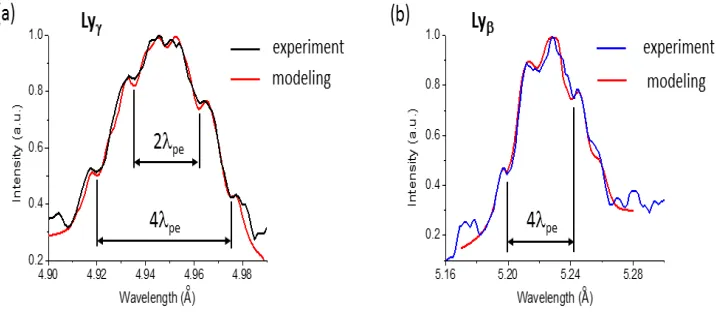
Let us consider the experimental profile of Si XIV Ly-gamma, produced in an interaction with a single laser pulse with initial laser intensity at the surface of the target estimated as 1.01x10²¹ (black trace in Fig. 2(b)). The experimental profile shows a pair of two L-dips nearest to the line center (q = ±1, s = 1) separated from each other by 28 mÅ yielding an electron density of Ne = 3.6x1022 cm-3. In addition to this, a pair of L-dips, separated from each other by 56 mÅ, were also observed, representing a superposition of two pairs of the L-dips: q = ±2, s = 1 and q = ±1, s = 2. This yields the same Ne = 3.6x1022 cm-3, thus reinforcing the interpretation of the experimental dips as the L-dips – caused by the resonant interaction of the Langmuir waves, developed at the surface of the relativistic critical density, with the quasistatic electric field.
In both cases, L-dips separated by 28 mÅ and for the L-dips separated by 56 mÅ, the mid-point between the two dips in the pair practically coincides with the unperturbed wavelength
λ0. This is a strong indication that the quasistatic field F was dominated by the LET. If the LET would be absent, then according to Eq. (1), the mid-point of the pair of the L-dips separated by 28 mÅ should have been shifted by 5.8 mÅ to the red with respect to λ0 and the mid-point of the pair of the L-dips separated by 56 mÅ would have been similarly shifted by 10.7 mÅ to the red with respect to λ0, these shifts being due to the spatial non- uniformity of the ion microfield reflected by the 2nd term in Eq. (1).
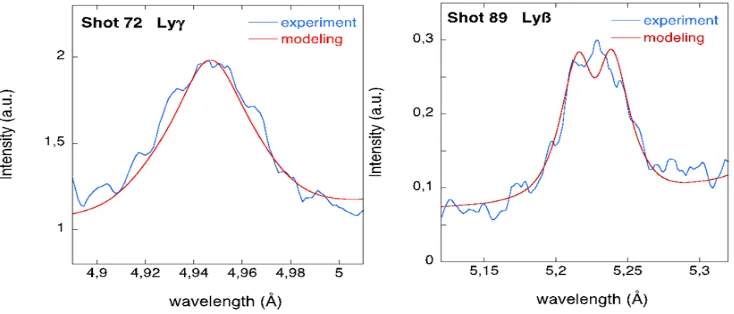
Fig. 2. Experimental spectra and their comparisons with FLYCHK modeling. (a) Comparison of the experimental profile of Si XIV Lyγ line in shot with initial laser intensity at the surface of the target estimated as 1.01x10²¹ W/cm2
with a simulation performed using a variation of the code FLYCHK for calculating the Stark broadening, then adding both Doppler and instrument broadening, and, if necessary, opacity. The L-dips phenomenon and the spectral line broadening by LET were not included in the FLYCHK. The plasma parameters for the best fit are Ne = 0.9x1023 cm-3
and Te = 500 eV. b) The same as in (a) but for Si XIV Lyβ line produced in a single laser shot with initial laser
intensity at the surface of the target estimated as 0.24x10²¹ W/cm2 ; N
e = 3x1023 cm-3 and Te = 500 eV. At the initial laser intensity at the surface of the target estimated as 1.01x10²¹ W/cm2, the
relativistic critical density would be Ncr = 2.3x1022 cm-3 according to Eq. (4). However, due to several physical effects, the actual intensity of the transverse electromagnetic wave in the plasma can be significantly higher than the intensity of the incident laser radiation at the surface of the target. One of these effects is the self-focusing of the laser beam in plasmas - details of the process of the laser propagation in the plasma corona at the overcritical density can be found, for example, in papers [44, 46] and in reviews [21,47]). The other effects are Raman and Brillouin backscattering, For example, in paper [48] this was proven by a spectroscopic analysis of the experimental X-ray line profiles and by PIC simulations. In the present experiment in shot 72, for the relativistic critical density to be approximately equal to the density Ne = 3.6x1022 cm-3 deduced by the spectroscopic analysis, it would require the enhancement of the initially estimated intensity of the transverse electromagnetic wave at the surface of the target due to the above physical effects just by a factor of two.
We also evaluated (independently of the spectroscopic analysis) the enhancement of laser
intensity due to the self-focusing from the well-known model – see, e.g., Chap. 4 of book [49]. Taking into account our plasma parameters one can get the enhancement of the laser intensity by the factor of two, which was consistent with the results of our spectroscopic analysis.
We mention in passing that L-dips were not observed in the experimental profiles of Si XIV Lyα and Lyβ lines in shot 72. It seems that a process of self-absorption of radiation
prevented L-dips from being visible in these lines: the self-absorption “washes out” fine features of the experimental profiles.
The analysis of the experimental profile of Si XIV Lyβ in shot 89 with the initial laser
intensity at the surface of the target estimated as 2.4x10²⁰ W/cm2 (blue trace in Fig. 1(b)), shows a situation similar to Si XIV Lyγ in shot 72. There is a pair of the L-dips separated from
each other by 43 mA. The electron density deduced from the separation within the pair of these L-dips, is Ne = 1.74x1022 cm-3 (assuming |q|s = 2 in Eq. (2)). The location of the would-be L-dips, corresponding to |q|s = 1, is too close to the central, most intense part of the experimental line profile: they are not observed either due to a self-absorption in the most intense part of the profile, or because the relatively small values of the field F, corresponding to the central part of the profile, are not quasistatic (as it is well-known from review [50]). So, the would-be L-dips, corresponding to |q|s = 1 could not form for either or both reasons. The mid-point between the two dips in the pair practically coincides with the unperturbed wavelength λ0. This is again a strong indication that the quasistatic field F was dominated by the LET. If the LET would be absent, then according to Eq. (1), the mid-point of this pair of the L-dips should have been shifted by 6.1 mÅ to the red with respect to λ0.
Another strong indication of the presence of the LET in shot 89 comes from the analysis of the broadening of this spectral line is following from the modeling, which was performed using code FLYCHK [45]. An electron density of Ne = 3x1023 cm-3, was obtained, i.e. 17 times higher than the experimentally verified Ne = 1.74x1022 cm-3 (the best fit to the experimental profile by code FLYCHK is shown in Fig. 2(b)). This is yet another strong indication of an additional Stark broadening by the LET (not accounted for by FLYCHK). At the initial laser intensity at the surface of the target estimated as 2.4x10²⁰ W/cm2, the relativistic critical density would be Ncr = 1.1x1022 cm-3 according to Eq. (4). However, again due to the self-focusing, as well as Raman and Brillouin backscattering, the actual intensity of the transverse electromagnetic wave in the plasma can be significantly higher. In the present experiment in shot 89, for the relativistic critical density to be approximately equal to the density Ne = 1.74x1022 cm-3 deduced by the spectroscopic analysis, again it would require the enhancement of the intensity of the transverse electromagnetic wave due to the above physical effects just by a factor of two. By the same reasoning as presented above with regard to shot 72, the experimentally discovered LET in shot 89, which developed simultaneously with the Langmuir waves, should have been also developed at the relativistic critical density surface and thus is most likely to be ion acoustic turbulence.
In shot 89, L-dips were not observed in the experimental profiles of Si XIV Lyα and Lyγ
lines. This is because the Lyα line seemed to experience a significant self-absorption, which
prevented L-dips from being visible. As for the Lyγ line in shot 89, at the possible locations of
the L-dips, the experimental profile already merged into the noise.
For a further quantitative analysis, we calculated the corresponding theoretical profiles, where the total quasistatic field is F = Ft + Fi. For calculating the distributions of the total quasistatic field F = Ft+ Fi, where Ft is the field of a LET and Fi is the quasistatic part of the ion microfield, we employed the results from references [51, 52]: the distribution of the total quasistatic field is a convolution of the Rayleigh-type distribution of Ft [51] with the APEX distribution of Fi [53]. The broadening by the electron microfield, as well as the Doppler and instrumental broadenings were also taken into account. For calculating the spectra in the regions of L-dips we used the analytical solution [38, 9] for the wave functions of the quasienergy states caused simultaneously by all harmonics of the total electric field E(t) = F +
E0 cosωpet, where vectors F and E0 are not collinear. Further details can be found in paper [38] and in book [9], Sect. 4.2. Below is the outcome.
microfield Fi,typ = 2.603 eZ1/3Ne2/3 was 1.0 GV/cm. From the half width of the experimental L-dips, by using Eq. (3), we found the amplitude of the Langmuir wave to be E0 = 0.6 GV/cm. The resonant value of the quasistatic field Fres , determined by the condition of the resonance between the separation of the Stark sublevels and the plasma frequency 3nħFres/(2Zrmee) =
ωpe, was 3.1 GV/cm, so that the validity condition for the existence of L-dips E0 < Fres [9] was satisfied.
From the experimental profile of Si XIV Ly-beta in shot 89, it follows that the root-mean-square value of Ft was Ft,rms = 3.9 GV/cm. For comparison, the characteristic ion microfield was Fi,typ = 0.6 GV/cm. From the halfwidth of the experimental L-dips, by using Eq. (3), we found the amplitude of the Langmuir wave to be E0 = 1.0 GV/cm. The resonant value of the quasistatic field was Fres = 5.8 GV/cm, so that the validity condition for the existence of L-dips E0 < Fres was satisfied.
The comparison of the theoretical profiles, allowing, in particular, for a LET and L-dips,
with the corresponding experimental profiles is shown in Fig. 3.
The good agreement between experimental spectra and simulations reinforces the discovery of the simultaneous production of LET with the Langmuir waves. We note that the electron densities involved turned out to be much lower than the densities deduced using FLYCHK simulations, which ignored the LET and the L-dips.
[image:11.612.126.488.381.537.2]One more point should be clarified. A Langmuir wave E0 cosωpt, considered without the presence of a quasistatic field F in plasmas, could produce satellites [54], which for the Ly lines would be at the same locations as the L-dips. However, it had been shown analytically (Sect. 7.3 of book [9]) that at the presence of the quasistatic field in plasmas, the local “zigzag” of the intensity due to the L-dip is much stronger than the local “zigzag” of intensity due to a would-be satellite at the same location in the spectral line profile. Therefore, Langmuir waves in plasmas always manifest as L-dips rather than satellites.
Fig. 3. Experimental spectra and their comparisons with a different Stark broadening code including L-dips and the spectral line broadening by LET. a) Experimental spectra of Si XIV Lyγ line in a single laser shot with initial laser
intensity at the surface of the target estimated as 1.01x10²¹ W/cm2 initial laser intensity at the surface of the target.
The positions of the dips/depressions in the profiles are marked by vertical lines separated either by 2λpe or 4λpe, where λpe= [λ02/(2πc)]ωpe (λ0 is the unperturbed wavelength of the corresponding line). Also shown is a theoretical
profiles at Ne = 3.6x1022 cm-3 allowing, in particular, for a low-frequency electrostatic turbulence (see the text for details). b) Same but for Si XIV Lyβ line in a single laser shot with initial laser intensity at the surface of the target
estimated as 0.24x10²¹W/cm2 initial laser intensity at the surface of the target. The theoretical profile is shown at N
e = 1.74x1022 cm-3.
We also performed experiments where the spectrometer viewed the laser-irradiated front
line in shots 82 (4 µm Al foil coated by 0.45 µm CH), which was obtained in a single laser shot with duration of 0.9 ps and the laser intensity at the surface of the target theoretically estimated as 6.7x10²⁰ W/cm2.
Fig. 4. Experimental spectrum of Al XIII Lyβ and its comparison with the Stark broadening code including L-dips and
the spectral line broadening by LET. The experimental spectrum was obtained in a single laser shot with initial laser intensity at the surface of the target estimated as 6.7x10²⁰ W/cm2. The positions of the dips in the profiles (the
L-dips being very pronounced) are marked by vertical lines separated either by 2λpe or 4λpe, where λpe = [λ02/(2πc)]ωpe
(λ0 is the unperturbed wavelength of the corresponding line). Also shown is a theoretical profile at Ne = 2.35x1022 cm -3 allowing, in particular, for L-dips and for a low-frequency electrostatic turbulence. This value of N
e is much lower
than Ne obtained from fitting the same experimental spectrum by code FLYCHK that did not include the L-dips
phenomenon and the spectral line broadening by LET, and therefore had significant discrepancies with the experimental profile at the locations of the L-dips.
This spectrum exhibits two pairs of L-dips: one pair – at ± 16.8 mA from the line center, another pair – at ± 33.6 mA from the line center. The L-dips are very pronounced: for example, for the L-dips at ± 16.8 mA from the line center, the intensity of the bump nearest to the center of the dip exceeds the intensity at the center of the dip by 15% for the L-dip at +16.8 mA and by 11% for the L-dip at –16.8 mA. Just by itself, such a strong modulation of the line profile clearly indicates that it is not a noise. More importantly – and this argument concerns all of the above spectra – the fact that the observed dips are located symmetrically
(rather than randomly) with respect to the line center (located at 6.06 A) indicates that this is not a noise. This is especially clear in cases where two pairs of symmetrically-located L-dips were observed (such as in Al XIII Lyβ spectrum in shot 82 and in Si XIV Lyγ spectrum in shot
72): not only there was the symmetry (rather than randomness) in terms of the dips location within each pair, but also the distance from the line center for one pair was consistent (differed exactly by the factor of 2, as theoretically expected) with the distance from the line center for the second pair.
development o
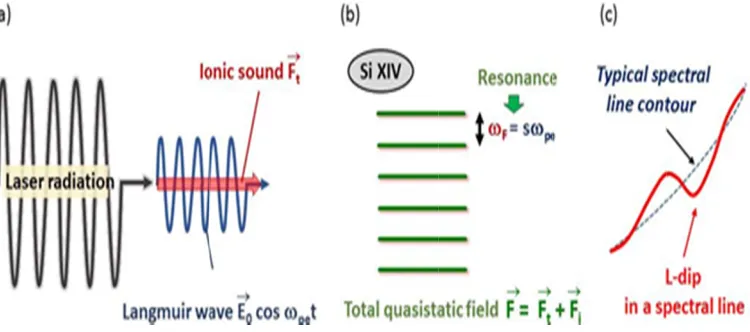
[image:13.612.124.499.190.356.2]Also it shou various lines Los Alamos c the region of t with the resu instabilities on Figure 5 physics and p interaction ph
Fig. 5. Sketch o paper. a) Parame relativistic critica field F, whic harmonics: sωpe
resonance (solid 2.4. PIC sim
The results of simulations w duration tL = propagates alo density ramp density of Ni = of the simulat
At the pea decay is clos Langmuir wav relativistic cr relativistic cri critical densit green line is t decays (t → laser intensitie 3. Summary We analy interaction of
of the parametr uld be emphasi
of H and He-li code Atomic [3 the electron de ults of the pre n the X-ray spe
presents a sk plasma physic henomena can b
of the interlinked p etric decay of the l al density. b) Reso ch is dominated by , s = 1,2,.. . c) Mag d line); the dashed ulations
f our spectrosc were performed 0.6ps and inte ong the x-axis over the lengt = 6x1022 cm-3. ions are shown ak of the laser se to the scal
ve El appeared ritical density.
itical density N
y is 8λ < x <
the manifestati
l+l’, s) were st es.
y
zed the exper f a super-inten
ric decay insta zed that measu ike ions of Si, 37], clearly dem ensity of about esent paper, th
ectra. ketch of the i cs relevant to
be revealed thr
physical processes laser radiation into onance between th y the field Ft of the
gnified part of the line shows the pro
copic analysis d using the mod
ensity IL = 2.7x and interacts w th L = 6 µm a
Angle of incid n in Fig. 6.
pulse intensity le of the plas d in the vicinit The Langmu
Ncr = 3.6x10²²
8.25λ: the mo on of the ion a tudied in the p
rimental spect nse laser radia
ability. urements of pla
processed for monstrated that
1022 W/cm2 . T he latter includ
interlinked phy the present p rough atomic/o
from plasma phys o a Langmuir wave e Stark splitting ω
e ion acoustic wave experimental prof ofile at the absence
have been als dified 1D PIC x1021 W/cm2 i with Si+14 inhom and a target th dence was set u
y (t = 320 fs) ma inhomoge ty of the point uir wave exist 2cm-3. In Fig.
odulation of ion acoustic wave.
ast (see, e.g., b
tra of Si XIV ation with thi
asma paramete r the same expe at the plasma em
Those results a ding the influ
ysical process paper and show optical physics
sics and atomic ph e and an ion acous
ωF of the levels of S
e, with the plasma file showing an L-e of thL-e abovL-e Lan
so supported by code LPIC, in interacted with mogeneous pla hickness of 2u up 450 at P – p
it is seen that eneity. The lon
where the den ts up to a po 5(b), the regi n density in th Similar proce book [56]), but
V and Al XIII in Si foils. Th
ers by intensity erimental cond mission origina are in a good a
ence of the p
ses from atom wing that lase diagnostics.
hysics relevant to th stic wave at the sur Si XIV in the total a electron frequenc -dip resulting from ngmuir waves in th
y PIC simulat n which a laser h a Si [55]. La asma layer wit um, with a con
polarization. T
t the scale of l ngitudinal fiel nsity is about 1 oint slightly a ion near the re his region show esses of such p
t for significan
I lines obtaine he analysis sh
y ratios of ditions by ated from agreement parametric mic/optical er-plasma he present rface of the l quasistatic cy or its m the above
he plasma.
tions. The r pulse of aser pulse th a linear nstant ion he results
laser field ld of the 1/4 of the above the
elativistic wn by the parametric ntly lower
Langmuir wav that at high la Langmuir wav where the pum l + s. Ther
Fig. 6. PIC sim radiation with th beginning of the in units of the las and ion densitie units of ZNcr in
calculated scale
ves developed aser intensities,
ves at the surfa mp wave (t1) ex
efore,
mulations of the inte he Si14 plasma lay
e interaction (a) an ser wavelength λ. T
es are presented by n (b); here Ncr = γN
d transversal elect La
at the surface the most prob face of the criti xcites both the
eraction of a 600 f er. The general vie d the zoom (b) on The initial scaled d y the red and green Nc, where Nc is the
tric field aL= eEL/(
angmuir wave) al=
e of the relativi bable and the b
ical density is e Langmuir wa
fs pulse of the inte ew of the laser-targ
the area shown by density profile is p n lines. They are g e critical plasma de (meωLc) is shown
= eEl/(meωLc) – by
istic critical de est studied me the PDI, which ave (l) and an i
ense (2.7x10²¹ W/c
rget interaction at t y the black rectang presented by the vi given in the units o ensity and γ = aLis
by the black line a y the blue line.
ensity. It is we echanism for de h is a nonlinea ion-acoustic wa
cm2) linearly-polar
the instant t=320 f gle in (a). The coo iolet line. The scal of 0.04ZNcr in (a) a
s the relativistic fa and the longitudina
ell-known eveloping ar process ave (s): t1
the experimentally discovered LET, which developed simultaneously with the Langmuir waves, will have also been developed at the surface of the critical density and thus will most probably have been the ion acoustic turbulence. These conclusions have been also supported by PIC simulations. We determined both the amplitude of the Langmuir waves and the root-mean-square field of the ion acoustic waves.
The ratio of the energy density of the turbulent electric fields E2/(8π) to the thermal energy density of the plasma NeT in this experiments was ~ 10 –1. In atmospheres of quasars, pulsars, and Seyfert galaxies, the electron density is at least by 12 orders of magnitude lower than in the above experiments, but the order of magnitude of the ratio E2/(8πN
eT) is a similar to the order of magnitude of this ratio in the above experiments. Since the conditions for developing the PDI are satisfied for atmospheres of these astrophysical objects [28], the above type of laboratory experiments could serve as a tool for modeling the PDI in these astrophysical objects. The principle of modeling astrophysical objects in laboratory experiments based on the similarity of dimensionless controlling parameters was already successfully used, e.g., in laboratory modeling of mechanisms of solar flares (see, e.g., review [29]).
Our spectra were integrated over the pulse duration. Time-resolved X-ray spectroscopy
had been already performed for similar experimental situations – see, e.g., paper [44]. In that paper it was shown from the Li-like emission history for Al thin foils that during 700fs the
electron density of the plasma, deduced from the broadening of the lines, was very high (solid-state density) and steady. It was attributed to the hottest plasma produced during the highest laser intensity. After 700fs there was no significant signal that would come from colder plasma. So, we interpreted our experimental results (in this regard) the same way as in paper [44].
The idea of employing these two different codes simultaneously should be applied to other spectroscopic experiments in laser-produced plasmas showing identifiable L-dips. The identification of L-dips in the experimental line profiles provides a very accurate determination of the electron density Ne independent of the broadening of the spectral lines. Then if a code like FLYCHK, ignoring the LET and the L-dips, yields a much higher value of Ne than the one deduced from the L-dips, this would be an indication of the development of the LET in those other experiments.
Thus, our results should be important from both theoretical and practical points of view. The experimental discovery of the ion acoustic turbulence in laser-plasma experiments is an important new result in its own right, enabling the comparison of theoretical predictions concerning the development of the ion acoustic waves with the experimentally determined parameters of these waves. Our results can be also used for important practical purposes, such as: A) modeling physical processes in atmospheres of quasars, pulsars, and Seyfert galaxies – in particular, the PDI, causing the anomalous absorption of the incident electromagnetic radiation; B) providing a better understanding of the physics of laser-produced plasmas, in particular, the transport phenomena (especially, the anomalous resistivity) – as they are strongly affected by the ion acoustic waves.
Funding
Science and Technology Facilities Council, and the Engineering and Physical Science Research Council of the United Kingdom Grant EP/J003832/1; RAS Presidium Program for Basic Research Program #13 and Competitiveness Program of NRNU MEPhI
Acknowledgements