Theses Thesis/Dissertation Collections
7-11-2012
The Effect of the Promoting Alternative Thinking
Strategies curriculum on internalizing symptoms in
both a maltreated and non-maltreated sample
Elizabeth Raynor
Follow this and additional works at:http://scholarworks.rit.edu/theses
This Thesis is brought to you for free and open access by the Thesis/Dissertation Collections at RIT Scholar Works. It has been accepted for inclusion in Theses by an authorized administrator of RIT Scholar Works. For more information, please [email protected].
Recommended Citation
The Effect of the Promoting Alternative Thinking Strategies Curriculum on Internalizing
Symptoms in both a Maltreated and Non-Maltreated Sample
Graduate Thesis
Submitted to the Faculty
Of the School Psychology Department
College of Liberal Arts
ROCHESTER INSTITUTE OF TECHNOLOGY
By
Elizabeth Raynor
In Partial Fulfillment of the Requirements for the Degree of
Master of Science and Advanced Graduate Certificate
Rochester, New York July 11, 2012
Approved: _________________________________
Jennifer Lukomski, Ph.D.
(Thesis Advisor)
_________________________________
Erin Merydith, Ph.D.
The Effect of the Promoting Alternative Thinking Strategies Curriculum on Internalizing
Symptoms in both a Maltreated and Non-Maltreated Sample
Elizabeth Raynor
Abstract
The present study examines whether the Promoting Alternative THinking Strategies
(PATHS) curriculum has an ameliorating effect on internalizing symptoms among 68
low-income and maltreated participants between the ages of 7 and 11. Participants attended a
six-week after school program, which implemented the PATHS curriculum. Pre and post measures
were obtained and a repeated measures design was used to analyze all participants across three
measures of anxiety, depression, and self-esteem. Results indicated that participants did not
report clinical significant levels of anxiety, but that those children whose parents had 11 years or
more of education reported significantly lower levelsof anxiety after participating in the PATHS
curriculum. This is in contrast to those children whose parents did not obtain 11 years of
education, who did not report lowered levels of anxiety after participating in the PATHS
curriculum. Participants’ reports did show clinically significant levels of depression both before
and after completing the PATHS curriculum, and demonstrated statistically significantly higher
levels of self-reported depression after completing the PATHS curriculum. Girls tended to report
a higher level of depression, but no interaction was found between genders. Participants reported
a clinically significant level of Negative Self-Esteem as well, and did not show improvement
CHAPTER ONE
Introduction
There is a clear link between child maltreatment and various forms of psychological
maladjustment. Those who experience child maltreatment are vulnerable to a variety of
deleterious effects including both internalizing and externalizing symptoms. However,
internalizing symptoms present some unique challenges because they are problems that occur
within the self that are more difficult to observe (Brown, Cohen, Johnson & Smailes, 1999; Toth,
Cicchetti & Kim, 2002). Internalizing problems include symptoms of depression and anxiety,
and a general lowered self-esteem. Many children who exhibit internalizing symptoms do not
receive treatment, and those who do tend to receive treatment that is not evidence-based
(Berwick, 2003). There are a number of treatments shown to be effective for those who
experience internalizing symptoms and have endured child maltreatment, but many are costly
and not easy to access (Berwick, 2003). This study aims to examine the effectiveness of a
preventative treatment program that can be offered in an inexpensive and accessible way, while
still using many aspects of effective treatments that tend to be more time consuming and costly.
The Promoting Alternative Thinking Strategies (PATHS) program is an evidence-based
program which uses the Affective-Behavioral-Cognitive-Dynamic (ABCD) model of
development and aims to provide children with the skills set and knowledge to effectively
practice self-control, empathy, express emotions in an appropriate and healthy way, and
problem-solve. Many of these components mirror aspects of the individual psychotherapeutic treatments
maltreatment (Greenberg, Domitrovich & Bumbarger 2000). PATHS is intended to be
implemented in a general education setting, and therefore reaches a large number of students at a
lower cost than individualized psychotherapy. Therefore, using PATHS with children who have
been maltreated may serve as an inexpensive and efficient way to help mediate negative
outcomes in maltreated children who would otherwise go without treatment.
However, no research has been conducted to support the effectiveness of the PATHS
curriculum with children who have been maltreated. While many components of the PATHS
curriculum have been useful tools in the treatment of maltreated children, it is unclear whether it
is beneficial in ameliorating internalizing symptoms. In order to establish effective and efficient
courses of treatment for this often vulnerable and overlooked population, it is crucial to collect
relevant data on the PATHS curriculum’s effect on maltreated children’s internalizing symptoms.
To examine the effectiveness of the PATHS curriculum in decreasing internalizing
symptoms on a sample of both maltreated and non-maltreated children from a low-income, urban
population, pre and post measures were obtained. Participants were administered the Children’s
Depression Inventory (CDI), the Self-Perception Profile for Children (SPPC) and the Revised
Children’s Manifest Anxiety Scale (RCMAS) during weeks one and six in order to measure
depression, self-esteem, and anxiety, respectively. It was hypothesized that participants’ scores
on these three measures would indicate a decreased amount of depression, anxiety, and a
decrease in low self-esteem after participating in the six-week PATHS curriculum. It was further
hypothesized that those who had been maltreated would have higher initial levels of internalizing
Definition of Terms
Child Maltreatment is difficult to define due to a lack of social consensus about its scope and
parameters (Cicchetti & Manly, 2001). For the purposes of this research, however, child
maltreatment will be defined as physical abuse, emotional abuse, sexual abuse, and neglect
experienced by a child.
Internalizing can be defined as those symptoms that occur within a person, and are not
observable. This research examines the following internalizing symptoms in specificity: anxiety,
depression, and low self-esteem.
Anxiety can be thought of as excessive worry or concern that is quantified, for the purposes of
this research into several categories including: physiological anxiety, worry/oversensitivity,
social concerns/concentration (RCMAS; Reynolds & Richmond, 2002).
Depression is a significantly generally lowered mood which is, for the purpose of this research,
captured by a number of symptoms including a negative mood, interpersonal difficulties, a
negative self-perception, a feeling of ineffectiveness, and a general loss of pleasure in daily
activities (CDI; Kovacs, 1992).
Self-Esteem can be conceptualized as an overall global perception of one’s sense of worth or
CHAPTER TWO
Literature Review
Effect of PATHS on Internalizing Symptoms
Research delineating the deleterious effects of child maltreatment shows a clear link
between abuse, neglect, and various psychological impairments as well as a marked decrease in
academic achievement and social acceptance by peers (Cicchetti, Lynch, Shonk & Manly, 1992;
Cohen, Brown, & Smailes, 2001; Cohen, Mannarino, Murray, & Igelman, 2006; Eckenrode,
Leiter, 2007; Nelson et al., 2002; Schultz, Tharp-Taylor, Haviland, & Jaycox, 2009). Although
the definition of child maltreatment is a general term often used to encompass various types of
abuse such as emotional abuse, physical abuse, sexual abuse, and neglect, the recent body of
literature on the topic points to a clear association between child maltreatment and negative
outcomes (Schultz et al., 2009). It is therefore critical to directly address the difficulties to which
children who have been maltreated are especially vulnerable.
One negative outcome resulting from child maltreatment is a decrease in academic
performance (Slade & Wissow, 2007). Eckenrode et al. (1993) found that maltreated children
earn significantly lower scores on standardized tests, earn lower grades, repeat grade levels more
often, and have higher rates of disciplinary action taken upon them than their peers who have not
experienced maltreatment. Shonk and Cicchetti (2001) more closely examined school
performance among maltreated children and found that teachers rated them as having a lack of
persistence, a tendency to avoid challenging material, and an over-reliance on teacher guidance
Maltreated children also consistently show an increase in externalizing symptoms such as
behavior problems including impulsivity, risk-taking behavior, substance abuse, and delinquency
(Cohen, Brown & Smailes, 2001; Cohen et al., 2006; Leiter, 2007; Nelson et al., 2002; Schultz et
al., 2009; Toth, Cicchetti & Kim, 2002). Children who have been subject to maltreatment
experience a disproportionately high incidence of internalizing symptoms such as anxiety,
depression, and low self-esteem (Bolger & Patterson, 2001; Cohen et al., 2001; Cohen et al.,
2006; Hankin 2005; Kim & Cicchetti, 2006; Leiter, 2007; Schultz et al., 2009; Nelson et al.,
2002; Shonk & Cicchetti, 2001; Toth, Cicchetti, & Kim, 2002; Toth, Cicchetti, Macfie, Maughan
& Vanmeenan, 2000). Based on the number and severity of risk factors associated with child
maltreatment, it is clear that there is a need for preventative and remediating measures.
Perhaps the most under-identified set of symptoms among children in general are
internalizing symptoms; this is believed to be the case because internalizing symptoms are
problems that occur within the self and therefore do not typically interfere with others
(Achenbach, 1991). Those who exhibit more overt behavioral symptoms are more likely to
receive attention, and subsequently, treatment. Therefore, it is likely that a disproportionately
large number of maltreated children experience internalizing symptoms that do not get identified.
A number of research studies have identified specific internalizing symptoms that occur in
maltreated children. Three types of symptoms that are of particular concern are low self-esteem,
depressive symptoms, and anxiety symptoms.
Maltreated children experience a disproportionately high rate of depression when
compared with their non-maltreated peers (Brown, Cohen, Johnson & Smailes, 1999; Toth,
relation to a history of abuse during childhood. These results were obtained by administering a
detailed self-report questionnaire to 652 undergraduate psychology students assessing their
experiences with child abuse. They were asked to complete measures including a battery of
questionnaires assessing depression, attachment style, anxiety, and cognitive style at two separate
time points. He found that children who are maltreated tend to exhibit an insecure attachment
style and a negative cognitive style which he found to be predictors of depressive symptoms in
young adulthood. Given the large number of negative outcomes associated with depression, and
the higher likelihood of childhood depression in maltreated children, it is clear that interventions
addressing the issue are necessary.
Kim and Cicchetti (2009) found that a low self-image was a direct correlate with
depression in a sample of 109 non-maltreated and 142 maltreated children attending a summer
day camp. The study examined both groups’ mean levels of self-esteem and depression through
the Self-Esteem Inventory (SEI) and the Children’s Depression Inventory (CDI), which are both
self-report measures. Kim and Cicchetti’s findings also indicate that low self-esteem is more
prevalent in a maltreated child population; this highlights the importance of recognizing the
possible implications of a low self-esteem.
Self-esteem, as it will be referred to in this study, can be conceptualized as a person’s
global feelings of self-worth. More specifically, it is defined as the sum of evaluations across
various significant aspects of one’s personality or self (Kim & Cicchetti, 2009). It is an important
construct and, when determined as lowered, is often related to poor peer-relationships,
depression, suicidality, loneliness, and decreased academic achievement and life satisfaction
lower self-esteem during adolescence has long-term negative effects that endure into adulthood;
these negative outcomes include a greater risk of mental health problems, substance dependence,
and lower levels of general life satisfaction at ages 18, 21, and 25 (Boden, Fergusson &
Horwood, 2008). These findings that point to such deleterious effects of low-self-esteem on
children, both immediate and long-lasting, emphasize the importance of addressing low
self-esteem early on.
A study conducted by Caldwell, Rudolph, Troop-Gordon & Kim (2004) revealed that
negative self-views have a significant effect on children’s peer relationships; this study found
that children with a negative self-concept tend to disengage from social interaction, resulting in
an increase in stress among their relationships. Another possible explanation for peer rejection
among children with low self-esteem is that those who have a negative self-image are more
likely to exhibit aggression and externalizing problems (Donnellan, Trzesniewski, Robins,
Moffitt & Caspi, 2005). A research study by Ladd and Burgess (1999) showed a link between
aggressive behavior and poor relationships with both peers and teachers; additionally, the study
found that aggressive children showed a higher rate of loneliness, friendlessness, and a higher
likelihood to be disliked. Some explanations, then, between lowered self-esteem and peer
rejection could be disengagement and/or aggression.
Not surprisingly, then, research suggests that children who are maltreated have difficulty
being accepted by and forming relationships with their peers (Cicchetti et al., 1992). Research
conducted by Bolger, Patterson and Kupersmidt (1998) found that maltreated children show low
levels of acceptance among their peers; they found that those who are most chronically
that those maltreated children who experienced peer-rejection benefitted most from increased
self-esteem, especially when the children were able to develop a reciprocal, high-quality
relationship.
Bolger and Patterson (1998) found that maltreated children benefit from having a close
quality relationship, which resulted in an increase in self-esteem over time. They hypothesized
that because parents of maltreated children often do not model functional friendships, it is likely
that maltreated children do not always have the same opportunity to learn how to initiate and
maintain an appropriate relationship. Bolger and Patterson explained that internalizing symptoms
affect maltreated children’s ability to form social relationships with peers. However, those
children who are able to do so demonstrated an amelioration of internalizing symptoms such as
low self-esteem. This emphasizes the importance of using social skill building as a way to
moderate the negative effects of maltreatment.
In addition to low self-esteem and depression, anxiety is an internalizing symptom that
has an effect on many aspect of a child’s life. Research suggests that adolescents with anxiety
disorders are at a higher risk for developing anxiety, depression, substance abuse problems, and
academic underachievement during early adulthood (Woodward & Fergusson, 2001). Children
who exhibit significant levels of anxiety also tend to interpret ambiguous information in a
negative way; this is a cognitive style that leads to a negative attribution bias causing difficulties
dealing with otherwise benign situations (Hadwin, Frost, French & Richards, 1997). Chorpita
and Barlow (1998) researched the early development of anxiety, and found that those who feel as
the maltreated child population to whom adverse events often occur which are out of their
control.
Therefore, it is not surprising that maltreated children experience a higher incidence of
anxiety than those who are not maltreated (Bolger & Patterson, 2001; Maikovich et al., 2008). In
a review of recent literature, Grant et al. (2004) found that life stressors are a significant
predictor of symptoms related to anxiety. Given the negative outcomes associated with anxiety in
children, along with its frequent co-occurrence with both a lowered self-esteem and depression,
the need for treatment of anxiety in maltreated children is clear.
Taking into account the gravity of the consequences related to child maltreatment, it is
especially important that effective, and therefore, evidence-based interventions are implemented.
The importance has been recognized as being increasingly important in recent years. The idea of
evidence-based practices was born from the consensus that too many treatments are based on
tradition and common-sense beliefs of effectiveness that have not been empirically proven. To be
a true evidence-based practice, treatments must be demonstrated to be safe and effective. This
must be proven through randomized, controlled trials. A number of research studies have
outlined effective treatments and the characteristics that are correlated with a higher likelihood
for success among maltreated children (Chaffin & Friedrich, 2004).
Recent research is increasingly showing a link between social competence and academic
success. With caring interpersonal relationships and a positive classroom climate, students are
more likely to be focused, attentive, motivated, and engaged which, in turn, increases academic
Holmes, 2000). Prosocial behavior in students, as defined by cooperativeness, helpfulness,
empathy, and sharing, has proven to be a significant predictor of both social and academic
success (Caprara, Barbaranelli, Pastorelli, Bandura & Zimbardo, 2000). Emotion regulation in
students has also been shown to predict academic success (Graziano, Reavis, Keane, & Calkins,
2007). In a study surveying teachers’ opinions about behavioral traits necessary in students,
Lane, Givner and Pierson (2004) found that both general and special education teachers feel that
self-control and cooperation are two of the most essential characteristics in a successful student.
A study conducted by Elias and Haynes (2008) revealed higher academic performance among
those students who possessed higher social competence in a high-risk, urban, low SES
community.
Likewise, a number of negative outcomes are associated with poor social skills such as
social rejection, internalizing and externalizing problems, as well as lower academic
achievement (Cook, Gresham, Kern, Barreras, Thornton & Crews, 2008). Emotional and
behavioral difficulties frequently co-occur with academic difficulties, further highlighting the
need for intervention as a way to increase academic performance (Dodge & Pettit, 2003).
Schools have become progressively more receptive to implementing school-wide programs that
aim to increase social competence.
Current research supports the idea that those who have experienced maltreatment suffer
from mental health challenges; the number of maltreated children who actually receive
treatment, however, remains low. Most maltreated children and violence-exposed children
receive no treatment for their trauma symptoms, and those who do typically go to community
considering the large number of children who are maltreated and the severity of their symptoms,
it is clear that there is a need for an effective intervention that can be implemented by community
health care workers. Recent research has suggested that certain treatments are effective, and has
identified a number of factors contributing to resilience in children.
Research and theory on resilience has identified two sets of leading protective factors that
help to support success in the face of adversity: social resources and personal resources. Social
resources refer to close, quality relationships in the schools and with supportive adults both in
effective school settings and within the community (Luthar, Cicchetti & Becker, 2000). Personal
resources, on the other hand, refer to more internal sources of support; these include a basic
sense of values, competence, self-esteem, and priorities. Both serve as buffers which may
contribute to the success of maltreated children who, by definition, experience aversive
circumstances predisposing them to more negative outcomes in general. Accentuating either, or
both, of these protective factors could help lead to an increased likelihood of success despite
hardships that maltreated children are more likely to endure. Therefore, providing an
environment and skills set that would foster the growth of quality relationships may be an
integral step in promoting resilience in at-risk youth. In addition, providing support for
maltreated children to develop self-esteem and a sense of motivation toward school and various
aspects of their lives would also appear to serve as a crucial step in advancing the success of
children who are at-risk for negative outcomes. Some effective treatment strategies have been
identified for maltreated children, and cultivating these social and personal resources are often
Effective treatment strategies for children who have been maltreated or exposed to
traumatic events have typically involved Cognitive-Behavioral Therapy (CBT) of different
variations (David-Ferdon & Kaslow, 2008; Kolko, 1996; Paz, Jones & Byrne, 2005; Silverman et
al., 2008). CBT can use a wide variety of techniques to address a number of issues. Some
underlying assumptions of the therapy are that behavior is learned and can therefore be
“unlearned.” Another assumption made when using CBT is that our thoughts mediate our
behavior. Therefore, the way that we cognitively frame events determines our emotional
reaction; patterns of maladaptive cognitions, then, are a precursor and essentially the cause of
psychological disorders (Verduyn & Calam, 1999). A meta-analysis of the effectiveness of
evidence-based treatments on minority populations conducted by Huey and Polo (2008) indicates
that CBT is the most effective treatment among various minority populations as well.
A number of studies have discussed the effectiveness of individual CBT with children
who have been maltreated (Caffo, Forressi, and Lievers, 2005; Lawson, 2009; Verduyn & Calam,
1999). When using CBT with a maltreated child, a therapist seeks to establish a collaborative,
working therapeutic alliance with the client who then works on increasing skills and
competencies as well as challenging distortions. This is done through direct psychoeducation and
role playing, as well as through homework. Progress is monitored between the therapist and
client throughout the treatment. Some studies involving maltreated children participating in
CBT involve family members, which has proven to increase the effectiveness of the intervention
(Lawson, 2009).
Deblinger et al. (2006) conducted a study assessing the effectiveness of a particular type
Behavioral Therapy (TF-CBT) is a variation of CBT, which targets trauma-related symptoms,
Post Traumatic Stress Disorder (PTSD), anxiety, depression, and trauma-related cognitions
including shame and self-blame. The therapy is a hybrid treatment integrating
cognitive-behavioral, family-based therapy, and focuses on trauma symptoms. More specific treatment
components include parenting skills, psychoeducation for both parents and children, relaxation
skills, affective modulation, cognitive processing, trauma narration, in-vivo desensitization, and
conjoint parent-child sessions focused on future development. Some strategies used are teaching
children and their parents about the prevalence of abuse and offering information that helps
victims feel validated by teaching them about others’ similar reactions which then normalizes
their feelings. They also practice some relaxation techniques including deep breathing and
learning to become aware of their bodies’ physiological reaction to stress. Parenting components
were included which helped parents to become more supportive and react appropriately to their
child’s reaction and overall experiences (Cohen et al. 2006).
A sample consisting of 183 children ranging from ages 8 to 14 participated in the
research; 92 participants completed twelve sessions of the TF-CBT and were compared to a
group of 91 participants who attended twelve sessions of Child Centered Therapy (CCT), which
consisted of non-directive Rogerian techniques. These include active listening, reflection,
encouragement to discuss feelings, and an empowerment of the client to direct his or her own
therapy and develop coping strategies. Unlike the TF-CBT group, those in the CCT group were
encouraged to come up with their own personal coping strategies; in TF-CBT, direct behavioral
and educational strategies were used in a more didactic and directive manner. Parents were
2006). The TF-CBT proved to be a more effective treatment than the comparison group who
received CCT; the difference in symptom abatement was statistically significant with a medium
to large effect size in favor of the TF-CBT. The symptoms which were ameliorated include Post
Traumatic Stress Disorder (PTSD), depression, anxiety, shame, behavior symptoms, and negative
abuse-related cognitions. As was evident in prior research, the findings suggesting that TF-CBT
is an effective treatment for symptoms in children who have been sexually abused (Cohen et al.
2006, Deblinger et al. 2006).
Another similar treatment is called Cognitive-Behavioral Intervention for Trauma in
Schools (CBITS). The treatment was originally designed to address symptoms of PTSD,
depression and anxiety related to community violence exposure. However, it has since been used
with a wider range of traumatic events. It is intended for use within the school, and is
administered in a group setting including 5-8 students. There are ten treatment sessions which
involve cognitive-behavioral activities including: education about common reactions to stress
and relaxation training, introduction about linking thoughts and feelings, combating negative
thoughts, cognitive coping strategies, exposure through creative means such as drawing or
writing, and opportunities to practice newly-acquired skills. These skills are taught through a
didactic teaching style, age-appropriate examples, and activities to solidify learning (Cohen et al.
2006).
Stein, Jaycox, Kataoka, Wong and Elliott (2003) conducted a research study assessing the
effectiveness of the CBITS intervention with a sample of 126 sixth-grade students randomized
into either a wait-list or intervention group. They found that, when compared to a three-month
symptoms with a large effect size; depression scores in the intervention group also decreased
with a medium effect size. Parents completed assessments about students’ psychosocial
functioning, and the intervention group showed a significant improvement. This further supports
the idea that CBT is helpful in decreasing negative effects of maltreatment; it also shows that
interventions can be helpful in a group setting (Silverman et al. 2008; Stein et al. 2003).
Another treatment based in CBT called Self-Control Therapy was evaluated by
David-Ferdon and Kaslow (2008). This treatment is similar to CBITS in that it is administered in a
group format within a school setting; its intention was to decrease depressive symptoms.
Students participated in twelve sessions involving teaching self-management skills. More
specifically, it focuses on teaching self-control and social skills, assertiveness training, relaxation
techniques, and cognitive restructuring. The data concluded that, when compared to a “treatment
as usual” group consisting of traditional counseling and a waitlist group, those participating in
the Self-Control Therapy group benefitted more by showing a greater decrease in depressive
symptoms and a greater increase in self-esteem as evaluated through self-report questionnaires.
Some common themes in CBT treatments geared toward children with internalizing
symptoms, particularly those who have been exposed to trauma, include psychoeducation,
linking thoughts and feelings, challenging maladaptive cognitions, role playing, and relaxation
skills. These key features are utilized to help a client become aware of his or her own feelings
and cognitions, and develop strategies to cope with challenges.
One evidence-based program that integrates some major concepts that are common in
by Luthar, Cicchetti and Becker (2001) is the Promoting Alternative Thinking Strategies
(PATHS) program. Originally designed by Mark Greenberg as a program promoting emotion
recognition, regulation and understanding for people who are deaf, it has now been adapted for
use with regular education as well as special education students. PATHS is based on the ABCD
(Affective-Behavioral-Cognitive-Dynamic) model of development and aims to provide children
with the skills set and knowledge to effectively practice self-control, empathy, express emotions
in an appropriate and healthy way, and problem-solve. Five conceptual domains are specifically
targeted including self-control, emotional understanding, positive self-esteem, relationships, and
interpersonal problem-solving skills. Those skills are taught didactically, in a group setting, and
practiced and generalized in a natural, usually classroom, type setting (Greenberg, Domitrovich
& Bumbarger 2000).
Some specific similarities between PATHS and CBT are in psychoeducation, relaxation
training, linking thoughts to feelings, and role playing. Although PATHS does not specifically
target trauma symptoms or challenge dysfunctional beliefs related to trauma, it does provide a
framework for understanding the way that thoughts relate to the way we feel and, subsequently,
behave. Problem-solving techniques are also taught didactically and practiced within a group
setting. Similar to CBT, PATHS offers strategies to regulate one’s emotions and recognize what
stress feels like in a physiological way. It teaches ways to calm down and make appropriate
choices (Greenberg et al. 2000). It is likely that, given its similarities to CBT, the PATHS
curriculum can lead to some similar results.
PATHS is designed with the intention of being a universal, preventative program aimed at
PATHS shares similarities to CBT interventions mentioned above, which may suggest that it
could be used with maltreated children to help ameliorate negative symptoms. It could therefore
be used as an intervention for maltreated children as well rather than be restricted for use as a
preventative measure.
A number of studies have researched the effectiveness of the PATHS program across a
number of demographics. Kelly et al. (2004) conducted a qualitative study aimed at exploring the
usefulness of PATHS in developing “emotional intelligence.” The term emotional intelligence
can be defined as a type of intelligence that is social in nature and involves the ability to monitor
one’s own emotions and recognize emotions in others; it describes the ability to discriminate
between emotions and use that information to affect one’s own thinking and actions. An
awareness of emotions in oneself and others is crucial in being able to problem-solve effectively
and develop social competence.
The study examined the implementation of the program, and found a number of positive
outcomes. Teachers and support staff praised the program and found it educational, innovative
and manageable for students. Students described PATHS as being enjoyable and could explain
appropriate strategies for handling difficult emotions. Children performed better on the Kusche
Affective Interview (KAI), which assesses students’ understanding of emotions in relation to a
range of various affective states and circumstances. Teachers also rated the students higher on
their social and emotional competence when given a standardized questionnaire called the
Taxonomy of Problematic Social Situations. Kelly et al. (2004) concluded that PATHS had a
positive effect on both staff and students. Its effectiveness was studied in more quantitative
Originally designed to increase effective problem-solving skills in a deaf and hard of
hearing population, PATHS’ effectiveness was first reflected in its use in that capacity. A study
conducted by Greenberg & Kusche (1998) included 57 hearing-impaired children ages 5-12 from
11 self-contained classrooms for deaf children. Classrooms were randomly assigned to either an
intervention group who was participating in the PATHS curriculum, or a wait-list group who
would participate in the program during the following year. The results found that those who
went through the PATHS curriculum showed improvement in several aspects of social
understanding, which includes the recognition of problematic situations, the ability to generate
alternative solutions to problems, and the anticipation of consequences. Of particular importance
is that the intervention students were more likely to provide prosocial solutions to situations that
arose in comparison to the wait-list group. Qualitatively, teachers reported being surprised at the
number of affective and problem-solving concepts the students could grasp. This study suggests
that PATHS can be successful in increasing prosocial behavior and problem-solving skills in a
deaf and hard of hearing population (Greenberg & Kusche 1998). Controlled studies were also
conducted examining the effectiveness of the program among other populations.
Greenberg et al. (1995) conducted a research study on the effectiveness of the PATHS
curriculum, which involved a sample of 286 second and third-grade hearing students. Of those
students, thirty percent were placed in a self-contained, special education classroom setting. 130
children from two schools received the PATHS curriculum, and the remaining 156 were in the
control group. After participating in the PATHS program for one year, students made significant
gains in their emotional vocabulary. General education students made the most significant gains,
however, with an increase in their ability to understand cues and recognize emotions in others
(Bardon, Dona & Symons 2008).
An additional research study examining the effectiveness of PATHS on students attending
five different schools in the United Kingdom (UK) was conducted (Curtis & Norgate 2007).
They compared a sample of 284 children, 114 in the intervention group and 173 controls, using
the Strengths and Difficulties Questionnaire (SDQ) and semi-structured interviews with teachers.
The data suggests that compared with the children in the control school, those students who
participated in the PATHS program showed significant improvement across all five behavioral
and emotional constructs measured by the SDQ: emotional symptoms, conduct problems,
hyperactivity/inattention, peer relationship problems, and prosocial behavior. Interviews with
teachers revealed that they perceived PATHS to have a positive impact on students’ empathy,
self-control, and cooperativeness. They also felt that PATHS had a positive impact on the
emotional vocabulary and understanding of the children. This study provides further evidence of
the positive impact PATHS can have on students. Additional studies have shown sustained effects
of the curriculum on students in special education.
Kam et al. (2004) conducted a study tracking the long-term effectiveness of the PATHS
curriculum on the adjustment of children who attend special education classes; students were
primarily educated in a self-contained classroom, but had varying levels of mainstreaming.
Results indicated that, first, the PATHS curriculum is effective when implemented in a special
education environment. Teachers reported fewer externalizing and internalizing symptoms in
students, and students participating in PATHS reported significantly fewer depressive symptoms
group were also found to have a greater fluency with understanding emotions and identifying
them in others as indicated by the KAI. In addition to pre-post measures, additional assessments
were given 2 years after the intervention. The findings were significant, and showed that those in
the intervention group showed a continual decrease in both externalizing and internalizing
symptoms while the control group showed a continual increase. This study, then, suggests that
the PATHS curriculum is not only effective in a special education population, but that its effects
can be sustained over a 2-year period.
The positive effects of the PATHS curriculum have also been studied in at-risk, minority
students. A study by Bardon, Dona, and Symons (2008) examined PATHS’ effects on three
third-grade, general education, African-American children who were referred by their teachers because
of their behavioral difficulties and risk for special education referral as a result. Two of the
participants were girls, and one was a boy. Their entire classes received the PATHS curriculum,
and progress was monitored and evaluated using behavioral observations of their cooperative
play using the operational definition from the Tough Kid Observation Form. Of the 20
observations conducted, the first five and last five were used as baseline and intervention
measures, respectively. Reliability checks were completed using videotaped observations.
Results show an association between increased cooperative play and the PATHS intervention.
The authors of the study propose that the PATHS curriculum could be used as a Response to
Intervention approach to prevent the disproportionately high number of minority students
requiring special education services largely due to behavioral difficulties.
Results of a number of studies indicate that the PATHS curriculum is effective in
sustained period of time. A greater ability to recognize and name emotions in both oneself and
others was apparent in those who participated in PATHS. In addition, more prosocial skills and
problem-solving strategies were found among intervention groups using the PATHS curriculum.
These skills are similar to those learned and utilized in CBT when attempting to treat various
internalizing disorders among both non-maltreated and maltreated children. These skills could
show mediating effects on internalizing symptomology when used with children who are at-risk.
While studies have indicated that PATHS can be effective among at-risk, minority students, it is
unclear whether PATHS would be effective among a maltreated population because no studies
have examined this specific population. Furthermore, no studies have examined the effects of the
PATHS curriculum on symptoms directly associated with maltreatment such as anxiety,
depression, and low self-esteem.
PATHS could serve as a valuable and cost-effective tool in treating internalizing
symptoms among maltreated children. Many children who have experienced maltreatment go
without any treatment, and PATHS could be an effective way to provide some important skills to
them. It is implemented in a group setting, and can be run by a professional who has training in
the PATHS curriculum. This is advantageous because many mental health providers are costly
and unavailable, especially among low-income, needy populations. PATHS can also take place in
a school setting, where children are more likely to show up for treatment. Invaluable skills,
which are especially crucial among maltreated children, are taught in an accessible and effective
manner through the PATHS curriculum.
The purpose of the current study was to examine the effects of the PATHS curriculum on
Two groups of low income, largely minority students were compared: a non-maltreated group
versus a maltreated group of children. The effects of the PATHS curriculum were measured using
pre and post measures assessing internalizing symptoms which include the Children’s
Depression Inventory (CDI; Kovacs 1992), the Self-Perception Profile for Children (SPPC;
Harter 1985), and the Revised Children’s Manifest Anxiety Scale (RCMAS; Reynolds &
Richmond 1985). It is hypothesized that participants from both the maltreated and
non-maltreated groups’ scores on these three measures will indicate a decreased amount of
depression, anxiety, and low self-esteem after participating in the PATHS curriculum. This aims
to address two separate research questions: Is the PATHS curriculum effective in decreasing
depression, anxiety and lowered self-esteem when used with largely minority, low-income
children? Is the PATHS curriculum effective in decreasing depression, anxiety and lowered
CHAPTER THREE
Method
Participants
Archival data from participants at a center devoted to psychological research affiliated
with a university in central New York was used; those who participated attended the PATHS
program for six weeks at the center. Participants consisted of 68 children ranging from ages 7 to
11. All the children included in the data analysis had either experienced some form of
maltreatment (81.2%), as confirmed by a founded case determined by the Department of Human
Services (DHS), or were from a low-income background, which was determined based on the
family’s receipt of public assistance (17.4%). Those in the latter group were considered
“non-maltreated” and had no documented record of involvement with Child Protective Services (CPS)
in any capacity (neither founded nor unfounded cases). This was a sample of convenience with
some participants obtained by DHS referrals. Additional participants were recruited by
distributing fliers to local urban schools. In addition, school officials referred students they felt
would benefit from the program and parents requested that their child participate. Several
participants’ parents or family members were enrolled in prior studies at the Mount Hope Family
Center (MHFC) and called in to inquire about future studies; they were signed up to participate
in PATHS as a result. Those participants who were enrolled through the DHS all had a maltreated
status, and those who were recruited through local schools or prior participation in studies at the
MHFC represented a combination of maltreated and non-maltreated participants.
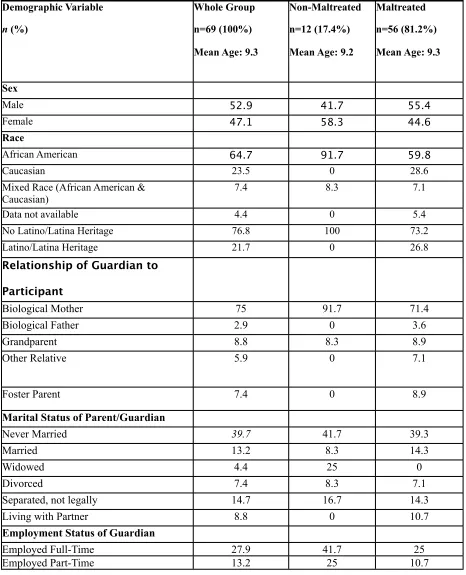
The sample consisted of 32 females (47.1%) and 36 males (52.9%).Participants’ age
participants identified themselves as being African American, 23.5% were Caucasian, 7.4% were
a mix of African American and Caucasian, and for 4.4% of participants this information was
missing. The majority of participants (81.2%) had a maltreated status whereas 17.4% had a
non-maltreated status. The majority of participants in the study also received public assistance: for
45.6% of those in the sample, public assistance was their sole form of income, and 25% of
participants supplemented their income earned from employment with some form of public
assistance. For more specific demographic data see Appendix A.
Instruments
Mount Hope Family Center Demographics Interview
The Mount Hope Family Center Demographics Interview was developed by various
researchers at the University of Rochester’s Mount Hope Family Center (see Appendix B). The
interviewer gathered information regarding participants’ race, living situation, parents’
educational level and work and marital status, as well as family income level. Research
Assistants asked the caregivers of the participants questions orally and recorded their responses
on the questionnaire. The measure was administered by a research assistant trained in
standardization and sensitivity in asking questions regarding personal aspects of the participants’
lives.
Childhood Depression Inventory (CDI; Kovacs, 1992).
The CDI is a self-report instrument which assesses depressive symptomology in children
and adolescents ranging from ages 7 to 17 years. The measure consists of 27 items, and yields an
Mood, Interpersonal Difficulties, Negative Self-Esteem, Ineffectiveness, and Anhedonia. The
measure requires the respondent to choose one of three statements that best describe him or her
during the past two weeks. Items are scored with a “0,” “1,” or “2” based on the severity of the
symptom.
Raw scores can range from 0-54 with higher scores indicating a higher degree of
depression. Linear T-scores were developed, and have a mean of 50 and a standard deviation of
10. Kovacs (1992) suggests that, based on normative data, scores ranging from 61-70 are
considered “Above Average”-“Much above average” and that scores exceeding 70 are considered
“Very much above average.” The CDI’s psychometric properties are acceptable: test-retest
reliability r = 0.54-0.87 and coefficient alpha = 0.71-0.86. Raw scores and T-scores from the
overall measure of depression were used in the analyses. The CDI’s psychometric normative
analyses were conducted on a sample which included ethnic minorities as well as a wide range of
socioeconomic backgrounds; this suggests that the measure’s norms are appropriate to use with
the low-income, largely minority population who are evaluated in the current study.
Self-perception Profile for Children (SPPC; Harter, 1985). The SPPC is a self-report instrument
consisting of 36 items assessing children’s sense of competence across several domains
including: scholastic, athletic, physical, social, behavioral competencies, and global self-worth.
Each item includes two statements describing “some kids,” and the participant is asked to first
choose which one best describes him or her. For example, one item states: “Some kids find it’s
hard to make friends BUT Other kids find it’s pretty easy to make friends.” After choosing a
like” that statement. The technical properties are acceptable for this measure: test-retest
reliability r = 0.70-0.87 and coefficient alpha = 0.71-0.86.
Revised Children’s Manifest Anxiety Scale (RCMAS; Reynolds & Richmond 2002).
The RCMAS is a self-report inventory of anxiety designed to assess the level and nature of
anxiety in children ages 6 to 19 years. It consists of 37 items, to which children respond ‘yes’ or
‘no.’ Questions are divided into three sub-scales: Physical Anxiety, Worry/Over-Sensitivity and
Social Concerns/Concentration. There are nine additional items making up a Lie scale, which is
viewed as a measure of social desirability. High scores on this scale are seen as an attempt to
present oneself in a positive light. Each of the 28 anxiety-related items is given a score of 1 for a
response of ‘yes’ and 0 for a response of ‘no,’ which results in a Total Anxiety score.
T-scores (n=50) are used to calculate the Total Anxiety score, and those that are greater
than 70 are considered significantly elevated. Individual sub-scale scores used scaled scores with
x=10, SD=3, therefore deeming a scaled score of 13 or higher clinically significantly elevated.
The RCMAS has adequate technical properties: test-retest reliability r = 0.68 and coefficient
alpha = 0.82. Normative samples included in determining the psychometric properties of the
RCMAS were representative of ethnic minorities and a low socioeconomic status. One exception
is noted among African American females, where the reliability coefficients are significantly
lower at ages 6, 8, 10, and 11 than for white females at the same ages. Therefore, special care
should be used when interpreting Total Anxiety scores for African American females below age
PATHS Intervention
Dr. Jody Todd Manly collaborated with Dr. Mark Greenberg, who is the creator of the
PATHS curriculum, to select the most appropriate and relevant lessons for the Rochester-based
program. Twenty-one lessons were chosen and modified to appropriately fit the participants’ age
and interests. The content and objectives remained unchanged; this type of flexibility is common
and recommended when using the PATHS curriculum.
The first lesson begins by introducing PATHS to the participants and developing
readiness skills in role-playing and paying attention to others. These skills are prerequisites to a
successful program, and provide a basic skills-set for subsequent lessons. Skills are reiterated
and practiced until they are mastered during the six-week PATHS curriculum.
The curriculum provides an “introduction to feelings,” which uses direct instruction to
teach children about what feelings are and how to recognize them in oneself and others. This
provides a basic understanding for the rest of the curriculum, much of which is spent learning
how to name and identify different kinds of emotions such as angry, afraid, safe, frustrated,
disappointed, and guilty. Participants are taught that all feelings are okay, but that not all
behavior is okay. The last lesson focuses on “Manners,” and teaches the distinction between
feelings and manners; it provides a time for children to practice naming which behaviors are
“polite” and, therefore, okay, and which are not.
The other major skill taught in the PATHS curriculum is self-control. It is taught by either
using “the turtle” story or the “control signals” analogy. The objective is to teach three steps in
breath, say the problem and how you feel, then rest until your feelings are not so strong or until
you feel calmer. The control signal’s steps include: Stop and calm down, slow down and think,
go ahead and try the plan, and then evaluate how it went. The next lesson is devoted to practicing
using the appropriate use of these calming techniques.
Procedures
Permission was granted for the collection of the data to Dr. Jody Todd Manly after she
submitted a proposal to the Research Subjects Protection Board (RSRB), and funding and
resources were provided by the United Way and Foodlink. Dr. Jody Todd Manly serves as both
the Principal Investigator for the research conducted during the PATHS program as well as its
clinical director. The PATHS program, as well as the research associated with it, takes place at
the Mount Hope Family Center, which is a part of the University of Rochester.
Children were recruited through referrals by the Department of Human Services (DHS)
as well as through responses to fliers distributed throughout local urban schools. Several
participants’ parents who had participated in past research studies called the program
coordinator, and were enrolled. Those children referred through the DHS were all classified as
having a maltreated status, and were referred as a result of a case worker’s determination that the
child would benefit from participating in the PATHS curriculum. Participants recruited in schools
and past participants consisted of a combination of children who have been maltreated, and those
who have not. The sample of participants was comprised of a convenience sample.
Participants were separated into a maltreated group and a comparison group as
pressed and founded, on their behalf by Child Protective Services (CPS) at some point during
their life. Those in the comparison group must not have a history of any child abuse or neglect
according to the DHS. Children attending PATHS who had a case which was not founded were
still invited to participate in the program, but their data was excluded in the analysis for this
study.
Children were enrolled in the program upon the agreement from the child’s parent or
legal guardian. To do this, the project coordinator made an appointment to obtain
approved consent and demographic information from the parent. All children signed an
RSRB-approved assent form prior to participating in any of the research. Participants and their parents
or legal guardians were informed that they were free to withdraw or abstain from the research at
any time without being penalized in any way, and would be able to continue to attend the PATHS
program despite their research participation.
Confidentiality was maintained in several ways. First, it was explained to participants that
their answers are private and will not be shared with anyone outside of the project. Participants
were identified by number only, not by name, on their paper measures. These measures were
kept in a locked filing cabinet; at that point they contained no other identifying information other
than the number that participants were assigned. After data was collected and entered
electronically, results were accessible to only those analyzing the data who had no access to any
other identifying information about the participants.
Children who participated attended the PATHS program after school for six consecutive
3:00PM until 6:00PM and were provided with transportation, an after-school snack, and dinner.
Grant money was provided by United Way as well as private donors to the Mt. Hope Family
Center, and meals were provided at a reduced cost by Foodlink. Three sessions, each containing
different samples of children, took place during each respective year; sessions were either in the
fall, winter or spring.
Participants were divided into separate groups according to age; three groups attended the
program, but this study analyzed data collected on the groups consisting of eight and
nine-year-olds and ten and eleven-year-nine-year-olds. This was because the younger children’s assessments differed
due to comprehension and literacy issues. Each respective group had two consistent counselors
who led the PATHS lesson as well as other activities in the groups. During the three-hour period
that the participants attended the program, they had a 30 minute PATHS lesson, time to do
homework from school, music, art, and gym. All people working in the program were trained in
the PATHS curriculum, and incorporated the lessons into all of the activities. A certified School
Counselor or a certified Mental Health Counselor were on-site each day to supervise and ensure
that the curriculum was being followed with integrity.
All three measures were administered individually by a Research Assistant, in one sitting,
and at both the first and sixth week, respectively. Research Assistants were given independent
training by the program coordinator in administering the paper measures in a standardized and
objective manner. In order to ensure that participants were able to comprehend the questions on
the measures, Research Assistants read the items aloud while participants looked on. Research
visually and auditorily was intended to reduce the likelihood that poor readers would
misunderstand the questions.
CHAPTER FOUR
Results
To answer the research question regarding whether low-income and maltreated children
experienced lower internalizing symptoms after completing the PATHS curriculum, a repeated
measures test was conducted with the RCMAS Total and CDI Total scores as well as the
Negative Self Image score. The PATHS curriculum served as the independent variable. The
dependent variables were anxiety symptoms, depressive symptoms, and negative self-image as
measured by the RCMAS Total Score, CDI Total Score, and the Negative Self-Image scale’s
score on the CDI, respectively.
Anxiety
The first repeated measures test was conducted in order to determine whether participants’
anxiety symptoms were lower after participating in the six-week PATHS curriculum, and was
measured using the RCMAS Total score. Completion of the PATHS curriculum was the
independent variable, and the RCMAS Total score was the dependent variable. When looking at
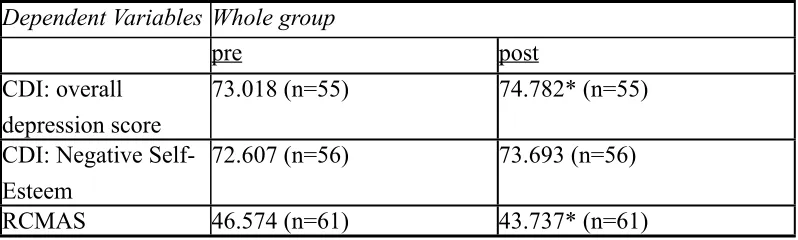
overall anxiety, the test revealed that participants reported significantly lower anxiety symptoms
after completing the curriculum as compared to their initial self-reports, F(1,60)=7.083, p ≤01.
It is important to note that the sample’s mean scores fell within normal limits, indicating that the
participating in the PATHS curriculum (see Table 2). As stated above, T-scores at or above 70 are
considered clinically significant for anxiety symptoms on the RCMAS.
When analyzing whether gender had any difference on overall self-perceived anxiety
symptoms, a test of within-subjects contrasts for males (n=32) and females (n=29) was
conducted. Results indicated that there is a significant difference between male and females’
level of anxiety both pre and post, F (1, 59)=6.890, p≤.01. Females reported a significantly
higher mean level of anxiety both before and after participating in the PATHS curriculum as
compared with their male counterparts (see Table 4). However, there is no significant interaction,
F(1, 59)=.064, p=.802. This indicates that both males and females reported a similar level of
response to the treatment in the same direction (both reported lower levels of anxiety after
completing the PATHS curriculum).
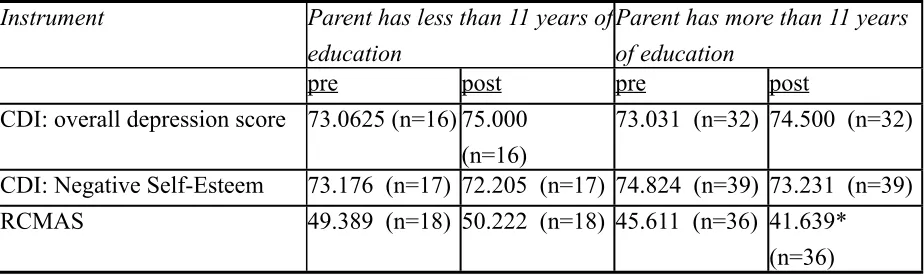
In order to determine whether participants’ parents level of education had an impact on
their anxiety symptoms, tests of within-subjects contrasts were completed with two groups:
those whose parents completed less than 11 years of education (n=18), and those whose parents
completed more than 11 years of education (n=32). Results indicated that those participants
whose parents reported having completed 11 or more years of education tended to benefit
significantly more from the PATHS curriculum than participants whose parents completed less
than 11 years of education, F(1,52)=4.019, p ≤ .05. Initially, the two groups did not show
significant differences in anxiety symptoms. However, when examining their scores after
participating in the PATHS curriculum, those whose parents were more educated showed
lowered anxiety symptoms as compared to those with parents who had less education and
overall significantly lowered anxiety symptoms among the whole group can be generalized only
to the group of participants whose parents had more than 11 years of education; those whose
parents had fewer than 11 years did not significantly benefit from the PATHS curriculum.
Depression
In order to determine whether the PATHS curriculum is effective in decreasing symptoms
of depression among participants, a repeated measures test was conducted. Completion of the
PATHS curriculum was the independent variable, and CDI Total score was the dependent
variable. When looking at overall self-reported depression symptoms, the test revealed that
participants reported significantly higher depressive symptoms after completing the curriculum
as compared to their initial self-reports, F (1,54)=4.246, p ≤ .05. As described above, a T-score
on the CDI falling above 70 is considered “Very much above average.” It is important to note
that group means are above 70 both pre and post, indicating that their self-reported depressive
symptoms started off and remained significantly elevated throughout the course of the PATHS
curriculum.
When analyzing if gender had any difference on overall depressive symptoms, a
within-subjects contrasts was conducted. Results revealed significant differences in overall self-reported
depressive symptoms across gender, F(1, 53)=4.185, p ≤ .05. Girls’ pre and post CDI total scores
were significantly higher than that of their male counterparts’ scores (see table). However, no
interaction was detected, F (1, 53)=.018, p=.895. This indicates that while girls’ self-reported
symptoms were significantly higher than males’, both groups experienced a similar increase in
In order to determine whether participants’ parents level of education had an impact on
their depressive symptoms, tests of within-subjects contrasts were completed with those whose
parents completed less than 11 years of education and those whose parents completed more than
11 years of education. Results indicated that there was no significant difference in depressive
symptoms or response to the PATHS curriculum across parents’ education level, F (1,46)=3.109,
p=.084.
Self-Esteem
A large number of missing data points occurred with the Self-perception Profile for
Children (SPPC), and the reason for this was explored. It was tentatively concluded that the
measure was refused by many participants due to its length. This brought into question its
validity as a measure, due to some children’s inability to attend during its administration and
inability to understand the directions. Due to both the incompleteness of the data along with the
questionable validity of the measure, it was decided that the measure should not be analyzed for
the purposes of this study. The Negative Self Image scale from the CDI was used in its place to
explore participants’ self-esteem.
The third repeated measures test was conducted with the Negative Self-Esteem scale,
which is included in the CDI. This was intended to measure whether completing the PATHS
curriculum would help to increase participants’ level of self-esteem. Completion of the PATHS
curriculum was the independent variable, and the T-score on the Negative Self-Esteem scale was
the dependent variable. The test revealed that completing the PATHS curriculum did not have a
Participants’ overall scores fell within the “Very much above average” range indicating that the
sample reported experiencing a clinically significant level of negative self-esteem both before
and after completing the PATHS curriculum.
When analyzing if gender had any difference on overall negative self-esteem, a
within-subjects contrasts was conducted. Results revealed no significant differences in negative
self-esteem across gender, F(1,61)=2.241, p=.140.
The effect of the participants’ parents level of education was also examined. A
within-subjects contrasts test was conducted to determine whether there is a significant difference
between participants’ outcomes based on their parents education level. No significant difference
CHAPTER FIVE
Discussion
Two separate research questions were intended to be explored through the current study:
Is the PATHS curriculum effective in decreasing depression, anxiety and lowered self-esteem
when used with largely minority, low-income children? Is the PATHS curriculum effective in
decreasing depression, anxiety and lowered self-esteem when used with maltreated children?
With regards to the first research question, the results of this study revealed that completing the
PATHS curriculum decreased internalizing symptoms only in the area of anxiety. However, it is
important to note that participants’ overall level of anxiety was not considered to be clinically
significant either before or after completing the PATHS curriculum. This is in contrast to
participants’ levels of depressive symptoms and negative self-esteem, which were within the
clinically significant range both before and after completing the PATHS curriculum.
With regard to the second research question addressing the effectiveness of the PATHS
curriculum in reducing internalizing symptoms when working with maltreated children, an
accurate comparison could not be made due to a lack of complete data for the non-maltreated
children. Although this study was intended to measure the effectiveness of the PATHS
curriculum on low-income children as well as maltreated children, a number of issues arose that
eliminated the possibility for an accurate comparison. The initial sample of participants included
equivalent numbers of non-maltreated and maltreated children, but several factors influenced the
final sample composition. First, many participants had incomplete data. When just a pre or a post
measure was completed, the data could not be used. Second, the data was archival and at the start
status due to incidents that occurred either during or after the data collection period. Other
participants’ status as maltreated or non-maltreated became unclear because of reports to Child
Protective Services that were unfounded. For the purposes of research, these unfounded cases
created doubt about participants’ level of maltreatment and their data could therefore not be used.
Due to the disproportionately high number of children with a maltreated status as compared with
a non-maltreated status in this study, no accurate comparison can be made between maltreated
and non-maltreated children’s response to the PATHS curriculum. The results can instead be used
as more general, preliminary data measuring both low-income and maltreated children’s response
to the PATHS curriculum.
As stated above, completing the PATHS curriculum significantly decreased self-reported
anxiety symptoms. In contrast to research that suggests that individuals who experience
maltreatment have clinically significant levels of anxiety (Bolger & Patterson, 2001; Maikovich
et al., 2008), participants in this study reported typical levels of anxiety at the beginning of the
PATHS intervention, and their anxiety levels tended to decrease to significantly lower levels
after completing the curriculum. An explanation for the significant decrease in anxiety symptoms
as compared with depression and negative self-esteem which did not show improvement may be
due to the fact that the participants’ anxiety levels were manageable to begin with. Both
depression and negative self-esteem were considered clinically significant at the initial measure,
whereas anxiety was not. It may be the case that if one is overwhelmed with negative symptoms
in a particular area (depression, negative self-esteem, etc.), a more intensive and customized plan
of treatment such as individual counseling is necessary to make improvements for those
feel more capable of making positive changes. Additionally, when a person is feeling less
debilitated by negative symptoms, he or she may have more energy to devote to making positive
changes. Therefore, because participants showed manageable levels of anxiety to begin with, in
contrast to their self-reported clinically significant levels of depression and negative self-esteem,
they may have been able to make greater gains.
In terms of demographic changes that impact participants’ anxiety levels pre and post
PATHS curriculum, several factors were apparent. First, although both group anxiety scores fall
within normal limits, girls’ scores were statistically significantly higher on anxiety as compared
with boys. Similarly, Armstrong and Khawaja (2002) found that females experience and report
anxiety symptoms more often than males in non-clinical populations. Despite the statistically
significantly higher report of anxiety among females, both males and females benefitted
similarly from the PATHS curriculum. In other words, while the groups may have reported
differing levels of anxiety, both showed similar levels of improvement after completing the
PATHS curriculum.
The second demographic factor that showed a significant effect on participants’ change in
anxiety level in response to the PATHS curriculum was participants’ parent’s education level.
Those participants whose parents completed more than 11 years of education tended to benefit
significantly more than those whose parents completed less than 11 years of education. When
this demographic characteristic was examined in isolation, it became apparent that the results
indicating lowered anxiety after completing the PATHS curriculum could not be generalized
across the entire population, but only to those who have a parent with 11 years of education or