Copyright©1977 AmericanSocietyforMicrobiology Printed in U.S.A.Vol. 24, No. 2
Evidence
for Two Nucleotide Sequence Orientations Within
the
Terminal Repetition
of
Adeno-Associated Virus
DNA
ILENE S. SPEAR, KENNETH H. FIFE, WILLIAM W. HAUSWIRTH,t CAROL J. JONES,tt AND
KENNETH I.BERNSt*
Department of Microbiology, The Johns Hopkins University School of Medicine, Baltimore, Maryland 21205
Receivedforpublication23May 1977
Duplexadeno-associated virus (AAV) DNA,produced byannealing plus and minus virion single strands, has beendigested with severalbacterial restriction endonucleases. Thesestudies reveal the existence ofalternate secondary struc-tures at the termini ofduplexAAVDNA. Analysisofthe sites of endo R Hpa IIcleavage,theproducts ofcompleteendo R Hpa IIdigestion, and themultiple terminalsecondary structures leadsto theconclusionthat there are twopossible nucleotide sequences at each end of AAV DNA. A model that attributes the terminal nucleotide sequence heterogeneity totwo possible orientations ofthe first 120 nucleotides at each end of the DNA is proposed; in one case the sequence is 1 to120; in the other case the sequence isinverted. An origin ofthe inversion issuggested based onpreviously described intermediatesin AAV DNA replication.
Adeno-associated virus (AAV) is one of a group of animal viruses knownasparvoviruses, which are, perhaps, the simplest of all known viruses (2). Like other parvoviruses, AAV con-tains a small (1.4 x 10' dalton), linear, single-stranded DNA molecule,butunlikemostother parvoviruses, both strands of AAV DNA are encapsidated separately so that duplex AAV DNA can be obtained inquantity (3, 6, 20, 22). AAV is also different from other parvoviruses in that it is defective and requires coinfection byahelperadenovirus foraproductiveinfection (1). Because of their simplicity, parvoviruses may be usefulprobes for the studyof intracel-lular processes suchasgeneexpressionand DNA synthesis.
AAV DNAhasbeenfoundto contain both a natural and an inverted terminal repetition (4, 12, 18). One model that would explain these findingsis oneinvolvingaterminalsymmetrical sequenceorpalindrome,andweshow elsewhere that a terminal palindrome does indeed exist (11).Whenplusand minus strands of AAV DNA are annealed, duplex moleculeswith two types of termini areformed. Some ofthe terminiare
completely base paired, others have
single-strandedregionsavailable for furtherbase pair-ing,leadingtothe formation ofdouble-stranded circles and oligomers (12, 18). Consistent with
t Present address: Department ofImmunology and
Medi-calMicrobiology, UniversityofFloridaCollegeofMedicine, Gainesville,FL 32610.
tt Present address: Department of Biochemistry and Bio-physics,OregonStateUniversity,Corvallis,OR97331.
these observations, digestion with bacterial re-striction endonucleases produces multiple ter-minal fragments from each end of AAV DNA (5, 7-10). In this paper wefurther characterize the structure ofthe variousterminal fragments and propose a model toaccountforthese unu-sual structures.
MATERIALS AND METHODS
Cells and viruses. AAV-2H (16) was grown on
KBcells insuspension culture with adenovirustype
2helperasdescribedpreviously (5).
Virus and DNApurification. Viruswaspurified
by bandingin CsCl after lysis ofinfected cells with
trypsin and deoxycholate asdescribed (6). DNA
la-beled with 3H or 32P waspurified by sedimentation
through alkaline sucrose, and the resulting single
strandswereannealedasdescribed(5, 6).
Enzymes. Hae II, HindII, HindIII, and Hpa II
were purchased from Bethesda Research Labs,
Be-thesda, Md. Hae IIIwas a gift of D. Brown or was
purchased from Bethesda Research Labs. BamHIwas
agift of D. Shortle. Bacterial alkaline phosphatase
was purchased from Worthington Biochemicals. T4
polynucleotidekinasewaspurifiedaccordingto
Rich-ardson(21)orpurchasedfromP-LBiochemicals.
Gelelectrophoresis.Electrophoresison1.4% aga-rose or6or8%polyacrylamide gelswas asdescribed
(5, 24). High resolution gels were composed of 20%
acrylamide-0.67% bisacrylamide-7 M urea and were
runinabuffer of 50 mM Tris-borate (pH8.3)-i mM
EDTAat 15V/cm (13, 19). Sampleswere loadedin
0.05 N NaOH-5 M urea. Gradient gels (3.5 to 7.5%
acrylamide) weremadeasdescribed (17), except that
thegelwaspouredat a90°anglefrom the direction
inwhich itwas run.Fragmentswereeluted fromgels asdescribedpreviously (7, 19).
627
on November 10, 2019 by guest
http://jvi.asm.org/
Terminal labeling.The 5' ends of the DNA mol-eculeswerelabeledusing polynucleotidekinase in the presence of y-[32P]ATP (synthesized according to
GlynnandChappell [14]asmodifiedbyMaxam and
Gilbert[19] afterremoval of the terminalphosphate
with bacterialalkalinephosphatase [14]).
Restrictionenzymedigestions. Digestions with
HindII,HindIII, and BamHIwere asdescribed
pre-viously (5, 7).All digestionswereat 370 for 3 h. The
HpaII reactionmixture contained 1 to10logofDNA
and1 to5 Uofenzymeinasolution of 6.6mMMgC12,
60 mMNaCl,and 20 mMTris-hydrochloride (pH 7.4)
withatotal volumeof100 dl.Hae II digestions
con-tgined1 to 10jgof AAV DNA inavolume of 10 to 50plinabuffercontaining6 mMTris-hydrochloride
(pH7.5),6mMMgCl2,6 mM2-mercaptoethanol,and
one-fifth volume ofenzyme. DNA (1 to 10 tg) was
digestedwith 1 to 5 U of Hae III inavolume of 10 to
50pl in a bufferof 10 mM Tris-hydrochloride (pH 7.5)and 6 mMMgCl2.
RESULTS
Ordering of restriction endonuclease fragments. We have previously described the physical ordering of fragments produced by digestion of AAV DNA using HindII, HindIII, and BamHI (5, 7).Maporders ofthefragments producedby Hpa II, Hae II, and Hae III have also been determined. Figure 1 illustrates the
mapsdeterminedforthecleavagesites of allsix
oftheseendonucleases.
Interconversion of different species of terminal fragments. Restriction
endonuclea-ses with a terminal cleavage site outside the
terminalrepetitioncreate twoclasses ofterminal fragments as determined by electrophoresis
throughpolyacrylamidegels (5,7, 9). BamHI B
represents the left 22% ofAAVDNA. The
sep-arationofthe twospecies ofBamHI B is
illus-trated in Fig. 2. The two species have been designatedB1 andB2inorder ofincreasing
mo-bility. The difference in mobilities betweenthe
twospecies mightrepresent eithera difference
in molecular weight or conformation or both.
To resolve this question, BamHI B1 and -B2
were separated andindividually denatured and
reannealed. In bothcases the product of
rena-turation consisted of approximately equal
amountsofspeciesmigratingasBamHI B1and
-B2 (Fig.2).Thus, thetwospeciesare
intercon-Bi
-FIG. 2. Terminally labeled AAV DNA was
di-gestedwith BamHI andtheproductswere
fraction-atedona6%polyacrylamide gel. Thetwospecies of
Bfragmentswererecovered andthendenatured and reannealed andagain run on a 6%polyacrylamide gel.Column1,B1 denatured andreannealed;column
2, untreated B1; column 3, mixture ofB1 and B2;
column 4, B2 denatured andreannealed; column 5, B2untreated.
HindIrm A
E D A C
BramHI
B A
HpeU
ter6IT5I M Pi N J1 oI01 'RI I A IM E DIer6
H C
Haso
C 'E 'F B {D A
Hoem
iP
EM
C1111~
AII
IIIFI
P~Ol E Mlol C RPL Q K J N H N F D
FIG. 1. CleavagemapoftheAAVgenome forall restrictionendonucleases usedinthisstudy:HindII+III (5),BamHI(7), HpaII (Spear,Ph.d.thesis), HaeII(Fife,Ph.d.thesis), HaeIII (Fife, Ph.d. thesis).
J.
on November 10, 2019 by guest
http://jvi.asm.org/
[image:2.500.269.455.123.436.2] [image:2.500.67.453.529.657.2]FLIP-FLOP IN THE TERMINAL REPETITION 629
vertible by denaturationand reannealing. These data are most compatible with thedifference in mobility betweenBamHI B1 and -B2, reflecting a difference in conformation. Iftheinitial differ-ence in mobility had reflected a difference in molecularweight ofnormal double helices, de-naturation and reannealing ofeither of the spe-cies alone would have resulted in asingle prod-uct.
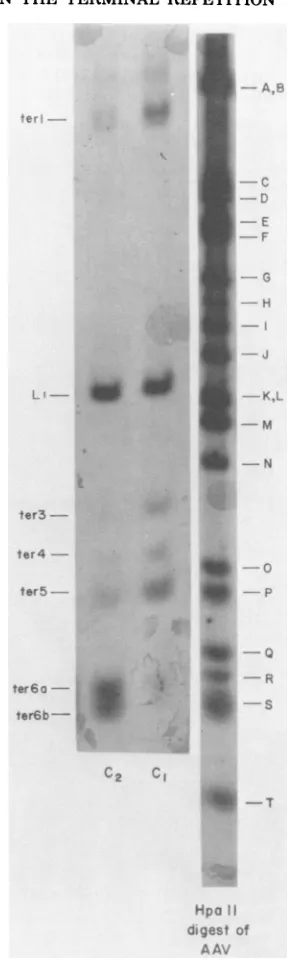
Hpa II terminal fragments. Because the terminal cleavage site of Hpa II is within the inverted terminal repetition, onlyasingle species of terminalfragment (i.e., the same from both ends)wouldbeexpectedifdouble-strandedAAV DNAhadanormaldouble helicalstructure with a single nucleotide sequence at the ends. Con-trary tothisexpectation,morethan six terminal fragments were produced by Hpa II digestion. The six terminal fragments reproducibly ob-served were designated ter 1 to 6 in order of increasingmobilityonpolyacrylamide gels. Sub-sequently, it was possible to resolve ter 6 into two species, designated ter 6a and ter 6b on higherpercentagegels.Todetermine the origins of the various Hpa II terminal fragments, the right and left ends ofduplex AAV DNA were separated before Hpa II digestion. Fragments ter 3 through 6 were produced from bothends and thus represent sequences restricted to the terminalrepetition (datanotshown).Fragment ter 1 comesfrom theright end and ter 2 from the leftend of themolecule, respectively. These species extend beyond the terminal repetition. As stated above, restriction endonucleases withterminalcleavagesitesoutsidetheterminal repetitionproduce twospeciesof terminal frag-mentsfrom eachend. Therelationshipofthese twospeciestothevariousHpa IIterminal frag-ments was determined. HindII +III C, andC2,
whichrepresent0.86 to 1.0ofAAVDNA,were
separated, labeled at the 5' termini with 32p
usingpolynucleotide kinase, and then digested
with Hpa II (Fig. 3). In spite of some cross
contamination,it isclearthatHpaIIter1, 3, 4,
and 5 were produced from HindII+III Cl and
that ter 6a and 6b were produced from HindII+III C2. Thus,themultiplicityofHpa II terminal fragments can be correlated, at least inpart,totheconformational differencesatthe ends of the DNA. Hae III alsocuts within the terminal repetition and produces multiple
ter-minalfragments. Thereis asimilar correlation ofthe various Hae III terminalfragments with HindII+IIIC1andC2 (datanotshown).
Previous studies have shown that half of the termini of double-stranded AAV DNA have a
normaldoublehelical structure (12). To deter-mine which Hpa II terminal fragments have aberrantsecondarystructures, anHpaIIdigest
4
I
-
0
4
ter3
ter4
-.-A
tef5 W
ter6a
ter6b--
,
eC2 r
J'b
I.Hpo digest cf
i
FIG. 3. AAVDNA wasdigested with HindII+III
and then labeled at the 5' ends with 32P by using polynucleotidekinase.Fragmentswereseparatedon
6% polyacrylamide gels and recovered. The two
HindII+III C fragments were each recovered and redigested with HpaII. 32P-labeled AAVDNA di-gested with HpaII was used as marker. L' is the internal terminal fragment of both HindII+III C1
andC2.
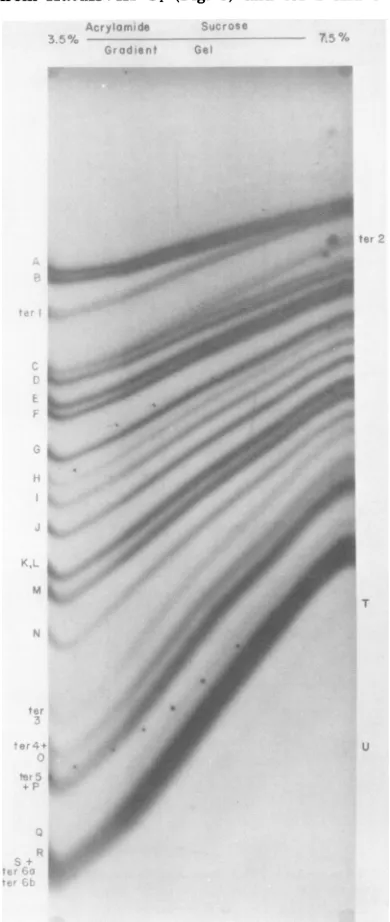
wasanalyzed by electrophoresis througha trans-versegradient gel of3.5to7.5%acrylamide. Hpa II ter 1 and ter 2 and, possibly, ter 3, havean
r
N
r!
R
S
VOL. 24, 1977
on November 10, 2019 by guest
http://jvi.asm.org/
[image:3.500.276.422.61.542.2]630 SPEAR ET AL.
aberrant mobility dependence on gel
composi-tion (Fig. 4) and presumably an aberrant
sec-ondarystructure.Becauseter 1 and3 originate from HindII+III C1 (Fig. 3) and ter 2 and 3
[image:4.500.60.255.110.571.2]._
FIG. 4. Transverse gradient gels of 3.5 to 7.5%
acrylamide of 2P-labeledAAVDNA and DNA
la-beledonthe 5'endwith
y-lP2PATP
byT4polynucle-otide kinase and then digested with Hpa I. The
specific activity ofminor species ofterminal
frag-ments are increased by this method and aberrant
migrationpatterns (ter I and ter2) are clearly evi-dent. ter 3 may also have an aberrant migration
pattern.
originatefromHae II C1 andBamHI B1 (data not shown), the decreased mobilities of
HindIL+III
C1,BamHIB1, andHae IIC1 reflect anaberrantsecondarystructure.To further document aberrant secondary structureinvariousHpa II terminal fragments, ter 1through6 weredenaturedand
electropho-resed underdenaturingconditionsthrough
poly-acrylamide (Fig. 5). Fragments with a normal double helicalstructureshouldproduceasingle
species ofsinglestrandsintermsoflengthand, thus,mobilityundertheseconditions. The exis-tence of multiple single-stranded species in a terminal fragment isstrongevidence foran aber-rantsecondarystructure. Theanalysisis some-whatcomplicated bythefact that 35% ofAAV single strands have the sequenceTT at the 5' terminus, whereas 50% haveonly a single T in thisposition (11) and thataone-nucleotide dif-ference inlengthisdetectable in thisexperiment. Nevertheless, the results were straightforward. Hpa II ter6a and 6b eachproduced only one
single-strandedspecies (actuallytwodiffering in lengthbyasingle nucleotide),andter6aproved to be four nucleotides longerthan ter 6b. The presenceofa minorityofshorterter6b species in the ter6achannel is consideredtorepresent initial contamination of6aby 6b. Hpa II ter 1 through5allproduced multiple speciesofsingle
strands with discrete mobilities. We conclude that all
Hpa
II terminal fragments other than ter 6a and 6breflect aberrant secondary struc-turesattheends of double-strandedAAV DNA. Additionally,weconclude that ends witha nor-mal double helical structure produce two ter-minalfragments, ter6aand6b, whichdifferin length by four nucleotides. Possiblereasonsfor thisareconsidered below.HpaIIcleavage sites within the terminal
repetition.The methodofSmith and Birnstiel (23)wasusedtodetermine thepositions of Hpa IIcleavage sites within the terminal repetition.
Double-stranded AAV DNA labeled at the 5' termini with
32p
was digested with BamHI. BamHIB2 (0to0.22),which hasanormal sec-ondarystructureattheterminus,wassubjected to apartial digestionwithHpaII.Thosepartial digestionproducts containingtheoriginal5' ter-minusof theDNAweredetectedby autoradiog-raphy afterpolyacrylamide gel electrophoresis, and the relative lengths of these species were determined. Theselengths correspondedto the distance of the various Hpa II cleavage sites from the end of the DNA. Cleavagesites were found 42, 46, 56, 66, 76, and 80nucleotidesfrom the end (Fig. 6). Analysis of the products of a complete Hpa IIdigestion showed that Hpa II Twasthepenultimate fragmentfrom DNA with a normalsecondaryterminal structure (Fig. 1).on November 10, 2019 by guest
http://jvi.asm.org/
IN
2 3 4 5 C: 7 8.&i j
_ F ..:.~~~,v ,
V500
400
K 300
F
200
100
5,
FIG. 5. Sizesofthe strandsofthe various terminal
species. Terminally labekedAAVDNA wasdigested
withHpa II, and the various terminalspecieswere
located andrecoveredfrom an8%polyacrylmamide
gel.Thesefragmentswerethendenatured and loaded
ontoahighresolutiondenaturing gel
(20%polyacryl-amide, 7M urea) along with marker fragments of
knownsize. Thescaleatleftgivestheapproximate
chainlength innucleotides. Column1, ter1; column
3, ter2; column 4, ter 3; column 6, ter 4; column 7,
ter5;column9,ter6a; column 10,ter6b; columns2,
5, and8, markerfragments consisting ofamixture
of HpaIIF,0,andQand HaeIII Cand L.
42 4 10 10 10 4 (a) 5'
ter61 T V (b 5 42 24 10 ter6A V T
c) 5, 46 101 24
FIG. 6. (a) Hpa II cleavage sites within the
termi-nalrepetition as determined by the Smith-Birnstiel
partial digestion technique (23). (b)and (c)
Interpre-tation of the origins of the pattern in (a) assuming
aninversion of the first120nucleotides in the
termi-nalrepetition.
Hpa II Tis 24nucleotides long and would not bepredicted fromthe results of the Smith-Birn-stieltypeofanalysis. Reasons forthis apparent paradoxarediscussedbelow.
DISCUSSION
Inthis paper we have further documented the existenceof two typesofsecondary structure at the ends of double-stranded AAV DNA, one with the properties of a linear double helix, the other with an aberrant secondary structure. These two types ofterminal structures are in-terconvertible bydenaturation andreannealing.
We had previously suggested that the hetero-geneity in terminalstructure wastheresult ofa limited number ofnucleotide sequence permu-tations of thetypeseeninvariousphage DNAs (12),but the present data donotseem compat-ible with this hypothesis. Itis more likely that there is some mechanism by which complete base pairing between the complementary
strands ofAAV DNA is prevented in the ter-minalregions about 50%ofthe time. The prob-lem with basepairingisconfinedtothe terminal
repetition because only Hpa II and Hae III fragments containing sequences withinthe ter-minalrepetition areaffected (i.e.,have alterna-tive secondary structure [K. Fife, Ph.D. thesis,
Johns Hopkins University, Baltimore, Md., 1977; I.Spear,Ph.D.thesis, Johns Hopkins Uni-versity,Baltimore, Md., 1977]).
Onepossibilityis thatthepalindromicnature of the terminal repetition (11) prevents inter-strand basepairing.This seemsunlikely fortwo reasons. (i) BamHIB1 produces equalamounts of B1 and B2 upon denaturation and renatur-ation. If the hairpin caused by self annealing within the terminal repetition were stable enough to resist branch migration, the above resultwould not beanticipated. (ii)Ifthe extent of self basepairingwithin the aberrant terminal structurewereconstant,onlyoneHpaII termi-nalfragment wouldbeproducedfrom this
struc-ture, yet thereare severalreproducible HpaII terminalfragmentsof this type.
631 24,
on November 10, 2019 by guest
http://jvi.asm.org/
[image:5.500.276.433.69.130.2] [image:5.500.58.234.81.539.2]Anotherpossibilitythat seemsmore likely is thatthereare twonucleotidesequences possible within the terminal repetition.Inthis case, com-plementarystrandswith appropriatenucleotide sequences in theterminalrepetition would have ends with a normal double helical structure, whereasamismatch in this regionwould result in anaberrantterminal secondarystructure. The results illustrated in Fig.2 arecompatible with thispossibility. The occurrence oftwo Hpa II terminal fragments (ter 6a and 6b) from ends with anormalsecondarystructure arealso com-patible with this idea, although two adjacent HpaIIsitesmight yield thesameresults. Prob-ably the best evidence fornucleotidesequence heterogeneityistheapparent paradoxbetween the results of complete Hpa II digestion and themapping of HpaIIsites withintheterminal repetition by the Smith-Birnstiel partial diges-tiontechnique (23). NotwoHpaIIsites within the terminal repetition are greaterthan 10 nu-cleotides apart, yet complete Hpa II digestion yields Hpa II T, which is 24 nucleotides long and within the terminalrepetition. Itmightbe arguedthatHpa II cannot cleaveasecondsite within 24nucleotides of aninitial site of cleav-age, but we know this is not true because the smallest fragments seen in Fig. 4 are about 10 base pairs in length. The problem is simply resolved if there are two possible nucleotide sequences.
The extent of possible nucleotide sequence heterogeneity within the terminal repetition is limited. We have reported that the first seven nucleotidesarethesame atthe5'termini of all AAVstrands, with the exceptionofthe number of 5' terminal Ts (0, 1, or2) (11). By using the Maxam-Gilbert methodof DNAsequencing (19) wehave extended thisanalysis (Fife,Ph.d. the-sis). The unique5'terminalnucleotidesequence extends for 41 nucleotides. At this point the sequence diverges. Similarly, nucleotides 79 through 140 are constant and, tentatively, 79 through 120 are palindromic to 1 through 41. Thus, anyheterogeneitymust occurfrom posi-tions 42 through 78. Interestingly, all the Hpa IIsites are within thisregion.
Therefore, it appears that there are two pos-sible nucleotide sequences within the terminal repetitionandthat the actualheterogeneity oc-curs from positions 42 through 78. We would like to suggest that the heterogeneity results from two possible orientations of nucleotides 1 through 120. Half ofthetime thesenucleotides would be in the reverse orientation (i.e., an in-version or flip flop). This model would be in
agreement with both the nucleotide sequence data and the data from theSmith-Birnstiel-type
experiment, as illustrated in Fig. 6. Additional
sequencing datasupport this model. At the in-board end ofter6b theHpa II site is
immedi-I1
atelyadjacentto anHae IIIsite (5'GGCCGG3', nucleotides40through 45), whereas theHpa II site creating ter 6a is separated from the same Hae III site by four nucleotides
l
I
(5'GGCCGCCGG3', nucleotides 40through 48). The complements of these two sequences are
resolvable at the outward 5' terminus of two species ofHpa II I (the fragmentwithin which the left terminal repetition ends) (Fife and Berns,manuscriptinpreparation).
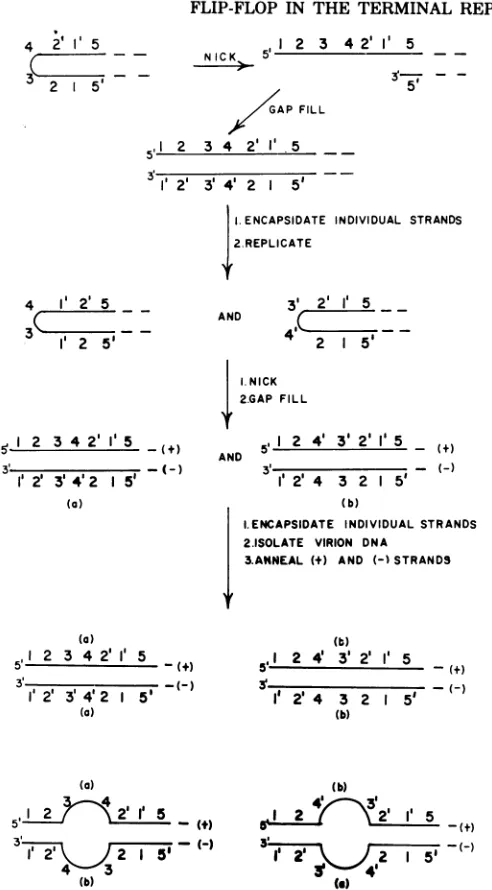
Apossibleorigin for the inversion is illustrated inFig. 7. Terminal covalent hairpinstructures
have been postulated in models ofparvovirus DNAreplicationbasedonboth invitro data for minute virus of mice (25) and invivo data for AAV (15, 24) as possible sites of the origin or
termination of DNA synthesis. Hauswirth and Berns(15)suggested thepossibilityof the trans-fer of the terminal repetition from parent to
progenystrand. In the modelpresented in Fig. 7,thenumbers1through5representnucleotide sequences within the terminalrepetition,and 1' through5' representtherespective complemen-tarysequences. Positions 1 through41 are rep-resentedby1,2; 42through78by 3,4;79through 120 by 2',1'; and 121 through 140 by 5. There would beanunpairedregionattheactual hair-pin, which would involve the 37 bases repre-sentedby3,4. Thehairpincould be nickedbya
site-specific endonuclease approximately 20
bases from the inboard end of the terminal rep-etition between 1 and 5' creating a
single-stranded 5' terminus. The resultantgapwould then be filled in by DNA polymerase, and the individual plusandminusstrands would be en-capsidated.Asecond round ofreplication, nick-ing, gap filling, and strand separation would result in halfthe encapsidated strands having oneorientation of the first 120nucleotides and the other half having the reverse orientation. Purification of this DNA andannealing ofplus and minus strandswould leadtohalf thetermini having a normal double helical structure and the other half having mismatching of some bases.
We are nowinvestigating further theHpaII partial digestion products to more rigorously testthe inversionhypothesis.
J.. VIROL.
on November 10, 2019 by guest
http://jvi.asm.org/
FLIP-FLOP IN THE TERMINAL REPETITION 4 2' I' 5
2 5'
NICK 511 2 3 4 2' I' 5
53
>/GAP FILL
51 2 3 4 2' '.5
2' 3' 4' 2 1 5'
1. ENCAPSIDATE INDIVIDUAL STRANDS 2.REPLICATE
y
4 I' 2' 5
3
I' 2 5'
1 2 3 4 2' I'5 (+
3.
'2' 3' 4' 2 1 5'
(a)
(a)
511 2 3 42'1' 5 ()
3-I' 2' 3'4'2 1 5' (a)
(a)
3.
'
2' 2
(b)
3' 2' 1' 5
AND
4 2 1 5@
I.NICK 2.GAP FILL
5.1 2 4 3'2'15 _ +
AND~~~~~~~~~+
I' 2' 4 3 2 1 5' (b)
I.ENCAPSIDATE INDIVIDUAL STRANDS 2.ISOLATE VIRION DNA
3ANNEAL (+) AND (-)STRANDS
(b)
1 2 4 3' 2' V' 5
2' 4 3 2 1 58 (b)
(b)
4' 3'
1~l2 21 15 T
3'
[image:7.500.127.373.54.499.2]-(a)
FIG. 7. Model for the origin of two nucleotide sequence orientations (inversion) within the terminal
repetitionof AA V DNA. Nucleotidesequenceswithintheterminalrepetitionarerepresentedby1 through5,
and1' through5' arethecomplementarysequences. Theproposedsequenceforthe terminalrepetition is
123471'5(seetextfor details). Duringreplication,acovalent hairpinstructureformstolinkplusandminus strands. Thehairpin isnicked bya site-specific endonuclease between 1 and5', and the resultantgap is
filledby DNApolymerase. Afterstrandseparationandencapsidation,asecond round of replication, hairpin
formation,nicking,gapfilling, andstrandseparationresults inequal numbersof both nucleotidesequence
orientations in the terminalrepetition ofencapsidated DNA. Isolation of virion DNA and annealing of
complementarystrands results infourclassesof duplex ends; twofullydoublehelical andtwoincomplete
duplexeswithnon-based-paired regionswithin theterminalrepetition.
ACKNOWLEDGMENTS
This workwassupportedby Public Health Servicegrant
1 P01CA 16519-02 from theNationalCancerInstitute. We thankA. MaxamandW. Gilbert forcommunicating
toustheirsequencingtechniquepriortopublication.
LITERATURE CITED
1. Atchison,R.W.,B.C.Casto, andW.Hammon.1965. Adenovirus-associated defective virusparticles.Science 149:754-756.
2. Berns, K. I. 1974. Molecular biology of the
adeno-asso-633
on November 10, 2019 by guest
http://jvi.asm.org/
ciatedviruses. Curr. Top.Microbiol. Immunol. 65:1-20. 3. Berns, K.I., and S. Adler. 1972. Separation of two types ofadeno-associated virus particles containing comple-mentarypolynucleotide chains. J. Virol. 9:394-396. 4. Berns, K.L, and T. J. Kelly, Jr. 1974. Visualization of
the inverted terminal repetition in adeno-associated virus DNA. J. Mol. Biol.82:267-271.
5. Berns, K.I., J. Kort, K. H.Fife, E. W. Groggan, and I. Spear. 1975. Studyofthe fine structure of adeno-associated virus DNA with bacterialrestriction endo-nucleases. J. Virol. 16:712-719.
6. Berns, K.I., and J. A. Rose.1970.Evidencefor a single-stranded adeno-virus-associated virus genome: isolation andseparation ofcomplementarysingle strands. J. Vi-rol. 5:693-699.
7.Carter, B. J., K. H.Fife, L. M. de la Maza, and K. I. Berns.1976.Genome localization ofadeno-associated virus RNA. J. Virol. 19:1044-1053.
8.Carter, B.J.,G.Khoury, and D. T. Denhardt. 1975. Physical map and strand polarity of specific fragments ofadenovirus-associated virus DNA produced by en-donuclease R EcoRI. J. Virol. 16:559-568.
9. de la Maza, L., and B. J. Carter. 1976. Cleavage of adeno-associated virus DNAwithSal I, PstI,andHae II restriction endonucleases. Nucl. Acids Res. 3:2605-2616.
10. Denhardt, D.T., S.Eisenberg,K. Bartok, and B. J. Carter. 1976.Multiplestructuresofadeno-associated virus DNA: analysis ofterminally labeled molecules withendonuclease R HaeIII. J. Virol. 18:672-684.
11. Fife,K., K.Murray,and K. Berns. 1977.Structure and nucleotide sequence of the terminal regions of adeno-associated virus DNA.Virology78:475-487.
12. Gerry,H.W.,T. J.Kelly,Jr., and K.I.Berns. 1973. Arrangement of nucleotide sequences in adeno-associ-ated virus DNA. J. Mol. Biol. 79:207-225.
13. Gilbert, W., A. Maxam, and A. Mirzabekov. 1976. Contactsbetween lac repressor and DNA revealed by methylation.InN.0. Kzelgaard and0.Maaloe (ed.), Control of ribosomesynthesis. The Alfred Benzon Sym-posium IX.Munksgaard, Copenhagen.
14. Glynn, I. M., and J. B.Chappell.1964.Asimplemethod
for the preparation of:2P-labelled adenosine triphos-phateofhigh specificactivity. Biochem. J. 90:147-149.
15.Hauswirth,W.W., and K. I. Berns. 1977. Origin and termination of adeno-associated virus DNAreplication. Virology 78:488-499.
16.Hoggan, M. D., N. R. Blacklow, and W. P. Rowe. 1966. Studies of small DNA virus found in various adenoviruspreparations: physical, biological and im-munological characteristics. Proc. Natl. Acad. Sci. U.S.A.55:1467-1471.
17. Jeppesen,P.G. N. 1974. A method for separating DNA fragments by electrophoresis in polyacrylamide concen-trationgradient slab gels. Anal. Biochem. 58:195-207. 18. Koczot, F. J., B. J. Carter, C. F.Garon, and J. A. Rose. 1973. Selfcomplementarity of terminal sequences withinplusorminus strands ofadenovirus-associated virus DNA.Proc. Natl. Acad.Sci. U.S.A. 55:1467-1471. 19. Maxam,A., and W. Gilbert. 1977. Anewmethod for sequencing DNA. Proc. Natl. Acad. Sci. U.S.A. 74:560-564.
20. Mayor, H. D., K. Torikai, J. L. Melnick, and M. Man-del. 1969. Plus and minussingle-stranded DNA sepa-ratelyencapsidated in adeno-associated satellite viri-ons.Science 166:1280-1282.
21. Richardson, C. C. 1965.Phosphorylation of nucleic acid by an enzyme from T4 bacteriophage-infected E. coli. Proc. Natl. Acad. Sci. U.S.A. 54:158-165.
22. Rose, J. A., K. L. Berns, M. D.Hoggan, andF. J. Koezot.1969.Evidence forasingle-stranded adenovi-rus-associated virus genome: formation ofaDNA den-sity hybrid on release of viral DNA. Proc. Natl. Acad. Sci. U.S.A.64:863-869.
23. Smith, H. O., and M. L. Birnstiel.1976. Asimple method for DNA restriction sitemapping.Nucleic Acids Res. 3:2387-2398.
24. Straus, S. E., E. D. Sebring, and J. A. Rose. 1976. Concatemers ofalternating plus and minus strands are intermediates inadenovirus-associated virus DNA syn-thesis. Proc.Natl. Acad. Sci. U.S.A. 73:742-746. 25. Tattersall, P., and D. Ward. 1976. Therolling hairpin:
a model for thereplication of parvovirus and linear chromosomalDNA. Nature(London) 263:106-109.
on November 10, 2019 by guest
http://jvi.asm.org/