City, University of London Institutional Repository
Citation: Smets, M. & Jarzabkowski, P. (2013). Reconstructing institutional complexity in
practice: A relational model of institutional work and complexity. Human Relations, 66(10), pp. 1279-1309. doi: 10.1177/0018726712471407This is the accepted version of the paper.
This version of the publication may differ from the final published
version.
Permanent repository link: http://openaccess.city.ac.uk/15116/
Link to published version: http://dx.doi.org/10.1177/0018726712471407
Copyright and reuse: City Research Online aims to make research
outputs of City, University of London available to a wider audience.
Copyright and Moral Rights remain with the author(s) and/or copyright
holders. URLs from City Research Online may be freely distributed and
linked to.
City Research Online: http://openaccess.city.ac.uk/ [email protected]
Reconstructing institutional complexity in practice: A relational model of institutional
work and complexity
Michael Smets and Paula Jarzabkowski
Abstract
This paper develops a relational model of institutional work and complexity. This model advances current institutional debates on institutional complexity and institutional work in three ways: First, it provides a relational and dynamic perspective on institutional complexity by explaining how constellations of logics - and their degree of internal contradiction - are constructed rather than given. Second, it refines our current understanding of agency, intentionality and effort in institutional work by demonstrating how different dimensions of agency dynamically interact in the institutional work of reconstructing institutional complexity. Third, it situates institutional work in the everyday practice of individuals coping with the institutional complexities of their work. In doing so, it reconnects the construction of institutionally complex settings to the actions and interactions of the individuals who inhabit them.
Keywords
Introduction
Debates over the nature of agency and the institutional terrain in which it occurs have recently captured institutional scholarship under the banners of ‘institutional work’ (Lawrence and Suddaby, 2006) and ‘institutional complexity’ (Greenwood et al., 2011). Both are connected insofar as the experience of institutional complexity, defined as the encounter of ‘incompatible prescriptions from multiple institutional logics’ (Greenwood et al., 2011: 317), has been associated with actors’ ability to create new institutional arrangements (e.g. Greenwood and Suddaby, 2006; Seo and Creed, 2002), the need to maintain existing ones in light of alternatives (e.g. Hirsch and Bermiss, 2009; Zietsma and Lawrence, 2010), and the opportunity to disrupt them through strategic responses (e.g. Oliver, 1991; Pache and Santos, 2010). However, despite these obvious connections between institutional complexity and institutional work, there has been little attention to the practice of working with institutional complexity (Jarzabkowski et al., 2009). Therefore, in this paper we focus on the mundane practices - on what individuals actually do in their everyday work – that construct and resolve institutional complexity.
dimensions of agency involved in constructing ‘constellations’ of logics (Goodrick and Reay, 2011). Our model extends existing understanding of institutional work and responses to institutional complexity in three ways.
First, it provides a relational and dynamic perspective on institutional complexity by explaining how, over time, practitioners can construct the same two logics and their associated practices as strange, contradictory, commensurable and complementary. Second, our relational model demonstrates how different dimensions of agency (Battilana and D'Aunno, 2009; Emirbayer and Mische, 1998) dynamically interact in the institutional work of constructing and reconstructing institutional complexity, providing a more nuanced understanding of agency, intentionality and effort than existing notions of ‘purposive’ institutional work (Lawrence and Suddaby, 2006). Third, it situates institutional work in the practical work through which individuals encounter contradictory institutional practices, negotiate adaptations that facilitate task accomplishment, and reconstruct their underlying institutional logics. In doing so, our model addresses recent critiques that institutional analysis has lost sight of the situated, socially constructed nature of agency and actors (Delbridge and Edwards, 2008; Delmestri, 2006; Hwang and Colyvas, 2011). As repeatedly called for, it re-connects the ‘macroworlds’ of institutions and the ‘microworlds’ of the actors who populate them (Kaghan and Lounsbury, 2011: 75; Lawrence et al., 2011).
Theoretical background
‘Institutional work’ (Lawrence and Suddaby, 2006; Lawrence et al., 2011) is the latest incarnation of the embedded agency debate, addressing the question of how actors become motivated and enabled to change the taken-for-granted practices and norms that supposedly define them (Seo and Creed, 2002). The idea of institutional complexity entered this debate when institutionalists discovered its role in promoting reflexivity and change (e.g. Greenwood and Suddaby, 2006; Seo and Creed, 2002; Thornton et al., 2005). The below review elaborates these connections and the gaps in existing literature that inform our research questions.
Institutional work
This view draws upon three dimensions of agency: iterative, projective, and practical-evaluative (Emirbayer and Mische, 1998). The iterative dimensions underpins the reproduction of established practices and institutions, which institutionalists have traditionally considered taken-for-granted and subconscious (DiMaggio and Powell, 1991). Emirbayer and Mische (1998) and other practice theorists (e.g. Giddens, 1984; Jarzabkowski, 2005), by contrast, consider iterative agency far from mindless, as it requires actors to recognize specific situations and choose appropriate behaviours from an almost infinite repertoire. The projective dimension, which supports planning and future change, dominates concepts of institutional entrepreneurship or creation (Battilana et al., 2009; Lawrence et al., 2009). The practical-evaluative dimension enables actors to exercise judgment and ‘get things done’ in the here and now (Tsoukas and Cummings, 1997). As such, it is arguably the most relevant dimension for studying how actors respond to, and construct, institutional complexity; albeit one that has received little attention in discussions of institutional work so far.
These three dimensions, ‘like notes in a chord’, jointly create the ‘tone’, or mode, of agency, ranging from reproductive to transformative (Seo and Creed, 2002: 222). Given the inaugural definition of institutional work as purposive and its strong institutional entrepreneurship heritage, the ‘chord’ of agency that Lawrence and Suddaby (2006) strike, remains dominated by overtones of projective agency. Thus, the promise of institutional work to provide ‘a broader vision of agency in relationship to institutions’ (Lawrence et al., 2009: 1) remains to be fulfilled.
as actors develop and realize their interests in particular institutional settings (Hwang and Colyvas, 2011). In addressing this gap, we respond to repeated calls to refine theories of intentionality and effort (Lawrence et al., 2009, 2011) and explore how institutional work is underpinned by different dimensions of agency (Battilana and D'Aunno, 2009). We do so, by drawing on practice theory, which maintains that the construction and maintenance of social order is always agentic and potentially surprising (Chia and Holt, 2009). Therefore, even mundane activity that is not aimed at social change constitutes an effortful accomplishment (Giddens, 1984; Jarzabkowski, 2005, 2008; Tsoukas and Cummings, 1997) and change may arise, inadvertently initially, from actors’ practical work (e.g. Chia and MacKay, 2007; Chia and Holt, 2009). Hence, a practice lens is particularly suitable for disentangling the different dimensions of agency and intentionality that underpin institutional work and the construction of institutional complexity.
socially accomplish the ‘shared practical understanding’ and social structure that preoccupies institutional theorists (Schatzki, 2001: 2; see also: Giddens, 1984).
Institutional complexity
legitimating audiences systematically collide in everyday operations and institutional complexity must be managed continuously.
However, despite recognition that institutional complexity can arise in – and from – everyday practice, suggested responses to such permanent complexity are largely structural (for reviews, see Greenwood et al., 2011; Pache and Santos, 2010). For instance, they advocate the compartmentalization of organizational units following different logics, (e.g. Lounsbury, 2007; Reay and Hinings, 2009), recruiting staff with no prior attachment to either competing logic (Battilana and Dorado, 2010), or leveraging organizational status to insulate from sanctions of external constituents (Greenwood and Suddaby, 2006). The lack of attention to individual-level, practical responses to institutional complexity is intriguing, given the increasing prevalence of individuals working across institutional divides (e.g. Jarzabkowski et al., 2009; Smets et al., 2012). We, therefore, identify three gaps that complement those identified in institutional work.
how a ‘vision’ of new institutional arrangements emerges from practical-evaluative improvisations (Battilana et al., 2009: 68). Third, the focus on choice has oversimplified the relationships between co-existing logics which have, with very few exceptions (e.g. Goodrick and Reay, 2011), been portrayed as binary – compatible or incompatible. There are thus calls to look beyond the prevalent imagery of conflict and to ‘delve deeper into the dynamic patterns of complexity’ (Greenwood et al., 2011: 334). The practice approach helps address such calls through a relational ontology (Emirbayer, 1997; Hosking, 2011), which assumes that complex social orders are always in flux, and continuously being constructed through practice (Chia and MacKay, 2007; Hernes, 2008; Tsoukas and Chia, 2002). Therefore, it enables us to unpack how individuals construct the relationality between logics within complex institutional environments on an ongoing basis within their everyday work.
In sum, literatures on both institutional work and complexity currently show related shortcomings. In particular, they oversimplify relationality between co-existing logics, under-emphasize the multidimensional nature of agency, and divorce discussions of institutional work and complexity from how individuals experience them in practice. Specifically, we examine the following research questions: How do individuals construct and reconstruct complex institutional environments in their practical everyday work?; and What are the implications of practical work for our understanding of effort, intentionality, and agency in institutional work?
Research Methods
Research design
Justitia, as a salient case to explore how individuals accomplish their practical work in
complex institutional environments.
Justitia is a global corporate law firm, created by an Anglo-German merger in the early
2000s. As a law firm, it partakes in a classic profession, characterized by strong institutional prescriptions for individual practice (DiMaggio and Powell, 1991). Being a ‘global firm’ that integrates a network of proprietary offices within a single organization, Justitia spans multiple jurisdictions, each with its own laws, professional logics, and practices (Morgan and Quack, 2005, 2006). Justitia’s banking group is a salient case of ‘the confluence and blending of [institutional] streams’ (Delmestri, 2006: 1517), as international banking transactions require lawyers to collaborate across offices in different jurisdictions. Managing the ‘jurisdictional overlap’ (Thornton et al., 2012: 57) of national laws, local professional regulations, and global financial market expectations in seamless cross-border services is thus the everyday work of banking lawyers in global law firms. We chose the banking group’s English and German offices as embedded sub-cases to maximize the potential for observing institutional work and complexity. Located in common-law and civil-law jurisdictions with distinct ‘institutional legacies’ (Morgan and Quack, 2005), the two offices allowed us to study both sides of an institutional divide within a single organization.
Data collection
field-level data to ascertain the institutional ramifications of our observations and triangulate emerging findings.
Observation Observation suits a practice perspective on institutional complexity and
work, as it captures both the reality of ‘work practices and relationships in situ’ (Barley and Kunda, 2001: 84) and ‘the ongoing negotiations between members and subgroups over the interpretations and understandings of this reality’ (Zilber, 2002: 237). Furthermore, it examines action and interaction at the individual, rather than collective level and avoids over-reliance on retrospective accounts in which activity may be portrayed as more purposive than it originally was (Chia and Holt, 2009).
intellectual and practical effort of completing cross-border banking transactions as well as efforts to construct their institutional ramifications.
Interviews Being around for social interactions facilitated informal interviewing to clarify
observations shortly after their occurrence. We then used more formal interviews to deepen our understanding of ‘how people make sense of their work and the issues they believe are important’ (Barley and Kunda, 2001: 84). In these interviews, we encouraged participants to elaborate on the nature of their work, the activities it involves, and how inter-office collaboration unfolds over the course of cross-border transactions. The main body of conversation focused on first-hand accounts of respondents discovering inter-jurisdictional legal inconsistencies and negotiating these with lawyers from different jurisdictions. As participants shared their views of appropriate practice, it emerged that not only were local legal interpretations contested, but also the practices that produced them, and the professional logics that underpinned their appropriateness.
We interviewed 17 solicitors in London, 16 solicitors in Frankfurt and 17 Rechtsanwälte in Frankfurt, covering all hierarchical levels from trainees, to associates to partners (Morris and Pinnington, 1998). We then accessed a group of five elite respondents, including Justitia’s senior partner, former managing partner, global head of banking and two founding members of the German office, bringing the interview total to 55 and accumulating 48 hours of recordings. All interviews were conducted in the respondent’s native language, tape recorded, transcribed, and translated into English where necessary.
Documentary evidence We initially triangulated observation- and interview-based
governing logics, and with public materials (e.g. marketing or recruitment materials, client newsletters, websites). Then, we perused law textbooks, professional codes of practice and training guidelines, but especially the publications of the English and German law societies (Law Society Gazette and BRAK-Mitteilungen) and the German Federal Bar’s Report on International Law Firms (BRAK, 2007) to evaluate firm-level accounts against field-level
evidence of institutional struggle (see Barley and Tolbert, 1997).
Data analysis
We used an open-ended analytic process in which we iterated between data, literature and tentative theories emerging from the data (Strauss and Corbin, 1998). NVivo qualitative analysis software supported the systematic nature of our analysis and helped assess the empirical prevalence of emerging analytical themes.
First, given our interest in how everyday practical work is accomplished in complex institutional environments, we began by writing a thick case description of what lawyers actually do when they do deals. From this description, we distilled a flowchart of banking transactions that disentangled the legal documents and practical activities required for completing cross-border banking transactions, including transaction structuring, document drafting and revising, commercial negotiating, and closing.
additional activities, such as reviewing existing documents, drafting supplementary documents, and discussing possible routes around legal issues. These activities, in participants’ words ‘test the commensurability of different legal systems’ (GER-A-21)2 and
ensure that English and German legal documents are enforceable in both jurisdictions. These data confirmed that it is in these activities that actors experience and resolve institutional complexity. Therefore, they formed the focus for our further analysis.
Third, we examined lawyers’ responses to this complexity, such as when they deviated from local institutional templates of professional practice, resisted pressures to deviate, or explained (shifts in) practice to each other or the researcher. We clustered these data into four distinct themes (Strauss and Corbin, 1998), which we labelled using participants’ own expressions as in vivo codes. A theme labelled ‘What are you doing?!’ was used for data that expressed ‘surprise’ and ‘lack of understanding’ as people face deviations from the ‘taken for granted’. The ‘How can you do that?’ theme clustered data characterized as ‘bullying’, ‘entrenchment’, and ‘internal fighting’ in which practitioners ‘make sure that you’ve pushed [the other] as much as you can’ (ENG-P-47). These two contrasted with a third theme, labelled ‘Let’s try this’, which crystallized around passages that described lawyers as ‘more understanding’, ‘sympathetic’, able to ‘work together’, ‘throw ideas’, and ‘invent fixes’. In the fourth theme, ‘This is how we do it!’, we clustered data describing a new ‘hybrid amalgam’ or ‘happy compromise’ between local practices, and reports of managerial initiatives or tools to support cross-border collaboration, which provided a ‘sort of lingua franca in which to communicate and do the deals’ (ENG-P-49).
cues woven into the raw data. Lawyers’ tendency to explain their practices in relation or contrast to how lawyers from another jurisdiction would work given their training and socialization, suggested practice-theoretical notions of relationality and ‘other’ as helpful concepts for theorising the socially constructed relationships between their local ‘professional self-conceptions’ (ENG-P-44), or logics. Based on this analysis, we developed the following conceptual labels for the relationship between logics in each theme: strange (What are you doing?); contradictory (How can you do that?); compatible (Let’s try this!); and complementary (This is how we do it!). Consistent with our empirically-grounded approach,
we retain the empirical labels to structure our case study account and use the more conceptual labels to theorize our findings.
Fifth, in order to understand the process of responding to, and reconstructing, institutional complexity, we looked for any temporal order to our four themes (Langley, 1999). Drawing on participants’ own juxtapositions of an ‘old story’, in which cross-border work was contested, and the emerging hybrid practice, organized around mutual adjustment, we ordered and interpreted our four themes as representing four empirically entangled, but analytically distinct phases in the transition from contested to collaborative forms of cross-border work. Specifically, we saw the four phases as unfolding in a processual relationship, in which the activities and inter-logic relationships that emerged in one phase, triggered and shaped the next phase. In light of their empirical manifestation in our data and our practice theoretical framing, we labelled these transitory conditions novel institutional complexity, polarization, work-level crisis, expanded practice repertoire, and embedded reconstructed relationality.
Finally, we explored the activities in each phase with a view to their underlying mode of agency. To do so, we followed others who have examined agency empirically, by looking at specific actions and their (non)-compliance with established institutional templates (e.g. Barley and Tolbert, 1997; Jarzabkowski, 2008) or displays of heightened reflexivity and awareness (e.g. Greenwood and Suddaby, 2006; Seo and Creed, 2002). Practically, we looked for accounts or incidents in which cross-border collaboration made practitioners ‘aware’ or forced them to ‘think about things that you otherwise take for granted’ (ENG-A-4). Such data pointed to instances of reflexivity and practical-evaluative agency, particularly when contrasted with actors’ accounts of their ‘taken for granted’ professional templates, which suggested a more iterative mode of agency (Emirbayer and Mische, 1998). Moreover, the mantra of ‘getting the deal done’ highlighted that lawyers’ efforts in more collaborative cross-border engagements were not targeted at (planned) change, as the institutional work literature would suggest (e.g. Lawrence and Suddaby, 2006). Instead, it was aimed at accomplishing the work task at hand, which resonated strongly with practice-theoretical concepts of coping (Chia and MacKay, 2007), and a practical-evaluative, present-oriented dimension of agency (Emirbayer and Mische, 1998). Later though, when Justitia aimed at generating capacity for future cross-border transactions, rather than closing the current one, we found the projective dimension of agency to dominate.
The case study
Historical, institutional and transactional context
The late 1980s and early 1990s saw a gradual rapprochement of the English and German financial and legal markets. Post-reunification privatisation and infrastructure projects and management buy-outs of the retiring founder generation of the SME sector required financing that the traditional German Hausbank system with bilateral lender-borrower relationships could no longer provide (Lane, 2005). Growing demand for high-volume, ‘syndicated’ finance entailed growing demand for legal experience with international capital markets and their norms and expectations. Leveraging their size and experience with syndicated finance transactions in their home jurisdictions, Anglo-American lawyers started trickling into Germany before a wave of cross-border mergers cemented their presence around the year 2000 (BRAK, 2007; Morgan and Quack, 2005).
Accordingly, the documents they draft comprise only a few pages because they can ‘imply’ these pre-existing statutes (Avenarius, 1997).
By contrast, English common law is ‘case law’ that affords contracting parties extensive freedom of contract in their agreements (Halliday and Karpik, 1998). The legal profession is split between court-facing barristers and client-facing solicitors (Reeves and Smith, 1986). Solicitors’ practice, taking care of clients’ legal business and their interests in commercial affairs, is informed by a client service logic (Brint, 1994). Trained to make ‘the client’s business [their] first concern’ (SRA, 2007: 16), solicitors proactively exploit the room for manoeuvre inherent in case law to realize their clients’ commercial goals. Established contract formats such as the Loan Market Association’s (LMA) template for finance agreements materially reflect this practice. As lawyers negotiate and document a stand-alone system of clauses and remedies that reflects client interests, they easily comprise several hundred pages for a single transaction (LMA, 2008).
These contradictory logics and practices constantly collide in the transactional work of Justitia’s banking lawyers. In syndicated finance transactions, an ‘arranger’ bank, with the
banks and meet rating agencies’ demands to obtain a favourable rating for resulting financial products. Due to London’s dominance in the European syndicated finance market, and the extensive freedom of contract English law offers, these contracts are governed by English law as the ‘law of choice’ and, hence, were traditionally the domain of English lawyers in Justitia’s banking group. As finance agreements are considered ‘where the real action is’ (GER-P-36), they also gave English lawyers close contact with the client and control over transaction progress.
Conversely, under international law, collateral assets that secure financing must be governed by the law applying at their location. This means that for finance secured on German assets, German lawyers must review their English colleagues’ finance agreement to ensure that English-law contract clauses are enforceable in Germany and must then draft a commensurate security agreement. Where problematic clauses, wordings, or concepts are surfaced, English and German lawyers within Justitia negotiate which documents to adapt, and how, before they can be handed to their counter-party. Thus, in aligning their respective legal documents for a seamless cross-border service, English and German lawyers tackle the institutional complexity that arises from the jurisdictional overlap of their legal systems and professional norms. We now present the four phases through which this alignment process typically unfolds and in which lawyers construct the relationships between their legal documents and the practices and logics that produce them.
Phase 1: ‘What are you doing?’ - Actors encounter strange alternatives
that without intentionally ‘being difficult’ (ENG-A-18), the others persisted in doing contracts ‘the way they had been brought up’ and in doing so ‘overlook that not everybody is like them’ (GER-A-21). In German lawyers’ practice, for instance, this entailed deleting from English-law contracts supposedly superfluous clauses that they assumed to be automatically implied; or sending lengthy memos deliberating whether a certain English-law concept would be enforceable in Germany, rather than providing suggestions how to ensure it is.
Based on their assumption that ‘the loan leads, the asset [security] follows suit’ (ENG-P-47) and that extensive freedom of contract was a universal feature, English lawyers expected their German colleagues to give precedence to the English-law finance agreements and to circumnavigate legal obstacles in pursuit of clients’ goals. They were surprised when German lawyers, trained to diagnose rather than solve problems, would conclude that certain financial or legal structures ‘just cannot be done’ (GER-A-31). In addition to the many semi-conscious utterances of ‘this can’t be right’ or ‘this doesn’t work’ that we heard as lawyers encountered the other jurisdiction’s legal concepts as ‘strange’, one English associate pointed out:
I definitely was surprised in the workgroup that there were people saying: “Well you just can’t do that.” And, maybe I don’t appreciate what you really can’t do under whatever continental law, but, I mean, I would never say that. (ENG-A-20)
working, however, quickly turned surprise into polarization, which shaped the next phase of engagement.
Phase 2: ‘How can you do that?’ – Contradictions crystallize
English lawyers dismissed German colleagues as ‘analysts, rather than problem-solvers’ (ENG-P-44) and their ‘academic’ (ENG-P-52), law-focused approach as unprofessional and not fit for purpose under their own client-service logic. As a consequence, German lawyers found that English colleagues tried to ‘impose legal solutions that are not always possible’ and applied pressure to ‘make it work’ (GER-A-34). Even an English partner observed of her colleagues:
They have no willingness, I think … to understand the [German] non-common law jurisdictions and what the issues may be there. And then friction starts straight away. Because their whole attitude is just: […] “We want it”, when they don’t really understand, I think, what they’re asking for. (ENG-P-2)
In response to this approach which one German partner denounced as ‘imperialistic’, German lawyers began to ‘really entrench in their way of doing things’ (ENG-P-2) and, when pressured to change their practices, to insist that ‘sometimes it’s just “no”!’ (GER-A-31). They did so to the extent of forcing entire transactions to a halt so that English-law agreements could be amended to reflect their concerns, arguing that ‘if something is not valid, then I cannot give a legal opinion for it, then the deal doesn’t get done. Period.’ (GER-A-42).
light of these, they urged their English colleagues to understand that some of their concepts and practices could not be maintained in a civil-law system. English lawyers found this difficult to accept, given their client-service logic and assumption of freedom of contract. They articulated the same problems as commercial and, focusing on client goals, argued that ‘you have to not look at the law books, but see how you can fit the law into the business’ (ENG-T-9).
Hence, for English lawyers, the content and format of their documents was not exclusively, or even primarily, governed by law. In their view, courts would not normally get to pass their verdict on these agreements, because ‘nobody is really relying on the general operation of law in these transactions’ (ENG-P-47). Instead, they form self-contained agreements, structured to resolve disputes without recourse to a local court, which, English lawyers maintained, invalidated their German colleagues’ arguments. Therefore, they prioritized the demands of their clients and the expectations of the global financial market in which syndicate banks, rating agencies and trade associations such as the LMA, maintained ‘an accepted way of doing things’ (ENG-A-4). They insisted on the wording and format of the LMA template and justified their insistence with reference to the delays and rate increases that deviations from the accepted standard would entail. An English associate summarized:
The moment you need to syndicate and sell the deal outside of Germany you need to accept what is customary in the international market and that is the kind of [LMA] documentation that we use and that's just a fact of life. (ENG-A-38)
legitimacy of its associated practices. However, entrenchment and disruption produced a work-level crisis that alerted English and German lawyers to the unsustainability of their contentious relationship and, as we show in the next phase, triggered a new mode of collaboration.
Phase 3: ‘Let’s try this…’ – Compatibility is constructed
Given the collaborative relationship between banks, borrowers and lawyers for the counter-party in banking transactions, clients showed no tolerance for delays resulting from disagreements among their own lawyers. They put increased pressure on Justitia to get the deal done; pointing out that missing transaction deadlines or increasing costs of syndication by using non-standard contracts would lose Justitia future deals. Hence, over the course of numerous discussions, lawyers realized that delaying transactions with in-house debates did ‘not inspire confidence’ (ENG-A-24) in Justitia’s ability as a globally integrated firm. In fact, they found themselves ‘at each other’s mercy’ (GER-A-42) in terms of closing deals and living up to the expectations of a global firm. Thus, motivated by client pressure and enabled by a growing understanding of institutional alternatives, they began to review those local practices that interfered with task accomplishment. In the absence of any templates for managing the new complexity of their transactions, they jointly experimented and, in so doing, began to reconstruct their own practice in relation, rather than opposition, to the foreign alternative.
dealt with the subsequent German-law constraints. Now they switched to making these constraints the starting point of their original drafting. English lawyers conceded that ‘there is no point in drafting an English-law loan agreement until you understand the jurisdiction you are lending to’ (ENG-P-23) and introduced a ‘local-law due diligence’ to anticipate stumbling blocks, pre-empt discussions, and produce quicker, seamless services. An English associate summarized his new approach:
Your starting point won’t be: “I always structure an English deal like this.” You’re going to say: “Hmm, I need to think about how I’m going to structure it, because they’re not all English parties … and different legal systems take a completely different approach to pretty basic premises of law. (ENG-A-4)
This change in practice was significant, insofar as it contravened English lawyers’ fundamental assumption of freedom of contract, partially relinquished their control over those English-law documents that were thought to ‘lead’ the transaction, and gave credence to the previously mocked law focus of German colleagues as a starting point for their discussions.
first step to experimenting with alternative legal routes in Germany, they also found that ‘explaining it to colleagues abroad forces you to think about things that you otherwise take for granted.’ (ENG-A-18).
Bringing lawyers from both jurisdictions to ‘think together to find out what is commercially wanted and how it can be legally implemented’ (GER-P-3) also significantly modified German lawyers’ working practice. While previously, pointing out civil-law issues formed the end point of their analysis, doing so in their English colleagues’ ‘local-law due diligence’ now forms the starting point of their work. They started to use traditionally English proactive elements in their practice, ‘trying to translate the English concept - legal concept - into the local law’ (ENG-P-52). To do so, they would carefully select and arrange familiar civil-law building-blocks that individually resonated with local normative categories, but collectively realized the intended commercial outcome. A German associate summarized this shift in practice, which embraced the pragmatism and client-orientation that originally characterized his English counterparts, saying that ‘now we come with a self-conception that we solve the problem or [that] we have a toolkit we can work with and we can achieve what the clients want’ (GER-A-42).
Concurrently, based on their interactions with English colleagues, German lawyers acknowledged syndication as a certainty in their class of transactions. Thus, they now considered the concerns of prospective syndicates in their contract wording and format, because:
agreements … have certain expectations what it does and doesn’t say in there. (GER-P-36).
This change in attitude had an important practical consequence: German lawyers could no longer imply civil-law statutes in drafting their security agreements. Rather, they had to adopt a common-law approach, spelling out every clause and definition in detail, and inflating their documents from only a few to several hundred pages. As an associate recalled:
Ten years ago, a German contract was three pages long. Everything else was in the [German civil code]; whereas English contracts were about 100 to 150. Now they are about the same. […] And now every clause is specified in the contract. (ENG-A-17)
In combination, these practice adaptations - emulating English-law concepts by combining different German-law building blocks and drafting German-law documents in accordance with finance market expectations – allowed lawyers to satisfy both local and global audiences of their work. They ensured ‘content is modelled to requirements of the civil code, but the way the document looks is very much standardized’ (GER-A-22).
English in the way of doing deals and of transacting’ (ENG-P-23). Hence, an expanded practice repertoire emerged, comprising both traditional local practices and new hybridized practices, which triggered the next phase of working within the two logics.
Phase 4: ‘This is how we do it!’ - Complementarity is codified
As practices were blended under a common logic, cross-border collaboration did not lead to the displacement of one set of practices by another. Instead, joint improvisation expanded lawyers’ practice repertoire and kept both sets of local practices available to be activated by transaction-specific demands. German and English lawyers concluded that engaging in cross-border work ‘ultimately broadens the horizon for both’ (GER-A-22). This meant that German lawyers could do large-scale financings to the standards of the international financial market, but could equally return to their old ways if a domestic client preferred. Likewise, they noted that:
English lawyers are getting more used to working different styles so that it doesn’t have to be the one they’re used to. As long as [issues] are covered, the way they are recognized doesn’t have to be identical to their standards. (ENG-A-44)
jurisdictions that would need to be accommodated in drafting or addressed during cross-border discussions. Similarly, the group instituted a formal secondment programme between the English and German offices, both for trainees who rotate offices quickly as well as for English-qualified associates who permanently provide English-law advice in the German office. Lastly, ‘best practices’ in cross-border collaboration were agreed in 2005 and then disseminated throughout the firm to embed the new practice and its inherent client-service logic in the organization and build capacity for future cross-border collaboration.
A practical manifestation of lawyers’ expanded practice repertoire and their purposive intervention to facilitate future deals was a German-law LMA template that Justitia’s lawyers developed in conjunction with colleagues from other large law firms. This template combined the best of both worlds by spelling out in full the core elements of the agreement, while making implicit reference to the German civil code for more standard elements. Its development drew on a blend of German lawyers’ original and newly acquired skills and English lawyers’ growing understanding of the German legal tradition. In doing so, English and German lawyers reconstructed the complex institutional environment in which they worked by reconfiguring conflicting logics and especially their constitutive practices as complementary:
Ultimately, the embedding of both local and hybrid practices in formalized templates enabled English and German lawyers to extend their professional horizon and zone of competence. These embedded practices reconstructed the relationship between previously contradictory logics and their constitutive practices as complementary, so altering actors’ experience of the complex institutional environment in which they work.
Discussion: Constructing institutional complexity at work
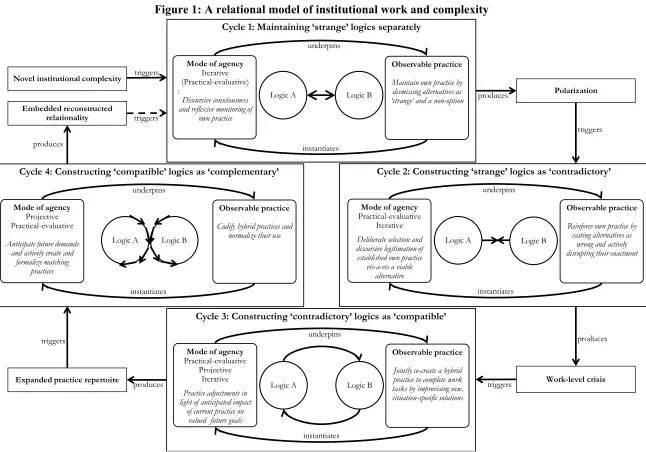
instantiated are empirically entangled, we distinguish them conceptually in the model in order to explore the nature of agency, effort and intentionality in the reconstruction of institutional complexity at work. We connect the four cycles through transitory conditions, respectively labelled novel institutional complexity, polarization, work-level crisis, expanded practice repertoire, and embedded reconstructed relationality, which emerge from the reconstruction of relationality in one cycle and trigger the next.
INSERT FIGURE 1 AROUND HERE
We now elaborate the dynamics of each cycle individually, showing the more or less intentional and effortful construction of institutional complexity by individuals at work. In doing so, we contribute to the literatures on institutional work and institutional complexity by explaining (i) the interplay of different forms of agency; (ii) their effect on the effort and intentionality of institutional work; and (iii) the construction of institutional complexity.
Cycle 1: Maintaining strange logics separately
While cross-border work made English and German lawyers aware of an alternative practice and more sensitive to the limited ‘sharedness’ of the understandings underpinning their own practice (Schatzki, 2001), the first phase of cross-border collaboration in Justitia was characterized by maintenance of established templates. Despite the noted presence of an alternative, people continued ‘the way they had been brought up’. Hence, in contrast to existing models which leap from awareness to action (e.g. Seo and Creed, 2002), we find that actors initially continue to perform their local practices in established ways. This persistence, however, is neither mindless nor effortless. Surprised by the presence of an unexpected alternative, actors can no longer continue business as usual, but, as in our case, are forced to ‘think beyond’ - and be critical of - their own practice. Actors have to select their established practice from among an array of available alternatives and reflexively monitor its performance, which makes it more effortful even just to ‘go on’ (Giddens, 1984: 43; see also Emirbayer, 1997). Therefore, despite the lack of intention to initiate change or actively rebut an alternative that institutional scholars would commonly focus on (e.g. Lawrence et al., 2009; Seo and Creed, 2002), the continuation of a previously taken for granted practice under conditions of institutional complexity constitutes an effortful accomplishment (Giddens, 1984; Jarzabkowski, 2005, 2008).
mode of agency that underpins actors’ observable practice in this cycle remains dominated by an iterative dimension, as illustrated by their arrangement in Figure 1. In contrast to existing work that associates the encounter of institutional alternatives with purposive action, aimed at either fending off or pursuing a potential alternative (e.g. Greenwood and Suddaby, 2006; Lawrence and Suddaby, 2006; Seo and Creed, 2002), we find that the projective agency implicit in these accounts did not feature in this initial cycle.
Dismissing another logic or practice keeps it separate from the established local alternative, as illustrated by the opposing arrows between logics A and B in Figure 1. In our case, by casting foreign lawyers’ practice as strange, awareness spawned caricature and reinforced, rather than undermined, lawyers’ knowing instantiation of their respective local logics. As any situation is related to some ‘other’ situation, which may be more or less similar to one’s own, the specific relationality between those situations is not given, but constructed (Emirbayer, 1997; Hosking, 2011). Importantly, the construction of a specific relationality informs specific forms of institutional work, such as maintaining existing practices by keeping them separate from alternatives that are constructed as ‘strange’. While Kaghan and Lounsbury (2011: 75) emphasize that ‘the self (and intentionality) cannot be understood without reference to the particular “others” in which the acting individual is embedded’, the active construction of those ‘others’ and especially of their relationality to actors’ own situations, have so far been neglected in institutional studies. Hence, in unpacking how specific forms of institutional work are underpinned by a specific construction of the ‘other’, our model extends current understanding.
298; see also Boussebaa, 2009; Currie et al., 2008). Such polarization, as our case showed, triggers a new cycle in which the relationality between logics is reconstructed.
Cycle 2: Constructing strange logics as contradictory
In parallel, the mode of agency in this cycle is no longer dominated by the iterative dimension, but by the practical-evaluative, as illustrated by their altered position in Figure 1. In the presence of a viable alternative, actors can no longer fall back on previous, known practices, but have to deliberately evaluate both practices and choose the established option, which they then iteratively enact. Such agency is not projective, as the purpose of work remains practically located in the moment. For instance, lawyers challenged each other in order to complete the transaction at hand, rather than to change its institutional environment. Yet, despite the lack of intention to change institutions, practical work does have institutional effects, insofar as it purposively maintains established practices and rejects alternatives informed by other logics. This nuance has so far not been shown in studies of institutional work (Lawrence et al., 2011).
In particular, selection and dismissal of alternative practices enact a reconstructed relationality between co-existing logics. Through their polarization and subsequent conscious rejection of practices informed by an alternative logic, actors shift the relationality of these co-existing logics from strange to contradictory, as illustrated by the opposing arrows between logics A and B in Figure 1. In our case, for instance, lawyers on both sides maintained their established practice by evaluating the alternative as ‘wrong’, in order to assert their own as ‘right’ with reference to their local professional logic. This shift in relationality from ‘strange’ to ‘wrong’, constructs the alternative logic as illegitimate and produces the insistence and entrenchment discussed above (Hargrave and Van de Ven, 2009; Jarzabkowski et al., 2009; Suddaby and Greenwood, 2005).
the deal done’, this entrenchment produced a ‘work-level crisis’ (Smets et al., 2012: 892), as lawyers faced tight transaction schedules to resolve their differences, and avoid potential financial and reputational losses associated with delays. As shown in Figure 1, a work-level crisis triggers a new cycle of institutional work. It alerts actors that their insistence on local practice is at odds with the complexity of their new institutional environment (Delmestri, 2006) and prompts them to explore new ways to accomplish their work within these new complexities.
Cycle 3: Constructing contradictory logics as compatible
The sense of crisis that the lawyers in our case experienced when struggling to get the deal done despite institutional disconnects overcame entrenchment and precipitated mutual adjustment. The nature of this precipitator is important, as it enables us to theorize the nature of effort and intentionality, agency, and inter-logic relationality we find in this cycle.
up’ (Jarzabkowski et al., 2012). Rather, actors reconstruct the existing social order in which they are embedded in response to immediate demands, enabling business to continue while new solutions emerge and are tested.
Nonetheless, although the intent that individuals develop in coping with institutional complexity is not necessarily aimed at reshaping institutional arrangements, it would be misleading to label these institutional consequences as outright unintentional. Rather, in taking the practice perspective seriously and refining our understanding of intentionality in institutional work, it is necessary to differentiate the object that actors’ intent is directed at; in our case the completion of work tasks in a complex institutional environment.
This intentionality is reflected in the mode of agency, which shifts from a combination of practical-evaluative and iterative dimensions to a strong dominance of practical-evaluative judgement with some iterative and projective additions. In our case, as pressure for change originated in the situation-specific demands of individual tasks, lawyers did not have a clear understanding of what they wanted a new practice or institutional arrangement to look like. Hence, they improvised customized solutions that would allow them to close a deal. These improvisations, based on present-oriented, practical judgement then gradually congealed over time and numerous transactions into a new practice. We therefore argue in contrast to the existing literature (e.g. Battilana et al., 2009; Lawrence et al., 2009), that creative efforts of coping individuals are not dominated by projective agency, but by practical-evaluative agency oriented towards the contingencies of the here-and-now and the pressures to get work done.
future-oriented activities cannot know in advance the future structures or practices that they aim to construct (Jarzabkowski et al., 2012). Rather, as seen in our case where lawyers developed a ‘hybrid amalgam’ of existing practices, they selectively recombine existing practice modules to complete specific tasks and carry past practices into the future, combining projective and iterative elements in their practical resolution of the situation at hand.
As improvisations congeal in a recognizable ‘hybrid’ practice, they also re-cast the relationality between logics. As seen in our case, during hybridization, some local practices were maintained, some terminated or transformed, and some re-associated with a different logic. However, none were actively dismissed or disrupted. Thereby, the logics these practices enact, previously constructed as contradictory based on the clashes of their constitutive practices, are being reconstructed as compatible (Battilana and Dorado, 2010; Goodrick and Reay, 2011); that is, they are not fully aligned with the ‘other’ but can accommodate it, as indicated by the arrows connecting logics A and B in Figure 1. By uncovering this significant shift from contradictory to compatible logics and the forms of intentionality and agency that bring it about, we significantly extend the current understanding of both the dynamics of institutional complexity (Greenwood et al., 2011) and the constellation of logics (Goodrick and Reay, 2011). Specifically, we elaborate others’ findings of mutual adjustment (e.g. Jarzabkowski et al., 2009) to show that such constellations are constructed rather than given, and which dimensions of agency drive their construction.
institutional portfolio (Viale and Suddaby, 2009). Our findings show that the expanded portfolio need not be cultural, but may also be practical. More importantly, it is not the encounter of institutional complexity per se, but the nature of the situation in which this complexity is encountered that conditions the emergent portfolio. Our model suggests that, where institutional complexity puts individuals under pressure to engage with an ‘other’ and amalgamate their respective practices in order to complete common tasks, the resultant numerous interactions provide a constructive context for generating an expanded organizational portfolio of practices. Furthermore, as indicated in Figure 1, in an organizational context the expanded practice repertoire may trigger a final cycle to consolidate ongoing improvisations and make them readily available for similar situations in the future.
Cycle 4: Constructing compatible logics as complementary
We therefore suggest that the mode of agency in this cycle is dominated by ‘future-oriented intentionality’ (Emirbayer and Mische, 1998: 984; see also Battilana and D'Aunno 2009). That is, as indicated in Figure 1, actors extrapolate their experience of past interactions and project desirable forms of action and interaction into the future. In formally adopting and embedding the practices that they have co-created, actors purposively reconstruct the institutional bases of their future organizational practice to match their experience of an altered institutional environment.
The institutional work of consolidating these new normalized practices and structures reflects and affects the relationality between logics within a complex institutional environment. As new practices become the normalized order of working, they encode the reconstructed relationality of their underpinning institutional logics. Where these new practices emerge as a hybrid that incorporates the ‘best of both worlds’, as for instance in the German-law LMA template in our case, the embedded relationality is one of complementarity, as illustrated by the mutually reinforcing relationship between logic A and
B in Figure 1. The finding that hybridization occurs within mutually constitutive cycles of institutional work constitutes an important elaboration of existing institutional literature.
Hybridization is considered to enable organizations to secure endorsement from different
field-level actors and, at the same time, achieve effective performance (Battilana and Dorado,
2010; Greenwood et al., 2011; Pache and Santos, 2010; Rao et al., 2003). Our model
illustrates how such hybridization emerges over successive cycles and is embedded within
current and future-oriented working practices. We suggest that the endorsement of these
practices is largely grounded in the practical way that they emerge from actors’ own efforts
and their proven effectiveness for their own everyday work.
the dashed arrow connecting Cycle 4 to Cycle 1, this is not fixed or permanent. The newly embedded relationality of logics may be challenged if events cause a shift in the existing institutional order or new work-level demands emerge that inject new complexity into the existing arrangement.
potential of our model to stretch beyond our own case-specific findings and provide the basis for future research.
Conclusion
Despite growing interest in the nature of agency and the institutional terrain in which it occurs, a lack of attention to the actions and interactions of individuals at work has limited our understanding of both institutional work and complexity. In response to shortcomings in current conceptualizations of intentionality, effort and agency in institutional work as well as the nuances and dynamics of institutional complexity, we developed a relational model of institutional work and complexity that advances these concepts in three ways:
First, our model offers a relational and dynamic perspective on institutional complexity that explains how individuals construct the relationality of logics in practice. By drawing on practice theoretical concepts of relationality and ‘other’ (Emirbayer, 1997; Hosking, 2011), this model extends existing conceptualizations of ‘constellations’ of logics (Goodrick and Reay, 2011). It acknowledges degrees of incompatibility between logics and explicates when and how, in their practical engagement with complex institutional environments, actors re-cast them as more or less compatible (Goodrick and Reay, 2011; Greenwood et al., 2011; Reay and Hinings, 2009).
practical-evaluative judgement in connecting iterative and projective dimensions of agency in institutional work. We argue it is this dimension of agency that allows actors to ‘go on’ in the face of complexity and dominates the experiments and improvisations through which actors develop the kind of institutional ‘vision’ that has commonly been taken as the starting point of creative institutional work.
Furthermore, this finding also sheds new light on the nature of intentionality and effort in institutional work. We find that actors are doing the mundane work of institutions without necessarily being intentional in the narrow sense of institutional work as ‘purposive action aimed at creating, maintaining, and disrupting institutions’ (Lawrence and Suddaby, 2006:
217 emphasis added), but in the broader sense of accomplishing their practical work – which may end up reconstructing the current institutional order. As these actions should not be labelled unintentional for lack of an institutional vision, we argue that discussions of work should attend not just to the presence of intentionality, but also to its object; that is, the primary aim to be accomplished, rather than where its ultimate consequences unfold.
We are aware that our model has been developed from a very specific setting. As suggested in our discussion of conceptual extensions to the model, future research should, therefore, explore whether and how the observed cycles, transitory conditions, and sequences operate in other organizational contexts. For example, other studies might bring in contingent features of organizational design and coordination, such as how steeper hierarchies or less frequent interactions impact upon the processes we found; that is, where individuals may enjoy less room for improvisation to reconstruct and embed alternative configurations of institutional complexity. Alternatively, other scholars might examine whether any particular cycle, and the time spent in each cycle, is essential to the process. For example, we suspect that Cycle 1, in which actors become aware of a situation of novel complexity through their experience of alternatives as strange would always be the initiation for any subsequent process. However, this may be a more rapid process than in our case with, for example, Cycle 1 and 2 even occurring within a single conversation. We therefore encourage future research to draw upon and extend the cycles, triggers and sequences illustrated in our model and expect that our model will provide useful concepts for others to elaborate upon and extend.
Funding
This research received no specific grant from any funding agency in the public, commercial, or not-for-profit sectors.
Notes
Following Greenwood et al.’s (2011) review, ‘institutional complexity’ has become the dominant term for these situations, and we follow this nomenclature.
References
Anand N, Gardner H and Morris T (2007) Knowledge based innovation: Emergence and embedding of new practice areas in management consulting firms. Academy of Management Journal, 50(2): 406-428.
Avenarius H (1997) Die Rechtsordnung der Bundesrepublik Deutschland: Eine Einführung. Bonn: Bundeszentrale für politische Bildung.
Barley SR (1990) Images of imaging: Notes on doing longitudinal field work. Organization Science, 1(3): 220-247.
Barley SR and Tolbert PS (1997) Institutionalization and structuration: Studying the links between action and institution. Organization Studies, 18(1): 93-118.
Barley SR and Kunda G (2001) Bringing work back in. Organization Science, 12(1): 76-96.
Barley SR (2008) Coalface institutionalism. In Greenwood R, Oliver C, Sahlin K and Suddaby R (eds), The Sage handbook of organizational institutionalism. London: Sage, 490-515.
Battilana J (2006) Agency and institutions: The enabling role of individuals' social position.
Organization, 13(5): 653-676.
Battilana J and D'Aunno T (2009) Institutional work and the paradox of embedded agency. In Lawrence T, Suddaby R and Leca B (eds), Institutional work: Actors and agency in institutional studies of organizations. Cambridge: Cambridge University Press, 31-58.
Battilana J, Leca B and Boxenbaum E (2009) How actors change institutions: Towards a theory of institutional entrepreneurship. The Academy of Management Annals, 3(1): 65-107.
Battilana J and Dorado S (2010) Building sustainable hybrid organizations: The case of commercial microfinance organizations. Academy of Management Journal, 53(6): 1419-1440.
Benda E (1981) Anwaltschaft und Bundesverfassungsgericht. München: C.H. Beck.
Boussebaa M (2009) Struggling to organize across national borders: The case of global resource management in professional service firms. Human Relations, 62(6): 829-850.
BRAK (2007) Deutsches Berufsrecht und Internationale Anwaltssozietäten: Tätigkeitsbericht des Ausschusses 'Internationale Sozietäten' der Bundesrechtsanwaltskammer. Berlin: Bundesrechtsanwaltskammer.
Brint S (1994) In an age of experts: The changing role of professionals in politics and public life. Princeton, NJ: Princeton University Press.
Chia RCH and MacKay RB (2007) Post-processual challenges for the emerging strategy-as-practice perspective: Discovering strategy in the logic of strategy-as-practice. Human Relations, 60(1): 217-242.
Chia RCH and Holt R (2009) Strategy without design: The silent efficacy of indirect action. Cambridge: Cambridge University Press.
Cooper DJ, Hinings B, Greenwood R and Brown JL (1996) Sedimentation and transformation in organizational change: The case of Canadian law firms. Organization Studies, 17(4): 623-647.
Currie G, Finn R and Martin G (2008) Accounting for the 'dark side' of new organizational forms: The case of healthcare professionals. Human Relations, 61(4): 539-564.
Delbridge R and Edwards T (2008) Challenging conventions: Roles and processes during nonisomorphic institutional change. Human Relations, 61(3): 299-325.
Delmestri G (2006) Streams of inconsistent institutional influences: Middle managers as carriers of multiple identities. Human Relations, 59(11): 1515-1541.
Denis J-L, Langley A and Rouleau L (2007) Strategizing in pluralistic contexts: Rethinking theoretical frames. Human Relations, 60(1): 179-215.
DiMaggio P and Powell WW (1991) Introduction. In Powell WW and DiMaggio P (eds), The
new institutionalism in organizational analysis. Chicago, IL: University of Chicago Press, 1-38.
Dunn MB and Jones C (2010) Institutional logics and institutional pluralism: The contestation of care and science logics in medical education, 1967–2005. Administrative Science Quarterly, 55(1): 114-149.
Emerson RM, Fretz RI and Shaw LL (1995) Writing ethnographic fieldnotes. Chicago, IL.: University of Chicago Press.
Emirbayer M (1997) Manifesto for a relational sociology. The American Journal of Sociology, 103(2): 281-317.
Emirbayer M and Mische A (1998) What is agency? The American Journal of Sociology, 103(4): 962-1023.
Friedland R and Alford RR (1991) Bringing society back in: Symbols, practices and institutional contradictions. In Powell WW and DiMaggio P (eds), The new institutionalism in organizational analysis. Chicago, IL: University of Chicago Press, 232-263.
Giddens A (1984) The constitution of society: Outline of the theory of structuration. Cambridge: Polity.
Goodrick E and Reay T (2011) Constellations of institutional logics. Work and Occupations, 38(3): 372-416.
Greenwood R and Suddaby R (2006) Institutional entrepreneurship in mature fields: The Big Five accounting firms. Academy of Management Journal, 49(1): 27-48.
Greenwood R, Magàn Diaz A, Li S and Céspedes Lorente J (2010) The multiplicity of institutional logics and the heterogeneity of organizational responses. Organization Science, 21(2): 521-539.
Greenwood R, Raynard M, Kodeih F, Micellota E and Lounsbury M (2011) Institutional complexity and organizational responses. Annals of the Academy of Management, 5(1): 1-55.
Grey C (2003) The real world of Enron's auditors. Organization, 10(3): 572-576.
Halliday T and Karpik L (eds.) (1998) Lawyers and the rise of Western political liberalism Oxford: Oxford University Press.
Hargrave TJ and Van de Ven AH (2009) Institutional work as the creative embrace of contradiction. In Lawrence TB, Suddaby R and Leca B (eds), Institutional work: Actors and agency in institutional studies of organizations. Cambridge: Cambridge University Press, 120-140.
Heimer CA (1999) Competing institutions: Law, medicine, and family in neonatal intensive care. Law & Society Review, 33(1): 17-66.
Hernes T (2008) Understanding organization as process: Theory for a tangled world. Abingdon: Routledge.
Hirsch PM and Bermiss YS (2009) Institutional "dirty" work: Preserving institutions through strategic decoupling. In Lawrence TB, Suddaby R and Leca B (eds), Institutional work: Actors and agency in institutional studies of organizations. Cambridge: Cambridge University Press, 262-283.
Hosking DM (2011) Telling tales of relations: Appreciating relational constructionism.
Organization Studies, 32(1): 47-65.
Hwang H and Colyvas J (2011) Problematizing actors and institutions in institutional work.
Journal of Management Inquiry, 20(1): 62-72.
Jarzabkowski P (2005) Strategy as practice: An activity-based approach. London: Sage.
Jarzabkowski P, Balogun J and Seidl D (2007) Strategizing: The challenges of a practice perspective. Human Relations, 60(1): 5-27.
Jarzabkowski P (2008) Shaping strategy as a structuration process. Academy of Management Journal, 51(4): 621-650.
Jarzabkowski P, Matthiesen J and Van de Ven A (2009) Doing which work? A practice approach to institutional pluralism. In Lawrence TB, Suddaby R and Leca B (eds), Institutional work: Actors and agency in institutional studies of organizations. Cambridge: Cambridge University Press, 284-316.
Jarzabkowski P, Le JK and Feldman M (2012) Toward a theory of coordinating: Creating coordinating mechanisms in practice. Organization Science, 23(4): 907-927.
Kaghan W and Lounsbury M (2011) Institutions and work. Journal of Management Inquiry, 20(1): 73-81.
Keillmann A (2006) The Einheitsjurist: A German phenomenon. German Law Journal, 3: 293-312.
Kitchener M (2002) Mobilizing the logic of managerialism in professional fields: The case of academic health centre mergers. Organization Studies, 23(3): 391-420.