City, University of London Institutional Repository
Citation
:
Kennedy, S., O'Higgins, S., Sarma, K., Willig, C. and McGuire, B. E. (2014). Evaluation of a group based cognitive behavioural therapy programme for menstrual pain management in young women with intellectual disabilities: protocol for a mixed methods controlled clinical trial. BMC Women's Health, 14, p. 107. doi: 10.1186/1472-6874-14-107This is the accepted version of the paper.
This version of the publication may differ from the final published
version.
Permanent repository link:
http://openaccess.city.ac.uk/11643/Link to published version
:
http://dx.doi.org/10.1186/1472-6874-14-107Copyright and reuse:
City Research Online aims to make research
outputs of City, University of London available to a wider audience.
Copyright and Moral Rights remain with the author(s) and/or copyright
holders. URLs from City Research Online may be freely distributed and
linked to.
City Research Online: http://openaccess.city.ac.uk/ [email protected]
1
Evaluation of a group based cognitive behavioural therapy programme for
menstrual pain management in young women with intellectual disabilities: A
mixed methods controlled clinical trial.
Susan Kennedy ¹ ² Siobhan O’Higgins ³ Kiran Sarma ³ Carla Willig ¹ Brian E.
McGuire 4
1
Department of Psychology, City University London, United Kingdom 2 Brothers of Charity Services, Galway, Ireland 3 School of Psychology, National University of Ireland, Galway, Ireland 4 Centre for Pain Research, National University of Ireland, Galway, Ireland
ISRCTN75567759
Background
The International Association for the Study of Pain (IASP) defines pain as “an
unpleasant sensory and emotional experience associated with actual or potential tissue damage, or described in terms of such damage” (International Association for the Study of Pain, 1986). Although definitions of what constitutes “chronic” pain vary,
2
disabilities, especially amongst those who are non-verbal or have a more severe level of disability (McGuire, Daly & Smyth, 2010). As those with more severe intellectual disabilities are not always able to verbally communicate their pain to carers, their pain experience may not always be recognised and reported. Whilst the use of proxy respondents can also be beneficial in gathering information about the pain experience of those with significant intellectual disabilities and communication challenges, this method presents its own challenges including the issue of reliability of carer report. Other methods such as structured behavioural observation offer a reliable and valid alternative (McGuire & Kennedy, 2013).
Dysmenorrhea, defined as pain during menstruation which is severe enough to impact or interfere with daily activities (ACOG, 2011) has recently been the focus of brain-imaging studies. Results have shown that the brains of otherwise healthy women with moderate-to-severe dysmenorrhea show significant differences in brain structure and function, when compared with non-dysmenorrheic women. Berkley (2013) suggests that the consistency of these findings with those from individuals with other chronic pain conditions provides a strong argument that dysmenorrhea should be considered a chronic pain condition.
3
were surveyed to ascertain how menstrual pain presents in women with intellectual disabilities. Results suggested that two thirds (62.5%) of the women with Autism, 75% of the women with Down Syndrome and all four of the women with Aspergers Syndrome appeared to have problematic period pain. These rates were higher than the 50% rate reported for women in the general population (Eden, 1992).
Given the potential for significant personal, social and economic impact from chronic pain, much research attention has been directed towards pain management and
treatment options. In a review of psychological therapies for the management of chronic pain in the general population, Eccleston, Williams and Morley (2008) found that CBT results in improvements in overall functioning and psychological well-being. There is also evidence of the effectiveness of such approaches for the treatment of dysmenorrhea (Proctor et al., 2007).
4
In view of the ample evidence that CBT can be used for chronic pain management including the management of dysmenorrhea in the general population, and the preliminary evidence for effectiveness in people with intellectual disability
(McManus & McGuire, 2013), there is a rationale for evaluating a CBT-based pain management programme for menstrual pain in women with an intellectual disability. This study will be the first matched controlled clinical trial to address the issue of menstrual pain management with individuals with intellectual disabilities. Research on pain in individuals with intellectual disabilities has largely focused on
identification of pain and medical management of pain symptoms. Pain management has largely been ignored and pain management programmes have not routinely been offered to such individuals.
Research Aims & Objectives
This study will evaluate a theory-based cognitive-behavioural therapy programme for menstrual pain management which has been derived from the “Feeling Better” manual. Process evaluation will also be conducted to examine which elements of the programme are most successful in promoting change for young women with
intellectual disabilities who experience menstrual pain. It is envisaged that this innovative approach will yield valuable information which can enrich the quality of life of individuals with intellectual disabilities who experience menstrual pain, as well as enhancing the lives of their Carers.
5
1. Participation in the menstrual pain management group will result in an increase in participants’ ratings of pain coping strategies, pain management knowledge and pain self-efficacy and this will be maintained at 3 month follow-up.
2. Participation in the menstrual pain management group will result in a reduction in ratings of pain intensity and pain interference by participants and ratings of pain intensity and pain interference experienced by participants, as rated by their parents and this will be maintained at 3 month follow-up.
3. Participants whose parents score highly on pain-catastrophizing will experience greater pain intensity and greater pain interference with quality of life. This is based on the hypothesis that parents are modelling this response to pain for their daughter.
4. Participants in the menstrual pain management group will adopt more behavioural than cognitive coping strategies to manage their menstrual pain.
Method.
Ethical Approval
The research study protocol, participant information leaflets, consent forms and assessment measures were granted ethical approval by the Senate Research Ethics Committee of City University London on 16/5/2012 (Ref: PSYETH 11/12 026).
6
intellectual disabilities in County Galway, Ireland), ethical approval was also sought from the organisations Research Ethics Committee. Ethical approval was granted by the Brothers of Charity Services Research Ethics Committee on 25/6/2012.
Recruitment & Eligibility
Setting
This study takes place within Galway city and county, in the Republic of Ireland. Recruitment, data collection, intervention and trial management all take place within this region and are co-ordinated by the primary researcher under the joint supervision of the School of Arts and Social Sciences at City University London and the School of Psychology at the National University of Ireland, Galway (NUIG).
Participants
Participants are females with a diagnosis of a Mild or Moderate Intellectual Disability who receive support services from the Brothers of Charity Services, Galway. This organisation provides day programmes, residential and respite services, family and multi-disciplinary supports to individuals with intellectual disabilities and to their families.
7
consent to participate in the research study will also be sought from the young women in question, via a visual participant information sheet and consent form.
Inclusion criteria
Research study participants are females aged between 12 and 30 years of age who have been formally diagnosed using standardized measures of cognitive ability and found to be functioning in the Mild or Moderate range of Intellectual Disability. The upper age limit of 30 years was selected to avoid overlap with early menopausal symptoms, as per Kyrkou (2005). Speech is the primary means of communication of research participants.
Participants must also be in education or training, attending either a secondary school or an adult training programme. They must have commenced menstruation and experience pain symptoms with menstruation.
Exclusion criteria
Females are not eligible to participate in the study if they do not have an Intellectual Disability. Research indicates that cognitive-behavioural strategies may be suitable for individuals with Mild and Moderate Intellectual Disabilities and for this reason, individuals with more significant degrees of cognitive impairment are excluded from the study as they would not be able, cognitively, to participate.
8
not experience menstrual pain or if their primary method of communication is via non-verbal strategies.
Participants are not excluded from participating in this research on the basis of ethnicity, race, sexuality, religion or any other socio-cultural factors.
Sample size and power calculation
There is a lack of well-conducted controlled trials and a lack of information about effect sizes of CBT with people with an Intellectual Disability. Recently, the protocol for the first rigorous randomised controlled trial (RCT) to be conducted in this area has been published (Hassiotis et al, 2011) which proposed a total sample of 30 to be allocated across two conditions. We have based our sample size on this paper and have allowed for 20% attrition, thus we plan to recruit 36 across the treatment and control conditions, with n=18 in each arm.
Research Design
This will be a mixed methods study involving both quantitative and qualitative analysis. The sample size of N = 36 will be achieved by delivering the pain management programme to approximately three groups of participants in the intervention condition (18 participants in total). There will 18 participants in a
9
The study design and methodology is based on the Medical Research Council’s
(MRC) Framework for Evaluating Complex Interventions (2008) and will be considered an exploratory clinical trial.
Treatment Allocation and Matching Process
Intervention Condition
Due to the logistics and practicalities of delivering an intervention condition to individuals within a wide geographical sampling area, a non-randomised process was used to assign participants to the intervention condition.
A list was compiled of all females attending a special class for students with a Mild or Moderate Intellectual Disability or a school for students with Mild or Moderate Intellectual Disabilities, who receive support services from the Brothers of Charity Services within County Galway. The Principals of five schools were contacted, informed of the research study and invited to participate in the study. Two of these schools responded to the research invitation indicating a desire to participate in the study and were assigned to the intervention condition. Parents/Guardians of the relevant students were then contacted and invited to participate in the study. Once consent was obtained, the young women were approached and invited to take part in the study and consent was obtained directly from them.
10
delivered to participants at an appropriate time i.e. during Social, Personal and Health Education (SPHE) class and supported consistent group attendance.
It is envisaged that the same approach will be used to recruit participants attending Adult Day Centres providing educational and training opportunities to young women with Mild and Moderate Intellectual Disabilities, who receive support services from the Brothers of Charity Services within County Galway.
Control Condition
Individuals in the control condition are an equivalent comparison group matched by gender, age range and level of intellectual disability. They were recruited from the remaining list of individuals supplied by Team Leaders for school age and adult services. These individuals were invited to participate in the research study and received treatment as usual. They were informed that they have been allocated to the control condition and what this means. They were informed that they will be offered the intervention condition, once the study is completed.
Programme Development
Prior to the main intervention, qualitative preparatory work was completed.
Parents/Guardians were invited to take part in a focus group to assist in shaping the programme format and content of the “Feeling Better” manual to best meet the needs
of this group participants. A participative research method was chosen for this aspect of the study as it facilitates people to present their views in a “more reflexive,
interactive and flexible framework” (Rifkin, 1996). A participative research method
11
interpretation of the researcher. This method allows varying and sometimes unexpected perspectives to be heard and gives participants control of the research process and results. Participants were provided with session outlines for the “Feeling Better” programme and asked to consider what should and should not be included in
the menstrual pain management programme and how this could be done. A web-type model was used to facilitate this process. Parents were firstly asked to respond to a single question: “If your daughter takes part in this group, what would it need to have to help her to cope with menstrual pain?” Responses were represented on a large
poster emanating from the central question. Parents were then asked to consider how these concepts could be addressed in the group. Again, responses were represented on the poster emanating from each of the key concepts.
Pilot Study
During the pilot study phase, the intervention was delivered to five participants and assessment measures completed at key time points. Following the pilot study,
12
provided with a summary sheet at the end of the programme, outlining the techniques discussed and including the picture representing each technique. Participants
themselves were asked for feedback on the pilot study and suggested that a certificate of participation be presented to participants at the end of the programme.
Intervention Programme
The menstrual pain management intervention programme consists of twelve sessions composed of modules for psycho-education (session 1), deep breathing, progressive muscular relaxation and guided visualisation (sessions 2 – 4), taking exercise (session 5), distraction techniques (session 6), how your thoughts make you feel, challenging negative thoughts and using positive coping strategies (session 7 – 9), problem solving (session 10), medication (session 11) and planning for the future (session 12). Each session is approximately 45 minutes in duration and consists of general
information, examples related to the topic, group exercises and discussion, homework exercises and a session summary sheet. Each session begins with a review of the previous session topic and feedback from participants on their use of the technique. Each session ends with a snack break which affords participants an opportunity for social interaction with group members and supports group cohesiveness. The
intervention programme is delivered on a weekly basis to groups of 6 – 8 participants at a time and in a location deemed appropriate by the School Principal and/or Adult Centre Manager.
Data Collection
13
the effects of pain severity, pain interference, pain self-efficacy and
pain-catastrophizing. Following delivery of the intervention, qualitative analysis will be conducted with stakeholders including group participants, Parents/Guardians, Teachers, Principals and/or staff members at Adult Day Centres to evaluate the programme and its impact.
Primary Outcome measures
Pain coping will be measured via two questionnaires administered to research participants - The Pain Coping Strategies Questionnaire (McManus, 2007) and the Pain Coping Scenarios Questionnaire (modified from McManus, 2007). On the Pain Coping Strategies Questionnaire participants are asked to name all of the different things that they do to deal with their pain. This open-ended style of questioning will prompt participants to describe the different strategies they use to cope with pain and the effectiveness they assign to each strategy. The Pain Coping Scenarios
Questionnaire consists of four items which ask participants how they would cope with pain in four hypothetical situations i.e. during the night, at school / at their day
programme, at home and during a social activity. This measure seeks to determine if participants would generalise techniques learnt during the intervention programme to commonly occurring situations in which they may experience menstrual pain. The Pain Knowledge Questionnaire (McManus, 2007) will assess knowledge of pain coping strategies using a seven item multiple choice questionnaire.
These questionnaires were developed and used by McManus and McGuire (2013) in a case study series on the use of CBT for pain management in individuals with
14
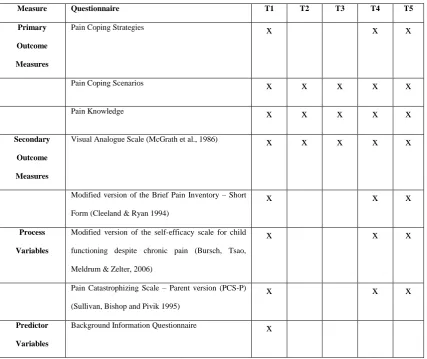
All three primary outcome measures will be administered at the following time-points - T1: baseline (pre-intervention), T4:12 weeks from baseline (post-intervention) and T5: 3 months follow-up. Post intervention measures will be completed by another Researcher, in order to minimise the likelihood of socially desirable responding by group participants. The Pain Coping Scenarios Questionnaire and the Pain Knowledge Questionnaire will be administered at two additional time points - T2: 5 weeks from baseline and T3: 9 weeks from baseline. Administration of these primary outcome measures at these additional time points will facilitate process evaluation to determine which elements of the intervention programme are most effective for this population.
Secondary Outcome measures
A coloured Visual Analogue Scale (VAS) (McGrath et al. 1996) will be used to measure pain severity. Participants will be asked to rate the average degree of pain which they experienced during their last period. On this scale, 0 = no pain and 10 = unbearable pain. Pain interference will be measured by a modified version of the Brief Pain Inventory – Short Form (Cleeland and Ryan 1994). This questionnaire uses a likert scale where 0 = did not interfere and 10 = completely interferes.
Secondary outcome measures will be administered to participants at the following time-points - T1: baseline (pre-intervention), T4:12 weeks from baseline (post-intervention) and T5: 3 months follow-up. Secondary outcome measures will also be administered to Parents / Guardians at T1, T4 and T5. The VAS will also be
15
Table 1: Outcome Measures
Measure Questionnaire T1 T2 T3 T4 T5
Primary Outcome Measures
Pain Coping Strategies x x x
Pain Coping Scenarios x x x x x
Pain Knowledge x x x x x
Secondary Outcome Measures
Visual Analogue Scale (McGrath et al., 1986) x x x x x
Modified version of the Brief Pain Inventory – Short
Form (Cleeland & Ryan 1994)
x x x
Process Variables
Modified version of the self-efficacy scale for child
functioning despite chronic pain (Bursch, Tsao,
Meldrum & Zelter, 2006)
x x x
Pain Catastrophizing Scale – Parent version (PCS-P)
(Sullivan, Bishop and Pivik 1995)
x x x
Predictor Variables
Background Information Questionnaire x
Supplementary Research Methodologies
Moderator Analyses
Process Variables
16
Pain self-efficacy refers to an individual’s belief that they can perform certain tasks related to school, friends and family even when they are in pain. It is an important variable to consider given its potential impact on participants’ willingness to
implement strategies to cope with their pain. Participant pain self-efficacy will be measured using a modified version of the self-efficacy scale for child functioning despite chronic pain (Bursch, Tsao, Meldrum & Zelter, 2006). The questionnaire will use a likert rating scale where 1 = Always and 3 = Never.
Pain catastrophizing refers to a negative cognitive-affective response to anticipated or actual pain and has been consistently associated with pain intensity and pain related activity interference (Quartana, Campbell & Edwards, 2009). Pain catastrophizing will be assessed using the parent version of the Pain Catastrophizing Scale (PCS-P) (Sullivan, Bishop and Pivik, 1995). This is a thirteen item rating scale which assesses parents’ thoughts and feelings when their child is in pain. Response options to
statements are: not at all (disagree), mildly (agree), moderately (agree), severely (agree) and extremely (agree). Pain self-efficacy and pain-catastrophizing will be assessed at the same time-points as the outcome variables i.e. T1: baseline (pre-intervention), T4:12 weeks from baseline (post-intervention) and T5: 3 months follow-up.
Predictor Variables
17
number and frequency of menstrual symptoms experienced and history, treatment and use of medication to manage gynaecological problems or any other medical
conditions. Moderator analyses will be conducted to examine the conditions under which moderating variables interact with the intervention condition as predictor variables in the main effect analyses.
Data Analyses
This study will employ a mixed methods (quantitative and qualitative) research methodology.
Quantitative
Quantitative statistical analysis will be conducted using repeated measures analysis of variance (ANOVA) to examine differences in the primary and secondary outcome measures between the intervention and matched control groups. Within-groups differences will be measured at two time points (T4: post intervention and T5: at three month follow-up). Regression analysis will be used to look at predictors of outcome. Process evaluation will be conducted by looking at within groups differences at two additional time points (T2: 5 weeks from baseline and T3: 9 weeks from baseline) for the primary outcome measures. To assist with process evaluation, the delivery of primary components will be counter balanced in the intervention programme i.e. behavioural elements followed by cognitive elements.
Qualitative
18
members. This data will be analysed via thematic analysis, a process which enables the identification, analysis and reporting of themes which adequately reflect the data.
Discussion
In this study, we will evaluate the impact on pain coping and pain management knowledge of a menstrual pain management programme for young women with intellectual disabilities. We expect that participants in the intervention group will report the use of a greater number of coping strategies and have greater knowledge of pain management strategies after participating in the intervention programme and after three months, compared to control group participants.
The content of the menstrual pain management programme was developed from the theory-based cognitive behavioural therapy programme “Feeling Better – A manual for carers working with people who have intellectual disabilities and chronic pain”
19
The inclusion of process evaluation to determine which elements of a cognitive behavioural therapy programme work best for individuals with intellectual disabilities is a significant advantage to this study. Hunter (2003) identified the need for
clarification on the effective components of CBT approaches for pre-menstrual symptoms and this is particularly relevant for this population.Moderator analyses of the outcome of the intervention helps us to understand with whom this type of training is most effective and under what conditions. Such information will enable us to
optimize treatment for each individual into the future. For this reason, a number of variables which are assumed to be related to pain coping have been measured in this study.
Conclusion
This research study aims to evaluate the efficacy of a menstrual pain management programme for young women with intellectual disabilities. If successful, this training could be incorporated within social, personal and health education initiatives
20
References:
International Association for the Study of Pain. (1986). International Association for the Study of Pain: classification of chronic pain. Pain, 24:1 – 226.
Walsh M, Morrison T, McGuire BE (2011). Chronic pain in adults with an intellectual disability: prevalence, impact and health service use based on caregiver report. Pain, 152: 1951 – 1957.
McGuire BE, Daly P, Smyth F (2010). Chronic pain among people with an
intellectual disability: Under-recognised and under-treated? Journal of Intellectual Disability Research, 54, 240-245.
McGuire BE, Kennedy S (2013). Pain in people with an intellectual disability. Current Opinion in Psychiatry, 26, 270-275.
American Congress of Obstetricians and Gynaecologists (2011). Dysmenorrhea. Patient Education Pamphlet.
Berkley KJ (2013). Primary Dysmenorrhea: An Urgent Mandate. Pain: Clinical Updates. Vol. XXI, No. 3, October.
21
Eden JA (1992). Dysmenorrhoea and premenstrual syndrome. In Essentials of Obstetrics and Gynaecology, 2nd edn (eds F.N. Hacker & J.G. Moore), pp. 332 – 337. W.B. Saunders, Philadelphia, PA.
Kyrkou M (2005). Health issues and quality of life in women with intellectual disability. Journal of Intellectual Disability Research, 49(10): 770 – 772.
Eccleston C, Williams AC de C, Morley S (2008). Psychological therapies for the management of chronic pain (excluding headache) in adults. Cochrane Database Systematic Review, 4, Art. No.: CD007407. DOI: 10.1002/14651858.CD007407.
Proctor ML, Murphy PA, Pattison HM, Suckling J, Farquhar CM (2007).
"Behavioural interventions for primary and secondary dysmenorrhoea". In Proctor, Michelle. Cochrane Database Syst Rev (3): CD002248.
doi:10.1002/14651858.CD002248.pub3. PMID 17636702.
McManus S, McGuire BE(2013). Cognitive behavioural therapy for chronic pain in people with an intellectual disability using the Feeling Better programme: A case series. Journal of Intellectual Disability Research. Article first published online: 6 Feb 2013 DOI: 10.1111/jir.12018.
22
Craig P. Dieppe P, Macintyre S, Michie S, Irwin I, Petticrew M. (2008). Developing and evaluating complex interventions: the new Medical Research Council guidance. British Medical Journal, 337doi: 10.1136/bmj.:a1655
Rifkin SB (1996). Rapid Rural Appraisal: its use and value for health planners and managers. Public Administration. Vol. 74 (3), 509 – 526.
McManus S (2007). Cognitive behaviour therapy for chronic pain among people with intellectual disability: a case series. D.Psych. Sc. (Clin Psych) Thesis.
McGrath PA, Seifert CE, Speechley KN, Booth JE, Stitt L, Gibson ME (1996). A new analogue scale for assessing children’s pain: an initial validation study. Pain, 64, 435 – 443.
Cleeland CS and Ryan KM (1994). Pain assessment: global use of the Brief Pain Inventory. Annals of the Academy of Medicine Singapore. 23(2): 129 – 138.
Bursch B, Tsao JCI, Meldrum M, Zelter LJ (2006). Preliminary validation of a self-efficacy scale for child functioning despite chronic pain (child and parent versions). Pain, 125 (1-2), 35 – 42.
23
Quartana PJ, Campbell CM, Edwards RR (2009). Pain catastrophizing: a critical review. Expert Review of Neurotherapeutics. Vol. 9(5), p. 745 – 758.
McGuire, B.E., Daly, P. & Smyth, F. (2007). Lifestyle and health behaviours of adults with an intellectual disability. Journal of Intellectual Disability Research, 51, 497-510.