City, University of London Institutional Repository
Citation
:
Le, J. K. and Jarzabkowski, P. (2014). The Role of Task and Process Conflict in Strategizing. British Journal of Management, 26(3), pp. 439-462. doi:10.1111/1467-8551.12076
This is the accepted version of the paper.
This version of the publication may differ from the final published
version.
Permanent repository link:
http://openaccess.city.ac.uk/4009/Link to published version
:
http://dx.doi.org/10.1111/1467-8551.12076Copyright and reuse:
City Research Online aims to make research
outputs of City, University of London available to a wider audience.
Copyright and Moral Rights remain with the author(s) and/or copyright
holders. URLs from City Research Online may be freely distributed and
linked to.
The Role of Task and Process Conflict in Strategizing
Authors
Jane Lê, The University of Sydney Business School, U. of Sydney, Sydney Paula Jarzabkowski, Cass Business School, City U., London
The Role of Task and Process Conflict in Strategizing
The implementation of strategic initiatives is central to organizational success (Balogun &
Johnson, 2004; Maitlis & Lawrence, 2003). Recent studies show that implementation does not
simply operationalize and execute strategy, but also results in subtle adjustments or explicit
reformulations of strategy content (Sminia & de Rond, 2012; Vaara & Whittington, 2012). Strategy
implementation is thus central to effective strategizing. Yet, strategy implementation is complex,
partially because it is critically affected by human dynamics like resistance (Courpasson et al, 2013),
politics (Whittle et al, 2013) and tension (Jarzabkowski et al, 2013). Rather than indicators of failure,
such dynamics are an integral part of how organizations negotiate multiple goals (Denis et al, 2001,
2007; Johnson et al, 2003) and can improve the quality of strategy (Normann, 1977; Pettigrew,
1977). It is thus important to understand the human dynamics underlying strategy implementation.
While strategy scholars have studied the role of dynamics such as resistance, politics, and
tensions during strategy implementation, little focus has been put on conflict. This is surprising as (i)
conflict is specifically about incompatibility of goals, processes and relationships (De Dreu and
Gelfand, 2008; Jehn and Bendersky, 2003), which are central to strategy implementation; (ii) conflict
significantly impacts organizational outcomes such as performance (De Wit et al., 2012) and helps
develop organizational capability (Danneels, 2008; Hinthorne, 1996); (iii) all organizations are
affected by conflict to some degree (De Dreu & Gelfand, 2008); and (iv) conflict often precedes
resistance, politics and tensions (Courpasson et al, 2013; Jarzabkowski et al, 2013; Whittle et al,
2013). Hence, conflict is a critical dynamic for strategist to understand.
The few studies explicitly investigating conflict in the strategy process tend to focus on
formulation by studying strategic decisions (e.g. Amason, 1996; Amason & Schweiger, 1994;
Eisenhardt, 1999; Eisenhardt et al, 1997). Such studies show that conflict leads to increased scrutiny
of information and, consequently, better decisions (Eisenhardt, 1999; Kellermanns et al, 2008;
Mooney et al, 2007). There has been little attention to conflict during strategy implementation
(exceptions: Floyd & Lane, 2000; Regnér, 2003). Conflict is likely to impact implementation but do
not know how. That is our focus.
Employing a strategizing perspective, we theorize the role of human dynamics in strategy
implementation, focusing on conflict. We then investigate these ideas in a detailed longitudinal study
of implementing a strategy in real-time, highlighting the importance of task and process conflict. Our
study shows that the interaction of task and process conflict, and the responses this interaction
identify strategy problems, but the recursive relationship between them is critical in iteratively
shaping the emergence of strategy content and process. Managers iterate back and forth between
strategy process and strategy content issues as they experience and respond to process and task
conflict. This iteration is critical, as actors cannot define all strategy content and process in advance
and must follow an incremental, process-based feedback loop, identifying and resolving problems as
these emerge during implementation. We contribute to understanding of how strategy content
emerges during implementation. Specifically, we show that conflict is revelatory of the emergent
process of strategy implementation and thus integral to how managers strategize in practice.
A Strategizing Perspective
This paper adopts a strategizing perspective, which implies a focus on “the detailed processes
and practices which constitute the day-to-day activities of organizational life and which relate to
strategic outcomes” (Johnson et al, 2003: 3). In line with the turn toward practice in organization
studies (Orlikowski, 1992, 2000; Schatzki et al, 2001), this requires shifting focus away from
strategy as a static input or output toward strategy as a dynamic set of activities enacted by
individuals (Jarzabkowski, 2005). Strategizing has important implications for how we view and study
strategy (Johnson et al, 2003; Jarzabkowski et al, 2007). First, it emphasises micro-activities, i.e.
what people in organizations do when they do strategy, thereby giving critical importance to
everyday human dynamics like information-sharing, coordination and conflict (McGrath & Argote,
2001). These are seen as central to strategizing due to their link to strategic outcomes like firm
direction and survival (Jarzabkowski et al, 2007).
Second, strategizing encourages a broader definition of strategists by demonstrating that
middle managers are central in shaping strategy (e.g. Balogun, 2003; Balogun & Johnson, 2004,
2005; Mantere, 2005; Regnér, 2003; Rouleau, 2005). This suggests that strategy, once formulated, is
not stable, shifting attention from strategy formulation toward implementation. Since the seminal
work of Mintzberg (1978; & Waters, 1985) and Pettigrew (1985; 1987), we know that strategy
content emerges through implementation and, hence, is inimically entwined with the processes that
produced it. Strategy making is thus an emergent process (Hutzschenreuter & Kleindienst, 2006;
Tsoukas, 2010; Vaara & Whittington, 2012) and working out strategy content is messy, incremental
and continuous (Bartunek, Balogun & Do, 2011). Thus, we are called to study the social mechanisms
that explain the relationship between strategy process and content (Sminia & de Rond, 2012); we
propose conflict as one such mechanism.
Conflict is likely to be central to strategizing because strategy is complex and ambiguous
what the strategy is and how it should be implemented. Indeed, conflict is a common occurrence in
strategy processes (Amason, 1996; Eisenhardt et al, 1997) due to the plurality of strategic roles and
activities (Balogun & Johnson, 2004; Floyd & Lane, 2000; Stensaker & Falkenberg, 2007; Westley,
1990). We thus need to understand conflict in strategy implementation.
Strategy Implementation: Tensions, Politics & Resistance
While strategy implementation studies often only address conflict indirectly, they commonly
study related topics like resistance, politics and tensions. Focusing on the human dynamics that
underpin strategizing, such work may assist our understanding of the role of social dynamics like
conflict in strategy implementation. Indeed, resistance, politics and tension often precede conflict.
For instance, resisting a dominant direction may result from conflict over a task or process (Floyd &
Lane, 2000). Similarly, political behaviour often occurs in response to conflict: “The political
decision process can be understood in part as the resolution of conflicting demands” (Pettigrew,
1977: 82; also Baldridge, 1971; March, 1962; Pfeffer, 1981). Equally, tensions may the result of
contradictions being made salient through confrontation (Jarzabkowski et al, 2013). These studies
highlight the importance of human dynamics for strategy outcomes.
The resistance to change literature illuminates the role of social dynamics in strategy
implementation. Resistance generally refers to an action (Brower & Abolafia, 1995) that is not
aligned with the dominant direction or status quo. Resistance is inherent to organizations (Thompson
& Ackroyd, 1995) and can produce both positive and negative outcomes (Courpasson et al, 2012).
While much literature still views resistance as “an adversarial and antagonistic process” that may
waylay strategy (Courpasson et al, 2012: 801), resistance can also positively influence management
decisions and so generate constructive change (Courpasson & Dany, 2009; Courpasson, Dany &
Clegg, 2012; Thomas & Hardy, 2011). This has resulted in theorizing about positive (Piderit, 2000)
and productive resistance (Courpasson & Dany, 2009). This suggests that ‘resisters’ may introduce
new ideas (cf. Ford et al, 2008; Piderit, 2000), thereby positively altering decisions of
strategy-makers and, so, the path of strategy (Regnér, 2003).
Micro-politics of strategy further illuminate social dynamics of strategizing (cf. Pettigrew, 1977). Politics are “the observable, but often covert, actions by which executives enhance their power to influence decisions” (Eisenhardt & Bourgeois, 1988: 737). Strategic decision-making is a
political process; which issues are attended to and which action adopted depends on how power is
mobilized (Pettigrew, 1977; Pfeffer & Salancik, 1974). Political activity is common in organizations
(Rosen et al, 2013; Whittle et al, 2013) but can be counterproductive by focusing activities on
delaying strategic decisions and actions. Conversely, politics can be productive; for instance,
ensuring there is appropriate questioning of strategic decisions and actions to secure the best
organizational outcome (Johnson, 1992; Whittle et al, 2013).
Work on organizational tensions casts light on the social dynamics inherent in strategizing. ‘Tension’ bridges the literature on dialectics, paradox and contradiction, emphasizing organizations’
need to balance multiple contradictory pressures (Crossan & Hurst, 2006; Lewis, 2000).
Contradictions present in organizational life include cooperation vs. competition, rigidity vs.
flexibility, and short-term vs. long-term goals (Das & Teng, 2000). Tensions can be negative, leading
to either/or trade-offs and suboptimal strategizing via suppression of one pole (Lewis, 2000). Yet
tension can also be positive when organizational actors are able to transcend and work across
different forces in a both/and fashion (Lewis, 2000). Positive outcomes of tensions are often
achieved via improvisation, which is the “creative and spontaneous process of trying to achieve an objective in a new way” (Vera & Crossan, 2005: 205; also Crossan & Hurst, 2006). To fully
appreciate strategy implementation, it is thus important to understand such dynamics.
Existing Work on Social Dynamics of Strategizing
The bodies of work reviewed above highlight the importance of social dynamics during
strategizing and help understand the potential implications of conflict on strategizing. They outline
the importance of studying human micro-dynamics in understanding how destructive and generative
potential is created. Thus, we expect some similarity between how conflict and these other dynamics
function in strategy implementation.
Yet, there are also likely to be important differences as conflict is distinct from resistance,
politics and tensions. Unlike resistance, conflict neither assumes divergence from a dominant
direction, nor a change context; conflict may arise between equally powerful and legitimate interests
during relative stability. Further, conflict may occur without politics, as it is not necessarily based in
power and influence but rather focuses on tasks, processes and relationships (Befahr et al., 2011).
Conflict also implies disagreement, not contradiction; while disagreement suggests active salience of
differences between groups, tensions may lie dormant. Conflict is thus more common and impactful.
However, despite the relative importance of conflict in strategy processes, work on
strategizing and conflict has evolved independently with few exceptions (e.g. Amason, 1996;
Eisenhardt et al, 1997; Kellermanns, 2008; Mooney et al, 2007). Consequently, strategy has
The Role of Conflict in Strategy Implementation
Conflict refers to incompatibility, discrepancy or disagreementbetween individuals or groups
in relation to goals, processes and relationships (De Dreu & Gelfand, 2008; Jehn & Bendersky,
2003). It often arises as people from different divisions and specialisms advance a joint task (Pruitt,
2008). While acknowledging conflict as important, the strategy literature often only studies it
indirectly, creating a void of systematic strategy research on conflict. The modest work that has been
conducted indicates that conflict may play an important role in strategy implementation.
Research suggests that conflict may arise from different interpretations of strategy (Balogun
& Johnson, 2004; Floyd & Lane, 2000; Ketokivi & Castañer, 2004; Meyer, 2006; Westley, 1990;
Wooldridge & Floyd, 1989). Interpretations may generate disagreement as people come together to
achieve goals (Floyd & Lane, 2000; Westley, 1990; Wooldridge & Floyd, 1989), and produce
ambiguity about action, increase opportunistic behaviour, lower the quality of information shared,
reduce trust, hinder change, and lead individuals to work cross-purpose (Floyd & Lane, 2000).
Conflict may also have beneficial effects by uncovering disparity in perceptions, interpretations, and
practices (Floyd & Lane, 2000), heightening information scrutiny (Ford et al., 2008), and aligning
decisions with organizational interest (Ford et al., 2008). For instance, Régner (2003) shows that
conflict can mobilize managers into taking action.
While these strategy studies indicate the significance of conflict in strategy implementation,
they cannot explain how effects are generated. Mixed results highlight the need to further understand
the role of conflict during strategy implementation through a more fine-grained approach. We turn to
conflict studies for theoretical and empirical tools.
Conflict as a Lens to Unpack Strategy Implementation
Despite little direct attention from strategy scholars, conflict studies have a long history
within management (Crozier, 1964; Pondy, 1967; Walton, 1967). The dominant focus has been on
group conflict (Jehn & Mannix, 2001; March & Simon, 1958), as organizations consist of groups
with different aims and methods that are interdependent and share macro-goals (Walton, 1967).
These competing values provide fertile ground for conflict(De Dreu & Gelfand, 2008). How conflict
is enacted and dealt with is critical for organizational success (Pruitt, 2008). While conflict was
traditionally seen as something to be eradicated (Crozier, 1964; Pondy, 1967), new
conceptualizations position conflict as a natural part of human interaction (Jehn & Mannix, 2001;
Martin & Bergman, 1996; Pruitt, 2008). Conflict can have positive and negative effects depending on
relevant to strategy implementation, as they centre on task-related issues1. Both types can evoke
positive and negative effects (Behfar, Peterson, Mannix & Trochim, 2008).
Task conflict is disagreement about the content and outcomes of a task; i.e. what the task is
(Amason & Sapienza, 1997; Shaw et al., 2011). This conflict arises from discrepancy between
task-based values, needs or interests. Examples include discrepant views about goals or key performance
indicators. Task conflict can lead to poorer information processing (Carnevale & Probst, 1998) and
reduce group effectiveness, creativity and decision-making (De Dreu, 2006). However, it may also
improve task criticality (Amason, Thompson, Hochwater & Harrison, 1995; Nemeth, 1995),
innovation (De Dreu, 2006; De Dreu & West, 2001), task commitment and member satisfaction
(Behfar, Mannix, Peterson & Trochim, 2011). This potential for benefit means task conflict is
labelled the most constructive form of conflict (De Wit et al., 2011). Task conflict is interesting to
strategists, as it speaks to core strategy issues: The content and outcomes of tasks. Conflict around
strategy content is thus likely to arise during strategy implementation (Regnér, 2003).
Process conflict is disagreement about task logistics like delegation and role assignment; i.e.
how the task should be accomplished (Jehn, 1997; Shaw et al., 2011). Examples comprise
disagreement about who should lead a project or what constitute key milestones. Detrimental effects
are commonly reported (de Wit et al., 2012), especially if process conflict is high (Jehn, 1997). Such
conflict may hamper group functioning (Greer, Jehn & Mannix, 2008) and viability (Thatcher, Jehn
& Zamutto, 2003; Vodosek, 2007), distract from task accomplishment (Jehn, 1995), and reduce
productivity (Jehn et al., 1999). Yet, low levels can have positive impacts like clarified roles, agreed
resource use, and suitable plans and timelines (e.g., Jehn & Bendersky, 2003; Jehn & Mannix, 2001).
Process conflict is relevant to strategy, involving issues like deadline agreement (Goncalo, Pollman
& Maslach, 2010), role/task allocation (Karn, 2008), and time management (Karn, 2008; Kurtzberg
& Mueller, 2005), which underpin the coordinating and scheduling work of strategy implementation.
As implementation is often characterized by resource issues and contested assignment of
responsibilities (e.g. Floyd & Lane, 2000; Jarzabkowski & Balogun, 2009), process conflict is likely.
This suggests that it matters which conflict takes place. Longitudinal studies of conflict
(Greer et al., 2008) propose that it also matters whenconflict occurs (Goncalo et al., 2010; Greer et
al., 2008). Early work suggests high performing teams experience low but increasing levels of
process conflict and moderate task conflict at midpoint (Jehn & Mannix, 2001). Comparison with
lower performers confirms that conflict fluctuates over time, though the pattern is different; these
groups experience higher process conflict at the start and end of projects and high task conflict at the
end (Jehn & Mannix, 2001). These studies indicate the need to trace conflict patterns if we are to
better understand the role of conflict. In strategy implementation, we thus need to consider which
conflict type occurs when.
Additionally, conflict types can interact, with one type morphing into or stimulating another
(cf. Jehn, 1997). For instance, process conflict may lead to task conflict as disagreement about task
execution interferes with task accomplishment (Greer et al., 2008) or deters from critical discussions
and implementation (Jehn, Northcraft & Neale, 1999). Similarly, task conflict may lead to process
conflict, as discrepant views about goals produces disagreement about how to pursue the goals (Greer
et al., 2008). Given the ambiguity of strategic goals (Sillince et al., 2012), we would expect a
dynamic process of interaction between conflict types to shape the messy and emergent processes of
strategy implementation as actors work out strategy (Hutzschenreuter & Kleindienst, 2006; Vaara &
Whittington, 2012). Yet, despite various calls (cf. Martin & Bergmann, 1996), we still know little
about the dynamics of conflict, particularly how conflict types interact (Greer et al., 2008). This is
the focus of our paper in which we ask: What is the role of task and process conflict during strategy
implementation, and what impact do they have upon the implementation process?
Method
Case and Data
Consistent with our exploratory approach, we use a longitudinal, real-time case study (Yin,
1994). We observed Telco, an infrastructure firm that just agreed a new strategy with its regulator.
As Telco owned the industry distribution network and could give unfair monopolistic benefits to its
Retail division, Telco agreed to separate the network into an independent business division. The
strategy required this division, Distribution, to ensure all industry players had equal access to the
Telco-owned network. Distribution could thus not favour Telco divisions, neither sharing
commercial information nor allowing influence over decision-making. The strategy also required
Telco to separate products offered through its integrated value chain to tight deadlines.
This salient case of strategy implementation profoundly altered the business environment; the
new strategy changed the industry and its dynamics by transforming the relationship between Telco
and its competitors (Marcus & Geffen, 1998). It also changed the company’s integrated business
customer service. Telco’s ability to respond to the new configuration determined its future success
(Burgelman & Grove, 1996). There was conflict over strategy implementation as divisions remained
and worked together in the same corporate structure, but had different goals. While Distribution was
an independent industry supplier treating all customers equally, other divisions pursued market goals
of service differentiation. Tension over strategic objectives is a common source of conflict (Marcus
& Geffen, 1998; Pondy, 1967; Shaffer & Hillman, 2000).
To observe strategy implementation, we conducted an 18-month study of Telco from
inception of the regulatory strategy, tracing the separation of one Telco product, Beep, in real-time.
Beep was important because the Retail market was based on Beep; if Beep failed, the Retail market
failed. Beep was also complicated to separate as there was no blueprint to follow. Importance,
complexity and novelty are associated with conflict (De Dreu & Weingart, 2003; Jehn, 1997). To
access naturally-occurring data and preserve temporality, our core data comes from non-participant
observation of implementation meetings (see Jarzabkowski & Seidl, 2008). These meetings were
used to manage the implementation process and were scheduled regularly –weekly or bi-monthly –
and attended by set attendees, largely middle-managers. We observed 130 meetings in total, of which
70 were central meetings and 60 were divisional meetings. Functional managers attended divisional
meetings, while divisional leads attended central meetings. Meetings were typically two hours long,
audio-recorded, and transcribed verbatim. We took extensive notes to complement recordings.
Avoiding bias from a single source and broaden contextual understanding (Yin, 1994), we
also gathered 125 interviews, audio recorded and transcribed, informal on-site interaction, and
copious documents. Interviewees were people central to the implementation process, and generally
the same individuals participating in implementation meetings. However, we also sampled for some
more senior and junior managers to ensure we understood the broader context and impact.
Documents related specifically to Beep and included PowerPoint slides, reports, and e-mails.
Analysis was iterative; the full process is summarized in Table 1 and a complementary fuller
description can be accessed in a weblink to Appendix A2.
INSERT TABLE 1 ABOUT HERE
Findings
In qualitative research there is always a trade-off between showing the rich data upon which
findings are based and the constraints of an academic manuscript (Eisenhardt & Graebner 2007;
Golden-Biddle & Locke 2006). This trade-off is particularly pertinent in presenting incidences of
conflict in strategy implementation, where situated activities must be analysed to expose underlying
dynamics. We thus present findings around stages of strategy implementation, using representative
vignettes of the interaction between process and task conflict. Vignettes progressively illustrate how
recognizing and working through conflict helped define and implement strategy. In illustrating this
dynamic we show that, conflict was necessary but not sufficient to advance the implementation
process. Rather, the interaction between conflict types and actors’ ability to appropriately recognize
and respond to both types, enabled implementation.
Beep had two strategic goals: Producing an equitable and functioning product by Month 10
(BHAG), and ensuring its full consumer uptake by Month 16 (CTC). Managers described these goals
as follows: ‘BHAG puts pressure on us; if we don’t meet the date, we’ll make a payment to other
industry players…$5 million per month. But more than that it’s about loss of credibility…The legal
commitment is the CTC in Month 16. All of our customers will be using Beep then, so we better make sure it works!’ (Retail manager3
).
Meeting these strategic goals was critical for Telco but there was no guide for what
constituted an equitable and functioning product. Consistent with the emergent nature of strategy,
actors had to work out this content through implementation (Sminia & de Rond, 2012). Task and
process conflict arose as disagreements about how to implement the strategy highlighted
disagreement about what constituted the strategy, which in turn produced further conflicts about how
to do this. Task and process conflict thus interacted in important ways. For instance, process conflict
could arise from task conflict, as problems with defining strategy content made it difficult to develop
an implementation process. Yet, managers would not have recognized this and responded
appropriately without experiencing task and process conflict. In our description, we thus focus on
how the interaction between task and process conflict shaped definition of strategy content and
coordination of strategy process. For each phase, we explain the task and process conflict
dimensions, provide a vignette of their interaction in defining and implementing the goals, and
explain the implications of conflict for strategy.
Phase 1 (M1-4): Ambiguous strategy
Process and task conflict were mutually reinforced the ambiguous nature of the strategy.
Process conflict and subsequent decisions about how to approach building project plans, setting
timelines, and assigning roles, uncovered task conflict due to a vague understanding of task elements.
While managers knew they needed to produce an equitable and functioning product and transfer all
customers to that product, they did not know what equitable or functioning meant or how they could
achieve it: ‘When we signed up to this, the reality was that it was best guess’ (Telco manager,
interview). The strategy was thus ambiguous, producing not only task conflict but also fuelling
process conflict as actors did not know how to interact, who to involve, and what to do to implement strategy; ‘Our communication wasn’t good. The tendency when you’re embattled is to run away and
hide in a corner.’ (Distribution manager, interview).
Interaction between conflict types. Divisional managers realised they needed to agree a
project plan. As they debated their discrepant views about how to address this process issue, they
recognized the underlying task issue surrounding functionality. Retail managers argued the process
should be organized around a common project document detailing required Beep functionality: ‘The first thing to do is to get the document that’s got the information that you need, as opposed to trying to solve the issues that might then exist. So a group of people should go and build that document’
(Retail manager). Distribution managers favoured industry discussion about what functionality was
needed; ‘I wasn’t aware that was an objective. My view was that this was a collaborative forum in which we collaborate with industry to come up with a specification’ (Distribution manager). This
process conflict and debate around whether industry discussion or project document should come first spurred further recognition of task conflict: ‘That goes to show what we don’t know’ (Retail
manager); ‘It raises a lot of issues. Some of them are product requirement issues, some of them are
technical issues, some of them are performance issues. I hear that – But I think there’s potential danger that we get bogged down in the detail.’ (Distribution manager). Actions proposed and taken to
implement the strategy thus uncovered more disagreements, not just about process but also task
issues, i.e. task conflict about definition of product and performance requirements. With no clear way
forward, the Retail manager returned to his earlier point: ‘The number one aim has to be to get a deliverable, a document. Any issue like “this is not fast enough” or “that functionality is not right” has to be put to one side. You’d then use the document to solve those issues’ (Retail manager). While
what constituted a functioning product remained unclear, there was effort to progress the task by
resolving the process disagreement about how to proceed with implementation. So, process conflict
highlighted a specific process issue that was problematic and on which a decision needed to be made.
Deciding on the issue facilitated implementation progress. By helping managers identify a problem,
and taking steps to resolve it, process conflict facilitated the implementation. This focus was on
Strategy implications. The task remained ambiguous with no agreed definition of equitable
or functioning. Yet managers could progress implementation by developing mechanisms to surmount
process conflict, creating joint programs and rules of engagement between divisions. These
mechanisms subdued conflict and enabled actors to progress planning. However, managers did not
deal with the basis of the task conflict; the ambiguous strategy. Without agreeing what equitable and
functioning meant (strategy content), it was impossible to work out how to achieve this (strategy
process). The result was sustained ambiguity and superficial implementation progress: ‘There are two
things we need to work out: “what we are going to deliver” and “the impact on our plan of delivering that”…there is going to be a knock-on effect.’ (Distribution manager). Process issue responses were
a temporary solution and task issues responses were delayed; the stage was set for further conflict.
Phase 2 (M4-6): Progressing strategy process by ignoring ambiguity over content
Managers advanced implementation by purposefully ignoring ambiguity over strategy
content. Process conflict arose over how to time deliverables, uncovering task conflict about what
was needed for a functioning and equitable product. This process conflict helped actors recognise the
need for better interdivisional collaboration. Coordination mechanisms were introduced to surmount
process conflict but strategy content remained vague, with few product elements defined. The
underlying problem was thus not addressed while actors over-attended to process conflict.
Interaction between conflict types. Attempts to hone delivery plans generated more task
and process conflict. The product spec was central as it outlined the development plan and detailed
the functionality available by BHAG. Managers’ reactions to the spec indicated continued task
conflict about what features to include, stimulating process conflict about how to embed additional
features in the existing delivery schedule. Yet, content issues remained: ‘The spec is still not agreed.
The version that Distribution sent us was very different to the version we were working to. And some of the changes we expected weren’t there; only about 50% of the changes were. We’re still working significantly at risk.’ (Retail manager). This highlighted a content gap around what spec could be
deemed functioning (task conflict) and a process gap around how they approached the task (process conflict). ‘There are 77 technical issues and 11 key customer issues that we’re trying to work through
with Distribution. Their CEO made a commitment that the 11 customer issues would be resolved by Friday. That’s impossible because they’re doing feasibility work to see how the issues can be fixed. And they obviously can’t agree to do it until they know how they’re going to do it.’ (Retail manager).
The way functioning was defined exacerbated process conflict: Trying to deliver more functionality
threw up new process issues, such as running trials, which constrained efforts to agree strategy
dominant focus: ‘The spec was released early so we could thrash out some of these issues and start working together’ (Distribution manager). However, Retail managers felt that they just needed to get
on with making the spec work; ‘With all due respect, it was supposed to be published in Month 3!’
(Retail manager). Process conflict created by delays in producing and releasing the spec details was
thus not a separate issue, but rather compounded the task conflict over what features would be
offered. Process and task conflict were intertwined as managers tried to implement the strategic task
without clarity about the strategy. However, managers’ focus on process, driven by process conflict,
obscured this relationship and meant they did not address issues of content.
Strategy implications.Managers sought progress by developing mechanisms that enabled
them to request and prioritize functionality. This offered an equitable strategy process tool to
communicate product needs between divisions, allowing actors to surmount process conflict and
advance implementation: ‘It’s easy; we just ask for it’ (Retail manager). Process conflict thus initially
drove the implementation by enabling managers to identify and address specific process problems,
which uncovered the need to further define content. Strategy content was iteratively defined as actors
responded to process conflict issues, paying little attention to task conflict. There was only marginal
progress in determining strategy content, with equitable refined to mean appropriate access and
functionality for all industry players. This did not eliminate the origin of task conflict, as ambiguity
remained about what functioning meant, constraining implementation of the strategy process.
Phase 3 (M6-10): Defining strategy content through crisis
Process conflict became increasingly specific, centring on the inability to progress
implementation due totask conflict about the features underpinning equitability and functionality. As
attempts to coordinate the strategy process failed to produce real progress due to underlying strategy
content issues, both conflict types surged. Process conflict over progress failure led to sharp task
conflict, as actors realized they could not advance strategy process without defining strategy content: ‘We’ve hit a wall. We can’t progress the delivery until we figure out what we are going to do!’
(Retail manager). As actors tried to use new implementation processes, they realized these did not
overcome core definitional differences. Significantly, product design was deemed insufficient to
meet market demands; Beep was failing to function: ‘This doesn’t allow us to fulfil our current
customer contracts. That’s not what I would call a market-ready product’ (Retail manager). As
managers tried to work out what features were sufficient to make Beep function, they recognized
called on senior managers to develop a common understanding of the strategy; ‘We are currently awaiting a steer from the Group CEO’ (Telco manager).
Interaction between conflict types. As the origin of task conflict became clearer and the
need to address it urgent, actors tried to work toward content-based solutions. This uncovered further conflict: ‘I see a total mismatch in how we approach this task. Some people are just trying to meet the deadline regardless of quality. That’s not good enough. We actually need a product that works!’
(Retail manager); ‘You can’t expect a perfect product on day one. That’s not how product delivery
works...BHAG means having a working product and we are on track to deliver that. It might not be as elegant a solution as you would like, but it will work’ (Distribution manager). Task conflict
continued about the functionality that had to be delivered. While some managers insisted functioning
solely meant the product was available and being supplied, others demanded a high functionality:
‘That’s totally unacceptable. That’s not what I call fit-for-purpose. The customer experience and operational procedures in Retail depend on the ability to offer functionality. That’s not happening but it is something we absolutely have to do. Otherwise we can’t progress. We may be able to turn Beep
on at BHAG, but we’d have a catastrophe on our hands!’ (Retail manager). By explaining that the
implementation process had not enabled them to work out Beep’s functionality, Retail emphasized
they had a content and process crisis, in which ‘no current plan indicates that we can make BHAG!’
(Retail manager). Unable to progress the task, the implementation broke down. Senior managers
intervened and helped overcome task conflict by defining the strategy. They clarified that a
functioning product had to satisfy consumer demand by ‘meeting or exceeding’ quality levels of
comparable products; this meant more features. The BHAG deadline was forsaken to facilitate this: ‘The exec has decided that the current product is insufficient to be used by BHAG and has made it
clear what we need to deliver in order for the product to go live’ (Telco manager); ‘If we tried to
meet BHAG, the result would be a bad customer experience, possibly a service crisis and meltdown.
The CEO agreed to a delay but made it very clear that he regards this as a failure.’ (Retail manager).
Strategy implications. Strong focus on how to manage the implementation (strategy
process), driven by high levels of process conflict, had waylaid the task by preventing managers from
defining the core task (strategy content). Managers had deferred response to task issues, initially
ignoring task conflict, in favour of process-based responses. They thus became stuck in a cycle of
experiencing and responding to process conflict. When actors recognized the need to address content
issues and tried to respond, it was too late: There was no feasible plan to get to BHAG and Telco had
to pay a cumulative fine until it delivered on BHAG. This breakdown disrupted the process, forcing
strategy was. Senior managers were called in to help define strategy content, prioritizing clarity about
functionality. The outcome was a clear definition of strategy content; senior managers defined what
was meant by functioning and gave achieving this primacy over the deadline. Task conflict subsided,
enabling managers to advance the implementation; ‘The exec worked with us to agree a solution. If that hadn’t happened, we would really have struggled. That was breaking through the barrier...but it meant we didn’t actually start implementing the solution until the beginning of Month 10’ (Retail
manager, interview). Hence, the breakdown occasioned by failing to recognize the task-based origin
of much conflict ultimately forced a breakthrough in defining the strategy content, which had been
ambiguous throughout the implementation. This breakdown and breakthrough, while costly for
Telco, allowed them to understand the strategy content and progress its implementation.
Phase 4 (M10-13): Making the defined strategy work
Defining strategy content led to more specific process conflict about how to deliver content.
Telco was paying a hefty monthly fine for failing BHAG and needed to deliver. Defining the strategy
reduced ambiguity and prevented much task conflict, but process conflict increased as actors worked
out how to achieve the agreed strategy. This spurred very specific task conflict about minor delivery
elements: With strategy content better defined, actors could coordinate the strategy process.
Interaction between conflict types. Working out how to design and include new features
within tight timescales, surfaced process conflict over how to best progress. This uncovered minor
task conflict about the detail of specific functionality, including the ability to satisfy transfer
requirements. As each detail was better understood, it was integrated into the process, creating
opportunity for further process conflict: ‘It’s getting back to the age-old debate; it’s not just about what we’ve agreed, but also how we’ve agreed to do it’ (Distribution manager). For example, as
managers tried to deliver a functional product, they realized it was intertwined with testing. They
needed the process of testing to achieve the outcome of functionality, jeopardising the final CTC goal: ‘We are very concerned about the lack of stability in the testing platform. That’s going to knock our transfer plan back...these problems are going to affect other areas.’ (Retail manager). Thus,
efforts to implement defined product features uncovered additional process conflict; e.g. delivery
mode changes were needed: ‘It is an entire change of systems and that means teething problems... not
imperative is to start using Beep ASAP but we’re running out of time’ (Retail manager).
Implementation was a process of working out how to deliver the strategy, involving iteration between
process and content, often via conflict, to achieve sufficient clarity to progress.
Strategy implications. While the strategy content was now clear, actors still faced major
work in deciding how to implement the strategy (strategy process). As they developed and released
product features, process issues like how to use ICT systems to deliver new features emerged.
Actions to address these issues spurred some task conflict, drawing attention to the need to refine
nuances of strategy content, e.g. agreeing specific characteristics of product features. This iteration
between strategy process and content, enabled increasing strategy implementation. Process tools like
delivery groups, project dashboards, and early-testing helped to surmount process conflict and
advance implementation. Actors delivered the features necessary for a functioning product and
satisfied BHAG requirements. While late and not perfect, it was successful: ‘Given the situation, it
was a pretty good delivery...even when we met BHAG, there was still functionality missing, but
there was no major service crisis.’ (Telco manager, interview).
Phase 5 (M13-18): Achieving strategy implementation
In this phase, conflict was much decreased, focusing on very specificissues. With a clear
definition of strategy content and a viable strategy process emerging, managers focused on minor refinements while working toward CTC: ‘Once we get the customers transferred, we can move Beep
into business-as-usual.’ (Telco manager).
Interaction between conflict types. As actors moved toward CTC and started transfers, they uncovered process disagreement about how and when to progress: ‘I don’t think we can start mass
transfer on Thursday because we won’t even have tested the transfer feature!’ (Retail manager).
Actions to address process conflict around transfer targets led to task conflict; different transfer plans
had different milestones and functionality. For instance, managers disagreed about deadlines for
specific transfer features: ‘If you ask why we can’t do it sooner, the main rub is the capability to
develop this alongside the product. We hope this will go live for testing in M14; then it better meet expectations!’ (Retail manager). Working through these issues, managers noted other disagreements,
like task conflict around the definition of transfer and what completion meant: ‘CTC literally means “customer transfer complete”. That means we have to transfer all customers by the deadline’
(Distribution manager); ‘All customers that can be transferred. Obviously there’ll be some customers that we won’t be able to transfer.’ (Retail manager). They also disagreed about numbers: ‘The
number of residual customers is rapidly rising and now far exceeds what we predicted...we need to
but it’s actually less than 5% of our total volume. You have got to remember that we’ve transferred millions of customers; so a few thousand customers are insignificant’ (Retail manager). Customer
transfers not only raised process conflict about how to transfer customers but also task conflict about
what constituted success: ‘There has been disagreement about what is necessary to do mass transfer... the core issue seem to be how soon we can move to volume’ (Retail manager). These issues were
intertwined; decisions about task content had implications for task process and vice versa. Conflict
drove identification of the issues and decisions that became focal points. Thus, conflict, where
properly identified and responded to, had generative effects on the emergent strategy process.
Strategy implications. Moving toward meeting the final goal, managers focused on strategy
process by coordinating activity to meet CTC: ‘Yesterday we declared customer transfer complete.’
(Telco manager). The only minor refinement to strategy content was the definition of full product
uptake. It was defined to include the entire customer base, apart from few unique cases that became
stuck during the transfer process and required additional time to be moved. At CTC, Telco had
implemented a major shift in the product base of the retail market, in the process emerging a clear
definition of the strategy and the way to achieve it.
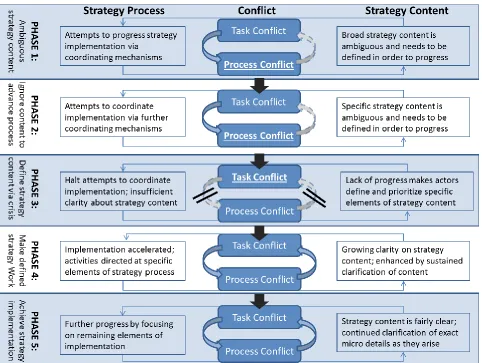
INSERT TABLE 3 ABOUT HERE
These implementation phases, during which increasingly clear definitions of strategy content
and process emerged, are summarized in Table 3. Task and process conflict were central to strategy
implementation. While conflict itself was not generative, it directed managers’ attention to critical
issues requiring resolution. Managers’ ability to understand and address content and process issues
appropriately, including acknowledging the relationship between these, enabled managers to
incrementally work out what the strategy was and how to implement it. Specifically, managers
experienced process conflict as they developed mechanisms to advance strategic goals. Efforts to
respond to this process conflict highlighted disagreement over what the goals were and generated
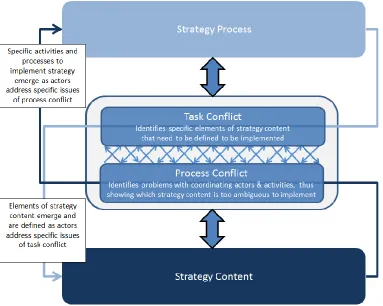
micro task-conflicts. Task and process conflict were thus iterative and recursive (see Figure 2).
Findings also suggest that task conflict in Phase 3 generated a breakthrough in defining strategy
content. This impasse was critical in raising awareness that strategy content was still ambiguous and
constituted a barrier to implementation. Actors could not make real progress on task or process until
they agreed quite specific strategy elements. Responding to task conflict was necessary for strategy
content to be sufficiently defined for managers to focus on specific implementation actions. Yet, this
was also not without conflict. As actors focused on strategy process, they exposed disagreement
about how to advance specific tasks, resulting in more process conflict. Telco implemented the
understandings of the strategy and how to execute it. Our case shows that iteration between strategy
content and process is a necessary part of implementation; it offers an important feedback loop that
ensures implementation is aligned with the emerging strategy content. Conflict is critical in
highlighting problematic issues that need to be addressed. Yet, addressing these issues is not
straightforward, as strategy process and content, like process and task conflict, are entwined in
practice, difficult to entangle, and hard to address. This helps to explain why strategy implementation
is so complicated and can often lead to unintended consequences (Balogun & Johnson, 2005), inertia
(Jarzabkowski, 2008; Johnson, 1988) and even failure (Maitlis & Lawrence, 2003).
Discussion
This paper examines the role of task and process conflict in strategy implementation. Our
findings identify a recursive micro-process of interaction between task and process conflict within
which strategy emerges and is implemented. Thus, we conceptualize the interaction between task and
process conflict as an explanatory mechanism for how strategy content emerges within, shapes, and
is shaped by implementation. While not claiming that conflict is generative, we explain that conflict
can have generative effects when managers correctly recognize and respond to it; this requires
acknowledging the link between task and process conflict, and iteratively working through the issues
it exposes. This informs our theorizing, summarized in two conceptual models below.
INSERT FIGURE 2 ABOUT HERE
Figure 2 demonstrates the recursive association between task and process conflict central to
our study. Managers’ experience of and response to one type of conflict necessarily impacts their
experience of and response to the other. This interaction shapes both strategy content and strategy
process in an incremental, emergent way. As indicated by the arrows in the model, conflict iteratively
shapes strategy by directing managerial focus and enabling recursive switching between ill-defined
elements of strategy process and content. Thus, task conflict occurs when some element of the
strategy content is ambiguous, prompting actors to define micro-elements of the strategy. Process
conflict occurs when actors experience disagreement about how to make the strategy work,
stimulating coordination activities.
Responding to task conflict over different understandings about quite specific strategy
elements, managers generate an increasingly shared definition of strategy. This is emergent as many
elements of strategy content are unclear and cannot be anticipated in advance; they are defined as
they arise from interaction between task and process conflict. Simultaneously, as actors try to make
the strategy work, they find which actors and activities need to be coordinated to implement their
they do not have a sufficiently common strategy definition to identify processes necessary for
achieving it. Process conflict thus shows which elements of strategy content remain too ambiguous to
implement, generating task conflict that further stimulates definition of the strategy content. As our
conceptual model shows, strategy is implemented via association of strategy process and content.
The micro-process of experiencing and responding to numerous small task and process conflicts
underpins the process of strategy implementation illustrated in Figure 3.
INSERT FIGURE 3 ABOUT HERE
Actors go through recursive cycles of task and process conflict as they implement an
ambiguous and emergent strategy (Figure 3). In our study, initial progress in Phases 1 and 2
improved coordination of the strategy process without defining strategy content (see dotted arrow
from process to task conflict). This overemphasis on strategy process, driven by an unbalanced focus
on process conflict (shown with bold, underlined text), proved unsustainable as strategy content was
too ambiguous to enable further implementation. Actors thus reached a crisis point in Phase 3
(indicated by broken arrows); the strategy process could not move forward as actors did not have an
agreed definition of strategy content. Rather, the previously neglected task conflict dominated
(indicated by bold, underlined text), requiring actors to focus on and deal with strategy content
ambiguity. This breakdown indicates that recognition of and willingness to respond to task conflict as
soon as it arises is critical. Otherwise, actors become ‘stuck’ in a cycle of responding only to process
conflict by addressing process-based problems, essentially ignoring the need for fundamental
redefinition of the strategy content highlighted by task conflict. Thus, while task conflict can have a
generative effect in prompting actors to address ambiguity and work through specific strategy
elements highlighted by conflict, it can constrain and even lead to breakdown in strategy
implementation when its interaction with process conflict is ignored. Hence, the recursive
relationship between conflict types and strategy process and content is critical. Without sufficiently
common definitions of the strategy, implementation cannot progress, as actors do not know what to
implement. Actors need to respond to both process and task conflict to advance implementation. As
we show, even when actors arrive at some common understanding of strategy content,
implementation still raises further conflict as experiencing and responding to process conflict
highlights ongoing elements of strategy content needing clarification. Interaction between strategy process and content during strategy implementation is spurred by actors’ experience of and responses
to task and process conflict. Only when recognizing this, managers can balance task and process
conflict sufficiently to progress implementation (indicated by regular font and solid arrows). It is thus
strategy implementation: If managed appropriately, conflict enables actors to iterate between strategy
process and content, working out what the strategy is and how to make it work in practice.
Contributions
Our conceptual model of the role of conflict in strategy implementation contributes to the
strategizing literature. First, we demonstrate how middle managers actively define strategy by
identifying and defining specific elements of strategy content through responses to task and process
conflict. As most strategies are ambiguous (Sillince et al, 2012), these micro-details of how an
intended strategy is worked out through implementation are critical in the emergence of common understandings of strategy. While middle managers may not ‘formulate’ strategy, they fill strategy
content with meaning and action by defining its micro-elements. This provides deeper understanding
of how strategy emerges and is realized through fluctuating human dynamics.
Further, our focus on the interaction between task and process conflict, and the responses
managers formulate to address conflict, extends knowledge of the generative mechanisms through
which middle managers provide impetus to the strategy process. Studies of emerging strategies focus
on generative mechanisms such as championing, forcing (Burgelman, 1983a), experimenting, and
adjusting (Régner 2003). While Régner notes that conflict is important in this process, because it
enables middle managers to sharpen arguments and mobilize energy, he views conflict as a process
outcome. By contrast, studying conflict during implementation of intended strategy, we show that
conflict critically underpins the identification of specific elements of strategy content and process by
directing managerial attention. Rather than simply being an outcome, if managed appropriately,
conflict can have generative effects in underpinning mechanisms others have found. For example, we
might better understand championing and forcing (Burgelman, 1983a) as activities fuelled by task
conflict, and experimenting and adjusting (Regnér, 2003) as activities fuelled by process conflict, or
arising from a combination of task and process conflict. Further studies adopting our granular
approach might show different conflict types underpinning different strategic responses. A
micro-view of conflict may also help us better understand resistance (Courpasson et al, 2013), politics
(Whittle et al, 2013) and tensions (Jarzabkowski et al, 2013).
Our process model may also explain different paths of strategizing. For example, where
strategy failure has been attributed to different political interests (e.g. Maitlis & Lawrence, 2003;
Sillince & Mueller, 2007) that waylay implementation of the strategy (e.g. Guth & Macmillan, 1986),
future research might examine whether the strategy process has become stuck in a cycle of
inadequately defined strategy content. If so, task conflict will be prevalent and needs response.
become frustrated trying to implement the strategy whilst ignoring definitional problems. Our case
showed this dynamic temporarily in Phase 3, potentially explaining tendencies toward strategic drift
(e.g. Johnson, 1988), in which actors focus on existing processes, so neglecting alignment between
these processes and strategy content. An appreciation of the iterative association between task and
process conflict is critical in highlighting where actors lack a common strategy definition, helping a
definition to emerge, and working out ways to implement that definition. In short, process and task
conflict in combination indicate that something is not working in implementation and that this cannot
be resolved by simply improving process or content issues, but that both need to be addressed
simultaneously. It is important for firms to understand conflict type, what this indicates, and that this
might be recursively entwined with and indicative of another form of conflict.
While our main contributions are to the strategy literature, our findings also elaborate the
conflict literature. First, our process model illuminates the recursive relationship between task
conflict and process conflict. Our study underscores the close correlation between task and process
conflict reported in the literature. A recent meta-analysis aggregating correlations across studies
suggests that the association ranges between .44 and .90. (De Wit et al., 2012). While some authors
argue this may be due to overlap in definition and measurement (cf. Befahr et al., 2011), our findings
support an alternative explanation: Task and process conflict underpin one another (see also Greer et
al., 2008). We show that, rather than one type of conflict simply morphing into or stimulating
another type (cf. Jehn, 1997), the relationship between task and process conflict evolves in a series of
recursive loops, with conflict types continuously informing one another. We propose that this is
because defining task content and process is an incremental process, which actors have to work
through iteratively. We show the different responses that managers make to the conflict they face.
Our findings thus offer a more fluid and dynamic conceptualisation of conflict and emphasize the
need for dynamic research methods that go beyond cross-sectional studies to advance understanding
(Jehn & Bendersky, 2003) and generate insight into the relationships between conflict types.
Second, while many studies see process conflict as predominantly negative (De Wit et al.,
2012), our study of strategy implementation, focusing on middle managers, suggests process conflict
may also play an important role in implementing tasks. Process conflict directs managerial attention
to process-based issues, enabling actors to advance implementation in the absence of a clear
definition of content. This is a common strategy problem, as content is worked out as it is
implemented in practice. While middle managers may be more prone to process conflict as their
tasks inherently involve logistics and their roles provide authority over implementation activities, our
implementation. We thus show how task conflict, via its link with process conflict, is one of the ways
that middle managers influence tasks and their definition, even if this is not their original remit
(Mantere & Vaara, 2008). For conflict to have this generative effect, managers need to understand
the incremental nature of the strategy process and respond to conflict as an indicator that something
in either the task or process is problematic, rather than pushing harder on an existing process, or
insisting on a particular definition of the task, without understanding ramifications for the other.
Future research should study this relationship between task and process conflict and examine how to
minimize its negative consequences whilst harnessing its generative effects in implementation.
This paper responds to calls for strategy research to furnish new insight into the
micro-processes underpinning strategizing by refocusing on implementation (Tsoukas, 2010; Vaara &
Whittington, 2012) and the association between strategy process and content (Sminia & de Rond,
2012). We illuminate the human dynamics that underlie strategizing, pointing to task and process
conflict as critical mechanisms enabling actors to complete implementation. Our findings are
generated from a single case in which managers, because of regulation, were required to implement
the strategy or face overt penalties. This is thus a bounded context and we do not claim empirical
generalizability. However, as firms in other contexts also face decline or financial consequences from
failure to implement strategy (e.g. Johnson, 1988; Maitlis & Lawrence, 2003), our results have wider
theoretical application. Further, we studied changes typical for regulated firms in OECD countries
(Baldwin & Cave, 1999; Kay & Vickers, 1988; Young, 2001). Our findings are thus relevant in other
regulated firms. We expect our models to provide grounds for future research on how the dynamic
Table 1. Iterative Stages of Data Analysis
Stage Analytical Activities Output
1.Develop thick descriptions to generate initial insights
1.Generate thick descriptions of Telco case
2.Share descriptions with informants to improve trustworthiness
1 thick description identifying two key strategic goals:
i. Big Hairy Audacious Goal (BHAG): equitable and
functioning product by Month 10
ii. Customer Transfer Complete (CTC): full uptake of equitable and functioning product by Month 16
2.Code observational data to identify conflict
1.Define conflict as incompatibility, discrepancy or disagreement between individuals or groups in relation to goals, processes and relationships (De Dreu & Gelfand, 2008; Jehn & Bendersky, 2003)
2.Develop rigorous coding scheme for task and process conflict using existing survey measures and qualitative assessments of conflict (cf. Table 2) to develop synonym-lists (Jehn, 1995), behavioural cues (Jehn, 1997; Pondy, 1967) like changes in inflection (broken or high pitch speech), emotive word usage (using mean, crass or emotion-invoking words), volume (raised voices or yelling), and physical gestures (like banging a fist on the table)
3.Prepare data for coding by treating each specific incident of conflict as a datum; incidents ranged from three sentences to two paragraphs (cf. Armstrong et al, 1997) 4.Code data using this coding scheme
5.Confirm coding scheme and data classification (Clark et al, 2010; Dutton et al, 2001; Guler, 2006; Suddaby & Greenwood, 2005)
i. Examining how participants referred to specific incidents or experiences of conflict in our interview data
ii. Using multiple coders to verify accuracy: code 10% of the data to check consistency (71% agreement), discuss areas of ambiguity and discrepancy to reach full agreement & clarify coding scheme, code a second random sample of 10% of data (91% agreement), discuss areas of ambiguity and disagreement to reach full agreement.
iii. Training graduate student to code each datum and flag up any queries; 5% of data recoded through this process
Identify conflict in meeting data
i. 115 conflict incidents relating to Beep
Conflict data coded to task and process conflict ii. 19 task conflicts
iii. 96 process conflicts
Verified coded data
3.Map conflict patterns over time to identify conflict dynamics
1.Conduct monthly frequency counts of task and process conflict
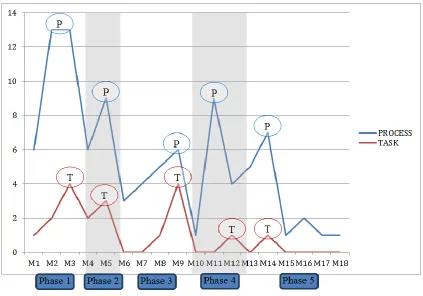
2.Graphically display conflict patterns (cf. Figure 1) as early indicator of variability (see Jehn, 1995, 1997)
3.Identify interpretive trends in variability (Maguire & Hardy, 2009; Langley, 1999)
Conflict patterns: Task and process conflict followed almost identical patterns of waxing and waning over time
Rich narrative of patterns, focusing on the relationship between task and process conflict
4.Examine evolution of strategic task to seek evidence of how task & process conflict impact the implementation of Beep
1.Revisit conflict data to see how conflict unfolded and how strategy implementation progressed to identify relationship between the two: responding to task conflict helped actors identify ambiguities & problems in strategy content (= refine what the strategy task is); responding to process conflict helped actors identify ambiguities & problems in strategy process (= refine how they might best accomplish the strategy task)
Five stages of implementation: (1) ambiguous strategy, (2) progressing strategy process by ignoring content ambiguity, (3) defining strategy content via crisis, (4) making the defined strategy work, and (5) achieving implementation.
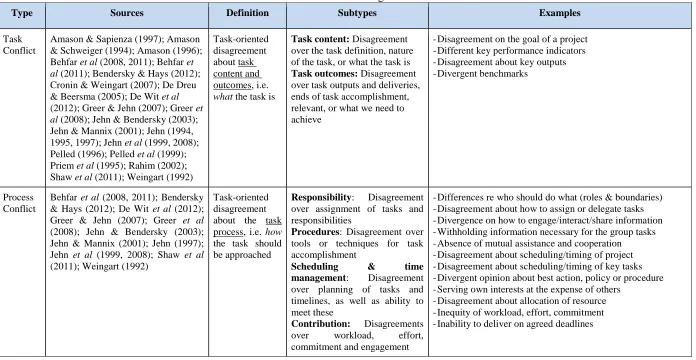
Table 2. Conflict Coding Scheme
Type Sources Definition Subtypes Examples
Task Conflict
Amason & Sapienza (1997); Amason & Schweiger (1994); Amason (1996); Behfar et al (2008, 2011); Behfar et al (2011); Bendersky & Hays (2012); Cronin & Weingart (2007); De Dreu & Beersma (2005); De Wit et al
(2012); Greer & Jehn (2007); Greer et al (2008); Jehn & Bendersky (2003); Jehn & Mannix (2001); Jehn (1994, 1995, 1997); Jehn et al (1999, 2008); Pelled (1996); Pelled et al (1999); Priem et al (1995); Rahim (2002); Shaw et al (2011); Weingart (1992)
Task-oriented disagreement about task content and outcomes, i.e.
what the task is
Task content: Disagreement
over the task definition, nature of the task, or what the task is
Task outcomes: Disagreement
over task outputs and deliveries, ends of task accomplishment, relevant, or what we need to achieve
-Disagreement on the goal of a project -Different key performance indicators -Disagreement about key outputs -Divergent benchmarks
Process Conflict
Behfar et al (2008, 2011); Bendersky & Hays (2012); De Wit et al (2012); Greer & Jehn (2007); Greer et al
(2008); Jehn & Bendersky (2003); Jehn & Mannix (2001); Jehn (1997); Jehn et al (1999, 2008); Shaw et al
(2011); Weingart (1992)
Task-oriented disagreement about the task process, i.e. how
the task should be approached
Responsibility: Disagreement
over assignment of tasks and responsibilities
Procedures: Disagreement over
tools or techniques for task accomplishment
Scheduling & time
management: Disagreement
over planning of tasks and timelines, as well as ability to meet these
Contribution: Disagreements
over workload, effort, commitment and engagement
-Differences re who should do what (roles & boundaries) -Disagreement about how to assign or delegate tasks -Divergence on how to engage/interact/share information -Withholding information necessary for the group tasks -Absence of mutual assistance and cooperation
-Disagreement about scheduling/timing of project -Disagreement about scheduling/timing of key tasks -Divergent opinion about best action, policy or procedure -Serving own interests at the expense of others