MD-15-1249 Cai 1 Cai Jianguo1
Key Lab. of C & PC Structures of Ministry of Education, National Prestress Engineering Research Center, Southeast University
Si Pai Lou 2#, Nanjing, China
e-mail: [email protected]; [email protected]
ASME Member
Zhang Yuting
School of Civil Engineering, Southeast University, China
e-mail: [email protected]
Xu Yixiang
Department of Civil Engineering, Strathclyde University, Glasgow, UK e-mail: [email protected]
Zhou Ya
School of Civil Engineering, Southeast University, China
Current address: Wuxi Architectural Design & Research Institute Co. Ltd, Wuxi, Jiangsu, China
e-mail: [email protected]
Feng Jian
School of Civil Engineering, Southeast University, China
e-mail: [email protected]
ABSTRACT
Foldable structures, a new kind of space structures developed in recent decades, can be deployed gradually to a working configuration, and also can be folded for transportation, thus have potentially broad application prospects in the fields of human life, military, aerospace, building structures and so on. Combined with the technology of origami folding, foldable structures derive more diversified models, and the foldable structures in cylindrical shape are mainly studied in this paper. Some researchers use the theory of quaternion representing spatial fixed-point rotation and construct the rotating vector model to obtain the quaternion rotation sequence method (QRS method) analyzing origami, but the method is very limited and not suitable for the cylindrical foldable structures. In order to solve the problem, a new method is developed, which combines the QRS method and the dual quaternion method. After analyzing the folding angle via the QRS method for multi-vertex crease system and calculating the coordinates of all vertices via the dual quaternion, the rigid foldability can be checked. Finally, two examples are carried out to confirm validity and versatility of the method.
1 Corresponding author.
MD-15-1249 Cai 2
INTRODUCTION
As an art of paper folding, origami has raised considerable research interest in mathematics. On the other hand, origami has been proved as a valuable tool to develop various engineering applications in numerous fields [1-5]. Most recent research on origami science mainly addresses the foldability issue, which is still regarded as intractable in many cases [6]. Rigid origami is a branch of origami whose facets and crease lines can be replaced by rigid panels and hinges. It stipulates that all panels bounded by creases in an origami pattern are not allowed to stretch or bend during folding, and thus all creases act as rotational hinges. Among recent research on rigid origami, a great majority focuses on the problem of rigid foldability [7]. Rigid foldability pays attention to the entire folding procedure and the method to assess the rigid foldability.
“Miura-ori” is an example of a famous pattern of rigid-foldability [8]. It is a well-known rigid origami structure utilized in the packaging of deployable solar panels for use in space or in the folding of maps [9]. A mathematical model based on the Gaussian curvature theory of polygonal surfaces has been proposed to study rigid origami by Huffman and Miura [10-11]. Belcastro and Hull [12] proposed a matrix method for modelling origami configurations, which derived the necessary condition of the rigid origami patterns with either single or multiple vertices. In order to represent sequential rotations around creases, the affine mapping from two dimensions to three dimensions was considered to obtain the loop-closure equations. With the diagram method and numerical method, Watanabe and Kawaguchi [13] derived the necessary condition to judge the rigid foldability. Streinu and Whiteley [14] linked single-vertex rigid origami to spherical polygonal linkages, and proved that via spherical motions, some single vertex origami could be rigidly folded into other configurations continuously. It has been generalized to a family of rigid foldable origami with quadrilateral mesh [15]. By considering an origami carton as one planar four-bar loop and two spherical 4R linkage loops, Wei and Dai [16] studied the geometry and kinematics of this origami carton. Based on the concept of an assembly of spherical linkages, Wang and Chen [17] proposed the mobile assembly of spherical 4R linkages to study the Kokotsakis type of the rigid origami patterns. Moreover, Liu et al. [18, 19] also established the kinematic and geometric compatibility conditions of the mobile assemblies of spherical 4R linkages to find the general condition of the rigid origami pattern for the deployable prismatic structures. Wu and You [20] proposed a new crease pattern that allows a tall box-shaped bag with a rectangular base to be rigidly folded flat. A rotating vector model was also proposed by Wu and You [7], which establishes the loop-closure conditions among a group of characteristic vectors. With the relationship between the single-vertex origami and the spherical linkage mechanism, the rotating vector model can conveniently and directly describe arbitrary three-dimensional configurations and can detect some self-intersection. Then a QRS method and a dual quaternion transformation sequence (DQTS) method were given to study the rigid foldability of single-vertex and multi-vertex origami, respectively.
MD-15-1249 Cai 3
In this paper, the rigid foldability of cylindrical origami has been studied. Firstly, the rotating vector model and the quaternion rotation sequence (QRS method) proposed by Wu and You [7], were introduced to study the rigid foldability of foldable cylinder structures. The limitation of this method was discussed. Then a new method, based on the dual quaternion was proposed. Finally, two examples are studied to confirm validity and versatility of the proposed method.
FOLDABILITY OF A CYLINDRICAL ORIGAMI
The rotating vector model
It is very convenient to express a single-vertex origami by the rotating vector model. Therefore, this section will briefly introduce the rotating vector model. More details about this model can be found in Ref. [7]. A four-fold single-vertex flat pattern is shown in Fig.1(a). The rigid panels are denoted by Bi (i=1, 2, 3, 4). The creases are denoted by Ei (i=1, 2, 3, 4). αi,jrepresents the layout angles from edge Ei to Ej (i =1, 2, 3, 4, j =2, 3, 4, 1). Figure1(b) shows a configuration during the folding process. The edge vector ei is along the crease Ei and the normal vector ni is perpendicular to panel Bi.
Figure 2 shows the rotational relationships between the vectors, which can be illustrated by some sequential steps. The angle between normal vectors of adjacent panels that intersects at edge Ei is denoted as γi. Starting with n1 and e1. ei rotates to ei+1 around the axis along the vector ni by the angle αi,j and ni rotates to ni+1 around the axis along the vector ei by the angle γi. It should be noted that the last two steps return to the initial vectors e1 and n1, respectively. Thus a closed-loop rotation sequence can be obtained.
The QRS method
The QRS method means applying the quaternion rotation operator to the edge and normal vectors in origami patterns. Consider the vectors e1=(1,0,0) and n1=(0,0,1) in a three-dimensional Cartesian coordinate frame. Now the folding angle between the adjacent panels, ti, is equal to π-γi. The sequential steps shown in Fig. 2 can be expressed as:
(1) 1 12,
1 2
n α
e e
1
1 1
12 12 12 12
1 1 1
*
2 1
{cos( ),sin( ) ,sin( ) ,sin( ) }
2 2 2 2
( )
n
x y z
n n
α α α α
q n n n
e q e q
(1)
(2) 2, 2
1 2
e π t
n n
2
2 2
2 2 2 2
2 2 2
*
2 1
{cos( ),sin( ) ,sin( ) ,sin( ) }
2 2 2 2
( )
e
x y z
e e
π t π t π t π t
q e e e
n q n q
(2)
(3) 2,23
2 3
n α
e e
2
2 2
23 23 23 23
2 2 2
*
3 2
{cos( ),sin( ) ,sin( ) ,sin( ) }
2 2 2 2
( )
n
x y z
n n
α α α α
q n n n
e q e q
(3)
(4) 3, 3
2 3
e π t
MD-15-1249 Cai 4 3
3 3
3 3 3 3
3 3 3
*
3 2
{cos( ),sin( ) ,sin( ) ,sin( ) }
2 2 2 2
( )
e
x y z
e e
π t π t π t π t
q e e e
n q n q
(4)
(5) 3 34,
3 4
n α
e e
3
3 3
34 34 34 34
3 3 3
*
4 3
{cos( ),sin( ) ,sin( ) ,sin( ) }
2 2 2 2
( )
n
x y z
n n
α α α α
q n n n
e q e q
(5)
(6) 4, 4
3 4
e π t
n n
4
4 4
4 4 4 4
4 4 4
*
4 3
{cos( ),sin( ) ,sin( ) ,sin( ) }
2 2 2 2
( )
e
x y z
e e
π t π t π t π t
q e e e
n q n q
(6)
(7) 4,41
5 4
n α
e e
4
4 4
41 41 41 41
4 4 4
*
5 4
{cos( ),sin( ) ,sin( ) ,sin( ) }
2 2 2 2
( )
n
x y z
n n
α α α α
q n n n
e q e q
(7)
(8) 5, 1
5 4
e π t
n n
5
5 5
1 1 1 1
5 5 5
*
5 4
{cos( ),sin( ) ,sin( ) ,sin( ) }
2 2 2 2
( )
e
x y z
e e
π t π t π t π t
q e e e
n q n q
(8)
In these equations, ei and ni are the quaternion representations of vectors ei and ni, the quaternion ( )* is the conjugate element of quaternion ( ).
It can be found that the vectors e5 and n5 should be the same as two initial vectors e1 and n1 based on the rotating vector model. So the loop-closure equation system can be derived as
5 5 5 5 1 1 1 1
5 5 5 5 1 1 1 1
{0, , , } {0, , , }
{0, , , } {0, , , }
x y z x y z
x y z x y z
e e e e e e e e
n n n n n n n n
(9) which leads to
5 1 5 1 5 1 5 1 5 1 5 1 1 0 0 0 0 1 x x y y z z x x y y z z e e e e e e n n n n n n (10)
Six simultaneous equations are obtained. For a given origami pattern, all αi,j are known and therefore all the equations can be solved if the folding angle t1 is specified.
Application of the QRS method to a cylindrical origami
MD-15-1249 Cai 5
given from its previous subsystem. Finally, check whether the geometric parameter, such as the folding angle, common in the first and the last subsystems has the same values. If so, the origami pattern has the global compatibility. Wu and You [7] used this strategy to study the motion of some multi-vertex origami patterns. However, they did not try to study the rigid foldability of a cylindrical origami.
Figure 3 shows a modified Miura origami pattern. Four this pattern, it can have a flat configuration. With the QRS method, its rigid foldability can be shown. If we combine the vertices V12 together, this origami pattern forms a cylinder configuration as shown in Fig.4. For the cylindrical origami, it also folds rigidly with the QRS method. However, many researchers have stated the cylinder structure with Miura origami pattern cannot move rigidly. It can be found that the QRS method is not suitable for checking the rigid foldability of cylinder structures. It can be seen that when the origami pattern given in Fig.3 forms a cylinder, an additional geometric constraint has to be added to the system. The constraint is that two vectors, V0 and V12, should coincide during the motion.
THE PROPOSED METHOD FOR CHECKING RIGID FOLDABILITY
This section discusses the dual quaternion method, which is proposed to check the foldability of the cylindrical origami. Wu and You also proposed a dual quaternion transformation sequence (DQTS) method. Compared with the QRS method, the DQTS method operates in a more global sense. However, it requires more inputs to solve the loop-closure equation system [7]. Moreover, when this method is used for the origami with many vertices, the number of loop-closure equations will be very high leading to numerical difficulty. Furthermore, the rigid foldability of cylinder structures was not investigated by them. In this paper, an improved method based on the dual quaternion method and the vertex coordinate transfer is proposed. Furthermore, we can simplify the dual quaternion operation using the known folding angle, which leads to a transfer from the parameter calculation to the numerical calculation. Then the coordinates of all vertices during the motion can be obtained. The relationship between folding angle and the vertex coordinate is used to check the rigid foldability of the cylindrical origami.
The dual quaternion is introduced firstly. A dual numberz is defined as the sum of a scalar part and a dual part
z a b (11) where a and b are both real numbers, 2
0
and 0.
Thus a dual quaternion Q can be defined as
1 2 1 2 3 4 5 6 7 8
ˆ
Q q q a aiajak a aia jak (12)
wherea a a a a1, 2, 3, 4, 5,a a a6, 7, 8 are real numbers, i, j, k are imaginary units. Q can also be expressed as
1 2 3 4 5 6 7 8
ˆ , , , , , , ,
Q a a a a a a a a (13)
Normally, any rigid motion can be seen as screw motion. For the cylindrical origami considered in this paper, the motion can be seen as the fixed rotational motion and the vertices translational motion. For the fixed rotation motion, if the vector r1=(r1x,r1y,r1z) is
rotated about the vector z, rˆ1 is the dual quaternion represent of vector r1. Then the
MD-15-1249 Cai 6
*
2 ˆ ˆ1
ˆ ˆ
r QrQ (14)
where the unit dual quaternion operator Q
and its conjugate elements can be represented as
ˆ {cos( ),sin( ) ,sin( ) ,sin( ) ,0,0,0,0}
2 2 x 2 y 2 z
α α α α
Q z z z
and ˆ*
{cos( ), sin( ) , sin( ) , sin( ) , 0, 0, 0, 0}
2 2 x 2 y 2 z
α α α α
Q z z z .
If vertex V1 is translated to vertex V2 along vector n =(n n nx, y, z), the resultant vertex
V2 is then given as
2 ˆ 1ˆ
ˆ ˆ
V QV Q (15)
where the unit dual quaternion operator ˆ {1,0,0,0,0, , , }
2 x 2 y 2 z
d d d
Q n n n and d = the distance
of the translation from vertex V1 to vertex V2.
Figure 5 shows the serial numbers of the vertices and fold lines of the cylindrical origami. Assume the coordinate of Vertex V1 is (0, 0, 0), the x-axis is along the vector
1 1
V e , the z-axis is along the normal vector of rigid plate V n1 1. Then the vertex coordinates
can be obtained by following sequential steps. Firstly, the vector V e1 1 of Vertex V1 rotates
to vectorV e1 2about the vectorV n1 1. Then the vector V n1 1rotates to vectorV n1 2 about the
vectorV e1 2. After that, vector V e1 2rotates to vectorV e1 3about the vectorV n1 2. Then the vertex
V 1 translates to vertex V 2 along the vectorV e1 3. Repeat the four steps until the vertex is
translated from V 1 to V 0 and finally the whole closed-loop sequence is completed. The dual quaternion form of the vectorsV e1 1, V n1 1, and V 1 can be given as
1 1ˆ {1, 0, 0, 0, 0, 1 1x, 1 1y, 1 1z} {1, 0, 0, 0, 0,1, 0, 0}
V e V e V e V e (16)
1 1ˆ {1, 0, 0, 0, 0, 1 1x, 1 1y, 1 1z} {1, 0, 0, 0, 0, 0, 0,1}
V n V n V n V n (17)
1 1 1 1
ˆ {1,0,0,0,0, , , } {1,0,0,0,0,0,0,0}x y z
V V V V (18)
Then the calculated steps of vertex coordinates can be given as
1 1 1 12,
1 1 1 2
V n V α
V e V e :
1
1 1
1
1 1 1
1 1
1 1
1 12 1 12 1 12 1 12
1 1 1
*
2 1
, 0, 0, 0, 0
ˆ {cos( ),sin( ) ,sin( ) ,sin( ) }
2 2 2 2
ˆ ˆ
ˆ ˆ ( )
V n
x y z
V n V n
V V V
V α V α V α V α
Q n n n
V e Q V e Q
(19)
1 2, 1 2
1 1 1 2
V e π V t
V n V n :
1 2
1 1 1
1 2 1 2
1 1
1 2 1 2 1 2 1 2
2 2 2
*
2 1
, 0, 0, 0, 0
ˆ {cos( ),sin( ) ,sin( ) ,sin( ) }
2 2 2 2
ˆ ˆ
ˆ ˆ ( )
V e
x y z
V e V e
π V t π V t π V t π V t
Q e e e
n Q n Q
V V V
V V (20)
1 2,1 23
1 2 1 3
V n V α
V e V e:
1
1 1
2
1 1 1
2 2
1 1
1 23 1 23 1 23 1 23
2 2 2
*
3 2
, 0, 0, 0, 0
ˆ {cos( ),sin( ) ,sin( ) ,sin( ) }
2 2 2 2
ˆ ˆ
ˆ ˆ ( )
V n
x y z
V n V n
V V V
V α V α V α V α
Q n n n
V e Q V e Q
(21)
Vector transformation:
2 1 1 1 1 1 1 1 1
2 1
3 3 3 3 3 3 3 3
2
1 1
{ ˆ(1), ˆ(2), ˆ(3), ˆ(4), ˆ(5), ˆ(6), ˆ(7), ˆ(8),} ˆ
ˆ ˆ
V e V e V e V e V e V e V e V e
V n
V e V n
(22)
MD-15-1249 Cai 7 1 3 1 3 1 3
2 1
1 1 1
1 2
1 2( ) 1 2
ˆ {1, 0, 0, 0, 0, , , }
2 2 2
ˆ ˆ
ˆ ˆ
x y z
V e V e V e
d d d QV V
V QV V V QV V
(23)
For the cylindrical origami pattern shown in Fig. 3, repeating Eqs. (19) to (23), we can obtain the coordinates of vertexVˆ0. The sixth, seventh and eighth elements of this
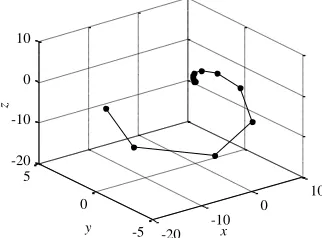
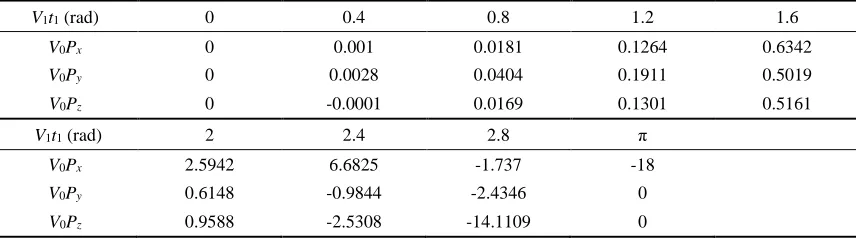
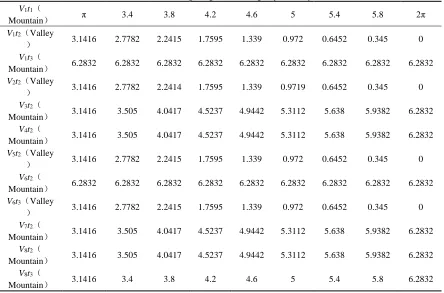
dual quaternion are the x, y, z coordinates of Vertex 0. With the help of MATLAB, the coordinates of Vertex 0 with different folding angles are given in Table 1 and Fig. 6. It can be found the coordinates of Vertex 0 varied during the motion of the cylinder. That is to say, the cylindrical origami with Miura pattern is not rigidly foldable.
Rigid origami stipulates that all panels bounded by creases in an origami pattern are not allowed to stretch or bend during folding. The proposed method can also be used to check the foldability of multi-vertex cylindrical origami. The criterion is summarized as follows: ①The folding angle can be solved by the QRS method. If the last crease vectors are same as the initial crease vectors after a closed-loop rotation but the folding angle in different folding configuration does not always remain the same as the original value, then the model does not have rigid foldability. Otherwise, go to step 2. ②After obtaining the coordinates of the vertices using the dual quaternion method, if the coordinate of last vertex Vn+1 (or V0) is not same as that of origin vertex V1, then the cylinder does not have rigid foldability. ③The coordinate curves of all vertices should keep continuous and smooth for a rigidly foldable cylinder.
NUMERICAL EXAMPLES
To confirm validity and versatility of the proposed method, foldability analyses of several types of crease patterns are carried out.
Tachi cylindrical origami
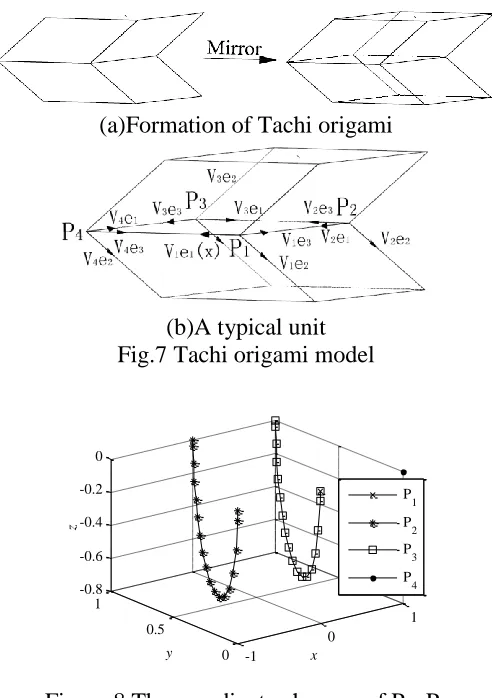
Figure 7(a) shows the formation of Tachi cylindrical origami [22]. Mirror the Miura-ori and then a Tachi origami is obtained. Figure 7(b) shows a typical unit of Tachi cylinder. The Tachi cylinder is rigidly foldable and has a single degree of freedom. Besides it has both flat configurations in fully folded state and fully unfolded state.
After analyzing the typical unit, it can be obtained that P1 and P3 are two-dimensional single-vertices, P2 and P4 are three-dimensional vertices which cannot fold flatly. Assuming the folding angleV t1 1 of crease V e1 1as the input angle, all other corresponding
folding angles of vertex P1 can be obtained. After vertex P1 is translated to P2 along the vectorV e1 3, all the folding angles of vertex P2 can be calculated. Following that analogy,
the folding angles of vertices P3 and P4 can be obtained. The crease vector V e4 3should be
the same as the crease vectorV e1 1. Therefore, if V t4 3V t1 1, the angle relationship satisfies
the necessary condition of rigid foldability.
For the Tachi typical unit, the geometric parameters can be assumed as
1 12 1 41 3 23 3 34 3 / 4
V α V α V α V α π , V α1 23V α1 34V α3 12V α3 41π/ 4,
2 12 2 23 2 34 2 41 3 / 4
[image:7.612.236.410.74.140.2]MD-15-1249 Cai 8
The distance between two adjacent vertices isdk 1. Then the folding angles are listed
in Table 2.
It can be found from Table 2 that V t4 3V t1 1, which means the angle relationship satisfies the necessary conditions for rigid foldability. Then we will study the vertex coordinates relationship. Assuming the coordinate of P1 is (0,0,0), the crease vector V e1 1=(1,0,0), and
the normal vector of the rigid plate V n1 1=(0,0,1), with the dual quaternion method, the
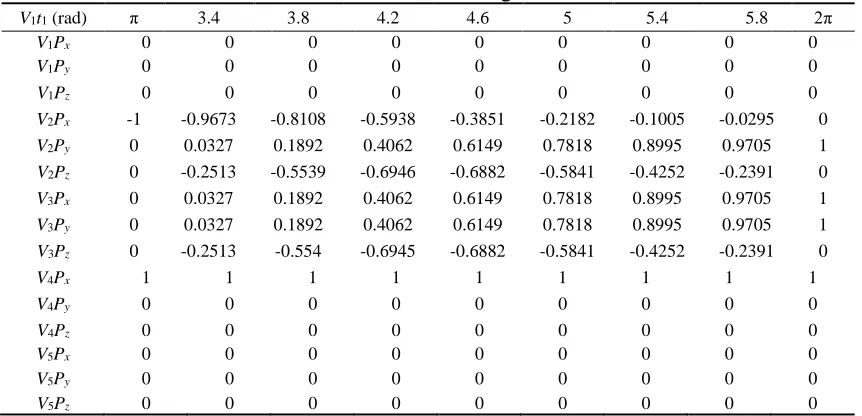
coordinates changes of the vertices are given in Table 3.
It can be found from Table 3 that the coordinate of P5 is the same as that of P1during the motion, which indicates that the coordinate relationship satisfies the necessary conditions for rigid foldability. The coordinate changes of P1~P4 are shown in Figure 8.
The changing curves are continuous and smooth, satisfying the last necessary condition for rigid foldability. Therefore, the Tachi cylindrical origami has a rigid foldability.
Deployable cylinder
Based on the concept of the Tachi-Miura Polyhedron [23], a new type of deployable cylinders was given in Fig. 9. The cylinder is formed by two pieces of Miura origami, which is connected by two six-creases origami patterns. Therefore, as shown in Fig.10, the Vertices 1 and 6 have six creases, and all other vertices have four creaes.
Assuming the folding angle V t1 1 of crease V e1 1 as the input angle, the other
corresponding folding angles of vertex P1 can be calculated. After vertex P1 is translated to P2 along the vectorV e1 4, the folding angles of vertex P2 can be obtained. Following that
analogy, the crease angle of vertex P8 can be obtained and the crease vector V e8 3 should
be the same as the crease vectorV e1 1. If V t8 3V t1 1, the angle relationship satisfies the
necessary conditions for rigid foldability.
For the deployable cylinder, the geometry parameters can be assumed as
1 12 1 23 1 56 1 61 / 4, 1 34 1 45 / 2
V α V α V α V α π V α V α π
12 41 / 4, 23 34 3 / 4
k k k k
V α V α π V α V α π
12 41 3 / 4, 23 34 / 4
k k k k
V α V α π V α V α π
6 12 6 61 / 2, 6 23 6 34 6 45 6 56 / 4
V α V α π V α V α V α V α π The distances between two adjacent vertices are
1 5 1, 2 3 4 6 8 2, 7 4
d d d d d d d d . The results are listed in Table 4.
It can be found thatV t8 3V t1 1 , so the angle relationship satisfies the necessary
conditions for rigid foldability. However,V t1 3V t1 5V t6 2V t6 62π , indicating that the
corresponding creases don’t deploy during the motion.
Then we will study the vertex coordinates relationship. Assuming the coordinate of P1 is (0,0,0), the crease vector V e1 1 =(1,0,0), and the normal vector of the rigid plate
1 1
V n =(0,0,1), with the dual quaternion method, the changes in vertices coordinates are given in Table 5.
MD-15-1249 Cai 9
The changes of coordinate P1~P8 are shown in Fig. 11. The curves are continuous and smooth, satisfying the last necessary condition for rigid foldability. Therefore, the deployable cylinder can be proved rigidly foldable via the proposed method.
CONCLUSIONS
In this paper, we established a new method to study the rigid foldability of the multi-vertex cylindrical-shaped origami patterns. After analyzing the folding angles via the QRS method for multi-vertex crease origami, calculating the coordinates of all vertices using the dual quaternion method, the rigid foldability can then be checked. Compared with the original QRS method proposed by Wu and You [7], the method is able to check the rigid foldability of multi-vertex cylindrical origami. Through two examples, we demonstrated that the proposed method can analyze the folding angles and coordinates of vertices, and thereby predict its rigid foldability. However, due to the complexity of both the folding angles and vertex coordinates of the multi-vertex origami, we have yet to use the proposed method to develop an algorithm for detecting more cylindrical origami with rigid foldability, which will be the further study of this topic.
ACKNOWLEDGMENTS
MD-15-1249 Cai 10 REFERENCES
[1] Sorguc A G, Hagiwara I, Selcuk S A. Origami in Architecture: A Medium of Inquiry
for Design in Architecture. Metu Jfa, 2009, 26(2): 235-247.
[2] Hagiwara I. From Origami to Origamics. Science Japan Journal, 2008, July, 22-25.
[3] Guest S D. Deployable structures: Concepts and Analysis. PhD thesis, Cambridge
University, Cambridge, UK, 1996.
[4] Ma J, You Z. Energy Absorption of Thin-Walled Square Tubes with a Prefolded
Origami Pattern-Part I: Geometry and Numerical Simulation. Journal of Applied Mechanics-Transactions of the ASME, 2014, 81(1): 011003
[5] Ma J, You Z. Energy absorption of thin-walled beams with a pre-folded origami
pattern. Thin-walled Structures, 2013, 73: 198-206
[6] Demaine E D, O’Rourke, J. A survey of folding and unfolding in computational
geometry. In Mathematical sciences research institute publications, 2005, vol. 52, pp. 167-211. Berkeley, CA: MSRI Publications.
[7] Wu WN, You Z. Modelling rigid origami with quaternions and dual quaternions,
Proceedings of the Royal Society A: Mathematical, Physical and Engineering Sciences, 2010, 466: 2155-2174
[8] Miura K. Map Fold a La Miura Style, Its Physical Characteristics and Application to
the Space Science. In Research of Pattern Formation, edited by R. Takaki, pp. 77-90. Tokyo: KTK Scientific Publishers, 1989.
[9] Miura K. Method of packaging and deployment of large membranes in space, In:
Proceedings of 31stCongress of International Astronautics Federation (IAF-80-A31), Tokyo, Japan, 1980, 1-10.
[10]Huffman D. 1976 Curvature and crease: a primer on paper. IEEE Trans. Comput.
C-25, 1010–1019.(doi:10.1109/TC.1976.1674542)
[11]Miura K. 1989 A Note on Intrinsic Geometry of Origami. In Proc. 1st Int. Meet. of
Origami Science and Technology, 6-7 December, Ferrara, Italy (ed. H. Huzita), pp. 239–249.
[12]Belcastro, S. & Hull, T. 2002, Modeling the folding of paper into three dimensions
using affine transformations. Linear Algebra Appl. 348, 273–282.
[13]Watanabe N, Kawaguchi K. 2006, The method for judging rigid foldability. In
Origami 4Proc. 4th Int. Conf. on Origami in Science, Mathematics, and Education, Pasadena, CA, September 8-10,, pp. 165–174. Natick, MA: AK Peters
[14]Streinu I, Whiteley W. 2005 Single-vertex origami and spherical expansive motions.
Lecture Notes in Computer Science, no. 3742, pp. 161-173. Berlin, Germany: Springer.
[15]Tachi T. Generalization of Rigid Foldable Quadrilateral Mesh Origami. Proceedings
of the International Association for Shell and Spatial Structures Symposium 2009, edited by Albert Domingo and Carlos Lazaro, pp. 2287-2294. Madrid: IASS, 2009.
[16]Wei GW, Dai JS. Origami-Inspired Integrated Planar-Spherical Overconstrained
Mechanisms, J. Mech. Des., 2014, 136(5), 051003
[17]Wang KF, Chen Y. Rigid Origami to Fold a Flat Paper into a Patterned Cylinder,
The 5th international conference on origami in science, Singapore, 2010.
[18]Liu SC, Chen Y, Lu GX. The rigid origami patterns for flat surface, Proceedings of
MD-15-1249 Cai 11
Computers and Information in Engineering Conference, IDETC/CIE 2013, August 4-7, 2013, Portland, Oregon, USA
[19]Liu SC, Lv WL, Chen Y, Lu GX. Deployable Prismatic Structures with Origami
Patterns, Proceedings of the ASME 2014 International Design Engineering Technical Conferences & Computers and Information in Engineering Conference, IDETC/CIE 2014 August 17-20, 2014, Buffalo, New York, USA
[20]Wu W, You Z. A solution for folding rigid tall shopping bags, Proc. R. Soc. London,
Ser. A, 2011, 467, 2561-2574.
[21]Miura K, Tachi T, Miyazaki Y. Foldable space structures-foldable cylindrical
polyhedron and IKAROS solar sail, IASS-APCS 2012 Symposium, May 21-24, 2012, Seoul, Korea
[22]Tachi T. One-DOF Cylindrical Deployable Structures with Rigid Quadrilateral
Panels, in: A. Domingo, C. Lazaro (Eds.) The International Association for Shell and Spatial Structures Symposium 2009, Madrid: IASS, 2009, pp. 2295–2305.
[23]Miura K, Tachi T. Synthesis of rigid-foldable cylindrical polyhedral, Symmetry: Art
MD-15-1249 Cai 12 Figure Captions List
Fig. 1 Origami crease pattern(a) The initially flat state (b) a folding configuration
Fig. 2 The closed-loop rotation sequence of the characteristic vectors
decomposed into eight steps in the rotating vector model of the single-vertex fourfold system
Fig. 3
The modified Miura origami pattern
Fig. 4
The cylinder configuration
Fig. 5
The serial numbers of the vertex and fold lines
Fig. 6
The coordinates of Vertex 0
Fig. 7 Tachi origami model
Fig. 8 The coordinate changes of P1~P4
Fig. 9 Crease pattern of a deployable cylinder
Fig. 10 Vertices of the deployable cylinder (a) Vertex P1 (b) Vertex P2~ P5(c)
Vertex P6 (d) Vertex P7~ P8
MD-15-1249 Cai 13 Table Caption List
Table 1 The coordinates of Vertex 0
Table 2 The folding angles of Tachi typical unit
Table 3
The coordinates changes of the vertices
Table 4
The folding angles of Deployable cylinder
MD-15-1249 Cai 14
(a) The initially flat state
[image:14.612.155.456.404.599.2](b)a folding configuration Fig.1 Origami crease pattern
MD-15-1249 Cai 15
[image:15.612.186.428.199.458.2]Fig.3 The modified Miura origami pattern
Fig.4 The cylinder configuration
Fig. 5 The serial numbers of the vertex and fold lines
-20
-10 0 10
-5 0 5 -20 -10 0 10
x y
z
[image:15.612.236.397.505.624.2]MD-15-1249 Cai 16
(a)Formation of Tachi origami
(b)A typical unit Fig.7 Tachi origami model
-1
0
1
0 0.5 1 -0.8 -0.6 -0.4 -0.2 0
x y
z
P1
P2
P3
P
[image:16.612.183.429.69.418.2]4
Figure 8 The coordinate changes of P1~P4
[image:16.612.195.421.455.565.2]MD-15-1249 Cai 17
(a)Vertex P1
P2 P3 P4 P5
V2e1
V2e2
V2e3
V2e4
(b)Vertex P2~ P5
(c)Vertex P6
(d)Vertex P7~ P8
Fig. 10 Vertices of the deployable cylinder
-2 0 2 4
6 8 0
2 4 -4 -3 -2 -1 0
x y
z
P
1
P
2
P3 P4 P
5
P
6
[image:17.612.215.399.74.398.2]P7 P8
MD-15-1249 Cai 18
Table 1 The coordinates of Vertex 0
V1t1 (rad) 0 0.4 0.8 1.2 1.6
V0Px 0 0.001 0.0181 0.1264 0.6342
V0Py 0 0.0028 0.0404 0.1911 0.5019
V0Pz 0 -0.0001 0.0169 0.1301 0.5161
V1t1 (rad) 2 2.4 2.8 π
V0Px 2.5942 6.6825 -1.737 -18
V0Py 0.6148 -0.9844 -2.4346 0
MD-15-1249 Cai 19
Table 2 The folding angles of Tachi typical unit
V1t1(
Mountain) π 3.4 3.8 4.2 4.6 5 5.4 5.8 2π
V1t2(
Mountain) 3.1416 3.505 4.0417 4.5237 4.9442 5.3112 5.638 5.9382 6.2832
V2t2(
Mountain) 6.2832 5.9198 5.383 4.9011 4.4805 4.1135 3.7868 3.4866 3.1416
V3t2(
Mountain) 3.1416 3.505 4.0417 4.5237 4.9442 5.3112 5.638 5.9382 6.2832
V4t2(
Mountain) 6.2832 5.9198 5.383 4.9011 4.4805 4.1135 3.7868 3.4866 3.1416
V4t3(
Mountain) π 3.4 3.8 4.2 4.6 5 5.4 5.8 2π
Table 3 The coordinates changes of the vertices
V1t1 (rad) π 3.4 3.8 4.2 4.6 5 5.4 5.8 2π
V1Px 0 0 0 0 0 0 0 0 0
V1Py 0 0 0 0 0 0 0 0 0
V1Pz 0 0 0 0 0 0 0 0 0
V2Px -1 -0.9673 -0.8108 -0.5938 -0.3851 -0.2182 -0.1005 -0.0295 0
V2Py 0 0.0327 0.1892 0.4062 0.6149 0.7818 0.8995 0.9705 1
V2Pz 0 -0.2513 -0.5539 -0.6946 -0.6882 -0.5841 -0.4252 -0.2391 0
V3Px 0 0.0327 0.1892 0.4062 0.6149 0.7818 0.8995 0.9705 1
V3Py 0 0.0327 0.1892 0.4062 0.6149 0.7818 0.8995 0.9705 1
V3Pz 0 -0.2513 -0.554 -0.6945 -0.6882 -0.5841 -0.4252 -0.2391 0
V4Px 1 1 1 1 1 1 1 1 1
V4Py 0 0 0 0 0 0 0 0 0
V4Pz 0 0 0 0 0 0 0 0 0
V5Px 0 0 0 0 0 0 0 0 0
V5Py 0 0 0 0 0 0 0 0 0
[image:19.612.92.523.269.477.2]MD-15-1249 Cai 20
Table 4 The folding angles of Deployable cylinder
V1t1(
Mountain) π 3.4 3.8 4.2 4.6 5 5.4 5.8 2π
V1t2(Valley
) 3.1416 2.7782 2.2415 1.7595 1.339 0.972 0.6452 0.345 0
V1t3(
Mountain) 6.2832 6.2832 6.2832 6.2832 6.2832 6.2832 6.2832 6.2832 6.2832
V2t2(Valley
) 3.1416 2.7782 2.2414 1.7595 1.339 0.9719 0.6452 0.345 0
V3t2(
Mountain) 3.1416 3.505 4.0417 4.5237 4.9442 5.3112 5.638 5.9382 6.2832
V4t2(
Mountain) 3.1416 3.505 4.0417 4.5237 4.9442 5.3112 5.638 5.9382 6.2832
V5t2(Valley
) 3.1416 2.7782 2.2415 1.7595 1.339 0.972 0.6452 0.345 0
V6t2(
Mountain) 6.2832 6.2832 6.2832 6.2832 6.2832 6.2832 6.2832 6.2832 6.2832
V6t3(Valley
) 3.1416 2.7782 2.2415 1.7595 1.339 0.972 0.6452 0.345 0
V7t2(
Mountain) 3.1416 3.505 4.0417 4.5237 4.9442 5.3112 5.638 5.9382 6.2832
V8t2(
Mountain) 3.1416 3.505 4.0417 4.5237 4.9442 5.3112 5.638 5.9382 6.2832
V8t3(
MD-15-1249 Cai 21
Table 5 The coordinates changes of the vertices
V1t1 (rad) π 3.4 3.8 4.2 4.6 5 5.4 5.8 2π
V1Px 0 0 0 0 0 0 0 0 0
V1Py 0 0 0 0 0 0 0 0 0
V1Pz 0 0 0 0 0 0 0 0 0
V2Px 1 0.9674 0.8108 0.5938 0.3851 0.2182 0.1005 0.0295 0
V2Py 0 0.0326 0.1892 0.4062 0.6149 0.7818 0.8995 0.9705 1
V2Pz 0 -0.2513 -0.5539 -0.6946 -0.6882 -0.5841 -0.4252 -0.2392 0
V3Px 3 2.7104 1.4401 0.0042 -1.0215 -1.5914 -1.8591 -1.9671 -2
V3Py 0 0.159 0.8029 1.371 1.5621 1.464 1.2611 1.0849 1
V3Pz 0 -1.2238 -2.3504 -2.3442 -1.7484 -1.0939 -0.5962 -0.2673 0
V4Px 5 4.6451 3.0615 1.1918 -0.2512 -1.1551 -1.658 -1.9081 -2
V4Py 0 0.2243 1.1814 2.1834 2.7918 3.0277 3.0601 3.026 3
V4Pz 0 -1.7265 -3.4584 -3.7333 -3.1248 -2.262 -1.4467 -0.7457 0
V5Px 7 6.6451 5.0615 3.1918 1.7488 0.8449 0.342 0.0919 0
V5Py 0 0.2243 1.1815 2.1833 2.7917 3.0278 3.0601 3.026 3
V5Pz 0 -1.7264 -3.4584 -3.7333 -3.1248 -2.2619 -1.4467 -0.7457 0
V6Px 8 7.6125 5.8723 3.7856 2.134 1.063 0.4425 0.1213 0
V6Py 0 0.2569 1.3708 2.5895 3.4066 3.8097 3.9595 3.9965 4
V6Pz 0 -1.9777 -4.0124 -4.4279 -3.813 -2.846 -1.8719 -0.9848 0
V7Px 6 5.8694 5.2429 4.3752 3.5406 2.8726 2.4021 2.1179 2
V7Py 0 0.1306 0.7571 1.6247 2.4593 3.1275 3.5979 3.8821 4
V7Pz 0 -1.0053 -2.2159 -2.7781 -2.7527 -2.3361 -1.701 -0.9567 0
V8Px 2 2 2 2 2 2 2 2 2
V8Py 0 0 0 0 0 0 0 0 0
V8Pz 0 0 0 0 0 0 0 0 0
V9Px 0 0 0 0 0 0 0 0 0
V9Py 0 0 0 0 0 0 0 0 0
![Figure 7(a) shows the formation of Tachi cylindrical origami [22]. Mirror the Miura-ori and then a Tachi origami is obtained](https://thumb-us.123doks.com/thumbv2/123dok_us/1513800.104002/7.612.236.410.74.140/figure-formation-tachi-cylindrical-origami-mirror-origami-obtained.webp)