City, University of London Institutional Repository
Citation
:
Flaxman, P., Stride, C., Soderberg, M., Lloyd, J., Guenole, N. and Bond, F. W. (2017). Relationships between two dimensions of employee perfectionism, postwork cognitive processing, and work day functioning. European Journal of Work and Organizational Psychology, doi: 10.1080/1359432X.2017.1391792This is the accepted version of the paper.
This version of the publication may differ from the final published
version.
Permanent repository link:
http://openaccess.city.ac.uk/18435/Link to published version
:
http://dx.doi.org/10.1080/1359432X.2017.1391792Copyright and reuse:
City Research Online aims to make research
outputs of City, University of London available to a wider audience.
Copyright and Moral Rights remain with the author(s) and/or copyright
holders. URLs from City Research Online may be freely distributed and
linked to.
City Research Online: http://openaccess.city.ac.uk/ [email protected]
This is an Accepted Manuscript of an article published by Taylor & Francis in EUROPEAN JOURNAL OF WORK AND ORGANIZATIONAL PSYCHOLOGY on 19th October 2017,
available at http://www.tandfonline.com/ https://doi.org/10.1080/1359432X.2017.1391792
Relationships between two dimensions of employee perfectionism,
postwork cognitive processing, and work day functioning
Paul E. Flaxman
1, Christopher B. Stride
2, Mia Söderberg
1, Joda Lloyd
3, Nigel
Guenole
3, and Frank W. Bond
31 Department of Psychology, City, University of London, London, UK
2 Management School, University of Sheffield, Sheffield, UK
3 Institute of Management Studies, Goldsmiths, University of London, London, UK
Author Note
Paul E. Flaxman and Mia Söderberg, Psychology Department, City, University of London;
Christopher B. Stride, Management School, University of Sheffield (e-mail:
[email protected]); Joda Lloyd, Nigel Guenole, and Frank W. Bond, Institute of
Management Studies, Goldsmiths, University of London (e-mail: [email protected];
[email protected]; [email protected]).
Mia Söderberg is now at the Department of Occupational and Environmental
Medicine, University of Gothenburg, Sweden (e-mail: [email protected]).
This research was supported by the Economic and Social Research Council (ESRC)
under grant reference: RES-061-25-0232.
Correspondence should be addressed to: Dr. Paul E. Flaxman, Department of
Psychology, City, University of London, Northampton Square, London EC1V 0HB, United
Relationships between two dimensions of employee perfectionism,
postwork cognitive processing, and work day functioning
This daily diary study examined relations between two distinct perfectionism dimensions and
work-related cognitions experienced by employees during evening leisure time. Drawing from perseverative cognitive processing theory, we hypothesized that perfectionistic concerns would
be related to work-related worry and rumination during postwork evenings. In contrast, we hypothesized that a theoretically more adaptive perfectionist dimension (perfectionistic strivings) would be associated with positively valenced self-reflections about work across
consecutive evenings. A sample of 148 full-time workers completed an initial survey, which included a trait perfectionism measure, reported their work-related cognitions across four
consecutive evenings of a working week, rated their sleep quality immediately upon awakening on each subsequent morning, and their daily levels of emotional exhaustion and work
engagement at the end of each work day. Results showed that perfectionistic concerns were indirectly negatively associated with sleep quality and work day functioning via the tendency to
worry and ruminate about work. In contrast, perfectionistic strivings were indirectly positively associated with work day engagement via the propensity to experience positive thoughts about
work during evening leisure time. The theoretical and practical implications of these findings are discussed.
Relationships between two dimensions of employee perfectionism,
postwork cognitive processing, and work day functioning
The ability to recover from work demands during nonwork time is widely recognized as an
important factor for maintaining employees’ health and job performance. In the absence of
adequate recovery experiences, the psychophysiological system can be exposed to prolonged
activation, which over time increases the risk of psychological (e.g., burnout) and somatic
(e.g., cardiovascular) ill-health (Brosschot, Gerin, & Thayer, 2006; Geurts & Sonnentag,
2006; McEwen, 1998; Sluiter, van der Beek, & Frings-Dresen, 1999). Within the employee
recovery literature, the propensity to psychologically detach (or “switch off”) from work
during leisure time has attracted particular interest (e.g., Etzion, Eden, & Lapidot, 1998;
Feuerhahn, Sonnentag, & Woll, 2014; Fritz, Yankelevich, Zarubin, & Barger, 2010; Rivkin,
Diestel, & Schmidt, 2015; Smit, 2016; Sonnentag & Bayer, 2005; Sonnentag, Binnewies, &
Mojza, 2008, 2010; Sonnentag & Fritz, 2015). A large body of research indicates that the
ability to detach from work during nonwork hours (e.g., evenings and weekends) is often
positively associated with employee well-being (for reviews see Sonnentag, 2012; Sonnentag
& Fritz, 2015).
More recently, researchers have begun investigating the specific types of work-related
cognitions experienced by employees during nonwork time. Some types of perseverative
work-related thinking, such as worry and rumination, have been found to be especially
detrimental to employees’ well-being and recovery (e.g., Cropley, Michalianou, Pravettoni, &
Millward, 2012; Flaxman, Ménard, Bond, & Kinman, 2012; Querstret & Cropley, 2012;
Wang et al., 2013). In contrast, other research has shown that reflecting positively about work
during nonwork time is beneficial for well-being(e.g., Binnewies, Sonnentag, & Mojza,
2009; Meier, Cho, & Dumani, 2016). Such research demonstrates that thinking about work
attached to work are contingent upon the type of work-related thoughts being experienced
(Sonnentag & Fritz, 2015).
Most research in this area has focused on the influence of job characteristics (e.g.,
time pressure and overtime hours) on detachment from work during leisure time. By contrast,
the role of personality characteristics in the propensity to psychologically detach from work
has received less theoretical or empirical attention. In the present study, we respond to recent
calls for research examining specific types of personal characteristics that might, in theory, be
influencing the way employees cognitively process work-related issues during nonwork time
(e.g., Flaxman et al., 2012; Lorente Prieto, Salanova Soria, Martínez Martínez, & Schaufeli,
2008; Ragsdale, Hoover, & Wood, 2016;Sonnentag & Fritz, 2015).
Specifically, we draw from established theories of cognitive perseveration to propose
and test a model that assumes a substantive role for employee perfectionism in the tendency
to continue thinking about work during evening leisure time (see Figure 1). Using a daily
survey design, we first examine a central proposition that two theoretically distinct
perfectionism dimensions will be related to different modes of work-related thinking across
consecutive postwork evenings. In addition, we explore the degree to which different types of
work-related cognition experienced during evening leisure time mediate associations between
perfectionistic characteristics and three aspects of employees’ daily functioning: sleep quality,
emotional exhaustion, and work engagement.
Previous research examining relations between personality and detachment from work
during leisure time
Although personal characteristics have not been a primary focus in detachment from work
research, some studies have found that higher-order personality dimensions (such as the Big 5
or trait negative affectivity) are associated with the ability to switch off from work. For
between emotional stability and psychological detachment from work (e.g., Nasser, Khan, &
Khawaja, 2012; Sonnentag & Fritz, 2007). Weaker relationships have been found between
these broad personality traits and daily (e.g., evening) levels of detachment from work (e.g.,
Sonnentag & Binnewies, 2013).
A small group of longitudinal and daily diary studies has explored the role of more
specific personality characteristics in detachment from work. For example, Flaxman et al.
(2012) found that one aspect of trait perfectionism was positively associated with
work-related worry/rumination among University academics during an Easter break. In addition,
work-related worry/rumination during the Easter break was found to mediate relationships
between this aspect of perfectionism and well-being during the first week back at work. In a
daily diary study, Hülsheger et al. (2014) found that an attentional facet of mindfulness was
positively associated with the ability to detach from work across consecutive evenings.
Moreover, psychological detachment from work during the evening mediated the relationship
between mindful attention and sleep quality.
We believe that the extant research in this area has left some potentially important
empirical questions unresolved. First, it is unclear whether different dimensions of these focal
personality characteristics might relate to different modes of work-related cognition during
nonwork time. For example, perfectionism measures tend to factor into two relatively distinct
dimensions, only one of which is usually found to be maladaptive among working
populations (Cox, Enns, & Clara, 2002; Stoeber & Damian, 2016; Stoeber & Gaudreau,
2017). Second, research has yet to establish whether such characteristics explain unique
variance in the ability to cognitively switch off from work beyond other potentially
influential factors, such as the tendency to continue working during leisure time, job stressors
(e.g., perceived time pressure), and neuroticism/ emotional stability. Finally, previous studies
cognitive preoccupation with work during leisure time. For example, Hülsheger et al. (2014)
assessed employees’ general sense of detachment from work, whereas Flaxman et al. (2012)
focused exclusively on work-related worry/rumination. As noted earlier, some employees
who do not switch off from work during leisure time may be experiencing positive or
constructive thoughts about work (e.g., Meier et al., 2016). Thus, we believe a fruitful avenue
for research would be to examine whether different types of work-related cognitive
processing experienced during nonwork hours are associated with distinct personality
characteristics.
The present study extends prior research by exploring whether two dimensions of trait
perfectionism relate to different types of work-related cognitions experienced by employees
during evening leisure time. We focus on the cognitive mechanisms of employee
perfectionism for two main reasons. First, as discussed in the next section, theories of
cognitive processing identify perfectionism as a key vulnerability factor for perseverative
worry and rumination (e.g., Berenbaum, 2010; Verkuil et al., 2011). Second, our focus on
perfectionism extends recent work on the role of employees’ own performance expectations
as a personal demand that appears distinct from more “external” work demands (e.g., Bakker
& Demerouti, 2016; Barbier, Hansez, Chmiel, & Demerouti, 2013;Lorente Prieto et al.,
2008). An initial study in this area focused on the adaptive nature of employees’ own
performance expectations as a predictor of work engagement (see Barbier et al., 2013). In the
present study we examine the notion that performance expectations can also be maladaptive,
especially when they are underpinned (or motivated) by a fear of failing or making mistakes
(Frost, Marten, Lahart, & Rosenblate, 1990; Stoeber & Otto, 2006).
With these issues in mind, we propose and test a dual path model (see Figure 1), in
which one perfectionism dimension (i.e., perfectionistic concerns) is predicted to relate to
postwork evenings. In contrast, our model posits that a theoretically more adaptive dimension
of perfectionism (i.e., perfectionistic strivings) would be related to positive thinking about
work during evening leisure time. As indicated in Figure 1, these distinct personality and
cognitive processing configurations are, in turn, expected to show a divergent pattern of
associations with employees’ sleep quality and daily work functioning.
Perfectionism and cognitive processing: Theoretical principles
Our model’s hypothesized paths between the two perfectionism dimensions and work-related
cognitive processing are derived from the initiation-termination (IT) model of worry
(Berenbaum, 2010). The IT model offers a synthesizing theoretical framework that integrates
two other theories of cognitive processing: the metacognitive theory of worry and rumination
(e.g., Wells, 2004), and the mood-as-input theory of cognitive and behavioral perseveration
(e.g., Davey, 2006). This two-phase model identifies an interrelated set of personality
characteristics and cognitive-affective processes that function to: (a) trigger episodes of worry
and/or rumination (the initiation phase); and (b) increase the “momentum” of this type of
cognitive processing, making it unhelpfully perseverative, recurrent, and difficult to terminate
(the termination phase).
Perfectionistic concerns and perseverative worry/rumination
Perfectionistic concerns represent the most maladaptive dimension of perfectionism. This
dimension is characterized by an excessive concern about making mistakes, fear of failure,
self-criticism, and doubts about the quality of one’s actions (resulting in the tendency to
repeatedly check tasks for mistakes; Blankstein, Dunkley, & Wilson, 2008; Frost &
DiBartolo, 2002; Frost et al., 1990; Hewitt & Flett, 2002). Perfectionistic concerns have been
associated with various markers of poor mental health (e.g., negative affect and heightened
stress reactivity) and behavioral ineffectiveness (e.g., avoidant coping; Chang, Watkins, &
Blankstein, 2003; Hill & Curran, 2016; Stoeber & Rennert, 2008). Although most research
focuses on perfectionism among college students, a growing number of studies have found
negative associations between perfectionistic concerns and employees’ mental health (see
Stoeber & Damian, 2016 for a recent review).
The IT model suggests that individuals high in perfectionistic concerns possess a
particular set of characteristics that facilitate unhelpful forms of thinking, such as
perseverative worry and rumination. First, the model posits that episodes of worry/rumination
are initiated in response to a perceived threat. For people high in perfectionistic concerns, a
frequent and primary threat is failing or making mistakes. These individuals tend to endorse
conditional beliefs that function to ensure the prospect of failing carries an unusually
significant and personal cost; for instance, believing that failing at any single task means that
one is a “complete” failure or a failure “as a person” (Frost et al., 1990). According to the IT
model, such elevated cost estimates serve to increase the magnitude of perceived threats
(Berenbaum 2010). Thus, even if an unwanted outcome is believed to be relatively unlikely
to occur (i.e., it has a low probability estimate), it may still be appraised as a significant threat
if the perceived personal costs of its occurrence are high.
The characteristics associated with perfectionistic concerns also play an influential
role in the termination phase of the IT model, which focuses on why bouts of
worry/rumination can, for some individuals, become highly perseverative and difficult to
stop. For individuals displaying perfectionistic concerns, threat appraisals tend to activate
metacognitive beliefs about the benefits of worrying and ruminating, typically the belief that
this type of thinking helps one to prepare thoroughly for future events, reduce the risk of
failing, and/or (in the case of rumination) avoid repeating past mistakes (Macedo, Marques,
& Pereira, 2014). As a result, these individuals may deploy stringent (and often implicit)
or problem (Davey, Startup, MacDonald, Jenkins, & Patterson, 2005). The implicit goals of
such a task are usually to reduce the perceived threat, to obtain a satisfactory solution, and/ or
to feel less anxious about some future undesirable outcome. Unfortunately, individuals
exhibiting perfectionistic concerns are prone to use concurrent (and often negative) mood as a
source of information to indicate whether the goals of the cognitive processing task have been
achieved (Davey et al., 2005). In this way, negative affect is utilized as a “sign” that the goals
of the cognitive task have not yet been fully met (e.g., by signaling that the desired state of
satisfaction has not yet been obtained), thereby delaying any sense of closure, and fueling
further (and sometimes prolonged) bouts of cognitive perseveration (Berenbaum, 2010;
Meeten, & Davey, 2011).
To summarize, the IT model provides a theoretical account to explain why
perfectionistic concerns are likely to be associated with frequent and prolonged bouts of
worry and rumination. On the basis of these assumptions, we predict that perfectionistic
concerns will be related to work-related worry/rumination aggregated across consecutive
evenings of the working week, above and beyond the influence of a second dimension of
perfectionism (i.e., perfectionistic strivings), trait emotional stability, job stressors (e.g., time
pressure), and hours of overtime worked during postwork evenings. Hence,
Hypothesis 1: Perfectionistic concerns will be positively and uniquely related to
work-related worry/rumination across consecutive post-work evenings.
As illustrated in Figure 1, we then posit that worry/rumination about work during the
evening will have a detrimental impact on employees’ work day functioning. This mode of
cognitive processing tends to prolong stress-related psychophysiological activation, affects
sleep, and hence inhibits recovery (Geurts & Sonnentag, 2006; McEwen, 1998; Verkuil et al.,
2011). Accordingly, we anticipate that a heightened tendency to worry and ruminate about
indicators of daily functioning: sleep quality, emotional exhaustion, and daily work
engagement.
Hypothesis 2: There will be a negative indirect (i.e., mediated) relationship between
perfectionistic concerns and both sleep quality (Hypothesis 2a) and work engagement
(Hypothesis 2b) operating through work-related worry/rumination during post-work
evenings; and a positive indirect relationship between perfectionistic concerns and emotional
exhaustion (Hypothesis 2c) also via evening worry/rumination about work.
Perfectionistic strivings and positive thinking about work
As noted earlier, researchers have identified a second perfectionism dimension
(perfectionistic strivings), which is typically seen as more adaptive, or at least less harmful to
people’s mental health and behavioral functioning (Stoeber & Gaudreau, 2017; Stoeber &
Otto, 2006). This dimension is primarily characterized by the pursuit of very high, and
typically self-imposed, performance standards and expectations (Blankstein et al., 2008; Cox
et al., 2002; Frost et al., 1990).
According to IT model assumptions, perfectionistic strivings should not be as strongly
associated with the cognitive-affective characteristics that facilitate perseverative
worry/rumination. First, individuals high in perfectionistic strivings tend to show sensitivity
to approach-oriented (or “reward-focused”) forms of motivation (Chang et al., 2007; Slade &
Owens, 1998); this motivational pattern contrasts with the avoidance-based reinforcement
sensitivity exhibited by individuals high in perfectionistic concerns, whose primary
motivation is avoidance of failure (Chang et al., 2007; Santanello & Gardner, 2007). As a
result, individuals high in perfectionistic strivings would be less likely to experience the
elevated cost estimates and threat appraisals that initiate frequent episodes of
worry/rumination. Second, the perfectionistic strivings dimension is often only weakly
ability to terminate bouts of worry/rumination, should they occur. Specifically, those high in
perfectionistic strivings would be less inclined to use concurrent negative mood as an implicit
“signal” that a cognitive processing task has failed to achieve its goals (Davey et al., 2005).
This reduces the likelihood that cognitive processing tasks (e.g., thinking through
work-related difficulties) will become unhelpfully perseverative.
As illustrated in Figure 1, we predict that perfectionistic strivings will instead be
associated with positive work-related thoughts during evening leisure time. This prediction is
consistent with the notion that perfectionistic strivings are partly underpinned by a reward
responsive (i.e., approach-oriented) motivation (Chang et al., 2007; Stoeber & Corr, 2015;
Stoeber & Rennert, 2008). This motivational pattern may manifest in thought content that is
shaped more by cognitive representations of potential “rewards” than by perceptions of
threat. Accordingly, we theorized that employees high in perfectionistic strivings would
experience, and be attentive to, positively valenced self-reflective cognitions that help to
confirm that performance expectations are being met. This type of thinking can be viewed as
a specific (i.e., work-related) example of the attainment-focused and self-affirmative mode of
cognitive processing (such as “basking”) that has been discussed in the social cognition
literature (see Martin & Tesser, 1996). If these theoretical assumptions are correct, we expect
employees high in perfectionistic strivings to show (a) fewer signs of perseverative worrying
and ruminating about work during leisure time, and (b) a tendency to experience positive
reflections about their work performance. Hence,
Hypothesis 3: Perfectionistic strivings will be positively related to positive
work-related thinking (e.g., positive reflection on one’s work performance) across consecutive
evenings.
Reflecting positively about oneself in relation to work is a mode of cognitive
(Martin & Tesser, 1996). Thinking positively about work during evening leisure time should
not activate threat-based psychobiological systems (McEwen, 1998) or further deplete
emotional resources (Binnewies et al., 2009). Instead, a propensity for positively valenced
work-related cognitive processing may function as a potent personal resource (see Grebner,
Elfering & Semmer, 2010), and might help to explain the positive associations found in
previous studies between perfectionistic strivings and employee well-being. Hence,
Hypothesis 4: There will be a positive indirect (i.e., mediated) relationship between
perfectionistic strivings and sleep quality (Hypothesis 4a) and daily work engagement
(Hypothesis 4b), and a negative indirect relationship between perfectionistic strivings and
emotional exhaustion (Hypothesis 4c), via positive thinking about work during post-work
evenings.
Method Participants
Participants were government agency employees in the United Kingdom. All participants
worked a traditional regular schedule (e.g., 9am to 5pm). Completed surveys were returned
by 160 employees. We removed those participants who had failed to respond to any of the
perfectionism dimensions or to any of the outcome variables at any time point. This resulted
in a final analysis sample of 148 participants, providing a total of 589 observations on
day-level variables measured across four consecutive days. These observations were 97%
complete, with just a handful of missing responses to the sleep quality and worry/rumination
variables (specifically 16 missing observations spread among 11 different respondents).
Participants’ average age was 41 years (SD = 9.6, range = 20 to 60 years), 72% were female,
and median tenure with current organization was 7 years (IQR = 5, range = 1 to 34 years).
Participants worked an average of 39 hours in a typical working week.
An advertisement for the research was distributed via the organization’s internal staff email
on two separate occasions. Employees were invited to contact the research team if interested
in participating or to request further information. Due to the nature of the study, and security
restrictions surrounding some of the organization’s IT systems, data were collected via paper
and pencil survey booklets. An initial group of 241 employees expressed interest and received
a pack of four survey booklets in the post, with instructions on when to complete each survey,
and a pre-paid envelope for returning completed surveys. The survey booklets were labeled
“Initial Survey”, “Evening Surveys”, “Morning Surveys”, and “After Work Surveys”. The
surveys could be completed in any relatively normal working week of participants’ choosing,
within one month of receipt. The initial survey included measures of perfectionism, trait
emotional stability, demographic information, and job characteristics. Participants were
instructed to complete the initial survey just before beginning the daily survey booklets. The
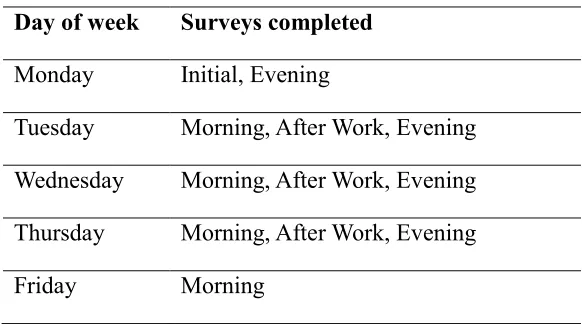
full measurement schedule is summarized in Table 1.
The evening surveys included measures of the hypothesized work-related cognitive
processing mediators. These surveys were completed on four occasions, Monday to Thursday
evenings, just before going to bed. To capture day-level outcomes, participants completed a
morning sleep quality survey on four occasions (Tuesday to Friday morning, immediately
upon awakening); and then an after work survey on three occasions (Tuesday to Thursday,
around 5pm or 6pm) to capture daily levels of emotional exhaustion and work engagement.
These measurements provided four time points for the previous evening and morning
measures, and three time points for the after work measures. The study ended with the Friday
morning survey, since Friday afternoon is considered part of the psychological transition
period between the working week and weekend (Areni, 2008).
Survey instructions included a suggestion to keep the morning and evening survey
evening experiences) and upon awakening (rating sleep quality). Participants were instructed
to take the after work survey booklet into work, and to rate work day levels of exhaustion and
engagement as soon as work ended. Participants were asked to record date and time of
completion at the beginning of each daily survey. Instructions stressed the importance to the
study of leaving a survey blank if participants had forgotten to complete it at the correct time.
Initial survey measures
Perfectionism
Frost et al.’s Multidimensional Perfectionism Scale (FMPS; Frost et al., 1990) was used to
measure perfectionistic concerns and strivings. Consistent with previous research, we
measured perfectionistic concerns with a combination of items from the FMPS concern over
mistakes and doubts about actions subscales (e.g., Cox et al., 2002; Dunkley et al., 2003). We
used the 5-item short form concern over mistakes subscale validated by Cox et al. (2002; e.g.,
“The fewer mistakes I make, the more people will like me”); and the 4-item doubts about
actions subscale (e.g., “Even when I do something very carefully, I often feel that it is not
quite right”). Perfectionistic strivings were measured with the 5-item short form FMPS
personal standards subscale validated by Cox et al. (2002; e.g., “I expect higher performance
in my daily tasks than most people”). Items were scored on a six-point response scale from 1
(strongly disagree) to 6 (strongly agree).
Evening survey measures
Work-related worry/rumination
We measured work-related worry/rumination across four consecutive evenings, using three
items adapted for the day level from the perseverative cognition scale developed by Flaxman
et al. (2012): “I worried about things I need to do at work”; “I worried about how I would
deal with a work task or issue”; and, “My thoughts kept returning to a stressful situation at
thoughts during each evening, since leaving work. The response scale ranged from 1 (not at
all) to 5 (a great deal).
Positive thinking about work
We developed three items to capture positive thoughts about work during each evening: “I
thought positively about my work performance”, “I had constructive thoughts about a work
project”, and “I reflected on things that have gone well for me in my job”. These positive
work-related thinking items were randomly mixed with the worry and rumination items
described above, and administered with the same instructions and response format.
Morning survey measure
Sleep quality
Upon awakening, participants rated their sleep quality using four items from the Karolinska
Sleep Diary (Åkerstedt, Hume, Minors, & Waterhouse, 1994; Keklund & Åkerstedt, 1997).
As previously shown by Keklund and Åkerstedt (1997), these four items combine to create a
sleep quality index that captures both initiation and maintenance of sleep. Items were “How
was your sleep last night?” (rated 1 very poor through to 5 very good); “How calm was your
sleep last night?” (1 very restless to 5 very calm); “How easy did you find it to fall asleep?”
(1 very difficult to 5 very easy); and “Did you wake up prematurely?” (rated on a three-point
scale: yes, I woke up much too early; yes I woke up a bit too early; and no, I did not wake
prematurely).
After work survey measures
Emotional exhaustion
Work-related exhaustion was measured at the end of each work day (i.e., around 5pm or
6pm), with four items adapted from the emotional exhaustion subscale of the Maslach
Burnout Inventory (MBI-GS; Schaufeli, Leiter, Maslach, & Jackson, 1996). The validity of
previous research (e.g., Derks, van Mierlo, & Schmitz, 2014; Flaxman et al., 2012; Schmidt,
Klusmann, Lüdtke, Möller, & Kunter, 2017). Items were modified to assess work-induced
exhaustion for that particular work day (e.g., “I felt burned out from my work”). A fifth item
(“I felt frustrated by my job”) was excluded due to its detrimental impact on the fit of our
measurement model (see Results section). The response options ranged from 1 (strongly
disagree) to 6 (strongly agree).
Work engagement
Day-level engagement was measured with items adapted from the Utrecht Work Engagement
Scale (UWES; Schaufeli & Bakker, 2003). The following five items demonstrated strong
psychometric properties across three consecutive work days, and were statistically distinct
from the work-related exhaustion measure: “I felt strong and vigorous while working”; “I felt
happy because I was working intensely”; “I felt enthusiastic about my work”; “I felt inspired
by my job”; and “I felt bursting with energy in my work”. The validity of using a subset of
UWES items, adapted to the day level, has been demonstrated in previous daily diary studies
(e.g., Bakker & Xanthopoulou, 2009; Xanthopoulou, Bakker, Demerouti, & Schaufeli, 2009).
The engagement items were mixed with the emotional exhaustion items, and followed the
same instructions and response format.
Control variables
To examine the relative influence of perfectionism over and above other work and personal
characteristics, we controlled for work demands (general perceptions of time pressure, and
amount of overtime worked each evening), job control, and trait emotional stability. We
deemed it important to control for both work demands and job control, given the compelling
body of evidence indicating that these work design variables are reliably associated with
burnout and engagement (e.g., Bakker & Demerouti, 2016). We controlled for emotional
perfectionism on cognitive and affective outcomes beyond such “higher-level” personality
factors (e.g., Clark, Lelchook, & Taylor, 2010). We measured work demands in the initial
survey with six time pressure items adapted from the Job Content Questionnaire (JCQ;
Karasek et al., 1998) and Haynes, Wall, Bolden, Stride, and Rick’s (1999) work
characteristics scales. An example item was: In your job, to what extent do you… “Work
under a great deal of time pressure?” Job control was measured with Haynes et al.’s (1999)
six item work autonomy and control scale; e.g., In your job, to what extent do you… “Plan
your own work?”. The demands and control items were rated on a five-point response scale
from 1 (not at all) to 5 (a great deal).
Trait emotional stability was measured using the single-item bipolar scale developed
by Woods and Hampson (2005). This item’s response scale has personality descriptors as
anchor statements at each end of a continuum: at the lower scored end “Someone who is
sensitive and excitable, and can be tense”; and at the higher scored end “Someone who is
relaxed, unemotional, rarely gets irritated and seldom feels blue”. Participants were asked to
rate how each description “sounds like you”. We coded the continuum as a nine-point rating
scale, from -4 to 4, with zero as the central point representing both descriptors “sounding
equally like you”. A higher score indicated a higher level of emotional stability.
We measured overtime work in each evening survey, asking participants to state any
time spent (in hours and minutes) during that evening on work-related activities outside of
normal working hours. Person mean and daily person-mean-centered scores were computed
in units of hours. Finally, we controlled for age (years), and gender (coded 1 male, 0 female).
Analytic strategy
Our analysis comprised two main stages. First, we assessed the validity of our measurement
model, designed to capture the two perfectionism dimensions, distinct modes of work-related
characteristics employed as control variables. The second stage extended the validated
measurement model to a multilevel structural equation model to test the hypothesized direct
and indirect effects (see Preacher, Zyphur, & Zhang, 2010).
Measurement model validation
We employedmultilevel confirmatory factor analysis (MCFA) to validate the proposed
five-factor measurement model for the constructs assessed on consecutive days (distinct five-factors
for work-related worry/rumination, positive thinking about work, sleep quality, emotional
exhaustion, and work engagement). This approach allowed us to (a) control for
non-independence of multiple measurements from the same participants, and (b) examine the
possibility of construct measurement operating differently at the day and person levels.
Following the order suggested by Hox (2002), we first tested the adequacy of the lower-level
(i.e., our day-level) structure alone, and then applied MCFA to test whether the hypothesized
structure also existed at the higher (i.e., person) level, or whether plausible competing models
offered an improvement in fit.
Having established the best multilevel measurement model for the daily survey
measures, we tested temporal measurement invariance to ensure that each measure worked
(and was understood) in the same way on each occasion (van de Schoot, Lugtig, & Hox,
2012). Measurement invariance testing was performed by transposing the data to the
person-level, and, for each separate factor, assessing fit and comparing successive models in which:
item-factor loadings, intercepts, and item variances were free to differ across time (i.e.,
configural invariance); item-factor loadings were fixed equal across time (i.e., metric
invariance); and item-factor loadings and intercepts were fixed equal across time (i.e., strong
invariance).
We utilized conventional CFA to test the proposed four factor structure of the
concerns, perfectionistic strivings, work demands, and job control as distinct factors. In line
with previous research, we assessed perfectionistic concerns as a second-order manifestation
of the FMPS concern over mistakes and doubts about actions subscales.
Hypothesis testing
We constructed a multilevel structural equation model (MSEM) to test our hypotheses.
Ideally, we would have combined and extended the measurement models validated for the
day-level and person-level measures; however, the person-level sample size relative to
number of model parameters to be estimated precluded using latent variables for every
construct. Thus, using the item-factor groupings validated by CFA and MCFA, we computed
composite scores for each construct by averaging across the respective items. We used these
variables, along with our control variables, to construct a MSEM1 of the hypothesized 2-1-1
type mediation model (see Figure 1).
Given our focus on perfectionist personality dimensions, we were primarily interested
in effects at the person level. Thus, we added the following paths: (1) from the two
perfectionism dimensions to the person-level parts of each hypothesized mediating variable
(i.e., work-related worry/rumination and positive thinking about work); (2) from these
cognitive processing variables to the person-level parts of our model outcomes (i.e., sleep
quality, work engagement, and emotional exhaustion); and (3) direct paths between the
perfectionism dimensions and each outcome. Outcomes and mediators were also regressed
upon all control variables. We calculated estimates of person-level indirect effects of
perfectionistic concerns and strivings on each outcome via the two proposed cognitive
processing mediators. Indirect effects were tested by calculating confidence intervals via
Monte Carlo simulation (see Bauer, Preacher, & Gil, 2006; Preacher & Selig, 2012; Preacher,
1 MSEM provides the most reliable estimate of each participant’s average across time for the constructs
et al., 2010; Selig & Preacher, 2008).
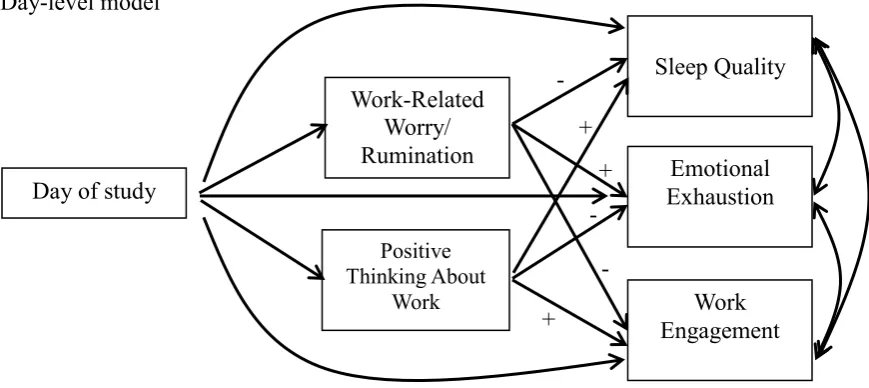
Although we made no specific prediction about change over time, as a supplementary
analysis, we added paths at the day level from the (person-mean-centered) mediators to the
outcomes, and the effect of time (i.e., day of study) and person-mean-centered evening hours
worked as predictors of each mediator and outcome. These day-level variables were
person-mean-centered to remove person-level variability; so that they are measuring just the effect of
the predictor on the day, as opposed to an (uninterpretable) mixture of daily effect and typical
person effect (Curran & Bauer, 2011). We then examined whether the effect of time on each
variable varied between participants.
Models were estimated using Mplus software v7.4, and fitted by Full Information
Maximum Likelihood estimation (FIML), using missing data theory under the assumption of
missing completely at random (MCAR; Muthén & Muthén, 1998-2012). Given that we had
systematic missing data arising from not measuring day-level exhaustion and engagement on
Friday afternoon, as a robustness check we reran the analyses for days 1 to 3 only and
compared the results. Finally, due to a slight positive skew on the work-related
worry/rumination and emotional exhaustion variables, as a further robustness check we reran
our analysis using a Robust Maximum Likelihood estimator (MLR).
Results
Measurement model
Day-level measures
When assessing the (person-mean-centered) day-level items using a single level CFA, the
proposed five factor structure (with separate factors for work-related worry/rumination,
positive thinking about work, emotional exhaustion, sleep quality, work engagement)
demonstrated a satisfactory fit: χ2 (142) = 471.82, CFI = .934, RMSEA = .060, SRMR = .056.
work-related worry/rumination with either positive thinking about work or emotional exhaustion.
As expected with a daily survey design, the ICC(1) statistics for day-level items were
high, justifying a multilevel approach (.294 < ICC(1) < .629). Retaining the five factor model
at the day-level, we used MCFA to test a matching model at the person level. This model
exhibited satisfactory fit: χ2 (284) = 529.73, CFI = .938, RMSEA = .037, SRMR Within =
.053, SRMR Between = .085. The five person-level factors appeared distinct, in that shared
variation between them did not exceed the AVE score for the sets of items loading on any
factor. Alternative person-level factor structures, which combined correlated factors,
diminished model fit.
Four of the five constructs measured at the day level demonstrated strong
measurement invariance over time, and model fit was not significantly compromised by
fixing item-factor loadings or intercepts. The positive thinking about work factor failed to
achieve strong invariance, but demonstrated metric invariance; however, considered in
isolation, the strong invariance model offered a satisfactory fit. The ICC(1) statistics for mean
(composite) scale scores calculated for each factor for each day were again high:
work-related worry/rumination .575; positive thinking about work .477; emotional exhaustion .690;
sleep quality .637; work engagement .385. Using Cronbach’s alpha in a multilevel context, as
described by Geldhof, Preacher, and Zyphur (2014), we calculated within- and
between-person internal consistency reliability for each scale. The estimates suggested adequate
consistency for these brief scales at both day- and person-levels: work-related
worry/rumination day-level alpha = .74, person-level alpha = .94; positive thinking about
work .69, .88; emotional exhaustion .66, .93; sleep quality .71, .85; and, work engagement
.74, .95.
For person-level only measures (i.e., perfectionistic concerns, perfectionistic strivings, work
demands, and job control), a four factor model, including a second-order perfectionistic
concerns factor, offered an adequate fit to the data: χ2 (244) = 322.76, CFI = .944, RMSEA =
.046, SRMR = .070. Discriminant validity was evident, with intra-factor correlations all
falling below rho = .303. Two simpler alternative measurement models--a first-order only
four factor model in which the concern over mistakes and doubts about actions items loaded
on to one factor, and a first-order three factor model with all perfectionism items loading on
to one factor--offered a significantly weaker fit: Δχ2(2) = 27.01, p < .001 and Δχ2(5) = 213.17,
p < .001.
A first-order only five factor model, in which distinct concern over mistakes, doubts
about actions, and perfectionistic strivings factors were estimated, did not yield a better fit
than our proposed second-order model: χ2 (242) = 320.50, CFI = .944, RMSEA = .046,
SRMR = .069, Δχ2(2) = 2.26, p = .97. Given the strong correlation between the concern over
mistakes and doubts about actions factors in this model (rho = .843), the model including the
single second-order perfectionistic concerns factor was considered the preferable solution.
The person-level measures exhibited high internal consistency: perfectionistic concerns, α =
.82; perfectionistic strivings, α = .77; work demands, α = .78; job control, α = .87.
Hypothesis testing
Our hypothesized model (see Figure 1), incorporating paths from perfectionistic concerns and
perfectionistic strivings to the person-level parts of the proposed work-related cognitive
processing mediators, and from these mediators to sleep quality, work engagement, and
emotional exhaustion, demonstrated a satisfactory fit to the data: χ2 (10) = 11.82, p = .297,
CFI = .995, RMSEA = .018, SRMR Within = .016, SRMR Between = .022. Table 2 displays
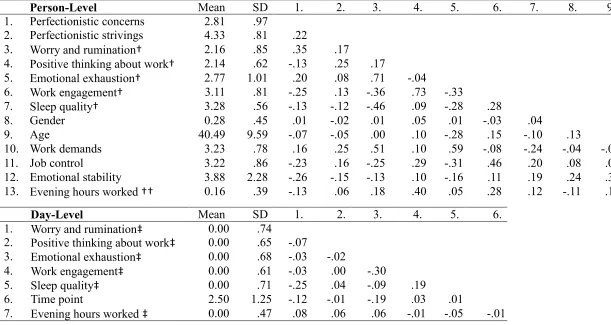
the means, standard deviations, and bivariate correlations. Table 3 summarizes the model’s
In support of Hypothesis 1, we found a significant positive relationship between
perfectionistic concerns and work-related worry/rumination, B = 0.23, 95% CI [0.09, 0.37], p
= .002, with perfectionistic concerns explaining 6% unique between-person variance in
work-related worry/rumination. In support of Hypothesis 3, there was a significant positive
relationship between perfectionistic strivings and positive thinking about work, B = 0.13,
95% CI [0.01, 0.26], p = .039, with perfectionistic strivings explaining 5% unique
between-person variance in positive thinking about work. Adding the alternative pair of predictors to
mediator paths (i.e., from perfectionistic concerns to positive thinking about work, and from
perfectionistic strivings to work-related worry/rumination) did not significantly improve
model fit: χ2 (8) = 11.71, Δχ2(2) = 0.11, p = .165; and neither of these alternate paths were
statistically significant.
As shown in Table 3, evening work-related worry/rumination was significantly
positively associated with emotional exhaustion, and significantly negatively related to work
engagement and sleep quality, uniquely explaining between 7% and 22% of person-level
variance in these model outcomes. In support of Hypotheses 2a, 2b, and 2c, there were
indirect relationships between perfectionistic concerns and each outcome via work-related
worry/rumination: indirect effect on emotional exhaustion = 0.15, 95% CI [0.05, 0.25], p =
.003; on work engagement = -0.10, 95% CI [-0.18, -0.04], p = .005; and on sleep quality =
-0.07, 95% CI [-0.13, -0.02], p = .013. Adding direct paths between perfectionistic concerns
and each outcome did not improve model fit: χ2(7)= 6.91, Δχ2(3) = 4.91, p = .178.
Positive work-related thinking had a significant positive relationship with work
engagement, uniquely explaining 47% of person-level variance in this outcome. In support of
Hypothesis 4b, positive work-related thinking transmitted a significant positive indirect
relationship between perfectionistic strivings and work engagement: indirect effect = 0.12,
indirect relationship between perfectionistic strivings and sleep quality or emotional
exhaustion via positive thinking about work. Adding direct paths from perfectionistic
strivings to each outcome did not improve model fit: χ2(7)= 9.96, Δχ2(3) = 1.87, p = .60.
The day-level results are reported in the lower portion of Table 3. There was a
significant negative relationship between (person-mean-centered) work-related
worry/rumination and sleep quality: B = -0.24, 95% CI [-0.33, -0.16], p < .001. Emotional
exhaustion was the only daily variable to show significant linear change over time,
decreasing from Tuesday to Thursday. The fit of the model was not improved by allowing the
effect of change over time in mediators and outcomes to vary between participants, and none
of the estimated slope variance coefficients was statistically significant.
Finally, our robustness checks performed by repeating the MSEM analyses using the
data from time points 1 to 3 only, and when using MLR estimation, produced an identical
pattern of results. Excluding the control variables (of which age, work demands, job control
and evening hours worked had significant associations with one or more outcomes) did not
remove any of the significant relationships between the perfectionism dimensions, mediators,
or outcomes.
Discussion
The aim of this study was to test a model in which two perfectionism dimensions were related
to different modes of work-related cognitive processing during evening leisure time; different
forms of work-related cognitive processing were in turn predicted to have different
consequences for employees’ work day functioning. In support of our first hypothesis, our
findings provide evidence that perfectionistic concerns are associated with a tendency to
worry and ruminate about work during postwork evenings. In support of Hypotheses 2a, b
and c, this type of perseverative work-related cognitive processing was found to have an
noteworthy that all three specific indirect effects of perfectionistic concerns on the work day
outcomes via work-related worry/rumination were statistically significant, despite controlling
for a set of potentially confounding variables: emotional stability, perfectionistic strivings,
work characteristics (i.e., time pressure and job control), and time spent on work activities
during evening leisure time.
In support of Hypothesis 3, we also found evidence that a second perfectionism
dimension, perfectionistic strivings, was associated with a different mode of work-related
cognitive processing. Specifically, perfectionistic strivings were not uniquely related to
evening levels of work-related worry/rumination, and instead predicted evening levels of
positive thinking about work. For this dimension, only one of the three hypothesized indirect
effects on work day functioning was supported (i.e., Hypothesis 4b), with positive
work-related thinking across consecutive evenings mediating a positive relationship between
perfectionistic strivings and work engagement.
Theoretical implications
These results have potential implications for the study of individual differences in detachment
from work research, for the application of perseverative cognitive processing theories to
working populations, and for the growing interest in the effects of perfectionism and personal
performance expectations among working age adults. First, there have been recent calls for
research designed to understand the role played by specific personality characteristics in
employees’ leisure time experiences (e.g., Flaxman et al., 2012; Ragsdale et al., 2016;
Sonnentag & Fritz, 2015). Such research should prove useful for enhancing our
understanding of (a) the types of employees who suffer most due to an inability to cognitively
switch off from work, (b) the types of employees who benefit from thinking about work
during nonwork time, and (c) the intrapersonal cognitive-affective processes that might help
demonstrating that distinct dimensions of perfectionism were uniquely associated with
different modes of work-related cognitive processing during evening hours.
Second, this study may help to advance understanding of (impaired) detachment from
work by testing hypotheses derived from the IT model of worry, which identifies personality
and cognitive-affective processes likely to influence work-related thinking during off-job
time. The finding that perfectionistic concerns explained unique variance in worry and
rumination (i.e., Hypothesis 1) is congruent with IT model predictions. From an IT
perspective, individuals with a vulnerability for perfectionistic concerns are likely to deploy a
combination of heightened threat appraisals and mood-as-input processes, which function
together to initiate and then fuel bouts of unhelpfully perseverative thinking (see Berenbaum,
2010). Given the growing interest in work-related worry and rumination among recovery
researchers, the IT model--and the cognitive processing theories it incorporates--may prove
informative for understanding how, and for whom, such perseverative thinking unfolds. As
we have seen, IT principles help to explain why dysfunctional processing of work issues can
keep recurring for some employees during nonwork time, when work stressors are no longer
physically present.
Third, our study contributes to the literature on employee perfectionism, most notably
by offering insight into the distinct (work-related) cognitive processes through which the two
perfectionism dimensions seem to operate. Our findings may help to inform debate about
whether perfectionistic strivings should be considered “adaptive”. Some scholars have been
unconvinced that perfectionism dimensions should be labeled as adaptive or positive (e.g.,
Flett & Hewitt, 2006). In contrast, Stoeber and Otto (2006) concluded that evidence in favor
of perfectionistic strivings being a healthy form of perfectionism “far outweighs” the
evidence against it (p. 296; see also Hill & Curran, 2016). The degree to which the setting
population being studied. Among clinical populations, having stringent performance
expectations might itself serve a range of maladaptive functions and thus help to maintain
presenting problems (cf., Egan, Wade, & Shafran, 2011). Among general working
populations, perfectionistic strivings (or closely related constructs) have been empirically
linked to adaptive coping, lower burnout and fatigue, and higher work engagement (e.g.,
Childs & Stoeber, 2010; Stoeber & Rennert, 2008; for an exception see Sherry, Hewitt,
Sherry, Flett, & Graham, 2010).
Given this ongoing debate, we followed Stoeber et al.’s recommendation by
simultaneously assessing the effects of the perfectionistic strivings and concerns dimensions
(Stoeber & Gaudreau, 2017; Stoeber & Otto 2006). Under these analytic conditions, we
observed an indirect relationship between perfectionistic strivings, positive thinking about
work and daily levels of work engagement. On the basis of these (and previous) findings, it
seems reasonable to conclude that striving for perfectionistic standards, or having very high
performance expectations for oneself, is not in itself detrimental to employees’ well-being,
and may even heighten a propensity for work day engagement (see also Barbier et al., 2013;
Childs & Stoeber, 2010; Stoeber & Gaudreau, 2017). Thus, it is important to draw a
distinction between the healthy pursuit of high (self-oriented) performance expectations, and
perfectionistic tendencies that are motivated by fear of failure and concern about making
mistakes (as seen among those high in perfectionistic concerns).
Finally, we hope that the results of this study will help inform recent theorizing
around the role of employees’ own performance expectations in models of job burnout and
work engagement. The significant indirect path between perfectionistic strivings and work
engagement in our model aligns with Barbier et al.’s (2013) finding that relatively stable and
self-imposed performance expectations were positively associated with job engagement. The
maladaptive when they are motivated by an underlying fear of failing or making mistakes.
Hence, it may prove useful for future explorations of these constructs to include a
multidimensional measure of trait perfectionism, raising the possibility of capturing both
adaptive and maladaptive functions of employees’ intrapersonal performance expectations.
Practical implications
Cognitive-behavioral therapy (CBT) interventions have been shown to address some of the
problematic aspects of the perfectionist personality repertoire (e.g., Pleva & Wade, 2007).
These interventions can be brief and cost-effective (e.g., guided self-help), making them
suitable for workplace delivery. It may also help to educate managers about the common
characteristics of perfectionism. For example, managers might be trained to refrain from
“punishing” relatively minor mistakes, to ensure they do not reinforce unhelpfully
perfectionistic expectations and behaviors in their direct reports. Worksite interventions can
also be aimed at helping employees to psychologically detach from work during nonwork
time (e.g., postwork evenings), thereby enhancing the quality of leisure experiences (e.g.,
Hahn, Binnewies, Sonnentag, & Mojza, 2011; ten Brummelhuis & Trougakos, 2014).
Limitations and directions for future research
The study inevitably has some limitations. We relied exclusively on self-report data,
potentially raising the influence of common method variance. This issue may have been
mitigated in the current study by (a) the use of different measurement time points for each of
the constructs under study, and (b) controlling for trait emotional stability and job-related
perceptions as part of our statistical modeling (cf. Podsakoff, MacKenzie, Lee, & Podsakoff,
2003). Nonetheless, it would be useful for future research to assess the degree to which the
same personality and cognitive experiences predict more objective measures of sleep
maintenance and job functioning across the working week (e.g., Pereira & Elfering, 2014;
All variables were measured via paper-and-pencil surveys. One disadvantage of this
method is that it does not provide an objective indicator that participants have completed
surveys at the correct times. There were some practical constraints on the use of electronic
survey links for this particular study. We therefore took steps to increase the likelihood that
our participants would complete surveys at the requested times (e.g., by asking respondents to
record the date and time of completion on each daily survey). Despite the increased use of
electronically administered surveys, paper surveys are still deemed most suitable for some
organizational contexts and work day variables (e.g., ten Brummelhuis & Trougakos, 2014;
Feuerhahn, et al. , 2014;Garrick et al., 2014;Hülsheger, Feinholdt, & Nubold, 2015;
Onwezen, van Veldhoven, & Biron, 2014;Sanz-Vergel, Rodríguez-Muñoz, & Nielsen, 2015;
Volman, Bakker, & Xanthopoulou, 2013). It would be useful for future studies to trial
alternative methods of data collection, such as collecting verbal reports of leisure experiences
in brief telephone conversations with participants (and perhaps spouses or other family
members), and by applying screen modifications to ensure that on-line bedtime surveys do
not expose participants to the artificial light that affects sleep quality.
The current study focused on one model (and measure) of perfectionism that was
developed by Frost et al. (1990). Although the Frost measure remains one of the most widely
used in the perfectionism literature, future studies could also include Hewitt and Flett’s
(1991) multidimensional perfectionism scale, particularly the self-oriented (SOP) and socially
prescribed perfectionism (SPP) subscales. When submitted to factor analyses, SOP items tend
to load on to the perfectionistic strivings factor alongside Frost’s personal standards subscale,
while SPP loads on to the perfectionistic concerns factor alongside Frost’s concern over
mistakes and doubts about actions subscales (e.g., Cox et al., 2002). Including these
additional facets in future studies may help to capture a wider range of employees’
Although we adopted a daily survey design, we found significant linear change over
time for only one of the three model outcomes (i.e., emotional exhaustion, which decreased
from Tuesday through to Thursday). We were unable to demonstrate that change in
work-related cognitive processing across consecutive evenings was predictive of change in the
model outcomes. It is important also to acknowledge that this study’s mediation findings are
based on between-group (i.e., person-level) effects, with employees’ evening and day-level
experiences aggregated over consecutive days (see Preacher et al., 2010). Nonetheless, it is
worth reiterating that the primary aim of this study was not to examine within-person effects
over time, but rather to obtain repeated and proximal measures of cognitive and affective
experiences that were predicted to be associated with theoretically distinct perfectionism
dimensions. However, given the brief period of data collection, and the fact that we did not
extend data collection into Friday afternoon, it would be useful for future research to examine
the same set of personality and cognitive processing variables over longer time frames (e.g.,
two or more consecutive working weeks; see Dunkley et al., 2014).
Conclusion
This study tested a model in which two perfectionism dimensions exhibited a divergent
pattern of relationships with employees’ work day functioning via distinct modes of
work-related cognitive processing.We hope that the findings stimulate further investigations of the
adaptive and maladaptive links between employees’ personal characteristics and leisure time
experiences. Ultimately, we believe such research will be useful for tailoring worksite
interventions to those individuals who are experiencing most difficulty recovering from work
References
Åkerstedt, T., Hume, K., Minors, D., & Waterhouse. J. (1994). The subjective meaning of
good sleep - an intraindividual approach using the Karolinska Sleep Diary. Perceptual
and Motor Skills, 79, 287-296.
Areni, C. S. (2008). (Tell me why) I don’t like Mondays: Does an overvaluation of future
discretionary time underlie reported weekly mood cycles? Cognition and Emotion, 22,
1228-1252. doi: 10.1080/02699930701686107
Bakker, A. B., & Demerouti, E. (2016). Job demands-resources theory: Taking stock and
looking forward. Journal of Occupational Health Psychology. Advance online
publication. doi: 10.1037/ocp0000056
Bakker, A. B., & Xanthopoulou, D. (2009). The crossover of daily work engagement:
Test of an actor–partner interdependence model. Journal of Applied Psychology, 94,
1562-1571. doi: 10.1037/a0017525.
Barbier, M., Hansez, I., Chmiel, N., & Demerouti, E. (2013). Performance expectations,
personal resources, and job resources: How do they predict work engagement?
European Journal of Work and Organizational Psychology, 22, 750-762. doi:
10.1080/1359432X.2012.704675
Bauer, D. J., Preacher, K. J., & Gil, K. M. (2006). Conceptualizing and testing random
indirect effects and moderated mediation in multilevel models: New procedures and
recommendations. Psychological Methods, 11, 142-163. doi:
10.1037/1082-989X.11.2.142
Berenbaum, H. (2010). An initiation–termination two-phase model of worrying. Clinical
Psychology Review, 30(8), 962–975. doi: 10.1016/j.cpr.2010.06.011
Binnewies, C., Sonnentag, S., & Mojza, E. J. (2009). Feeling recovered and thinking about
experiences for job performance. Journal of Occupational Health Psychology, 14,
243-256. doi: 10.1037/a0014933
Blankstein, K. R., Dunkley, D. M., & Wilson, J. (2008). Evaluative concerns and personal
standards perfectionism: Self-esteem as a mediator and moderator of relations with
personal and academic needs and estimated GPA. Current Psychology, 27, 29–61. doi:
10.1007/s12144-008-9022-1
Brosschot, J. F., Gerin, W., & Thayer, J. F. (2006). The perseverative cognition hypothesis:
A review of worry, prolonged stress-related physiological activation, and health.
Journal of Psychosomatic Research, 60, 113-124. doi:
10.1016/j.jpsychores.2005.06.074
Chang, E. C., Watkins, A. F., & Banks, K. H. (2004). How adaptive and maladaptive
perfectionism relate to positive and negative psychological functioning: Testing a
stress-mediation model in black and white female college students. Journal of
Counseling Psychology, 51, 93-102. doi: 10.1037/0022-0167.51.1.93
Chang, E. C., Zumberg, K. M., Sanna, L. J., Girz, L. P., Kade, A. M., Shair, S. R., et al.
(2007). Relationship between perfectionism and domains of worry in a college student
population: Considering the role of BIS/BAS motives. Personality and Individual
Differences, 43, 925-936. doi: 10.1016/j.paid.2007.02.026
Childs, J. H., & Stoeber, J. (2010). Self-oriented, other-oriented, and socially prescribed
perfectionism in employees: Relationships with burnout and engagement. Journal of
Workplace Behavioral Health,25(4), 269-281. doi: 10.1080/15555240.2010.518486
Clark, M. A., Lelchook, A. M., & Taylor, M. L. (2010). Beyond the Big Five: How
narcissism, perfectionism, and dispositional affect relate to workaholism. Personality
Cox, B. J., Enns, M. W., & Clara, I. P. (2002). The multidimensional structure of
perfectionism in clinically distressed and college student samples. Psychological
Assessment, 14, 365-373. doi: 10.1037//1040-3590.14.3.365
Cropley, M., Michalianou, G., Pravettoni, G., & Millward, L. J. (2012). The relation of post
work ruminative thinking with eating behaviour. Stress & Health, 28(1), 23-30.
doi:10.1002/smi.1397
Curran, P. J., & Bauer, D. J. (2011). The disaggregation of within-person and between-person
effects in longitudinal models of change. Annual Review of Psychology, 62, 583-619.
doi: 10.1146/annurev.psych.093008.100356
Davey, G. C. L. (2006). A mood-as-input account of perseverative worrying. In: G. Davey &
A. Wells (Eds.), Worry and its psychological disorders (pp. 217–238). West Sussex,
England: Wiley & Sons. doi: 10.1002/9780470713143
Davey, G. C. L., Startup, H. M., MacDonald, C. B., Jenkins, D., & Patterson, K. (2005). The
use of "as many as can" versus "feel like continuing" stop rules during worrying.
Cognitive Therapy and Research, 29(2), 155-169. doi: 10.1007/s10608-005-3162-5
Derks, D., van Mierlo, H., & Schmitz, E. B. (2014). A diary study on work-related
smartphone use, psychological detachment and exhaustion: examining the role of the
perceived segmentation norm. Journal of Occupational Health Psychology, 19, 74-84.
doi:10.1037/a0035076
Dunkley, D. M., Mandel, T., & Ma, D. (2014). Perfectionism, neuroticism, and daily stress
reactivity and coping effectiveness 6 months and 3 years later. Journal of Counseling
Psychology, 61, 616-633. doi: 10.1037/cou0000036
Dunkley, D. M., Zuroff, D. C., & Blankstein, K. R. (2003). Self-critical perfectionism and
daily affect: Dispositional and situational influences on stress and coping. Journal of
Egan, S. J., Wade, T., & Shafran, R. (2011). Perfectionism as a transdiagnostic process: A
clinical review. Clinical Psychology Review,31, 203-212. doi:
10.1016/j.cpr.2010.04.009
Etzion, D., Eden, D., & Lapidot, Y. (1998). Relief from job stressors and burnout: Reserve
service as a respite. Journal of Applied Psychology, 83, 577-585.
Feuerhahn, N., Sonnentag, S., & Woll, A. (2014). Exercise after work, psychological
mediators, and affect: A day-level study. European Journal of Work and
Organizational Psychology, 23, 62–79. doi: 10.1080/1359432X.2012.709965
Flaxman, P. E., Ménard, J., Bond, F. W., & Kinman, G. (2012). Academics’ experiences of a
respite from work: Effects of self-critical perfectionism and perseverative cognition on
post-respite well-being. Journal of Applied Psychology, 97, 854-865. doi:
10.1037/a0028055
Flett, G. L., & Hewitt, P. L. (2006). Positive versus negative perfectionism in
psychopathology: A comment on Slade and Owens’s dual process model. Behavior
Modification, 30(4), 472–495. doi: 10.1177/0145445506288026
Fritz, C., Yankelevich, M., Zarubin, A., & Barger, P. (2010). Happy, healthy, and productive:
The role of detachment from work during nonwork time. Journal of Applied
Psychology, 95, 977-983. doi:10.1037/a0019462
Frost, R. O., & DiBartolo, P. (2002). Perfectionism, anxiety and obsessive compulsive
disorder. In G. L. Flett & P. L. Hewitt (Eds.), Perfectionism: Theory, research, and
treatment (pp. 341-371).Washington, DC: American Psychological Association Press.
Frost, R. O., Marten, P. A., Lahart, C., & Rosenblate, R. (1990). The dimensions of
perfectionism. Cognitive Therapy and Research, 14, 449-468.
Garrick, A., Mak, A. S., Cathcart, S., Winwood, P. C., Bakker, A. B., & Lushington, K.