Rochester Institute of Technology
RIT Scholar Works
Theses
Thesis/Dissertation Collections
5-11-1983
Painted Conversations
Deborah J. Felix
Follow this and additional works at:
http://scholarworks.rit.edu/theses
This Thesis is brought to you for free and open access by the Thesis/Dissertation Collections at RIT Scholar Works. It has been accepted for inclusion
in Theses by an authorized administrator of RIT Scholar Works. For more information, please contact
.
Recommended Citation
ROCHESTER INSTITUTE OF TECHNOLOGY
A Thesis
Submitted
to theFaculty
ofThe College
ofFine
andApplied
Arts
in
Candidacy
for
theDegree
ofMASTER OF FINE ARTS
PAINTED
CONVERSATIONS
by
Deborah
J.
Felix
THESIS PROPOSAL
Page 1
Thesis Proposal for the Master of Fine Arts Degree
College of Fine and Applied Arts
Rochester Institute of Technology
Title: Painted Conversations
Submitted by: Deborah
J.
Felix
Thesis Committee:
Chief Adviser: Donald Bujnowski
Associate Advisers:
1.
Max Lenderman
2.
Sheila Wells
Departmental Approval:
Date: September
30,
1982
Date:
Approval, Assistant to
~he
Dean for Graduate Affairs:
Date:
/
OJ;(}/fV
Final Committee Decision:
Page
2
I
will create a series offlat
surface designsutlizing
various
dyeing,
painting
and resisttechniques.
Each textile
design
willbe
directly
relatedto
my currentfigurative
studiesACKNOWLEDGEMENTS
I
wouldlike
to
acknowledgemy
husband,
Robert
Malkemes,
for
alwayssupporting
even the craziest ofideas,
knowing
that
those
wildflashes
ofinspiration
would someday
become
a reality.I
would alsolike
to
acknowledge"Mr.
B.",
"Max"and
"Sheila"
for
letting
the
creative messesin
theback
ofthe
studio produce some wonderful
ideas.
TABLE
OF
CONTENTS
A
C
KNOWLED GEMENT
S
Page
iv
LIST
OF
ILLUSTRATIONS
viWhy
Textiles
1
Influences
3
Evolution
ofWork
9
Conclusion
20
Bibliography
22
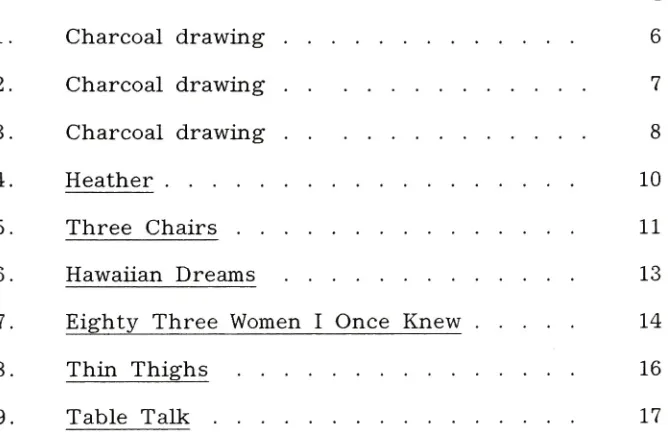
LIST OF ILLUSTRATIONS
Page
1
.Charcoal
drawing
6
2.
Charcoal
drawing
7
3.
Charcoal
drawing
8
4.
Heather
10
5.
Three Chairs
11
6.
Hawaiian Dreams
13
7.
Eighty
Three Women I Once Knew
14
8.
Thin Thighs
16
9.
Table
Talk
17
[image:8.518.88.422.144.366.2]WHY TEXTILES
In
observing
my
thesis
workPainted
Conversations,
the
viewermight ask
himself
just why did
I
choosethe
use oftextiles
instead
ofpainting
on canvas.Actually
there
is
avery
sound reasonbehind
my
conscious choice of
fiberous
materials as a mediumfor
expression.Robert
Rauchenberg
stated whathundreds
of artistshave
also agreedupon;
painting is
alonely
process.When
a painter paints apainting,
the
end resultis usually just
that,
apainting,
a statementthat
is
to
be
stretched across a canvas and
hung
upon a wall.Paintings
have
anaura of preciousness
that
surroundthem.
Many
paintings evenhave
signs
that
accompany
them
anddenounce
people whodare
to
try
to
touch
them.Textiles
on the otherhand,
beckon
peopleto
make contact withtheir
surface.The
initial
reaction a personhas
whenhe
sees afiber
piece
is
to
touchthe
surface.Most
peoplelike
tofeel
whatthe
artistused
in
creating
the art work.As
the
creator ofthe
thesis workI
made a
painterly
statementthrough
the
use of color and composition.Yet
oneis
awarethat
I
chosefabrics
instead
of paint.A
vieweris
invited
to
inspect
the surface embellishments orto
instinctively
runhis
hands
over thefabric.
A
textile
artist's audience caneasily
relateto
the
artist's choice of materials.Most
peoplehave
experiencedthe thrill
of a
soft,
warm piece offabric, however,
few
people can relateto the
layering
of paint on a canvasby
an artist.Therefore,
it is
easierfor
the
viewerto
relate on a personallevel
to the thesis
workPainted Con
versations
because
ofits
association to objectsthat
may
be
in
mostover a
bed
or as an article ofclothing,
besides
being
a wallhanging.
A
painting is
always a painting.No
matterhow
onelooks
atthe
thesis
workPainted Conversations
there
canbe
nodenying
that
I
am concerned withthe
same questions apainter
is
concerned with:composition,
technique andthe
use of color.In
the
thesis
workthere
is
an attemptto
make each piecestep
beyond
the
initial
pictureframe
that
encompasses apainting
and reachinto
theworld of
touchable
art,
textiles.
A
person nolonger has
to
live in fear
of
being
caught whiletouching
a piece of art work as the guard glancesaway.
Fiber
art was madeto
be
felt,
touchedlovingly
and caressedINFLUENCES
Every
artistis
influenced
consciously
orsubconsciously
by
his
surroundings,
environment,
pastexperiences,
andby
other artists.An
artist must acknowledge past and present artist's work andincor
porate
this
knowledge
into
his
own experiences.By
utilizing
books,
museums,
schools,
travel etc. . . an artist will neverlack
a sourcefor
his inspirations.
Painted Conversations
stemsfrom
an academicbackground
in
thearts with an emphasis on
drawing
and painting.Each
wall pieceis
flooded
withbits
and pieces ofMatisse,
Picasso,
DeKooning
andDavid
Hockney,
alllurking
in
the
background.
Even
if
the
influence
of eachartist
isn't
visiblehis
spirit existsin
each wallhanging.
Each
artisthas
adeep
rooteddesire
to portray
life
ashe
seesit;
Matisse's,
Picasso's,
DeKooning's
andDavid Hockney's
art work shows aunique vision of one's surroundings which reveals a passion
for life
asthe artist sees
it.
Each
piecein
Painted Conversations
is
alsobased
onan artist's view of
life.
People,
places,
rooms,
chairs and colors allhave been
combinedinto different
perceptions ofdaily
events.Matisse
led
the
way
to
the use of pure andintense
color.In
Matisse's
paintings thereis
aninstinctual
sense of color relationshipsthat
deny
all colortheories,
yet somehow workharmoniously
because
each color comes
from
Matisse's
intense
love
of color."This
art reflectsan existential
happiness
subjectonly
toinstinctive,
non scientificlaws
of color harmony."
In
looking
atMatisse's
workthere
is
nodoubt
that
he
knew
allthe
rulesfor
color vibrations or opticalillusions but he
alsounderstood
the
rules sowell,
that
he
could put abright
pink colornext
to
alime
green with no otherreasoning behind
the
choice of colorsother
than
thatthey
look
right.It
wouldbe
nearly
impossible
to
recreatethe
colors usedin
Painted
Conversations
because
eachdye bath
was createdby
a combination
ofdyes,
inaccurate
measurements andby
bright
visions of colorthat
only
I
could see.My
academicbackground
is
reflectedin
eachpiece and
takes
partin
the
total
composition.A
purely
instinctual
visual sense
however,
rulesin
my
final
color choices.A
love for
coloris
apparentin
each wallhanging.
The
needto
expresslife in
terms
ofcolor
is
meantto
overwhelmthe
viewer andfight
for
his
attention.Matisse's
passionfor
life
andmy
own zealfor life
was recaptured andput
into
each wallhanging.
I
hope
that others will see whatboth
Matisse
andI
saw whendescribing
various subjects.The
human
figure
is
an obsessionfor
past and present artists.To
define
one moment ofpain,
weariness,
anger orjoy
andleave
alasting
impression
afterthe
gestureis
goneis
the
object of a greatmany
artists search.Matisse,
Picasso,
DeKooning
andDavid
Hockney
drew
over and overagain,
one person afteranother,
in
orderto
createa
line,
that would representsomething
that
is
alive andhas
the
capabilities of
feeling.
One
mark can make apainting
great or makeit
fail
miserably.The
subject matteris
important
in
a piece of artwork,
but
even the greatest composition can't workif
the
basis
for
it
isn't
sound.
There
has
to
be
anunderstanding
ofthe
human anatomy before
it
canbe
abstracted or representedin
the
form
of a piece of art work.David
Hockney's
nudesin
the
shower are allbased
ondetailed
observations
and aninsatiable
desire
to
represent manin
the
form
of agesture.
Matisse's,
Picasso's
DeKooning's
andDavid Hockney's
art workhas
had
animmense
influence
on other artists.Even
thoughthe
human
figure
is
not a new subject each of these artistshas
portrayedhis
subjects
in
such away
that
they
have
motivated other artiststo
look
attheir
surroundings andtry
to
express whatit is
they
see.The
mostordinary
task
couldbe
taken
for
grantedif
an artistdidn't
takethe
time
to
capturethe
task,
and make a personreally
seethe
beauty
that
Illustration
1
Illustration 2
Illustration
3
EVOLUTION
OF THE WORK
Before
any
ofthe
thesis
work was createdthere
was a greatdeal
of
sketching
done
that
eventually became
the
foundation
whichPainted
Conversations
wasbased
upon.Visions
of peoplein
rooms withplants,
chairs and
tables
were of concernto
me,
but
they
had
tobe life
sizecompositions or
larger in
orderto
make animpact
onthe
viewer.This
is
how
the
first
large
charcoaldrawings
werestarted,
whichlater
inspired
meto
carry
thetheme
of peoplein
roomsinto
atextile
medium.Each
pre-thesisdrawing
(illustrations
1,
2, 3,
pages6, 7, 8)
wasinfluenced
atthe
time
by
the
contemporary
photo-realists who wereinvolved
withdescribing
an actualfragment
oftime
and place.I
had
aneed
to
forego
all use of color exceptblack
and white.Color
in
adrawing
ofteninfluences
how
a personinterprets
the
events shown.I
wanted
to
make astatement,
void of colorbut
stillkeep
intact
the
initial idea
ofrecording the
time,
place and action that occurred.Drawing
directly
from
3"x5"photographs
I
blew up
each photo to ahuman
sized scale so thatthe
viewer could relate on a personalbasis
to
the
actionsdescribed
within eachdrawing.
The
techinque
ofusing
aphotograph as a reference was
later
carriedinto
thethesis
work.Instead
ofmaking
literal
translationsfrom
the
photographsI
combinedmy
ownimages
and segmentsfrom
the
photosto
create a composition.The
drawings
which were exact renderings of a photograph wereincomplete
in
describing
whatI
wantedto
express aboutordinary
events
in
a person'slife.
Each
drawing
became
a stiff and mechanicalexercise
in
copying.This
is
whenI
felt it
wasnecessary
to
take the
Illustration
4
Heather
Quilted
and appliqued wallhanging
using
cotton and cottonblended
materials,
techniquebatik,
machinestitchery
andbeads
11
Illustration
5
Three Chairs
Machine
stitchery
onsilk,
painted withDeka dyes
12
and
describe
these
ideas
in
atextile
medium.Hence,
Painted Conver
sations was created.
The
first
wallpiece,
Heather
,(illustration
4,
page10)
incorpor
ated
the
use of aphotograph,
but
took the
idea
of a personisolated
in
a room and made
it
morethan
just
ablack
and whitedrawing.
Color
was added
by
using
the
technique
calledbatik,
which requiresthe
useof numerous
dye
baths.
The
result ofthis technique
was a wide rangeof color variations.
A
total
of15
dye
baths
were usedin
Heather
.The
addition offabrics
to
the
surface ofthe
piece madethe
total
composition
take
on athree-dimensional
quality
the
charcoaldrawings
lacked.
Surface
embellishments,
such asthreads
andbeads,
wereadded
causing
the
viewer to come rightup
to
the
surface andlook
atthe
detailing.
I
purposely
setup
a contradiction of termsby inviting
the
viewerup
to
the
picture plane yetarranging
the
figure
sothat
there was no
facial
expression.The
lack
of expression shouldhave
caused
the
viewerto
look
atthe
figure
yetbe
drawn
away
from it
atthe
sametime.
In
looking
atthe
wall piece a personmay
have
wondered just why
thefigure is
located in
that particularsetting
and whatit
is
the
figure
is
looking
at outsidethe
pictureframe.
The
idea
of afigure
in
anisolated
situation was maintainedthroughout
the
entirethesis
.The
next thesispiece,
Three
Chairs,
(illustration
5,
page11)
goeseven
further
in
its
idea
ofisolation.
Two
people are seenin
a roomthat
is
purposely
distorted
in
perspective and offers nodetails
asto
where the room
is
located.
Each
figure is gazing
offthe
picture planeand
into
an unknown area.Another
important
detail
to
this
workin
13
Illustration 6
Hawaiian
Dreams
Hand
dyed
silk and cottonfabrics,
appliqued oncommercial
fabric,
batik
fabrics
14
Illustration 7
Eighty
Three Women I Once Knew
Hand
dyed
silk,
french
dyes,
oil crayon15
and
how
they
define
different
shapes.The
vieweris
once againinvited
to
look
atthe
surfacestitching
andtreatment
of colorbut
is
then
turned
away
by
the
trance-like
stares ofthe
figures.
Each
figure is
also
treated
with equalimportance
to the
chairsin
the
roomemphasizing
my
intention
ofonly
recording
the
entirescene,
as a record of placeand
time.
Hawaiian Dreams
(illustration
6,
page13)
still relatesto
the
idea
of
recording
the
time
and place yetthe
idea is
expressedin
adifferent
manner
than
Three
Chairs.
There
is
an explosion of color and patternthat
shoutsto
the
viewerto
look
at whatis
happening
in
the
pictureframe.
The
pictureframe
has
been purposely
exaggeratedin
orderto
attract
the
viewer's attention.However,
oncethe
viewer observesthe
total
compositionhe
suddenly
realizesthat
the
figure's
face,
whichis
suddenly
turned
towards
the
viewer,
is
expressionlessleaving
the
viewer once again
looking
back
andforth
to
the
figure
andits
surroundings.
The
use ofbold
cut out shapes andequally intense
colorscause
the
viewerto
standback
andlook
at the composition as a whole.Eighty
Three
Women I
Once
Knew
(illustration
7,
page14)
is
arecreation of all
the
womenI
have
seen or envisioned at onetime
oranother.
Drawing
in
aspontaneous,
gestural motion recreatedthe
feeling
oftrying
to
recapture an actionbefore it
changes.The
idea
ofmomentary
action andrecording how quickly it
changes wasimportant
to
me when
I
createdthis
piece.The
choice of colors are warm andbright
and are supposedto
evoke a
feeling
of sensuality.A
field
of colors areto
be
the
first
thing
a viewersees,
then
he is
to
noticethat
there
arefigures
within16
Illustration
8
H^^BM^MMgMMTMr I'll IT H^l" "* KT
.<t|,f,HJ^iHI I IIt HI' JUj |'*||.
i :nviix:i
skh\
m*u.
uin-enSi-i:-I
Thin Thighs
Dyed
cotton,batik,
hand
stenciled, stitched, stuffed17
Illustration 9
Table
Talk
Silk,
French
dyes
[image:25.518.83.442.113.624.2]18
another.
Each
drawing
couldbe
a complete compositionin
itself
yetevery
drawing
is
anintegral
part ofthe total
composition.A
spontaneous reactionto
my
obsession ofthe
human anatomy
wasthe
creation ofThin Thighs
(illustration
8,
page16).
This
piecerelates
to
the
previousthesis
pieces,
and goesbeyond
the
pictureframes
that
encompassthe
past works.There
is
aframe
around thepiece,
but
nowthere
are words stencileddirectly
onthe
surface.David
Hockney
described
the
necessity
for
words once thatdirectly
relates
to
Thin Thighs.
"The
presence of a word created afeeling
about a picture
that
was more specific."
"...
the
writing brings
the
viewer closer
to
the
surface ofthe
work andforces
him
to
readthe
painting
interms
of a writtenmessage,
or code."As
the artist ofPainted
Conversations
I
wantedthe
viewerto
feel
the
enjoymentthat
I
had
in
making
eachpiece,
through
the
use ofcolor,
subject andcomposition;
however,
my
feeling
ofrejoicing
in
the
creation of a piece of art work exploded
in
Thin Thighs.
I
also wantedthe
viewerto
laugh
with me and atmy
total
obsession withhuman
gestures,
love
ofbright
colors and passionfor living.
The
playfulness of subject matter and use ofintense
colorsthat
are
displayed
in
Thin Thighs
are also shownin
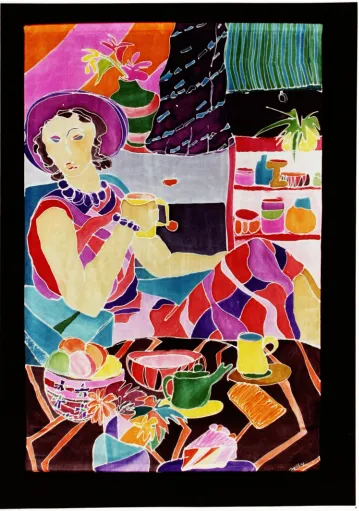
Table Talk
(illustration
9,
page17).
The
wallhanging
speaks of whattextiles
is
or canbe.
There
is
a combination of allthe
elementsthat
I
felt
werenecessary
to
express
in
the thesis work.I
wantedto
representmy
love
ofcolor,
David
Hockney,
72
Drawings
by
David
Hockney,
(New
York,
Viking Press, 1970),
introduction.
19
line
andfigure
on an elegant piece offabric
that
a viewer wouldbe
20
CONCLUSION
An
artist musthave
patience,
the
ability
to
be
flexible,
and asense of
humor
whencreating
abody
of work.I
relied upon all ofthese
charactertraits
in
orderto
producePainted
Conversations.
In
producing
the
thesis
work,
patience,
flexibility
andhumor
werecombined and
helped
meto
convey my feelings for life.
Three
Chairs
could nothave
been
createdif
I
wasn't patientin
doing
the
tedious
machinestitchery,
that
in
the
end,
madethe
piecemore
beautiful
andinteresting
to
look
at.Before
the thesis
workI
wasimpatient
in
creating
the
artwork,
which often resultedin
a solutionthat
wasn't alwaysthe
best for
that
particular piece.There
are stillmoments of
impatience
andimpulsive
actions,
but
these moments arebecoming
less
andless
eachtime
a pieceis
created.I
have
found,
through
the
evolution of thethesis
work,
that
it is
necessary
totake
the time
to
create a greatdesign,
dye
the
exact color orpainfully hand
stitch a seam
in
order to achievethe
desired
effectsthat
I
want.Patience
was and always willbe
a characteristicthat
I
will struggle withbut
will conquerin
time.Flexibility
in
ideas
has
offered memany
outletsfor my
creativity.I
have
discovered
thatbeing
open to all possibilitiesis
necessary
to
cultivate a
fertile
mind.Very
often oneidea
willlead
to another andsoon even the most remote
idea
willbecome
a reality.This
theory
is
proven true
in
the
thesis work.Who
wouldhave
everthought
that
atoaster
cover with arms andlegs
wouldlead
to the
creation of a 10'xll'piece called
Thin Thighs?
Each
thesis work evolvedfrom
adiscovery
in
the previous piece.It
wouldbe
difficult
tosay that
from
now onI
three-21
dimensional
objects or even a productionline
are allideas
thatI
amflexible
and opento,
for
usein
the
future.
Of
allthe
previoustraits
stated,
patience,
flexibility
andhumor,
I
relied upon a sense of
humor
the
most.A
sense ofhumor
was essentialto the
production ofPainted Conversations.
Why
Thin
Thighs?
It
allleads back
to
toaster
covers,
thehuman
anatomy.Legs
are niceespecially
thin
ones.In
amoment of
desperation
one ofthose
Thin
Thigh
magazineswas
bought
andhence,
Thin Thighs
became
an obsession.If
I
can'thave
them
I'll
create them.When
I
createthem
they'll
notonly
be beautiful but
alsobright
andbeautiful!
Beautiful
thin
thighs.
What
about shoes to embellish thethin
thighs?
Naturally
whatlooks
greaterthan
thin thighswith great
looking
shoes?!Consequently
a sense ofhumor has
enabled me to standback
andenjoy
22
BIBLIOGRAPHY
Bakke,
Karen,
The
Sewing
Machine As A Creative
Tool,
Englewood
Cliffs,
New
Jersey:
Prentice-Hall
Inc.,
1976.
Brown,
Elsa,
Creative
Quilting,
New
York,
New
York:
Watson-Gup
tillPublications,
1975.
Chase,
Lyda,
Hyperealism,
New
York,
New York:
Rizyoli
InternationalPublications
Inc.,
1975.
Feilding,
Diantha
andShears,
Evangeline,
Applique,
New
York,
New
York:
Watson-Guptill
Publications,
1972.
Gray,
Jenifer,
Machine
Embroidery
Technique
andDesign,
New
York,
New York:
Van Nostrand Reinhold
Co.,
1973.
Hockney,
David,
72 Drawings
by
David
Hockney,
New
York,
New York:
Viking Press,
1970.
,
David
Hockney
Travels With
Pen, Pencil,
andInk,
London,
Great Britain:
Petersburg
Press,
1978.
Laury,
Jean
Ray,
Quilts
andCoverlets,
A
Contemporary Approach,
New
York,
New York:
Van
Nostrand Reinhold
Co.,
1970.
Morgan,
Mary
andMosteller,
Dee,
Trapunto
andOther Forms
ofRaised
Quilting
,New
York,
New
York:
Charles
Scribner's
Sons,
1977.
Mosteller,
Dee
andMorgan
Mary,
Trapunto
andOther Forms
ofRaised
Quilting
,New
York,
New
York:
Charles
Scribner's
Sons,
1977.
Negri,
Renata,
Matisse
and theFauves,
New
York,
New
York:
Lamp
Light
Publishing Inc.,
1975.
Ruby
,Erik
A
.,
The Human Figure A Photographic
Reference
For
Artists
,New
York,
New
York:
Van
Nostrand
Reinhold
Company,
1974.
Shears,
Evangeline andFeilding,
Diantha,
Applique
,New
York,
New