Dense Convolutional Networks for Efficient Video Analysis
Tian Jin
Master Student CeSIP, Royal College Building University of Strathclyde, Glasgow+86-15257220611 [email protected]
Zhihao He
Master Student CeSIP, Royal College Building University of Strathclyde, Glasgow+44-7712734792 [email protected]
Amlan Basu
Ph.D. Candidate CeSIP, Royal College Building University of Strathclyde, Glasgow+44-7459802138 [email protected]
John Soraghan
ProfessorCeSIP, Royal College Building University of Strathclyde, Glasgow
+44 (0)141 548 2514 [email protected]
Gaetano Di Caterina
Research Fellow CeSIP, Royal College Building University of Strathclyde, Glasgow01415484458
Lykourgos Petropoulakis
Senior Knowledge Exchange FellowCeSIP, Royal College Building University of Strathclyde, Glasgow
+44-7459802138 [email protected]
Abstract - Over the past few years various Convolutional Neural Networks (CNNs) based models exhibited certain human-like performance in a range of image processing problems. Video understanding, action classification, gesture recognition has become a new stage for CNNs. The typical approach for video analysis is based on 2DCNN to extract feature map from a single frame and through 3DCNN or LSTM to merging spatiotemporal information, some approaches will add optical flow on the other branch and then post-hoc fusion. Normally the performance is proportional to the model complexity, as the accuracy keeps improving, the problem is also evolved from accuracy to model size, computing speed, model availability. In this paper, we present a lightweight network architecture framework to learn spatiotemporal feature from video. Our architecture tries to merge long-term content in any network feature map. Keeping the model as small and as fast as possible while maintaining accuracy. The accuracy achieved is 91.4% along with an appreciable speed of 69.3 fps.
Keywords- CNN, LSTM, 3D-Net, DenseNet, 2D Layer, Video Analysis.
I. INTRODUCTION
Thanks to larger datasets and multiple deep learning algorithms, video understanding and, specifically, action classification which have reported outstanding performance in recent years. Meanwhile, efficient and low cost video analysis algorithm has become a meaningful subject, especially for real time human-robot computer interaction. Short time action recognition is depending on the present action within a short time window, however video understanding is concerned with longer-term frames information. Several architectures have been proposed to capture spatiotemporal information between frames, however the speed and efficiency always remained at the bottleneck. Such as 3D CNN [5,6], theoretically time window should cover whole video, due to the cost of calculation people have to use a small window, each convolution computation contains several frames, the information is merged by convolution and pooling
computation layer by layer. Obviously, this algorithm is suboptimal for exploiting relationship between frames. In fact, ordinary LSTM [3, 4] structure still cannot get satisfactory results, even if it has outstanding performance in several sequence problems, some algorithms choose to sacrifice speed to improve accuracy, these ideas are through add an optical flow branch to achieve ‘Two-Stream’ structure [7, 8] and the get excellent results, however the speed of ‘Two-Stream’ is too slow that these algorithms lack of practicality.
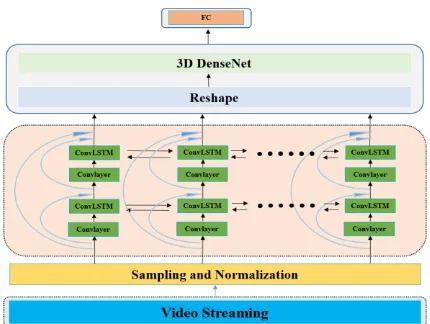
Figure 1. Overview of Dense Convolutional Networks, Dense bidirectional ConvLSTM are utilized to learn long-term spatiotemporal features and sent original information to the high-level structure, all feature will be re-stacked and fed to 3D DenseNet which classifies the action.
II. TYPE STYLE AND FONTS
Although the development of deep learning is very rapid, but there is still not a unified video analysis framework, the current architecture is mainly based on convolutional layers and layers operators with 2D or 3D convolution kernel. Also, either the network is only for analysing RGB videos or includes pre-computed light flow. 2D convolution merges the space and time information which is evident from LSTM network structure in 2D convolution, spatiotemporal information (can be learned by LSTMs), or aggregation over time.
For video classification problems, there are some generally accepted algorithm based on deep learning method [8, 12-15]. In order to extract more spatiotemporal features from a sequence of frames 3D convolution network is introduced. 3D kernel can learn the spatiotemporal feature. Tran et al. [3] proposed a 3D architecture using 3D convolution kernels which slide whole video. They studied the 3D structure of Resnet system and improved the structure of C3D [15]. In addition, recurrent networks are also a good approach to extract temporal relation between frames [16, 17, 12]. Donahue et al. [12] proposed an approach using LSTM to integrate features from CNN. In fact, LSTM-based network to extract the features of spatiotemporal is inefficient and unsatisfactory. In action recognition field, the performance of LSTM-based method is always behind the CNN-based methods. Recently introduced 3D CNN has some new approach and new methods emerge one after another [10, 14, 18]. The characteristic of these methods is the use of sliding window to obtain short term temporal context. However, such methods consume all computing resources because the average score of these Windows needs to be calculated before final fusion.
In fact, these methods do not utilize video's spatiotemporal information very efficiently and require very large computing resources. Especially through the post-hoc fusion, not only inefficient, but also reduces the operation speed which cannot be used in the scene of fact work.
Figure 2 A video will be divided into N subsection, and sampled one frame form each subsection randomly, 2 DenseConvLSTM part will be used to learn sample spatiotemporal feature, the feature from different frame have same
place. will be re-stacked and 3D DensNet used to post-hoc fusion.
III. ARCHITECTURE
The network architecture is shown in Fig. 2. a whole video will be split into N subsections 𝑁𝑛 n = 1, 2,……, N each subsection containing the same number of video frames and then randomly samples a frame from each subset
[image:2.595.72.523.457.656.2]information can be extracted, and spatiotemporal information of video can be extracted effectively through repeated random sampling iteration in training.
After sampling, N frames will be obtained and will be sent to network. The network has two main components, the first is the DenseConvLSTM, and this part is used for learning simple spatiotemporal information. And second is the 3D DenseNet, this part is for high dimensional spatiotemporal information fusion. Concat is also used in the DenseConvLSTM block, which means that the original information can be passed on to the next structure irrespective of whether the results of the feature are good or not.
Since convolution layer is very useful in learning the features of image, it is necessary to extract the features of video using the convolution block before bi-direction ConvLSTM. Each convolution block has three different convolution layers, and connect to ConvLSTM block to learn spatiotemporal features. ConvLSTM consists of two bi-direction LSTM. All features will be re-stacked using DenseNet architecture with 3D convolutions. The DenseNet contains 4 dense blocks with growth rate of 32 and 3D DenseNet network yields the final action class label. It is a straightforward architecture and it can be trained end-to-end on action classification and large data base.
A. 2D Layer
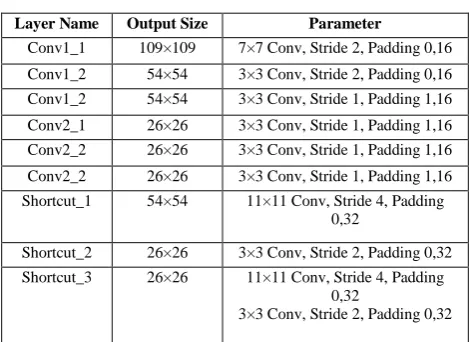
[image:3.595.42.277.458.629.2]Each Conv block contains three convolution layers and two bi-direction LSTM layers. The parameters of convolution layers and shortcuts are shown in table 1.
TABLE I. THE PROPOSED ARCHITECTURE OF CNN Layer Name Output Size Parameter
Conv1_1 109×109 7×7 Conv, Stride 2, Padding 0,16
Conv1_2 54×54 3×3 Conv, Stride 2, Padding 0,16
Conv1_2 54×54 3×3 Conv, Stride 1, Padding 1,16
Conv2_1 26×26 3×3 Conv, Stride 1, Padding 1,16
Conv2_2 26×26 3×3 Conv, Stride 1, Padding 1,16
Conv2_2 26×26 3×3 Conv, Stride 1, Padding 1,16 Shortcut_1 54×54 11×11 Conv, Stride 4, Padding
0,32
Shortcut_2 26×26 3×3 Conv, Stride 2, Padding 0,32 Shortcut_3 26×26 11×11 Conv, Stride 4, Padding
0,32
3×3 Conv, Stride 2, Padding 0,32
B. ConvLSTM
In the traditional fully connected LSTM, input features will be vectorized, which is very unfavorable for learning space-time features. In the transmission process of each layer, vectorized features will lose spatial relevance, however, object posture and position is significance for recognition. So ConvLSTM [19] is used to learn long-term temporal and spatial properties, and convolution and recursion can take full advantage of spatiotemporal
information. This is also shown using the mathematical equations which are,
𝑖𝑡= σ(𝑊𝑥𝑖∗ 𝑋𝑡+ 𝑊ℎ𝑖∗ 𝐻𝑡−1+ 𝑊𝑐𝑡○ 𝐶𝑡−1+ 𝑏𝑖) (1)
𝑓𝑡= σ(𝑊𝑥𝑓∗ 𝑋𝑡+ 𝑊ℎ𝑓∗ 𝐻𝑡−1+ 𝑊𝑐𝑓○ 𝐶𝑡−1+ 𝑏𝑓) (2)
𝐶𝑡= 𝑓𝑡○ 𝐶𝑡−1+ 𝑖𝑡○ tanh(𝑊𝑥𝑐∗ 𝑋𝑡+ 𝑊ℎ𝑐∗ 𝐻𝑡−1+ 𝑏𝑐) (3)
𝑜𝑡= σ(𝑊𝑥𝑜∗ 𝑋𝑡+ 𝑊ℎ𝑜∗ 𝐻𝑡−1+ 𝑊𝑐𝑜○ 𝐶𝑡+ 𝑏𝑜) (4)
𝐻𝑡= 𝑜𝑡○ tanh (𝐶𝑡) (5)
The feature map of hidden layer we adopt 32 as each signal LSTM output
C. 3D-Net
For the 3D network, we adopted the 3D structure based on DenseNet. DenseNet itself has many advantages, reducing model size and increasing classification effect. This is a very effective structure and the network parameters are shown in table 2.
TABLE II. NETWORK PARAMETERS FOR 3D-NET
Layer Name 3D-DenseNet (growth rate=32)
3D-Dense Block (1) [1 × 1 × 1 𝑐𝑜𝑛𝑣
3 × 3 × 3 𝑐𝑜𝑛𝑣] × 4, stride 1, padding 1 Transition Layer (1) 1 × 1 × 1 stride 1, padding 0
3 × 3 × 2 average pool, stride 2 × 2 × 2, padding 1
3D- Dense Block (2) [1 × 1 × 1 𝑐𝑜𝑛𝑣
3 × 3 × 3 𝑐𝑜𝑛𝑣] × 8, stride 1, padding 1
Transition Layer (2) 1 × 1 × 1 stride 1, padding 0 3 × 3 × 2 average pool, stride 2 × 2 × 2,
padding 1 3D- Dense Block (3) [1 × 1 × 1 𝑐𝑜𝑛𝑣
3 × 3 × 3 𝑐𝑜𝑛𝑣] × 8, stride 1, padding 1 Transition Layer (3) 1 × 1 × 1 stride 1, padding 0
3 × 3 × 2 average pool, stride 2 × 2 × 2, padding 1
3D- Dense Block (4) [1 × 1 × 1 𝑐𝑜𝑛𝑣
3 × 3 × 3 𝑐𝑜𝑛𝑣] × 8, stride 1, padding 1 Classification Layer 7 × 7 global average pool
FC, softmax
IV. TRAINING DETAILS
attenuation is 0.0005, and the minus-sized is 32. All the training was done on a tesla P100 GPU.
Test time inference: In order to improve the accuracy, many start-of-the-art algorithms prefer to run some post-processing. For instance, TSN [9] and ARTNet [10], each segment video collects 25 individual frames. Each frame/volume sample crops 10 areas of corner and center and their horizontal flipping. Then based on the average scores of the 250 samples results are obtained. It is clear that methods for calculation are very expensive and that is not the best way for fast video analysis algorithm. However, our algorithm without too much additional operations, is based on many widely recognized ideas to solve the problem of speed. During the test period, our algorithm in video is divided into N subsection and randomly extracts a frame from each section, these frames only perform center cropping and send the cropped part to the network. This is an end-to-end prediction.
V. EXPERIMENT
In order to test the generalization ability of our method, we evaluated it on different data sets to make it more convenient and intuitive to compare with other excellent methods. We tested UCF101 [11] on the original RGB video as input.
We also tested speed of our approach at the same time. A lot of methods always select fps (frames per second) as a standard comparison for speed. Actually such comparisons have problems because of the different algorithms applied on same video to calculate the number of frames which is always different. So here we are more concerned with the processing speed of each video. Our approach can reach 790 FPS on a Tesla P100 GPU. All the results are shown in table 3.
TABLE III. THE SIMULATION RESULTS
Method Pre-Train Accuracy (%)
Speed (fps)
Our Approach Kinetics 91.4 69.3
HOG [20] - 72.4 -
ConvNet+LSTM (AlexNet) [21]
ImageNet 68.2 -
C3D (VGGNet-11) [3] Sports-1M 82.3 -
Res3D [15] Sports-1M 85.8 <2
TSN Spatial Network [9]
ImageNet 86.4 21
TSN Spatial Network [9]
ImageNet + Kinetics
91.1 21
RGB-13D [22] ImageNet+ Kinetics
95.6 0.9
ECO12F [2] Kinetics 92.4 52.6
ARTNet w/o TSN [10] Kinetics 93.5 2.9
CONCLUSION
We have put forward a structure which is highly efficient for video analysis. And that is evident form the result obtained. The proposed structure can be used not only in video classification but also can be used in various video understanding tasks. The advantage is that network only needs an RGB image and no other pre-treatment. ConvLSTM replaces the traditional LSTM which is good for extracting spatiotemporal information. High density of residual can make the network robust as well.
ACKNOWLEDGMENT
We are grateful to University of Strathclyde for providing us with appropriate software and computer system because of which we are able to present this work. Also, thanks to the deep learning group based in CeSIP for their valuable support and guidance.
REFERENCES
[1] Huang, Gao, et al. "Densely Connected Convolutional Networks." CVPR. Vol. 1. No. 2. 2017.
[2] Zolfaghari, M., Singh, K., & Brox, T. (2018). ECO: Efficient Convolutional Network for Online Video Understanding. arXiv preprint arXiv:1804.09066.
[3] Tran, Du, et al. "Learning Spatiotemporal Features with 3D Convolutional Networks." Computer Vision (ICCV), 2015 IEEE International Conference on. IEEE, 2015.
[4] Ng, Joe Yue-Hei, et al. "Beyond short snippets: Deep networks for video classification." 2015 IEEE Conference on Computer Vision and Pattern Recognition (CVPR). IEEE, 2015.
[5] Ji, Shuiwang, et al. "3D convolutional neural networks for human action recognition." IEEE transactions on pattern analysis and machine intelligence 35.1 (2013): 221-231. [6] Taylor, Graham W., et al. "Convolutional learning of
spatio-temporal features." Proceedings of the 11th European conference on Computer vision: Part VI. Springer-Verlag, 2010.
[7] Feichtenhofer, Christoph, Axel Pinz, and Andrew Zisserman. "Convolutional Two-Stream Network Fusion for Video Action Recognition." 2016 IEEE Conference on Computer Vision and Pattern Recognition (CVPR). IEEE, 2016.
[8] Simonyan, Karen, and Andrew Zisserman. "Two-stream convolutional networks for action recognition in videos." Proceedings of the 27th International Conference on Neural Information Processing Systems-Volume 1. MIT Press, 2014.
[9] Wang, L., Xiong, Y., Wang, Z., Qiao, Y., Lin, D., Tang, X., & Van Gool, L. (2016, October). Temporal segment networks: Towards good practices for deep action recognition. In European Conference on Computer Vision (pp. 20-36). Springer, Cham.
[10] Wang, L., Li, W., Li, W., & Van Gool, L. (2017). Appearance-and-relation networks for video classification. arXiv preprint arXiv:1711.09125.
[11] Soomro,K,Zamir,A.R.,Shah,M.:UCF101:A dataset of 101 human actions classes from video in the wild. CoRR abs/1212.0402(2012)
[12] Donahue, J., Hendricks, L.A., Guadarrama, S., Rohrbach, M., Venugopalan, S., Saenko, K., Darrell, T.: Long-term recurrent convolutional networks for visual recognition and description. In: CVPR. (2015)
[image:4.595.44.276.510.739.2]convolutional neural networks. In: Proceedings of the 2014 IEEE Conference on Computer Vision and Pattern Recognition. CVPR’14, Washington, DC, USA, IEEE Computer Society (2014) 1725–1732
[14] Zolfaghari, M., Oliveira, G.L., Sedaghat, N., Brox, T.: Chained multi-stream networks exploiting pose, motion, and appearance for action classification and detection. In: IEEE International Conference on Computer Vision (ICCV). [15] Tran, D., Ray, J., Shou, Z., Chang, S., Paluri, M.: Convnet
architecture search for spatiotemporal feature learning. CoRR abs/1708.05038 (2017)
[16] Lev, G., Sadeh, G., Klein, B.,Wolf, L.: Rnn fisher vectors for action recognition and image annotation. In Leibe, B., Matas, J., Sebe, N., Welling, M., eds.: Computer Vision – ECCV 2016, Cham, Springer International Publishing (2016) 833–850
[17] Li, Z., Gavrilyuk, K., Gavves, E., Jain, M., Snoek, C.G.: Videolstm convolves, attends and flows for action recognition. Comput. Vis. Image Underst. 166(C) (January 2018) 41–50
[18] Diba, A., Fayyaz, M., Sharma, V., Karami, A.H., Arzani,
M.M., Yousefzadeh, R., Gool, L.V.: Temporal 3d convnets: New architecture and transfer learning for video classification. CoRR abs/1711.08200 (2017)
[19] Xingjian, S. H. I., Chen, Z., Wang, H., Yeung, D. Y., Wong, W. K., & Woo, W. C. (2015). Convolutional LSTM network: A machine learning approach for precipitation nowcasting. In Advances in neural information processing systems (pp. 802-810).
[20] H. Wang and C. Schmid. Action recognition with improved trajectories. In ICCV, pages 3551–3558, 2013.
[21] J. Donahue, L. A. Hendricks, S. Guadarrama, M. Rohrbach, S. Venugopalan, T. Darrell, and K. Saenko. Long-term recurrent convolutional networks for visual recognition and description. In CVPR, pages 2625–2634, 2015.
Authors’ background
First Author’s Name: Tian Jin
Position
(Prof., Assoc. Prof., Asst. prof., Dr., Mr., Ms.) Mr.
Research Field Vision, Recognition and Reconstruction
Personal Webpage
Second Author’s Name: Zhihao He
Position
(Prof., Assoc. Prof., Asst. prof., Dr., Mr., Ms.) Mr.
Research Field Vision, Recognition and Reconstruction
Personal Webpage
Third Author’s Name: Amlan Basu
Position
(Prof., Assoc. Prof., Asst. prof., Dr., Mr., Ms.) Mr.
Research Field Vision, Recognition and Reconstruction
Personal Webpage https://pureportal.strath.ac.uk/en/persons/amlan-basu
Fourth Author’s Name: John Soraghan
Position
(Prof., Assoc. Prof., Asst. prof., Dr., Mr., Ms.) Prof.
Research Field Image Processing, Vision, Recognition and Reconstruction
Personal Webpage https://pureportal.strath.ac.uk/en/persons/john-soraghan
Fifth Author’s Name: Gaetano Di Caterina
Position
(Prof., Assoc. Prof., Asst. prof., Dr., Mr., Ms.) Dr.
Research Field Image Processing, Vision, Recognition and Reconstruction
Personal Webpage https://pureportal.strath.ac.uk/en/persons/gaetano-di-caterina
Sixth Author’s Name: Lykourgos Petropoulakis
Position
Research Field Image Processing, Vision, Recognition and Reconstruction