City, University of London Institutional Repository
Citation
:
Bloomfield, R. E., Butler, E. and Netkachova, K. (2017). Assurance of open
systems dependability: developing a framework for automotive security and safety. Paper
presented at the Sixth Workshop on Open Systems Dependability, 21 Oct 2017, Tokyo,
Japan.
This is the published version of the paper.
This version of the publication may differ from the final published
version.
Permanent repository link:
http://openaccess.city.ac.uk/18799/
Link to published version
:
Copyright and reuse:
City Research Online aims to make research
outputs of City, University of London available to a wider audience.
Copyright and Moral Rights remain with the author(s) and/or copyright
holders. URLs from City Research Online may be freely distributed and
linked to.
City Research Online:
http://openaccess.city.ac.uk/
[email protected]
Assurance of open systems dependability: developing
a framework for automotive security and safety
Robin Bloomfield1,2, Eoin Butler2, Kate Netkachova1,2 1Centre for Software Reliability, City University of London
2Adelard LLP
London, UK {kn,eb,reb}@adelard.com
Abstract—We describe how a security informed analysis of the open systems dependability model of DEOS can be used to frame the problem of open systems and security. Together with an approach for analysing industry objectives based on claims, arguments and evidence (CAE), we develop a set of principles and rationale for the security and safety of road transport systems. The associated CAE will provide a generic template for a security informed safety case and supports standardization activities for security-informed safety.
Keywords—security-informed safety; automotive systems; DEOS; assurance cases
I. INTRODUCTION
In this paper and associated talk, we describe how the open systems dependability model of DEOS can be used to frame the problem of open systems and security. Together with a framework for analysing decision based on claims, arguments and evidence (CAE), we are developing principles for security and safety for an automotive standard.
II. FRAMING THE PROBLEM
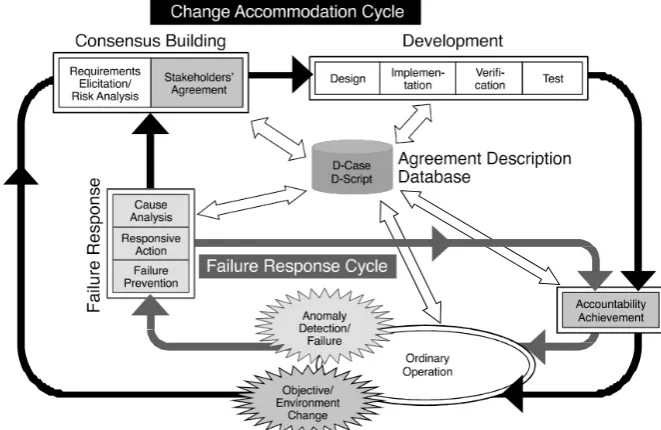
Open systems dependability is the ability to accommodate changes in purpose, objectives, environment and actual performance and to achieve accountability continually, so as to provide expected services as and when required.
The DEOS process provides a reference model for an open
system. It consists of two cycles:
• Change Accommodation Cycle to adapt system according to requirement changes;
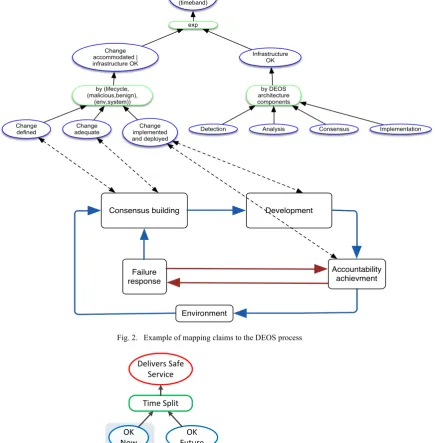
• Failure Response Cycle to provide failure prevention, failure response and analyse the causes of failures. We use a CAE framework for analysing engineering decision, particularly those concerned with dependability but also wider issues such as regulatory strategy [1]. We can assess the role for the different parts of the DEOS process (see Fig.2) [9] by examining their contribution to different claims and arguments and evidence for a generic dependability claim. Fig. 2 shows how the CAE framework can be mapped to the DEOS process (and vice versa).
[image:2.595.132.463.536.751.2]Changes OK (timeband)
exp
Change accommodated | infrastructure OK
Infrastructure OK
by DEOS architecture components
Detection Analysis Consensus Implementation by (lifecycle,
(malicious,benign), (env,system))
Change
defined adequateChange implemented Change and deployed
Development Consensus building
Failure response
Environment
[image:3.595.77.513.77.521.2]Accountability achievment
Fig. 2. Example of mapping claims to the DEOS process
Assurance at a particular
moment
Benign Changes
Non-benign Events Types of Events
OK Future Time Split
OK Now
[image:3.595.153.421.429.682.2]Delivers Safe Service
DEOS Cycles
D-ADD
Consensus Building
Development
Accountability
Failure Response Cause Analysis, Responsive
Action, Failure Prevention
Requirements History
D-Case
Failures & Anomalies Logs D-Script Code
D-RE
D-Box
[image:4.595.118.469.61.305.2]D-System Monitor D-App Monitor D-Script Engine
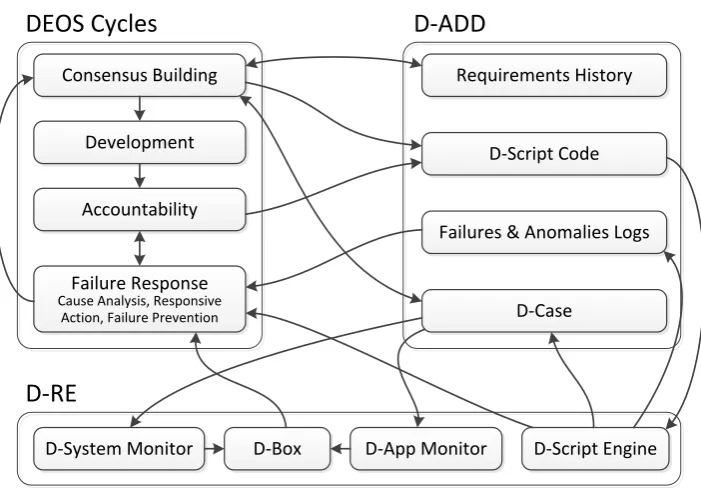
Fig. 4. Detailed data flow diagram in the DEOS framework
To do this we need to create more detailed models of the dataflow within the reference DEOS architecture. This is shown in Fig. 4.
[image:4.595.40.288.491.721.2]In the traditional DEOS model the relationships on this diagram are trusted, so we can apply the standard security approach to analysing each of them. For example, we can use Microsoft’s STRIDE with six main threat categories: Spoofing, Tampering, Repudiation, Information disclosure, Denial of service, and Elevation of privilege. An example is shown in Table 1.
TABLE I. ANALYSIS OF DATA FLOW FROM THE CONSENSUS BUILDING TO THE DEVELOPMENT BLOCK
STRIDE keyword Analysis of Data flow from the Consensus Building to the Development block
Spoofing
Someone acting like a stakeholder (but not actually a stakeholder) sends a set of new requirements to the development.
Tempering Requirements are modified during while being transferred to the development.
(Non-) repudiation Developers claim to have not received any requirements for implementation.
Information disclosure
Leakage of requirements to a third party during the transfer process. This can be important as requirements can be confidential (e.g. encrypt all data with this type of key).
Denial of service Requirements cannot be delivered because of the flooded channel.
Elevation of privilege
Someone gets access to a stakeholder’s account and sends requirements to the
This analysis will lead to more detailed recommendation for the implementation of the DEOS process and architecture.
III. DEVELOPING PRINCIPLES
Having used the open systems perspective to frame the problem we can relate these to the principles and guidance for use in standardisation. We can identify principles using a top down approach based on a vision for the industry that we systematically analyses in our CAE framework to derive objectives (see for example the work in [1] applying this to aviation regulation). We can use the DEOS perspective to check our approach for scope. We also undertake a more bottom up analysis by comparing and contrasting the principles from existing guidance on security, risk assessment, assurance and automotive applications.
We have developed claims-evidence-argument approaches to reason and communicate about the trustworthiness of systems. In previous projects we have used them to support the development of policy and to assess the impact of security issues on safety regulation [1] To develop and justify the principles for the Guidance, we are constructing a claims-evidence-argument case showing how the principles support a high-level vision for the industry.
In this Section we provide an overview and some details of the evolving approach.
Supports confidence of other stakeholders
Future behaviour of product Current and future
organisational aspects
Assets and compete
ncies Assurance
case Developm
[image:5.595.58.552.61.412.2]ent lifecycle
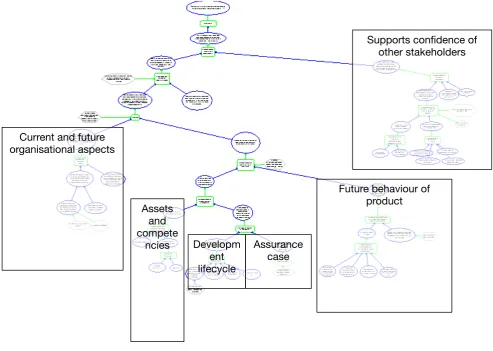
Fig. 5. CAE structure
The complete CAE structure we are developing can be seen in Fig. 5 where we have identified the main areas of the principles. We will expand and develop further on this structure as the project develops.
REVIEW AND MAPPING OF OTHER PRINCIPLES
There is considerable work done on developing security principles. We have reviewed the following principles for security:
• DfT/CCAV: The Key Principles of Cyber Security for Connected and Automated Vehicles [2]
• NCSC: NIS Directive Guidance [3] • ONR: Security Assessment Principles [4] • NHTSA: Cybersecurity for Modern Vehicles [5] • Rail Industry Cyber Security Assurance Group: Cyber
Security Assurance Principles [6]
We have also documented the ENISA Good practices [7] and the draft IET “Safe and Secure” principles [8] as further useful sources of information.
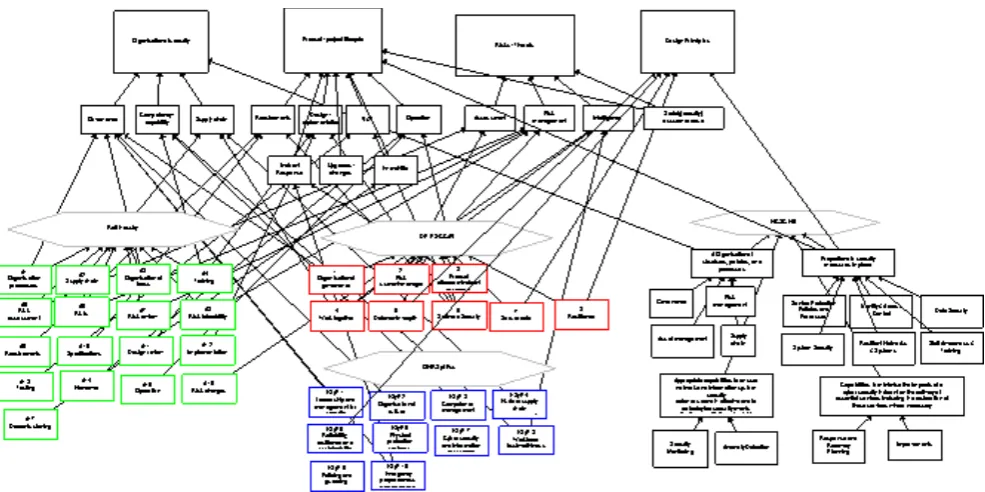
We have used the ASCE tool to map these principles and to show their interrelationships as shown in Fig. 6. This initial analysis identifies three broad categories of principles that all these documents address to a differing extent:
1. Organisational security 2. Product or project lifecycle
3. Design principles (covering architecture through to component design)
A detailed comparison of the principles is in progress. In addition we use of own experience of assessing the safety and security of systems, as well as consultation with industry and government, to develop a list of cross cutting themes for which we provide more detailed guidance tied into the different principles. We currently envision topics such as the following:
• Lifecycle processes
Fig. 6. Overview of mapping of principles
CONCLUSIONS AND NEXT STEPS
We have described how a security informed analysis of the open systems dependability model of DEOS can be used to frame the problem of open systems and security. Together with an approach for analysing objectives based on claims, arguments and evidence, we are developing a set of principles and rationale for the security and safety of road transport systems. The associated CAE will provide a generic template for a security informed safety case. This is currently work in progress but the intention is to publish in late 2018 the output of this work to support a new standard for the industry.
REFERENCES
[1] Bloomfield, Robin and Bishop, Peter and Butler, Eoin and Netkachova, Kate, Using an Assurance Case Framework to Develop Security Strategy and Policies, Publisher, in Computer Safety, Reliability, and Security, SAFECOMP 2017 Workshops, ASSURE, DECSoS, SASSUR, TELERISE, and TIPS, Trento, Italy, September 12, Springer International Publishing, 2017, 10.1007/978-3-319-66284-8-3
[2] HM Government, The Key Principles of Cyber Security for Connected and Automated Vehicles, August 2017.
[3] National Cyber Security Centre, Networks and Information Systems (NIS) Directive: Security objectives and principles. Retrieved 28 September 2017 from https://www.ncsc.gov.uk/information/networks- and-information-systems-nis-directive-security-objectives-and-principles.
[4] Office for Nuclear Regulation, Security Assessment Principles for the Civil Nuclear Industry, v1.0, 2017.
[5] National Highway Traffic Safety Administration, Cybersecurity best practices for modern vehicles. Report No. DOT HS 812 333, October 2016.
[6] Rail Industry Cyber Security Assurance Group, Cyber Security Assurance Principles, Issue 7, November 2016.
[7] ENISA, Cyber security and resilience of smart cars - good practices and recommendations, December 2016.
[8] IET Safe and Secure Code of Practice Principles, version 0.6 (draft). [9] Mario Tokoro, Open Systems Dependability, ISBN 978-1-4665-7751-0,