ContentslistsavailableatScienceDirect
European
Journal
of
Operational
Research
journalhomepage: www.elsevier.com/locate/ejor
Interfaces with Other Disciplines
Theory
into
practice,
practice
to
theory:
Action
research
in
method
development
✩
Colin
Eden
a,∗,
Fran
Ackermann
b aStrathclydeBusinessSchool,Glasgow,G40QU,UKbCurtinBusinessSchool,GPOBoxU1987,Perth6845,WesternAustralia,Australia
a
r
t
i
c
l
e
i
n
f
o
Articlehistory:
Received6October2017 Accepted23May2018 Availableonlinexxx
Keywords:
Decisionprocesses Actionresearch BehaviouralOR Soft-ORmethod Rigourandrelevance
a
b
s
t
r
a
c
t
Thepurposeofthispaperisthreefold.Firstly,althoughtherehavebeenmanyarticlesandbooks describ-ingthe natureofActionResearchtherearefewexamplesofdoingitinpractice. Wedescribehowa ResearchOrientedActionResearchprogrammeunfoldedovermanyyearsfocussingonthe operationali-sationoftheoryalongsidethedevelopmentofasoft-ORmethodology. Anoutcome ofthisprogramme was therefinementof anActionResearch method. Secondly, wepresent the developmentofan un-derstanding ofemergentstrategy – a‘theory’ that attractedboththe researchers and managers ina numberoforganisationsasone thatcouldenhancethedevelopment ofasoft-ORmethodand aidthe processofstrategymaking. Indoingsowedemonstratehowresearchcanbebothrigorousandrelevant. Wealsodevelopedour understandingofemergentstrategyinamannerthat enablesit tobeusedin practice. Andthirdly, weshow howthesoft-ORmethodofStrategicOptionsDevelopmentand Analy-sis(SODA)methodologygraduallybecameastrategymakingmethodology(JourneyMaking). Although muchhasbeenwrittendescribingthebackgroundtothesesoft-ORmethodologies,thispapershowshow andwhytheydeveloped.Weillustratehowrelevanttheoryfromarangeofdisciplinescaninform prac-tice,andhowtheprocessofimplementingtheoryintomethoddevelopstheory.
© 2018TheAuthor(s).PublishedbyElsevierB.V. ThisisanopenaccessarticleundertheCCBYlicense.(http://creativecommons.org/licenses/by/4.0/)
1. Introduction
Effective operationalresearch(OR)dependsupon an appropri-ate understanding of the problem beingaddressed – finding the ‘right problem’ (Ackoff, 1981). Over the past four decades, prob-lemstructuringmethods (PSMs)havebeendevelopedtohelp op-erational researchersaddress the rightproblem(Mitroff & Feath-eringham, 1974;Rosenhead& Mingers,2001). In particular,three PSMs haveseen extensive use: SoftSystems Methodology (SSM), theStrategicChoiceApproach(SCA),andStrategicOptions Devel-opment and Analysis (SODA)(Mingers & Rosenhead, 2004). Each ofthesemethodsisgroundedinparticularviewsoforganisational life, andto a greateror lesserdegree hassome theoretical basis. Thesemethodsfrequentlyhavebeenlabelledas‘soft-OR’. Predom-inantlythesesoft-ORmethods havebeendevelopedthrough con-tinual use in practice andin response to some of the perceived
✩ Theauthorswouldliketothankthreeextremelydiligentandhelpfulreviewers,
whohavehelpedussignificantlyimprovethepaper.
∗ Correspondingauthor.
E-mailaddresses:[email protected](C.Eden),
[email protected](F. Ackermann).
limitations of more mathematically informed OR. Consequently, these ‘soft-OR’ methods are open to the criticism that they are notadequatelyinformedbysoundtheory.Forexample,soft-ORis “seenby manyashavingnegativeconnotationswithin OR gener-ally,implyingimprecisionandlackofrigour” (Mingers,2011:2).
Giventhat operationalresearch is intendedto impact practice and has a history of doing so (Williams, 2008), it would seem likelythatOR,particularlysoft-ORwithitsbasisinproblem struc-turing andsolving messy complex problems, could make a seri-ouscontribution tothedevelopmentofmanagement theory.This isparticularlysoasmanagement andorganisationalscholarshave consistentlyargued thatthe theoryin thesefields isnotmeeting thedoublehurdleofrigourandrelevance.Despitehavingplayeda powerfulroleattheoperationalleveloforganisations,operational research has hadless impact on organisational strategy develop-ment and the strategic decision-making of senior management teams. This is notwithstanding ‘soft-OR’ methods paying consid-erableattention tobounded rationality (Huxham & Dando,1981) andthe sort of satisficing (Simon, 1956) that is necessary when seniormanagementteamsaredealingwithcomplexmessy strate-gicproblems.Thatsaid, some ORwriters havemadeattempts to demonstratethepowerofORinhelpingstrategydevelopment(for
https://doi.org/10.1016/j.ejor.2018.05.061
0377-2217/© 2018 The Author(s). Published by Elsevier B.V. This is an open access article under the CC BY license. (http://creativecommons.org/licenses/by/4.0/)
exampleDyson, 2000; Dyson & O’Brien, 1998; Franco, O’Brien, & Bell,2011; O’Brien& Dyson,2007),andalso applysoft-ORin the pursuitofresolvingcomplexfar-reachingissueswhichhave strate-gic implications (Checkland & Scholes, 1999; Friend & Hickling, 2005).
Giventhe earlierpremise thatsoft-ORmethods aredeveloped throughuse, inthis paperwe show that Action Researchcan be a powerful and effective way of developing theoretically sound soft-OR methods. In addition, by doing so, the development is able to make a contribution to the elaboration anduse of man-agementtheory,particularlyinthefieldofstrategicmanagement. Inaddition,Action Research,throughits focusonrobust practice, canmeet the double hurdleof rigour and relevanceasevidenced throughworkcarriedoutbyChecklandandHolwell(1998). More-over,although the nature of Action Researchhas been presented in the literature, there are few, if any, examples of the reality of doing Action Research and particularly of doing Research Ori-entedAction Research(Eden & Huxham, 2006) where thedesign ofmethod/technique/toolhasalsobeenapartofoperationalising, andsodeveloping,theory.Oneaimofthispaperistoprovidesuch anarrative.
Inordertodemonstratehowtheorycontributestothe develop-mentofmethod,andmethoddevelopmentcontributesto theory, wepresentarealAction Researchprogrammethat (i)resulted in therefinementoftheActionResearchmethod,(ii)elaboratedand developedthetheoreticalideasbehindemergentstrategyand(iii) illustratedthe processof augmentationofa soft-ORmethodfrom problemstructuring throughstrategicproblemsolving tostrategy making.In addition we demonstrate that Action Research,which dependsupon usingtheorythatisofinterestto managerand re-searcher,resultsinthedevelopmentofamethodthatcanimpact seniormanagementteamswhenstrategymaking.
We beginthepaperwithabriefdiscussion abouttheneedto attendto both rigour and relevance, and then continuewith an explicationofthenatureofActionResearch.Wefollowwitha re-portonthreecyclesofanAction Researchprogrammeundertaken overtwentyyears.Inaddition,weshowhowrelevanttheoryfrom arangeofdisciplinescaninformpractice,andhowtheprocessof implementingthe theory intoa methodexpresses the usefulness oftheory.Aftereachresearchcycle,involvingmanyinterventions1
(typicallybetween 15 and30), we show how our understanding ofthefocaltheory,namelyemergentstrategy, wasdevelopedand how it influenced the design of the soft-OR method from prob-lem structuring to strategic problem solving and finally strategy making.Attheendofeachsectiondiscussingaresearchcycle, in-volvingmany interventions, we summarise theelaboratednotion ofemergentstrategy.Wefinishthepaperbyreportingtheinsights gainedaboutAction Research inpractice, thecontribution tothe focal theory and implications for the developmentof method as wellasreflectonActionResearch’scontributiontoORmethod de-velopment.
Thus, the contribution made by this paper is to: (i) provide anillustrationoftherealityofundertaking ActionResearchalong withconcomitantinsights;(ii)illustrateitsroleintheelaboration andtestingoftheusefulnessoftheideaofemergentstrategy,and (iii)presenttherole Action Researchplays indeveloping method (inthiscaseasoft-ORmethod).
1The interventionsencompassedmulti-nationals (e.g.Reed-Elsevier,Shell,ICL)
andsomethatwerenational(e.g.AMEC).ItincludedsomeSMEsaswellasother nationalorganisationsintheprivatesector(e.g.largeconstructioncompany)and othersinthepublicsector(e.g.StrathclydePolice,GovanInitiative,andNational AuditOffice)andnotforprofit(StrathclydePovertyAlliance).Someinterventions weresingleoneortwo-dayworkshops,othersencompassedanongoing relation-ship.Theworkwaswithseniormanagementteamsofbetween7and15people.
1.1. Rigourandrelevance
Atensionbetweenrigourandrelevancehadbeenanimportant context to our initial interest in soft-OR. This tension was typi-cally expressed as a need to strike “the balance between OR as a knowledge-oriented science ora problem-oriented technology” (Corbett&VanWassenhove,1993:628).Inparticulartheextensive debatefollowingAckoff (1979a)arguingthat“TheFutureof Oper-ationalResearchis Past” raisedissuesabouteleganceofso-called solutions versus the pragmatism neededto deal with the messi-nessoftherealproblemsfaced bymanagers(Lilien,1987:38) as clients(Eden&Sims,1979).
However, in addition, the last decade has seen many explicit pleas for rigour and relevance within the general field of busi-ness and management research with pleas to pay attention to this“doublehurdle” (Pettigrew,1997).ThomasandWilson(2009: 678) commented that, “the ‘voice of practice’ has become lost” and Pearce and Huang (2012) reflect on how practicing man-agers are becoming lessand less engaged withmanagement re-search. “Ourgoalshouldbe toseekrigourandrelevance through boundary-spanningresearchfocusedsquarelyonphenomenaof in-terest to managers” (Gulati, 2007: 775). This focus on relevance and rigourraises the issue ofhow research should have impact. Recently George (2016: 1869) argued that “animpactful research agenda would preclude an overt emphasis on theoretical “gaps” intheliterature, andinstead wouldmoveourcollectiveattention towardaddressing problemsorunderstandingemergent phenom-enathataresignificantandrelevanttoourstakeholders”.This re-quirementis a fundamentalrequirementforeffective operational research, particularly given the definition of OR provided by IN-FORMS(2006):“ORisthedisciplineofapplyingadvanced analyti-calmethodstohelpmakebetterdecisions”.
Some writershaveargued thattherigour-relevance gapis un-bridgeableinmanagementresearch(Kieser&Leiner,2009).Wedo notaccepttheseviews.Wesupporttheveryoftenrepeatednotion that “nothing is aspractical asgood theory” (Lewin, 1951: 169). Whatwetakethistomeanisthat,forthemostpart,theorymust be expressed insuch a way that it is possible to designpractice asareflectionofthetheory,evenifitisacademicresearcherswho concentrateon initialdesignandit ispractitioners andmanagers who comment on that design through their experience of it. As
CummingsandJones (2004)argue,knowledgemustbeactionable ifitisevertobeusefultomanagers.Thisisverymuchthebasisof theoriginsofORasdevelopedandusedfromWW2(Kirby,2002). Theorygrowsandchangesbyshiftingtheorydevelopmentfrom ‘pure research’ to practice based research, not as if either were wrong,butrathersothat whenbroughttogetherthey enrichone another.In theworkreportedherewe areaimingto actmore as a bridge in the value chain of knowledge production (Starkey & Madan,2001;Thorpe,Eden, Bessant,& Ellwood, 2011) by enrich-ing theory and adapting theory into a form that can be applied inpractice.AsGulati (2007)suggests“theory buildingisa cumu-lative enterprise and, as such, can onlyhappen if we are explicit
aboutbothourtheoriesandtheirimpactsonmanagerialpractice” (p780ouremphasis).
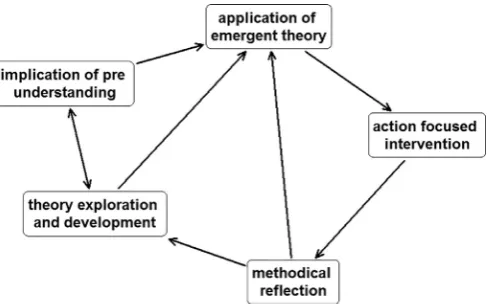
re-Fig.1. The1996ActionResearchcycle(fromEden&Huxham,2006:396).
searchappearstobeoperationalisingsuchattractiveconcepts and theories,andthenusingtheprocessofoperationalisingasabasis fordevelopingthesetheoriesandconcepts furthertoensureboth relevanceandrigour.Intheexamplereportedhereitwasthe con-ceptofemergentstrategy(Mintzberg&Waters,1985)thatbecame theresearchtopicofinteresttobothourselvesandmanagers, par-ticularlyasitemergedfromresearchandengagementwiththe de-velopmentofaparticularsoft-ORmethod.
1.2. ThenatureoftheActionResearchmethod
ActionResearchisanobviouscandidateresearchmethodwhen theobjectiveistoexploretheoryinrelationtopractice.Action Re-search (Lewin,1946; Susman &Evered, 1978) emphasises knowl-edge produced in the context of application. Organisational set-tings provide rich dataaboutwhat people do andsay, andwhat theories are used and usable, when faced with a genuine need to take action. “[Action Research] demands valuing theory, withthe elaboration and development of theoretical constructs as an ex-plicit concern of the research process” (Eden & Huxham, 2006: 394).ActionResearchisnotincompetitionwithotherwaysof do-ing research,ratheritisappropriate withrespectto specificaims and particularlywhere “the method is likely to produce insights which cannot be gleaned in any other way” (Eden & Huxham, 2006:396).
An involvement with practitioners and managers2, however,
doesnot necessarilyguaranteesuccessfulcontributions to knowl-edgethatcansignificantlyinfluenceboththedevelopmentof the-ory andmanagerial practice.There is a great danger that Action Researchcanbeseenasaformofconsultancy,wherethe engage-mentwithpractitioners issimplyawayofenablingacademic re-searchers to become involvedin the practitioner world andthen develop abstracttheories asusual,butwiththe abilityto hintat anengagementwithpractitionersandmanagers.Carefulavoidance ofthistrapisnecessary.Furthermore,notallAction Researchwill deliverusefulknowledgeandactionresearchcanbedonebadly.
TheActionResearchcycle(Fig.1)asdepictedbyEdenand Hux-ham(1996)wastheinitial basis fortheresearch,where each re-search cycle was made up of many organisational interventions spanningdifferentcontexts.
OneoutcomefromourActionResearchprogrammewasa mod-ificationtothe1996cycle(Fig.1).Thus, inmeeting ourfirst con-tributionofthispaper,providingconcomitant insightsinthe
pro-2Inthispaperwerefertopractitioners,whetheritbeORpractitionersor
strat-egypractitioners,asthosewhowillbeapplyingthemethodasopposedto man-agerswhowillbeexperiencingit.
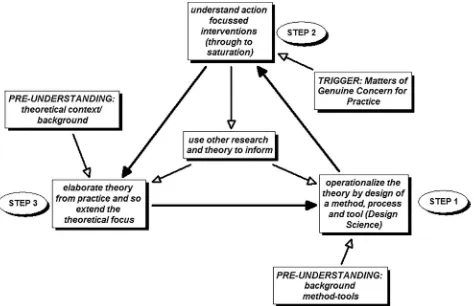
cessofdoingActionResearch,theActionResearchcyclewas elab-oratedandadaptedduringtheprocessofundertakingtheresearch reportedinthispaper.Fig.2representsthisadapted version.This newversion emerged, in particular, through beingexplicit about whatconstitutesthecommencement ofanAction Researchstudy andthedriversofthecyclesofresearch.Thefigureshowstwo as-pects of pre-understanding as the starting point for undertaking theresearch:beingexplicitabout(i)the extantliterature inform-ingtheinitialunderstandingofthefocaltheorybytheresearchers, and(ii)thebackgroundtoolsandmethodsassociatedwiththe re-searchers.This requirementforexplication isin contrast toEden andHuxham (2006) who recommend not making these two as-pectsexplicituntilthestageofwritingup.Inaddition,thereisan explicitlystatedtrigger– adrivingforcefrombothresearcherand practitioner– thatinitiatesthefirstresearch cycleandensuresits relevance.Itisthecombinationofpre-understandingsandthe trig-gerfortheresearchthat pushtheActionResearchstudyintolife. Inparticulareach oftheseiscrucialforeffectivereflectiononthe seriesofinterventionsthatformthefirstresearchcycleofthe Ac-tionResearchprogramme.It isnotpossibleto reflectproperlyon theshortcomingsofthetheoriesthatguidetheattemptto opera-tionalisetheorywithoutan explicitpre-understanding ofthe the-oriesthatdrivethedesignofthemethod.Ourfocusonaspecific pre-understanding denies the notionthat “theories quasiemerge bythemselvesfromthedata(withoutanyprevioustheoretical in-put)” (Reichertz,2010:2).Itis,however,perhapsimportanttonote thatinadditiontothespecificelementsofactionresearchshown inFigs.1and2,animportantaspectofanyresearchisthe contin-ualscrutiny that comes fromcolleagues through conference pre-sentationsandpublications andtheresearch environment within aresearchorientedinstitution.
Weundertookseveralcycleswithrespecttoourresearch pro-gramme,eachAction Researchcycleencompassing a seriesof in-terventions,where each intervention sought to be faithful to the conceptsandtheoriesofinterest.Eachresearchcyclewas:the ap-plicationofnascenttheorythroughadesignedsoft-ORmethod re-flecting our best interpretation of the theory, application of the methodwithmanagementteamsin arealsetting,methodical re-flectionontheintervention(s), andfurtherexploration and devel-opment of the theory,before commencing the next research cy-clethroughanothersetofinterventions. Thisresearchprogramme tookplaceovera periodofmanyyearsandinvolvedbetween fif-teenandthirtyinterventionsforeachresearchcycle.Thus,each re-searchcyclecomprised:step1– thedesignstep;step2-the intra-cycleexplorationofinterventionsyielding dataleadingto satura-tionofbothdesignandoutcomes;andstep3-thedeparturepoint forthe next cycle of Action Research (when saturation has been achieved– i.e.enoughdatatobereasonablyassuredofrobust con-clusions).Allthreestepsareregularlyinformedbyorinformother bodiesof theory (thestep atthe centreofFig. 2– “use other re-searchandtheorytoinform”).
[image:3.595.48.292.55.208.2]Fig.2. StartingtheActionResearchcycle:explicatingpre-understandingandidentifyingthepracticebasedtrigger.
programmewefacedtheusualissuesincollectingdataaboutthe thinking of elites (Ford, 1977; Pettigrew, 1992) where interview protocolsare difficult toadhere to (Norburn, 1989). Much of our datacollectionreliedoninformaldiscussionandcommentsaswell asmoreformal interview/reflectionsessions withindividualsand ingroups, takenalongsidenotestakenbybothresearchersduring workshops.Criticalincidentsprovidedausefulsourceofdata– ob-viousshiftsinthinkingandgroupbehaviour,conflicts,etc.(Bryson, Ackermann,Eden,&Finn,1996).
Aswestatedabove,duringthemethodicalreflectionperiod fol-lowingeach cycle(step 3), potential changes to the intervention designareexplored.Thechangesoftenresultintheliteraturethat hadguideditsdevelopmentbeingre-examinedandre-interpreted (aswellasconsiderationofother publishedresearch).The reflec-tionincludesconclusionsbeingcheckedforrobustnessby explor-ing alternative interpretations. In addition the designed method ofeach researchcycleiscontinuouslymodifiedtoreflectlearning fromallpreviousinterventions.Theiterativeprocessofcomparison betweenthemethodfor aresearch cycleandthe implications of thedatafromtheinterventionsexploredinthecycleiscontinued “untilrepetition frommultiple sources isobtained. Thisprovides concurring andconfirming data, and ensures saturation” (Morse, 1994:230).ActionResearchthusfollowsa‘fine-grained methodol-ogy’which cycles betweenthe worldsof practice and of theory (Harrigan,1983;Tranfield&Starkey,1998).
The development of tools/techniques/methods (in our case a soft-ORmethod)thataremanifestationsoftheoryisawayof de-velopingtheory.TheActionResearchcycledevelopstheoryin prac-tice: Application: operationalise an idea/theory/notion through an explicitly stated/designed method; Action: apply the method; Re-flect:understandtheuseandimpactofthemethod;Explore:look fortheorytoexplainoutcomes;andsofurtherdevelopthemethod
andsothetheory;redesignthemethod.
2. Action Research in practice: exploring emergent strategy
2.1. Pre-understandings:ourbackground
In our work with management teams, we had developed a problemstructuringmethodknownasStrategicOptions Develop-ment and Analysis (SODA) (Rosenhead, 1989). This development had been influenced by the sociality of defining the situation (McHugh, 1968) and personal construct psychology (Kelly, 1955) aswaysofunderstandingsense-making(Daft&Weick,1984; We-ick,1995a).Thenotionoftheories-in-useversusespousedtheories (Argyris & Schon,1978; Argyris& Schon,1991) also provided in-sightstoourunderstanding ofwhatpeople saidwastheproblem compared withhow they responded to it.The problem structur-ing method designed to acknowledge theseinfluences was addi-tionallyinfluencedbycausalmappinginpoliticalscience(Axelrod, 1976)whichactedasabasisforaformalcognitive/causalmapping methodbasedonpersonalconstructpsychology(Eden,1988).Thus the influential body of literature provided an initial view about howtooperationalisesense-makinginaproblemstructuring con-textthrough theuseofcognitiveandcausalmapping– formulat-inga‘softOR’method.
2.2. ThetriggerfortheActionResearchprogramme:amatterof genuineconcernforpractice
[image:4.595.59.533.55.361.2]man-agementconcepts,forexampleemergentstrategyaspresentedby
Mintzberg and Waters(1985). We, andthe practitioners, felt the use of the SODA OR method developed for problem structuring might put some flesh onto the detection of the emergent strat-egy of the organisation. In particular, the OR practitioners saw theproblemstructuringcapabilitiesprovidingsupportwith strate-gicproblem-solvingandthereforeapotentialprocessfordetecting an emergent strategy, and the emergent strategy as being some-thingthatshouldbeunderstoodasapartofstrategymaking.This sharedinterestbecamethetriggerfortheresearch.
2.3. Preunderstanding:thetheoreticalcontextandbackground
The attractiveness of the notion of emergent strategy lay, in part,initslinkbacktotheexplanationoforganisationalbehaviour as ‘muddling through’ as a “succession of incremental changes” (Lindblom,1959:86) andthat“policy makingistypically anever endingprocessofsuccessivestepsinwhichcontinualnibblingisa substituteforagood bite” (Lindblom, 1968:25).Eachofthese ex-planationshadseemedappropriatetothesituationsourmanagers enjoyed. Mintzberg first definedan emergent strategy asthe re-sultofa“patternina streamofsignificant decisions” (Mintzberg, 1972).Mintzberg, (1978) latersuggested that “thestrategy-maker perceived an unintended pattern in a stream of decisions and made that patternthe intended one forthe future” (p946). Even later MintzbergandWaters(1985)viewedemergentstrategy em-anating froma patternin a stream of actions. Emergent strategy couldbeseenastheconsequenceofantecedentmultipleactivities that would need to be changed in order to stop orto alter the strategy. “The crucial activities for decision making are not sep-arate episodes of analysis.Instead, they are actions, whose con-trolled execution consolidates fragments of policy that are lying around,givesthemdirection,andclosesoff otherpossible arrange-ments” (Weick,1983).“Strategiesneednotbedeliberate– theycan alsoemerge” (Mintzberg,1987).Eachofresearchers,OR practition-ersandmanagersviewedtheprocessofstrategicproblem-solving, usingSODA, tobe potentially onevery effectivewayofdetecting emergentstrategy.
3. The Action Research programme
3.1. Researchcycle1(1992onwards)– step1:operationalisethe theorybydesignofamethodthatreflectsthetheory
Asnotedabove,ORpractitioners andmanagerswereintrigued withthenotionofemergentstrategy,theyalsofeltthattheSODA ORmethodwehaddevelopedcouldhelpdetectemergentstrategy. The detection ofemergent strategy would assist withthe strate-gic problem solving. There had been many instances where the problems beingaddressed were considered to havemajor strate-gicramifications(Ackermann,1992).
TheoriginalORproblemstructuringdesigninvolveddeveloping cognitive maps for each management team member, ‘back-room’ mergingtheseintoagroupcausalmap,andthenpresentinga sin-gle mergedmap backto thegroup forthem towork ontogether (Eden & Simpson, 1989). However, there are signficant time de-mands associated withthis design, where one-to-one interviews areconducted,individualmapscheckedwitheachparticipant,and thentime devotedtomergingallofthemapseachwithtypically eightytoone-hundred-and-twentynodes.Forthisreason,tomeet the needs of strategicproblem solving,the method waschanged to that of buildinggroup causal mapswith the simultaneous in-volvementofall membersoftheteam(Bryson,Ackermann,Eden, &Finn,1995).
Thisdevelopmentofthemethodwasatrade-off between seek-ing to understand the emergent thinkingof individual managers
(throughcognitivemaps)that wouldbeexpectedtoinfluencethe behaviourofeachofthem,ascomparedtothecreationofagroup causalmapthatmightbeexpectedtorevealaspects ofgroup be-haviour.Bothpractitionersandresearcherssaw themethodtobe abasisforoperationalisingtheideaofemergentstrategyby seek-ingtodetectit(asexplicitpatternsina streamofthinkingofthe group)throughanexplicitprocessofstrategicproblemsolving.
Groupcausalmapswerederivedasparticipantswereinvitedto expresstheirviewsoftheimportantstrategicissuesfacingthe or-ganisationbywritingtheseonto ovalshaped cardsandspreading them around a large wall and subsequentlyadjusting their posi-tiontoreflectthematicclusters.Thesethematicclusterswere tem-porary asthey were subsequently adjustedto reflect causalityas participantsmadejudgementsabouthowthesestrategicissues in-teractedwithoneanother.Thisresultedinthecreationofagroup causalmapwherenewclustersemergedfromthenetworkoflinks. Causalitywasseenasthebasis foragroup‘definitionofthe situ-ation’facingtheorganisationwherethegroupfocused on means-endscausalitythat wasaction-orientedandstill reflecting princi-plesembeddedinpersonalconstructtheory.
Thegroup mapenabledmanagersto continuouslysurfaceand refine issues, structure them through the linksreflecting means-ends causalityand then refine the emerging map. It was under-stoodthatasthepictureonthewallbegantostabilise,agreement abouttheprioritisationofissuescouldbegin.Thismethodwas ex-pected to reveal aspects of emergentstrategy through the active processofsolvingastrategicproblem.
3.2.Researchcycle1-step2:actionfocusedinterventions
Analysisoftheoutcomesfromovertwentyinterventionsacross severalorganisationsinboththepublicandprivatesector consis-tentlyleftbothresearchersandmanagersinvolvedwiththesense thattheoutcomeswereasignificantlybetterrepresentationofthe realemergentstrategicfutureofthe organisation,ascompared to thatindicatedbytheirstrategicplans.
Theshiftfrommergingindividualinterviewmapsintoasingle map todevelopingthe map withthegroup usingthe ‘oval map-ping technique’ appeared to be a helpful developmentin detect-ingemergentstrategy. Themethodenabledthemultiple perspec-tivestobecaptured‘inrealtime’allowingbothforinitialviewsto beelicitedbutalsoforparticipantsto‘piggyback’oneachother’s contributions.
As the interventions had progressed both managers and re-searchersexpressedtheconcernthatpayingattentiontoan emer-gent strategy mightinevitablybe too embeddedinthe past.The method foroperationalising emergent strategy wasderived from recognisingthesignificanceofproblemsolvingindeterminingthe strategic future of the organisation. The method was, therefore, seenasperhapstoomuchofa focusondealingwiththepresent and so not capturing enough of a redesigned emergent strategic future.Counterto thisview were argumentsfrommanagersthat their definition of the situation necessarily anticipated worrying futuresintheirproblemdefinition.Theyarguedthattheemergent strategising they had undertaken respected the manager’s ‘soft’ andjudgmental beliefsaboutthefuturethatwere notrecognised properlyinastrategicplanningprocess.
Thus, attheendofthefirst twosteps ofresearch cycle1,the methodfordetecting emergentstrategywasthat ofdevelopinga group casual map directlywith theteam rather thanusing indi-vidual cognitive mapsas the basis of a group map. This shift in methodhadindicatedtheneedforagreaterfocusontwo impor-tant processesas a part ofdetecting emergent strategy: the role ofreal-time socialnegotiationandtheprocess ofindividual man-agers‘selling’theiremotionallyandjudgmentallydrivenviewsofa problematicfuture.Theseconsistent outcomessuggestedthatthe cycleshoulddrawtoa closeandafull reviewandreflectiontake place– step3inFig.2.
3.3.Researchcycle1-step3:elaboratetheoryfrompracticeandso extendthetheoreticalfocus:whatisemergentstrategy?
Asanemergentstrategywasbeingdetecteditwasclearthatit wasanactiveprocessofstrategizingratherthansimplyastrategy.
Howmanagementteamsresolvedmessyissuesofstrategic sig-nificancehad demonstratedthe needto recognise therole of so-cialnegotiationintheprocess ofagreeing a‘solution’tothe prob-lem.The processofdevelopinga groupdefinitionofthesituation throughthedevelopmentofagroup causalmap suggested emer-gentstrategisingreflectingthenotionoftheorganisationassocially negotiatedorder.
Theemergentstrategisingarosethroughthewaymanagers ad-dressed and managed key strategic issues. The strategic issues wereinfluencedbythepublishedstrategy,butindividualexpertise, organisational politics, ‘taken-for-granteds’, culture, history, sys-tems,andstructureplayedamoresignificantroleintheway strat-egy emerged. In many respects the method was allowing emer-gentstrategising to be representedas a process that wasgetting closetodetectingtheories-in-actionratherthanespousedtheories (Argyris& Schon, 1974). Emergent strategising, andso the emer-gent strategy, belonged to, and was created by, the managerial teamintheeverydayresolutionofstrategicissues,ratherthan pri-marilythrough aplanningprocessoftenundertaken byasupport group.
In summary, the idea of emergent strategy in practice could now be seen as emphasizing emergent strategizing, a process ratherthanaformofstrategy,andstrategisingasanegotiationof priorityissuesandoptions,encompassingbothcognitiveandsocial negotiation.
3.4.Researchcycle2(1996onwards)– step1:operationalisethe theorybydesignofamethodthatreflectsthetheory
InthemovefromthefirsttosecondActionResearchcyclethe elaboratedmethodthusrequiredattentiontotheprocessesof cog-nitiveandsocialnegotiation– buildingintheoryderivedfromthe field ofnegotiation(see the central featureof Fig.2). Our explo-ration of the field of negotiation led to two particularly helpful literatures, one ‘handed to us’ through serendipity. The first was thewritingof Strauss andSchatzman (1963),andStrauss (1978), wherethereisanotionofahospitalasanegotiatedorder(seealso
Nathan& Mitroff,1991). Thisconceptualisation led usto see the outcomeofresearchcycle1asrevealingaformofsocially negoti-atedorderandnegotiatedsocialorderwheresolutionscomefrom socialnegotiationandinvolvechangesinsocialrelationships(Eden &Ackermann,1998:48–49).
The second body of literature was from the field of interna-tionalconciliation,anditsimpactonourunderstandingofresearch cycle 1 was significant particularly the book on negotiation by
FisherandUry(1982).Thisbookpresenteda keyaspectof effec-tivenegotiation,namelypartiessociallycreatenewoptionsrather than‘fightoveroldoptions’.
Aswerevisitedourresearch datathisdescriptionofsuccessful negotiationappeared toexplain thewayinwhichthedeveloping groupcausalmapenabledparticipantstousethemapasa contin-uously changing definitionof the problemrevealingnew options fromthe synthesis andelaborationofperspectives. Thisfocus on negotiationalso,interestingly,paralleledthesuggestionthatORis effectivewhen seen asfacilitatingnegotiation (Eden, 1989; Eden, Jones,&Sims,1994).Themapwasalwaysintransition-actingas a ‘transitional object’ -providing a way ofthe group seeing and developingnewoptions reflectingtheprocessofemergent strate-gising.
The process of strategisingwas now seen asa process of ne-gotiationwherethe mapas atransitionalobjectwasacontinually changingrecordofthestrategising.Ourunderstandingoftherole ofa transitional objectwasusefullyinformedby ideasfrom psy-choanalysis (Winnicott, 1953) andmuch later withrespectto or-ganisationscience byCarlile (2002,2004).However, althoughthe mapchangedasareflectionofthecausallinkingofpointsofview fromdifferentparticipantsandthecontinualadditionof elaborat-ing views, the use of‘ovals’ (in cycle1) made continual editsof statements on the map difficult without losing the pace of the workshop.Thus,research cycle2demandedpayinggreater atten-tiontoenablingcontinuoustransition,strategising,ofthepointsof view asissuesmoved frombelongingto anindividual to belong-ingtothegroup.Therevisedmethod,therefore,utilisedcomputer software3 designedasthetransitionalobjectforfacilitating
inter-active causal mapping: a formof group support system (Eden & Ackermann,1992).
Finally,asearchforanunderstandingofthewayinwhich par-ticipants initially seemedto be ‘selling’ their own sense of what wascruciallyimportantforsuccess– making‘claims’onthefuture oftheorganisation.The researchofDutton(Dutton,1986;Dutton & Ashford, 1993; Dutton & Ottensmeyer, 1987) introduced us to thenotionof“issueselling”,adescriptionthatillustratedwhatwe hadbeenexperiencing.Laterthisconceptualizationwasreinforced bytheresearch ofNutt(2002)intowhydecisionsfail,andwhere heexplicitlydiscussestheidea of“claims”.Thus,issueselling be-cameanintegralpartofresearchcycle2.
Recent research on the performativity of strategy focuses on “mattersofconcernaswhatdrivesparticipantstodefendor evalu-ateaposition,accountforordis-alignwithanaction,orjustifyor opposeanobjective” (Vasquez,Bencherki,Cooren,&Sergi,2018:2) reinforcingtheneedtoattendtotheissuesandclaims.
In summary, the designed method (method 2) now encom-passed a specific focus on: (i) facilitating negotiation: developing
new options that were likely to be the synthesis and adaptation ofoldoptions;(ii)usingamorepowerfultransitionalobject(causal mappingsoftware);and(iii)recognizingandlegitimizingissue sell-ing as a part of the intervention andas an important emotional aspectofemergentstrategising.
3.5. Researchcycle2– step2:actionfocusedinterventions
AswithResearchcycle1,anumberofinterventionstookplace (around20)providingarangeofinsights.Firstly,itappearedtothe researchers (confirmed through comments from managers) that thesoftwareversion ofthemap hadsome importantadvantages. The map’sability to act as a transitionalobject helped the man-agement teamnegotiate a continuousrefining of themeaning of issues.Theprocessallowedforcontinuousandeasyeditingof ma-terial(bothwordingandcausal links)sothatgroup ownershipof themap developed asemergentstrategisinggradually developed. It becameclear that the visual interactive modellingelement
lowedsocialreadjustmentstotakeplace;asparticipantscame to-getherasateameachoftheirviewswasgivenmorerespectthan usual, andnew social relationships developed (negotiating social order).The transitionofmeanings enablednewoptionstobe de-veloped through the amalgamandrefining of issues – more op-tions were explored and developed. Visual Interactive Modelling (VIM)followingasimilarpathwasbecominganimportantaspect ofOR(Hurrion,1986;Smith,1986;Bell,1991).
Significantly,thedetectedemergentstrategywasseenby man-agerstobemoreintelligentandrobustbecauseitencapsulatedthe depthofexperience,specialistknowledgeandexpertiseofspecific roles.Managersfelttheresultantemergentstrategicdirectionwas significantly lesslikely toleadto unintended,orunforeseen, con-sequencesthantheofficialstrategicplan.
In addition, thepresentation ofthe map as a means-ends hi-erarchy revealed that what one person regarded as an issue of strategicsignificancewassometimesseenbyothersasoperational. Separatingoperationsfromstrategywasregardedasunhelpful to strategising: managers not only explored the ‘what’ of strategy making butalso the‘whyandhow’,themeans-ends agreements; assuchthey couldnot usefullyseparate thesetwoaspects of op-erationsandstrategyinmanagingthefutureoftheorganisation.
The process of developing an emergent strategy meant there wasnoneedtogothroughastageof‘makingdecisions’,astheact of continuallyrefining the map (bothin termsof thestatements themselvesandthemapasawhole)resultedinagreements grad-uallyemerging.Asanemergentstrategywasdetectedadeliberate strategywasbeingformed.
However, some problems becameapparent. The abilityof the mappingsoftwaretomovestatementsandassociatedrelationships (the causallinks)around easilyandsocontinuously rejigthe pre-sentationofa mapinto ahierarchymeant that thefastchanging andcomplexnatureofthe mapalso,onoccasion, confused man-agers.Thisconfusionindicated aneedforaclearer conceptualisa-tionofthenature,orstructure,ofemergentstrategysothat com-plexity could be managed withoutit being reduced.Categorising statements withrespect to a view of their nature as a partof a strategy appeared tobe thenext development, butnotby seeing some as strategic and others as operational: another conceptual structureofstrategywasrequired.
3.6. Researchcycle2– step3:elaboratetheoryfrompracticeandso extendthetheoreticalfocus:whatisemergentstrategy?
Thefocusonnegotiationasacriticalpartofamethodfor oper-ationalising emergentstrategy nowseemedobviousandreflected the idea of organisations as negotiatedorder as well as strategy as“patternsinastreamofdecisions” (Mintzberg,1978).However, theimpactandrelevanceoftheworkofFisherandUryon under-standing the process of emergent strategising was profound. The process ofmembers ofa managementteam continually negotiat-ing andrenegotiating their viewoftheorganisation’sstrategic is-sues came alive throughthe use ofa transitional object: a grad-uallystabilising‘picture-on-the-wall’.Therole ofcontinual transi-tion facilitatedcognitive shifts: the essenceofemergent strategy. Sotoowasthegroupdevelopingnewoptionsthatreflectedfuture opportunitiesratherthan theconstraininginfluenceofastrategic plan. As suchthis focuson futureopportunities appearedto res-onate withIsenberg’s(1987) viewregarding thereality of oppor-tunismdrivingstrategicfuturesthusfurtherestablishingthework intheextantliterature.
Therealityofissuesellingwasnowreflectedinthemethodof detectingemergentstrategisingandwasenablingandencouraging connectionbetweenagreedactions andemotions.Theact of sell-ing issueswasemotional– themethodwaslegitimising anxieties about the future and the commitment of the managers to their
ownroleincreatingasuccessfulorganisation.Detectingemergent strategy was grabbingthe attention of managers andreinforcing thesignificantroleofemergentstrategyasthedriverofan organ-isation’sfuture.
Thus, emergent strategy now reflected both analysis (through problemstructuring)andtheroleofemotionindelivering organ-isational change (via issue selling through to negotiated agree-ments).Howeveranxietyaboutthefuture,incontrasttothe plan-ningfocus ongoals, wasrevealed asa crucialand legitimate as-pectofemergentstrategising.Thisled toourconceptualisationof ‘negative goals’(Eden &Ackermann, 2013). Negativegoals, rather thanconstraints,expressanaspirationtoavoidapotentialdisaster. Thus,negativegoalsappearedasanimportantaspectofemergent strategy, andone that in manyways reflects research suggesting thatmanagersfocusondealingwithissues(Mintzberg,1975).
In summary, the idea of emergent strategy in practice could nowbeseentoencompass:socialandcognitivenegotiationinthe creation ofnew options through the useof a transitional object, theemotionofissueselling,theindivisibilityofstrategyand oper-ationsandtheroleofnegativegoals.
3.7.Researchcycle3(2000onwards)– step1:operationalisethe theorybydesignofamethodthatreflectsthetheory
The experiences of research cycle 2 implied elaborating the method (method 3) for research cycle 3 focusing specifically on managingthecomplexityofstrategisingbyexploringthestructure ofemergentstrategy.
Exploration of extant theory that would help understand the strategystructure ledtothework ofAckoff andEmery(1972) on purposefulsystems. This work resonated on two levels. The first beingtheuseofasystemsperspective:themapwasanetwork,a system,ofissues.Thesecondbeingthefocusonpurpose,together with a clear and definitional approach to a hierarchy of goals.
Pettigrew’s(1977) suggestionthat strategy isaboutthe “manage-ment ofmeaning” provided another important focuson the way inwhichthestructureofacausalmapprovidedmeaningnotjust through the words in statements but more importantly through theimplicationsforchangeimpliedbywhatiscausingsomething (in-arrows) andwhyitmatters(out-arrows) (Eden & Ackermann, 2010).
Throughthesetheoreticalconceptsthemethodforresearch cy-cle3 focused on the development of mapping coding rules that helpedrepresentthestructureofemergentstrategy(Eden& Acker-mann,2001).Mapshadbeenpredominantlya‘means-ends’ hierar-chyandforstrategicproblemsolvingtheyhadbeenfurther struc-turedasoptions/actions leadingto goals/objectives. Inmethod 3, structurewasmaintainedbutelaboratedtoincludestrategies sup-portinggoals, strategies encompassing strategic programmesthat includedmore operational actions,and, agreed actions that were identifiedasparticularlypotentbecausetheyimpactedmanygoals. In addition,the previous actionresearch cycle(research cycle 2)hadidentifiedthesignificanceofanxietywheremanagers wor-ried about avoiding disasters – these were categorised as ‘nega-tivegoals’.Understanding thisaspectofthestructureofemergent strategy took usback to Mintzberg’s research on thenature of a manager’s job (Mintzberg, 1972) where heargued that managers devotemostoftheir timedealingwithissues,andso by implica-tionpotentiallyaddressingnegativegoals(whetherexplicitor im-plicit).Hisresearchsuggestedthatthestructureofstrategy conver-sations,andsoemergentstrategy, might appropriatelyarise from astartingscriptthatfocusesonissues,andthenencourages elab-orationupwardsinthehierarchytowardsgoalsanddownwardsto strategicoptions.
(Ackermann & Eden, 2011a). The implication in our hierarchical structure was that conceptual distinctions should not be treated asiftheywere easytodetermine,althoughmanagingcomplexity requiredconceptualclarity,themethodshouldneverthelessreflect afuzzy boundarybetween, forexample,goals andstrategies and actions/options.Thus, an emergentstrategy wouldreflect thefull extentofbothstrategicandoperationalconsiderations.
3.8.Researchcycle3– step2:actionfocusedinterventions
The focus of thiscycle ofinterventions hadbeen expectedto belessdemanding thanthepreviouscyclesbecausewehadbeen usedto using some formof mapping basedconceptual structure foroperationalresearchbasedproblem-solvinginterventions.This provedtobethecase,withsaturationoccurringmorequicklythan theprevioustworesearchcyclesinvolvingaround15interventions. However, asthe research cycle progressed the analysis ofthe emergentstrategymapsgraduallyutilisedmoreanalysistoolsthan expected(Eden,2004;Eden,Ackermann,&Cropper,1992).For ex-ample,exploring themapthroughhierarchicalclusteranalysis re-vealedtheemergingstrategicarenasorthemesthatexercisedthe managementteam.Itbecameimportanttousethesearenasasan agenda for the development of agreed strategic programmes by makingsure that each cluster showedat leastone strategic pro-grammedesignedtoaddressthetheme.Similarly,theuseof anal-ysisembeddedinthesoftwareforfindingfeedbackloopsbecame an important recurring task asthe map developed.The recogni-tionof,inparticular,viciouscyclesbecameakey outcomeof the detectingemergentstrategydesign.Viciouscycleswere,ofcourse, notapartofanemergentstrategyperseastheyhadnothitherto beenacknowledgedhoweveridentifyingtheirpresencewas impor-tant if effective strategy was to be produced. The beliefs about the future that created the potential vicious cycle often derived fromtheexplicitmergingofthebeliefsofseveralindividualsand reflected, therefore, the interactions betweenthe perspectives of people in different roles. Consequently, as the group moved to-wardsusingdetectingemergentstrategisingasabasisforagreeing adeliberate strategy, thedevelopmentofstrategiesto reducethe impactofviciouscycleswereimportanttoidentifyandmanage.
Unsurprisingly the development of an emergent goals system
(Eden & Ackermann, 2013) that included recognition of negative goals turned out to be a crucial outcome of this research cycle ofinterventions.Theemergentgoalssystemwasalwayscompared withtheofficialgoalssystemandtheemergentgoalssystemwas consistentlyseen as amore realistic reflectionof the future pur-poseoftheorganisation.Theemergentgoalssystemreflectedwhat thepower brokers inthe organisationwanted toachieve, andso would seek to achieve, rather than that laid out in the official plan(Eden& Ackermann,1998;Eden &vanderHeijden,1995).It wasthesefeatures ofthecyclethat reinforcedadevelopingview thatemergentstrategisingwas,inpractice,akeyaspectofthe ac-tualstrategyofanorganisationandapowerfuldeterminantofthe strategicfuture of an organisation, and that it could be detected andusedtohelpcreatearealisticdeliberatestrategy.
3.9.Researchcycle3– step3:elaboratetheoryfrompracticeandso extendthetheoreticalfocus:whatisemergentstrategy?
As a resultofseekingto manage thecomplexityofthe emer-gentstrategymaps,anemergentstrategywasseentofit,insome respects, a conceptual structure that reflected the aspiration and purposefulnessexpectedtobeapartofatraditionalstrategy.But, thereareimportantdistinctionsandelaborations.
Detectingemergentstrategyhadbecometheprefacefor agree-ingadeliberate emergentstrategy– astrategythat wasregarded
asbothrealistic,becauseitbasedonanemergentstrategyandyet alsoaspirational.
Thedeliberateemergentstrategyreflected ahierarchyof causal-ity(means-ends/how-why)thatencompassedbothoperationsand strategywithafuzzyboundarybetweenthesetwoaspects. Signifi-cantlyoperationsandstrategywerenotseparateconsiderationsfor changinganorganisation’sfuture– theywereintegrallylinked.
Thedeliberateemergentstrategyalsorecognisedarolefor neg-ativegoals.Negativegoalswereaspirational,inthesensethatthey werenotconstraintsbutratherinvolvedactivelystrategisingabout avoiding disastrous futures. The means-ends hierarchy therefore was cappedby a goals system which is a network ofinterlinked goalsthataregoodoutcomesintheirownrightandyetalso sup-port andare supported by other goals. The goals systemitself is ahierarchy.Thisstructureofstrategyprovidedabasisforstrategy conversationsthatexploitedemergentstrategising.
4. Theory development
In this illustration of a real Action Research programme we havepresentedthreecyclesoftheprogramme. Inreflecting upon them(andsubsequentAction Researchprogrammes)it was inter-esting that each cycle focused primarily on one particular theo-reticaldevelopment.Researchcycle1focusedonemergent strate-gizingasan activeprocess throughsense-makingtodetect emer-gentstrategy, researchcycle2focusedonnegotiation(bothsocial andcognitive),issuesellingandtheroleofatransitionalobjectin sense-making, research cycle 3 on managingcomplexity through thestructureofemergentstrategy andsotheanalysisofstrategy maps.There wasone further cyclerelatingto thisresearch topic whichdidnotadvancetheorybutdidadvancethemethod.This re-searchcyclebroughtintoplaytheoriesofProceduralJustice(Tyler & Blader,2000)andthe developmentofa GroupSupportSystem (Group Explorer4) to reflect the significance of procedural justice
and alsoof negotiation (Ackermann & Eden, 2010; Ackermann & Eden,2011a;2011b).
Thus,insummarytheprimarytheorydevelopmentabout emer-gentstrategywas:
Research Cycle 1 - emergent strategy is an active process of strategisingratherthansimply astrategy– thus emergent strate-gising not emergent strategy; management teams socially create newstrategicoptionsthroughtheexplicitconvergenceandlinking ofperspectivesandthroughaprocessofcognitiveandsocial nego-tiationleadingtochangingofmindsandagreementofpriorities;
ResearchCycle2-emergentstrategyreflectsbothanalysisand the role of emotion in delivering organisational change (i.e. issue selling through to negotiated agreements); anxiety about the fu-ture,in contrast to the planning focus on goals, is a crucial and legitimate aspect of emergent strategising; the conceptualisation of‘negativegoals’andtheirimportance inan emergentstrategy– “negative goals” rather than constraints, expressan aspiration to avoidapotentialdisaster;andoperationsandstrategyare inextrica-blylinked.
Research Cycle 3 – the significance of the role of detecting emergent strategy as the preface for agreeing a deliberate emer-gent strategy;developinga strategy that isboth realistic, because itbasedonanemergentstrategy,andalsoaspirational;andisalso basedonacoherentstructureofstrategy.
These aspects of theory development, in turn, became re-flected in the developing soft-OR method that gradually shifted
4GroupExplorerissoftwarethatpermitseachparticipantstocontribute
fromSODA(Strategic OptionsDevelopmentandAnalysis)to Jour-ney Making (JOintly Understanding and NEgotiating strategY) (Ackermann&Eden,2011a;Eden&Ackermann,1998).
5. Conclusions
We set out to address three aims in thispaper: doing Action Research in practice andits implications for the Action Research method; ActionResearchforthedevelopmentoftheory, manage-mentresearchthatisrigorousandrelevant;andtheroleofAction Researchindevelopingsoft-OR.Inthisfinalsectionwesummarise ourconclusionswithrespecttoeachoftheseaims.
Theprocessofwritingthispaperinevitablyforcedreflectionin depthontheActionResearchprocessbeingfollowed(Eden& Hux-ham, 2006). This reflectionled to a different view of the Action Researchcycle(fromwhatispresentedinFig.1)wherethe expli-cation of pre-understanding wasnow a key featureand the role ofencompassingnewtheoryamorefundamentalpartofthecycle (seeFig.2).
The research programme discussed in this paper, shows that Action Research demands attention to detailed design, deep un-derstanding of the extant literature with respect to its implica-tions for practice, and perhaps most significantly a willingness to engage with practitioners over long periods of time. Notably the Action Research cycleneeds to be thought ofasmany mini-cycles/interventions(in thisresearch programbetween15 and30 foreachresearchcycle)beforesaturationoccur.Aspectsofthe de-signed methods sometimes need to be ‘dumped’as they are not viewed asrelevantand orvaluedby a management team, anda balancing actmaintainedbetweenworkingwiththemessinessof organisationallifeintersectedbyadesiretoembedthoughtful co-herent designthat influencespractice andyet reflectsgood theo-reticalideas.
Weintroduced thispaperbyreferencetotheissuesofmaking operationalresearch/management researchbothrelevantand rig-orous.The research we report heredemonstrates that Action Re-search inpractice can deliver rigour andrelevance, as long asit isconductedasResearchOriented ActionResearchtodistinguishit from “forms ofaction research that do not have research output as their raison d’etre” (Eden & Huxham, 2006: 388). In particu-lar the process ofdeveloping soft-ORthrough Action Researchis a particularlysignificant opportunity for operationalising and de-veloping promising theory – in this casemaking the concept of emergent strategy meaningful forstrategy making in practice.In thedebatesonrigourwithrelevancethereisoftenapresumption that applicationpresumesthe knowledgeto becompleteprior to its useinpracticeandthat theissueofgainingrelevance is sim-plythatoftranslatingtheknowledgefurtherdowntheknowledge chain (Thorpe etal., 2011).The work reportedherestrongly sug-geststhatknowledgewillbecomeincreasinglymorecompleteasit is appliedinpractice.Developing operationalresearch techniques involvesworkingwithmanagersontheirproblemsandsothrough attempts to apply theory it is well placed to ensure rigour and relevance. Managers are part of the knowledge production pro-cess– through providingfeedback.Sotooare ORpractitioners as throughoutthe developmentof themethod (fromSODA to JOur-NEyMaking)countlessdiscussionshavetakenplace.
Furthermore the apparent linearity of the process is to some extentnot atruedepictionofwhatoccurs;Action Research com-prisesresearchcycleswhichconstitute notonlyinsights fromthe particular set of interventions taking place within the cycle but also throughreflections on interventionsorliterature exploration gainedfromlaterresearchcycles’impactandinfluencing develop-ments madeinearliercycles.Assuch thispaperreflectsa macro examination of the research programme. Moreover, in order to presenta clearviewof theprocess ofActionResearch thispaper
hasnecessarilypresenteda view that istidierthan thereality of theresearch process buthasdone sowithout divergingfromthe logicasdescribed.
InsympathywithTranfieldandStarkey(1998)thefocusofthis type ofresearch isdirected towards design forpractice– exactly thenatureofOR.AsTsoukasandChia(2002)write,“onlyadirect perceptionofreality will enableoneto geta glimpseof itsmost salientcharacteristics – it’sconstantlychanging texture;it’s indi-visiblecontinuity;theconfluxofthesamewiththedifferentover time.[…]Onlybyplacingourselvesatthecentreofanunfolding phe-nomenoncanwehopetoknowitfromwithin” (p571,ouremphasis).
Deeptheoreticalandpracticalinsightscomefrom(i)theprocessof understandingtheory fromthe perspectiveofapplication, (ii) the processofdesigningtheoryforpractice,(iii)applicationwith man-agersdeterminedtogetvalue fromitandactonits implications, and(iv)undertakingacontinuingcycleofelaborationandredesign of ideasand theory and its re-application. Therefore,in essence, accepting“thattheoryisapproximated” (Weick,1995b:386)inthe field oforganisational studies, andso will usually need elaborat-ingtowardscreationofa strongtheoryandlegitimateknowledge (Suddaby,2014).Thus,bybeingsolution-orientedthereisanatural affinitywithAction Researchasbothseekto helpmanagers con-frontingbusiness problemsinamannerthat isrobust.We there-foresee operational research andAction Research asoverlapping andcomplementary.
Inthis paperwe havediscussed the applicationofAction Re-search in practice: practice fromtheory (a soft-OR method) and theoryfrompractice(emergentstrategy).TheActionResearch pro-grammeusedtoillustrateActionResearchwasdesignedtodevelop amethod that morphedfromproblemstructuringto an effective strategicproblemsolvingandultimatelystrategymakingmethod; an OR ‘design forpractice’, buildingon the concept of emergent strategy.Theresearchevolvedthroughtheuseofthefocaland ad-ditionalconceptsandtheoriesthatseemedattractiveandapposite toboth theresearchers/authors andtosenior managementteams andpractitioners.Assuch,itshould notbeasurprisethatan im-portant outcome of this project was the requirement for Action Research,and thedevelopment ofa soft-OR method,to be open toan inter/trans-disciplinaryapproachto theapplicationof theo-riesthat arepresented intheliterature asifsittingwithin a sin-glediscipline.BehaviouralORisnowbeginningtolegitimise open-ing up OR to consider wider aspects of the organisational world – a widening that wasbeing argued for in the OR literature in the1970sand1980s(Ackoff,1979a,1979b;Dando&Eden,1980; Eden,1978;Eden,Jones,&Sims,1983;Jackson,1997).
The research represented here suggests that Action Research stimulates managersandpractitioners inexploring other promis-ingrelatedideasfromthemanagementresearchliterature.Insome respectsthiscreatesthepotential for‘neverendingcycles’where a new research cycle is introduced from the previous cycle and where saturation of one concept development naturally leads to the encompassing of new research avenues. In our case the re-search focus on emergent strategy generated interest in compet-itive advantage as ideas from the resource based view became entwined in discussion about developing competitive advantage (Brysonetal.,2007;Eden &Ackermann,2010),andalsoin stake-holdermanagement (Ackermann& Eden, 2011b). There were not clearbreak-pointsbetweeneachresearchfociastherearenotclear break-pointsbetweentheresearch cycles.Operationalresearchers, andparticularlypracticeorientedOR academics,can exploitsuch opportunities.
1.beingwillingtopayattentiontothedetaileddesignofthe re-search,includingthekeyinitialtheoreticalandpracticedrivers, 2. developingan on-going anddeepunderstanding oftheextant
literaturewithrespecttoitsimplicationsforpractice,
3. beingwillingtoengagewithpractitionersoverlongperiodsof time,
4. recognising that aspects of the designed methods sometimes need to be ‘dumped’ asthey are not viewed as relevant and orvaluedbyamanagementteam
5. maintainingabalancebetweenworkingwiththemessinessof organisational life intersectedbya thoughtfulcoherentdesign thatinfluencespracticeanddevelopsgoodtheoreticalideas 6. appreciatingthatmanagersandOR(orotherdiscipline)
practi-tionersarepartoftheknowledgeproductionprocess
7.beingopentoelicitinginsightsnotonlyfromtheinterventions takingplacewithin thefocalcyclebutalsothroughreflections oninterventionsorliteratureexplorationgainedfromlater cy-cles,
8. being open to encompassing theory across a range of disci-plines.
Designing methods that operationalise good ideas/‘theories’ thatcanbeusedbyothersandthatreflectsoundtheoryhas pro-videdus with the privilege of not only working intimately with some impressive senior management teams but additionally see-ing the results of the interventions embedded within organisa-tionalpractice. Inseeking to designmethods that adequately re-flecttheory the requirementfor clear explication oftheir use in practicemeanstheycan beusedbyothers– inourcaseby oper-ationalresearchersandconsultants.Tosomeextentsoft-ORis vul-nerablebecausethemodellingapproachiseasytoapplyitpoorly (Ackermann,2012). ResearchOrientedAction Research(ROAR) of-fers an opportunity to attack this vulnerability as dispel the ac-cusations that soft-OR is too atheoretical. OR has an opportu-nity/skillstotake‘good’ideasfrommanagementtheoristsand con-vert them into rigorous, well-grounded and relevant and usable method. The work has also supported Dyson’s (2000) view that Problem Structuring Methods (soft-OR) provide a valuable aid to managersinthestrategyarena(see alsoFranco, Bryant,&Hindle, 2007).
References
Ackermann,F.(1992).Strategicdirectionthroughburningissues-usingSODAasa strategicdecisionsupportsystem.ORInsight,5,24–28.
Ackermann,F.(2012).ProblemstructuringmethodsintheDock.EuropeanJournalof OperationalResearch,219,652–658.
Ackermann,F.,&Eden,C.(2010).Theroleofgroupsupportsystems:negotiating safeenergy.InD.M.Kilgour,&C.Eden(Eds.),Handbookofgroupdecisionand negotiation(pp.285–299).Dordrecht:Springer.
Ackermann,F., &Eden,C.(2011a).Makingstrategy:Mappingoutstrategicsuccess. London:Sage.
Ackermann,F.,&Eden,C.(2011b).Strategicmanagementofstakeholders:Theory andpractice.LongRangePlanning,44,179–196.
Ackoff,R.L.(1979a).Thefutureofoperationalresearchispast.Journalofthe Oper-ationalResearchSociety,30,93–104.
Ackoff,R.L.(1979b).Resurrectingthefutureofoperationalresearch.Journalofthe OperationalResearchSociety,30,189–199.
Ackoff,R.L.(1981).Theartandscienceofmessmanagement.Interfaces,11,20–26. Ackoff,R.L.,&Emery,F.(1972).Onpurposefulsystems.London:Tavistock. Argyris,C.,&Schon,D.(1978).Organizationallearning:Atheoryofactionperspective.
Reading,MA:Addison-Wesley.
Argyris,C.,&Schon,D.A.(1974).Theoriesinpractice.SanFrancisco:JosseyBass. Argyris,C.,&Schon,D.A.(1991).Participatoryactionresearchandactionscience
compared: A commentary.InW.F.Whyte(Ed.),Participatoryactionresearch (pp.85–96).London:Sage.
Axelrod,R.(1976).Structureofdecision.Princeton:UniversityofPrincetonPress. Baldridge,D.C.,Floyd,S.W.,&Markoczy,L.(2004).AremanagersfromMarsand
academicians from Venus?Toward anunderstanding ofthe relationship be-tweenacademicqualityandpracticalrelevance.StrategicManagementJournal, 25,1063–1074.
Bell,P. C. (1991). Visual interactive modelling: The past,the present, and the prospects.EuropeanJournalofOperationalResearch,54,274–286.
Bettis,R.(1991).Strategicmanagementandthestraightjacket:Andeditorialessay. OrganizationScience,2,315–319.
Bryson,J. M., Ackermann, F., Eden,C., & Finn, C.(1995). Usingthe ‘Oval Map-ping Process’ to identify strategic issues and formulate effective strategies. InJ.M. Bryson (Ed.),Strategicplanning forpublicandnonprofitorganisations (pp.257–275).SanFrancisco:JosseyBass.
Bryson,J.M.,Ackermann,F.,Eden,C.,&Finn,C.(1996).Criticalincidentsand emer-gent issues inthe managementoflargescalechange effects.InD. Kettl,& H.BrintonMilward(Eds.),Thestateofpublicmanagement(pp.267–285). Bal-timore,M.D.:JohnHopkinsPress.
Bryson,J.M.,Ackermann,F.,&Eden,C.(2007).Puttingtheresource-basedview ofstrategyanddistinctivecompetenciestoworkinpublicorganizations.Public AdministrationReview,67(4),702–717.
Carlile,P.R.(2002).Apragmaticviewofknowledgeandboundaries:Boundary ob-jectsinnewproductdevelopment.OrganizationScience,13,442–455. Carlile,P.R.(2004).Transferring,translating,andtransforminganintegrative
frame-workformanagingknowledgeacross boundaries.OrganizationScience,15(5), 555–568.
Chakravarthy,B.S.,&Doz,Y.(1992).Strategyprocessresearch:Focusingon corpo-rateself-renewal.StrategicManagementJournal,13,5–14SpecialIssue. Checkland,P.,&Holwell,S.(1998).Actionresearch:Itsnatureandvalidity.Systems
Practice,11,9–21.
Checkland,P.,&Scholes,J.(1999).Softsystemsmethodologyinaction.Chichester: Wiley.
Corbett,C.J.,&VanWassenhove,L.N.(1993).Thenaturaldrift:Whathappenedto operationsresearch?OperationsResearch,41,625–640.
Cummings,T.G., &Jones,Y.(2004). Creatingactionableknowledge. Academyof Managementconference.http://meetings.aomonline.org/2004/theme.htm.
Daft,R.L.,&Weick,K.E.(1984).Towardamodeloforganizationsasinterpretive systems.AcademyofManagementReview,9,284–295.
Dando,M.,&Eden,C.(1980).Reflectionsonoperationalresearch..InR.H.Collcutt (Ed.),Successfuloperationalresearch.Birmingham:OperationalResearchSociety. Dutton,J.E.(1986).Theprocessingofcrisisandnon-crisisstrategicissues.Journal
ofManagementStudies,23,501–517.
Dutton,J.E.,&Ashford,S.J.(1993).Sellingissuestotopmanagement.Academyof ManagementReview,18,397–428.
Dutton,J.E.,&Ottensmeyer,E.(1987). Strategicissue management systems:Forms, functionsandcontexts.AcademyofManagementReview,12,355–365. Dyson,R.G., &O’Brien,F.A.(1998).Strategicdevelopment:Methods andmodels.
Chichester:Wiley.
Dyson,R.G.(2000).Strategy,performanceandoperationalresearch.Journalofthe OperationalResearchSociety,51,5–11.
Eden,C.(1978).Operationalresearchandorganizationaldevelopment.Human Rela-tions,31,657–752.
Eden,C.(1988).Cognitivemapping:Areview.EuropeanJournalofOperational Re-search,36,1–13.
Eden,C.(1989).Operationalresearchasnegotiation.InM.C.Jackson,P.Keys,& S.A.Cropper(Eds.),Operationalresearchandthesocialsciences(pp.43–50).NY: PlenumPress.
Eden,C.(2004).Analyzingcognitivemapstohelpstructureissuesorproblems. Eu-ropeanJournalofOperationalResearch,159,673–686.
Eden,C.,&Ackermann,F.(1992).Strategydevelopmentandimplementation-the roleofaGroupDecisionSupportSystem.InS.Kinney,R.P.Bostrom,&R. Wat-son(Eds.),Computeraugmentedteamwork:Aguidedtour(pp. 325–342).New York:VanNostrandandReinhold.
Eden,C.,&Ackermann,F.(1998).Makingstrategy:Thejourneyofstrategic manage-ment.London:Sage.
Eden,C.,&Ackermann, F.(2001).A mappingframeworkfor strategymaking.In A.Huff,&M.Jenkins(Eds.),Mappingstrategy(pp.173–195).London:Wiley. Eden,C.,&Ackermann,F.(2010).Decisionmakingingroups:Theoryandpractice.
InP.Nutt,&D.Wilson(Eds.),Handbookofdecisionmaking.Oxford:Blackwell 2301-272.
Eden,C.,&Ackermann,F.(2013).Problemstructuring:Onthenatureof,and reach-ingagreementabout,goals.EUROJournalofDecisionProcesses,1,7–28. Eden,C.,Ackermann,F.,&Cropper,S.(1992).Theanalysisofcausemaps.Journalof
ManagementStudies,29,309–324.
Eden,C.,&vanderHeijden,K.(1995).Detectingemergentstrategy.InH.Thomas, D.O’Neal,&J.Kelly(Eds.),Strategicrenaissanceandbusinesstransformation.New York:Wiley.
Eden, C., & Huxham,C. (1996). Action research for the study oforganizations. In S. Clegg, C. Hardy, & W. Nord (Eds.), Handbook of organization studies (pp.526–542).BeverlyHills:Sage.
Eden,C., &Huxham,C. (2006).Researchingorganizationsusingaction research. In S. Clegg, C. Hardy, & W. Nord (Eds.), Handbook of organization studies (pp.388–408).BeverlyHills:Sage.
Eden,C.,Jones,S.,&Sims,D.(1983).Messingaboutinproblems.Oxford:Pergamon. Eden,C.,Jones,S.,&Sims,D.(1994).Misunderstandings:Understandingproblems
andtheproblemsofmisunderstanding.InR.Armson,&R.Paton(Eds.), Organi-zations:Cases,issues,concepts.London:PaulChapmanPublishing.
Eden,C.,&Sims,D.(1979).Onthenatureofproblemsinconsultingpractice.Omega, 7,119–127.
Eden, C., & Simpson, P. (1989). SODA and cognitive mapping in practice. In JonathanRosenhead(Ed.),Rationalanalysisforaproblematicworld(pp.43–70). Chichester:Wiley.
Ford,C.H.(1977).“The‘elite’decision-makers:Whatmakes themtick?”.Human ResourceManagement,16,14–20.
Franco,A.,Bryant,J.,&Hindle,G.(2007).ProblemStructuringandthebuildingand negotiationofstrategicagendas.InF.O’Brien,&R.G.Dyson(Eds.),Supporting strategy:Frameworks,methodsandmodels(pp.87–114).Chichester:Wiley. Franco,L.A.,O’Brien,F.,&Bell,P.(2011).Supportingstrategy:Contributionsfrom
OR.JournaloftheOperationalResearchSociety,62,815–816.
Friend,J.,&Hickling,A.(2005).Planningunderpressure:Thestrategicchoiceapproach (3rdedition).Oxford:Elsevier.
George,G.(2016).ManagementresearchinAMJ:Celebratingimpactwhilestriving formore.AcademyofManagementJournal,59,1869–1877.
Gopinath,C.,&Hoffman,R.C.(1995).Therelevanceofstrategyresearch: Practi-tionerandacademicviewpoints.JournalofManagementStudies,32,575–594. Gulati,R.(2007).Tentpoles,tribalism,andboundaryspanning:Therigor-relevance
debateinmanagementresearch.AcademyofManagementJournal,50,775–782. Harrigan,K.R.(1983).Researchmethodologiesforcontingencyapproachesto
busi-nessstrategy.AcademyofManagementReview,8,398–405.
Hurrion,R.D.(1986).Visualinteractivemodelling.EuropeanJournalofOperational Research,23,281–287.
Huxham,C.,&Dando,M. (1981).Isboundedvision anadequateexplanation of strategicdecision-makingfailures?Omega,9,371–379.
Isenberg,D.J.(1987).Thetacticsofstrategicopportunism.HarvardBusinessReview, 92–97March–April.
Jackson,M. (1997).Pluralisminsystemsthinking and practice.In J.Mingers, & A.Gill(Eds.),Multimethodology:Thetheoryandpracticeofcombining manage-mentsciencemethodologies(pp.347–378).Chichester:Wiley.
Jarzabkowski, P., Balogun,J.,&Seidl,D.(2007).Strategizing:Thechallengesofa practiceperspective.HumanRelations,60,5–27.
Kelly,G.A.(1955).Thepsychologyofpersonalconstructs.NewYork:Norton. Kieser,A.,&Leiner,L.(2009).Why therigour-relevance gapin management
re-searchisunbridgeable.JournalofManagementStudies,46,516–533.
Kirby,M.(2002).Operationalresearchinwarandpeace:TheBritishexperiencefrom the1930sto1970.London:ImperialCollegePress.
Lewin,K.(1946).ActionResearchandminorityproblems.JournalofSocialIssues,2, 34–46.
Lewin,K.(1951).Fieldtheoryinsocialscience:Selectedtheoreticalpapers.NewYork: Harper&Row.
Lilien,G.L.(1987).MS/OR:Amid-lifecrisis.Interfaces,17,35–38.
Lindblom,C.E.(1959).Thescienceofmuddlingthrough.PublicAdministration Re-view,19,79–88.
Lindblom,C.E.(1968).Thepolicy-makingprocess.NewJersey:Prentice-Hall. McHugh,P.(1968).Definingthesituation.NewYork:Bobbs-Merrill.
Mingers,J.(2011).SoftORcomesofage-butnoteverywhere!.Omega,39,729– 741.
Mingers,J.,&Rosenhead,J.(2004).Problemstructuringmethodsinaction.European JournalofOperationalResearch,152,530–554.
Mintzberg,H.(1975).Themanager’sjob:Folkloreandfact.HarvardBusinessReview, 49–61July-Aug.
Mintzberg, H. (1978). Patterns in strategy formation. Management Science, 24, 934–948.
Mintzberg,H.(1987).Craftingstrategy.HarvardBusinessReview,66–75July-August. Mintzberg,H.,&Waters,J.A.(1985).Ofstrategies,deliberateandemergent.
Strate-gicManagementJournal,6,257–272.
Mintzberg,H.(1972).Researchonstrategy-making.InProceedingsofthe manage-mentconference.Minneapolis.
Mitroff,I.I.,&Featheringham,T.R.(1974).Onsystemicproblemsolvingandthe errorofthethirdkind.BehaviouralScience,19,383–393.
Morse, J. M. (1994).Designing funded qualitativeresearch. InN. K. Denzin, & Y. S.Lincoln(Eds.),Handbookofqualitativeresearch(pp.220–235).Thousand Oaks,CA:Sage.
Nathan,M.,&Mitroff,I.(1991).Theuseofnegotiatedordertheoryasatoolfor theanalysisanddevelopmentofaninterorganizationalfield.JournalofApplied BehaviouralScience,27,163–180.
Norburn,D.(1989).Thechiefexecutive:Abreedapart.StrategicManagement Jour-nal,10,1–15.
Nutt,P.C.(2002).Whydecisionsfail:Avoidingtheblundersandtrapsthatleadto debacles.SanFrancisco:Berrett-KoehlerInc.
O’Brien,F.A.,&Dyson,R.G.(2007).Supportingstrategy:Frameworks,methodsand models.Chichester:Wiley.
Pearce,J.L.,&Huang,L.(2012).Thedecreasingvalueofourresearchto manage-menteducation.AcademyofManagementLearningandEducation,11,247–262. Pettigrew,A.M. (1977). Strategyformulationasa politicalprocess. International
StudiesofManagementandOrganization,7,78–87.
Pettigrew,A.M.(1992).Onstudyingmanagerialelites.StrategicManagementJournal, 13,163–182.
Pettigrew,A.M.(1997).Thedoublehurdlesformanagementresearch.InT.Clarke (Ed.),Advancementinorganizationalbehaviour:EssaysinhonourofDerekS.Pugh (pp.277–296).London:DartmouthPress.
Pettigrew,A., Thomas,H.,&Whittington, R. (2002).Strategic management: The strengths and limitations of a field. Handbook of strategy and management (pp.3–30).London:Sage.
Reason,P.,&Rowan,J.(1981).Humaninquiry.Asourcebookofnewparadigmresearch. Chichester:Wiley.
Reichertz,J.(2010).Abduction:Thelogicofdiscoveryofgroundedtheory.Forum: Qualitativesocialresearch,11(1)Article13.
Rosenhead,J.,&Mingers,J.E.(2001).Rationalanalysisinaproblematicworld revis-ited.Chichester:Wiley.
Rosenhead,J.(1989).Rationalanalysisforaproblematicworld:Structuringmethods forcomplexity,uncertaintyandconflict.London:Wiley.
Simon,H.A.(1956).Rationalchoiceandthestructureoftheenvironment. Psycho-logicalReview,63,129–138.
Smith,V.L.(1986).Visualinteractivemodelling.JournaloftheOperationalResearch Society,37,1017–1020.
Starkey,K.,&Madan,P.(2001).Bridgingtherelevancegap:Aligningstakeholdersin thefutureofmanagementresearch.BritishJournalofManagement,12,S3. Strauss,A.(1978).Negotiations:Varieties, contexts,processesand socialorder. San
Francisco:Jossey-Bass.
Strauss, A., & Schatzman, L. (1963). The Hospital and its negotiated order. In E. Friedson (Ed.), The hospital in modern society (pp. 147–169). New York: Macmillan.
Suddaby,R.(2014).Editor’scomments:Whytheory?AcademyofManagement Re-view,39,407–411.
Susman,G.,&Evered,R.(1978).Anassessmentofthescientificmeritsofaction research.AdministrativeScienceQuarterly,23,582–603.
Thomas,H., &Wilson, A.(2009).An analysisofthe environmentand competi-tivedynamicsofmanagementresearch.JournalofManagementDevelopment,28, 668–684.
Thorpe,R.,Eden,C.,Bessant,J.,&Ellwood,P.(2011).Rigour,relevanceandreward: Introducingtheknowledge translationvalue-chain.British Journalof Manage-ment,22,420–431.
Tranfield, D., & Starkey, K. (1998). The nature, social organisation and promo-tionofmanagementresearch:Towardspolicy.BritishJournalofManagement,9, 341–353.
Tsoukas,H.,&Chia,R.(2002).Onorganizationalbecoming:Rethinking organiza-tionalchange.OrganizationScience,13,567–582.
Tyler,T.R.,&Blader,S. L.(2000). Cooperationin groups:Proceduraljustice,social identity,andbehaviouralengagement.Oxford:PsychologyPress.
Vasquez,C.,Bencherki,N.,Cooren,F.,&Sergi,V.(2018).From‘mattersofconcern’ to‘mattersofauthority’:Studyingtheperformativityofstrategyfroma com-municativeconstitutionoforganization(CCO)approach.LongRangePlanningin press.
Weick,K.E.(1983).Managerialthoughtinthecontextofaction.InS.Srivastava (Ed.),Theexecutivemind(pp.221–242).SanFrancisco:Jossey-Bass.
Weick,K.E.(1995a).Sensemakinginorganizations.ThousandOaks,CA:Sage. Weick,K.(1995b).Whattheoryisnot,theorizingIs.AdministrativeScienceQuarterly,
40,385–390.
Williams,T.(2008).Managementscienceinpractice.Chichester:Wiley.