City, University of London Institutional Repository
Citation
: Marra, G. and Radice, R. ORCID: 0000-0002-6316-3961 (2017). Bivariate
copula additive models for location, scale and shape. Computational Statistics & Data Analysis, 112, pp. 99-113. doi: 10.1016/j.csda.2017.03.004This is the accepted version of the paper.
This version of the publication may differ from the final published
version.
Permanent repository link:
http://openaccess.city.ac.uk/20766/Link to published version
: http://dx.doi.org/10.1016/j.csda.2017.03.004
Copyright and reuse:
City Research Online aims to make research
outputs of City, University of London available to a wider audience.
Copyright and Moral Rights remain with the author(s) and/or copyright
holders. URLs from City Research Online may be freely distributed and
linked to.
City Research Online: http://openaccess.city.ac.uk/ [email protected]
Bivariate Copula Additive Models for Location, Scale
and Shape
Giampiero Marra
∗Rosalba Radice
†Wednesday 15
thFebruary, 2017
Abstract
In generalized additive models for location, scale and shape (GAMLSS), the response
dis-tribution is not restricted to belong to the exponential family and all the model’s parameters
can be made dependent on additive predictors that allow for several types of covariate effects
(such as linear, non-linear, random and spatial effects). In many empirical situations,
how-ever, modeling simultaneously two or more responses conditional on some covariates can be
of considerable relevance. The scope of GAMLSS is extended by introducing bivariate
cop-ula models with continuous margins for the GAMLSS class. The proposed computational
tool permits the copula dependence and marginal distribution parameters to be estimated
si-multaneously, and each parameter to be modeled using an additive predictor. Simultaneous
parameter estimation is achieved within a penalized likelihood framework using a trust region
algorithm with integrated automatic multiple smoothing parameter selection. The introduced
approach allows for straightforward inclusion of potentially any parametric marginal
distribu-tion and copula funcdistribu-tion. The models can be easily used via thecopulaReg()function in
theRpackageSemiParBIVProbit. The proposal is illustrated through two case studies
and simulated data.
Key Words: additive predictor, marginal distribution, copula, simultaneous parameter estima-tion.
∗Department of Statistical Science, University College London, Gower Street, London WC1E 6BT, UK,
†Department of Economics, Mathematics and Statistics, Birkbeck, University of London, Malet Street, London
1
Introduction
Regression models typically involve a response variable and a set of covariates. However,
mod-eling simultaneously two or more responses conditional on some covariates can be of
consider-able empirical relevance. Some examples can be drawn from health economics (e.g., modeling
self-selection and dependence between health insurance and health care demand among married
couples), engineering and econometrics (e.g., building time-series models for electricity price and
demand), biostatistics (e.g., modeling adverse birth outcomes), actuarial science (e.g., studying
the interdependence between mortality and losses) and finance (e.g., modeling jointly the prices
of different assets); see Trivedi & Zimmer (2006) for more examples. The copula approach
of-fers a convenient and computationally tractable framework to model multivariate responses in a
regression context and it has been the subject of many methodological developments over the last
few years (e.g., Cherubini et al., 2004; Kolev & Paiva, 2009; Nelsen, 2006; Radice et al., 2016,
and references therein).
Rigby & Stasinopoulos (2005) extended the class of generalized additive models
(GAM; Hastie & Tibshirani, 1990; Wood, 2006) by introducing generalized additive models for
location, scale and shape (GAMLSS). Here, the response distribution is not restricted to belong to
the exponential family and its parameters can be made dependent on flexible functions of
explana-tory variables. A similar idea was followed by Yee & Wild (1996) and has been recently exploited
by Klein et al. (2015b). This article extends the scope of GAMLSS by introducing a
computa-tional tool for fitting bivariate copula models with continuous margins for the GAMLSS class.
The method permits the copula dependence and marginal distribution parameters to be estimated
simultaneously, and each parameter to depend on an additive predictor incorporating several types
of covariate effects (such as linear, non-linear, random and spatial effects). The framework
al-lows for the use of potentially any parametric marginal response distribution, several dependence
structures between the margins as implied by parametric copulae, and as many additive
predic-tors as the number of distributional parameters. The proposed approach is a direct competitor of
the technique by Vatter & Chavez-Demoulin (2015). The main difference is that these authors’
method is based on a two-stage technique where the parameters of the marginal distributions and
of the copula function are estimated separately, whereas our method is based on the simultaneous
the works by Radice et al. (2016) and Yee (2016), and as a frequentist counterpart of the Bayesian
implementation by Klein & Kneib (2016). Other existing bivariate copula regression approaches
and software implementations (e.g., Acar et al., 2013; Gijbels et al., 2011; Kramer et al., 2012;
Kraemer & Silvestrini, 2015; Sabeti et al., 2014; Yan, 2007) cover only parts of the flexibility of
the proposed modeling tool.
The methodology developed in this article is most useful when the main interest is in
relat-ing the parameters of a bivariate copula distribution to covariate effects. Otherwise,
semi/non-parametric extensions where, for instance, the margins and/or copula function are estimated using
kernels, wavelets or orthogonal polynomials may be considered instead (e.g., Kauermann et al.,
2013; Lambert, 2007; Segers et al., 2014; Shen et al., 2008). Such techniques are in principle
more flexible in determining the shape of an underlying bivariate distribution. In practice,
how-ever, they are very limited with regard to the inclusion of flexible covariate effects and may require
the imposition of functional identifying restrictions.
The remainder of the paper is organized as follows. Section 2 introduces the proposed class
of models, discusses parameter estimation and inference, and provides some guidelines for model
building. Sections 3 and 4 illustrate the approach on simulated and real data, whereas Section
5 discusses some potential directions for future research. The models discussed in this paper
can be easily used via the copulaReg() function in the R package SemiParBIVProbit
(Marra & Radice, 2017), and the reader can reproduce the analyses in this paper using theRscripts
in the on-line Supplementary Material.
2
Methodology
This section introduces bivariate copula additive models and describes its main building blocks.
Parameter estimation, inference and model building are also discussed.
2.1
Copula models for the GAMLSS class
Let us express the joint cumulative distribution function (cdf) of two continuous random variables,
Y1 andY2, conditional on a generic vector of covariateszas
whereϑ = (µ1, σ1, ν1, µ2, σ2, ν2, ζ, θ)T, F1(y1|µ1, σ1, ν1)andF2(y2|µ2, σ2, ν2)are marginal cdfs
ofY1 and Y2 taking values in (0,1), µm, σm and νm, for m = 1,2are marginal distribution
pa-rameters,C is a uniquely defined two-place copula function with dependence coefficientθ (e.g.,
Sklar, 1959, 1973), ζ represents in this case the number of degrees of freedom of the
Student-t copula (which only appears in C and ϑ when such copula is employed), and the parameters
in ϑ are linked to z via additive predictors (see next section). Note that equation (1) also
al-lows for copulae with two association parameters in which caseζ would represent an additional
dependence coefficient. A substantial advantage of the copula approach is that a joint cdf can
be conveniently expressed in terms of (arbitrary) univariate marginal cdfs and a functionC that
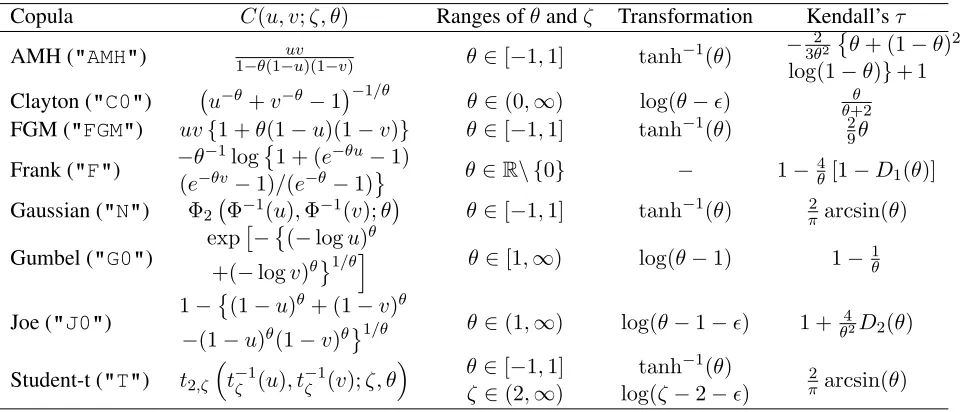
binds them together. The copulae implemented inSemiParBIVProbit are reported in Table
1. Counter-clockwise rotated versions of the Clayton, Gumbel and Joe copulae are obtained using
the formulae in Brechmann & Schepsmeier (2013). Furthermore, each of the Clayton, Gumbel
and Joe copulae can be mixed with a rotated version of the same family. For instance, mixing the
Clayton copula with its 90 degree (counter-clockwise) rotation allows one to model positive and
negative tail dependence. More details on copulae can be found in Nelsen (2006), for instance.
The marginal distributions of Y1 andY2 are specified using parametric cdfs and densities
de-noted respectively as Fm(ym|µm, σm, νm) and fm(ym|µm, σm, νm), for m = 1,2. In this work,
we have considered two and three parameter distributions, hence the notation adopted. However,
the computational framework can be conceptually easily extended to parametric distributions with
more than three parameters. The distributions implemented in SemiParBIVProbit are
de-scribed in Table 2 and have been parametrized according to Rigby & Stasinopoulos (2005);
some-timesµm,σmandνm represent location, scale and shape.
As it should be clear from our model specification, this paper is concerned with conditional
copula models. We would like to stress that the theory for such models is relatively new. Patton
(2002) first discussed conditional copulae by assuming that the conditioning covariate vector is the
same for the margins and copula, whereas Fermanian & Wegkamp (2012) relaxed this assumption
and developed the concept of pseudo-copula. Vatter & Chavez-Demoulin (2015) pointed out that
a regression-like theory for the dependence parameter is possible when using conditional copulae
and assuming exogeneity of the covariates.
Copula C(u, v;ζ, θ) Ranges ofθandζ Transformation Kendall’sτ
AMH ("AMH") 1−θ(1−uvu)(1−v) θ∈[−1,1] tanh−1(θ) −
2
3θ2
θ+ (1−θ)2
log(1−θ)}+ 1 Clayton ("C0") u−θ+v−θ−1−1/θ
θ∈(0,∞) log(θ−ǫ) θ+2θ FGM ("FGM") uv{1 +θ(1−u)(1−v)} θ∈[−1,1] tanh−1(θ) 29θ
Frank ("F") −θ
−1log
1 + (e−θu−1)
(e−θv −1)/(e−θ−1) θ∈R\ {0} − 1−
4
θ[1−D1(θ)] Gaussian ("N") Φ2 Φ−1(u),Φ−1(v);θ
θ∈[−1,1] tanh−1(θ) π2arcsin(θ)
Gumbel ("G0")
exp
−
(−logu)θ
+(−logv)θ 1/θi θ∈[1,∞) log(θ−1) 1−
1
θ
Joe ("J0") 1−
(1−u)θ+ (1−v)θ
−(1−u)θ(1−v)θ 1/θ θ∈(1,∞) log(θ−1−ǫ) 1 +
4
θ2D2(θ)
Student-t ("T") t2,ζ
t−ζ1(u), t−ζ1(v);ζ, θ θ∈[−1,1] ζ ∈(2,∞)
tanh−1(θ) log(ζ−2−ǫ)
2
πarcsin(θ)
Table 1: Definition of copulae implemented inSemiParBIVProbit, with corresponding parameter ranges of as-sociation parameterθand number of degrees of freedomζ(when present), transformation/link function ofθandζ, and relation between Kendall’sτ andθ. Φ2(·,·;θ)denotes the cdf of a standard bivariate normal distribution with
correlation coefficientθ, andΦ(·)the cdf of a univariate standard normal distribution. t2,ζ(·,·;ζ, θ)indicates the cdf
of a standard bivariate Student-t distribution with correlationθandζdegrees of freedom, andtζ(·)denotes the cdf
of a univariate Student-t distribution withζdegrees of freedom.D1(θ) = 1θR θ 0
t
exp(t)−1dtis the Debye function and
D2(θ) =R01tlog(t)(1−t)
2(1−θ)
θ dt. Quantityǫis set to 1e-07 and is used to ensure that the restrictions on the space
[image:6.595.70.552.209.415.2]Fm(ym|µm, σm, νm) fm(ym|µm, σm, νm) E(Ym) V(Ym) Support ofym
Parameter ranges
beta ("BE")
I(y;α1, α2)
α1= µ(1−σ
2)
σ2
α2= (1−µ)(1−σ
2)
σ2
yα1−1(1−y)α2−1
B(α1,α2) µ σ
2µ(1−µ) 0< y <1
0< µ <1,0< σ <1
Dagum ("DAGUM")
1 +yµ−σ
−ν σν y (y µ) σν
{(y µ)
σ
+1}ν+1
−µσ
Γ(−1
σ)Γ(
1
σ+ν)
Γ(ν) ifσ >1
− µσ
2
2σΓ(−
2
σ)Γ(
2
σ+ν)
Γ(ν)
+
Γ(−1
σ)Γ(
1
σ+ν)
Γ(ν)
2#
ifσ >2
y >0
µ >0, σ >0, ν >0
Fisk ("FISK")
1 +yµ−σ
−1
σyσ−1
µσ{1+(y µ)
σ }2
µπ/σ
sin(π/σ)ifσ >1 µ
2n 2π/σ
sin(2π/σ)− (π/σ)2 sin(π/σ)2
o
ifσ >2
y >0
µ >0, σ >0
gamma ("GA") 1
Γ(1
σ2) γ1
σ2,
y µσ2
1
(µσ2)σ12
yσ12−1exp− y µσ2
Γ(1
σ2)
µ µ2σ2 y >0
µ >0, σ >0
Gumbel ("GU") 1−exp
−exp y−σµ 1
σexp
y−µ
σ
−exp y−σµ µ−0.57722σ π2σ2
6
−∞< y <∞ −∞< µ <∞, σ >0
inverse Gaussian ("iG")
Φ 1 √ yσ2 y µ−1
+ expµσ22
Φ
−√1
yσ2
y
µ + 1
1
√
2πσ2y3exp n
− 1
2µ2σ2y(y−µ)
2o
µ µ3σ2 y >0
µ >0, σ >0
log-normal ("LN") 12+12erfnlog(σ√y)−µ
2 o
1
yσ√2πexp
h
−{log(2yσ)−2µ}2
i p
exp (σ2) exp (µ) exp σ2 exp σ2
−1}exp (2µ)
y >0
µ >0, σ >0
logistic ("LO") 1+exp(1
−y−µ
σ )
1
σ
exp −y−σµ
1 + exp −y−σµ
−2
µ π23σ2 −∞< y <∞ −∞< µ <∞, σ >0
normal ("N") 12n1 +erfy−µ
σ√2 o
1
σ√2πexp
n
−(y2−σµ2)2 o
µ σ2 −∞< y <∞
−∞< µ <∞, σ >0
reverse Gumbel ("rGU") exp
−exp −y−σµ σ1exp
−y−σµ
−exp −y−σµ µ+ 0.57722σ π26σ2 −∞< y <∞ −∞< µ <∞, σ >0
Singh-Maddala ("SM") 1−n1 +µyσo−
ν
σνyσ−1
µσ{1+(y µ)
σ
}ν+1 µ
Γ(1+1
σ)Γ(−
1
σ+ν)
Γ(ν) ifσν >1
µ2
Γ 1 + 2σ
Γ(ν)Γ −2
σ +ν
−Γ 1 +σ12
Γ −1
σ +ν
2o
ifσν >2
y >0
µ >0, σ >0, ν >0
Weibull ("WEI") 1−expn−µyσo σ µ
y µ
σ−1
expn−yµσo µΓ 1
σ + 1
µ
2
Γ 2
σ + 1
−
Γ 1
σ+ 1
2i y >0
µ >0, σ >0
Table 2: Definition and some properties of the distributions implemented inSemiParBIVProbit. These have been parametrised according to Rigby & Stasinopoulos (2005) and are defined in terms ofµ,σandν(which sometimes represent location, scale and shape). Subscriptmcan take values 1 and 2; to avoid clutter in the notation we have suppressedmin the main body of the table. The means and variances ofDAGUM,FISK(also known as log-logistic) andSMare indeterminate for certain values ofσandν. If a parameter can only take positive values then the transformation/link functionlog(· −ǫ)is employed, whereǫis defined and its use explained in the caption of Table 1. If a parameter can take values in(0,1)
then the inverse of the cumulative distribution function of a standardized logistic is used.I(·;·,·)is the regularized beta function,B(·,·)is the beta function,Γ(·)is the gamma function,
[image:7.595.39.811.45.455.2]is on modeling independent bivariate realizations (yi1, yi2)T as functions of additive predictors,
wherei= 1, . . . , nandnis the sample size.
2.2
Predictor specification
All the model’s parameters are related to covariates and regression coefficients via additive
predic-torsη’s and known monotonic link functions which ensure that the restrictions on the parameter
spaces are maintained (see Table 1 and the caption of Table 2 for the links employed). As an
example, ifσ1 and σ2 can only take positive values and we wish to model them as functions of
covariates and regression coefficients then we can specifyg(σ1i) =ησ1iandg(σ2i) =ησ2i, where
the link functiong(·)is equal tolog(·). As for the copula parameter, similarly to Klein & Kneib
(2016) and Sabeti et al. (2014), we can uselog(θi−1) =ηθiin the Gumbel case; this would allow
for the strength of the (upper tail) dependence between the marginals to vary across observations.
Copula models in which each parameter inϑis related to an additive predictor can also be regarded
as instances of the distributional regression framework described by Klein et al. (2015a).
Let us define a generic predictorηi as a function of an intercept and smooth functions of
sub-vectors of a generic covariate vectorzi. That is,
ηi =β0 +
K
X
k=1
sk(zki), i= 1, . . . , n, (2)
where β0 ∈ R is an overall intercept, zki denotes the kth sub-vector of the complete covariate
vectorzi (containing, for example, binary, categorical, continuous, and spatial variables) and the
K functionssk(zki) represent generic effects which are chosen according to the type of
covari-ate(s) considered. Eachsk(zki)can be approximated as a linear combination ofJk basis functions
bkjk(zki)and regression coefficientsβkjk ∈R, i.e.
Jk
X
jk=1
βkjkbkjk(zki). (3)
Equation (3) implies that the vector of evaluations{sk(zk1), . . . , sk(zkn)}Tcan be written asZkβk
withβk = (βk1, . . . , βkJk)
T and design matrixZ
equation (2) to be written as
η=β01n+Z1β1+. . .+ZKβK, (4)
where1nis ann-dimensional vector made up of ones. Equation (4) can also be written in a more
compact way asη=Zβ, whereZ= (1n,Z1, . . . ,ZK)andβ = (β0,β1T, . . . ,βKT)T.
Eachβkhas an associated quadratic penaltyλkβkTDkβkwhose role is to enforce specific
prop-erties on thekthfunction, such as smoothness. It is important to note thatD
k only depends on the
choice of basis functions. The smoothing parameterλk ∈[0,∞)controls the trade-off between fit
and smoothness, and plays a crucial role in determining the shape ofsˆk(zki). The overall penalty
can be defined as βTDβ, where D = diag(0, λ
1D1, . . . , λKDK). Finally, the smooth functions
are subject to centering (identifiability) constraints (Wood, 2006). In practice, the model’s
addi-tive predictors and corresponding penalties are set up using theR mgcvpackage (Wood, 2016);
Supplementary Material 1 (SM-1) gives some examples of smooth function specification for the
reader’s convenience.
2.3
Some estimation details
It is well known that the log-likelihood function for a copula model with continuous margins can
be written as (e.g., Kolev & Paiva, 2009; Vatter & Chavez-Demoulin, 2015)
ℓ(δ) =
n
X
i=1
log{c(F1(y1i|µ1i, σ1i, ν1i), F2(y2i|µ2i, σ2i, ν2i);ζi, θi)}+ n
X
i=1 2 X
m=1
log{fm(ymi|µmi, σmi, νmi)},
where c is the copula density and is given by ∂2C(F1(y1i),F2(y2i))
∂F1(y1i)∂F2(y2i) (here the conditioning on
pa-rameters has been suppressed for notational simplicity). The distributional papa-rameters are
de-fined as µmi = g−µm1(ηµmi), σmi = g
−1
σm(ησmi), νmi = g
−1
νm(ηνmi), for m = 1,2, ζi = g
−1
ζ (ηζi)
and θi = gθ−1(ηθi), where the g’s are link functions. The parameter vector δ is defined as
(βT
µ1,β
T µ2,β
T σ1,β
T σ2,β
T ν1,β
T ν2,β
T
ζ,βθT)T, which is indeed made up of the coefficient vectors
associ-ated withηµ1i,ηµ2i,ησ1i, ησ2i, ην1i,ην2i, ηζi andηθi. Because of the flexible predictors’ structures
unduly wiggly estimates (e.g., Ruppert et al., 2003; Wood, 2006). Therefore, we maximize
ℓp(δ) =ℓ(δ)−
1
2δ
TSδ, (5)
where ℓp is the penalized log-likelihood, S = diag(Dµ1,Dµ2,Dσ1,Dσ2,Dν1,Dν2,Dζ,Dθ). The
smoothing parameters contained in theDcomponents make up the overall vector
λ= (λT µ1,λ
T µ2,λ
T σ1,λ
T σ2,λ
T ν1,λ
T ν2,λ
T ζ,λTθ)T.
To maximize (5), we have extended the efficient and stable trust region algorithm with
inte-grated automatic multiple smoothing parameter selection by Marra et al. (2017) to incorporate two
and three parametric continuous marginal distributions and two-parameter copula functions, and
to link all the model’s parameters to additive predictors. Estimation ofδ andλ is carried out as
follows. At iteration a, holding λ fixed at a vector of values and for a givenδ[a], we maximize
equation (5) using a trust region algorithm. That is,
δ[a+1]=δ[a]+ arg min
e:kek≤∆[a]
˘
ℓp(δ[a]), (6)
whereℓ˘p(δ[a]) =−
ℓp(δ[a]) +eTgp(δ[a]) + 12eTHp(δ[a])e ,gp(δ[a]) =g(δ[a])−Sδ[a]andHp(δ[a]) =
H(δ[a])−S. Vectorg(δ[a])consists ofgµ1(δ[a]) =∂ℓ(δ)/∂βµ1|βµ1=βµ[a1], . . . ,
gθ(δ[a]) = ∂ℓ(δ)/∂βθ|β
θ=β[θa], the Hessian matrix has elementsH(δ
[a])
o,h=∂2ℓ(δ)/∂βo∂βhT|βo=β[oa],βh=β[ha]
whereo, h =µ1, µ2, σ1, σ2, ν1, ν2, ζ, θ,k·kdenotes the Euclidean norm and∆[a]is the radius of the
trust region which is adjusted through the iterations. The first line of (6) uses a quadratic
approxi-mation of−ℓpaboutδ[a](the so-called model function) in order to choose the beste[a+1]within the
ball centered inδ[a]of radius∆[a], the trust-region. Estimation is made precise and quick by using
the analytical score and Hessian. Also, close to the converged solution, the trust-region usually
behaves like a classic unconstrained optimization algorithm.
Then, holding the model’s parameter vector value fixed atδ[a+1], we solve the problem
λ[a+1]= arg min
λ k
M[a+1]−A[a+1]M[a+1]k2−nˇ+ 2tr(A[a+1]), (7)
whereM[a+1] =p−H(δ[a+1])δ[a+1]+p
−H(δ[a+1])−1g(δ[a+1]),
A[a+1]=p−H(δ[a+1]) −H(δ[a+1]) +S−1p
degrees of freedom (edf) of the penalized model andnˇ = 8n(if three parameter marginal
distri-butions and the Student-t copula are employed). The formulation of (7) is derived in Marra et al.
(2017), whereas the problem is solved using the computational approach by Wood (2004) which is
based on the performance iteration idea of Gu (1992). SinceHandgare obtained as a byproduct
of the estimation ofδ, little computational effort is required to set up the quantities required for
(7).
Trust-region algorithms have several advantages over classical alternatives. For instance, in
line-search methods, when an iteration falls in a long plateau region, the search for stepδ[a+1]can
occur so far away fromδ[a]that the evaluation of the model’s log-likelihood may be indefinite or
not finite, in which case user’s intervention is required. Trust-region methods, on the other hand,
always solve sub-problem (6) before evaluating the objective function. So, if this is not finite at the
proposedδ[a+1] then stepe[a+1] is rejected, the trust-region shrunken, and the optimization
com-puted again. The radius is also reduced if there is not agreement between the model and objective
functions (i.e., the proposed point in the region is not better than the current one). Reversibly, if
such agreement occurs, the trust region is expanded for the next iteration. In summary,δ[a+1] is
accepted if it improves onδ[a]and allows for the evaluation ofℓ˘p, whereas the reduction/expansion
of∆[a+1]is based on the similarity between model and objective functions. Theoretical and
practi-cal details of the method can be found in Nocedal & Wright (2006, Chapter 4), Conn et al. (2000)
and Geyer (2015). The latter also discusses the necessary modifications to the sub-problem (6)
and the radius for ill-scaled variables.
The methods for estimating δ and λ are iterated until the algorithm satisfies the criterion
|ℓ(δ[a+1])−ℓ(δ[a])|
0.1+|ℓ(δ[a+1])| < 1e −07. Proving algorithmic convergence when smoothing parameters are
estimated in a performance iteration fashion is difficult and to the best of our knowledge this is
still an open issue (see, for instance, Gu (2002) for a full discussion). However, the ease of
im-plementation and success of this approach for practical modeling justifies its use in many contexts
including the one considered in this paper (e.g., Marra et al., 2017; Wood, 2004, 2006; Yee, 2016).
Starting values for the parameters of the marginals are obtained using the functiongamlss()
withinSemiParBIVProbit, which has been designed to fit GAMLSS with two or three
param-eter response distributions and additive predictors, using the estimation approach of this paper.
Kendall’s association between the responses. The analytical score and Hessian ofℓ(δ)required for
estimation have been derived in a modular way. It will therefore be easy to extend our algorithm
to other copulae and marginal distributions not included in Tables 1 and 2 as long as their cdfs and
probability density functions (pdfs) are known and their derivatives with respect to their
parame-ters exist. If a derivative is difficult and/or computationally expensive to compute then appropriate
numerical approximations can be employed. The score and Hessian for all combinations of
copu-lae and marginal distributions considered here have been verified using the functions available in
thenumDeriv Rpackage (Gilbert & Varadhan, 2015).
2.4
Further details
At convergence, reliable point-wise confidence intervals for linear and non-linear functions of the
model coefficients (e.g., smooth components, copula parameter, joint and conditional predicted
probabilities) are obtained using the Bayesian large sample approximation
δ ∼ N· ( ˆδ,−Hp( ˆδ)−1). (8)
The rationale for using this result is provided in Marra & Wood (2012) for GAMs, whereas some
examples of interval construction are given in Radice et al. (2016) for copula binary models. This
result can be justified using the distribution ofMdiscussed in Marra et al. (2017), making the large
sample assumption thatH(δ)can be treated as fixed, and making the usual Bayesian assumption
on the prior ofδ for smooth models (e.g., Silverman, 1985; Wood, 2006). Note that (8) neglects
smoothing parameter uncertainty. However, as argued by Marra & Wood (2012) this is not
prob-lematic provided that heavy oversmoothing is avoided (so that the bias is not too large a proportion
of the sampling variability) and in our experience we found that (8) works well in practice (see
Section 3.2 for some simulation-based evidence). To test smooth components for equality to zero,
the results discussed in Wood (2013a) and Wood (2013b) are employed.
Proving consistency of the proposed estimator is beyond the scope of this paper although,
un-der certain assumptions on the size of the spline bases and on the asymptotic behavior of the
smoothing parameters, this could be straightforwardly demonstrated (e.g., Radice et al., 2016;
Vatter & Chavez-Demoulin, 2015).
con-vergence failure typically occurs when the model is misspecified and/or the sample size is low
compared to the complexity of the model. Examples of misspecification include using marginal
distributions that do not fit the responses satisfactorily, and employing a copula which does not
accommodate the type and/or strength of dependence between the margins (e.g., using the AMH
copula when the association between the margins is strong). copulaReg()produces a warning
message if there is a convergence issue, andconv.check()provides some detailed diagnostics
about the fitted model.
2.5
Model building
The flexibility of the proposed framework means that the researcher has to be able to choose a
suit-able copula function and response distributions as well as select relevant covariates in the model’s
additive predictors. To this end, we recommend using the Akaike information criterion (AIC)
and/or Bayesian information criterion (BIC), normalized quantile residuals (Dunn & Smyth, 1996)
and hypothesis testing. Since many choices need to be made, model building can become a time
consuming and daunting process when working with large data sets and many candidate
regres-sors. To facilitate the process, we suggest following roughly the guidelines of Klein et al. (2015a)
who argue that each of the above criteria is most useful for specific aspects of model building. In
short, quantile residuals can be used to assess the goodness of fit of the marginal distributions and
AIC/BIC to find a best fitting model given some pre-selected marginal distributions. The criteria
are discussed below in more detail.
Quantile residuals for each margin are defined as rˆmi = Φ−1{Fm(ymi|µˆmi,σˆmi,νˆmi)}, for
i = 1, . . . , nandm = 1,2, whereΦ−1(·)is the quantile function of a standard normal
distribu-tion. IfFm(ymi|µˆmi,σˆmi,νˆmi)is close to the true distribution then the ˆrmifollow approximately
a standard normal distribution, hence a normal Q-Q plot of such residuals is a useful graphical
tool for detecting lack of fit of the marginal distributions. We observed that, in practice, quantile
residuals are fairly robust to the exact specification of the additive predictors of the distribution’s
parameters; this has also been found by Klein et al. (2015a). Therefore, the choice of marginal
distributions can be based, for example, on more or less complex model specifications. Also, note
that adequate marginal fits are necessary but not sufficient conditions for a satisfactory fit of the
and normal Q-Q plots of normalized quantile residuals.
AIC and BIC are defined as−2ℓ( ˆδ)+2edfand−2ℓ( ˆδ)+log(n)edf, respectively, where the
log-likelihood is evaluated at the penalized parameter estimates andedf =tr( ˆA). Given some marginal
distributions, AIC/BIC can be used to select a copula function and the most relevant covariates in
the model’s predictors (using stepwise backward and/or forward selection, for instance). To favor
more parsimonious models, small differences in the AIC/BIC values of competing models can be
assisted by looking at the significance of the estimated effects; for instance, a covariate with linear
effect could be excluded if the respective parameter’s p-value is larger than 5%. Here, the relevant
Rfunctions areAIC(),BIC(),summary()andplot().
3
Simulation study
3.1
Setup
We consider two continuous outcomes, one binary covariate and two continuous regressors. The
responses are assumed to follow inverse Gaussian and Singh-Maddala distributions, respectively.
The responses are joined using several copulae. Linear and non-linear effects of the regressors
on the parameters of the resulting bivariate distributions are also introduced. In practice, this is
achieved as follows.
library(copula); library(gamlss)
library(SemiParBIVProbit)
cor.cov <- matrix(0.5, 3, 3); diag(cor.cov) <- 1
s1 <- function(x) x*sin(3*x)
s2 <- function(x) sin(2*pi*x) # sin(6*pi*x)
data.gen <- function(cor.cov, s1, s2, FAM){
cov <- rMVN(1, rep(0,3), cor.cov)
cov <- pnorm(cov)
z1 <- cov[, 1]
z2 <- cov[, 2]
z3 <- round(cov[, 3])
eta_mu1 <- 0.5 - 1.25*z2 - 0.8*z3
eta_sigma1 <- 1.8
eta_sigma2 <- 0.1
eta_nu <- 0.2 + z3
eta_theta <- 0.2 + z1 + s2(z2)
if( FAM == "clayton") theta.para <- exp(eta_theta) + 1e-07
if( FAM == "gumbel") theta.para <- exp(eta_theta) + 1
if( FAM %in% c("normal", "t")) theta.para <- tanh(eta_theta)
if( FAM %in% c("clayton", "gumbel") ) Cop <- archmCopula(family = FAM,
dim = 2, param = theta.para)
else Cop <- ellipCopula(family = FAM, dim = 2, param = theta.para, df = 4)
speclist1 <- list( mu = exp(eta_mu1), sigma = exp(eta_sigma1) )
speclist2 <- list( mu = exp(eta_mu2), sigma = exp(eta_sigma2), nu = 1,
tau = exp(eta_nu) )
spec <- mvdc(copula = Cop, c("IG", "GB2"), list(speclist1, speclist2) )
c(rMvdc(1, spec), z1, z2, z3)
}
Packagecopula(Yan, 2007) contains functionsarchmCopula(),ellipCopula,mvdc()
andrMvdc()which allow us to simulate from the desired copula. Packagegamlss(Stasinopoulos et al.,
2016) contains all functions required to simulate inverse Gaussian (IG) and Singh-Maddala (GB2
withnu = 1) deviates, andrMVN()(fromSemiParBIVProbit) allows us to simulate
Gaus-sian correlated variables. The correlation matrix used to associate three simulated GausGaus-sian
co-variates iscor.cov, whereas cov <- pnorm(cov)allows us to obtain Uniform(0,1)
corre-lated covariates (e.g., Gentle, 2003). A balanced binary variable is created usinground(cov[,
3]). Following Vatter & Nagler (2016), FAM is set to "clayton", "gumbel", "normal"
and "t". Functions s1 and s2 produce curves with different complexity; the latter is from
Vatter & Nagler (2016). The variouseta refer to the predictors of the marginal and copula
pa-rameters. These are transformed inspeclist1andspeclist2to ensure that the restrictions
on the parameters’ spaces of the marginal distributions are maintained (see Table 2). For the same
reason, theta.paratransforms the respective predictor based on the chosen copula (see
Ta-ble 1). SincearchmCopula()andellipCopula()do not allow for the use of vectors for
param, functiondata.gen()is executed as many times as the number of observations that the
Sample sizes are set to 500 and 5000, the number of replicates to 1000, and the copulae
employed are C0C90, G0G90, N, and T with 4 degrees of freedom. Models are fitted using
copulaReg()inSemiParBIVProbitand the two-stage approach by Vatter & Chavez-Demoulin
(2015) (in this case, usinggamlss()from thegamlss Rpackage for the margins andgamCopula
(Vatter & Nagler, 2017) for the copula parameter). In both approaches, each smooth function is
represented using a penalized low rank thin plate spline with second order penalty and 10 basis
functions. For each replicate, smooth function estimates are constructed using 200 equally spaced
fixed values in the(0,1)range (e.g., Radice et al., 2016).
3.2
Results
This section compares the performance ofcopulaReg()with that ofgamlss+gamCopula
by assessing the accuracy and precision of the linear and non-linear effect estimates. Some model
selection and computation time considerations are also provided. We only discuss the results
obtained for the case of data simulated usingFAM = "t"as they are virtually identical to those
obtained using the other copulae and hence do not lead to any further insight. We also repeated
the experiments using a Weibull distribution instead of Singh-Maddala for the second margin; the
substantive conclusions did not change.
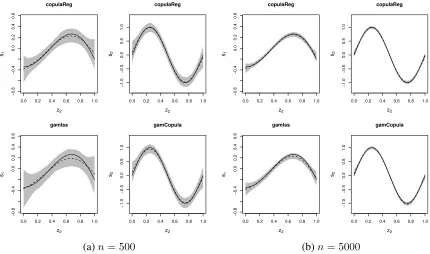
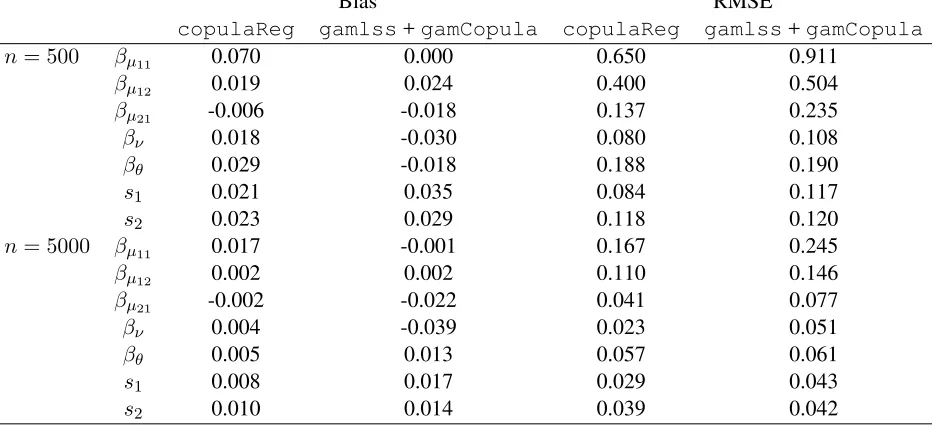
Figures 1 and 2 depict linear and non-linear estimates under the two methods whereas Table
3 reports the bias and root mean squared error of the parameter estimators. All mean estimates
are very close to the true values and, as expected, their variability decreases as the sample size
in-creases. Our proposal generally delivers less biased and more efficient estimates. The main
excep-tions are the estimates related to the copula parameter which are fairly close, withcopulaReg()
yielding slightly better results. Using a more complex function fors2(i.e.,sin(6*pi*x)from
Vatter & Nagler (2016)) did not lead to different conclusions when comparing the two methods.
We also calculated95%average coverage probabilities for the smooth functions using point-wise
intervals based on the result of Section 2.4. The coverages delivered bycopulaReg() fors1
ands2 were 0.961 and0.943 forn = 500, and0.952 and0.956 forn = 5000, hence confirming
the good performance of the employed approximation.
We also explored whether the correct model is selected by AIC/BIC in the presence of several
−2
−1
0
1
βµ11 βµ12 βµ21 βν βθ
(a)n= 500
−2
−1
0
1
βµ11 βµ12 βµ21 βν βθ
[image:17.595.93.514.84.323.2](b)n= 5000
Figure 1: Linear coefficient estimates obtained by applyingcopulaReg()(black circles and black vertical bars) and the two-stage method by Vatter & Chavez-Demoulin (2015) (grey circles and grey vertical bars) to data simulated from Student-t copula models with inverse Gaussian (IG) and Singh-Maddala (SM) margins. The two stage approach is implemented usinggamlss()from the gamlss Rpackage for the margins andgamCopulafor the copula parameter. copulaReg() andgamlss+ gamCopulawere specified using the Student-t copula with IG and SM margins. Circles indicate mean estimates while bars represent the estimates’ ranges resulting from5%and95%
quantiles. True values are indicated by black solid horizontal lines.
0.0 0.2 0.4 0.6 0.8 1.0
−0.8 −0.4 0.0 0.2 0.4 0.6 copulaReg z2 s1
0.0 0.2 0.4 0.6 0.8 1.0
−1.0 −0.5 0.0 0.5 1.0 copulaReg z2 s2
0.0 0.2 0.4 0.6 0.8 1.0
−0.8 −0.4 0.0 0.2 0.4 0.6 gamlss z2 s1
0.0 0.2 0.4 0.6 0.8 1.0
−1.0 −0.5 0.0 0.5 1.0 gamCopula z2 s2
(a)n= 500
0.0 0.2 0.4 0.6 0.8 1.0
−0.8 −0.4 0.0 0.2 0.4 0.6 copulaReg z2 s1
0.0 0.2 0.4 0.6 0.8 1.0
−1.0 −0.5 0.0 0.5 1.0 copulaReg z2 s2
0.0 0.2 0.4 0.6 0.8 1.0
−0.8 −0.4 0.0 0.2 0.4 0.6 gamlss z2 s1
0.0 0.2 0.4 0.6 0.8 1.0
−1.0 −0.5 0.0 0.5 1.0 gamCopula z2 s2
(b)n= 5000
Figure 2: Smooth function estimates obtained by applying copulaReg()andgamlss+ gamCopulato data simulated from Student-t copula models with inverse Gaussian and Singh-Maddala margins. True functions are represented by black solid lines, mean estimates by dashed lines and pointwise ranges resulting from5%and95%
[image:17.595.82.512.455.709.2]Bias RMSE
copulaReg gamlss+gamCopula copulaReg gamlss+gamCopula
n= 500 βµ11 0.070 0.000 0.650 0.911
βµ12 0.019 0.024 0.400 0.504
βµ21 -0.006 -0.018 0.137 0.235
βν 0.018 -0.030 0.080 0.108
βθ 0.029 -0.018 0.188 0.190
s1 0.021 0.035 0.084 0.117
s2 0.023 0.029 0.118 0.120
n= 5000 βµ11 0.017 -0.001 0.167 0.245
βµ12 0.002 0.002 0.110 0.146
βµ21 -0.002 -0.022 0.041 0.077
βν 0.004 -0.039 0.023 0.051
βθ 0.005 0.013 0.057 0.061
s1 0.008 0.017 0.029 0.043
[image:18.595.73.539.58.271.2]s2 0.010 0.014 0.039 0.042
Table 3: Bias and root mean squared error (RMSE) obtained by applying the copulaReg() and gamlss +
gamCopulaparameter estimators to data simulated from Student-t copula models with inverse Gaussian and Singh-Maddala margins. Bias and RMSE for the smooth terms are calculated, respectively, asn−1
s
Pns
i=1|s¯ˆi −si| and
n−1
s
Pns
i=1
q
n−rep1Pnrep=1rep (ˆsrep,i−si)2, wheres¯ˆi =n−rep1
Pnrep
rep=1ˆsrep,i,nsis the number of equally spaced fixed
values in the(0,1)range, andnrepis the number of simulation replicates. In this case,ns= 200andnrep= 1000.
The bias for the smooth terms is based on absolute differences in order to avoid compensating effects when taking the sum.
non-correct copulae with one incorrect margin (i.e., Singh-Maddala was replaced with Weibull).
For each scenario and replicate, the correct model was always chosen by both criteria.
Finally, comparing the computation times of the two methods for the scenarios considered here
when using a 2.20-GHz Intel(R) Core(TM) computer running Windows 7, we generally found that
copulaRegis 1.3 times faster than gamlss + gamCopula. As for the latter approach, the
margins’ estimation step was the most expensive as it typically amounted to 93% of the total
computation time.
4
Empirical illustrations
The next sections illustrate the proposed bivariate copula additive modeling framework using two
empirical case studies based on electricity and birth data.
4.1
Analysis of Spanish electricity price and demand data
The aim of this section is to build an explanatory bivariate time-series model for electricity price
electricity prices throughout the time and one way of capturing this is via transfer function models
(e.g., Nogales & Conejo, 2006). Here, we take a different approach by relating price and demand
of energy using copulae. We also quantify the effect of prices of raw materials (oil, gas and
coal) on electricity price and demand. In the last decade, the issue of modeling electricity price
and demand has been the key question to determine the causes of price behavior as well as the
macroeconomic significance of the prices of raw materials, since Spain is an importer country. We
use working-daily data from January 1, 2002 to October 31, 2008 which are available from theR
packageMSwM(Sanchez-Espigares & Lopez-Moreno, 2014).
The first step is to choose the margins. Following the guidelines of Section 2.5, we choose the
normal and Gumbel distributions for price and demand, respectively. As for the choice of copula
we start off with the normal. We also allow the dependence between the margins, location and
scale parameters to vary with raw material prices. In addition to these covariates, we employ a
time variable as the underlying electricity prices and demands tend to vary with time, for reasons
which may have little or nothing to do with material prices. When we attempt to fit a copula model
in which all variables (time, oil, gas and coal prices) enter the five equations (two equations for the
location parameters, two for the scale parameters and one equation for the association parameter)
the algorithm fails to converge. This suggests that the sample size is perhaps low compared to the
complexity of the model. We, therefore, try out more parsimonious specifications. Specifically,
we always keep the time variable in all the model’s equations and, in a forward selection fashion,
choose the best (converged) model as judged by AIC and BIC. This leads to
eq.mu.1 <- Price ~ s(t, k = 60) + s(Oil) + s(Coal)
eq.mu.2 <- Demand ~ s(t, k = 60) + s(Oil) + s(Gas) + s(Coal)
eq.sigma2.1 <- ~ s(t, k = 60)
eq.sigma2.2 <- ~ s(t, k = 60) + s(Oil) + s(Gas)
eq.theta <- ~ s(t, k = 60)
fl <- list(eq.mu.1, eq.mu.2, eq.sigma2.1, eq.sigma2.2, eq.theta)
outN <- copulaReg(fl, margins = c("N", "GU"), data = energy, ...)
where thesare smooth functions of time, oil, gas and coal represented using penalized low rank
thin plate splines with default second order penalties andk(the number of basis functions) equal
to 10, unless otherwise stated; see SM-1 for more details. The value ofk = 60for the smooth
Peng & Dominici (2008), if k per year is small (say 2) then only the long-term trend and
sea-sonality are accounted for and other sub-seasonal and shorter-term variations remain in the data.
When building an explanatory time-series model, using 10 or 12 bases per year is more
appropri-ate as variation in the data longer than a timescale of about one week is modeled. As a sensitivity
analysis, we increased the kvalues for thes terms by several multiples of their original values;
the smooth functions of t became increasingly wigglier and the effects of raw material prices
progressively smoother. This suggested that allowing the time variable to capture very short
timescale variation in the data has a detrimental impact on the explanatory power of the model
(e.g., Peng & Dominici, 2008; Wood, 2006). The final estimated edfs for the smooth components
are57.7, 1, 6.6foreq.mu.1, 55.2, 8.4, 7.4, 8.8foreq.mu.2, 55.2foreq.sigma2.1, 53.6,
8.3, 7.4 for eq.sigma2.2, and 50.7 for eq.theta. Recall that when the edf is equal to 1,
the respective estimated effect is linear, hence the covariate can enter the model parametrically.
On the other hand, the higher the edf the more complex the estimated curve. The total number of
estimated parameter is 363 and the computation time was about 12 minutes. TheRcode used for
this analysis is given in SM-2.
The overall Kendall’s τˆandθˆare positive and significant (seesummary(outN)), however
some of the individualτˆandθˆassume negative values. We, therefore, tried all mixed combinations
of the Clayton, Gumbel and Joe families,T,F,AMHandFGMwhere the last two can only account
for weak dependencies (−0.18≤ τ ≤ 0.33and−0.22≤ τ ≤ 0.22, respectively). The Gaussian
copula is the most supported model by AIC and BIC. Using the Student-t copula virtually yielded
the same results as those obtained under the Gaussian copula; this did not come as a surprise as
the estimated value for theζ was249.15.
Marginal residual plots for the final model are shown in Figure 3 and suggest that the choice of
distribution for the first margin is sound, whereas that for the second margin is questionable as the
lower-tail residuals are off the reference line. Unfortunately, in this case, it was not possible to find
a better fitting distribution. Autocorrelation plots of the response variable and quantile residuals
(obtained after fitting the model) show that, while most of the structure has been modeled, short
term auto-correlation is still present in the data; see Figure 1 in SM-2. This could be addressed by
incorporating in the model autoregressive and/or moving average components but it is beyond the
Histogram and Density of Residuals
Quantile Residuals
Density
−3 −2 −1 0 1 2 3
0.0
0.1
0.2
0.3
0.4
−3 −2 −1 0 1 2 3
−3
−2
−1
0
1
2
3
Normal Q−Q Plot
Theoretical Quantiles
Sample Quantiles
Histogram and Density of Residuals
Quantile Residuals
Density
−4 −2 0 2
0.0
0.1
0.2
0.3
0.4
−3 −2 −1 0 1 2 3
−4
−3
−2
−1
0
1
2
3
Normal Q−Q Plot
Theoretical Quantiles
[image:21.595.77.530.135.643.2]Sample Quantiles
year
θ
^
2002 2003 2004 2005 2006 2007 2008 2009
−0.5
0.0
0.5
[image:22.595.84.516.71.347.2]1.0
Figure 4: Estimates and95%intervals forθover time from a Gaussian copula model with normal and Gumbel margins fitted to electricity price and demand data.
Using the fitted model, we build the plot in Figure 4 which shows that the correlation between
Price and Demand fluctuates around 0.5 (a similar plot could be produced for Kendall’s τ).
Many of the intervals do not contain zero: after accounting for raw material prices, a significant
association between the two responses which varies over time still persists. The reason of these
fluctuations are most likely due to variables, such as weather conditions and human habits, that
we could not control for because they were not available. Moving on to the covariate effects and
focusing, for instance, on the first equation, Figure 5 displays the impacts oft,OilandCoalon
Price. The plots show a cyclic trend with maximum and minimum peaks and suggest that on
average electricity price tends to linearly increase withOil, and decrease and then stabilize with
Coalalthough there is substantial uncertainty related to the last half of the curve. The estimated
effect ofCoalis counter-intuitive and further research is needed to shed light on this. Figure 2
in SM-2 reports the estimates and intervals for σ2
1. We could also predict joint and conditional
probabilities of interest from the model. This point is illustrated in the next section.
When we employed the two-stage estimation approach by Vatter & Chavez-Demoulin (2015),
the algorithm converged in about 16 minutes (after settingcontrol = gamlss.control(n.cyc
year
s(time
, 57.71)
2002 2003 2004 2005 2006 2007 2008 2009
−4
−2
0
2
4
20 40 60 80
−0.5
0.0
0.5
1.0
Oil
s(Oil,1)
40 60 80 100 140
−1.0
0.0
1.0
2.0
Coal
[image:23.595.89.498.200.612.2]s(Coal,6.62)
above.
It would be interesting to compare the performance of bivariate and univariate GAMLSS in
a context of forecasting. However, this would make more sense if the models were specified
with this goal in mind. A possibility would be to follow the approach by Marx et al. (2010) and
Lee & Durban (2012) in which case the scope of the models would have to be extended
accord-ingly.
4.2
North Carolina birth data analysis
The analysis in this section uses 2010 birth data from the North Carolina Center for Health
Statis-tics (http://www.schs.state.nc.us/) which provides details on all the live births
oc-curred within the State of North Carolina, including information on infant and maternal health
and parental characteristics. The data cover maternal demographic information, pregnancy related
events and outcomes, maternal medical complications, newborn conditions and maternal health
behaviors. The choice of variables largely follows the work by Neelon et al. (2012) and the
anal-ysis reported below is for female infants (similar results were obtained for male infants). The
responses are birth weight in grams (bwgram) and gestational age in weeks (wksgest). The
co-variates are maternal ethnicity (nonhisp, categorized as non-Hispanic and Hispanic), singleton
birth (multbirth, born as a multiple or single birth), maternal age (magein years), mother’s
marital status (married) and county (county, indicating the North Carolina county of
resi-dence of the mother).
Birth weight and gestational age are important determinants of infant and child health;
re-cent evidence has also shown that these factors affect long-term health throughout adulthood
(Oreopoulos et al., 2008; Hack et al., 2002). Although both birth weight and gestational age are
predictors of future health, modelling these outcomes jointly is essential for a number of reasons.
First, birth weight and gestational age are highly correlated and confounded by factors such as
intrauterine growth restriction (Slattery & Morrison, 2002). In addition, risk factors for low birth
weight, such as maternal age, are also the same risk factors for preterm birth. Finally, evidence
suggests that the impact of low birth weight on health may be elevated by low gestational age, and
vice-versa (Hediger et al., 2002). Thus, modelling these outcomes independently would present a
more accurate picture is revealed by modelling these outcome jointly. The goal is, therefore, to
build a bivariate copula regression model for the simultaneous analysis ofbwgramandwksgest.
The resulting model can, for instance, be used to estimate the association (adjusted for covariates)
betweenbwgramandwksgestby county, to quantify the effects of covariates onbwgramand
wksgest, and to calculate joint and conditional probabilities of interest.
We first choose the marginal distributions forbwgramandwksgestbased on the guidelines
outlined in Section 2.5. The normal Q-Q plots of the normalized quantile residuals and AIC/BIC
suggest that the best fits for bwgram and wksgest are achieved using the logistic and
Gum-bel distributions (see Figure 3 in SM-4). Using backward selection, we fit bivariate models for
bwgramandwksgest and choose the best model as judged by AIC and BIC. Several copulae
are also tried out in a similar way as described in the previous section. The final model is
eq.mu.1 <- bwgram ~ nonhisp + multbirth + married + s(mage) +
s(county, bs = "mrf", xt = xt)
eq.mu.2 <- wksgest ~ nonhisp + multbirth + married + s(mage) +
s(county, bs = "mrf", xt = xt)
eq.sigma2.1 <- ~ nonhisp + multbirth + married + s(mage) +
s(county, bs = "mrf", xt = xt)
eq.sigma2.2 <- ~ multbirth + married + s(mage) +
s(county, bs = "mrf", xt = xt)
eq.theta <- ~ nonhisp + multbirth + s(mage) +
s(county, bs = "mrf", xt = xt)
fl <- list(eq.mu.1, eq.mu.2, eq.sigma2.1, eq.sigma2.2, eq.theta)
outC0 <- copulaReg(fl, margins = c("LO", "GU"), BivD = "C0",
data = datNC, ...)
where the default number of basis functions for the Gaussian Markov random field smooth term
(mrf) is equal to the number of covariate’s levels or regions (in this case, number of North
Car-olina counties which is 100), and a Clayton copula is used to join the logistic and Gumbel
distri-butions for the two responses. The first two equations refer to theµparameters ofbwgramand
wksgest, the third and fourth to theσ2 parameters and the last toθ. These parameters are
mod-eled using additive predictors involving factor, continuous and regional variables. The use ofmrf
smoothers in all equations ensures that the distribution parameters vary smoothly across counties.
The total number of observations and estimated parameters are 56940 and 558, respectively, and
af-fect the final result and only increased the computation time. The estimated edfs for the smooth
components are5.5, 52.0 for eq.mu.1, 4.3, 68.6 for eq.mu.2, 5.3, 3.9 for eq.sigma2.1,
2.6, 45.6foreq.sigma2.2, and5.3,36.6foreq.theta. Note that a low value for the edf of
themrf smooth term indicates that the estimated county effects are similar with each other and
vice-versa. TheRcode used for this analysis is given in SM-3.
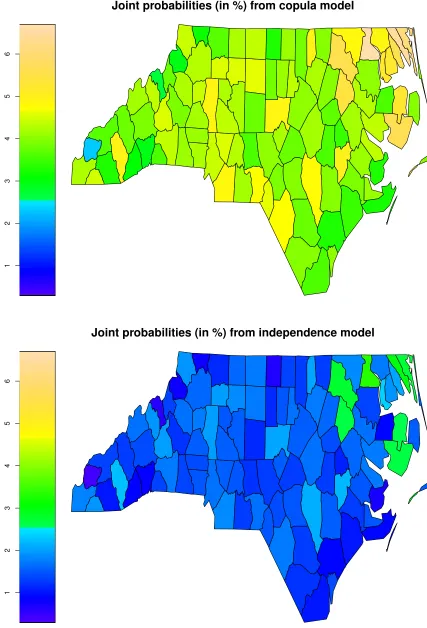
Figure 6 shows the joint probabilities of low weight birth babies and premature deliveries
in North Carolina when using a copula model and an independence model (which assumes that
bwgramanwksgestare not associated after accounting for covariates). This joint probability
was calculated for all the observations in the dataset and then averaged by county. The AIC/BIC
values for the copula and independence models suggest that the former provides a better fit to
the data. As it can be seen from Figure 6, in this case, assuming independence leads to smaller
probabilities. Looking at the copula model’s results, the probabilities vary across counties, ranging
from around 2% to 7%. The least favorable places to be born are clustered in the northeast of
the state, specifically Hertford, Northampton, Halifax, Edgecombe, Gates, Chowan, Perquimans,
Pasquotank, Camden, Currituck, Tyrell and Hyde counties.
For comparison purposes, we also employed the two stage approach with the same model
specification as that used forcopulaReg(). Computatio time was around 34 minutes where
the majority of time was spent at the margins’ stage. Results are similar to those obtained using
copulaReg()(see Figures 4, 5 and 6 in SM-4).
An analysis similar to that produced in Section 4.1, showing for instance some estimated
smooth function and Kendall’sτˆby county is given in SM-4 to save space.
5
Discussion
We have introduced a modeling framework for bivariate copula additive models for location, scale
and shape. The modularity of the estimation approach allows for easy inclusion of potentially any
parametric continuous marginal distribution and copula function as long as the cdfs and pdfs are
known and their derivatives with respect to their parameters exist. Parameter estimation is carried
out within a penalized maximum likelihood estimation framework with integrated automatic
mul-tiple smoothing parameter selection, and known and reliable inferential results from the smoothing
1
2
3
4
5
6
Joint probabilities (in %) from copula model
1
2
3
4
5
6
[image:27.595.84.511.70.698.2]Joint probabilities (in %) from independence model
be easily used via copulaReg() inSemiParBIVProbit and the potential of the approach
has been demonstrated using simulated and real data.
Future releases of SemiParBIVProbit will incorporate more copulae and marginal
dis-tributions as well as facilities for comparing the predictive ability of competing models based,
for instance, on proper scoring rules (Gneiting & Raftery, 2007). Copula models with
binary-discrete, binary-continuous, discrete-discrete and discrete-continuous margins will also be made
available in the near future. These developments will obviously involve writing and implementing
the respective log-likelihood functions, score vectors and Hessian matrices, but the estimation and
inferential framework will essentially be unaffected by such changes.
Future research will look into the feasibility of strengthening the framework described in
this article by incorporating two-parameter and non-exchangeable copulae (e.g., Durante, 2009;
Frees & Valdez, 1998; Brechmann & Schepsmeier, 2013). Another interesting extension would
be to consider systems involving more than two responses using C- and D-Vine copulae (e.g.,
Brechmann & Schepsmeier, 2013).
Acknowledgement
We would like to thank two reviewers for their well thought out suggestions which improved
considerably the presentation and message of the article. One reviewer also provided very useful
comments onSemiParBIVProbit and asked us to implement the Student-t copula as well as
mixed versions of the Clayton, Gumbel and Joe families. Finally, we are indebted to Thibault
Vatter for various clarifications on the use ofgamCopula.
References
Acar, E. F., Craiu, V. R., & Yao, F. (2013). Statistical testing of covariate effects in conditional
copula models. Electronic Journal of Statistics, (pp. 2822–2850).
Brechmann, E. C. & Schepsmeier, U. (2013). Modeling dependence with c- and d-vine copulas:
The R package CDVine. Journal of Statistical Software, 52(3), 1–27.
Conn, A. R., Gould, N. I. M., & Toint, P. L. (2000). Trust Region Methods. Society for Industrial
and Applied Mathematics.
Dunn, P. K. & Smyth, G. K. (1996). Randomized quantile residuals. Journal of Computational
and Graphical Statistics, 5, 236–245.
Durante, F. (2009). Construction of non-exchangeable bivariate distribution functions. Statistical
Papers, 50, 383–391.
Fermanian, J. D. & Wegkamp, M. H. (2012). Time-dependent copulas. Journal of Multivariate
Analysis, 110, 19–29.
Frees, E. W. & Valdez, E. A. (1998). Understanding relationships using copulas. North American
Actuarial Journal, 2, 1–25.
Gentle, J. E. (2003). Random number generation and Monte Carlo methods. Springer-Verlag,
London.
Geyer, C. J. (2015). trust: Trust Region Optimization. R package version 0.1-6.
Gijbels, I., Veraverbeke, N., & Omelka, M. (2011). Conditional copulas, association measures
and their applications. Computational Statistics and Data Analysis, 55, 1919–1932.
Gilbert, P. & Varadhan, R. (2015).numDeriv: Accurate Numerical Derivatives. R package version
2014.2-1.
Gneiting, T. & Raftery, A. E. (2007). Strictly proper scoring rules, prediction, and estimation.
Journal of the American Statistical Association, 102, 359–378.
Gu, C. (1992). Cross validating non-gaussian data. Journal of Computational and Graphical
Statistics, 1, 169–179.
Gu, C. (2002). Smoothing Spline ANOVA Models. Springer-Verlag, London.
Hack, M., Flannery, D. J., Schluchter, M., Cartar, L., Borawski, E., & Klein, N. (2002).
Out-comes in young adulthood for very-low-birth-weight infants.New England Journal of Medicine,
Hastie, T. J. & Tibshirani, R. J. (1990). Generalized Additive Models. Chapman & Hall/CRC,
London.
Hediger, M. L., Overpeck, M. D., Ruan, W. J., & Troendle, J. F. (2002). Birthweight and
ges-tational age effects on motor and social development. Paediatric and Perinatal Epidemiology,
16(1), 33–46. 00140.
Kauermann, G., Schellhase, C., & Ruppert, D. (2013). Flexible copula density estimation with
penalized hierarchical b-splines. Scandinavian Journal of Statistics, 40, 685–705.
Klein, N. & Kneib, T. (2016). Simultaneous inference in structured additive conditional copula
regression models: a unifying bayesian approach. Statistics and Computing, 26(4), 841–860.
Klein, N., Kneib, T., Klasen, S., & Lang, S. (2015a). Bayesian structured additive distributional
regression for multivariate responses. Journal of the Royal Statistical Society, Series C, 64,
569–591.
Klein, N., Kneib, T., Lang, S., & Sohn, A. (2015b). Bayesian structured additive distributional
regression with an application to regional income inequality in germany. Annals of Applied
Statistics, 9(2), 1024–1052.
Kolev, N. & Paiva, D. (2009). Copula-based regression models: A survey. Journal of Statistical
Planning and Inference, 139, 3847–3856.
Kraemer, N. & Silvestrini, D. (2015). CopulaRegression: Bivariate Copula Based Regression
Models. R package version 0.1-5.
Kramer, N., Brechmann, E. C., Silvestrini, D., & Czado, C. (2012). Total loss estimation using
copula-based regression models. Insurance: Mathematics and Economics, 53, 829–839.
Lambert, P. (2007). Archimedean copula estimation using bayesian splines smoothing techniques.
Computational Statistics and Data Analysis, 51, 6307–6320.
Lee, D. J. & Durban, M. (2012). Seasonal modulation smoothing mixed models for time series
forecasting. Proceedings in the 27th International Workshop on Statistical Modelling, Prague,
Marra, G. & Radice, R. (2017). SemiParBIVProbit: Semiparametric Copula Bivariate Probit
Modelling. R package version 3.8-1.
Marra, G., Radice, R., Bärnighausen, T., Wood, S. N., & McGovern, M. E. (2017). A simultaneous
equation approach to estimating hiv prevalence with non-ignorable missing responses. Journal
of the American Statistical Association.
Marra, G. & Wood, S. (2012). Coverage properties of confidence intervals for generalized additive
model components. Scandinavian Journal of Statistics, 39, 53–74.
Marx, B. D., Eilers, P. H. C., Gampe, J., & Rau, R. (2010). Bilinear modulation models for
seasonal tables of counts. Statistics and Computing, 20(2), 191–202.
Neelon, B., Anthopolos, R., , & Miranda, M. L. (2012). A spatial bivariate probit model for
cor-related binary data with application to adverse birth outcomes. Statistical Methods in Medical
Research, 23(2), 119–133.
Nelsen, R. (2006). An Introduction to Copulas. New York: Springer, second edition.
Nocedal, J. & Wright, S. J. (2006). Numerical Optimization. New York: Springer-Verlag.
Nogales, F. J. & Conejo, A. J. (2006). Electricity price forecasting through transfer function
models. Journal of the Operational Research Society, 57, 350–356.
Oreopoulos, P., Stabile, M., Walld, R., & Roos, L. L. (2008). Short-, Medium-, and Long-Term
Consequences of Poor Infant Health An Analysis Using Siblings and Twins. Journal of Human
Resources, 43(1), 88–138. 00278.
Patton, A. J. (2002). Applications of copula theory in financial econometrics. Ph.D. thesis,
Uni-versity of California, San Diego.
Peng, R. D. & Dominici, F. (2008). Statistical Methods for Environmental Epidemiology with R:
A Case Study in Air Pollution and Health. Springer.
Radice, R., Marra, G., & Wojtys, M. (2016). Copula regression spline models for binary outcomes.
Rigby, R. A. & Stasinopoulos, D. M. (2005). Generalized additive models for location, scale and
shape (with discussion). Journal of the Royal Statistical Society, Series C, 54, 507–554.
Ruppert, D., Wand, M. P., & Carroll, R. J. (2003). Semiparametric Regression. Cambridge
University Press, New York.
Sabeti, A., Wei, M., & Craiu, R. V. (2014). Additive models for conditional copulas. STAT, 3,
300–312.
Sanchez-Espigares, J. A. & Lopez-Moreno, A. (2014).MSwM: Fitting Markov Switching Models.
R package version 1.2.
Segers, J., van den Akker, R., & Werker, B. J. M. (2014). Linear b-spline copulas with applications
to nonparametric estimation of copulas. Annals of Statistics, 42, 1911–1940.
Shen, X., Zhu, Y., & Song, L. (2008). Linear b-spline copulas with applications to nonparametric
estimation of copulas. Computational Statistics and Data Analysis, 52, 3806–3819.
Silverman, B. W. (1985). Some aspects of the spline smoothing approach to non-parametric
re-gression curve fitting. Journal of The Royal Statistical Society Series B, 47, 1–52.
Sklar, A. (1959). Fonctions de répartition é n dimensions et leurs marges.Publications de l’Institut
de Statistique de l’Université de Paris, 8, 229–231.
Sklar, A. (1973). Random variables, joint distributions, and copulas. Kybernetica, 9, 449–460.
Slattery, M. M. & Morrison, J. J. (2002). Preterm delivery. The Lancet, 360(9344), 1489–1497.
00704.
Stasinopoulos, M., Rigby, B., Voudouris, V., Akantziliotou, C., Enea, M., & Kiose, D. (2016).
gamlss: Generalised Additive Models for Location Scale and Shape. R package version 5.0-0.
Trivedi, P. K. & Zimmer, D. M. (2006). Copula Modeling: An Introduction for Practitioners.
Vatter, T. & Chavez-Demoulin, V. (2015). Generalized additive models for conditional dependence
structures. Journal of Multivariate Analysis, 141, 147–167.
Vatter, T. & Nagler, T. (2016). Generalized Additive Models for Pair-Copula Constructions.ArXiv