City, University of London Institutional Repository
Citation: Collins, D. A. ORCID: 0000-0002-5517-6949 and Klotz, E. (2018). GDPR and E-Commerce. City, University of London.
This is the published version of the paper.
This version of the publication may differ from the final published version.
Permanent repository link: http://openaccess.city.ac.uk/19417/
Link to published version:
Copyright and reuse: City Research Online aims to make research outputs of City, University of London available to a wider audience. Copyright and Moral Rights remain with the author(s) and/or copyright holders. URLs from City Research Online may be freely distributed and linked to.
DATA PROTECTION AND
ECOMMERCE
A Report commissioned by City, University of London,
Industrial Strategy Seed Fund. February 2018
Introduction
Creative sector companies are likely to be significantly impacted by data
protection laws particularly given the fact that they are likely to store, analyse
and transfer personal data as part of their day to day operations.
This review looks at two general areas that will impact companies
i) The new General Data Protection Regulation (‘GDPR’) – the largest overall
change in data protection laws in 20 years. This is on most international
companies’ agenda’s particularly given the large fines that will accompany it;
and
ii) Data transfers – the restrictions regarding data transfers inside and outside
the EU – which may particularly be complicated post-Brexit. This specific
restriction (which applied under previous laws as well as GDPR) creates
complexities to global companies and could potentially be further
1. General Data Protection Regulation (‘GDPR’)
One of the reasons that GDPR impacts UK companies even after Brexit is
that it affects all companies that are trading with or processing personal data
of EU individuals. Under the GDPR, the definition of personal data is set out
in Article 4 as:
an identifiable natural person is one who can be identified, directly or
indirectly, in particular by reference to an identifier such as a name, an
identification number, location number, an online identifier or to one or more
factors specific to the physical, physiological, genetic, mental, economic,
cultural or social identity of that natural person
As such, the definition of personal data is so broad under EU law that it
encompasses any information that could potentially identify an individual.
Obviously, this could include a name, or email address, or even more
transcient information such as IP addresses.
Moreover, extraterritorial reach under Article 3 of the GDPR means that it will
impact all global and US multinationals, i.e, any company that will be
processing data of individuals within the Union could be impacted.
1.1 GDPR – what changes?
Some of the key changes under GDPR are as follows:
• Increased fines: While there are some changes to existing laws under
GDPR, one of the key reasons that companies are paying attention to
the rule changes is quite simply the level of potential fines – the greater
of 4% of global turnover and 20 Million Euros. For large multinationals
• Greater governance: Another issue that companies face is the
governance requirements – have they a proper GDPR governance
team in place. This is required to ensure that internal privacy impact
assessments are carried out, responding to subject requests (access
requests, deletion requests, correction requests etc), or managing any
incidents such as data breaches. In relation to data breaches,
companies will also need to ensure they adhere to good industry
security practices – which could for instance include a third party
attestation (SOC2 or ISO27001).
• Stricter contractual commitments: Finally, under GDPR Article 28(3),
companies will need to adhere to explicit contractual commitments –
around processing data, audit, and giving individuals’ rights, so these
will require updates to terms and conditions for all customer contracts.
Frequently, this will be in the form of a ‘data protection addendum’.
All of these changes will bring with them a greater compliance and
administrative burden on EU creative companies processing personal data.
2. Data Transfers
One specific area of data protection (including under GDPR) that is likely to
create the most confusion is that of data transfers – particularly when the
While the UK regulator, the Information Commissioner’s Office, has publicly
stated the UK will implement GDPR1, one of the challenges UK companies
will face post Brexit is the fact that, even if implemented, the EU may not
view this implementation as aligned with their requirements. The key
mechanisms to enable data transfers between the EU and third party
countries include:
• Adequacy finding – note that only 102 countries, as well as Canada
(Partial) and the US (Safe Harbor, now Privacy Shield), have received
such a finding and it takes extensive review and negotiation with the
European Commission.
• Model clauses – this undoubtedly increases the administrative burden
on UK companies. Also, the validity of model clauses may be for
dispute.
• Binding Corporate Rules – a set of fully approved internal privacy rules
which need to be officially approved. This process is likely to be out of
reach for most creative SME’s.
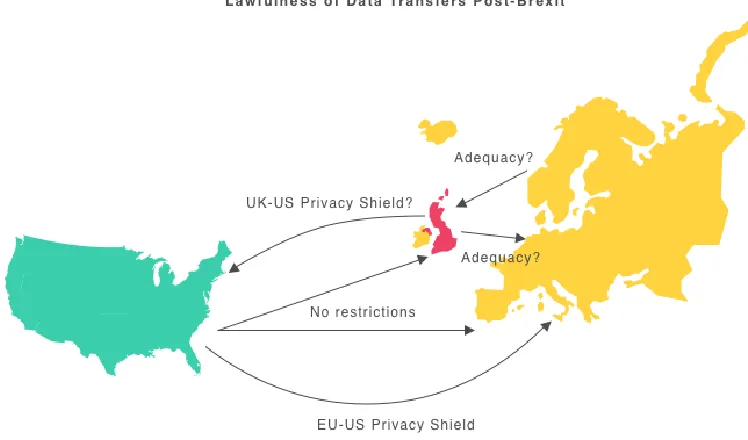
The below graphic suggested by Eduardo Ustaran of Hogan Lovells,
suggests the probable solutions for UK companies.
1 https://iconewsblog.org.uk/2016/10/31/how-the-ico-will-be-supporting-the-implementation-of-the-gdpr/
2 This list currently comprises: Andorra, Argentina, Faroe Islands, Guernsey, Isle of Man, Israel, Jersey, New
Figure 1 Data transfer solutions post Brexit
While there are likely to be solutions to the issue of data transfers for EU
creative companies post Brexit, the administrative hurdles, uncertainty and
costs will undoubtedly increase, and more pertinently, doing business with
EU customers will be more difficult.
However, data transfers is only one of the challenges Creative sector
companies will face. On the basis that the UK implements GDPR in full, this
will have wide ranging ramifications far beyond simply data transfers and
3. General Privacy Awareness
In order to assess the existing approach taken by companies in dealing with
issues such as GDPR or data transfers, we contacted multiple cloud vendors
to assess their responses and awareness of privacy laws, their privacy
governance and IT security posture.
Our overall assessment was that almost half of the 46 companies reviewed
were struggling to meet their privacy compliance obligations. We note that
this was based on a brief email exchange whereby many were unable to
[image:8.612.204.407.440.637.2]answer basic questions to satisfy compliance.
Additionally, less than a third of companies contacted could provide
confirmation of mature privacy compliance including governance and
appointment of a data protection officer.
A reasonable number of companies had information security attestations
4 Conclusion
Privacy and Data Protection law will present a significant hurdle to creative
sector companies and are likely to involve an increase in overheads and
administration in handling the complexities as a result of data transfer
obligations post-Brexit and the new GDPR.
However, most of the issues that may be encountered will likely have clear
legal solutions to minimize risks of non-compliance, and for companies that
have the resources to spend on ensuring compliance with best practices, the
complexities are likely to lead to new opportunities and increased