JOURNAL OFVIROLOGY,Aug.1992, p.4884-4892 Vol. 66, No. 8 0022-538X/92/084884-09$02.00/0
Copyright © 1992, AmericanSociety for Microbiology
The
UL8
Subunit of the
Herpes
Simplex Virus
Helicase-Primase
Complex
Is
Required for Efficient Primer Utilization
G. SHERMAN, J. GOTTLIEB,ANDM. D. CHALLBERG*
Laboratory of Viral Diseases, National Institute of
Allergy
and InfectiousDiseases, 9000Rockville Pike, Bethesda, Maryland 20892Received 24 March1992/Accepted 11 May 1992
The herpes simplexvirus (HSV) type 1 helicase-primase is a three-protein complex, consisting of a 1:1:1 associationofULS, UL8, and UL52 gene products (J. J. Crute, T. Tsurumi, L. Zhu, S. K. Weller, P. D. Olivo, M. D.Challberg, E. S. Mocarski, and I. R. Lehman, Proc. Natl. Acad. Sci. USA 86:2186-2189, 1989). We havepurified this complex, as well asa subcomplex consisting of UL5 and UL52 proteins, from insect cells infected with baculovirus recombinants expressing the appropriate gene products.Inconfirmation ofprevious reports, we find that whereasUL5 alone has greatly reduced DNA-dependent ATPase
activity,
theUL5/UL52 subcomplex retains the activities characteristic ofthe heterotrimer: DNA-dependent ATPaseactivity,
DNA helicaseactivity,and theabilitytoprime DNA synthesisonapoly(dT)
template. We also found that theprimers madeby thesubcomplex areequal inlength to those synthesized by theUL5/UL8/UL52complex. Inaneffort touncover a role for UL8 in HSV DNA replication, we have developeda model system forlagging-strand synthesis in which the primaseactivity of thehelicase-primase complex is coupledtotheactivity
of the HSV DNApolymerase on ICP8-coatedsingle-stranded M13 DNA. Using this assay, we found that the UL8 subunit of the helicase-primase is criticalfor theefficient utilization of primers; in the absence ofUL8, we detectedessentially
noelongation ofprimers despite the factthattherateofprimersynthesisonthe sametemplate isundiminished. Reconstitution oflagging-strand synthesis in thepresence ofUL5/UL52was achieved by the addition of
partially
purified UL8.Essentially
identical results were obtained when Escherichia coli DNA polymeraseIwassubstituted fortheHSVpolymerase/UL42complex. On the basis of thesefindings,wepropose that UL8 acts to increase the efficiency of primer utilization by stabilizing the association between nascent oligoribonucleotide primers and templateDNA.Theherpessimplexvirus(HSV)genomeisa153-kb linear DNAduplex that contains threeoriginsof DNAreplication and codes for at least 72 proteins (25). Seven viral genes code for proteins that are essential for HSV origin-depen-dent DNAsynthesis(2-6,24, 34,35,40-43).Theproductsof these genes include an origin-binding protein(UL9) (30), a DNApolymerase (UL30) (5, 6, 34) and its associated pro-cessivity subunit (UL42) (14-16, 32), a single-stranded DNA-binding protein (UL29 or ICP8) (8, 33, 41), and the three members ofa primase-helicase complex (UL5, UL8, andUL52) (10).
TheUL5/UL8/UL52complex has been isolated both from HSV-infectedcells and from insect cellstriply infected with baculovirus recombinants expressing each of the proteins (10, 12).Therecombinant enzyme is indistinguishable from that isolated from HSV-infected cells with respect toboth structureandenzymatic activity.Itcomprisesaheterotrimer containingoneeach of the subunits (9).Asahelicase,itcan utilize ATP or GTPtounwind DNA in a 5'-to-3' direction (9a) and is stimulated by the HSV single-stranded DNA-binding protein,ICP8(18). Kinetic analyses have shown that the helicase has two nucleoside triphosphate (NTP) sites; onesitehydrolyzes ATP and GTP, and the other hydrolyzes only ATP (8a). The primase activity of the complex synthe-sizes shortoligoribonucleotides 8 to 12 bases in length and can utilize both poly(dT) and natural DNAs as templates (9-11).
There is very little information available regarding the functions of the individual subunits of the helicase-primase
*
Corresponding
author.complex. Although the UL5 genecontains regions bearing considerable homologytoseveral conservedmotifs in other known helicases, including a likely ATPbinding site (26), neither DNA-dependent ATPase nor helicase activity has beenassociated with theprotein duringitspurificationfrom cells infected with a UL5-expressing baculovirus recombi-nant(1). A biochemicalcharacterizationof the UL52protein has not been possible because of the insolubility of this proteinwhenoverexpressedin the absence of UL5protein (unpublished observations). A subcomplex consisting of UL5 and UL52proteinshasrecentlybeen showntopossess theenzymatic activities that have beenassociated with the heterotrimer: DNA-dependent ATPase and GTPase activi-ties,abilitytodisplacea3'-tailedoligonucleotideannealedto M13 single-stranded DNA, andability to prime DNA syn-thesisonpoly(dT),albeitat aratesomewhat lower thanthat of the heterotrimer (1, 12). It therefore appearslikely that UL5and UL52proteinsconstituteafunctional unitinwhich both helicase and primase activities are dependent on the presence ofbothsubunits. The UL8 protein hasno detect-ableATPase, primase, orhelicase activities(1, 12).
To betterunderstand the role that the UL8protein playsin viralreplication,wecomparedpurified preparationsofUL5/ UL8/UL52 and
UL5/UL52
complexes in a number of as-says.Wefound thatUL5/UL52is verysimilartoUL5/UL8/
UL52inDNA-dependentATPaseactivity,helicaseactivity, andabilitytoprimeDNAsynthesison apoly(dT) template, confirming previous findings(1, 12). Inaddition,we demon-strated thatUL5/UL52makesprimers of the samesize and at the same rate as does UL5/UL8/UL52. We detected striking differences, however, when we compared the het-erotrimer and subcomplex in primase-primed replication
4884
on November 9, 2019 by guest
http://jvi.asm.org/
assays on single-strandedM13 circles. We showed that M13 single-stranded DNA was converted to nicked or gapped double-stranded circles by either the HSV DNA polymerase (Pol/UL42) or Escherichia coli DNA polymerase I (Pol I) when thereaction was primed byusing theUL5/UL8/UL52 complex. In contrast, little or no DNA synthesis was ob-served with either DNA polymerase in the presence of UL5/UL52; activity was restored in this system, however, bythe addition of partiallypurified UL8. Our data indicate, therefore, that UL8 is required forefficient primer utilization onnatural DNA templates. Our results are consistent with a model in which UL8 acts during lagging-strand synthesis to stabilize the association of primerswith the templatebefore they are elongated by DNApolymerase.
MATERIALS AND METHODS
Buffers. Buffer A contained 20 mM Tris hydrochloride (pH 8.0), 0.5 mM dithiothreitol (DTT), 0.5 mM EDTA, 0.5 mM phenylmethylsulfonyl fluoride (PMSF), and 10% glycerol. Buffer B contained 20 mM HEPES (N-2-hydroxyethylpiper-azine-N'-2-ethanesulfonic acid; pH 7.6), 0.5 mM DTT, 0.5 mM MgCl2, 10 mM NaHSO3, 0.5 mM PMSF, and 2.0
,ug
each ofleupeptin and pepstatin A per ml. Buffer C contained 20 mMHEPES (pH 7.6), 0.5 mM EDTA, 0.5 mMDTT, 0.5 mM PMSF, and 10% glycerol. Buffer D contained 20 mM Trishydrochloride (pH 7.5), 4 mMMgCl2, 0.1 mM EDTA, 1 mM DPI,50 mMNaCl, and 10% glycerol.
Cells andviruses. Spodoptera frugiperda (Sf9) cells were maintained in TMNFH medium (GIBCO) containing 10% fetal bovine serum. Recombinant baculoviruses containing the UL5, UL8, and UL52 genes (Autographa californica nuclear polyhedrosis virus [AcNPV]/UL5, AcNPV/UL8, and AcNPV/UL52) (31) were propagated as described pre-viously (37).
Enzyme assays. (i) DNA-dependent ATPase assays were performed as described previously (10) except that incuba-tions were for 1 h at 37°C. (ii) Indirect (coupled) primase assays(40 ,u)contained 50 mM Tris hydrochloride (pH 7.5), 8 mM MgCl2, 1 mM DTT, 0.5 mM ATP, 5.0 ,uM
poly(dT)350,
2.35 puM [3H]dATP (1 x 10⁴ to 2 x10⁴
cpm/pmol), and 3 to 5 U of E. coli DNA Pol I. Reaction mixtures were incubated at 37°C for 1 h, at which time they were terminated by the addition of 10
pI
of 0.5 M EDTA. Incorporation of [3H]dATP intoacid-insoluble material was measured in a liquid scintillation counter. One unit of enzymeactivity is defined as the incorporation of 1.0 pmol of [3H]dATPper h(10). (iii)Assays for lagging-strand synthesis (50,ul) contained 60P.M
each GTP, CTP, and UTP, 1 mM ATP, 60 p.Meach dGTP, dATP, anddT'lP, 2.5 p.g of bovine serumalbumin (BSA), 20 p.M [32P]dCTP (0.8 x 10⁴ to 1.6 x 10⁴ cpm/pmol), 20 fmol of single-stranded M13mpl9(+) DNA, 400 fmol of HSV Pol/UL42 complex, 7.0 pmol of ICP8, and 200 to 1,600 fmol ofUL5/UL8/UL52
or UL5/ UL52 complex in buffer D. Reaction mixtures were incu-bated for 30 min at 37°C in the presence of HSV Pol/UL42 complex and then chilled on ice for the sequential addition of[32P]dCTP,
UL5/UL8/UL52orUL5/52, and ICP8; they werethenincubated for 2 h at 25°C. Reactions were terminated by adding an equal volume of 1% sodium dodecyl sulfate (SDS)-40mM EDTA-0.6 M sodium acetate-100 pg of calf thymus DNA per ml. Afterphenol-chloroform extraction of protein and precipitation in ethanol, the reaction products were analyzed by gel electrophoresis in 1% neutral agarose gels and autoradiography. Singly primed M13 DNA was prepared as described previously (16). The synthetic
oligo-nucleotide used was 5'-CAGTCACGACGTTGTAAAACG
ACGGCCAGT-3',
which is complementary to nucleotides6300 to 6271 ofM13mpl9(+) DNA.
Determination of the length of the RNA primers. Standard reaction mixtures (50 p.l) contained 20 mM Tris acetate (pH 7.2), 3 mMMg'acetate, 1 mM
DTT,
50 p.M each GTP,CTP,
and UTP, 8.3 p.M
[32P]ATP
(1.6 x10⁵
to 3.2 x10⁵
cpm/pmol), and either 50 p.M (nucleotide concentration) M13mpl9(+) orpoly(dT)3500
(17). After addition of HSV primase-helicase, reaction mixtures were incubated for 2 h at37°C,
and reactions were terminated with the addition of an equal volume of1% SDS-40 p.M EDTA-50 p.g of tRNA per ml. After phenol-chloroform extraction of protein and etha-nol precipitation, reaction products were resuspended in deionized formamide and analyzed by electrophoresis on denaturing gels containing 20% polyacrylamide, 0.7% meth-ylene bisacrylamide, 7M urea, and 50 mM Tris borate (pH 8.3). Gels were dried and exposed to Kodak XAR-5 X-ray film at-80°C.
Size standards, generated either by 5' 32p labeling ofClaI
linkers or by partial alkaline hydrolysis of5'-32P-labeled
poly(rA) (13), were electrophoresed in parallellanes on the same gels. The lengths of RNA primers, relative to that of
p(Ap)n
size standards, were corrected for the presence of an expected 5' triphosphate.Protein purification. (i)
UL5/ULS2
complex. Forty225-cm2
flasks of Sf9 cells were coinfected with baculovirus recom-binants AcNPV/UL5 and
AcNPV/UL52
at a multiplicity of infection of 10 PFU of each virus per cell. At 60 h after infection, cells were dislodged from the flasks and harvested from the cell culture medium by centrifugation for 10min
at 3,000 rpm in a Sorvall HA-6 rotor. Pelleted cells were gently resuspended in 500 ml of ice-cold serum-freeGrace's
me-dium and collected by centrifugation at4°C
as described above. The cells were resuspended in 40 ml of buffer B, allowed to swell on ice for 15 min, and then lysed by 15 strokes in a Kontes all-glass Dounce homogenizer (B-type pestle). The homogenate was centrifuged for 10min
at 3,000 rpm ina Sorvall SS34 rotor to pellet nuclei. The supernatant was decanted and clarified by centrifugation at 12,000 x g for 10 to 20minat4°C.
Nuclei were resuspended in 20 ml of buffer B, to which an equal volume of buffer B containing 3.4 M NaCl was added. The lysate was incubated on ice for 1 h, clarified by centrifugation at 100,000 x g for 1 h, and dialyzed to equilibrium against buffer C containing 50 mM NaCl.The cytosolic extract (fractionI)was made 25 mM in NaCl and applied to a DEAE-Sephacel column (35 ml) previously equilibrated with buffer A containing 25 mMNaCl. Proteins were eluted from the column in a linear salt gradient (350 ml) from 25 to 600 mM NaCl in buffer A. Fractions (7 ml) containing the peak of DNA-dependent ATPase activity were pooled and dialyzed to equilibrium against buffer C containing 50 mM NaCl. The clarified dialysate (fraction II) was applied to a column of heparin-agarose (25 ml) that had been equilibrated with buffer C containing 50 mM NaCl. Proteins were eluted from the column in a linear gradient (250 ml) from 50 to 600 mM NaCl in buffer C. Fractions (5 ml) containing the peak of DNA-dependent ATPase activity were pooled and dialyzed to equilibrium against buffer C containing 50 mM NaCl. The clarified dialysate (fraction III) was applied to a single-stranded DNA agarose column (5 ml) previously equilibrated in the same buffer. Proteins were eluted from the column in a linear gradient (50 ml) from 50 to 600 mM NaCl in buffer C. Fractions (1 ml) were assayed for DNA-dependent ATPase and primase activities. Peak frac-tions were pooled and concentrated 20-fold in Centricon 30
on November 9, 2019 by guest
http://jvi.asm.org/
4886 SHERMAN ET AL.
concentrators (Amicon). The concentrate (0.2 ml) (fraction IV) was applied to a prepacked Superose 12 gel filtration columnequilibrated in buffer C containing 0.2 M NaCl and 0.01% Nonidet P-40. The column was eluted with the same buffer at a flow rate of 0.25 ml/min, and fractions, collected every 2.0 min, were assayed for DNA-dependent ATPase activity and primase activity. Peak fractions (fraction V) were pooled and stored at -80°C. The polypeptide compo-sition of this fraction wasexamined by SDS-polyacrylamide gel electrophoresis (PAGE) and staining with Coomassie blue and with silver. By this analysis, we estimated that the UL5/UL52 complex comprised approximately 60% of the totalprotein. A more accurate determination of the concen-tration of UL5/UL52 was obtained by performing SDS-PAGE and Western immunoblot analysis of this fraction, using rabbit antisera to the UL5 and UL52 gene products. Proteins were quantitated by comparing the intensities of thesebands,indensitometricscans,with that ofareference standard of pureUL5/UL8/UL52(see below).
(ii) UL5/UL8/UL52. Forty 225-cm2 flasks were triply in-fected with baculovirus recombinants AcNPV/UL5, Ac-NPV/UL8, andAcNPV/UL52atamultiplicity of 10 PFU per cell for each virus. Preparation of infected cell extracts and the procedure for purification of the UL5/UL8/UL52 pri-mase-helicase complex from the cytosolic lysate were ex-actly as described above for the UL5/UL52 complex. An examination of the finalfraction (fraction V) bystainingof SDS-protein gelswith Coomassie blue and with silver indi-cated that UL5, UL8, and UL52 proteins together consti-tutedgreaterthan 95% of the totalprotein. An early prepa-ration ofUL5/UL8/UL52andUL5/UL52 used in this study wasinitially appliedto aphosphocellulosecolumn. Since the majority ofUL5/UL8/UL52 andUL5/UL52 proteins failed tobindtothecolumn, this stepwasomitted fromsubsequent preparations.
(iii) UL8. PartiallypurifiedUL8 wasobtained duringthe purificationof theUL5/UL8/UL52complexfromacytosolic lysate prepared from triply infected Sf9 cells. The lysate, prepared asdescribed above from
40-cm2
flasks, wasmade 25 mM in NaCl and applied to a 25-ml DEAE-Sephacel columnpreviously equilibratedwith bufferAcontaining 25 mMNaCl. Proteinswereeluted inalinear saltgradientfrom 25 to500 mMNaCl in bufferA.UL5/UL8/UL52-containing
fractions, asdeterminedbyDNA-dependentATPase activ-ity and Western blotting, were pooled, dialyzed against 50 mMNaClin bufferC, andappliedto a25-mlheparin-agarose column. Proteinswereeluted from the column inalinear salt gradient from 50 to 500 mM NaCl in buffer C. Western analysisandDNA-dependent ATPase assaysindicated that the flowthrough material contained UL8, free of UL5 and UL52proteins,whereas the column fractions contained UL8 complexedwithUL5 and UL52. UncomplexedUL8 consti-tuted approximately30% (0.5 mglml) of the totalproteinin theflowthrough material.
(iv) HSV DNApolymeraseandICP8. The HSVPol/UL42 complex and ICP8 were purified as described previously (16).
RESULTS
Enzymatic activities of purified proteins. UL5/UL52 and UL5/UL8/UL52 complexeswere purified from insect cells
that were dually or triply infected with the appropriate
[image:3.612.313.550.100.169.2]recombinant baculoviruses. During the purification, the peaksof bothDNA-dependentATPase and primase activi-ties coincided with the peak of UL5/UL52 or UL5/UL8/
TABLE 1. Comparison of the specific activities of theUL5/UL8/ UL52 complex, UL5/UL52subcomplex, and UL5 protein
DNA-dependent ATPase DNAprimase (pmol of dATP
Enzyme(s) (nmol ofATP hydro- incorporated/pmolof enzyme) lyzed/pmolofenzyme) Poly(dT)primer M13 primer
UL5/UL8/UL52 5.3 4.4 0.63
UL5/UL52 5.6 3.4 0.008
UL5 0.03 NDa ND
a ND,not done.
UL52proteins.In agreementwith previous reports(11, 12), the elution profile for each complex from a Superose 12 column was consistent with an equimolar (1:1 or 1:1:1) association ofsubunits. In addition, we found that both the UL5/UL52 complex and the UL5/UL8/UL52 complex dis-played helicaseactivity on a substrate consisting of single-stranded M13 annealedto anoligonucleotide (30-mer) having a 15-base free 3' tail. Thus, our results confirm previous studies demonstrating that the UL5/UL52 subcomplex has the helicase, DNA-dependent ATPase (1, 12), and primase (12) activities that have been associated with UL5/UL8/ UL52. Our dataarealso inclose agreement withpreviously published values for the specific activities associated with these related enzyme complexes (Table 1) (12).
During thepurificationofUL5/UL52onaheparin-agarose column, immunoblot assays of column fractions revealed that theUL5polypeptideeluted from the column bothas an uncomplexed polypeptide and in association with UL52
A r 2 6 10 14 18 22 26 39 3_ 33 42 -L' 5
U '-.
_,
B
CD
cn
0- .-C z
a)
Fraction No.
FIG. 1. Evidence that UL5 alone hasnegligibleDNA-dependent ATPaseactivity.(A)Western blot of fractionselutingfrom heparin-agarose,probedwith UL5- andUL52-specificantisera. L,column load material; F, column flowthrough fraction; W, column wash fraction.(B)Plot ofDNA-dependentATPaseactivityversuscolumn fractions from the heparin-agarose column shown in panel A. DNA-dependent ATPase activity was assayed as described in Materials and Methods.
J. VIROL.
6
!i
i
-1"
"'I
i
L
on November 9, 2019 by guest
http://jvi.asm.org/
[image:3.612.314.550.401.650.2]HSV HELICASE-PRIMASE UL8 SUBUNIT 4887
i .4- 3 . -2.5 - -
-Pl3
_ rll 3 - -4**
;*W
[image:4.612.114.266.76.328.2]2 3.
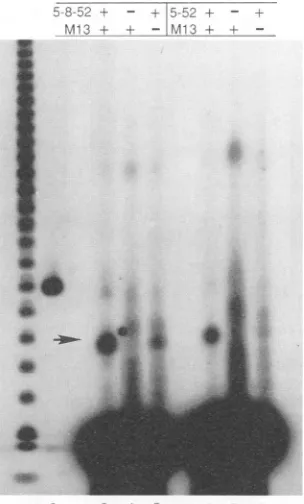
FIG. 2. Sizes ofRNA primers madeby HSV UL5/UL8/UL52 (lane 3) or UL5/UL52 (lane 6). Primase reactions products were
analyzed as described in Materials and Methods. Lanes 4 and 7 representcontrolreactions lackingprimase-helicase; reaction mix-tures in lanes 5 and 8 lacked single-stranded M13mpl9(+) DNA. Lane 1, 5'-32P-labeled p(Ap)n size standards generated by partial alkalinehydrolysisofpoly(rA) (13);lane2,5'-32P-labeledClaI linker (5'-CATCGATG-3'). The arrow indicatesthe locationofprimers.
(Fig. 1);UL5wasevidentlyexpressedat ahigherlevel than wasUL52 in thedoubly infected cells. Thisfindingprovided anopportunityto assayuncomplexed UL5polypeptide for DNA-dependent ATPase under conditions in which the complexed form of the polypeptideisolated from the same infected cellpreparationwasknown tobe active. The results clearly showed that the peak of DNA-dependent ATPase activitycorresponds tothepeak ofUL5/UL52 antigen. We estimate that specific ATPase activity of free UL5 (Fig. 1, fractions 8to 14) is less than5% of that of the UL5/UL52 complex.Asothers have reported (1,12),wewere notable to find conditions in which uncomplexed UL52 could be isolated in soluble form.
Determination of thelengthofprimers made by UL5/UL52 and UL5/UL8/UL52 complexes. To determine whether UL8 plays a role in regulating the size of primers made by the helicase-primase complex, we analyzed reaction products madebypurified UL5/UL8/UL52 and UL5/UL52. The two enzyme preparations were incubated with single-stranded M13 DNA template and 32P-labeled rNTPs. The reaction products were then analyzed byelectrophoresis on a 20% polyacrylamide sequencing gel. As shown in Fig. 2, both proteins synthesized short oligoribonucleotides approxi-mately 6 to 8 nucleotides in length (lanes 3 and 6). The primersmadeby both enzymes appearedtobequite homo-geneous, with greaterthan90% of the reaction products ina singleband onthe gel. The nucleotide composition of this band has not yet been determined. Some preparations of UL5/UL8/UL52 andUL5/UL52 synthesized primers in the absence oftemplate (lane 5). Control experiments showed
A 0C0 0
fmol 0 N °
O,
C 00II-o
III.w-1 2 3 4 5 6 1 2 3 4 5 6
FIG. 3. Primase-primed DNA synthesis on a single-stranded M13 DNAtemplate.Reaction mixtures(50jLl)contained20fmol of single-stranded M13mp(+) circular DNA, 1.0mMATP,2.5 pg of BSA, 60 ,M each dATP,dGTP, anddTTP, 20p,M [32PJdCTP(1.6 x
104cpm/pmol);60pMeachGTP, CTP,andUTP, 7.0 pmol of ICP8 (where indicated), 400fmol ofHSVPolIUL42 complex, and0 to 1,600 fmol ofUL5/UL8/UL52inbufferD.(A)Eachreaction mixture contained the indicated amount ofUL5/UL8/UL52. Lanes 1 to 5 contained 7.0pmol of ICP8. Reaction productswere analyzedby neutral agarose gel electrophoresis as described in Materials and Methods.Arrowsindicate the locations of nickeddouble-stranded M13 circles (form II) and linear M13 duplexes (form III). (B) Reactionconditions were as described forpanel A. Reaction
prod-ucts were dissolved in 15 pl of 0.1 N NaOH-5% glycerol-1 mM EDTA-0.025% bromocresol green and analyzedon a 1% alkaline agarosegel.All lanes contained 7.0pmolofICP8and 0 fmol(lane1), 200fmol (lane 2),400 fmol(lanes3and5),and 800 fmol (lane4)of UL5/UL8/UL52.Inlane5, ATP, GTP,CTP,andUTPwereomitted from the reaction mixture. Lane 6,
?hage
lambda DNA digested withHindIll and end labeled with 3 P. The sizes of theHindIIl restrictionfragments (in kilobases)areindicatedby the numbers at theright.that this template-independent primase activity could be selectively removed by passing the enzyme preparation over aDEAE-Sephacel column(datanotknown). Quantitation of the radioactiveoligoribonucleotide productsonthegel dem-onstrated that, as in the case when primase activity was testedby using the indirect assayon apoly(dT) template, the specific primase activities of thetwoenzymes were similar (Table 1). We conclude that UL8 hasnoeffect either on the rateofsynthesisor onthelength of the RNA oligonucleotide synthesized by thehelicase-primase complex.
Assay system forlagging-strand DNA synthesis.Since UL8 hasnoapparentrolein either of the knowncatalytic activi-ties of the UL5/UL8/UL52 complex, we considered the possibility that UL8 provides a link between the helicase-primaseand theHSVDNApolymeraseat areplicationfork. To test such a possibility, we developed a model assay systemforlagging-strandDNAsynthesis.This assay system utilized ICP8-coated single-stranded M13 circles as a tem-plate and measured the incorporationof32P-labeled dNTPs into partially or fully duplex circular DNA molecules by agarose gel electrophoresis. As shown in Fig. 3A, lane 1,
B
S
-23.1I 0
p -9.4-6.5
1
-4.301):
VOL.66, 1992
on November 9, 2019 by guest
http://jvi.asm.org/
[image:4.612.333.559.77.289.2]4888 SHERMAN ET AL.
whenthe HSV DNA polymerase(Pol/UL42) was incubated with template DNA in the absence of helicase-primase, a single major productwasformed thatmigratedonthe gel at thepositionoflinearduplexM13 DNA(formIII). Analysis of the product DNA strands by gel electrophoresis under denaturing conditions (Fig. 3B, lane 1) revealed a broad smearof radioactive productsthatmigratedover arangeof sizes fromunit-lengthM13 DNA strandstotwice-unit-length strands. We therefore presume that theproductsproduced in the absence ofprimase aredue to the extension of nicked circular molecules by a hairpin self-priming mechanism. When the reaction was carried out in the presence of the
helicase-primase
complex (Fig. 3A,lanes 2to5), additionalproducts that migratedon aneutralgelmoreslowlythan did linear duplex molecules were observed; the most slowly migrating productshadanelectrophoretic mobilitythat was identical tothat of relaxedcircularduplexM13 DNA(form II). Analysis of these reaction products under denaturing conditions
(Fig.
3B, lanes 2 to 4) again revealed a broad smear of radioactive products superimposed on a bandapproximately
thesize ofunit-lengthM13 DNA strands(7.6kb).The appearance of this bandwasdependentnotonlyon the presence of the
helicase-primase
but alsoonthe presence of rNTPs(Fig.
3B, lane5).
We conclude that the product DNAmigratingmore slowlythan linearduplexDNAundernondenaturing
conditionsrepresentspartiallyorfully duplexM13 DNAcircular molecules formed by the extension by DNA polymerase of primers synthesized by the helicase-primase. We consider that the synthesis of such products represents a model system for studying the synthesis of laggingstrands at anHSV DNA
replication
fork.Reaction conditions were systematically varied to opti-mizelagging-strand
synthesis.
Reaction mixturescontainingthe HSV DNA
polymerase
alone on atemplate
ofsingly
primed,
ICP8-coated M13 DNA were used as controls.Althoughinmostrespectstheoptimalconditions for thetwo reactionswere
similar,
the effects ofincubation temperature on the two reactions weresignificantly
different(Fig. 4).
With the DNA
polymerase
alone(Fig. 4,
lane4),
theoptimal
temperaturewas
-37°C,
andat thattemperature, the prod-uct waspredominately fully duplex
M13 circularmolecules,
asobservedpreviously.
Atlower temperatures, fewer prod-ucts wereformed and therewas anincreasing proportion
of productthat had anelectrophoretic mobility
between those of form II and form III. It islikely
that suchproducts
represent partially duplex circular molecules formed as a consequence of the failure of the HSV DNA
polymerase
tosynthesize through regions
oftemplate secondary
structure.Incontrast,althoughthedistributions of
product
sizesatthe various temperatureswere similar in thetworeactions,
the temperatureoptimum
of theprimase-primed
reaction wasconsiderably lower,
between 25and30°C
(Fig. 4,
lanes 6 and7); at 37°C, product formation was less than 10% of that observed at 25°C (Fig. 4; compare lanes 6 and 8). Control experiments (not shown) demonstrated that the primase activityperseof theUL5/UL8/UL52 complex [asmeasured
by
the indirect assayon apoly(dT) template]
hada temper-atureoptimum
of37°C. We therefore think itlikelythat the low temperature optimum of the lagging-strand synthesis reaction reflects the relative instability of the interaction betweentemplate DNAand the shortoligonucleotideprim-ers
synthesized
by the helicase-primase. Accordingly, allsubsequent
assays forlagging-strand
DNAsynthesis
wereperformed
at between 25 and30°C.We also
investigated
the effecton ICP8 on thelagging-strand
synthesis
reaction. As shown inFig. 3A,the reaction220 250
300 370
220 250
30° 3704p~~~~~~~~~~~~~
.6..:
1 2 3 4 5 6 7 8
FIG. 4. Temperature optimum of lagging-strand DNA synthesis. Lanes 1 to4, DNA replication by HSV Pol/UL42 on M13 circles, primed bya30-baseoligonucleotide. Reaction mixtures containing HSV DNApolymeraseand single-stranded M13 DNA primed with a30-basesyntheticoligodeoxyribonucleotidewere preincubated at 37°CasdescribedinMaterialsand Methods and then, following the additionof[32P]dCTP, incubatedfor 2 h at the indicated tempera-tures. Inlanes5 to8, reaction mixtures were preincubated at 37°C as described inMaterialsandMethods, and then[32P]dCTP,800 fmol ofUL5/UL8/UL52,and 7fmolofICP8 were added on ice. Reaction mixtures were subsequently incubated for 2 h at the indicated temperatures. Reaction products were analyzed by agarose gel electrophoresis. Arrows indicate the location of nicked, doubled-stranded M13 circles(formII)and linear M13 duplexes (form III).
is almost completely dependent on ICP8 (compare lanes 4 and6). Analysis of the smallamountofproduct produced in the absence of ICP8 by denaturing gel electrophoresis re-vealed that the product strands were very short, with an average length of less than 500 nucleotides. Itseems likely that therequirementforICP8 in thelagging-strandreaction reflects theabilityofICP8toalter the secondarystructureof the template DNA, thereby increasing the lengths of the strandssynthesized bythe HSV DNApolymerase.Suchan effect of ICP8 has been reported previously (18).
The UL5/52 complexdoes not support lagging-strand syn-thesis. ThepurifiedUL5/UL52 subcomplexwastested for its abilitytosupportthelagging-strand synthesisreaction. As is evident from theexperimentshown inFig. 5, lagging-strand synthesis was not observed when UL5/UL52 was substi-tuted for UL5/UL8/UL52 (lanes 4 and 5). The highest concentration of UL5/UL52 tested was at least eightfold higher than a level ofUL5/UL8/UL52 at which synthesis wasreadily detectable. The activity of theUL5/UL52 com-plexwas restored by the addition ofpartially purifiedUL8 (lanes6and7), rulingoutthepossibilitythat thepreparation ofUL5/UL52hadsimplybecomeinactivated. We therefore conclude that although UL8 has no effect on the two enzymatic activities of helicase-primase complex, UL8 does haveanessential function inlagging-strandDNAsynthesis. The failure of the UL5/UL52 complex to prime lagging-strand synthesis by the HSV DNA polymerase suggested that UL8 may play a role in the elongation of nascent primers byinteractingdirectly with the Pol/UL42complex. As apreliminary test of this hypothesis, we substituted a heterologousDNApolymerase,E.coliDNAPoll,forHSV Pol/UL42inthelagging-strand assay. Since primers synthe-sizedbyboth forms of the enzymeareelongated byE. coli Pol I whenpoly(dT)is usedas atemplate,weexpectedthat suchwould alsobethecase with M13DNA as atemplate.
J.VIROL.
on November 9, 2019 by guest
http://jvi.asm.org/
[image:5.612.325.538.76.228.2]d 3 - 5 6 8 9 10 1 1 122 3 14
FIG. 5. Reconstitution oflagging-strandDNA synthesis.
Reac-tion mixtures(50 pl) containedthe basic componentsasdescribed in
thelegendtoFig.3 andwerepreincubatedat37°C priortoaddition
of[32P]dCTP, ICP8,and the components indicated above each lane.
Controlextractreferstoanextractoninsectcells infected with a
recombinant baculovirus expressing the HSV UL42 polypeptide (16) thatwas subjected to the same chromatographic purification
procedures as wastheextractcontaining UL8. Additionswere as
follows: lane2, 10pmolofUL8(3 pLgof totalprotein); lane3, 50
pmol of UL8 (15,g of total protein);lane4, 400 fmol of UL5/UL52; lane5,1,600 fmol ofUL5/UL52; lane6, 10 pmol of UL8 and 1,600 fmol of UL5/UL52; lane 7, 50 pmol of UL8 and 1,600 fmol of UL5/UL52; lane8,400fmol ofUL5/UL8/UL52; lane9, 1,600fmol
ofUL5/UL8/UL52; lane 10,control extract, 3 F±gof totalprotein; lane 11, control extract, 15 ,ug of total protein; lane 12, control extract, 15 Fgoftotalproteinand 400fmol ofUL5/UL52; lane13,
control extract, 15 pLgoftotalproteinand1,600fmol ofUL5/UL52. Thereaction mixture in lane 14containedM13DNAprimed witha
30-base complementary oligodeoxynucleotide (see Materials and
Methods)andnoprimase.Arrowsindicate thelocations ofnicked,
double-stranded M13 circles(form II)and linearM13duplexes (form III).
As shown inFig. 6,suchwasnotthecase;UL5/UL8/UL52
efficientlyprimedDNAsynthesis byPolI(lanes2to5),but UL5/UL52didnot(lanes6to9).Whilethisexperimentdoes notcompletelyexcludea specific interaction betweenUL8 and DNApolymerases in general, we think it more likely
thatUL8 affects theefficiencyofprimerutilizationbysome
other mechanism.
DISCUSSION
TheHSV-encodedhelicase-primase complexiscomposed ofa1:1:1 association of threepolypeptides, UL5, UL8, and UL52.Althoughit is clearfromgenetic analysesthateach of these three subunits is absolutely essential for viral DNA replication in infected cells, the contributionsof each sub-unittothe twoenzymaticactivitiesof the complexand the
preciseroles ofeach subunit in DNAsynthesishavenotyet been elucidated. It has been shownpreviouslythatastable
subcomplexoftwoof the subunits, UL5 andUL52, canbe
isolated from insect cells after coinfection with the
appropri-ate recombinant baculoviruses (1, 12).TheUL5/UL52
sub-5-8-52 5-52
cl,
c: c
C r
cc
;-II_
I_tS
III
_-1 2 3 4 5 6 7 8 9 10
FIG. 6. Primase-primedDNA synthesis byE. coli Pol I.
Reac-tionmixtures contained theindicated amountsofUL5/UL8/UL52 (lanes2to5)orUL5/UL52 (lanes6to9).Reaction conditionswere
identicaltothosedescribed in thelegendtoFig.3 except that 2 U of DNA PolIwassubstituted for 400 fmol of HSV PolIUL42.Although
we arenotcertainofthecause, wesuspectthat thebackgroundof form IIproductsynthesizedinthe absenceofprimase (lane 1)isdue the presence ofcontaminating polynucleotides in the commercial
preparation of E. coli Pol I. The reaction mixture in lane 10
contained M13primedwith a30-base complementary
oligodeoxy-nucleotide (see Materials and Methods) and no primase. Arrows
indicate the locations of nicked, double-stranded M13 circles (form II) andlinearM13 duplexes (form III).
complex was shown to displayboth helicase and primase activities in standard assays (1, 12); UL8, therefore, is not
requiredfor either of thesetwoenzymaticactivities. Inthis report, we have confirmed published results regarding the enzymatic activities of the UL5/UL52 subcomplex. We purified both the three-subunit helicase-primase complex and a UL5/UL52 subcomplex from recombinant
baculovi-rus-infected insect cells and showed that thespecific activi-ties ofthe twoproteinsin standard assaysfor
DNA-depen-dentATPase, DNA-dependent GTPase, DNAhelicase, and primasewereessentiallyidentical. Inaddition,wefoundthat
thelengthsof theoligoribonucleotide primers synthesized by theenzymewerenotaffectedbythepresenceofUL8. None of thesedata, therefore,suggestarole forUL8 in viral DNA
replication.
As one approach to understanding the function of the virus-encodedreplication proteinsingreaterdetail,wehave begunto developassays involvingthese proteinsthat more
closelyresembletheprocessof DNAreplicationthan dothe standard assays forthe component activities such as DNA polymerase, helicase, andprimase. Inthis study,weuseda
model system for lagging-strand synthesis in which the primase activityof thehelicase-primase complexiscoupled
totheactivityofthe HSV DNApolymeraseonICP8-coated
single-stranded M13 DNA. Usingthis assay, wefound that the UL8 subunit of the helicase-primase is critical for the Co.It ex
1tr:>actt
UL5-8 52 UL8 UL5-52
- +- i
--+ + + -- 41 .l
Ii-fmco
0
III
C-1 c-- c-- C-- C-- C. 8 (-- (-- 5. C-5 C-5
C-1 "., -. I--, - cl-,i
II.-. 6--10
a r
00
on November 9, 2019 by guest
http://jvi.asm.org/
[image:6.612.353.535.74.328.2] [image:6.612.81.294.75.298.2]4890 SHERMAN ET AL.
efficient utilization of primers; in the absence of UL8, we detectedessentially no elongation of primers despite the fact that the rate of primer synthesis on the same template was undiminished.
We have considered two possible mechanisms by which UL8 could act to stimulate primer utilization. First, UL8 may act as a protein bridge between the helicase-primase complex and DNA polymerase, thereby increasing the effi-ciency by which DNA polymerase locates primers on the template. Second, UL8 may act to stabilize the association of primers with template DNA to prevent dissociation of the primersbefore they can be located and then elongated by the DNApolymerase. Although we do not yet have any direct experimental evidence that addresses this issue, our data argue against the idea that UL8 acts by linking the DNA polymerase with the helicase-primase, and we favor the view thatUL8 acts to stabilize the primer-template association. We have shown that UL8 is required for the efficient utilization ofprimers on an M13 DNA template not only by theHSV DNA polymerase but also by aheterologous DNA polymerase,E.coliPol I. Thus, if an interaction between the HSV DNA polymerase and UL8 accounts for increased primer utilization, then it is reasonable to suppose that a similarinteractionmust also occur between Pol I and UL8. Our data suggest, however, that UL8 and E. coli Pol I do not interact, since UL8 had no effect onprimase activity in the standard indirect primase assay, in which primers synthe-sizedon apoly(dT) templateareelongated by E. coli Pol I. The fact that UL8 isrequired for the efficientelongation of primersby E. coliPol I whenM13, but notpoly(dT),is used as a template argues against the idea that UL8 increases primer utilizationbymediatinganinteractionbetween DNA polymerase and the helicase-primase. There is no simple way that such a mechanism can account for the template specificity of the requirement for UL8. In contrast, these dataarereadily accommodatedby thehypothesis thatUL8 increases primer stability. Inthis model, the effect of UL8 should be apparent regardless of the polymerase used to extend primers, and the lack of a requirement forUL8 in assaysemployingpoly(dT)as atemplatecanbeexplained by the low sequence complexity of poly(dT). Thus, with a template of low sequence complexity,the initialstabilityof the primer-template association is not critical because the reassociationofprimerswith templateisrapid; in contrast, withatemplateofrelativelyhighsequencecomplexity,such asM13 DNA, reassociation ofprimersis slow and afactor that prevents the dissociation of primers after they are synthesized becomes necessary. Experiments to obtain di-rectevidence for this modelarein progress.
Theissue ofprimer stabilityhasnotbeenexplored exten-sively, but the sizes of the primers synthesized by most knownprimasessuggestthat theremustbesomemechanism toovercomeintrinsicprimer instability.Therequirementfor such a function is particularly evident in the case of the bacteriophage T4 primase, for example, whichsynthesizes primers that are five nucleotides in length (20, 22, 23, 27). Eukaryoticprimases synthesize primers that aresomewhat longer, ranging from 8 to 14 nucleotides (7, 36, 38); never-theless,asignificantfraction of RNA-DNAduplexes in that size rangearelikelytobe unstable underphysiologic condi-tions. One mechanism forovercoming primer instability is exemplified by the eukaryotic Pol a primase, in which primase activity istightly associated with aDNA polymer-ase activity. Thus, in atightlycoupled system, short RNA primers are extendedby DNA polymerase before dissocia-tion can occur. Coordinationbetweenprimase activity and
DNA polymerase is likely to be a feature of most DNA replication systems, including those for which there is no evidence of a tight association between primase and DNA polymerase. Nevertheless, there is precedent for the idea that other components of the replication machinery may directly influence primer stability. For example, the T4 helicase-primase is a two-subunit enzyme consisting of a heterodimer of the gene 61 protein and the gene 41 protein. Nossal and Hinton (28) have demonstrated that the 61 protein synthesizes predominately pentanucleotide primers in the presence of the 41 protein but only trace amounts of much longeroligonucleotides (5 to 45 bases) in the absence of 41.Moreover, it is only the minor population of very long primers, which remain stably hybridized to the DNA tem-plate, thatare elongated by the polymerase in the absence of the 41 protein. These observations are consistent with the idea that the 41 protein serves to stabilize the short penta-nucleotide primers that would otherwisedissociate from the template. If the UL8 subunit of the HSV helicase-primase complex proves to act, as we suggest, to increase primer utilization by increasing primer stability, then it will be the first example of a primase subunit that affects primer stabil-ity but has no other apparent role in the catalytic activstabil-ity of theenzyme. Thus, the HSV helicase-primase may prove to be aparticularly useful system in which to gain new insights intothis aspect of primase function.
Our dataprovide no new insights into the activities of the other two components of the helicase-primase. Since UL5 contains amino acid sequence motifs that are characteristic of other DNA helicases (26), it seems likely that UL5 contains the helicase catalytic center. By default, then, UL52is thelogical candidate for the primase subunit. There is as yet,however, no direct experimental support for these assignments. Our data, which are in agreement with previ-ous results (1), demonstrate that the isolated UL5 subunit haslittleenzymatic activity in the absence of UL52, and we havefound that UL52 is completely insoluble in the absence ofUL5. In this regard, the HSVhelicase-primase is similar to other multisubunit helicase-primase complexes. For ex-ample, the helicase activity of the phage T4 gene 41 protein and the primase activity of the gene 61 protein are greatly stimulated upon formation of a heterodimer (19, 28, 39). Similarly, the primase activity of the E. coli DnaG protein is dependent on the presence of the DnaB helicase, and the helicase activity of the DnaB protein is stimulated by the presence of DnaG (21). It is possible that theseobservations simplyreflect the effect of intersubunit interactions on the folding of each polypeptide. It is also possible, however, that theobserved interdependence of helicase and primase activ-itiesreflects an underlying control mechanism by which the two activities are regulated at a replication fork. Such regulation may be necessary because the two activities involve translocation of the complex in opposite directions along the same DNAstrand and hence cannot occur simul-taneously. According to this model, the helicase activity of one subunit of the complex is stimulated by a specific conformation of the primase in which the primase itself is inactive. Conversely, the primase activity would depend on a specific inactive conformation of the helicase subunit. Mutational analyses of each subunit that may shed some light on these ideas are in progress.
Whether or not the HSV primase utilizes specific or preferred sites on a template has yet to be determined. It seems unlikely that primer synthesis is completely depen-dent onaspecific template sequence, since the enzyme has observable activity on homopolymer templates such as J. VIROL.
on November 9, 2019 by guest
http://jvi.asm.org/
poly(dT).
Ourexperiments involving
theextension ofprim-ers
by
the HSV DNApolymerase
onsingle-stranded
M13 DNAwould appear, atleast on thesurface,
to support the existence of a fewpreferred
sites forprimase
activity. Asseenin
Fig.
3to5,
inadditiontoobserving
theformation offully duplex
circular M13 DNA in theseexperiments,
we also observed theformation ofthreeorfour discreteprod-uctsthat
migrated
fasteronthegel
thandid thefully
duplexDNA. We
initially
assumed that these discrete productsweretheresult of
elongation
ofspecific primers
uptositesof extensivesecondary
structureinthetemplate. Pausing
of the HSV DNApolymerase
at sites ofsecondary
structure has been observedpreviously (16, 18, 29). However,
controlexperiments
inwhichrandomhexanucleotideswereusedasprimers
revealed the same discreteproducts (35a).
There-fore,
while we cannot at present rule out the existence ofpreferred
sites forprimase
activity,
wethink itmorelikely
thatthe HSV
primase
initiatessynthesis
atrandomsites.Wespeculate
that the discrete bands ofpartially
duplex
DNAseen in our
experiments
reflect the existence of a few discreteregions
ofsecondary
structure on thesingle-stranded
portion
of these molecules that leads to sets of molecules in which theelectrophoretic
mobility
iscontrolledby
the location of theduplex region
but isrelatively
insen-sitivetothesize of theduplex region.
Otherexplanations
arepossible.
In summary, in this
study
we have used amodel system forlagging-strand synthesis
tobegin
todefinearole in viral DNAreplication
forUL8,
a subunit of the HSVhelicase-primase complex.
Thelagging-strand
model systemthatwe havedeveloped depends
onthepresenceof sixofthesevenvirus-encoded
polypeptides
thatareknowntoberequired
in vivo forDNAreplication.
Continuedanalysis
of this system,therefore,
should prove useful indefining
the interactions amongthesepolypeptides
that leadtotheefficientsynthesis
of viral DNA in
lytically
infected cells. ACKNOWLEDGMENTSWeare
grateful
toDaniel Fierer and Donna Klinedinst forusefuldiscussions and
helpful
commentsonthemanuscript.REFERENCES
1. Calder, J. M., and N. D. Stow. 1990. Herpes simplex virus
helicase-primase:
the UL8 protein is not required forDNA-dependent
ATPase andDNAhelicaseactivities. NucleicAcidsRes. 25:3573-3578.
2. Carmichael, E. P., M. J. Kosovsky, and S. K. Weller. 1988. Isolation and characterizationof herpes simplexvirus type 1 hostrange mutants defectiveinviral DNAsynthesis.J. Virol. 62:91-99.
3. Carmichael,E.P.,andS. K. Weller.1989.Herpessimplexvirus type 1 DNA
synthesis
requiresthe productof the UL8 gene: isolationand characterizationofanICP6::lacZ insertionmuta-tion. J.Virol. 62:2970-2977.
4.
Challberg,
M. D.1986. A method foridentifyingthe viral genesrequired for herpesvirus DNA replication. Proc. Natl. Acad. Sci. USA83:9094-9098.
5. Chartrand, P., C. S. Crumpacker, P. A. Schaffer, and N. M. Wilkie. 1980.
Physical
and genetic analysisof theherpessim-plexvirus DNApolymeraselocus.Virology103:311-326. 6. Coen,D.M.,D. P.Aschman,P.T.Gelep,M.J.Retondo,S. K.
Weller,and P. A. Schaffer. 1984. Finemappingand molecular
cloning
of mutations in theherpes simplexvirus DNApolymer-aselocus. J.Virol.49:236-247.
7. Conaway, R. C., and I. R. Lehman. 1982. A DNA primase
activity
associated with DNA polymerase afromDrosophilamelanogaster embryos.
Proc. Natl. Acad. Sci. USA79:2523-2527.
8. Conley, A. J., D. M. Knipe, P. Jones, and B. Roizman. 1981. Moleculargenetics of herpes simplex virus.VII. Characteriza-tion ofa temperature-sensitive mutant produced by in vitro mutagenesis and defective in DNA synthesisand accumulation ofgammapolypeptides. J. Virol.37:191-206.
8a.Crute, J. J., R. C. Bruckner,M.S. Dodson,and I. R.Lehman. 1991. Herpes simplex-1 helicase-primase. J. Biol. Chem. 266: 21252-21256.
9. Crute, J. J.,andI. R. Lehman. 1991. Herpes simplexvirus-1 helicase-primase. Physical and catalytic properties. J. Biol. Chem.266:4484 4488.
9a.Crute, J. J., E. S. Mocarski,andI. R. Lehman. 1988. A DNA helicase inducedby herpes simplex virustype1.Nucleic Acids Res. 16:6585-6596.
10. Crute, J. J., T. Tsurumi, L. Zhu, S.K. Weller, P. D. Olivo, M. D. Challberg, E. S. Mocarski, and I. R. Lehman. 1989. Herpes simplex virus 1 helicase-primase: a complex of three herpes-encoded gene products. Proc. Natl. Acad. Sci. USA 86:2186-2189.
11. Dodson,M.S., J. J. Crute,R.C.Bruckner, and I. R. Lehman. 1989.Overexpressionand assembly of the herpes simplexvirus type-1 helicase-primase in insect cells. J. Biol. Chem. 264: 20835-20838.
12. Dodson, M.S., and I. R. Lehman. 1991. Association of DNA helicase andprimase activities withasubassembly of the herpes simplex virus 1 helicase-primase composed of the UL5 and UL52geneproducts. Proc. Natl. Acad. Sci. USA88:1105-1109. 13. Donis-Keller, H.,A. M.Maxam,and W.Gilbert. 1977. Mapping adenines, guanines, and pyrimidines in RNA. Nucleic Acids Res.4:2527-2538.
14. Gallo,M.L.,D.I.Dorsky,C. S.Crumpacker,and D.S. Parris. 1989. Theessential65-kilodaltonDNA-binding protein of her-pessimplex virus stimulates the virus-encoded DNA
polymer-ase.J. Virol. 63:5023-5029.
15. Gallo,M.L.,H.D.Jackwood,M.Murphy,H.S. Marsden, and S.D. Parris.1988. Purification of theherpes simplex virustype 1 65-kilodaltonDNA-binding protein: propertiesof theprotein and evidence of its association with the virus-encoded DNA polymerase.J. Virol. 62:2874-2883.
16. Gottlieb, J.,A. I. March, D. M.Coen, and M. D. Challberg. 1990. Theherpes simplexvirus type 1 UL42 gene product: a subunitof DNApolymerasethat functionstoincrease proces-sivity.J. Virol.64:5976-5987.
17. Grosse,F.,andG.Krauss. 1985.Theprimase activity ofDNA polymeraseafrom calfthymus.J. Biol.Chem. 260:1881-1888. 18. Hernandez,T.R.,and I. R.Lehman.1990. Functional interac-tion betweentheherpes simplex-1DNApolymeraseand UL42 protein.J. Biol. Chem. 265:11227-11232.
19. Hinton, D.M.,L. L. Silver,and N. G. Nossal.1985. Bacterio-phageT4DNAreplicationprotein41.Cloningofthegeneand purificationof theexpressed protein.J. Biol. Chem. 260:12851-12857.
20. Kurosawa, Y., and T. Okasaki. 1979. Structure of the RNA portion of the RNA-linked DNA pieces in bacteriophage T4-infected Escherichiacolicells. J. Mol. Biol. 135:841-861. 21. LeBowitz, J. H.,and R.McMacken. 1986. TheEscherichiacoli
dnaB replication protein is a DNA helicase. J. Biol. Chem. 261:4738-4748.
22. Liu, C.-C.,and B. M. Alberts. 1980. Pentaribonucleotides of mixed sequence aresynthesizedandefficientlyprime denovo
DNA chain starts in the T4 bacteriophage DNA replication system.Proc. Natl. Acad. Sci. USA 77:5698-5702.
23. Liu,C.-C.,and B. M. Alberts. 1981. Characterization of RNA primer synthesisin the T4bacteriophagein vitroDNA replica-tion system. J. Biol. Chem. 256:2821-2829.
24. Marchetti, M. E., C. E. Smith, and P. A. Schaffer. 1988. A temperature-sensitivemutation inanHSV-1 generequiredfor viral DNAsynthesismapstocoordinates 0.609-0.614 in UL. J. Virol. 62:715-721.
25. McGeoch, D. J., M. A. Dalrymple, A. J. Davison,A. Dolan, M.C.Frame,D.McNab,L.J. Perry, J.E.Scott,and P.Taylor. 1988. ThecompleteDNA sequence of thelong unique regionin the genome of herpes simplex virus type 1. J. Gen. Virol.
on November 9, 2019 by guest
http://jvi.asm.org/
4892 SHERMAN ET AL.
69:1531-1574.
26. McGeoch,D. J., M.A. Dalrymple,A. Dolan, D. McNab, L. J. Perry, P. Taylor, and M. D. Challberg. 1988. Structures of herpes simplex virus type 1genes required for replication of
virus DNA. J. Virol. 62:444 453.
27. Nossal, N. G. 1980. RNA priming of DNA replication by bacteriophageT4proteins. J.Biol.Chem.255:2176-2182. 28. Nossal, N.G., and D. M.Hinton. 1987.BacteriophageT4 DNA
primase-helicase: characterization ofDNAsynthesis primed by theT461proteinin the absenceof 41protein. J. Biol. Chem.
262:10879-10885.
29. O'Donnell, M. E., P.Elias,and I. R.Lehman.1987. Processive
replication of single-stranded DNA templates by the herpes simplex virus-induced DNApolymerase. J. Biol. Chem. 262: 4252-4259.
30. Olivo,P. D., N. J. Nelson, and M. D. Challberg. 1988. Herpes simplex virusDNAreplication: the UL9geneencodesanorigin
bindingprotein. Proc. Natl. Acad. Sci. USA 85:5414-5418. 31. Olivo, P. D., N. J. Nelson, and M. D. Challberg. 1988. Herpes
simplexvirus type 1geneproducts requiredforDNA
replica-tion:identificationandoverexpression. J. Virol. 63:196-204. 32. Parris, D. S., A. Cross, L. Harr, A. Orr, M. C.Frame, D. J.
Murphy, D. J. McGeoch, and H. S. Marsden. 1988. Identifica-tionofthegeneencodingthe65-kilodaltonDNA-binding protein
ofherpessimplexvirus type1. J. Virol. 62:818-825.
33. Powell, K.L., E. Littler, and D. J.M.Purifoy. 1981. Nonstruc-turalproteins of herpes simplexvirus. II. Major virus-specific DNA-binding protein. J. Virol. 39:894-902.
34. Purifoy, D. J. M., R. B. Lewis, and K. L. Powell. 1977.
Identification of the herpes simplex virus DNA polymerase
gene.Nature (London) 269:621-623.
35. Purifoy, D. J. M., and K. L. Powell. 1981.
Temperature-sensitive mutants in two distinct complementation groups of
herpessimplex virustype 1specify thermolabileDNA polymer-ase.J.Gen. Virol. 54:219-222.
35a.Sherman, G., and M. D.Challberg. Unpublished data. 36. Singh, H. J., R. G. Brooke, M. H. Pausch, G. T. Williams, C.
Trainor, and L. B. Dumas.1986. YeastDNA primaseand DNA polymerase activities. An analysis of RNA priming and its couplingtoDNAsynthesis. J. Biol. Chem. 261:8564-8569. 37. Summers,M.D.,and G. E.Smith. 1987.Amanual of methods
forbaculovirusvectorsand insect cellprocedures.TexasA&M University, CollegeStation.
38. Tseng, B. Y., and C. N. Ahlem. 1983. ADNAprimase from mousecells.J. Biol. Chem. 258:9845-9849.
39. Venkatesan, M., L. L. Silver, and N. G. Nossal.1982. Bacterio-phageT4 gene 41 protein, requiredfor the synthesis ofRNA primers, is also a DNA helicase. J. Biol. Chem. 257:12426-12434.
40. Weller, S. K., E. P. Carmichael, D. P. Aschman, D. J. Goldstein, andP. A.Schaffer. 1987. Genetic andphenotypic characteriza-tionofmutantsinfour essentialgenesthat map to theleft half of HSV-1UL DNA.Virology 161:198-210.
41. Weller, S. K., K. J. Lee, D. J. Sabourin, and P. A. Schaffer. 1983. Genetic analysis of temperature-sensitivemutantswhich define the gene for the major herpes simplex virus type 1 DNA-bindingprotein. J. Virol.45:354-366.
42. Wu, C.A., N. J. Nelson, D. J.McGeoch,and M. D.Challberg. 1988. Identification of herpes simplex virus type 1 genes
re-quired fororigin-dependent DNAsynthesis. J. Virol. 62:435-443.
43. Zhu, L., andS. K.Weller. 1988. UL5, a protein required for HSV DNAsynthesis: genetic analysis, overexpressionin Esch-erichiacoli, and generation ofpolyclonal antibodies. Virology 166:366-378.
J. VIROL.