JOURNAL OFVIROLOGY, June 1992, p.3435-3447 0022-538X/92/063435-13$02.00/0
CopyrightC)1992, American SocietyforMicrobiology
Characterization of
a
Herpes
Simplex Virus Sequence
Which Binds
a
Cellular
Protein
as
Either
a
Single-Stranded
or
Double-Stranded
DNA
or
RNA
LOUISE McCORMICK, RICHARD J. ROLLER,AND BERNARD ROIZMAN*
The
Marjorie
B. Kovler Viral Oncology Laboratonies, The Universityof Chicago, 910East58thStreet, Chicago, Illinois 60637Received 29 October1991/Accepted 17 March 1992
Earlierwereported that herpes simplex virus 1 DNA containsa sequencewhich bindsa host protein ina
sequence-specificmanner aseitherasingle-strandedor adouble-stranded DNAorRNA and that thissequence
is locatedinatranscriptional unitwhoseRNAtraversesthe origin of viral DNA replication
(OrisRNA)
(R. J. Roller, L. McCormick,andB. Roizman, Proc. Natl. Acad.Sci.USA 86:6518-6522, 1989). The proteinreacts with bothDNAandRNA inband-shiftassaysandprotectsthesingle-stranded RNAsequencefrom digestionby RNase. We report that the minimal cognate sequence required for these interactions consisted of
[N(GTGGGTGGG)2(N < 10)]. The ninemerrepeatsequence waslocatedatnucleotides -1to-18 relativeto
thetranscriptioninitiation of themajor species of
OrisRNA.
The activityofthecognatesequencerequiredat least three guanines between thyminesand tolerates the insertionof additional thymines, but itwasinactivatedby the insertion of adenines or by the substitution of some of the guanines with cytosines in one repeat. Replacement of the 10 3' nucleotides has noeffect onbinding activity, whereas deletion of thesesequences
abolished it. Among the related sequences with no demonstrable binding activity were some telomeric sequenceswhich interact with knowncognateproteins. The electrophoretic mobility of the herpes simplexvirus cognatesequencesin nondenaturing gelssuggeststhat theymaybe abletoform higher-orderstructures, but the conditions under which they were formed were different from the optimal conditions for binding the
protein. UV light cross-linking studies of labeled RNA-protein complexes following digestion with RNases indicatedthat theelectrophoretic mobilityof theprotectiveactivitycorrespondedtothatofaproteinwithan
apparentmolecularweightof100,000.
Inthispaper, wereporton theproperties ofanucleotide sequencewhicheitherasDNAor as RNAin eithera single-or a double-stranded form binds a cellular protein in
se-quence-specificfashion. The circumstanceswhich ledtothe discoveryof thissequence and itspropertiesare asfollows.
(i)Theherpes simplexvirus 1(HSV-1)genomeconsists of
twocovalentlylinkedcomponents,L andS,eachconsisting ofuniquesequences(ULand
Us)
flankedbyinvertedrepeats (31, 36).Theinvertedrepeatsof the Lcomponentareeach 9kbp and have been designated ab and b'a', whereas the inverted repeatsofthe S component are each 6.5 kbp and have beendesignateda'c' andca (42) (refertoFig. 1).Thea sequence is approximately 200 to 500 bp in length and
represents the terminal genomic sequence present in the
sameorientationatthe termini and inaninverted orientation
atthejunction betweenL and S components (23, 41). The invertedrepeatsofthe Lcomponenteachcontaintwogenes
which encode the infected cell proteins(ICP)0 (19, 26)and 34.5 (4), whereas the inverted repeats ofthe S component
contain thegenespecifyingICP4 and the identicalpromoter and 5' transcribed noncodingdomains oftwogenes, ICP22 andICP47 (19, 20, 26).The nonidenticalcodingsequencesof the lattertwogenesarelocated in the
Us
sequencesadjacentto the invertedrepeats.
(ii)TheHSVgenomecontains threeorigins(Ori)of DNA replication used during lytic infection. One origin, desig-natedOriL(38),islocatedatapproximatelythe middle of the UL,whereas thetwootherorigins
(Oris)
(24, 39) mapin the*Correspondingauthor.
invertedrepeatsof the Scomponentbetween thepromoters encoding ICP4 and either ICP22 or ICP47.
Oris
istran-scribed late ininfection,probablyafter thecessation of viral DNA synthesis (17). The
OrisRNA
initiates within the 5' transcribed noncoding domains of the ao22 or a47gene andterminates at a polyadenylation site coterminal with the
transcript of the a4 gene (11). Approximately half of the
OrisRNA
(majorOrisRNA)
initiates froma single site des-ignatednucleotide 1. The otherOrisRNAs
areinitiated from heterogenous sites up to 100 bp 5' to the majorOrisRNA
(32). In a previous paper, this laboratory reported that a
host-encodedprotein(s)bindstoanin vitrotranscribed RNA
which contained sequencesextendingupstreamfrom nucle-otide +30 of themajor
OrisRNA
transcriptioninitiation site. The binding was shown to be sequence specific but notnucleic acid specific. Thus, the proteinwas shown to bind
the same sequence when present as either RNA or DNA,
whether in single-stranded or in double-stranded form. The
complementarysequence,however, representedintheRNA transcriptsoftwoviralgenes,a22 andao47,wasnotboundor
protected from degradation by RNases. To facilitate
refer-ence to this protein, we have designated it a
nucleic-acid-protective protein,orNPP,onthe basisof itsabilitytobind
either DNA or RNAand to protectthe latter from nucleo-lytic degradation.
The function ofthe
OrisRNA
is not known. By analogy with othersystems, it has beensuggestedthat itmayplayarole in DNAreplication (11). As astepin the
characteriza-tion ofpotential trans-actingfactorsregulatingOrisRNA,we
have chosento investigate further thespecificity ofNPP in
vitro. In this paper, we report that (i) NPP binds to the
3435
Vol. 66, No. 6
on November 9, 2019 by guest
http://jvi.asm.org/
sequenceN[G(T/U)GGG(T/U)GGG]2(N c 10) with the nine-mer repeat positioned at nucleotides -18 to -1 relative to
themajor
OrisRNA;
(ii) asmeasured incompetition assays,the proteins involved in recognition and binding of the single-stranded RNA and DNA appear to be identical; (iii) the properties of the HSV-1 single-stranded DNA sequence
in native polyacrylamide gel electrophoresis (PAGE) are
suggestive ofthe formation ofsecondarystructuresof either
an inter- orintramolecular association; and (iv) radioactive
label in the cognate RNA sequence was transferred by
cross-linkingtoaprotein with anapparent molecularweight of 100,000 under conditions which enable the formation of the specific RNA-protein complex.
MATERUILSAND METHODS
Cells and viruses. HeLacellsobtained from the American Type Culture Collectionwere propagated asdescribed
else-where (14). HSV-1 strain F [HSV-1(F)], the prototype
HSV-1 strain used in this laboratory, was described
else-where (7).
Preparation of cellular extracts. HeLa cells grown in
Corning 25240 roller bottles were collected in the culture
mediumandpelleted bycentrifugation for 5 minat2,500rpm
in a DuPont GS-3 rotor in aSorvall RC2-B centrifuge. The
cells were then rinsed three times by suspending them in phosphate-buffered saline [PBS(A); 137mM NaCl, 27mM KCl, 8.1 mM Na2PO4, 1.5mM
KH2PO41
to avolume of 20ml per approximately 109 cells and centrifuging them for 5
min at 2,500 rpm in a Beckman model TJ-6 centrifuge,
suspendedat aconcentration ofapproximately2 x 108 cells
per ml of Dignam's lysis (A)buffer (10 mM HEPES [N-2-hydroxyethylpiperazine-N'-2-ethanesulfonic acid] [pH 7.9], 1.5 mMMgCl2, 10 mMKCl, 0.5mMdithiothreitol [DTT])(6) containing 0.5 mMphenylmethylsulfonyl fluoride, storedon
ice for15
min,
pelleted again, and thenresuspended in twopacked-cell-volume equivalents of the A buffer. The cells
werelysed bytheaddition of 0.1% Nonidet P-40. Thenuclei were collected by centrifugation, suspended to 3 x 10⁸
nucleipermlofextraction buffer(20mMHEPES buffer [pH 7.8], 25% glycerol, 520 mM NaCl, 1.5 mM MgCl2, 0.1 mM
EDTA, 0.5 mM phenylmethylsulfonyl fluoride, 0.5 mM DTT,0.1%NonidetP-40),andmaintained for 60minat4°C. Cell debris was removed by centrifugation, and the
super-natant fluid was stored at -80°C. The nuclear extracts of HeLacells used in thecross-linkingstudieswerepreparedas
previously described (32) from cells mock infected or
in-fected with 10 PFU of HSV-1(F), except that the buffers contained HEPES rather than Tris and included 0.5 mM DTTandtheprotease inhibitors leupeptin, pepstatinA,and aprotinin, each at concentrations ofS p.g/ml. Protein
con-centrationsweredeterminedwith theBio-RadProtein Assay
reagent.
Ammonium sulfate fractionation. Forthe affinity studies, nuclearextractswerefractionated with ammonium sulfateas
follows. The buffer concentration wasincreased to 50 mM HEPES, pH 7.8. Solid ammonium sulfate was added to a
concentration of 134 mg/ml, and the precipitate formed at
4°Cfor30minwascollectedby centrifugationat 15,000rpm
for20 minin a DuPontSS34rotor.An additional 146 mgof
solid ammonium sulfate per ml was then added, and the
solution was processed as described above except that the precipitatewasresuspended in the nuclearextraction buffer
containing 50 mM HEPES buffer. This fraction represents
the material precipitated by 25to 50% ammonium sulfate.
Nonspecific single-stranded DNA competitor.M13mpl8 sin-gle-stranded DNA was used as thenonspecificcompetitor in allexperiments. This DNA waspreparedessentiallyasinthe large-scale protocol described by Sambrook et al. (34) but was extracted twice each with phenol, phenol-chloroform, andchloroform and was ethanolprecipitatedpriortodialysis against 10 mMTris (pH 7.5)-i mM EDTA.
Plasmids,oligodeoxynucleotides, and in vitro transcription. The plasmid pRB3953 containing the 69-bp HSV-1 DNA sequenceused as a probe and the in vitro transcription of the cloned sequence to serve as an RNA probe in the RNA-bindingreactions was previously described (32).
Oligodeoxynucleotides were synthesized on an Applied Biosystems model 380B synthesizer. Full-length oligodeoxy-nucleotides were purified after electrophoretic separation in denaturing 12% acrylamide gels by overnight elution in 0.5 M ammonium acetate-2 mM EDTA, concentrated in a Speed-Vac, transferred via a Sephadex G50 spin column to 10 mM Tris(pH7.5)-imMEDTA, and stored at -20°C. The length of the elutedoligodeoxynucleotides was confirmed by PAGE. Oligodeoxynucleotides containing contaminating species with lower molecular weights were gel purified and analyzed a second time.
RNA-binding reactions. The RNaseT1 protection assay for the cross-linking labelling was as previously described (32). All other RNase
T,
protection assays were done as follows. The labeled RNA probe was denatured by heating to 85°C for 3 to 5 min, reacted at 37°C for 60min with 0.5 ,ug of the 25 to 50% ammonium sulfate nuclear extract fraction in a 12-,ul volume reaction containing 0.5 ,ug ofM13mpl8 single-stranded DNA and competitoroligodeoxynucleotide in bind-ing buffer (200 mM NaCl, 20 mM Tris [pH 7.5], 1 mM EDTA, 0.5 mM DTT, 0.2 mM phenylmethylsulfonyl fluo-ride, 1.6% polyethylene glycol [molecular weight, 8,000], 25% glycerol), and then digested at room temperature for 10 min with 9 U of RNaseT1. After that, heparin was added to aconcentration of 5 mg/ml, and the mixture was allowed to react for an additional 10 min at room temperature. The digest was then electrophoretically separated on a4% acryl-amide gel and run in 0.5x TBE (45 mM Tris, 45 mM boric acid, 1.25 mM EDTA). All RNA-binding reactions were done in the presence of 1 U of Promega RNasin RNase inhibitor per ,ul.DNA-binding reactions. For competition studies, the T4 polynucleotide kinase-labeled oligodeoxynucleotide 69 probe (Fig. 1) was reacted with the nuclear extract as described above for the RNaseT1 protection assays except that the RNase T1digestion step was omitted and no RNasin was added to the reaction mixtures. For binding reactions with truncated oligodeoxynucleotides and oligodeoxynucle-otides 1 to 15, the reaction mixture volume was reduced to 10 ,ul.
Photo-affinity labelling. Following an RNaseT1 protection assay, the binding reaction mixture was transferred to a Falcon 2063 tube with Saran Wrap placed on top of the tubes. The reaction mixture was exposed to 254-nm light at room temperature by using a model UVG-11 Mineralight Lamp obtained from UVP, Inc., San Gabriel, Calif. The UV light dosage at the sample through the Saran Wrap was measured at 260
p.W/cm2
with a UVP, Inc., UV-lightmeter. Protease digestion was done by reacting the sample for 45 min at 37°C with predigested protease K at a final concen-tration of 2 mg/ml. Exhaustive RNase treatment was done by reacting the samples with 238 ,ug of RNase A per ml and 31 ,ugof RNaseT1per ml for 60min at 37°C. The samples were then solubilized by the addition of 2x disruption buffer,on November 9, 2019 by guest
http://jvi.asm.org/
DNA-RNA G REPEAT BINDING PROTEIN 3437
a b b' aa' co c a
A.
L-
l
- - -5
--2
C ~
~~~~~~~~~~i
~
2USll u
,7
1-OrisRNA
-~~~~s79
SP6 - --- N
B. pRB3953 9
69
59 -39
-39
49-1
49-2
29-1 29-2
23
18
NlIjor Ori5RNA
-29
-1 -19
+20 +10
+20
+10
9 1
-13 t10
-18 -1
CGTGGGTGGGGTGCGTGGGTC1TfCCGCG.
3 4
FIG. 1. Schematic representation of the HSV-1 genome showing the location of the NPP cognate site and of the oligonucleotides
synthesizedtomapitspreciselocation. (A) A schematic representation of thesequencearrangementof theHSV-1genomeis shown(line1).
The terminalinvertedrepeatsab, b'a', a'c', andcaflank the long (UL)and short(Us)uniquesequences.Also shownis the expansion of the
Xhol-NruI fragment of plasmid pRB421 showingthelocation oftheUs11,(47,andOrisRNAtranscripts(lines 2to4). (B)Expansion of the Sma-SaufragmentofpRB421 cloned into the plasmid pRB3953. Thearrow indicates the direction of transcription fromthe SP6promoter.
(C) Representation ofsequences contained in oligodeoxynucleotide 69 and truncations of oligodeoxynucleotide 69numbered according to
length. Thesequenceofoligonucleotide 69 is identicaltothe viralsequencespresentin the SP6 transcript of pRB3953. Thearrowshows the
directionoftranscription for the majorOrisRNA.Pluses andminuses above the 5' and 3' ends of the oligonucleotides refertotheir termini
relative to +1 of the majorOrisRNA. Oligonucleotides whichbound NPP have a plus in the right-most column,and the sequence of the smallestfragment testedwhichbound NPP(no. 29-2) is shownonthe last line.
boiled for 2min, andelectrophoretically separated in dena-turing 9.3% polyacrylamide gels cross-linked with N,N'-diallyltartardiamide asdescribed elsewhere (26).
RESULTS
NPPbindstoasequencelocatedatnucleotide positions -19
to +10relativetothetranscription initiation site of the major OrisRNA. Earlier we reported that NPP protected in an
RNase T1protection assay asequence ofapproximately 40 nucleotides locatedatornearthetranscription initiation site of the major
OrisRNA
transcript. The probe RNA in that study was synthesized by in vitro transcription of a DNA sequence which included sequences upstream from the transcription initiation site of themajor OrisRNA. Incon-trast, the sequences contained in the transcript ofa cDNA clone derived from themajor OrisRNAwere notprotected byNPP, indicatingthat thesequencescontained in themajor OrisRNAwere notsufficientto form astablecomplexwith
NPP. Theexperiments describedbelowweredone witha25
to 50% ammonium sulfate fraction of uninfected HeLa nuclearextractsandshow that thebindingsitewas
immedi-ately upstream from nucleotide +1 of the major OrisRNA. Specifically, the experimental design and results
summa-rized in Fig. 1 and 2were asfollows.
(i) The 69-bp sequence spanning the transcription initia-tion siteofthemajorHSV-1(F)OrisRNA(describedin Fig. IC) and cloned in pRB3953 was transcribed in vitro. As
shown inFig. 2B,lane3,asequencecontained in this RNA
transcriptwasboundbyNPP and protectedfrom RNase T1
digestion. In theabsence oftheNPP, RNaseT,digested the probe (Fig. 2B, lane 2).
(ii) To define the binding site more precisely, we took
advantage of the observation that NPP binds to single-stranded DNA in the same sequence-specific fashion as it
binds to RNA (32). Therefore, a series of single-stranded
oligodeoxynucleotide competitorsweresynthesized in vitro, and these were tested in competition assays against two
probes. The first probe consisted of a 69-base
single-stranded DNA synthesized in vitro; it contained the same
viralsequences as the RNA probe described above. In the presence of nonspecific single-stranded DNA, the 69-base radiolabeled DNAprobewasshiftedtoasingle band by the
addition of nuclear extract (Fig. 2A, lanes 1 and 2). The
nonspecific DNAwas added toall reactionmixtures in Fig.
2A. In the competition assays with the oligodeoxynucle-otides listed in Fig. IC, all oligodeoxynucleotides except
nos. 29-1, 18, and, in part, 23 effectively blocked the band shift of the 69-baseprobe.
(iii) The second probe consisted of the RNA transcript
describedaboveandlabelled with32P-CTP.Theobjectiveof this series of competition reactions was to determine
whether theoligodeoxynucleotide competitors precluded the protection ofthe RNAprobe from RNase
TI.
To mimic the conditions of the first series ofcompetitionreactions,single-stranded nonspecific DNA was added to all RNA-binding reactionmixtures. ThenonspecificDNA didnotpreventthe
capacityof NPPtoprotecttheprobefromdigestion (Fig. 2B, lane3). As shownin Fig.2B, lanes 5to36,the
oligodeoxy-nucleotides which competed with the 69-base DNA probe
for the band shift (Fig. 2A) also competed for NPP in the
Sma
C. Oligonucleotide
-39
5
Sau Rsa
DNAbinding
_ +30
+ + + + +
i
Voil.66, 1992
l
on November 9, 2019 by guest
http://jvi.asm.org/
[image:3.612.127.484.80.303.2]Dligodeoxynucieotide
Competitor
A 4 pm69 pm 59 pm 49-1 pm 49-2 p
29-1
p 29-2 PM 23 pm 18+100 f.,,.jI -fl~ii u_u_u~ I-J
I .NOOCN 09 In9 r 100 no
4 4 0 V 4 0 C 4 C
A _. :S . .. : . Z!.. - ... .A1 . .xi E i& L :;!
1 2 3 4 5 6 7 8 91011 1213 1415 1176181920212223242526272829303132333435
op69 P.59 pm 49-1 p 49-2 P.29-1 PM29-2 Pm23 1 Is
.~~~~~~CONO4AN O O4tNC4 ONO40 An O nOOAqOOA 0 .
1. D. C O OOO-o so O;C;o_9n_ O O _ O O _ O_ 000
In tf-__ t
[image:4.612.137.496.85.573.2]1 2 3 4 5 6 7 8 9 10 11 1213 141516 1718192021222324252627282930313233343536
FIG. 2. Autoradiographicimages of complexes formed by NPP withsingle-strandedDNA(A)orRNA (B) in thepresenceof nucleicacid
competitors. Oligonucleotide69radiolabelled with T4polynucleotidekinasewastheprobe in panel A. The plasmid pRB3953waslinearized
atthepolylinkerRsaI site, and in vitro transcription with SP6 yieldeda100-nucleotide radiolabelledprobe forpanel B. Lanes: 1, DNA (A)
orRNA(B) radiolabelled probe (Pr.) in the absence of NPP; 2 (B), RNaseT1digestion of the RNA probe in the absence of NPP; 2 and 35
(A)and 3 and 36(B),level of NPP-DNAbinding and NPP-RNA binding-protection by the 25to50%ammonium sulfate fractionated nuclear
extract(Prot.) in the absence ofaspecific competitor. For the lanes containingacompetitorDNA(lanes 3to34in panelAand4 to35in panel
B), the competitoroligonucleotide is identified above the lanes. The number aboveeach lane indicates the amount of competitor in the
reaction mixture inpicomoles (pm). Themapof the genomic location of the competitor oligodeoxynucleotidesis given in Fig.1C. Thereaction
conditionswere asdescribed in Materials and Methods.
protection assay. The conclusion from this first series of experiments is that the complex formed with the 69-base single-stranded oligonucleotide as demonstrated in a band-shift assay requires the same 29-base region as does NPP when assayed in anRNase T1 protectionsystem.
(iv)Toverify theoligodeoxynucleotide competition stud-ies, weexamined the capacity of thesynthetic oligodeoxy-nucleotides to bind NPP as measured by electrophoretic band-shift assaysinnondenaturinggels.Asshown inFig. 3, the electrophoretic mobilities of the oligodeoxynucleotides &-k A :.'. Ili
..i&Ali Ji A
.-AAA.
..lALA
A.A.
'A.AkAA,,AAAAJk
on November 9, 2019 by guest
http://jvi.asm.org/
DNA-RNA G REPEAT BINDING PROTEIN 3439
BProbe
+ Pr oteinI04 WICF n0^ C4
i I
[image:5.612.96.264.84.440.2]1 2 3 4 5 6 7 8 9 10 11 12 13 14
FIG. 3. Autoradiographic imageofoligodeoxynucleotidesinFig. 1C reacted with NPP andelectrophoreticallyseparated in nondena-turinggels. (A) Mobilities of single-stranded DNAs, radiolabelled withT4polynucleotide kinase, in the absence ofNPP. Oligodeoxy-nucleotide numbers are given above the appropriate lanes. (B)
Mobilities ofsingle-stranded DNAs in the presence of 25 to 50%
ammonium sulfate fractionated nuclear extract. Oligodeoxynucle-otide numbers are given above the appropriatelanes. The reaction
conditionsare described in Materials and Methods.
29-1,23, and 18(not shown),whicheither didnot competeor
competed poorly, were not affected by exposure to NPP. The mobility of the complex formed on single-stranded
DNAsdepended inpartonthe length of the probe(compare
the relative mobilities of the complexes formed onnos. 69,
59, 49-1, and 29-2) and in partonan additional factor which
was related either tothe position of the binding site on the
probeortothesequencesflanking the binding site (e.g.,nos.
49-1 and 49-2). Thus, for theoligonucleotides 49-1 and 49-2 the protein-DNA complex formed migrated with relative mobilities whichwereopposite to the relative mobilities of the free DNA.Wehavenot, atthisstageintheinvestigation, determined the contribution of the various factors to the mobilities ofthe complexes.
The locations of the sequences represented in the 69-base
probe andthoseof theoligodeoxynucleotide competitorsare
shown in Fig. 1C. The results show that the minimal se-quence which (i) bound NPP, (ii) competed for NPP and
made the RNA probes accessible to RNase T1, and (iii)
competed for NPP and precluded binding of DNA probe extended from nucleotides -19 to +10 relative to the
tran-scription initiation site of the major
OrisRNA.
The nucleo-tidesequence of this stretch isCGTGGGTGGGGTGGGTGGGTCTTTCCGCG.
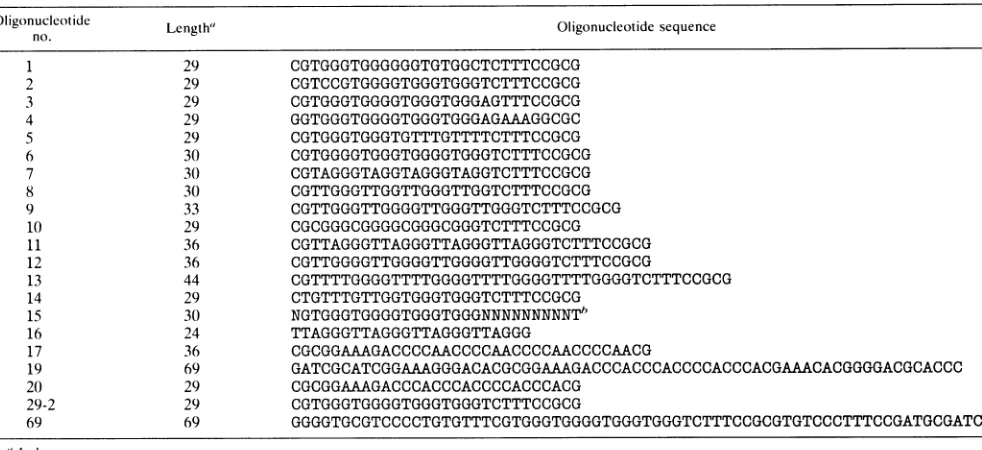
Mutagenesis ofthe binding site of NPP. The 29-base se-quence identified above consisted of two repeats of the 9-base sequence GTGGGTGGG, a C at the 5' end, and 10 additional nucleotides at the 3' terminus. The repeat se-quences resembled the human telomeric sequence repeats (TTAGGG),, and (TTGGGG)n (1, 27). The purpose of this
seriesofexperimentswasto determine, on thebasis of the
resultsobtained in the preceding experiments, (i)thespecific
sequence requirements for the binding of NPP and (ii) the relationship of the optimal bindingsequence tothe consen-susbinding sites of human telomeric proteins and of
tran-scriptional factors. To this end, we synthesized a series of
derivative oligodeoxynucleotides (Table 1, sequences 1 to
15) designed to test (i) the requirement for the sequence
flankingthe9-baserepeat,(ii) the degreetowhich the 9-base repeat could be modified without affecting the binding to
NPP, (iii) the possibility that the repeatsequenceisavariant
of the CACCC box reported in the ,B-globin promoter (28), and (iv) whether the human and other eukaryotic telomeric
consensus sequences react with NPP. The derivative oli-godeoxynucleotides 1 to 15weretested for their abilitiesto compete with the 69-base DNA probe for binding to NPP (Table 2; Fig. 4A) and with the 69-base viral RNAsequence
for the protection conferred by NPP against RNase T1 degradation (Table 2; Fig. 4B). The experimental designwas
identical to that reported for Fig. 2. Figure 4 shows the results of the competitions of all oligonucleotides which competedclosetothelevel of the parentalno.29-2 andsome
of theoligonucleotides which competedatlevels higher than that of no. 29-2. The results grouped according to the hypotheses testedwere asfollows.
(i)Thesequenceflankingthe9-baserepeatisnotrecognized by NPP. Oligodeoxynucleotide derivativesnos. 3, 4,and15
competed with the 69-base oligodeoxynucleotide probe for NPP aswell asthe 29-2 competitor. The results show that
the 5'terminal C(oligodeoxynucleotides 4 and 15) andthe3' terminal flanking sequence TCTTTCCGCG
(oligodeoxynu-cleotides 3, 4, and 15)arenotrequiredfor either DNA(Fig. 4A, lanes 9 to 14and34to 36)or RNA(Fig. 4B,lanes 9 to 14 and 34to 36)recognition. To ruleoutthepossibility that the actualsequenceandnotmerelythelengthoftheflanking
sequence was important, the oligodeoxynucleotide deriva-tives contained nucleotide replacements rather than dele-tions of the flanking sequences. The results obtained with oligodeoxynucleotides 4 and 15 explainthe failure of oligo-nucleotides 29-1 and 18 in the previous series of
experi-ments. Oligodeoxynucleotides 29-1 and 18 both contain the 18 basesofspecificsequenceintheoligodeoxynucleotides4
and 15 required by NPP but lack the nonspecific flanking regionwhich contains transversions inoligodeoxynucleotide 4 and randomsequencesinoligodeoxynucleotide 15. There-fore, NPP requires nonspecificsequences 3' to the binding site and may also require a single-base extension 5' to the binding region.
(ii) NPP tolerates specific mutations within the 9-base
re-peat. Oligodeoxynucleotide derivatives 6 and 9 competed with the 69-baseoligodeoxynucleotide probeforNPPaswell as the 29-2 competitor. The insertion of an additional thy-mine adjacent to the existing thymine (i.e., GTTGGGT TGGG inplaceofGTGGGTGGG)hadnoeffect (oligodeox-ynucleotide9).The results also demonstrated thattherepeat
A
Probe ODny
- CN - N
o o, o. oi d
ao u) V v i C
VOL.66, 1992
on November 9, 2019 by guest
http://jvi.asm.org/
TABLE 1. Nucleotide sequencesof theoligonucleotidestested Oligonucleotide Length" Oligonucleotidesequence
no.~~~~~~~~~~~~~~~~~~~~~~~~~~~~~~~~~~~~~~~~~~~~~~~~~~~~~~~~~~~~~~~~~~~~~~~~~~~~~~~~~~~~~~~~~~~~~~~~~~~~~~~~~~~~~~~~~~~~~~~~~~~~~~~~~~~~~~~~~~~~~~~~~~~~~~~~~~~~~~~~~~~~~~~~~~~~~~~~~~~~~~~~~~~~~~~~~~~~~~~~~~~~~~~~~~~~~~~~~~~~~~~~~~~~~~~~~~~~~~~~~~~~~~~
1 29 CGTGGGTGGGGGGTGTGGCTCTTTCCGCG
2 29 CGTCCGTGGGGTGGGTGGGTCTTTCCGCG
3 29 CGTGGGTGGGGTGGGTGGGAGTTTCCGCG
4 29 GGTGGGTGGGGTGGGTGGGAGAAAGGCGC
5 29 CGTGGGTGGGTGTTTGTTTTCTTTCCGCG
6 30 CGTGGGGTGGGTGGGGTGGGTCTTTCCGCG
7 30 CGTAGGGTAGGTAGGGTAGGTCTTTCCGCG
8 30 CGTTGGGTTGGTTGGGTTGGTCTTTCCGCG
9 33 CGTTGGGTTGGGGTTGGGTTGGGTCTTTCCGCG
10 29 CGCGGGCGGGGCGGGCGGGTCTTTCCGCG
11 36 CGTTAGGGTTAGGGTTAGGGTTAGGGTCTTTCCGCG
12 36 CGTTGGGGTTGGGGTTGGGGTTGGGGTCTTTCCGCG
13 44 CGTTTTGGGGTTTTGGGGTTTTGGGGTTTTGGGGTCTTTCCGCG
14 29 CTGTTTGTTGGTGGGTGGGTCTTTCCGCG
15 30 NGTGGGTGGGGTGGGTGGGNNNNNNNNNTh
16 24 TTAGGGTTAGGGTTAGGGTTAGGG
17 36 CGCGGAAAGACCCCAACCCCAACCCCAACCCCAACG
19 69 GATCGCATCGGAAAGGGACACGCGGAAAGACCCACCCACCCCACCCACGAAACACGGGGACGCACCC
20 29 CGCGGAAAGACCCACCCACCCCACCCACG
29-2 29 CGTGGGTGGGGTGGGTGGGTCTTTCCGCG
69 69 GGGGTGCGTCCCCTGTGTTTCGTGGGTGGGGTGGGTGGGTCTTTCCGCGTGTCCCTTTCCGATGCGATC
Inbases.
N,randiom base.
sequenceGTGGGTGGG couldbereplaced with GTGGGGT GG (oligodeoxynucleotide no. 6).
Oligodeoxynucleotidederivatives 7and 8 didnotcompete in eithertest (data not shown)orbind NPP as measuredby band-shift assays (Fig. 5, lanes 22 and 23). Oligodeoxynu-cleotide derivatives no. 7 and no. 8differfrom no. 6bythe replacement of two guanines within each repeat with ad-enines and thymines, respectively. Oligonucleotides 2, 5,
TABLE 2. Summary ofbindingandcompetitionstudies with
oligodeoxynucleotides
Oligonucleotide Binding" Affinity/
*lO.
ssDNA ssRNA29-2 + +++ +++
1 - + +
2 - + +
3 + +++ +++
4 + +++ +++
5 - _ +/_
6 + +++ +++
7 - _ _
8 - _ _
9 + +++ +++
10 + + +
11 - -
-12 + +++ +++
13 + +++ +++
14 - - +
15 + +++ +++
Bindingwasdetermined bya single-stranded DNAmobility shift assay withtestoligonucleotide aslabelled probe.
"Single-stranded DNA(ssDNA) and ssRNA affinities were determined in ssDNA-binding and ssRNA protection assays with test oligonucleotides as
competitors. Reaction conditions were asreported in the legend to Fig. 4. ssDNAaffinities: + ++, .50%kcompetition at0.25pmol; + +, .50% compe-titionat1.25pmol; +,>50%lccompetition at 6.24 pmol; -,.50%Icompetition at6.24pmol.ssRNAaffinities: +++, .50%kcompetition at 0.05 pmol; ++,
.50%,kcompetition at0.25 pmol; +,>50(%competition at 1.25 pmol;-,.50%)c
competitionat6.24pmol.
and 14 competed less well than the corresponding native sequence in both assays. In no. 2, two guanine residues in the first 9-nucleotide repeat werereplaced with cytosine. In no. 14, the 5' half ofthe 18-basesequence was transversed, i.e., only one intact 9-base repeat plus 1 nucleotide of the native 18-base sequence were present in this oligonucleo-tide. In no. 5, the 3' half of the 18-base sequence was transversed. Nos. 5 and 14 both contain within the HSV conserved sequence aclose approximation (12 of 13 bases) of the consensus site of RAP1 (2), a yeast transcriptional factor(37) and telomere-bindingprotein (3, 5, 18). Oligode-oxynucleotide derivative no. 10 behaved in an anomalous fashion. Thus, replacement of the thymines with cytosines (oligodeoxynucleotide no. 10) had noeffect in competitions for RNase protection (Fig. SB, lanes 23 to 25) but has a variable effect on the ability of the oligodeoxynucleotide derivative to compete with the DNA probe. In the experi-ment shown in Fig. 4, no. 10 competes less efficiently than no.29-2(Fig. 4A, lanes 23to25), while in otherexperiments, the oligodeoxynucleotide competed aswellas 29-2.
(iii) The oligonucleotide 1 containing the variant CACCC boxreported inthe
0-globin
promoter(28) does not compete for NPP or form characteristic oligonucleotide-NPP com-plexes. Oligodeoxynucleotide derivative 1 competed in DNA-bindingor RNAprotection assaysonly at high levels (6.25 pmol [DNA], 1.25 pmol[RNAI),
and in band-shift assays oligodeoxynucleotide 1 did not form a band which comigrated with or resembled in its mobility 29mer-NPP complexes (datanot shown).(iv) NPP reacts with some human and other eukaryotic telomeric consensus sequences. Oligodeoxynucleotide deriv-atives12 and 13 could not bedifferentiated from the oligode-oxynucleotide29-2 with respect to their abilities tocompete with the 69-base oligodeoxynucleotide probe for NPP. Oli-gonucleotide 12, which contained fourrepeatsof the human telomeric sequence
YTGGGG
(1), and oligonucleotide 13, which contained four repeats of theOxytricha
telomeric sequenceTTTTGGGG (12), competedwithequal efficiencyon November 9, 2019 by guest
http://jvi.asm.org/
[image:6.612.65.556.93.318.2]DNA-RNA G REPEAT BINDING PROTEIN 3441 OligodeoxynucleotideCompetitor
A pm29-21 pm2 pm3 pm4
ppinm
PM PM6 pm9 j10 pml2lpm13 pml4 pm 15+ e In w m <I eno mnn mW I n v in -n
_ cN co O.CcN IcNO CNI'lcolO.c N O. co O.ICNO.C Co ONONC C
X. X.- O i-o0c-00 -OcI - Oc O1' C- cI OOi
-X4
.4flM
a -A aIWJ/
1 2 3 4 5 6 7 8 9 101112131415161718 9 20321 24 52682782930313233 34 3536
B 29-2 pm2 pm3 pm4pm5 pm6 pm9 pm10 pm12 pm13 pm14 pm15
1.+ oC4eC4 %C4 clCl R cc Coo m Cl C4 C oi'm
eIC
o No0 cm C> A.a d -o _6 6 o - - o._ v o c_c 6 _ o6o 6 A- 6 o__fa hfl fesdaaiafnfl a , n
N
~
-1 2 3 4 5 6 7 8 9101112131415 16 17181920212223242526272829303 32 33
FIG. 4. Autoradiographicimages of complexes formed by NPP with single-stranded DNA (A) or RNA (B) in the presence of nucleic acid
competitors. Oligonucleotide69radiolabelled with T4 polynucleotide kinase was the probe for panel A. The plasmid pRB3953 was linearized
atthepolylinkerRsaIsite, and in vitro transcription with SP6 polymerase yielded a 100-nucleotide radiolabelled probe for panel B. Lanes: 1, DNA(A)orRNA(B)radiolabelled probe (Pr.) in the absence of NPP; 2 (B), RNaseT1 digestion of the radiolabelled RNAprobe in the absence of NPP; 2 (A) and 3 (B), level of NPP-DNA binding and NPP-RNA binding-protection by the 25 to 50% ammonium sulfate
fractionatednuclearextract(Prot.)in theabsence ofspecificcompetitor; 3 to 36 (A) and 4 to 36 (B), lanes containing a competitor DNA, with thecompetitor oligonucleotideinpicomoles (pm) indicated above the lanes (the sequences of the oligonucleotide competitors are given in Table2);4 to 6(A)and 5 and 6(B), competition of the NPP-nucleic acid complex by oligonucleotide 29-2, the parent oligonucleotide for the derivatives tested in thisfigure.The reaction conditions were as described in Materials and Methods.
in bothcompetition assays(Fig.4, lanes 26 to31). Oligode-oxynucleotide derivative 11 did not compete in either test (data not shown) or bind NPP as measured by band-shift assays (Fig. 5, lane 26). It has been reported that the TTAGGG sequence ofoligodeoxynucleotide 11corresponds to the terminal human telomeric sequence (1, 25, 27). The sequencesTTGGGGand TGAGGG alsohybridizetohuman telomeres and are located centromere proximal to the se-quenceTTAGGG(1). The sequence TGAGGG hasnotbeen tested for its abilityto bindNPP.
To investigate further the binding requirements of NPP, theoligodeoxynucleotide derivatives 1 to 15(Table 1)were labelled and used as probes in the single-stranded
DNA-binding reaction. The results (Table 2andFig. 5) show that theoligodeoxynucleotide derivatives nos. 3, 4, 6, 9, 10, 12, 13, and15, which competed with the native oligonucleotide 29-2 efficiently, also formed complexes whose electropho-retic mobilities were similar tothat of the NPP-DNA com-plex. Two observations are noteworthy. First, these com-plexes did not comigrate; the migration depended on the length of the oligonucleotide derivative, which varied from 29 to 44bases.Second, theoligodeoxynucleotidederivatives 1, 2,5, 7, 8, 11, and 14, whichwereinefficientcompetitors, also did not form complexes which could be identified as involving NPP inasmuch as the mobilities of the bands formedin the presenceof the ammonium sulfatefraction of VOL.66, 1992
on November 9, 2019 by guest
http://jvi.asm.org/
[image:7.612.152.466.76.500.2]A B
Probe Only Probe Protein
(N
(N;W~ijFi
uc r9 vvC
-No
~AA
W
W
12 3 4 5 6 7 8 91011121314151617181920212223 2425262728 2930
FIG. 5. Autoradiographic image of labelled oligodeoxynucle-otide derivatives listed in Table 2 reacted with NPP and electro-phoretically separated in nondenaturing gels. (A) Mobilities of single-stranded DNAs radiolabelled with T4polynucleotide kinase in theabsence ofNPP.Oligodeoxynucleotide numbersareindicated
abovetheappropriate lanes. (B) Mobilities of single-strandedDNAs
reacted with the 25 to50%ammonium sulfate fractionated nuclear
extract.Oligodeoxynucleotide numbersaregiven above the
appro-priate lanes. The positions of the NPP-DNA complexareindicated
bydots.The reactionconditionswere asdescribed in Materialsand
Methods.
the HeLa nuclear extract did not migrate in a position
characteristic ofother NPP complexes with oligodeoxynu-cleotides ofsimilar length (datanot shown for oligonucleo-tide 1).
Single-stranded oligodeoxynucleotidescontaining the HSV-1 NPP cognate site migrate anomalously in native polyacryl-amidegels.Telomericsequenceshavebeenreportedtoform intra- and intermolecular structures that are apparent by
theiranomalous migrationin nondenaturing gels (10,40,43). The purpose ofthis series of experiments was todetermine (i) whether the oligodeoxynucleotides containingthe HSV-1
NPP cognate site exhibit anomalous mobilities on native
polyacrylamide gels, (ii) whether telomeric sequences
flankedby the 3' HSVsequenceexhibit the samebehavior,
and(iii)whether therewas anapparentrelationshipbetween electrophoretic behavior and sequences bound by NPP.
Three series of experiments were done.
In thefirst series of experiments, single-stranded oligode-oxynucleotides containing sequences bound by NPP (nos.
12, 29-2, and 69), the reverse complements of sequences
boundbyNPP (nos. 17, 20, and 19; Table 1),or sequences
notbound byNPP(nos. 16 and 11; Table 1)were subjected
to electrophoresis under conditions similar to those
de-scribed by Henderson et al. (10). Specifically, samples containing 2 nM radiolabeled oligodeoxynucleotides in 10
mMTris (pH 7.5)-l mM EDTAwere heatedto 95°C for 2 min, placed atroom temperature for 4min, adjusted to5%
glycerol,equilibratedat38°C(Fig.6A)or4°C(Fig. 6B) for 10 min, and subjected to electrophoresis in the same environ-ment through 12% polyacrylamide gels at 1.8 mA constant current for 19 h.Theautoradiograms(Fig. 6) showthat(i)all oligodeoxynucleotides migrated slightly faster at 4 than at 38°C (compared with the migrations of the xylene cylanol [top arrow] and bromophenol blue [bottom arrow]), (ii) oligodeoxynucleotides 69, 29-2,and 16migrated much faster at 4 than at38°Ccompared with the other oligodeoxynucle-otides tested (Fig. 6, lanes 1 and 9, 5 and 13, and 7 and 15), and (iii) in contrast tothetemperature-dependent mobility of no. 16, oligodeoxynucleotide 11, which contains the HSV flanking sequences, shows only a slight increase in mobility at40C (compare lanes 1 and 9 with 2 and 10 in Fig. 6).
The conclusions from this series of experiments were that (i) the electrophoretic mobilities of both oligodeoxynucle-otides69 and 29-2, which contain the HSV NPP cognate site, were affected by the temperature of theelectrophoresis; (ii) at least one oligodeoxynucleotide derivative (no. 12) which bound NPPdid not show the sameelectrophoreticbehavior; and (iii) atleast one oligodeoxynucleotide derivative, no. 16, which did not bind NPP showed the same electrophoretic behavior.
The second series of experiments examined the possible cation stabilization of DNA conformations of the HSV NPP cognate site under conditions similar to those described by Williamson et al. (43). The experimentaldesign was the same as that described above for Fig. 6B except that 50 mM NaCl was added to the sample prior to the denaturation step. The sample was then subjectedto electrophoresis for 20 h (1,875 V/h) at 4°C. Both the gel andthe runningbuffercontained 50 mM NaCl. The results (Fig. 6C) showed that (i) relative to the marker dyes, all oligodeoxynucleotides increased in migrationmobility in the presence of 50 mM NaCl (compare relative mobilities in Fig. 6B and C) and (ii) for each complementary pair of oligodeoxynucleotides (nos. 12 and 17, 29-2 and 20, and 69 and 19), the electrophoretic mobility at 4°C in the presence of 50 mM NaCl was reversed compared with migration at 38°C in the absence of the salt (compare Fig. 6A and C). Theconclusion for this experiment was that there were no obvious differences between G-rich oligonucleotides which bound NPP and those that did not (compare oligonucleotides 11, 12, 29-2, and 69).
The thirdseries ofexperiments (Fig. 6D andE)examined thebehavior ofsingle-stranded oligodeoxynucleotides under conditions similar to those reported by Sundquist and Klug (40). Samples containing 1 ,uM oligodeoxynucleotides in a solution containing 10 mM Tris (pH 7.5), 1mM EDTA, and NaClconcentrations ranging from 0 to 500mM were allowed toreact at roomtemperature for 48 h. Afterbeing adjusted to 5% glycerol, the samples were subjected to electrophoresis at 40Cthrough a 10% nativepolyacrylamide gel. The results showed that (i) single-stranded oligodeoxynucleotide 29-2 (Fig. 6D, lanes 32 to 38) migrates predominantlyas asingle band, but high concentrations of NaCl produced a more slowlymigrating band, indicated with a star by lane 38 (the gel cracked upon drying,producing an artificial doublet) and (ii) incontrast, oligodeoxynucleotides 69 and 12 migrated as single species at allconcentrations of NaCl (Fig. 6E, lanes 39 to 45 and 25 to 31). Itshould be noted thatthe band marked with a star by lane 38 was visible on a longer exposure of this gel atconcentrations of .200 mM NaCl,whereas no more slowly migrating species was visible with oligodeoxynucle-otide 69 or 12. Theconclusion from this experimentwas that not alloligonucleotides which bound were capable of form-inghigher-order structures under the test conditions.
on November 9, 2019 by guest
http://jvi.asm.org/
[image:8.612.67.304.75.336.2]DNA-RNA G REPEAT BINDING PROTEIN 3443
-0
V
' 6
9
0
4p
1 2 3 4 5 6 7 8 9 1011121314 1516 17181922 21 2223 24 2526 27 28 293031 32 33 34 35363738 9404142434445
FIG. 6. Autoradiographic imageofsingle-strandedoligonucleotides listed in Table 2 radioactively labelled with T4 polynucleotide kinase and separated in nativegels. The temperatures of electrophoresis are indicated on the top line of the figure. (A and B) Samples containing 2 nMoligodeoxynucleotide in 10 mM Tris (pH7.5)-l mM EDTA were heated to 95°C for 2 min, placed at room temperature for 4 min,
adjustedto5%glycerol,equilibratedat38°C (A) or 4°C (B) for 10 min, and subjected to electrophoresis in the same environment through a 12%polyacrylamidegel. (C) Samples were treated as described for panel B except that 50 mM NaCl was added to the DNA prior to treatment
at95°Cand thegelandrunningbuffer contained 50 mM NaCl. Forpanels A to C, oligodeoxynucleotide numbers are indicated immediately above the lanes. Arrows indicate the positions of xylene cylanol (top) and bromophenol blue (bottom) at the end of the electrophoresis. (D andE) Samples containing1,uMoligodeoxynucleotidein asolutioncontaining 10 mM Tris (pH 7.5), 1 mM EDTA, andNaCIconcentrations
ranging from0 to 500mM,indicated immediatelyabove each lane, were incubated at room temperature for 48 h, adjusted to 5% glycerol, and
subjected to electrophoresis at 4°C through a 10% polyacrylamidegel. Oligodeoxynucleotide numbers are indicated. The star in lane 38
indicates the position ofthe band formed by oligonucleotide 29-2.
We conclude from these three series ofexperiments that (i) the HSV sequences in theregion of the NPP cognate site can potentially exist as at least three electrophoretically distinct conformations, although the native gels shown are notsufficient todefine the natureof theconformations, and (ii) we were unable to correlate NPP binding andstructure formation.
A 100,000-molecular-weight protein with NPP-binding characteristicswasfootprinted by cross-linkingof theprotein tolabelled RNA. In this series ofexperiments, labeled RNA containing the 69-base viral sequencewas reacted with the HeLa cell nuclear extracts, digested with RNase T1, ex-posed to UV light to cross-link NPP to the RNA, and extensively digestedwith RNase A and T1. The digestwas then electrophoretically separated on denaturing polyacryl-amide gels. Two series ofexperiments as described in the legend to Fig. 7were done. The first series, shown in Fig. 7A, demonstrated thespecificity oftheprotein cross-linked to the RNA by including an unlabeled competitor, either M13 single-stranded DNA or the 69-base
oligodeoxynucle-otide (Fig. 1C), in the reaction mixture. The second series, shown in Fig. 7B, dealt with the protein requirement for
complex formation and with the length of exposure of the reaction mixture to UV light for labelling the protein. The results may be summarized as follows. (i) UV light cross-linking resulted in RNase-resistant labeling of proteins which formedtwocloselymigrating bandsfollowing RNase diges-tion (Fig. 7A, e.g., lane 2) andasingle band in the absence of RNase digestion following cross-linking (Fig. 7A, e.g., lane 15). The electrophoretic mobilities of these bands corresponded to those ofproteinswith apparent molecular weights ofapproximately 100,000. Extensive digestion ofthe cross-linked mixture with RNase T1 and A did not signifi-cantlyalter theelectrophoretic mobilities of the bands(data not shown). In competition assays, the addition of excess M13mpl8 single-strandedDNAdidnotblock the formation of the band(Fig. 7A,lanes6and8), whereas the additionof mixtures containing an excess unlabelled 69-base DNA probe precluded the formation ofthe band(Fig. 7A,lane4). The bands did not form in the absence of nuclear extract (Fig. 7A, lanes 3, 5, 7, and 9). The decreased amounts of radioactivity in lane 6 compared with those in lane 2 may reflectan inhibition ofNPPbindingandnotcompetition by the M13 DNA, since increasing the amount of M13 DNA VOL.66, 1992
A 38a B. 40 c - 40 D. 40 E. 4a
2nMOligo+TE 2nMOligo4.TE 2
nM01go+TE+50mMNaCi
lumOligol2+mMNaCl'ljiMOligo2g-2+mmw
Ipmoligo69+MMWCN CN
.C-;--.-- .--KC)Cl.7),R. 'o ;=51, !,- 0 %., 0 0, 0, 0 0O80 00C. 000 CD0 C. 0 CCD0 C) 10co000
C4 .p:::.'-! .-, 14C',. G c, ,) 2Rmlw-1 0In C'Wel'I 'n C. 114 roIqIn
on November 9, 2019 by guest
http://jvi.asm.org/
[image:9.612.108.504.76.379.2]A
0.6811X
M r - No Spe .
i1000' Como. Oligo.
_
W
075J1g M13
3.0Mg M13
Minute UV
15'
30T
200 _
.1
69 *
1 2 3 4 5 6 7 8 9 10 11 1 2
NucExt.+ - - + - + - NkucExt.- +
-BSA + + +Prot.K + + _
13 14 15 16 17 18 19
+ - + - + +
FIG. 7. Autoradiographic image of the products of RNase T1 protection and UV cross-linking separated in sodium dodecyl
sulfate-polyacrylamide gels.In vitrotranscriptionof the linearizedplasmid pRB3953 bySP6polymerase yieldeda100-nucleotideradiolabelledprobe.
The RNAwasreacted withNPP,cross-linked with UVlight,andsubjected toelectrophoresisas describedin Materials and Methods.(A) Autoradiogram of "'C-labelledproteinmolecularweightmarkers from Amersham(lane 1)andadjacently paired reactions, identicalexcept
for theprotein (7.5 ,ugofNPP-containingnuclearextract [Nuc. Ext.][lanes 2, 4, 6,and8]or7.5 jigof bovineserumalbumin [lanes3, 5, 7, and9]),areshown. The RNAbinding-protectionassayfor lanes 2 and 3 containednoadded nucleic acidcompetitor (comp.),whereasspecific competitoroligonucleotide (lanes4 and 5) or nonspecific competitorDNA (single-stranded M13mpl8 DNA)wereadded to the binding-protectionassayfor thesamples in lanes 6to9."Spec. Oligo."referstooligodeoxynucleotide 69(Fig. 1). (B)The lanes shownwerefrom
thesamegelandarederived from thesameautoradiogram.Values abovethe lanes indicate the reactions'exposuretoUVlight (inminutes).
The lanes inpanel B representpaired reactions,thatis,the addition of HeLa nuclearextract(oddlanes)isdenotedbyaplusin the first line
below the figure, and the absence of added protein (even lanes) is denoted by a minus. Proteinase K(Prot. K.) digestion following cross-linkingis indicatedbyaplus.
does not further decrease the amount ofradioactivity (Fig. 7A, lane8). (ii)The formation of the labeled bandsrequired
exposure toUVlight (comparelanes 13 and 15 in Fig. 7B), but cross-linking was complete after 15 min of exposure
(comparelanes15, 17,and 19 inFig. 7B). The bands didnot
form inextracts digestedwithproteinaseKfollowing
cross-linking (Fig. 7B, lane 11).
Weconclude from theseexperimentsthat NPP consists of
one or more polypeptides with a sum apparent molecular weight of100,000.
DISCUSSION
Inthis study, wehave identified and mappeda sequence
whichbindsacellularproteinaseitherasingle-strandedor a
double-stranded RNA or DNA. We have designated this
protein a nucleic-acid-protective protein (NPP) by its most
obvious property. The salient issues arethe significance of
thesequenceand its location inthe HSV-1 genome.
Thenature ofthe cognate sequence. Our results and their
significanceare asfollows.
(i) The cognate sequence is [G(T/U)GGG(T/U)GGG]2,
although additional nonspecific 3' nucleotides are required
andanadditional 5' nucleotidemayberequired.Thebinding of NPP is not affected by the insertion of one or three
additional thymine/uracil residues adjacent to the existing thymine/uracil residues. Bindingdoes require thepresence
ofat least three consecutive guanineresidues inasmuch as
substitution ofaguaninewith adenineorthymine abolished
thecapacityof theoligodeoxynucleotidetocompetewith the native sequence in eitherRNase T, protection assays orin
single-stranded DNAband-shift experiments.
Precisely how much of the 18-bp sequence is incontact
with NPPand how muchis requiredtoprovide thesequence
with a specific conformation is not known, although the substitution of some guanineswith cytosines in one of the
9-baserepeatsreduced thecapacityofthe oligodeoxynucle-otidederivativetocompeteagainsttheoligodeoxynucleotide withthe native sequence (oligodeoxynucleotide no. 2). The
18-base sequence is not sufficient to bind stably or to
competefor NPP in that 3'flankingsequences appeartobe required. The minimal size of the 3' flanking sequence has
notbeen determined. Furthermore,the5'-terminal cytosine had notbeen deleted in any of the oligodeoxynucleotides, althoughit has beenreplacedwith other bases. It is therefore B
.m
I
---I-5
f---on November 9, 2019 by guest
http://jvi.asm.org/
[image:10.612.161.466.79.375.2]DNA-RNA G REPEAT BINDING PROTEIN 3445 notknown whether anonspecific single-base extension 5' to
thebinding region is required for NPP binding.
The sequence of a nucleic acid that contains a protein-binding site may contribute to the specificity of protein-binding both by participation in specific base-protein contacts and by adopting a sequence-dependent backbone conformation. It seems likely that both mechanisms are involved in the binding of NPP to its cognate site. The NPP cognate site mustbe capable of adopting an NPP-recognizable conforma-tion in single- and double-stranded DNA and RNA, and we have suggested previously (32) that NPP itself may impart a common conformation to the sequences. Scant data, based solely on the observation that heat denaturation of RNA increases the binding of NPP, suggest that there is some conformation-specific component of the binding of NPP to single-stranded RNA. It is not yet clear whether this obser-vation reflects a requirement for particular secondary struc-ture elements in the probe or, rather, a requirement for an extended conformation without intramolecular base pairs. This latter possibility is more likely, since the double-stranded DNA and RNA cognate sitesarealmostcertainly in anextended conformation.
(ii) The cognate sitein the double-stranded form contains a potential binding site for the CACCC-box-binding factor (28) and in the single-stranded form apotential binding site for the human telomerase (25). The affinity studies using single-stranded oligodeoxynucleotides, however, do not supportthehypothesis thatNPPis relatedtoeither of these factors. Thus, the oligonucleotide used by Morin (25) to identify the human telomerase, the sequence[(TTAGGG)4] but without the flanking HSV-1 sequences (derivative no. 16), was tested without effect in the competition assays described above (data not shown). The implication of this result is that NPP does not appear to be a known human telomeric-binding protein and isnotof the class ofproteins identified in
Oxytricha
nova which protect the telomeres fromexonucleolytic degradation (9).The relationship of the native HSV sequence to other well-known telomeric repeat sequences has not been fully resolved. Our results indicate that the telomeric sequence repeats containing adenine do not compete with HSV-1 sequencesforNPP, whereas those that differ fromthenative sequencein the number ofthymines do compete. Itshould be noted that therepeatedsequencesfoundattelomeresare locatedatothersiteson the genome and that the analogous sequencesin yeastscanshow bothtranscriptional enhance-mentandsilencing.In yeasts, the telomeric sequences have been shownto function asupstream activators of transcrip-tion when the reporter gene is locatedon aplasmid (3, 33).In contrast, Gottschling et al. (8) havereported the transcrip-tional silencing of reporter genes placed near telomeres, whereas the same sequences show no repressor activity wheninsertednearthe reporter gene located 20 kb from the chromosome end. The sequenceGGGTGGGTGGGGTGGG has beenreportedupstreamof themouseanionantiportgene (13), and the sequence GGGGTGGGTGGGGTGGG has been located upstream of the human leukosialin gene
(15).
The function of these sequences in these locations is un-known; however, for the leukosialin gene, the overlapping sequence GGGTGGGTGGAGCC isimplicatedinthe tissue-specific expression of this gene.
(iii)G repeats characteristic of theNPPcognatesite have been studied extensivelybecause such sequences are capa-bleofforming unusual higher-orderDNAstructures. It has been suggested that the sequences foundin telomeres may exist in intramolecular
associations,
including
G quartets(43), single- or double-hairpin structures (10), or pseudo-knots (10); as dimers involving G quartets (40, 43); or in antiparallel or parallel triplex or quadruplex structures in-cludingorexcludingthecomplementarystrand(16, 29, 35). We have presented evidence that the HSV-1 NPP-binding region canform higher-orderstructuresapparent upon elec-trophoresis under appropriate conditions. Raghuraman and Cech (30) have shown that the
Oxytricha
telomere-binding protein binds neither to a DNA comigrating with the pro-posed intrastrand structure following cross-linking of this structure nor to methylated DNA incapable offormingthe intrastrand structure. For NPP, the conditions for optimal bindingto oligonucleotidesdescribed in this report werein contrast totheconditions necessary for the demonstration of higher-order oligonucleotide structures. Thus, binding of NPP increases as the temperature of the binding reaction mixture increases from 0 to 37°C, and binding remains constantfrom 37to42°C (datanotshown). Nevertheless,the questionsof whetherNPPrequiresaspecific conformation, whether itimpartsone, and whether itcan bind oligonucle-otides in higher-orderstructuresremain unresolved.(iv) A search of the 18-base sequence GTGGGTG GGGTGGGTGGG orof the mutated sequences which bind stronglytoNPP(i.e.,the G repeat ofoligodeoxynucleotides nos.6,9, 10, 12,and 13in Table1)failedtodetecthomologs in thepublishedsequenceofHSV-1(17) (21, 22).Itshould be noted that inHSV-1(17),thehomologoussequencecontains a cytosine in place of the fourth thymine. Inasmuch as substitution of all four
thymines
withcytosines
does not affect thebindingofsingle-stranded probe (Table 2, mutant 10),weexpect that thesinglesubstitution ofathyminewith acytosineshould havenosignificant
effectonthebinding
of NPP tothe sequence.The biological functions of the cognate sequence and of NPP.The cognate sequence which attractedourattention is locatedat aposition
extending
fromnucleotide -1to nucle-otide -19 relative to thetranscription
initiation site of the majorOrisRNA.
We conclude from this observation that, since NPPcannotbind the major species oftheOrisRNA,
theprobability
that its function is to bindsolely
the minor species is likely to be remote. In its interactions with the DNA,NPPcould sustain the cognate sequence inaspecific
conformation,
but towhatpurpose?
At thistime, theonly
potential
function forNPPin HSV infection appearstobe relatedtothepositionof the cognate sequenceimmediately
5'tothetranscription
initiation siteof themajor
OrisRNA
species
and 3' to thetranscription
initiation site of the
remaining
heterogeneousspecies
ofOrisRNA.
The function ofOrisRNA
is not known. This RNA doesnotappearto encodeapolypeptide,
and detect-able amounts ofOrisRNA
become apparentduring
the waning hours of viral DNAsynthesis
rather than at itsinception.
Onehypothesis
that is testable is thatNPPservestoblock the
synthesis
ofOrisRNA
until eitherviral factorsdislodge
NPPoritsactivity
is inactivated. Thishypothesis
isbeing
tested.The apparent molecular
weight
of the NPPactivity
ap-pears tobeapproximately 100,000.
Herpesviruses
encodealarge number of
proteins,
and many oftheseproteins
dupli-catethe functions of the hostcells. We have notdetecteda
viral protein with
affinity
for the cognate sequence, andtherefore,
if NPP isrequired
forviralreplication,
the virus appears todepend entirely
on the host toprovide
it. In preliminarystudies,
wehave found that NPPactivity
could bereadily
detectedinvirtually
everymurine organtested. If in fact NPPactivity
is present in all cells which HSV-1VOL.66, 1992
on November 9, 2019 by guest
http://jvi.asm.org/
infects, the virus need not encodea genewhichexpresses a
similar function. The puzzle, however, is that if the protein is in factasabundant as itappears tobe, whyhasits unique affinity for a sequence in the form of either single- or
double-stranded RNAor DNA escaped attention?
ACKNOWLEDGMENTS
These studies were aided by grants from the National Cancer
Institute (CA47451) and the National Institute for Allergy and Infectious Diseases (AI124009 and AI1588), U.S. Public Health
Service. L.M. isapredoctoraltraineesupported byatraininggrant from theNational Cancer Institute(CA09273-14).
REFERENCES
1. Allshire, R.C., M. Dempster, and N. D. Hastie. 1989. Human telomeres contain atleast three types ofG-rich repeat distrib-uted non-randomly. Nucleic AcidsRes. 17:4611-4627.
2. Buchman,A.R.,W.J. Kimmerly, J. Rine,and R.D.Kornberg.
1988. TwoDNA-bindingfactorsrecognizespecificsequencesat
silencers, upstream activating sequences, autonomously repli-catingsequences, and telomeres inSaccharomyces cerevisiae.
Mol.Cell. Biol. 8:210-225.
3. Buchman,A.R.,N.F.Lue,and R.D.Kornberg. 1988.
Connec-tions between transcriptional activators, silencers, and telo-meres as revealed by functional analysis of a yeast
DNA-bindingprotein. Mol.Cell. Biol.8:5086-5099.
4. Chou,J., and B. Roizman. 1990. The herpes simplex virus 1
geneforICP34.5,whichmapsininverted repeats,isconserved
inseveral limited-passage isolatesbut not instrain 17syn+. J.
Virol.64:1014-1020.
5. Conrad, M. N., J. H.Wright, A.J. Wolf, andV. A. Zakian. 1990. RAPI protein interacts with yeast telomeres in vivo: overproductionalterstelomerestructureand decreases chromo-somestability. Cell63:739-750.
6. Dignam, J. D., R. M. Lebovitz, and R. G. Roeder. 1983.
Accurate transcription initiation by RNA polymerase II in a
soluble extractfromisolatedmammalian nuclei. Nucleic Acids Res.11:1475-1489.
7. Ejercito,P.M., E.D.Kieff,and B.Roizman. 1968.
Characteri-zationofherpes simplexvirusstrainsdifferingintheir effectson
socialbehaviour ofinfected cells. J. Gen. Virol.2:357-364.
8. Gottschling, D.E.,0. M.Aparicio,B. L.Billington, and V. A.
Zakian. 1990.PositioneffectatS.cerevisiae telomeres:
revers-iblerepressionofPol IItranscription.Cell63:751-762.
9. Gottschling, D.E.,and V. A.Zakian. 1986. Telomereproteins: specific recognition and protection of the natural termini of
Oxytrichamacronuclear DNA.Cell 47:195-205.
10. Henderson, E., C. C. Hardin, S. K. Walk, I. Tinoco, Jr., and
E. H.Blackburn. 1987. TelomericDNAoligonucleotides form
novel intramolecular structures containing guanine-guanine
base pairs.Cell51:899-908.
11. Hubenthal-Voss, J.,L.Starr,andB.Roizman.1987. Theherpes simplexvirusoriginsof DNAsynthesisin theScomponentare
each contained in a transcribed open readingframe. J. Virol.
61:3349-3355.
12. Klobutcher, L. A., M. T. Swanton, P. Donini, and D. M. Prescott. 1981. Allgene-sizedDNAmoleculesinfourspecies of hypotrichshave thesame terminalsequenceand anunusual 3' terminus.Proc.Natl. Acad. Sci.USA 78:3015-3019.
13. Kopito, R. R., M. A. Andersson, and H. F. Lodish. 1987. Multiple tissue-specific sites oftranscriptional initiation of the mouse anion antiport gene in erythroid and renalcells. Proc. Natl. Acad. Sci.USA84:7149-7153.
14. Kristie,T.M.,andB.Roizman. 1986. ox4,the majorregulatory
proteinofherpes simplexvirustype1,is stablyandspecifically associatedwithpromoter-regulatory domains ofotgenesandof
selected otherviralgenes.Proc.Natl.Acad. Sci. USA
83:3218-3222.
15. Kudo, S., and M. Fukuda. 1991. A short, novel promoter sequenceconfers theexpressionofhumanleukosialin, amajor sialoglycoproteinon leukocytes. J. Biol. Chem.266:8483-8489.
16. Lipps, H.J., W.Gruissem, andD. M. Prescott. 1982. Higher
order DNAstructurein macronuclear chromatinofthe hypotri-chous ciliate Oxytricha nova. Proc. Natl. Acad. Sci. USA 79:2495-2499.
17. Liu, F., and B. Roizman. Unpublished data.
18. Longtine, M. S., N. M. Wilson, M. E. Petracek, and J. Berman. 1989. A yeast telomere binding activity binds to two related telomere sequence motifs and isindistinguishable fromRAP1. Curr. Genet. 16:225-239.
19. Mackem, S., and B. Roizman. 1980. Regulationofherpesvirus macromolecular synthesis: transcription-initiation sitesand
do-mains of cx genes. Proc. Natl. Acad. Sci. USA77:7122-7126.
20. Marsden,H.S., J. Lang, A. J. Davison, R. G. Hope, and D. M. MacDonald. 1982. Genomic location and lack of
phosphoryla-tion of the HSV immediate-early polypeptide IE 12. J. Gen.
Virol. 62:17-27.
21. McGeoch, D. J., M. A. Dalrymple, A. J. Davison, A. Dolan,
M.C. Frame, D.McNab, L. J. Perry, J. E. Scott, and P. Taylor.
1988. Thecomplete DNAsequence of the long unique region in
the genome of herpes simplex virus type 1. J. Gen. Virol. 69:1531-1574.
22. McGeoch, D. J., A. Dolan, S. Donald, and F. J. Rixon. 1985. Sequence determination and genetic contentof the shortunique region in the genome of herpes simplex virus type 1. J. Mol. Biol. 181:1-13.
23. Mocarski, E. S.,and B.Roizman. 1981. Site specific inversion
sequence ofherpes simplex virus genome: domain and struc-tural features. Proc. Natl.Acad. Sci. USA 78:7047-7051.
24. Mocarski, E. S., andB. Roizman.1982.Herpesvirus-dependent
amplification and inversion of cell-associated viral thymidine
kinase gene flanked by viral a sequencesandlinked to anorigin
ofviral DNAreplication. Proc.Natl. Acad. Sci. USA
79:5626-5630.
25. Morin, G. B. 1989. The human telomere terminal transferase enzyme is a ribonucleoprotein that synthesizes TTAGGG re-peats. Cell 59:521-529.
26. Morse, L. S., L. Pereira, B.Roizman, andP.A. Schaffer. 1978.
Anatomy of herpes simplex virus (HSV)DNA. X. Mappingof
viral genes by analysis of polypeptides andfunctions specified
byHSV-1 XHSV-2recombinants. J. Virol. 26:389-410.
27. Moyzis, R. K., J. M. Buchingham, L. S. Cram, M. Dani, L.L.
Deaven, M. D. Jones, J. Meyne, R. L. Ratliff, and J.-R. Wu.
1988. A highly conserved repetitive DNA sequence, (TTAG
GG),,
present at the telomeres of humanchromosomes. Proc.Natl. Acad. Sci. USA 85:6622-6626.
28. Myers, R. M., K. Tilly, and T. Maniatis. 1986. Fine structure
genetic analysis of a P-globinpromoter.Science232:613-618.
29. Oka, Y., and C.A. Thomas, Jr.1987. Thecohering telomeres of
Oxytricha. Nucleic Acids Res. 15:8877-8898.
30. Raghuraman, M. K., and T. R. Cech. 1990. Effect of monova-lentcation-induced telomeric DNA structure on the binding of Oxytricha telomeric protein. NucleicAcidsRes. 18:4543-4552.
31. Roizman, B. 1979. The structure andisomerization ofherpes
simplex virus genomes. Cell16:481-494.
32. Roller, R. J., A. L. McCormick, and B. Roizman. 1989. Cellular proteins specifically bind single- and double-stranded DNAand RNA from the initiation site of a transcript that crosses the
origin of DNA replication of herpes simplex virus 1. Proc. Natl. Acad. Sci. USA 86:6518-6522.
33. Runge, K. W., and V. A. Zakian. 1990. Properties of the transcriptional enhancer in Saccharomyces cerevisiae telo-meres. Nucleic Acids Res. 18:1783-1787.
34. Sambrook, J., E. F. Fritsch, and T. Maniatis. 1989. Molecular cloning: a laboratory manual, 2nd ed. Cold Spring Harbor Laboratory, Cold Spring Harbor, N.Y.
35. Sen, D., and W. Gilbert. 1988. Formation of parallel four-stranded complexes by guanine-rich motifs in DNA and its implications for meiosis. Nature (London)334:364-366.
36. Sheldrick, P., and N. Berthelot. 1975. Inverted repetitions in the chromosome of herpes simplex virus. Cold Spring Harbor Symp. Quant. Biol. 39:667-678.
37. Shore, D., and K. Nasymth. 1987. Purification and cloning of a DNA binding protein from yeast that binds to both silencer and activator elements. Cell 51:721-732.
on November 9, 2019 by guest
http://jvi.asm.org/
DNA-RNA G REPEAT BINDING PROTEIN 3447 38. Spaete, R. R., and N. Frenkel. 1985. The herpes simplex virus
amplicon: analysis of cis-acting replication functions. Proc. Natl. Acad. Sci.USA 82:694-698.
39. Stow,N.D.1982. Localization ofanorigin of DNA replication withintheTRs/IRsrepeated region of the herpes simplex virus
type 1genome. EMBO J. 1:863-867.
40. Sundquist, W. I.,andA.Klug. 1989. Telomeric DNA dimerizes by formation of guanine tetrads betweenhairpin loops. Nature (London) 342:825-829.
41. Wadsworth,S., G. S. Hayward, and B. Roizman. 1976.Anatomy
of herpes simplex virus DNA. V. Terminally repetitive se-quences.J.Virol. 17:503-512.
42. Wadsworth,S., R. J.Jacob,and B. Roizman.1975.Anatomyof
herpes simplexvirusDNA. II.Size, composition,and arrange-mentofinverted terminalrepetitions. J. Virol. 15:1487-1497. 43. Williamson, J. R., M. K. Raghuraman, and T. R. Cech. 1989.
Monovalent cation-induced structure of telomeric DNA: the G-quartet model. Cell 59:871-880.
VOL. 66, 1992