Abstract: Compressed air distribution system is a major source of industrial power as it is safe, reduces cost of labour and easily transmitted. A well designed system should transport compressed air from the point of production to the point of application. However certain factors like type of compressor, air quality, layout and flow rate are major attributes to a well-designed system. Air ducts area unit the foremost vital elements of such reasonably systems, they outline the most important dynamic characteristics. The unidirectional flow is sometimes assumed once modelling the gas flow through associate degree duct. The work utilization of the electrical analogy methodology by change of integrity opposition with the hypothetically determined models of capacitance and inductance that prompts loads of first-request customary differential conditions for transient investigation of equal gas streams in pipeline network. Understanding the projected order standard equation is actually loads a lot of simple than world organization ravelling the arrangement of incomplete differential conditions. The process focal points of this strategy are shown by different them and therefore the ancient techniques once connected to a scope of pipe network simulation.
Index Terms: Air duct, Partial differential equations, Differential predictive control, MATLAB-Simulink..
I. INTRODUCTION
Distribution of compressed air through a system of complex pipelines is a primary test in the region of pipeline networks. Compressed air pipeline networks square measure systems with long pipelines consisting of pipes, production, storage and distribution centers, compressor, for instance, management valves, actuators and then on. These kinds of systems work on air mass and undergo intensify stations to provide compressed air at particular pressure. At the point when any liquid courses through the system it acquires misfortunes in the two spaces i.e energy and weight misfortunes because of the grinding between packed air and dividers of the pipelines. Whenever requested gas must be provided to conveyance focuses with a predetermined weight, the unwanted weight drops on the system should be intermittently re-established. This endeavor is performed by pressure stations introduced on the system, but these usually devour over 3 % or 5 % of complete gas transported [1]. If there should be an occurrence of any crisis circumstances it is important to enact a crisis system to keep away from such possibility.
Revised Manuscript Received on July 05, 2019
P. Anantha Christu Raj, Department of Instrumentation Engineering, Karunya Intitute of Technology & Sciences, Coimbatore, India.
P. Ramesh Kumar, Department of Agriculture, Karunya Intitute of Technology & Sciences, Coimbatore, India.
Dayanand Peter, Department of Food Processing Technology, Karunya Intitute of Technology & Sciences, Coimbatore, India.
A general square outline of a compressed air appropriation organize is appeared in figure 1. Traditional techniques for transient examination of pipeline prepare square measure unremarkably connected to find the numerical arrangement of the 2 halfway differential conditions which are unpredictable.
[image:1.595.304.532.241.274.2]
Figure 1: General air distribution network
The target of this examination is the execution of a compressed air dispersion pipeline organize test system to assess distinctive activity scenes, considering the recently referenced highlights for such sort of systems. Having a proficient test system is extremely valuable to secure a more profound learning of the system yet in addition to test conceivable future management methodologies[2]. Here, 2 numerical plans were created to include the efficient models got from the primary one supported the quality activity conditions. These calculations join to an agreeable arrangement even on account of keeping up the tendency term in the conditions.
II. GENERALIZEDPREDICTIVECONTROL
(GPC)
Current self-tuning calculations need strength to earlier decisions of either dead-time or model request. An novel strategy - generalized predictive control or GPC is created which is appeared by simulation studies concentrates to be better than acknowledged strategies, for example, summed up least change and shaft position. This retreating skyline technique relies upon anticipating the plant's yield more than a few stages dependent on suppositions about future control activities. One supposition that there is a" control horizon" past which all control increases become zero is appeared to be helpful both as far as heartiness and for giving disentangled estimations. It is equipped for stable management of procedures using variable parameters, with variable dead - time, and with a model, order that changes promptly provided that the data/yield information are adequately wealthy to allow smart plant identifying proof. it's powerful with a plant that is at a similar time non-least stage and open-circle unsteady and whose model is overparameterized by the estimation plot while not uncommon safety measures being taken. Thus itis fit to applications, for example, the control of adaptable system.
Generalized Predictive Controller Design for
Compressed Air Distribution
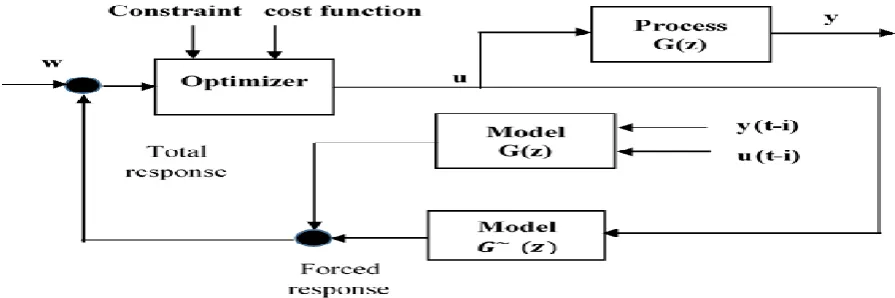
Figure 2: General Predictive Control Scheme
General Predictive Control generates a collection of control signals with future prediction in every sampling interval, however solely the primary part of the management sequence is applied to the system input. The output of the system y is predicated on 2 completely different components:
The predicted behaviour of the free response represents the
output y(t+j│ t) and the range from t+1 to t+N based on the
old outputs y(t-i│ t) and inputs u(t-i│ t), assuming a future control action of zero.
The response represents the extra part of the output y ensuing from the optimisation criterion[3]. the entire prediction is that the add of each the elements leading to a future error given by
e(t+j│ t)=w(t+j│ t)-y(t+j│ t) (1) With j investigation from one to N. Following this, future management signals square measure calculated to force the output the specified reference values. additionally to its well-known smart performance the lustiness properties makes General Predictive Control fascinating and realizable for a sensible management applications. For this General Predictive Control offers a compact control strategy in terms of model mismatches, variable dead time & disturbances.
III. METHODOLOGY
The analysis of flows and pressure drops in piping systems is typically based mostly au fait the thought of steady state conditions[4][9]. The introduction of the conception of your time variable adds on a replacement dimension to the mathematical model of the transient flow during a pipe distribution system, and ends up in process issue.
GOVERNING EQUATIONS: The governing equations of the system are represented by two models
Based on the above these equations,
Atypical branch of fluid network with transient flow are often painted as an [5]electrical circuit and be visualized in figure 3 from which we can understand that
;
Using the nodal approach
(3)
(4)
Applying the transformation matrix theory,
Substituting
(6)
(7)
When Eq.(6) and Eq.(7) are extended to open path and closed path, the relationship becomes
(8)
Model A
Model B
(2)
(9)
AlsoV
1o=E
o+e
1o=C
boE
b+e
1o; (10)
V
1c=E
c=C
cb; (11)
for an invariant pressure source Eb, we obtain the following set of equations.
(12)
Expanding the Eq(8) and(9) and incorporating Eqs(12) , the results obtained are
(13)
(14)
(15)
Rearranging the above equation for Jo, the system becomes
(16)
Equations (14) to (16) are the governing equations for transient pipe flow system with a continuing pressure supply and that they are a collection of first-order standard differential equations. Transient pipe flow drawback that is usually ruled by the set of 2 partial differential equations will currently be solved by a collection of first-order standard differential equations that is far easier to handle[6]. However, these equations can not be solved analytically as a result of the sophisticated relationships concerned within the network drawback. For a network with illustrious topology, tensors and inductance are freelance of your time and might be determined simply, whereas the precondition of admittance and capacitance are often calculated supported the results of steady state.
IV. RESULTS AND DISCUSSIONS
The modelling of the pipelines are simulated and studied on the basis of certain assumptions. Using MATLAB S functionsit is indeed easy to implement the pipelines. Generalized Predictive Controller is modelled based upon the z-transform. GPC is simulated for various types of systems
[image:3.595.307.555.157.354.2]keeping in mind the necessary requirements and assumptions for the modelling. The most common use of S-functions is to form custom Simulink blocks, but they're going to be used for a selection of applications[8]. and of practice S-functions is that it's accomplishable to form a general purpose block which is able to be used repeatedly in an exceedingly very model, variable parameters with each instance of the block. Figure 4 shows a pipeline network modelled in Matlab.
Figure 4:Pipeline network
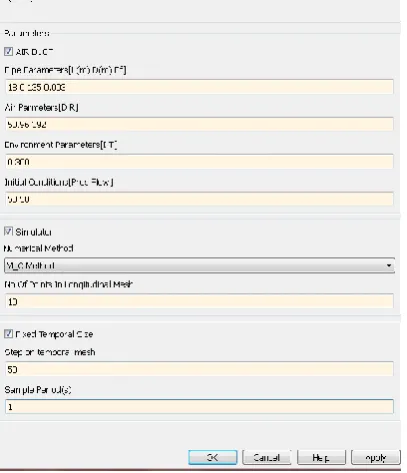
The S-function block implemented in the figure 4 has to be masked in order so as to make settings makeover for different systems for all instants. The mask has to be so provided that it can provide all the parameters required for simulation of the compressed air line. The parameters include the dimensions of the pipe, environmental factors, initial conditions necessary for the start condition and parameters of the fluid flowing inside the pipe. Figure 5 shows the necessary mask diagram
Figure 5: Mask created in MATLAB-Simulink For simulating GPC in
[image:3.595.305.509.490.727.2]equivalent z-transform representation for the system, control law and the prediction matrices. The concept of GPC is equivalent to DMC, there are some theoretical weakness which must be avoided and hence must be widely adopted and is successful.
Some assumptions are to be made before starting the simulations a shown below
1.Unbiased prediction:
(23)
2. Use of unbiased cost:(24)
The Predictions might be made by presumptuous that every one inputs would be selected , that choosing a set of future inputs and guaranteeing that every one different values area unit acknowledged. In practice such values become fixed after nu steps.
The SISO system
the numerator and denominator are given by
a=[1 -1.2 0.32]
b=[1, 0.3]
The output of SISO system is shown in the Table 1.
Table 1: Output of SISO system [image:4.595.304.558.50.198.2]
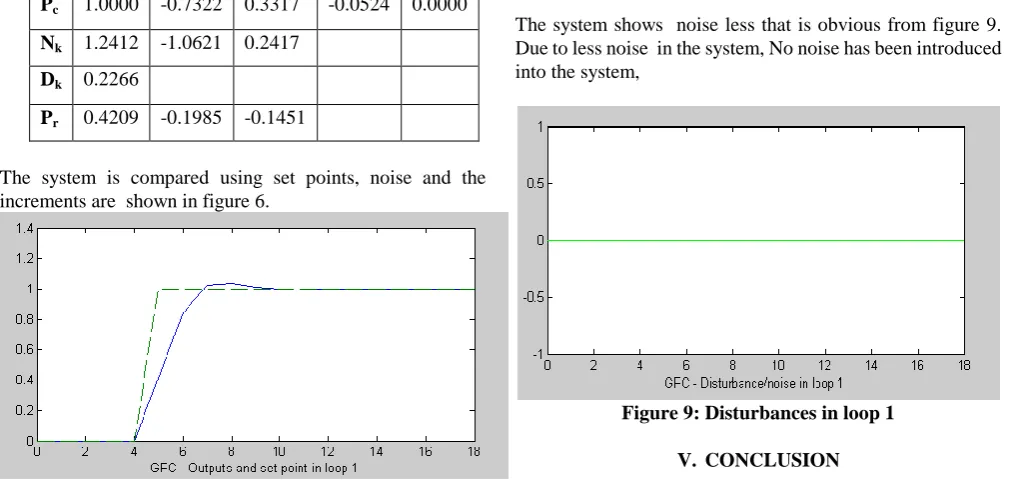
The system is compared using set points, noise and the increments are shown in figure 6.
Figure 6: Comparison with GPC output and Set Point The inputs of the system shown in figure 7and it shows the
rise in the input arguments from the plot.
Figure 7: GPC-Inputs in loop 1
[image:4.595.319.530.256.412.2]
Increments in the output can be clearly seen in the figure 8. The peaks values should be checked , For giving different inputs to the system.
Figure 8: GPC-Increments in loop 1
[image:4.595.47.555.420.663.2]The system shows noise less that is obvious from figure 9. Due to less noise in the system, No noise has been introduced into the system,
Figure 9: Disturbances in loop 1
V. CONCLUSION
As a future study, the development of Kalman filter in order to detect the leakages in pipelines based on LabVIEW could be investigated. Also different types of controller could be developed such as DMC(Dynamic Matrix Control), OGPC(Optimal Generalized Predictive Controller). An ideal control may well be actualised with the purpose of reducing the expense of the distribution method within the system beneath sure operation
conditions taking the discharge pressure at compressors.
Pc 1.0000 -0.7322 0.3317 -0.0524 0.0000 Nk 1.2412 -1.0621 0.2417
Dk 0.2266
REFERENCES
1. B. Van Hieu, S. Choi, Y.Uk Kim, Y. Park and T. Jeong “Wireless Transmission of Acoustic Emission Signals for Real-Time Monitoring of Leakage in Underground Pipes”, KSCE Journal of Civil Engineering, Vol. 15, No. 5, 2011.
2. Z. Yang, “Theoretical Research and Application of Steady and Transient Simulation of Gas Network,” Natural Gas Industry Journal, Vol. 26, No. 4, 2006, pp. 105-108.
3. Y. J. Li, “Design and Practice of Transmission and Distribution System,” China Construction Industry Press, Beijing, 2007, pp. 152-153.
a. J. O. Andrzej and C. Maciej, “Comparison of Isothermal and Non-Isothermal Pipeline Gas Flow Models,” Chemical Engineering Journal, Vol. 81, No. 1-3, 2000, pp. 41-51.
4. X. K. Xing, “A Simulation Method of Leakage Detection in Product Pipeline,” Pipeline Technique and Equipment, Vol. 3, 2000, pp. 12-14. 5. Z. Yang, Z. Xiong and M. Shao. “A New Method of Leak Location for the Natural Gas Pipeline Based on Wavelet Analysis,” Energy, Vol. 35, No. 9, 2010, pp. 3814- 3820.
a. S. Nitescu, A. Constantin and M. Stanescu, "Hydraulic study on pumping stations equipped with air chamber mounted next to the pump "International Journal of Mathematical Models and Methods in Applied Science, Vol. 5, Issue. 8, 1318-1325, 2011.
b. S. Jung and B. W. Karney,"Systematic Surge Protection for Worst Case Transient Loadings in Water Distribution Systems"Journal of hydraulic engineering, Vol. 135, Issue 3, 218-223, 2009.
6. [ D. J. Wood, S. Lingireddy, B. W. Karney, P. F. BoS. H. Aljanabi, "Numerical modeling of transient flow in long oil pipeline system." Journal of Engineering &Technology,Vol. 28, Issue. 16, 5346-5357, 2010.
7. S.L. Ke, H.C. Ti, Transient analysis of isothermal gas flow in pipeline network, Chem. Eng. Journal, Vol. 76 (2000) 169–177.
8. S. Wu, R.Z. Rios-Mercado, E.A. Boyd, L.R. Scott, Model relaxations for the fuel cost minimization of steady-state gas pipelinesnetworks, Math. Comput. Model. 31 (2000) 197–220.
AUTHORSPROFILE
Mr. P.Anantha Christu Raj, Assistant Professor from Karunya University, completed Bachelor of Engineering in Electrical and Electronics Engineering and Master of Engineering in Control and Instrumentation from St.Xavier catholic college of engineering, Nagercoil in the year 2006 and 2008 respectively. Currently pursuing Ph.D in Energy saving optimization in Anna University. His areas of Interest are Control system and signal processing. He has published 9 international journals and 10 international conferences.
P. Ramesh Kumar Ph.D (Biotechnology) works in the key research areas of plant physiology and anti-diabetic drug discovery from plant sources at the Department of Agriculture, Karunya Institute of Technology & Sciences, Coimbatore.