International Journal of Innovative Technology and Exploring Engineering (IJITEE) ISSN: 2278-3075, Volume-8 Issue-11, September 2019
Abstract: The Wireless Sensor Networks (WSNs) today is gaining plenty of attention due to its wide application range. The reduction of consumption of energy of their sensor nodes has been considered to be a crucial challenge for operating the WSNs in the long run. Low-Energy Adaptive Clustering Hierarchy (LEACH) which is an extremely popular technique which can form several clusters by means of employing a distributed algorithm. The Multi-Hop Low Energy Adaptive Clustering Hierarchy (MH-LEACH) has minimized the consumption of energy at the time of transmission of data among the Cluster Heads (CH) and Base Station (BS). The load is further reduced by multi-hop routing wherein packets are duplicated within the network to improve the efficiency of energy for the WSN. A heuristic method of local search is the Great Deluge Algorithm (GDA) which is employed for solving problems in optimization. In this work, a multi-hop LEACH along with the Great Deluge Algorithm that has been proposed for efficiency in clustering of the WSN.
Index Terms: Great Deluge Algorithm (GDA), Low-Energy Adaptive Clustering Hierarchy (LEACH), Multi-Hop LEACH (MH-LEACH) and Wireless Sensor Networks (WSNs).
I. INTRODUCTION
The Wireless Sensor Networks (WSNs) contains plenty of sensor nodes that can perform sensing, computing and also communication which is wireless. Such nodes are normally deployed densely within a region of interest that is applied to several other applications like monitoring the environment, industrial applications, habitat monitoring and military surveillance [1]. As there are wireless sensor nodes suffering from limitations of power, the design of large scale network has been posing various challenges. For the same reason, all the protocols proposed along with the sensor network algorithm have been focusing on utilising efficiently, the resources of sensor energy. With the exponential increase in the consumption of energy, and the distance of communication which is based on the model of energy consumption [2], which makes multi-hop communication extremely advantageous for the gathering of data and for saving of energy. Furthermore, hierarchical routing is also very helpful in the performance of network more so on the case of consumption of energy and scalability.
Normally, any cluster network will employ, for every cluster, single-hop routing. One-hop clustering will be able to bring down consumption of energy for communication by means of forwarding the data of source nodes to the CH through the single hop. But, at the time there is an increase in
Revised Manuscript Received on September 06, 2019
Dr. K.TAMIZHARASU, M.E., Ph.D., MISTE., Professor and Principal, J.K.K. Nattraja College of Engineering and Technology, Natarajapuram, Kumarapalayam, Namakkal - 638183. Email ID:[email protected]
the distance of communication, single-hop communication can consume higher levels of energy thus becoming less energy-efficient. In the case of larger networks, the inter-node distance is crucial and there is a need for multi-hop communication which is also energy efficient for which the WSN may be employed. This has the advantages mentioned below: (1) It can enable aggregation of data at the point of the cluster head for discarding all redundant data and also the uncorrelated data. This brings down the consumption of energy of sensor nodes. (2) For this, routing may be taken as easily manageable since the CHs will require to maintain another local route setup for the remaining CHs and so will need only a small amount of routing information. This results in a great improvement to network scalability to a significant level. (3) It further conserves the bandwidth of communication since the sensor nodes tend to communicate with the CHs alone and avoid redundant messages. But, in the case of an approach to clustering, the CH may bear a certain amount of the additional workload like receiving any sensed data which is sent by the member sensor nodes, data dissemination and aggregation of data. The Low Energy Adaptive Clustering Hierarchy (LEACH) is a protocol that is based on clusters for the networks of micro sensors that can achieve scalable routing that is energy-efficient with a fair amount of media access to the sensor nodes [3].
The Low energy adaptive clustering hierarchy [4] has been a protocol that has been designed hierarchically in the early stages by making use of route information with clustering. This is a routing protocol that makes use of single-hop routing in which data get transmitted directly from the CH to its BS. But, it does have certain limitations. Firstly, the CHs are located away from the BS and tend to dissipate additional energy compared to the closer clusters. There is a process of direct transmission that is used in the LEACH which does not apply to networks of a large scale since it can adversely affect the distribution and load balancing. Secondly, the data transfer frequency is different from a single node to that of another that is based on the actual level of its importance for the detected information for every area. Such differentiation may result in an early death to active nodes in comparison to the ones that have average activity resulting in imbalance to the level of energy among the nodes in the network.
A Multi-Hop LEACH based protocol was found to be similar to the LEACH protocol except for the transmission of data to its base station. Once the data had been collected from the cluster nodes by the CH, it transmits them to a base station through its other CH.
Multi-Hop Leach using the Great Deluge
Optimization in Wireless Sensor Optimization
So, the distance of transmission among nodes can be reduced and this can bring down the consumption of energy. By means of increasing the hops, the lifetime of its sensor node can be improved efficiently [5]. For this, there is just one trade-off which is the delay that occurs during transmission. The objective function optimization that arises from various fields of both research and applications is not a fundamental issue that needs to be solved. As there are advanced resources of computation that helps us dealing with a size that is larger and more complex. The Great Deluge algorithm (GDA) is an algorithm that is based on the trajectory which is very similar to that of Simulated Annealing (SA) which is adjusted dynamically. One more complicated method of local search which may have either been a local search-based method that was embedded within it known as the GDA. This helps in identifying a solution which is better within the same neighbourhood and ensuring a new solution to iteratively improve it.
A Great Deluge optimization was proposed for enhancing the multi-hop Clustering found in the WSN. The literature that are related to this work are explained in Section 2. The techniques used for the work are explained in Section 3. The results that are obtained are elaborated in Section 4 and the conclusion was made in Section 5.
II. RELATEDWORK
Ammar et al [1] had made a proposed of another multi-hop clustering cross-layer protocol that was based on the LEACH. This had considered the SNR of other links along with its residual energy of the sensor nodes. The results of a simulation that were in terms of its average consumption of energy where the lifetime of the network and Packet Delivery Ratio was able to outperform the results of the algorithm against the LEACH.
Al-Sodairi and Ouni [6] had analysed the low-energy adaptive clustering hierarchy (LEACH) along with the protocols based on the LEACH to see if they are effective in increasing the lifetime of the WSNs that are energy-constrained. There was another protocol that was based on the LEACH clustering known as the enhanced multi-hop LEACH that was proposed for reducing and further balancing the consumption of energy for permitting an increase in packet delivery and the network lifetime. In addition to this, the paper had presented some of the weaknesses found in the LEACH protocol. Firstly, a new set of rules were formed for the selection of the cluster head. Next, there was a model of multi-hop communication that was integrated into the WSN that made use of two different processes of operating: the levelling and the generic multi-hop routing.
Arioua et al [7] had made a proposal of another approach which combined the MTE and the LEACH. Adopting the multi-hop communication as opposed to direct communication has now optimized the network communication. The results of the simulation have illustrated the efficiency of the energy of the routing approach based on a multi-hop cluster. The results of simulation proved the efficiency of energy and the improvement of network lifetime.
Alnawafa and Marghescu [8] had further proposed another
multi-hop technique (MHT-LEACH) that was proposed to improve LEACH performance. As opposed to forwarding the CH to the BS, there was the MHTLEACH which is employed to transmit the CH data to its BS on the basis of location and the distance. The results of simulation proved that MHT-LEACH to improve its throughput, stability and lifetime.
Ayoub et al [9] had made a new proposal of a Multi-Hop Advance Heterogeneity-aware Energy Efficient (MAHEE) based clustering path and its planning algorithm used for the WSNs. In this algorithm, an advance Cluster Head (CH) algorithm was employed with higher energy that is selected as the CH. Further, the inter-cluster multi-hop routing along with an advance CH selection will be able to enhance the stability of the network and also its lifetime. The results of the simulation had verified the proposed technique that provides better performance compared to the other state-of-the-art protocols of routing.
Acan and Ünveren [10] had proposed one more architecture with search operators that exploited all accumulated experience inside the framework of the Great Deluge algorithm which was for global optimization. The acceptance criterion of this algorithm was applied to every solution that was extracted within a certain iteration. Using such search methods based on memory which was supported by the results of the operator the approach proposed had illustrated three different sets of benchmark functions. The performance of this approach was evaluated and compared to the other well-known algorithms along with published results. Aside from very few problems of optimization, the evaluation of the experiments had shown that the approach was able to perform on par with its other competitors.
Tan et al [11] had proposed one more set of countermeasures for both the attacks. This approach has been based on Deluge, which was an open-source protocol of dissemination for the WSNs. It also provided some theoretical analysis along with some simulation proved this approach to be able to outperform other attempts made earlier. This ensured better evaluation of performance, latency, rate of dissemination and so on.
This Great Deluge Algorithm (GDA), has not been used earlier in the constrained problems of design optimization that was employed as in Baykasoglu [12] for solving problems in design optimization. There was also an attempt that was made to prove if there was a possibility to enhance their performance using a simple algorithm such as the GDA. There were eight other chaotic maps that were tested in this paper after which a comparison was made. It was further observed that chaotic maps were able to improve GDA performance to enable identifying the best solution to the problems.
III. METHODOLOGY
International Journal of Innovative Technology and Exploring Engineering (IJITEE) ISSN: 2278-3075, Volume-8 Issue-11, September 2019
A.Low Energy Adaptive Clustering Hierarchy (LEACH) LEACH [13] will expect the BS to be arranged and settled from sensors and these sensors are homogenous with a confined source of energy. The LEACH that was taken into consideration was for dealing with all nods thus dividing them to distribute energy among various sensor nodes for which there was a homogenous and confined source of energy which was among one another. The LEACH had been taken into consideration for dealing with nodes within the network for which in every group there was a new control node which was the CH. The LEACH procedure has been indicated. Every round in the LEACH included 2 phases. The cluster set-up process, its advertisement, and phase of schedule creation resulted in a setup phase. In the beginning of this phase, each node will puck a new and random number around 0 and 1, after which there is an edge condition that is figured [14] In case the subjective number that is picked is lower than its threshold number which is T(n), the node will become the fortunate CH for a round. The threshold number T(n) has been depicted as per Equation 1.
if n G 1
1 * ( mod )
( )
0 Otherwise P
P r
T n
p
(1)
Wherein P denotes the CH and its desired percentage, and r the current round, with G being the competing nodes not selected to be the CHs in the final 1/P rounds. The node will not become the CH for its current round and in case the number is not limited to T(n). At the time a node is selected to be the CH, it will not become the CH until each node in the group has been the CH at least once. This will be very valuable for being adjusted for utilization of energy. The Steady-state will be the second phase; all non-CHs will get their CH requests and will forward join demand to CHs by means of providing advise that they have been individuals within the same group. In the steady-state phase, every sensor node will aggregate and further transmit data to the CH based on the TDMA schedule. The LEACH protocol is used by the TDMA/CDMA MAC for resisting both inter-cluster and the intra-cluster collision. Each CH will get data and will aggregate them even before they are forwarded to its BS. Once a certain time is complete, the framework will begin one more round by means of withdrawing to this setup after which the persisting state will be arranged.
Advantages of the LEACH [15]
Cluster Heads will aggregate the data resulting in the reduction of traffic of the network.
Since it is single-hop routing from the nodes, the CH will be able to save energy.
The sensor network lifetime will increase for which location information is not required for the creation of clusters.
The LEACH will be fully distributed since it will not require control information from its base station and there is also no need for any global knowledge of the network.
The LEACH will not provide information on the cluster heads found in this network.
Disadvantages of LEACH
The major disadvantage of the LEACH is at the time a CH dies, the cluster is rendered useless since data that is gathered by the nodes may not reach the Base Station. The clusters have been divided randomly and this resulted in an uneven distribution of the clusters. There are some cluster heads in the centre and some in the edge of a cluster. This may result in an increase in the consumption of energy and this can have a major impact on network performance.
B.Multi-Hop LEACH
The LEACH will need source nodes to be able to forward all data to the CHs and this can affect the energy of the source nodes owing to a significant cost of all transmissions that are long-distance [16]. Thus, the source nodes located far from the CH who drain their energy hastily compared to other nodes. For resolving such energy constraints, this approach will employ a multi-hop inter-node communication that uses Minimum Transmission Energy (MTE). Every source node will send the message to its closest node for minimizing transmission energy. Taking into consideration the distance of communication and the requirements of network density, all network structures will assure direct communication among the members and the CHs which is not always practical. As a consequence of this, there is a need for wireless sensor network of a large scale, a communication structure that was multi-hop was required.
The MTE algorithm was a multi-hop protocol that was adopted widely within the wireless sensor network. This will contain transmitting data using other nodes acting as routers with environment sensing. There are intermediate nodes in the cluster route and the router nodes belong to other sensor data. There are router nodes that have been chosen to ensure the transmission of amplifier energy which has to be minimized. For every cluster, the source nodes will compute the distance to cluster heads by means of adopting the MTE algorithm. In case the actual distance of the direct path is minimum, source nodes will convey data directly using one hop which is attached to the CH. All chosen CHs within the clusters will transmit all aggregated data to their base station. At the same time, in case the distance from the source nodes to the CH that is not its minimum distance, source nodes will forward data with intermediate nodes inside a minimum distance. For this, the source node will transmit data using several minimum hops to the CH.
For the purpose of this approach, the source nodes will communicate with the CH through a routing approach as opposed to another direct hop for optimizing energy consumption. The CH will collect data from member nodes and aggregate the data received.
The primary purpose of the approach was to choose an optimal path which was from the member nodes to their base station. The protocol proposed will adopt a new multi-hop communication for sending data which was from the member nodes for Cluster Heads by means of intermediate nodes from the cluster heads to their base station. The LEACH protocol and the multi-hop cluster
protocol will operate in rounds such as LEACH and will choose the path having minimum hops among nodes and base stations.
C.Proposed Great Deluge Optimization (GDA) Algorithm for Clustering
In the approach that is proposed, there is an optimization of The main promise in this was its simplicity and the ability to
[image:4.595.148.455.150.689.2]be able to escape from the local optimum having a very simple mechanism needing a single parameter for setting it up. Since the GDA is a new metaheuristic, its applications will not be found often.
Fig 1 Flowchart of Great Deluge Algorithm (GDA) [18]
The Great Deluge Algorithm (GDA), had been initially presented by Dueck [17], which was another local search algorithm that was similar to the Simulated Annealing (SA). The exception was the acceptance rule was deterministic and was controlled by its threshold parameter known as the level. This was dependent on replacing its current best solution
using a new solution from the neighbourhoods. This is done by replacing the process until such time the values of the solution are equal or better
compared to its Level (L) value. There are two algorithmic parameters
Update best local solution and level
Update best local solution Solution initialization
Create neighborhood structure
Calculate quality of the new solution
Improvement
<=Level
Decrease Level
Stop
Exit No
Yes Yes
No
Yes
International Journal of Innovative Technology and Exploring Engineering (IJITEE) ISSN: 2278-3075, Volume-8 Issue-11, September 2019
which are the number of these iterations and estimation of best fitness value of its objective function. When searching for a solution space, another new solution is accepted and in case the fitness is found to be better compared to the present one, it can dynamically update the upper bound which is its level. The estimated best fitness value for the objective function will normally be set either less than or at an equal level to the fitness of its best solution until now. The level will be initially set to the initial solution and its fitness and gets iteratively lowered by the additive parameter which is β that has been computed as the function its initial value and its estimated the best fitness value for its objective function.
Fig 1 shows the flowchart for the GDA. The initial solutions in GDA is modelled to find a set of cluster head. A random set of nodes are selected to be cluster heads. As the algorithm iterates, the optimal set of cluster head is found.
IV. RESULTSANDDISCUSSION
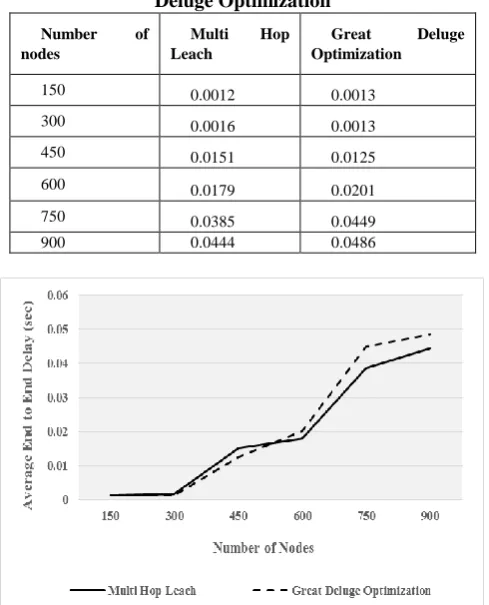
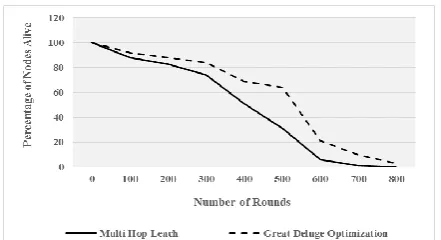
[image:5.595.307.548.154.463.2]The parameter of the LEACH is shown in Table 1. Tables 2 to 4 along with figures 2 to 4 will show average end-to-end delay, packet delivery ratio and percentage of the nodes alive.
Table 1 Parameters of LEACH Base Station Location 100m, 150m
Number of nodes 100
Network size 100m * 100m
Packet size 2000 bits
Nodes initial energy 0.5J
Percentage of CH 5%
Energy amplification for free space
10 pJ/bit/m2
Energy amplification for multi path
[image:5.595.57.283.321.443.2]0.0013 pJ/bit/m2
Table 2 Average End to End Delay (sec) for the Great Deluge Optimization
Number of
nodes
Multi Hop Leach
Great Deluge Optimization
150 0.0012 0.0013
300 0.0016 0.0013
450 0.0151 0.0125
600 0.0179 0.0201
750 0.0385 0.0449
900 0.0444 0.0486
Fig 2 Average End to End Delay (sec) for the Great
Deluge Optimization
Table 2 and Fig 2 shows that an average end to end delay (sec) of Great Deluge Optimization performs better by 8 %, by 20.69%, by 18.84%, by 11.58%, by 15.35% and by 9.03% than multi-hop LEACH for number of nodes 150, 300, 450, 600, 750 and 900 respectively.
Table 3 Average Packet Delivery Ratio for the Great Deluge Optimization
Number of nodes
Multi Hop Leach
Great Deluge Optimization
150 0.8208 0.9362
300 0.7873 0.9129
450 0.7727 0.9039
600 0.7383 0.8464
750 0.6794 0.7916
900 0.6025 0.759
Fig 3 Average Packet Delivery Ratio for the Great Deluge Optimization
Table 3 and Fig 3 shows that an average packet delivery ratio of Great Deluge Optimization performs better by 13.14%, by 14.8%, by 15.7%, by 13.6%, by 15.3% and by 22.99% than multi-hop LEACH for number of nodes 150, 300, 450, 600, 750 and 900 respectively.
Table 4 Percentage of Nodes Alive for the Great Deluge Optimization
Number of rounds Multi Hop Leach
Great Deluge
Optimization
0 100 100
100 88 92
200 83 88
300 74 84
400 51 69
500 31 64
600 6 21
700 1 10
[image:5.595.47.292.472.775.2]Fig 4 Percentage of Nodes Alive for the Great Deluge Optimization
Table 4 and Fig 4 shows that percentage of rounds alive of Great Deluge Optimization performs better by 4.44%, by 5.85%, by 12.66%, by 30%, by 69.47%, by 111.11 and by 163.64% than multi-hop LEACH for number of nodes 100, 200, 300, 400, 500, 600 and 700 respectively.
V.CONCLUSION
The WSN may be defined as the special ad hoc network containing many sensors. The LEACH protocol is a very prominent protocol employing a hierarchical approach to the distribution of sensor nodes within clusters. The GDA has been employed for improving the best solution that is identified. GDA will need a basic parameter to be set up and this has made is very attractive to solve problems in optimization. The results have proved the average packet delivery ratio of the Great Deluge Optimization has performed better by about 13.14%, 14.8%, 15.7%, 13.6%, 15.3% and finally by 22.99% compared to the multi-hop LEACH for the number of nodes which are 150, 300, 450, 600, 750 and 900. Further, the percentage of the nodes alive of the Great Deluge Optimization has performed better by about 4.44%, 5.85%, 12.66%, 30%, 69.47%, 111.11 and finally by 163.64% compared to the multi-hop LEACH for the number of nodes which are 100, 200, 300, 400, 500, 600 and 700.
REFERENCES
1. Ammar, A. B., Dziri, A., Terre, M., & Youssef, H. (2016, September). Multi-hop LEACH based cross-layer design for large scale wireless sensor networks. In 2016 International Wireless Communications and Mobile Computing Conference (IWCMC) (pp. 763-768). IEEE. 2. J. Ren, Y. Zhang, and K. Liu, “An energy-efficient cyclic diversionary
routing strategy against global eavesdroppers in wireless sensor networks,” Inter. J. Distr. Sensor Netw., vol. 2013, no. 15, pp. 1–16, Mar. 2013.
3. Tyagi, P., & Verma, V. (2018). LEACH ROUTING PROTOCOL FOR WIRELESS SENSOR NETWORKS: A SURVEY. Journal of Advances in Computational Intelligence and Communication Technologies, 2(1), 56-59.
4. Rhim, H., Tamine, K., Abassi, R., Sauveron, D., & Guemara, S. (2018). A multi-hop graph-based approach for an energy-efficient routing protocol in wireless sensor networks. Human-centric Computing and Information Sciences, 8(1), 30.
5. Sumitha, D. H., Kumar, M. V., Alamelumangai, M., & Nageswari, D. A SURVEY ON ENERGY OPTIMIZATION USING VARIOUS LEACH PROTOCOLS.
6. Al-Sodairi, S., & Ouni, R. (2018). Reliable and energy-efficient multi-hop LEACH-based clustering protocol for wireless sensor networks. Sustainable Computing: Informatics and Systems, 20, 1-13. 7. Arioua, M., El Assari, Y., Ez-Zazi, I., & El Oualkadi, A. (2016). Multi-hop cluster based routing approach for wireless sensor networks. Procedia Computer Science, 83, 584-591.
8. Alnawafa, E., & Marghescu, I. (2016, September). MHT: Multi-hop technique for the improvement of leach protocol. In 2016 15th
RoEduNet Conference: Networking in Education and Research (pp. 1-5). IEEE.
9. Ayoub, N., Asad, M., Aslam, M., Gao, Z., Munir, E. U., & Tobji, R. (2017, August). MAHEE: Multi-hop advance heterogeneity-aware energy efficient path planning algorithm for wireless sensor networks. In 2017 IEEE Pacific Rim Conference on Communications, Computers and Signal Processing (PACRIM) (pp. 1-6). IEEE. 10. Acan, A., & Ünveren, A. (2015). A two-stage memory powered Great
Deluge algorithm for global optimization. Soft Computing, 19(9), 2565-2585.
11. Tan, H., Ostry, D., Zic, J., & Jha, S. (2013). A confidential and DoS-resistant multi-hop code dissemination protocol for wireless sensor networks. Computers & Security, 32, 36-55.
12. Baykasoglu, A. (2012). Design optimization with chaos embedded great deluge algorithm. Applied Soft Computing, 12(3), 1055-1067. 13. Fu C, Jiang Z, Wei W, Wei A. An energy balanced algorithm of
LEACH protocol in WSN. Int J Comput Sci. 2013;10(1):354‐359. 14. Ramesh K, Somasundaram K. A comparative study of cluster head
selection algorithms in wireless sensor networks. arXiv preprint arXiv:1205.1673; 2012.
15. Parul Kansal, Deepali KAnsal, Arun Balodi, “Compression of Various Routing Protocol in Wireless Sensor Networks”, International Journal of Computer Applications Volume 5-No. 11(August 2010).
16. A. Mahboub, M. Arioua, E. M. En-naimi, I.Ez-Zazi. Performance evaluation of energy-efficient clustering algorithms in wireless sensor networks. Journal of Theoretical and Applied Information Technology, Vol. 83, Issue 2, 2016.
17. Dueck, G. (1993). New optimization heuristics: The great deluge algorithm and the record-to-record travel. Journal of Computational physics, 104(1), 86-92.
18. Jaddi, N., & Abdullah, S. (2013). Hybrid of genetic algorithm and great deluge
AUTHORS PROFILE
Chandrakala H L. Received B.E in CSE from Malnad College of Engineering ,Hassan, M.TECH IN CSE from VTU study center ,BMS College Of Engineering ,Bangalore. PhD in CSE from from VTU-RRC. He is now working as Associate professor of HKBK College of Engineering, Bangalore. His Academic experience is 23 years. He published his research work in 2 journals and attended Seminars and workshops.
[image:6.595.59.280.48.168.2]![Fig 1 Flowchart of Great Deluge Algorithm (GDA) [18]](https://thumb-us.123doks.com/thumbv2/123dok_us/8180190.254720/4.595.148.455.150.689/fig-flowchart-of-great-deluge-algorithm-gda.webp)