International Journal of Innovative Technology and Exploring Engineering (IJITEE) ISSN: 2278-3075, Volume-8 Issue-12, October, 2019
Abstract: Digital India is one of the vital initiatives introduced by our Indian Government to “Develop the online infrastructure” and to make sure that the Services given to the citizens by the government is available to them digitally. The target year to transform digital in all the sectors is set us 2020 and it is expected to happen based on successful adoption of information technology.Adopting information technology results in „Digital Transformation‟ and it is realized as the needful change of the hour by the entrepreneurs in all the sectors. Though the large scale organisations are comparatively in ready state for Digital transformation, most of the Small and Medium Enterprises (SMEs) have their own challenges in adopting information technology. This article has included the prime challenges in information technology adoption such as digital Illiteracy, connectivity, compatibility, cybercrime threat, inter departmental co-ordination, financial affordability and resistance to change Mind set. In spite of all these challenges, digital transformation is identified as unavoidable and vital in the present business scenario. Hence, the researcher has taken an attempt to identify the influencers and inhibitors involved in the process of information technology adoption among the SMEs in Tamilnadu State by analysing their demographic and organisational variables. The research results interpret about the digital perception of the SMEs, their difficulties and readiness to adopt information technology. The research findings highlight the prevailing need for digital literacy and better connectivity for better digital transformation.
Key words: Information Technology, Adoption, Digital transformation, SMEs
I. INTRODUCTION
Digital India is one of the vital initiatives introduced by our Indian Government to “Develop the online infrastructure” and to make sure that the Services given to the citizens by the government is available to themdigitally. The target year to transform digital in all the sectors is set us 2020 and it is expected to happen based
Revised Manuscript Received on October 10, 2019
* Correspondence Author
DrSridevi K B*, Professor - MBA Department, Sri Krishna College of Engineering and Technology, Coimbatore, India, Email:[email protected]
DrShyamala P,Head and Associate Professor –Department of Management Studies, Fatima College,Madurai, India, Email: [email protected]
DrNagarenithaM, Assistant Professor, Department of Management Studies, Fatima College,Madurai, India, Email: [email protected]
on successful adoption of information technology. Adopting information technology results in „Digital Transformation‟ and it is realized as the needful change of the hour by the entrepreneurs in all the sectors [1],[2]. Though the large scale organizations are comparatively in ready state for Digital transformation, most of the Small and Medium Enterprises (SMEs) have their own challenges in adopting information technology.The SMEs‟ business approach is categorized as conventional business approach and digitalized approach based on their level of information technology adoption.
A. Significance of Information Technology Adoption
The emerging importance of
informationtechnologyadoptionis,
The digital transformation will give global exposure to the enterprises, by which the Consistency of the business may become high with more quality worldwide [1],[2].
Digital record maintenance system will facilitate professionalism in maintaining the documents and paperless work will be achieved.
The documents or files can be easily accessed and also the information can be exchanged worldwide in a convenient and economic manner.
Quick response time may be possible and also the customers can be serviced from anywhere in the world, by which high customer satisfaction might be increased.
Digital transformation will facilitate cost effectiveness to the enterprises [4].
The enterprises can work in flexible hours.
According to the jobs, the employees can perform their day by day work as per schedule in their convenient time and place.
B. Challenges For Information Technology Adoption
There have been many Challenges perceived by SMEs inadopting information technology and proceeding towards Digital transformation [10]. The major challenges considered for the study are:
Adoption of Information Technology Among
Small and Medium Enterprises in Indian
Context
Digital Illiteracy:Most of the SMEs are not so proficient in digital process. Making a remedy for this is a major challenge. They are used to their manual system and not much familiar to create and publish data in websites or social media. Their digital usage is very less and also they require a good formal training and technical support teams.
Connectivity:As the SMEs are mostly operating in
rural and remote areas, access to internet is a great challenge.
Compatibility:SMEs are more convenient in their
regional languages. Availability of software in regional languages and its compatibility becomes an Issue as each state has its own regional
languages.Diversity is present in all
aspects.Compatibility is also a difficult factor. This is a key point of notice to be concentrated.
Cyber Crime:Prevalence of cyber threat is a Challenge
even to conglomerates and hence it is a tough challenge for SMEs to cope up with this challenge. There is also a threat of personal details may get stolen here. Signature can be misused. Fake records and fake licence may be created. Many forgeries can happen if cyber-crime is not focussed.
Inter Departmental Co-ordination:The availability of tech savvy employees in all the departments is not feasible for SMEs and hence coordination between departments becomes a hurdle.
Financial affordability:In the initial stage of
digitalization, huge investment is needed and in the case of SMEs, most of the ventures are started with loans only. Hence, this digital expenditure may be considered as a financial burden.
Resistance to change Mind set:the common human
tendency towards any change is „Resistance to Change‟ and hence making the SMEs to change their mind towards Digital India is a great challenge.
II. SIGNIFICANCE OF THE STUDY
The internet usage is continuously growing among the Indian customers. The drastic rise of mobile users has its reflection in increased rate of access to internet. The buying habits of Indian customers are undergoing a paradigm shift towards digital version.Also, Government today gives many priorities to the SMEs for their comfortable digital transformation.In spite of all the challenges in digitalization, implementing digitalization is identified as unavoidable and vital in the present business scenario. Hence, the researcher has taken an attempt to study the readiness of the SMEs in Tamilnadu State for adopting information technology. The study results will interpret about the digital perception of the SMEs, their difficulties and readiness to adopt information technology.
III. OBJECTIVES OF THE STUDY
To find out the preferences of SMEs for adopting information technology through digitalized approach.
To evaluate the digital readiness among the SMEs.
To identify the demographic variables those influence the SMEs‟ for information technology adoption.
To analyse the challenges perceived by SMEs in adopting information technology.
To provide suggestions for increasing the SMEs‟ information technology adoption.
IV. REVIEW OF LITERATURE
The adoption of information technology in SMEs depends on the characteristics of the enterprisesand the influencing factors are identified as the size of the enterprise, the industry, location, culture and attitude [10]. The need, opportunities and problems of information technology adoption is analyzedand inferred that the information technology adoption in small businesses as unique and different from large scale players [9]. Reference[8] summarizes a case about a Digital Readiness checklist created by Dave Senay. After taking up the position of CEO of „Fleishman Hillard‟ - one of the world‟s leading strategic communication firms, Dave emphasized on his firm‟s digital transformation by implementing digital networks and devices, data analytics and social media. The researcherstudied the digital readiness of 2500 Public Relation Employees belonging to 84 offices of his organization around the world by testing the Digital Readiness Checklist and inferred that the digital transformation has not taken its full form in his organization.
Acomplete digital readiness checklist needs to be designed to validate the digital fluency of people and it has to suggest an outline for evaluating their digital readiness. Byevaluating this, the organization could infer the level of their ability to transform digitally for a better futuristic organization [6].
A collaborative study undertaken by Training Industry, Inc. and Cross knowledge critically analyze the significance of training across industries for overcoming the challenges related with digital readiness. The study presented six themes for digital readiness of an organization such as technological literacy, workforce strategy, ability/up skilling, and employees properly/sufficiently trained availability of digital resources and competency of specific software / digital media. Finally, the researchers have suggested the organizations to insist their corporate priority to be digital readiness in order to move towards digital transformation.
Three steps to digital readiness such as the result, behavior and key influencers had been presented [7].The study insisted that organizations must clarify their employees about the results it look for out of digital transformation, the expected behavioral change and should identify the relevant influencers that will bring out the desirable outcomes. Accenture Strategy Research found that 78 percent of business leaders anticipate digital transformation of their businesses within 2020 [5]. The study has identified that the lack of digital skills among the employees as a vital challenge for digital transformation. It has suggested the leaders to be more focused
International Journal of Innovative Technology and Exploring Engineering (IJITEE) ISSN: 2278-3075, Volume-8 Issue-12, October, 2019
programmes in order to prepare their workforce for digital transformation. In the process of information technology adoption, the small and medium enterprises need to be aware of the positive and negative perspectives. This will facilitate them to optimize the effects and proceed further towards successful implementation [3].
V. RESEARCH METHODOLOGY
In order to analyse the gaps prevailing among SMEs‟ readiness towards digital transformation, the research area selected for the study is Tamilnadu, the researcher has randomly selected 383 registered Small and Medium Enterprises (SMEs) in Tamilnadu as respondents and collected data through surveymethod with the help of questionnaire. The collected data has been analysed and findings are interpreted.
VI. ANALYSIS AND INTERPRETATION
A. Age
The age of the entrepreneur represents his or her experience in business and it also determines their expectations and perceptions towards information technology adoption. In general, the aged entrepreneurs may have more experience and they may prefer conventional approach. At the same time, the youngsters may be aware of information technology and the innovative services offered by the digitalization approach and they may prefer digitalizedapproach. Hence, the age of the entrepreneurs is considered as one of the important profile variables in influencing the information technology adoption among the SMEs. In the present study, the age of the entrepreneurs is confined to less than 25 years, 25 to 35 years, 35 to 45 years, 45 to 55 years and more than 55 years. The age among the entrepreneurs is presented in Table I.
Table-I: Age wise distribution of the respondents and their preferred business approach
Sl. No.
Age (years) of the respondents
Conventional approach
(195)
Digitalized approach
(188)
Total (383)
F % F % F %
1. Less than 25 3 0.8 4 1.0 7 1.8
2. 25-35 69 18.0 80 20.9 149 38.9
3. 35-45 77 20.1 68 17.8 145 37.9
4. 45-55 46 12.0 28 7.3 74 19.3
5. More than 55 8 2.1 0 0 8 2.1
Total 195 50.9 188 49.1 383 100
Source: Primary Data F – Frequency, % - Percentage The first two major age groups among the entrepreneurs in
the present study are 25 to 35 years and 35 to 45years, which constitute 38.9 and 37.9 Per cent to the total. The most important age group among the conventional approach preferredentrepreneurs is 35 to 45 years with 20.1 Percent of the total and it is followed by 25 to 35 years with 18 Percent of the total. In the case of digitalized approach, the leading age group of the entrepreneurs is 25 to 35 years, which constitutes 20.9 Percent of the total and it is followed by the age group 35 to 45 years with 17.8 Percent of the total. The entrepreneurs aged above 55 years constitute only 2.1 and 0 per cent of the total, in conventional approach and
digitalized approach respectively. To test whether there is any association between the entrepreneurs‟ age and their preference towards digitalized approach, Chi-square test is computed in order to test the null hypothesis H0.
H0:There is no significant association between the
entrepreneurs‟ age and their preference towards digitalized approach.
The result of the Chi-square test is given in Table II. Table-II: Chi - Square Test for Independency
Calculated value of χ2 Table value of χ2 Inference
13.769 * 9.49 H0 is rejected
d.f. =4, p < 0.05, significant, d.f.: Degrees of freedom, *indicates that the χ2 value is significant at 5 per cent level
with 4 degrees of freedom.
The results of Table II reveal that the null hypothesis is rejected, since the calculated value is more than the Chi square Table value. Therefore there exist statistically significant association between the entrepreneurs‟ age and their preference towards digitalized approach.
B. Gender
Since the gender of the entrepreneurs has its own impact on the level of estimation and perception on information technology adoption, it is included as one of the profile variables. The nature of expectation and perception towards information technology adoption may completely differ from male to female. The gender of the entrepreneurs is illustrated in Table III.
Table-III: Gender wise distribution of the respondents and their preferred business approach
Sl. No.
Gender of the respondents
Conventional approach
(195)
Digitalized approach
(188)
Total (383)
F % F % F %
1. Male 162 42.3 164 42.8 326 85.1
2. Female 33 8.6 24 6.3 57 14.9
Total 195 50.9 188 49.1 383 100
Source: Primary Data, F – Frequency, % - Percentage Table III shows that 85.1 Per cent of the total respondents are maleand 14.9 Per cent of them are female. The dominant gender of both the preferred business approaches is male. In conventional approach preferred group, the male entrepreneurs constitute 42.3 Per cent of the total. In digital approach preferred group, the male entrepreneurs constitute 42.8 Per cent of the total. In conventional approach preferred group, the female entrepreneurs segment constitutes 8.6 Percent of the total and in digitalized approach preferred groupthey constitute6.3 Percent of the total. To test whether there is any association between the entrepreneurs‟ gender and their preference towards the information technology adoption, Chi-square test is computed in order to test the null hypothesis H0.
H0: There is no significant association between the
Table-IV: Chi - Square Test for Independency
Calculated value of χ2 Table value of χ2 Inference
1.306 * 3.841 H0 is accepted
d.f. =1, p > 0.05, not significant, d.f.: Degrees of freedom, * indicates that the χ2 value is not significant at 5 per cent
level with 1 degree of freedom.
The results of Table IV reveal that the null hypothesis is accepted, since the calculated value is less than the Chi square Table value. Therefore there is no statistically significant association betweenthe entrepreneurs‟ gender and their preference towards digitalized approach.
C. Educational qualification
The level of education provides more awareness on digital transformation to the entrepreneurs and exposure on the benefits of information technology adoption. The educated entrepreneurs may have more awareness and exposure on these aspects in general. Hence, the education may have its impact on the entrepreneurs‟ perceptions and preferences about information technology adoption. So, the level of education is included as one of the profile variables in the present study. It is confined to school level education, diploma, graduation, post-graduation and professional. The level of education among the entrepreneurs is shown in Table V.
Table-V: Educational qualification wise distribution of the respondents and their preferred business approach Sl.
No.
Educational qualification
of the respondents
Conventiona l approach
(195)
Digitalized approach
(188)
Total (383)
F % F % F %
1. Professional 9 2.3 0 0.0 9 2.3
2. Post graduate 46 12.0 40 10.4 86 22.5
3. Graduate 95 24.8 116 30.3 211 55.1
4. Diploma 24 6.3 20 5.2 44 11.5
5. Schooling 21 5.5 12 3.1 33 8.6
Total 195 50.9 188 49.1 383 100
Source: Primary Data, F – Frequency, % - Percentage Table V shows that the level of education among 55.1
percent of the total entrepreneurs is graduation and it is followed by post-graduation with 22.5 Percent of the total entrepreneurs. In the conventional approach preferred group, 24.8 Percent of the entrepreneurs have completed graduation and 12 Percent have post-graduation. Whereas in case of the digitalized approach preferred group, 30.3 Percent have graduation and 10.4 Percent have post-graduation. Professionally educated entrepreneurs are very less in number in both the preferred groups; they constitute 2.3 Percent and 0 Percent, respectively. To test whether there is any association between the entrepreneurs‟ qualification and their preference towards information technology adoption, Chi-square test is computed in order to test the null hypothesis H0.
H0: There is no significant association between the
entrepreneurs‟ educational qualification and their preference towards digitalized approach.
The result of the Chi-square test is given in Table VI.
Table- VI: Chi - Square Test for Independency Calculated value
of χ2
Table value of χ2
Inference
14.204 * 9.49 H0 is rejected
d.f. =4, p < 0.05, significant, d.f. : Degrees of freedom, * indicates that the χ2 value is significant at 5 per cent level with 4 degrees of freedom.
The results of Table VIreveal that the null hypothesis is rejected, since the calculated value is greater than the Chi square Table value. Therefore there exist statistically significant association between the entrepreneurs‟ educational qualification and their preference towards digitalized approach.
D. Organization size
The size of the organization is considered as a vital factor for influencing the entrepreneurs‟ perception towards information technology adoption. The small and medium level entrepreneurs differ in their requirements, expectations, preferences and perceptions based on their level of investment. Hence the study has included the size of the organization as an important variable in influencing the SME entrepreneurs‟ perception towards information technology adoptionand it is confined to small and medium size of the organization. The distribution of the respondents based on the organizational size is depicted in Table VII
Table- VII: Organization size wise distribution of the respondents and their preferred business approach Sl.
No.
Organization size
Conventional approach
(195)
Digitalized approach
(188)
Total (383)
F % F % F %
1. Small 136 35.5 156 40.7 292 76.2
2. Medium 59 15.4 32 8.4 91 23.8
Total 195 50.9 188 49.1 383 100
Source: Primary Data F – Frequency, % - Percentage Table VII reveals that 76.2 Percent of the total entrepreneurs belong to small level organization and the remaining 23.8 Percent of the entrepreneurs belong to medium level organization. Small level organizations are found to prefer conventional approach and digitalized approach in 35.5 Percent and 40.7 Percent respectively. Medium level organizations are found to prefer conventional approach and digitalized approach in 15.4 Percent and 8.4 Percent respectively. To test whether there is any association between the entrepreneurs‟ size of the organization and their preference towards digital transformation, Chi-square test is computed in order to test the null hypothesis H0.
H0:There is no significant association between the SME
entrepreneurs‟ size of the organization and their preference towards digitalized approach.
The result of the Chi-square test is given in TableVIII. Table- VIII: Chi - Square Test for Independency
Calculated value of χ2 Table value of χ2 Inference
9.256* 3.841 H0 is rejected
d.f. = 1, p < 0.05, significant, d.f.: Degrees of freedom, * indicates that the χ2
International Journal of Innovative Technology and Exploring Engineering (IJITEE) ISSN: 2278-3075, Volume-8 Issue-12, October, 2019
The results of Table VIII reveal that the null hypothesis is rejected, since the calculated value is greater than the Chi square Table value. Therefore there is statistically significant association between the SME entrepreneurs‟ organization size and their preference towards digitalized approach.
E. Location
Location is the place where the respondent is situated and it is having an influence in the exposure level of the entrepreneurs towards information technology adoption and its requirements. The study includes Rural, suburban and urban areas of the entrepreneurs‟ location and distribution of the respondents based on their location is exhibited in Table IX.
Table-IX: Location wise distribution of the respondents and their preferred business approach
Sl.
No. Location
Conventional approach
(195)
Digitalized approach
(188)
Total (383)
F % F % F %
1. Rural 56 14.6 40 10.4 96 25.1
2. Suburban 28 7.3 48 12.5 76 19.9
3. Urban 111 29.0 100 26.1 211 55.1
Total 195 50.9 188 49.1 383 100 Source: Primary Data
Table IX reveals that, 55.1 Percent of the SMEs are located in urban area and it is followed by 25.1 Percent of the entrepreneurs, who are located in rural area. In the conventional approach preferred group, 29.0 Percent of the entrepreneurs are located in urban area and 14.6 Percent of them are located in rural area. In the case of digitalized approach preferred group, 26.1 Percent of them belong to urban area and 12.5 Percent are located in suburban. To test whether there is any association between the SME entrepreneurs‟ location and their preference towards information technology adoption, Chi-square test is computed in order to test the null hypothesis H0.
H0: There is no significant association between the SME
entrepreneurs‟ location and their preference towards digitalized approach.
The result of the Chi-square test is given in Table X. Table-X: Chi - Square Test for Independency
Calculated value of χ2 Table value of χ2 Inference
11.347* 5.991 H0 is rejected
d.f. =2 p < 0.05, significant
d.f.: Degrees of freedom, * indicates that the χ2 value is significant at 5 per cent level with 2 degrees of freedom. The results of Table X reveal that the null hypothesis is rejected, since the calculated value is greater than Table value. Therefore there exist statistically significant association between the SME entrepreneurs‟ location and their preference towards digitalized approach.
F. Challenges perceived in digital transformation by the SMEs and their organization size
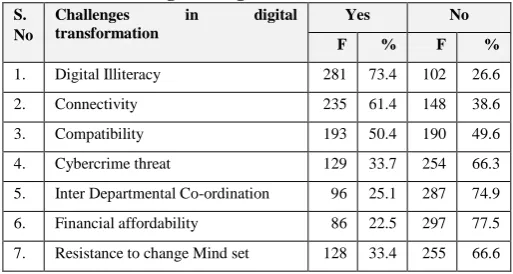
Digital transformation is ultimately aimed to bring more benefits to the entrepreneurs in long term, but in the initial period of information technology adoption, there may be few challenges faced by the entrepreneurs. Hence, the study
[image:5.595.298.555.170.307.2]has included Digital Illiteracy, Connectivity, Compatibility, Cybercrime threat, Inter Departmental Co-ordination, Financial affordability and Resistance to change Mind set as the list of challenges that theSMEs may experience in the process of digital transformation. It is imperative to analyse the experiencesof the SMEs towards thechallenges that they face in the process of digital transformation and tabulation for this is presented in Table XI.
Table-XI: SME entrepreneurs’ opinion towards the challenges in digital transformation
S. No
Challenges in digital
transformation
Yes No
F % F %
1. Digital Illiteracy 281 73.4 102 26.6
2. Connectivity 235 61.4 148 38.6
3. Compatibility 193 50.4 190 49.6
4. Cybercrime threat 129 33.7 254 66.3
5. Inter Departmental Co-ordination 96 25.1 287 74.9
6. Financial affordability 86 22.5 297 77.5
7. Resistance to change Mind set 128 33.4 255 66.6
Source: Primary data, F – Frequency, % - Percentage Table 11reveals that out of the total SME entrepreneurs, 73.4 Percent of them perceive that digital illiteracy will be the challenge in digital transformation and it is followed by the challenge connectivity with 61.4 Percent and then by compatibility with 50.4 Per cent. Whereas, only 22.5 Per cent of the respondents perceive that financial affordability will be a challenge.
VII. SUGGESTIONS
1.The study has identified that majority of the respondents prefer the conventional approach anddigitalized approach is yet to be fully preferred by the SMEs. Hence, training programs and campaigns are to be well designed by the policy makers in order toachieve completeinformation technology adoption.
2. The respondents' age and educational qualifications are identified as associated influencing factors for their digital readiness. Hence, adequate technical based digital qualifications could be provided to the young entrepreneurs to improve their digital readiness state.
3. The SMEs‟ location and their organization size are significantly associated with their digital readiness, special campaigns and training programmes could be exclusively planned by targeting the rural and small players in SME sector to motivate their digital compliance.
VIII. CONCLUSION
The study is a humble effort taken by the researcher to analyse the digital readiness of the SMEs in Tamil nadu and the findings have revealed that the need for information technology adoption is realised by the respondents. Based on analysing the demographic and organisational variables, it is found that rural and small players need a better focussed training workshops for smooth implementation of digitization. Based on the research findings, it is obvious that the vision of digital transformation by the year 2020 is feasible and it is to be achieved very soon in India.
REFERENCES
1. Amit R and Zott C, “Creating value through business model innovation”, MIT Sloan Management Review, Volume 53 No: 3, 2012
2. Arnold C Kiel and Voigt K, “How the Industrial Internet of Things changes business models in different manufacturing industries”, International Journal of Innovation Management, Vol 20 No: 8, 2016
3. Barhatov V, Campa A and Pletnev D, “The Impact of Internet-Technologies Development on Small Business Success in Russia” Procedia-Social and Behavioral Sciences (2018).
4. Berman SJ, “Digital transformation: opportunities to create new business models”, Strategy & Leadership, Vol. 40 No. 2, 2012 5. Celine Laurenceau and Colin Sloman, “Accenture Strategy”,
Research Report, 2016
6. Ernst & Young (EY), “The Digitisation of Everything. How Organisations Must Adapt to Changing Customer Behaviour”, Ernst & Young LLP, London, July,2011
7. GerdEhrhardt, “Three Steps to Digital Readiness”, Business Trends, December, 2015
8. Jeffrey F. Rayport, “Does Your Company Need a Digital Readiness Checklist?” Harvard Business Review, February 09, 2010
9. Premkumar G, “A Meta-analysis of Research on Information Technology Implementation in Small Business” Journal of Organizational computing and Electronic Commerce, June 2003 10. Stephen Burgess, “information Technology in Small Business: Issues
and Challenges” Information Technology in Small Business: Challenges and Solutions, Idea Group Publishing, January, 2002
AUTHOR PROFILE
DrSridevi K B is a Management Professor with specialization in Marketing. She has a blend of industry and academic experience of 18 years. Her areas of interest are Digital and social media marketing, Business analytics, Marketing Management, Business Research Methodology and International Business. Her research works are published in several reputed and peer reviewed journals. She has provided industrial consultancy in the field of Digital marketing and general marketing. She has convened an International conference on the title „Management in Digital Era‟ and also edited a book volume on the conference theme. She has completed AICTE certified Faculty Development Programmeon „E-Commerce‟ provided by IIT-Kharagpur. She has also upgraded her domain knowledge in Digital marketing through recognized MOOCs. She has conducted training programs for small enterprises on adoption of information technology and digital marketing.
DrShyamala P is a Management faculty with specialization in Marketing. She has almost two decades of academic experience. Her areas of interest are Management information systems, Business accountancy, Integrated Marketing Communication, Marketing Management, Business Research Methodology and general management. She has published 50 papers in National and international journals. She has presented her research works in 200+ conferences in India and foreign countries. She is currently guiding 10 Ph.Dscholars. She has convened national and international conferences.
She has been the resource person for a number of student development programmes organized by several colleges. She is also a doctoral committee member.