Abstract: Hastelloy C276 is investigated for dry sliding wear against an EN 31 stainless steel (hardness 60 HRC) at 298 K. The tribological properties such as frictional force, coefficient of friction and the wear rate on the material surface at different sliding distance are examined under different loading conditions. In the dry wear test at 40 N load, the wear rate increased by 300% as compared to 10, 20, 30 N loading conditions. The experimental results indicated reduction in coefficient of friction values and thus an increase in the frictional force with the increase in normal load. SEM images of worn out surfaces confirm that the delamination and adhesion causes the material removal from the surface in dry sliding. Further, the analysis of the hardness characteristics of worn out surfaces shows surface hardening during sliding wear process under 40 N loads.
Index Terms: Hastelloy C276, Tribological Properties, Sliding Wear, SEM, Microstructure.
I. INTRODUCTION
Super alloys remain created with nickel, nickel-iron, or cobalt which demonstrate a combination of mechanical strength and resistance to surface degradation and thus, favorably used in high-performance industrial applications where the ability to sustain high temperature, corrosive medium is of prime importance. The nickel super alloys are ideal materials for the components and elements of pumps, valves, piping arrangements, process equipment, turbines and assemblies in the marine, chemical processing, oil and accelerator pedal, aerospace, railway locomotive and military manufactures as they can withstand rough environments by exhibiting high heat resistance, erosion resistance and acid resistance [1]. Among all the nickel-based super alloys, Hastelloy (nickel-chromium-molybdenum alloys) is regarded as one of the best as the inclusion of molybdenum makes it harder, stronger at high temperatures, and also suitable for welding applications. They not only possess good ductility but also easily forged and cold worked. Hastelloy C276 finds good use across variety of chemical applications under severe corrosive environments. It is also widely used in nuclear and chemical reactors, heat exchangers, evaporators, pressure vessels and high strength nuts, bolts and bearings [2].
Owing to their wide spread industrial applications several Ni-based super alloys are investigated for their wear behavior by many researchers in the past. The corrosion and
Revised Manuscript Received on October 05, 2019.
S. K. Sahu, Department of Production Engineering, Veer Surendra Sai University of Technology, Sambalpur, Odisha, India.
N. K. Kund, VSSUT Burla, Odisha, India.
tribo-corrosion behavior of Hastelloy C276 sliding against Al2O3 pin in artificial sea water is investigated using a pin-on-disk tribometer integrated with a potentiostat for electrochemical control [3]. Wagle et al. [4] evaluated the dry sliding wear properties of two-phase Ni3Al/Ni3V against a G5 disc at 298K and 573K by using a pin-on-disc configuration. The tensile behavior of C276 alloy at high temperature has also been studied [5]. Cheng et al. [6] reported the wear rate of TiAl alloy sliding against the SiC ball to be two orders of magnitude higher than with SCr15 and C276 alloy as the mating surfaces. The wear mechanism of cutting tool while machining Hastelloy C-22HS is also investigated by researchers [7]. Recently, study pertaining to the sliding wear properties and mechanism of Inconel 718 and Hastelloy X at a temperature of 5000C is reported [8] which reveals that shear band and debris formation on the surface are the main reasons for the wear in case of Hastelloy X.
From the brief review we note that a few tribological facts available in the literature about friction and sliding wear behavior of Hastelloy C276. Therefore, the present work aims to study the wear characteristics of Hastelloy C276 using a Pin-On-Disc Tribometer at different normal loading conditions. The micro-hardness of the worn out surfaces after the experimentation are also investigated.
II. EXPERIMENTALDETAILS
As a first step, the dry sliding wear test is performed on Hastelloy C276 alloy samples under four different load in conditions (10, 20, 30, and 40 N). Then, the wear propagation on the surface of the samples is observed through microstructure observation and subsequently the micro-hardness of all the samples is measured.
A. Wear Test of Hastelloy C276
The Hastelloy C276 alloy is used as the pin material for determining the dry sliding wear behavior at the room temperature by using Pin-on-disc tribometer (DUCOM; TR-20LE). Cylindrical specimen (pin) with 6 mm diameter and 32 mm length (as shown in Fig. 1(a)) were prepared from the Hastelloy C276 block by conventional turning using the CNC lathe.
Microstructural Characterization and Evaluation
of Sliding Wear of Hastelloy C276 under
Different Loading Conditions
The surfaces of the specimens were polished with fine grit emery paper, then cleaned with acetone and the testing was performed at 298 K. The disc made of EN 31 is properly cleaned with acetone before and after the testing with different specimens at different experimental conditions. The sliding velocity was taken as 1.47 m/s. Fig. 1(b) shows the corresponding experimental setup for dry sliding wear measurement the pin-on-disc dry sliding wear tester. The variations of the coefficient of friction of Hastelloy C276 samples with increasing distance at normal loads of 10 N, 20 N, 30 N and 40 N are obtained. The COF values were recorded throughout each pin-on-disc test by using load sensors of the tribometer. The variation of COF with sliding distance provides the basic data for understanding the friction behavior of the material.
(a)
(b)
Figure 1 (a) Test sample (b) Pin-on-disc tribometer The tribological properties namely the COF, frictional force and the wear of the specimen in length were recorded in
variation of the normal load applied on the pin, each of the output data are plotted with respect to time duration and sliding distance.
B. Microstructural Observation
After the dry sliding testing the samples were taken to the SEM for the study the mechanisms of wear and the wear propagation on the surface of the samples. The effect of different loading conditions and the deterioration of the surface of the samples were also analyzed. The Hitachi SU3500 Premium Variable Pressure SEM was used to observe the surface microstructure of the worn samples. Surface image with 500x magnification was taken for clear view of the worn out surface and the images were taken in a scale of 1mm: 100 µm for the better interpretation of the surfaces. The images of four different samples (under loading condition 10, 20, 30, 40N in pin-on-disc test) were taken separately with a unidirectional wear marks which would be easy for observation. In addition, the compositions of the material at different areas were also studied using EDX analysis. With the help of its magnification capability and accelerating voltage of electron gun, images with higher magnification and quality could be achieved which provides a better understanding regarding the wear at the surface of the specimen.
III. RESULTSANDDISCUSSION
In this section, the results acquired by following the experimental procedure discussed in the previous section are analyzed and discussed in detail.
A. Variations in COF, Frictional Force and Wear The samples of Hastelloy C276 were tested on a pin-on-disc tribometer for the wear behavior under different loading conditions at 298K. In general, the abrasion and delamination of the material is observed when two surfaces of different hardness come into sliding contact with each other. In the present analysis, temperature of the sliding surfaces rises due to due to heat of friction caused by the rubbing action of the surfaces and some material of the softer Hastelloy C276 are cut out at the surface by the much harder surface of EN 31 plate. The variation in COF, frictional force and the most importantly wear has been shown in Fig. 2 to 4, respectively.
[image:2.595.45.292.243.670.2]It can also be noted that irrespective of loading condition the COF values of Hastelloy C276 specimen initially increased with increasing sliding distance till a peak value is reached and then it gradually come close to a steady state. Similar trend is also observed for the frictional force as evident from Fig. 3. This is owing to the influence of wear debris that plays a key role in wear process and the COF values as well. The entrapment of wear fragments between the sliding surfaces is the cause behind the fluctuation of friction coefficient. The wear particles those are entrapped between the wearing interfaces may slip over each other, act as rollers or become interlocked and undergo fracture. Thus, the friction coefficient involved in the wear process would change based on the stress applied on the worn surface. When the wear fragments act as roller during the sliding action the friction coefficient shows lower value and becomes higher when the particles act as abrasives.
[image:3.595.48.291.263.432.2]Figure 2. Variation in COF with respect to sliding distance
[image:3.595.313.539.339.502.2]Figure 3. Variation in frictional force with respect to sliding distance
Figure 4. Variation in wear with respect to sliding distance
B. SEM Morphology Involving Evolution of Wear The SEM images of the worn out surfaces of the cylindrical specimens were also examined to envisage the changes on the surface of the specimen after wear test. The elemental composition was also examined with the help of EDX which is combined with the SEM as described in Section II.B.
Figure 5 (a) SEM image of worn surface at 10N
[image:3.595.46.289.468.640.2] [image:3.595.315.539.527.688.2]Figure 5 (c) SEM image of worn surface at 10N
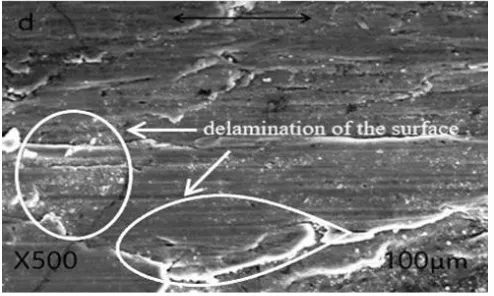
Figure 5 (d) SEM image of worn surface at 10N
The wear mechanism (SEM images) of Hastelloy C276 corresponding to loading conditions 10N, 20N are presented in Fig 5 (a) and (b), respectively. It is well known that when two surfaces are in sliding motion, combined normal and tangential forces are channeled through the contacting surfaces. Owing to the tangential shearing action, a local pressure is induced between contacting surfaces resulting in ploughing, which can clearly be observed in Fig. 5 (a). These ploughing marks normally start with the score lines, twin to the sliding direction and subsequently cause the shallow ploughing. The ploughing mechanism reduces the energy during sliding action, so that less energy is remained for introducing and passing around the fractures/cracks. The repeated sliding action of asperities on the surface makes the formation of grooves along with the debris built on the wear track surfaces. The groove formation of the wear track parallel to the sliding direction, show the signs of abrasive wear. As the load increases to 20N shearing of the matting surface occurs and this can be clearly observed from Fig. 5 (b).
At higher loading conditions (corresponding to 30N and 40N portrayed in Fig. 5 (c) and (d), respectively), the wear mechanism can be attributed to two phenomena: delamination and abrasion. Surface straining along the sliding direction of the alloy occurred under the united action of frictional shearing and repeated compression rolling. As sliding
sublayer of the sample. As a result fracture occurs in the contact surface and material is removed in the form of delaminated debris.
IV. CONCLUSION
The tribological properties of Hastelloy C276 for dry sliding wear against an EN 31 stainless steel at different sliding distance are studied under different loading conditions. By conducting the dry wear test, analyzing the SEM images and hardness of the worn out surfaces, few useful inferences are drawn. The wear mass loss and wear volume loss rate are significantly dependent on the loading conditions. The coefficient of friction decreases whereas the wear increases with increasing normal load. The effect of wear debris plays an important role in wear mechanism and the coefficient of friction. It is worthy to note that at greater load the adhesion of surfaces is more resulting delamination of the softer material. The microstructure analysis of the worn out surface revealed the occurrence of ploughing and shearing of the surfaces at lower and intermediate normal loads, respectively. However, at higher loading conditions the plastically deformed layers were delaminated and subsequent sublayers were came into contact with the disc material. Due to which the wear rate decreases with the increase of the sliding distance. It is seen that the surface hardness increases with the increase of normal load in dry sliding wear test.
ACKNOWLEDGMENT
The author gratefully acknowledge the support from VSSUT Burla for providing the essential resources to perform this research work. The author is also very much indebted to the referees besides journal editors for their painstaking efforts with perceptive thoughts for this manuscript.
REFERENCES
1. S.L. Shrestha, D. Bhattacharyya, G. Yuan, Z.J. Li, E.
Budzakoska-Testone, M. De Los Reyes, M. Drew, L. Edwards, 2016, Creep resistance and material degradation of a candidate Ni–Mo–Cr corrosion resistant alloy, Mater. Sci. Eng. A., Vol. 674, pp. 64–75.
2. Y. Ustinovshikov, 2016, Formation of microstructures responsible for
remarkable properties of the Ni-and Co-based superalloys, Acta Materialia, Vol. 111, pp. 66–74.
3. C. Jun, J. Wang, F. Yan, Q. Zhang, Q. Li, 2015, Corrosion wear
synergistic behavior of Hastelloy C276 alloy in artificial seawater, Trans. Nonferrous Met. Soc. China, Vol. 25, pp. 661–668.
4. S. Wagle, Y. Kaneno, R. Nishimura, T. Takasugi, 2013, Evaluation of
the wear properties of dual two-phase Ni 3 Al/Ni 3 V intermetallic alloys, Tribol. Int., Vol. 66, pp. 234–240.
5. Y. Lu, J. Liu, X. Li, J. Liang, Z. Li, G. Wu, X. Zhou, 2012, Hot deformation behavior of Hastelly C276 superalloy, Trans. Nonferrous Met. Soc. China, Vol. 22, pp. s84–s88.
6. J. Cheng, F. Li, S. Zhu, Y. Yu, Z. Qiao, J. Yang, 2017, Electrochemical
corrosion and tribological evaluation of TiAl alloy for marine application, Tribol. Int., Vol. 115, pp. 483–492.
7. K. Kadirgama, K.A. Abou-El-Hossein, M.M. Noor, K.V. Sharma, B.
Mohammad, 2011, Tool life and wear mechanism when machining Hastelloy C-22HS, Wear, Vol. 270, pp. 258–268.
[image:4.595.47.290.49.194.2] [image:4.595.46.293.222.370.2]AUTHORSPROFILE
S. K. Sahu(Corresponding Author) completed M.Tech. in Mech. Engg. with Prod. Engg. Specialization from VSSUT Burla. He completed B.Tech. in Mech. Engg. from BPUT Rourkela (Govt. Tech. Univ.). He is having international publications and research/teaching contributions. At present he serves as Assistant Professor in Veer Surendra Sai
University Technology, Sambalpur. Phone:
9090262166,
E-mail: [email protected]