International Journal of Innovative Technology and Exploring Engineering (IJITEE) ISSN: 2278-3075,Volume-8 Issue-3C, January 2019
Abstract: Background/Objectives: Recently, the introduction of microgrid(MG) is being extended to the islands and pilot areas. In previous researches, we designed an efficient operation algorithm for stand-alone MG. The purpose of this paper is to verify the economical feasibility of the algorithm. Methods/Statistical analysis: In this paper, we used HOMER PRO and actual MG operational data. Two scenarios constructed based on applying or not the algorithm. In HOMER Pro, the same parameters entered and only the operating conditions of the diesel generator, BESS varied. This paper does not merely derive a generator combination for optimal operation of MG. The purpose of the analysis is to analyze the economic feasibility of the algorithm. Findings: The economic feasibility of applying the algorithm was analyzed under the condition that renewable energy generation capacity does not exceed the load. HOMER Pro presents optimal combination of MG according to input variables and condition setting. Therefore, HOMER PRO simulation was carried out according to whether the algorithm was applied or not, and the results for the same optimal combination were selected. And, the economics derived from the selected combinations were compared and analyzed. In the case of the scenario where the algorithm is applied, the diesel generator is operated at an optimal power ratio of 60~80%, and BESS is operated within the set SOC range (average 42.5%). As a result, when the algorithm is not applied, the COE is 1.87 ~ 12.09 $ and the applied COE is as 1.71 ~ 2.61 $. In other words, when the MG is operated by applying the algorithm, it can save about COE 0.16 ~ 9.48 $. Improvements/Applications: In the next research, we will apply the algorithm to area where the amount of renewable energy is abundant, and conduct the economic analysis. This will confirm the validity of the algorithm in various situations.
Keywords: microgrid, MG, HOMER PRO, renewable energy, BESS, diesel generator, economic analysis
I. INTRODUCTION
Recently, the power paradigm is changing. With threats of frequent climatic changes, the global community at the 21st Conference of the Parties of the United Nations Framework Convention on Climate Change (UNFCCC) held in Paris reached a milestone to not only to combat the frequent climatic changes but also to strengthen the steps towards a sustainable development with low carbon footprint [1]. In this international trend, the importance of renewable energy is increasing, and microgrid(MG), which is mainly renewable energy, is being actively constructed.
Revised Manuscript Received on January 03, 2019.
Seo-Hyun Yeo, Thi-Tuan-Vi Le, Jin-Wook Park, Department of
Electrical Engineering, Chonnam National University, Gwangju 61186, Korea,
Seong-Mi Park, Department of Lift Design, Korea Lift College,
Geochang 50141, Korea,
Sung-Jun Park, Corresponding author, Department of Electrical Engineering, Chonnam National University, Gwangju 61186, Korea,
Especially, in Korea, the implementation of the 'Energy Independent Island Project' has led to the creation of a number of islands as pilot sites for MG, and construction for industrial complexes is also increasing.
In general, MG is used in two operational modes: grid-connected and stand-alone (off-grid or isolated). In both operational modes, micro grids have some effects on both consumers and main power system [2]. In this paper, we used the operation data of the specific island where the stand-alone MG was constructed.
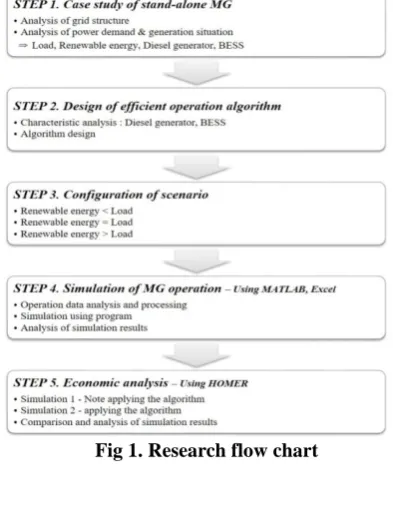
[image:1.595.328.525.468.726.2]A detailed research flow chart shows in Figure 1. In previous researches, STEP 1 ~ 4 were conducted, and the results of the research were published through existing papers. In this paper, STEP 5 conducted based on the results. STEP 5 aims to verify the economic feasibility of the design algorithm. This algorithm is an efficient operation algorithm of stand-alone MG designed in STEP 2 and briefly mentioned in Chapter 2 of this paper. The program used to verify the economic feasibility is the HOMER PRO software, which is excellent for deriving the MG optimal combination and economic analysis. Using this, we simulated the situation depending on whether the algorithm is applied or not, and compared the results to verify the economical feasibility of the algorithm.
Fig 1. Research flow chart
II. DESIGNOFEFFICIENTOPERATION ALGORITHM
Economic Analysis of Efficient Operation
Algorithm of Stand-Alone Microgrid
1
This algorithm designed in previous researches, and its efficiency verified through operation simulation in MATLAB and Excel. The below part is an explanation of the algorithm design method and the system structure and characteristics of the analysis area.
2.1. Case study
The analysis area is island, and has 124 kW average load, 305 kW peak load. This area has operated by the existing three diesel generators (150 kW per unit). Currently, WT (100 kW), PV (111 kW), ESS (500 kWh), inverter system (250kVA) and a new diesel generator (200 kW) are installed by KEPCO project [3]. And, the grid structure is a stand-alone MG that is not supplied with KEPCO power. This area has different monthly power demand due to fishery industry. Particularly, March is the place where the power demand is the highest in the evening due to the nighttime fishery activity, and this specific pattern is repeated. In addition, the installed renewable energy generation equipment in the area is solar power and wind power generation, but the power generation rate is very low at 21.76% on average compared with the total power generation. As a result of checking the actual operation data for one year, the generation amount of renewable energy did not exceed the load. Therefore, it is necessary to use BESS (Battery Energy Storage System) which can store and supply energy, and it is inevitable to actively drive the diesel generator for stable life and economic activity.
2.2. Characteristic of Stand-alone MG
In the previous researches, the optimal combination of the diesel generator and the BESS was designed to maintain the optimum efficiency.
2.2.1. Diesel generator
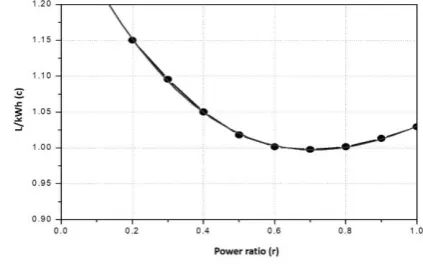
There are four diesel generators at the analysis area, three for continuous operation, and one for emergency power generation. For diesel generators for continuous operation, the fuel consumption according to the output power of the diesel generator is analyzed, and the diesel generator is operated only in the section where the lowest fuel is consumed. Therefore, analysis of the fuel consumption of the diesel generator shows that between 50% and 100% of the output, fuel consumption per output, which is closely related to power generation efficiency, appears almost similar. But falls sharply below 50% [4]. That is, generally, the diesel generator has a characteristic of lowering efficiency when driven at low output. Therefore, it is helpful to improve diesel generator efficiency by keeping the proper output ratio [4,5]. As a result of checking the fuel consumption data per 150 kW diesel generator output, the fuel consumption per 1 kW output was maintained at about 0.26 L/kWh at 60 to 80% of the output, and the fuel consumption was increased as the output ratio decreased. Reflecting this, Equation (1) was derived using curve fitting techniques to obtain continuous data of fuel consumption per output.
(1) r is the output ratio of the diesel generator to the rated value, and c is a function normalized by the curve fitting method, which is the continuous fuel consumption value according to the output ratio. The graph derived from this equation is
[image:2.595.323.535.78.210.2]shown in Figure 2, and the 150kW diesel generator consumes the lowest fuel at 60 ~ 80% of the output.
Fig 2. Fuel consumption per output of 150kW diesel generator
2.2.2. BESS
There is a500kWh BESS in the analysis area. Renewable energy has a problem that power supply is unstable due to characteristics that depend on natural conditions. This is a factor that can make the reliability of grid lower, and it is common to build a BESS that can store renewable energy generation and supply it when needed [6]. In the case of analysis area, since the generation of renewable energy is small, the frequency of absorbing renewable energy generation by BESS is low, but it is being used to supply power to demanding places such as nighttime fishery. In this paper, the diesel generator can be operated in addition to the efficiency operating conditions, so that the power of the diesel generator can be charged and discharged to the BESS. Also, this charging/discharging method can be performed only when the efficiency of the BESS is achieved.
International Journal of Innovative Technology and Exploring Engineering (IJITEE) ISSN: 2278-3075,Volume-8 Issue-3C, January 2019
Fig 3. Total energy according to Li-ion battery SOC
2.3. Efficient operation algorithm
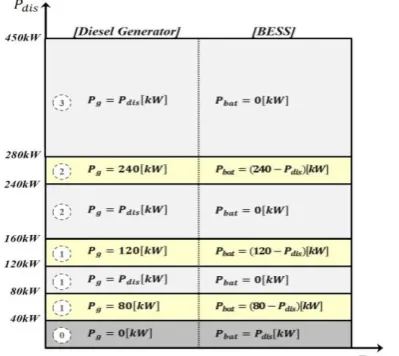
Figure 4 shows the efficient operation algorithm of stand-alone MG of the analysis area that was finally designed to reflect the characteristics of diesel generator and BESS. Renewable energy (WIND, PV) determined by natural environment and load (linear, nonlinear) determined by the usage environment were considered as an uncontrollable factor in algorithm design. Therefore, first, the load must be covered by renewable energy, and the diesel generator and BESS should be supplied with power for the remaining load.
In figure 4, is the subtracts renewable energy
generation from total load, is the diesel generator power,
[image:3.595.70.270.528.706.2]is the absorbed power of the BESS inverter. Also, the numbers written in the circles in the figure mean the number of diesel generators operated. However, according to existing research case, power generation efficiency of diesel generator decreases according to operation time, and it is generally reduced by 10% when operating 50,000 hours [11]. The diesel generators at the analysis area have been operated for a long time. Therefore, it should be operated within the range of 60 ~ 80% of 150kW according to 2.1, but it was operated from 80kW ~ 120kW to reflect the characteristics of reduced efficiency. BESS was operated within the SOC range of 35 ~ 55% which is the maximum energy guarantee ratio.
Fig 4. Efficient operation algorithm of diesel generator, BESS
III. SIMULATION 3.1. Configuration of scenario
For the economic analysis, HOMER PRO software of NREL (Nation Renewable Energy Laboratory) was used. The HOMER software is used as optimization tool in order to determine the size and energy management of the system. The HOMER software provides a powerful framework for comparing a lot of different economic and technical options for users. Moreover, the consideration of many changes and uncertainties in input data is possible. The HOMER software simulates the performance of energy system for each hour of a year and shows the possible ways of energy supplying and lifetime cost. In the optimization procedure, the software searches various possible configurations, the size of renewable resources and demand satisfaction by considering restrictions in order to achieve the most economic state [2]. The reason for using this software is that it is possible to change operating conditions of diesel generator and BESS among built-in functions.
Table 1 shows the scenarios constructed to analyze the economic feasibility of the designed algorithms. Scenario 1 is a basic mode in which no algorithm is applied, Scenario 2 is a mode in which an algorithm is applied, and is independently simulated using a HOMER PRO. The parameter inputs of scenario 1 and scenario 2 are the same. However, in case of scenario 2, in scenario 2, the operating time of the diesel generator is limited according to the efficiency range and the SOC is set according to the maximum energy securing range of BESS to reflect the algorithm. Finally, after confirming the optimum combination of operations for each scenario, which is the simulation result, we compared the economical efficiency of the same combination case.
Table 1. Scenario configuration scenario meaning
scenario 1 basic mode (Not applying efficient operation algorithm)
scenario 2 applying efficient operation algorithm
3.2. Simulation settings
3.2.1. Basic setting for simulation
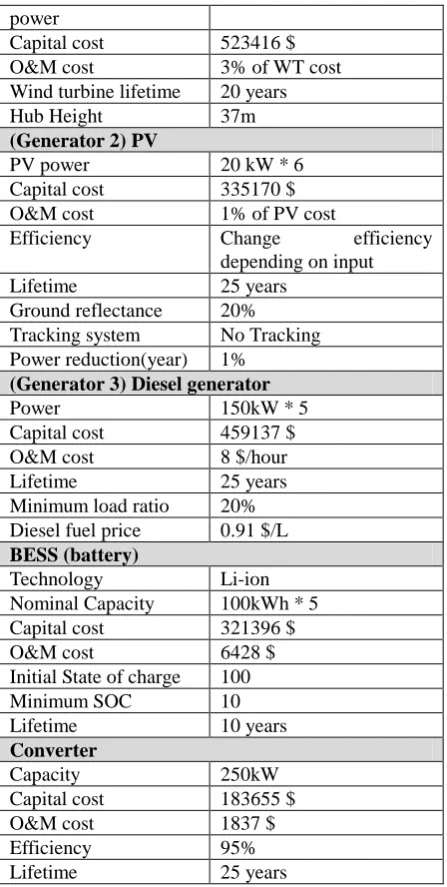
Scenario 1 is the basic mode and the algorithm is not applied. The parameters entered in the HOMER PRO are as shown in the following Table 2, and are input in common to scenario 1 and 2. First, the accurate location of the analysis area was entered as shown in Figure 5, and the temperature value based on location was reflected using NASA data. The total project lifetime was set at 25 years, and variables affecting efficiency were also entered. In the case of the load, the annual average load is 124 kW/d, the maximum load is 305 kW, the minimum load is 80 kW, and the setting result of HOMER PRO is the shown as figure 6.
and the diesel generator set 150kW Generac SD150 model. Of course, there is a cost error because it may be different from the model actually built in the area. However, However, it is possible to directly input the purchase cost, the installation cost, the maintenance cost, the efficiency, the life time and the specific specification after the model selection according to the case, so that the error rate can be greatly reduced as compared with other MG economics simulation programs.
Fig 5. Location input in HOMER PRO
Fig 6. Grid setting and load input in HOMER PRO Table 2. Technical parameters of MG’s components
System and Project Data (include economics, weather) Project lifetime 25 years
Operating strategy
Scenario 1 : Load following
Scenario 2 : Cycle charging
Location Latitude 34˚, longitude
126˚ Nominal discount rate 5% year Expected inflation rate 2% year Temperature (annual
average)
13.4 ˚C (NASA data)
Solar – scaled annual
average 3.68 (kWh/ /day)
Wind – scaled annual average
5.55 m/s
Wind – anemometer height
10 m
(Generator 1)Wind
Nominal wind turbine 100kW
power
Capital cost 523416 $
O&M cost 3% of WT cost
Wind turbine lifetime 20 years
Hub Height 37m
(Generator 2) PV
PV power 20 kW * 6
Capital cost 335170 $
O&M cost 1% of PV cost
Efficiency Change efficiency
depending on input
Lifetime 25 years
Ground reflectance 20% Tracking system No Tracking Power reduction(year) 1%
(Generator 3) Diesel generator
Power 150kW * 5
Capital cost 459137 $
O&M cost 8 $/hour
Lifetime 25 years
Minimum load ratio 20% Diesel fuel price 0.91 $/L BESS (battery)
Technology Li-ion
Nominal Capacity 100kWh * 5
Capital cost 321396 $
O&M cost 6428 $
Initial State of charge 100
Minimum SOC 10
Lifetime 10 years
Converter
Capacity 250kW
Capital cost 183655 $
O&M cost 1837 $
Efficiency 95%
Lifetime 25 years
3.2.2. Differentiated setting of scenario 2
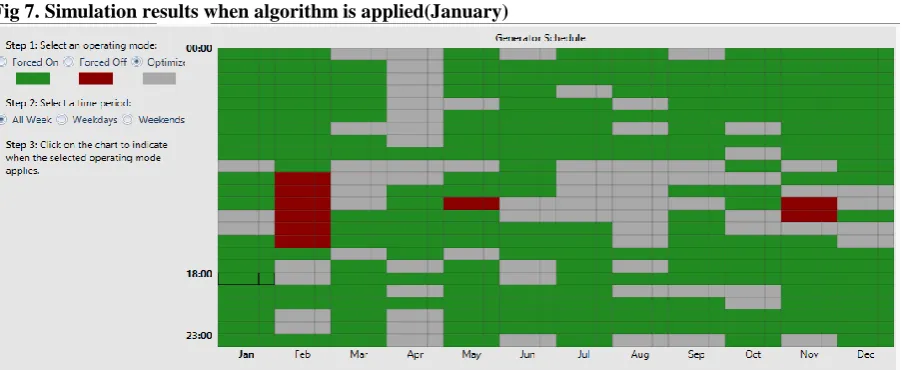
The input parameters of scenario 2 are the same as scenario 1 except that the diesel generator and BESS are changed by using only the following built-in functions.
①Different setting of diesel generator part
[image:4.595.56.286.158.780.2]International Journal of Innovative Technology and Exploring Engineering (IJITEE) ISSN: 2278-3075,Volume-8 Issue-3C, January 2019
green means priority operation, red means stop, and gray means optimal operation according to BESS SOC.
(Gray : Diesel generator, Orange : PV, Blue : WIND, Yellow : Battery discharge, Green : Battery charge)
[image:5.595.64.515.53.188.2] [image:5.595.61.514.203.388.2]Fig 7. Simulation results when algorithm is applied(January)
Fig 8. Operation setting screen of diesel generator by hour
②Different setting of diesel BESS part
BESS in scenario 1 was automatically operated in HOMER basic mode. Also, in scenario 1 and 2, the initial charge value was set to 100% in order to simulate the same conditions. However, scenario 2 should be operated according to the designed algorithm. Therefore, the Li-ion battery installed in the BESS was set to charge / discharge between SOC 35 ~ 55%. Therefore, the average value of 35 ~ 55% of the set point value of SOC was input as 42.5%. In addition, the SOC minimum value was set at the lowest value of 35%.
3.3. Simulation results and economic analysis
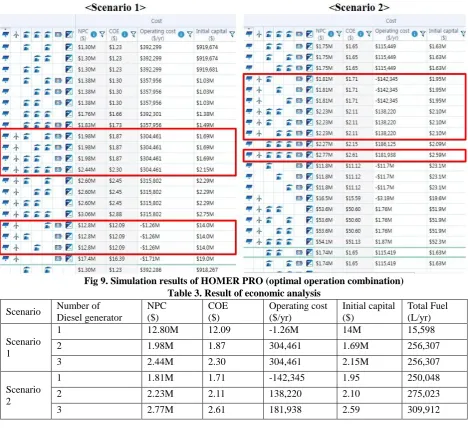
The optimal combination of scenarios 1 and 2 derived from the HOMER PRO is shown in Figure 9. The power generation amount supplied to the load differs according to each combination. Among the various combinations, the combination marked with a box in the figure was selected as the subject of analysis of this paper. The selection criteria are as follows. First, all the MG components built in the actual analysis area should be included. The purpose of this paper is not to derive the optimum operating combination. The purpose of this study is to understand the economic change caused by applying the designed algorithm. Therefore, only the case where the system configuration is the same as that of
the system constructed at the actual analysis area was selected as the target. Second, renewable energy must be operated. In the analysis area, the renewable energy source preferentially supplies power to the load. This is due to the government's policy to implement environmentally-friendly clean MG. Reflecting this aspect, we selected an operating combination that includes renewable energy.
Fig 9. Simulation results of HOMER PRO (optimal operation combination) Table 3. Result of economic analysis
Scenario Number of Diesel generator
NPC ($)
COE ($)
Operating cost ($/yr)
Initial capital ($)
Total Fuel (L/yr)
Scenario 1
1 12.80M 12.09 -1.26M 14M 15,598
2 1.98M 1.87 304,461 1.69M 256,307
3 2.44M 2.30 304,461 2.15M 256,307
Scenario 2
1 1.81M 1.71 -142,345 1.95 250,048
2 2.23M 2.11 138,220 2.10 275,023
3 2.77M 2.61 181,938 2.59 309,912
IV. CONCLUSION
In this paper, we verify the economical feasibility of efficient operation algorithm of stand-alone MG. The analysis target area is a specific island, and a renewable energy source based on WIND and PV is constructed. However, it is necessary to operate diesel generators because the amount of power generated is insufficient to supply power only with renewable energy (WIND, PV). In addition, because of the fishery activity, the power consumption is not constant, so BESS is necessary for stable power supply. Therefore, the strategy to operate the diesel generator and the BESS to ensure the maximum efficiency was designed, and the economic feasibility was analyzed through HOMER PRO. As a result of analysis, COE of scenario 1 (Basic mode) is 1.87 ~ 12.09 $, 00 won and COE of scenario 2 (Applying efficient operation algorithm) is 1.71 ~ 2.61 $. In other words, the COE when the algorithm is applied is reduced by 0.16 ~ 9.48 $, so the economic feasibility of the algorithm can be confirmed. In future research, we will apply the algorithm to many cases including grid-connected MG, and analyze the economical efficiency of the algorithm to secure the economic feasibility of the algorithm for various situations.
ACKNOWLEDGMENT
This research was supported by Korea Electric Power Corporation. (Grant number :R18XA04)
REFERENCES
1. Abhishek Kumar, Arvind R. Singh, Yan Deng, Xiangning He, Praveen Kumar, Ramesh C. Bansal. (2018). Multiyear load growth based techno-financial evaluation of a microgrid for an academic institution. IEEE Access. 37533-37555. DOI: 10.1109/ACCESS.2018.2849411. 2. Hossein Shahinzadeh, Majid Moazzami, S. Hamid Fathi. (2016).
Optimal sizing and energy management of a grid-connected microgrid using HOMER Software. Smart Grids Conference (SGC). DOI:10.1109/SGC.2016.7882945.
3. HongJoo Kim, Youngpyo Cho, Jaehan Kim, Jintae Cho, Juyong Kim. (2017). Demonstration of the LVDC distribution system in an island. CIRED - Open Access Proceedings Journal. 2215-2218. DOI:10.1049/oap-cired.2017.0732.
International Journal of Innovative Technology and Exploring Engineering (IJITEE) ISSN: 2278-3075,Volume-8 Issue-3C, January 2019
5. Kyung Kyu, Lee. (2016). Hybrid Energy System Control Strategy Considering Properties of Diesel Generator and ESS (Masters dissertation). Chungbuk National University, Cheongju, Korea. 6. Kintner-Meyer, M., Balducci, P., Elizondo, M., Jin, C., Nguyen, T.,
Viswanathan, V., Guo, X., Tuffner, F. (2012). Energy Storage for Power Systems Applications : A Regional Assessment for the Northwest Power Pool (NWPP) (PNNL-19300). Pacific Northwest National Laboratory. 7. Kintner-Meyer, M., Balducci, P., Colella, W., Elizondo, M., Jin, C.,
Nguyen, T., Viswanathan, V., Zhang, Y. (2012). National Assessment of Energy Storage for Grid Balancing and Arbitrage : Phase 1, WECC (PNNL-21388). Pacific Northwest National Laboratory.
8. Kintner-Meyer, M., Balducci, P., Colella, W., Elizondo, M., Jin, C., Nguyen, T., Viswanathan, V., Zhang, Y. (2013). National Assessment of Energy Storage for Grid Balancing and Arbitrage : Phase Ⅱ : WECC, ERCOT, EIC – Volume 1 : Technical Analysis (PNNL-21388-PHASE Ⅱ /Vo1.1). Pacific Northwest National Laboratory.
9. Viswanathan, V., Kintner-Meyer, M., Balducci, P., Jin, C. (2013). National Assessment of Energy Storage for Grid Balancing and Arbitrage : Phase Ⅱ - Volume 2 : Cost and Performance Characterization (PNNL-21388-PHASE Ⅱ /Vo1.2). Pacific Northwest National Laboratory.
10. Abbas A. Akhil, Georgianne Huff, Aileen B. Currier, Benjamin C. Kaun, Dan M. Rastler, Stella Bingqing Chen, Andrew L. Cotter, Dale T. Bradshaw, and William D. Gauntlett. (2013). DOE/EPRI 2013 Electricity Storage Handbook in Collaboration with NRECA (SAND2013-5131). Sandia National Laboratories.