Norm socialization from policies to practices:
Practices of Freedom of Association and Responsible Business Conduct in Myanmar during the first phase of transition (2011–2016)
Khin Thidar Aye
February 2019
Department of International Relations Coral Bell School of Asia Pacific Affairs
College of Asia and the Pacific The Australian National University
A thesis submitted for the degree of Doctor of Philosophy of The Australian National University
Statement of Originality
I declare that the present thesis is a product of my own work which was carried out under the supervision of Dr. Nicholas Farrelly, Associate Dean, ANU College of Asia and the Pacific, Dr. Matthew Davies, Head of the Department of International Relations, and Dr. Cecilia Jacob, Fellow, Department of International Relations.
Sources of information used in this work are indicated and acknowledged.
This thesis, in whole or in part, has never been published or submitted to another University for other types of recognition.
Sign
Name Khin Thidar Aye
Acknowledgement
I am privileged to have taken this academic journey in the Department of International Relations, Coral Bell School of Asia Pacific Affairs, at the Australian National University (ANU) which delivers on its promise reflected in its motto ‗Naturam Primum Cognoscere Rerum‘, ‗First to Learn the Nature of Things‘. My journey of pursuing knowledge at the ANU would not have been possible without generous support from the people and government of Australia delivered through the Australia Award Programme and I am deeply appreciative to all involved in delivering this programme. I am also thankful to my senior, contemporary and junior colleagues at the Ministry of Foreign Affairs of Myanmar for allowing me to take the leave of absence and for taking care of my workload while I was away on this academic undertaking.
I owe so much to so many people who have enabled me, in different ways, to carry out such a tough but a worthwhile task in search of knowledge and to make a contribution to the knowledge which human society always needs. I would like to acknowledge the support and contributions received from many individuals. I first wish to express my sincere appreciation to interview participants, scholars and practitioners in the field of labour rights promotion and private sector governance. Although I cannot mention all their names, I wish to record my sincere appreciation to each and every one of them for generously sparing time with me, and for sharing their experiences, insights and information, which greatly contributed to my research.
Completing such a tough PhD journey would be unthinkable without the mentorship, intellectual guidance and consistent moral support from my supervisors: Dr. Nicholas Farrelly, Associate Dean, College of Asia and the Pacific, ANU; Dr. Matthew Davies, Head of Department, Department of International Relations, Coral Bell School of Asia Pacific Affairs; and Dr. Cecilia Jacob, Fellow, Senior Lecturer and Convenor Peace and Conflict Studies Program, Department of International Relations, Coral Bell School of Asia Pacific Affairs. Their logical thinking and pragmatic reasoning in their academic work, and their dedication in their respective academic fields, has always inspired me. I am indebted to their unwavering support and guidance throughout my PhD journey.
also thankful to Dr. Nick Cheesman for reading my TPR paper and giving me valuable advice. My thanks also go to Ms Candida Spence from the ANU library for helping me in formatting the thesis and Ms Maxine McArthur from the Department of Political and Social Change, Coral Bell School, for providing editorial services for my thesis. Discussions with Ambassador Trevor Wilson, Professor Helen James, Dr. Jurgen Haask, Dr. Aung Htun Thet and U Aung Min, Director Myanmar Market Research and Development, and Professor Dr. Daw Yin Myo Thu of the International Relations Department, University of Yangon, were also illuminating and helpful to my research.
My appreciation also goes to my PhD cohort in the Department of International Relations: Wan-Ti, Su, Lana, Ruji, Carly, Kelly and Tereza, who have supported me during the process of Thesis Proposal Review. I have memories of fun times in the circle nick-named ‗ASEAN Curry Forum Plus‘ along with Borey, Giri, Fang, Yusuke, Ryosuke and Trang, as well as with my batch mates from the Australia Award Programme, Miranda, Mita, Leo, Wang Wang, Yah Yah and Thanh, will last forever.
I was able to survive the turbulent PhD journey mainly due to the stamina built up by my grandma, my parents and my teachers from primary and high schools and from those at the Mandalay University International Relations Department. I am particularly grateful to retired Professor U Maung Maung Lay from the IR department, Mandalay University, Professor Soo Bok Lee from the Ajou University, Republic of Korea, and my all-time mentor U Win Myat for their support and mentorship.
Abstract
Rich insights from norm research in International Relations mainly address the impacts of international norms on policy behaviours while assuming norm-favoured state policies would generate societal practices in line with the norms. Such assumptions need to be examined as many instances of norm practices in states lag behind state policies. In order to address this loophole in norm research, this study examines the way norm socialization animates domestic sites by investigating the practices of two norms: Freedom of Association (FOA) and Responsible Business Conduct (RBC) in Myanmar. The investigations focus on the interactive dynamic of international, transnational and domestic actors within the confines of domestic structural factors.
These two cases demonstrate that norm practices within a state are the function of the interactive dynamics of multiple actors as conditioned by the contents of norms and domestic structural factors. Conflictual dynamics of key stakeholders in the practices of FOA has led to the incomplete application of the FOA norm in Myanmar while the synergetic dynamics of key players in RBC practices keep the RBC norm on a trajectory towards the moral and functional purposes of the norm. Such findings go beyond the expectations of norm studies on the role socialization plays at domestic sites where external norm agents engage in ‗the leverage politics‘ of empowering domestic pro-norm coalitions to pressure the state(Keck and Sikkink, 1998: 23-24), in addressing capacity issues (Risse et al., 2013: 185-186) and in joint translation of norms with domestic actors (Zimmermann, 2017: 199-200).
Glossary and Abbreviations
ADB Asian Development Bank
ASEAN Association of South East Asia Nations
AMCHAM-Myanmar American Chamber of Commerce Myanmar AUSCHAM-Myanmar Australia-Myanmar Chamber of Commerce
BGR Bundesanstalt für Geowissenschaften und Rohstoffe
(BGR) (Federal Institute for Geosciences and Natural Resources), an entity providing advice to the German Federal Government in all geo-relevant questions
Brit Cham-Myanmar British Chamber of Commerce of Myanmar BSR Businesses‘ Social Responsibility
BWC the Biological Weapons Convention
BSPP Burma Socialist Programme Party
CCI France-Myanmar French Myanmar Chamber of Commerce and Industry
CSO Civil Society Organization
CWC the Chemical Weapon Convention
DIHR the Danish Institute for Human Rights (DIHR) EITI Extractive Industry Transparency Initiative
EIA Environment Impact Assessment
EU European Union
EuroCham-Myanmar European Chamber of Commerce Myanmar
FDI Foreign Direct Investment
FESR Framework for Economic and Social Reforms
FOA Freedom of Association
HRC Human Rights Council
IAEA International Atomic Energy Agency
ICRC International Committee of the Red Cross IHRB Institute for Human Rights and Business
IR International Relations
IL International Law
ILO International Labour Organization
JICA Japanese International Cooperation Agency
JMA Japan-Myanmar Association
LNGO Local Non-Governmental Organization
MCBA Myanmar Centre on Business and Aid
MCRB Myanmar Centre for Responsible Businesses
MEITI Myanmar Extractive Industry Transparency Initiative
NCDP National Comprehensive Development Plan
NGO Non-Governmental Organizations
NPT the Non-Proliferation Treaty
ODA Official Development Assistance
PATROL Partnership Against Transnational crimes through Regional Organized Law-enforcement
SDN List Specially Designated Nationals and Blocked Persons List
SIA Social Impact Assessment
SLORC State Law and Order Restoration Council
SPDC State Peace and Development Council
UNCAC United Nations Convention Against Corruption
UNCHR United Nations Commission on Human Rights
UNGA United Nations General Assembly
UNGC United Nations Global Compact
Table of Contents
Statement of Originality ... ii
Acknowledgement ... iii
Abstract ... v
Glossary and Abbreviations ... vi
Table of Contents ... ix
List of Tables ... xiv
List of Figures ... xv
Chapter One: Introduction ... 1
1.1 Introduction ... 1
1.2 Turning norm-related policies to practices: practical challenges in a transitioning democracy ... 5
1.3 Conceptual voids in norm research ... 10
1.4 Research questions, findings and contributions to norm research ... 14
1.4.1 Questions ... 14
1.4.2 Objective, key terms and assumptions ... 14
1.4.3 Findings and arguments ... 16
1.4.4 Conceptual contribution ... 17
1.4.5 Methodological contribution ... 19
1.4.6 Empirical contributions ... 21
1.4.7 Practical contributions to better governance ... 22
1.5 Principles, process and parameters of the research ... 22
1.5.1 Sampling ... 23
1.5.2 Data collection and analysis... 24
1.6 Organization of the thesis ... 24
Chapter Two: Literature on Socialization... 26
2.1 Introduction ... 26
2.2 Socialization defined... 30
2.3 Socialization: systemic perspective ... 31
2.4.1 Socialization as domestic processes ... 39
2.4.2 Domestic factors as scoping conditions in explaining impact variation ... 42
2.5 Socialization: global-local interactive perspectives ... 47
2.6 Conclusions... 51
Chapter Three: Conceptualizing Norm Socialization within States ... 53
3.1 Introduction ... 53
3.2 Key terms ... 54
3.3 Analytical steps and conceptual map ... 57
3.4 Conceptual value addition to norm research ... 63
3.4.1 From state-centric analysis to analysis on multiple agents within state ... 63
3.4.2 From general theory of socialization to context-specific studies ... 64
3.4.3 Analysis on norm contents and its impact on implementation ... 64
3.4.4 Measuring the compliance/implementation ... 65
3.4.5 An integrative model of state structures and agents ... 65
Chapter Four: Methodology ... 67
4.1 Introduction ... 67
4.2 Ethical research... 70
4.3 General approach to the study ... 71
4.4 Method of empirical enquiry ... 72
4.4.1 Sampling context, thematic cases and interview participants ... 73
4.4.2 Sample size ... 76
4.4.3 Data collection and generation ... 77
4.4.4 Data analysis ... 80
4.4.5 Transparency and verification method ... 82
4.4.6 Limitations of research method ... 85
Chapter Five: Practices of Freedom of Association in Myanmar ... 87
5.1 Introduction ... 87
5.2 Historical contexts of the trade union practice in Myanmar... 89
5.2.1 Workers‘ rights in pre-colonial Myanmar ... 89
5.2.2 Organized labour practices in colonial Myanmar [1885–1948]... 91
5.2.4 Trade union practice under socialist Myanmar [1962–1988] ... 101
5.2.5 Defunct FOA under the SLORC and SPDC [1988–2010] ... 105
5.3 Precarious industrial relations in transitioning Myanmar (2010–2016) ... 107
5.4 FOA practices, shifting structures and emerging agents ... 107
5.4.1 Favorable policies: the role of individual leadership ... 108
5.4.2 Evolving structure for FOA practices ... 109
5.4.3 Emerging domestic actors and FOA practices ... 112
5.4.4 Role of international actors for FOA practice ... 122
5.5 What explains FOA implementation challenges ... 124
5.5.1 Divergent conception of FOA by multiple actors ... 125
5.5.2 Defective legal and institutional structures ... 130
5.5.3 Inadequate agency by socializing actors ... 133
5.6 Conclusion ... 136
Chapter Six: Responsible Business Conduct in Myanmar ... 139
6.1 Introduction ... 139
6.2 Historical perspectives on business behavior in Myanmar ... 141
6.2.1 Business behavior in pre-colonial Myanmar ... 141
6.2.2 Business behavior in colonial Myanmar [1885–1948] ... 143
6.2.3 Businesses‘ behaviour in parliamentary Myanmar [1948–1962] ... 146
6.2.4 Business behavior in socialist Myanmar [1962–1988] ... 147
6.2.5 Business behavior under SLOC and SPDC [1988–2010] ... 149
6.3 Transition, favorable institutions and RBC practices (2010–2016) ... 151
6.3.1 The government initiatives on private sector governance ... 152
6.3.2 Civil society ... 155
6.3.3 Freer media and affordable telecommunication services ... 161
6.4 Transition, multiple actors and RBC practices ... 164
6.4.1 The MCRB as a dedicated lead actor for RBC practices ... 164
6.4.2 Emerging RBC Consultancy Service Providers ... 165
6.4.3 International Chambers of Commerce ... 166
6.5 Institutions, actors and RBC practices ... 167
6.5.1 New legal framework as enabler of RBC norm ... 167
6.5.2 RBC dedicated actors as incubators of RBC ... 175
6.5.3 International actors as RBC promoters ... 179
6.5.4 Government initiatives, CSO, media accelerates RBC ... 185
6.6 Practice changes of businesses in Myanmar ... 188
6.6.1 MAX Myanmar Holding Co. Ltd. ... 188
6.6.2 Telenor Myanmar ... 192
6.7 Drivers keeping RBC on-track ... 197
6.7.1 Strength and synergy of multiple actors ... 198
6.7.2 Institutional enablers for RBC in Myanmar ... 198
6.8 Conclusion ... 199
Chapter Seven: Conclusions ... 201
7.1 Introduction ... 201
7.2 Summary of empirical findings ... 203
7.2.1 States‘ domestic arena as the site of norm socialization ... 203
7.2.2 Multiple actors dynamics at domestic social site ... 205
7.2.3 Distinct strategies at domestic social sites ... 207
7.2.4 Socialization as mutual learning at a domestic social site ... 208
7.2.5 Multi-actor dynamics and domestic structures ... 209
7.3 Discussions on comparative analysis ... 211
7.3.1 Actor constellations and norms‘ contents ... 212
7.3.2 Awareness, appreciation and application of norms ... 214
7.3.3 Agential dynamics: conflictual or synergetic ... 215
7.3.4 Limits of states in norm implementation ... 216
7.3.5 Influence of norm contents on agential dynamics ... 217
7.4 Refined conceptual model for norm socialization within states ... 219
7.5 Transferability of the model ... 224
7.6 Addressing counter-arguments ... 224
Bibliography ... 228
Annex I. Text of ILO Convention 87 ... 240
Annex II Text of the Ten Principles of the UN Global Compact ... 247
Annex III List of interview participants ... 248
Annex IV Sample Interview Questions ... 255
Annex V List of events attended for personal observations ... 256
List of Tables
Table 1. Conceptual Map for Norm Socialization inside Target States ... 62
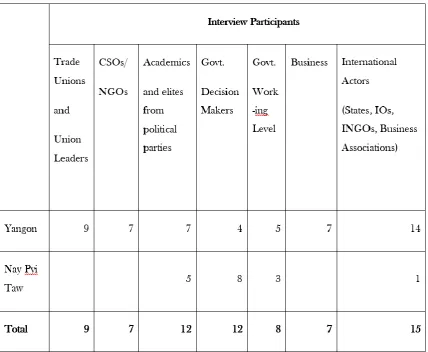
Table 2 Participant Sample Matrix ... 77
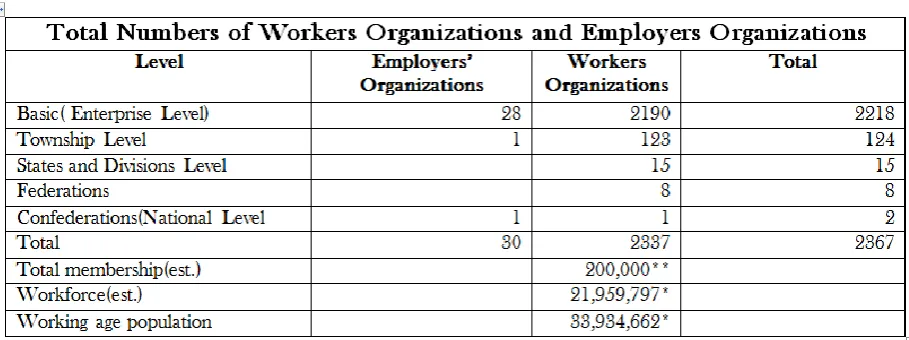
Table 3 Employers and Workers Organizations, Unionized Labour ... 114
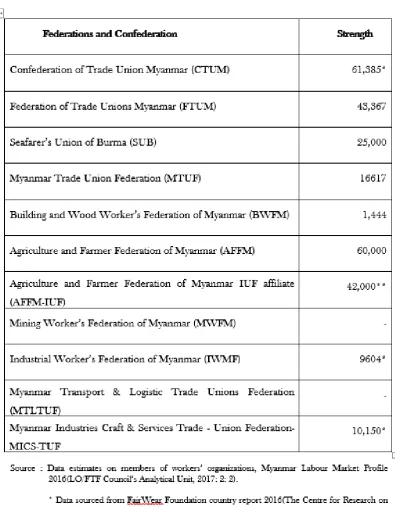
Table 4 Strength of Confederation and Federations ... 116
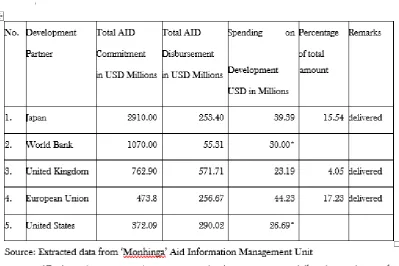
Table 5 Top Development Partners and Spending on CSO (2011–2016) ... 159
List of Figures
Figure 1 Model for norm socialization at domestic sites ... 19
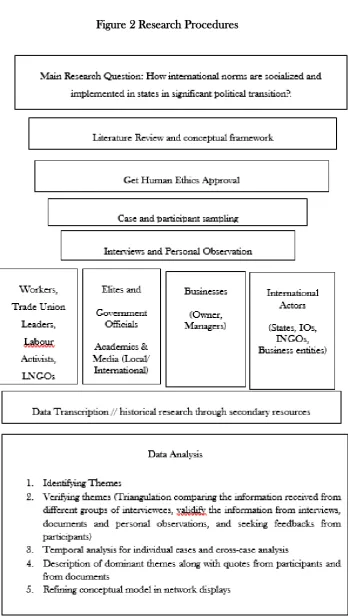
Figure 2 Research Procedures ... 69
Figure 3 Data Sources Triangulation ... 84
Figure 4 Perspectives Triangulation ... 84
Figure 5 Implementation of FOA norm in transitioning democracy ... 221
Chapter One: Introduction
1.1
Introduction
We are aiming for nothing less than a transition from half a century of military rule and authoritarianism to democracy. I believe you understand well that this is no easy thing. We see elsewhere the dangers of any sudden political shift, where institutions are unable to cope, and where the habits of democracy are not yet engrained, the dangers of violence and anarchy. We must manage this transition in a way that moves fast but prudently, grounded in our own realities.
U Thein Sein (Extract from his remarks at Chatham House on 15 July 2013 during his visit to the United Kingdom)
The year 2011 marked an historic moment for Myanmar, a nation in mainland South East Asia with a half century-long history of military domination from 1962 to 2010. The country took a dramatic turn to democracy following the 2010 general elections. The first phase of democratic transition took place during the period 2011–2016 under an elected semi-civilian government led by President U Thein Sein. At that juncture when multiple reforms were gaining momentum, The Economist‘s Richard Cockett commented on Myanmar‘s transition as ‗the most significant event to have taken place in South-East Asia‘ (Cockett, 2013). Democratic transition itself is not so notable as many countries across the globe have been making the transition to democracy over the past 100 years. However, the case of Myanmar‘s transition received widespread attention as the speed and scope of reforms occurred in multiple dimensions: political, socio-economic and governance. Skeptical views on the transition processes were also numerous considering the country‘s authoritarian history,1
and
1
the controversial constitutional framework2
under which transition took place. However, the significance of the transition processes was recognized over time, especially when the country achieved another milestone in 2016 with a smooth transfer of power to the National League for Democracy (NLD)3
-led government.
During the first phase of transition (2011–2016), U Thein Sein‘s government made conscious efforts to embrace international norms while carrying out reforms, specifically in building peace and bridging development and governance gaps. During that period, the country‘s engagement with international norms was reflected in significant policy changes in different issue areas ranging from press freedom, freedom of association to anti-corruption and gender equality. These policy changes required new initiatives and institutional arrangements. However, progress was uneven across different issue areas. Some norm-related policy initiatives made progress in meeting the moral and functional purposes of certain norms while others did not necessarily lead to norm practices in line with the purpose and prescriptions of the norms. This variation sparked my interest to examine the varying practice of two different norms in a state by interrogating how norm socialization animates domestically within a state.
To seek explanation on the cases of interest, this research draws on socialization studies in International Relations (IR). Socialization is an influential concept in norm research which explains the emergence and spread of norms. Norm research identifies the processes and mechanisms through which international norms are acquired by states.4
By taking different vantage points, three strands of socialization studies explain how and under what conditions international norms become state policies. The first strand depicts socialization as an ‗outside-in‘ process, emphasizing the role of ‗Transnational Advocacy networks‘ (TAN) and ‗pressure
2
The 2008 Constitutions includes controversial provisions including Chapter I, Basic Principles of the Union, section 6.(f) that provides one of the consistent objectives of the Union in ‗enabling the Defence Services to be able to participate in the National political leadership role of the State.‘ as section 17.(b) provides ‗In the executive of the Union, Regions, States, Union Territory, Self-Administered Areas and districts, Defence Services personnel, nominated by the Commander-in-Chief of the Defence Services to undertake responsibilities of the defence, security, border administration, so forth, shall be included. And section 109 and section 141 provides inclusion of representatives from the Defence Services in one-fourth of the total seats in the bicameral legislature. 110 out of 440 seats in the Pyithu Hluttaw (People‘s Assembly) and 56 out of 168 seats in the Amyotha Hluttaw (National Assembly).
3
The National League for Democracy (NLD) was founded on 27 September 1988 and it has remained the most influential and active party in the pro-democracy movement in Myanmar. The NLD won the majority in the disputed 1990 general elections, which the military government claimed were held for constitution drafting. Although the NLD refused to participate in the 2010 general elections, it contested and won an overwhelming majority both in the 2012 by-elections and 2015 general elections.
4
from above and below‘ as the main mechanisms of social influence (Finnemore and Sikkink, 1998, Keck and Sikkink, 1998, Risse-Kappen et al., 1999). The second strand explains norm practices mainly as the product of purposive local actors who ‗localize‘ international norms by adapting or building congruence with pre-existing local cultures and norms (Acharya, 2004), translated and reinterpreted in domestic contexts (Levitt and Merry, 2009: 446-447: 446-447). The most recent strand of socialization studies proposes socialization as an interactive processes of external and domestic actors in the joint translation of international norms (Zimmermann, 2017) and in the implementation of norms during the domestic parallel processes to systemic processes of norm development and institutionalization at international level (Orchard and Betts, 2014). Even the norm implementation theory, the most revealing of domestic processes of international norm mobilization, finds itself limited in explaining state policies as it defines norm implementation as ‗the steps necessary to introduce the new international norm‘s precepts into formal legal and policy mechanisms within a state or organization in order to routinize compliance‘ (Orchard and Betts, 2014: 2, 105).
Given these studies‘ overwhelming focus on states as target actors,5
their main concerns are state policy changes as the outcomes of socialization processes. However, they explain less about how socialization is involved in turning norm-favoured state policies into norm practice outcomes in a given domestic context. Thomas Risse states, ‗We still know little about processes of international norm diffusion and their transformation in domestic practices‘ (Risse, 2016: 13: 13). Likewise, Alexander Betts and Phil Orchard recognize that implementation is ‗far from a unitary state‘s action or inaction defining what norms do in practice, a range of non-state actors- whether INGOs, transnational civil society, UN peace keepers, rebel groups or elites within a disaggregated state-matter for the negotiation and (re)contestation of norms at the domestic level‘ (Orchard and Betts, 2014: 279). Despite such recognition of multiple actor roles in norm practices, state norm adoption and reflection in their policies and institutions has been observed as the analytical end points in most socialization studies.
My analytical starting point is therefore where most studies of socialization end their analytical processes. Instead of viewing the state‘s adoption of a policy as the end of the
5
socialization process, I view it as the start. Adopting a policy opens a new realm of potential contestation as norms go from government policy to actual implementation in practice by individuals, civil society and various agencies, both public and private.
Therefore, this thesis examines ‗how does norm socialization animate within states?‘ This question is addressed by focusing on the activities of four groups of actors: states, external socializing agents, businesses and workers in Myanmar, in practicing two norms exhibiting different outcomes. The two cases in points are the Freedom of Association and Protection of the Right to Organize Convention, 1948 (No. 87) (herein after FOA) (Annex I) and Responsible Business Conduct6
governed by United Nations Global Compact (UNGC) (herein referred to as RBC) (Annex II). After the government‘s introduction of the Labour Organization Law in 2011, the practices of the FOA norm deviate from the desired path of the norm, i.e. peaceful industrial relations. However, the practices of the RBC norm show a growing awareness and embrace by businesses since the government‘s introduction of the UNGC in the country in 2012.
This comparative study of FOA and RBC practices helps reveal contributing factors and conditioning factors for the two norms being socialized in Myanmar. In addressing these questions, this research embeds the works of Thomas Risse and colleagues, and draws largely on the works of Alexander Betts and Phil Orchard. In particular, the theory of norm implementation provides a useful lens for examining the agency of norms without losing sight of domestic structures. This study is important for norm research because the literature currently dominated by an emphasis on the international dimensions of socialization requires a coherent conceptualization for the domestic dimensions of international norm socialization. What makes the contribution in this thesis unique is that it examines norm socialization in a state undergoing significant political and economic transition. As such, this study does not assume a stable structure in which socialization is occurring. This is an important departure from most of the literature on socialization.
6
1.2
Turning norm-related policies to practices: practical challenges in a
transitioning democracy
Myanmar had a dire record for violating international human rights and democratic norms throughout the periods of military domination from 1962 to 2010. The country was the target of country-specific resolutions of the United Nations General Assembly and international human rights bodies, and actions of the International Labour Organization on labour rights issues from the early 1990s.7
However, since 2011, democratic transition in Myanmar supported the government‘s rapid liberalization efforts and new policy initiatives to promote peace, progress and good governance. U Thein Sein‘s government paid greater attention to promoting civil liberty, basic rights and freedom in the country. On the country‘s liberalization of press freedom, Robert Taylor assessed that freedom of speech in Myanmar has become acknowledged as ‗a human right in practice and principle‘ (Taylor, 2013: 192). On political, civil and human rights fronts, the government entered ceasefire agreements with fourteen out of sixteen ethnic armed groups. It granted amnesty to 29,820 prisoners including more than 1000 political prisoners (Lwin, 2013). It removed 2000 people, including 350 exiled political activists, from its black list (Lone, 2013). Legislative measures were also taken to ensure greater freedom of expression, freedom of the press, and freedom of association and assembly.8
These reforms prompted recognition from the international community on the transformative potential of elite-driven transition. One scholar concludes, ‗Its [the country‘s] moves to implement forms of more transparent, and potentially democratic, government are also exemplary‘ (Farrelly, 2013: 324). Some anticipated a gradual process of change would result in improved governance in the short term, enhanced civil-military relations and greater confidence in the liberalization process in the medium term, with a longer-term prospects of fuller liberalization and respect for human rights and ethnic rights (Pedersen, 2011: 64-65).
These bold reforms were recognized along with the important role of the leading individual, President U Thein Sein, a former senior military officer. Scholars noted that ‗significant political and civil liberty reforms have been instituted since the start of the new presidency‘ (Jacob, 2014: 396). David Faehnle, Commander, United States Navy, reflected his personal views on Myanmar‘s transition stating:
7
The country has been the target of resolutions by the United Nations General Assembly every year since 1991 and that of the Commission on Human Rights (replaced by Human Rights Council in 2006) every year after 1992.
8
Thein Sein has set an example of open government with like-minded cabinet ministers, creating a reformist environment with dedication to establishing peaceful negotiation of conflict that accepts public opinion. In initiating this process, Sein can be compared to other transformative leaders such as F.W. de Klerk, Mikhail Gorbachev, and B.J. Habibie, providing a historical analogy of the changes taking place now in Burma. While the other leaders were reform-minded, they were not originally committed to full democratic upheaval. In each case, however, the process gained momentum and became unstoppable once those leaders cracked open the door to reform. Thein Sein has nudged that door open, which will lead to a similar unstoppable change in Burma. (Faehnle, 2014)
In this context, Myanmar‘s positive trajectory during the first phase of transition had led to a phenomenal surge of external interest and increased engagement with countries across the world. Jurgen Haacke argued that the pursuit of domestic political reforms since 2011 had proved very successful for Nay Pyi Taw in foreign policy terms (Haacke, 2016: 4-5). Such a reflection was proved to be true as the country saw the tripling of the Official Development Assistance (ODA) flows,9
quadrupling of Foreign Direct Investment (FDI)10
and a huge surge of tourist arrivals11
during the first phase of transition (2011–2016).
The government‘s active turn towards international norms was also notable during the period under consideration (2011–2016). A series of international treaties were ratified during the first phase of democratic transition from 2011. The country signed the additional protocol for the Non-Proliferation Treaty (NPT) in 2013, ratified the Biological Weapons Convention (BWC) in 2014 and the Chemical Weapon Convention (CWC) in 2015, and cooperated with the International Atomic Energy Agency (IAEA) on low-level nuclear non-proliferation programs in 2013. According to recent research, conformity with international arms control
9
ODA increased from 355 million USD in 2010 to 1.16 billion USD in 2015.
https://data.worldbank.org/indicator/DT.ODA.ODAT.CD?end=2015&locations=MM&start=1960&view=chart
10
FDI increased from 900 million USD in 2010 to 4.084 billion USD in 2015.
https://data.worldbank.org/indicator/BX.KLT.DINV.CD.WD?locations=MM&view=chart
11
agreements leaves the international agency with no outstanding requests of Myanmar at this point in time (Wilson, 2016: 68). The government also took action on several human rights treaties.12
Myanmar became a state party to the United Nations Convention Against Corruption (UNCAC) in December 2012. It also entered into the agreement on Partnership Against Transnational crime through Regional Organized Law enforcement (PATROL) in 2013. Despite such a rapid move towards international norms, ensuring successful implementation of these commitments has been a major challenge for the government. Scholars note a mixed record with regard to norm practices in Myanmar, stating that norms against transnational criminal activities such as anti-trafficking of drugs and people and money laundering were reasonably satisfactory as opposed to limited progress in the country‘s cooperation on international humanitarian law, and with the International Committee of the Red Cross and similar bodies (Wilson, 2016: 68-69).
The country‘s moves in embracing international norms reflected its efforts to take on a new democratic identify. To reintegrate with the world‘s democratic society of states, the country‘s interests and the importance it attached to several liberal norms also changed. Different norms had functional utility for the socio-economic development of the country also factored in to the country‘s embrace of more liberal norms. For instance, the hope was that introducing the norm of Freedom of Association for workers and employers (FOA) would help ensure good industrial relations and activating the norm of Responsible Business Conduct (RBC) would improve private sector governance while facilitating the socio-economic wellbeing of the society as a whole. Gary Goertz and Paul F. Diehl have rightly assessed that ‗whereas rationality is about the efficient means of achieving ends, norms are frequently concerned about means‘ (Goertz and Diehl, 1992: 638). In this context, international norms with their moral and functional purposes provided transitioning Myanmar with a means to achieve the socio-economic development of the country, a key area from which domestic legitimacy can be secured.
12
Many studies also emphasized the need to decipher the drivers for democratic transitioning in Myanmar. This research considers the diverse motivations for human action (March and Olsen, 2004: 17)13
and recognized the interrelationship between strategic and normative aspects of state behaviour (Goertz and Diehl, 1992: 661). My study avoids the crowded area of analysis on drivers for transition in Myanmar or elsewhere. Instead, this study is focused on revealing how norm socialization plays out in transitioning state norm practices.
As economic progress has been a major concern in the country‘s turn to democracy, the transitional government attached great importance to ensuring peaceful industrial relations and improving private sector governance. Since the beginning of democratic reforms, U Thein Sein‘s government prioritized peace and socio-economic development (Sein, 2013: 186, Thane, 2018). Several concrete measures taken by the ruling elite reflected their seriousness in delivering social progress and economic opportunity and prosperity more widely.14
Even in the time leading up to the general elections in 2010, the State Peace and Development Council (SPDC) government formed a task force to implement a key goal of the ASEAN Economic Community Blueprint by removing all foreign exchange restrictions on current account transactions by the end of 2011 (Rieffel, 2010: 4). The newly elected government‘s 20 years National Comprehensive Development Plan (NCDP 2011–2031) was explicit about its vision for ‗Myanmar as a prosperous nation, integrated in the global community‘. Political, social and economic reforms placed development-related and private sector-related matters high on the government‘s agenda.
The government‘s policy priority for the improvement of private sector governance were reflected in the government‘s measures to revive a defunct FOA norm by introducing the Labour Organization Law15
in 2011 and to introduce the RBC by launching a Myanmar chapter of the United Nations Global Compact in 2012. Both FOA and RBC received a similar level of
13James G. March and Johan P. Olsen states that there is a great diversity in human motivation and modes of action and they
may be driven by habit, emotion, coercion, and calculated expected utility, as well as by the interpretation of internalized rules and principles.
14
Interview with former President U Thein Sein on 28 February 2017, Interview with former Foreign Ministers, U Wunna Maung Lwin on 3 February 2017, with U Nyan Win on 25 March 2017, with former Deputy Minister for Defence, General Aung Thaw on 7 February 2017, with U Htin Lynn the then Director General of Department of International Organization, Ministry of Foreign Affairs on 8 September 2016.
15
The Labour Organization Law was one of the earliest legislations promulgated by the Union Legislature (Pyidaungsu
Hluttaw) as the Pyidaungsu Hluttaw Law No. 7/2011 on 11th
legal and institutional support from the government.16
And yet, the FOA found the path into the country more difficult as opposed to the relatively smooth entry of the RBC.
Since the introduction of the Labour Organization Law in 2011, the number of workers‘ organizations increased from 18 in 2012 to over 2367 in 2016. However, issues of union busting, inter-union tensions and violent labour strikes also increased and proved a challenge to democratic principles. Side-tracking of FOA practices has been a policy challenge not only for the semi-civilian government during the first phase of transition (2011–2016), but also such challenge continued under the civilian-led government in the second phase of transition after 2016.
The transition period also saw the introduction of the relatively new norm of Responsible Business Conduct through the launching of the United Nations Global Compact (UNGC) in May 2012. The ten guiding principles of UNGC encourage business signatories to incorporate them in their business strategies and operations (please refer to Annex I). These principles encompass four key areas of human rights, labour, environment and anticorruption. Principle 3 requires businesses ‗to uphold the freedom of association and the effective recognition of the right to collective bargaining‘. Since the launch of UNGC in Myanmar in 2012, business signatories have expanded from 15 to 177 as of 2018 and the awareness of enterprises and incorporation of the guiding principles in their business operations are increasing. And therefore, RBC implementation is ‗on track‘ although we cannot claim it is ‗perfect‘ as some businesses struggle with several issues such as FOA, one of the elements of RBC. These practical challenges of a transitioning Myanmar in implementing FOA by itself or as part of RBC warrant the current scholarly examination.
In addition, deviation from the norms‘ moral and functional purposes has broader
implications for the success of transition and consolidation of democracy in a country like Myanmar. Considering the significant number of states in transition in the world,17
and their vulnerability to external shocks and internal challenges, it is important to address the issues
16
Detailed discussion on the legal and institutional measures related to these respective norms can be found in Chapters IV and V of this thesis.
17
facing this particular group of countries. The following section will briefly outline how this work enriches existing norm research. Detailed discussions of the socialization literature, its significance and limitations, will be presented in Chapter Two.
1.3
Conceptual voids in norm research
Constructivists and sociological institutionalist scholars in International Relations attach great importance to the role of norms in states and international politics. They have contributed much to norm research with their knowledge on the emergence, spread, and impacts of international norms. These scholars consider the ways that ideational factors shape interactions among states as their interests and identities are constructed by shared values and norms (Finnemore and Sikkink, 2001: 392-393). Constructivists take the premise that state actions (or those of state agents) result from a collective understanding of appropriate behaviour derived from norm-governed international society. In this interpretation, changes in state identity and interests are endogenous to socialization or social actions. Sociological institutionalists, on the other hand, consider state understanding of appropriateness results from participation in international institutions which create a sense of community and belonging. In the words of Friedrich Kratochwil and John Gerard Ruggie, international regimes create ‗shared understandings of desirable and acceptable forms of social behavior‘ (Kratochwil and Ruggie, 1986: 764). The views of constructivists and sociological institutionalists are distinctive from mainstream International Relations scholars, who consider that social interaction can change state behaviour only through the imposition of exogenous constraints created by interaction rather than believing in independent effects of social interactions and that of institutional participation (Johnston, 2008: 1).
Towards the end of the 20th
The concept of ‗socialization‘ has its foundation in sociology and is applied across the disciplines of sociology, political science and international law.18
Scholars pay great attention to social mechanisms and social actors in explaining states‘ identity formation and role enactment19
(Trondal, 2001: 17-18, Finnemore and Sikkink, 1998, Keck and Sikkink, 1998). Transnational Advocacy Networks or TAN, which are understood to be global-regional-local networks including domestic norm advocates, international non-governmental organizations (INGOs), intergovernmental organizations (IOs) and the epistemic community, play an important role in the construction and spread of international norms among states (Keck and Sikkink, 1998). Sociological institutionalists emphasize international institutions and regional organizations as the sites of socialization.
For the purpose of this study‘s review on socialization literature, socialization studies in International Relations are grouped into three strands. The first strand takes a systemic perspective on socialization. These studies established that ‗norms matter‘ in international politics by signifying transnational forces and mechanisms which influence target actors (usually states or state agents) (Finnemore and Sikkink, 1998, Keck and Sikkink, 1998, Risse-Kappen et al., 1999, Alderson, 2001, Kelley, 2004, Checkel, 2005a, Schimmelfennig et al., 2006). These studies are important to give an understanding of state policy changes favourable to international norms and such changes result from influences of TANs. The presence, strength and sustainability of TANs provide leverage on the international community and domestic pro-norm groups in pressuring for target states‘ policy change. TANs‘ main mechanism of influence are usually described as ‗pressure from above and from below‘ (Risse-Kappen et al., 1999: 24). Variation in their effectiveness and outcomes are explained by domestic factors, mainly political structures, state-society relations (Checkel, 1999a: 83,88) or ‗willingness and capacity of target actors‘ (Risse et al., 2013: 292-293).
These studies, with an exclusive empirical focus on states (decision makers and political elites) only explain the changes in state policies and their insights are inadequate to explain changes in practices at societal level. Although scholars noted that ‗international norms matter only when they are used domestically‘ (Gurowitz, 1999: 416), exclusive empirical accounts on
18
Alastair Iain Johnston provides a synthesis of how scholars, from different discipline with different paradigmatic backgrounds,
use the concept of socialization in their theories in ‗ Social states. China in International Institutions, 1980-2000'.
19
TAN versus states and broad depiction of socialization as ‗outside-in‘ perspective limit norm studies‘ explanatory power on domestic norm practices.
Studies in the first strand recognize that the move from norm commitments to compliance is a ‗multifactor interactive process‘ where multiple actors are involved with different motivations (Risse et al., 2013: 276, 294). Despite such recognition, studies do not go any further to examine how such processes take place and how they can be conceptually understood. From my perspective it would be more useful to theorize the multiple actor dynamics and their influence on outcomes, capturing the interactive dynamic of global (transnational) and local actors (domestic actors in recipient states) involved in norm processes. Ciaran O‘Faircheallaigh made similar points by arguing for ‗the need to achieve an explicit and systematic focus on domestic political actors as well as on the structures within which they operate‘ (O'Faircheallaigh, 2014: 161). However, this line of research remains underdeveloped. The second strand of studies scrutinizes socialization from domestic perspectives (Acharya, 2004: 188, Checkel, 1999b: 97, Cortell and Davis Jr, 1996, Risse-Kappen, 1994). Localization studies ‗privilege domestic over the international‘ (Risse, 2016: 14) while missing the global-local dynamics as they focus on the agency of local actors and domestic culture and norms. These studies consider domestic structural factors as filters conditioning the access of transnational actors, their ability to build winning coalitions in target states and influence target states‘ policy (Risse-Kappen, 1995). They take static views on domestic structures which are usually considered as scoping conditions. In fact, domestic structures are versatile in many instances, such as those in transitioning states where political, legal and /institutional changes are common. Therefore, to be able to understand the path from norm-focussed policies to practices in states, it is important to examine how socialization takes place in the contexts of dynamic structures and actors.
Among these studies, Alexander Betts and Phil Orchard‘s theory of ‗norm implementation‘ provides insight about domestic practices of norms, as they conceptualize norm implementation within states or organizations as parallel processes to the systemic processes of institutionalization of norms being negotiated and adopted at the international level. Such a norm implementation theory is a starting point for this research as it provides a useful lens for identifying factors and actors that influence norm practices within states.
However, in their efforts to explain domestic norm practices, three aspects need greater clarity. First, the role of external actors in implementation processes. Although Alexander Betts and Phil Orchard recognize external actors‘ roles in the domestic sphere as ‗transnational in domestic‘, their roles and their interactions with domestic actors are less conclusive in their empirical findings. Second, their attempts to examine the nexus of norm types (treaty, principles, and policy norms) and practice outcomes do not produce clear insights. Although Alexander Betts and Phil Orchard indicate that norm contents might have impact on practice outcomes, they left this aspect unexamined. Third, although Alexander Betts and Phil Orchard emphasize the influences of structures and agency, they did not offer specific guidance in how the relations between structural influences and agency can be conceptually understood. Given these three limitations in what is a significant advance in our theorization, implementation theory left some gaps in fully explaining the role of domestic practices in the socialization of international norms, particularly not fully explaining the process involved in turning state policies into practices.
1.4
Research questions, findings and contributions to norm research
1.4.1 Questions
To address the above-stated conceptual limits of socialization studies to explain variegated norm practices in a recipient state, this research poses the following questions:
Question How does international norm socialization animate within norm recipient sites?
Sub-questions What makes domestic sites of socialization distinctive from regional and international sites of norm socialization?
How do norm contents shape the interactions among global and domestic actors within domestic social sites?
How do domestic structures influence the dynamic of multiple actors in states?
These questions are addressed by examining two cases of norms: FOA and RBC norms and their practices in Myanmar. The cases are analyzed individually over time and comparatively. Empirical studies, analysis and theoretical proposals are embedded in ‗socialization‘ literature in International Relations and they also are informed by the insights and experiences of research participants. The country case Myanmar, with its transition context, allows this research to better comprehend existing and emerging key actors and their interplay with evolving legal and institutional structures. It also allows temporal comparison by contrasting norm practices under successive periods of authoritarianism with those that emerged during the first phase of transition (2011–2016).
1.4.2 Objective, key terms and assumptions
This research aims to contribute to norm research by taking better account of socialization within domestic sites of norm recipient states, as this particular aspect is under-studied and under-theorized for socialization studies.
set of intersubjective understandings readily apparent to actors that makes behavioral claims on those actors‘ (Finnemore, 1994: 2). Socialization is the process by which international norms reach to states and influence their policies, institutions and practices in new contexts. Different scholars‘ definitions on socialization are presented in literature discussions under Chapter Two on pages 43–44.
In this respect, the present study embeds itself in Thomas Risse and his colleagues‘ works on the ‗Persistent Power of Human Rights‘, and Alexander Betts and Phil Orchard‘s norm implementation theory which considers the significance of domestic structures and actors (Orchard and Betts, 2014: 271-272). Building on their explanatory work and those of other scholars, this study takes the premises that 1) multiple actors act on given norms in multiple ways within the confines of ideational, legal, institutional and political structures, 2) international norms possess both moral and functional attributes at their core, and 3) norm socialization in recipient states is a dynamic process which involves multiple actors and entails practices in line with or deviating from norms‘ moral and functional purposes. When considering a norm, its creators and subscribers have in mind that such a norm and its practices
are to serve not only to the end of producing appropriate outcomes( the so-called moral
component). That moral component is perceived, at least by the society of the time, as morally
and ethically correct in fulfilling a particular need or in solving a particular problem (which is
the functional component).
To observe such a variety of norm practices, this study pays attention to domestic sites of the norm recipient state as important sites of socialization, extending from a research focus on international, regional and transnational organizations as major sites of socialization. In fact, socialization in domestic sites provides a better vantage point from which we can discern the interactive dynamic of actors, both international and domestic, and domestic structures and global–local agents with greater clarity and thus socialization outcomes can be better appreciated.
environmental matters. For the implementation of each set of complex norms, diverse stakeholders play differing roles. Identification of diverse actors for FOA and RBC and their roles assigned for each actor are discussed in detailed in Chapter 3, section 3.2 in page 57. By considering the complexity of Myanmar‘s and the world‘s interlocking normative terrains, this study offers a considered explanation of the multifaceted character of norms in domestic and foreign affairs.
1.4.3 Findings and arguments
Based on the premise that norm practices and socialization can be understood better in domestic sites by examining the interactions of multiple actors and domestic structures, two norm cases—FOA and RBC norm practices in Myanmar—are examined from historical perspectives and from the perspective of practices observed during the first phase of democratic transition from 2011–2016.
The two cases demonstrate that study of socialization at domestic sites reveals important insights distinctive from existing knowledge derived from the studies at familiar sites of socialization; international institutions, regional organization and transnational sites. There are specific insights drawn solely from domestic site of socialization. First, ‗socializing actors‘ face greater challenges as they have to interact with more diverse counterparts and operate within the confines of domestic structures. At the same time, they also have an advantage at domestic sites in developing more effective policy advocacy and in showcasing and demonstrating new practices. It is found that global–local interaction at the domestic sites is a two-way track phenomenon. Learning how to pass the message across to their counterparts is found to play an important part in the work of socializing actors. That is the reason, fundamentally, that most of the external players invest a great deal in research and assessment of domestic situations.
merely conventional strategies such as the empowerment of rights holders and the building of enforcement capacity for governments.
Third, leading players‘ roles and strategies are also found to be a significant factor for practice outcomes. It is not a new insight that the attributes of socializing actors matter for norm impact. Attributes such as authority, legitimacy, financial resources, academic esteem, and professional connections are important (Hafner-Burton, 2013, Herro, 2015). What is new about the current study‘s finding is the fact that socializing agents derive trust not solely from local knowledge but from their dedication and sincerity to the values they promote and their ability to deliver what they promise by allowing stakeholders to participate in activities and experience the benefits of practicing the relevant norms.
Fourth, this study found that the content of norms, rather than the type of norm, matters in generating the interest of external actors and their investment which, in turn, affects the multi-actor dynamic in norm practices. Such multi-actor dynamics can be enhanced or eased by the attributes and strategies of socializing lead actors. Finally, it is found that domestic political, legal and institutional structures need to provide a permissive environment for norms to be able to take root. However, the actual practices associated with these norms can only be explained by the dynamic of norm agents operating in domestic sites.
Guided by these findings, this research argues that socialization at the domestic sites of states can be conceptualized as multi-actor, global–local dynamics taking place within the confines of domestic structures. Norm practices can be appreciated from the vantage point of such agential dynamics rather than seeing norm practices as the product of domestic actors alone or external–internal socialization, as depicted by the first and second strands of socialization studies. This focus on agential dynamics better explains domestic norm practices, taking into consideration the influences from domestic structures, norm content, and external actors‘ interest and investment—the key aspects which existing strands of socialization studies have yet to capture in an integrated model.
1.4.4 Conceptual contribution
structures and agency (Whittington, 2010), and dualist social ontology as discussed by O'Neill et al. (2004: 152-159), whose review of international cooperation theories assumes a mutually constitutive relationship between ‗agents‘ and ‗structures‘ which are analytically autonomous.
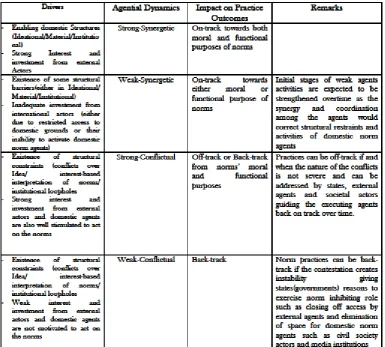
This study proposes the concept of ‗agential dynamic‘ as a new conceptual lens for understanding the variety of norm practices after a state‘s adoption, legalization and domestic institutionalization of the two norms. The agential dynamic is a variable reflected by the density of norm agents, the intensity of their interactions, and the visibility of their activities and the effectiveness of agent strategies relating to norm implementation. This concept is important addition to socialization literature, which lacks an applicable model to explain the domestic dimensions of socialization despite it being rich in hosting influential models to explain the systemic dimensions of norm socialization.
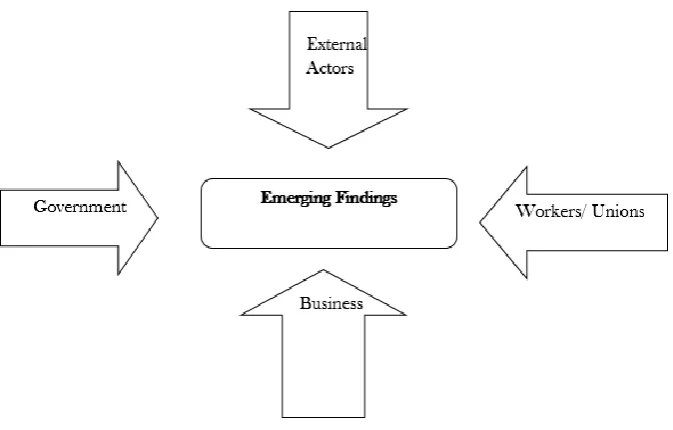
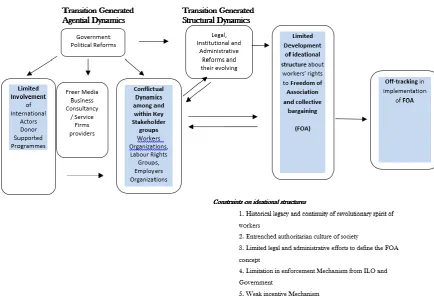
Along with the concept of ‗agential dynamic‘, this research proposes a conceptual map linking actors, structures and norm processes. A simplified version of this research‘s proposed theoretical model is presented in Figure 1. The model provides conceptual linkage of ‗agential dynamics‘ with varying track records of norm implementation. Norm contents, external actor interests and investments, and the domestic context of democratic transition influence norm implementation processes through their mediation of this ‗agential dynamic‘. The current study‘s theoretical model benefits greatly from existing norm socialization and implementation theories of International Relations. Detailed discussion of a more finely elaborated model will be discussed in Chapter Three.
Figure 1 Model for norm socialization at domestic sites
1.4.5 Methodological contribution
political context. Historical data, discussed detailed in Chapter Five, indicates that FOA did not get a chance to be a practice under successive governments in Myanmar until 2012 mainly due to the state‘s inhibiting agency role.20
However, the state‘s role then shifted to become enabling since the country embraced a limited democratic identity from 2011 onwards. Identifying states as either enabling or inhibiting agents of norms helps the study‘s analytical processes.
In addition to identifying states as ‗Enabling/Inhibiting Agents of norms‘, this study has to devise categories of actors based on the observed functions of different groups in norm practices. International and transnational actors are identified as ‗Facilitating/Impeding Agents of norms‘. The group of domestic right holders and stakeholders is identified as ‗Monitoring Agents of Norms‘. Business enterprises and workers are identified as ‗Executing Agents of the FOA norm‘ because their actions or inactions determine whether and how the norms in question are put into practices. For RBC norms, business enterprises are identified as ‗Executing Agents of Norms‘. However, businesses might not play this agency role by absolutely neglecting such roles or they may execute norms in other ways. Such distinctions help the study to analyze the limits and contributions of each group or actors to norm practices.
In estimating the norm processes of FOA and RBC, this study employs the indicators of on-track, off-track and back-track towards the moral and functional purposes of each norm. (defining and clarification of what is moral and functional purposes)The research would consider the norm on-track if and when observed activities and practices contribute in fulfilling the purposes of norms even though the scale and extent of those activities and practices are yet to be overwhelming. The research considers the norm off-track if observed activities and practices deviate either from the functional or moral purposes of the respective norms. The
20
Under the administration of the Burma Socialist Programme Party (BSPP) government, workers organizations (Workers
Asee Ayone) were organized under single union system. Although such organizations served a functional purpose of norms
for peaceful industrial relations, they also effectively deviated from the moral purpose of the norms which aimed to allow
workers to join the organization of their choice with their own free will. Under the rule of the State Law and Order
Restoration Council (SLORC) and State Peace and Development Council (SPDC) governments, FOA was totally inhibited
and the presence of employees‘ welfare associations in public enterprises were also not to the standard of labour
organizations which allows workers to communicate with employers, express grievances and negotiate for their own
betterment. Since the political transition in 2011, the government‘s role shifted from a norm inhibiting agent to norm
enabling agent along with its changing identity and interests. Its policy on FOA changed to reflect the legalization of workers
norm would be considered back-tracked if observed activities and practices negate or deny the purposes of the norm. Employing such indicators allows this research to overcome norm research‘s struggle in measuring outcome in terms of the norm compliance: the norm violation dichotomy. It also overcome the vagueness of ‗incomplete internalization‘, ‗decoupling‘ (or compliance decoupled from commitment) and ‗adaptation‘ (Zimmermann, 2017: 4). Taking these benchmarks of the moral and functional purposes of norms provides greater conceptual clarity. These indicators also serve as the most relevant measures to capture an emerging consensus in norm studies on domestic norm practices as ongoing processes rather than as a fixed end stage or outcome.
There are three specific measures taken by this research, that is, 1) distinguishing agents of norms for analytical purpose based on their observed function, 2) measuring norm processes with new indicators ‗on-track‘ and ‗off-track‘ towards the benchmarks of moral and functional purposes of norms, and 3) temporal and cross-case analyses employed in empirical case studies are the modest methodological contribution of this study to norm research.
1.4.6 Empirical contributions
Existing norm socialization research studies have offered rich empirical accounts on the socialization of countries in Eastern Europe, Latin America and Africa. The country case of Myanmar hardly appears in existing analyses. Indeed, this country case was previously seen as an outlier in socialization models given its historical record. The current study describes how domestic structures constrained the two norms in the past and how such constraints were eased during the transition to democracy, and how socializing agents factored in such an environment and make impact on norm practices. These descriptions are new empirical ballast for future contributions to the socialization literature. This study is also the first detailed analyses of FOA and RBC practices from the perspective of the socialization lens. Rich historical data dating back to the immediate post-colonial period and a significant amount of primary data from extensive contemporary field research are also important contributions in empirical terms.
how its responses can be better understood by focusing on the disaggregated functions of multiple actors within the state.
1.4.7 Practical contributions to better governance
The main concern of this research is to understand the process of norms from policies to practices; this study pays great attention to being practically relevant to get insights on chokepoints and facilitative factors for better governance. The cases illuminate the enabling and limiting aspects of political transition on different actors within states and identify the channels through which norms make impact. Such information would be helpful for policy diagnostics, planning, prioritizing and adjusting to make greater norm impact within transitioning states. At a time when democracy is in crisis and liberal norms are challenged by populist and nationalist elements even in mature democracies,21
the challenges for fragile democracies in practicing international norms are extensive. This research demonstrates that an innovative approach to shape the ideational structure is required to achieve desired norm impacts by fostering awareness and appreciation of new norms. Application of the norm will follow societal awareness and appreciation of the norm‘s moral and functional purposes. Socializing actors‘ innovative programmes and activities allow the participation of executing agents (businesses in the case of the RBC norm), enabling them to experience new ways of behaving in line with norms, are found to be a more effective tool in shaping ideas. In contrast, socializing agents of FOA merely focus on empowering workers (executing agents) with organizing and bargaining skills and on strengthening the enforcement capacity of relevant laws and institutions, and overlook the aspect on ideational development of FOA among executing agents—both businesses and workers.
1.5
Principles, process and parameters of the research
This research takes a relativist ontological stand, considering that knowledge about the social world is gathered by the researcher through examining and relating the experiences, perceptions and actions of the objects of the study (in this case, the research participants). In my study, state, businesses, society and international actors and their perceptions and actions are examined in order to understand the way international norms were implemented before
and during Myanmar‘s transition. The possibility of multiple truths and alternatives to the current study‘s findings is recognized and expected. Such ontological underpinning leads the research to take a constructivist epistemological position by reasoning the knowledge this research generates is constructed by the observed experiences, perceptions and actions of the objects of the study, the researcher‘s observations and analysis on the historical and evolving ideational and legal/institutional structures of the country case and norm cases.
Andrew P. Cortell and James W. Davis Jr. have rightly mentioned that ‗the routes to domestic salience (of international norms) may be many and because knowledge of the mechanisms is limited, initial analysis should be flexible and process oriented‘ (Cortell and Davis Jr, 2000: 84-85). Therefore, this study takes a case study method considering historical perspectives as well as scrutinizing their contemporary practices during the first phase of democratic transition (2011–2016). Analyses of the two cases focus on structural factors, i.e. ideational, legal/institutional and political structures while paying attention to the multiple stakeholders involved in the practices of respective norms.
Guided by these ontological and epistemological stands as basic principles in generating knowledge, this research offers a case study research method. The processes of data collection and analysis is elaborated in the following section and detailed further in Chapter Four.
1.5.1 Sampling
The study works on the definition of case study as proposed by John Gerring, ‗an intensive study of single unit for the purpose of understanding a larger of (similar) units‘ (Gerring, 2004: 342). Three levels of sampling is undertaken: one country sample (context sampling), two norm samples (case samples) and participant samples. The country case of Myanmar is selected as it provides varying political contexts under different administrations. Such a country case is helpful for this study in estimating the influence of structures and actors in explaining variegated practices of the norms. The Myanmar case also allows temporal analysis, using historical records of norm-resistance against varying degrees of norm implementation in the democratic transition phase.